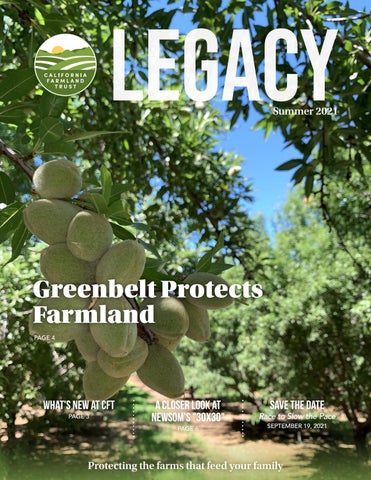
Summer 2021
Greenbelt Protects Farmland PAGE 4
What's New at CFT PAGE 3
A closer look at Newsom's "30x30" PAGE 6
save the date
Race to Slow the Pace SEPTEMBER 19, 2021
Protecting the farms that feed your family
Climate-Resilience Starts With Farmland Protection OUR MISSION Help Farmers Protect the Best Farmland in the World CURRENTLY SERVING Sacramento, San Joaquin, Contra Costa, Stanislaus, Merced, Madera, and Fresno counties Directors: Clay Daulton, Madera Ron Dolinsek, Rocklin Denny Jackman, Modesto Ryan Jacobsen, Fresno Jim Jorgensen, Rocklin Theresa Kiehn, Modesto Larry Ruhstaller, Stockton Barbara Smith, Courtland Sam Zanutto, Sebastopol Board Officers: Jon Harvey, Pleasanton | President Patrick Johnston, Brentwood | Vice President Maxwell Norton, Merced | Secretary Ken Oneto, Elk Grove | Treasurer Ron Freitas, Modesto | Immediate Past President Trustee Council: Jennifer Beretta Reagan Denny Ed Nishio Emily Rooney Ann Veneman Paul Wenger Becca Whitman Staff: Charlotte Mitchell | Executive Director Aundriea Montzingo | Program Associate Katie Otto | Development & Operations Director Chelsea Slaton | Conservation Director Adriana Toste | Communications Associate Contributors: Vicky Boyd Charlotte Mitchell Aundriea Montzingo Katie Otto Chelsea Slaton Adriana Toste Editor/Design: Jennifer Luiz Patton, Twisted Twig Design and Print
2 |
Legacy
By Charlotte Mitchell, CFT Executive Director Recently, there has been considerable momentum from California, the United States, and even global leaders, to react to climate change. The focus is to coordinate all natural and working land programs to move toward the combined goal of maintaining a resilient carbon sink and improve air and water quality, wildlife habitat, and recreation, along with other benefits. In 2020, Governor Newsom announced his "30x30" plan and shortly after that, President Biden issued his order to address the climate crisis by conserving an additional area twice the size of Texas - more than 440 million acres, within the next 10 years. Trustee Council member and Ag Council president, Emily Rooney discusses the topic in detail on page 6.
L i k e w i s e , a s f a r m e r s b e c o m e m o re innovative, California Farmland Trust Working lands, specifically farmland, have is doing the same. Earlier this year, we always been seen as a critical strategy to revealed a newly updated logo that the broader climate change portfolio of blends together the elements of who we activities. Not surprising, are and what we do. You the work of California may have noticed our F a r m l a n d Tr u s t a n d refreshed Legacy design "Working lands, our landowners, such a l s o f o l l o w s s u i t . We specifically farmland, as the Murphy family, aim to entice a larger have always been complement these focus a udience s o that our seen as a critical areas, while pursuing m i s s i o n c a n b e m o re our primary goal of strategy to the broader w i d e l y s h a re d , w h i l e protecting farmland. s t i c k i n g t o o u r ro o t s climate change and traditions to better portfolio of activities. Farmers continue to find serve our community of Not surprising, the innovative approaches to farmers. manage land to achieve work of California multiple objectives, While the "30x30" efforts Farmland Trust and including practices that a re s t i l l d e v e l o p i n g , our landowners, such reduce greenhouse gas we know the first and as the Murphy family, emissions through low most important step or no-till practices and to achieving a climatecompliment these utilize newer technology re s i l e n t e n v i ro n m e n t focus areas, while by converting old starts with conserving our pursuing our primary irrigation pumps and farmland from conversion goal of protecting systems to increase to non-agricultural uses. e f f i c i e n c y. T h o s e i n CFT will continue to be farmland.” production agriculture proactive in stakeholder have worked to improve and public outreach s o i l h e a l t h t h ro u g h c o m p o s t , c ro p opportunities to express the importance rotation, and cover crops among other of increasing funding for conservation management practices, all while balancing easement programs. economic sustainability and production results.
What's New at CFT... WELCOME CLAY DAULTON
We are proud to welcome wellrespected Madera County rancher and community member, Clay Daulton as a newly appointed California Farmland Trust board member. In addition to being a current owner of Daulton Ranch, Clay has served on numerous boards and committees including the Madera County Farm Bureau, M a d e r a C o u n t y C a t t l e m a n ’s Association, the Foreign Trade Committee at the National Cattleman’s Beef Association, and The Agricultural Foundation of California State University, Fresno. “Given Clay’s extensive experience and professional involvement in the agriculture industry, we are excited to collaborate with him to further the mission of protecting farmland,” said Charlotte Mitchell, executive director at California Farmland Trust. Daulton joins the existing 13 members of California Farmland Trust’s board of directors and will serve on the farmland conservation committee.
WELCOME ADRIANA TOSTE
We are excited to introduce our new communications associate, A d r i a n a To s t e t o C a l i f o r n i a Farmland Trust! Adriana is a recent agricultural communications graduate of Oklahoma State University. A native of Gustine, Adriana was bor n and raised on her family's dairy farm and brings a wealth of knowledge and passion for the agriculture and communications industries. We are looking forward to working with Adriana to capitalize on our communications, outreach, and education efforts to help protect California's farmland. Welcome aboard, Adriana!
CONGRATS CHELSEA
Congratulations to our Conservation Director, Chelsea Slaton (Molina) on her recent marriage to Beau Slaton! All of us at CFT send you our best wishes as you two start your lives together!
CFT 2020 ANNUAL REPORT
California Farmland Trust is proud to present our 2020 Annual Report. 2020 was a year of unchartered territory and there is no doubt it has left a mark on all of us. While all things normal seemed to be cancelled, we cautiously charged ahead, while utilizing our “shelter in place” time to "Despite the dig into our internal uncertainty operations and our own of 2020, we sustainability. 2020 also reiterated the steadfast collectively s u p p o r t o f o u r s t a ff , made the leadership, volunteers, most of it and landowners, sponsors, appreciate donors, and friends who understand agriculture is your efforts essential and a resilient to sustain food system is critical. the future of Despite the uncertainty agriculture of 2020, we collectively made the most of it and and California appreciate your efforts Farmland to sustain the future of Trust." agriculture and California F a r m l a n d Tr u s t . W e encourage you to visit the website to read our Annual Report (www. cafarmtrust.org/annual-reports) or call the office if you would like to receive a hard copy.
Protecting the farms that feed your family
| 3
Greenbelt ensures scenic views and productive, protected farmland
BY VICKY BOYD
TOM AND CHESTER Murphy grew up in a red brick house
along Highway 4, which today is a paved gateway to the Sierra Nevadas with a steady stream of traffic, particularly on summer weekends. As kids, the two brothers remember their father describing the slower pace of life on the ranch east of Farmington in the late 1930s.
the time, electricity was not available in Telegraph City, but it was in Farmington, so their grandfather built the brick house. Following their move to Farmington, Tom and Chester’s grandparents slowly expanded their business and began a path of diversification, adding various grain and row crops.
AN EASEMENT “MADE A LOT OF SENSE” Watching their brother, Bill, put an adjacent 125-acre walnut orchard into the California Farmland Trust in 2019 got Tom and Chester thinking about protecting the ground abutting their childhood home. “We started talking about it, and it made a lot of sense,” Tom said. They followed suit and placed the 72-acre ranch, which is planted to almonds, in an easement with California Farmland Trust. The property is within 1 mile of land zoned residential in Farmington, which they expect to expand. “This is up against Farmington and is on a major highway,” Chester said. “Twenty-five years from now, it’s likely to be on the outskirts.”
“My grandfather built this house, and we have pictures of Model T’s out here,” said Chester, the older of the two brothers.
Charlotte Mitchell, CFT executive director, agreed and said being along a major thoroughfare puts more development pressure on adjacent farmland.
“I’m thinking it was 1938 that the house was built,” Tom said. “The old wooden-spoked wheels on the cars. There was a picture we had when the roof wasn’t on the house. My dad used to talk about when Highway 4 was just a dirt road. When you saw somebody once or twice in a day, that was high traffic.”
“Highway 4 is a major east-west artery connecting the Bay Area to the Sierra Nevada,” she said. “Protecting the important farmland along this artery sends a clear signal to local planners that urbanization along this corridor needs to be thoughtfully planned.”
The Murphys’ grandparents were cattle ranchers near Telegraph City in Calaveras County. In the 1930s, their grandmother wanted a home with the modern conveniences provided by electricity. At
In its “2016 Traffic Volumes on the California State Highway System,” CalTrans cited average daily traffic on Highway 4 of between 87,000 and 94,000 vehicles, with peaks of up to 100,000 vehicles.
4 |
Legacy
“Permanently protecting the Murphys’ farm will not only ensure scenic views along Highway 4 but will encourage ongoing production of a permanent orchard crop that employs low-carbon best management practices,” said Chelsea Slaton, CFT conservation director. “In addition, Duck Creek, which flows along the farm’s northern boundary, provides both riparian habitat and a corridor for wildlife.” Funds for the C&T Murphy Farm agricultural conservation easement were made available through the Califor nia Strategic Growth Council’s (SGC) Sustainable Agricultural Lands Conservation Program (SALC) in collaboration with the Department of Conservation. SALC is part of California Climate Investments, a statewide initiative that puts billions of cap-andtrade dollars to work reducing greenhouse gas emissions, strengthening the economy, and improving public health and the environment, particularly in disadvantaged communities. Slaton said Tom, Chester and Bill’s easements will create a 200-acre greenbelt less than 1 mile east of Farmington to help ensure prime farmland remains available for agriculture and is not subdivided for residential uses. "CFT has several priority areas to continue its work to build meaningful protected farmland areas, and the area in San Joaquin County where the Murphys’ easements are located is just one", Mitchell said.
FARMING FLEXIBILITY
installed, the 100% prime soil was planted to irrigated row crops and more recently, a winegrape vineyard. Seeing opportunities in almonds, the two brothers pulled out the vineyard and planted the orchard about six years ago. Without knowing what agricultural markets hold in the future, the Murphys’ like that the easement provides for the flexibility in crop choices and farm management practices that will ensure the land will be sustainable for agriculture and for the environment. They also like knowing the ground will remain in agriculture, even if a family member isn’t tilling it. Two of their children have shown interest in possibly farming. Tom’s oldest daughter is pursuing an agriculture degree at Cal Poly San Luis Obispo, and his eighthgrade son is excited about shop class and welding. Tom and Chester faced similar choices in 1991, when their father passed away unexpectedly, and they had to decide whether they wanted to come back to farming. At the time, both were involved in non-agricultural jobs off the farm. “After he passed away, we all sat down to decide whether we were going to be the generation who sold it or be more proactive and actively farming it, so it led to us starting a vineyard business,” Tom said. He and Chester also remain involved in the family’s cattle operation in Calaveras County as well as venturing more into almond, walnuts and winegrapes in San Joaquin County.
The Home Ranch is currently home to a 6-year-old almond orchard comprising 50% Nonpareil, 25% Wood Colony and 25% Supareil varieties. It is irrigated with a micro-sprinkler system, which conserves water and provides a bit of frost protection. But that hasn’t always been the case. “The industry has cycled over the decades, and it’s given us the ability to change with the times,” Tom said. The ranch started as dryland cattle grazing and evolved into dryland grains. Once the ground was leveled and pumps were
Brothers Chester (left) and Tom (right) Murphy.
Protecting the farms that feed your family
| 5
Land Management Proposals Create Opportunities & Challenges for Working Lands Conservation Efforts By Emily Rooney, President, Agricultural Council of California, emily@agcouncil.org Last fall, Governor Gavin Newsom signed Executive Order N-82-80, commonly known as “30x30,” which is an effort to conserve 30 percent of California’s land and coastal waters by 2030.
conversations continue about the prospects heading into 2022. The concept behind a climate bond is to fund activities that reduce greenhouse gas emissions and sequester carbon. Many of the programs within the proposals are focused on the farm-level.
In this effort, the governor plans to protect the biodiversity in plants and animals prevalent in our state, the 2,500 soil types and other environmental benefits California has to offer. Governor Newsom also plans to protect natural and working lands and, in fact, part of his Executive Order requires the newly created California Biodiversity Collaborative to: “Advance multi-benefit, voluntary and cooperative approaches that protect and restore biodiversity w h i l e s t e w a rd i n g n a t u r a l a n d working lands, building climate resilience and supporting economic sustainability.” Under this Executive Order, a diverse community of stakeholders will be engaged, including a farmer and rancherled effort, managed by the California Department of Food and Agriculture (CDFA). CDFA held workshops and is in the process of synthesizing comments at this time. We are hopeful the comments will provide foresight in the coming weeks and that funding for conservation easements will be a priority as ideas from the process at both CDFA and the California Natural Resources Agency start to filter to the top.
"Amid the efforts, conservation easements are usually part of the conversation. Elected and appointed officials understand the pressure of increasing urbanization and the impact it has on our natural resources, including agriculture."
At the same time, three climate bonds have been under consideration in the State Legislature. The proposals are not moving forward in 2021 given the unexpected state budget surplus. However,
On the regulatory side, the California Air Resources Board (CARB) is focusing on its Natural and Working Lands regulation in the second half of 2021. This regulation will become part of the next “Scoping Plan” within the statewide climate change regulation. CARB may look to this regulation to find and create incentives for farmers to sequester carbon and decrease their environmental footprint from a greenhouse gas perspective, and Ag Council is participating in this process. Amid the efforts, conservation easements are usually part of the conversation. Elected and appointed officials understand the pressure of increasing urbanization and the impact it has on our natural resources, including agriculture. The key to ensuring success in funding conservation easements is flexibility in the execution of these programs. Some groups attempt to restrict the types of activities performed on easements. We believe the lands must be working lands – in every sense of the word – to best secure the future of California agriculture.
The ability to farm on these lands and produce our incredible California food and fiber will be key in our dialogue and in the pursuit of final outcomes, and we look forward to working with like-minded entities to achieve these objectives in the months and years to come.
Tackling the Issues: A Conversation wth Secretary Crawfoot
Find the podcast by searching Capitol Farm Connection on your favorite podcast platform.
6 |
Protecting the farms that feed your family
In a conversation not to be missed, Secretary Wade Crowfoot of the California Natural Resources Agency discusses critical water and environmental issues with Ag Council President Emily Rooney in the newest Capitol Farm Connection podcast.
Save the Date for CFT’s Inagural Race to Slow the Pace CFT will be hosting the inaugural Race to Slow the Pace run at Bokisch Vineyards on Sunday, September 19, 2021. This live (virtual optional) 5K fundraiser aims to connect people with nature, the environment and the family farms that feed them. The run will foster a connection to the land and the importance of slowing the pace of development to protect valuable farmland. Race to Slow the Pace runners will weave through the scenic Bokisch Vineyards, kicking-off where the winery meets the vineyard, continuing through the property on a maintained terrain, taking in the vines and the habitat, and eventually crossing the finish line at Bokisch’s infamous oak tree picnic area. Runners and registered guests will be served a paella lunch and celebrate with awards and Bokisch wine. To make this event successful, we are looking for sponsors and event volunteers. To learn more or register visit www.cafarmtrust.org/ racetoslowthepace.
Sponsor Spotlight: Raley’s
Monthly Donors You can make a difference and impact the future of farmland protection in California. Every year we work with farmers to steward nearly 17,000 acres of farmland and ensure it remains farmland – that’s enough farmland to feed 72,000 familes. Your monthly donation can help protect farmland and feed more families. Your support is put right to work, protecting more farmland and ensuring more families have a safe and abundant food supply. You’ll have the satisfaction knowing you’ve helped protect family farms, promote agriculture education and support farmers who steward our natural resources day in and day out. Your consistent support helps us confidently continue to ensure more farmland is protected and not paved over or developed. “I'm moved by Kimball Musk’s quote 'Strong communities are built around local, real food. Food we trust to nourish our bodies, the farmer and planet.' Everything needs to eat, so it’s important to me to support CFT as they work towards building resilient communities.” - Florin Barnhart, Monthly Donor “It’s important agriculture and family farms stay viable – more farmland needs to be protected. We used to give annually, but we can help CFT do more collectively by giving monthly.” - Pam Magneson, Magneson Dairy, Easement Holders in Merced County. PIctured below, back row left to right; Sally Magneson, Jake Magneson, Pam Magneson, Scott Magneson, Bryce Magneson, Front row; Justus Magneson.
Raley’s is a privately-owned and family-operated customer experience grocery company headquartered in West Sacramento, CA. Raley’s stores are the destination for the best fresh products, affordable offerings, and personalized service. The company’s commitment is to infuse life with health and happiness by changing the way the world eats, one plate at a time, while positively impacting the communities they serve. Raley’s has carefully and intentionally balanced purpose with profit and believes in serving multiple bottom lines. The success of their business relies on the vitality of the communities they serve, so they continue to offer fulfilling career opportunities, donate generously to hundreds of nonprofit organizations, food banks and schools and work to reduce their environmental impact everywhere they operate. Since 2016, Raley’s has proudly sponsored the CFT educational program, focused at elementary students. Thanks to their support, so far in 2021, CFT was able to present our Orange You Glad We Have Farmland Activity virtually to more than 5,600 students. Raley’s operates 129 stores under five banners: Raley’s, Bel Air Markets, Nob Hill Foods, Food Source, and Market 5-ONE-5. Thank you Raley’s for your support!
When you become a monthly donor, you will join a special, dedicated group of people reaching out each month to futher our mission to protect farmland. Together, we can make a difference. To learn more visit www.cafarmtrust.org/giving.
Legacy
| 7
Post Office Box 1960 Elk Grove, California 95759
NON-PROFIT ORG U.S. POSTAGE PAID PERMIT #182 ELK GROVE, CA
916-687-3178 phone 916-685-1041 fax www.cafarmtrust.org
Thank you to our 2021 Sponsors
Thank you to our 2021 sponsors. Many of our sponsors have provided CFT with ongoing support for years. We appreciate their support and investment in the mission of California Farmland Trust.
Legacy
Visionary
Heritage
Sustaining
Guardian
Make a gift today at cafarmtrust.org