Maria Kao, Esq. Brisoe Prows Kao Ivester & Bazel LLP
Matthew Gardner, Esq. Richardson | Ober
Tom Chaffee, Esq. O’Toole Rogers, LLP
Lorena Sterling, CAFM Community Association Financial Services (CAFS)
Brenda Hendricks, CAMEx, CCAM The Helsing Group Inc., ACMC
Shanne Ho, CCAM-HR.N.AA.LM ProActive Professional Management
Follow @CACMchat
An archive of past issues can be found under Member Resources at CACM.org
The CACM Law Journal is a digital publication distributed four times per year to all members, in addition to supporters of the California Association of Community Managers.
DISCLAIMER: CACM does not assume responsibility for the accuracy of articles, events or announcements listed. Please be advised that the opinions of the authors who contribute to the Law Journal are those of the author only, and do not necessarily reflect the opinions of CACM and other industry attorneys. Please note that in a constantly evolving industry there are frequently multiple interpretations of the controlling statutes and case law. The information contained in these articles is of a general nature and not intended as legal advice. If you have any questions, please discuss them with your association’s legal counsel.
Interested in advertising in CACM’s Law Journal?
Reach out to us at marketing@cacm.org
Guest Editor’s Note
Summertime is around the corner and while here in California that means sunshine, beaches, and adventures, for homeowners associations the changing of the seasons can also herald an influx of guests, greater amenity use, and violations. Our theme for the Summer 2026 Issue is “Fun in the Sun: Rules Refresh.” The purpose of this Summer Issue is to provide proactive advice for associations to review and update their rules to address the myriad of issues faced during the busy and often chaotic summer months in the associations.
Proactive, carefully scoped operating rules can help associations address safety and nuisance concerns without overreaching or acting arbitrarily. This Summer Issue will help associations and managers identify recurring issues, guide boards through proper rulemaking, and provide advice for applying adopted rules consistently. These articles will assist associations to adopt effective and defensible rules, while reducing ad hoc decision making and selective enforcement situations. Well-drafted and efficient rules can provide clear expectations to both owners and board members, resulting in reduced conflicts while promoting community harmony throughout the association.
Specifically, the articles provide a comprehensive guide to rule-making in associations. The first few articles address the “Nuts and Bolts” of rule-making and explain the benefits of policydriven governance. The next few articles get into board protections offered by the business judgment rule for decision-making and get into specifics regarding specific policies to address e-bikes and short-term rentals. The final articles address advanced rule making and provide guidance when faced with complex issues and discuss how rules must balance governing documents, case law, California law, and local municipal codes.
The audience will walk away with a firm grasp and understanding of rule-making procedures, the legal authority and requirements for rule-making, business judgment rule protection for decisions, and how to apply that knowledge to proactively address increased amenity use, e-bikes, short term rentals, and other issues communities face during the summer vacation season.
Dyanne L. Peters, Esq. is an attorney with Tinnelly Law Group and has been serving the community association industry for nine years. She provides legal counsel to homeowner associations throughout California, with a focus on governance, enforcement, and risk management.
From Draft to Done
Mastering HOA Operating Rules
Adopting new rules should not feel like navigating a legal labyrinth. When community managers assist a board in drafting or adopting a new rule, mastering the nuts and bolts of drafting standards and statutory requirements is essential to creating sound, enforceable rules. This article explores best practices for effective drafting and the specific procedural requirements for adoption under the DavisStirling Common Interest Development Act.
By Tonya Todd, Esq.
DEFINING THE “OPERATING RULE” Civil Code § 4340 defines an operating rule as any regulation governing the management, operation, or conduct of an association. This includes rules regarding common-area and unit use, architectural guidelines, enforcement policies, fine schedules, assessment collection, and election procedures.
It is equally important to identify those board actions that do not fall under the definition of operating rules. Under Civil Code § 4355(b), several common board actions are excluded from this definition. These include routine maintenance decisions, setting regular or special assessment amounts, and decisions that do not apply generally to the entire membership. Additionally, operating rules do not include rule changes required by law where the board has no discretion, actions that merely restate existing law or CC&R provisions, or corrections of minor typographical or formatting errors.
VERIFYING LEGAL AUTHORITY
Before drafting a proposed rule, you must verify the scope of the board’s rulemaking authority. Boards do not have inherent rulemaking authority; rather, the governing documents or California law must explicitly grant a board rulemaking authority. While most newer governing documents provide the board with broad rulemaking authority, older documents are often silent.
In cases where the documents are silent, specific sections of the Davis-Stirling grant all associations the authority to adopt rules regarding certain mandatory matters. These include election rules, architectural applications, dispute resolution procedures, and monetary penalty schedules.
Even when the board’s authority is clear, an operating rule must respect the hierarchy of the association’s governing documents. While a rule may supplement the CC&Rs and bylaws, it cannot supersede or contradict them. For example, a board cannot use its rulemaking authority to permit an activity that the CC&Rs specifically prohibit. If a conflict exists, the CC&Rs or bylaws will control.
THE THREE-STEP ADOPTION PROCESS
The association must follow the procedures in Civil Code § 4360 to adopt or amend an operating rule. The procedure involves a threestep process:
1. Notice of the Proposed Rule Change
a. Content
Must include the full text of the proposed rule and a description of purpose and effect of the proposed rule.
b. Timing
Provide notice to all members at least 28 days before the open board meeting at which the vote to adopt the rule will occur.
2. Adoption by the Board
a. Open Board Meeting
The decision to adopt the rule must be made at an open board meeting that is held at least 28 days after the Notice of Proposed Rule Change was delivered to the members.
b. Member Feedback
The board is required to consider any member feedback received during the notice period; however, the final decision to adopt or modify the rule remains with the board.
3. Notice of Approval
Rules become effective upon delivery of written notice to the membership.
a. Content
Identify the rule that was adopted. You may refer back to the original notice of the proposed change, and you are not required to resend the entire policy or rules document.
b. Timing
Provide notice of the approved rule change to the members within 15 days of adoption.
THE EMERGENCY EXCEPTION
If a new rule or change is required due to an imminent threat to public health, safety, or risk of substantial economic loss, the board may adopt an emergency rule without following the threestep adoption process. The board must record specific findings regarding the nature of the emergency in the minutes of the open meeting at which the emergency rule is adopted.
Emergency rules are effective for only 120 days. That means if the board wants to keep the rule in place indefinitely, managers should initiate the three-step permanent adoption process immediately following board approval of the emergency rule to account for the 28-day review and comment period for formal rule adoption. This ensures that a permanent rule is in place before the 120-day period expires, preventing any lapse in enforceability.
RULE REVERSAL BY OWNERS
Civil Code § 4365 allows members to overturn a new rule adopted by the board. If the members object to the newly adopted rule, members owning 5% or more of the separate interests may petition to call a special meeting to reverse a rule change. These members can deliver a written request to the association for a membership vote within 30 days of the rule’s notice. The association must hold the vote within 35–90 days. A majority of a quorum can reverse the rule (or higher if governing documents require). If reversed, the rule cannot be readopted for one (1) year. The board must notify members of the results within 15 days. These rule reversal procedures do not apply to emergency rules.
DRAFTING CONSIDERATIONS
When drafting rules, managers must ensure that each rule is clear, reasonable, and consistent with both the governing documents and applicable law. Under Civil Code § 4350, a rule is legally valid only if it is in writing, within the board’s authority, and reasonable.
To ensure enforceability, managers should prioritize the following five drafting principles:
1. Conflict Check
A rule must never contradict the CC&Rs or applicable law.
2. Clarity
Avoid subjective terms. Instead of “No overnight guest parking,” use “No guest parking between 10:00 p.m. and 4:00 a.m.”
3. Reasonableness
Rules must serve a legitimate purpose and apply uniformly. For example, instead of “Children may not run in the hallways,” use “Running in hallways is prohibited.” This avoids any potential age discrimination claims for rules being targeted specifically toward children.
4. Practicality
Avoid rules that are difficult or impossible to enforce. For example, if a parking rule requires 24/7 “tire chalking” and the association does not have on-site personnel to monitor parking, the rule is effectively toothless.
5. Legal Review
Always have legal counsel either draft or review the rule before it is circulated to the members. It is far cheaper to edit a draft than to defend a challenge.
CONCLUSION
Ultimately, the most effective and enforceable rules are those that are clear, objective, uniformly applicable, and serve a legitimate purpose. By verifying legal authority and complying with the three-step adoption process, managers can protect their associations from costly legal challenges and claims of discrimination and selective enforcement.
Clear, welldrafted rules are the foundation of consistent, enforceable community governance.
Tonya Todd, Esq. is an attorney with Adams Stirling PLC located in Los Angeles and specializing in common interest development law with six years of experience.
By Cecilia Chung, Esq.
Incommunity associations, many disputes that consume board and management resources are not new problems, they are recurring ones.
The distinction between constant firefighting and efficient operations often turns on a single factor: whether the association has adopted clear, proactive policies before issues arise. A significant number of enforcement disputes stem from ambiguity in governing documents or the absence of clear guidance or defined procedures for addressing recurring situations.
Policies are among the most useful tools available to community managers and boards. When thoughtfully drafted, such policies promote (1) consistent decision-making, (2) procedural fairness, (3) clearly defined expectations for members, and (4) efficient administration of recurring issues. In short, policies reduce uncertainty. The more policies an association has addressing common situations, the fewer “gray areas” remain for managers and directors to navigate on a case-by-case basis, and the less frequently legal counsel is needed for routine questions.
Policies are most effective when they translate the association’s governing documents and applicable statutes into practical guidance. A well-written policy typically identifies the relevant governing document provisions or statutory framework and then articulates how those provisions will be applied in common scenarios. This approach provides both transparency and predictability.
A helpful starting point is for boards and managers to identify the issues that arise repeatedly within the community. If the same questions or disputes appear multiple times each year, for example water intrusion claims, neighbor complaints, architectural questions, or parking disputes, those issues are strong candidates for formal policy development. By addressing recurring situations proactively, the board can establish a consistent framework before the next issue arises, which also helps manage owner expectations. When expectations are communicated in advance through written policies, owners are less likely to perceive decisions as unpredictable or unfair.
Examples of Common Pol I ci E s
For example, many condominium associations adopt a water intrusion policy. Water intrusion issues are among the most common disputes in condominium communities, particularly where owners seek reimbursement from the association for interior damage. Under such a policy, if a water intrusion incident damages an owner’s separate interest and the source of the leak is a component maintained by the owner, such as an appliance or other owner-maintained component, the owner is typically responsible for repairing the damage to his or her unit.
With a policy in place, a manager can review reimbursement requests and apply the framework already adopted by the board. The manager can also point the owner directly to the policy as the basis for the decision. This provides a clear explanation, reduces protracted back-andforth disputes, and lessens administrative burden. Just as importantly, clear policies empower managers to address routine issues as they arise without needing to seek board direction every time a familiar situation occurs.
Another common policy is a Neighbor-toNeighbor Policy. These types of policies are recommended to address neighbor disputes, such as noise complaints, interpersonal conflicts, and minor nuisance allegations. These issues can consume a disproportionate amount of management and board time. In many cases, the association does not have either the authority or the practical ability to resolve purely private disputes between owners.
A Neighbor-to-Neighbor Policy establishes expectations at the outset. It may clarify that the association is not a mediator for personal disputes between neighbors and that owners should first attempt to resolve issues directly or through local mediation services. The policy can provide guidance on appropriate procedures and available resources, ensuring that owners understand where to turn rather than relying on the association for resolution. It can also clarify when a dispute rises to the level of an association enforcement matter, such as when there is evidence of a governing document violation affecting the broader community.
B E nefits of p oli C y Driven Governance
The long-term benefits of adopting policies are substantial compared to the costs to prepare in the short term. Policies can prevent repeated legal consultations regarding the same issue, reduce the time managers spend responding to recurring complaints, and provide owners with predictable outcomes. In effect, a modest upfront investment can yield significant savings in both administrative time and legal expenses.
Proactive policy adoption also strengthens the association’s position if enforcement becomes necessary. When clearly articulated procedures are applied consistently, it is easier to demonstrate that enforcement decisions are reasonable and not arbitrary. Courts and arbitrators often look favorably on associations with established rules and processes rather than ad hoc decision-making.
Perhaps most importantly, policies enable boards to govern proactively rather than reactively. Instead of responding in the midst of a dispute, the board can thoughtfully consider common issues in advance and adopt policies that reflect the community’s expectations. This approach results in stronger governance and a more predictable experience for both managers and homeowners.
Policies should also be periodically reviewed and updated. As communities evolve and new issues emerge, associations may find that existing policies require revision or that additional policies should be adopted. Regular review ensures that policies continue to reflect the needs and realities of the community.
For many associations, the path to fewer disputes is not reacting faster, it is deliberate, proactive planning. Clear policies may not eliminate every dispute, but they can turn many recurring problems into routine administrative decisions.
Cecilia S. Chung, Esq. is a senior attorney at the Tinnelly Law Group with two years of experience in Homeowners Association Law.
PROCESS IS PROTECTION
The State of Rulemaking, Judicial Deference, and Governance After Eng v. Opperman
By Nicholas A. Rogers, Esq. and Pejman D. Kharrazian, Esq.
1 .
RULEMAKING — THE DAVIS-STIRLING ACT AND GOVERNING DOCUMENTS
Community managers play a pivotal role in guiding boards through one of the association’s most important and legally demanding functions: rulemaking. The Davis-Stirling Common Interest Development Act (“Davis-Stirling Act”) mandates the adoption of certain policies, such as election rules, fine schedules, and architectural review procedures. Beyond these requirements, boards increasingly need discretionary operating rules to address the realities of modern community living.
The regulatory environment has expanded dramatically, and associations that fail to adopt thoughtful policies risk liability exposure and operational dysfunction.
Consider the range of issues associations now face: ADU applications; adverse health-and-safety determinations under new fine cap laws (AB 130); reasonable accommodation processes under fair housing laws; civility standards for member comments at open board meetings; political gatherings and speech in common areas; parking regulations; move-in/move-out fees and deposits; amenity use rules for pools and recreational facilities; and insurance deductible allocation procedures, among others. No statute mandates a specific policy for each subject, but without clear, written rules, boards make ad hoc decisions that invite inconsistency, member disputes, and litigation. One size does not fit all; a 50-unit condominium faces different challenges than a 500-lot planned development with a golf course.
Understanding the legal framework enables managers to advise boards effectively. The Davis-Stirling Act establishes a hierarchy of governing documents: statutory law prevails, followed by the CC&Rs, articles of incorporation, and bylaws. Covenants in a recorded declaration are presumed reasonable, as owners accept them upon purchase. Operating rules differ. An “operating rule” is a board-adopted regulation that applies generally to the development’s management or the
The regulatory landscape for community associations in California has never been more complex. Boards of directors must navigate an expanding array of decisions under the watchful eyes of both the legislature and the courts. This article explains why process is protection. When boards adopt rules through proper statutory procedures and exercise discretion through documented, good-faith decision-making, the law rewards them with judicial deference—the recent decision in Eng v. Opperman (2025) 117 Cal.App.5th 354 confirms this principle, extending the Lamden doctrine of judicial deference to design review and Accessory Dwelling Unit (“ADU”) decisions—reinforcing that boards, not courts, are best positioned to govern their communities.
association’s affairs (Civ. Code § 4340(a)). Unlike CC&Rs, operating rules do not carry a presumption of reasonableness; if challenged, the association bears the burden of demonstrating that the rule is reasonable.
Civil Code Section 4350 sets forth five requirements for a valid, enforceable operating rule:
(1) it must be in writing;
(2) it must fall within the board’s authority under law or governing documents;
(3) it must not conflict with governing documents or law;
(4) it must be adopted in good faith and in substantial compliance with statutory procedures; and
(5) it must be reasonable.
Reasonableness is measured from the perspective of the development as a whole, not by reference to any individual homeowner’s circumstances.
2.
THE BUSINESS JUDGMENT RULE AND JUDICIAL DEFERENCE
In Lamden v. La Jolla Shores Clubdominium Homeowners Assn. (1999) 21 Cal.4th 249, the California Supreme Court articulated a rule of judicial deference analogous to the business judgment rule (Corporations Code § 7231). When a duly constituted board, after reasonable investigation and in good faith, exercises discretion within its governing authority, courts defer to the board’s decision and presumed expertise. Lamden emphasized that review of discretionary economic decisions should not default to an “objective reasonableness” standard, but that reviewing courts should instead respect the board’s institutional competence.
Earlier authority in Nahrstedt v. Lakeside Village Condominium Assn. (1994) 8 Cal.4th 361 reinforced that courts will uphold association decisions so long as they reflect good-faith efforts to further the purposes of the development and remain consistent with governing documents and public policy.
California courts have since expanded Lamden to apply to a broad range of discretionary board actions, including: enforcement actions against owners (Haley v. Casa Del Rey Homeowners Association (2007) 153 Cal. App. 4th 863; Beehan v. Lido Isle Community Assn. (1977) 70 Cal.App.3d 858), architectural and design review (Dolan-King), interpretation of CC&Rs (Eith v. Ketelhut (2018) 31 Cal. App.5th 1), and adoption and enforcement of rules governing short-term rentals (Watts v. Oak Shores Community Assn. (2015) 235 Cal.App.4th 466).
This deference is not without limits. It does not apply where a board acts outside its authority (Ekstrom v. Marquesa at Monarch Beach Homeowners Assn., (2008) 168 Cal.App.4th 1111), where directors have material conflicts of interest (Coley), or where the board fails to conduct any meaningful investigation (Affan v. Portofino Cove Homeowners Assn. (2010) 189 Cal. App.4th 930). The Lamden doctrine is an affirmative defense and may be waived if not raised. Nonetheless, the trajectory is clear: where boards act within their authority, conduct reasonable investigation, and exercise good-faith judgment, courts will defer.
3 .ENG V. OPPERMAN — EXPANSION TO ADU DECISION-MAKING
In Eng v. Opperman (2025) 117 Cal. App.5th 354, the Court of Appeals reaffirmed and extended judicial deference to community association boards. The case arose from a design-review decision involving an ADU, confirming that Lamden applies broadly to discretionary board decisions not merely to routine maintenance disputes.
In Eng, homeowners proposed converting a detached garage into an ADU and relocating the structure. The architectural committee referred the matter to the board due to a lack of expertise. The board retained an independent consultant, investigated traffic safety and fire access concerns, held an open meeting, allowed applicant input, and ultimately denied the proposal in a detailed written decision, citing specific health and safety concerns.
Litigation followed. The court held that the board acted within its authority, that Lamden applied, and that the decision was entitled to judicial deference.
A key contribution of Eng is its confirmation that Lamden extends to design review decisions with significant operational impact. The court adopted an expansive view: judicial deference applies whenever owners challenge discretionary decisions entrusted to a board’s expertise regardless of whether the subject involves maintenance, construction, or governance.
For incorporated associations, the court further noted that the statutory business judgment rule under Corporations Code § 7231 may apply directly, not merely by analogy, providing an additional layer of protection.
The decision also intersects with ADU legislation. Civil Code § 4751(a) renders void any CC&R provision that effectively prohibits or unreasonably restricts ADU construction. However, reasonable restrictions remain permissible (Civil Code § 4751(b)). Eng demonstrates that boards may deny specific applications on legitimate health and safety grounds, provided they act within their authority, conduct a reasonable investigation, and exercise good faith.
4 .
PRACTICAL GUIDANCE FOR COMMUNITY MANAGERS
Community managers are uniquely positioned to ensure that boards earn judicial deference by embedding sound process into every significant decision.
The starting point is strict statutory compliance. Managers should ensure that operating rules are adopted in accordance with Civil Code §§ 4350, 4355, and 4360, including notice. Member comment, and post-adoption notification, and that rules remain with the board’s authority. Where boards seek to exceed rulemaking authority, managers should guide them toward formal amendments to governing documents.
Beyond procedure, Eng highlights the importance of substance: reasonable investigation and good faith. Boards should document their decision-making process—retaining experts where appropriate,
gathering relevant evidence, conducting open meetings, and providing affected members with an opportunity to be heard.
The Eng board provides a model: it retained an independent expert, evaluated safety concerns, allowed procedural flexibility, and issued a detailed written decision. This created a defensible record supporting judicial deference.
ADUs require particular attention. Managers should encourage the proactive adoption of ADU-specific rules that address aesthetics, safety, access, and consistency with governing documents. This establishes clear expectations and a defensible framework for decisions. At the same time, managers must ensure boards understand statutory limits particularly that restrictions cannot effectively prohibit ADU construction.
The legislature increasingly treats common-interest developments as quasi-governmental entities that exercise significant control over property rights. Courts expect decision-making that reflects transparency, documentation, and good faith.
The lesson of Eng is clear: boards that invest in proper process, including rulemaking compliance, reasonable investigation, and documented deliberation, will receive judicial deference. Managers who ensure adherence to these principles serve both their communities and the law.
experience
businesses and individuals in professional liability
His practice focuses on representing nonprofit homeowner associations, common interest developments, boards, and managing agents in litigation, arbitration, corporate counsel, and risk management matters throughout California.
Pejman Kharrazian, Esq. is an attorney at Epsten, APC, with nearly 20 years of experience representing community associations throughout California as both a litigator and corporate counsel.
Nicholas A. Rogers, Esq. is a founding partner at O’Toole Rogers LLP with 15 years of
defending
claims.
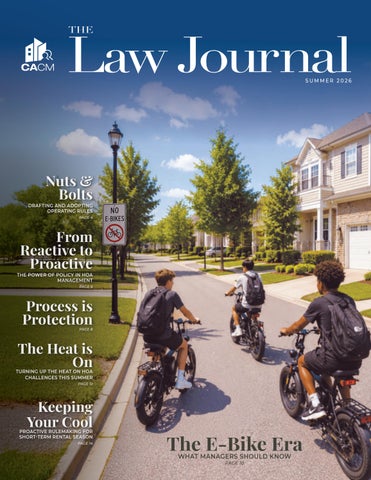
E‑BIKES
THE RISING USE OF IN COMMUNITY ASSOCIATIONS
Practical Guidance for Managers
By Alex Sohal, Esq.
The use of electric bicycles (“e-bikes”) and other motorized personal mobility devices have become increasingly widespread in common interest developments. While these devices offer convenience, recreation, and an alternative mode of transportation for residents, their growing presence has also introduced new challenges and risks for associations. Association managers are often the first to confront these issues through resident complaints or injuries, long before a board has adopted clear rules addressing how such devices may be used within the association.
For managers, the central question is rarely whether an association has authority to regulate e-bikes, but how to approach regulation in a manner that is reasonable, legally defensible, and addresses the community concerns on a day-to-day basis.
First, one of the most common sources of confusion is that not all devices marketed as “e-bikes” or “electric scooters” are treated the same under California law. The California Vehicle Code distinguishes between different classes of e-bikes based on speed and how the motor is engaged, and it separately defines electric scooters. An e-bike is defined as a bicycle with operable pedals and an electric motor of no more than 750 watts, and is categorized into three classes based on speed and motor function, with assistance capped at either 20 or 28 miles per hour depending on the class. (California Vehicle Code § 312.5.) Devices that exceed these limits or lack operable pedals are not considered e-bikes under the Vehicle Code. Electric scooters are defined separately as two-wheeled, electric-powered devices with handlebars and a floorboard or seat. Some devices exceed statutory limits or have been modified in ways that remove them from those definitions altogether.
From a management perspective, this distinction matters because many
enforcement disputes begin with residents questioning whether their device is subject to association regulation at all. Associations that lack clear definitions often put their managers in the uncomfortable position of making technical determinations without objective standards. Associations with successful enforcement strategies tend to anchor their approach to existing statutory classifications rather than subjective descriptions or brand labels.
Regulation of e-bikes or electric scooters is typically driven by complaints and incidents that raise legitimate safety or nuisance concerns. This means proactive adoption of rules addressing e-bikes can help limit the Association’s exposure to liability. Safety is the most frequent issue, particularly when devices are operated at higher speeds on private streets, near intersections with limited visibility, or in areas where children and pedestrians are present. The safety concerns inherent with these issues include accidents that cause injury to the rider and/or others in the community, accidents with motor vehicles, and damages to association and member property.
California law already imposes baseline safety requirements that often shape how associations address e-bike and electric scooter use. Riders under 18 are generally required to wear a properly fitted helmet when operating an electric bicycle or electric scooter, and Class 3 (the fastest) e-bikes are subject to additional age and helmet requirements due to their higher assisted speeds. Electric scooters are also subject to minimum age requirements under state law.
In practice, many associations build on these statutory guardrails by focusing restrictions on where devices may be used, rather than attempting to regulate ownership. An association can consider prohibiting e-bikes and electric scooters from sidewalks, pedestrian walkways, trails,
As e-bike use grows, clear, targeted rules are essential to balance convenience with community safety.
greenbelts, and recreational or amenity areas where foot traffic is heavy, while allowing use on association streets or designated routes. In general, these location-based restrictions tend to be easier to understand and for managers to enforce, and they directly address the safety and nuisance concerns that most often prompt board involvement. Some associations distinguish between different types of devices or classes of e-bikes based on speed and functionality.
Helmet requirements for minors, speed-related expectations, and prohibitions on stunt riding or racing are also common. From a management standpoint, narrower and more targeted restrictions are often easier to explain to residents and easier to enforce consistently than broad prohibitions.
In most communities, boards have authority under the governing documents to adopt operating rules governing the common area and resident conduct. Regulation of e-bike and electric scooter use typically falls within that authority, provided the rules are reasonable, consistent with governing documents and applicable law, and adopted using the required rulemaking process. When boards are looking to create rules, citing or referring to the existing law upon which some of the classifications are based will establish association authority and also provide better understanding of the requirements for residents of the community.
Once rules are adopted, consistent enforcement becomes the next focus. Selective enforcement, informal exceptions, or inconsistent responses to similar conduct can undermine the credibility of the rule and expose the association to challenge. Managers should focus enforcement on observed conduct or written/photographic reports.
Documentation is important and managers should maintain records of complaints, observations, warnings, and enforcement actions, as these records often become relevant if a rule is later challenged or escalated.
E-bikes and similar devices are likely to remain a permanent feature of association living given the more affordable price point for many of these devices. Whether used as toys or as general transportation, associations that wait until a serious incident occurs often find themselves reacting under pressure. Proactive, carefully scoped operating rules can help associations address safety and nuisance concerns without overreaching or acting arbitrarily. Managers can help by identifying recurring issues, guiding boards through proper rulemaking, and applying adopted rules consistently, to help ensure that e-bike regulation is both effective and defensible, reducing conflict while promoting safety throughout the association.
Alex Sohal, Esq. is a founder and partner of McGuire Shuber Sohal LLP with 10 years of experience as general counsel to common interest developments throughout California.
NAVIGATING SUMMER CHALLENGES IN HOA COMMUNITIES
By Melina Rezai, Esq.
If you manage a community association in a beach town, mountain resort, or any popular vacation destination, summer is your busiest and most demanding season. This article focuses on the most common summer-related challenges and what practical and preventative steps you can take to stay ahead of the season’s most common problems.
1. Late Dues and Financial Disruptions
Summer travel can have a direct impact on association finances. Owners who are traveling or otherwise occupied during the summer months may overlook assessment payments, leading to an increase in late dues. Even short-term disruptions in collections can affect the association’s cash flow and its ability to meet ongoing maintenance and operational obligations.
The most effective approach is proactive communication. Managers should consider sending payment reminders to owners ahead of the summer months. The association may also consider offering flexible payment plans to
accommodate those who may be traveling. Encouraging owners to enroll in automatic payments or to prepay assessments for upcoming months can help ensure continuity while owners are away.
Governing documents and collection policies should also be reviewed to confirm that they clearly outline due dates, late fees, and enforcement procedures. Owners are more likely to remain compliant when expectations, as well as consequences, are clearly stated. Keep in mind that Civil Code § 5650 caps late fees at 10% of the delinquent assessment or $10, whichever is greater, unless the governing documents set a lower amount.
2. Guests Who Don’t Know the Rules
Summer also brings a noticeable increase in guests. Whether it is friends and family visiting, or short-term occupants cycling through units, the result is the same: more people in the community who are unfamiliar with the rules. The issue is rarely intentional misconduct. More often, it is a lack of awareness.
The owner is responsible for their guests’ conduct, and your governing documents should say so explicitly. CC&Rs or operating rules should clearly state that owners are fully responsible for their guests and tenants’ compliance with all community rules, and that owners are required to provide a copy of those rules to any tenant or guest prior to check-in.
When a guest violation occurs, act on it through the owner: document complaints with dates, times, and descriptions, send a formal notice of violation to the owner, and schedule a board hearing if the issue is not resolved. Fines, suspension of amenity access, and referral to legal counsel are all available tools for repeat violations. If your documents do not yet include these specific requirements, work with association counsel to add them. Clear language makes enforcement both straightforward and defensible. Given that recent legislation (AB 130) caps most fines at $100 per violation, this is also a good time to review and update your fine and enforcement policy, if you have not already, before the summer season.
3. Overuse and Wear of Shared Amenities
Summer is a social season. Pools, fitness centers, clubhouses, and other shared facilities see their highest use during the summer months. Even in communities without significant short-term rental activity, increased occupancy alone can strain these spaces. There are three proactive steps associations can take to address these issues.
First, address amenity access directly in your governing documents. Guest limits, reservation systems, or time restrictions can help reduce overcrowding during peak hours. Consider whether guests should have the same access as permanent residents and whether a guest fee is appropriate.
Second, revisit your budget and reserve. If your community consistently experiences higher summer usage, that pattern should be reflected in your maintenance planning and budgeting.
Third, summer often brings an increase in short-term rental activity, which can place additional strain on shared amenities and lead to higher maintenance and enforcement costs. If your association has documented that short-term rental activity is driving higher maintenance costs, California law supports imposing specific fees on renting owners, provided those fees are tied to documented costs. In Watts v. Oak Shores Community Association (2015) 235 Cal.App.4th 466, a California appellate court upheld an association’s authority to impose a range of short-term rental-related fees, including an annual rental fee, a per-day watercraft fee, and a mandatory garbage collection fee. The court’s reasoning is instructive: the association had conducted a cost study showing that each short-term rental cost the association approximately $900 per year in increased staff time, code enforcement, road wear from boat trailers, and facility use. That documented evidence gave the board the foundation it needed to impose fees reasonably related to actual costs, and the court upheld them. The takeaway from Watts is that associations can impose specific short-term rental fees on owners, but documentation is everything. Boards should track maintenance and enforcement data tied to rental activity and adopt any fees through proper board action.
Summer will always bring increased activity to community associations. The associations that are best positioned to manage these challenges are those that act before problems arise. This means, first, reviewing governing documents to ensure they clearly set expectations for owners, tenants, and guests, particularly during periods of higher occupancy. It also requires consistent documentation and enforcement of violations. Second, evaluating how shared amenities are used and setting reasonable limits where needed to prevent overcrowding during peak times. Finally, communities should account for increased summer usage when budgeting and remain proactive in addressing potential disruptions such as late dues or seasonal payment delays.
SUMMER IS A SOCIAL SEASON: POOLS, FITNESS CENTERS, CLUBHOUSES, AND OTHER SHARED FACILITIES SEE THEIR HIGHEST USE DURING THE SUMMER MONTHS.
Melina Rezai, Esq. is an attorney with Briscoe Prows Kao Ivester & Bazel LLP with two years of experience in Common Interest Developments.
PROACTIVE RULEMAKING FOR SHORT-TERM RENTAL SEASON
As the warm weather rolls in, community associations across California transform into bustling hubs of activity. Owners may flock back to their vacation homes, guests arrive in droves, and short-term rentals (STRs) can skyrocket, turning the typically quiet community into an unrecognizable retreat destination. While this seasonal burst of activity can bring new energy and excitement, it often unleashes a wave of challenges. Advance rulemaking— crafting and implementing targeted policies well before peak season—is not only strategic, but necessary. By anticipating issues and aligning with the law, community leaders can foster harmony rather than react to chaos. Here are some common summer pitfalls, key regulatory and legal considerations, and actionable rules to keep your association thriving.
By A.J. Jahanian, Esq.
Common Short-Term Rental Challenges
Picture this: A serene coastal condo complex suddenly overrun with vacationers. Streets clog with extra vehicles, parking lots overflow, and common areas buzz with unfamiliar faces. These scenarios aren’t hypothetical, they’re the reality for many associations during summer months when STR usage spikes. Congestion tops the list, as increased foot and vehicle traffic leads to bottlenecks in entryways, elevators, and shared paths. Parking woes escalate dramatically; guests might double-park or occupy resident spots, sparking disputes and towing requests that drain management resources.
Nuisances add fuel to the fire. Late-night pool parties with blaring music, rowdy barbecues, or unsupervised children can shatter the peace, resulting in a flood of complaints. Trash accumulation becomes a persistent headache—overflowing bins from extra guests attract pests and create unsightly messes, especially in high-density developments. Amenity overuse strains infrastructure as well. Pools can see constant crowds, leading to faster wear on equipment, higher maintenance costs, and safety concerns like overcrowding. Fitness centers and clubhouses face similar pressures, with equipment breakdowns and reservation conflicts becoming commonplace.
STRs exacerbate these issues because uninvested renters, who are often unfamiliar with community norms, may prioritize fun over courtesy and care. Multiple surveys and community feedback affirm the obvious: Associations with high STR activity report more violations in summer, pulling managers and boards into endless enforcement cycles. This is underscored by lender and insurer hesitancy when it comes to funding and insuring in communities with a high number of renters. Without proactive measures, these challenges not only erode resident satisfaction but also risk legal liabilities and increase costs.
Regulatory Roadblocks: Balancing Association Rules with Broader Laws
When crafting summer rules, associations must navigate a web of external regulations to avoid costly missteps. The California Coastal Commission, for instance, wields significant influence over developments in coastal zones. Under the Coastal Act,
associations cannot adopt rules that impede public beach access—a rule limiting guest access to beachfront amenities might seem practical for congestion control but could invite commission scrutiny or lawsuits if it encroaches on public rights. Additionally, communities within the Coastal Zone may be prohibited from enforcing any short-term rental restrictions without Coastal Commission approval, even if those restrictions are contained in the CC&Rs.
Local governments add another layer. Cities and counties increasingly regulate STRs through permitting systems, often requiring licenses for rentals under 30 days. Associations cannot outright ban STRs if local laws allow them and the association’s governing documents don’t prohibit them either. However, they can require proof of municipal permits as a condition for operating rentals within the community. These challenges show why it is critical to consult legal counsel to harmonize internal policies with these agencies and local (or state). Proactively adopting rules which clearly identify the association’s STR enforcement rights will also help prevent backlash and strengthen legal standing.
Preparation is Key! Update the Governing Documents
The good news is that associations can adopt targeted rules to address these challenges headon, provided they’re rooted in the governing documents like CC&Rs and not inconsistent with the law. For congestion and parking, implement guest registration requirements; for example, Owners
must notify management 48 hours in advance of arrivals, including vehicle details. Limit guest parking to designated overflow areas or one vehicle per unit during peak weeks, with expiring permits to prevent hoarding. To curb nuisances, enhance quiet hours, such as extending them from 9 p.m. to 8 a.m., and prohibit outdoor amplified sound after sunset. Mandate that STR hosts provide renters with a community “welcome packet” including all of the association’s governing documents (CC&Rs, rules and policies, etc.) with fines for non-compliance.
For amenity overuse, new rules can establish reservation systems and protocols via apps/ portals. These systems will help monitor, track and enforce caps on amenity usage as outlined by the rules: two pool guests per unit daily, time slots for gym access, etc.
STR-specific policies require close examination of state and local law, as well as Coastal Commission regulations (if applicable). State law prohibits associations from enforcing any rule which outright prohibits rentals, but it does allow associations to adopt a 30-day minimum lease term—assuming no conflicting Coastal Act or municipal codes apply. Occupancy caps would still be enforceable to comply with Health and Safety laws. Associations can also establish protective measures such as proof of insurance requirements, point of contact for the residence (which should be the owner, even if rented), administrative fees for reviewing and processing new rentals, a rental cap (no less than 25%), and more.
Of course, rules are necessary to protect the value and safety of the community because they establish the association’s right to enforce through discipline. However, they also serve an important role in setting expectations early on, at least, for those owners who read them, given that they must be distributed to the owners for 28-day comment period and after that, can only be formally adopted at an open board meeting. (Civ. Code Sec. 4340 et seq.). All in all, education is key—if simply adopting the rules isn’t enough to deter behavior, consider hosting pre-summer town halls or send newsletters emphasizing how these rules protect everyone’s enjoyment.
Summer doesn’t have to spell stress for community associations. By identifying challenges like parking pandemonium and nuisance noise, respecting regulators like the Coastal Commission, and rolling out thoughtful rules, community association leaders can transform potential turmoil into smooth sailing. Advance planning not only minimizes disruptions but also enhances community cohesion.
With eight years of experience in the industry, A.J. Jahanian, Esq. is an attorney at Beaumont Tashjian and a part of the HOA Legal Counsel.
2025-2026 LEGAL DIRECTORY
ASSESSMENT COLLECTION SERVICES
ALLIED TRUSTEE SERVICES
Assessment Collections
Stefan Murphy
Serving All of California for Over 30 Years 1601 Response Rd., Ste. 390 Sacramento, CA 95815 (800) 220-5454 smurphy@alliedtrustee.com www.alliedtrustee.com
ALTERRA ASSESSMENT RECOVERY
Assessment Collection Services
Steven J. Tinnelly Esq., President Advanced, Efficient, Effective HOA Assessment Recovery 27101 Puerta Real, Ste. 250 Mission Viejo, CA 92691 (888) 818-5949 ramona@tinnellylaw.com www.alterracollections.com
AXELA TECHNOLOGIES
Ethical HOA Collections Technology
Martin Urruela, Chief Executive Officer A Better Way to Collect 7215 NE 4th Ave., Unit 101 Miami, FL 33138 (305) 392-0389 info@axela-tech.com www.axela.com
COMMUNITY LEGAL ADVISORS, INC.
General Counsel & Assessment Collections
Mark Guithues, Esq., Laurie Masotto, Esq., Jeffrey Speights, Esq., Jay J. Brown, Esq.
Inland Empire, Orange County, San Diego County 509 N. Coast Hwy. Oceanside, CA 92054 (760) 529-5211 • Fax (760) 453-2194 mark@attorneyforhoa.com www.attorneyforhoa.com
FELDSOTT, LEE & NICHTER, ATTORNEYS AT LAW
General Counsel, Community Association Law
Stanley Feldsott, Martin Lee, and Austin Nichter
Laguna Hills, California 23161 Mill Creek Dr., Ste. 300 Laguna Hills, CA 92653 (949) 729-8002 • Fax (949) 729-8012 feldsott@gmail.com www.cahoalaw.com
THE JUDGE LAW FIRM
HOA Law, General Counsel, Assessment Collections Services
James Judge, Esq.
Providing General Counsel & Collection Services Throughout CA for Over 20 Years 9245 Laguna Springs Dr., Ste. 200 Elk Grove, CA 95758 (949) 833-8633 • Fax (949) 833-0154 info@thejudgefirm.com www.thejudgefirm.com
UNITED TRUSTEE SERVICES
Trusted Partners in Assessment Collections
Lisa E. Chapman
HOA Assessment Collection Services 696 San Ramon Valley Blvd., Ste. 353 Danville, CA 94526 (925) 855-8554 • Fax (925) 855-8559 lisa@unitedtrusteeservices.com www.unitedtrusteeservices.com
WITKIN & NEAL, INC.
Assessment Collection Services
Susan Paquette, Esq. Assessment Collections Made Simple 5805 Sepulveda Blvd., Ste. 670 Sherman Oaks, CA 91411 (818) 845-8808 • Fax (818) 845-8844 susanp@witkinandneal.com www.witkinandneal.com
ATTORNEYS
ADAMS | STIRLING PLC
Community Association Law, General Counsel
Adrian Adams, Esq & Laurie S. Poole, Esq. California’s Premier Law Firm Dedicated to Residential & Commercial Associations 2566 Overland Ave., Ste. 730 Los Angeles, CA 90064 (800) 464-2817 info@adamsstirling.com www.adamsstirling.com
BERDING | WEIL
Construction Defect Attorneys
Serving All of California and Hawaii Offices in Walnut Creek, San Diego, Orange County, Los Angeles, Sacramento & Hawaii Walnut Creek, CA 94596 (662) 832-3030
spowell@berdingweil.com www.berding-weil.com
BRISCOE IVESTER & BAZEL LLP
Corporate Counsel and Enforcement Litigator
Maria C. Kao, Esq. All of California 235 Montgomery St., Ste. 935 San Francisco, CA 94104 (415) 402-2712 mkao@briscoelaw.net https://briscoefirm.com/
COMMUNITY LEGAL ADVISORS, INC.
General Counsel & Assessment Collections
Mark Guithues, Esq., Laurie Masotto, Esq., Jeffrey Speights, Esq., Jay J. Brown, Esq. Inland Empire, Orange County, San Diego County 509 N. Coast Hwy. Oceanside, CA 92054 (760) 529-5211 • Fax (760) 453-2194 mark@attorneyforhoa.com www.attorneyforhoa.com
DELPHI LAW GROUP, LLP
Community Association Law
Christina Baine DeJardin, James McCormick, Jr., Kyle Lakin, Zachary Smith Carlsbad & Indian Wells CA 5868 Owens Ave., Ste. 200 Carlsbad, CA 92008 (844) 433-5744 • Fax (760) 820-2696 info@delphillp.com www.delphillp.com
EPSTEN, APC
Association Counsel, Civil Litigation, Construction Defect Litigation
Jon Epsten, Esq. & Susan Hawks McClintic, Esq. San Diego | Coachella Valley | Inland Empire 3111 Camino del Rio North, Ste. 560 San Diego, CA 92108 (858) 527-0111 • Fax (858) 527-1531 info@epsten.com www.epsten.com
FIORE RACOBS & POWERS, A PLC
Community Association Law and Assessment Collections
Jacqueline D. Foster, Esq., Peter E. Racobs, Esq., and John R. MacDowell, Esq. The Recognized Authority in Community Association Law
Orange County | Inland Empire | Coachella Valley l San Diego County (877) 31-FIORE • Fax (949) 727-3311 dweissberg@fiorelaw.com www.fiorelaw.com
GURALNICK, GILLILAND & GARCIA
Association Law, Assessment Collections, General Counsel
Wayne S. Guralnick, Robert J. Gilliland Jr., Ryan Garcia Serving Community Associations for Over 30 Years 36-917 Cook St., Ste. 102 Palm Desert, CA 92211 (760) 340-1515 • Fax (760) 568-3053 wayneg@gghoalaw.com www.gghoalaw.com
HICKEY & ASSOCIATES, P.C. Community Association Law
David E. Hickey, Esq. 27261 Las Ramblas, Ste. 120 Mission Viejo, CA 92691 (949) 614-1550 • Fax (949) 748-3990 dhickey@hickeyassociates.net www.hickeyassociates.net
HUGHES GILL COCHRANE TINETTI, PC Community Association & Construction Defect Law
John P. Gill, Esq. l Amy K. Tinetti, Esq. 1350 Treat Blvd., Ste. 550 Walnut Creek, CA 94597 (925) 926-1200 • Fax (925) 926-1202 atinetti@hughes-gill.com www.hughes-gill.com
THE JUDGE LAW FIRM
HOA Law, General Counsel, Assessment Collection Services
James Judge, Esq. I Terry Dall, Esq. I Stephen M. Levine, Esq.
Providing General Counsel & Collection Services Throughout CA for Over 20 Years
300 Spectrum Center Dr., Ste. 100 Irvine, CA 92618 (949) 833-8633 • Fax (949) 833-0154 info@thejudgefirm.com www.thejudgefirm.com
Continues on page 18
Continued from page 17
LOEWENTHAL, HILLSHAFER & CARTER, LLP
Community Association Law I
Construction Defect Litigation
David A. Loewenthal I Robert P. Hillshafer
Los Angeles, Ventura & Surrounding Counties 5700 Canoga Ave., Ste. 160 Woodland Hills, CA 91367 (866) 474-5529 Fax (818) 905-6372 info@lhclawyers.net www.lhclawyers.net
MCGLINCHEY STAFFORD
Community Association Law & Litigation, Arbitration-Mediation, HOA Expert
Michelle M. McCliman Irvine, CA
2050 Main St., Ste. 550 Irvine, CA 92614 (949) 381-5924
mmccliman@mcglinchey.com www.mcglinchey.com
PRATT & ASSOCIATES, APC
Community Association Law
Sharon Glenn Pratt Los Gatos, CA 634 North Santa Cruz Ave, Ste. 204 Los Gatos, CA 95030 (408) 369-0800 Fax (408) 369-0752 spratt@prattattorneys.com www.prattattorneys.com
RAGGHIANTI FREITAS LLP
General Counsel and Mediation
David F. Feingold, Esq. Serving Bay Area Communities Since 1986 1101 Fifth Ave., Ste. 100 San Rafael, CA 94901 (415) 999-7635 dfeingold@rflawllp.com www.rflawllp.com
RICHARDSON | OBER LLP
Community Association Law, Assessment Collection
Kelly G. Richardson | Matt D. Ober Throughout California (877) 446-2529 info@roattorneys.com www.roattorneys.com
SWEDELSONGOTTLIEB
Community Association Law, Construction Defect, Assessment Collection
David C. Swedelson, Esq., Sandra L. Gottlieb, Esq., Cyrus Koochek, Esq. Los Angeles | Orange County | Palm Desert | San Francisco l Ventura 11900 W. Olympic Blvd., Ste. 580 Los Angeles, CA 90064 (800) 372-2207 Fax (310) 207-2115
slg@sghoalaw.com www.lawforhoas.com
TINNELLY LAW GROUP
Community Association Law
Steven J. Tinnelly, Managing Partner & Richard A. Tinnelly, Senior Partner Orange County | Los Angeles | San Diego | Coachella Valley | Northern CA 27101 Puerta Real, Ste. 250 Mission Viejo, CA 92691 (949) 588-0866
ramona@tinnellylaw.com www.tinnellylaw.com
WOLF, RIFKIN, SHAPIRO, SCHULMAN & RABKIN, LLP
Community Association Law
Michael W. Rabkin, Esq. 11400 W. Olympic Blvd., 9th Fl. Los Angeles, CA 90064 (310) 744-4100 Fax (310) 479-1422 mrabkin@wrslawyers.com www.wrslawyers.com
ZIMMERMAN PAVONE LLP
Community Association Law, General Counsel and Litigation
Barbara Zimmerman and Daniella Pavone Providing Legal Services to the Bay Area for Over 20 Years 6010 Commerce Blvd., Ste. 148 Rohnert Park, CA 94928 (707) 578-7555 info@zp-law.net https://zp-law.net/
CONSTRUCTION DEFECT ANALYSIS
BERDING | WEIL
Construction Defect Attorneys Serving All of California and Hawaii Offices in Walnut Creek, San Diego, Orange County, Los Angeles, Sacramento & Hawaii Walnut Creek, CA 94596 (662) 832-3030
spowell@berdingweil.com www.berding-weil.com
FENTON GRANT KANEDA & LITT, LLP
Construction Defect Litigation & CID Education
Charles R. Fenton, Esq. & Joseph Kaneda, Esq. Servicing California & Nevada Communities for Over 25 Years 2030 Main Street, Ste. 550 Irvine, CA 92614 (949) 435-3800 Fax (949) 435-3801 cfenton@fentongrant.com www.fentongrant.com
HENNIGH LAW CORPORATION
Construction Defect Litigators & Trial Attorneys
Aaron Ehrlich, Esq., Scott Hennigh, Esq., Garrett Mott, Esq.
Winning the Highest Stakes Defect Claims Across California 700 Flower St., Ste. 1000 Los Angeles, CA 90017 (213) 277-7226
The Authority in California Construction Defect Claims for 40 Years 19 Corporate Plaza Dr. Newport Beach, CA, 92660 (800) 403-3332 • Fax (929) 442-0646 rachel@constructiondefects.com www.constructiondefects.com
THE NAUMANN LAW FIRM, PC
Construction Defect Analysis
William H. Naumann
Los Angeles, Orange County, San Diego, Inland Empire, Coachella Valley, California Statewide 10890 Thornmint Rd. Ste. 200 San Diego, CA 92127 (619) 980-3281 elaine@naumannlegal.com www.naumannlegal.com
RILEY I PASEK I CANTY I SELTZER LLP
Construction Defect Resolution & Construction Defect Analysis Attorneys
Rick Riley, Melissa Pasek, Kevin Canty, Joe Seltzer Danville, Irvine, San Diego, Temecula, Woodland Hills & Throughout California 780 San Ramon Valley Blvd. Danville, CA 94526 (844) 775-5000
We Make Association Voting Management Easy 1900 Camden Ave. San Jose, CA 95124 (408) 482-9659
deanna@hoaelection.com www.hoaelection.com
PRO ELECTIONS LLC
Electronic Voting, Paper Ballot Voting & Hybrid Voting Options
Abigail Padou
We’ll Run HOA Elections That Comply with the Law 635 Bret Harte Dr. Murphys, CA 95247 (209) 559-1448 info@pro-ei.com www.pro-ei.com
RESERVE STUDY FIRMS
ASSOCIATION RESERVES
Reserve Studies
Paige Schauermann Rely on the Experts to Budget Responsibly with a Reserve Study 2945 Townsgate Rd., Ste. 200 Westlake Village, CA 91361 (800) 733-1365
Serving All of California 6101 Bollinger Canyon Rd., Ste. 200 San Ramon, CA 94583 (925) 355-2100 • Fax (925) 355-9600 reservestudies@helsing.com www.helsing.com