FALL 2026
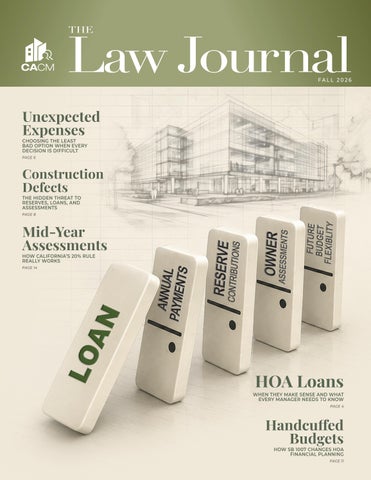
Unexpected Expenses CHOOSING THE LEAST BAD OPTION WHEN EVERY DECISION IS DIFFICULT PAGE 6
Construction Defects THE HIDDEN THREAT TO RESERVES, LOANS, AND ASSESSMENTS PAGE 8
Mid-Year Assessments HOW CALIFORNIA’S 20% RULE REALLY WORKS PAGE 14
HOA Loans
WHEN THEY MAKE SENSE AND WHAT EVERY MANAGER NEEDS TO KNOW PAGE 4
Handcuffed Budgets
HOW SB 1007 CHANGES HOA FINANCIAL PLANNING PAGE 11
Fall 2026
A PRACTICAL REVIEW OF COMMUNITY MANAGEMENT LAW
Fall 2026 Law Journal Editorial Committee Chief Editor Attorney Guest Editor
Fred Whitney, Esq. Whitney | Curry APC John Hansen, Esq. Baydaline & Jacobsen LLP
Fall 2026 Law Journal Committee Members Douglas Bickham, Esq. DeNichilo Law, APC
Shanne Ho, CCAM-HR.N.AA.LM ProActive Professional Management
Megan Hall, Esq. Adams | Stirling PLC
Lorena Sterling, CAFM Community Association Financial Services (CAFS)
Garrett Wait, Esq. Kriger & Schuber, APC
Brenda Hendricks, CAMEx, CCAM The Helsing Group Inc., ACMC
Follow @CACMchat
An archive of past issues can be found under Member Resources at CACM.org. The CACM Law Journal is a digital publication distributed four times per year to all members, in addition to supporters of the California Association of Community Managers. DISCLAIMER: CACM does not assume responsibility for the accuracy of articles, events or announcements listed. Please be advised that the opinions of the authors who contribute to the Law Journal are those of the author only, and do not necessarily reflect the opinions of CACM and other industry attorneys. Please note that in a constantly evolving industry there are frequently multiple interpretations of the controlling statutes and case law. The information contained in these articles is of a general nature and not intended as legal advice. If you have any questions, please discuss them with your association’s legal counsel.
Interested in advertising in CACM’s Law Journal? Reach out to us at marketing@cacm.org
2 The Law Journal Fall 2026 | cacm.org
Guest Editor’s Note
C
Community management is more than just “property management”; it involves managing people and managing money. People take the most time and energy, so financial management is often neglected in seminars and classes. Rising housing costs have caused financial
management to be critically important with homeowners scrutinizing budgets and financials, and with Boards looking for ways to save money. Law Journal articles are centered on mastering the foundational areas of expertise applicable to community managers found in Business and Professions Code § 11502, and are the subjects that a certified common interest development manager must complete at least 30 hours of coursework in as part of the certification process. Community managers must be equipped with the knowledge and skills to create a budget, explain a budget, and strategize to make dollars go further. That includes knowing how assessments can be levied and increased, including in the middle of the year. Managers must also be aware of potential pitfalls with underbudgeted maintenance costs; and knowing ways to increase funding without violating the law, including through loans that are different than loans in any other setting. The legislature is also acutely focused on housing costs and has turned its sights on community associations. SB 1007 may not have been successful this year, but the legislature views community associations as a source of rising housing costs, so we need to be mindful of ways they may limit an association’s ability to increase funding in the future. This issue will cover these topics in a way that equips managers to effectively and strategically manage the financial affairs of associations and guide boards on how to make the best decisions. There is always more to learn and ways we can sharpen one another.
John D. Hansen, Esq. serves as General Counsel to Community Associations at Baydaline & Jacobsen LLP, in Sacramento California with 17 years in the industry
cacm.org | The Law Journal Fall 2026 3
WHAT BOARDS AND MANAGERS SHOULD KNOW
By Sam Roth, Esq.
Sooner or later, many community associations face a major expense that their reserves cannot fully cover, such as a failing roof, balconies, or aging plumbing. When that happens, boards are typically faced with two options to raise the money: a large one-time special assessment or a bank loan repaid over several years.
When a Loan Makes Sense
A loan can solve today’s problem, but its impact continues long after the first payment.
For a large project, a one-time special assessment can mean a bill of thousands of dollars per separate interest, an amount some owners simply cannot pay on short notice. A loan allows the association to complete the work now and spread repayment over a number of years, usually funded by a smaller special assessment or by an increase in regular assessments dedicated to loan payments.
4 The Law Journal Fall 2026 | cacm.org
Loans provide several key advantages. The
carefully and confirm the approval requirements
repairs can be completed sooner, owners can
with your legal counsel before applying for any
budget for more digestible monthly payments,
loan.
and the board avoids the hardship and collection problems that a sudden large lump sum can create. The trade-off, however, is that the association pays interest and incurs a multi-year obligation that it must manage carefully. Remember that it is the board’s duty to fund the reserves, and under Civil Code §5600(a), boards must levy assessments sufficient to meet their obligations under the governing documents. Importantly, courts have held that a board’s failure to fund reserves constitutes a breach of its fiduciary duties. A loan is a useful tool at the board’s disposal to address a critical funding gap, but it is not a substitute for prudent reserve planning.
Authority, Approval, and Collateral
Loan Terms, Costs, and Prepayment Association loans commonly have terms of three, five, seven, 10, or 15 years, with the term tied to the loan amount. The rate and eligibility depend on the association’s financial health. Lenders look at owner delinquencies, cash balances, the percentage of renters, reserve levels, and the association’s financial statements. The association must also be in good standing with the Secretary of State, meaning tax returns are filed, and taxes are paid. Lenders may also ask about insurance coverage. Watch for added costs and conditions. Some lenders charge application fees, and some do not, so ask before applying. Some require the association to move its operating and reserve
Before applying for a loan, the board will need
accounts to the lender, and most require an
to confirm whether the board actually has the
opinion letter from the association’s attorney
authority to borrow. Corporations Code §7140(i)
confirming the authority to borrow.
allows a corporation to obtain bank loans, subject to any limits in the governing documents. As
While loans provide owners with lower
such, the association must carefully review its
payments, one question invariably arises: can
governing documents, to ensure such authority
owners pay their share early? This often comes
exists.
up when an owner sells a separate interest.
“
A LOAN IS A USEFUL TOOL TO ADDRESS A CRITICAL FUNDING GAP, BUT IT IS NOT A SUBSTITUTE FOR PRUDENT RESERVE PLANNING.
The association must ask prospective lenders Assuming the association’s governing
whether prepayment will re-amortize the loan
documents provide such authority, there are also
or simply shorten the term. You want the loan
usually additional approval requirements. Under
to re-amortize so that the remaining payments
Civil Code §5605(b), the special assessment used
shrink. Prepayments cause significant issues if
to repay the loan requires membership approval
the loan does not re-amortize, as the association
if it exceeds 5% of the budgeted gross expenses
still owes the bank the same monthly payment
for that fiscal year, and the governing documents
but collects less from members to cover it. To
may also require a separate vote authorizing the
manage this, boards can adopt a policy on owner
board to enter into the loan agreement itself.
prepayments and require buyers to assume a
Some governing documents also require the
seller’s assessment obligation, leaving any price
approval of a certain percentage of mortgage
adjustment to the parties to negotiate.
holders before the association can pledge or hypothecate its assessments as collateral for a
Finally, remember the disclosure obligation under
loan.
Civil Code §5300(b)(8). Loans with an original term of more than one year must be reported to
Collateral works differently for associations than
members each year, including the payee, interest
for individuals. Banks generally do not take a
rate, outstanding balance, annual payment, and
lien on the common area as security. Instead, a
payoff date.
membership-approved special assessment or a pledge of future regular assessments serves as the collateral. If the association defaults, the lender can step into the association’s shoes and pursue payment from the membership. Directors should never personally guarantee an association loan, and if a bank insists on recording a lien against the common area, that often signals that the lender does not understand how associations work, and the board should look elsewhere. Because these requirements are set out in the governing documents and differ by association, the safest course is to read those documents
The Bottom Line A loan can be a smart way to fund essential repairs without overwhelming owners with a single large bill, but the authority, approval, collateral, and prepayment details all carry significant legal and financial considerations that boards and managers must be aware of. As such, we recommend that associations work with legal counsel early in this process to confirm borrowing authority, prepare any required ballot language, and review the loan terms before the association
Sam Roth, Esq. of Kriger & Schuber, APC brings four years of experience in community association law, providing legal guidance and support to homeowner associations in California.
commits.
cacm.org | The Law Journal Fall 2026 5
MANAGING UNEXPECTED EXPENSES
Best Practices Bad Options when there are only
By Cooper R. McHatton, Esq. and A.J. Jahanian, Esq.
C
ommunity managers know the email or call that
When additional funds are needed, the most
can shift a day’s priorities. The insurance broker
straightforward route is usually a special assessment under
sends the renewal quote, and the premium sits
the standard rules in Civil Code §5605. The statute limits
well above the figure the board used when it
regular assessment increases without member approval to
approved the budget. Or perhaps a period of heavy rain
twenty percent above the prior fiscal year and requires
reveals that a retaining wall along the common area has
member approval for special assessments in the aggregate
begun to shift, creating a safety concern that requires
exceeding five percent of budgeted gross expenses for the
prompt attention. These collisions between legal duty and
current fiscal year. Regardless, when time allows, explaining
available cash are the moments that test judgment,
the expense, the legal requirement, and the practical
relationships with owners, and the board’s willingness to
consequences gives owners the information they need to
make hard calls. The options on the table rarely feel good,
support the board’s decision.
yet the law still expects the association to act and to fund the fix.
Short-term funding gaps can sometimes be bridged with reserve funds. Civil Code §5515 permits a temporary transfer
Civil Code §4775 sets forth a homeowner’s association’s
from the reserve account to the operating fund when the
maintenance responsibilities. Unless the declaration
board follows the required steps. The notice of the board
provides otherwise, the association must repair, replace,
meeting must state the intent to consider the transfer,
and maintain the common area. This includes addressing
explain the reason, outline repayment options, and indicate
utility service interruptions resulting from damage to one of
whether a special assessment may be considered. Once
the common elements and the repairs needed to restore
approved, the board must record written findings in the
service. Insurance is a parallel practical requirement.
minutes that justify the transfer and set the repayment
Governing documents, lenders, and the Civil Code expect,
schedule and method of repayment. The funds are
and in some instances require, the association to carry a
generally expected to be returned to reserves within one
certain amount of property and liability coverage,
year. This approach works best for cash-flow timing issues
regardless of the rapidly increasing insurance premiums in
rather than ongoing shortfalls.
California. These duties of the association exist whether or not the budget is adequately anticipates them, thus
When ordinary approval requirements would prevent
shortfalls and funding issues must be addressed
necessary action, Civil Code §5610 provides an exception for
appropriately.
emergency situations to the limits set forth in Civil Code §5605 discussed above. An emergency situation exists in
6 The Law Journal Fall 2026 | cacm.org
§5605 SPECIAL ASSESSMENT The standard solution when additional funding is needed. If the assessment exceeds statutory limits, homeowner approval is generally required.
§5515 RESERVE TRANSFER
A temporary loan from reserve funds to cover short-term cash flow needs. The board must follow specific notice, documentation, and repayment requirements.
three defined circumstances. First, extraordinary
captured in the minutes and that association counsel
expenses required by a court order. The second
has reviewed the proposed action.
§5610 EMERGENCY ASSESSMENT Reserved for true emergencies, such as health and safety hazards, court-ordered expenses, or other unforeseeable costs. This option has strict legal requirements and should be used with caution.
circumstance covers extraordinary expenses required to operate, repair, or maintain the common interest development after discovery of a threat to personal health or safety or another hazardous condition on the property. The third applies to an extraordinary expense for repair or maintenance that the board could not reasonably have foreseen when it prepared the annual budget report under Civil Code §5300. For the third category the board must adopt a resolution
The association’s legal duties exist whether or not the budget adequately anticipated them.
containing written findings on necessity and foreseeability of the expense and distribute that
Insurance market conditions and replacement costs
resolution with the assessment notice.
tied to inflation continue to present challenges for associations across California. Managers who help
The third category requires a particularly careful
their boards navigate these situations should focus on
review. It may carry associations through sudden
preparation and clear communication. Updating
insurance spikes and uninsured litigation defense
reserve studies with current pricing and testing
costs when the expenses are both significant and
different insurance cost scenarios gives the board
genuinely unanticipated. However, when the board
better visibility into potential shortfalls. Boards that
had information during the budget process that costs
maintain strong documentation and act early on legal
were rising and did not budget accordingly this
advice are better positioned when these issues arise.
category is no longer an option. In those situations,
When a larger expense does arise, explaining the legal
obtaining member approval for a special assessment
obligation and the funding options under
or a documented reserve transfer followed by
consideration helps owners understand the decision.
replenishment is the more legally defensible path.
Early involvement of association counsel when these
Emergency assessments are likely to be highly
issues surface further allows the board to select the
scrutinized by the membership, so careful
most defensible approach and protects individual
consideration as to whether proceeding with an
directors in the process.
emergency assessment is the right path is necessary. Managers should ensure the board’s reasoning is
Cooper R. McHatton, Esq. and A.J. Jahanian, Esq. of Beaumont Tashjian bring more than 13 years of combined experience providing legal counsel in litigation, general counsel services, assessment collections, and dispute resolution for clients throughout California.
cacm.org | The Law Journal Fall 2026 7
THE HIDDEN BUDGET LINE ITEM
How Construction Defects Impact HOA Finances, Loans and Assessments By Ritchie Lipson, Esq. and Scott Thomson, Esq.
Community associations carefully budget for landscaping, utilities, insurance, reserve contributions, and routine maintenance. Yet one of the largest financial liabilities many communities face never appears as a line item at all: construction defects. For community managers, construction defects are not simply legal issues. They are financial issues that can significantly affect reserves, borrowing capacity, insurance costs, owner assessments, and property values. By the time construction defects are identified, the financial consequences that follow are substantial.
WHEN BUILDING COMPONENTS FAIL EARLY
Reserve studies are designed to forecast the repair and replacement of building components over their anticipated useful lives. A roof may be expected to last thirty years. A waterproofing system may be expected to protect a structure for decades.
If construction defects disrupt those assumptions, the plans made in reliance on reserve studies are no longer accurate, resulting in underfunding of community needs. Improperly installed roofing, windows, waterproofing, plumbing, siding, decks, or drainage systems can fail years before the expected end of their useful life. When that occurs, reserve funding plans often become inaccurate because the association is suddenly facing major repair costs that were never anticipated.
A REAL-WORLD EXAMPLE-WHY EARLY INVESTIGATION IS NEEDED
Several years ago, our firm represented a condominium association that began experiencing what at first appeared to be a low occurrence of water intrusion around windows and exterior walls. The board initially addressed the issues through localized repairs and maintenance projects.
CONSTRUCTION DEFECT
8 The Law Journal Fall 2026 | cacm.org
As conditions worsened, a comprehensive investigation revealed widespread buildingenvelope defects that had allowed water intrusion for years. Damage extended well beyond the exterior finishes and into framing and other concealed building components. What began as relatively minor repair costs ultimately resulted in a repair project amounting to several million dollars. Reserve funds were insufficient to cover the work, and the association faced difficult decisions involving financing, special assessments, and construction-defect claims. The lesson was clear: completing a thorough property condition assessment by a qualified expert would have identified issues earlier and reduced the ultimate repair costs.
THE FINANCIAL RIPPLE EFFECT
Construction defects trigger a chain reaction of financial consequences when there is a lack of recovery of damages from the responsible parties. Associations faced with significant defect-related repairs typically have few options, such as: • Use reserve funds. • Increase reserve contributions through increased monthly assessments. • Delay other planned projects. • Obtain financing. • Levy special assessments. None of these options is particularly popular with homeowners. Large special assessments frequently create owner dissatisfaction, collection issues, and financial hardship. In some cases, boards may face criticism for failing to identify problems sooner or for delaying investigations after warning signs appeared. For community managers, helping boards understand these risks before they become crises is one of the most important services they can provide.
THE IMPACT ON LOANS AND FINANCING
Construction defects can also affect an association’s ability to obtain financing. Lenders increasingly evaluate the overall condition of a community before approving association loans. Significant unresolved defects may raise concerns regarding future repair obligations, reserve adequacy, insurance coverage, and the association’s long-term financial stability. Even when financing remains available, lenders may require additional documentation or impose less favorable terms. The impact extends beyond association borrowing. Mortgage lenders reviewing individual unit purchases often consider reserve funding levels, deferred maintenance, special assessments, and major repair projects. Significant unresolved defects can complicate financing for prospective buyers and affect marketability within the community.
INSURANCE CHALLENGES
Insurance carriers are also paying closer attention to building conditions. Recurring water intrusion, building-envelope failures, structural concerns, and claims history can all affect underwriting decisions. Communities with unresolved construction-related issues may experience higher premiums, larger deductibles, coverage limitations, or difficulty obtaining coverage altogether. As insurance costs continue to rise, the relationship between building condition and insurability becomes increasingly important.
WHAT COMMUNITY MANAGERS SHOULD WATCH FOR
Community managers are often the first to identify warning signs that may indicate broader construction-related issues. Common indicators include: • Recurring leaks in multiple locations. • Repeated repair failures. • Premature deterioration of building components. • Widespread cracking or settlement. • Corrosion, rusting, or moisture intrusion. • Unexpected increases in maintenance costs. When these conditions appear repeatedly throughout a property, they may indicate systemic problems rather than isolated maintenance issues.
“
Construction defects are often viewed as engineering or legal problems. In reality, they are financial problems that impact virtually every aspect of a community association’s operations.”
Managers are not expected to diagnose construction defects. However, documenting recurring conditions, tracking repair histories, and encouraging boards to obtain professional evaluations can help associations make informed decisions before costs escalate.
CONCLUSION
Construction defects are often viewed as engineering or legal problems. In reality, they are financial problems that impact virtually every aspect of a community association’s operations. From reserve funding and special assessments to insurance costs and financing opportunities, the financial consequences are significant when defects remain undiscovered or unaddressed. For community managers, early recognition of warning signs and proactive investigation may be the difference between a manageable repair project and a multi-million-dollar financial challenge. The most expensive construction defect is often not the one that is discovered - it is the one that remains hidden until the budget can no longer absorb the consequences.
Ritchie Lipson, Esq. and Scott Thomson, Esq. of Kasdan Turner Thomson Booth LLP bring more than 50 years of combined experience in construction defect law, serving clients across California.
cacm.org | The Law Journal Fall 2026 9
10 The Law Journal Fall 2026 | cacm.org
HANDCUFFED
BUDGETS
8
The Practical Impact of SB 1007 on Association Finances SB 1007 OVERVIEW*
STRIKING
By Dyanne L. Peters, Esq.
20% 8% CURRENT LAW
UNDER SB 1007
VS.
Maximum increase without member approval
S
THE MOST
Maximum increase without member approval
IMPLICATION WILL BE THE
HANDCUFFING OF AN
ASSOCIATION’S ABILITY TO
RAISE REGULAR
enate Bill 1007 (“SB 1007”) was introduced and authored by Senator Menjivar and was originally drafted to limit regular
assessment increases to inflation adjustments. This means that, as previously written, the bill would have prohibited a board of
directors from imposing a regular assessment greater than the regular
ASSESSMENTS
TO MEET CASH FLOW NEEDS.
assessment for the association’s preceding year, adjusted for inflation,
without the approval of a majority of a quorum of members. Existing law
prohibits an association from increasing regular assessments by more than 20 percent higher than the prior fiscal year without the approval of a
majority of a quorum of members. However, on May 21, 2026, SB 1007 was
amended to cap regular assessment increases to eight percent (8%) higher than the prior fiscal year, without the approval of members.
Continues on page 14
cacm.org | The Law Journal Fall 2026 11
HANDCUFFED BUDGETS Continued from page 13
Furthermore, this bill would amend Civil Code §5300 to require the annual budget report to include a high-level summary breakdown of the anticipated expenses of the preceding fiscal year, compared to the actual expenditures of the previous fiscal year, describing what the regular assessments fund and a statement regarding compensation of a management company. These expenditures are required to be organized into major categories at the association’s discretion, which
IMPLICATIONS FOR ASSOCIATIONS IF SB 1007 IS PASSED If SB 1007 is passed as currently written, the most striking implication will be the handcuffing of an association’s ability to raise regular assessments to meet cash flow needs. Associations are constantly facing unanticipated costs; most notably, many associations have recently faced insurance premium hikes in the wake of wildfire disasters in California. Associations are also faced with compliance
shall include, but are not limited to, reserve contributions, a third-party management company, utilities, landscaping, maintenance, and insurance. The association may comply with this paragraph by including the comparison breakdown in the pro forma operating budget, as required by Civil Code §5300(b)(1). Think “pie chart” type depiction to be included in the annual budget report. The bill would also amend Civil Code §5320 to require a summary of an annual budget or policy statement to include this high-level breakdown that describes what the regular assessments fund. If the board fails to include this budget breakdown, it will be precluded from increasing regular assessments that year. This bill would also add Civil Code § 5860 to require the association to make any physical evidence used to determine that a violation of the governing documents has occurred available to the member at least five (5) business days before the hearing or deadline for the member’s response, if the association seeks to impose a monetary penalty against
“It requires little speculation to identify where the funding shortfall will inevitably fall: the reserve accounts.” obligations under other legislation, such as the recent nonfunctional turf legislation (AB 1572, effective January 1, 2024), which requires associations to convert their irrigation to reclaimed (recycled) water in all landscape areas not used for recreational purposes by January 1, 2029. Other examples of recent increases to associations’ operating budgets include skyrocketing utility costs, increases in minimum wage, and increases in gas prices. This means that if a
a member for such violation.
board is faced with any unexpected or unanticipated costs, the board will be
SB 1007 was approved in the Senate on May 27, 2026, with a vote of 24
address funding shortfalls.
“ayes” and 13 “noes.”
limited to raising assessments by no more than 8% above the prior fiscal year to
It requires little speculation to identify where the funding shortfall will inevitably fall: the reserve accounts, which, once again, will serve as the association’s financial backstop. The unintended consequence of this legislation likely means that associations will contribute less cash to their reserve funds as they struggle to pay for the increases in their operating expenses. Associations are facing the consequences of underfunded reserve accounts everyday in the form of deferred maintenance, failing components, and large special assessments to fund large-scale repair projects. Associations should also consider how the pending Assembly Bill 2050 (“AB 2050”) factors into an association’s analysis of its finances. If passed, AB 2050 would amend Civil Code §5550 to revise the requirement to perform a study of the reserve account to include the minimum reserve contribution level to prevent the projected association reserve account balance from falling below zero over the following 30 years. The bill would also add Civil Code §5552 to require an association to fund the reserve account annually in an amount no less than the minimum reserve contribution level. If the association is unable to fund the reserve account at the minimum reserve contribution level, the bill would require the association to levy a reserve special assessment within nine fiscal years to restore the account to minimum levels. If passed, the bill would give associations six years to implement a responsible phase-in plan and would become effective January 1, 2032. This bill is meant to build on California’s existing reserve study framework and to address a crisis facing many associations of underfunding of deferred maintenance projects. If both AB 2050 and SB 1007 are passed, it may be difficult for associations to comply with both a minimum reserve funding level and a limitation on raising regular assessments to a maximum of 8% above the prior year. This means that associations will likely need to lean heavily on a larger reserve special assessment every 9 years to keep reserve accounts funded at minimum levels.
12 The Law Journal Fall 2026 | cacm.org
WHAT SHOULD ASSOCIATION CONSIDER DOING NOW TO ADDRESS SB 1007
AT-A-GLANCE BILLS & CIVIL CODES
If a board knows it has deferred maintenance projects in the near future, and if legally permitted under Civil Code § 5600(b), it should consider a mid-year budget change
SB 1007
Proposed to limit regular assessment increases to 8% without member approval and add new budget transparency requirements.
CC §5300
Governs the annual budget report. SB 1007 would require a summary showing how assessment dollars are allocated.
CC §5320
Governs the annual budget summary. SB 1007 would require it to include the same spending breakdown provided in the budget report.
CC §5860
Would require associations to provide members with physical evidence before a hearing when monetary penalties are proposed.
AB 1572
Requires qualifying HOAs to convert irrigation for nonfunctional turf to reclaimed water by January 1, 2029.
AB 2050
Would establish minimum reserve funding requirements and strengthen long-term reserve planning.
CC §5550
Requires periodic reserve studies. AB 2050 would expand them to calculate the minimum annual reserve contribution.
CC §5552
Would require associations to fund reserves at the minimum level or restore funding through reserve special assessments.
CC §5600(B)
Allows boards to revise the budget mid-year and increase regular assessments within existing legal limits.
to increase the current 2025 regular assessments by the full twenty percent (20%) currently authorized by law without membership approval. There is also an argument that can be made that if boards are preparing their budgets this fall for the fiscal year beginning January 1, 2027, if the board approval takes place in the fall of 2026, or before the potential effective date of the SB 1007 legislation, then such boards may still increase regular assessments up to 20% of the 2026 regular assessment amount. However, this is an aggressive stance; associations should consult their own legal counsel for guidance. Finally, associations should begin looking at the long-term effects of this legislation. This means that long term financial planning should start now and if a board knows that it has several deferred maintenance projects, balcony repairs, or other expenses that may be on the horizon, it should begin planning and making incremental increases now, given that it will no longer be able to rely on the 20% increase as a potential option to “bail out” poor planning or decision-making. Overall, the passage of SB 1007 will handcuff a board’s ability to make financial decisions in the association’s best interests and ultimately may mean seeking alternative funding options to address financial needs, such as levying large special assessments. Associations should consult with their CPAs and legal counsel now to develop a strategy to address the potential implications of SB 1007 before the legislation is adopted. *The information and analysis contained in this article were reflective of the legislation as written as of June 21, 2026. The bill died in Assembly as of June 24, 2026, after this article was authored.
Dyanne L. Peters, Esq. of Tinnelly Law Group brings nearly a decade of experience providing corporate counsel to homeowners associations throughout California, offering trusted legal guidance and strategic support to communities statewide.
cacm.org | The Law Journal Fall 2026 13
r a e Y Mid
Assessm e in Califo nts r nia HOAs
20
P
icture the board halfway through its fiscal year. The master insurance policy renewed forty percent higher, a retaining wall the reserve study called sound has slumped after winter storms, and reserves cannot cover both. The obvious fix – a special assessment – risks frustrated owners voting it down while the invoices keep arriving. In California, with a hardening insurance market, aging buildings, and stubborn inflation, this is practically routine. So what are the board’s options? Civil Code §5605 is what makes a mid-year fix possible: its 20% cap on regular assessments runs by the fiscal year, not by the action, so a board that under-raised dues in January can raise them again mid-year – no membership vote required. The shortcut has guardrails: the year’s cumulative increase must stay within 20% of the prior year’s assessments, the budget must have been properly disclosed, and members must receive proper notice. This article shows how to calculate the 20% ceiling and the room beneath it, when an increase takes effect, the notice rules that make it enforceable, and the missteps that trip boards up.
14 The Law Journal Fall 2026 | cacm.org
%
The Davis-Stirling Act governs association finances. Civil Code §5605(b) sets two separate limits on a board’s authority to raise funds without a member vote:
Regular Assessments
The board may raise them up to 20% over the prior fiscal year’s regular assessment. This increase must be built into the annual budget distributed to owners 30 to 90 days before the fiscal year begins.
Special Assessments
The board may impose them only up to 5%, in the aggregate, of that year’s budgeted gross expenses.
Two points managers must internalize. These caps are measured per fiscal year, not per board action. And they are independent, unused regular assessment room never enlarges the 5% specialassessment cap.
Mid-Year Assessments
A common misconception among property managers and board members is that if the annual budget is set, it cannot be altered without a community-wide vote. If the board raised regular assessments by less than 20% at the beginning of its fiscal year, the unused room did not expire when the budget passed, it stays available until the fiscal year closes. That means the board may be able to raise the regular assessments now, mid-year, without a vote. So how is the 20% measured? This is where boards stumble. The ceiling compares this year’s regular assessment rate to last year’s rate – not the total dollar collected, and not a figure prorated for the months left in the year. A board that used only part of its 20% in January can raise the monthly rate again mid-year, up to that ceiling. The timing of the increase does not matter; the rate against last year does. None of this works, though, unless the board cleared a threshold months earlier: Civil Code §5605(a) requires that the Annual Budget report go out 30 to 90 days before the fiscal year begins. Miss that deadline and the shortcut closes – any increase, even a mid-year one within the 20% cap, then needs a majority vote of a quorum of members. Example Consider an association that adopted its January budget with a 10% dues increase. By July, emergency roof repairs outpace what reserves can absorb. Because January used only half of the 20% the law allows, the board can add up to another 10% mid-year and stay under the annual cap. Here is the math: Baseline Last year’s monthly dues – say, $250 per unit. Ceiling $250 x 20% = $50, so the maximum legal regular assessment this year is $300
Unused Margin The board raised dues to $275 in January, using only $25 of its available $50. That leaves $25 per unit, per month. Apply It Because only $25 of the 20% was used, the board can raise monthly regular assessments again mid-year, up to the $300 ceiling, without a member vote, provided homeowners receive proper notice. This can be a one-time special assessment or an increase in the monthly assessments (assuming you meet the appropriate notice requirements). This is a regular assessment increase, so the 5% special assessment cap never enters the analysis.
Procedural Requirements for Mid-Year Increases
Even within statutory limits, the board must follow proper procedure and managers drive compliance:
Open-Meeting Approval
The increase must be approved at a duly noticed open board meeting, with member notice under the Open Meeting Act (generally at least four days, absent an emergency).
Member Notice and Effective Date
‘‘
The 20% cap runs by the fiscal year, not by the board’s action.
‘‘
Civil Code Section 5605
Civil Code §5615 requires individual written notice of any increase in regular or special assessments not less than 30 nor more than 60 days before it becomes due. That window, not the meeting date, controls when the increase takes effect. Governing documents may add requirements.
Document the Basis
Tie the increase to a specific financial need in the minutes and explain how the funds will be used. A clear paper trail protects the board under the business judgment rule.
Common Pitfalls
Steer your boards clear of these frequent mistakes:
• Exceeding the 20% cap by failing to track cumulative increases across the year; • Improper notice, which can invalidate the increase; • Conflating the regular (20%) and special (5%) caps, which are separate; and • Failing to document the decision, which invites legal challenges.
Conclusion
When inflation or unexpected maintenance outpaces a conservative budget, a membership vote is not always required. By applying Civil Code §5605 and identifying unused regular-assessment margin, managers can guide boards through a compliant mid-year increase that keeps the community solvent – and the board out of court.
Stephen Levine, Esq. and Christian Emsiek, Esq. of The Judge Law Firm have more than 25 years of combined experience in community association and real estate law, representing associations and homeowners throughout California with expertise in governance, CC&Rs, assessment collections, and litigation.
cacm.org | The Law Journal Fall 2026 15
2026-2027 LEGAL DIRECTORY ARBITRATORS & MEDIATORS M3KT ADR SERVICES, LLC Alternative Dispute Resolution, Community Association Law and Litigation, HOA Expert Michelle M. McCliman and Kere K. Tickner 30767 Gateway Place, Suite 185 Rancho Mission Viejo, CA 92694 (949) 322-5868 admin@ticknermccliman.com www.ticknermccliman.com
ASSESSMENT COLLECTION SERVICES ALLIED TRUSTEE SERVICES Assessment Collections Stefan Murphy, CCIP Serving All of California for Over 30 Years 1601 Response Rd., Ste. 390 Sacramento, CA 95815 (800) 220-5454 smurphy@alliedtrustee.com www.alliedtrustee.com AXELA HOA Collections Technology Martin Urruela, Chief Executive Officer 10,000+ associations served | $100M+ recovered | 99% pre-legislative closure rate 7215 NE 4th Ave., Unit 101 Miami, FL 33138 (305) 392-0389 sales@axela.com www.axela.com COMMUNITY LEGAL ADVISORS, INC. General Counsel & Assessment Collections Mark Guithues, Esq., Laurie Masotto, Esq., Jeffrey Speights, Esq., Jay J. Brown, Esq. Inland Empire, Orange County, San Diego County 509 N. Coast Highway Oceanside, CA 92054 (760) 529-5211 • Fax (760) 453-2194 mark@attorneyforhoa.com www.attorneyforhoa.com
16 The Law Journal Fall 2026 | cacm.org
FELDSOTT, LEE & NICHTER, ATTORNEYS AT LAW General Counsel, Community Association Law Stanley Feldsott, Martin Lee, and Austin Nichter Irvine, California 9140 Irvine Center Drive, Suite 100 Irvine, CA 92618 (949) 729-8002 • Fax (949) 729-8012 feldsott@gmail.com www.cahoalaw.com UNITED TRUSTEE SERVICES Trusted Partners in Assessment Collections Lisa E. Chapman HOA Assessment Collection Services 696 San Ramon Valley Blvd., Ste. 353 Danville, CA 94526 (925) 855-8554 • Fax (925) 855-8559 lisa@unitedtrusteeservices.com www.unitedtrusteeservices.com
ATTORNEYS ADAMS | STIRLING PLC Community Association Law, General Counsel Adrian Adams, Esq & Laurie S. Poole, Esq. California’s Premier Law Firm Dedicated to Residential & Commercial Associations 2566 Overland Ave., Ste. 730 Los Angeles, CA 90064 (800) 464-2817 info@adamsstirling.com www.davis-stirling.com BEAUMONT TASHJIAN Community Association Law Jeffrey A. Beaumont, Esq., Lisa A. Tashjian, Esq., Tara Radley, Esq., and AJ Jahanian, Esq. Trusted Legal Counsel Throughout California Providing General Counsel, Litigation, Governing Documents & Assessment Collections Services 5008 Chesebro Rd., Suite 200 Agoura Hills, CA 91031 (866) 788-9998 • Fax (818) 884-9998 info@hoaattorneys.com www.hoaattorneys.com
BERDING | WEIL, LLP Construction Defect Attorneys Serving All of California and Hawaii Offices in Walnut Creek, San Diego, Orange County, Los Angeles, Sacramento & Hawaii Walnut Creek, CA 94596 (662) 832-3030 spowell@berdingweil.com www.berdingweil.com BRISCOE PROWS KAO IVESTER & BAZEL LLP Corporate Counsel and Enforcement Litigator Maria C. Kao, Esq. All of California 235 Montgomery St., Ste. 935 San Francisco, CA 94104 (415) 402-2712 mkao@briscoelaw.net www.briscoelaw.net COMMUNITY LEGAL ADVISORS, INC. General Counsel & Assessment Collections Mark Guithues, Esq., Laurie Masotto, Esq., Jeffrey Speights, Esq., Jay J. Brown, Esq. Inland Empire, Orange County, San Diego County 509 N. Coast Highway Oceanside, CA 92054 (760) 529-5211 • Fax (760) 453-2194 mark@attorneyforhoa.com www.attorneyforhoa.com DELPHI LAW GROUP, LLP Community Association Law, General Counsel James R. McCormick, Jr., Kyle E. Lakin, Christina Baine DeJardin, Zachary R. Smith Carlsbad & Indian Wells 5868 Owens Ave., Suite 200 Carlsbad, CA 92008 (844) 433-5744 • Fax (760) 820-2696 skirby@delphillp.com www.delphillp.com EPSTEN, APC Association Counsel, Civil Litigation, Construction Defect Litigation Commercial CID Counsel, Senior Housing & Assessment Recovery Collections Jon Epsten, Esq. and Susan Hawks McClintic, Esq. San Diego | Coachella Valley | Inland Empire 3111 Camino del Rio North, Suite 560 San Diego, CA 92108 (858) 527-0111 • Fax (858) 527-1531 info@epsten.com www.epsten.com
FIORE RACOBS & POWERS, A PLC Community Association Law and Assessment Collections Jacqueline D. Foster, Esq., Peter E. Racobs, Esq., and John R. MacDowell, Esq. The Recognized Authority in Community Association Law Orange County | Inland Empire | Coachella Valley l San Diego County (877) 31-FIORE • Fax (949) 727-3311 dweissberg@fiorelaw.com www.fiorelaw.com GURALNICK, GILLILAND & GARCIA Association Law, Assessment Collections, General Counsel Wayne S. Guralnick, Robert J. Gilliland, Ryan Garcia Serving Community Associations for Over 30 Years 36-917 Cook Street, Suite 102 Palm Desert, CA 92211 (760) 340-1515 • Fax (760) 568-3053 wayneg@gghoalaw.com www.gghoalaw.com HICKEY & ASSOCIATES, P.C. Community Association Law David E. Hickey, Esq. 27261 Las Ramblas, Suite 120 Mission Viejo, CA 92691 (949) 614-1550 • Fax (949) 748-3990 dhickey@hickeyassociates.net www.hickeyassociates.net HUGHES GILL COCHRANE TINETTI, PC Community Association & Construction Defect Law John P. Gill, Esq. l Amy K. Tinetti, Esq. 1350 Treat Blvd., Ste. 550 Walnut Creek, CA 94597 (925) 926-1200 • Fax (925) 926-1202 atinetti@hughes-gill.com www.hughes-gill.com THE JUDGE LAW FIRM Providing General Counsel & Collection Services Throughout CA for Over 35 Years James Judge, Esq. I Christian Emsiek, Esq. I Stephen M. Levine, Esq. Offices in Irvine and Elk Grove 300 Spectrum Center Dr., Ste. 100 Irvine, CA 92618 (949) 833-8633 • Fax (949) 833-0154 info@thejudgefirm.com www.thejudgefirm.com Continues on page 18
cacm.org | The Law Journal Fall 2026 17
2026-27 LEGAL DIRECTORY Continued from page 17
LOEWENTHAL, HILLSHAFER & CARTER, LLP Community Association Law I Construction Defect Litigation David A. Loewenthal I Robert D. Hillshafer Los Angeles, Ventura & Surrounding Counties 5700 Canoga Ave., Suite 160 Woodland Hills, CA 91367 (866) 474-5529 • Fax (818) 905-6372 info@lhclawyers.net www.lhclawyers.net
WHITE LAW GROUP, INC. Community Associations, Real Property Disputes Steven M. White, Esq., James P. Hillman, Esq. 1530 The Alameda, Suite 215 San Jose, CA 95126 (408) 345-4000 • Fax (408) 345-4020 info@whitelginc.com www.whitelginc.com
PRATT & ASSOCIATES, APC Community Association Law Sharon Glenn Pratt Los Gatos, CA 634 North Santa Cruz Ave, Ste. 204 Los Gatos, CA 95030 (408) 369-0800 • Fax (408) 369-0752 spratt@prattattorneys.com www.prattattorneys.com
WHITNEY CURRY, APC HOA Frederick T. Whitney, Esq., William J. Curry, Esq. Whitney Curry, APC Specializes in Providing Comprehensive Legal Services for Homeowner Associations 27 Orchard Lake Forest, CA 92630 (949) 766-4700 frederick@whitney-curry.com https://whitney-curry.com/
RAGGHIANTI FREITAS LLP General Counsel and Mediation David F. Feingold, Esq. Serving Bay Area Communities Since 1986 1101 Fifth Ave., Ste. 100 San Rafael, CA 94901 (415) 999-7635 dfeingold@rflawllp.com www.rflawllp.com
WOLF, RIFKIN, SHAPIRO, SCHULMAN & RABKIN, LLP Community Association Law Michael W. Rabkin, Esq. 11400 West Olympic Boulevard, 9th Floor Los Angeles, CA 90064 (310) 744-4100 • Fax (310) 479-1422 mrabkin@wrslawyers.com www.wrslawyers.com
SWEDELSONGOTTLIEB Community Association Law, Construction Defect, Assessment Collection David C. Swedelson, Esq., Sandra L. Gottlieb, Esq., and Cyrus Koochek, Esq. Los Angeles | Orange County | Palm Desert | San Francisco l Ventura 11900 W. Olympic Blvd., Ste. 580 Los Angeles, CA 90064 (800) 372-2207 • Fax (310) 207-2115 slg@sghoalaw.com www.lawforhoas.com
18 The Law Journal Fall 2026 | cacm.org
CONSTRUCTION DEFECT ANALYSIS BERDING | WEIL, LLP Construction Defect Attorneys Serving All of California and Hawaii Offices in Walnut Creek, San Diego, Orange County, Los Angeles, Sacramento & Hawaii Walnut Creek, CA 94596 (662) 832-3030 spowell@berdingweil.com www.berdingweil.com
FENTON GRANT KANEDA & LITT, LLP Construction Defect Litigation & CID Education Charles R. Fenton, Esq., Joseph Kaneda, Esq. Servicing California & Nevada Communities for Over 25 Years 2030 Main Street, Ste. 550 Irvine, CA 92614 (949) 435-3800 • Fax (949) 435-3801 cfenton@fentongrant.com www.fentongrant.com THE MILLER LAW FIRM Construction Defect Litigation Thomas E. Miller, Esq. Rachel M. Miller, Esq. Mathew T. Miller, Esq. 45 Years of Setting the Standard in Construction Defect Law 19 Corporate Plaza Dr. Newport Beach, CA, 92660 (800) 403-3332 • Fax (929) 442-0646 rachel@constructiondefects.com www.constructiondefects.com THE NAUMANN LAW FIRM, PC Construction Defect Analysis William H. Naumann Los Angeles, Orange County, San Diego, Inland Empire, Coachella Valley California Statewide 10890 Thornmint Rd., Ste. 200 San Diego, CA 92127 (619) 980-3281 elaine@naumannlegal.com www.naumannlegal.com RILEY I PASEK I CANTY I SELTZER LLP Construction Defect Resolution & Construction Defect Analysis Attorneys Rick Riley, Melissa Pasek, Kevin Canty, Joe Seltzer Danville, Irvine, San Diego, Temecula, Woodland Hills & Throughout California 780 San Ramon Valley Blvd. Danville, CA 94526 (844) 775-5000 JWebster@RileyPasek.com www.rileypasek.com
ELECTION ADMINISTRATION THE INSPECTORS OF ELECTION Providing Superior Election Support for California HOA’s Since 2006 Kurtis Peterson Completely Independent Full-Service Election Provider 2794 Loker Ave. W., Ste 104 Carlsbad, CA 92010 (888) 211-5332 kurtis@theinspectorsofelection.com www.theinspectorsofelection.com LIBERTY HOA ELECTION SERVICES, LLC Election Administration Deanna M. Libert We Make Association Voting Management Easy 3150 Almaden Expressway, Suite 235 San Jose, CA 95118 (408) 444-4462 deanna@hoaelection.com www.hoaelection.com PRO ELECTIONS LLC Electronic Voting, Paper Ballot Voting & Hybrid Voting Options Abigail Padou HOA Elections That Comply with the Law 635 Bret Harte Dr. Murphys, CA 95247 (209) 559-1448 info@pro-ei.com www.pro-ei.com
RESERVE STUDY FIRMS ASSOCIATION RESERVES Reserve Studies Paige Schauermann Rely on the Experts to Budget Responsibly with a Reserve Study 2945 Townsgate Rd., Ste. 200 Westlake Village, CA 91361 (800) 733-1365 pschauermann@reservestudy.com www.reservestudy.com THE HELSING GROUP, INC. Reserve Studies Ryan Leptien, President Serving All of California 6101 Bollinger Canyon Rd., Ste. 200 San Ramon, CA 94583 (925) 355-2100 • Fax (925) 355-9600 reservestudies@helsing.com www.helsing.com RESERVE STUDIES INC. Reserve Study Your Future is Our Business! PO Box 3007 Cerritos, CA 90703 (800) 485-8056 info@reservestudiesinc.com www.reservestudiesinc.com
cacm.org | The Law Journal Fall 2026 19