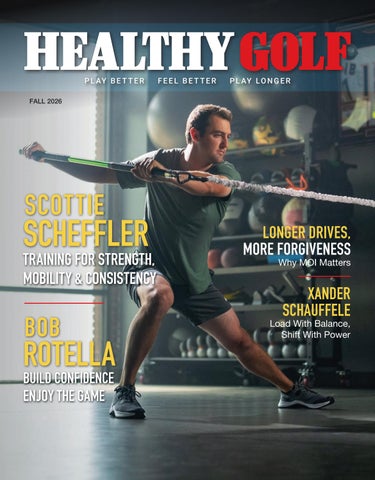
P L AY B E T T E R
FEEL BETTER
P L AY L O N G E R
FALL 2026
SCOTTIE
SCHEFFLER
TRAINING FOR STRENGTH, MOBILITY & CONSISTENCY
BOB
ROTELLA
LONGER DRIVES, MORE FORGIVENESS Why MOI Matters
XANDER SCHAUFFELE
Load With Balance, Shift With Power
BUILD CONFIDENCE ENJOY THE GAME
001_HG_Cover_FALL26_V2.indd 1
11/4/26 2:42 AM
000_HG_Ads_FALL26x.indd 2
11/3/26 11:53 PM
000_HG_Ads_FALL26x.indd 3
11/3/26 11:53 PM
CALIFORNIA GOLF + TRAVEL MAGAZINE
HEALTHY GOLF MAGAZINE
10 FALL 2026 – VOLUME 1, ISSUE 1
CONTENTS 6
Why Healthy Golf
A Balanced Approach to Enjoying the Game 8
A Better Golf Mindset Build Confidence with Bob Rotella
10
16
Built to Last How Scottie Scheffler Trains for Consistency
14
Technology That Helps You Score Better Yardages, Smarter Decisions
16
Longer Drives, More Forgiveness Why Higher MOI Matters
18
Load With Balance, Shift With Power Learn from Xander Schauffele
20 Understanding Peptides Potential Benefits & Risks
4
20
FALL 2026
004_HG_TOC_FALL26_V2.indd 4
P L AY B E T T E R
FEEL BETTER
P L AY L O N G E R
11/4/26 1:40 AM
000_GN_Ads_SPR26x.indd 17
4/28/26 8:25 PM
EDITOR’S NOTE
Good Times: Walking down the final hole to win back-to-back Canadian Tour Ontario Open Championships
Why Healthy Golf Magazine
By Eric Woods Looking back on my days as a playing professional, I vividly remember flying home from Santiago, Chile after winning the South American Tour money list title. I had more money than I had ever earned, and my future playing golf for a living looked incredibly promising. Flash forward six months later and, after missing six straight cuts on the Asian Tour, I left New Delhi, India flat broke and with huge doubts about my future. The hard truth is there will always be highs and lows in our relationship with golf. But having spent my entire adult life in and around the game, one thing has become clear: Golf needs to contribute to your life in a positive way. That’s why I’m creating Healthy Golf. My experience stretches from competing around the world to teaching for 40 years, building the Golf Lab Academy teaching studio and publishing California Golf + Travel for 20 years. 6
Some of my most valuable lessons came when I wasn’t chasing a living on tour. After stepping away from full-time competition, I focused on taking care of my body, increasing my flexibility and improving my balance. My body felt healthy, and my mind was calmer. Because I still had exemptions around the world, I played professional tournaments for fun, without grinding on my game. I was able to compete despite not playing or practicing very much. That enlightenment of sorts taught me something I want to explore through Healthy Golf: how we feel, move and think matters alongside how we swing and how much we play. There’s an enormous amount of golf information available. There are also knowledgeable people with valuable things to share. My job is to sift through it, ask questions and bring you the jewels: useful information from credible contributors that can make a difference in your golf journey and help you enjoy all
that golf has to offer. We’ll cover instruction, practice, fitness, mobility, nutrition, recovery, equipment and the mental game. We’ll help you understand your swing and explore ways to train that suit your body. What works for one golfer may not work for another. I’m building this publication for myself, too. When I stopped playing professionally, I set one lasting goal: to shoot my age. To do that, I need to live long enough, take care of my body and create time to play. It gives me something meaningful to work toward. Your reasons for playing may be different. Maybe you want lower scores, more time with friends or the ability to keep walking the course for years to come. Whatever your goal, you deserve to enjoy the pursuit. Healthy Golf is about learning, improving and finding that balance. I want our content to give you something useful and another reason to love the game.
FALL 2026
006_HG_EdNote_FALL26.indd 6
P L AY B E T T E R
FEEL BETTER
P L AY L O N G E R
11/4/26 1:41 AM
P P L AY B E T T E R
FEEL BETTER
P L AY L O N G E R
INSTRUCTION PRACTICE & TRAINING FITNESS & MOBILITY EQUIPMENT & TECHNOLOGY PERFORMANCE APPAREL NUTRITION & HEALTH MENTAL GAME
Facebook, Instagram and X @healthygolfmag www.healthygolf.com
007(046)_HG_HealthGolf_FALL26.indd 20
11/4/26 4:50 AM
MENTAL GAME
Bob Rotella and the Mental Side of Better Golf The renowned golf psychologist offers a useful starting point for playing with confidence and finding more enjoyment in the game. By Ken Lane, PGA of Canada ne poor swing can last a few seconds. The argument we have with ourselves afterward can last the rest of the round. A drive finds the trees, a short putt slips past the cup, and suddenly we are carrying more than our clubs to the next tee. For the first issue of Healthy Golf, that is a worthwhile place to begin. Taking care of our game includes paying attention to how we think, how we respond to disappointment and whether we still enjoy being out there. Dr. Bob Rotella has spent decades helping golfers address those questions. A former director of sport psychology at the University of Virginia, he has worked with athletes including Rory McIlroy, LeBron James, Greg Maddux, and Ken Griffey Jr. His books, including Golf Is Not a Game of Perfect, have brought his approach to recreational golfers as well. MAKE ROOM FOR MISTAKES A central theme of Rotella’s teaching is accepting golf’s inevitable imperfections. Even accomplished players miss shots. Fighting that reality makes an already demanding game harder to enjoy. Acceptance still leaves room for ambition. You can want to improve and be disappointed by a mistake without spending the next three holes punishing yourself for it. Consider a drive that finishes behind a tree. The useful question is what shot the situation allows. An argument about where the drive should have gone will not open a path to the green. Assess the lie, choose a sensible recovery and give that shot your attention. GIVE THE SHOT A CLEAR DECISION Rotella emphasizes decisiveness when preparing to play. A golfer who keeps debating a club or a putting line has yet to make a decision to trust. Here is one way to apply that idea: work through the yardage, conditions and target before you address the ball. Choose a shot within your abilities. Once you step in, give yourself permission to play the decision you made. Imagine an approach with a bunker guarding the flag. Choosing the wider part of the green can be a confident decision. Commitment does not require an aggressive target; it requires a clear one. PRACTICE CONFIDENCE In an interview with Golf Monthly, Rotella encouraged golfers to remember their good shots and attach positive feelings to them. Many players do the opposite, replaying every poor swing while quickly dismissing the shots they hit well.
O
8
Try ending a round by writing down three things you did well. They might include a solid iron, a well-paced putt or a patient recovery. Give those moments some space alongside the things you want to improve. Rotella also recommends practicing a consistent mental and physical routine, changing clubs and targets to make range sessions resemble actual golf. The routine deserves rehearsal along with the swing. KEEP IMPROVEMENT IN PERSPECTIVE Rotella is clear that confidence and physical skill belong together. Mental preparation cannot supply a technique you have never learned. Lessons and purposeful practice still matter. His broader philosophy also leaves room for enjoying the pursuit of improvement. There will always be another challenge, whether you are learning to make clean contact or trying to win a club championship. For golfers whose distance or stamina has changed, a useful personal goal might be better decisions or a more reliable short game. You can keep finding reasons to improve without measuring every round against the player you used to be. On your next round, choose one mental habit to practice. You might commit to each target or return your attention to the next shot after a mistake. Afterward, ask how well you kept that commitment. The score will still matter. So will the conversation, the walk and the good shot that brings you back. A healthier approach to golf makes room for all of it.
FALL 2026
008_HG_Rotella_FALL26.indd 8
P L AY B E T T E R
FEEL BETTER
P L AY L O N G E R
11/4/26 1:43 AM
ZERO TORQUE
SIR NICK FALDO
6-TIME MAJOR CHAMPION AND WORLD GOLF HALL OF FAMER
SIMPLY BALANCED FOR ALL PLAYERS.
DISCOVER MORE AT
BETTINARDI.COM
Q3 - Antidote Series Nick Faldo.indd 000_GN_Ads_SUM26x.indd 25 1
7/14/26 7/9/26 8:29 4:15 AM PM
PRACTICE & TRAINING
BUILT TO LAST: HOW SCOTTIE SCHEFFLER TRAINS HIS BODY FOR CONSISTENCY
With help from GolfForever’s director of performance Troy Van Biezen, Scottie Scheffler has developed a fitness routine designed for more than power. It’s about mobility, stability and performing his best when it matters most. By Jay Coffin cottie Scheffler’s golf swing is one of the most recognizable in the game. His feet move, his right foot slides and his body seemingly defies convention as he delivers one precise shot after another. But behind that unusual motion is a fitness program designed to keep his body healthy, his swing repeatable and his energy level high during a grueling PGA Tour season. For Scheffler, training isn’t simply about getting stronger or hitting the ball farther. It’s about preparing his body to perform consistently, whether he’s standing on the first tee Thursday or facing a crucial shot late Sunday.
S
10
FALL 2026 P L AY B E T T E R
010-013_HG_Scheffler_FALL26.indd 10
FEEL BETTER
P L AY L O N G E R
11/4/26 2:15 AM
P L AY B E T T E R
A central figure in that preparation is Scheffler’s longtime trainer, Dr. Troy Van Biezen, who also serves as GolfForever’s director of performance. “I think in the last two years I’ve taken much more of a priority in my physical health,” Scheffler said in a 2024 PGA Tour interview. Not coincidentally, that was the year he won eight times, including the Masters and the Olympic gold medal. “A huge part of my daily routine is making sure I’m physically ready to go, and my trainer, Troy [Van Biezen], has been a huge part of that.” Their relationship dates to Scheffler’s teenage years, when he began seeing Van Biezen because of back issues. Van Biezen recognized that Scheffler’s distinctive swing placed considerable demands on his body. Improving mobility through his hips and mid-back became an early priority. As Scheffler progressed professionally, the focus expanded to strength, stability, rotational movement and endurance. The objective wasn’t to change his swing. It was to build a body capable of supporting it. GolfForever resistance-training later became part of that approach, integrated into
FEEL BETTER
P L AY L O N G E R
his workouts and pre-round warmups. “With Scottie, he’s very, very strong,” Van Biezen told Sports Business Journal in 2022. “It’s just now, with GolfForever, what I really like is it just helps a lot with the stability and mobility patterns.” One particular concern emerged during Scheffler’s early years on tour – fatigue late in tournaments. Van Biezen believed Scheffler needed greater cardiovascular endurance to maintain his performance through four rounds. Scheffler began incorporating GolfForever into his off-week workouts in 2021. By early 2022, its portable resistance-training equipment had become part of his tournament preparation. He won his first four PGA Tour titles that year, including his first of two green jackets. At home, the emphasis is on developing strength, endurance and overall physical capacity. During tournament weeks, the focus shifts toward maintaining mobility, activating muscles and preparing his body for competition without unnecessary fatigue. At the 2022 PGA Championship, for example, Scheffler arrived at the event’s mobile gym two hours before his first-round
FALL 2026
010-013_HG_Scheffler_FALL26.indd 11
11
11/4/26 2:16 AM
PHOTO: BYDLON ANDREW
PRACTICE & TRAINING
tee time. Van Biezen estimated that the GolfForever Swing Trainer accounted for 85 percent of his warmup. The distinction between a workout and a warmup is important. A workout develops the physical qualities a golfer needs over time. A pre-round warmup prepares those qualities for immediate use. Rather than exhausting muscles, Scheffler’s warmup emphasizes controlled rotation, balance, hip mobility and stability. A five-exercise GolfForever routine demonstrated by Scheffler and Van Biezen provides a window into that approach. The movements emphasize rotational mobility, balance and lower-body stability, preparing his body for the demands of the golf swing without creating unnecessary fatigue. “We’re creating movement patterns in the gym that translate to the golf course, helping load the right side for a more repeatable swing,” Van Biezen told GOLF.com.
12
Just as important is the individualized nature of Scheffler’s training. Van Biezen uses movement assessments, baseline testing and 3D motion capture to identify physical limitations and asymmetries. He then adjusts exercises and resistance to address those needs. “Now I’m training myself in the gym on how to move properly on the course,” Scheffler told GOLF.com. “And, when I’m out there, I don’t have to think as much to swing the way I need to swing.” Most amateurs don’t have Scheffler’s physical abilities, training schedule or access to a personal performance coach, but they can apply the same fundamentals. The GolfForever training system pairs the Swing Trainer with an app featuring guided, golf-focused workouts, including many of the routines Van Biezen uses with Scheffler. For everyday golfers, that guidance takes the guesswork out of where to
start and what to do, whether they’re building strength at home or warming up before a round. The goal isn’t to train like a tour professional. It’s to move more comfortably, feel better prepared to play and keep enjoying the game. Perhaps the most valuable lesson is consistency. An occasional strenuous workout cannot replace a sustainable routine built around improving movement and maintaining physical health. “I’ve always said the game of golf is a marathon, not a sprint,” Van Biezen told Sports Business Journal. For Scheffler, that philosophy helps explain why his preparation extends well beyond the practice range. The goal isn’t simply to produce one powerful swing. It’s to have the strength, mobility, stability and endurance to produce quality swings repeatedly. And while most golfers will never hit a golf ball like Scottie Scheffler, they can learn something from the way he prepares his body to do it.
FALL 2026 P L AY B E T T E R
010-013_HG_Scheffler_FALL26.indd 12
FEEL BETTER
P L AY L O N G E R
11/4/26 2:16 AM
P L AY B E T T E R
FEEL BETTER
P L AY L O N G E R
THE BIGGEST TAKEAWAY?
Scheffler’s preparation isn’t about pushing his body to exhaustion before a round. It’s about getting his muscles activated and his body moving efficiently. For everyday golfers, a few minutes of controlled, golf-specific movement before teeing off can be a practical place to start.
1. SPLIT-STANCE ROTATION With one foot forward and the other behind, rotate your upper body in a controlled motion. This exercise helps develop rotational mobility while challenging balance and stability – essential ingredients for a repeatable golf swing.
2. SINGLE-LEG ECCENTRIC LATERAL HOLD This movement challenges the glutes, core and lower-body stabilizers, helping golfers develop better control of side-to-side movement. Recreational golfers can begin with light resistance and use a stable support for balance.
3. SIDE LUNGE HOLD WITH ROTATION Combining a lateral lunge with upper-body rotation, this exercise encourages hip mobility, lower-body stability and separation between the upper and lower body. Beginners can use a shallower lunge and a smaller rotation.
FALL 2026
010-013_HG_Scheffler_FALL26.indd 13
13
11/4/26 2:16 AM
TECH GAME
Golf Technology That Can Help You Score Better yardages help golfers choose the right club and make smarter decisions.
B
efore rangefinders and GPS, players relied on yardage books, marked sprinkler heads, and pin sheets to calculate distances. Hit a ball far from a known reference point, and getting an accurate yardage was extremely challenging. Today’s technology makes that information readily available. But knowing the distance to the flag is only part of the equation. Often, the more important question is: How far must I carry the ball to clear the front bunker? 1. Get the Yardages That Matter The mistake: Measuring the flag and immediately choosing a club. How technology helps: Check the distance needed to clear trouble and how much room you have beyond it. Use those numbers to establish a landing area and a margin for error. 2. Trade “Ego Yardages” for Useful Numbers The mistake: Choosing a club based on your longest shot. How technology helps: Use measured range targets to learn your normal carry distances. If your 7-iron usually carries 135 yards, an occasional 150-yard shot should not determine your selection. Choose enough club to clear trouble with normal contact. 3. Find a Better Target The mistake: Aiming at every flag. How technology helps: Use green and hazard distances to find room for your normal miss. A front flag may call for playing beyond it. A flag behind a bunker may make the open side of the green a better choice.
TWO PRODUCTS TO CONSIDER MILESEEY GenePro G1 Touchscreen & GPS Rangefinder: Combines a laser rangefinder with touchscreen GPS course maps, front, center, and back green yardages, and hazard information. It helps golfers measure the flag and assess safer landing areas, with no subscription fees. www.MileseeyGolf.com Shot Scope G6 GPS Watch: Provides green yardages, distances to reach and carry mapped hazards, and full-hole maps—all on your wrist, with no subscription fees. www.ShotScope.com Technology supplies the numbers. Use them to choose a realistic club and a target that leaves room for error. 14
FALL 2026
014(039)_HG_TECH_FALL26.indd 14
P L AY B E T T E R
FEEL BETTER
P L AY L O N G E R
11/4/26 1:47 AM
T E P T L T LL T LE L O LE B E A U LE L U RO L OF LL V B L U U D U F P E O BU FB O ET FB R B E A G F A P O L O O O R L O ET O AG NT DV TP BU R L RO T A A L N E P LE F T U P A DV G AN T O V E B A A E V L F D RO L O LL A E NT D AD G U A A U E E O A FB R B G T V E G V O P F A N D AG A D T T A A A T T O LE O N V E N N E G R VA D G A VA G A If your shaft isn't built differently, don't expect your game to be.
RI PE EX
The KINETIXX SyrgeX combines utility-patented hybrid construction with proprietary Kevlar® EXO™ technology to deliver explosive ball speed, exceptional stability, and tighter dispersion — even under aggressive swings,
EN
CE
TH
E
Use promo code: KEVLAREXO for 20% off at at kinetixxgolf.com
Experience the difference for yourself — try the KINETIXX SyrgeX today.
000_GN_Ads_SUM26x.indd 29
7/14/26 4:17 PM
EQUIPMENT
Higher MOI: Longer Drives, More Forgiveness How a more stable clubhead can help you retain ball speed, gain distance on mishits and keep more drives in play.
By Trevor Cigich very golfer wants to hit it farther. But finding more distance doesn’t always require swinging harder. Sometimes, it comes from losing fewer yards when you miss the center of the clubface. That’s where Moment of Inertia, better known as MOI, can help. In simple terms, it measures how much a clubhead resists twisting when you hit the ball away from the center of the face. When you catch a drive toward the heel or toe, the force of impact causes the head to rotate. That movement costs ball speed and can affect the shot’s direction. A higherMOI driver resists that twisting, helping preserve the speed that sends the ball farther. MORE DISTANCE FROM THE SWING YOU HAVE Most recreational golfers don’t find the center of the face on every swing. A solid drive may be followed by a toe strike that feels reasonably good but finishes well short. Higher MOI helps reduce that distance penalty. By keeping the head more stable through impact, it allows an offcenter strike to retain more ball speed than a comparable mishit with a lower-MOI design. The benefit is better average distance. Your longest drive may not get longer, but more of your drives can finish closer to it. Over a round, fewer short misses can leave you with shorter approach shots and more opportunities to reach greens. Manufacturers increase MOI by positioning more weight away from the clubhead’s center of gravity. This distribution makes the head harder to twist when contact moves away from the sweet spot. LONGER AND STRAIGHTER Off-center contact can also introduce unwanted curvature. Greater stability helps reduce the effects of those mishits, giving golfers the potential for longer, straighter shots. It won’t eliminate a slice caused by an open face or poor swing path. But it can make imperfect contact less costly in both distance and direction. FIND YOUR BEST COMBINATION Higher MOI alone does not guarantee the longest driver. Loft, launch angle, spin, face design and overall club fit still influence distance. A centered strike with a properly fitted driver remains the goal. When shopping for your next driver, ask about MOI and include higher-MOI models in your fitting. Compare how well they preserve distance and direction when you miss the center of the face. The right combination of forgiveness and fit could help you hit longer, straighter drives with the swing you already have.
Higher MOI helps reduce clubhead twisting on off-center hits
E
16
Lower MOI Weight closer to the center
Higher MOI Weight farther from the center
FALL 2026
016_HG_Equipment_FALL26.indd 16
P L AY B E T T E R
FEEL BETTER
P L AY L O N G E R
11/4/26 1:50 AM
000_GN_Ads_SUM26x.indd 35
7/14/26 4:17 PM
INSTRUCTION
LOAD WITH BALANCE SHIFT WITH
POWER LEARN FROM XANDER SCHAUFFELE’S TRANSITION By John Burckle ower starts with how you load your backswing and change direction. These two photos show how Xander Schauffele turns into a stable back leg, then shifts toward his front leg while keeping his hands soft and his upper body coiled.
P
PHOTO ONE: TURN WITHOUT SLIDING Xander transfers his weight into his right leg without sliding his hips away from the target. Notice how his right knee stays inside his right foot, and his right hip stays inside his right knee. This position maintains the inward angle of his right leg, helping him build a feeling of torque through his inner thigh and lower abdomen. He is turned and loaded over a balanced, athletic back leg, ready to change direction.
18
FALL 2026 P L AY B E T T E R
018-019_HG_Instruction_FALL26.indd 18
FEEL BETTER
P L AY L O N G E R
11/4/26 1:52 AM
P L AY B E T T E R
FEEL BETTER
P L AY L O N G E R
PHOTO TWO: SHIFT BEFORE YOU UNWIND As Xander changes direction toward the target, his lower body leads while his shoulders retain much of their backswing turn. His upper body stays stacked above his lower body as he moves toward a balanced left leg. This shift allows him to maintain his coil while keeping his hands soft, letting the club drop naturally into position. His back remains facing the target as he shifts forward, setting him up to unwind and deliver speed and power through the hitting area.
PHOTOS: MICHAEL WEINSTEIN
PUT IT INTO YOUR SWING Turn into your back leg without sliding your hips. Then shift toward a balanced front leg, keeping your hands soft and allowing your shoulders to follow. Practice this motion slowly to feel the sequence: load, shift and release.
FALL 2026
018-019_HG_Instruction_FALL26.indd 19
19
11/4/26 1:53 AM
HEALTH & NUTRITION
Peptides: Promise, Proof and Precautions
WHAT GOLFERS SHOULD KNOW ABOUT RECOVERY, WEIGHT LOSS AND HEALTHY AGING. By Aziah Arriola or golfers hoping to recover faster and stay active longer, peptides can sound appealing. They’re promoted for joint comfort, muscle growth and healthy aging. But what are they, and how much of the promise is proven? Peptides are short chains of amino acids, the building blocks of proteins. Your body makes many naturally. Some act as messengers that regulate appetite, blood sugar and hormone release. Laboratory-made peptides can mimic or influence these signals, but each works differently. Some peptide medicines have established benefits. Insulin helps manage diabetes. Semaglutide, sold as Ozempic and Wegovy, helps regulate blood sugar and appetite, with approved uses depending on the product. Side effects can include nausea, vomiting, diarrhea and constipation; less common complications include pancreatitis and gallbladder disease. Appetite reduction deserves attention. Medicines such as semaglutide and tirzepatide can support weight loss, but eating less may make it harder to get enough protein, vitamins and minerals. Weight loss can also include muscle loss. Adequate protein and regular strength training help preserve muscle, especially in older adults. A physician or registered dietitian can help patients meet nutritional needs while losing weight. Collagen peptides, commonly sold as powders or capsules, are a different category. Some studies suggest modest benefits for joint
F
20
discomfort or skin elasticity, but research limitations include small studies and industry funding. Taking collagen does not guarantee repair of damaged cartilage. Greater uncertainty surrounds injectable peptides marketed for recovery and anti-aging, including BPC-157, TB-500, CJC-1295 and ipamorelin. Strong human evidence supporting many advertised uses is lacking. FDA has identified concerns involving immune reactions, impurities and insufficient safety information. Long-term effects remain poorly understood. As interest grows, online sellers offer an expanding range of products, and quality cannot be assumed. Unverified products may contain incorrect ingredients, inconsistent concentrations or contaminants. A polished website or purity claim does not establish safety. Anyone considering peptide treatment should consult a licensed healthcare professional and verify the credentials of the dispensing pharmacy. Ask about independent testing for purity, potency and, for injectable products, sterility. Responses and side effects can vary from person to person. Compounded medicines are not FDA-approved, and quality testing alone does not establish that an experimental peptide is safe or effective. Medical guidance and ongoing monitoring should remain priorities. Before proceeding, ask what human research supports the treatment, what risks apply and whether proven alternatives exist. For golfers, maintaining strength, energy and mobility should remain central to the conversation.
FALL 2026 P L AY B E T T E R
020(033)_HG_Nutrition_FALL26.indd 20
FEEL BETTER
P L AY L O N G E R
11/4/26 1:54 AM