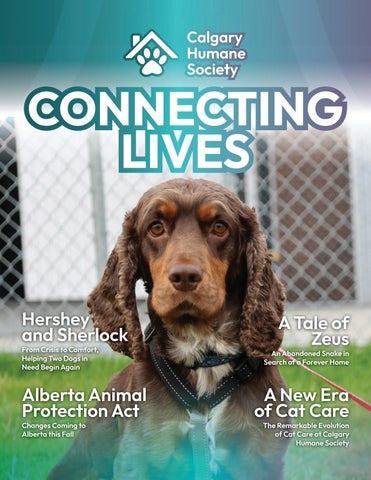
Hershey and Sherlock From Crisis to Comfort, Helping Two Dogs in Need Begin Again
Alberta Animal Protection Act Changes Coming to Alberta this Fall
A Tale of Zeus An Abandoned Snake in Search of a Forever Home
A New Era of Cat Care The Remarkable Evolution of Cat Care at Calgary Humane Society
Table of Contents 1
Letter from the Executive Director
3
Pet Inclusive Housing Update
5
From Crisis to Comfort: Helping Hershey and Sherlock Begin Again
7
20 Years of Dr. Howard and Dr. Bessonette
8
A Tale of Zeus: A Snake Abandoned and Searching for a Forever Home
9
Stronger Protection for Animals Are Coming to Alberta
10 Protection and Investigations 2026 Mid-Year update 11
More Than Meets the Eye
12
Connections that Last Beyond a Lifetime
13
Beyond the Kennel: A New Era of Cat Care
14 Saving Kittens, Six Days a Week 15
Petsecure | Adopt with Confidence. Protect What Matters Most
16
Humane Canada’s Summit for Animals
Letter from the Executive Director This year, we have shared many stories about the profound bond between people and animals. Through programs like Pets and Renters and other Continued Companionship initiatives, we’ve highlighted the importance of keeping families together and ensuring that people don’t have to choose between a home and the pet they love. Yet even with these efforts, there are still animals who need us in a different way. Every day, animals arrive at Calgary Humane Society facing uncertainty. Some need urgent medical attention. Some require behavioural support and rehabilitation. Others come to us after experiencing neglect, abandonment, or circumstances beyond their control. Whatever their journey, they all have one thing in common: they need a safe place to land and a community willing to help them heal.
Your support makes it possible for an injured animal to receive life-saving care, for a frightened animal to gain confidence through behavioural rehabilitation, and for vulnerable animals to find safety, comfort, and a second chance. When animals arrive at our doors on what may be the most difficult day of their lives, your generosity ensures they are met with compassion, expertise, and hope. Thank you for being part of this community of care. Together, we are changing lives every day, ensuring that animals in need receive the support they deserve and creating a future where every animal has the opportunity to thrive. With gratitude,
In this edition, you’ll meet some of those animals. You’ll read about Hershey and Sherlock, whose lives were turned upside down when a housing crisis left them without a place to call home. I had the privilege of getting to know these two remarkable dogs during their stay with us. As they spent time in my office between walks and enrichment breaks, I was reminded just how quickly animals become part of our lives and why every successful outcome matters so much to our team. Their story is a powerful example of both the challenges many pet owners face and the resilience animals show when given a second chance. You’ll also learn about Zeus, a ball python who required specialized veterinary care before he could begin his journey toward a new home. You’ll meet the talented veterinary and animal care professionals whose expertise helps animals recover and thrive. And you’ll discover how our new cat behaviour initiatives are helping more felines successfully navigate shelter life and find lasting homes. This issue also highlights important developments in animal welfare across our province, including the upcoming changes to Alberta’s Animal Protection Act. Stronger protections for animals, combined with compassionate community support, help create better outcomes for the animals who depend on us. While the stories in these pages are diverse, they all point to the same truth: none of this work happens without you. PAGE 1
Carrie Fritz Executive Director, Calgary Humane Society
PAGE 2
Pet Inclusive Housing Update
Every year, Calgary Humane Society welcomes hundreds of animals whose families never wanted to say goodbye. While there are many reasons animals come through our doors, one of the most preventable is housing. For hundreds of families each year, finding a place to live that accepts pets becomes an impossible challenge. Faced with eviction, rising rents, or a landlord who won’t allow animals, many people are forced into an unimaginable position: surrendering a beloved companion simply because they cannot find a home where they can stay together. These are not stories of people who don’t love their pets. They are stories of people who have run out of options. At Calgary Humane Society, we see these situations firsthand. They are heartbreaking for families, stressful for animals, and a reminder that animal welfare and human well-being are deeply connected. Recognizing that this was a growing community issue, we knew meaningful change would require collaboration. But partnerships like this don’t happen overnight. Two years before this initiative officially launched, we began investing in a relationship with the City of Calgary. PAGE 3
It started with a simple but impactful conversation. At our signature Dog Jog event, I had the opportunity to share a brief elevator pitch with Calgary’s Mayor about the challenges families face in finding pet-inclusive housing. That conversation planted the seed for what would become a much larger collaboration. Over the following two years, we continued to build that relationship, sharing Calgary Humane Society’s frontline experiences, data, and vision for a more pet-inclusive city. Together, we recognized that this was not simply an animal welfare issue, it was a housing issue, a social issue, and a community issue. For me, this project has been one of the most meaningful initiatives I’ve had the privilege to work on. It represents the kind of upstream, collaborative work that can prevent crises before they happen and keep more families together. Today, we’re proud to launch our Pet-Inclusive Housing Initiative in partnership with the City of Calgary. This initiative is the result of months of research, collaboration, and planning. Working alongside researchers from the University of Calgary’s Haskayne School of Business, Sally Johnston, Director of Community Services, and I sought to better understand the barriers facing pet owners and
the concerns facing landlords. The findings confirmed what we’ve long observed through our frontline work: the lack of pet-inclusive housing is a growing issue in Calgary, but it is one that can be addressed through practical, collaborative solutions. Our research found that more than 60 per cent of renters have been denied housing because of a pet. We also heard from people who stayed in unsafe living situations because they couldn’t find housing that would allow them to keep their animals. At the same time, landlords told us they are not necessarily opposed to pets, they are concerned about uncertainty, including potential property damage, noise, insurance, and liability. That distinction is important. If the concern is risk, then the solution is support. Rather than asking landlords to simply “allow pets,” this initiative provides practical resources that make petinclusive housing easier to manage. Through landlord toolkits, tenant resources, behaviour support, educational materials, and partnerships across the housing sector, we are working to reduce barriers for everyone involved. This initiative also reflects a broader evolution in animal welfare. For more than 100 years, Calgary Humane Society has cared for animals in need. Today, we know that protecting animals also means supporting the people who care for them. Preventing surrender is just as important as responding to it, and often the best way to help an animal is to help the family trying desperately to keep them. No single organization can solve the housing crisis. But together with landlords, housing providers, government, social service organizations, and our community, we can create more opportunities for people and pets to stay together. Every pet-friendly home has the potential to keep a family together while leaving space in our shelter for the animals who truly have nowhere else to go, those who have been abandoned, neglected, abused, or are in immediate need of protection. That is what this initiative is about. Not simply changing housing policies, but changing outcomes for people, pets, and our community. Because no one should have to choose between a safe place to live and the animal they love. Anna-Lee Fitzsimmons Vice Executive Director, Director of Public Relations
PAGE 4
From Crisis to Comfort: Helping Hershey and Sherlock Begin Again
Hershey
For Hershey and Sherlock, home disappeared in an instant. A fire forced their family from their home, and their owner reached out to Calgary Humane Society for Emergency Boarding, hoping the dogs would only need a few nights of temporary care while their family searched for somewhere to live. For families facing an unexpected housing crisis, finding a new home that is affordable, available, and welcoming to pets can be an impossible challenge. For Hershey and Sherlock, that challenge eventually meant saying goodbye. Their owner was unable to reclaim the dogs and made a heartbreaking decision to surrender them. Suddenly, two dogs who had already lost their home, lost their family as well. Like many dogs, Hershey and Sherlock found the transition into shelter life difficult. After losing their home and being separated from the people they knew, both arrived feeling scared and uncertain in unfamiliar surroundings. When staff approached, they responded with barking and growling, remaining highly alert to unfamiliar people and the unpredictable sounds around them. It was clear they were experiencing fear and stress.
PAGE 5
Sherlock
But our team didn’t see aggressive dogs. They saw two frightened dogs who had been through a lot and needed patience, understanding, and support. Staff gave both dogs the time and space to approach at their own pace. They used calm voices, gentle body language, and plenty of patience. Slowly, the dogs began to show signs that they were ready to trust again. Then the team tried something different. The kennel environment wasn’t where Hershey and Sherlock were able to show their true personalities. So, staff began bringing them into offices for visits, giving them an opportunity to experience something quieter and more predictable than the sights and sounds of the shelter. And the change was remarkable. Away from their kennels, Hershey and Sherlock began to relax. They sought attention from familiar staff, leaned in for pets, and became increasingly comfortable with handling. Staff could observe their behaviour in a different environment, build trust through positive experiences and importantly, begin to understand who these dogs really were.
They weren’t aggressive dogs. They were affectionate dogs who had been frightened by an enormous amount of change. While unfamiliar people could still make them nervous, both Hershey and Sherlock showed that once they trusted someone, they wanted to be close. Their progress didn’t happen overnight. It came through small moments: choosing to approach a staff member, accepting a gentle touch, relaxing in a quiet space, or heading out for a walk. Each positive interaction helped them build confidence and gave the team a better understanding of what they would need in a future home. This is the kind of work that can be easy to overlook. It happens in quiet moments, often without fanfare. But for an animal who is struggling, those moments can make all the difference. With time, patience, and consistency, Hershey and Sherlock began to show everyone who they were beyond the fear and uncertainty of their surrender. And then came the moment everyone had been hoping for. After a couple of weeks, both dogs were ready to become available for adoption. For Hershey, the journey from trembling in his kennel to confidently greeting familiar faces was a remarkable transformation. Sherlock, too, showed how much he could flourish when given the time and patience to feel safe. The right people saw what the staff at Calgary Humane Society had seen: two dogs who had experienced a huge upheaval, but who still had so much love to give. Hershey and Sherlock each found loving homes with families who recognized how much a safe, caring home could continue to shape their futures. A housing crisis can turn the meaning of “home” upside down, not just for people, but for the animals who depend on them. But for Hershey and Sherlock, losing their first home did not mean they would never have another. For animals experiencing the worst day of their lives, Calgary Humane Society can be a place where someone takes the time to understand them. Where a frightened dog gets another chance. Where a change of environment, a quiet office visit, a patient staff member or one more opportunity to build trust can completely change what comes next. Your support makes those moments possible. Because of donors like you, when an animal arrives at Calgary Humane Society frightened, uncertain or struggling to cope, our team can look beyond the behaviour in front of them and find the dog underneath it. For Hershey and Sherlock, that meant discovering two dogs ready to love again. And ultimately, it meant helping them find something they had both lost: a home.
PAGE 6
20 Years of Dr. Howard and Dr. Bessonette Dr. Howard started with Calgary Humane Society in December 2005. As a volunteer initially, Dr. Howard began shadowing the veterinarians. She was particularly interested in avian and exotic animal medicine after doing many externships and working alongside bird specialists in Florida. While her intention was to work in an avian and exotic animal practice, she had no idea she was going to spend most of her future veterinary career as a shelter veterinarian! Dr. Howard began working full-time in March of 2006. Dr. Bessonette moved to Calgary in 2005 from Nova Scotia via Toronto where she had been working in wildlife rehabilitation before a family move found her in Calgary. Once settled, she started looking for veterinary jobs and having worked in the not-for-profit sector in Toronto, she applied to a veterinarian position at CHS. In 2006, the new CHS building was impressive and a huge improvement from the old shelter that had been too small for decades. Over the years however, it became apparent there were deficiencies with the lack of species separation and ability to isolate for disease. There had to be a better way. Dr. Bessonette decided it was time to go back to school and completed the Graduate Certificate in Shelter Medicine from the University of Florida in 2014. Dr. Bessonette took advantage of the expanding resources and support of the shelter medicine community, and the Animal Health team began implementing strategies to improve outcomes. This included examination and vaccination on intake, fast tracking pathways, and risk assessment. All of the cat housing received an upgrade with portals being fitted to double the living space of each cat. The conversation of a much bigger renovation had begun. Dr. Howard also took on educational upgrades, completing her Bachelor of Education in 2020. She looked forward to applying
PAGE 7
her educational expertise by developing training materials and resources for Animal Care staff. She was excited to contribute to the creation of our rabbit spaces, providing larger areas for our rabbits and leading to decreased stress across the population. Dr. Howard also consulted on the development of custom-made aquatic turtle tanks and built-in reptile enclosures which allowed better options for husbandry enhancement that help these species thrive. During this time, the next renovation project for CHS was well underway. Dr. Bessonette enjoyed working through the details of animal housing and the configuration of the Calgary Humane Society Veterinary Clinic. She was also responsible for ensuring everything was ready for the Alberta Veterinary Medical Association inspection and approval in December 2021 when the newly renovated Spay and Neuter Clinic was reopened. We now had exam rooms and an admissions area that could accommodate owners and their pets for wellness and spay/ neuter clinics. All that was needed was permission through the veterinary licensing body. Dr. Bessonette, now Director of Animal Health, submitted requests for exceptions to our limited Humane Society and Charity veterinary license to allow us to help owned animals before they end up in the shelter. The Animal Health team grew to accommodate the changing veterinary needs and our programs expanded to support the community. There have been many milestones and reasons to celebrate in the last 20 years. Participation in massive seizures, treating the first ringworm case when we had appropriate isolation space, and hosting our first on-site Wellness clinic. We want to thank Dr. Howard and Dr. Bessonette for 20 years of dedicated service and the incredible impact they have made on the lives of more than a hundred thousand animals throughout their time with us.
A Tale of Zeus: An Abandoned Snake Searching for a Forever Home When people think of animal shelters, they often picture dogs, cats, and rabbits waiting to find loving homes. However, Calgary Humane Society also cares for a variety of exotic pets that have been surrendered by their owners, abandoned, or found as strays. Among these animals, snakes present unique challenges because of their specialized husbandry and care requirements. Zeus is a ball python who arrived at Calgary Humane Society in March 2025. Upon intake, Zeus was found to have retained shed covering both eyes, a condition known as retained spectacles. Treatment was initiated by one of the veterinarians and included increasing the humidity within the enclosure, providing warm water soaks, and applying a lubricating eye ointment over an extended treatment period. Retained spectacles are commonly associated with inadequate humidity. With appropriate husbandry, environmental conditions and treatment, Zeus’s retained spectacles gradually resolved over time. Caring for snakes requires specialized husbandry that differs from the care of traditional pets. Being ectothermic (“cold-blooded”) animals that originate from many different geographical locations in the wild, each snake species has their own unique requirements. These include appropriate lighting, humidity, enclosure size, and secure hiding places to support their health and well-being. Snakes also rely on carefully maintained temperature gradients to regulate their body temperature and thrive. In addition to proper housing, snakes require species-specific diets and routine health monitoring. Providing this level of care can be resource-intensive for animal shelters. Specialized enclosures and equipment, veterinary care from professionals experienced with exotic animals, and ongoing maintenance can utilize more resources than caring for traditional companion animals. Many potential adopters are unfamiliar with reptiles or are hesitant to adopt a snake because of common misconceptions and fear. Others may not have the knowledge or set-up necessary to provide proper long-term care. As a result, snakes like Zeus often remain in shelters much longer before finding their forever homes. While it is important that adopters understand the species’ husbandry requirements and are prepared for the ongoing commitment they require, education plays an important role in improving adoption outcomes. Calgary Humane Society can help provide adopters with care guides, reputable sources of online information, husbandry recommendations, and provide post-adoption support to ensure successful adoption placements. Every animal deserves a second chance. With patience, proper care, and an informed adopter, snakes like Zeus can find the safe, forever homes they deserve. Thank you for supporting the animals in our care—whether they have fur, feathers, or scales. Dr. Nicole Howard, B.Sc., DVM, B.Ed Veterinarian
PAGE 8
Stronger Protection for Animals Are Coming to Alberta • Expanded authorities for Peace Officers, allowing them to take meaningful action more effectively when animals are at risk. • Increased penalties intended to deter acts of cruelty and neglect. Together, these changes provide more opportunities to protect vulnerable animals and support earlier intervention when concerns arise. Why These Changes Matter Animal welfare challenges have evolved significantly in recent years. Shelters, rescue organizations, veterinarians, and enforcement agencies are increasingly encountering complex situations where an animal’s quality of life may be compromised even when basic needs appear to be met.
For more than a decade, Calgary Humane Society and animal welfare organizations across the province have advocated for stronger protections for animals. This fall, that work will result in some of the most significant updates to Alberta’s Animal Protection Act in years. While legislation may not seem like the most exciting topic, these changes have the potential to improve the lives of countless animals by giving enforcement agencies better tools to intervene, protect animals at risk, and address welfare concerns before they escalate. At its core, the updated legislation reflects an important shift in how animal welfare is understood. Historically, enforcement focused primarily on an animal’s basic survival needs such as food, water, and shelter. The new Act recognizes that good welfare goes beyond survival. Animals also need appropriate care, opportunities for movement and enrichment, and environments that support both their physical and behavioural well-being. What Will Change? The updated Animal Protection Act introduces several important improvements, including:
The updated legislation provides greater clarity for both pet owners and enforcement agencies, recognizing that animal welfare encompasses more than simply keeping an animal alive. It acknowledges that animals deserve conditions that support their physical health, behavioural needs, and overall well-being. For Calgary Humane Society’s Peace Officers, these amendments will help remove barriers that have sometimes limited intervention in situations where animals clearly needed assistance but existing legislation provided few options for action. Looking Ahead While no legislation can prevent every instance of neglect or cruelty, stronger laws create stronger protections. They help ensure that concerns can be addressed sooner, support more consistent enforcement, and ultimately improve outcomes for animals across Alberta. At Calgary Humane Society, we are proud to have contributed our knowledge and experience throughout the advocacy process. Most importantly, we are excited about what these changes mean for the animals we serve. Every step forward in animal welfare matters. These updates represent meaningful progress toward a future where more animals receive the care, protection, and quality of life they deserve.
• Expanded definitions of animal distress, including considerations for an animal’s mental well-being. • Stronger requirements for sanitary living conditions and appropriate housing. • Recognition of the importance of exercise, enrichment, and opportunities for animals to express natural behaviours. • Enhanced provisions addressing abandonment and situations where animals are left without appropriate care.
PAGE 9
“These significant changes to Animal Protection legislation will enhance the lives of Alberta’s animals. My team is excited to use these new tools to provide some of the strongest National protections to Calgary’s animals.” Brad Nichols Vice Executive Director, Director of Enforcement
Protection and Investigations 2026 Mid-Year Update
2026 Statistics
Animal Cruelty Convictions Justin GALLANT
474 Total Investigations
Convicted under the Criminal Code of Canada and sentenced to a $1500 fine and a lifetime animal prohibition order.
Christopher HARRIS Convicted under the Criminal Code of Canada and sentenced to 3-years probation, and a 3-year animal prohibition order.
287 Seized Animals
Dallas LOEFFLER
Medical Neglect
108
Abandonment
84
Inadequate Shelter
73
Physical Abuse
60
Unsanitary Conditions
58
Other
33
Malnutrition/Starvation
16
Inspections
12
Grooming Neglect
11
Overcrowding
8
Inadequate Water
7
Hot Car
4*
* Most hot car calls are diverted to CPS for emergency response
Convicted under the Criminal Code of Canada and sentenced to a Conditional Sentence Order and a lifetime animal prohibition order.
Justin MAKI Convicted under the Criminal Code of Canada and sentenced to a 10-year animal prohibition order.
Erik ROBIDAS Convicted under the Animal Protection Act of Alberta and sentenced to a 2-year suspended sentence and 2-years probation including a 5-animal limit.
Keisha SWEENEY Convicted under the Animal Protection Act of Alberta after 60-days in pre-trial custody and sentenced to 2-years probation and a lifetime animal prohibition order, limiting her to 2 fixed animals.
Nicholas WESEEN Convicted under the Criminal Code of Canada and sentenced to 8-years incarceration and a lifetime animal prohibition order.
PAGE 10
More than Meets the Eye Eyes are more than a visual apparatus; they provide insight into the health of the animal. Most conditions affecting shelter animal eyes are common and involve the globe or surrounding supportive tissues. Ocular conditions can range from infections and inflammation to congenital abnormalities. Eye infections can develop in puppies and kittens before their eyes open, while upper respiratory infections can cause eye inflammation. In cats, herpesvirus is a common cause of ocular concerns. Some animals are born with eye or eyelid abnormalities that require surgery, including anophthalmia, eyelid agenesis, and ectopic eyelashes. Cherry eye, or a prolapsed third eyelid gland, is also common in dogs and can be corrected surgically at Calgary Humane Society. Dry eye is commonly diagnosed in dogs, less often in cats, requiring ongoing treatment and monitoring. Multiple blind cats have found their way to Calgary Humane Society this year. Gus was one of these cats. Gus was found on the side of the road in Bragg Creek in May. On his intake exam, he was noted to have dilated pupils that did not respond to light with a large corneal ulcer on his left eye. Gus was diagnosed with dry eye in the left eye with undetermined blindness. Despite his situation, he was social, purring during his exam, and enjoyed any and all attention. By June, Gus had gained 1 kg of weight and he had a dental procedure. Radiographs taken of his skull PAGE 11
at the time of his dental showed a skull fracture of the eye socket that was healing, suggesting previous trauma. Referral to a veterinary ophthalmologist to determine the underlying cause of blindness provided the diagnosis of bilateral optic nerve atrophy. Gus was blind and there was nothing that could be done to change this. Gus was unfazed by his lack of vision, often appearing like he could see. He responds when people approach the kennel and uses his excellent hearing to interact with people near or in his kennel. Animal Care provided toys that produced sounds when he batted them around, helping him navigate his enclosure and play energetically regardless of his lack of vision. Gus had his left eye enucleated in August as he continued to have dry eye associated with this eye (the one that was originally ulcered on arrival). With the eye no longer visual, it made sense to remove the useless globe that was a risk for discomfort. Despite his long medical journey, Gus will be a perfect companion. Some care will need to be taken to ensure he can navigate his new home by managing potential hazards and keeping him as an indoor cat will help him live a long and healthy life. Dr. Elissa Bessonette B.Sc., DVM, Graduate Certificate Shelter Medicine Director of Animal Health
Connections that Last Beyond a Lifetime The bond between people and animals can shape a lifetime. A dog who was there through childhood. A cat who brought comfort during a difficult chapter. The companion who was waiting at the door at the end of every day. For many Calgary Humane Society supporters, that connection inspires another kind of commitment: ensuring animals and the people who love them will continue to have support in the future. A legacy gift is one way to make this possible. By joining the Nine Lives Society and including Calgary Humane Society in their estate plans, supporters can help create a more humane future long after their own lives have ended. Legacy gifts to Calgary Humane Society can provide care for an animal who has nowhere else to turn, help a family keep their pet during a difficult time, or support programs that prevent people and animals from having to say goodbye in the first place. A legacy doesn’t have to mean a large estate. It is a meaningful gift that shares the personal expression of your values, helping ensure the causes you care about continue to make a difference well into the future. For some, that may mean remembering Calgary Humane Society in a will. For others, it may mean
naming the Society as a beneficiary of an RRSP, life insurance policy, or another asset. However someone chooses to give, the intention is the same: to make sure the animals we care about continue to thrive beyond our own lifetime. A legacy gift can become part of the story of an animal we will never meet, a family we will never know, and a future made better because we chose to care today. At Calgary Humane Society, we see the impact of compassion every day. A legacy gift is a lasting expression of what matters most, carried forward in the lives it touches for generations to come. Make your connection part of the future.
To learn more about leaving a legacy and becoming a member of the Nine Lives Society or to share that you have already included Calgary Humane Society in your plans, please contact our team at: legacy.giving@calgaryhumane.ca or 403-205-4455.
PAGE 12
Beyond the Kennel: A New Era of Cat Care
When I started at Calgary Humane Society, 27 years ago, cat care looked very different. Cats received the essentials: food, water, shelter, medical care, grooming, and a clean, safe space. At that time, cat behaviour work—often shortened to cat “bx”— was almost unheard of. Since then, our understanding of cats and their fascinating, complex behaviors have grown tremendously, strengthening cat-human bonds, improving animal welfare, and revealing just how unique and resilient cats truly are. I have been fortunate to become the first Cat Care Supervisor at Calgary Humane Society, and I could not be more thrilled and honored. I have always put extra effort and care into my feline friends, and this opportunity allows me to focus more fully on cats and their individual needs. In this role, I work closely with cats, help them adjust to shelter life, assess their stress levels, and support increased cat adoptions. My goal is to make sure cats who are struggling in shelter receive the extra care, patience, love, and support they need. That support can look different for every cat. Sometimes it means sitting outside a kennel and speaking softly to them while playing calming cat music. Other times, it might mean leading an interactive play session to burn off excess energy and reduce boredom. For an extremely fearful cat, I may use a cat wand to gently stroke them before slowly swapping the wand for my hand. A delicious treat can also go a long way in helping build trust. The main objective of my position is to help these cats build confidence and thrive in a shelter environment. We often receive very shut-down cats or kittens who may appear to be “feral” and can present a safety risk to staff and volunteers. Some have never had human interaction and may live their best lives as
PAGE 13
shop cats or farm cats. Others may seem fractious because of high FAS—fear, anxiety, and stress—while being sheltered, but they are often simply struggling and need extra support and encouragement. For many cats, shelter life can be traumatic after losing a home, experiencing abuse or neglect, or living on the streets, which is why focused behaviour support matters so much. The evolution of cat care at CHS has been remarkable. Today, our cats are treated as individuals, with unique needs. They are able to benefit from a variety of toys, play sessions, socialization, improved housing designs, advanced medical procedures, stress reduction, in-kennel and out-of-kennel enrichment, expanded foster resources, and a beautiful outdoor catio. We also have an office with a catwalk and living space that can house a cat until we find their forever home. These spaces support cats showing signs of aggression or stress, cats with special medical needs, cats needing weight-loss support, cats needing to build confidence, and long-term cats who benefit from a change of environment. Some cats also go for walks outside the office or enjoy stroller rides outdoors for fresh air. Calgary Humane Society has come a long way, and we continue to look for new and innovative ways to help cats and kittens feel safe, supported, and understood. I am proud to be part of that progress, and I cannot wait to see what the future holds for our feline friends. Kelty McWalter Cat Care Supervisor
Saving Kittens, Six Days a Week At the end of January 2026, six kittens were found in a box in a cold alley. They spent the next month living in a garage before being surrendered to Calgary Humane Society. After such a difficult start, I was drawn to these innocent little beings, eventually named after the days of the week. Sunday, Monday, Tuesday, Thursday, Friday, and Saturday were all struggling. They had little to no human interaction and were afraid of everyone and everything except each other. Whenever staff or volunteers entered the room, the kittens hid or were hissing and growling. If we needed to get close, they hissed, growled, spat, and made it clear they wanted distance. Because they were so under-socialized, we did not know whether they would ever be able to live in a regular home or if they would need to live as barn cats. When I saw their tiny faces, I knew I had to try to help them come around—and I truly did. I began working with them the day they arrived. Calgary Humane Society is a busy place, with many animals, staff, volunteers, and visitors. I do my best work with cats and kittens when it is quiet, with just me and my feline friends. I started coming in early in the morning to give myself time to build their trust. For kittens who were so fearful and
lacked confidence, simply seeing or hearing people enter the room could be frightening. Being alone with them allowed me to control noise and movement so I could help keep their stress levels more manageable. With coffee in one hand and my cat bag of tricks in the other, I got to work. The room was quiet, with only a few other cats, so I could focus on the six “days of the week” kittens. I quickly realized each little dumpling had different needs. Monday was extremely fearful and needed help building his confidence. Tuesday showed significant fear aggression, swatting, hissing, growling, and biting at anything I brought near her. Thursday was extremely fearful, often hissing and hiding. He was also the first to steal my heart because he was the first to come around. He wanted love and attention, even if he was not yet sure how to accept it. Friday, Saturday, and Sunday struggled the most and took the greatest amount of effort. Friday and Sunday showed the most fear aggression, while Saturday was just fearful, bolting from one side of the kennel to the other, looking for ways to escape. We were unable to vaccinate these three upon arrival, posing barriers for both our staff and their progress. Because working with unvaccinated cats and kittens can pose a health risk to others, we had to take extra precautions and our interactions with them were limited. I thought about these six constantly. I sat with each of them, spoke softly, played calming cat music, and simply tried to earn their trust. Day by day, their behaviour slowly improved. I encouraged them to play with toys, eat treats from tubes and then from my fingers, and accept pets first with a cat wand and eventually with my hand. Within weeks, they began to change. Thursday was the first kitten to purr and the first one I was able to hold. After so much time and effort, hearing that purr was incredibly rewarding. I remember holding him and thanking him through my tears. The kittens would hear one another meow and come to the front of their kennels to visit. Before long, they greeted me each morning with trills, chirps, and sweet little meows, asking for love. All six kittens later spent time in foster care and eventually found loving homes. These kittens are why I will never stop fighting for animals like them. They gave me hope when things felt impossible, and despite everything they had endured, they kept fighting. Brave, resilient, and strong! Without question. Kelty McWalter Cat Care Supervisor
PAGE 14
Adopt with Confidence. Protect What Matters Most.
Your New Pet Comes with a Welcome Gift As a proud Adoptsecure partner, we’re pleased to help give your newest family member a healthy start. When you adopt a pet from us, you’ll receive six weeks of complimentary pet health insurance through Petsecure. It’s easy and completely hassle-free: No obligations No payment information required No automatic enrolment
Just 48 hours after bringing your new pet home, coverage begins.
Your trial includes: Up to $500 in coverage for unexpected accidents and illnesses Up to 80% reimbursement on eligible veterinary expenses Coverage that includes exam fees, taxes, emergency care, diagnostics, and more
Because even with the best care, unexpected veterinary expenses can happen. Curious what a full policy looks like? Get a quote to find out.
PAGE 15
Petsecure.com
Each year, Humane Canada hosts its Summit for Animals, its signature national event for professionals, advocates and volunteers working to improve the lives of animals and the people who care for them. In 2027, the 14th annual Summit will bring together 400 to 500 professionals from across sectors, including animal sheltering, advocacy, fundraising, research, academia, communications, veterinary care, and more. Held over three days in Ottawa, the Summit offers opportunities to learn from diverse perspectives, explore new ideas and gain practical knowledge that can be applied within organizations and communities. Through education, collaboration, and shared experiences, attendees can discover new approaches to animal welfare and build connections that can lead to meaningful change. Calgary Humane Society staff proudly attend the Summit each year as both participants and presenters. The 2027 Summit will allow our team to stay informed about emerging trends and best practices, share our expertise, and connect with colleagues from across the country. The knowledge and ideas gained at the Summit can then be brought back to CHS to strengthen our programs, services and approach to animal welfare in Calgary and beyond. Ultimately, the Summit is an opportunity to turn learning into action. By bringing together people with a shared commitment to animals, Humane Canada creates a space where new ideas can become collaborations and where connections can help shape a stronger future for animal welfare across Canada.
2027 Summit The Summit will take place from May 17-19, 2027, in Ottawa, ON, Canada, featuring three days of learning with approximately +55 sessions, +90 speakers and 25+ exhibitors. Registration opens in late November with super early bird savings. In the meantime, learn more about this annual event at: Humanecanada.ca/en/summit-for-animals
PAGE 16
Subscribe to our email list for updates on what’s happening at Calgary Humane Society and the community. CalgaryHumane.ca