
THE TASTE OF WATER
Dr. Ulrike Haase
De. | En. | It.
Joffrey Nogrette
Fr. | En.
Charlotte Chauvier
Fr. | En. | Es.
Galerie Cahn
SUMMER BREAK 2026 CONTACT
ulrike.haase@cahn.ch
Tel: +41 61 561 67 04
joffrey.nogrette@cahn.ch
Tel: +41 61 561 67 00
charlotte.chauvier@cahn.ch
Tel: +41 61 561 67 02
www.cahn.ch
Tel: +41 61 561 67 55
20 July – 14 August (By Appointment Only)
During this year‘s summer break, the gallery will be open by appointment only. Dr. Ulrike Haase will be available during this period. Please contact her by email or phone to arrange a visit.


THE TASTE OF WATER
Jonas Hernegger
At first glance, it appears to be nothing more than a liquid without color, odor, or taste. It falls as rain, is found in lakes, rivers, and seas, and is used, among other things, for washing and drinking. This is how the Oxford Dictionary describes water, attempting to arrive at a universally valid definition.
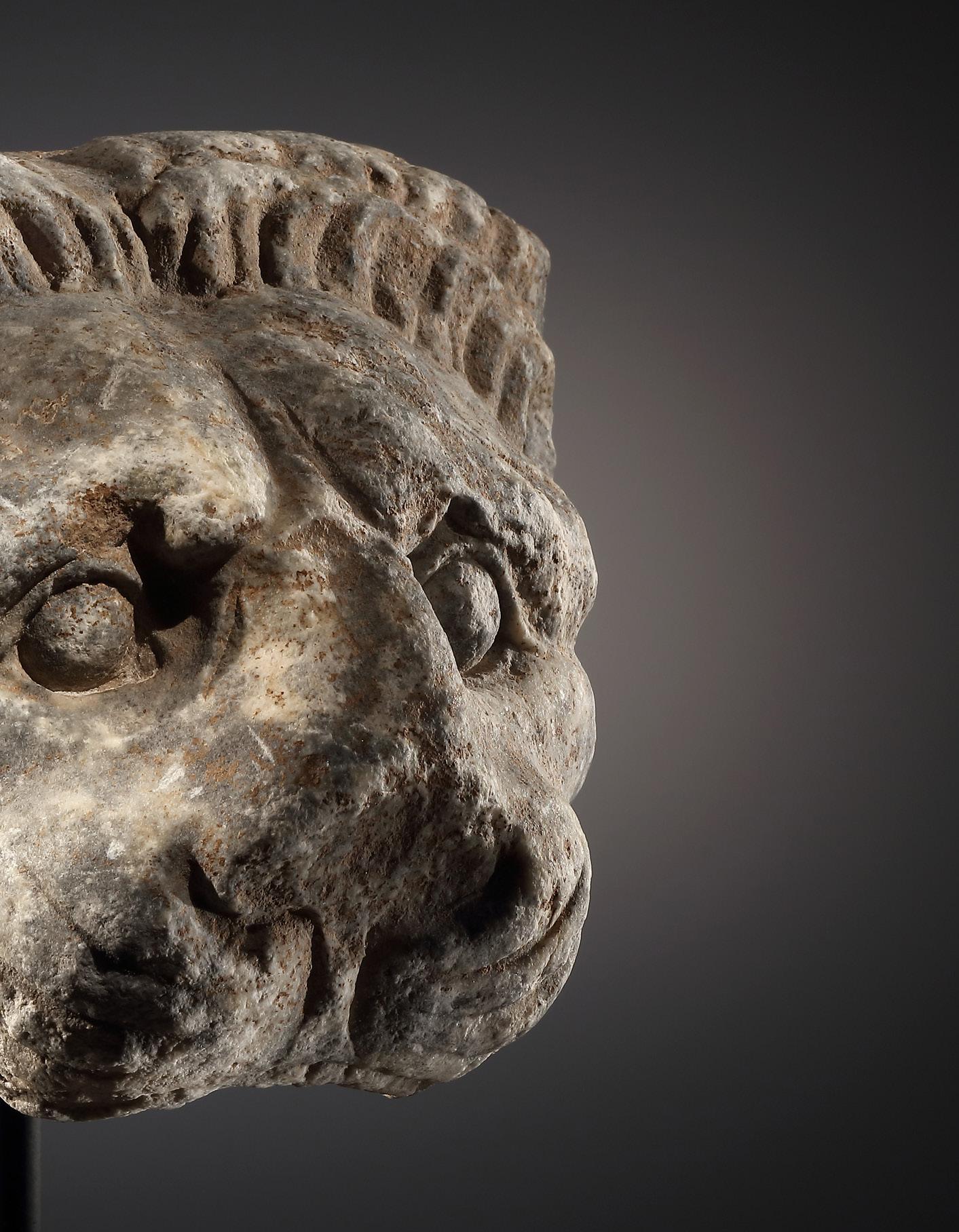
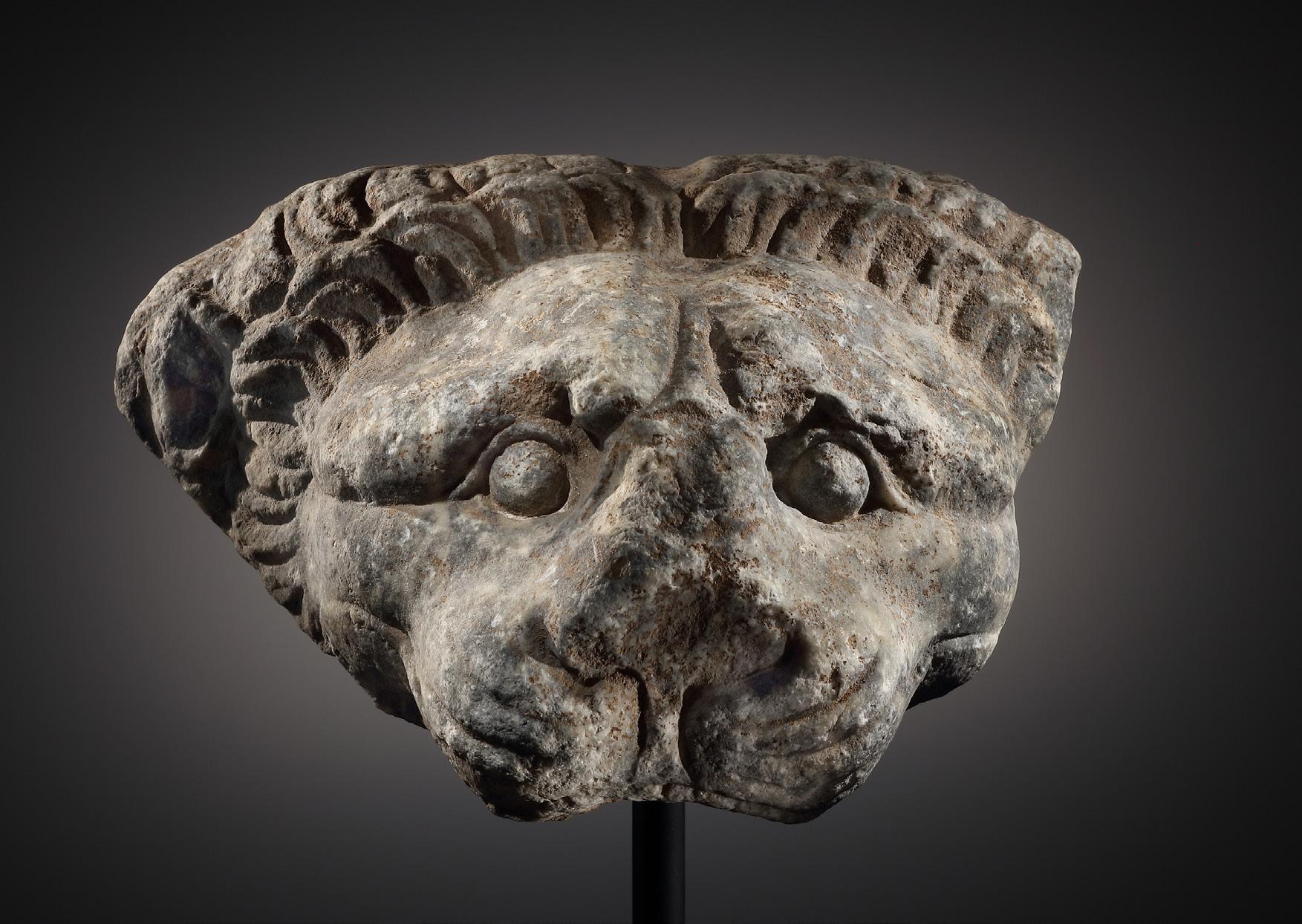
Left out are the subjective, emotional, as well as timeless and cross-cultural ways in which we relate to this element. The objects presented here therefore invite a wide range of personal associations. For example, the Lions Head Waterspout (No. 12) may currently remind visitors, especially those in Basel, of the city’s ten public bathing fountains, which invite families and friends to cool off together.
Likewise, the fascination of the sea and its animal and plant worlds is reflected in the Tetradrachm, Syracuse (no. 10), which depicts the nymph Arethusa with four dolphins swimming around her head. Evidence of the profound admiration for these creatures is also provided by the Dolphin Coin with Inscription, Olbia (no. 11), dating to the 5th century BC. Because these mammals accompanied merchant ships as they entered or left the harbor, their silhouettes inspired the distinctive
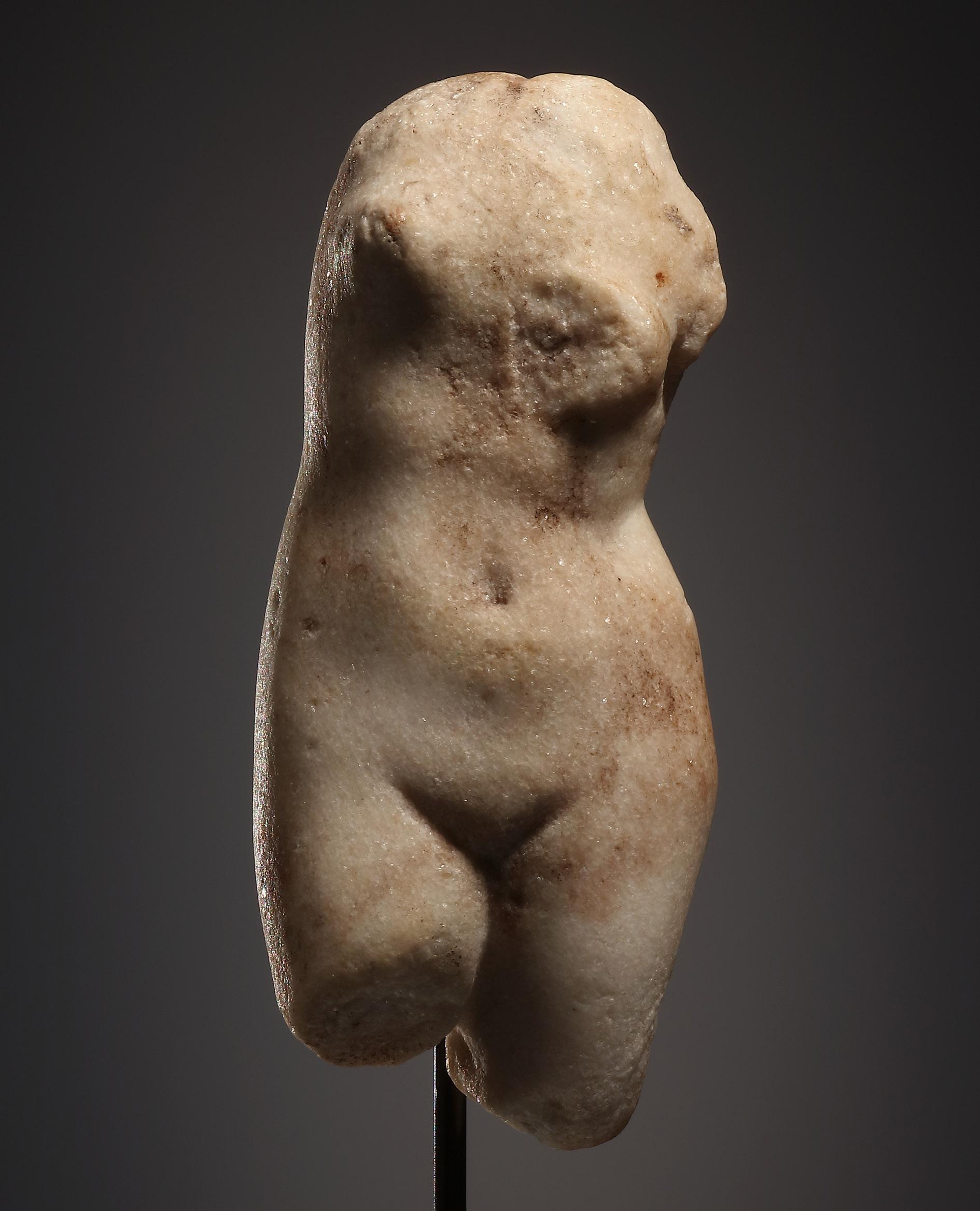
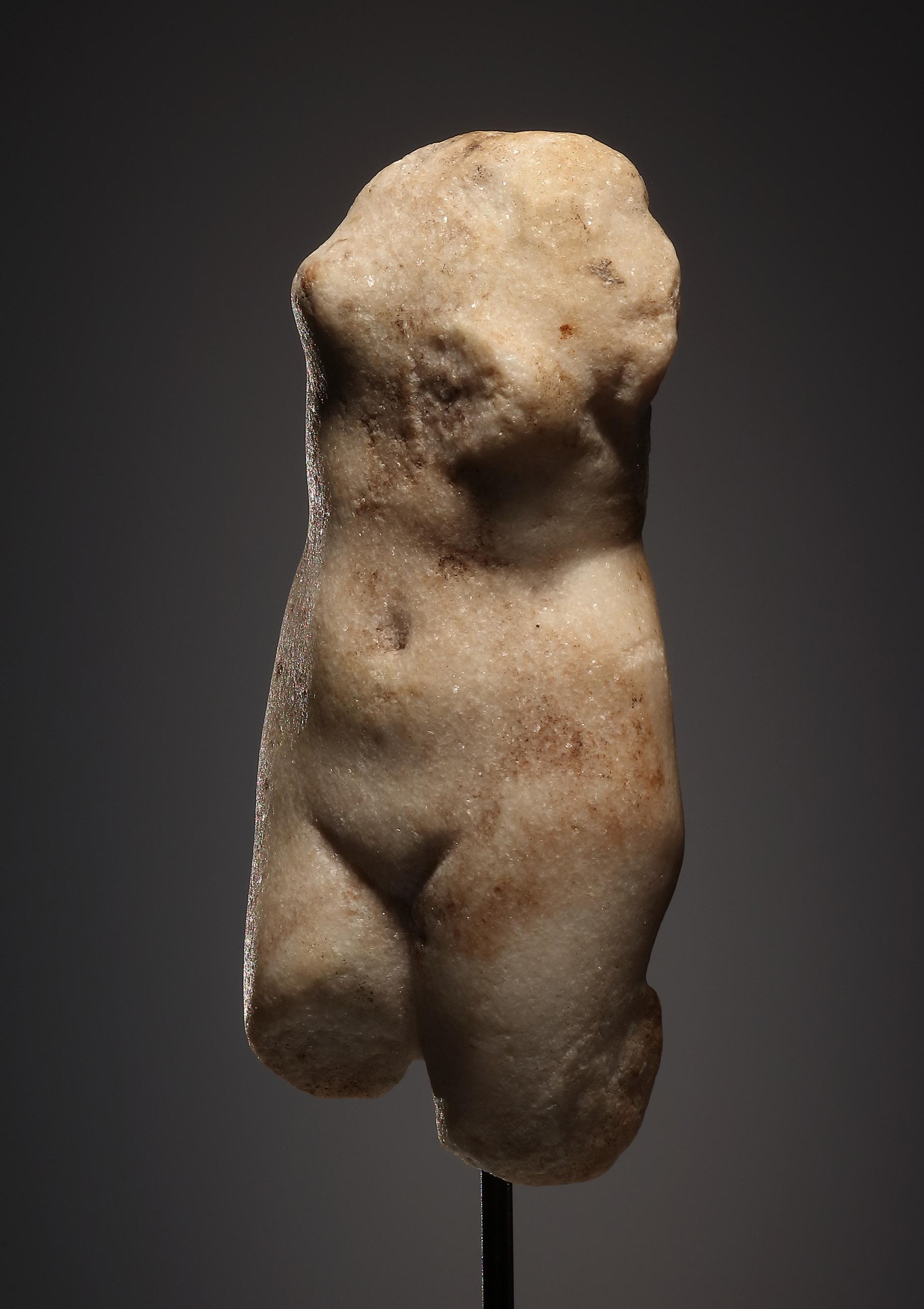
shape of this form of currency. Meanwhile, the torso of our Aphrodite Anadyomene (no. 15) reminds us that, despite approximately 44.000 deep-sea dives conducted since the 1950s, only 0,001 percent of the deep ocean floor has been visually documented. The sea therefore remains a place of longing, and whatever emerges from its depths continues - then as now -to be a source of speculation.
Therefore, the Galerie Cahn bids farewell for this year’s summer break under the title “The Taste of Water”. From 20 July to 14 August 2026, the gallery will be open by appointment only. Dr. Ulrike Haase will be available during this period; please contact her by email or telephone to arrange a visit. From Monday, 17 August onward, the gallery will resume its regular opening hours.
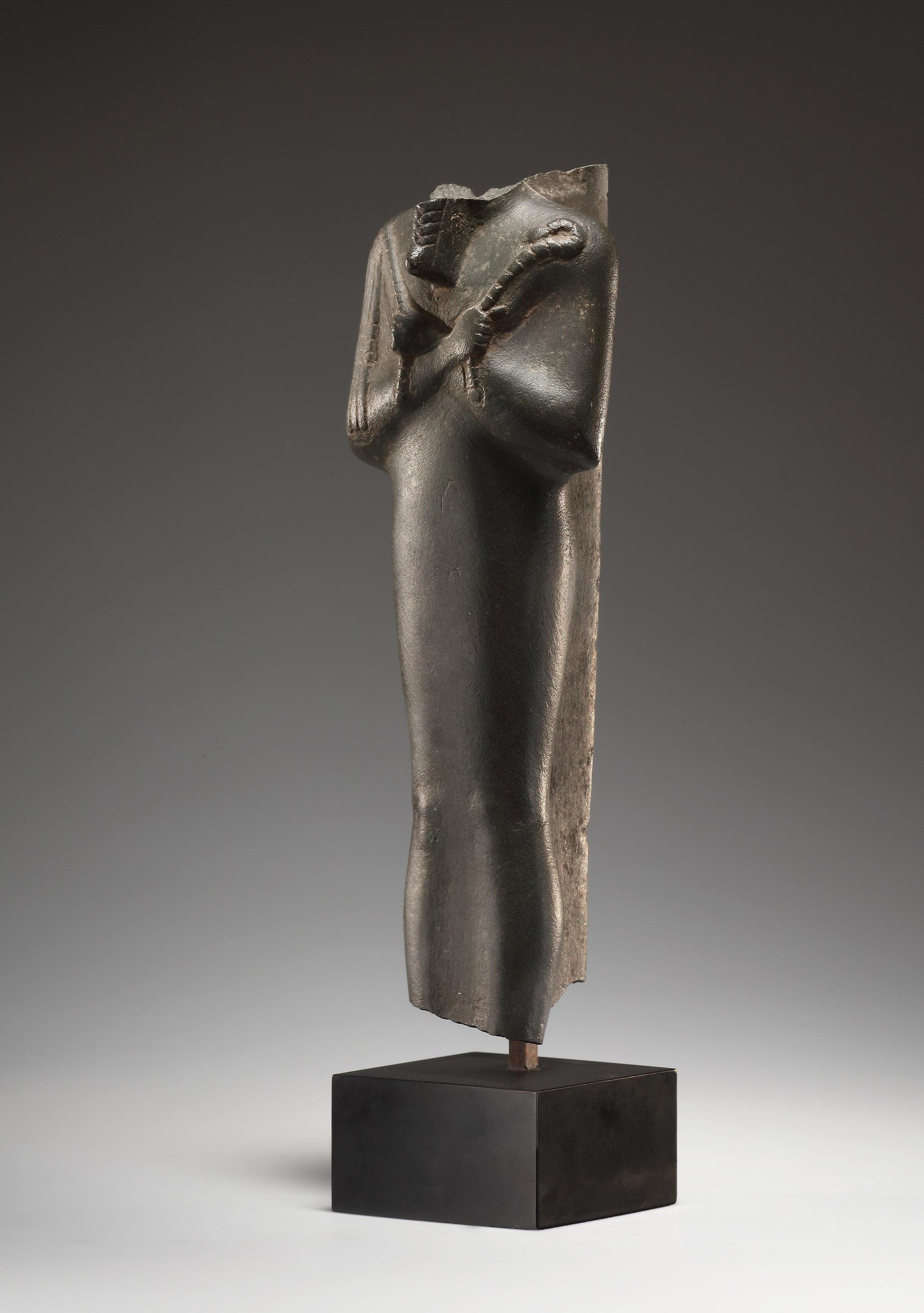
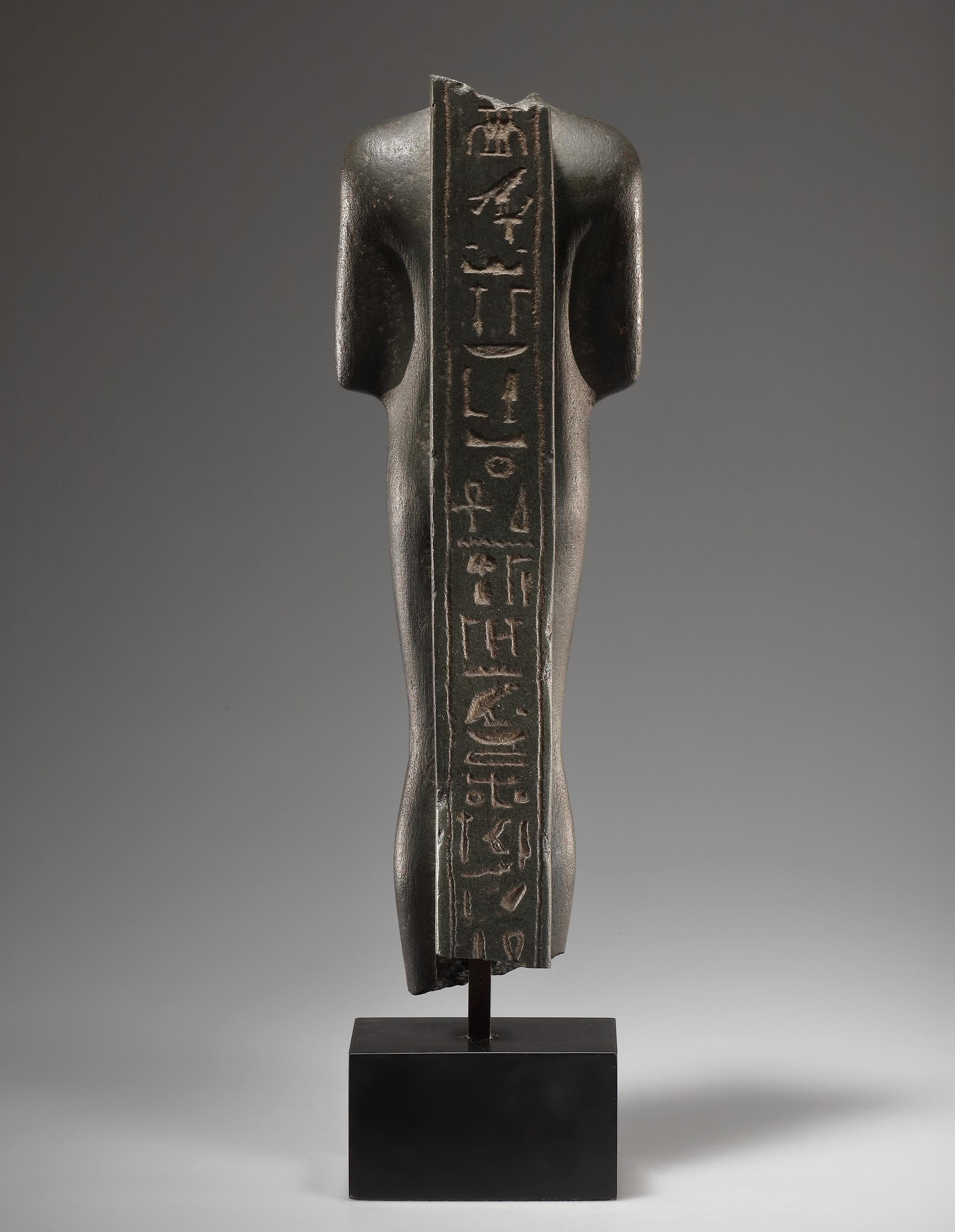
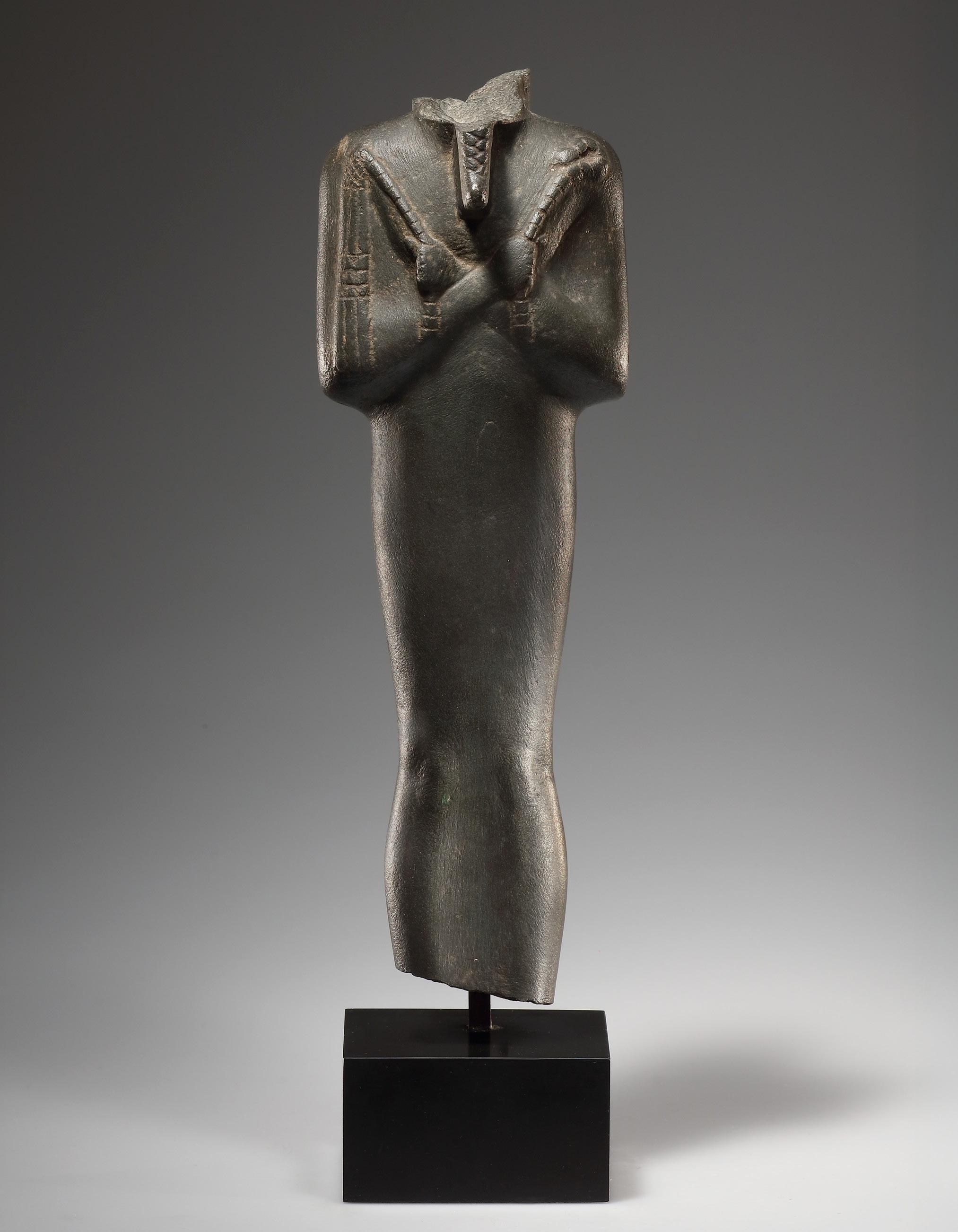
A STATUETTE OF OSIRIS
01 | Price on Request
Egypt, Late Period, 26th Dynasty (Saite Period) | ca. 650 B.C. Greywacke | H. 24,5 cm | W. 8,2 cm | D. 9,0 cm
This high quality statuette of Osiris shows the god of the dead in his typical appearance with a mummified body and plaited beard of the gods. He holds the insignia of power, crook and flail, in front of his chest. The sculpture is remarkable for the elegance of its contours both when viewed from the front and in profile. The knees and lower legs are subtly delineated beneath the garment. An inscription in hieroglyphs on the dorsal pillar: “Osiris, ruler of the West, great god, Lord of Abydos, gives life to the first prophet and scribe of the divine documents of the goddess Mut, Lady of Megeb, [whose name is] Iuef Aa, son of ….”. Osiris is the ruler of the underworld and thus one of the most important deities in the Egyptian pantheon. Head, feet and base lost. Rim of pillar very slightly worn.
NOTE
Cf. two statuettes of Osiris dating from the same time in the Louvre, inv. nos. N 3952 and E 9418 (both online).
PROVENANCE
Formerly priv. coll. Roger Liechti (b. 1934 - d. 2010), Petit-Lancy, Switzerland (inv.no. E. 477); acquired in 1972 from Galerie Beurdeley, Boulevard Saint-Germain, Paris
(the piece was already there in 1968). Thence by descent in the family, Switzerland.
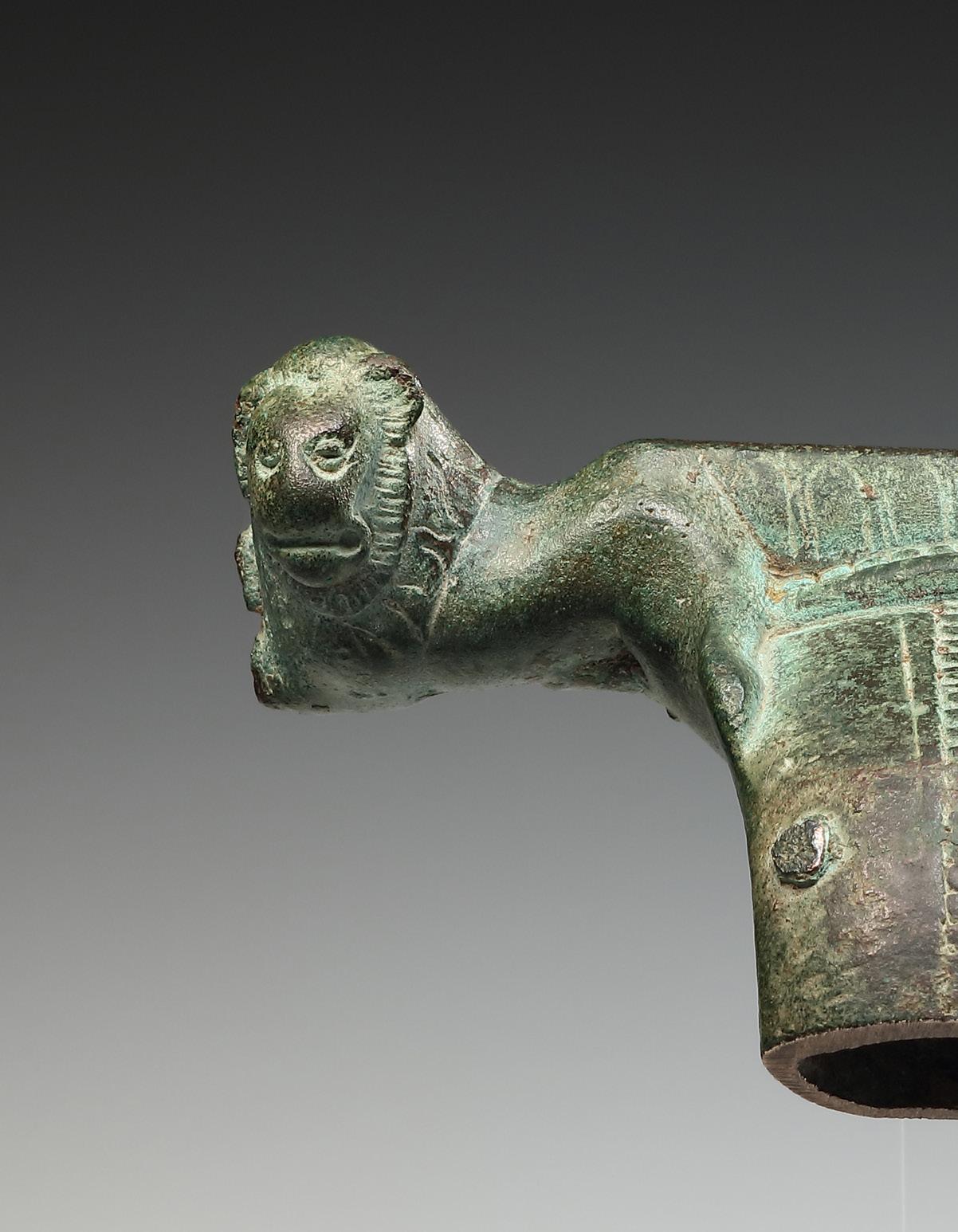
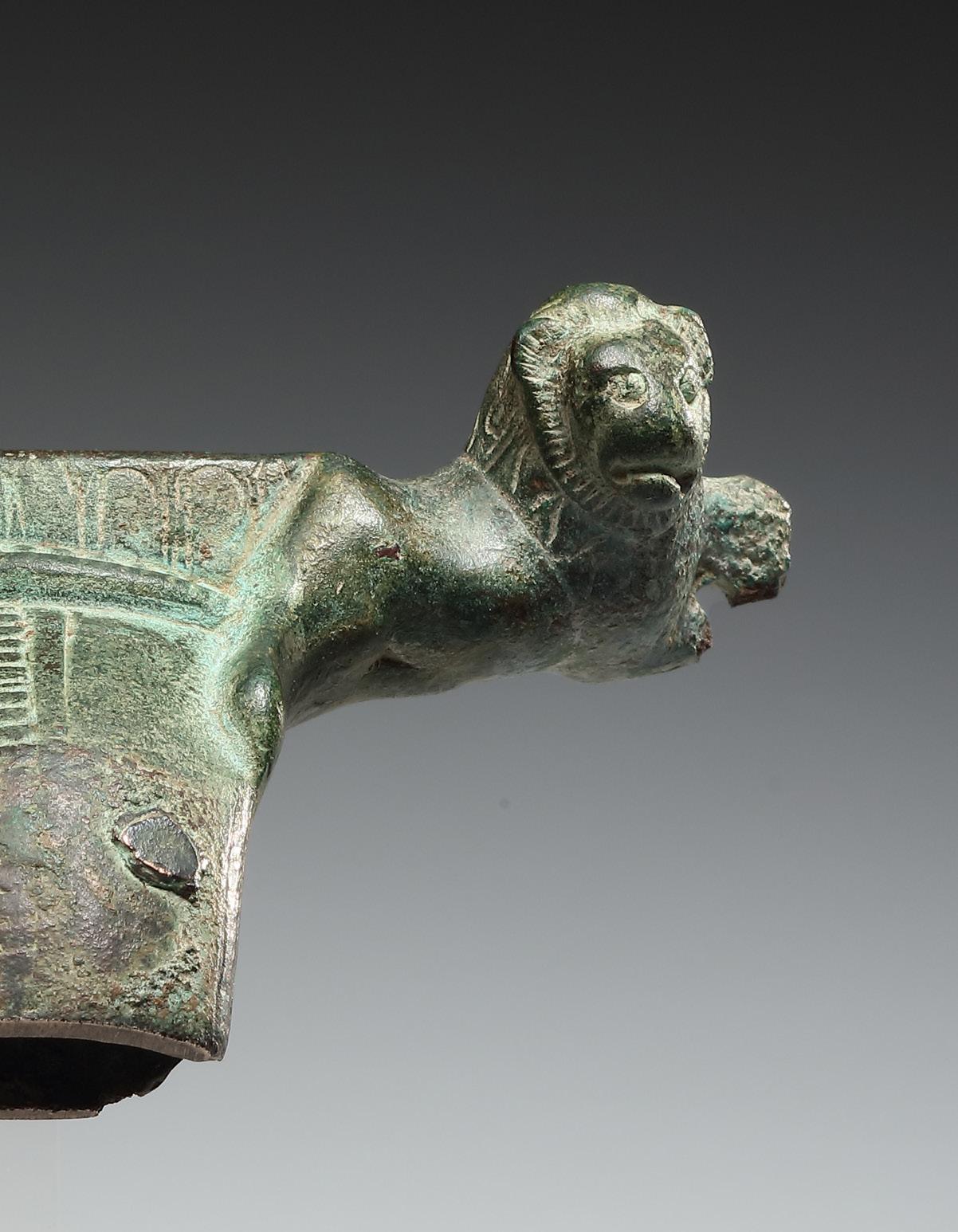
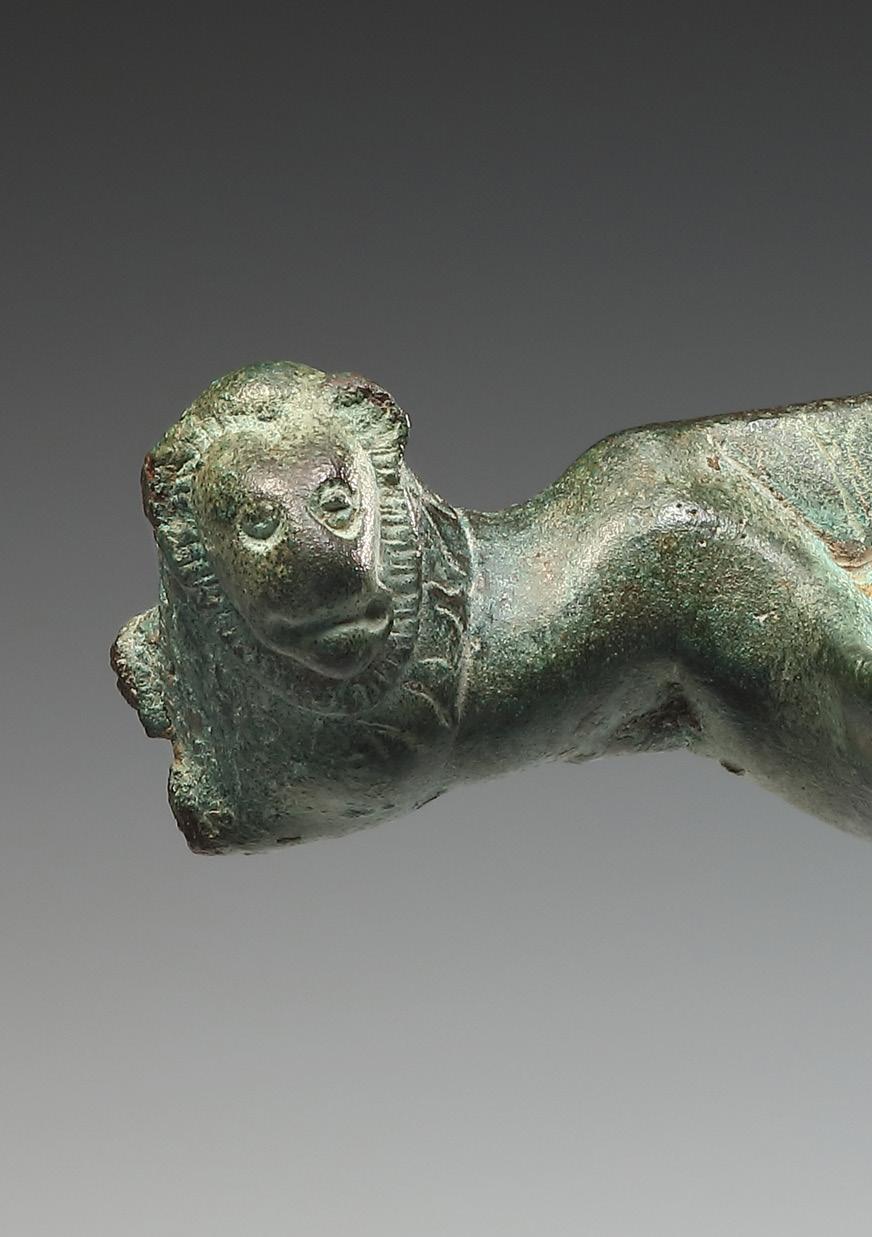
THE UPPER PART OF A HANDLE OF A HYDRIA WITH LIONS PROTOMES
02 | CHF 4.500
Greek, Laconian | mid-6th century B.C.
Bronze | H. 3,5 cm | W. 10,9 cm | D. 6,5 cm
The recumbent lions with outstretched forepaws, together with the section between them, form the top of a vertical handle that was attached to the rim of a vessel. The lions turn their heads towards the beholder. Their eyes are punched, and their manes are finely engraved with short dashes and flames. The section between the lions is decorated with a finely engraved tongue frieze, below it a bead moulding and a semicircular torus. The lion’s tails dangle down the handle that is decorated in the middle with a bead pattern. Below the tails, the handle is pierced all the way through by two ancient rivets. Traces of the casting core at the vessel’s rim and in the interior of the handle. Paws of the lions partially preserved. Lower edge of the handle cropped in modern times. Cracks in the handle closed and retouched.
NOTE
This fragment of a vertical handle comes from a large bronze hydria. It is closely related to the vertical handles with paired lions, tongue frieze and beaded decoration of a complete bronze hydria in the Coll. Walter Kropatschek, see W. Hornbostel et al., Aus Gräbern und Heiligtümern 2, Cat. Hamburg (Mainz 1980) 156 ff., no. 92 with illus.
PROVENANCE
Formerly priv. coll. Pierre Amandry, French archaeologist and excavator of Delphi and Delos. Consigned to Münzen und Medaillen AG, Basel, Kunstwerke der Antike 51, 14.15.3.1975, lot 225. Purchased there by Dr. Frank Hieronymus (1930-2022), Basel, bookseller and classical philologist.
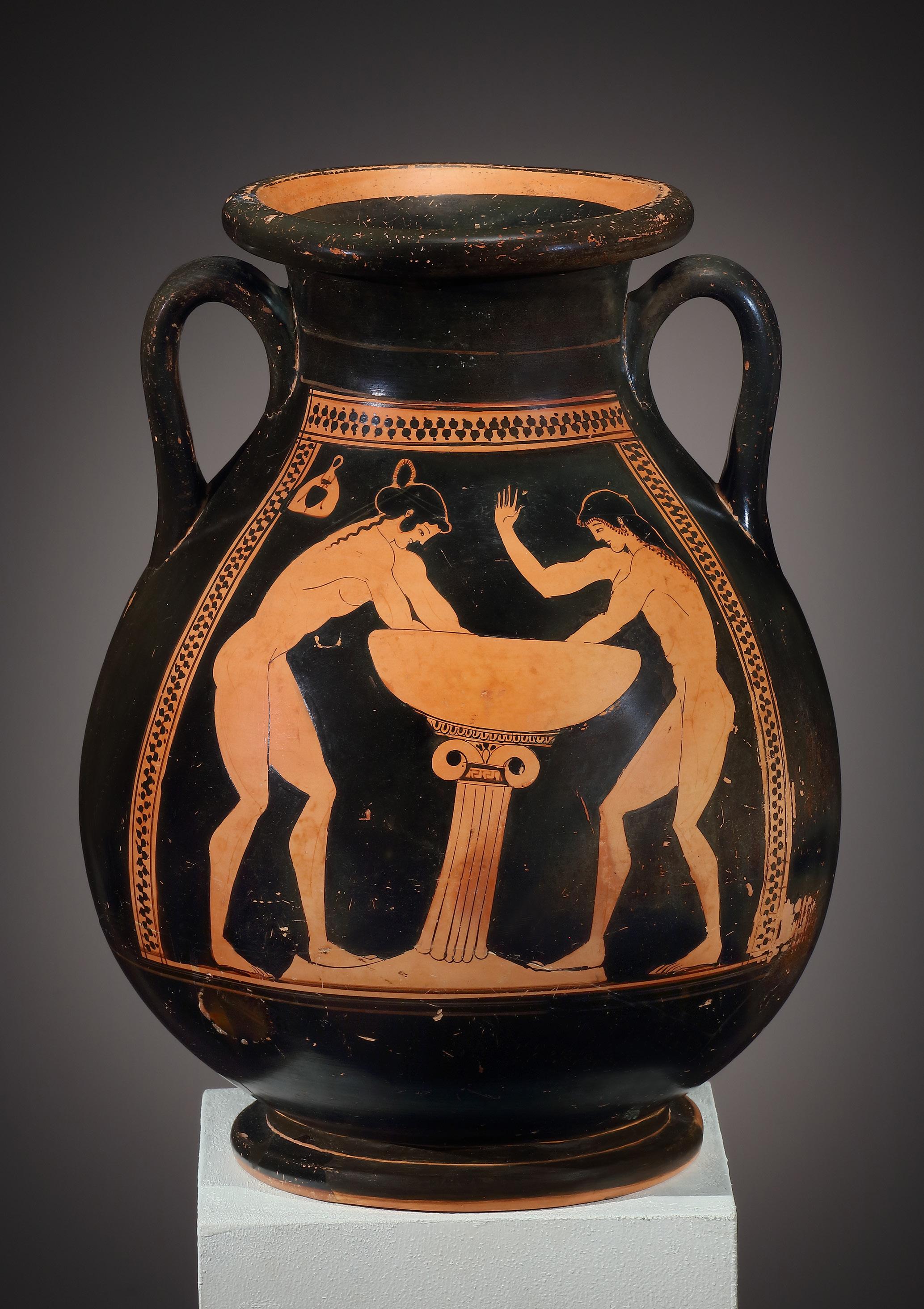
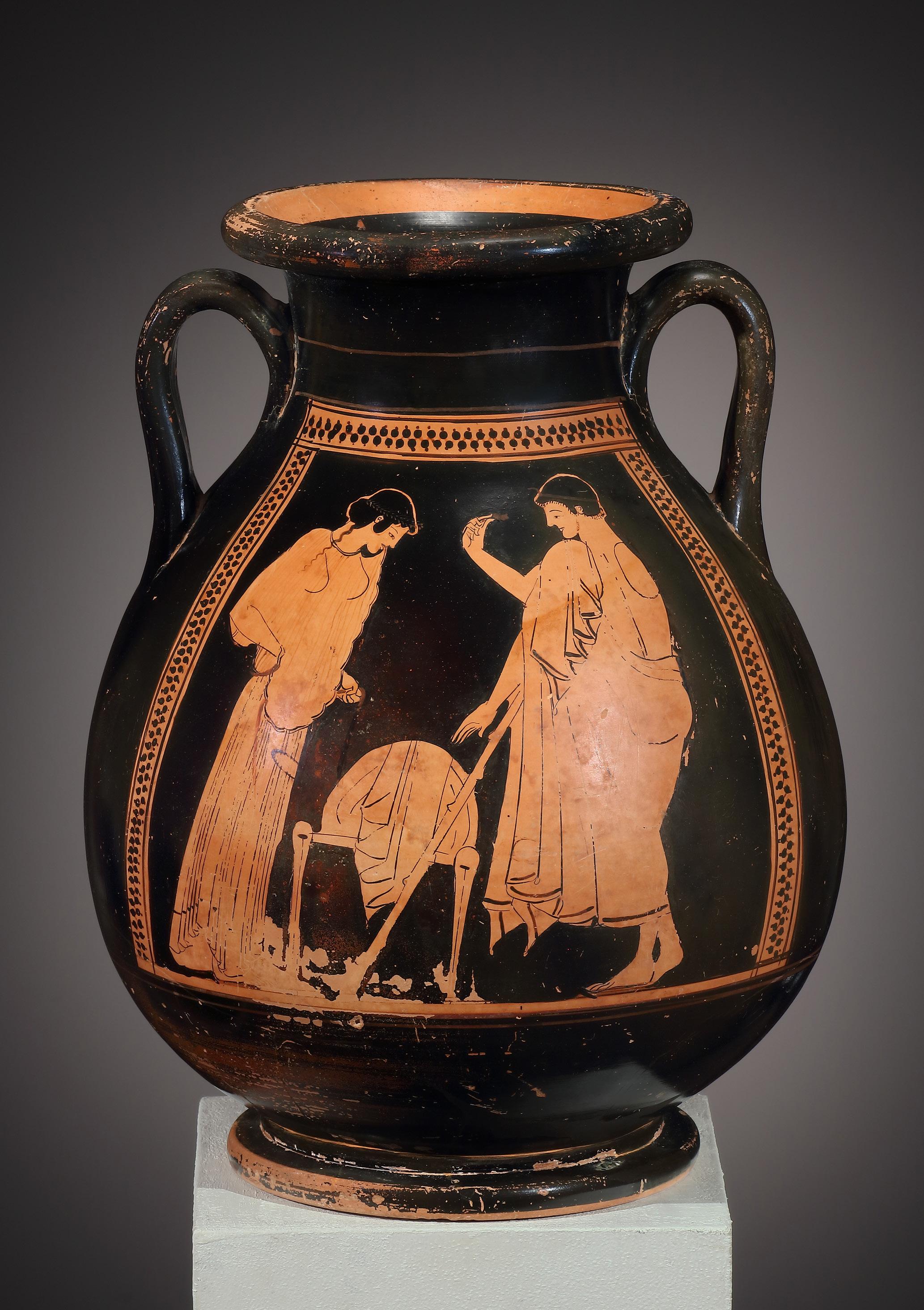
RED-FIGURE PELIKE ATTRIBUTED TO THE TYSZKIEWICZ PAINTER
03 | Price on Request
Attic | ca. 490 - 480 B.C. | Clay
H. 37,0 cm | Diam. Rim 18,0 cm | Diam. Body 30,9 cm | Diam. Foot 18,5 cm
Large pelike with a piriform body on a discoid foot, belonging to Becker‘s Class XII. The inside of the neck is glazed; on the inside of the rim, a reserved band. At the junction of body and the discoid foot, a rounded fillet profile. The lower part of the discoid foot is reserved and the bottom is unpainted. It bears a graffito (Johnston, Trademarks, type 5F and 9F) very similar to a graffito found on the bottom of another pelike attributed to the Tyszkiewicz Painter (Villa Giulia, inv. 1129, from Falerii; cf. CVA Italia fasc. LXIV, p. 24). The pictures are framed above and laterally by pomegranate-nets. A purple line runs on the neck and above the picture frames, while a double line encircles the body below. Side A: Toilet scene depicting two naked maidens washing at a louterion. In the field, hanging on a wall, a sponge and aryballos. Side B: A maiden holds a fold of her chiton between her teeth, while using both hands to adjust her belt. Beside her, a male observer – perhaps the bridegroom –leans on a stick and offers a flower. Between the figures is a stool with a folded himation. The representation of the female body on A is based on masculine figures typically seen in palestrian scenes on contemporary ceramics. Thus, the flat chest, extremely elongated legs and very narrow hips. These
nude female bathers, which first appear on red-figure vases in the last decade of the 6th century B.C., have long been interpreted as Hetairai. However, this interpretation has been widely debunked, with more recent studies suggesting they are more likely to represent Parthenoi (Pfisterer-Haas 2002, Sutton 2009). These young nubile women would be performing their ablutions either as part of the preparation for the nuptial ritual, or as the final stage of an athletic activity which was encouraged for young women as beneficial to produce strong offspring. The motif of the maiden tying her girdle and holding the overfold of her chiton between her teeth, on B, belongs to a related theme. The act of belt-tying was a symbol of status change for unmarried as well as for pregnant women (Sabetai 1997, p. 321). Both panels thus evoke transitional moment in a young woman‘s life. The pelike is one of a number painted by the Tyszkiewicz Painter, known for his distinctive monumental style. The choice of large framed fields with stiff but well drawn figures, are characteristic of his work. Assembled from several fragments. Abrasions on the rim, handles, lower body of B, and foot. Minor dents. On lower body, in A, „ghost“ of a pomegranate-net pattern band caused by touching another vase
during firing. The lower part of the vase was broken in Antiquity and repaired (holes and oxydised bronze pins in the lower body and foot).
PROVENANCE
Formerly MuM AG, Basel, acquired between 1976 and 1977, inv. no. A7220 (see Widmer negative no 7998/7999/8000, dating March 1981). Exhibited in March 1981 at KAM Basel, list no. 77; in December 1981 at Classical Antiquities with Emmerich Gallery, New York, list no. 43; in March 1983 at KAM Basel, list no. 98. Thereafter, priv. coll. Mr. Pedro Benda (1918-2001), Lausanne; acquired in 1985 from MuM AG, Basel, KAM 1985, Basel, list no. 85. Since then in the family. With HVMC, auction 06.05.2018, lot 45. Photographed by Giacomo Medici, active until 1995, while in the property of the Benda collection, according to the Polaroid archive production number (see Polaroid produced in 01.1990: no. 01079G22949; Polaroid produced between 1980 and 1995: no. 00679G11926).
Publ.: Suzanne Pfisterer-Haas, Mädchen und Frauen am Wasser (Jahrbuch des Deutschen Archäologischen Instituts, 117, 2002), pp. 42, 71, cat. no. L8.
NOTE
On the Tyszkiewicz Painter, see J. Boardman, ARFH1, p. 113. On the iconography of naked women at louterion, see S. PfistererHass, Mädchen und Frauen am Wasser (Berlin 2002); R. F. Sutton, „The Invention of the Female Nude: Zeuxis Vase-Painting, and the Kneeling Bather“ in Athenian Potters and Painters, vol. 2 (Oxford 2009). On the motif of the maiden tying her girdle and holding the overfold of her chiton between her teeth, see V. Sabetai, „Aspects of nuptial and genre imagery in fifthcentury Athens“ in Athenian Potters and Painters, vol. 1 (Oxford 1997); S. Blundell, „Clutching at clothes“, in Women‘s Dress in the Ancient Greek World (London 2002) p. 143-170.
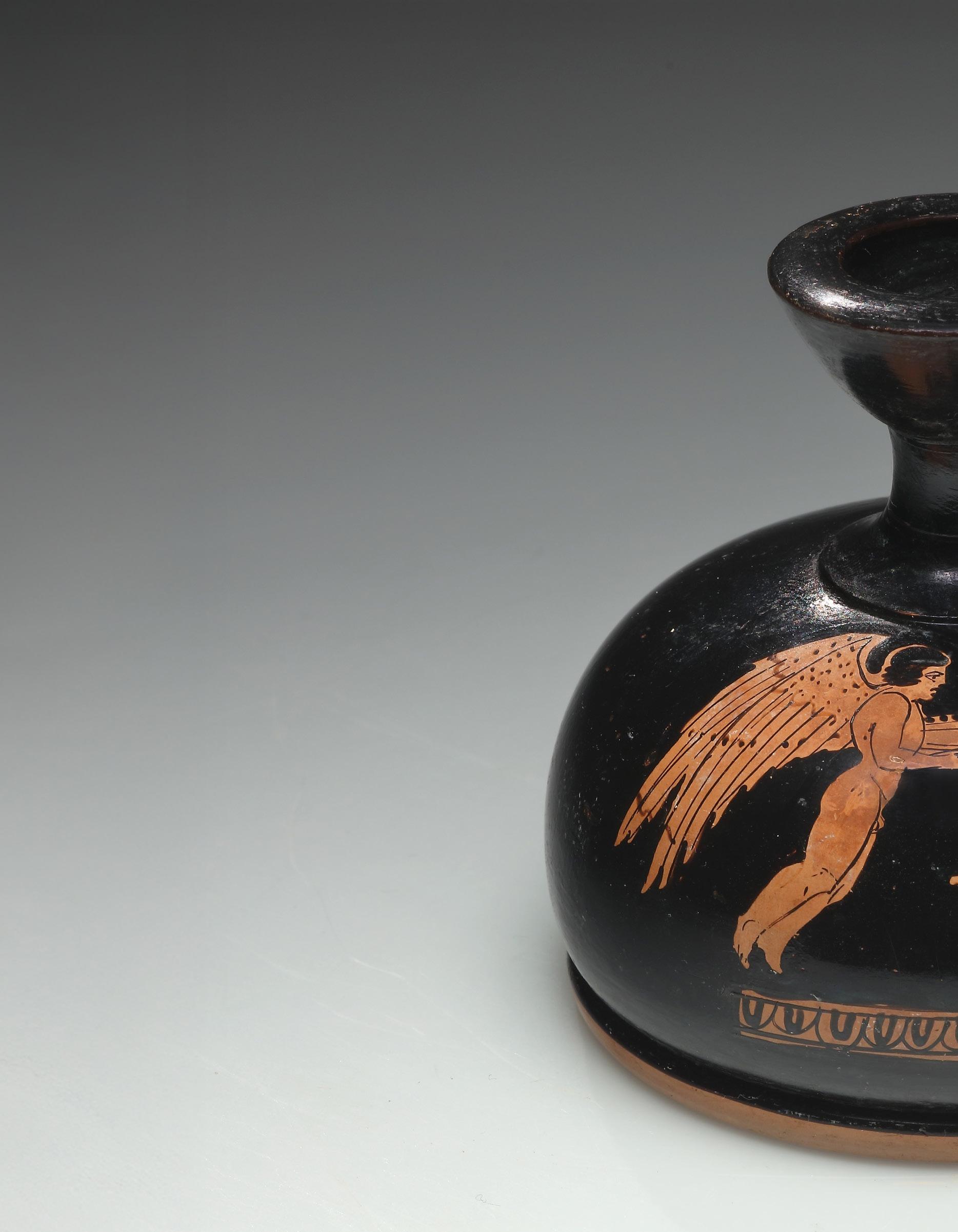
A RED-FIGURED SQUAT LEKYTHOS ATTRIBUTED TO THE WASHING PAINTER
04 | CHF 12.000
Attic, High Classical | ca. 430 - 420 B.C. Clay | H. 8,0 cm | Diam. Base 7,9 cm | Diam. Rim 3,5 cm
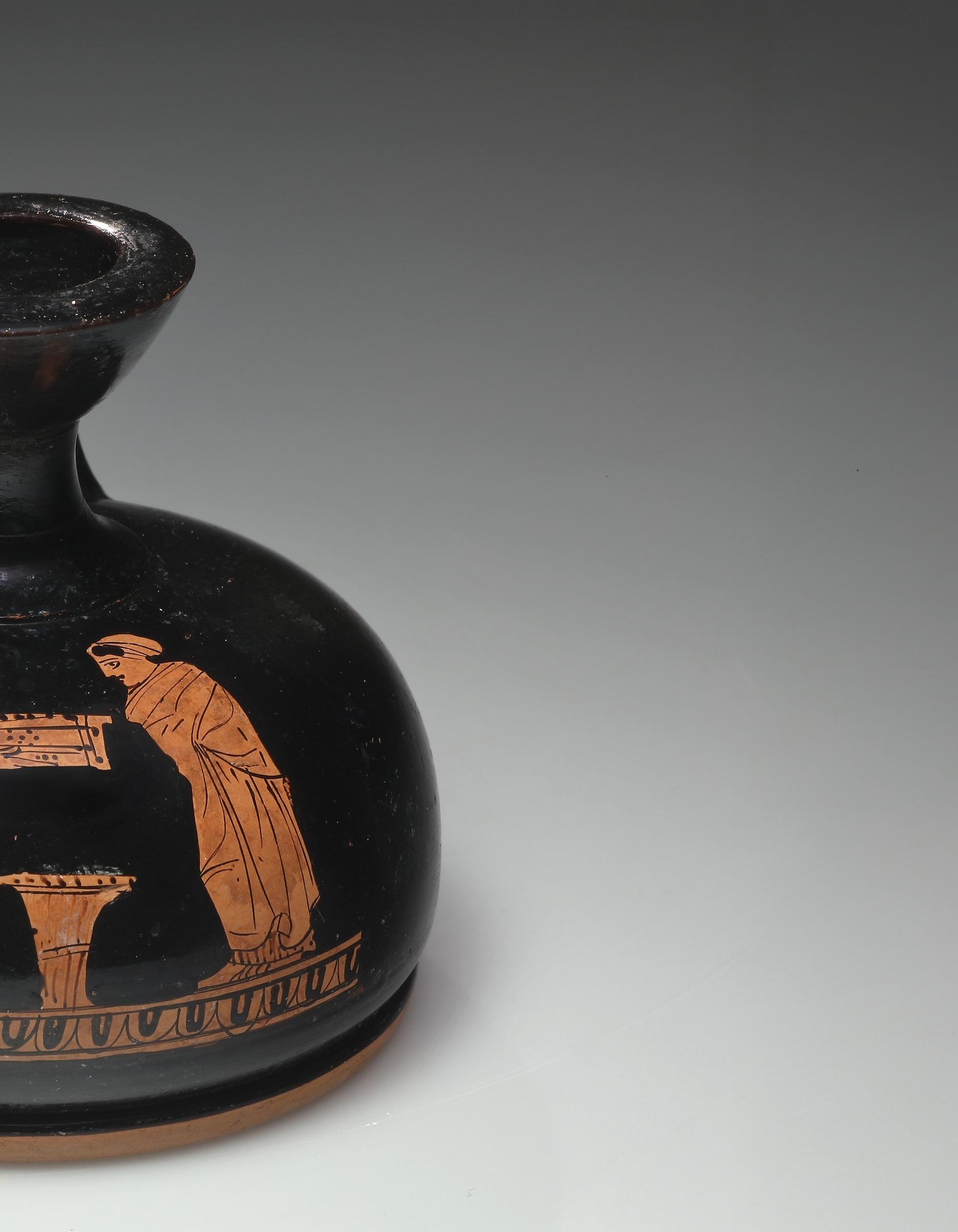
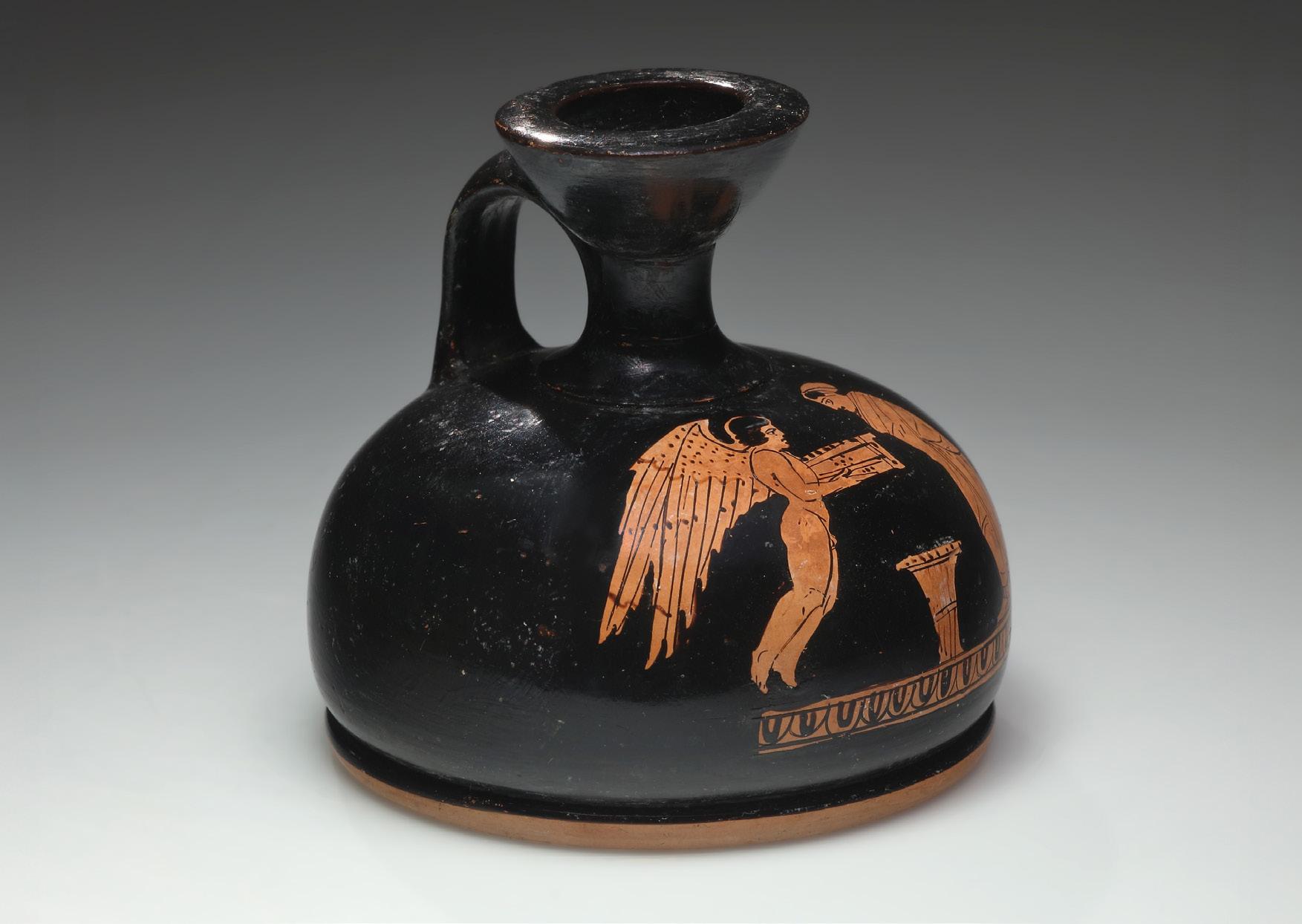
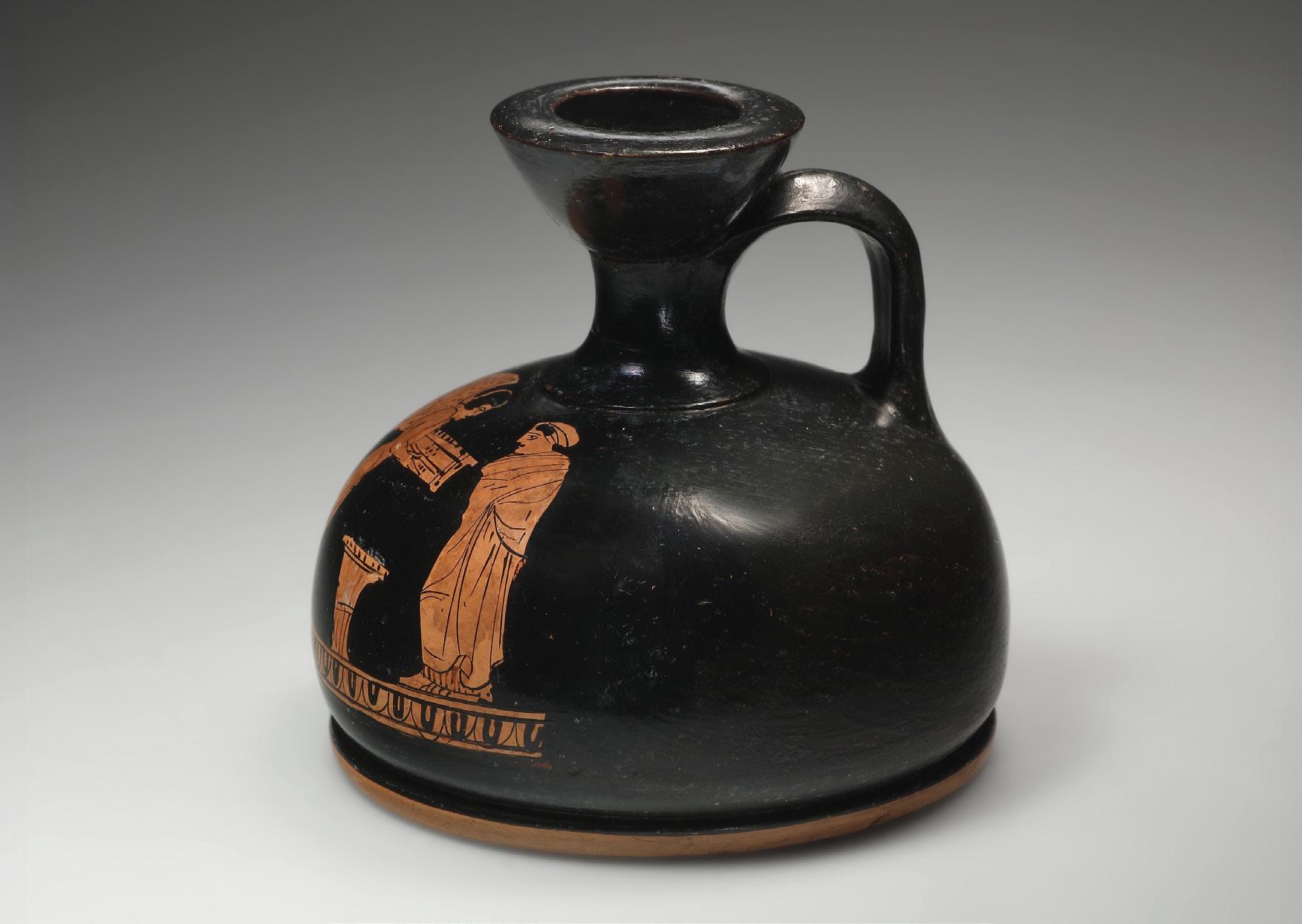
A red-figured squat lekythos with a broad, flat body on a ring foot. Neck, slightly offset from the shoulder; above, a wide echinus mouth. The shape is designed to hold oil or perfume. On an egg-pattern ground line, a woman stands facing left, wearing a chiton and himation; her hair bound in a sakkos. Eros flies towards her from the left, carrying a chest. Between them, a kalathos (wool basket) signals that the scene is set in the gynaeceum. Attributed to the Washing Painter by J.D. Beazley, this lekythos exemplifies the graceful style of this painter, and his preference for wedding imagery, well attested on his pyxides, loutrophoroi and nuptial lebetes. Shiny black glaze; minor retouches of the varnish; small chip filled with toned plaster on mouth and handle; concretions beneath the foot; otherwise intact.
PROVENANCE
Formerly priv. coll. Kussmaul, Basel. With MuM AG, Basel, auction XVI, 30.06.1956, lot 139. Thereafter, priv. coll. Erika (b. 1934 - d. 2025) and Jakob (b. 1927 - d. 2025) Binkert, Binningen, Switzerland; inherited from Jakob‘s father, August Binkert-Textor (b. 1896 - d. 1979), collected between 19401970, Basel. Since then in the family. See
Widmer negative no 640, dated 03.1956. Publ. Beazley AVR2, 1961, cat. no. 191.
NOTE
On the painter, see ARV² 1126–35; Paralipomena 453–54, 517; Addenda² 332–33. The Washing Painter takes his name from the scenes of women bathing that he painted on a group of small hydriai. Martin Robertson (The Art of Vase-Painting in Classical Athens, Cambridge 1992, 223–27) suggests that he may have trained in the Achilles Painter‘s workshop, alongside the Phiale Painter. The shape is rare and may be specific to the Washing Painter and his workshop, though it can be compared with a squat lekythos attributed to the Achilles Painter, formerly in the Philadelphia market (BAPD 4655; J. H. Oakley, The Achilles Painter (Mainz/Rhein 1997), cat. no. 162). See also Wolf W. Rudolph, Die Bauchlekythos (Bloomington 1971), 40, category VIII.C. (‚Klasse des Washing-Malers‘).
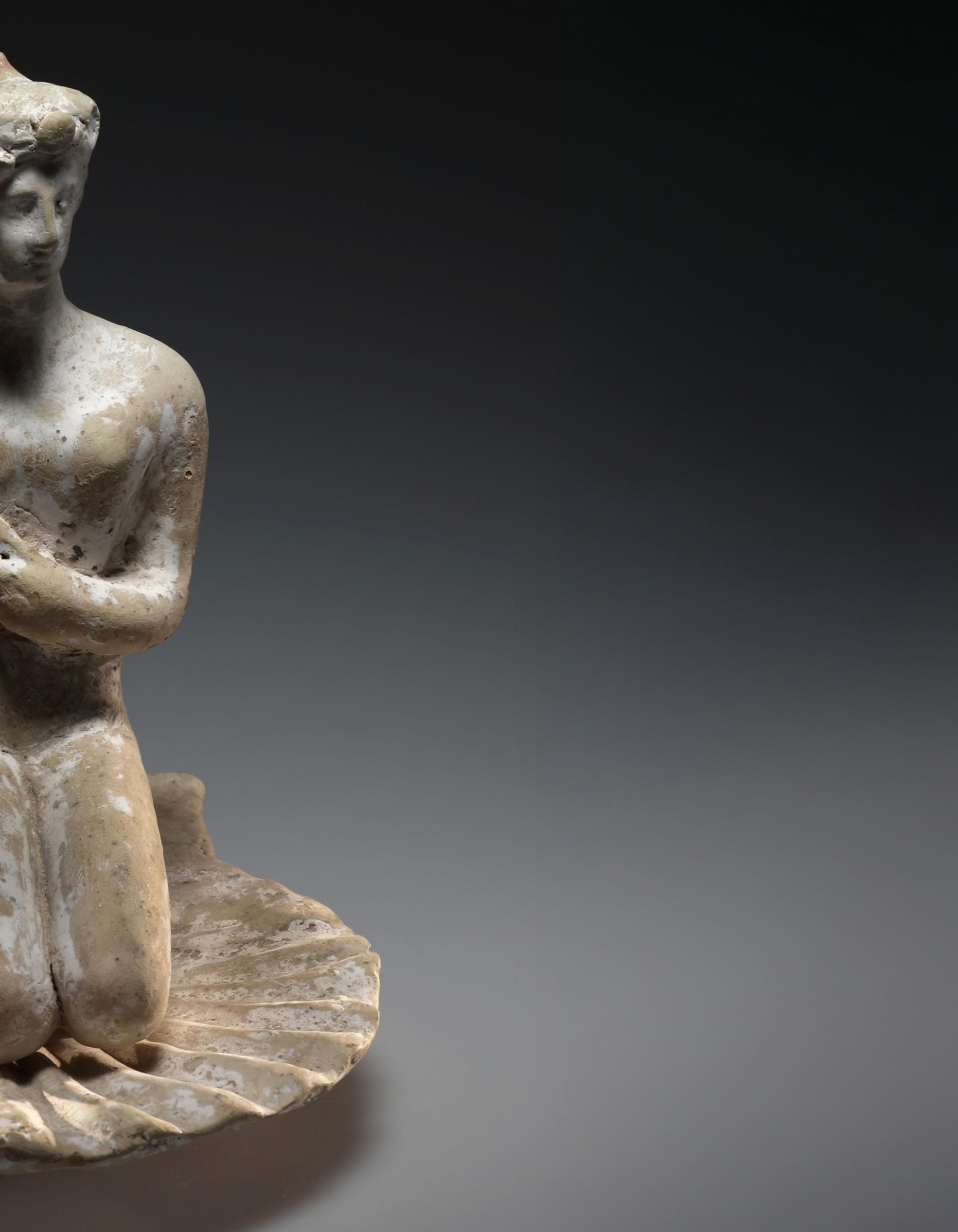
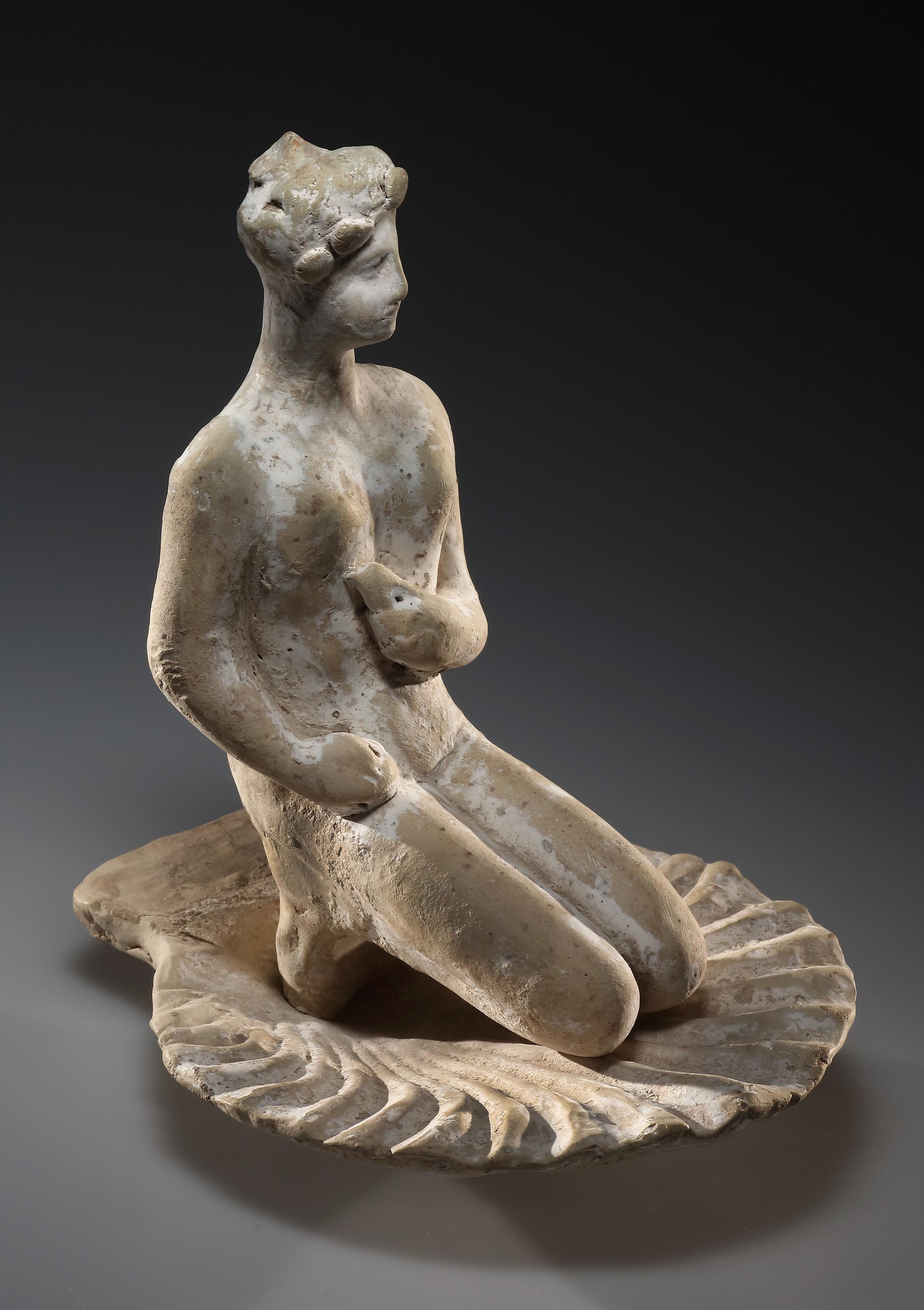
A STATUETTE OF APHRODITE KNEELING IN A
SHELL
05 | CHF 14.000
Greek or Western Greek | 4th century B.C.
Terracotta | H. 18,8 cm | W. 16,0 cm | D. 14,0 cm
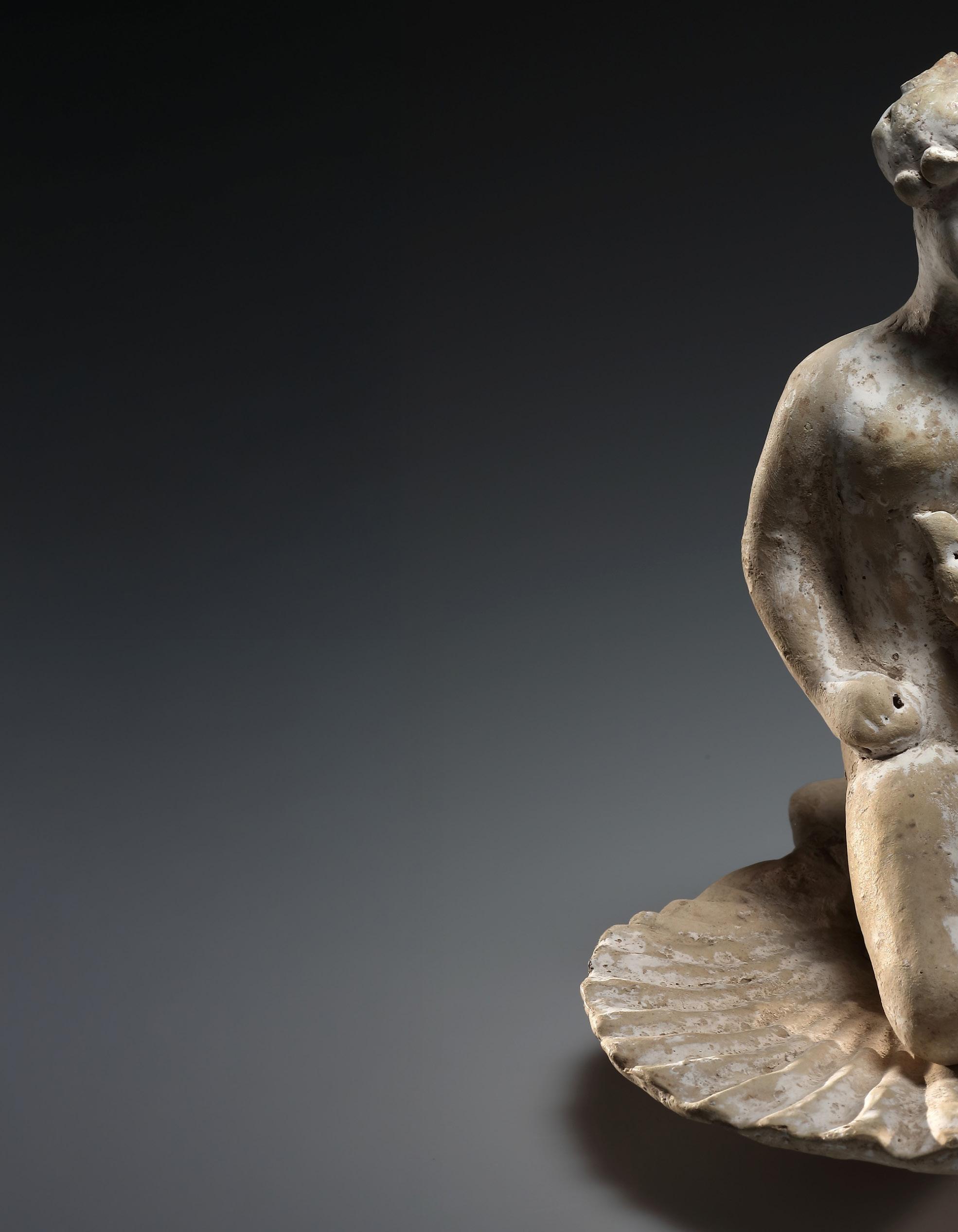
The nude goddess kneels in a scallop shell. Her bent left arm is placed against her chest and she holds a small bird, presumably a dove, in her hand. Her closed right hand rests on her thigh. Her hair is tied up in a (now lost) chignon at the top of the back of her head. She wears a wreath or diadem of discs in her hair above her forehead. According to Hesiod (Theogony 170 ff.), Aphrodite is the daughter of Uranus. At the behest of his mother Gaia, Uranus’s son Kronos cut off his father’s genitals and threw them into the sea. The sea foamed up around them and gave birth to Aphrodite. Referring to this myth, “the foam-born one” is depicted kneeling in or on the open valves of a shell in Greek-Hellenistic coroplastic art. Large areas of white engobe remain on the shell and figure. Traces of red paint in the hair. Chignon and a decorative disc lost, otherwise intact.
PROVENANCE
With Sotheby‘s auction, 12-13.12.1983, London, lot 562. With MuM AG, Basel, before 1985 (see Widmer negative no. 8782). Formerly priv. coll. Mr. Pedro Benda (19182001), Lausanne; acquired in 1987 at KAM Basel, list no. 111. Since then in the family.
NOTE
On Aphrodite in a shell, cf. LIMC II (1984) 103 f., nos. 1013-1017, pls. 99-100 s. v. Aphrodite (A. Delivorrias).
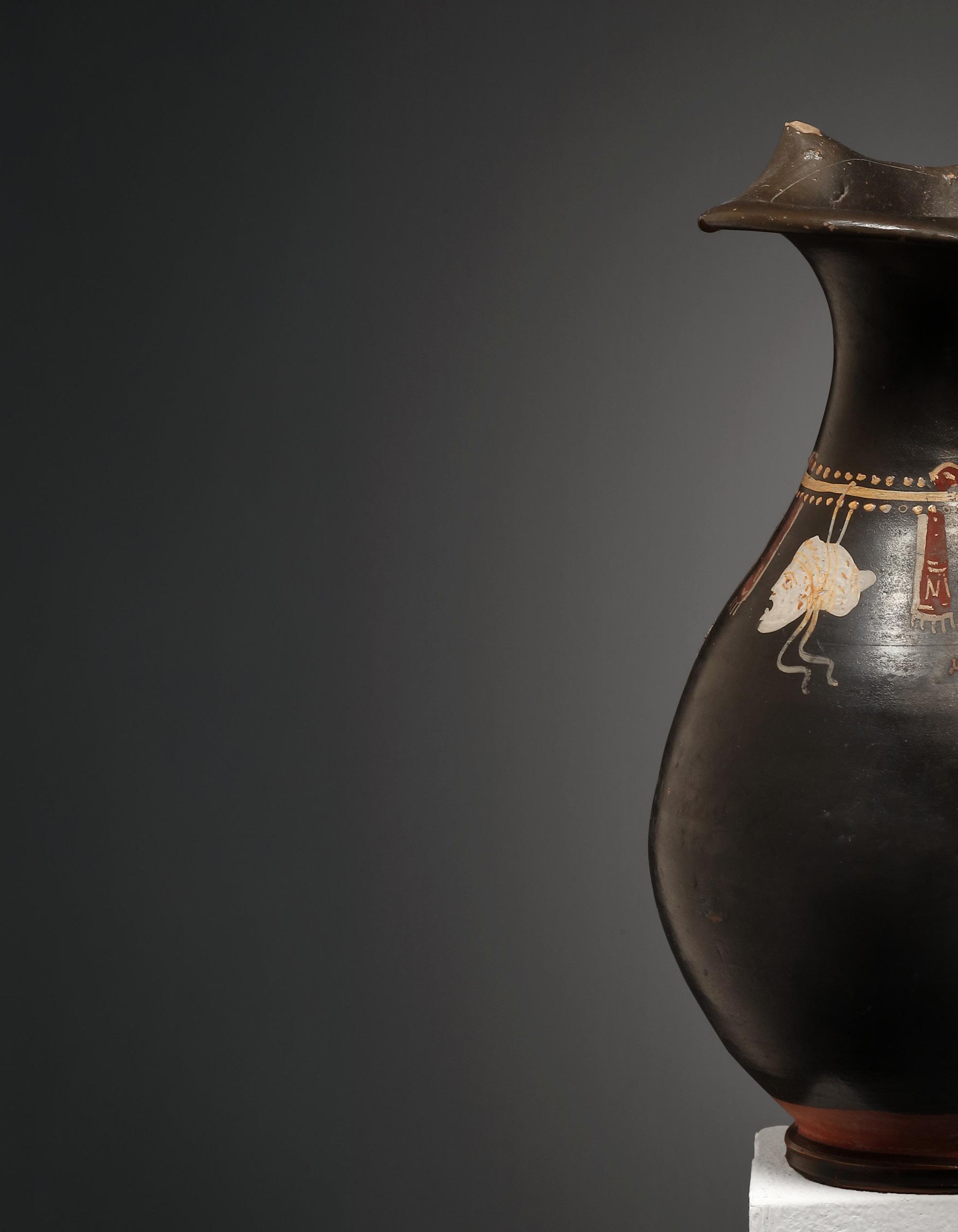
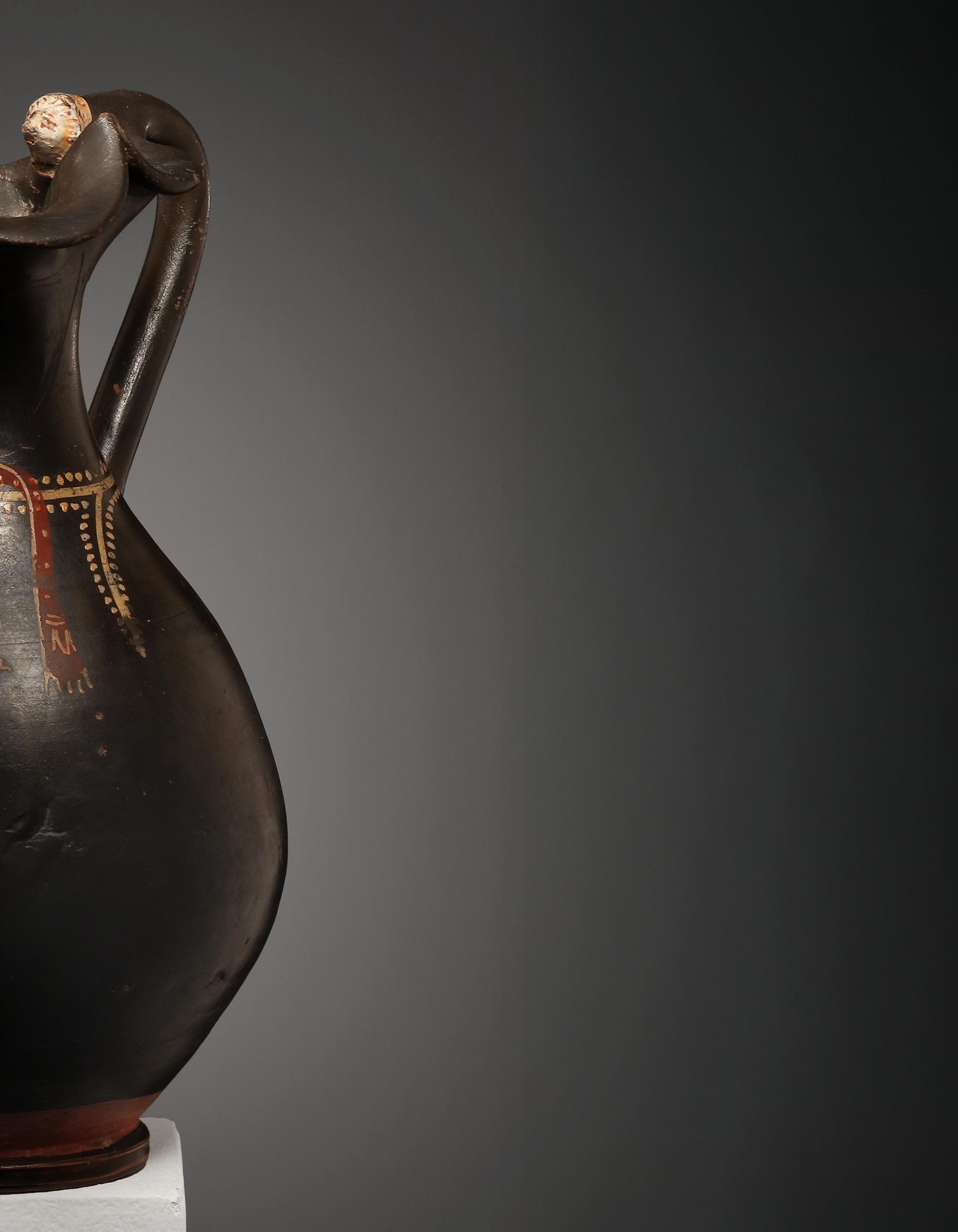
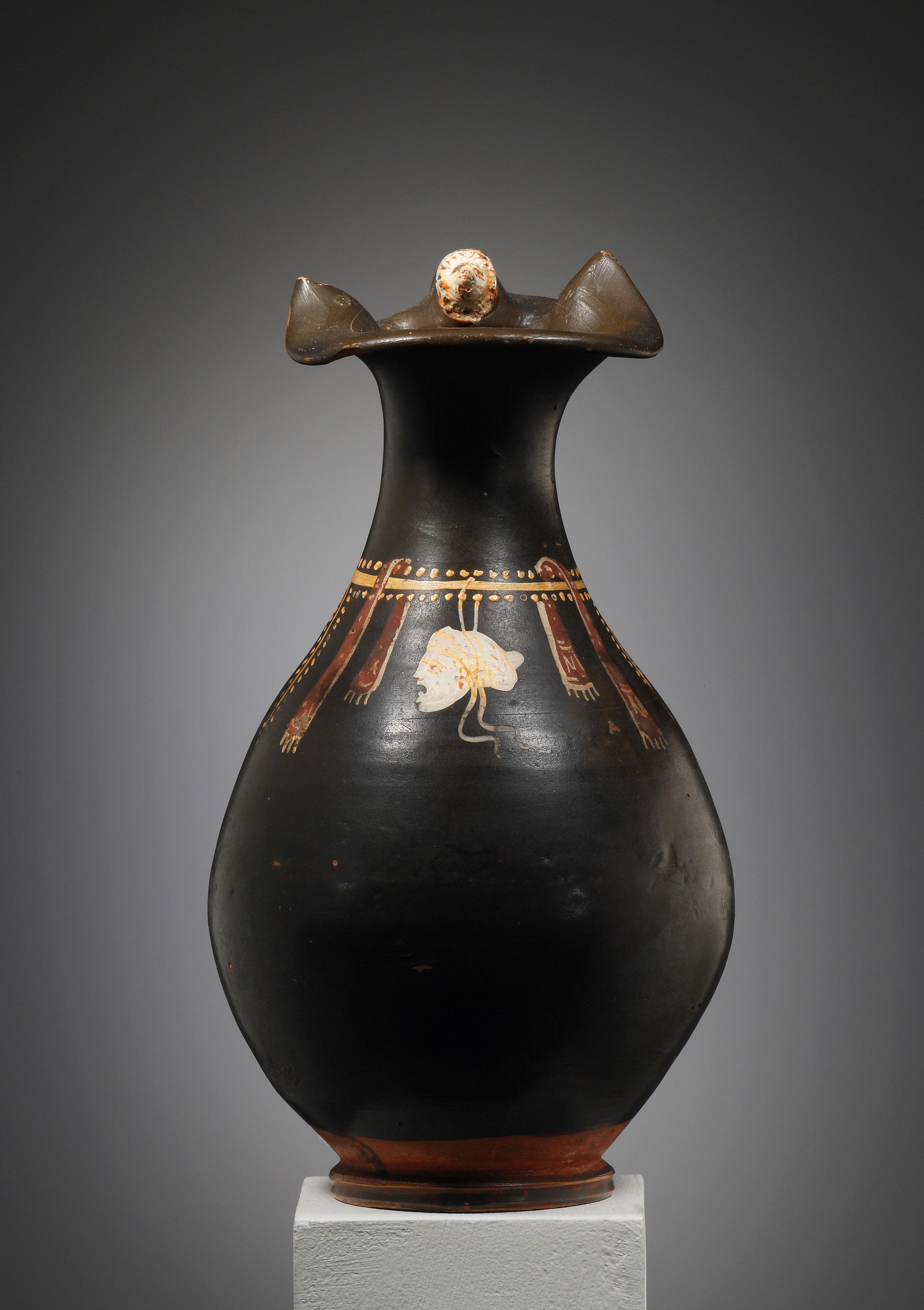
AN OINOCHOE WITH LIONS HEAD APPLIQUE
06 | CHF 8.800
Western Greek, Apulian | Last quarter of 4th century B.C. Clay, black glaze, red, white and yellow paint | H. 21,7 cm | Diam. Body 11,5 cm
A pear-shaped, black-glazed oinochoe of type 3, with trefoil mouth much pinchedin, and flat, profiled ring foot. The neck is adorned by a white-yellow tendril from which a female theatre mask, red fillets and whiteyellow twigs are suspended. The transition of the handle to the rim is enlivened by a plastic, polychrome lion‘s head applique. A reddish, reserved band above the foot. Paint abraded in places. Mouth slightly worn.
PROVENANCE
Formerly Coll. Alphonse Raifé (1802-1860).
Published: F. Lenormant, Description des antiquités, égyptiennes, babyloniennes, assyriennes, mèdes, perses, phéniciennes, grecques, romaines, étrusques et américaines composant la collection de feu M. A. Raifé, Paris, 1867, 181, no. 1420 (old collection label on the underside of the vase). Thereafter Paris priv. coll., acquired 1990.
NOTE
For the shape and decoration, cf. L. Forti, La Ceramica di Gnathia (Naples1965) pl. 1 c-d; Metropolitan Museum New York, inv. no. 76.12.8.
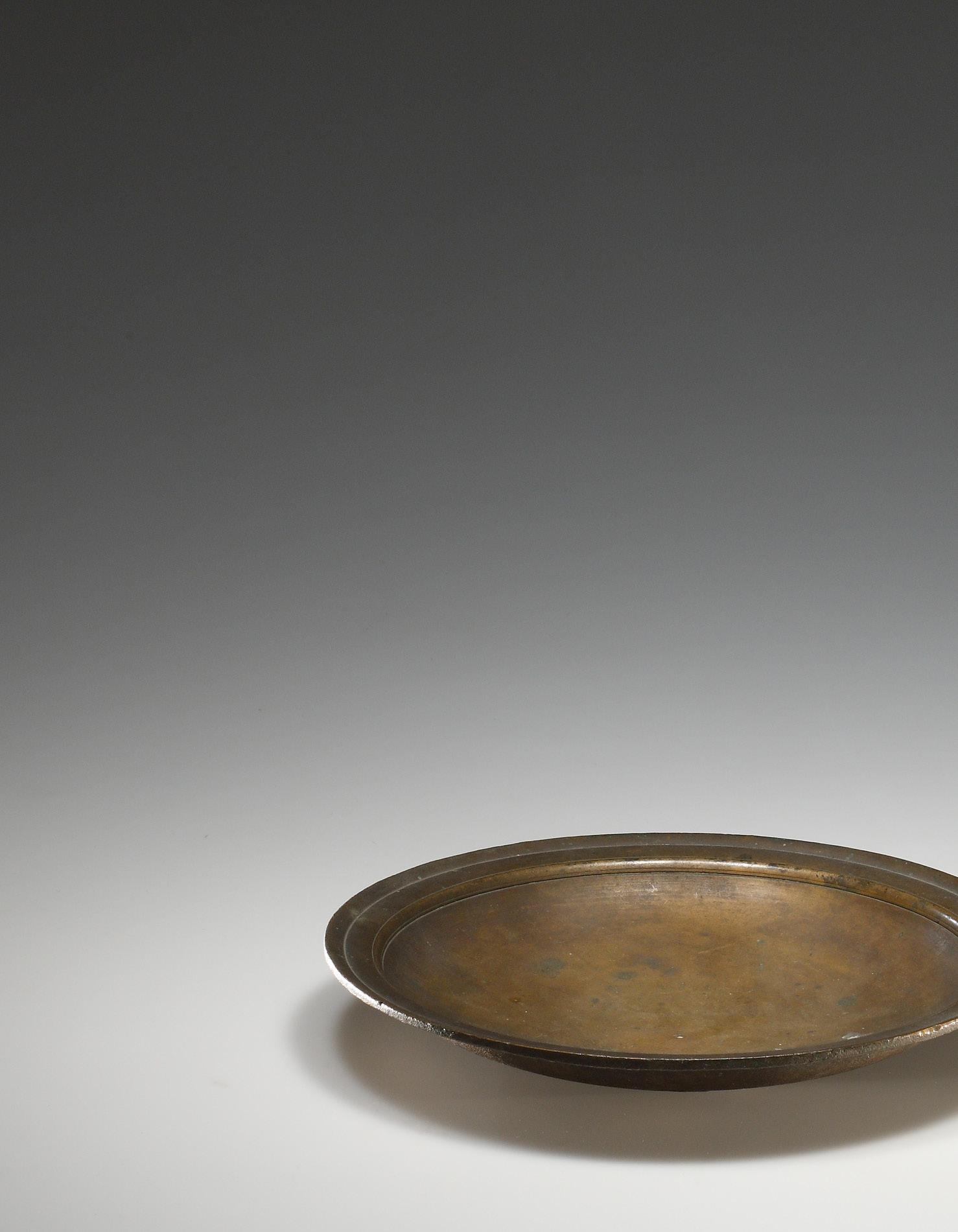
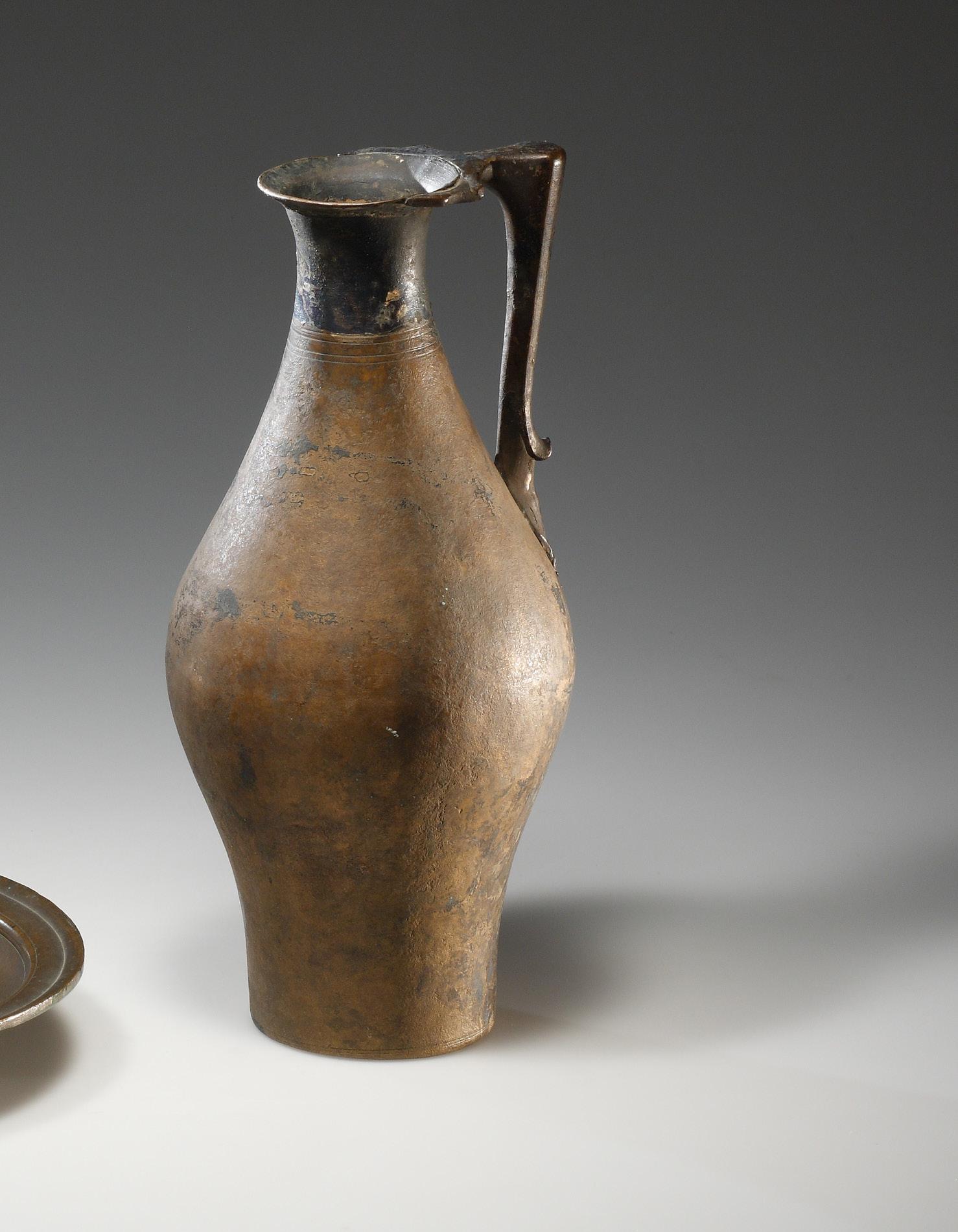
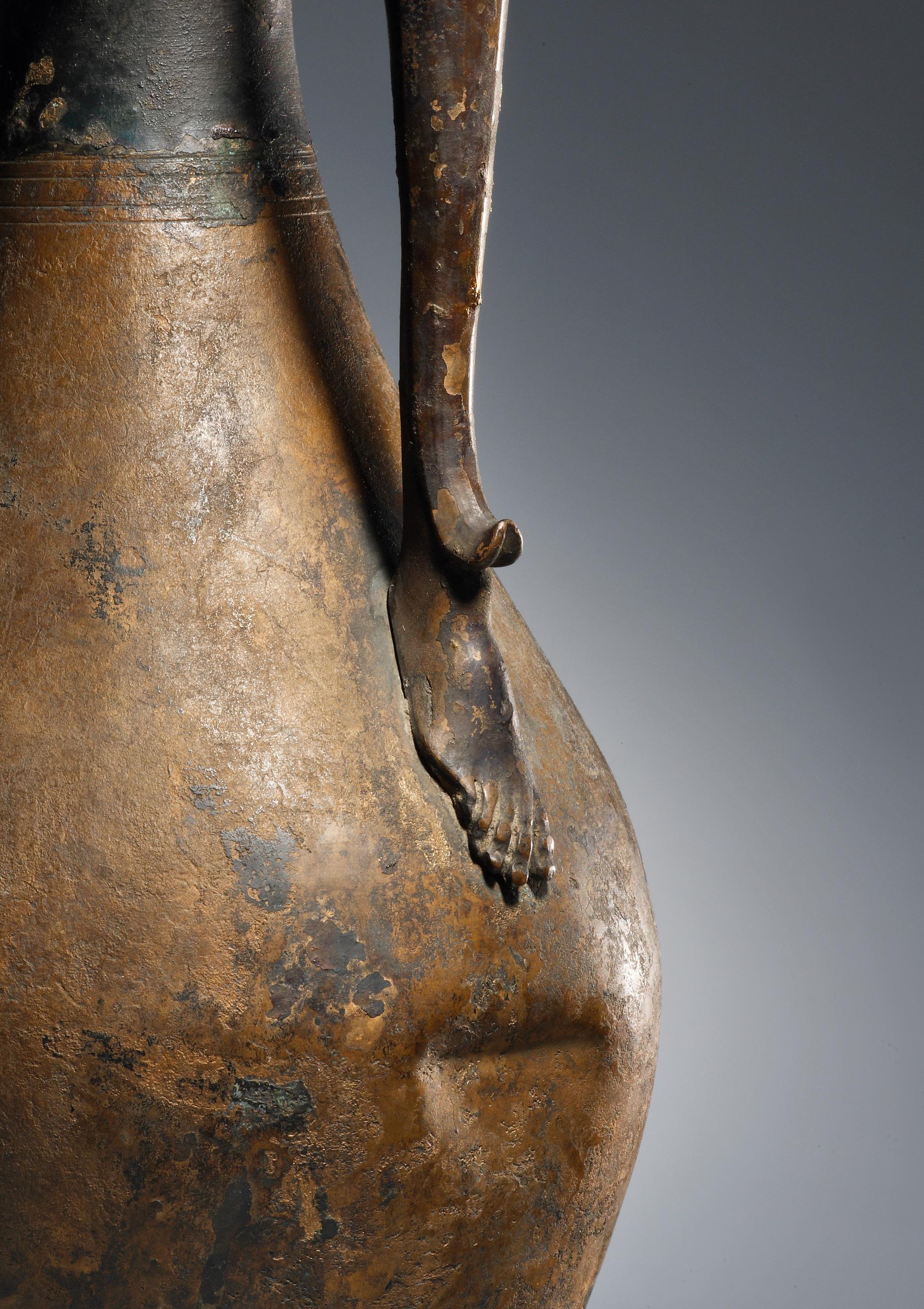
A TALL JUG AND A DEEP PLATE
07 | CHF 9.800
Roman | 2nd half of 2nd century A.D. | Bronze, iron
H. Plate 3,5 cm | Diam. Plate 22,4 cm | H. Jug 28,4 cm | W. Jug 12,5 cm
Jug: Slender vessel which widens in the middle. The rim of the everted mouth is folded outwards. A separately fashioned, right-angled handle with several edges leads from the rim to the shoulder of the jug. The lower end is adorned by an applique in the shape of a male right foot and a pointed leaf. Turning rills at the neck, foot and base. Traces of adhesive on the outside of the rim. Intact. Said to have been found in Grand (Vosges). Plate: Slightly concave wall and flat base ring. Broad rim with two turning rills which is folded outwards delicately. Set-off on the interior by a sharp bend. An inscription, probably naming the owner, on the exterior of the rim: FLAVI. Below it, old label: „SS6 FLAVI“. Below it, the number „SS6“ is written in a modern hand in pencil. An ancient repair within the ring base. Otherwise undamaged.
NOTE
For the jug, cf. a nearly identical specimen in K. Deppert, Römisches Bronzegeschirr im Museum für Vor- und Frühgeschichte zu Frankfurt am Main (Frankfurt a. M. 1977), 12 ff., with illus.; G. Faider-Feytmans, Les Bronzes Romains de Belgique (1979) 186f., no. 385 pl. 164f. For the dish, cf. S. Boucher-S. Tassinari, Bronzes Antiques du
Musée de la Civilisation Gallo-Romaine à Lyon, Vol. 1, Cat. Lyon (1976) 133, no. 161 with illus.
PROVENANCE
Formerly priv. coll. Louis-Gabriel Bellon (1819-1899), Paris. With Jack Philippe Ruellan, auction, Paris, 4.4.2009, lot 278. Old collection label on the underside of the plate with handwritten note „955 FLAVI“.
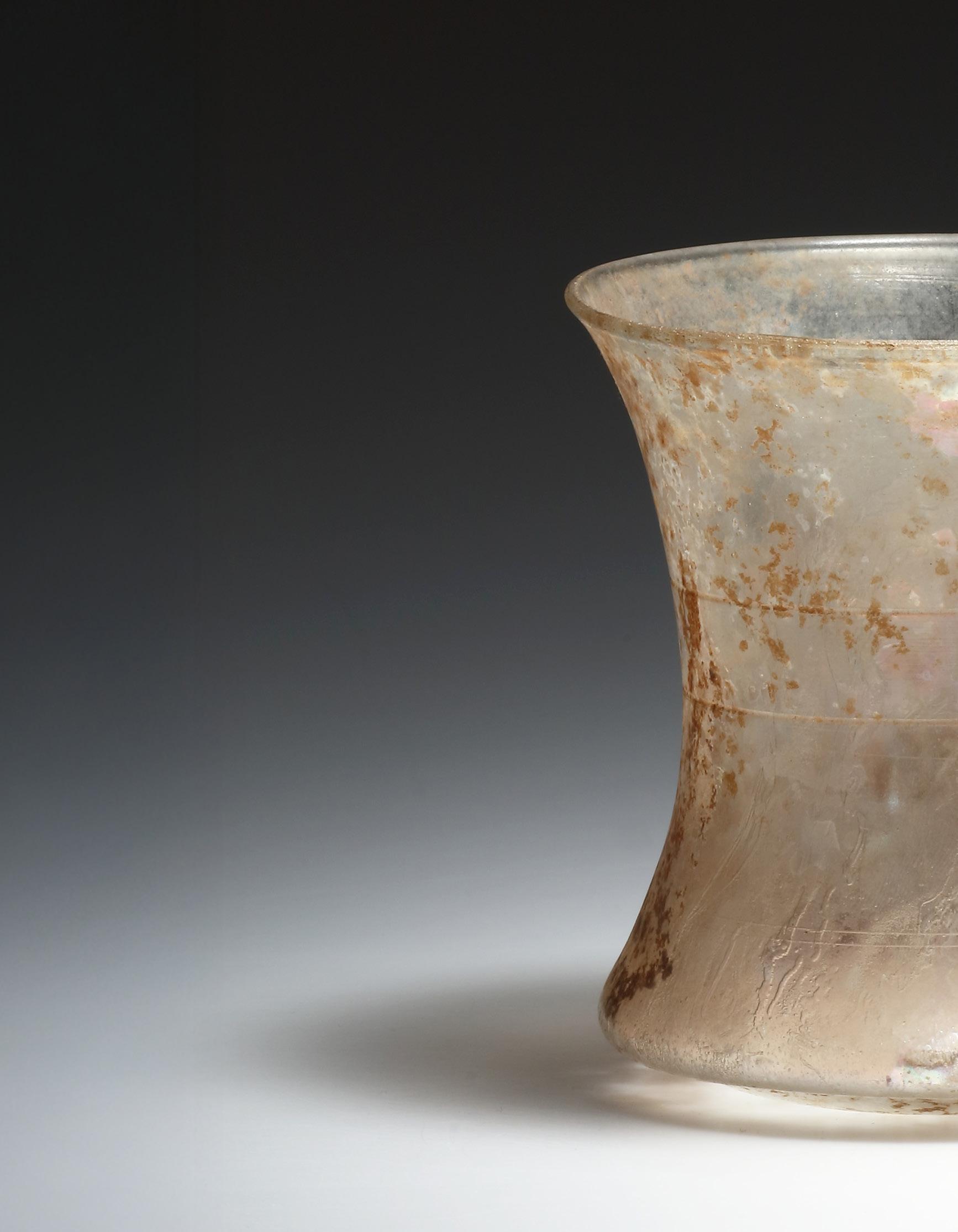
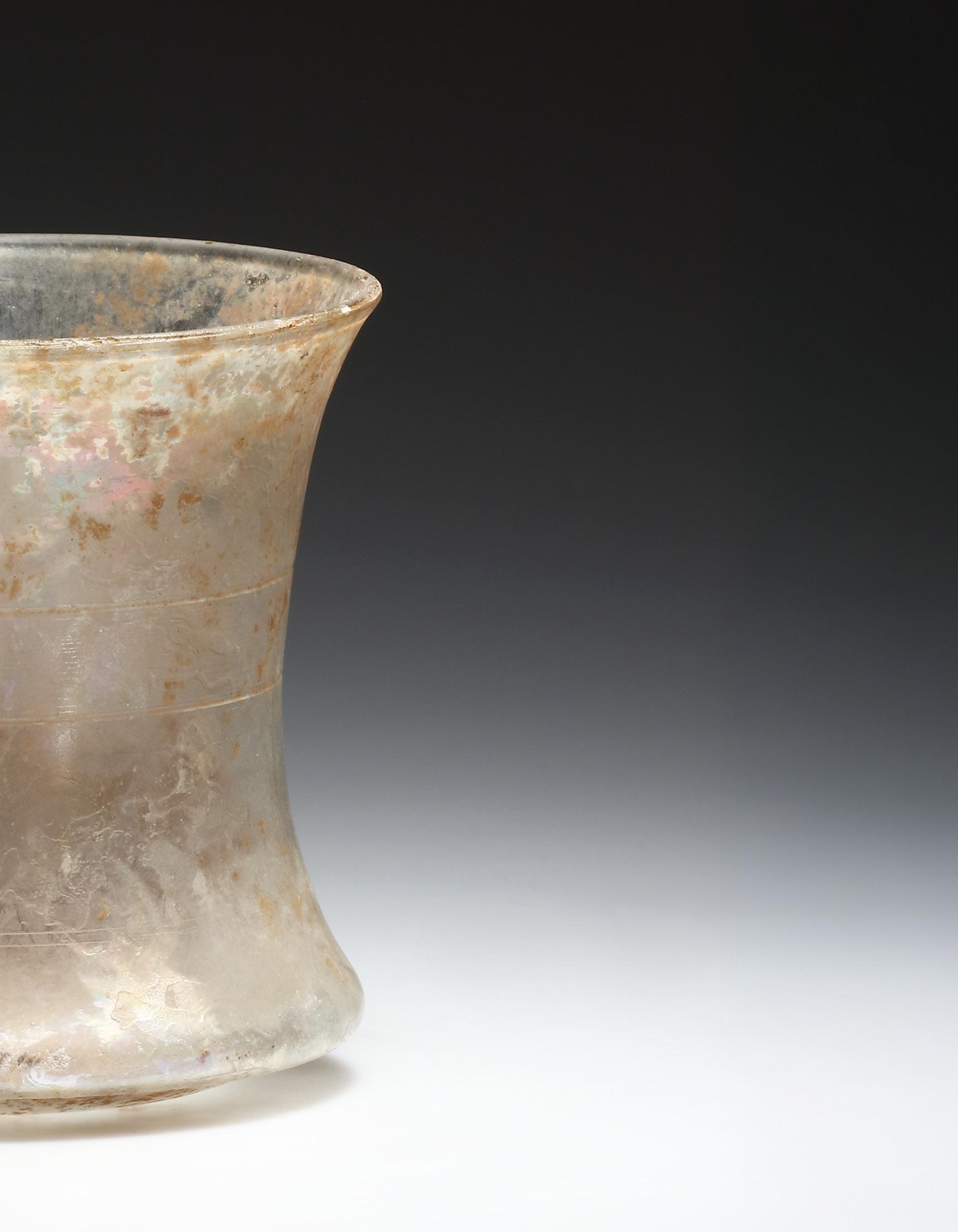
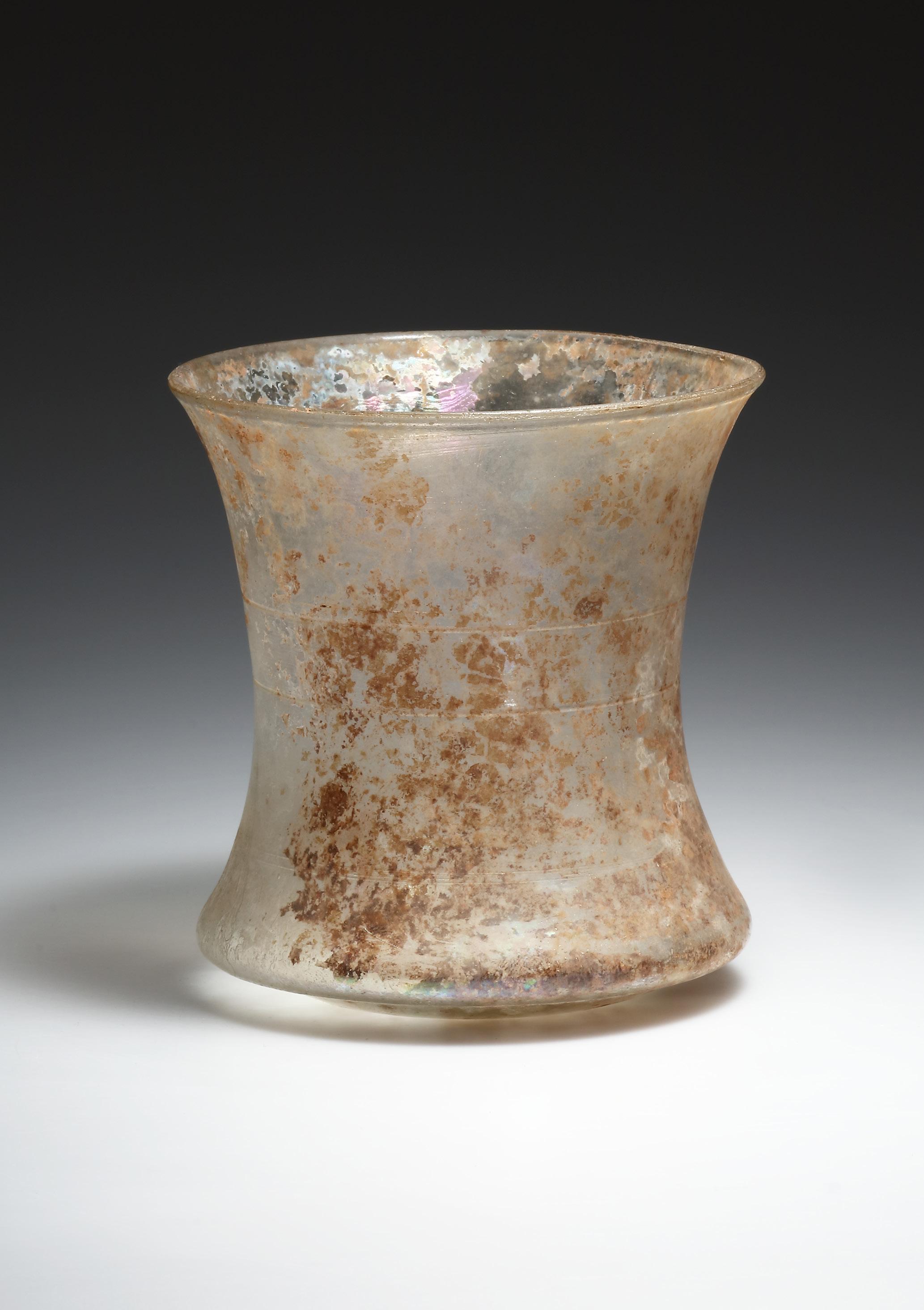
A BEAKER
08 | CHF 1.200
Roman | 1st - 3rd century A.D.
Colourless glass | H. 10,1 cm | Diam. Rim 9,5 cm
Beaker with elegantly curved, concave wall. Decorative encircling grooves of different widths cut into the wall. Bottom slightly arched in the middle. Free-blown. Fine brownish deposits in the interior. Slightly iridescent. Two tiny chips missing at the rim, otherwise undamaged.
PROVENANCE
Formerly Coll. Viviane Alioth, Basel.
NOTE
Cf. D. Whitehouse, Roman Glass in the Corning Museum of Glass, vol. 1 (New York 1997) 226, no. 383.
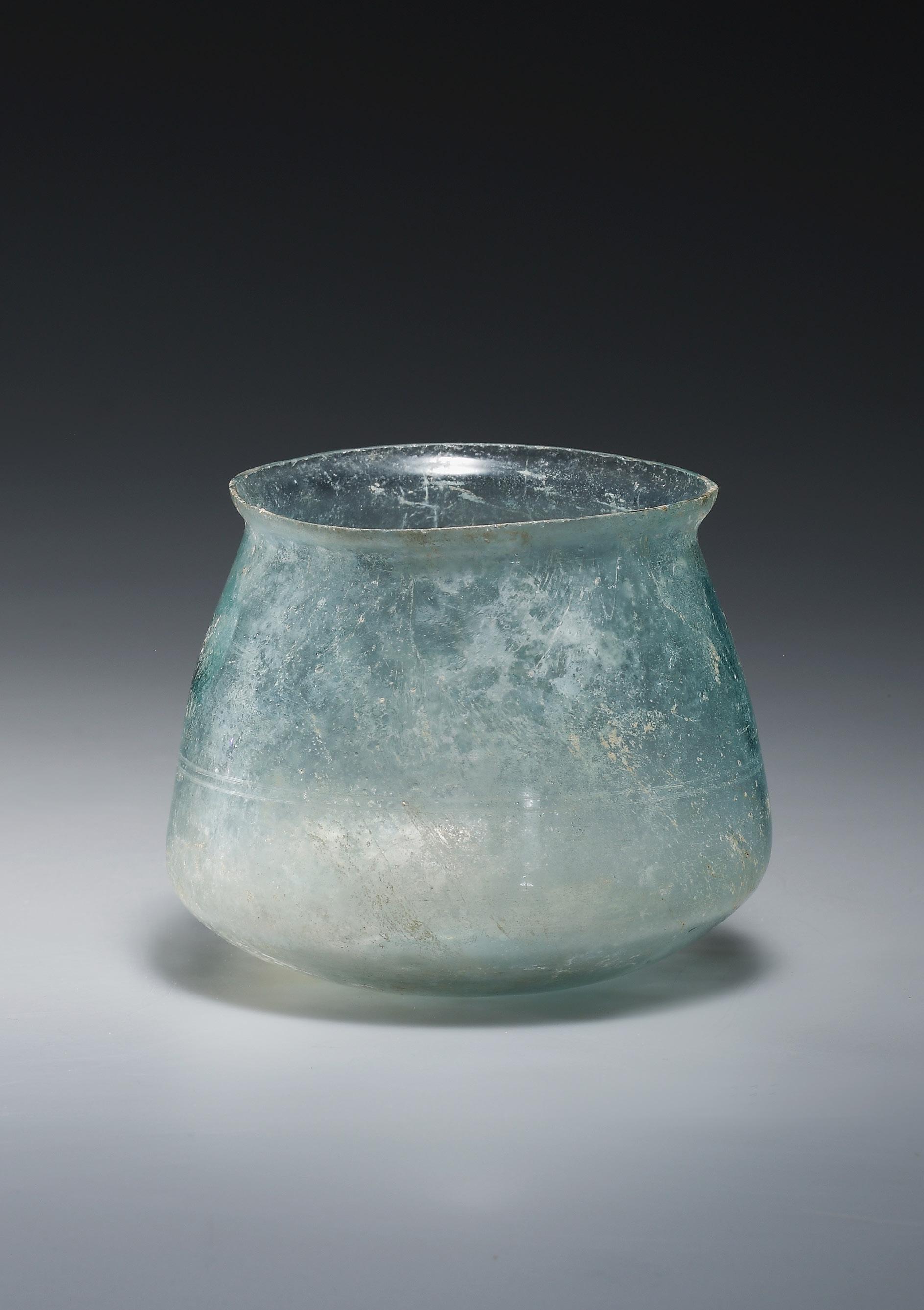
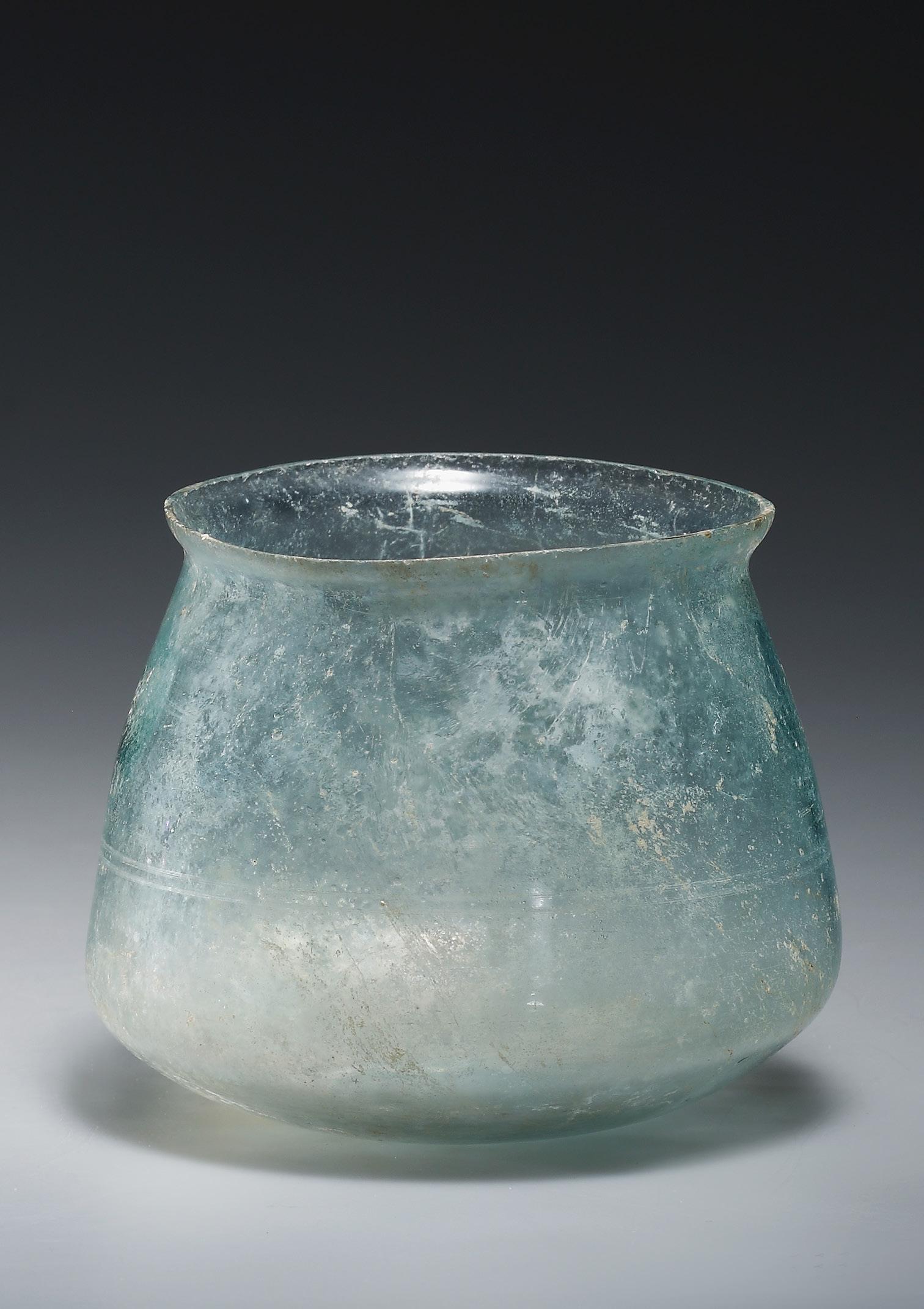
A BEAKER
09 | CHF 1.400
Roman | 2nd - 3rd century A.D. Bluish, translucent glass | H. 7,5 cm | Diam. Rim 7,3 cm
Biconical beaker. Two ground bands encircle the wall. Rim slightly flared, cracked off and sanded smooth. Free-blown. Fine, whitish to slighty brownish deposits. Very slight wear to the edge, otherwise undamaged.
PROVENANCE
Formerly priv. coll. Dr. W., acquired in the early 1980s from Galerie Puhze, Freiburg i. Br.; published: Galerie Günter Puhze, Cat. Kunst der Antike 4, 1982, no. 310.
NOTE
Cf. D. Whitehouse, Roman Glass in the Corning Museum of Glass. Vol. I (Corning, N.Y. 1997) 249, nos. 424-425.
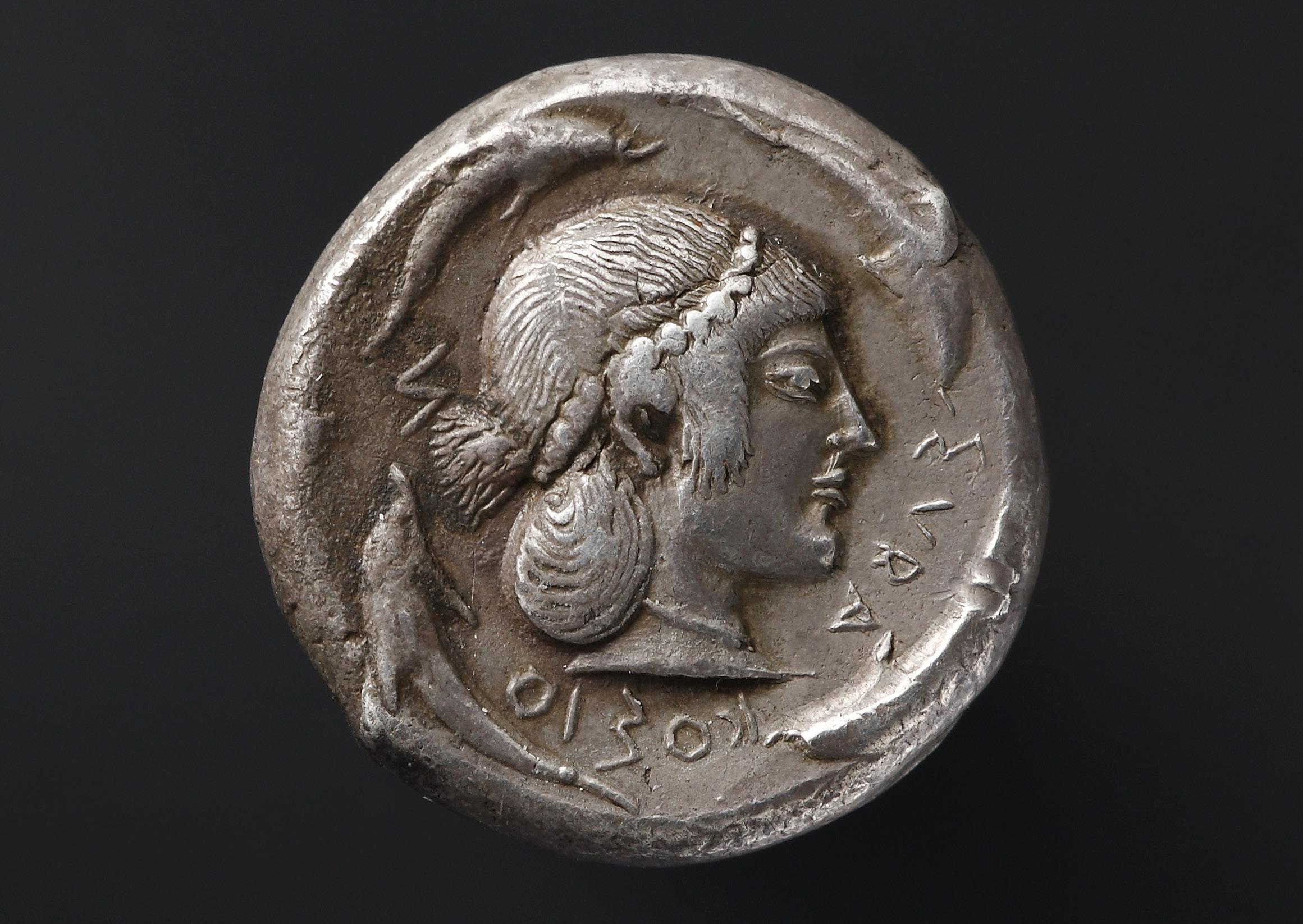
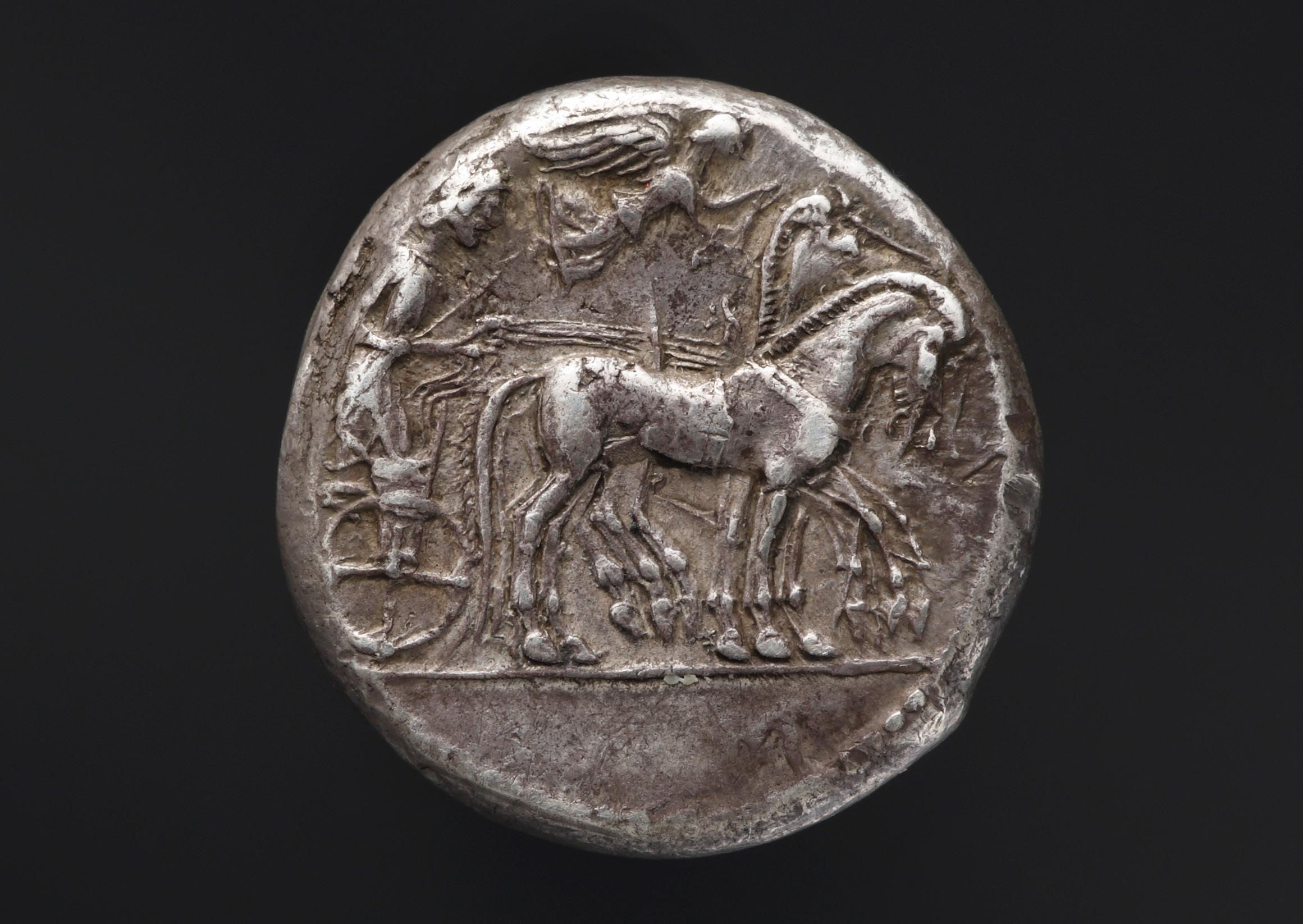
A TETRADRACHM, SYRACUSE
10 | CHF 6.800
Western Greek, Sicily, Syracuse | ca. 480-475 B.C. (Gelon I and Hieron I)
Silver | 17,33 g | Diam. 2,3 cm
Obverse: Male charioteer wearing a long chiton and holding a goad in his right hand and the reins in his left, driving a walking quadriga to right; above, Nike flying right to crown the horses. Reverse: ΣΥΡΑΚΟΣΙΟΝ.
Head of Arethusa, the guardian nymph of Syracuse, in profile to right, wearing necklace and pearl diadem, and with her hair tied in a krobylos; around, four dolphins swimming clockwise. Minor test cuts on the reverse, and with some striking flatness, otherwise very fine.
PROVENANCE
Formerly Coll. Roland Maly (1927-2006), Bern; acquired 1966 from Bank Leu, Zurich.
NOTE
Boehringer 166; SNG III 888
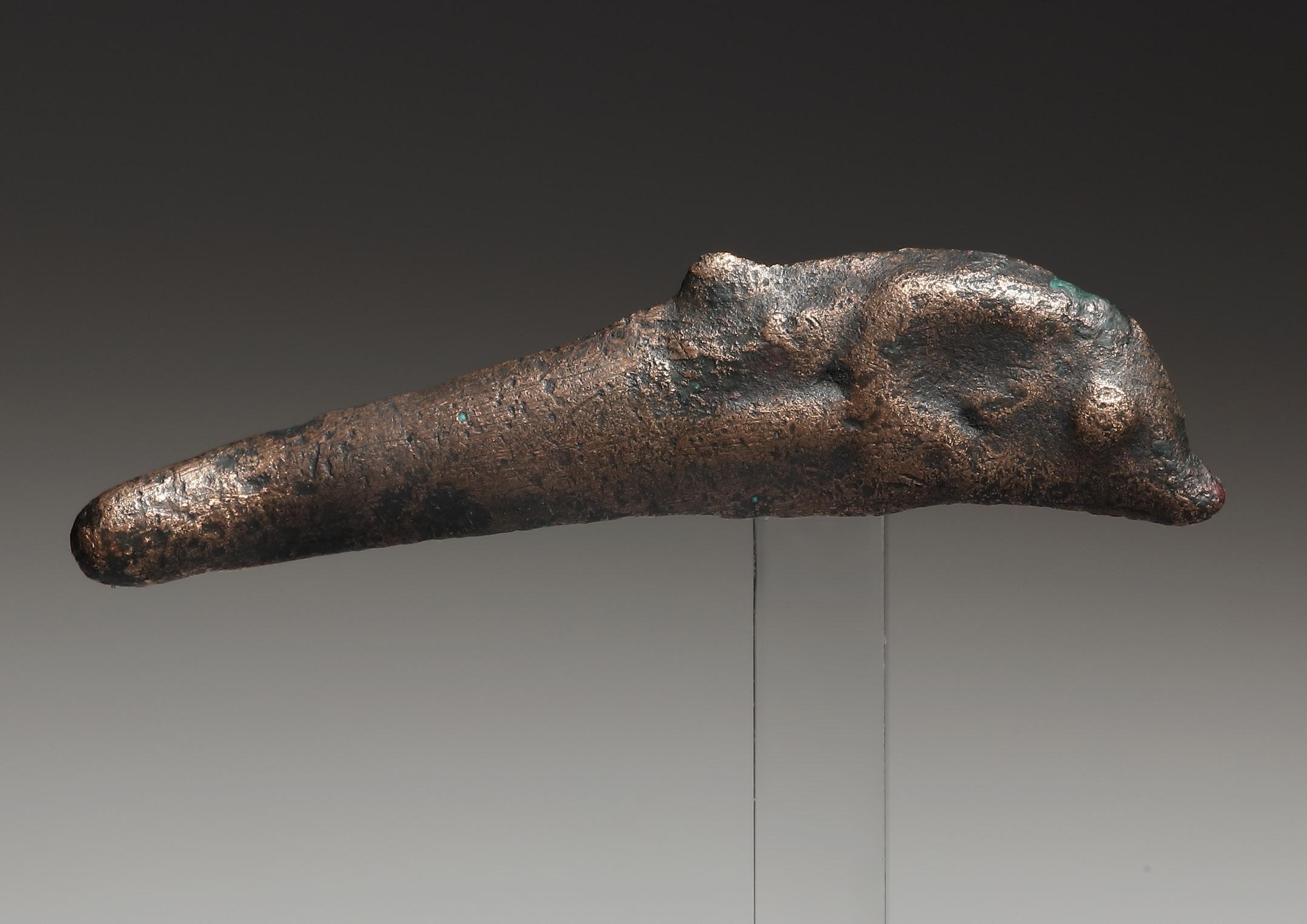
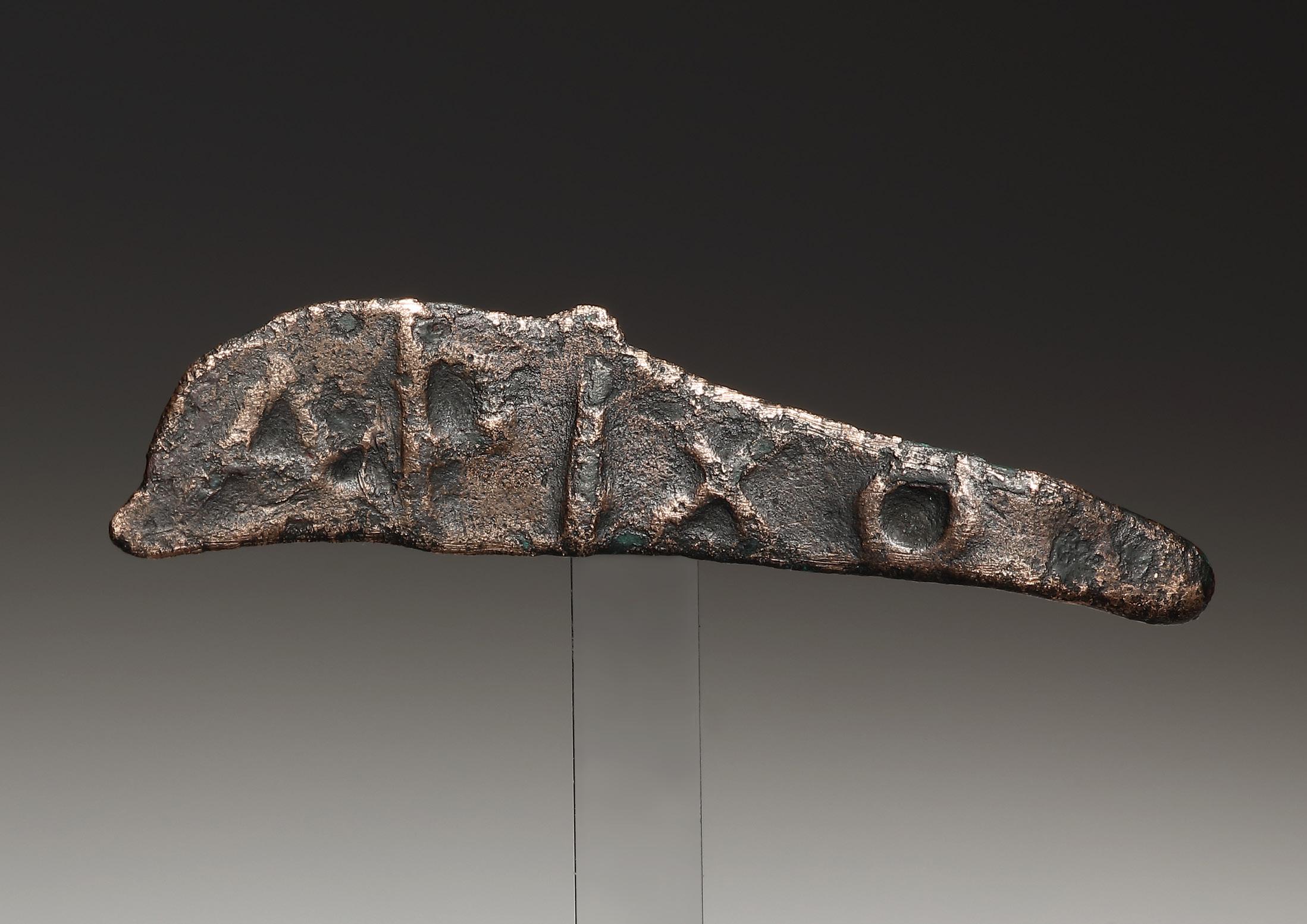
A DOLPHIN COIN WITH INSCRIPTION, OLBIA
11 | CHF 1.200
Greek, Olbia (Black Sea coast) | 5th century B.C.
Flat bronze plaque in the form of a dolphin swimming to the right, the body rendered in low relief. The object represents a precursor to standardized coinage and was used in Olbia. This Greek colonial city, founded by Miletus, was situated directly on the Black Sea coast at the mouth of the river Bug, in a region initially inhabited by the Scythians and later by the Sarmatians. The numerous dolphins inhabiting the local waters were known to accompany passing merchant ships for stretches of their journey, and over time the animals became a symbol of the city’s intensive mercantile activity. Furthermore, in Olbia the god Apollo was worshipped as Apollo Delphinios. As a particular feature, our dolphin bears on its smoothly finished reverse the letters ΑΡΙΧΟ, executed in low relief. The significance of this inscription, which does not occur on all of the numerous known dolphin coins, has not been conclusively established. It appears that the legend was added only on later specimens; possibly it was intended to legitimize the plaques as a an official medium of exchange. In addition to ΑΡΙΧΟ, a considerably rarer variant bearing the letters Θ and Υ is also attested. The earliest examples, dating to the late 6th cent. B.C., initially functioned as votive offerings to
Apollo. Following the introduction of standardized coinage, dolphin plaques were occasionally discovered together with coins in hoards — an indication that they were indeed employed as a medium of exchange. The dolphin motif subsequently also appears on the coinage of Olbia. The weight of the dolphin coins varies slightly; however, nearly all known specimens fall within a range of between 3 and 4 grams. Bronze-coloured to brownish patina, indicative of prolonged deposition in freshwater conditions.
PROVENANCE
From the collection of a teacher of classical languages. According to the collector’s note, acquired in September 1997 from Münzengalerie Grunow, Berlin (see label with note „SNG BMC: IX Nr. 375)“.
NOTE
Cf. SNG BM Black Sea 374-376.
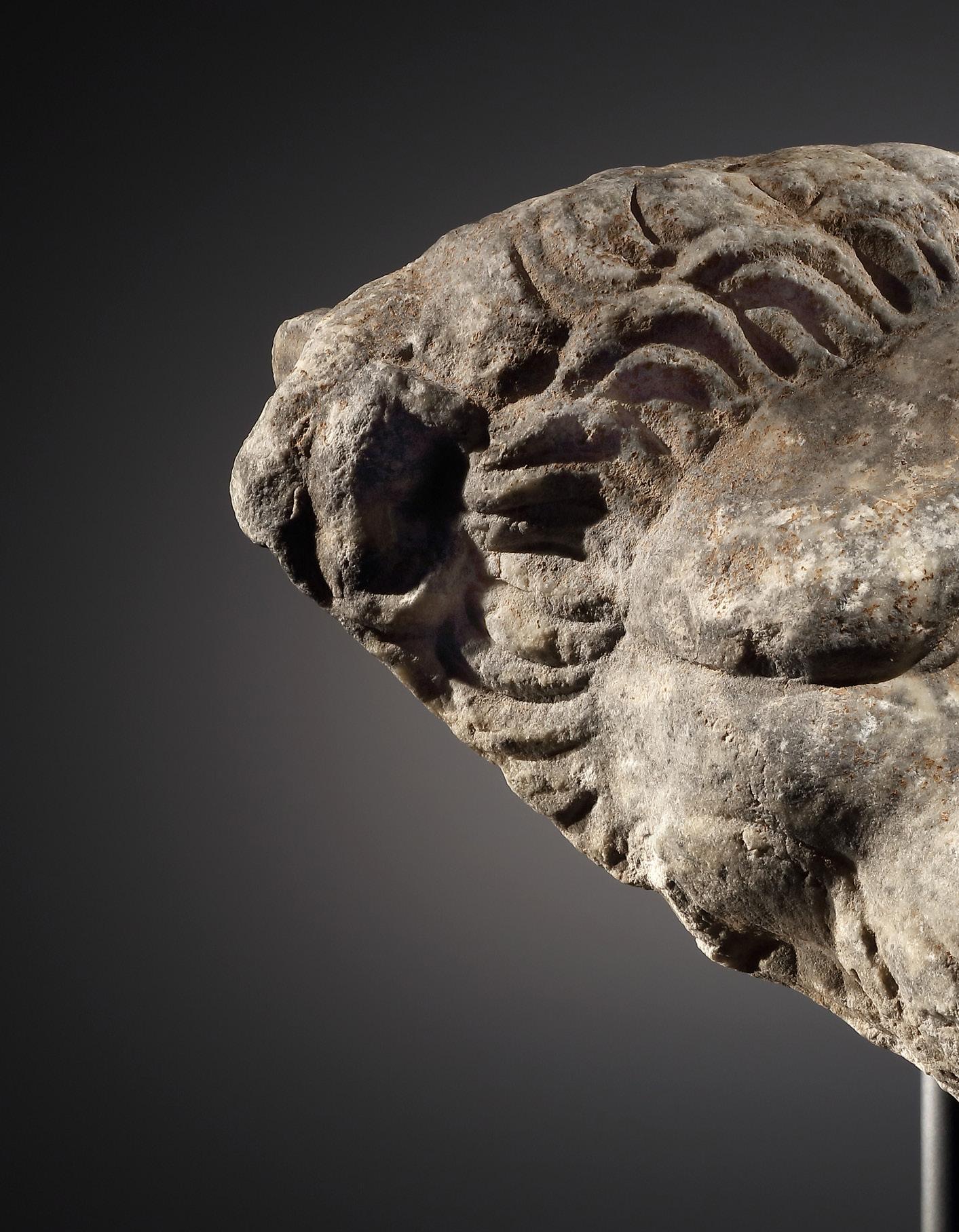
A LIONS HEAD WATERSPOUT
12 | Price on Request
Greek | 4th century B.C. | Grey marble with white inclusions H. 14,5 cm | W. 22,3 cm | D. 17,5 cm
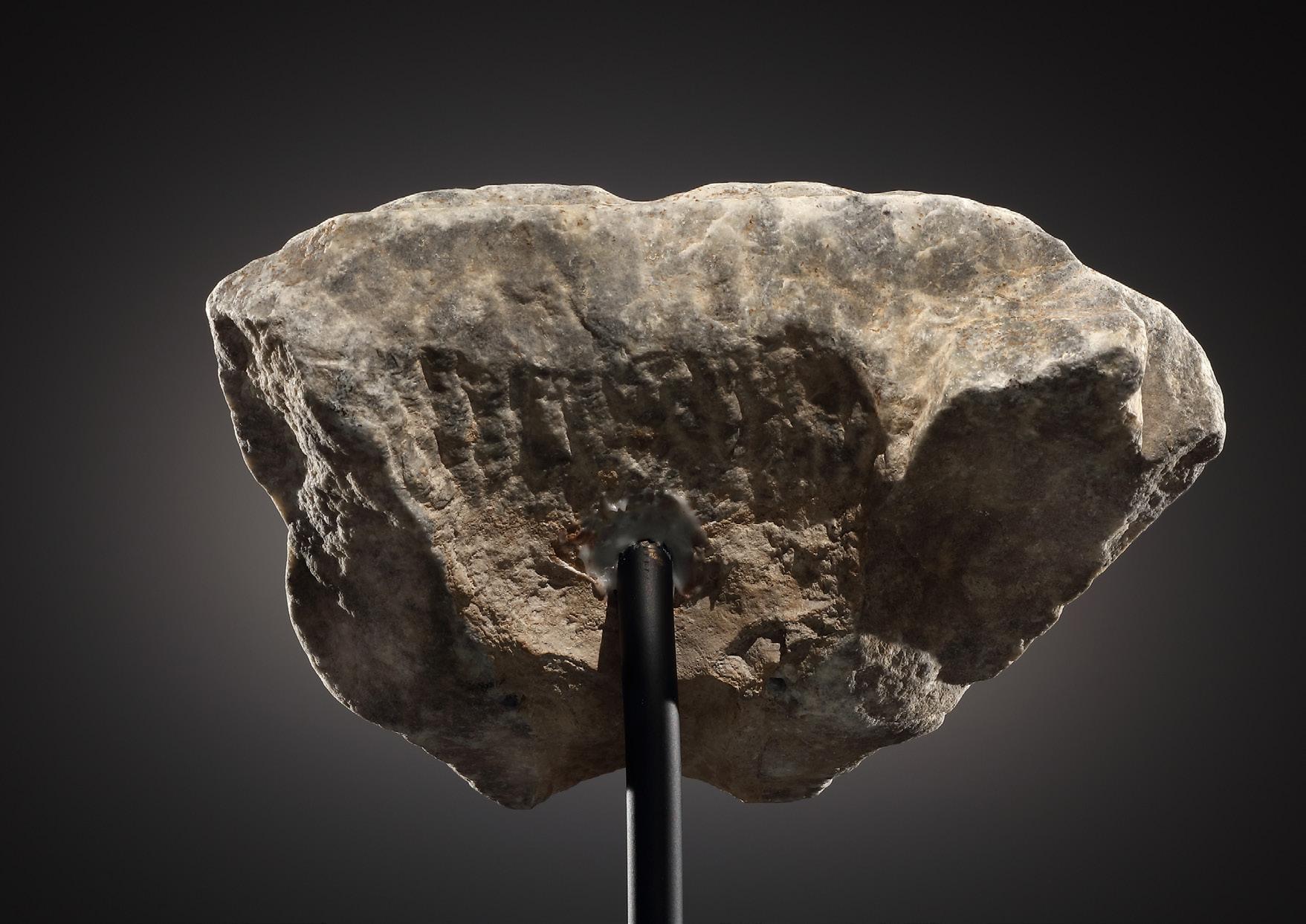
Expressive head of a lion that served as a waterspout. The forehead and face are surrounded by a mane composed of short tufts of fur. In the first row they curve outwards from the centre, whereas in the second row, the strands point in the opposite direction. The right ear has been preserved. Spherical eyes with plastically emphasized, drooping upper lids lie below bulging eyebrows. Two vertical wrinkles above the root of the nose. The bridge of the nose is convex in profile and widens considerably towards the bottom. Two deep vertical folds lead to the curved upper row of teeth that mark the end of the water channel. Three curved grooves on both sides for the whiskers. Behind the mane there is an area that is flattened at the top. Possibly, it is the base of the sima. A chiseled edge behind the ear. The reverse has a shallow cavity in the centre which transitions into a shallow groove beneath the upper jaw. Sinter deposits in this area, presumably from the passage of water. Lower jaw lost or not sculpted from the outset. Slightly worn.
PROVENANCE
Formerly priv. coll. Jürgen Ritter (19412021), Münzhandlung Ritter GmbH, Düsseldorf; formed between 1960 and 1990
within the European art market, primarily through London auction houses during the 1970s and 1980s. Thence by descent. On the German art market, prior to 2024.
NOTE
For the style, cf. a lion’s head waterspout from the Artemision in Ephesos: V. M. Strocka, Griechische Löwenkopfwasserspeier in Ephesos, in: B. Brandt (ed.), Synergia. Festschrift für Friedrich Krinzinger (Wien 2005) 337-348, fig. 1; the face of a lion’s head waterspout from the Temple of Despoina in Lykosura: Arachne, Database of the DAI -144578; a lion’s head waterspout from the sima of the Temple of Hera in Argos: NM Athen, inv. no. 1579 α, Arachne, Database of the DAI - 1179054; a lion’s head waterspout from the Temple of Apollo in Delphi.
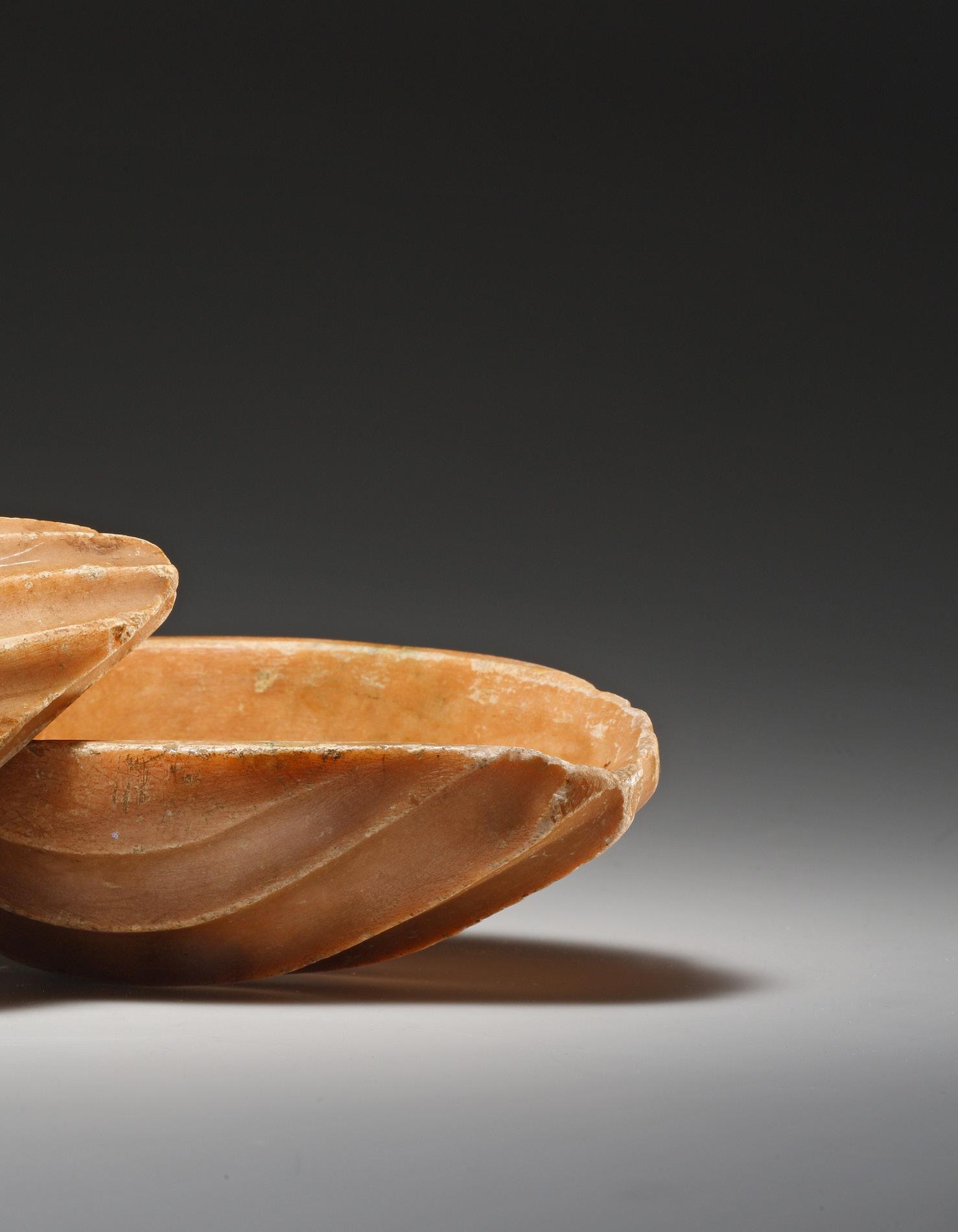
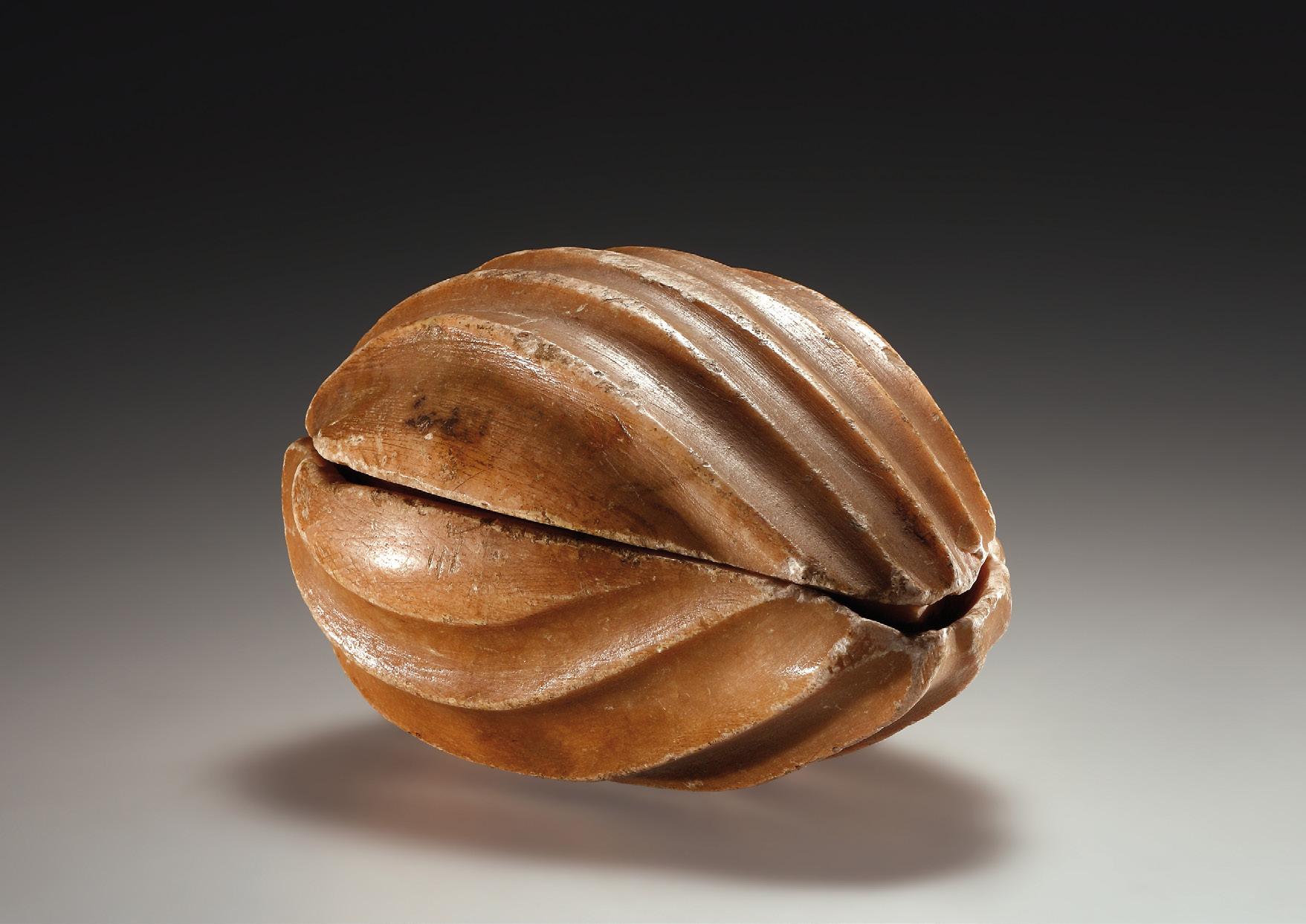
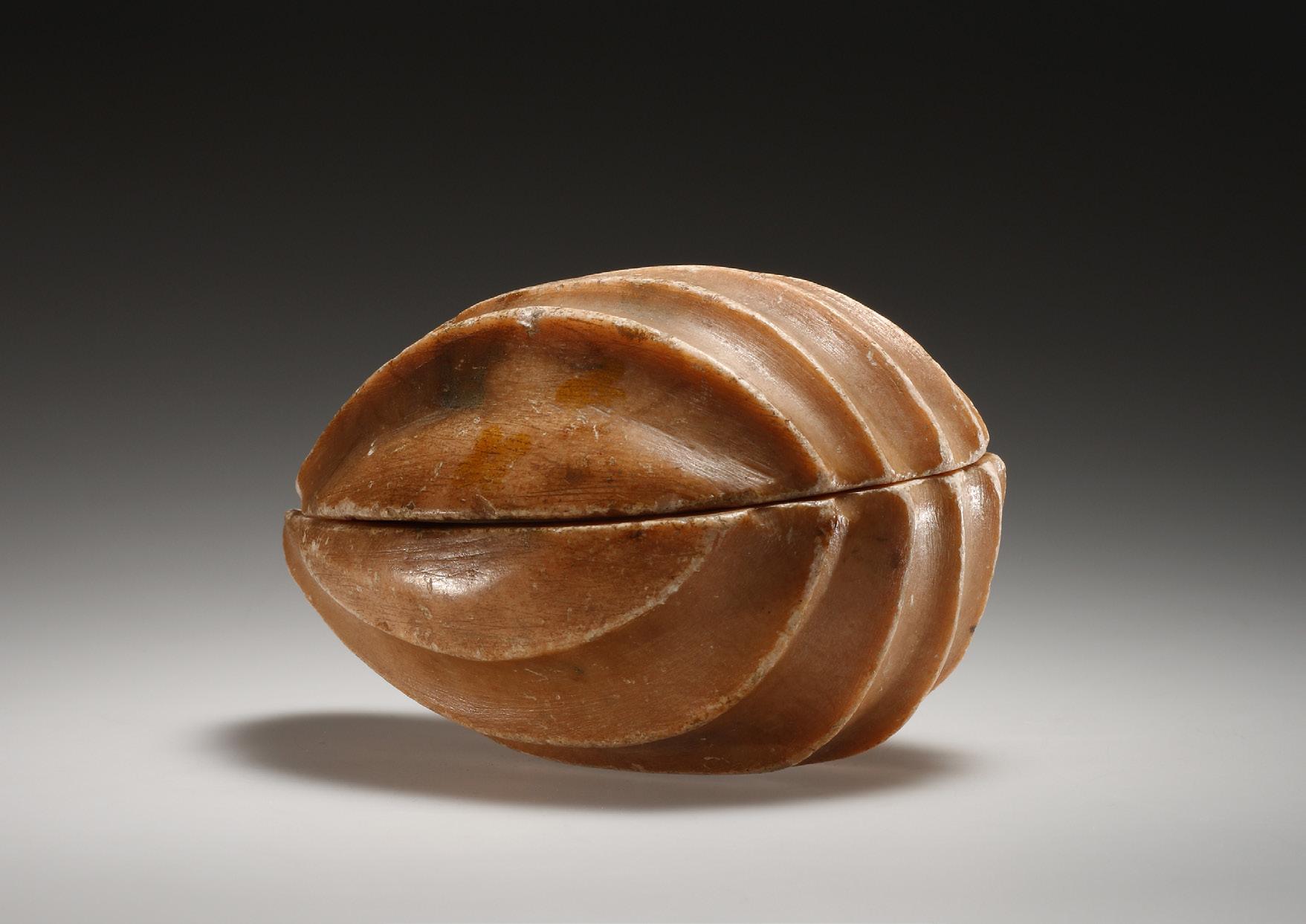
A RARE COSMETIC VESSEL IN THE FORM OF A SHELL
13 | CHF 8.800
Annunziata, now in the British Museum London, inv. 1856,1226.928-930 (dated 1st cent. A.D.); a shell-shaped bronze bowl from Pompeii, s. L. Franchi dell‘Orto - A. Varone (ed.), Pompeji wiederentdeckt, exh. cat. Basel, Antikenmuseum and Sammlung Ludwig, 19 March - 26 June 1994 (Rome 1994) 233, 235, no. 131 with illus. (1st cent. A.D.). Greek or Graeco-Roman | 5th century B.C. - 1st century A.D.
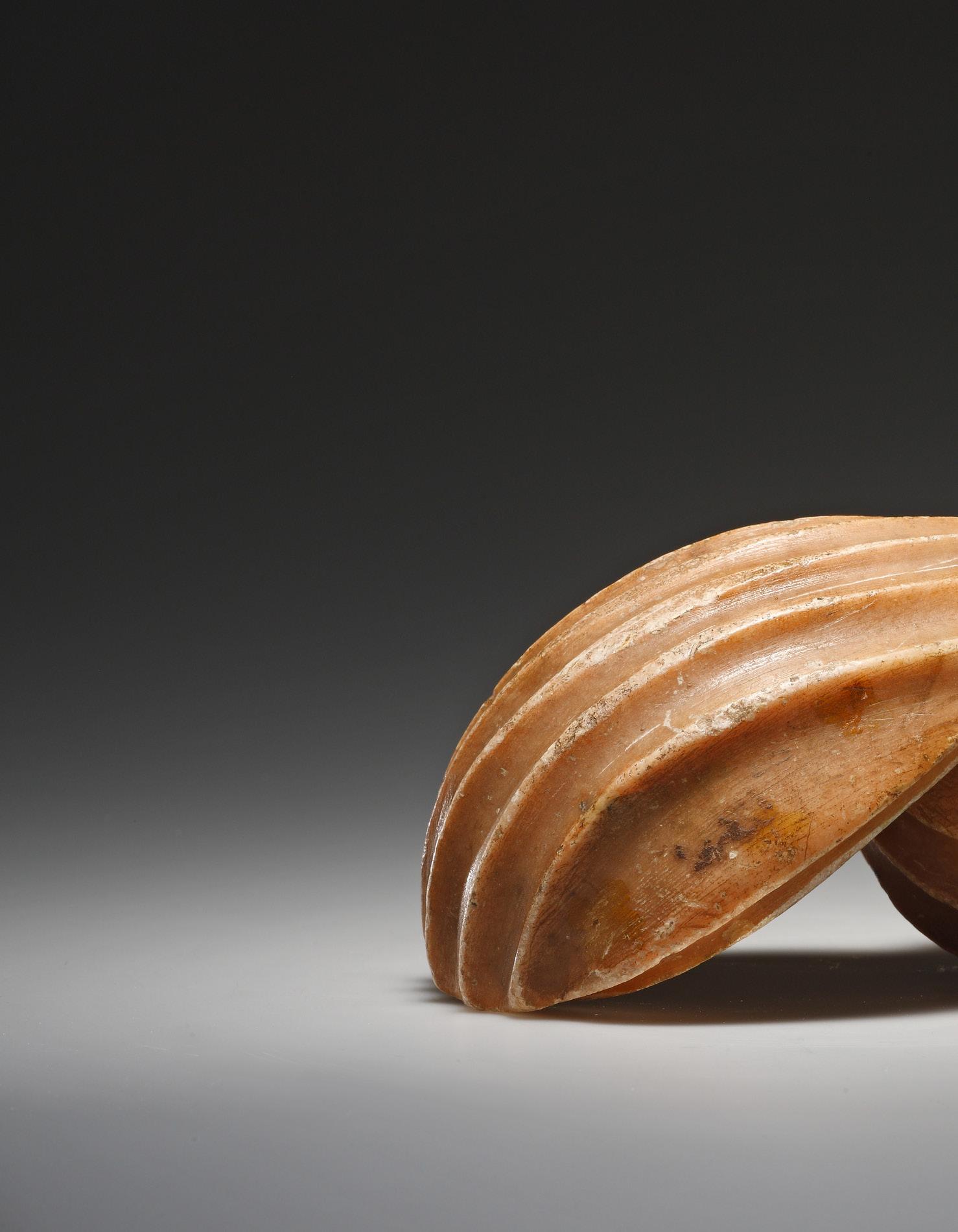
Two-part marble vessel in the shape of an elongated shell with distinct ribbing. The bowl-shaped lower part is flattened slightly on the underside. The lid has a stepped rim permitting a close fit with the lower shell. The shell was a popular shape for vessels in Antiquity. Such vessels were made of different materials (mostly bronze and terracotta, more rarely marble) and were used to store cosmetics amongst other things. Surface slightly worn. Reddishbrown patina.
PROVENANCE
Formerly Rupert Wace, Ltd., London, acquired in 1979 from a priv. coll. London (see declaration of honour). Label with inv. no. „17341“ on the underside.
NOTE
The shell was associated with the goddess Aphrodite, who was, as the myth relates, born from the sea. For this reason she was often represented in a shell. The female owners of such vessels would thus have made a mental link between their everyday toilette and the goddess of beauty and love. The pronounced ribs on our specimen are similar to those found on cockles (Cardiidae). Cf. several shell-shaped bronze plates found in Torre
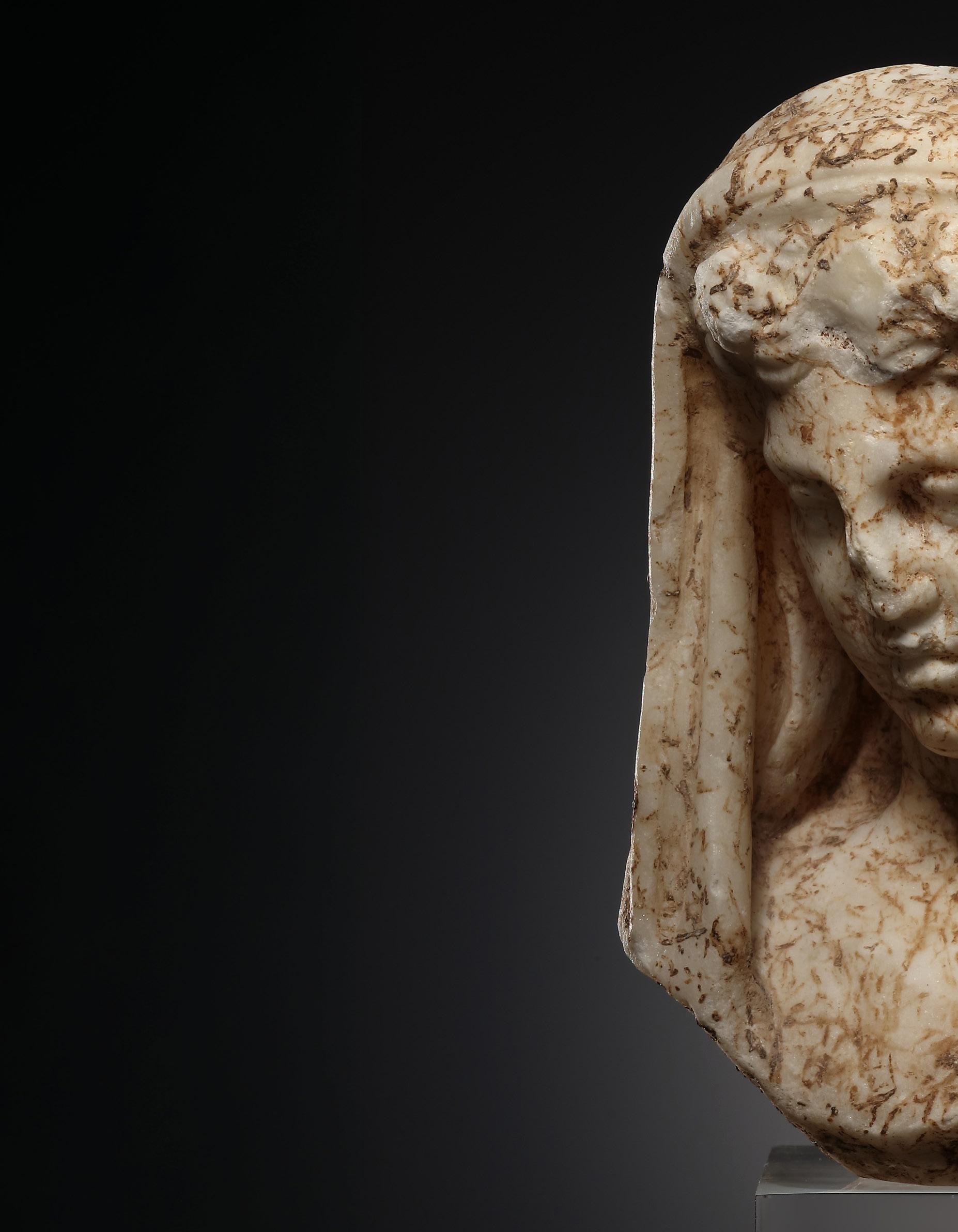
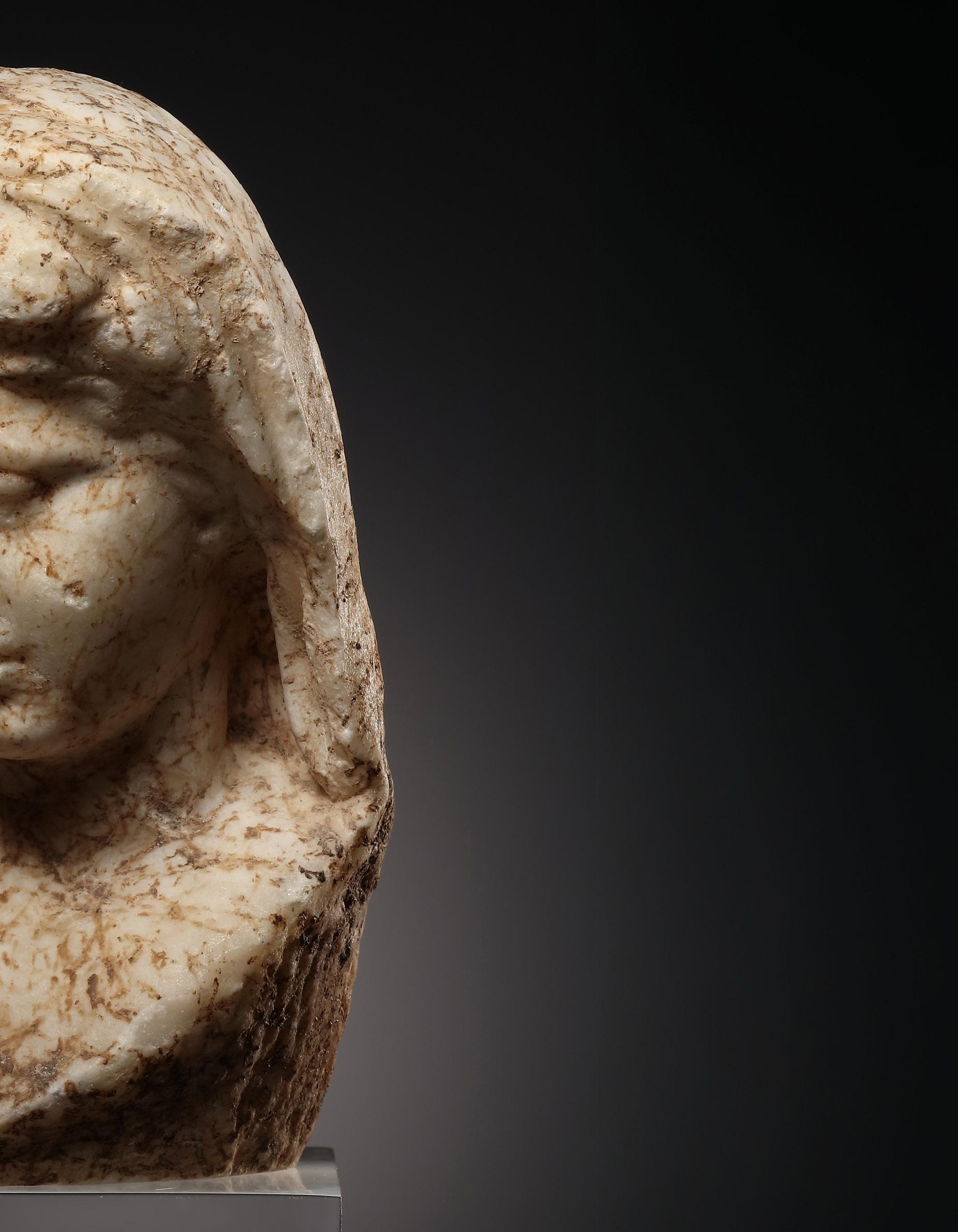
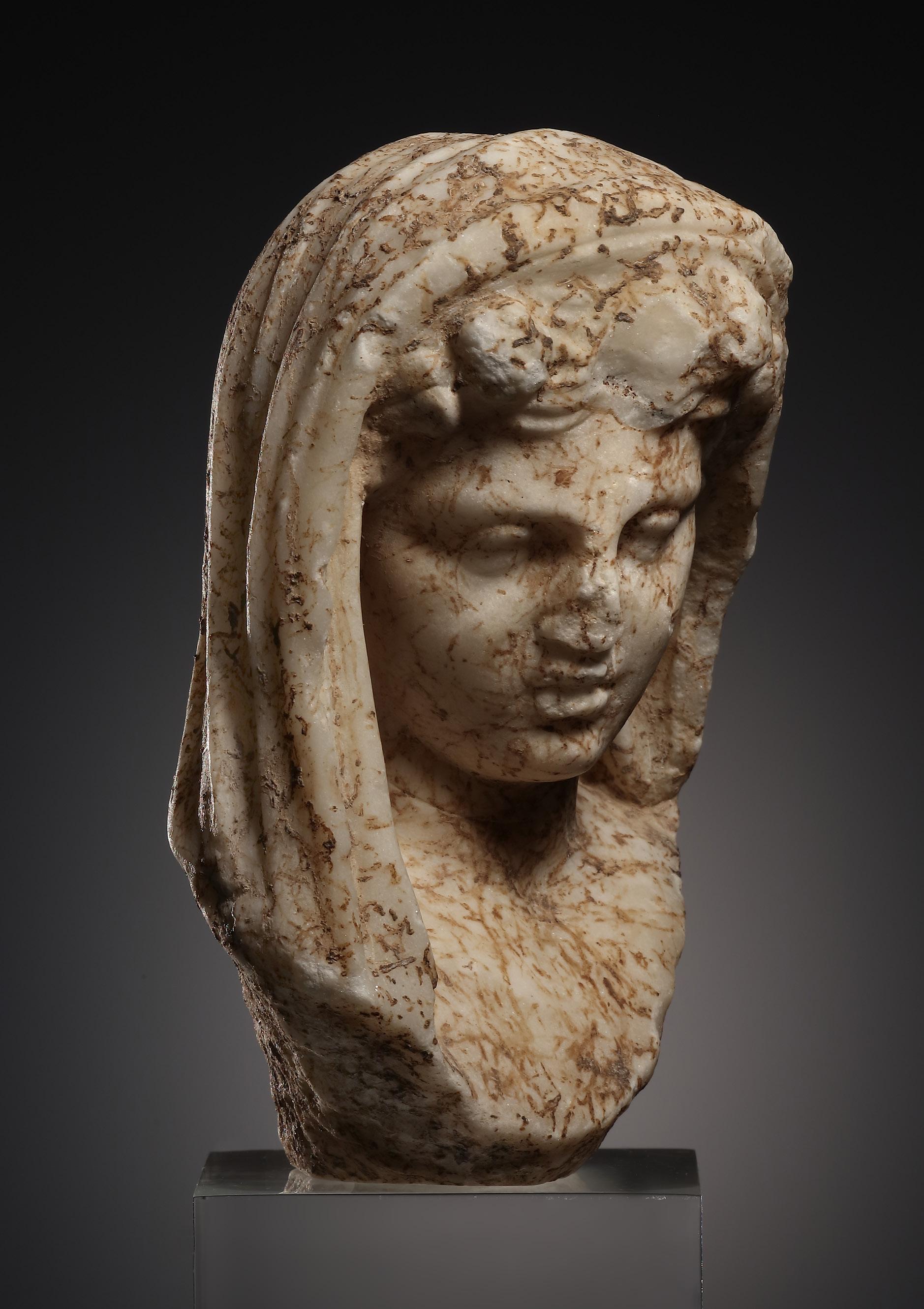
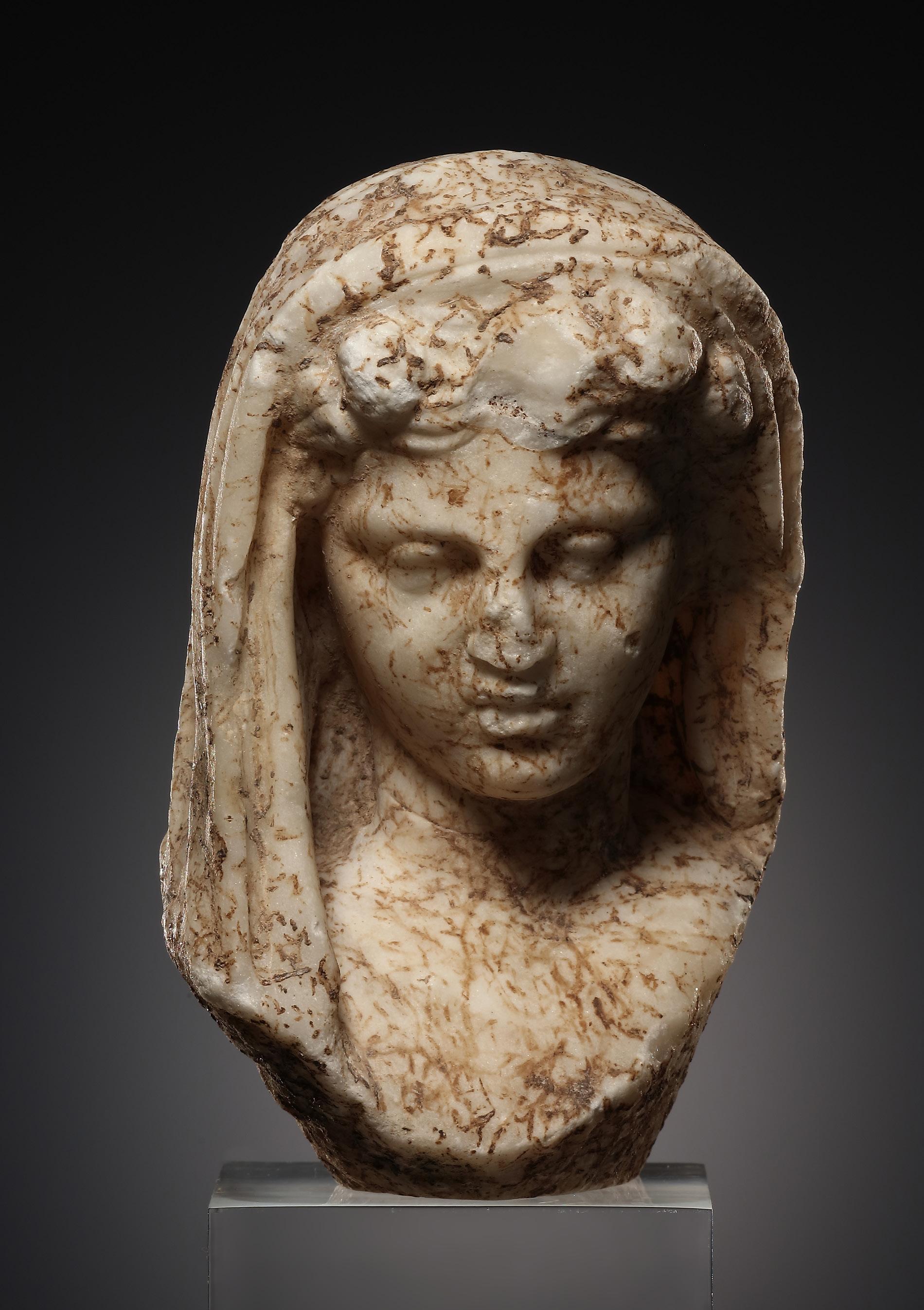
A BUST OF A YOUNG VEILED WOMAN
14 | Price on Request
Mediterranean, Late Hellenistic | 1st century B.C.
White fine-grained marble | H. 16,0 cm | W. 10,0 cm | D. 8,0 cm
Bust of a young woman (capite velato) whose veiled head is inclined to the right as if lost in thought. The idealized face is characterized by a low, markedly receding forehead; small eyes framed by broad upper and lower lids, shaded beneath prominent, slightly projecting eyebrows; a short, broad nose; and a small mouth with full lips. Above her forehead, the young woman wears a wreath decorated with flowers or corymbs, from beneath which a few waves of hair emerge. A short, ample neck transitions into to the unclothed bust. The lower end of the bust is conically shaped and only roughly smoothed, suggesting that the head was originally inserted into a statuette. As the head is carved fully in the round, with the reverse carefully finished, it was probably intended for display as a free-standing sculpture. The idealized features and the veil suggest that the figure represents a goddess. As the figure’s youthfulness is emphasized, it might depict Persephone. However, if the wreath were indeed composed of ivy, the sculpture might represent a maenad/bacchante or a nymph. Both belong to the Dionysian retinue, although it would be unusual for a maenad to wear a veil. Thalia, the muse of comic poetry and entertainment, is also depicted with an ivy wreath. If one interprets
the raised feature above the left earlobe as a pointed ear, a reading as a Paniska (satyr girl) is conceivable. Ariadne, as consort of Dionysus, is also occasionally shown wearing an ivy wreath. The narrow eyes with slightly puffy lids and the small mouth with full lips, that taper only slightly towards the corners, suggest a date of creation in the Late Hellenistic Period. The underside was presumably smoothed in modern times. Traces of root growth are visible throughout the sculpture’s surface. A flake lost above the centre of the forehead. Slightly worn in a few places. Yellowish patina.
PROVENANCE
Formerly priv. coll. Mark Sanders, Princeton, New Jersey; acquired in 1985 from Münzen und Medaillen AG, Basel. With Acanthus Gallery (see invoice 11.17.1992). With Jerome Eisenberg, New York; acquired in December 1995. Publ.: J. Eisenberg, Art of the Ancient World, vol. IX, 1997, no 23.
NOTE
For the style, cf. a head of Aphrodite in the Staatliche Museen Berlin, inv. no. 1993.13 (s. Arachne, Database of the DAI - 1121081).
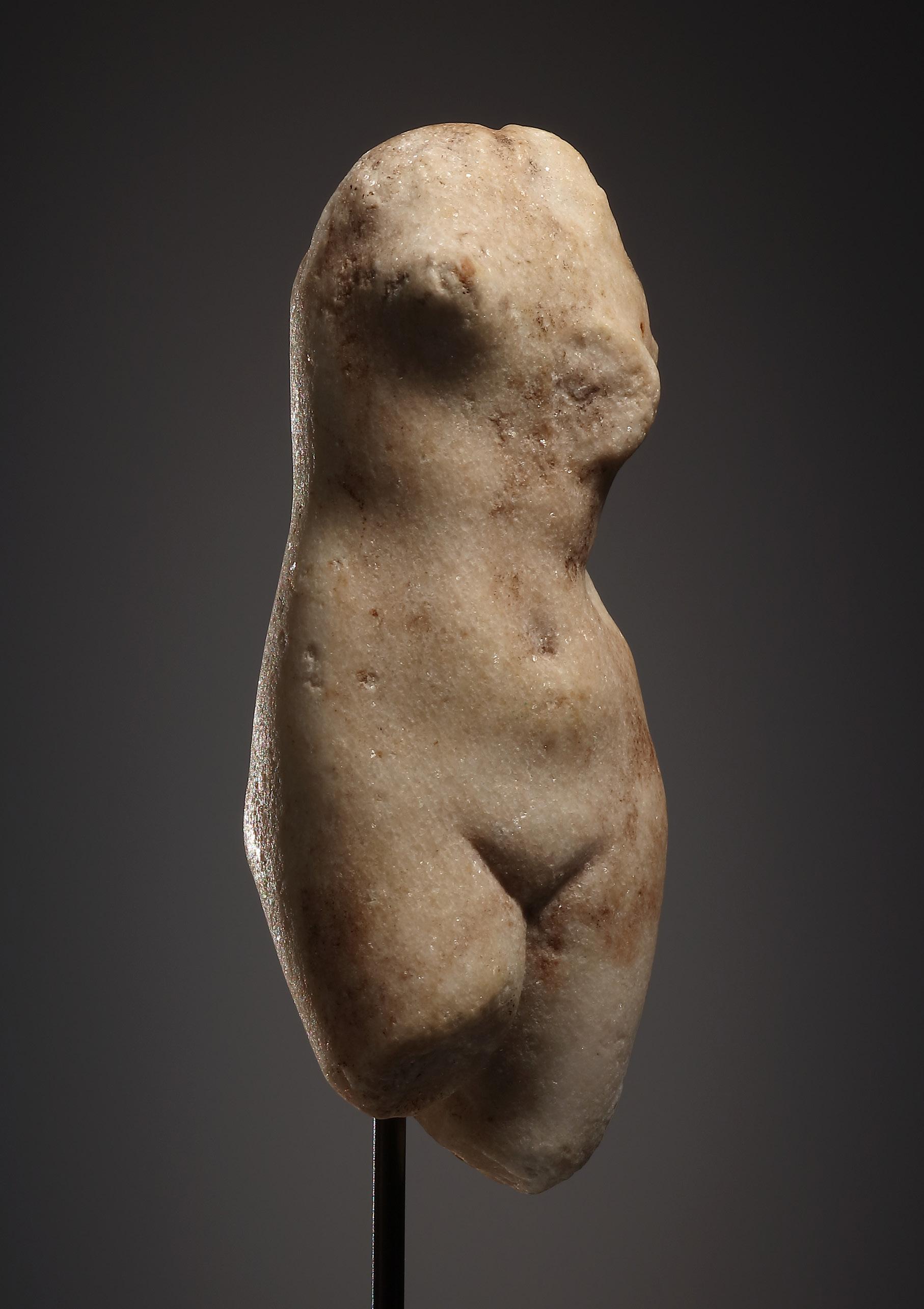
A MINIATURE TORSO OF APHRODITE ANADYOMENE
15 | CHF 8.800
Greek, Late Hellenistic | late 2nd to 1st century B.C.
Torso of the nude Aphrodite/Venus. In view of its small size, the body is remarkable for its careful modelling and the sensitive rendering of the rounded feminine contours. The goddess’s weight rests on her left leg, while her right thigh is advanced slightly. The slender upper body, with small, firm breasts, leans over the weight-bearing leg above the hips, resulting in a pronounced leftward slope of the shoulders. Traces of hair appear to have been preserved at the upper back. Due to the pose, our torso can be associated with the type of Aphrodite Anadyomene (“she who rises up from the foam”), which refers to the mythological birth of the goddess from the sea. It depicts Aphrodite, who has just emerged from the sea, gracefully wringing the water from her long hair. The emphasis placed on the figure’s feminine forms underscore the erotic connotations inherent in the motif. According to ancient sources, representations of Aphrodite Anadyomene were known at least since the 4th century B.C. The prototype is considered to be a famous painting by the Greek painter Apelles (cf. Pliny the Elder, Naturalis Historia 35, 86–87; Athenaeus, Deipnosophistai 13, 590), created around 330 B.C. In the Hellenistic Period, this exceptionally popular motif achieved wide
dissemination, particularly in sculpture, and was subject to continual variation, including partially draped versions of the goddess. These representations in turn inspired Roman copyists. By analogy to known depictions of Aphrodite Anadyomene, it can be assumed that the remains of a support on the outer side of the left thigh belonged to a dolphin, triton or sea dragon, figures that occasionally accompany the goddess’s ascent from the water. The naturalistic modeling, especially of the abdominal area, suggests that our torso was created in the Hellenistic Period. Furthermore, the slender overall appearance and the comparatively flat treatment of the figure in profile point to a fairly late phase within the Hellenistic era. The small, firm breasts are also consistent with this dating. Head, neck, and arms are missing. The legs are partially preserved, with one third of one thigh and two thirds of the other remaining. Part of the left breast lost. Brownish discolorations visible in a few places.
PROVENANCE
Formerly priv. coll. of a former retired antique dealer in Nizza, France; acquired in the French art market in the 2000‘s. The original metal mounting is to be dated about the same period or shortly before.
NOTE
For the Aphrodite Anadyomene and the various variations of the type, see LIMC II (1984), 54–57, nos. 424–455, pls. 40–43, s. v. Aphrodite (A. Delivorrias). A marble statuette in the Glyptothek, Copenhagen, is closely related with regard to pose and modeling: ibid., 65, no. 544, pl. 53.
CONDITIONS OF SALE
September 2025
Place of Execution is Basel
1) Jean-David Cahn AG (hereafter „the Seller“) hereby confirms that it has the right of disposal over the objects for sale according to Art. 18 KGTG. Any further warranty is excluded.
2) The specifications and descriptions given in this catalog are provided in good faith. Nevertheless, their accuracy cannot be guaranteed.
3) The seller guarantees that the sales objects were made in Antiquity. This guarantee, which is granted to the buyer only, is valid for two years after the conclusion of the sales contract.
4) The objects are sold in the condition they were in at the time of the sale („sold as seen“). Complaints regarding the authenticity of a piece (subject to lit. 3) shall be communicated to the Seller in writing at its domicile (Jean-David Cahn, Malzgasse 23, P.O. Box 217, 4010 Basel) upon detection and at the last two years after the conclusion of the sales contract. Other substantiated complaints shall be communicated to the Seller in writing at its domicile, as above, within 14 days of receipt, and at least three months after the conclusion of the sales contract. Any
complaints made later cannot be considered further. All liability for any loss or damage sustained during transportation is excluded. Insurance during transportation is the Buyer‘s responsibility.
5) The delivery and storage of sold objects shall be at the Buyer‘s risk and expense (costs arising from storage, packaging and transportation, any additional costs and expenses, all plus VATs) unless otherwise agreed in writing.
6) Foreign and Swiss customs, duty and shipment shall be borne by the Buyer. Declaration fees for the import into the EU are borne by the Seller if used through the services provided by the Seller. It is the responsibility of the Buyer to comply with foreign and Swiss customs and foreign exchange regulations and to obtain an EU import license through the services of the Seller. The Buyer is aware of the relevant import and export regulations of the EU and has consulted the website of the Swiss Federal Office of Culture Bern (www. bak.admin.ch/kgt) for details of the Swiss import and export regulations currently in force, as well as further provisions. The Seller declines all responsibility for any consequences arising from the
contravention of such regulations. The Buyer acknowledges that a valid import permit is required for the importation of the artworks transferred under this purchase invoice into the European Union. If such a permit is not available at the time of purchase, the approval process may take between four to six months. The registration and execution of the import procedure will be carried out by an art shipping agent appointed by the Seller within the EU. The Seller will organize this process in the name and on behalf of the Buyer. The Buyer is required to conduct the import procedure through the shipping agent designated by the Seller. Alternatives are the responsibility of the Buyers.
7) The Buyer is personally liable for all acquisitions made; he/she cannot claim to be acting for a third party or person. If a person acts as a representative, written proof of authorization may be requested; the Buyer as well as his/her representative can both be held jointly and severally liable for the purchase and for all other costs. The Buyer shall be liable for any damages caused by delayed payments, in particular for exchange rate and interest losses. Payments by cheque or by the internet shall be deemed to have been received only on clearance by the relevant bank.
8) Payment shall be due upon the conclusion of contract, but at the latest 30 days after the invoice is issued. Interest of 1.5% per month will be charged for payments made after 30 days. Payments can be made in cash, by bank transfer or by cheque. The Seller may ask for proof of creditworthiness. Title shall be transferred only upon receipt of payment in full; all risks, however, shall pass to the Buyer
upon conclusion of the sales contract.
9) If payment is delayed, the Seller can, after giving the Buyer due notice, withdraw from the contract forthwith. This also applies in cases where the object has already been transferred to the Buyer‘s possession at the Buyer‘s cost. The object in such a case must be handed back to the Seller upon request. Additionally, the Seller may claim further damages.
10) If the Buyer does not collect the object, the Seller can choose either to cancel the contract after 30 days and to claim compensation or to store the object at the Buyer‘s expense and to demand that the Buyer collects it.
11) All Sales are transacted in Basel, Switzerland, which is therefore the Place of Fulfillment and the court of jurisdiction The conclusion of contract, the quotation and the negotiations are subject to Swiss law, exclusive of the United Nations Convention on Contracts for the International Sale of Goods (CISG). By buying, the Buyer recognizes the exclusive right of the court of Canton Basel-Stadt, Switzerland, and of its jurisdiction. All sales are subject to Swiss jurisdiction. All parties recognize the exclusive choice of Swiss jurisdiction for the settlement of any matters arising from the conclusion of the sales contract.
12) All purchases and deliveries are performed solely on the basis of these conditions of sale. Any references by the Buyer to his/her terms and conditions are herewith expressly excluded.
13) Should individual provisions become fully or partially void after the conclusion of contract due to changes in the law, the validity of the remaining provisions and of the contract shall remain unaffected. The invalid provision shall be replaced by that provision which is closest in meaning and intention to the original provision.
14) The Buyer accepts the condition of the sales as above. He/She explicitly accepts the exclusive right of the courts of Basel-Stadt, Switzerland, and their jurisdiction, exclusive of the United Nations Convention on Contracts for the International Sale of Goods (CISG), over the quotation, the negotiations, and the sale.
15) The conditions of sale are provided in German and English, the German version being the definitive and legally binding one in the event of any disputes.
GENERAL ABBREVIATIONS
Beazley Archive Pottery Database
Deutsches Archäologisches Institut
H.A.C. KAM
Herbert A. Cahn (1988 - 1999)
Schweizerische Kunst und Antiquitätenmesse
Lexicon Iconographicum Mythologiae Classicae
Münzen und Medaillen AG, Basel (1943 - 1988) BAPD DAI
LIMC MuM
IMPRINT
Texts
Design
Translation
Photos
Dr. Ulrike Haase, Joffrey Nogrette, Charlotte Chauvier
Jonas Hernegger, Jean-David Cahn
Yvonne Yiu
Niklaus Bürgin, Galerie Jocelyn Wolff
Packaging, insurance and transport are at the expense of the purchaser. All prices in CHF net for export.

Galerie Cahn | Malzgasse 23 | CH-4052 Basel