THE JOY OF COLLECTING
CONTACT
Dr. Ulrike Haase
ulrike.haase@cahn.ch
Tel: +41 61 561 67 04
Joffrey Nogrette
joffrey.nogrette@cahn.ch
Tel: +41 61 561 67 00
Charlotte Chauvier charlotte.chauvier@cahn.ch
Tel: +41 61 561 67 02
Galerie Cahn
www.cahn.ch
Tel: +41 61 561 67 55
Packaging, insurance and transport are at the expense of the purchaser. All prices in CHF net for export.
Monday - Friday
- 1pm & 2pm - 6pm
14 - 18 June 2026 15 - 21 June 2026



FOREWORD
Jonas Hernegger
After this year’s Winter Show in New York, MAZE Art in Gstaad and St. Moritz, and TEFAF in Maastricht, this catalogue aims to focus on objects that, away from trends and headlines, establish a connection to our human history. For this reason, the selection of the following objects may appear eclectic. While it begins with A Right Hand from a Sarcophagus Lid, just a few pages later it is followed by an Axe Blade made of orange-brown stone, dating from around 4000–2000 BC. The small Celtic Head, gazing at us with its round eyes, may captivate just as much as the Greek Terracotta Figurine of a Grotesque. Other artworks, such as the large Skyphos with Grazing Deer, express much like the Lamp Stand in the
Shape of a Tree Trunk a fascination for nature and its forms. Although the origins of the art market, and with it the deliberate practice of collecting, re-main unclear, the initial motivation was mostly a desire for representation. While artworks adorned altars and temples as communal possessions, the first collections emerged in the cultural sphere of Hellenism and Rome. At first, these collections consisted of artworks seized during military campaigns, but soon evolved beyond the model of purely military dis-play. By the Imperial period at the latest, owning an art collection had become an expression of personal intellectual outlook and thus an attribute of the Roman elite. To meet this de-mand, specialized
commercial streets developed in major cities, such as the Via Iulia in Rome, whose renown rooted in the high concentration of art dealers located there. As the correspondence of Cicero shows, even agents where deployed in Athens to look out for Greek originals.
Freed from a need to represent, collecting ancient art thus becomes a source of joy. In this spirit, I wish you great pleasure in reading and discovering.
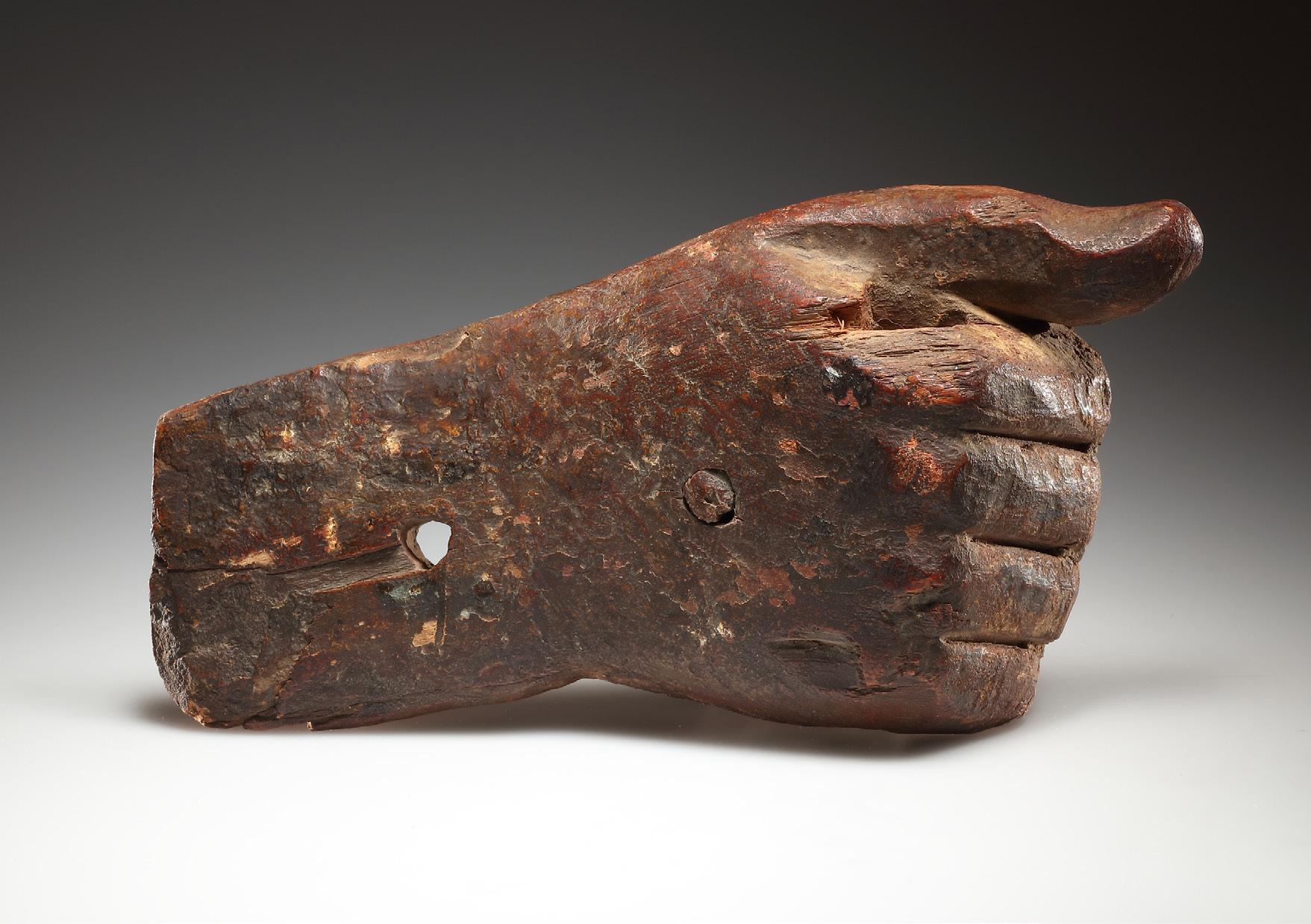
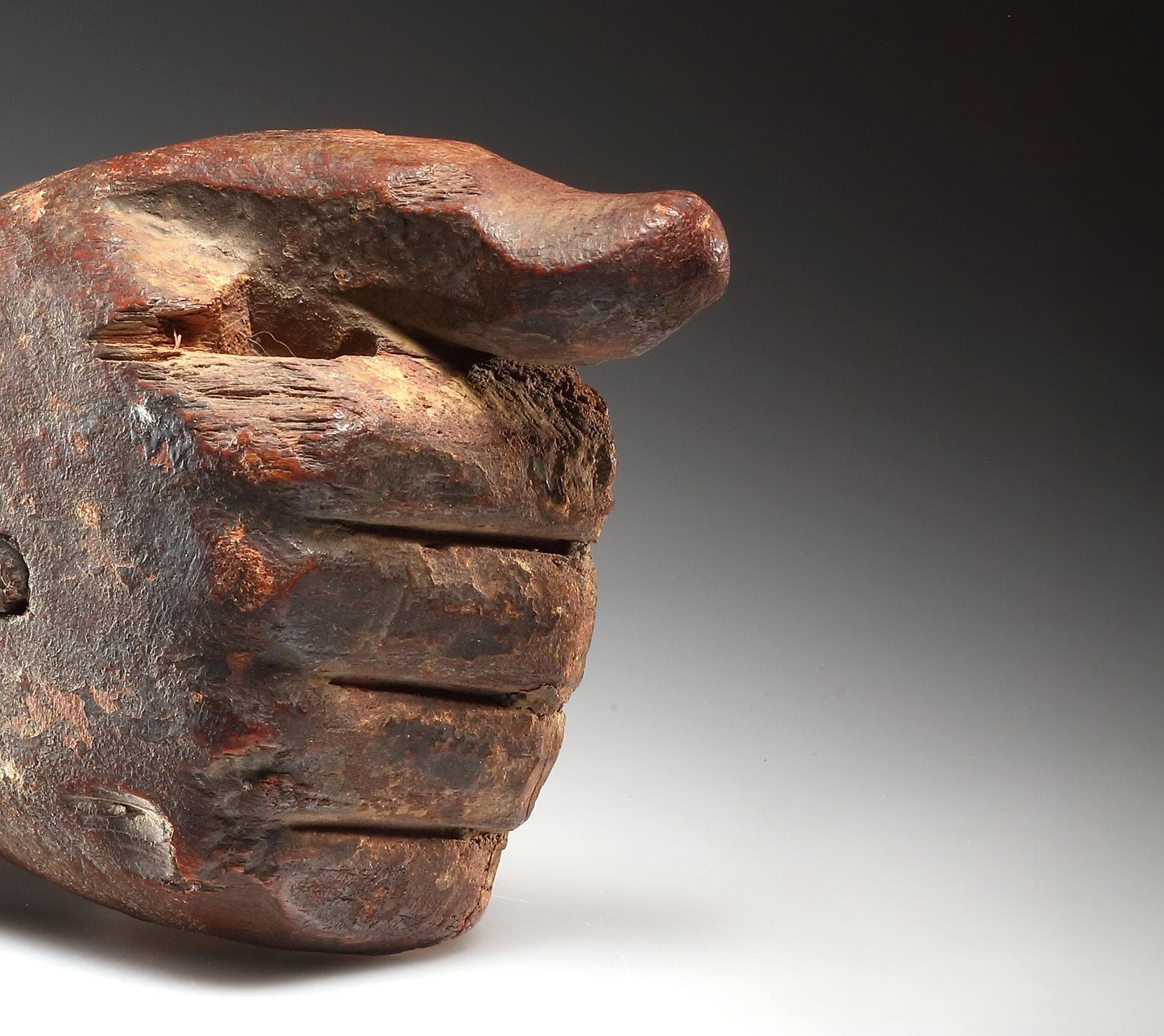
A RIGHT HAND FROM A SARCOPHAGUS LID
CHF 2400
Egypt, 3rd Intermediate Period | ca. 1070 - 664 B.C. H. 9,0 cm | L. 17,9 cm | D. 4,0 cm | Wood
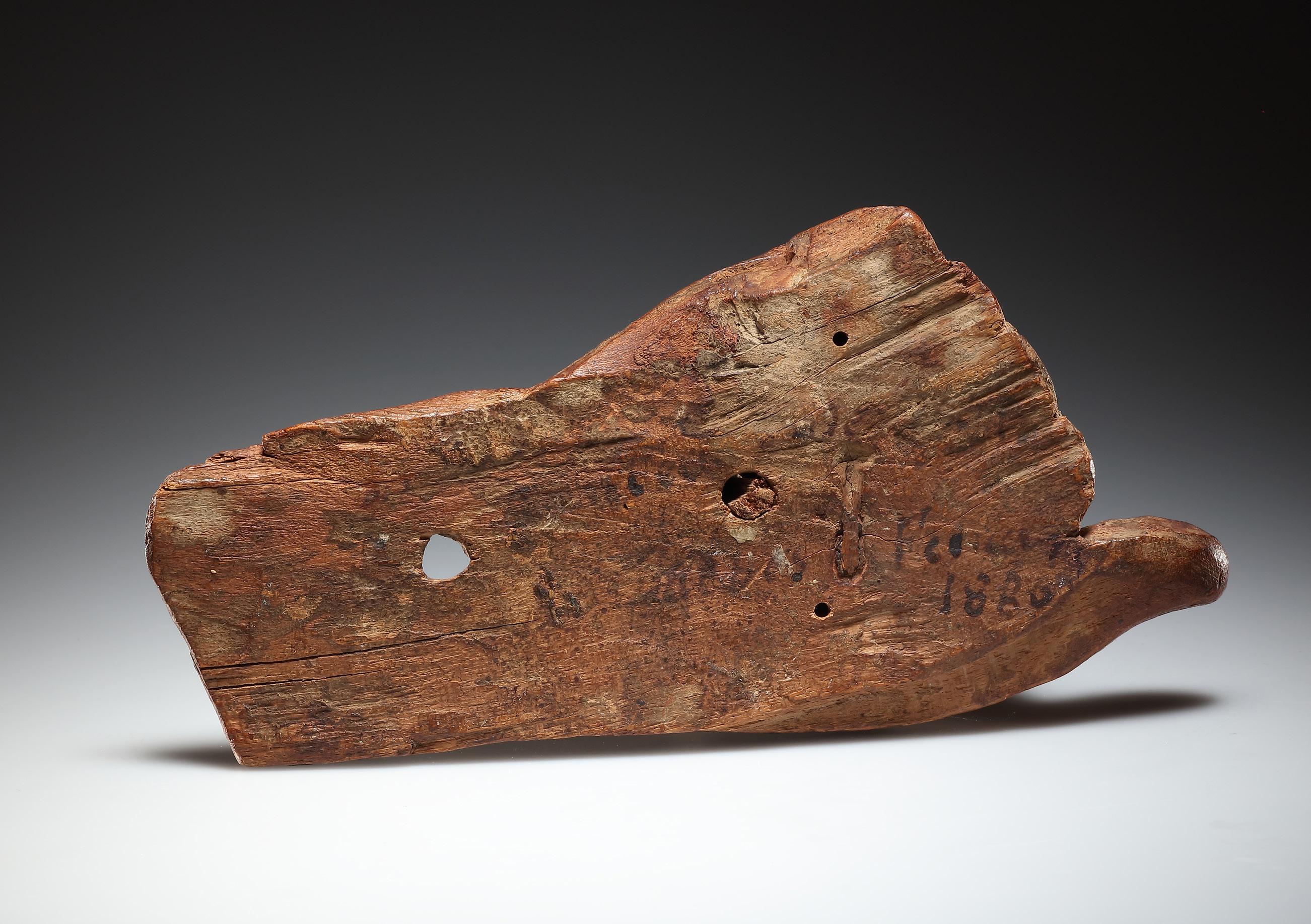
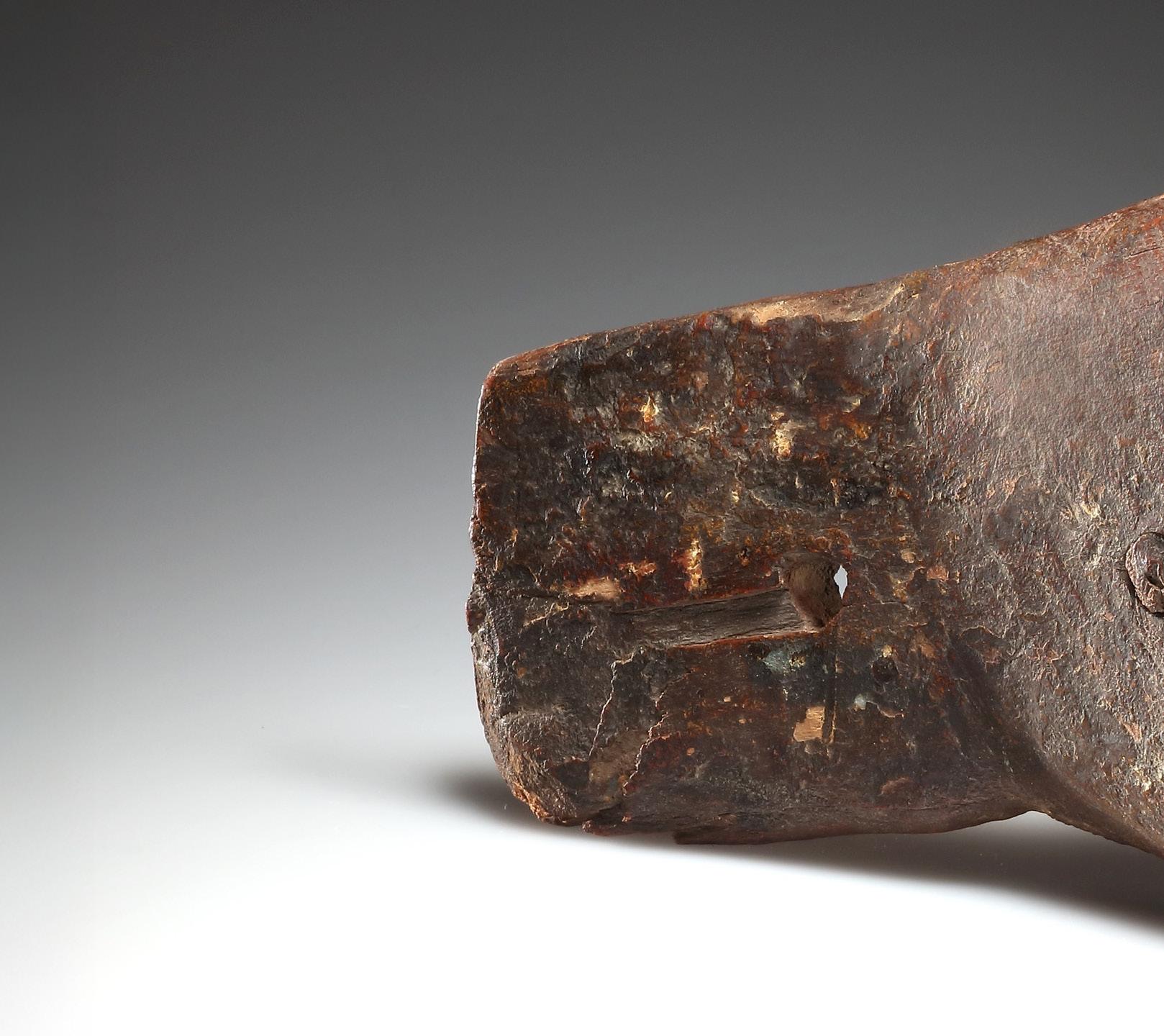
The roughly life-sized right hand, clenched into a fist and including the adjoining wrist, probably belonged to a wooden anthropomorphic sarcophagus lid. A hole through the back of the hand and at the base of the wrist served to attach it. Remains of a wooden peg are still preserved in one of the holes. Two small round holes in the palm. Between the thumb and index finger, as well as on the underside of the hand, there is a rectangular mortise into which a bipartite object was inserted. For
pharaohs, the royal insignia of the crook (heka-scepter) and the flail were frequently used, while for non-royal mummies symbols such as the djed-pillar, the ankh-sign, or papyrus scrolls were common. The surface has a wax-like appearance with reddish-brown paint, partially with black discolorations. There is a chip on the index finger and two smaller surface losses.
NOTE
For a complete sarcophagus lid with a hand that was carved separately and then attached, cf. Louvre Paris, inv. no. E 2826. As an example of an individual hand fragment cf. Louvre Paris, inv. no. E 22327 (both online).
PROVENANCE
Formerly priv. coll. Peter Itsvart (1943-2023), Paris, collected between 1975-1990. Partly legible notes in black ink on the reverse of the object: „... Thebes February 1880“.
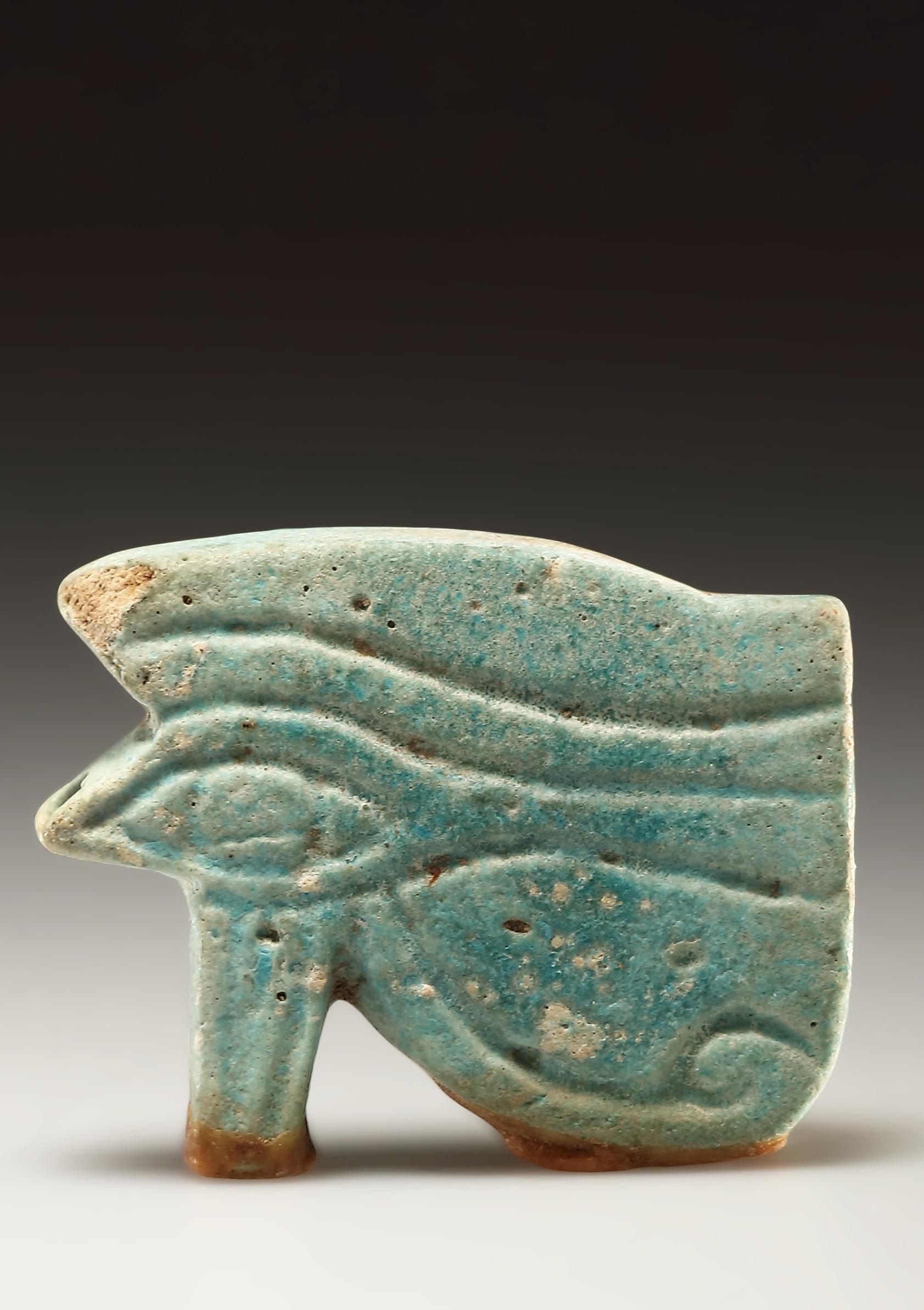
AN AMULET IN THE SHAPE OF AN UDJAT EYE
CHF 1200
Egypt, Late Period | 664 - 332 B.C.
H. 2,9 cm | L. 3,7 cm | D. 0,8 cm | Faience
A stylised eye with finely engraved details on both sides. The udjat is the left eye of Horus that was healed by Thoth. It symbolises the moon, while the right eye of the falconheaded god of the sky symbolises the sun. Amulets in the shape of the udjat were said to have magical powers and the ability to protect and to heal. Longitudinal drill hole. Two small chips missing.
PROVENANCE
Formerly priv. coll. Carl Leonhard Burckhardt-Reinhard (b. 1902 -d. 1965), collection built up since
1922, Egypt. Inherited by his son Christopher Burckhardt in 1966, Switzerland. Since then in the possession of his wife, Switzerland.
NOTE
Cf. Musée du Louvre, Paris, inv. nos. BF 913.00.303; E 18082; E 15707.
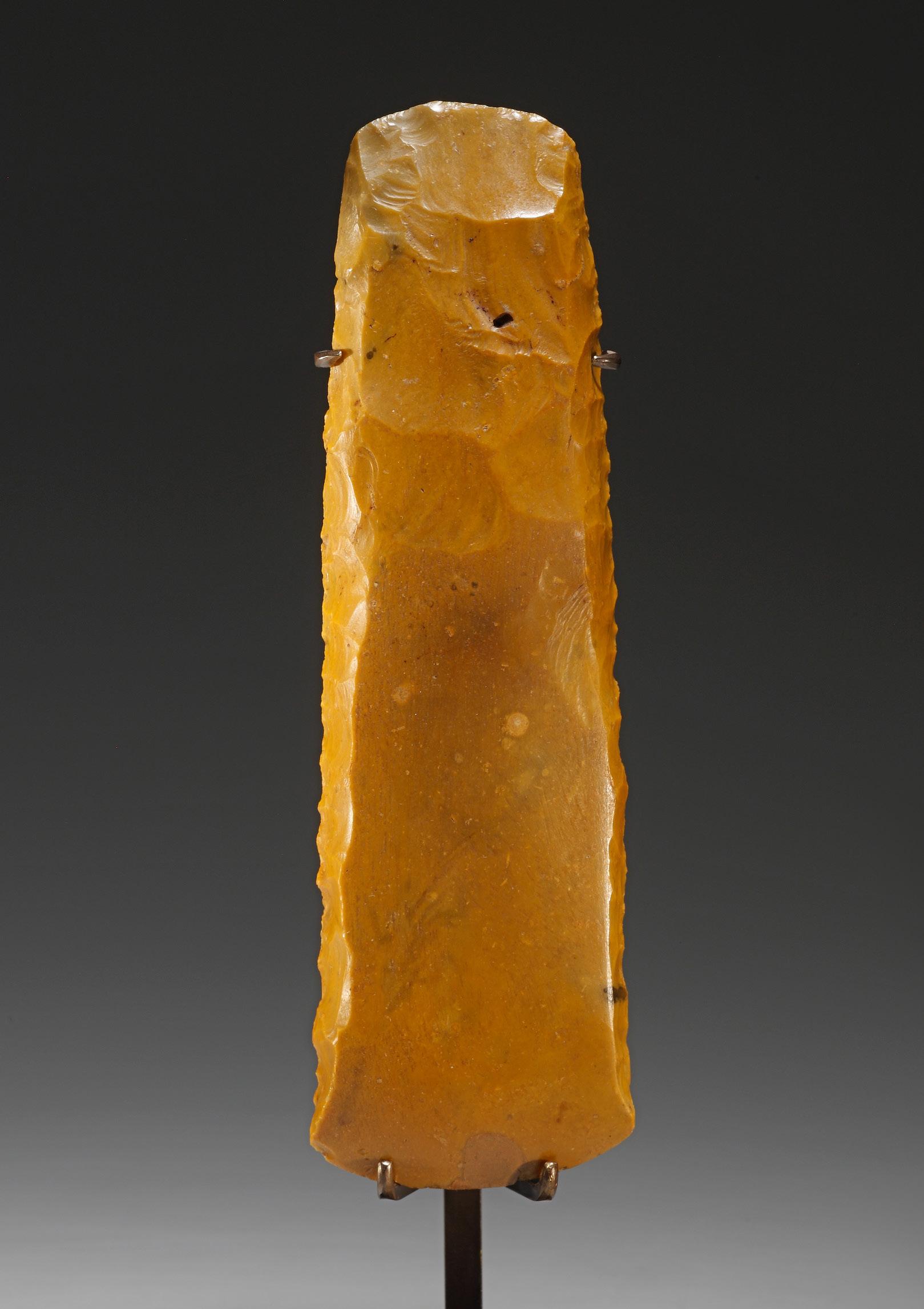
AN AXE BLADE
CHF 2800
Mecklenburg-Western Pomerania (Northern Germany), Nordic Neolithic, | ca. 4000 - 2000 B.C.
L. 16,4 cm | W. Neck 3,6 cm | W. Blade 5,0 cm | Stone
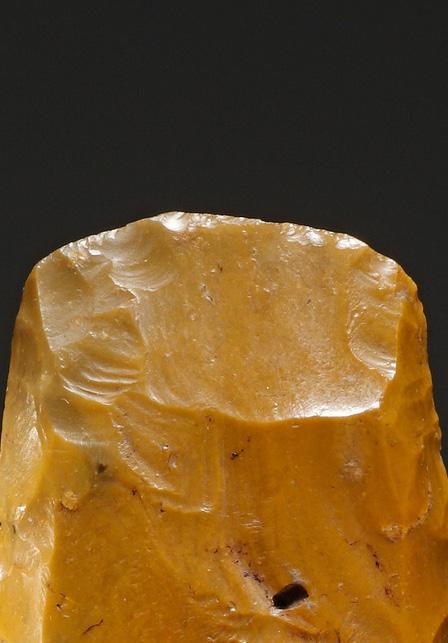
Tool worked on all surfaces. Symmetrical, trapezoid shape. Sides curve outwards as they approach the cutting edge. Trapezoid, flat crosssection. Longitudinal profile with a fairly flat and a slightly curved broad side, indicating that the blade was cross-mounted. Slightly rounded, angularly hewn neck. Slightly asymmetrically rounded cutting edge. Narrow sides “raw”, i. e. entire surface with traces of retouch; broad sides mostly polished. Generously hewn on both sides towards the neck; more so on the „underside“. Orange-brown stone with a few light
and dark spots. Unbroken; recently restored lacuna at the cutting edge.
PROVENANCE
Formerly priv. coll. Dr. Siegfried H. Zimmer (b. 1915 - d. 1984), ca. 1950, see inventory list, no. 91. Thereafter, priv. coll. Von Korff family, Germany; inherited by Julian von Korff before 1980, Germany. With Athena Münzen der Antike, München, prior 2004. On the object a handwritten note in Sütterlin (old German cursive) script: „Poggendorf“.
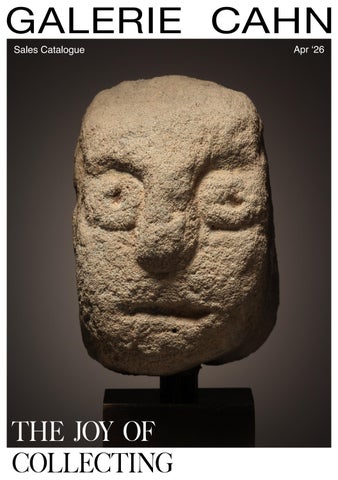
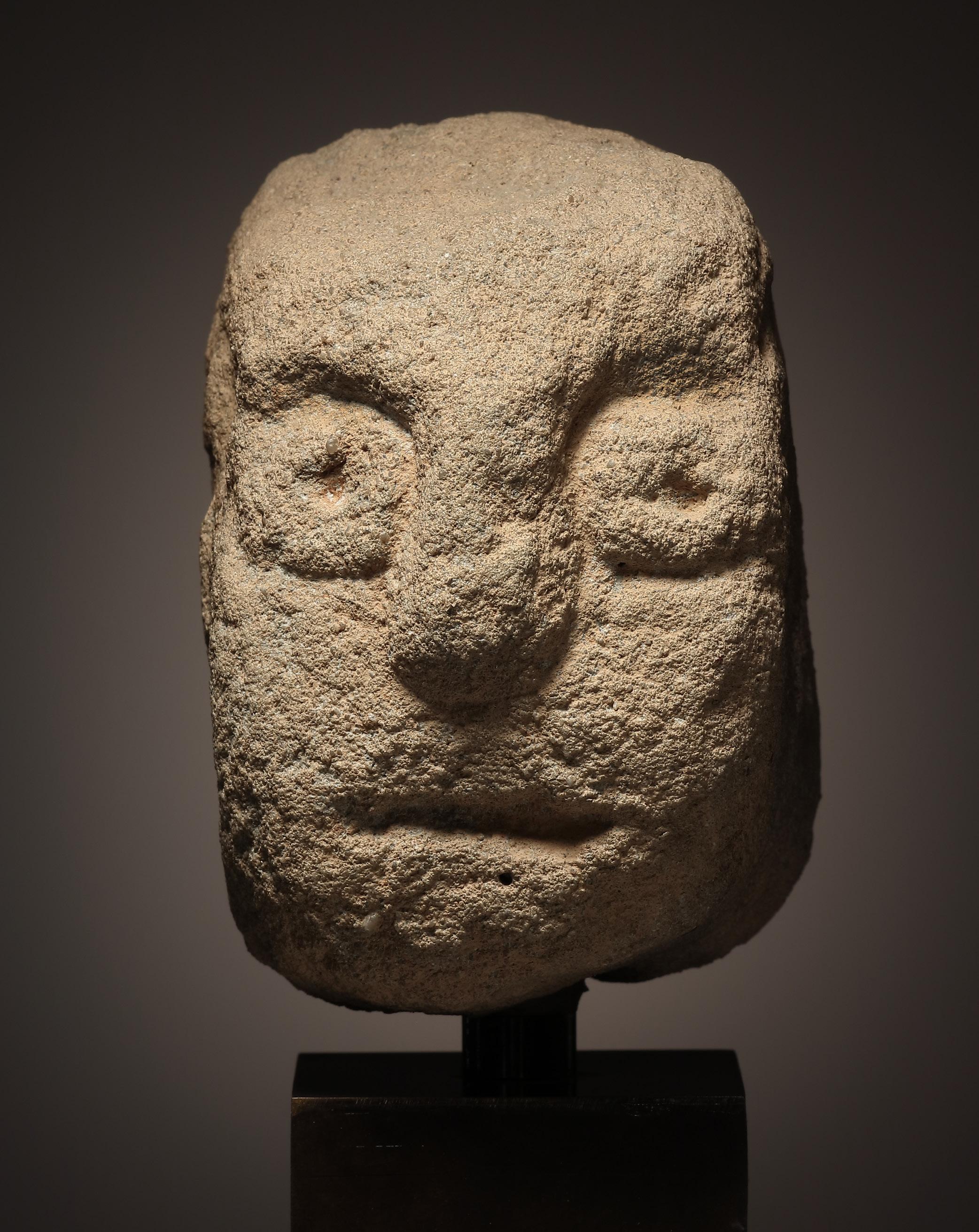
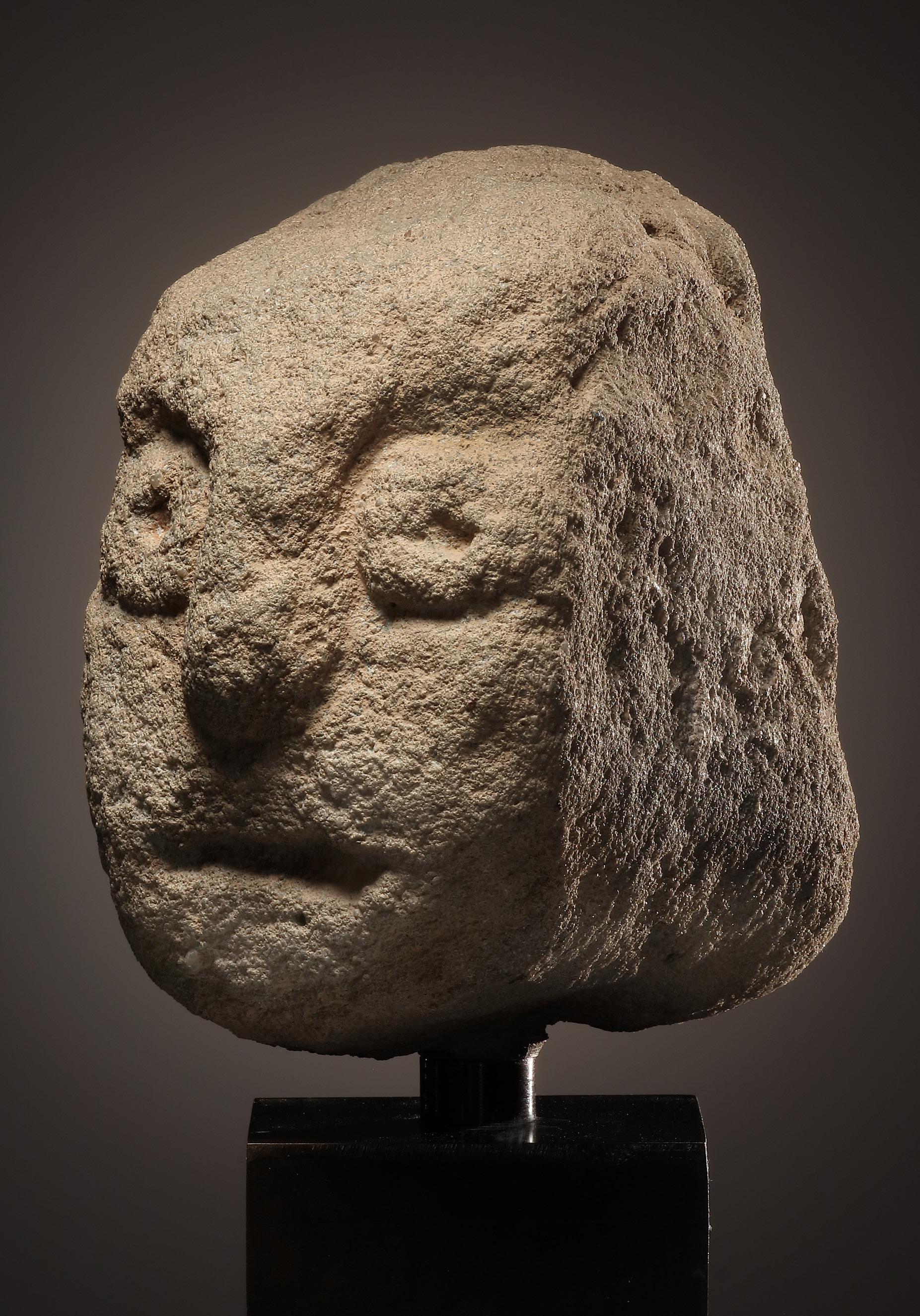
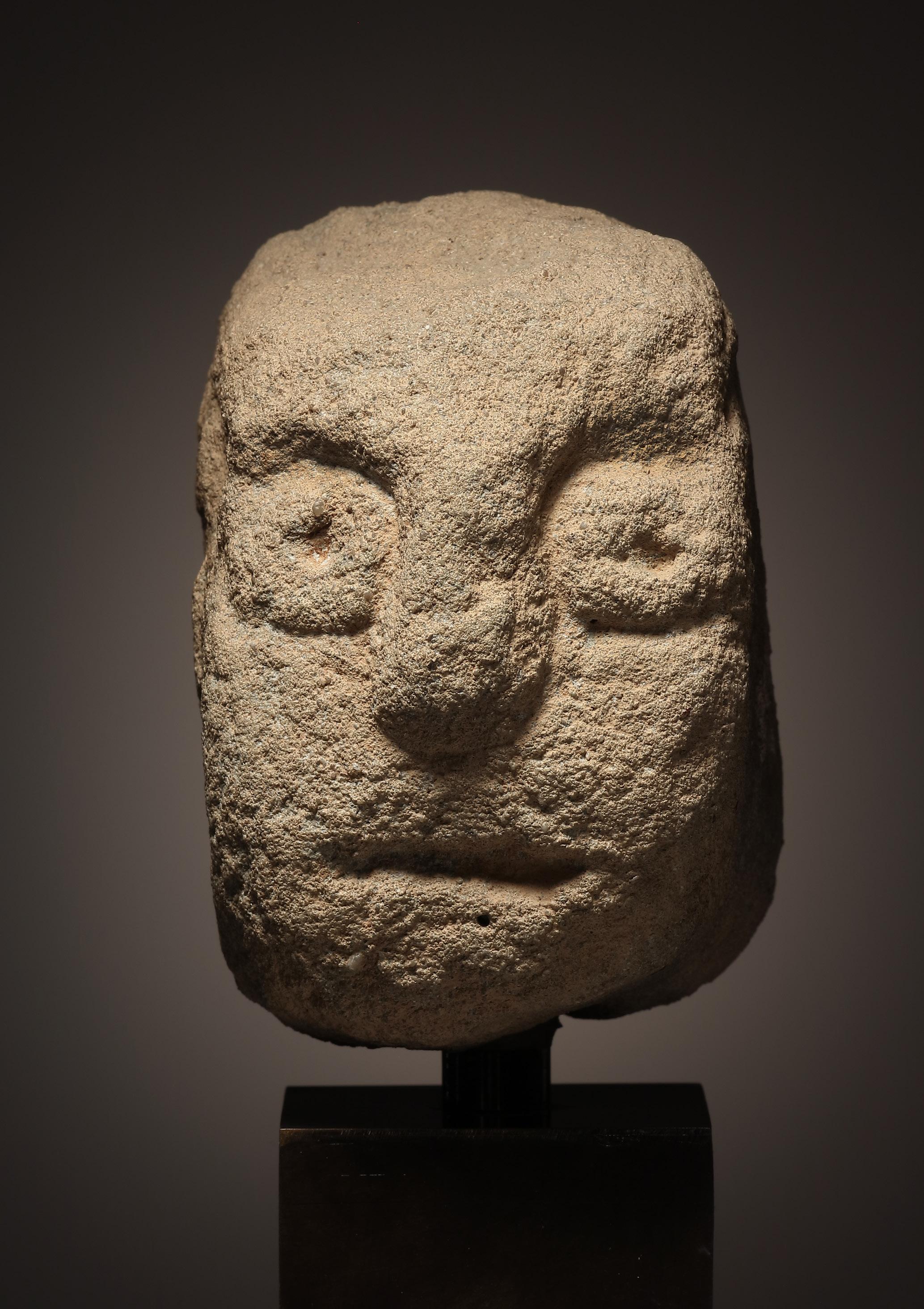
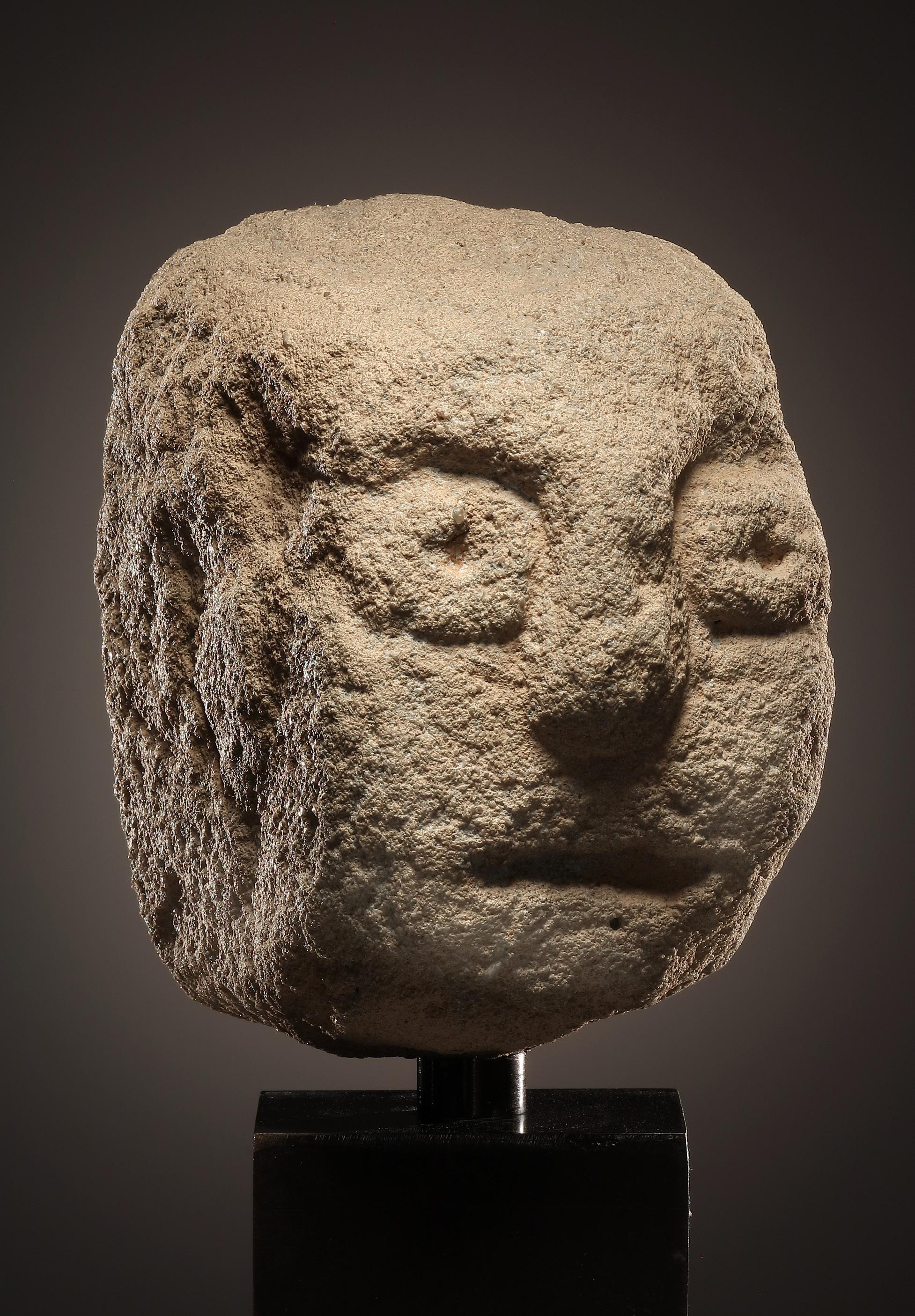
A CELTIC HEAD
CHF 14000
Celtic | 1st century B.C. - 1st century A.D. H. 12,5 cm | W. 8,2 cm | D. 11,3 cm | Sandstone
The anthropomorphic head has a roughly rectangular shape and strongly stylised facial features. The round eyes are framed by thick lids. The elongated, broad nose has a non-specific shape. The mouth is indicated by a vertical incision. The head was reportedly found at Wroxeter, Shropshire (near the Roman city of Viroconium, the administrative centre of the Celtic tribe of the Cornovii). For the Celts, the head was regarded as the seat of the soul. Accordingly, it assumes
a dominant role in Celtic art. The cult of the severed head, impressively documented by archaeological finds from Entremont (pillar with têtes coupées cut in stone and the so-called five têtes coupées) and Roquepertuse (portico pillar with recesses for human skulls), attests to the importance of the head in religious practice. Slightly worn.
NOTE
On the ritual background and the phenomenon of Celtic stone heads see (with numerous illustrations): R. Wace – K. Schubert (eds.) Celtic Stone Sculptures (London 1989) as well as B. Cunliffe, The Celts and Their History (Bergisch Gladbach 2000) 82–87.
PROVENANCE
Formerly priv. English collection; acquired from Chris Russ Antiquities, prior 1998 (see List 32). With Finch&Co private collection. Thereafter, priv. coll. J. P. Keane. WIth French market since 2025. Said to have been found near Wroxeter Shropshire, once the Roman Town of Viroconium, the Territoy of the Celtic Cornovii.
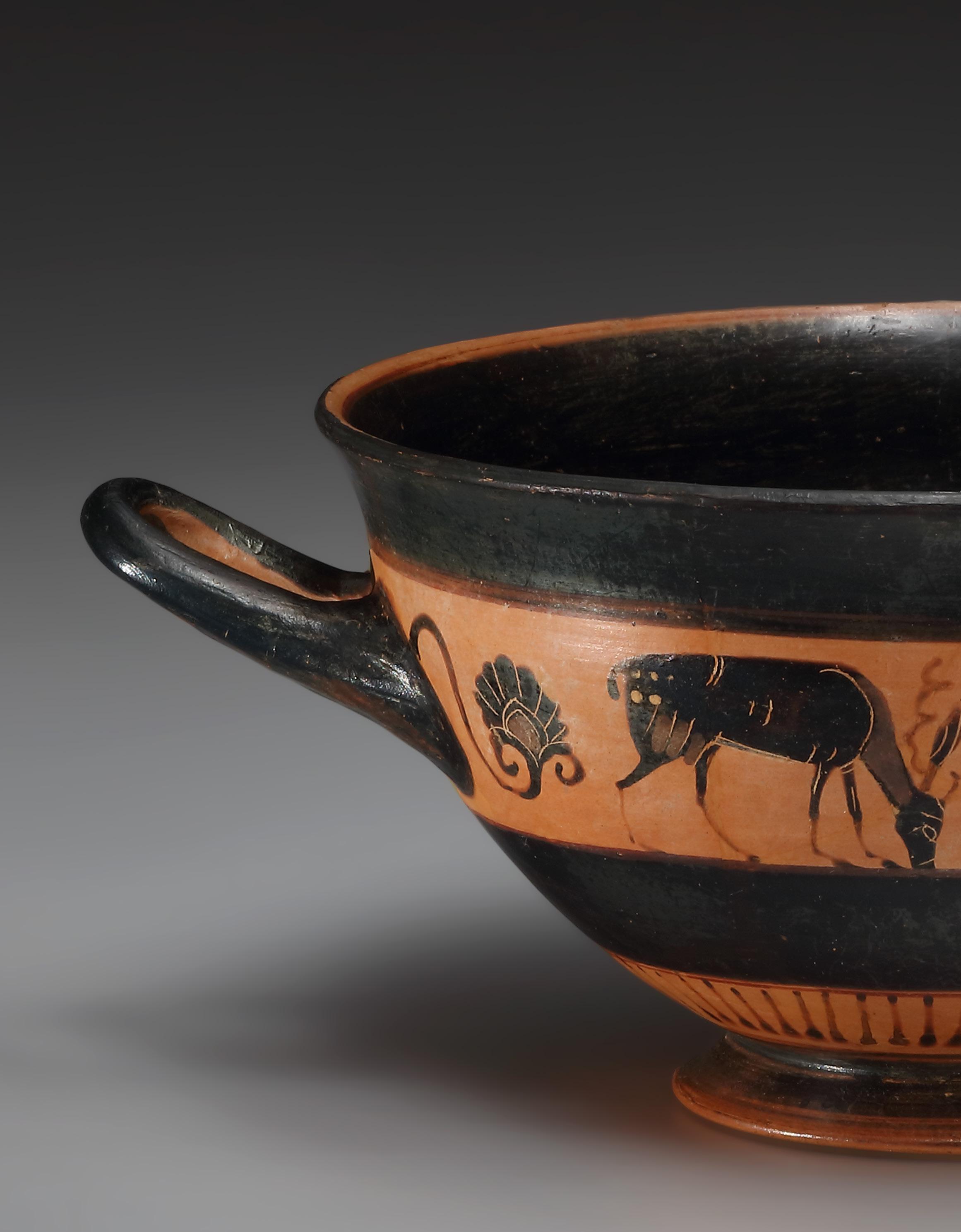
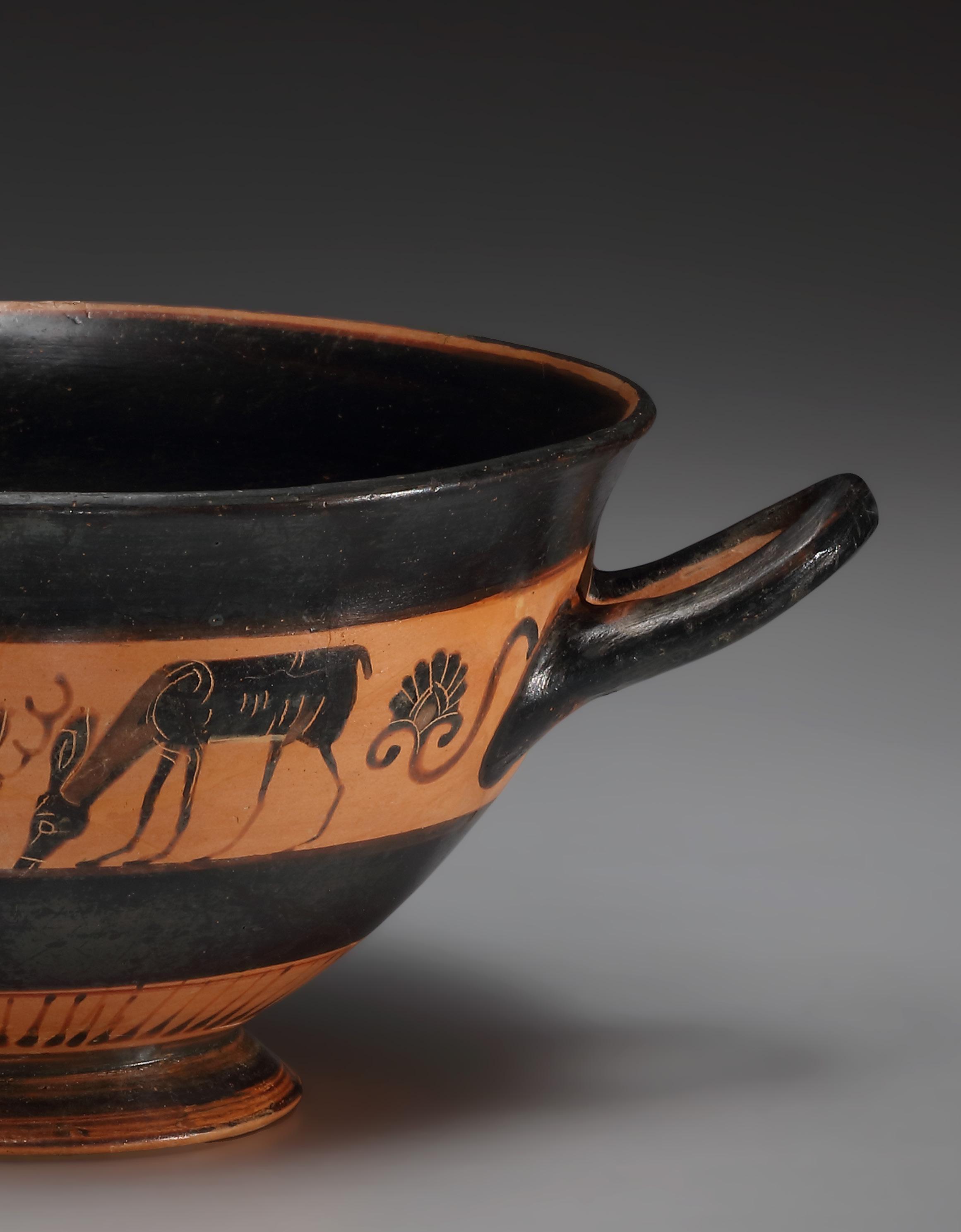
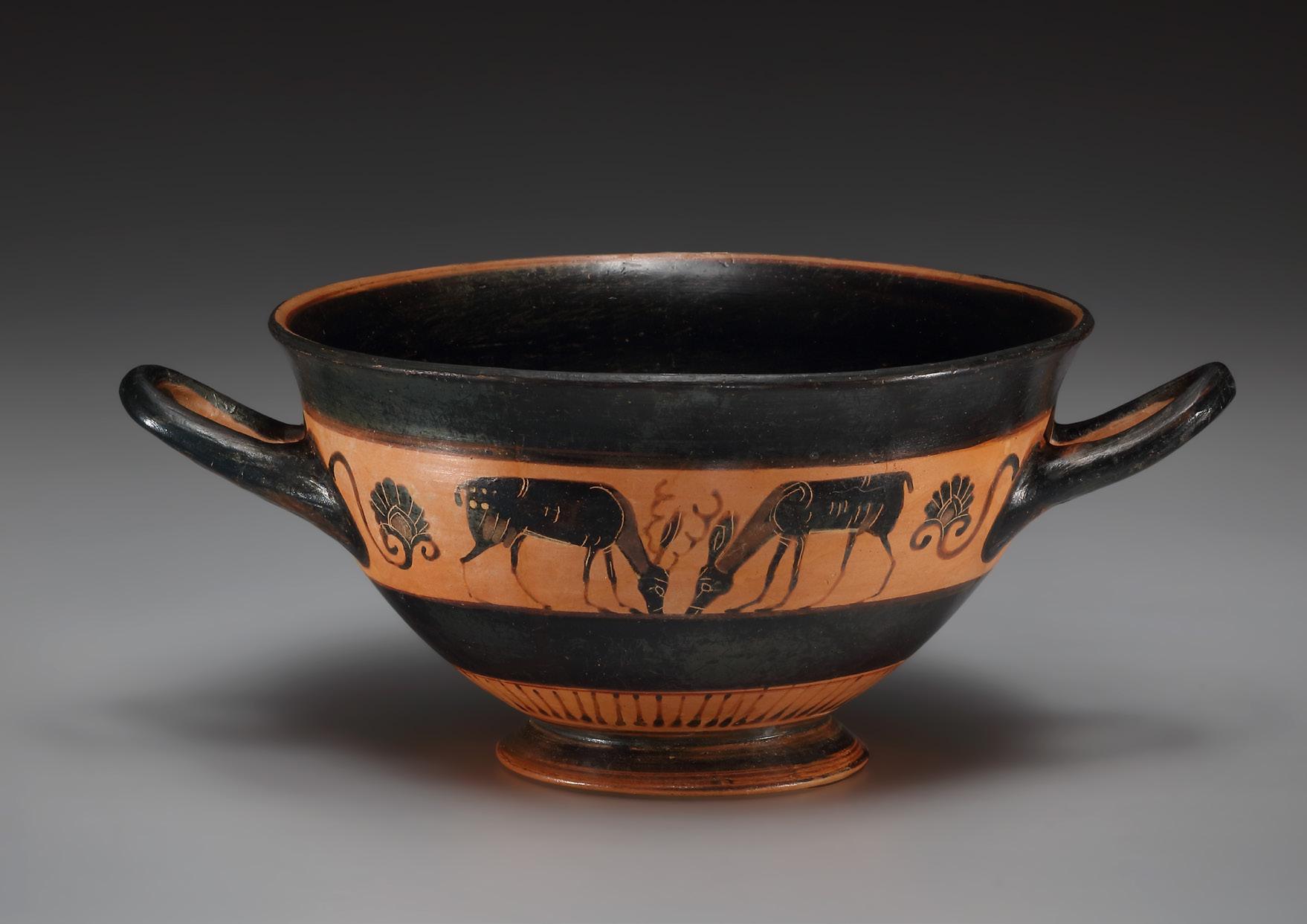
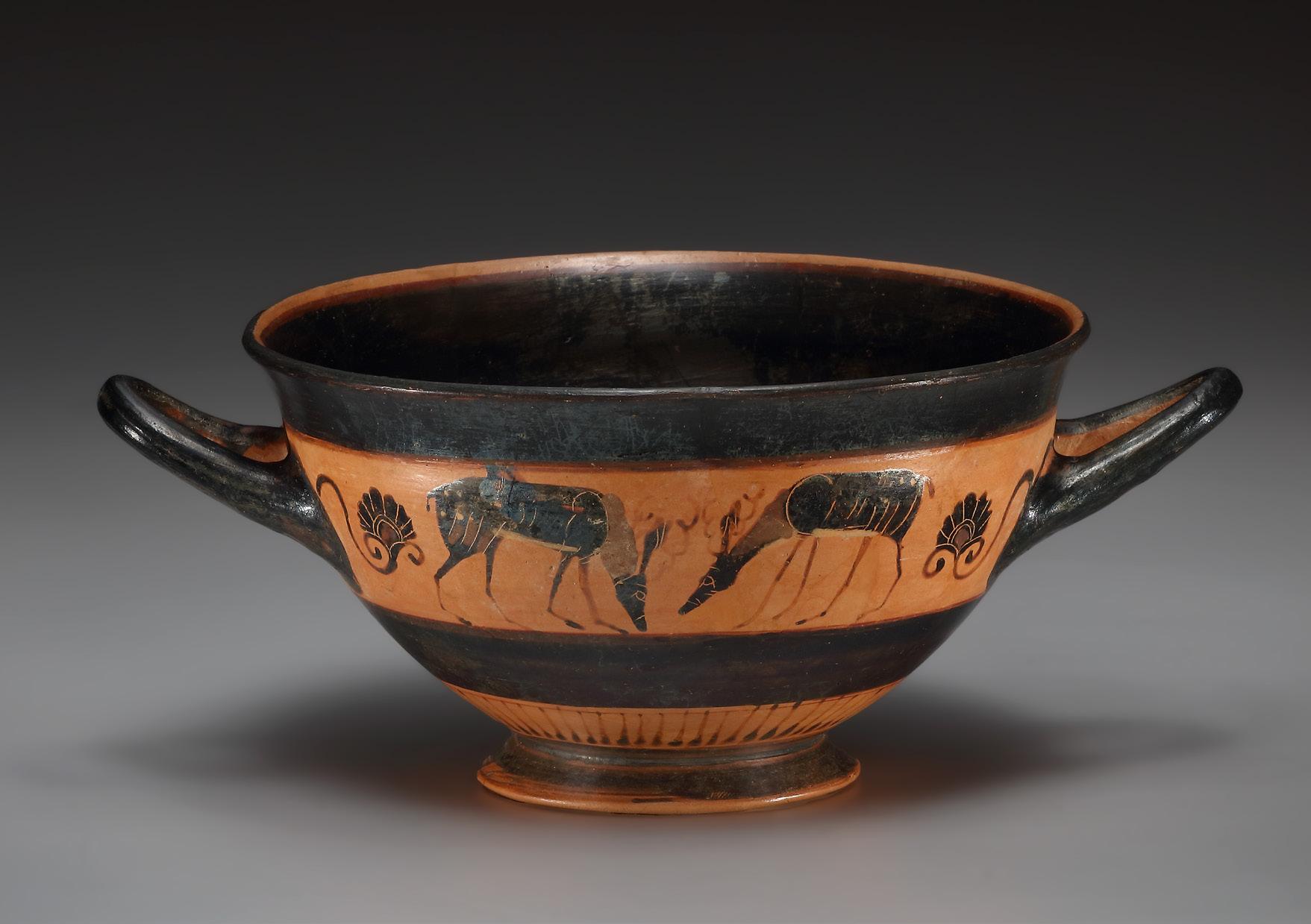
A BLACK-FIGURE SKYPHOS WITH GRAZING DEER
CHF 6800
Attic, Late Archaic | 3rd quarter of 6th century B.C. | Clay H. 9,6 cm | L. max. 23,o cm | Diam. without Handles 17,0 cm
Large skyphos with deep bowl, inverted echinus foot and handles round in section. Inside glazed, except for a reserved line around the rim. Lip and lower part of the bowl glazed. Above the foot, a band of rays in dilute glaze. Foot glazed. Underside reserved with one glaze circle around a central glaze dot. A-B: Animal frieze with two grazing deer, facing each other, between palmettes. Added white on the underbellies and hindquarters of the deer. Red highlights on the necks and thighs and on the palmettes. Reassembled from several fragments. A lacuna in
the rim restored. A few retouches.
NOTE
The skyphos, Beazley Archive no. 350912, ‚compare Hermogenes‘ (Beazley), is decorated with the same scene, cf. Hermogenes (Beazley).
The grazing deer motif appears fairly frequently on contemporary Little Master cups.
PROVENANCE
Formerly priv. coll. I. L., Austria, acquired between 1960 and 1990. Thereafter, Munich art market. With Austrian export license.
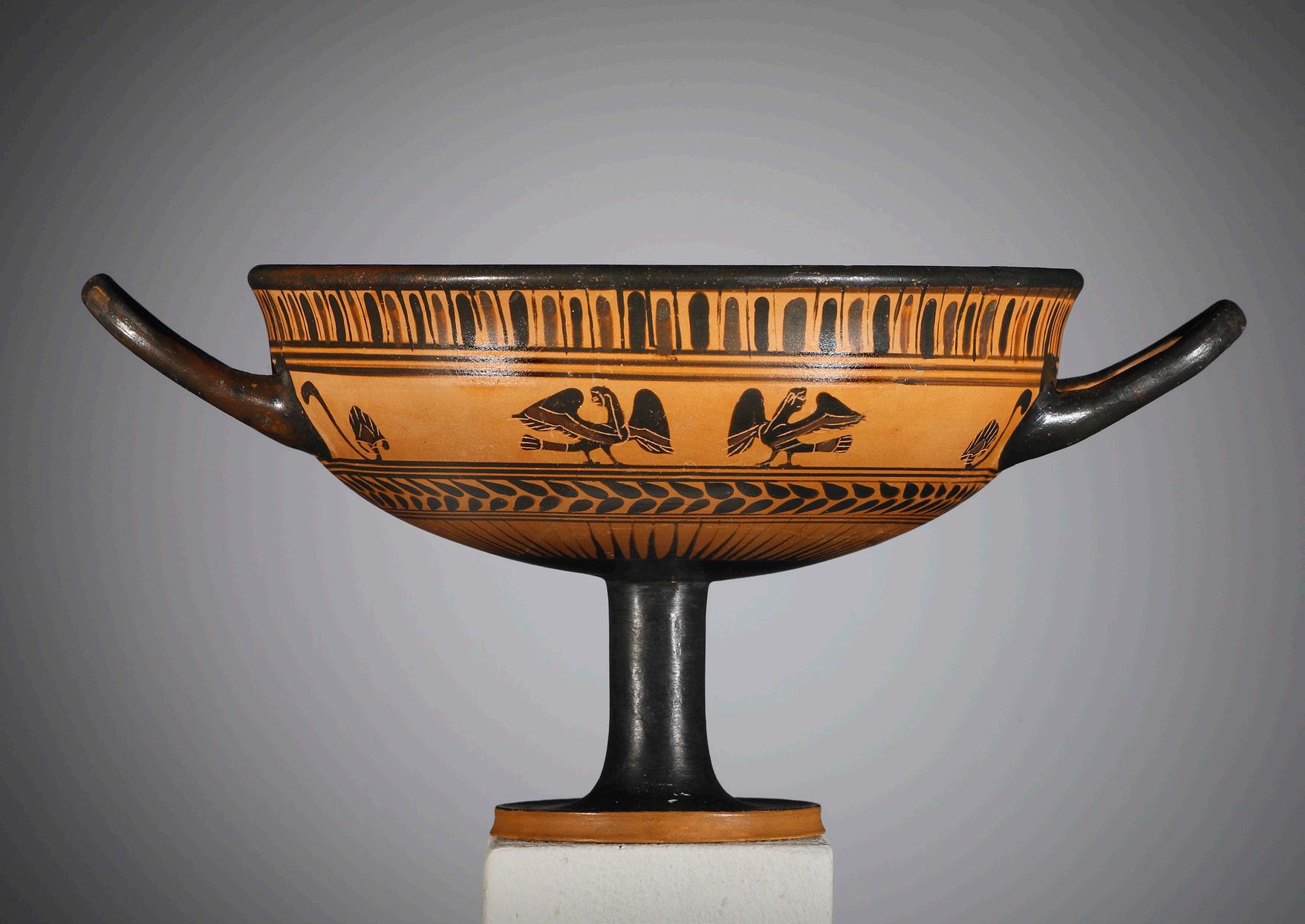
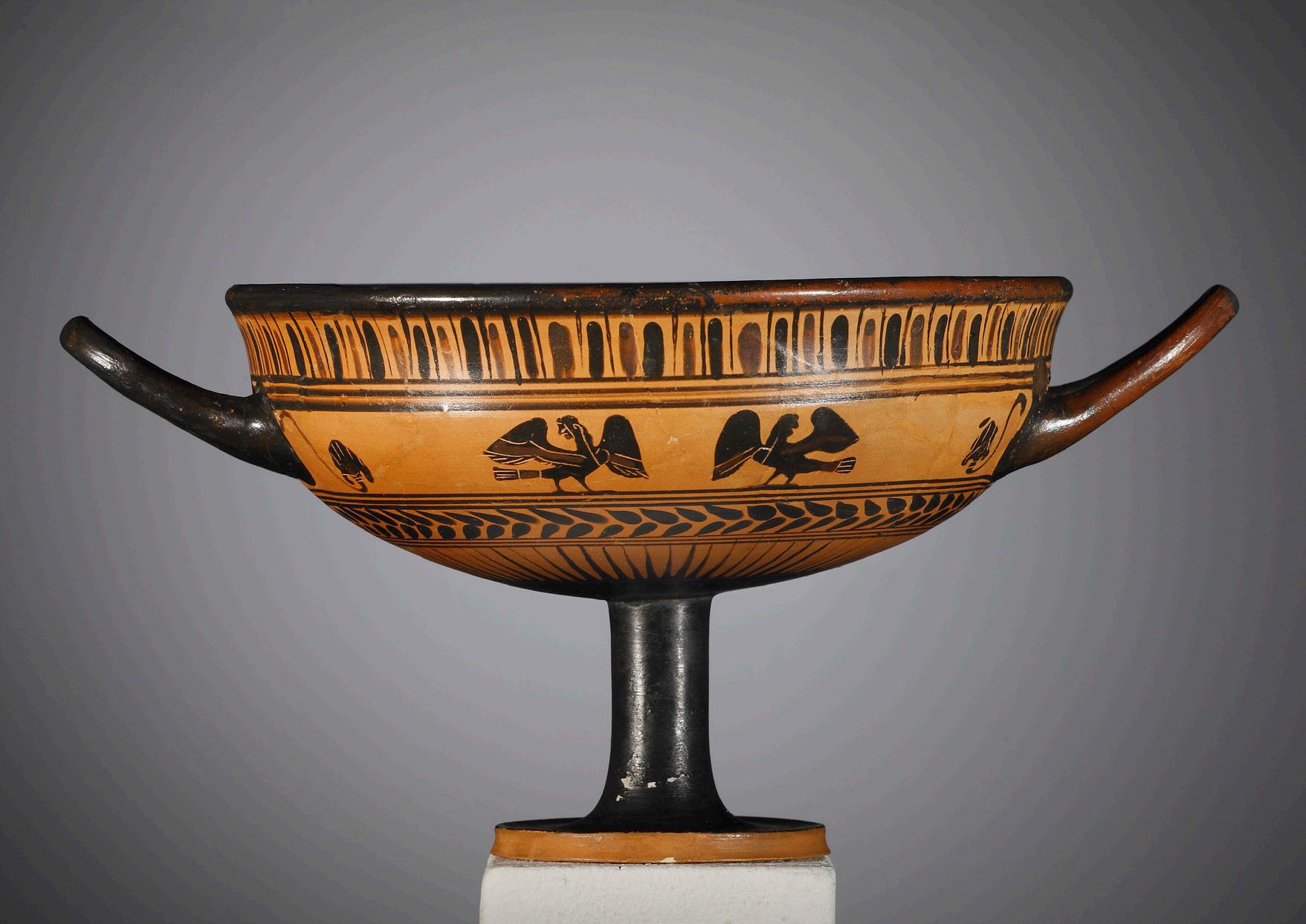
A LITTLE-MASTER CASSEL CUP WITH SIRENS
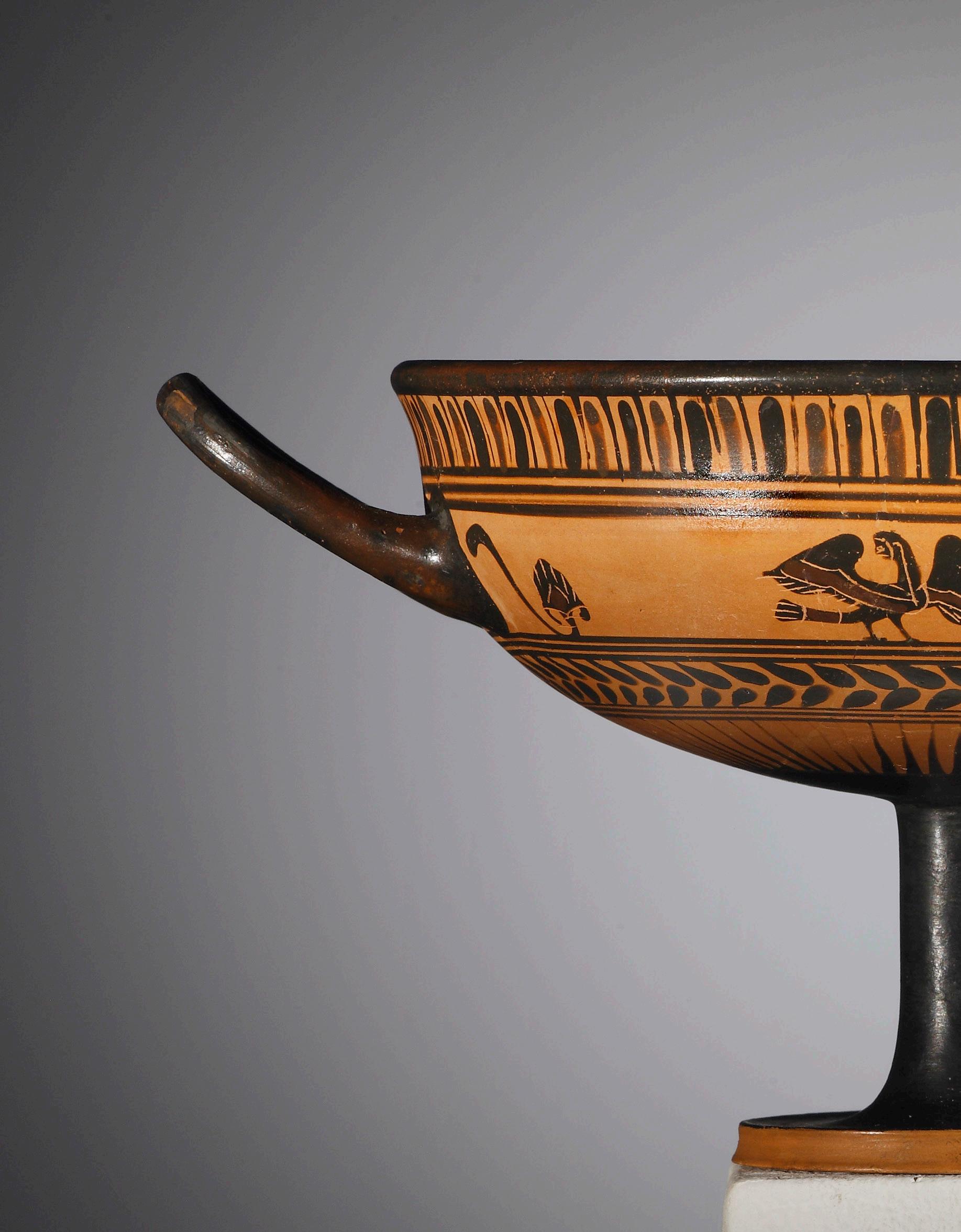
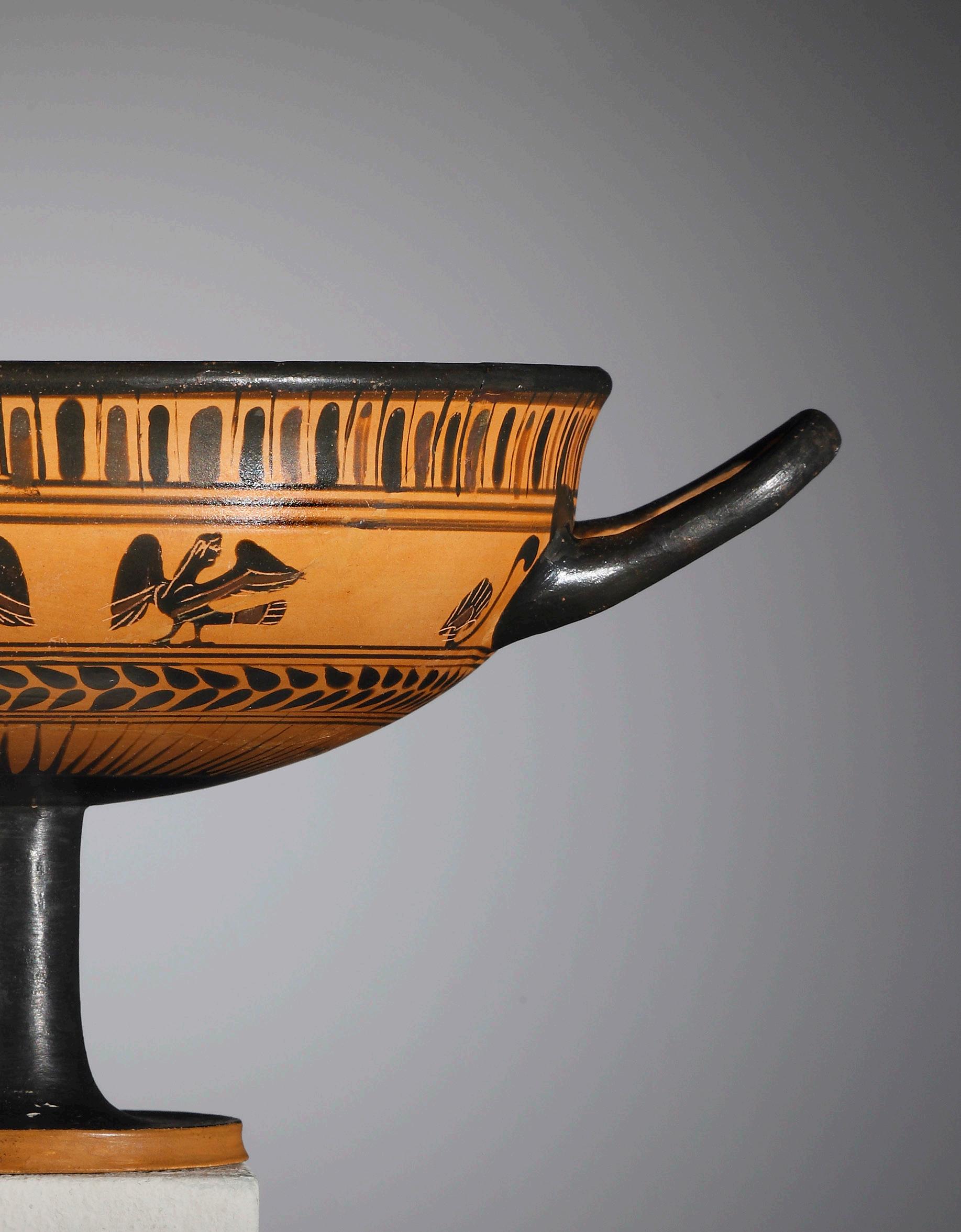
CHF 11000
Greek, Attic | 530 - 520 B.C.
H. 9,5 cm | Diam. 14,2 cm | Clay, added Red
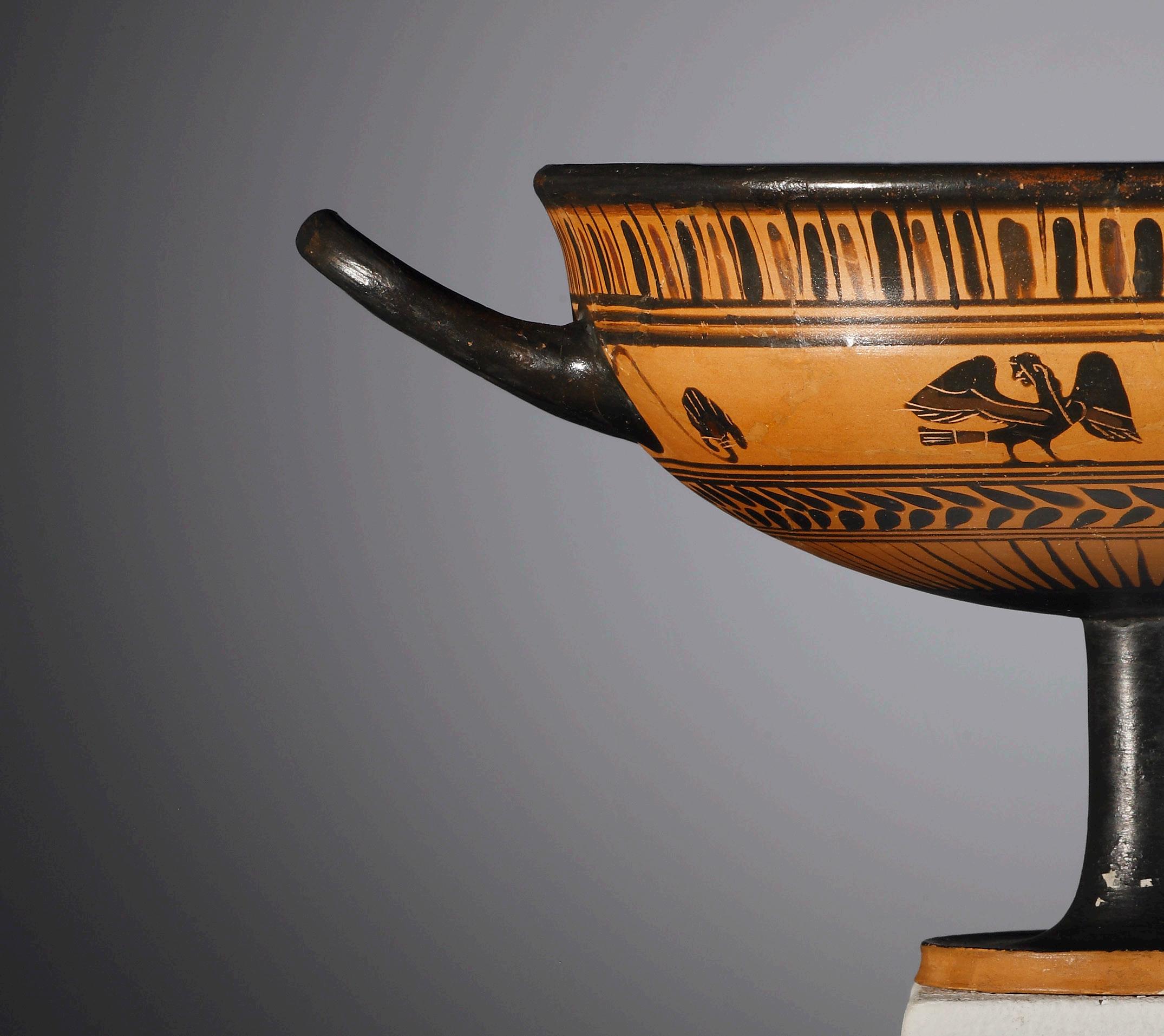
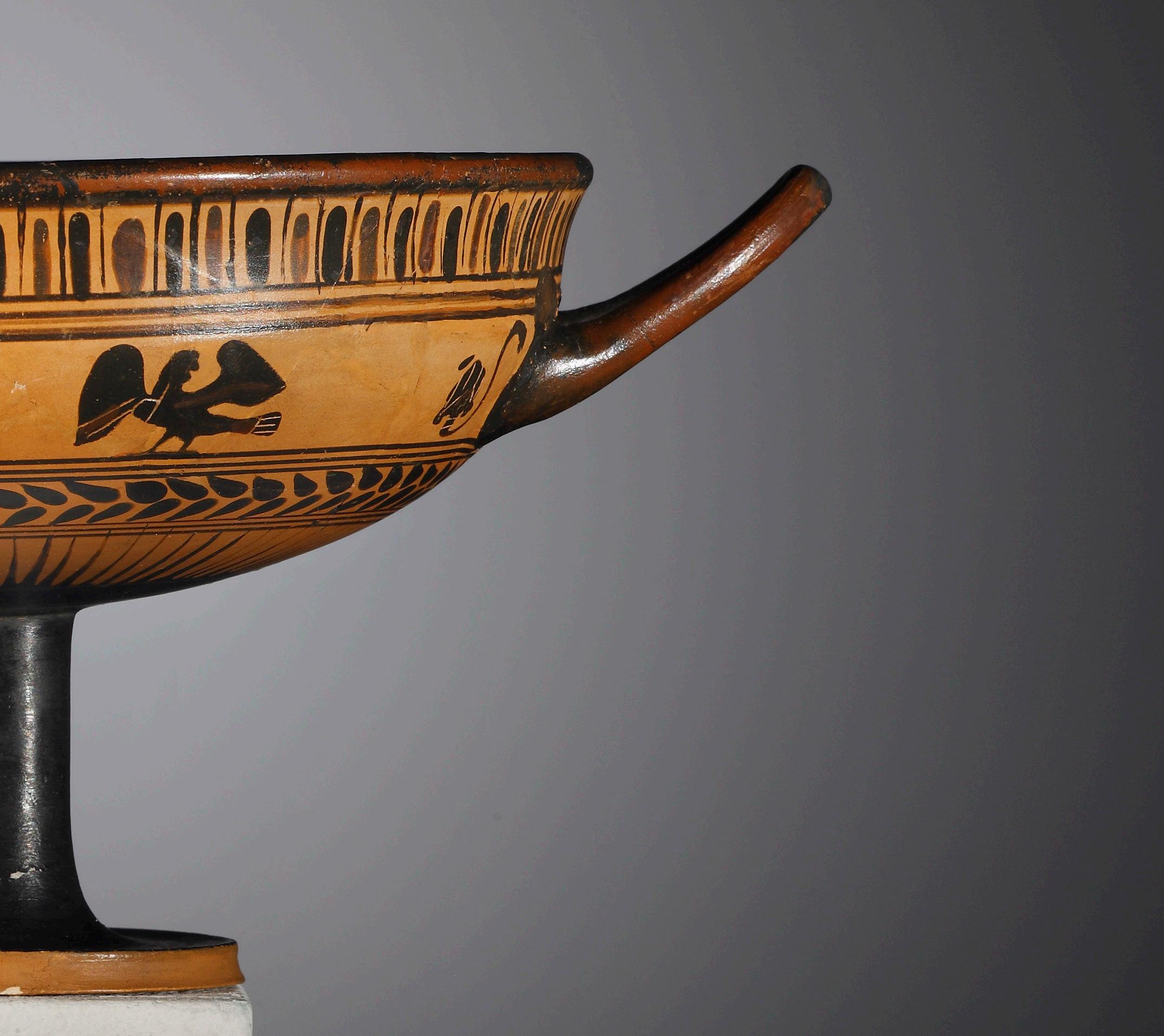
In the reserved zone between the handles, repeated on each side, a pair of confronted sirens stand with wings widespread and their heads turned back. A red-hearted palmette is attached by a tendril to the roots of each handle. On the offset lip, a pattern of alternating black and red tongues. Below the figured zone, a band of laurel to left, framed by three lines above and below. A corona of fine rays above an all-black base. Inside, a circumscribed dot within a small reserved tondo. Reassembled from fragments. Three lacunae in the wall of the cup are filled in, but the
painting has not been reconstructed. Footplate and most of stem restored. Some joins filled in and retouched. Although of the standard Cassel cup type, this example is one of the relatively few decorated with littlemaster figures on the bowl in place of chains of ivy or lotus.
NOTE
For a Cassel cup of standard type, cf. W. Hornbostel, Kunst der Antike. Schätze aus Norddeutschem Privatbesitz, Cat. Hamburg (Mainz, 1977) 275 f., cat. no. 243 with illus.
For an example with figures in the handle zone, see CVA Ireland 1 (2000) 28, pl. 21.1-3: University College Dublin 104 (old V3022). See
further H.A.G. Brijder, BABesch 68 (Leuven, 1993) 141, no. 43 for lists.
PROVENANCE
Formerly Coll. Dr. K. Deppert, Frankfurt. Thereafter Coll. Päselt, Karlsruhe, Germany, since the 1970s; listed (without illus.) in an inventory under no. 29, August 1993.
A TERRACOTTA FIGURINE OF A GROTESQUE
CHF 6500
Greek | 5th century B.C.
H. 16,4 cm | W. 5,3 cm | D. 4,9 cm | Terracotta
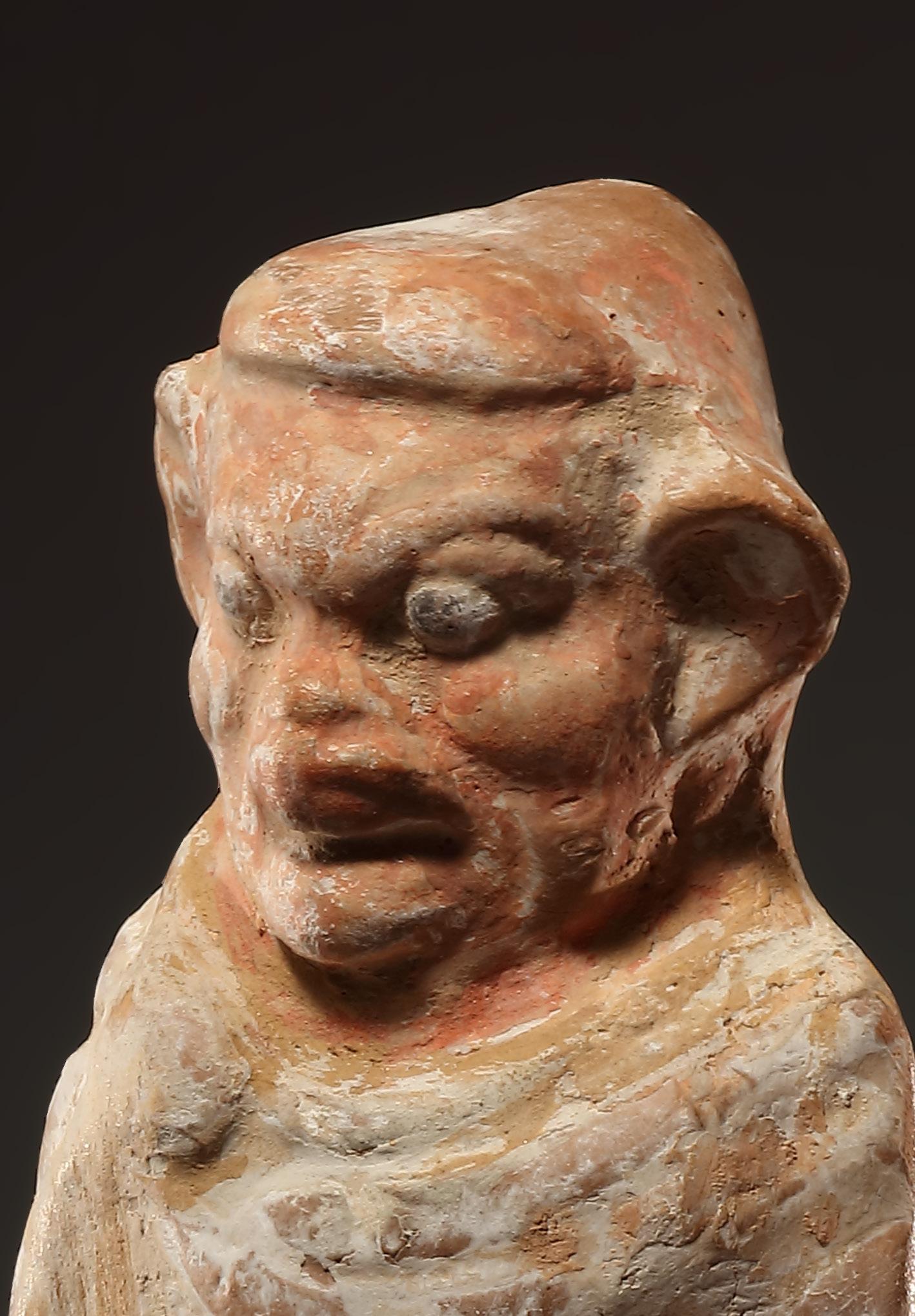
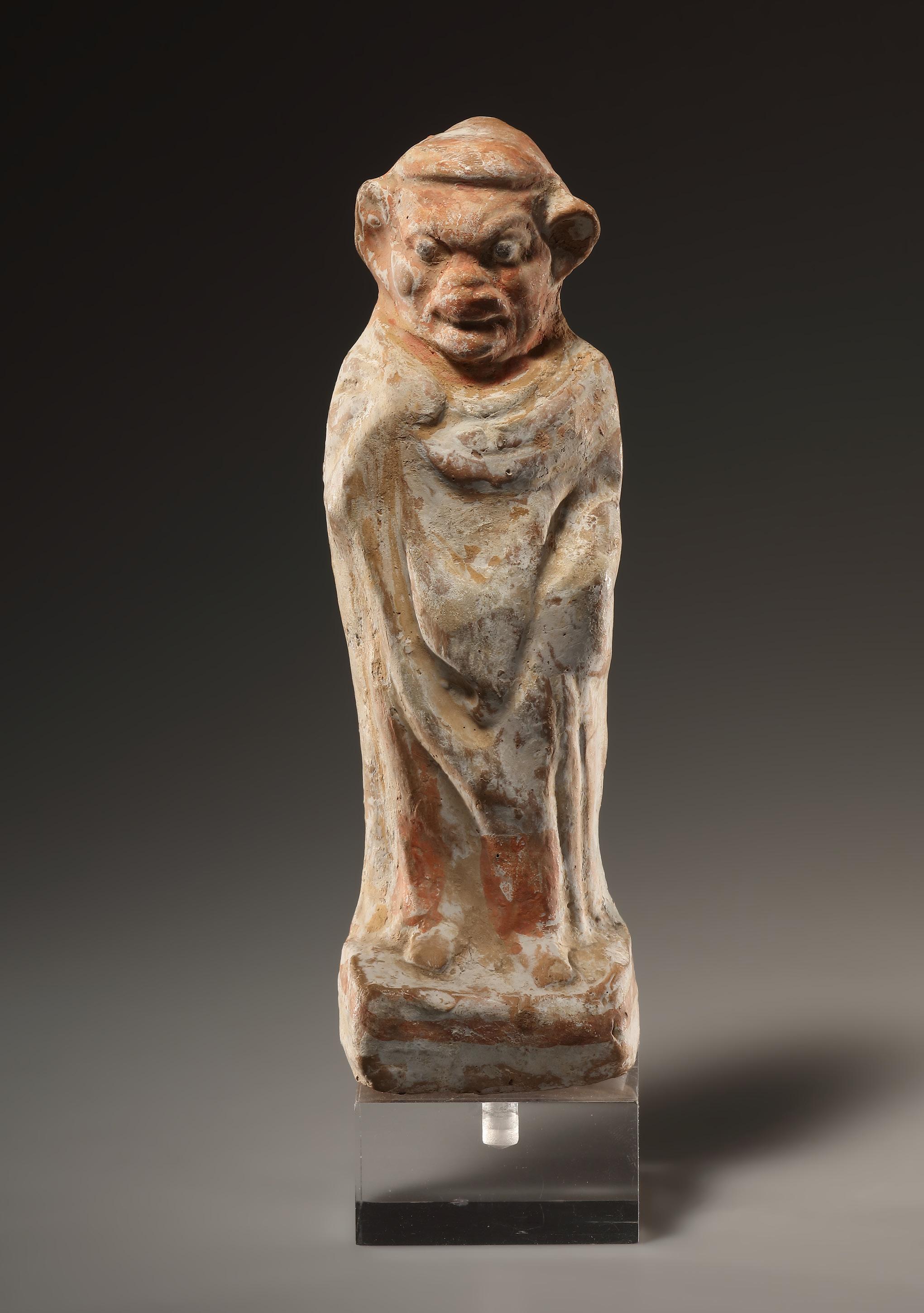
Statuette of a man whose body is almost entirely wrapped up in a himation. Large, sticking-out ears, slightly bulging eyes, a broad nose and fleshy lips lend him a somewhat grotesque appearance. On his head he wears a conical cap. On a low base. Our terracotta perhaps has to do with the rituals that formed part of the theatre performances at the Kabeiroi sanctuary of Thebes. Large areas of white engobe preserved. Traces of reddish paint in the face, on the neck and in the lower third of the legs (possibly indicating trousers).
Pupils defined in black. Traces of ochre paint on the himation. A reddish-brown stripe on the base.
NOTE
For a figurine of the same type, cf. B. Schmaltz, Terrakotten aus dem Kabirenheiligtum bei Theben (Berlin: W. de Gruyter, 1974), p, 177, pl. 25, cat. no. 318. For a close variante with an open mouth, cf. London, British Museum, Inv. no. 1996,0326.2.
PROVENANCE
Formerly priv. coll. (d. 1991), London, 1960s. Inherited by his daughter, (d. 2005) and then by his son-in-law R. J. M.-P., London.
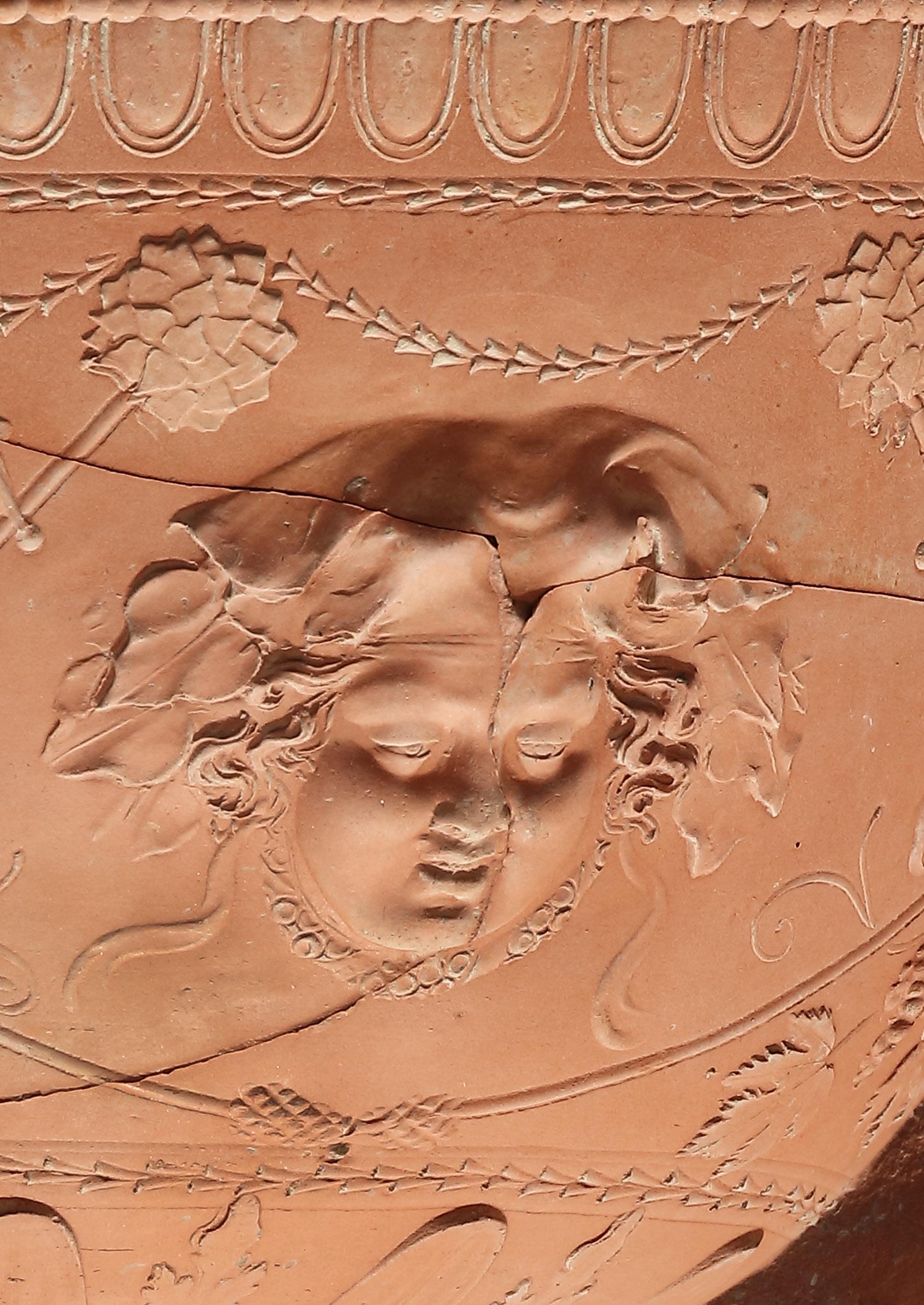
A PART OF A MOLD FOR A LARGE ARRETINE BOWL ATTR. TO THE WORKSHOP OF M. PERENNIVS
CHF 8500
Roman, Arretium (modern Arezzo) | ca. 15 B.C. - 10 A.D.
H. 12,1 cm | Diam. ca. 21,0 cm | Terra Sigillata
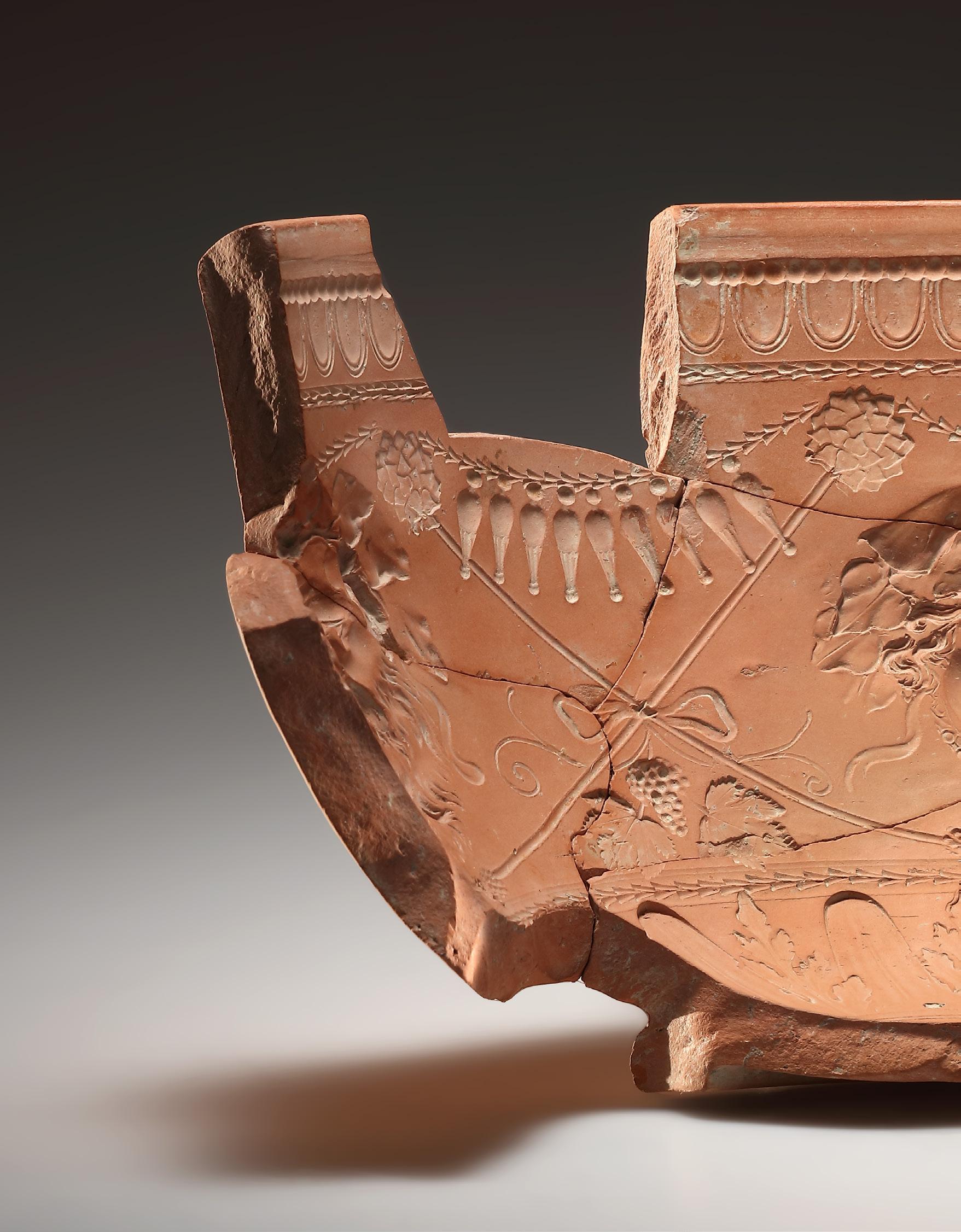
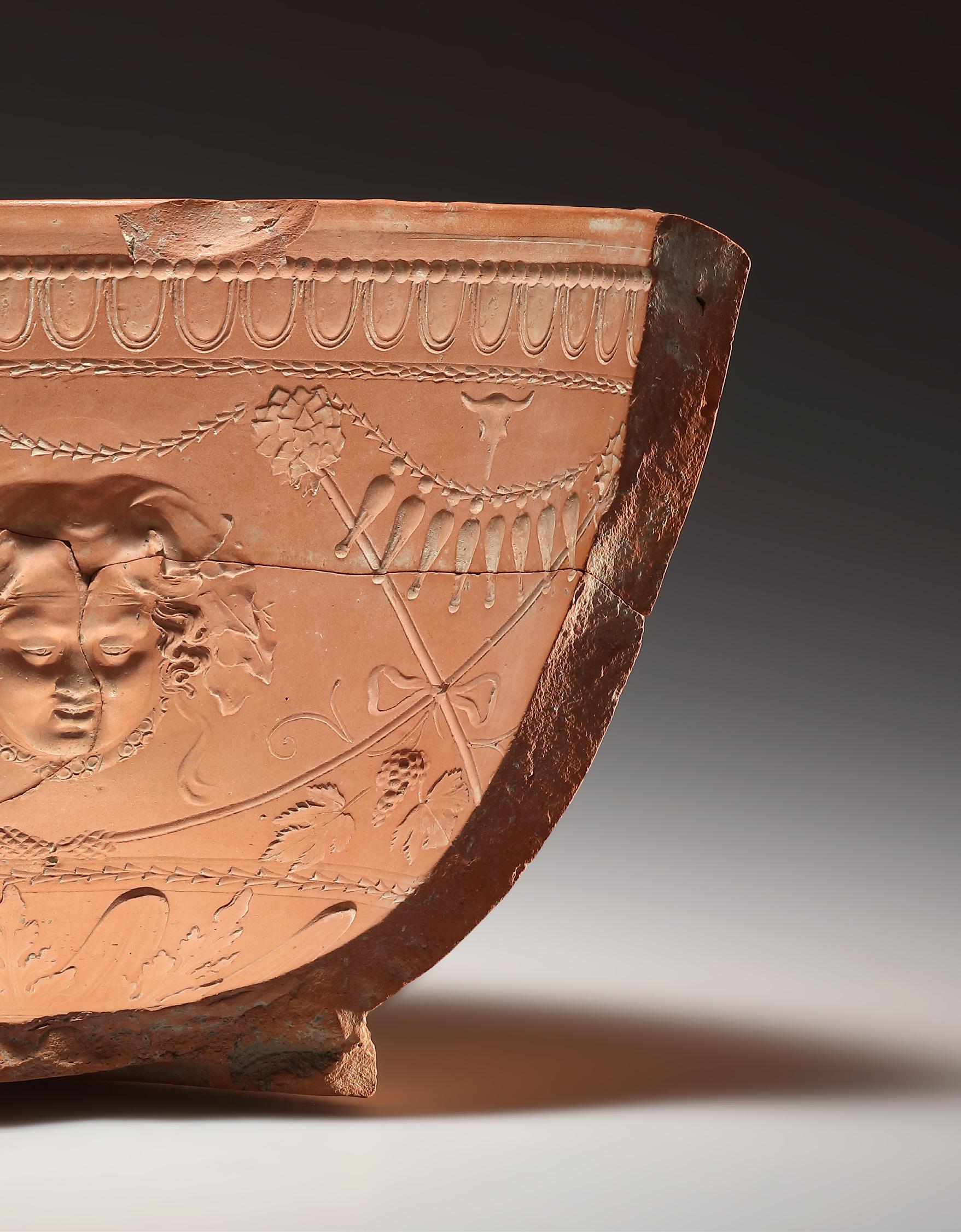
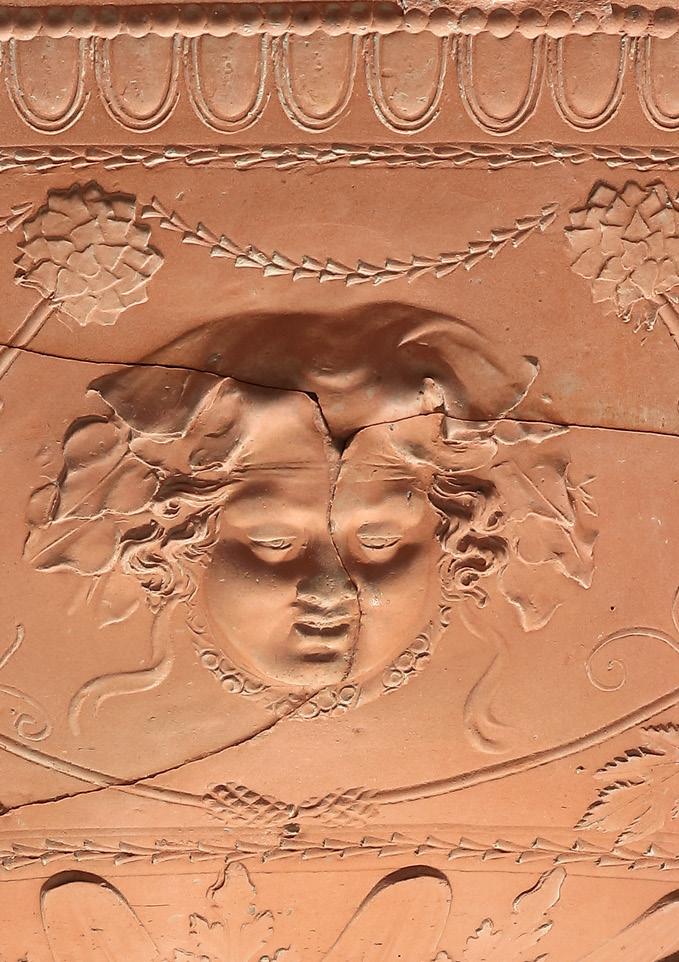
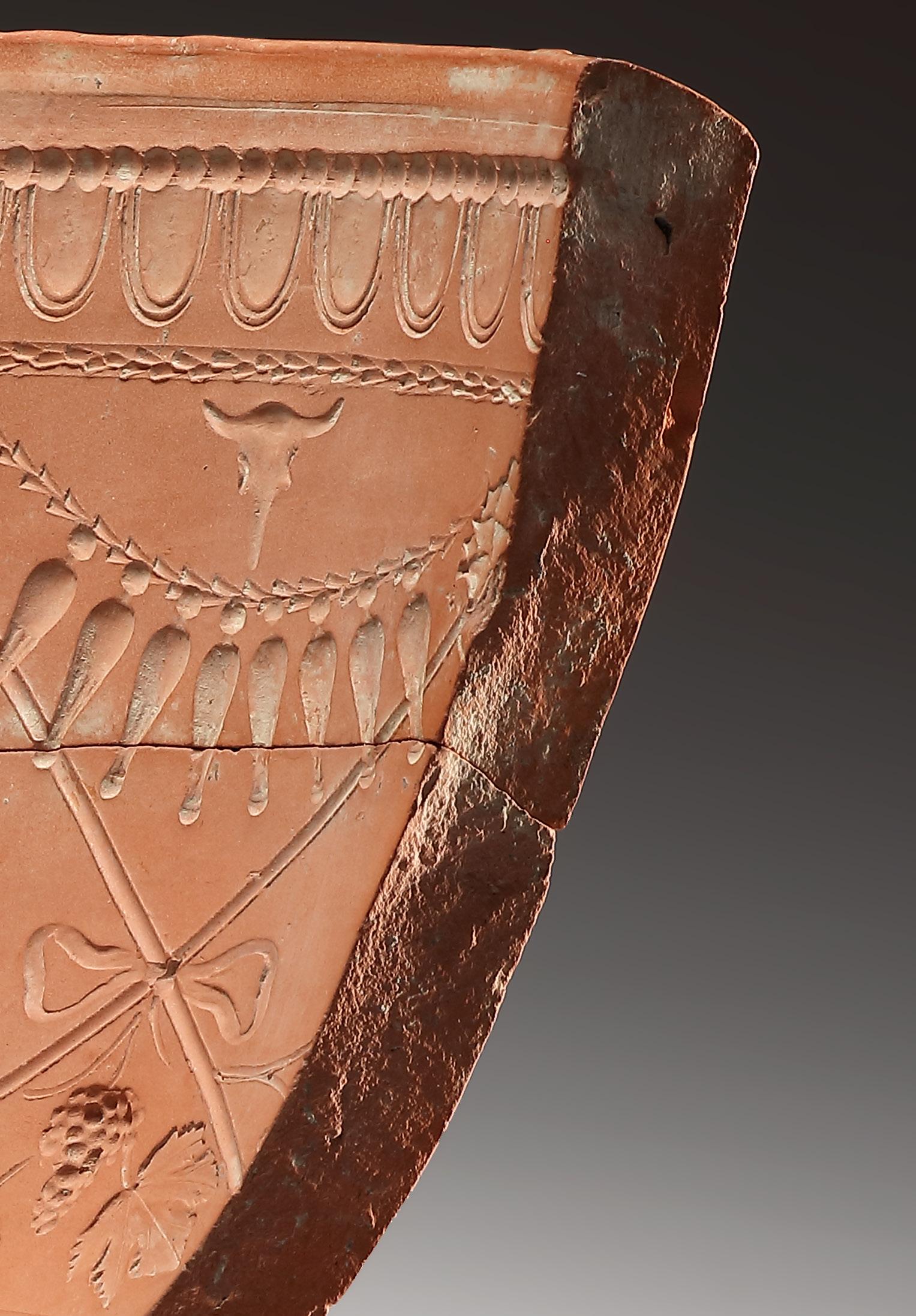
Part of a mould for a large Arretine bowl decorated with Dionysian motifs. The main field is divided by crossed thyrsoi connected by a garland of laurel leaves, from which bucrania hang. Below the thyrsoi bunches of grapes and vine leaves. Within the space defined by the thyrsoi there are two large masks, one depicting a youthful satyr and the other a bearded silen. Both are adorned with wreaths of ivy leaves and berries. Upper rim decorated with a tongue frieze. Lower field with alternating acanthus and waterleaves. The exterior is smooth.
The stamps used for the mask motifs are attributed to the Tigranus phase of the workshop of M. Perennius from Arretium (ca 15 B.C.-10 A.D). Reassembled from five fragments.
NOTE
The two types of masks are listed under the entries mMa fr 5 and mMa fr 7 in F. P. Porten Palange. Katalog der Punzenmotive in der arretinischen Reliefkeramik (Mainz 2004). Vol. 1, 299-300, tab. 164. For a similar scheme of ornamentation (with many of the same stamps), cf. Museum of Fine Arts, Boston, inv. no. 04.26, published in Chase, George H. Catalogue of Arretine Pottery (Boston 1916) 96, no. 105.
PROVENANCE
From the estate of Dr. Jacob Hirsch (1874-1955). Thereafter priv. coll. Gertrud Maly, Krienz, Switzerland.
A LAMP STAND IN THE SHAPE OF A TRUNK
CHF 5600
Roman | 1st century B.C. - 1st century A.D. | Bronze H. 24,3 cm | Diam. Foot 8,7 cm | W. Platform 8,3 - 8,5 cm
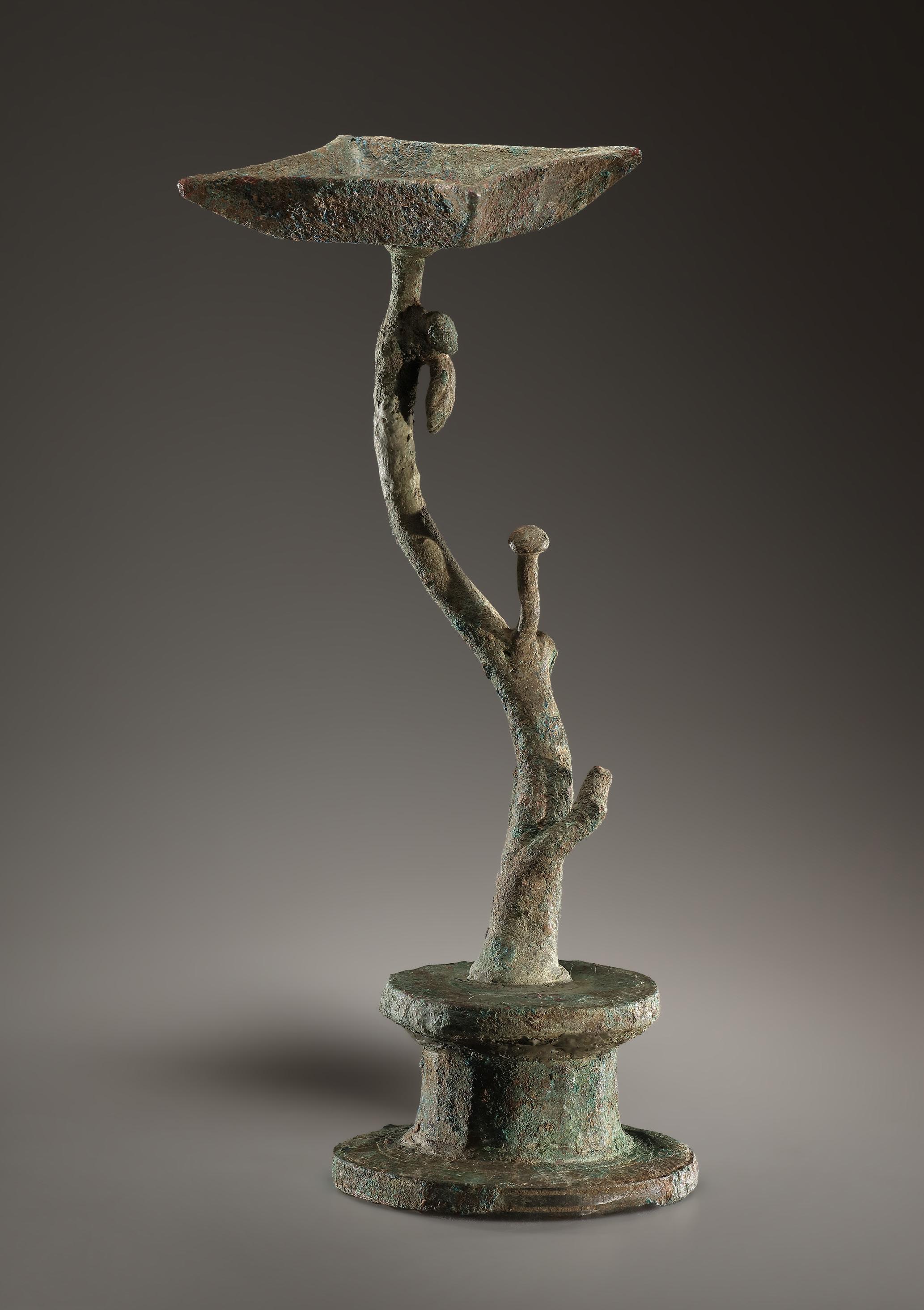
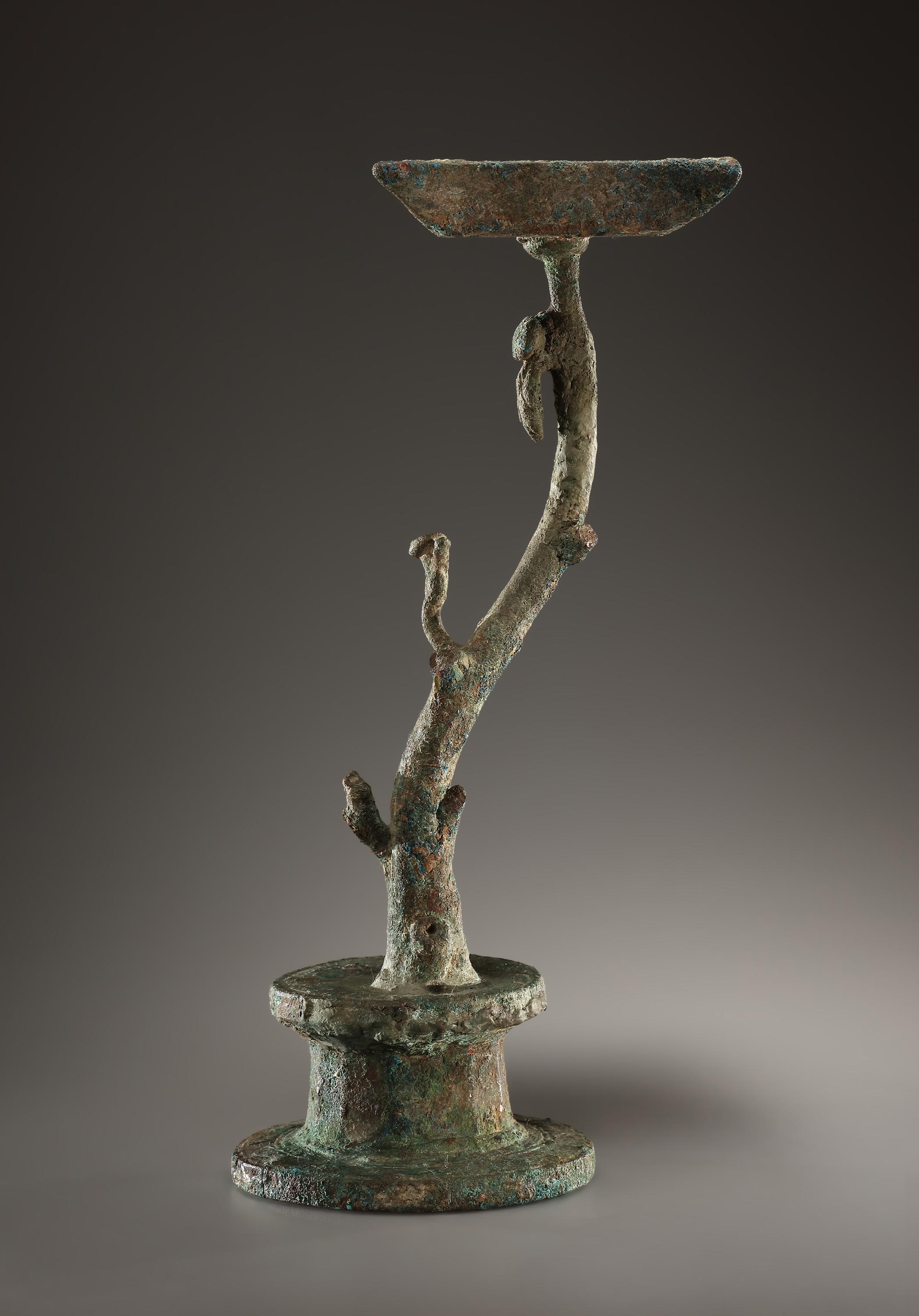
A slender tree trunk with branches rises up from the round, profiled base. One of the completely preserved branches ends in a knob and shows a lateral projection, probably indicating a new sprouting leaf. Slightly higher up, another branch terminates in a knob-shaped end and a fully developed leaf. The trunk supports a square platform with concave sides and grooves that probably mark the original placement of a bronze lamp. The candelabrum probably belonged to the furnishings of an opulent Roman villa. Similar objects have been
found, for example, in Pompeii and Boscoreale. Assembled from large fragments. Three branches broken off. Hardened organic material inside the hollow-cast base.
NOTE
Cf. L. Franchi dell‘Orto - A. Varone (eds.), Pompeji wiederentdeckt. Exh. cat. Antikenmuseum Basel und Sammlung Ludwig, 19 March-26 June 1994 (Rome 1994) 211 f., cat. no. 98; Pompeji. Leben und Kunst in den Vesuvstädten. Exh. cat. Kunsthaus Zürich (Recklinghausen 1974) 104 f., cat. no. 96.
PROVENANCE
Formerly priv. coll. London, acquired in the 1980s in Mayfair.
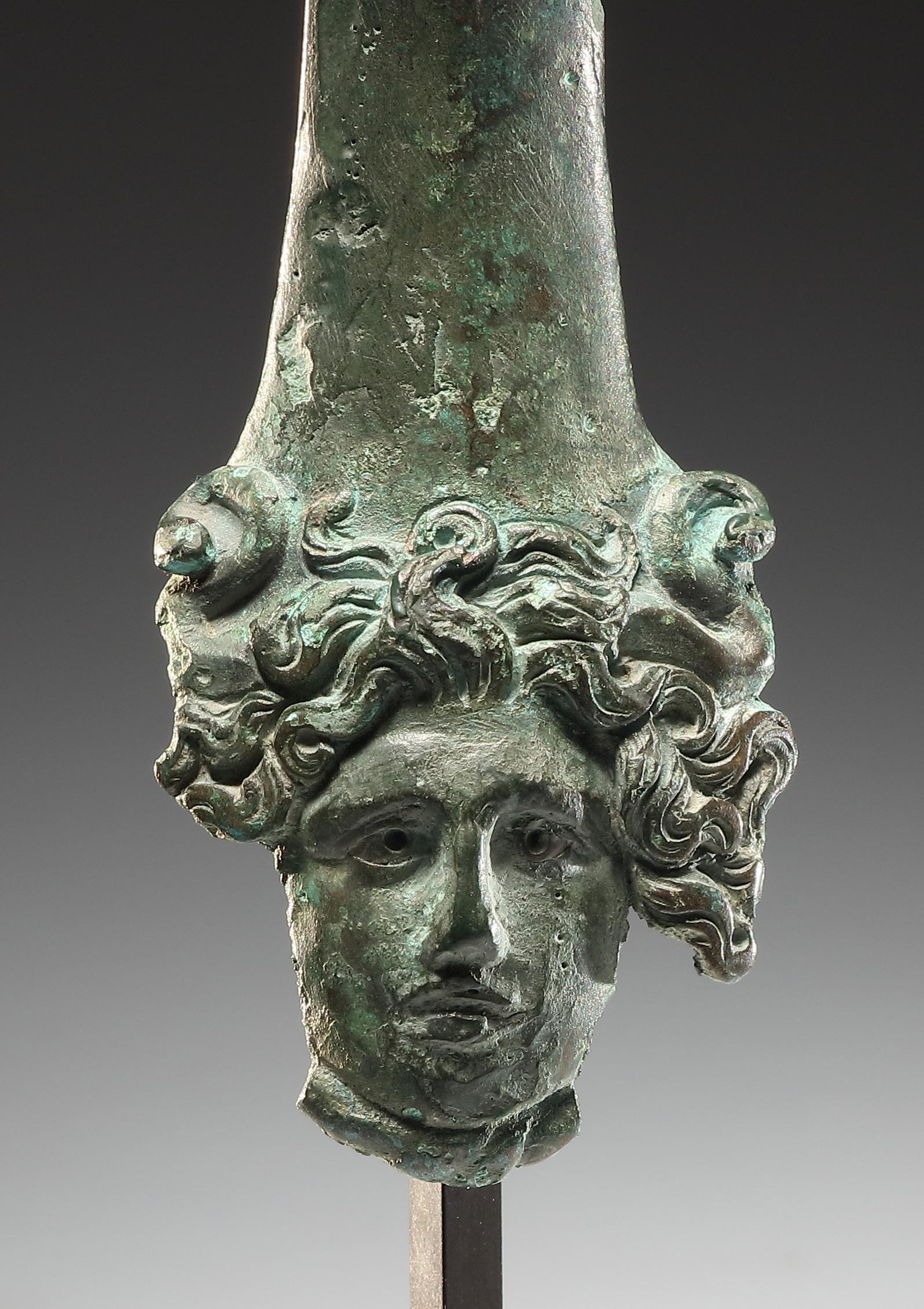
A JUG HANDLE WITH GORGONEION
CHF 1800
Roman | 1st century B.C. - 1st century A.D.
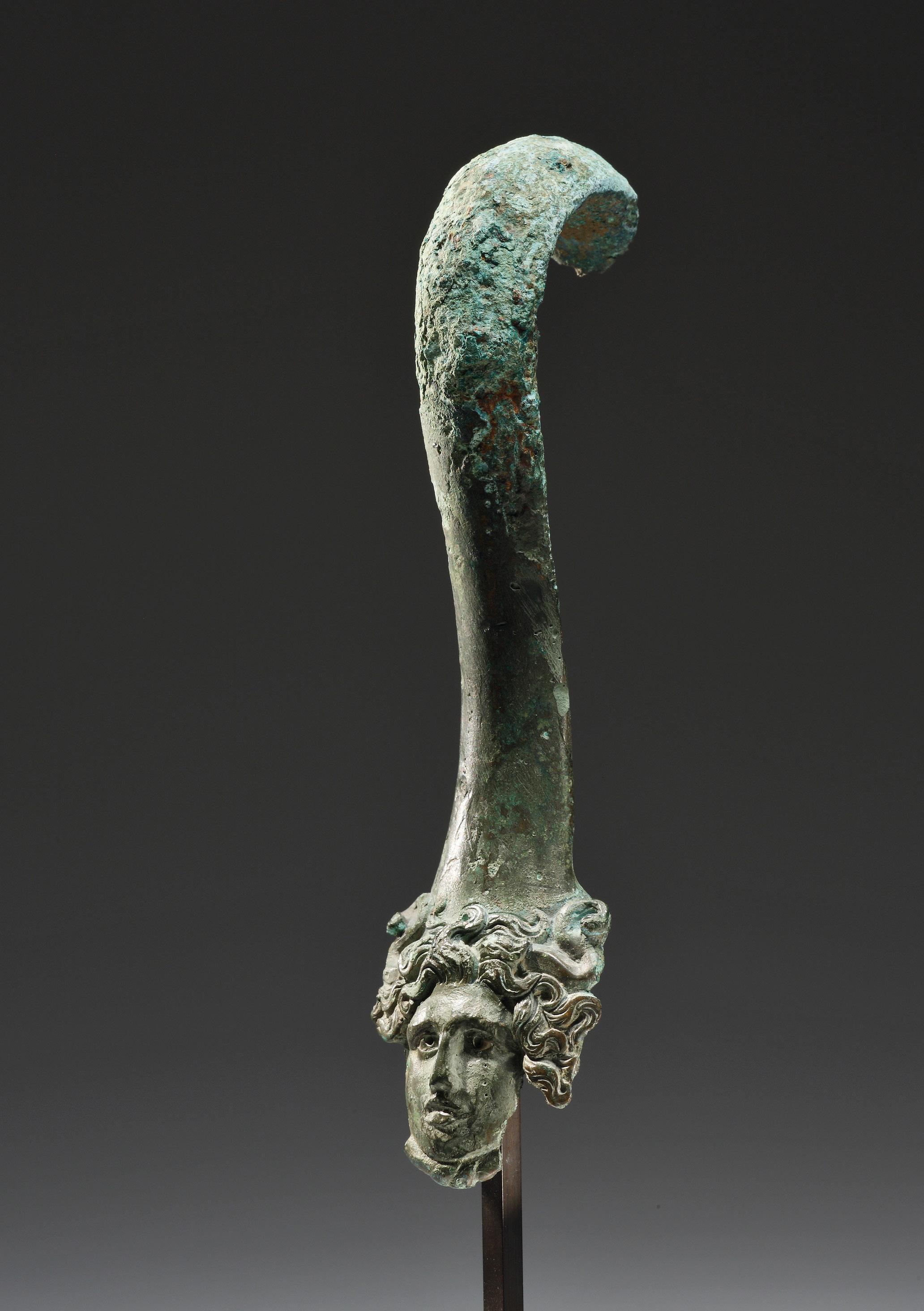
H. 14,0 cm | Bronze
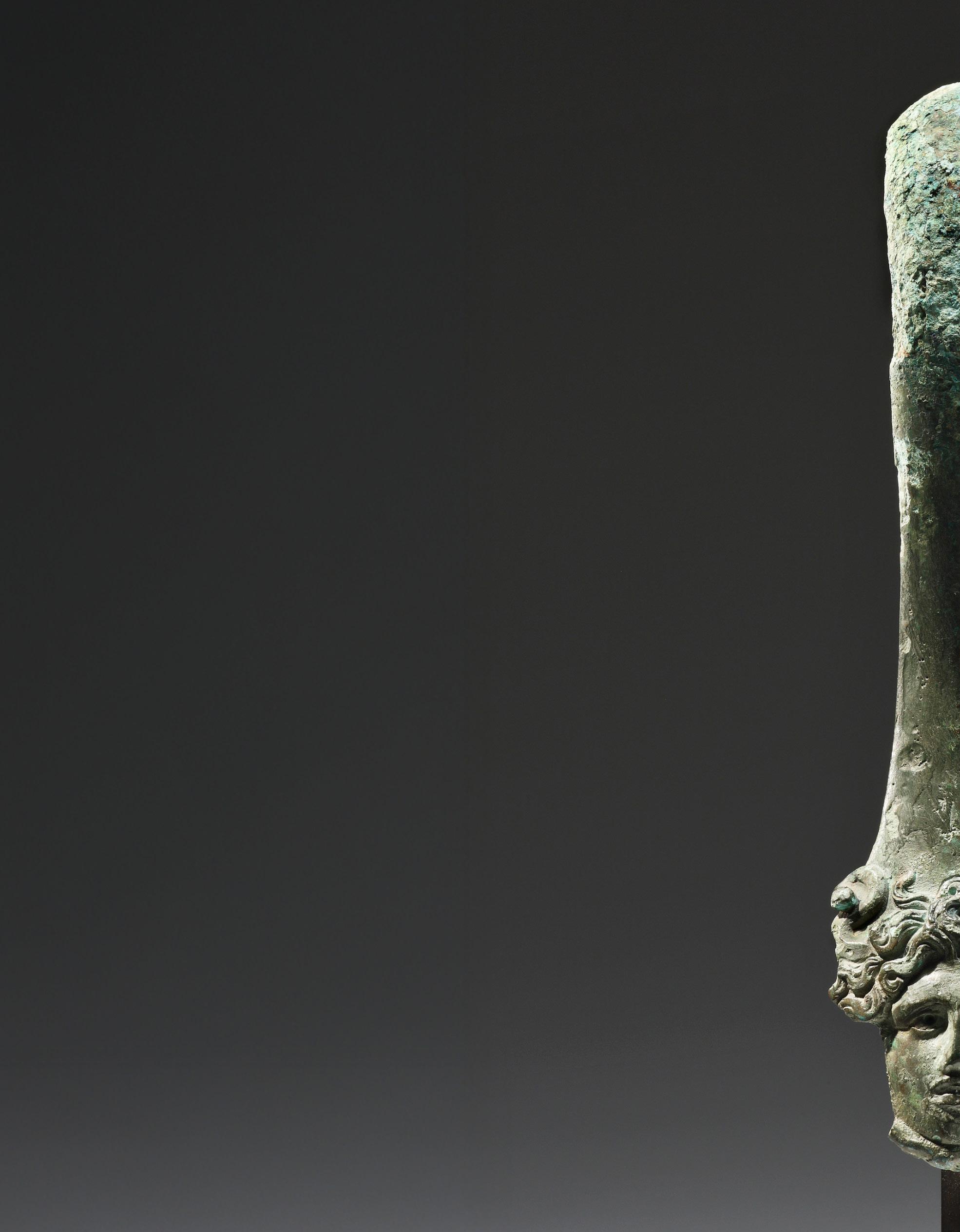
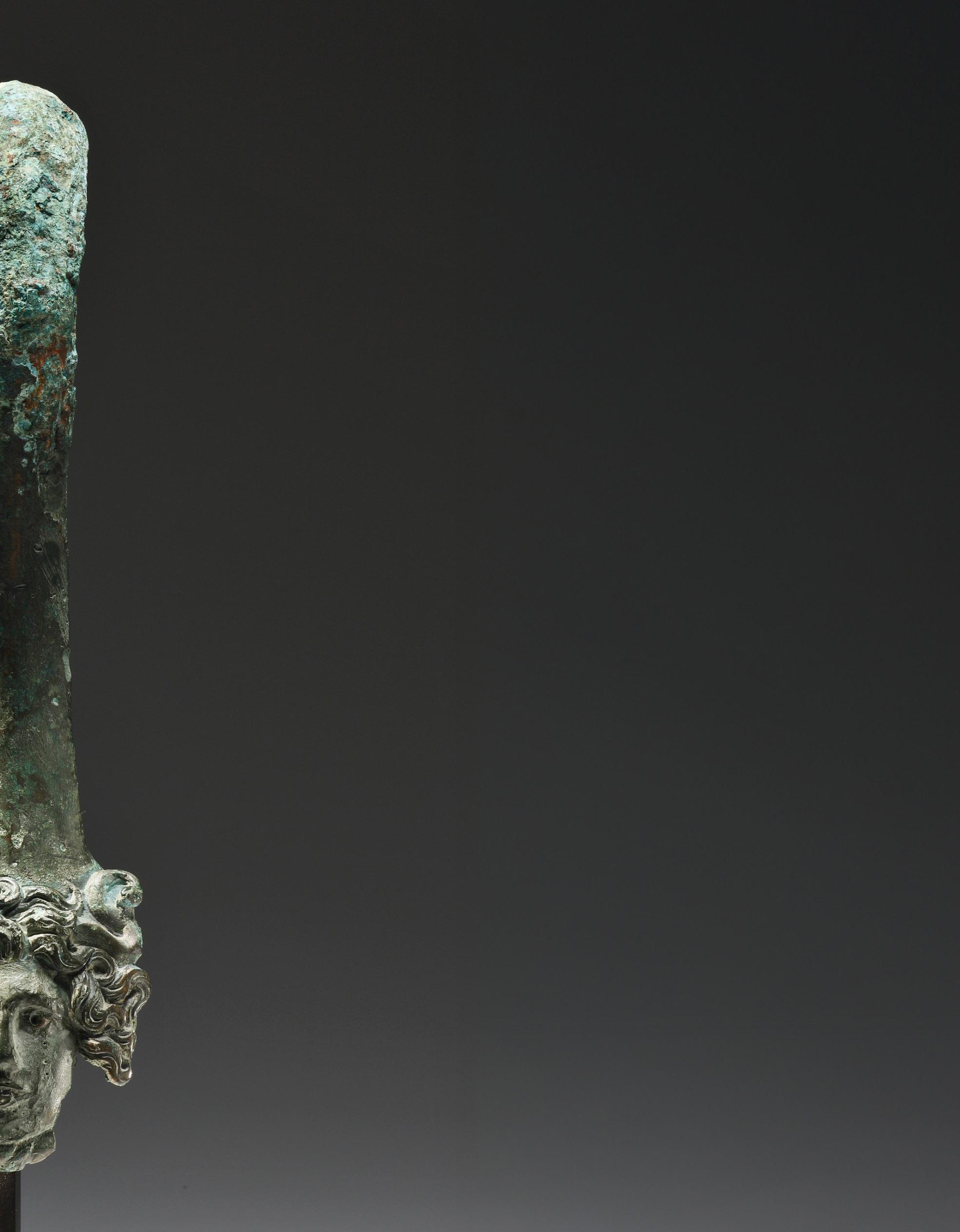
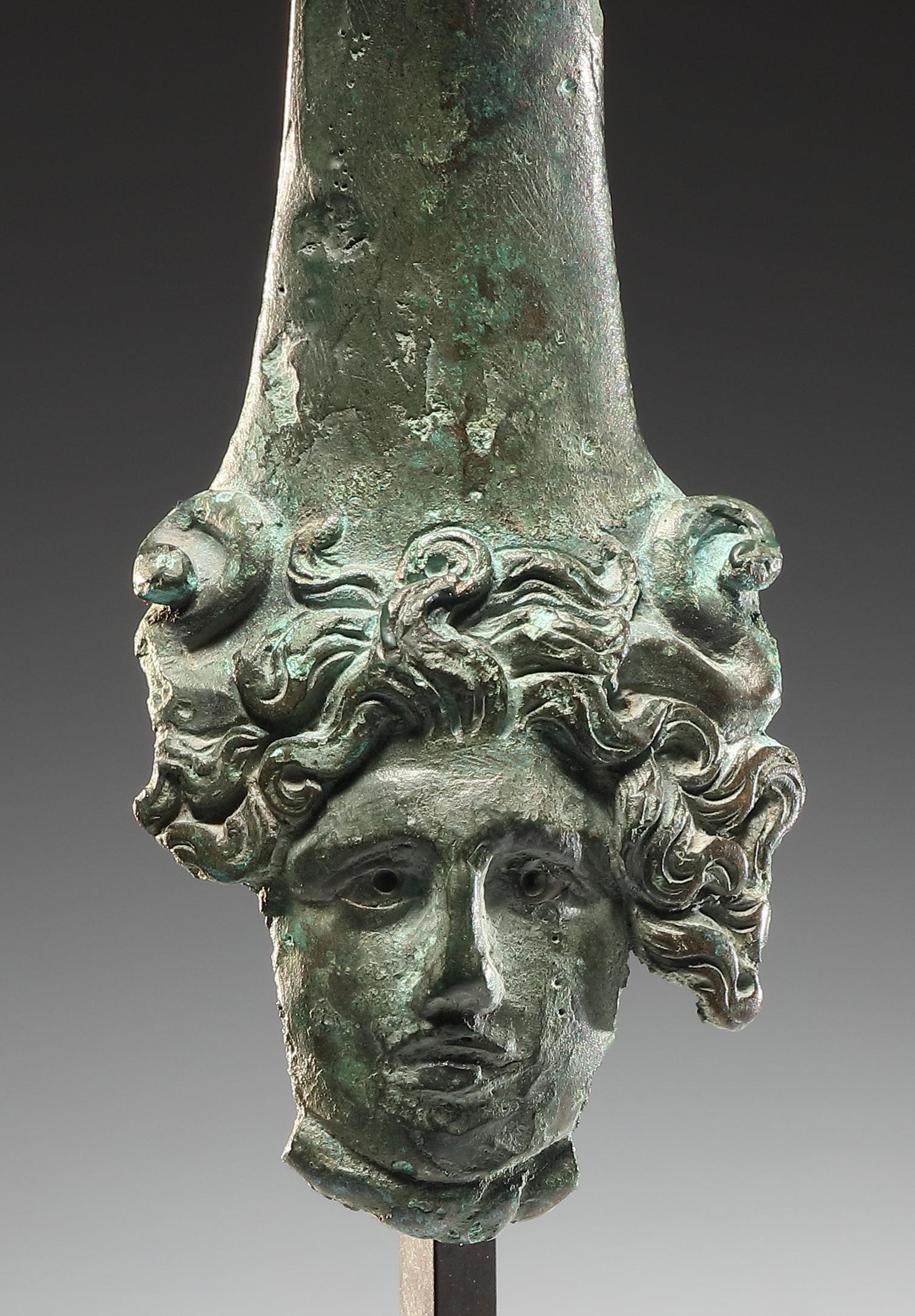
The curved strap handle ends in a Gorgoneion. Wild ringlets of hair, some rising upwards, frame the face of Medusa. Together with the raised eyebrows, this gives the face a dramatic expression reminiscent of theatre masks. Snake‘s heads emerge from the two horns on her head and writhe upwards. The bodies of two snakes form a knot under her chin. The round drill holes of the pupils were possibly originally inlaid in silver. The Gorgoneion is concave on the reverse and its sides were trimmed. Handle of an oinochoe. Surface of the upper section of the handle corroded.
NOTE
For a similar curved jug handle with Gorgoneion protome, cf. the Metropolitan Museum of Art, New York, inv. no. X.403 (online). It is dated slightly later and the rounder face of Medusa, whose eyes are inlaid in silver, is less dramatic than our specimen.
PROVENANCE
Formerly Coll. of the Archaeologist Louis-Gabriel Bellon (1819-1899). With Jack Philippe Ruellan, auction, Paris, 4.4.2009, lot 270.
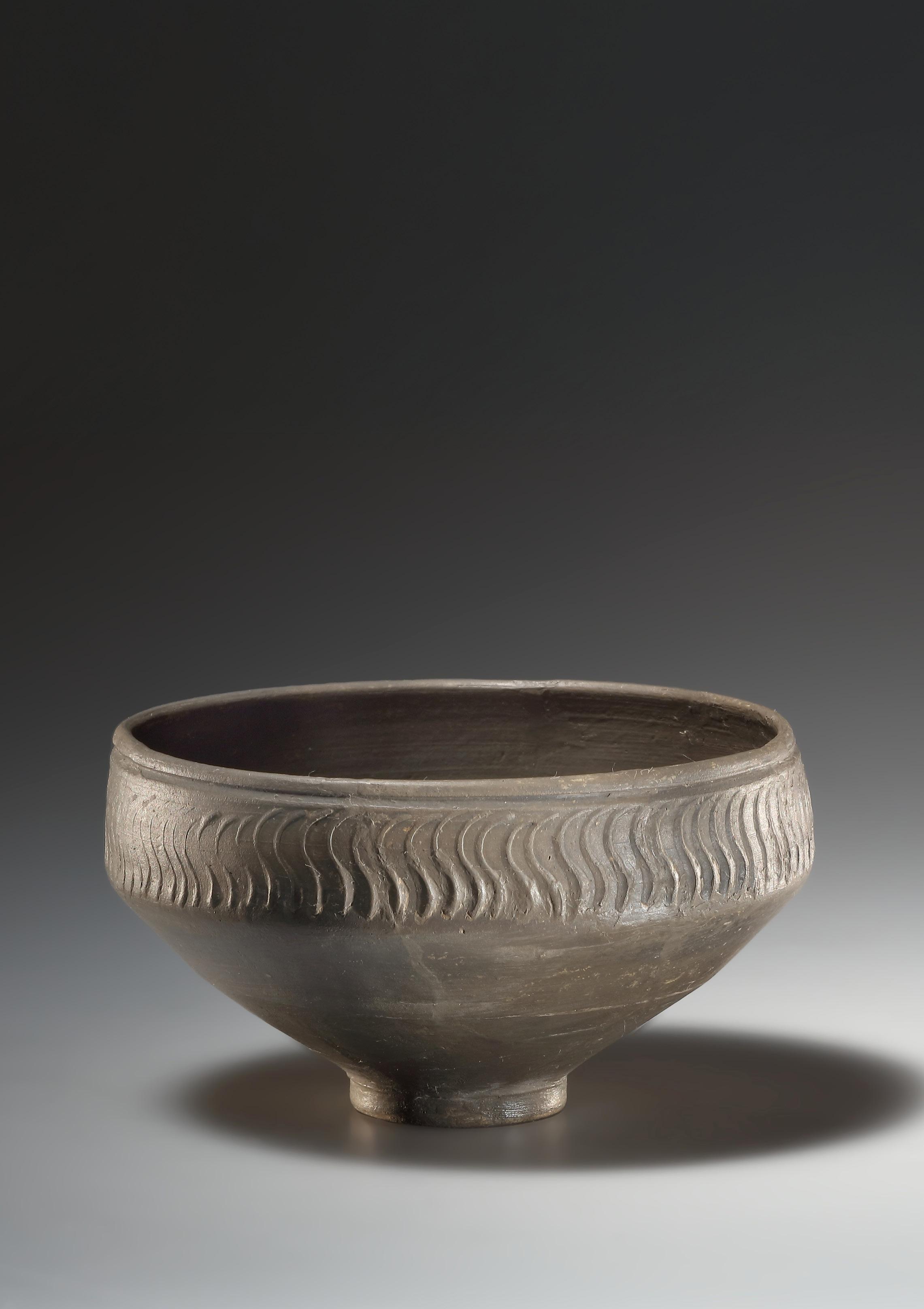
A SMALL BOWL
CHF 1200
Gallo-Roman | late 2nd century A.D.
H. 6,4 cm | Diam. Mouth 10,9 cm | Clay
Conical bowl fired to a grey colour, its carinated wall decorated with fine S-shaped ribbing below the offset rim. Cylindrical foot. Complete, reassembled.
PROVENANCE
Formerly C. B., Swiss dealer; consigned to Piguet Hotêl des Ventes auction, 11-14 June 2012, lot 166, Geneva.
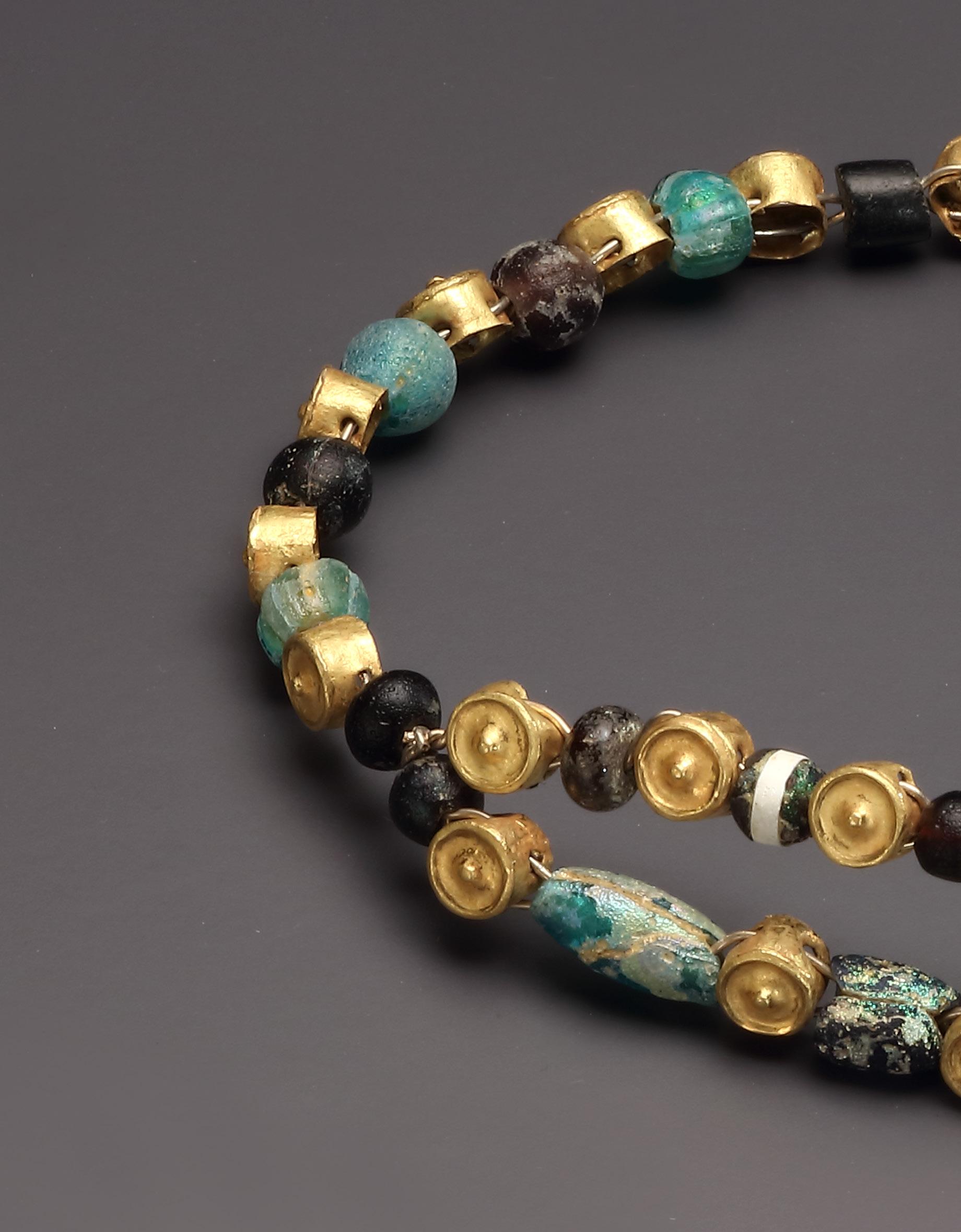
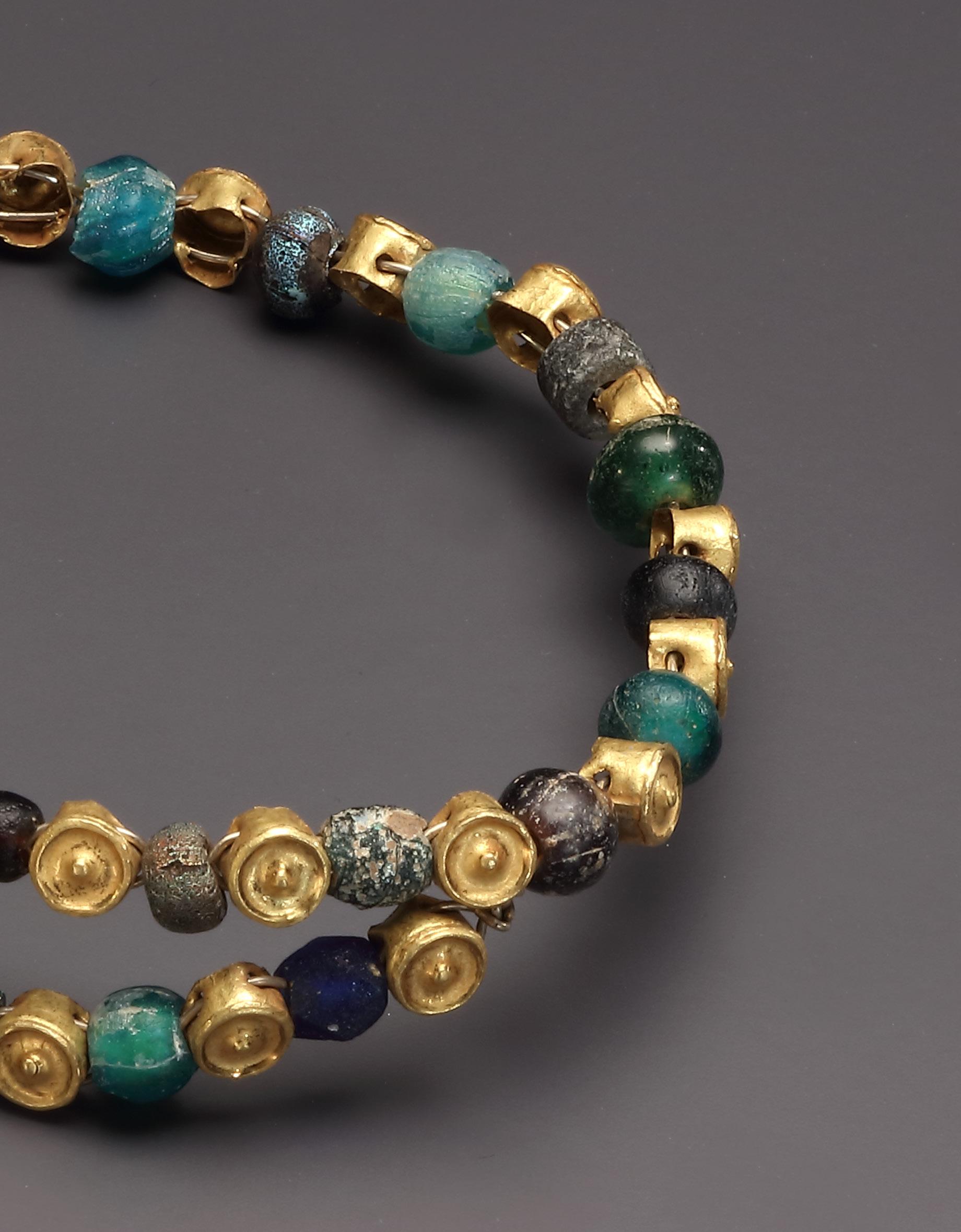
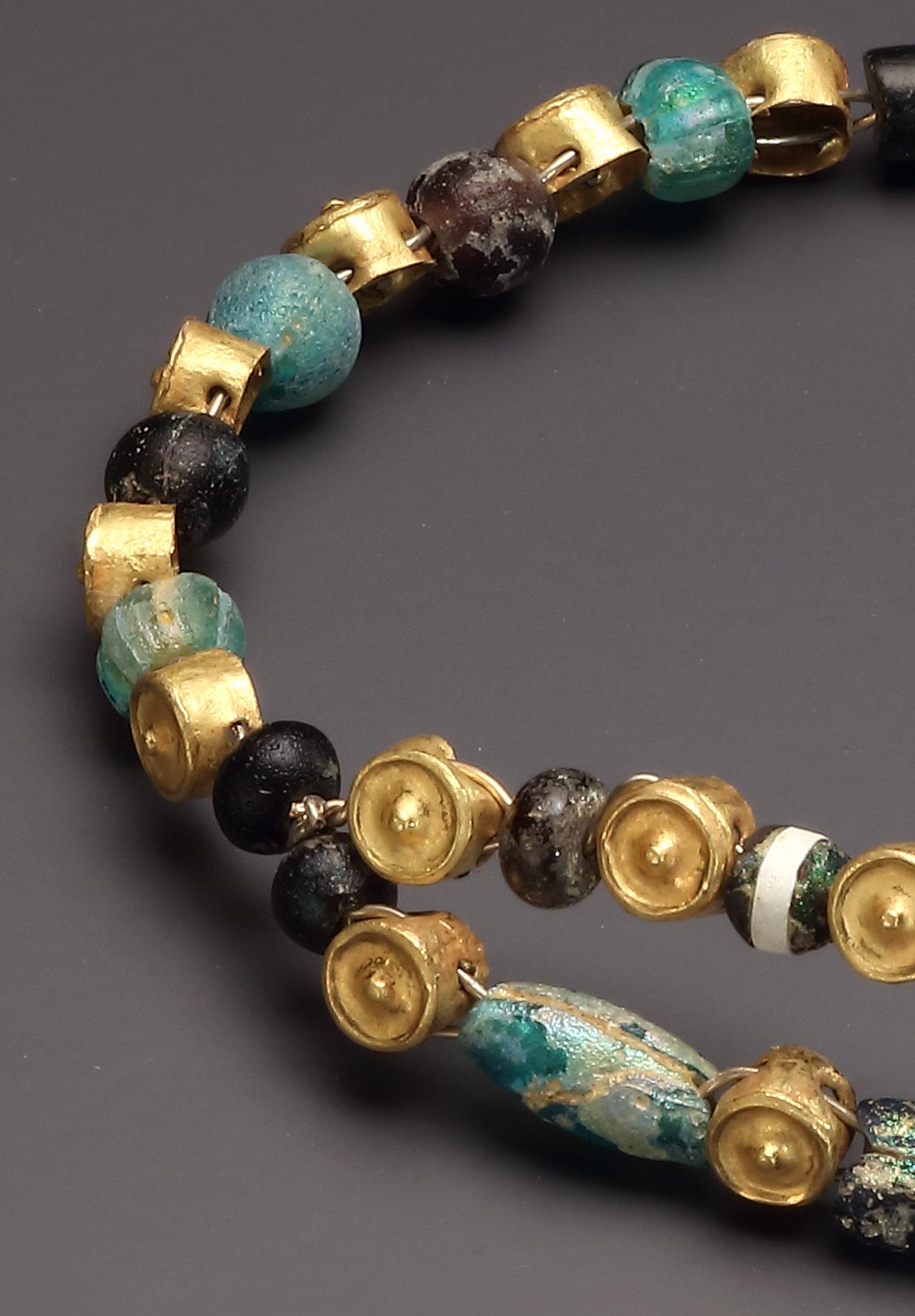
A ROMAN PERIOD GOLD AND GLASS BRACELET
CHF 4400
Roman | 3rd - 5th century A.D.
H. 5,6 cm | W. 7,8 cm | Inner Diam. max. 6,8 cm | Gold, Glass
Green, dark blue and dark purple glass beads of various shapes, alternating with cylindrical gold elements featuring shield motifs. Restrung on a (probably postantique) silver wire. Originally most likely elements of a necklace, now wearable as bracelet. The use of glass beads is a distinctive feature of Roman jewelry, where multicolored glass elements were frequently employed to imitate precious stones, such as gemstones and semiprecious stones. The green beads of our bracelet are likely intended to replicate emeralds, while another single one, characterized by a central white stripe, imitates striped agate.
PROVENANCE
Formerly coll. Petra Schamelmann, Breitenbach, Germany, acquired from the collection of Fernand Adda, formed in the 1920‘s. Thereafter priv. coll. London.
NOTES
For Roman necklaces composed of gold elements and gemstones, which may provide an idea of the original setting of our gold and glass beads, see L. Pirzio Biroli Stefanelli, L‘oro dei Romani. Gioelli di età imperiale (Rom 1992), cat. nos. 42-46. 70. 9091.123-124. 134. 143. 168. 175. 203204. 222.
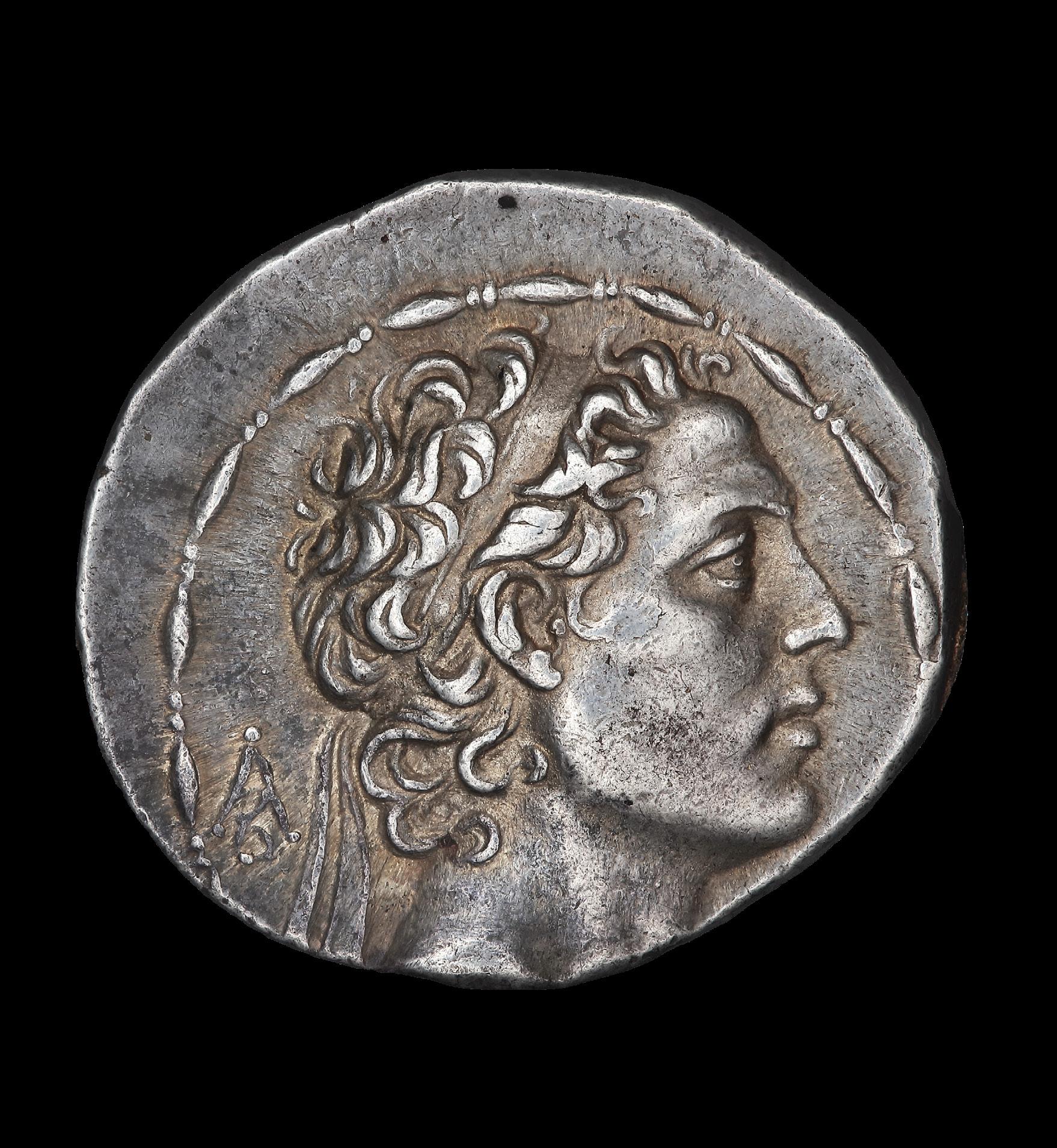
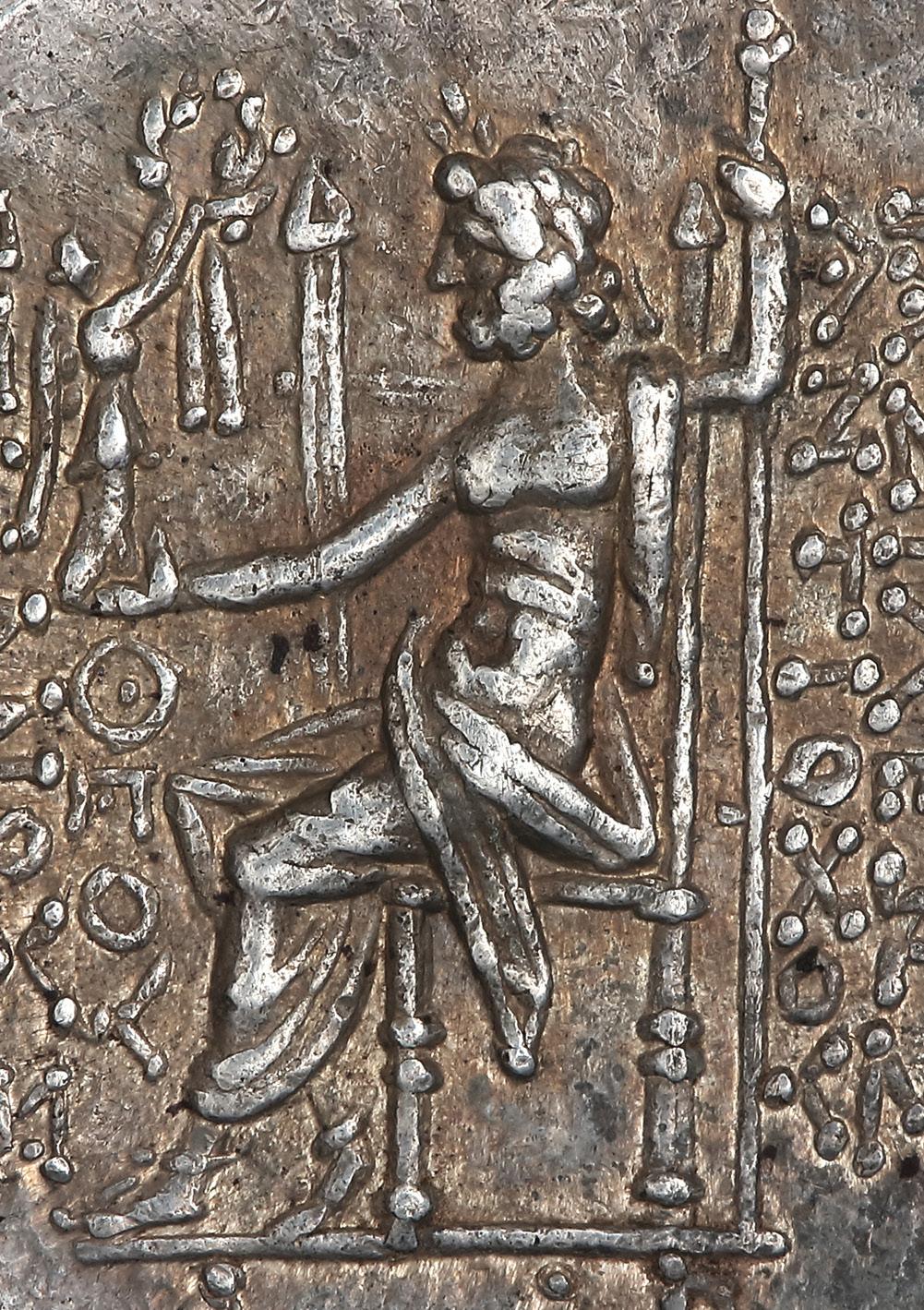
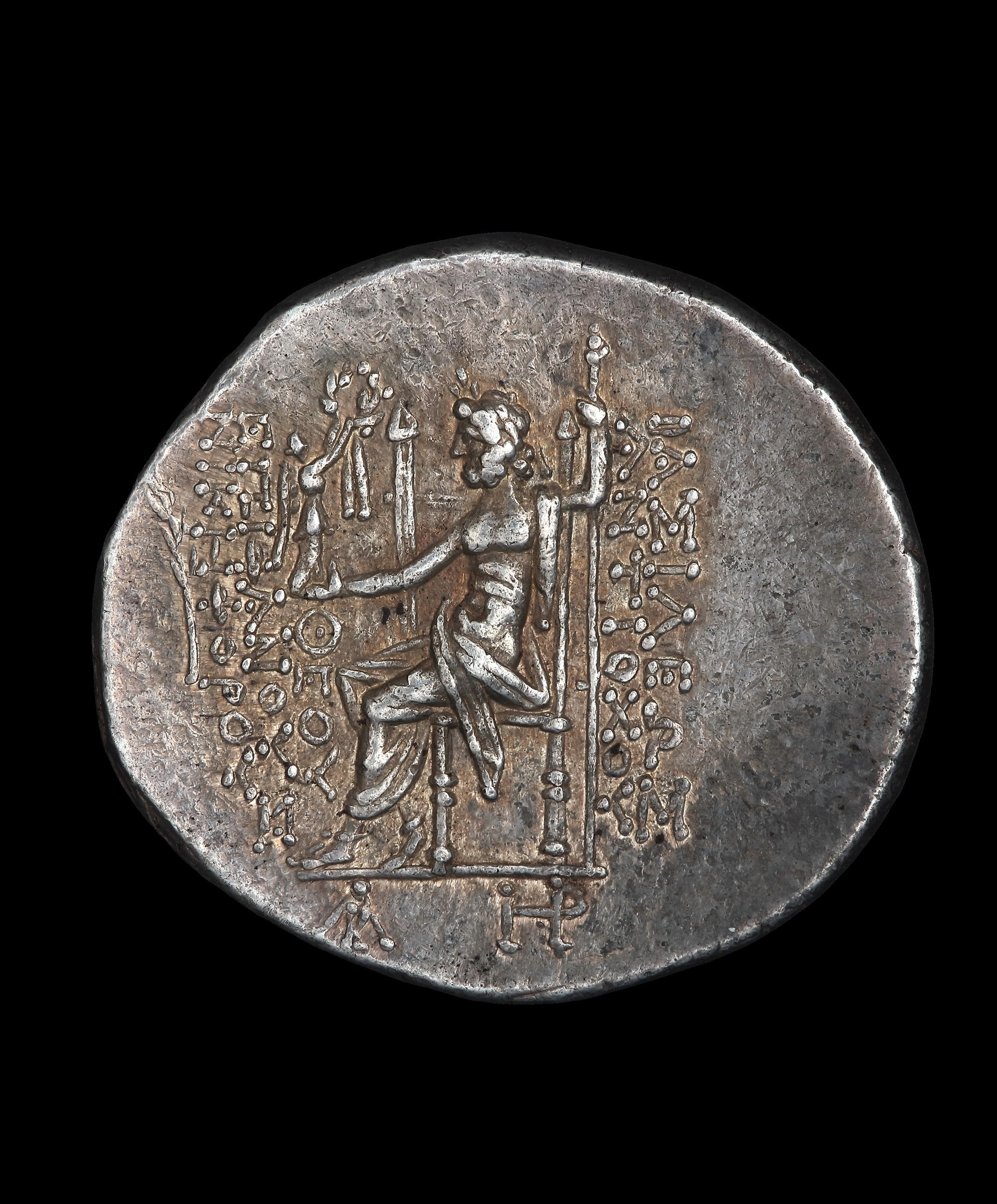
A TETRADRACHM, ANTIOCHOS IV EPIPHANES
CHF 6800
Obverse: Diademed head of Seleucid king Antiochos IV Epiphanes to right, the two ends of the diadem off flan; behind, the mint monogram; border composed of pairs of beads alternating with a biconical element. Reverse: Zeus holding a long sceptre in his left hand, seated to left on throne. Two columns of its backrest are visible. A Nike stands on his extended right hand and crowns him with a wreath. To right and left downwards
Hellenistic Palestine, Ake-Ptolemais (modern Acre) ca. 168 - 164 B.C. | Diam. 3,2 cm | W. 17,18 g | Silver in exergue the mint monogram (same as obv.) coupled with another monogram probably identifying the magistrate supervising the mint. The palm branch and the mint monogram are the characteristic marks of the coins minted in Ake-Ptolemais. Antiochos IV ruled from 175 to 164 B.C. This tetradrachm is part of a series linked to the increased coin production prompted by the Maccabean Revolt in Judea, which began in 167 B.C. The portrait of the king shows a neat and elegant head, with welldefined features: a delicately curved
in outer left field, a palm branch,
nose, full lips, and luxuriant flowing hair surmounting a high forehead. Although it retains a certain degree of individuality, Mørkholm observes that, compared to earlier coins from his reign, the style after 173 B.C. tends to idealise the king‘s image. Individual chararcteristics, such as his incipient baldness, are softened in favor of a full mane of hair and exceptionally regular features – traits that, since the time of Alexander the Great, have become emblematic of the deified ruler.
NOTE
Cf. O. Mørkholm. Studies in the Coinage of Antiochus IV of Syria, Ace-Ptolemais, Series II (ca. 168164 B.C.), 49, no. 10; Houghton 781 (this coin).
PROVENANCE
Formerly priv. coll. Arthur Houghton (b. 1940), New York, American numismatist, prior to 1983. Thereafter, priv. coll. Dr. Günter Wiedner, German; acquired on 19.12.1989 from Monetarium SKA (Schweizerische Kreditanstalt, Zurich, active between 1963-1996, represented by Dr. Giacosa). With
Gorny & Mosch Auction 269, Munich 2020, lot 525. German art market, prior to 2024. Published: A. Houghton. Coins of the Seleucid Empire from the collection of Arthur Houghton. Ancient Coins in North American Collections. The American Numismatic Society (New York 1983) 78, no. 781 (with illus. pl. 46).
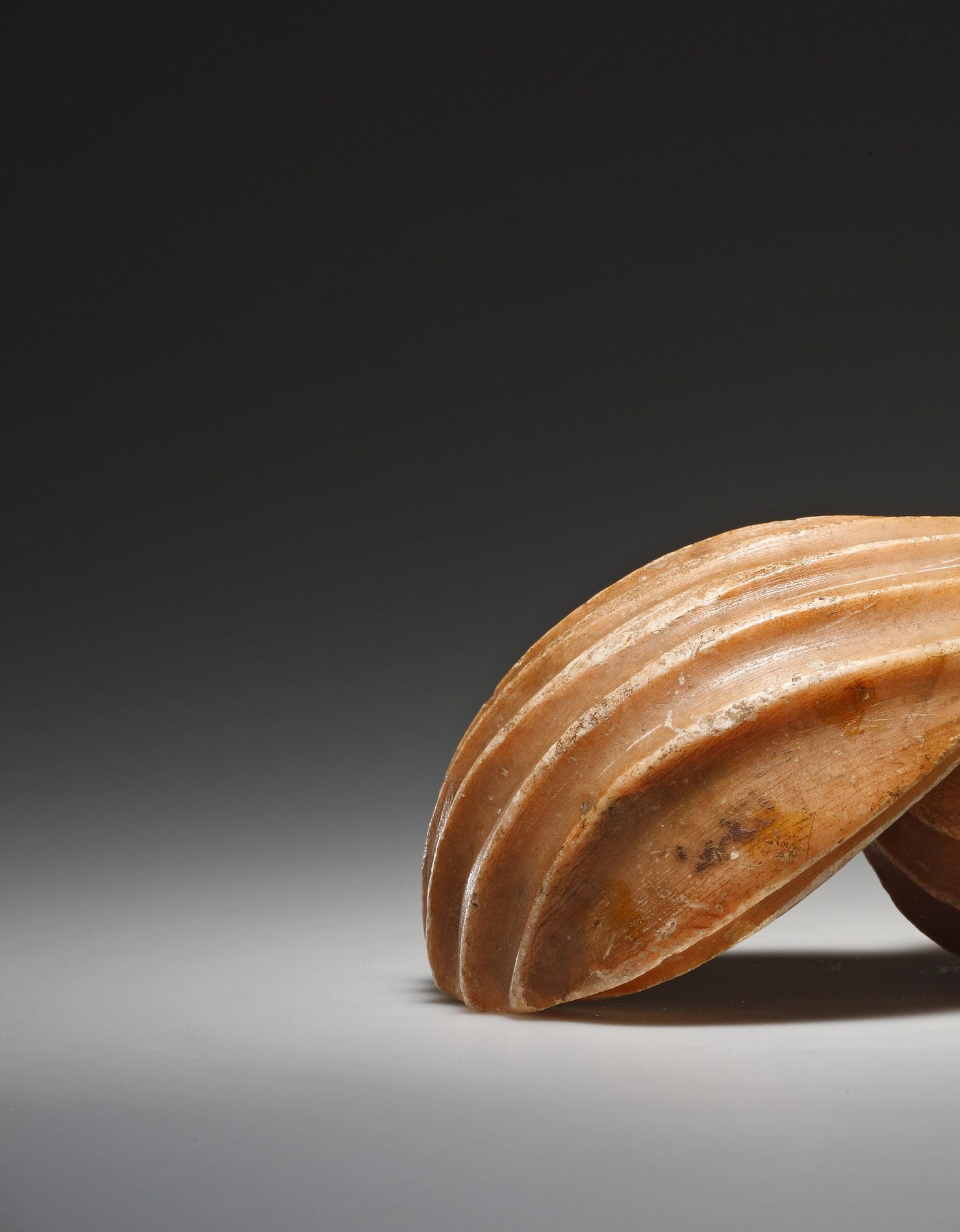
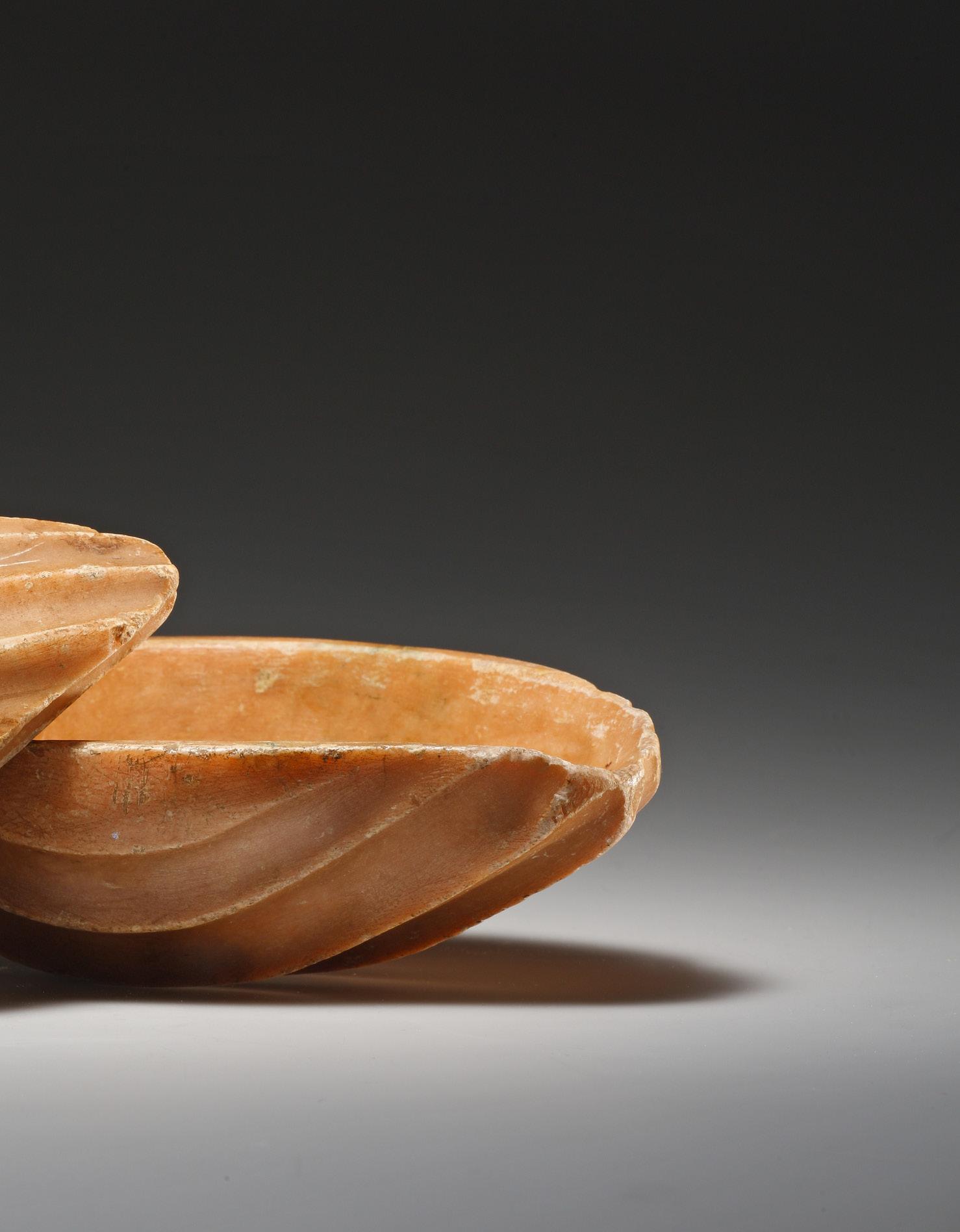
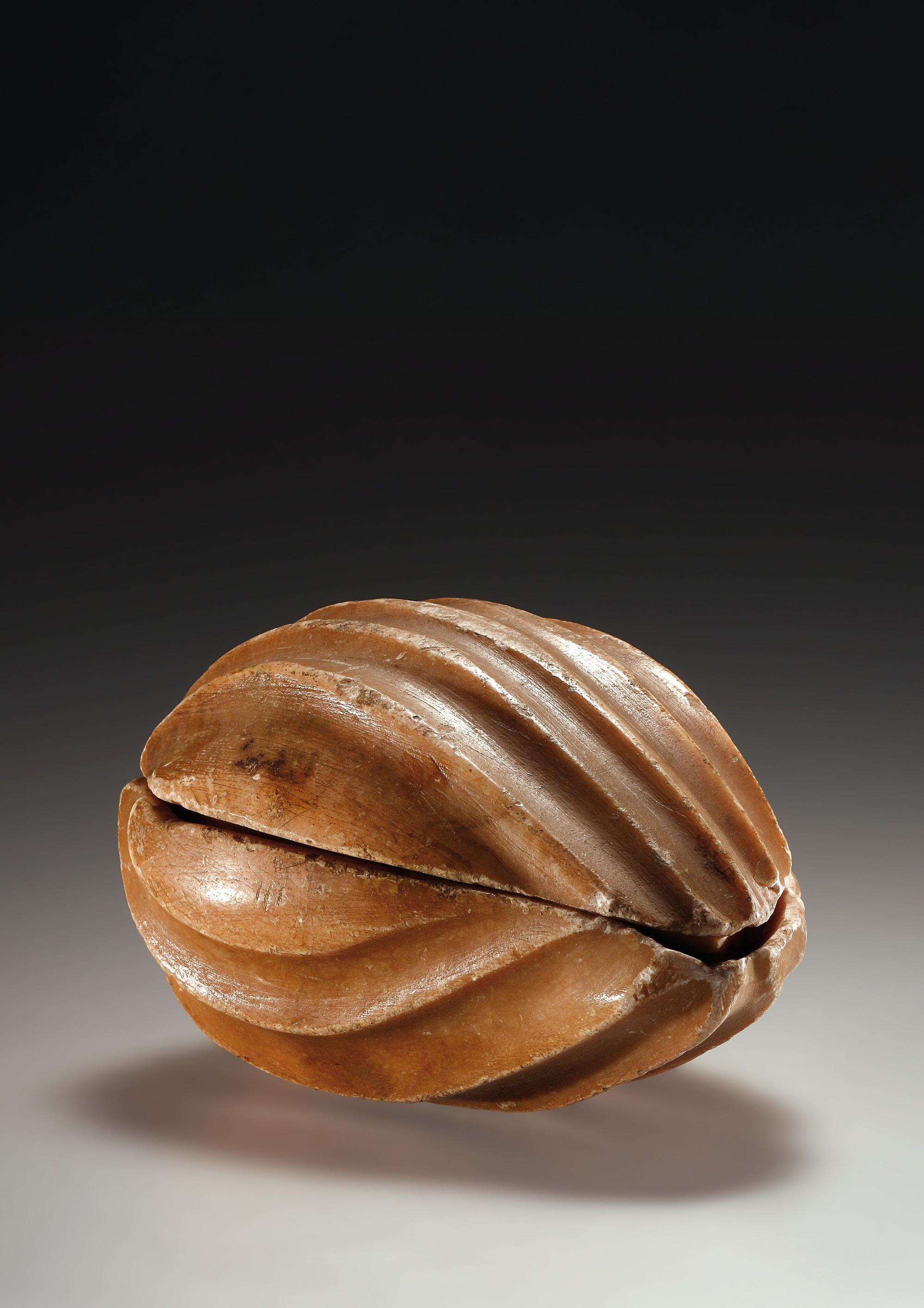
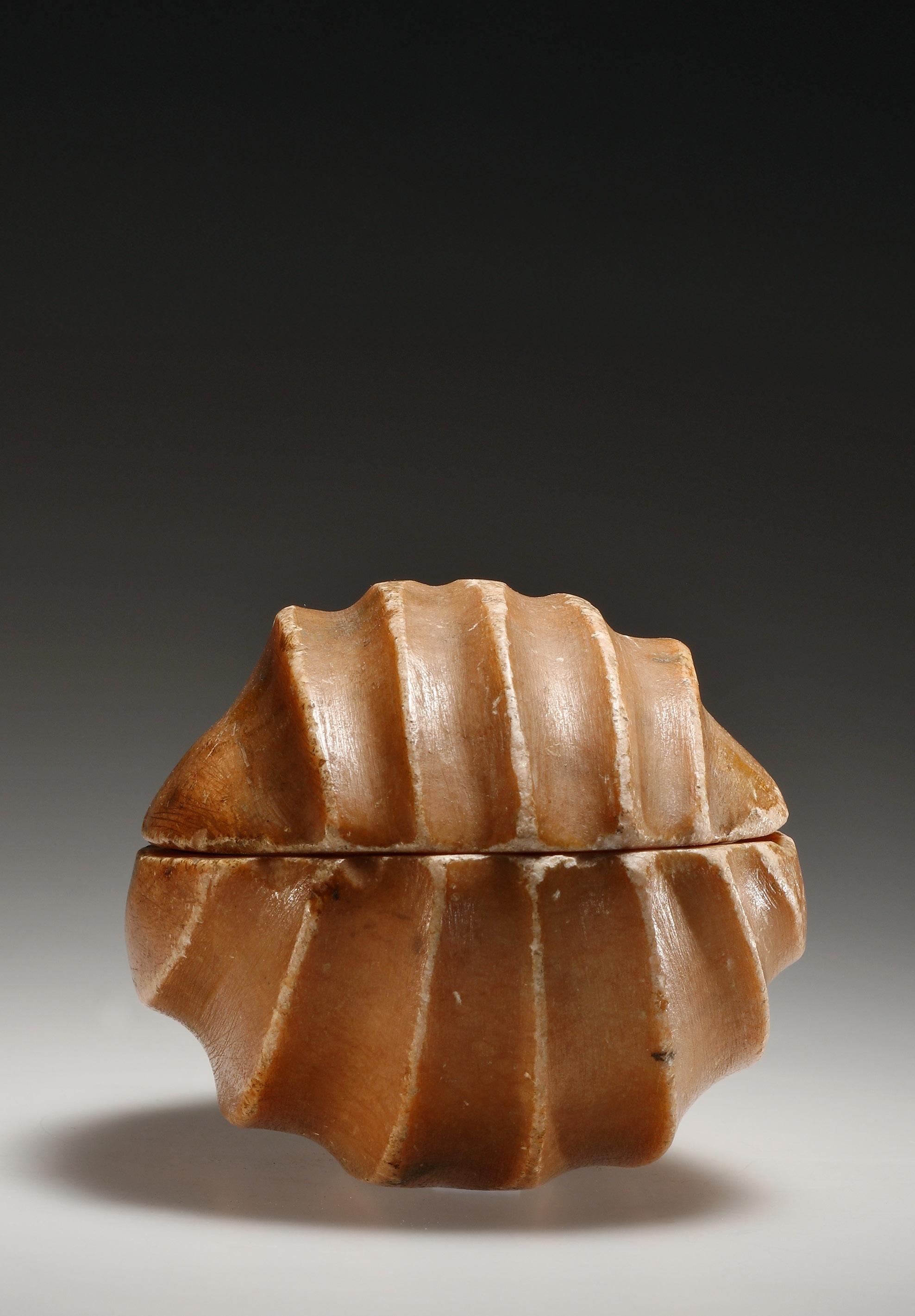
A RARE COSMETIC VESSEL IN THE FORM OF A SHELL
CHF 14000
Greek or Graeco-Roman | 5th century B.C. - 1st century A.D.
H. 9,5 cm | W. 10,1 cm | L. 15,0 cm | Marble
Two-part marble vessel in the shape of an elongated shell with distinct ribbing. The bowl-shaped lower part is flattened slightly on the underside. The lid has a stepped rim permitting a close fit with the lower shell. The shell was a popular shape for vessels in Antiquity. Such vessels were made of different materials (mostly bronze and terracotta, more rarely marble) and were used to store cosmetics amongst other things. Surface slightly worn. Reddish-brown patina.
PROVENANCE
Formerly Rupert Wace, Ltd., London, acquired in 1979 from a priv. coll. London (see declaration of honour). Label with inv. no. „17341“ on the underside.
NOTE
The shell was associated with the goddess Aphrodite, who was, as the myth relates, born from the sea. For this reason she was often represented in a shell. The female owners of such vessels would thus have made a mental link between their everyday toilette and the goddess of beauty and love. The pronounced ribs on our specimen are similar to those found on cockles (Cardiidae). Cf. several shell-shaped bronze plates found in Torre Annunziata, now in the British Museum London, inv. 1856,1226.928-930 (dated 1st cent. A.D.); a shell-shaped bronze bowl from Pompeii, s. L. Franchi dell‘Orto - A. Varone (ed.), Pompeji wiederentdeckt, exh. cat. Basel, Antikenmuseum and Sammlung Ludwig, 19 March - 26 June 1994 (Rome 1994) 233, 235, no. 131 with illus. (1st cent. A.D.).
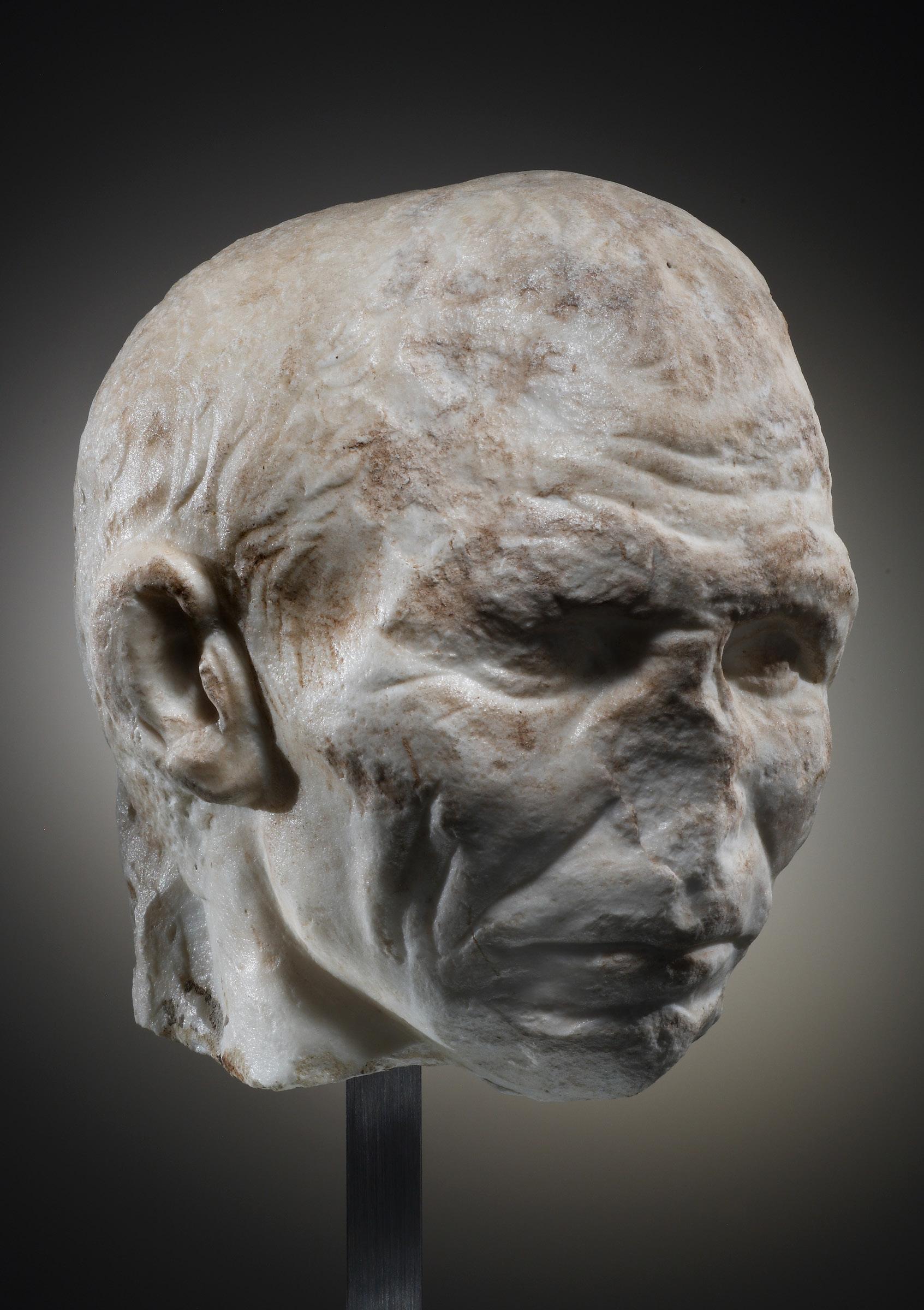
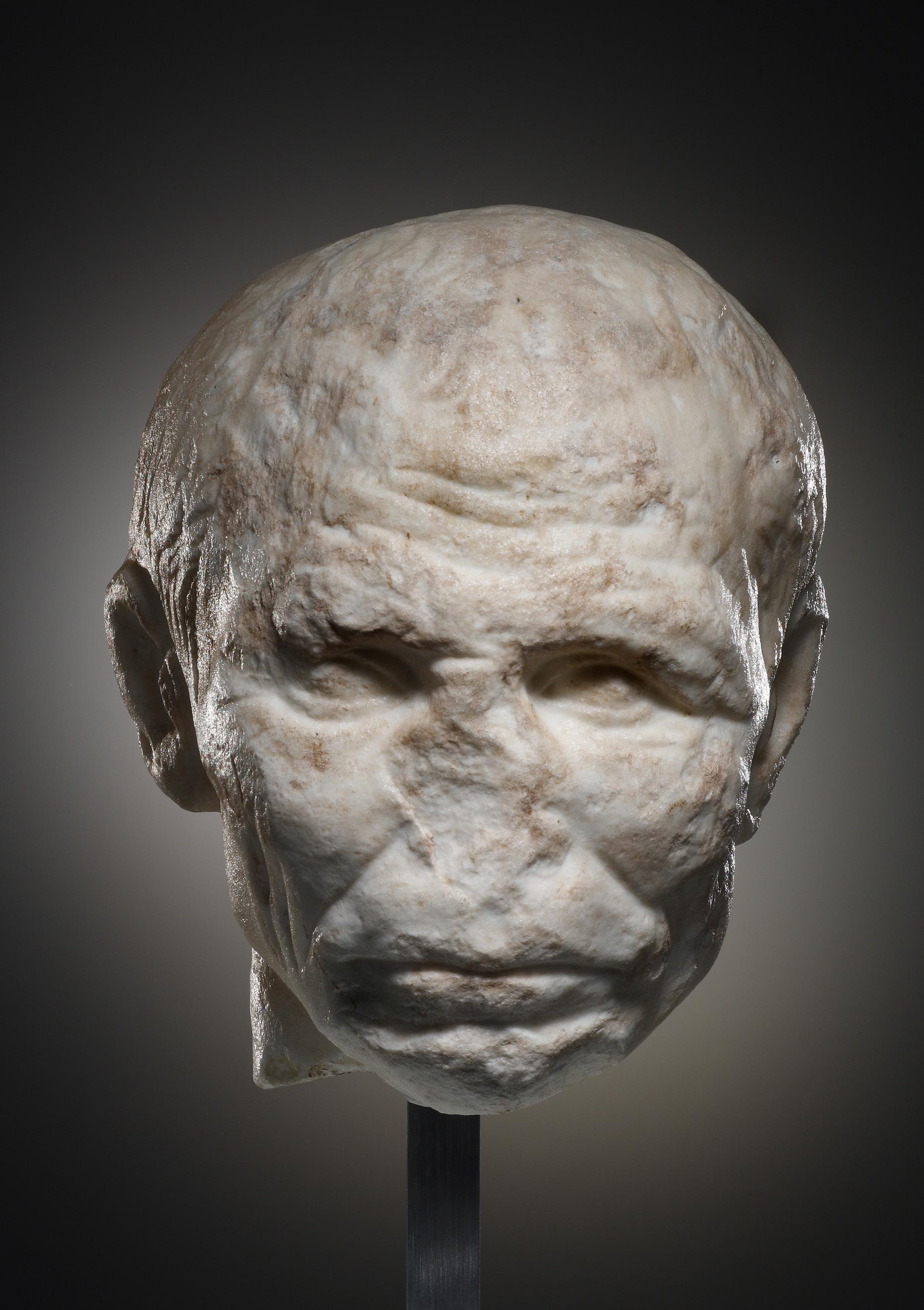
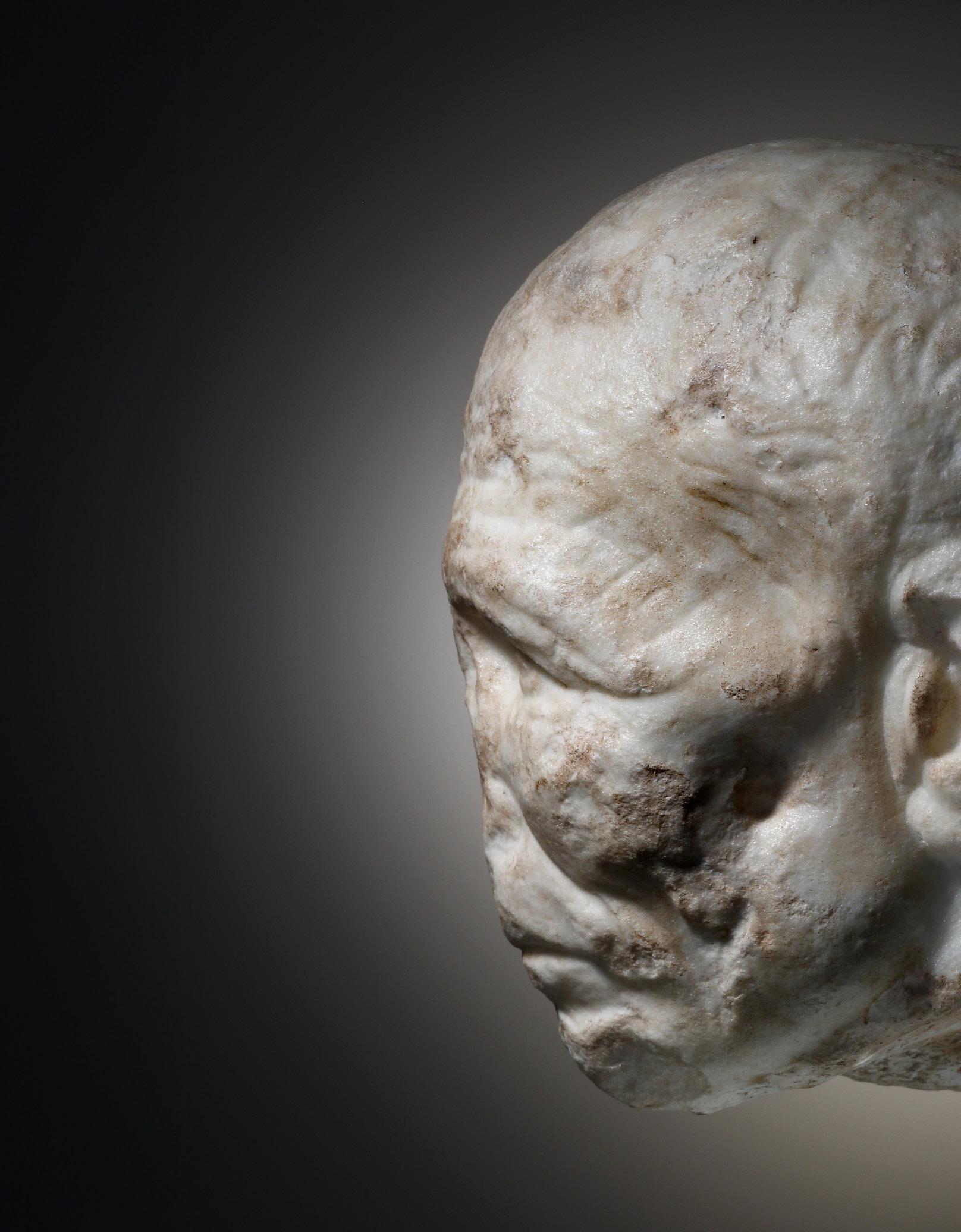
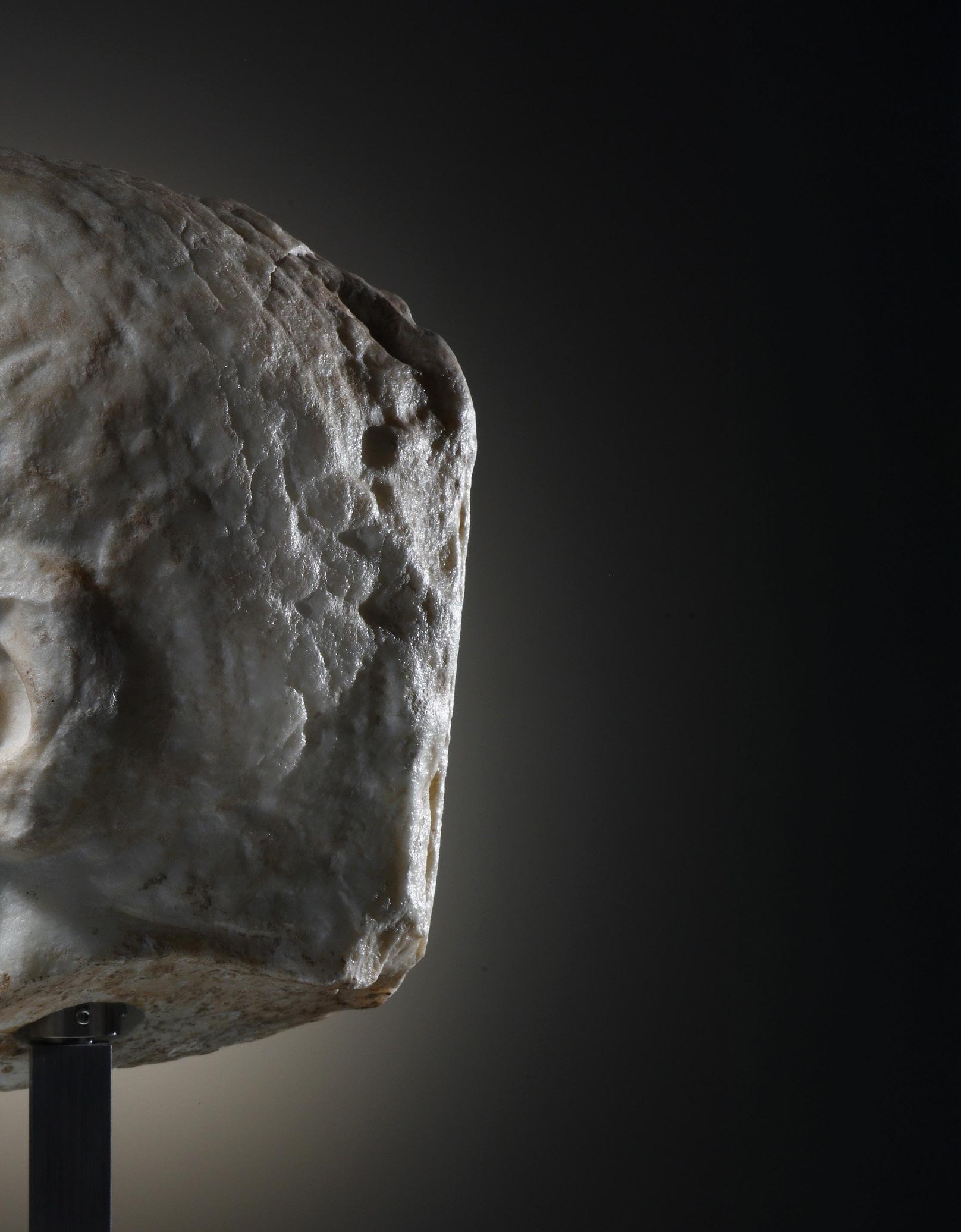
A PORTRAIT HEAD OF A MAN
CHF 16000
Roman, Late Republican | 2nd - 3rd quarter of 1st century B.C. H. 24,0 cm | Marble
Life-size portrait head of an elderly man, turned somewhat to the right, with furrowed forehead, receding hairline, deep-set eyes, prominent cheekbones, sunken cheeks, pronounced nasolabial folds and straight, tightly closed mouth with gently downturned corners. The face exhibits subtle asymmetries. The shape of the skull is slightly irregular. The short hair is summarily sculpted, with the more detailed treatment confined to the front. The areas behind the ears and on the crown are only roughly worked. In its verism, our portrait reflects
a trend that is characteristic of Roman portraiture of the 2nd half of the 1st cent. B.C. In the Roman Republic, old age was held in high esteem and terms such as „gravitas“, „virtus“ and “auctoritas” were used to express this. Remarkably, although Republican portrait heads appear realistic and individualised, they are based on a relatively fixed repertoire of expressive features. The reverse of the head, which is not sculpted fully in the round and elongated in profile, and the not fully articulated ears indicate that the head originally belonged to a relief. Formally and
in terms of portrait type, the head is reminiscent of the so-called „Kastengrabreliefs“, a group of Late Republican and Early Imperial reliefs in which the portraits are set within a rectangular recessed frame. These were commissioned mainly by freedmen and often also depict the relatives of the deceased. Bridge of the nose preserved. Surface slightly worn and repatinated.
PROVENANCE
French art market, 2018.
NOTE
The facial features of the portrait heads in the Roman-Germanic Museum in Cologne are closely related to those of our head (see D. Salzmann, Antike Porträts im Römisch-Germanischen Museum Köln [Cologne 1990] 147-150, cat. no. 2, figs. 24-27). Likewise, the head in the Antikensammlung Berlin, inv. no. Sk 1549 (see Arachne, database of the DAI - 1093218). For a possible reconstruction of the original relief context, compare, for example, the relief of the freedman Aiedius and his wife in the Antikensammlung Berlin, inv. no. Sk 840 (see Arachne,
database of the DAI - 2353). See also P. Zanker, “Grabreliefs römischer Freigelassener,” JdI 90, 1975, pp. 267–315. On Republican portraiture in general: L. Giuliani, Bildnis und Botschaft. Hermeneutische Untersuchungen zur Bildniskunst der römischen Republik (Frankfurt 1986); E. Gruen, Culture and National Identity in Republican Rome (Ithaca 1992); H. I. Flower, Ancestor Masks and Aristocratic Power in the Roman Republic (Oxford 1996); J. Tanner, “Portraits, Power, and Patronage in the Late Roman Republic,” Journal of Roman Studies 90, 2000, 18-50.
GENERAL ABBREVIATIONS
BAPD
DAI
H.A.C.
KAM
LIMC
MuM
Beazley Archive Pottery Database
Deutsches Archäologisches Institut
Herbert A. Cahn (1988 - 1999)
Schweizerische Kunst und Antiquitätenmesse
Lexicon Iconographicum Mythologiae Classicae
Münzen und Medaillen AG, Basel (1943 - 1988)
IMPRINT
Texts
Design
Translation
Photos
Dr. Ulrike Haase, Joffrey Nogrette, Charlotte Chauvier
Jonas Hernegger, Jean-David Cahn
Yvonne Yiu
Niklaus Bürgin
Published by Galerie Cahn. Your Partner in the Antique Trade since 1863.
CONDITIONS OF SALE
September 2025. Place of Execution is Basel
1) Jean-David Cahn AG (hereafter „the Seller“) hereby confirms that it has the right of disposal over the objects for sale according to Art. 18 KGTG. Any further warranty is excluded.
2) The specifications and descriptions given in this catalog are provided in good faith. Nevertheless, their accuracy cannot be guaranteed.
3) The seller guarantees that the sales objects were made in Antiquity. This guarantee, which is granted to the buyer only, is valid for two years after the conclusion of the sales contract.
4) The objects are sold in the condition they were in at the time of the sale („sold as seen“). Complaints regarding the authenticity of a piece (subject to lit. 3) shall be communicated to the Seller in writing
at its domicile (Jean-David Cahn, Malzgasse 23, P.O. Box 217, 4010 Basel) upon detection and at the last two years after the conclusion of the sales contract. Other substantiated complaints shall be communicated to the Seller in writing at its domicile, as above, within 14 days of receipt, and at least three months after the conclusion of the sales contract. Any complaints made later cannot be considered further. All liability for any loss or damage sustained during transportation is excluded. Insurance during transportation is the Buyer‘s responsibility.
5) The delivery and storage of sold objects shall be at the Buyer‘s risk and expense (costs arising from storage, packaging and transportation, any additional costs and expenses, all
plus VATs) unless otherwise agreed in writing.
6) Foreign and Swiss customs, duty and shipment shall be borne by the Buyer. Declaration fees for the import into the EU are borne by the Seller if used through the services provided by the Seller. It is the responsibility of the Buyer to comply with foreign and Swiss customs and foreign exchange regulations and to obtain an EU import license through the services of the Seller. The Buyer is aware of the relevant import and export regulations of the EU and has consulted the website of the Swiss Federal Office of Culture Bern (www. bak.admin.ch/kgt) for details of the Swiss import and export regulations currently in force, as well as further provisions. The Seller declines all responsibility for any consequences arising from the contravention of such regulations. The Buyer acknowledges that a valid import permit is required for the importation of the artworks transferred under this purchase invoice into the European Union. If such a permit is not available at the time of purchase, the approval process may take between four to
six months. The registration and execution of the import procedure will be carried out by an art shipping agent appointed by the Seller within the EU. The Seller will organize this process in the name and on behalf of the Buyer. The Buyer is required to conduct the import procedure through the shipping agent designated by the Seller. Alternatives are the responsibility of the Buyers.
7) The Buyer is personally liable for all acquisitions made; he/she cannot claim to be acting for a third party or person. If a person acts as a representative, written proof of authorization may be requested; the Buyer as well as his/her representative can both be held jointly and severally liable for the purchase and for all other costs. The Buyer shall be liable for any damages caused by delayed payments, in particular for exchange rate and interest losses. Payments by cheque or by the internet shall be deemed to have been received only on clearance by the relevant bank.
8) Payment shall be due upon the conclusion of contract, but at the latest 30 days after the invoice is issued. Interest of 1.5% per month will be charged for payments made
after 30 days. Payments can be made in cash, by bank transfer or by cheque. The Seller may ask for proof of creditworthiness. Title shall be transferred only upon receipt of payment in full; all risks, however, shall pass to the Buyer upon conclusion of the sales contract.
9) If payment is delayed, the Seller can, after giving the Buyer due notice, withdraw from the contract forthwith. This also applies in cases where the object has already been transferred to the Buyer‘s possession at the Buyer‘s cost. The object in such a case must be handed back to the Seller upon request. Additionally, the Seller may claim further damages.
10) If the Buyer does not collect the object, the Seller can choose either to cancel the contract after 30 days and to claim compensation or to store the object at the Buyer‘s expense and to demand that the Buyer collects it.
11) All Sales are transacted in Basel, Switzerland, which is therefore the Place of Fulfillment and the court of jurisdiction. The conclusion of contract, the quotation and the negotiations are subject to Swiss law, exclusive of the United Nations Convention on Contracts for the
International Sale of Goods (CISG).
By buying, the Buyer recognizes the exclusive right of the court of Canton Basel-Stadt, Switzerland, and of its jurisdiction. All sales are subject to Swiss jurisdiction. All parties recognize the exclusive choice of Swiss jurisdiction for the settlement of any matters arising from the conclusion of the sales contract.
12) All purchases and deliveries are performed solely on the basis of these conditions of sale. Any references by the Buyer to his/her terms and conditions are herewith expressly excluded.
13) Should individual provisions become fully or partially void after the conclusion of contract due to changes in the law, the validity of the remaining provisions and of the contract shall remain unaffected. The invalid provision shall be replaced by that provision which is closest in meaning and intention to the original provision.
14) The Buyer accepts the condition of the sales as above. He/She explicitly accepts the exclusive right of the courts of Basel-Stadt, Switzerland, and their jurisdiction, exclusive of the United Nations
Convention on Contracts for the International Sale of Goods (CISG), over the quotation, the negotiations, and the sale.
15) The conditions of sale are provided in German and English, the German version being the definitive and legally binding one in the event of any disputes.
CAHN

Galerie Cahn | Malzgasse 23 | CH-4052 Basel