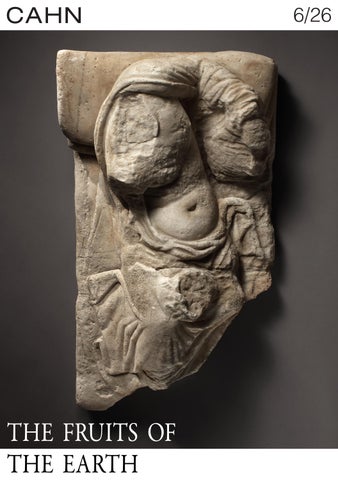
THE FRUITS OF THE EARTH
UPCOMING
MAZE DESIGN BASEL
14 June 2026 (Soft Opening)
15 June 2026 (VIP-Day)
16 - 17 June 2026 (Public Hours)
18 June 2026 (Public Hours)
Offene Kirche Elisabethen
ANTIKE IN BASEL
15 June 2026 (Opening)
16 - 20 June 2026 (Public Hours)
21 June 2026 (Public Hours)
Cahn Steinen
THE FRUITS OF THE EARTH
16 June 2026 (Opening)
17 - 20 June 2026
Galerie Cahn


www.mazepresents.com
05 pm to 09 pm
10 am to 07:30 pm
11 am to 07 pm
11 am to 06 pm
Elisabethenstrasse 10 - 14, Basel
www.antike-in-basel.com
02 pm to 07 pm
11 am to 07 pm
11 am to 05 pm
Steinentorstrasse 19, Basel
www.cahn.ch | www.galeriewolff.com
06 pm to 09 pm
10 am to 06 pm
Malzgasse 23, Basel
THE FRUITS OF THE EARTH
A Meditation on Food through Archaeology and Contemporary Art
By Galerie Cahn & Galerie Wolff
On the occasion of Art Basel, the exhibition
The Fruits of Earth (Les Nourritures terrestres). A Meditation on Food through Archaeology and Contemporary Art will open at the Galerie Cahn from June 16 to June 22, 2026. Bringing together archaeological objects from Galerie Cahn and works by contemporary artists represented by Galerie Jocelyn Wolff, the exhibition explores the question of food. To mark the opening, a banquet of ancient cultures conceived by the art historian Yvonne Yiu will feature recipes from Ancient Egypt, Rome and Greece, served to guests in archaeological tableware.
A sensual ode to desire, Les Nourritures terrestres1 by André Gide profoundly shaped the sensibility of several generations upon its publication in 1897. In it, nourishment appears as a metaphor for desire : by extension, eating can be understood as a way of entering into contact with the world, making it one’s own, and transforming it within oneself. The act of feeding becomes almost sacred in Les Nourritures terrestres: each fruit, each shared loaf of bread is an invitation to savor the moment with intensity and sensuality. Gide never separates body from mind; on the contrary, he celebrates their union. To desire and to
eat spring from the same impulse: to fully embrace what is offered, without restraint or guilt. Thus, food becomes a pedagogy of desire. Learning how to eat well—how to truly taste—is learning how to live. To refuse this experience, or reduce it to mere necessity, would impoverish one’s relationship to the world. For Gide, to nourish oneself is already to love life, in its most immediate and sensual form. The re#nement of the culinary arts since the highest antiquity, particularly evident in archaeological discoveries, echoes Gide’s vision of nourishment and its contemporary extensions.
In the ancient world, the fruits of the earth nourish not only human beings but also the gods. When divine beings accept sacrificial food offered to them, a bond is created between mortals and immortals that confirms the interdependence of the world and the heavens. As such, each sacri#ce is also a reiteration of the validity of the cosmic order. In like manner, the consumption and distribution of food in ancient cultures could serve to consolidate the structure of society and mirror the godlike role of rulers. In the Neo-Assyrian Period, for instance, the king’s meal was often prepared from the leftovers of food
offerings presented to the gods, and the leftovers from the king’s table were in turn distributed to selected persons. This circulation of food is a powerful symbol of the flow of divine authority through the king to society. Conversely, the disruption of this cycle has the potential to sha&er both political hierarchy and cosmic stability. In the comedy Birds by the playwright Aristophanes, two men, exasperated by the current situation in Athens, decide to build a city in the sky with the “beautiful and great name Nephelokokkygia” (Cloudcuckoocity). Strategically located, it separates the gods from humans and blocks the passage of sacrificial smoke, thus starving the gods into submission and forcing them to accept a new world order. Food in antiquity thus has a dimension that transcends the self, embedding it within structures of power, hierarchy, and belief.
Food in archaeology is addressed in the exhibition in an indirect way, through the presentation of objects that testify to practices related to the preparation, storage, and consumption of food. A group of prehistoric lithic tools - chopping tools and hand axes - illustrates the earliest gestures of cu&ing and processing animal carcasses. With the advent of the Neolithic, which marks a turning point in alimentary practices, ceramic vessels emerge for the storage and preparation of food. An assemblage of ceramics from the Lusatian Culture (1300-500 B.C.), at the juncture between the Late Bronze Age and the Iron Age, underscores these utilitarian functions while simultaneously reflecting an aesthetic concern that goes beyond mere practical purpose. This crucial
aspect should be considered in relation to the social significance of commensality: the Mycenaean stirrup jars, Attic figured pottery, and fine Etruscan bucchero wares presented here collectively testify to the care invested by the elite in the presentation of their tables. In the Hellenised world, the banquet constituted a collective institution divided into two stages: the deipnon, or meal proper, followed by the symposion, the convivial practice of drinking together. Representations of banquerers are frequently found in funerary contexts (for instance, on the marble lid of an Etruscan cinerary urn, or in terracotta figurines from Taranto or Eastern Greece that once formed part of the funerary assemblage). They reflect a vision of the afterlife in which the feasts of the living are perpetuated beyond death.
1 André Gide, Les Nourritures terrestres, Mercure de France, 1897
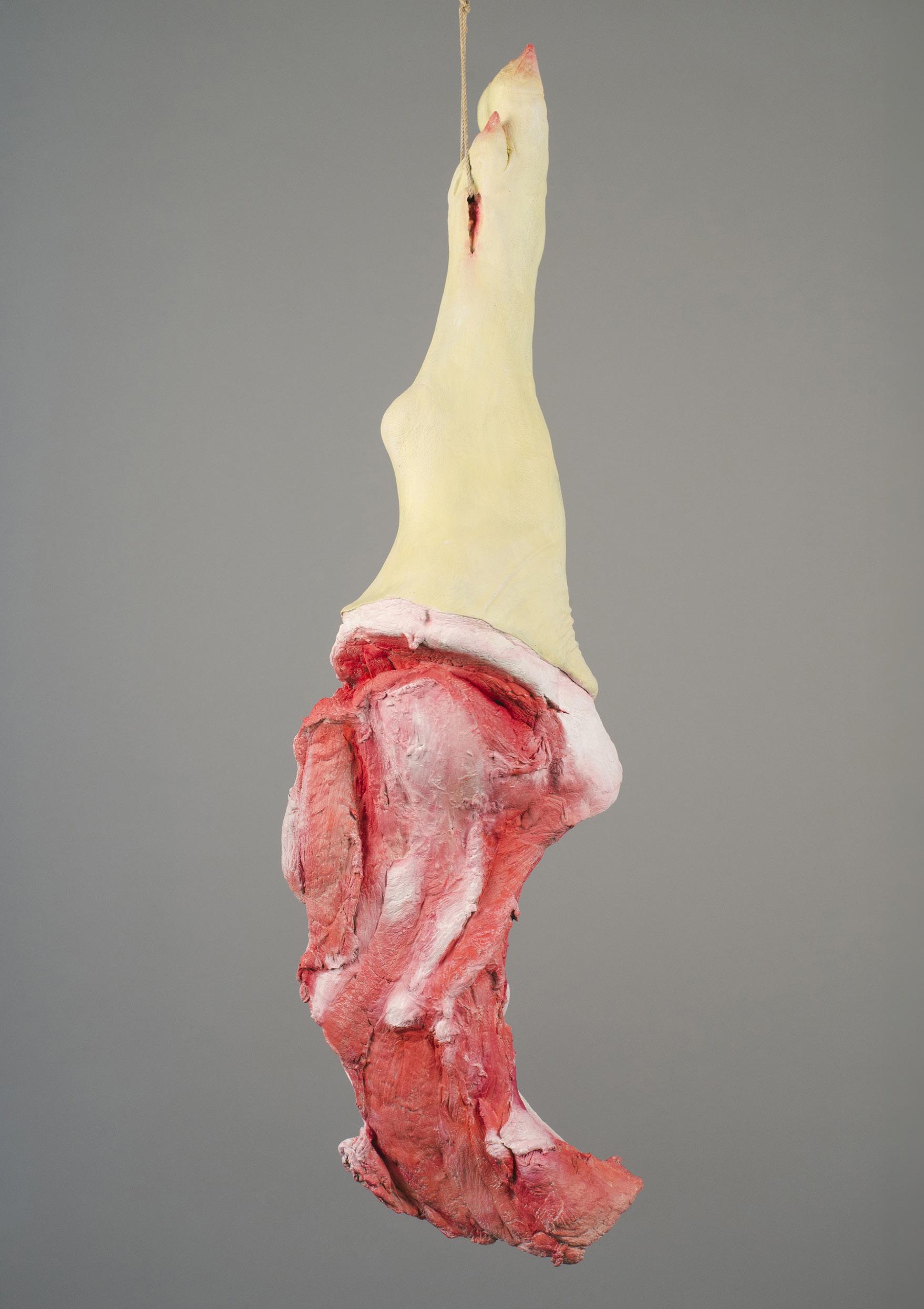
Francisco Tropa, Carne , 2020, Painted bronze, 73.0 x 22.0 x 14.0 cm, Unique.
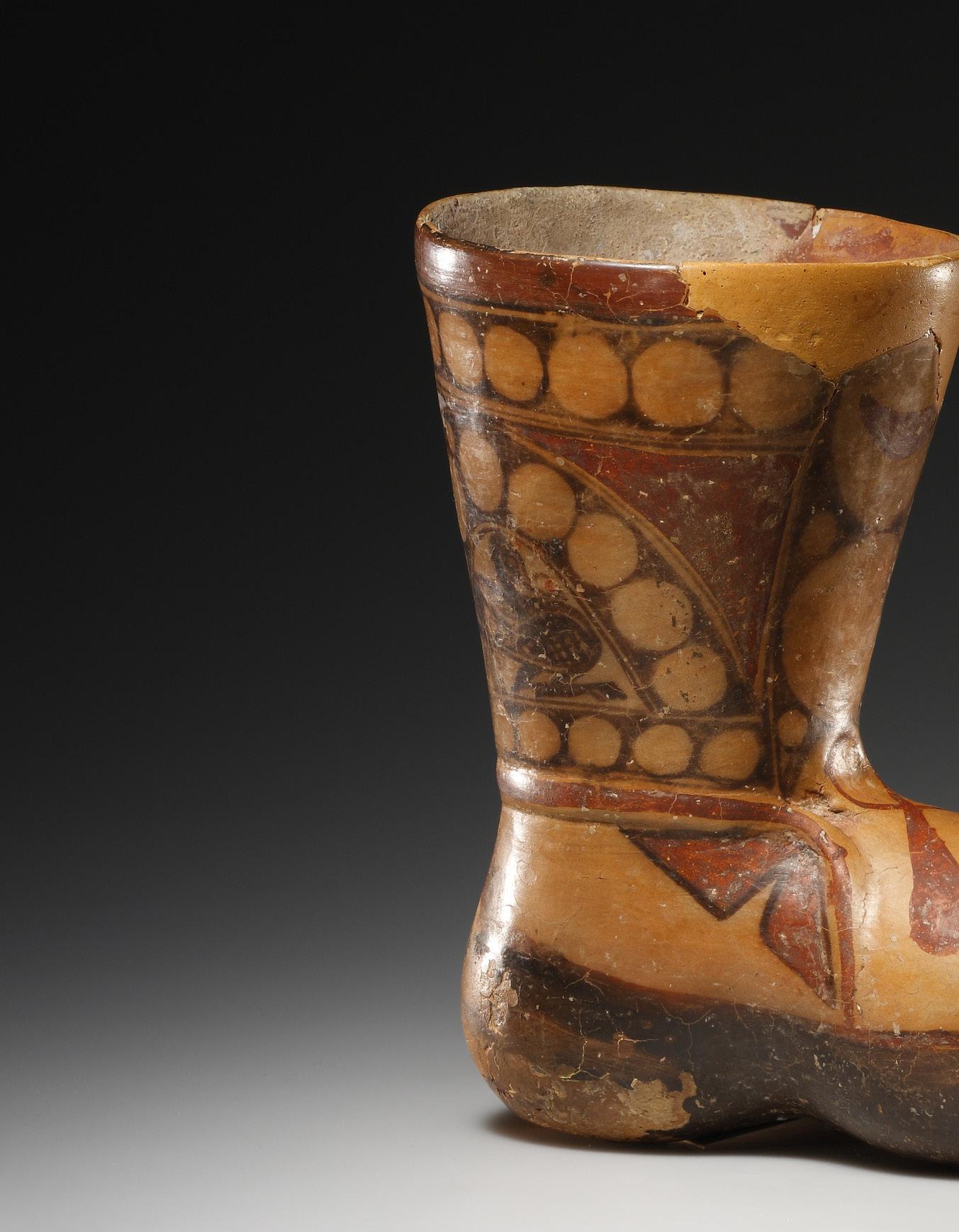
A RHYTON IN THE FORM OF A BOOT
01 | CHF 1.200
Western or Central Asia | 1st mill. B.C. Clay, polychromy | H. 16,5 cm | L. 19,8 cm
Rhyton in the shape of a boot with rich bichrome ornamentation and a pointed tip with a pouring hole on the underside. The lower section is painted black and bordered by a red line. The top is decorated with red ornamentation. A stylised bird to right surrounded by an arcade with reserved circles is painted on each side of the bootleg. A band of reserved circles above. The surfaces between the decorative elements as well as the interior of the rhyton painted red. Part of the bootleg and the heel restored. Interior encrusted. Colour partly abraded or peeled off.
PROVENANCE
Formerly Elie Borowski, Basel, March 1975. Thereafter priv. coll. of the Italian palaeontologist and scholar Giancarlo Ligabue (1931-2015).
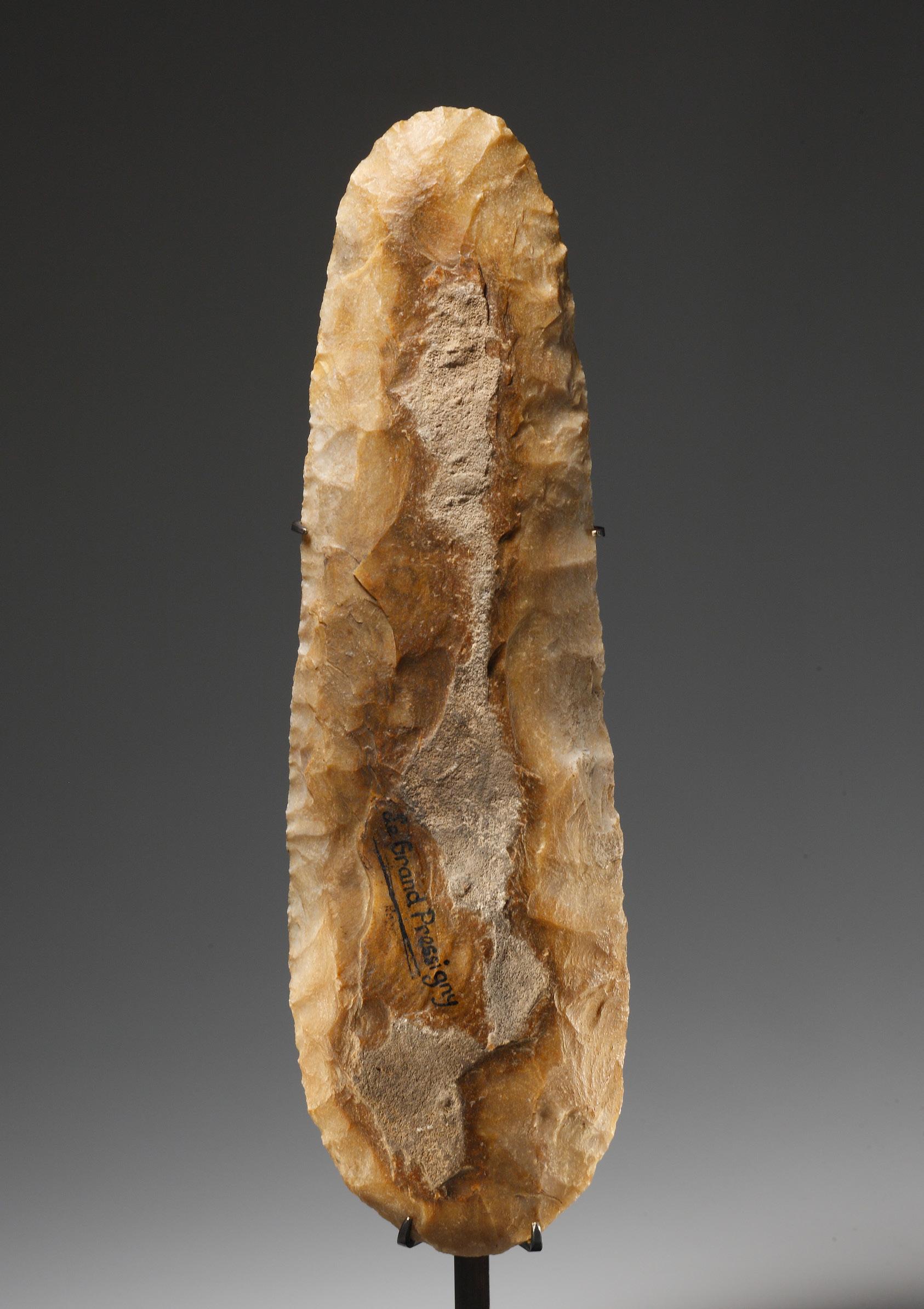
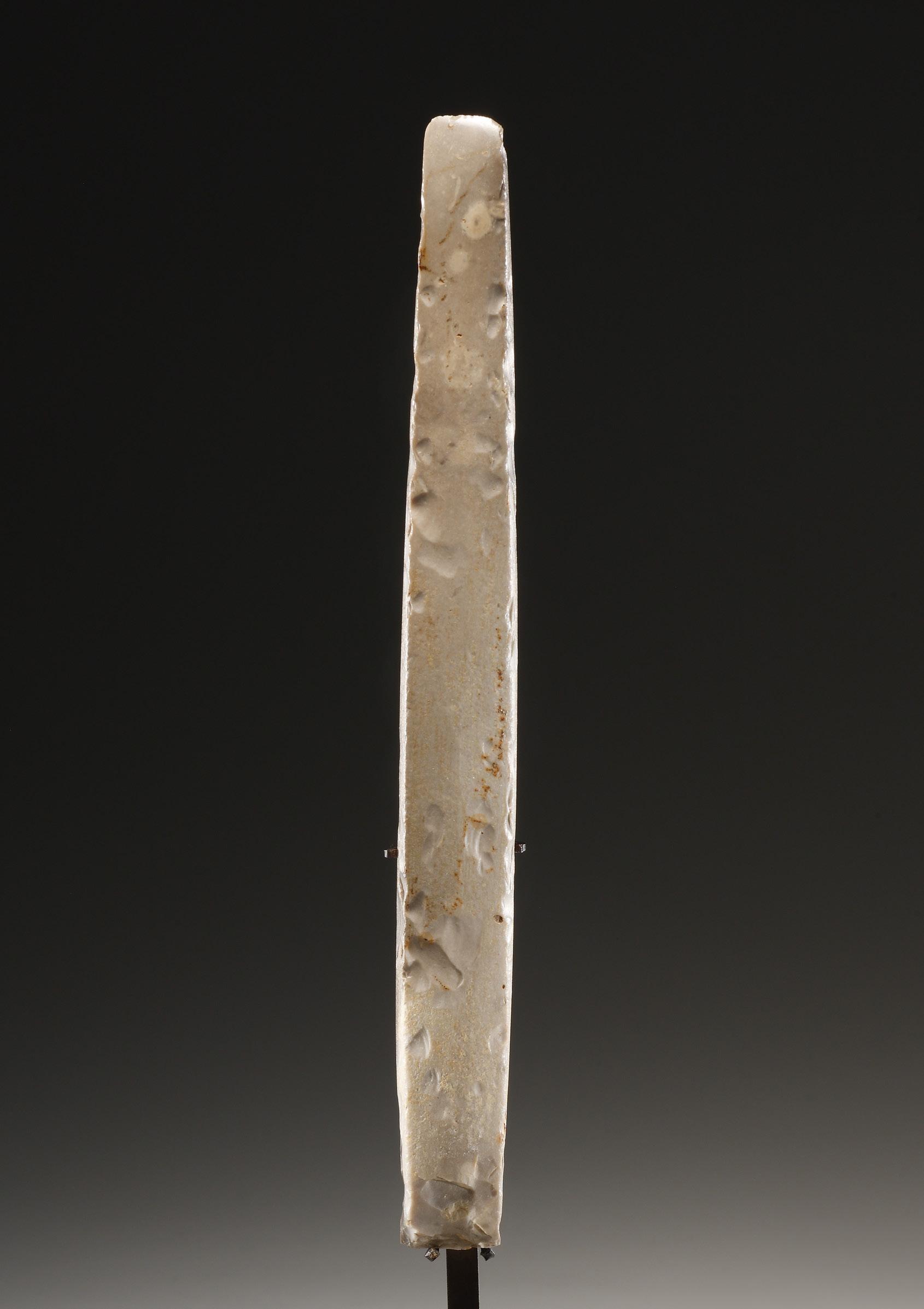
AN ADZE OR CHISEL
03 | CHF 2.200
Rügen (Germany) | Northern Middle to Late Neolithic, ca. 2800-2000 B.C.
Silex | L. 38,5 cm
Tool worked on all surfaces. Symmetrical, extremely elongated, slightly trapezoidal shape. Square cross-section. Symmetrical longitudinal section. Almost imperceptibly convex, seemingly straight „narrow sides“, slightly convex „broad sides“. Straight, flat neck end. The straight cutting edge is slightly curved towards the sides and is aligned at a slight diagonal to the tool‘s axis. All sides polished, traces of knapping on all surfaces (more on the narrow sides than on the broad sides). Denser traces of knapping in the neck area. Grey stone (silex) with various shades of grey and a few white spots. Intact; a few discolourations caused by oxidisation on the edges and surfaces.
PROVENANCE
Formerly Coll. Dr. Siegfried H. Zimmer (b. 1915 - d. 1984), ca. 1950, see inventory list, no 116. Inscription on object: „Vitt“ (Mecklenburg-Vorpommern, near Cape Arkona, Island of Rügen). Inscription on Label: „116“. With Gerhard Hirsch auction, Munich, 265, 16.02.05, lot 130; consigned by a German dealer.
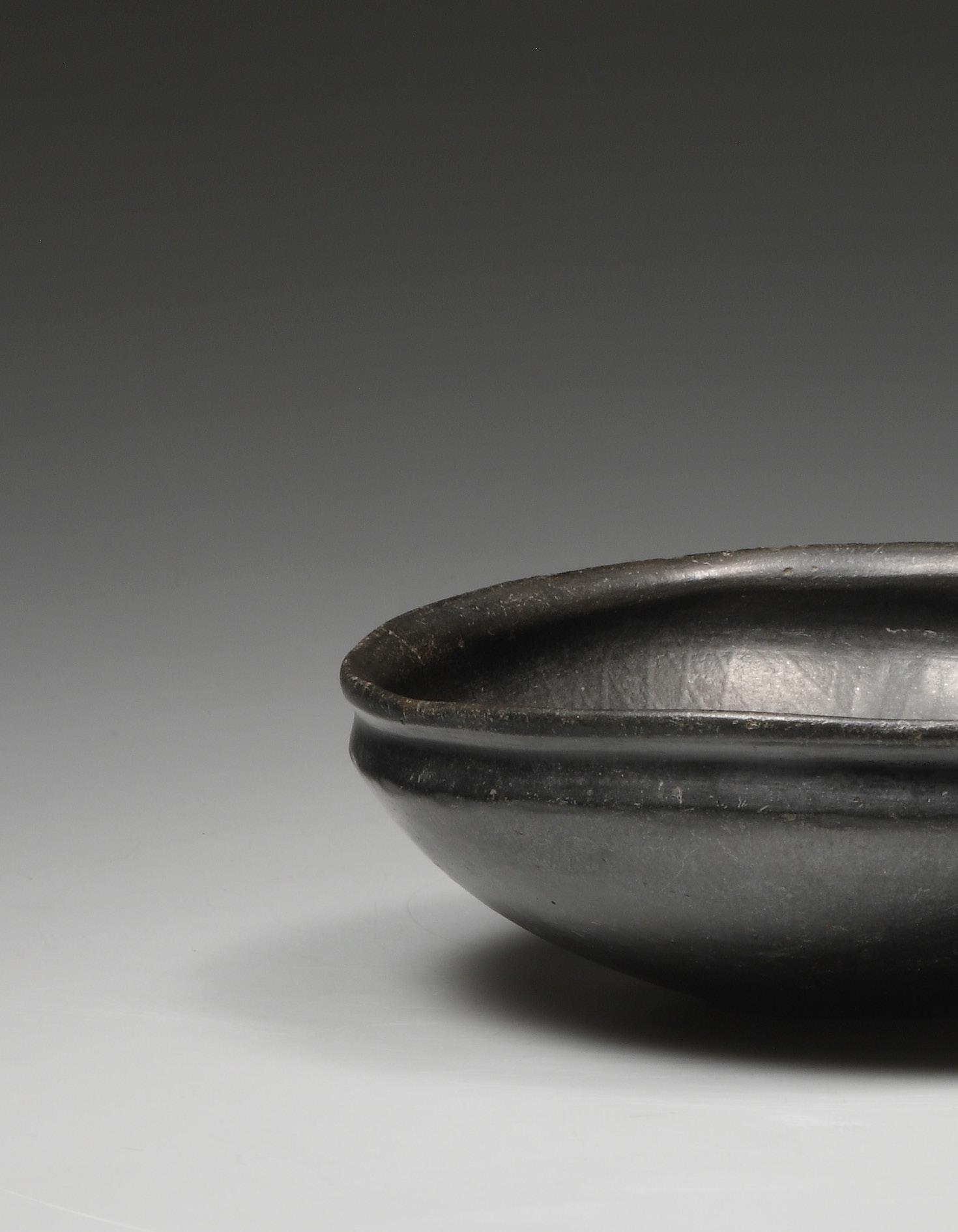
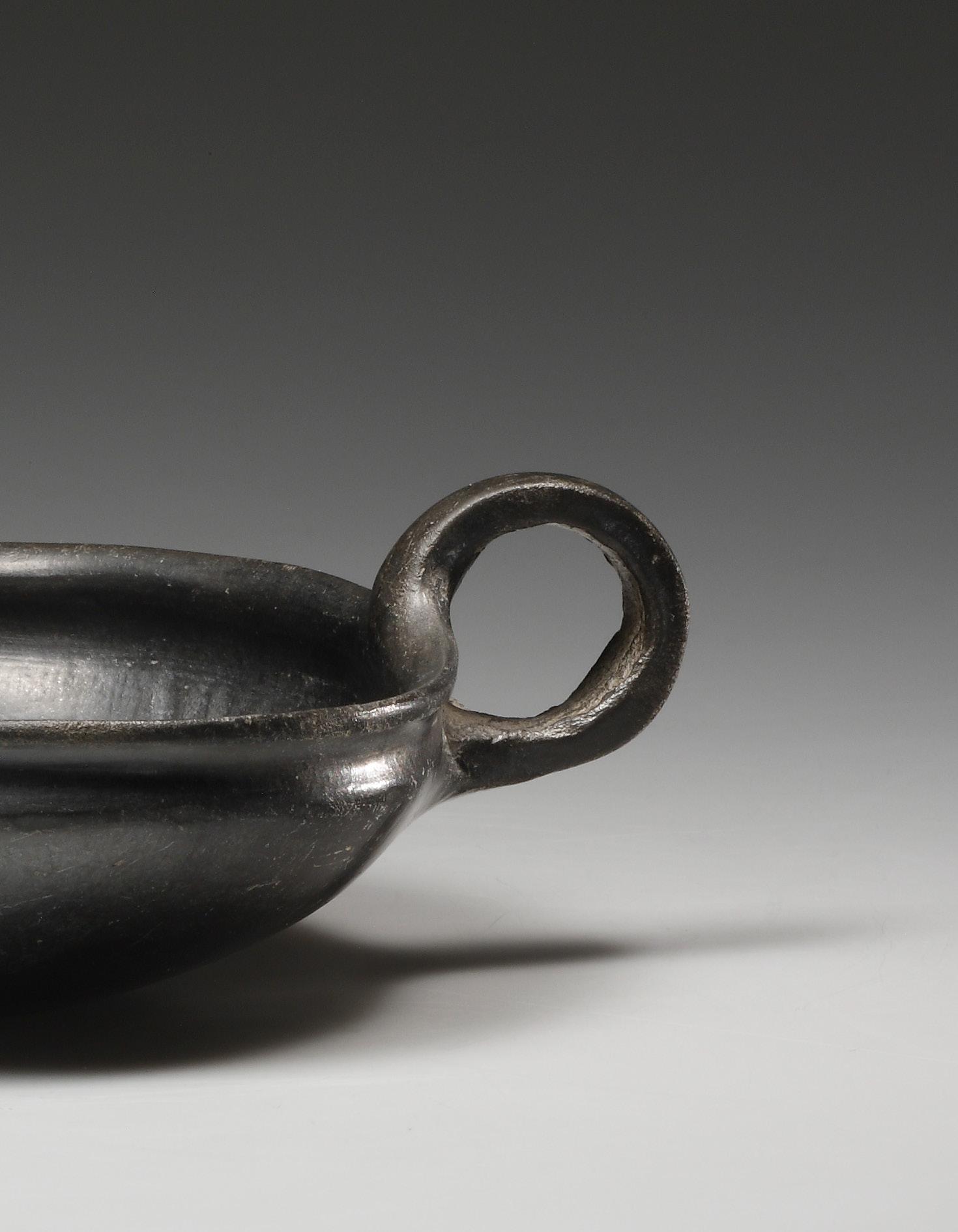
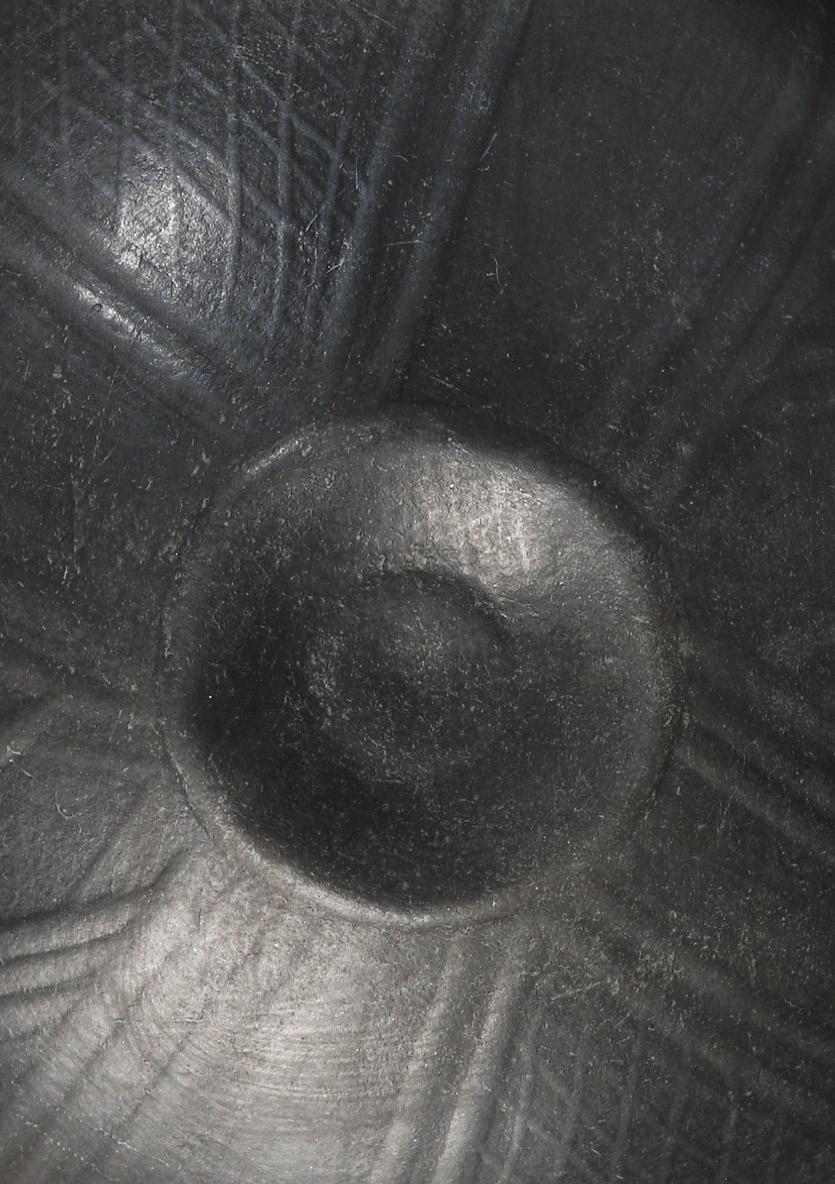
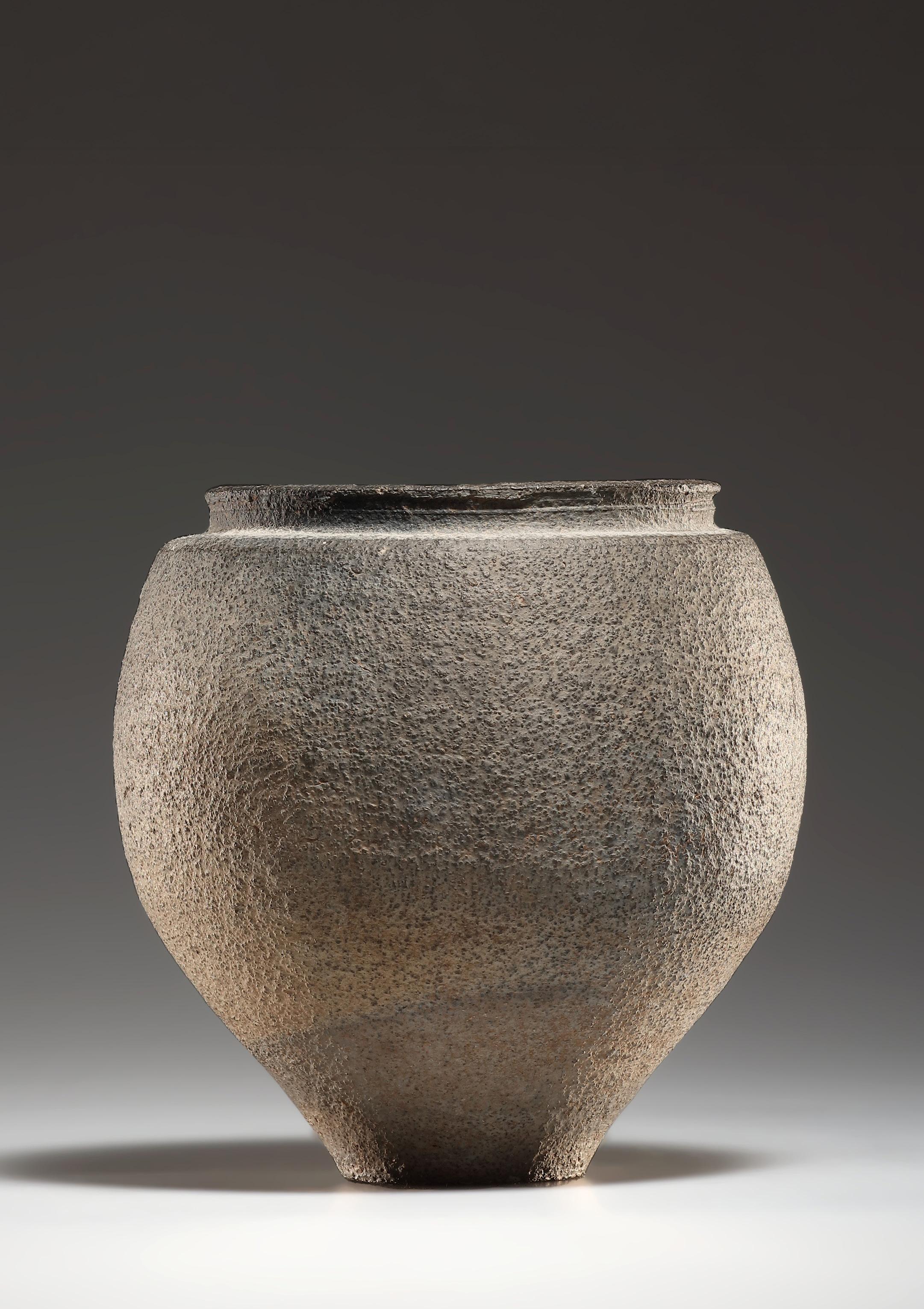
A DECORATED CUP WITH HANDLE
04 | CHF 2.600
Bronze to Iron Age Lusatian Culture | ca. 1300-500 B.C.
Fired clay | Diam. Mouth 12,2 cm
Flat, open vessel with short, flaring rim, distinctly constricted neck and high, rounded shoulder. Conically tapering lower section. Handle rises above the rim. Flat, slightly arched base (rudimentary omphalos).
Decorated interior: Centre of base slightly raised to form a central boss. Sides with triangle pattern on opposite sides, filled with “abbreviated” interlace pattern or with double grooves framed by a lozenge pattern. Carefully smoothed and graphitized surface with typical metallic sheen. Unbroken, fine crack at the rim, beginnings of cracks on the exterior of the base.
PROVENANCE
Formerly priv. coll. Dr. Siegfried H. Zimmer (b. 1915 - d. 1984), Germany, ca 1950, see inventory list, no 218. From Petschkendorf, Schlesien. Old label: „218“.
NOTE
V. Vokolek, Gräberfelder der Lausitzer Kultur in Ostböhmen. Fontes Archaeologici Pragenses 26 (Prague 2002) 123, illus. 20, var. 2, 124-126. E. Wesely-Arents, Studien zu Chronologie und Besiedlung der Lausitzer Kultur in Sachsen auf Grundlage des Gräberfeldes von Liebersee. Studien zur Lausitzerkultur III (Langenweissbach 2011) .
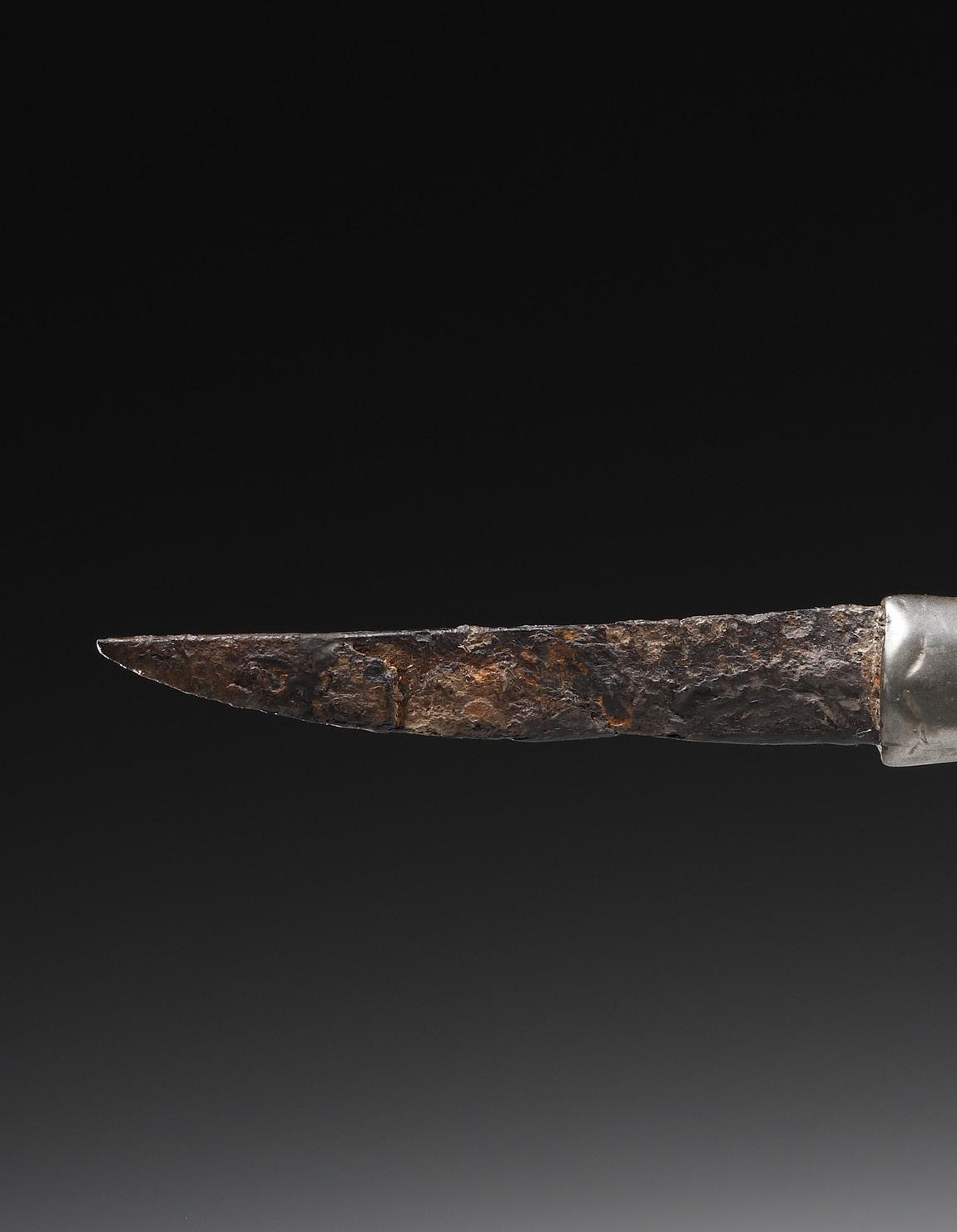
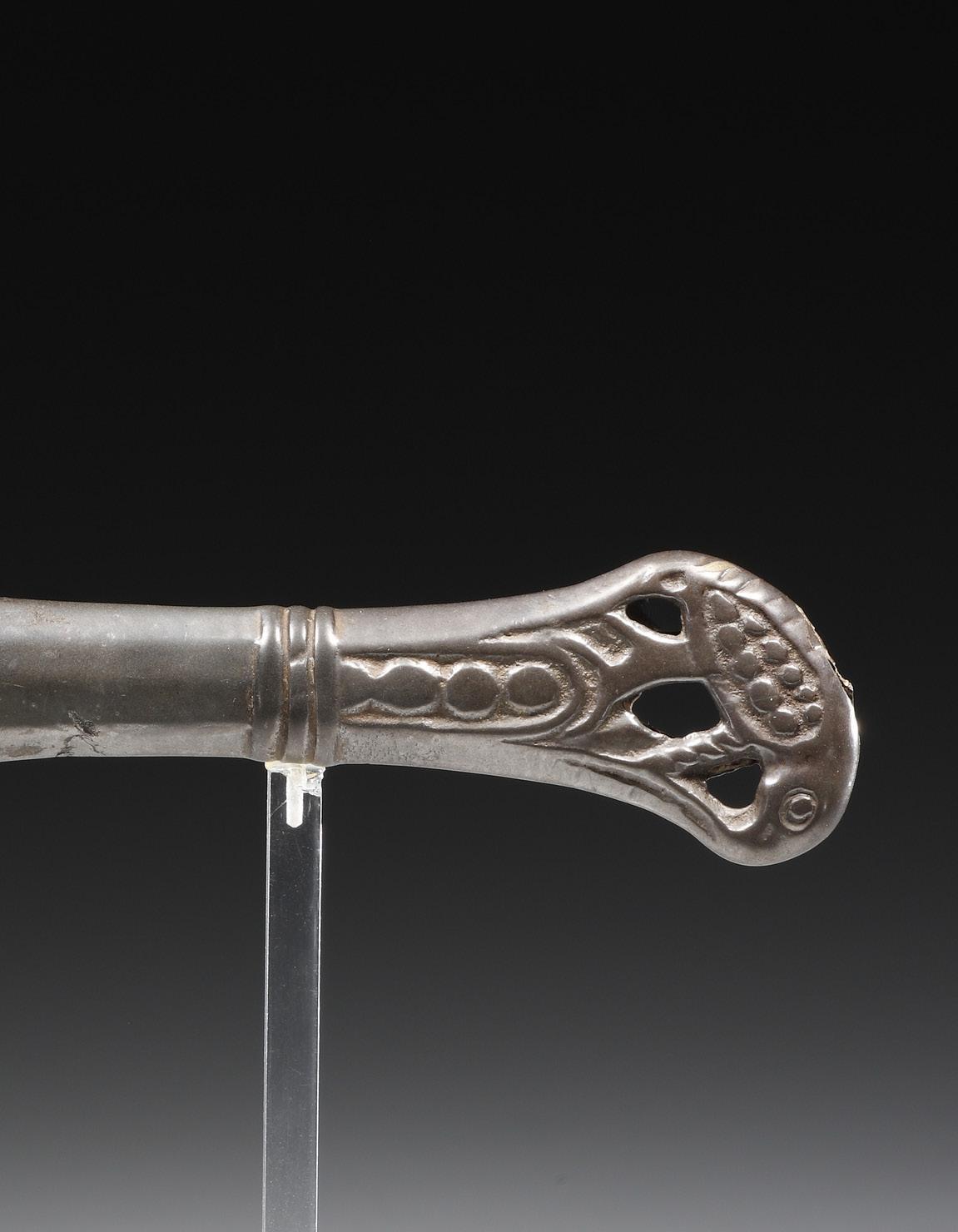
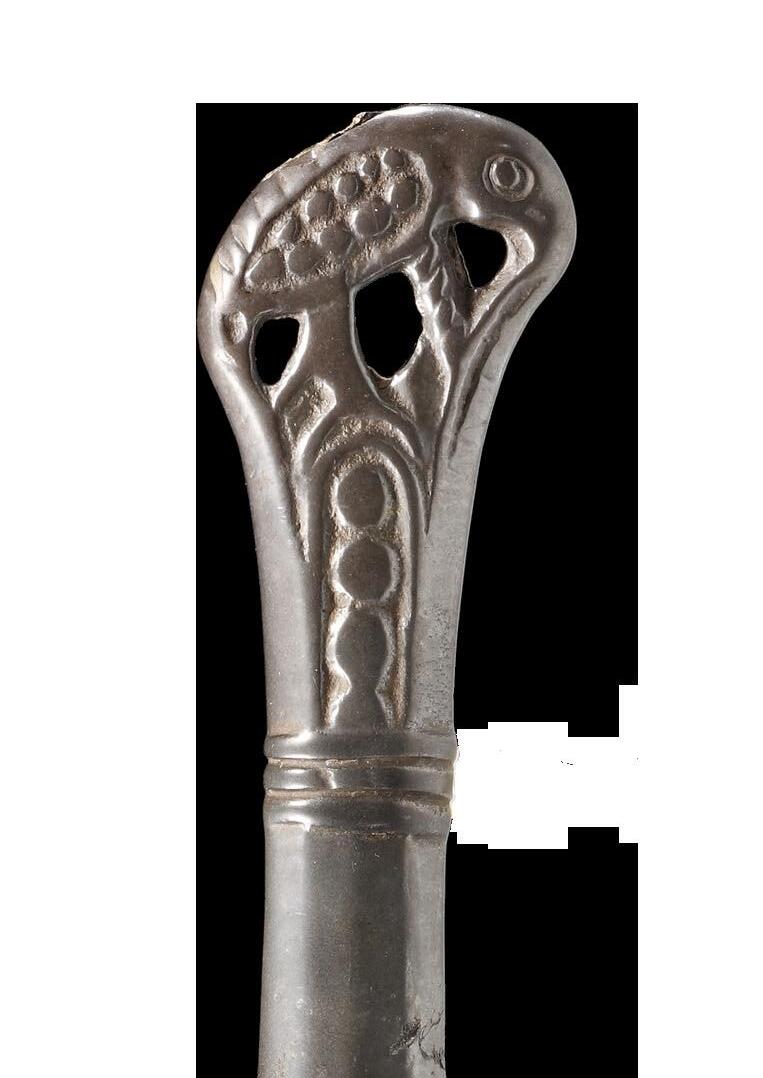
A KNIFE WITH A HANDLE IN THE SHAPE OF A RAPTOR
05 | CHF 5.800
Northeastern Ural or Western Siberia | 5th-10th cent. A.D. Bronze with high percentage of tin, iron | L. 17,2 cm | W. 3,2 cm | D. 0,9 cm
The iron blade is attached to the polygonal beginning of the handle by an adhesive. A triple band forms the transition to the figural butt with the representation of a pecking raptor with long claws sitting on a stylised tree. Large ring punches for the eyes; low nubs structure the wings and the interior of the tree. Due to the characteristic stylised execution of its ornamentation, the knife can be assigned to the „Perm Animal Style“ of the steppe people who lived in a region that extended from the Ural Mountains to the Yenisei and Ob Rivers. The handle was cast in two halves and polished. The low relief allows the handle to lie in the hand comfortably. Blade corroded, minor infills in the lower area. Minor lacuna at the back of the bird. Overall, the surface is very well preserved shows the metal’s high tin content to advantage.
PROVENANCE
Formerly priv. coll. W. L., USA, early 1990s. Thereafter, Artemis Gallery, 26.9.2016, USA.
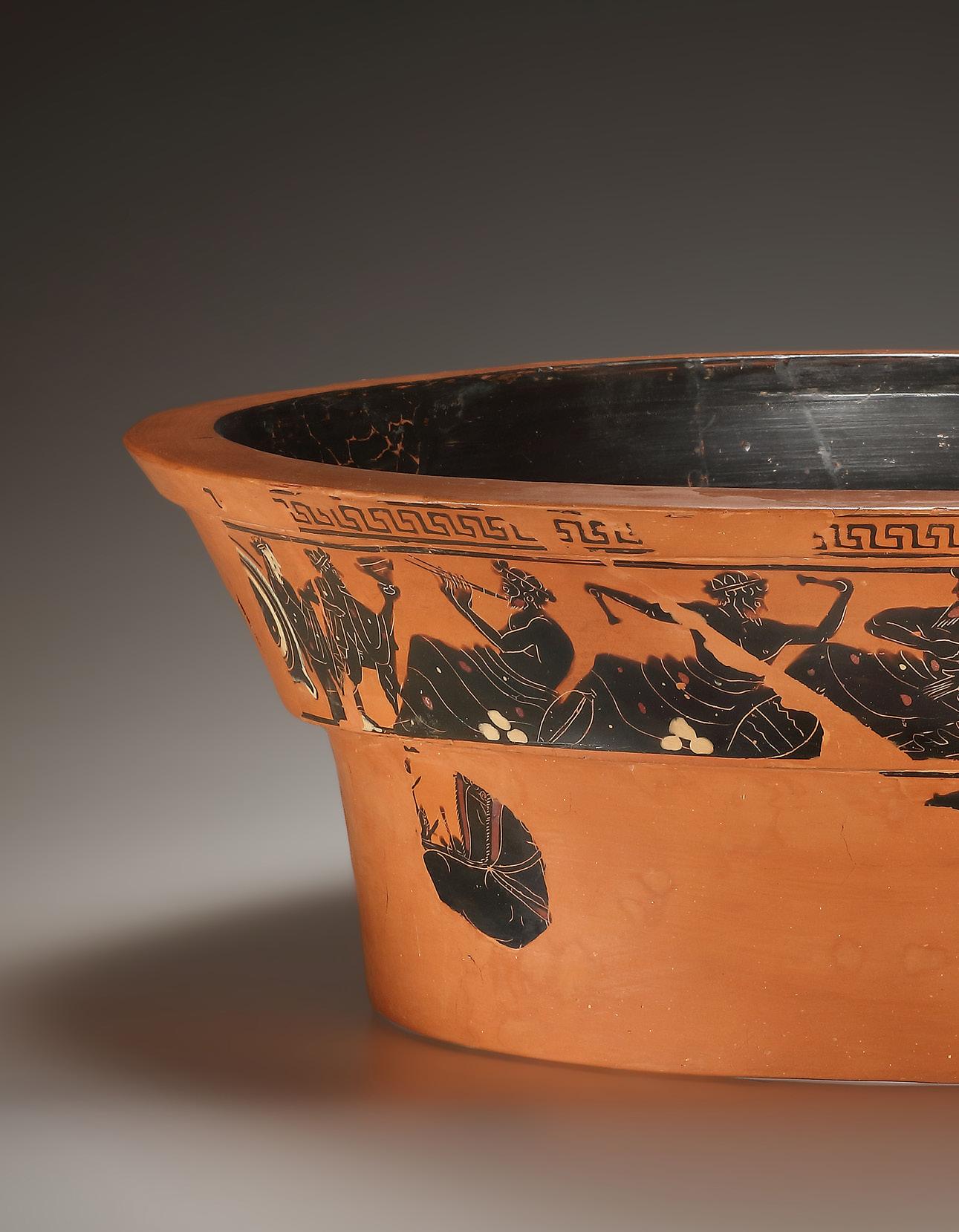
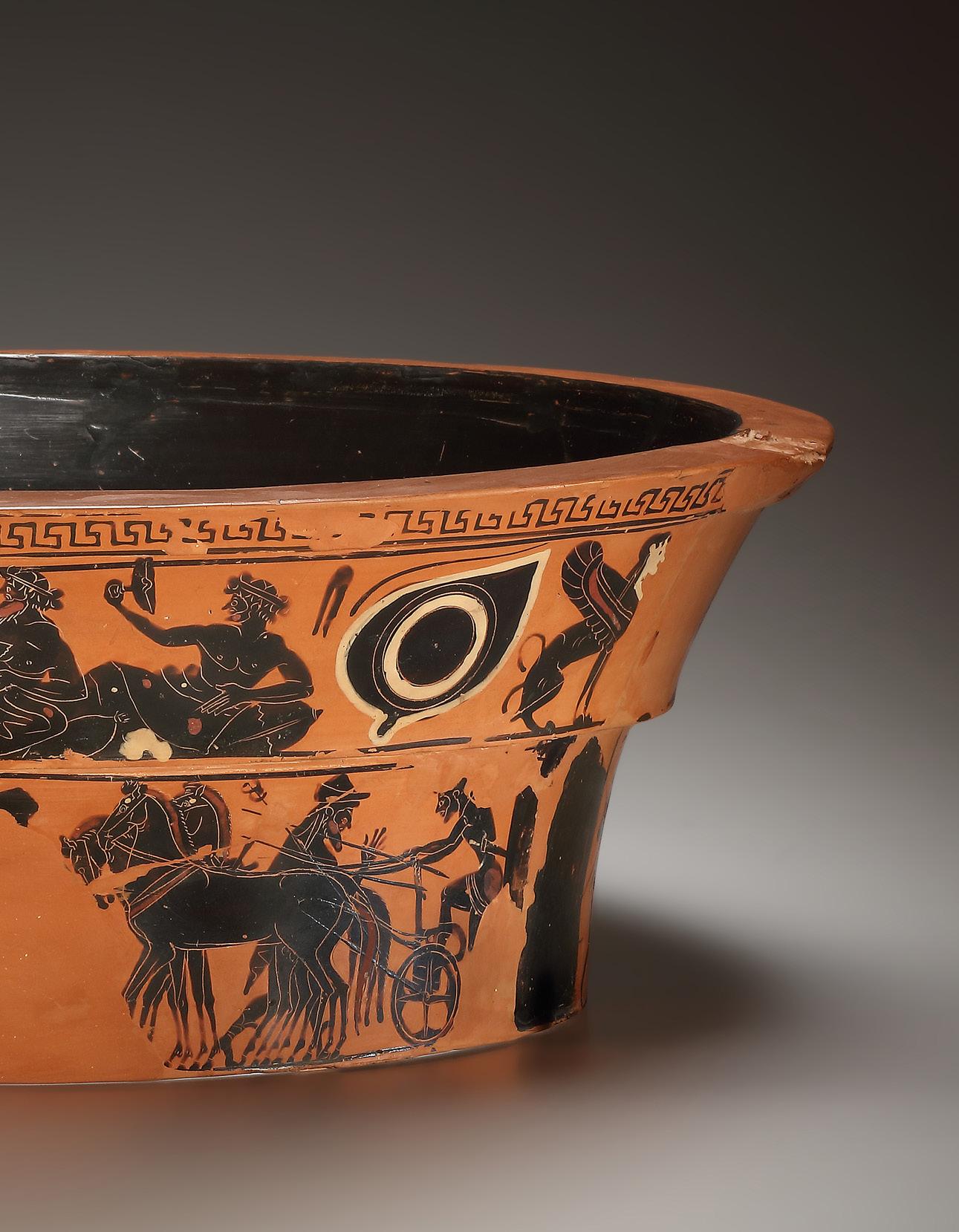
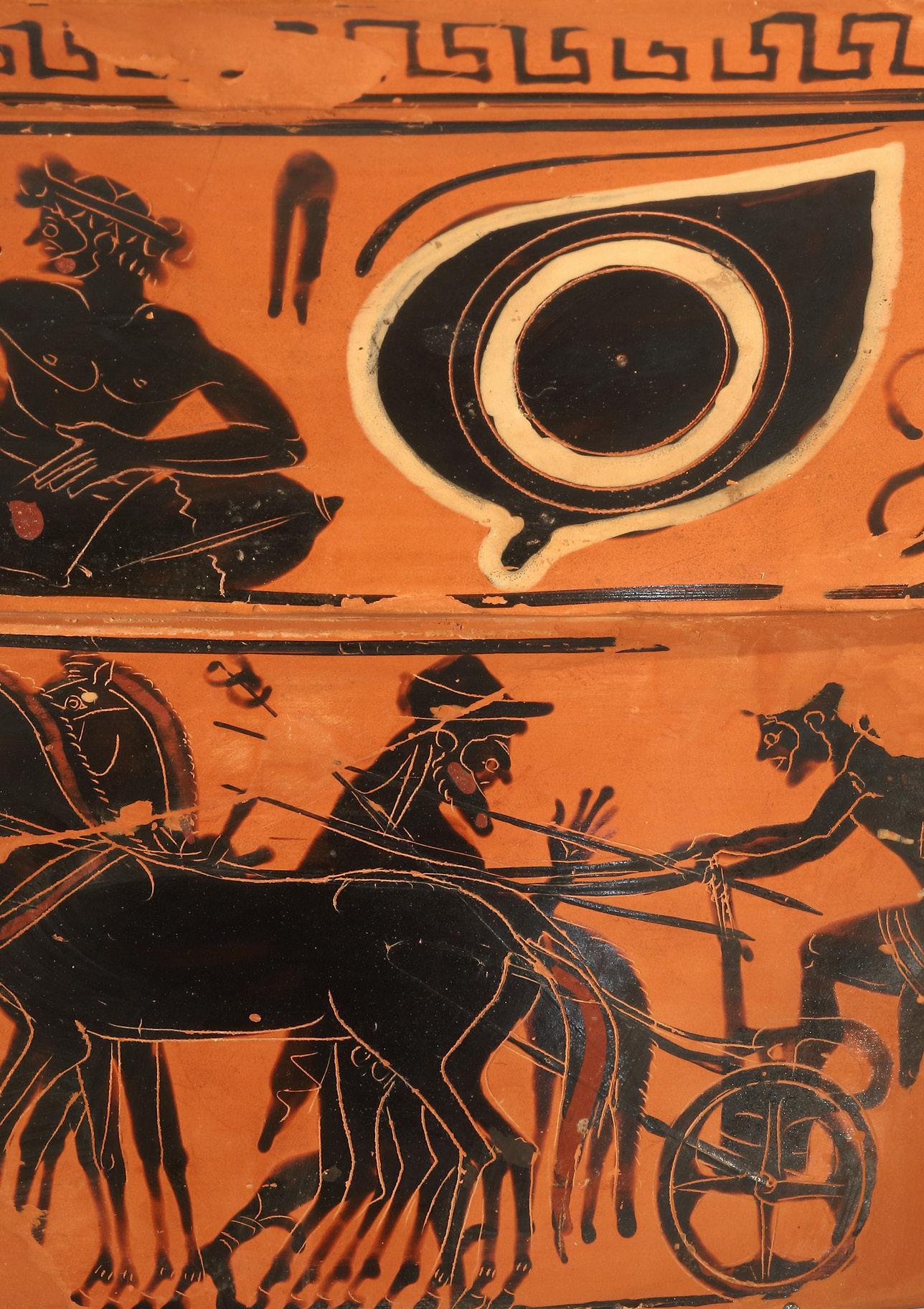
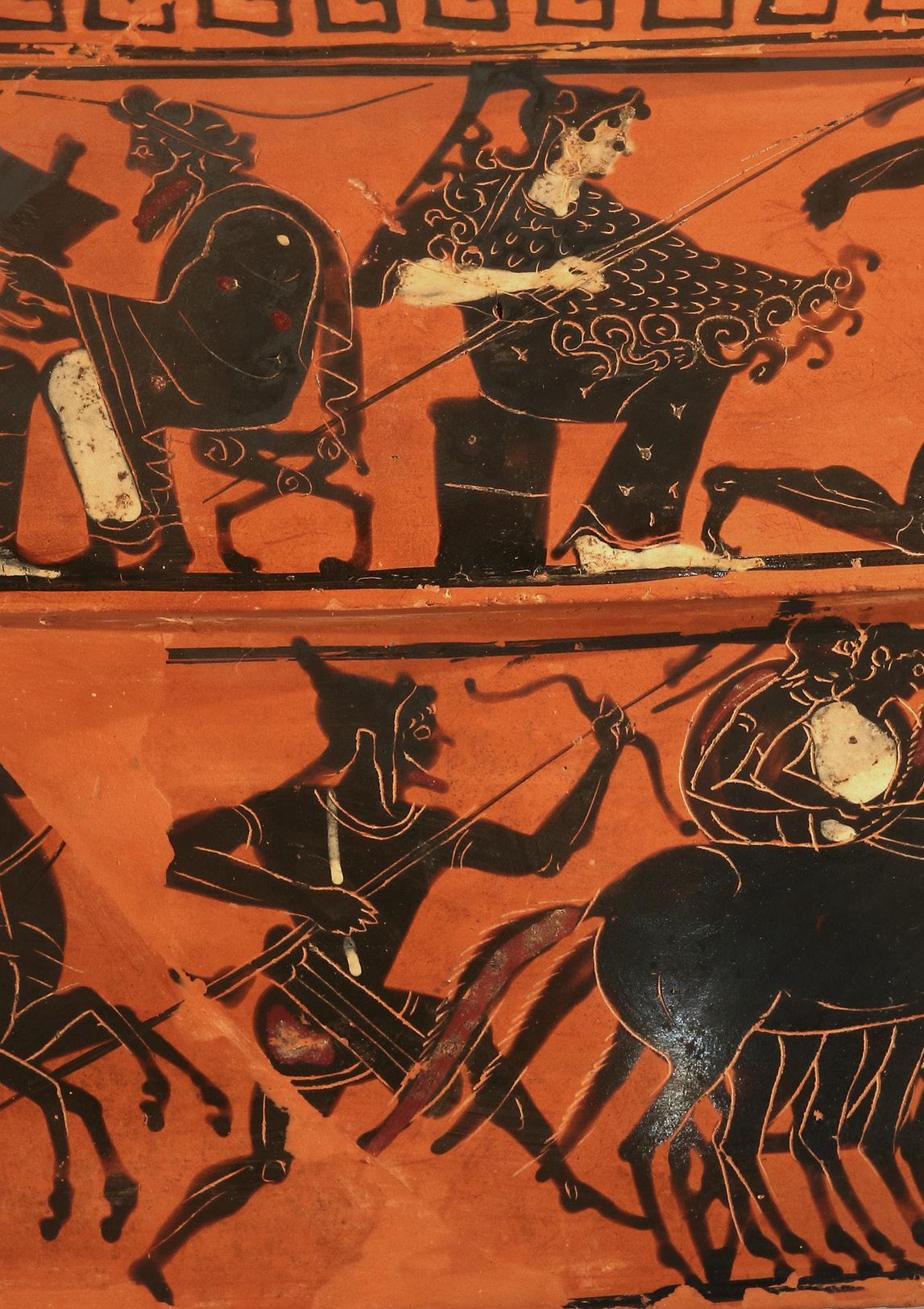
A LARGE ATTIC BLACK-FIGURE VOLUTE-KRATER FRAGMENT ATTRIBUTED TO THE GOLVOL GROUP
06 | Price on Request
Attic | ca. 520 - 500 B.C.
Clay | L. 40,0 cm | H. 14,5 cm
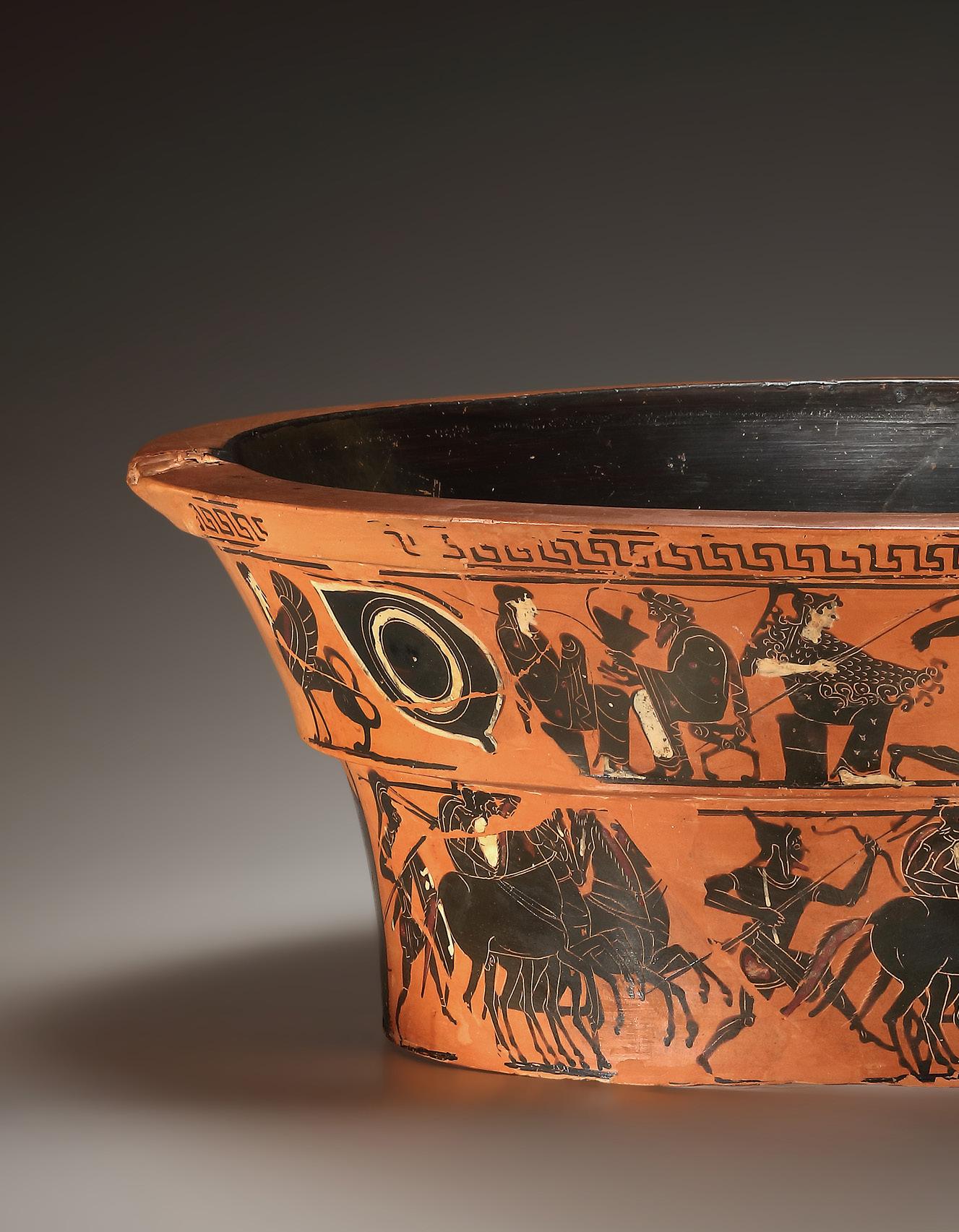
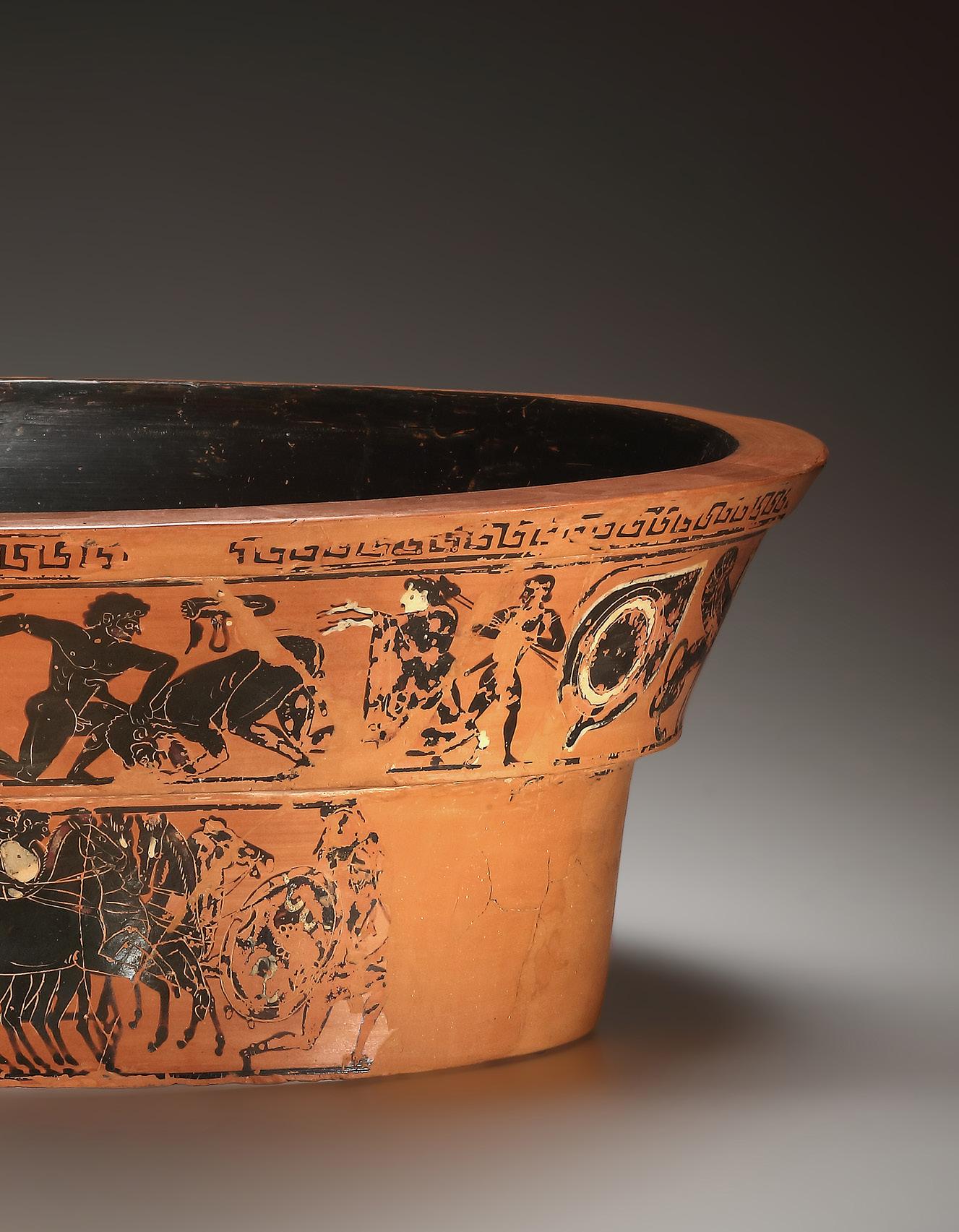
A fragment of the mouth and neck of a blackfigure volute-krater. It features a flared lip, reserved on the top. The inside of the neck is glazed, with a red line at the top and another one below. The side of the lip is reserved with a maeander to left between lines. The neck is divided into two sections, each reserved with figured decoration. The upper section, offset, is framed on both sides, next to the handle zones, by a sphinx and an apotropaic eye. Side A, upper frieze: to the left, next to the eye, two deities, Dionysos and Ariadne (or a maenad), each seated on a stool. Dionysos, bearded and wrapped in a himation, holds a kantharos and an ivy tendril. In the center, the struggle between Herakles and Antaios is flanked by two attendant goddesses: on the left, Athena, seated, the aegis extended; and on the right, Antaios‘ wife or his mother Gaia (the Earth). Behind her, Iolaos carries Herakles‘ club and spears. Herakles is depicted naked and unarmed, with his quiver and sword suspended above him. In the lower register, a war scene with hoplites and quadrigas marching to right. Among the soldiers, an archer dressed in a short tunic and Scythian cap, with a quiver hanging on his back from a baldric. Side B, upper frieze: four symposiasts recline on cushions. One examines the tondo of his cup, another
plays the krotala, a third plays the aulos. To the left, in front of the apotropaic eye, two standing servants: a youth clad in a himation, holding a skyphos and a maid behind him. The lower register is quite lacunose, but it features the departure of heroic warriors, with quadrigae, one of which is escorted by Hermes, who is bearded and holds the caduceus. The frequent use of white and red paint is especially striking, highlighting the vestments and elements of armor, as well as the women‘s skin. This work belongs to the Golvol Group. The body of the vessel was likely painted solid black with rays at the base. Assembled from fragments. Restoration in toned plaster along cracks and to fill the lacunae.
PROVENANCE
Possibly from Charles Ratton‘s stock, Paris. 19th century label with ink inscription „Wolfram / Les Montmins / Allier / n° 2098“. Thereafter, priv. coll. Michel Meignan (1947-2022), Paris.
NOTE
For the Golvol Group, cf. Beazley, John D. ABV, pp. 194-195, 689; Para, pp. 79-80; Hitzl, Konrad, Die Entstehung und Entwicklung des Volutenkraters von den Anfängen bis zur Ausprägung des kanonischen Stils in der attisch schwarzfigurigen Vasenmalerei (Frankfurt, 1982, pp. 123-125, 129, cat. nos. 37, 4548, 51-52, 16). The scene of Herakles fighting Antaios can be compared to that of Herakles and the Nemean Lion with Iolaos in attendance, flanked by two seated goddesses, possibly Athena and Hera, on a volute-krater in the Royal Ontario Museum, Toronto, inv. no. 959.17.212, BAPD 5992.
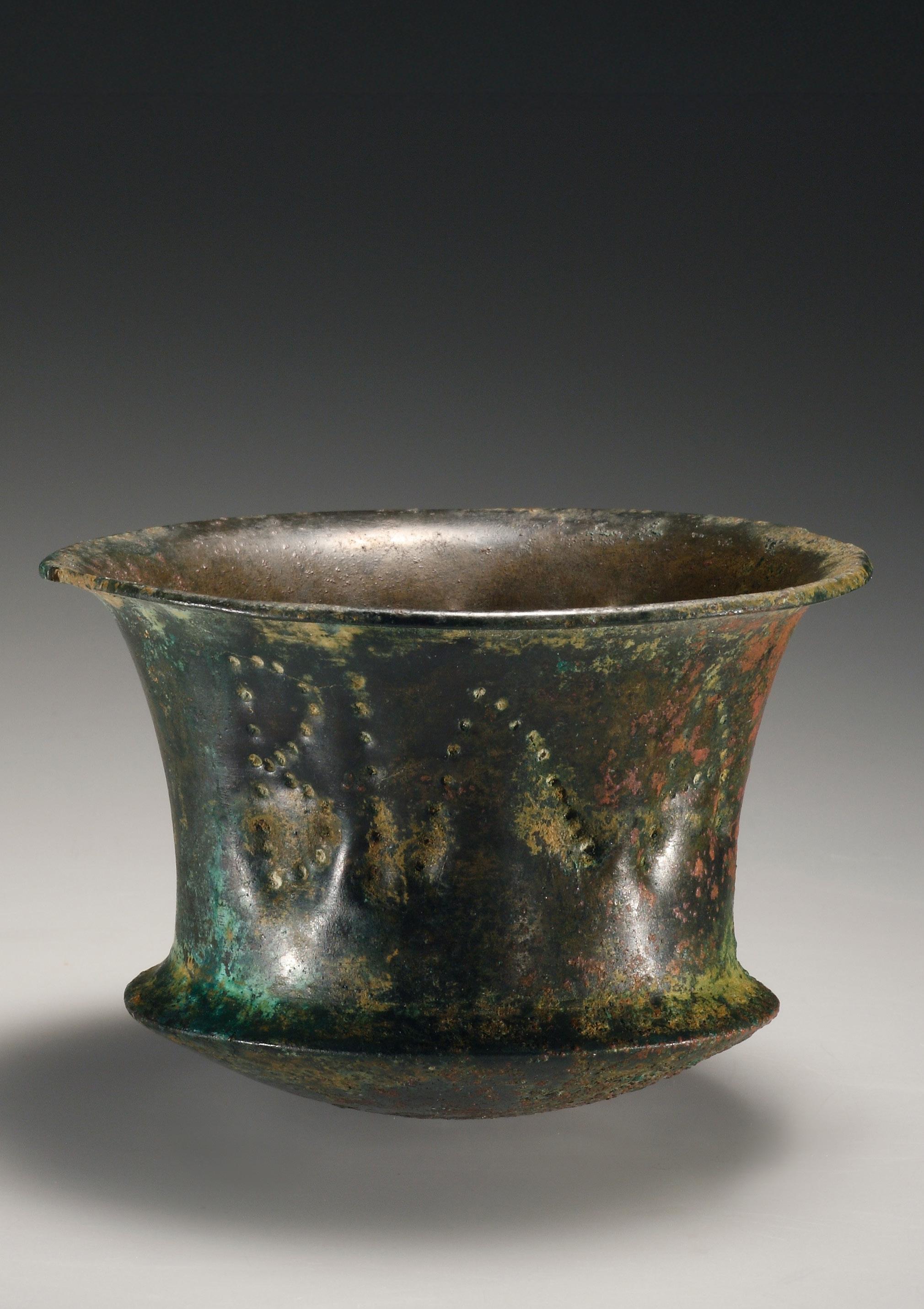
A RARE KANTHAROS WITH INSCRIPTION „BILA DIONYSOI“
07 | CHF 12.000
Greek | 5th cent. B.C.
Bronze | H. 6,9 cm | Diam. Max 6,0 cm
Kantharos with encircling votive inscription:
ΒΙΛΑ ΔΙΟΝΥΣΩΙ. Bila is probably not a Greek but an eastern name. Rim slightly worn, intact.
PROVENANCE
With Sasson Ancient Art Ltd, Jerusalem, Israël; acquired between 1980-1990 on the London art market.
NOTE
For the style and form cf. the bronze kantharoi and cups with handles in: S. Descamps et al., Au royaume d’Alexandre le Grand. La Macédoine antique, Cat. Paris (Paris 2011) 401 f., nos. 253-255 with illus. (all ca. mid to 2nd half of 4th cent. B.C.). With regard to the vessel‘s shape, a silver cup from Palaikastron/Crete is most closely related (mid-3rd cent. B.C., in the MFA Boston, inv. no. 48.253), cf. M. Pfrommer, Studien zu alexandrinischer und grossgriechischer Toreutik frühhellenistsicher Zeit (Berlin 1987) 219, no. KaB A 64, pl. 44d-f. 62, A 64; furthermore a black glazed cup with bosses (3rd cent. B.C.), Greek-Roman Museum, Alexandria, inv. no. 8664, cf. ibid., 213, no. KaB A2, pl. 45d; cf. also two kantharoi with strap handles from the Athenian Agora in: B.A. Sparks-L. Talcott,
Black and Plain Pottery of the 6th, 5th and 4th Centuries B.C., The Athenian Agora, vol. 12 (Princeton 1970), 280, nos. 628-629, pl. 27.
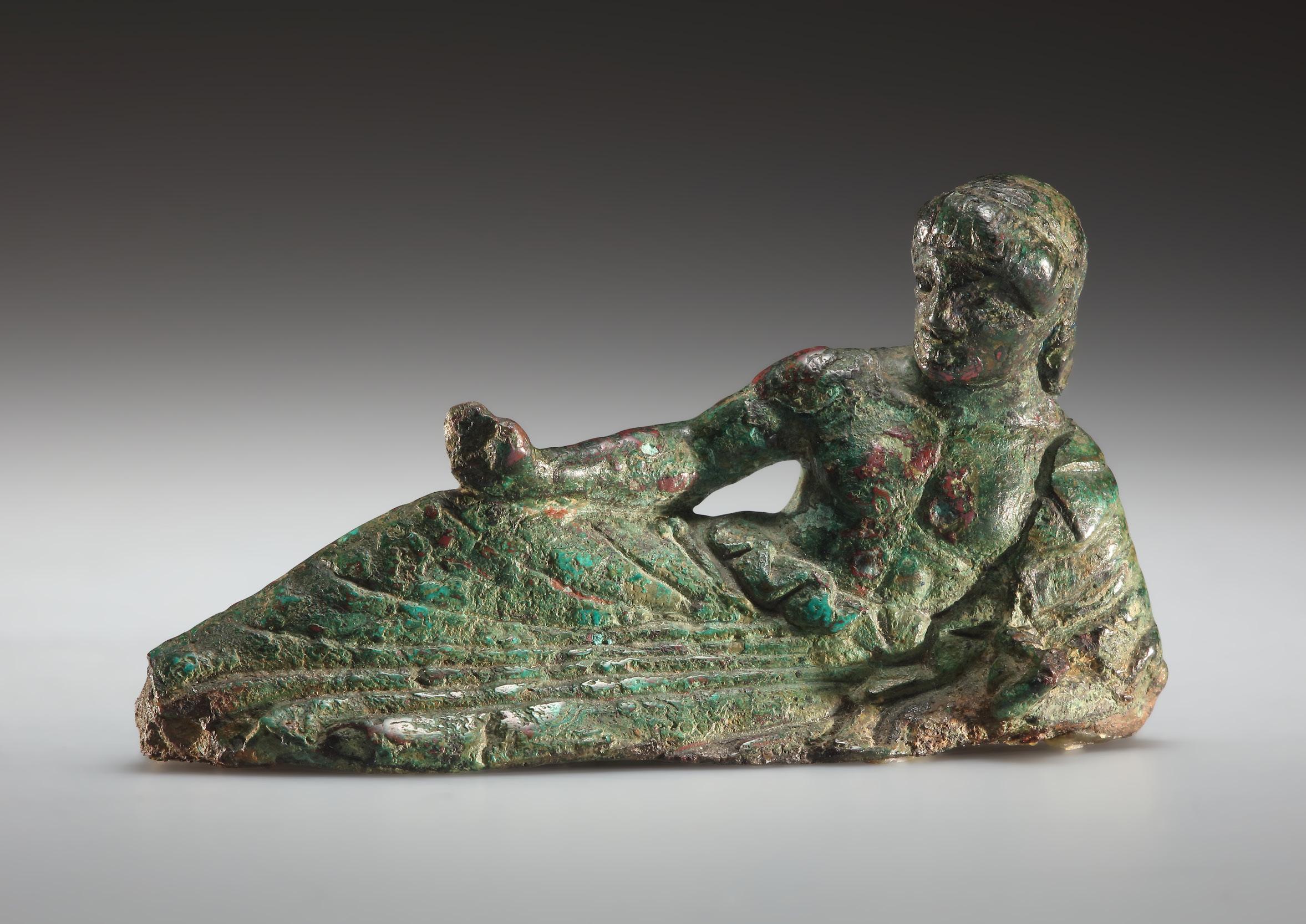
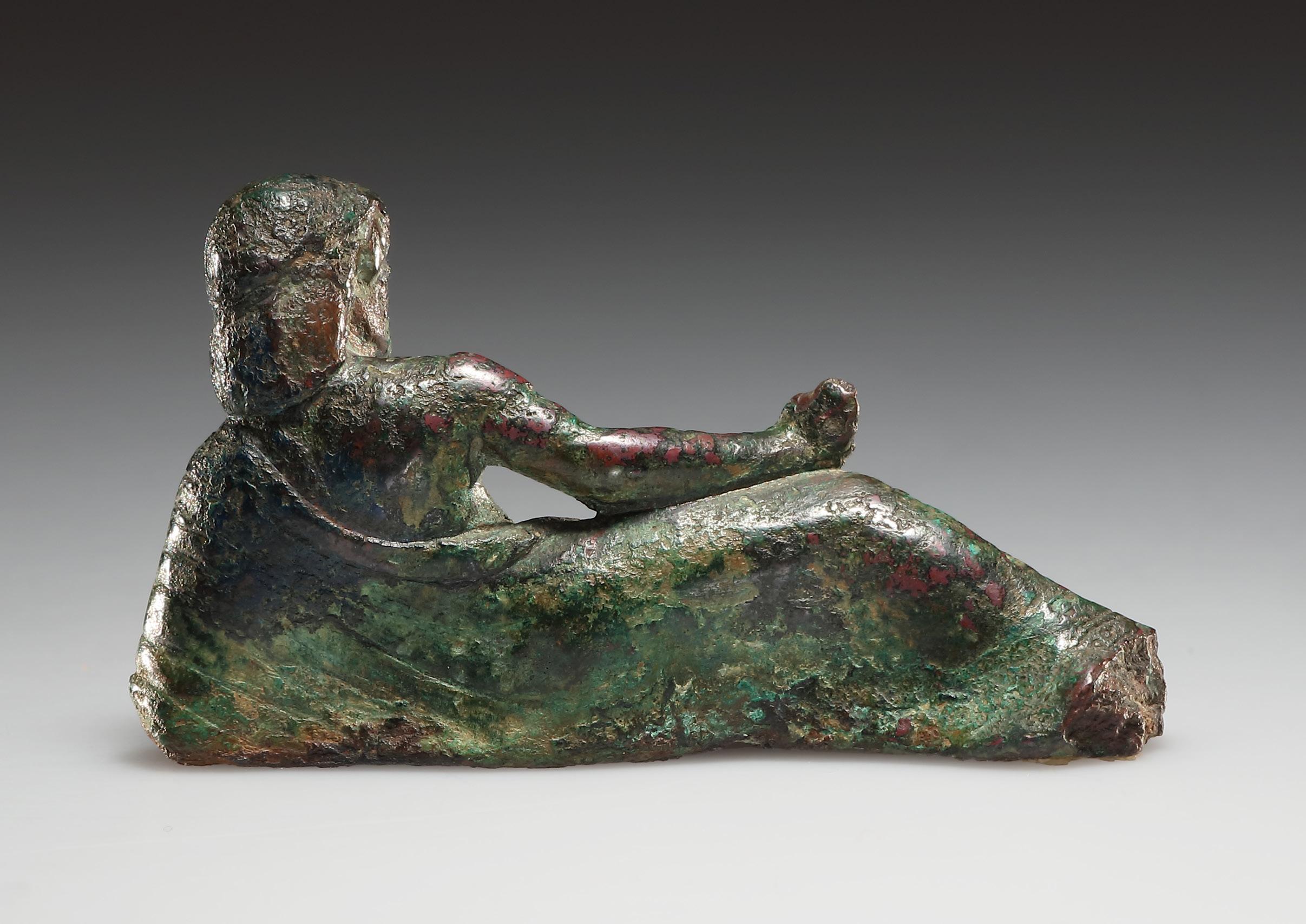
A RECUMBANT SYMPOSIAST
08 | CHF 16.000
Etruscan | ca. 480 B.C.
Bronze | L. 6,1 cm
He lies comfortably, with his legs almost completely extended, and supports his upper body on his left arm. His right arm rests on his thighs. He gestures with his hands as if speaking. A cloak is wrapped around his body in broad folds, leaving his chest and right shoulder bare. His almond-shaped eyes and smiling mouth are typical of the archaic period. His rich hair is held together by a narrow fillet and reaches down to the nape of his neck. Fingers and feet slightly worn. The recessed underside indicates that the piece was used as an applique, probably from a bowl.
PROVENANCE
Formerly priv. coll. Franz Trau (b. 1881- d. 1931), Vienna, prior 1931. Formerly MuM AG Basel, July 1953 (see Widmer negative no 276), inv. no 24412. Sold in 1955 to Galerie Fischer Luzern. With Galerie Fischer, Luzern, auction 21.06.1955, lot 183. Thereafter, priv. coll. Jean-Marie Talleux, Grand Fort Philippe, France; acquired in 1982 at KAM, Basel from MuM AG, Basel. With Drouot auction Paul Renaud, 06.12.1995, Paris. With Galerie Jean-David Cahn AG, Basel; acquired in 2004 at RoyalAthena Galleries, New York. Since then in a private coll. J. T., Switzerland.
PUBLISHED
Cahn Auktionen, A5, 2010, lot 179.
NOTE
Cf. similar appliques from Etruscan bowls of the 5th-4th cent. B.C. The Ernest Brummer Collection, Bd. 2 Ancient Art, Auktion Zürich 16.-19. Oktober 1979, Cat. Zurich 1979 96f., no. 547 C.E.H. with ill. The motif of the gesturing, recumbant symposiast is frequently found in Etruscan art, most often in a funerary context, for instance on the reliefs and lids of urns; see The Ernest Brummer Collection, Bd. 2 Ancient Art, Auktion Zürich 16.-19. Oktober 1979, Cat. Zurich 1979, 212f. 218, nos. B 10.1, B 10.10 with illus.
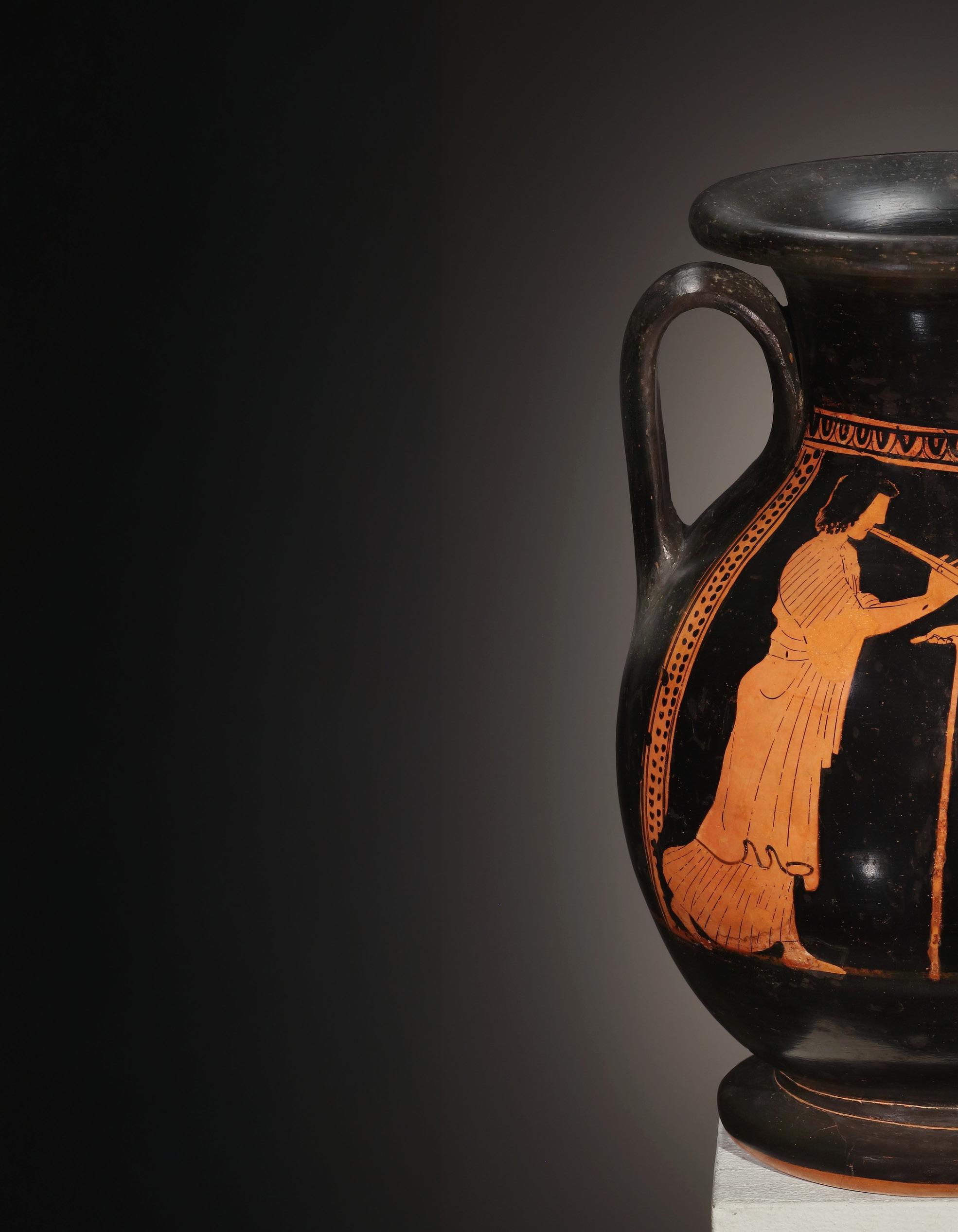
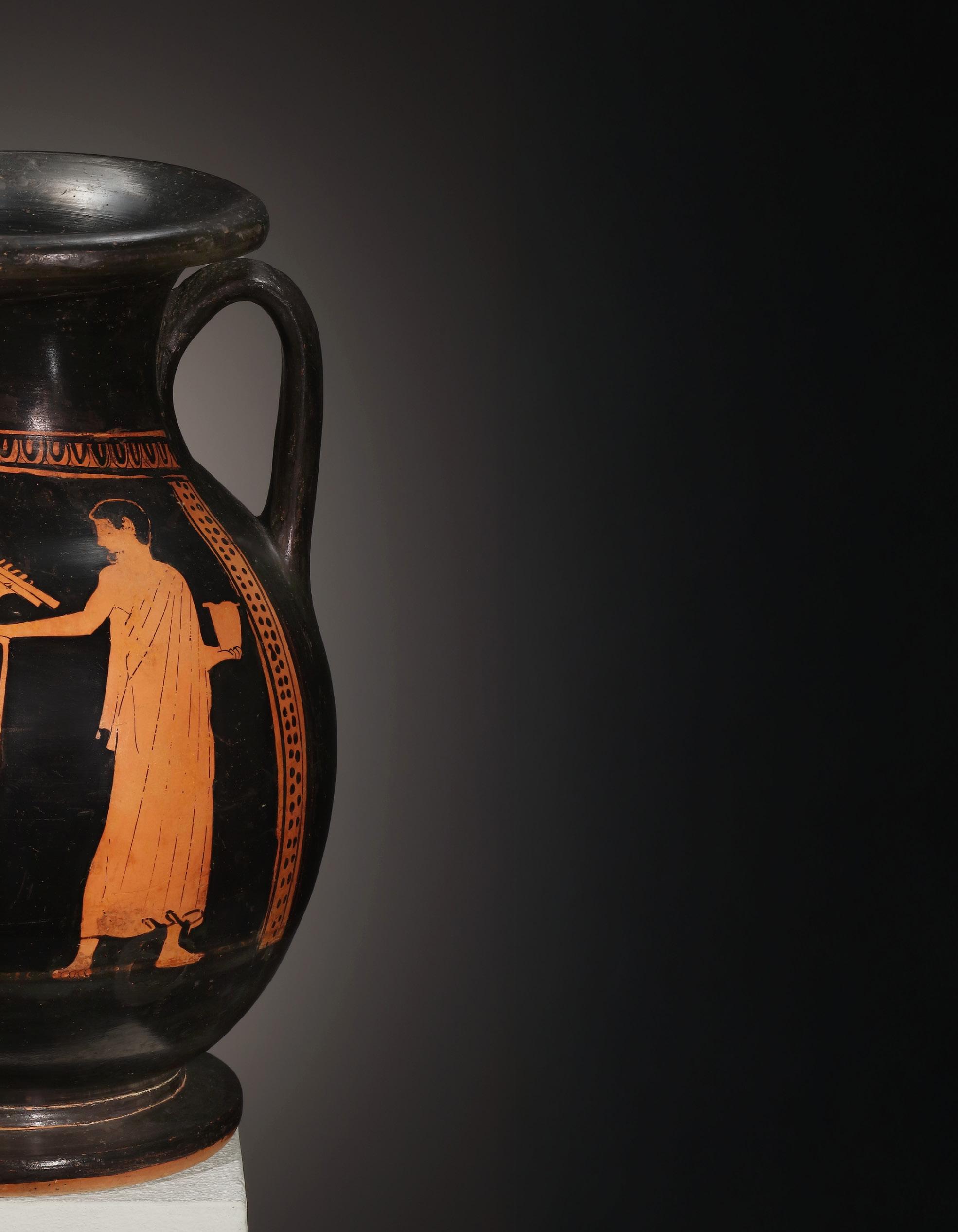
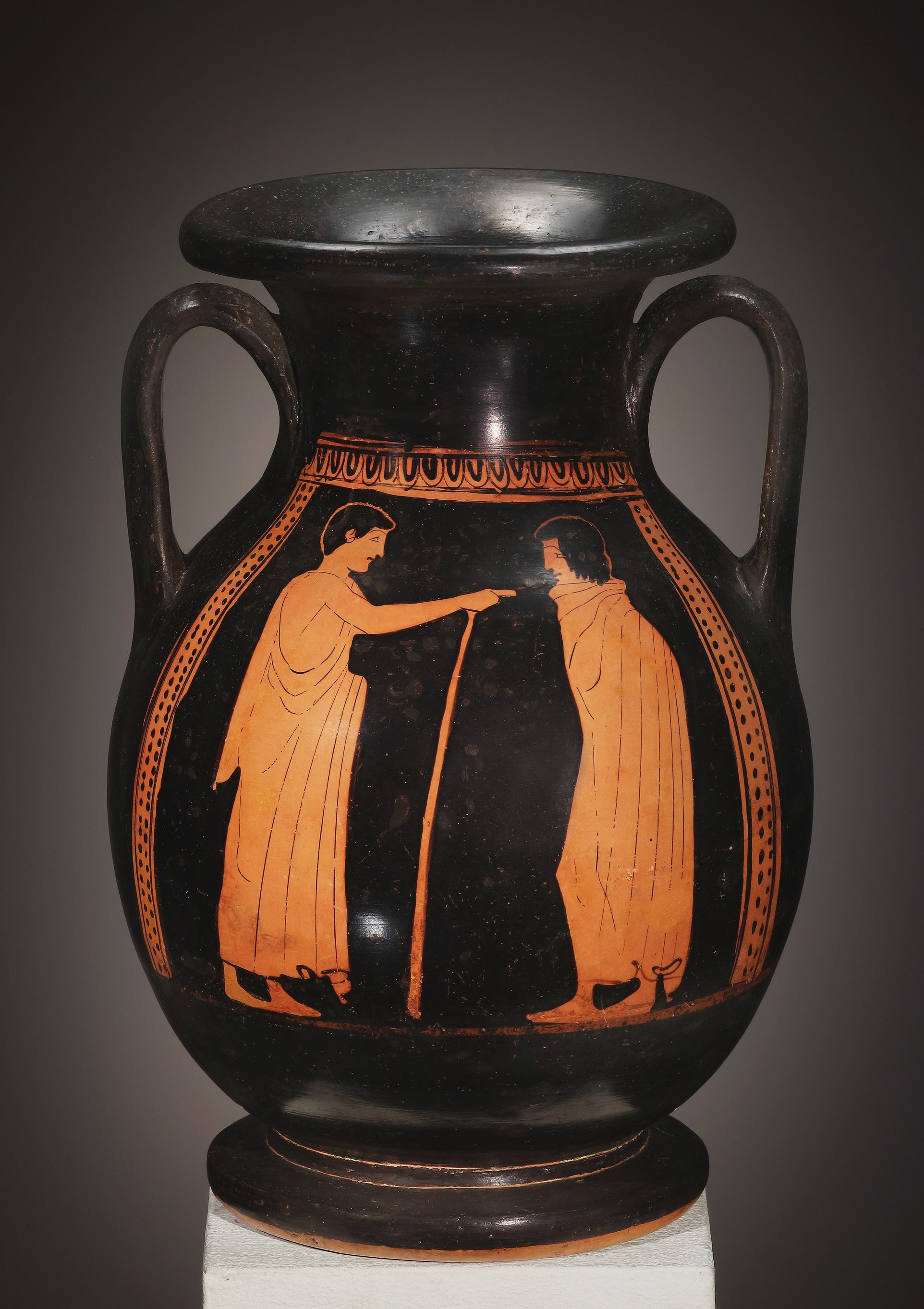
AN ATTIC RED-FIGURE PELIKE ATTRIBUTED TO THE FLORENCE PAINTER
09 | CHF 9.800
Attic | Early classical, ca. 460 B.C.
Clay | H. 30,5 cm | Diam. Rim 16,5 cm | Diam. Body 21,3 cm
A medium-sized pelike with an ovoid body on a discoid foot. Both sides are framed above by an egg-pattern band and at the sides by a double row of dots. A continuous purple line encircles the body below the scenes, serving as a ground line. On A, two mantled youth face one another. The figure on the left, with short hair, holds a staff in his right hand. His counterpart, mid-length wavy hair, is enveloped completely in his mantle. On B, a flute player, wearing a chiton and a himation draped over his left shoulder, advances left toward a bearded komast. The latter holds a staff in his left hand and a skyphos in his right, and wears a himation draped over his left shoulder. The composition is an abbreviated representation of a komos procession. The style is rather cursory, especially the ornamentation. The eyes are rendered in profile. Attractive black glaze. The interior is encrusted. Body intact with minor surface losses on side B, filled with toned plaster (the faces and the flute player‘s elbow area).
PROVENANCE
Formerly priv. coll. Erika (b. 1934 - d. 2025) and Jakob (b. 1927 - d. 2025) Binkert, Binningen, Switzerland; acquired in 1956 from Gallery Otto Markees, antiquarian,
Spalenberg, Basel. Since then in the family.
NOTE
The Florence Painter (ARV2 540-546) along with his ‚brother‘ the Boreas Painter, was a leading member of the BoreasFlorence group, which primarily produced column kraters. The pelike in question features stock figures that are highly characteristic of his repertoire and appear on many of his other works. For the shape, ornament and iconography, compare with a pelike in London, British Museum, inv. no. 1864.1007.118, BAPD 206198, ARV2 544.63. The flute player repeats the central figure of a column-krater in Paris, Musée du Louvre, inv. no. G 352, BAPD 206159, ARV2 542.29.
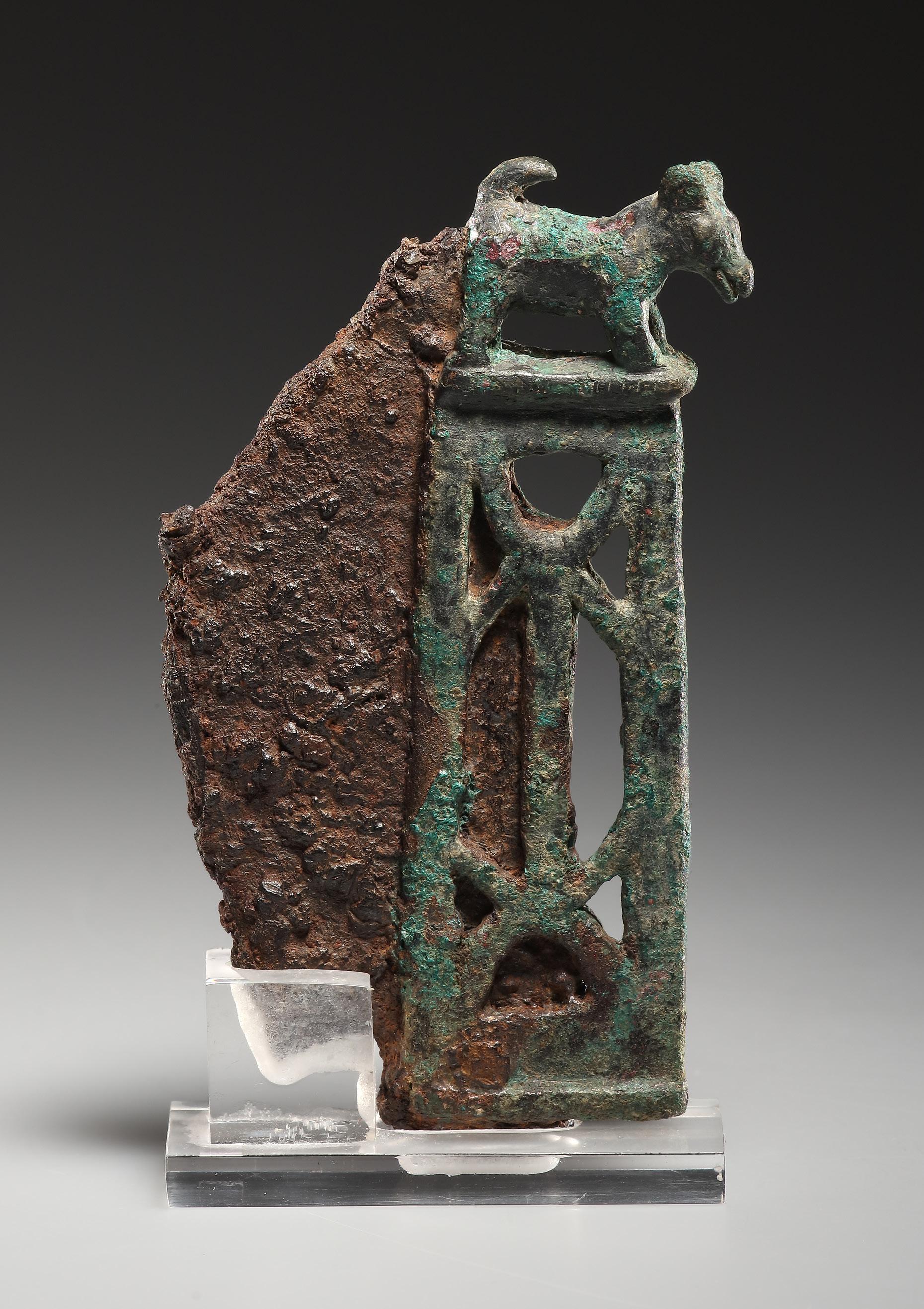
A FOLDING KNIFE WITH DOG APPLIQUE
10 | CHF 1.800
Roman | 1st - 3rd century A.D.
Bronze, iron | L. 9,1 cm | L. Handle 8,8 cm | L. Blade 8,5 cm | W. 3,0 cm
The curved iron blade is attached to the openwork bronze handle in a hinged manner by means of a rivet. The handle has a rectangular form, slightly tapering towards the top, and is surmounted by a small, fully modelled dog (possibly a Spitz) with an elongated snout rounded at the front, small erect ears, and a short, inward-curving tail. The internal ornamentation of the handle consists of a central rib terminating in two cross motifs. Blade and handle surfaces corroded. The blade is no longer movable.
PROVENANCE
Formerly priv. coll. Maxime Legrand (b. 1854 – d. 1924), lawyer, local historian, and vice-president of the Etampes City Museum.
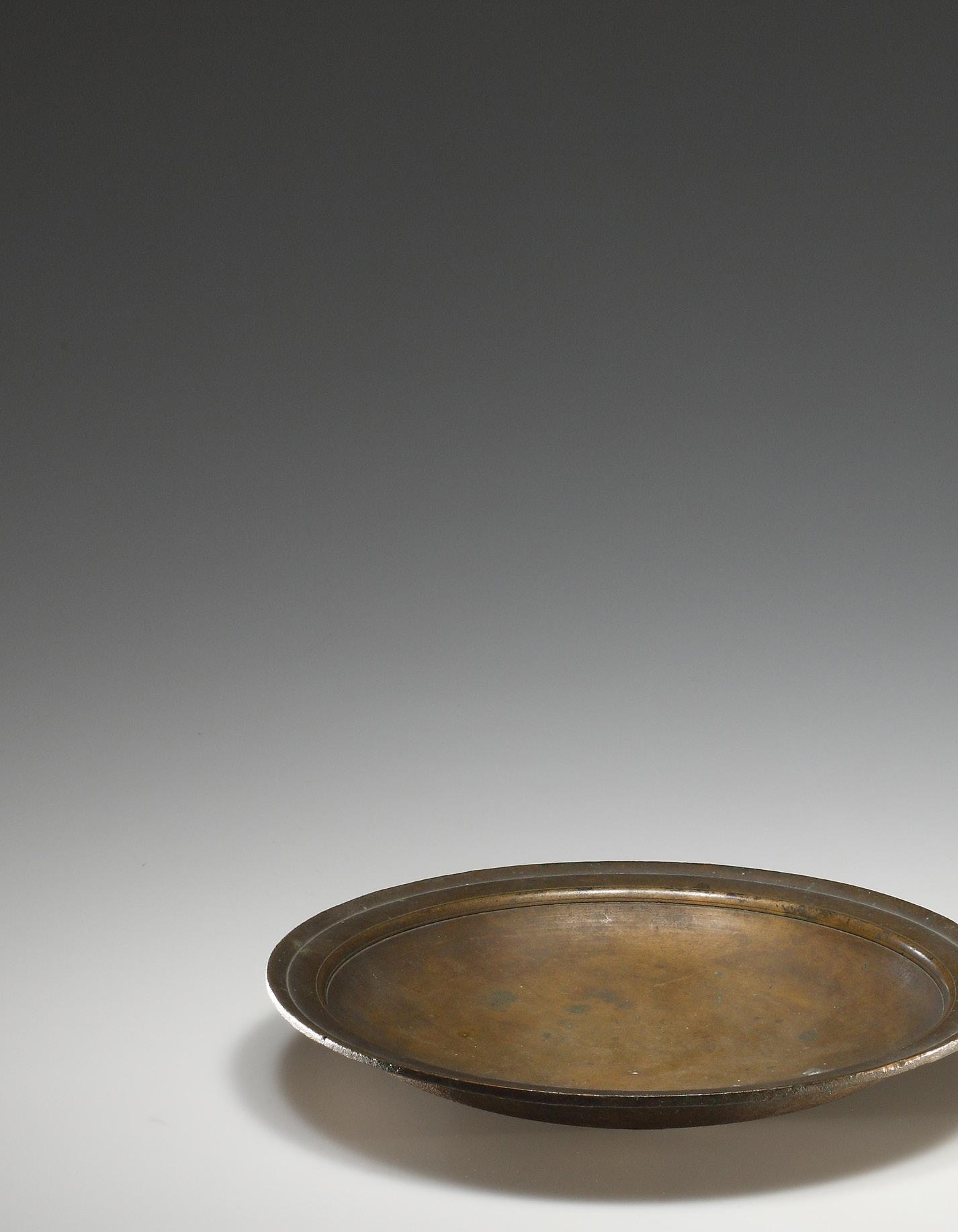
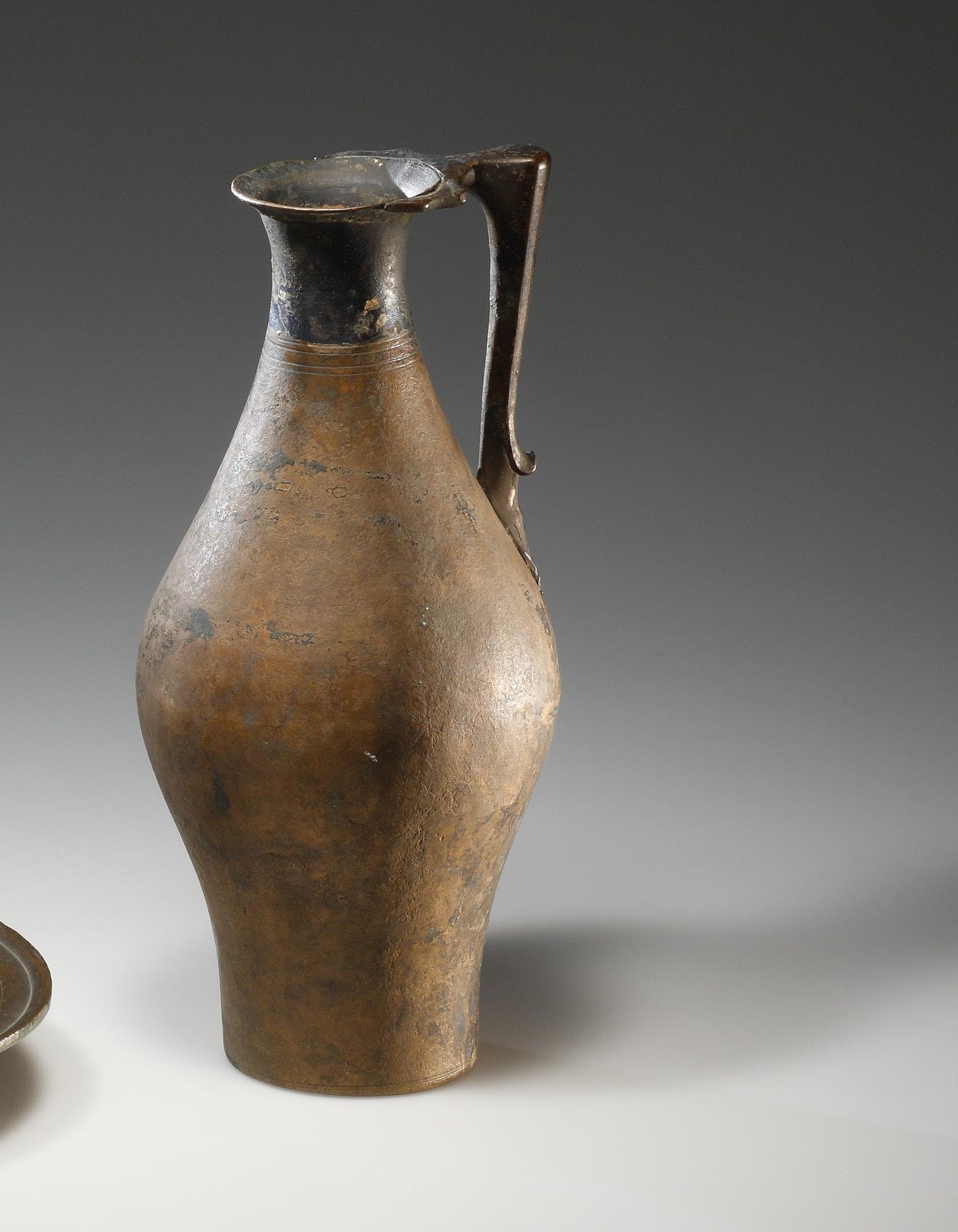
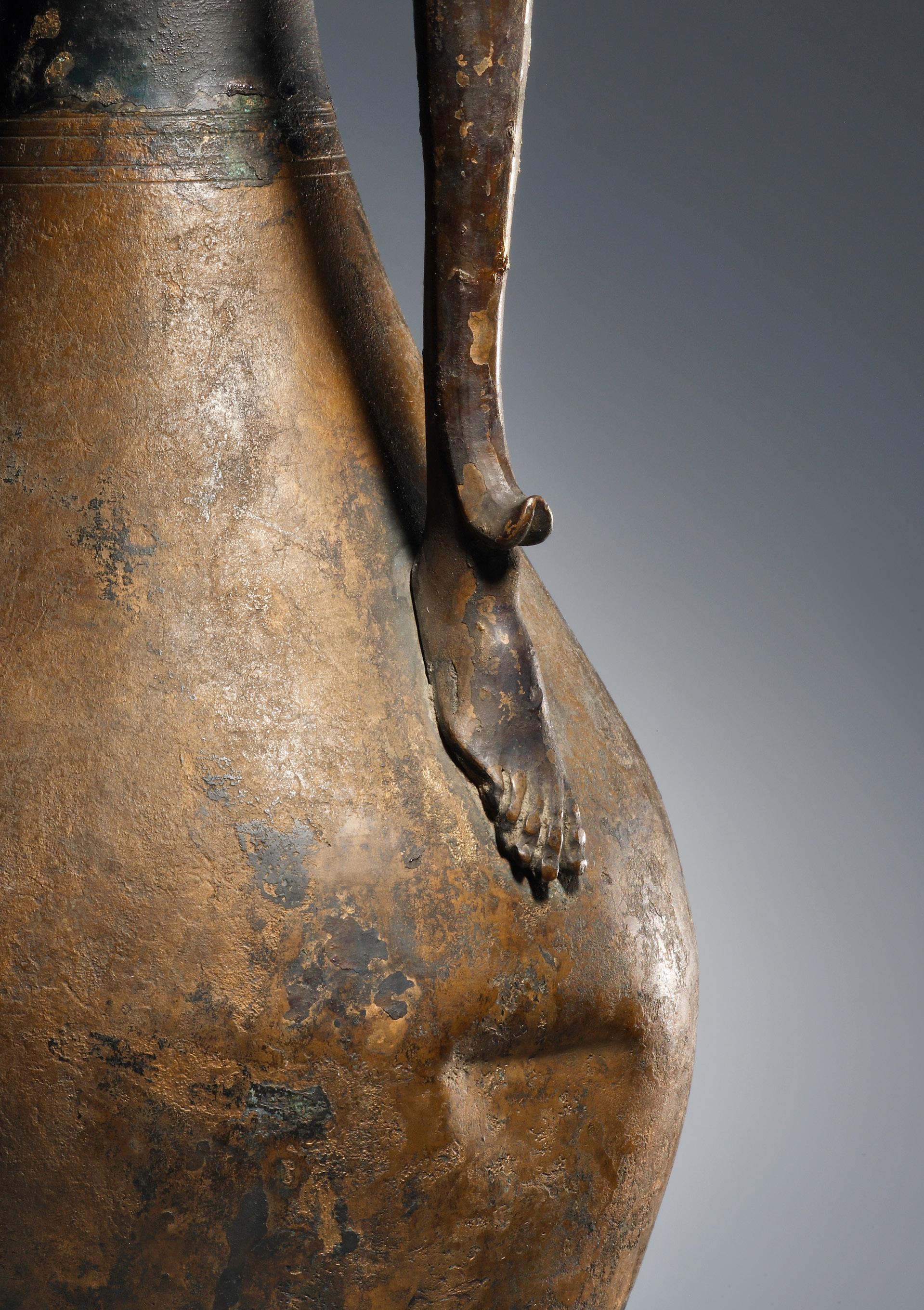
A TALL JUG AND A DEEP PLATE
11 | CHF 9.800
Roman | 2nd half of 2nd century A.D.
Bronze, iron | H. Plate 3,5 cm | Diam. Plate 22,4 cm | H. Jug 28,4 cm
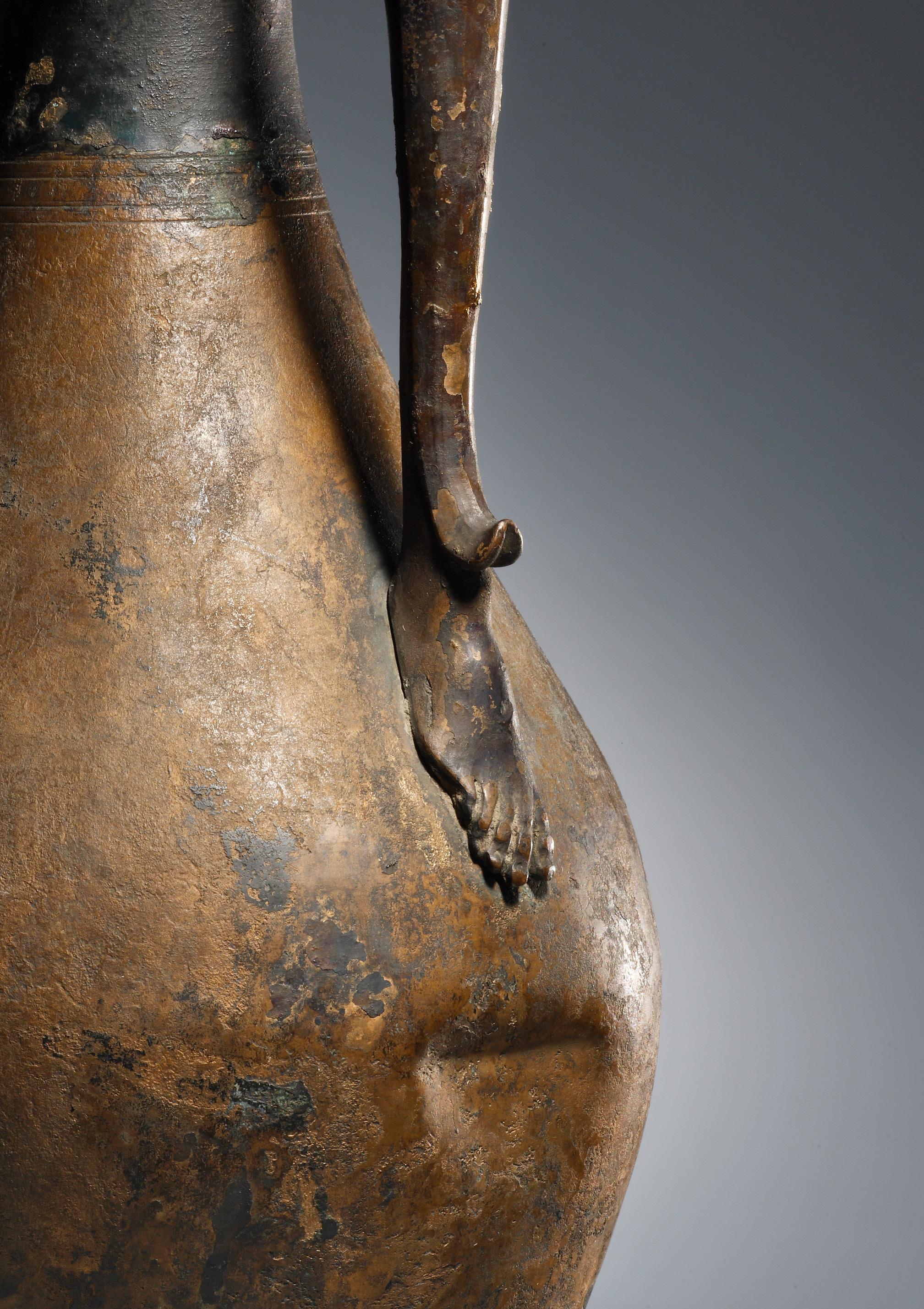
Jug: Slender vessel which widens in the middle. The rim of the everted mouth is folded outwards. A separately fashioned, right-angled handle with several edges leads from the rim to the shoulder of the jug. The lower end is adorned by an applique in the shape of a male right foot and a pointed leaf. Turning rills at the neck, foot and base. Traces of adhesive on the outside of the rim. Intact. Said to have been found in Grand (Vosges). Plate: Slightly concave wall and flat base ring. Broad rim with two turning rills which is folded outwards delicately. Set-off on the interior by a sharp bend. An inscription, probably naming the owner, on the exterior of the rim: FLAVI. Below it, old label: „SS6 FLAVI“. Below it, the number „SS6“ is written in a modern hand in pencil. An ancient repair within the ring base. Otherwise undamaged.
NOTE
For the jug: nearly identical Roman tableware, Cat. Frankfurt a. Main (1977) 12ff. with illus.; G. Faider-Feytmans, Les Bronzes Romains de Belgique (1979) 186f., no. 385 pl. 164f. For the dish: S. Boucher-S. Tassinari, Bronzes Antiques du Musée de la Civilisation Gallo-Romaine à Lyon, Vol. 1, Cat. Lyon (1976) 133, no. 161 with illus.
PROVENANCE
Formerly priv. coll. Louis-Gabriel Bellon (1819-1899), Paris. With Jack Philippe Ruellan, auction, Paris, 4.4.2009, lot 278. Old collection label on the underside of the plate with handwritten note „955 FLAVI“.
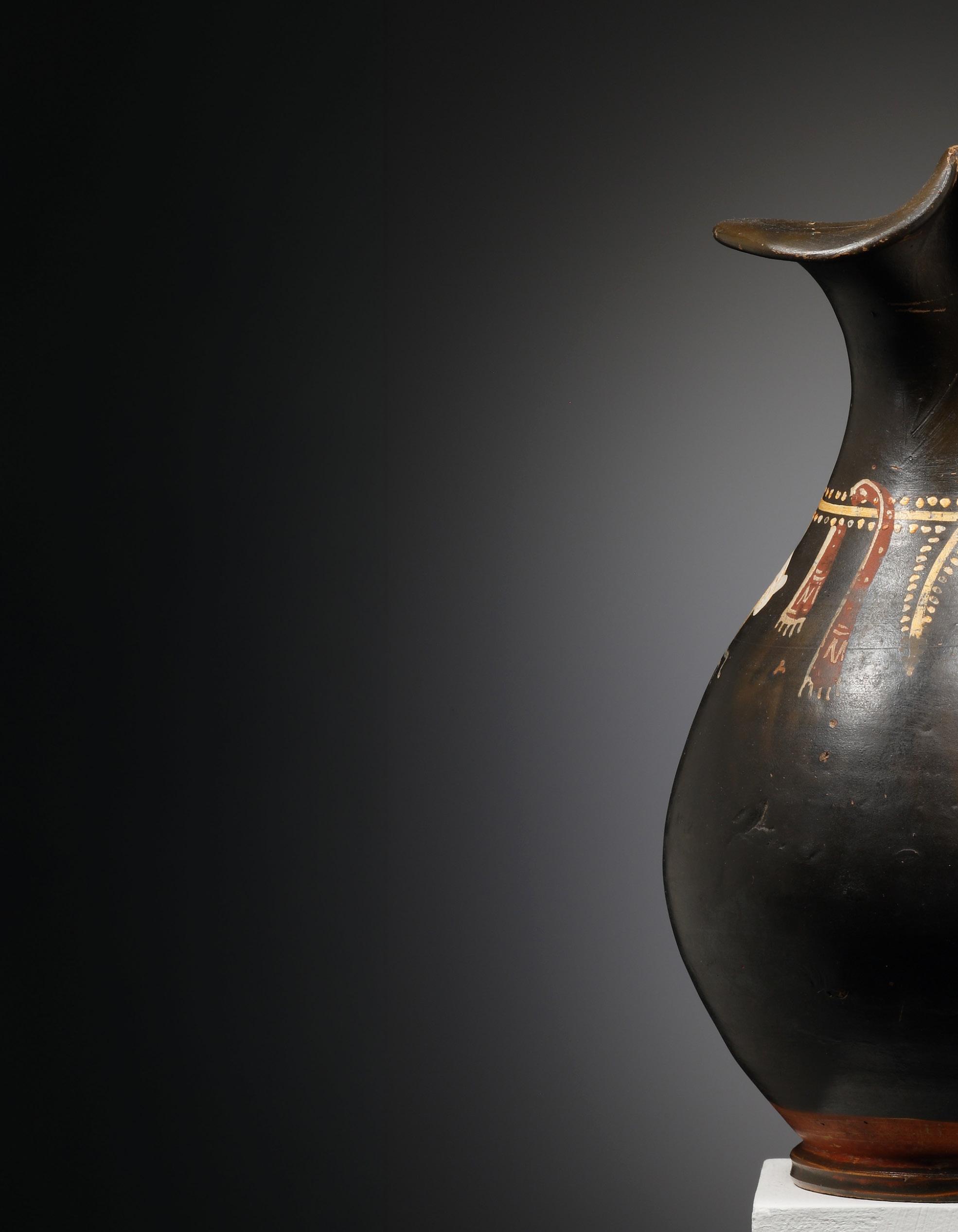
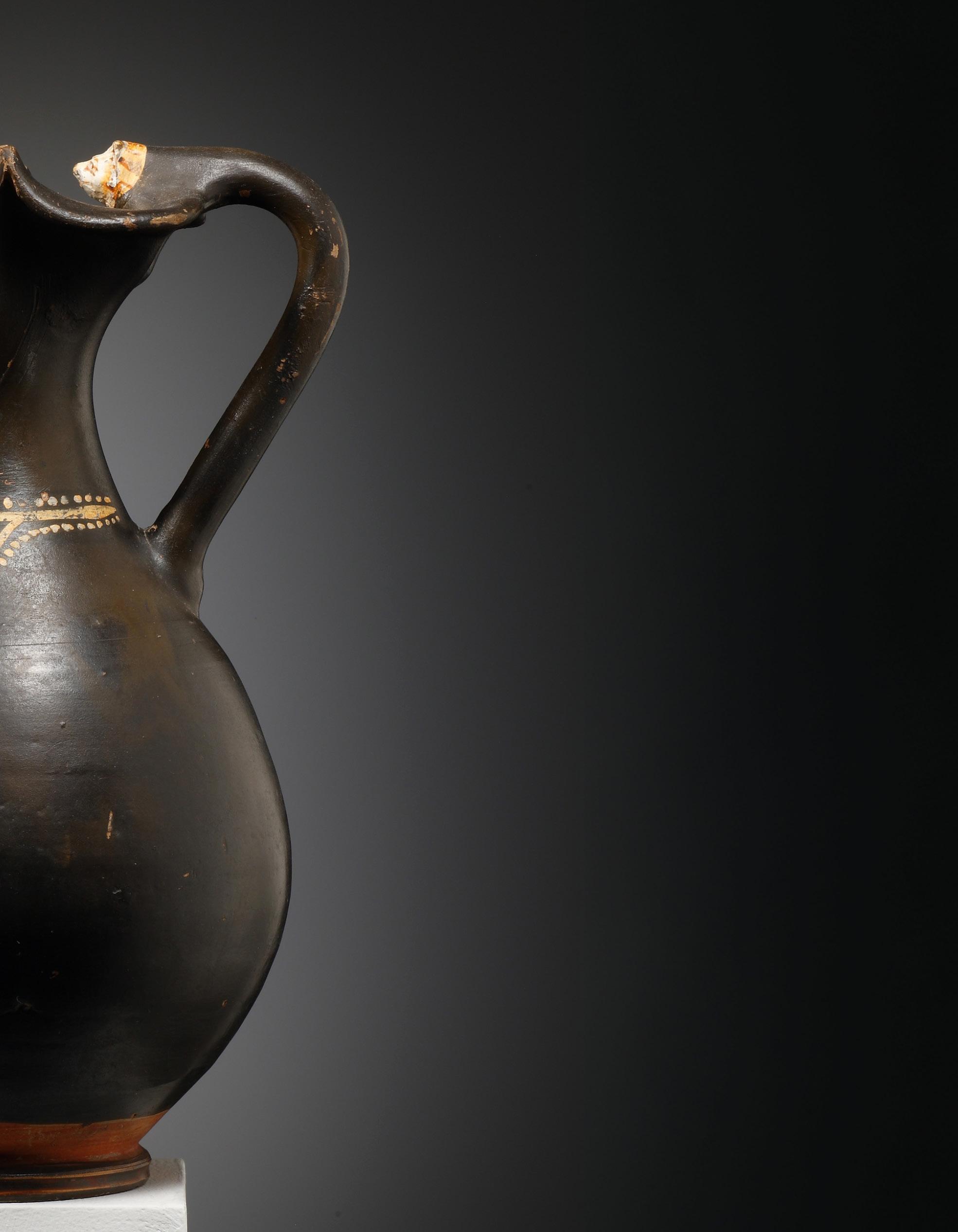
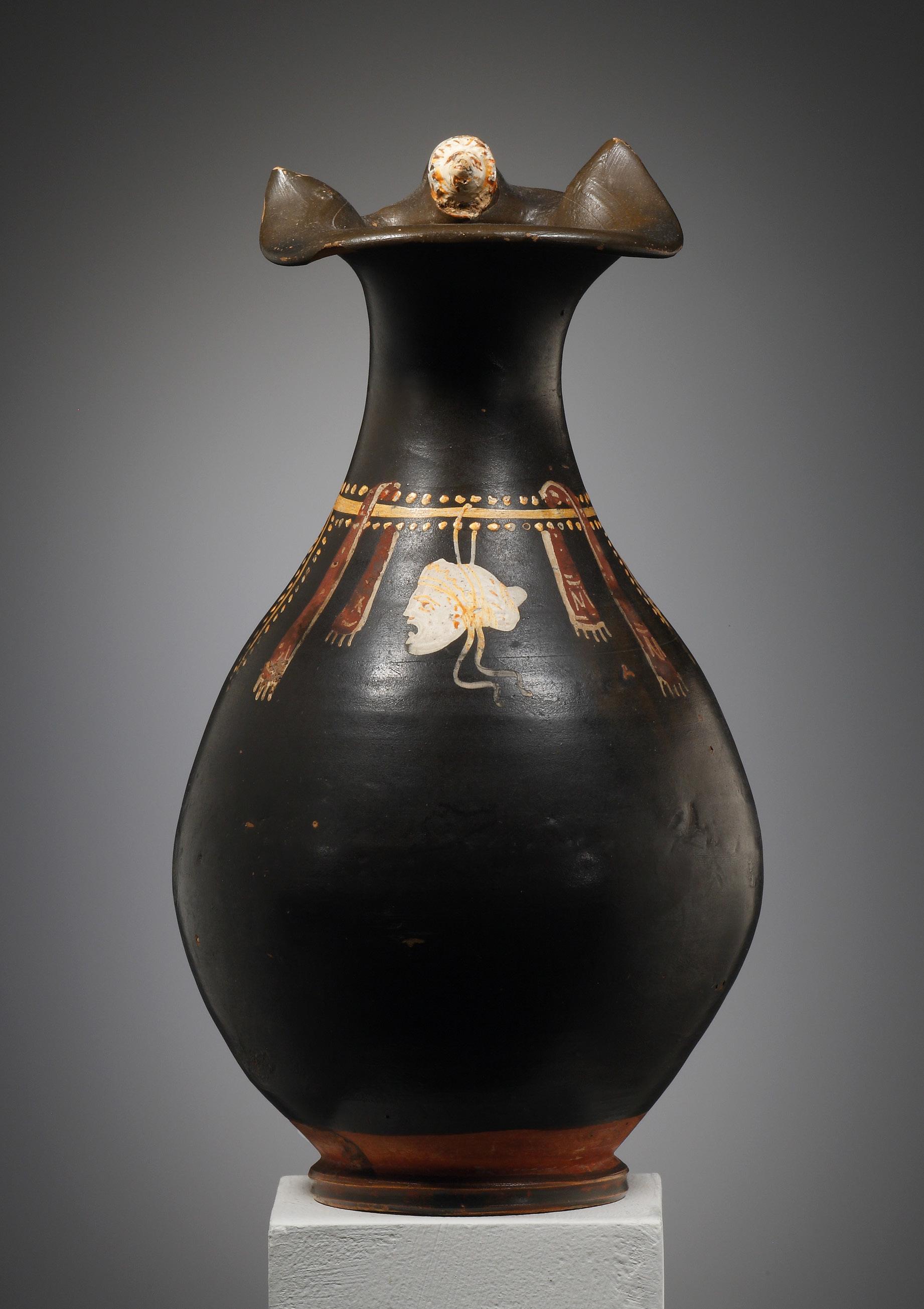
AN OINOCHOE WITH LION‘S HEAD APPLIQUE
12 | CHF 8.800
Westerm Greek | Apulian, Last quarter of 4th century B.C. Clay, black glaze, red, white and yellow paint | H. 21,7 cm | Diam. Body 11,5 cm
A pear-shaped, black-glazed oinochoe of type 3, with trefoil mouth much pinchedin, and flat, profiled ring foot. The neck is adorned by a white-yellow tendril from which a female theatre mask, red fillets and whiteyellow twigs are suspended. The transition of the handle to the rim is enlivened by a plastic, polychrome lion‘s head applique. A reddish, reserved band above the foot. Paint abraded in places. Mouth slightly worn.
PROVENANCE
Formerly Coll. Alphonse Raifé (1802-1860).
Published: F. Lenormant, Description des antiquités, égyptiennes, babyloniennes, assyriennes, mèdes, perses, phéniciennes, grecques, romaines, étrusques et américaines composant la collection de feu M. A. Raifé, Paris, 1867, 181, no. 1420 (old collection label on the underside of the vase). Thereafter Paris priv. coll., acquired 1990.
NOTE
For the shape and decoration, cf. L. Forti, La Ceramica di Gnathia (Naples1965) pl. 1 c-d; Metropolitan Museum New York, inv. no. 76.12.8.
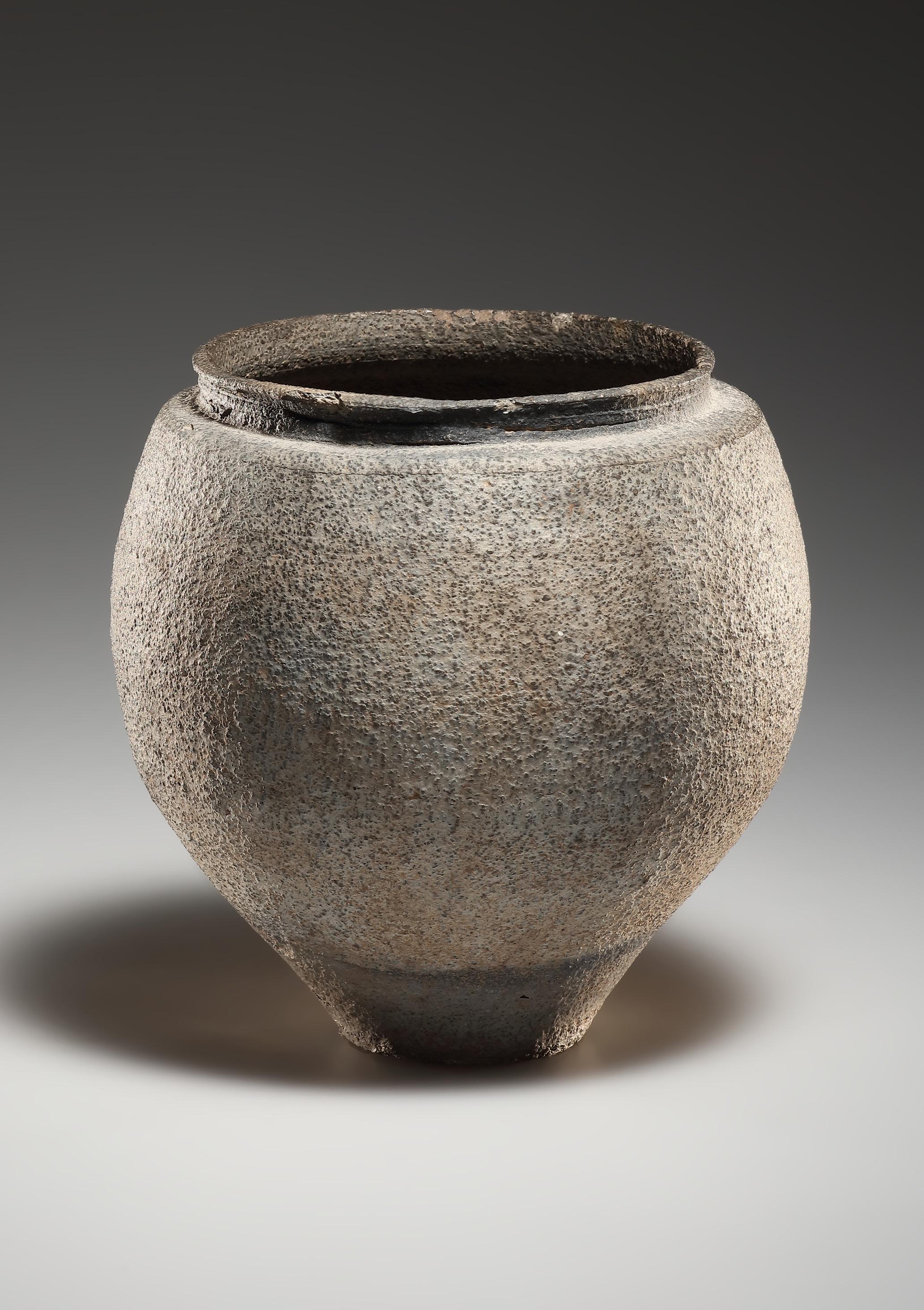
AN OVOID CUP
13 | CHF 800
Roman | 2nd - 3rd century A.D.
Clay | H. 10,9 cm
Elegantly curved cup with foot and bulbous body. Almost horizontal shoulder. The wide mouth is offset and has a slightly everted lip. Made on the potter‘s wheel. The rim of the mouth slightly worn, otherwise intact.
PROVENANCE
Formerly priv. coll. Dr. Frank Hieronymus (b.1930 - d. 2022), Basel, classical philologist, prior 2000.
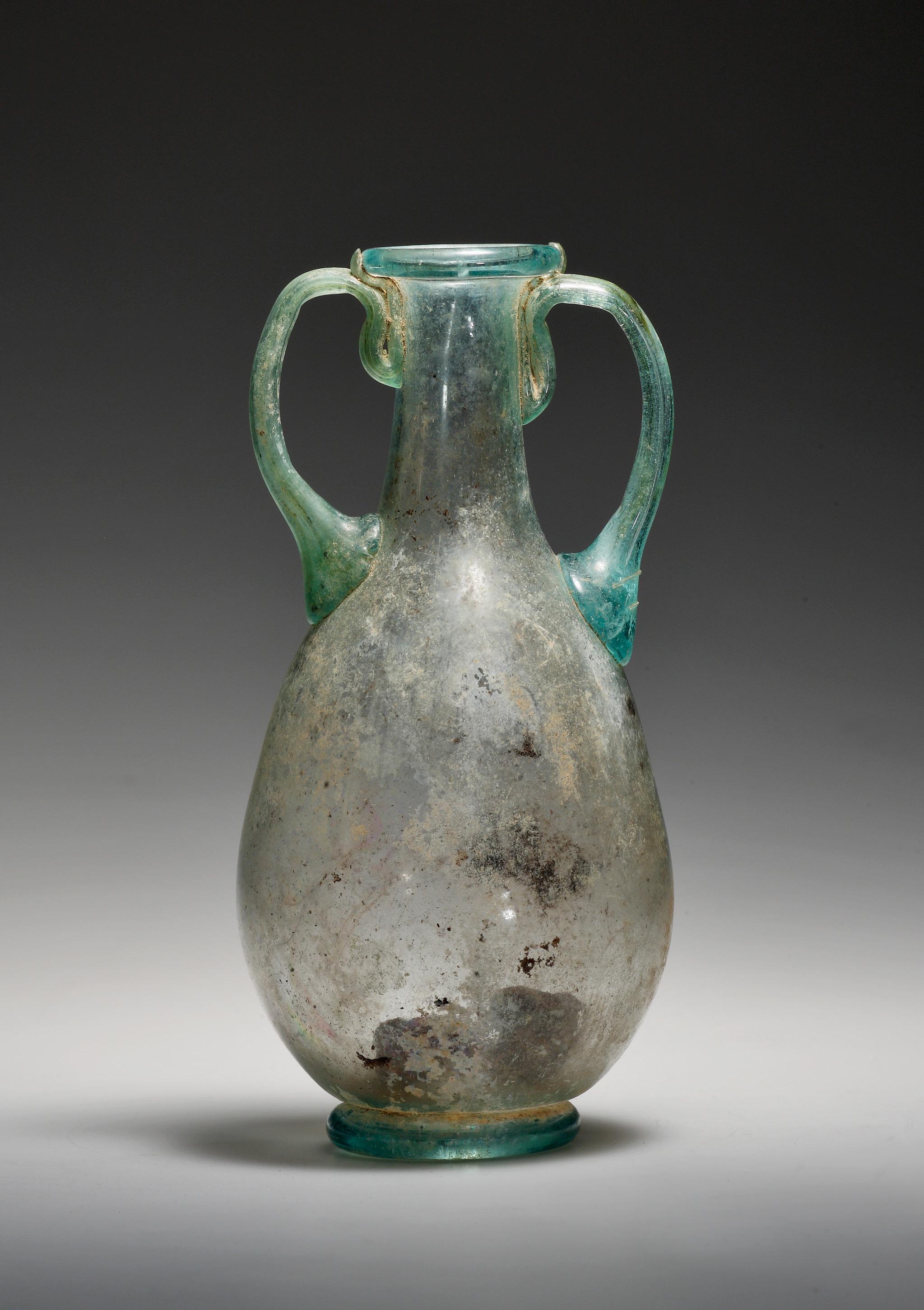
AN AMPHORISKOS
14 | CHF 4.600
Roman | 1st - 3rd century A.D.
Greenish, translucent glass | H. 14,9 cm | Diam. Body 7,0 cm
The piriform body stands on a broad ring and transitions smoothly into the cylindrical neck. The thickened, everted lip is folded inwards. Both lateral handles begin at the lip, briefly run down along the sides of the neck and then arch upwards before descending to the shoulder. Pushed up base. Organic material in the interior, possibly traces of the stopper. Iridescent. Intact.
PROVENANCE
Formerly priv. coll. Selim Dere, New Jersey, USA, acquired around 1997 from a German collector.
NOTE
For the shape cf. C. Isings, Roman glass from dated finds (Groningen 1957) 32-34, form 15.
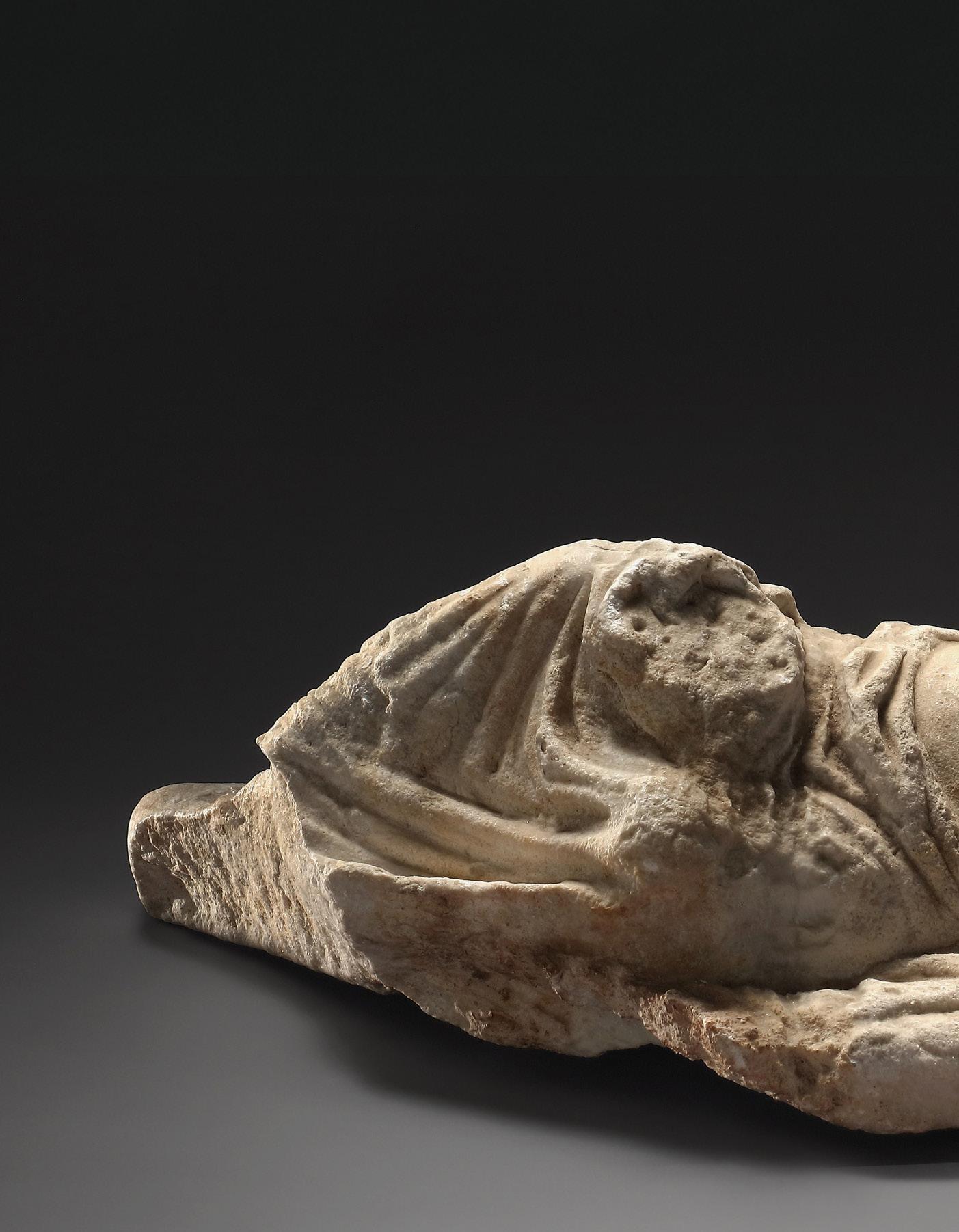
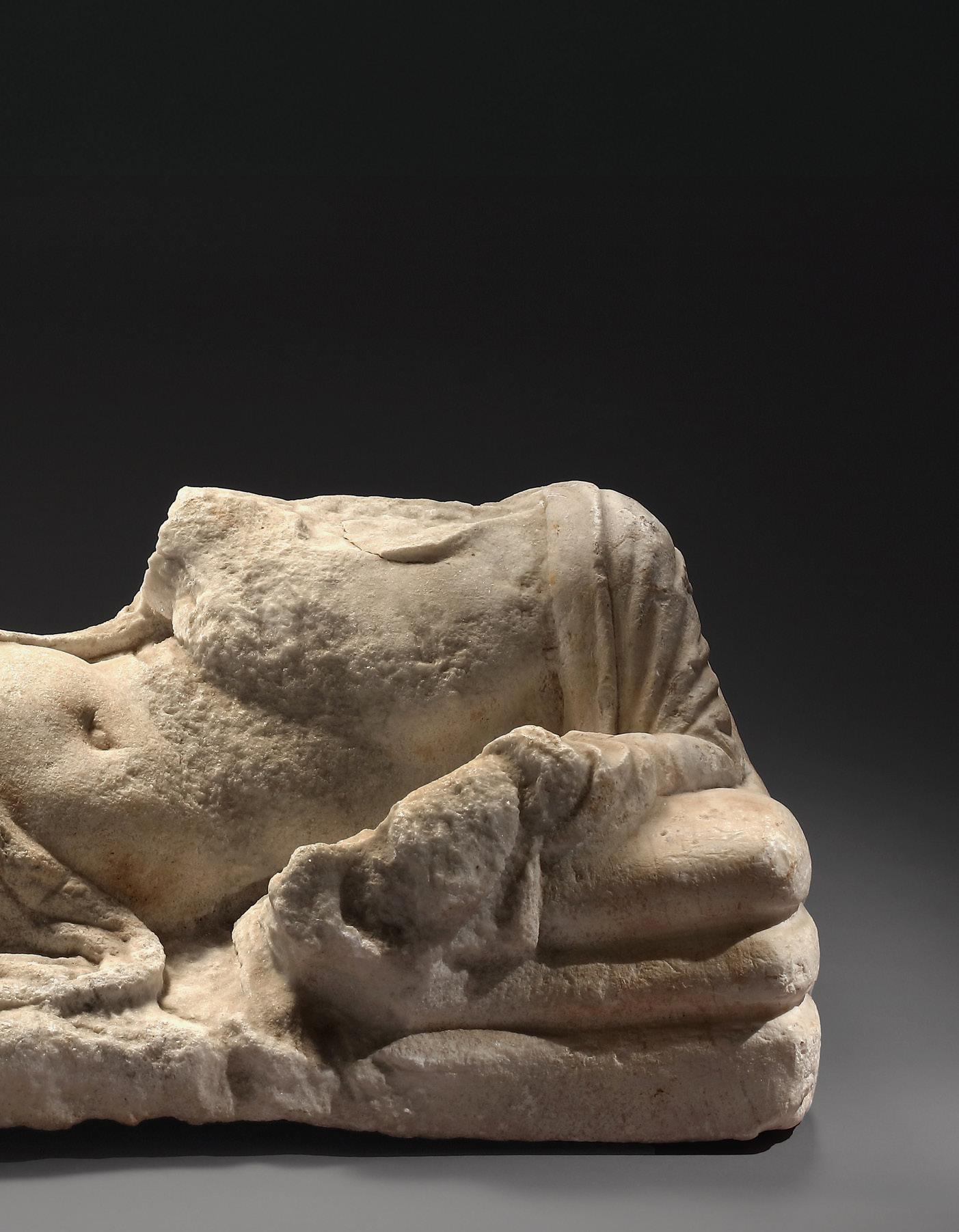
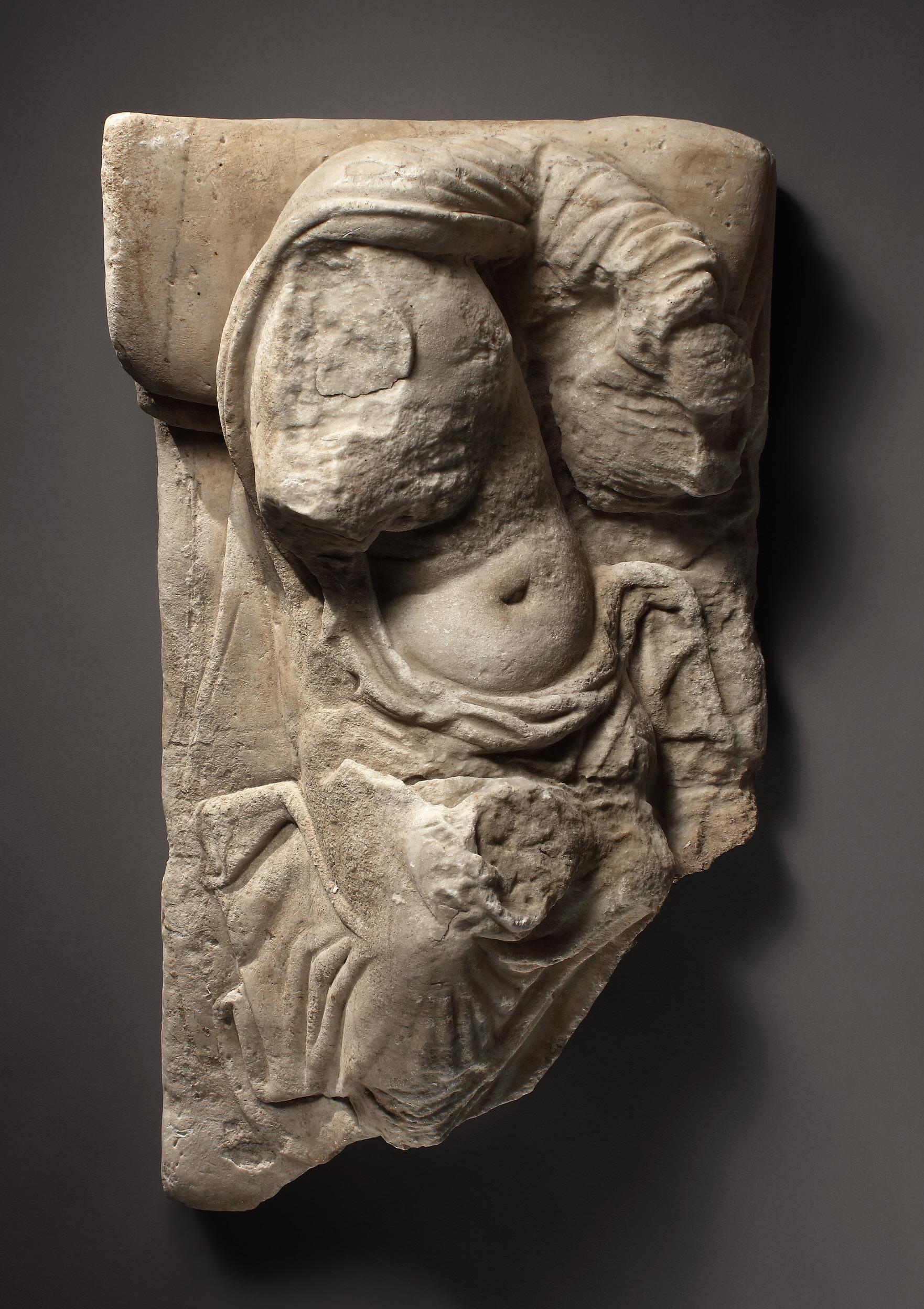
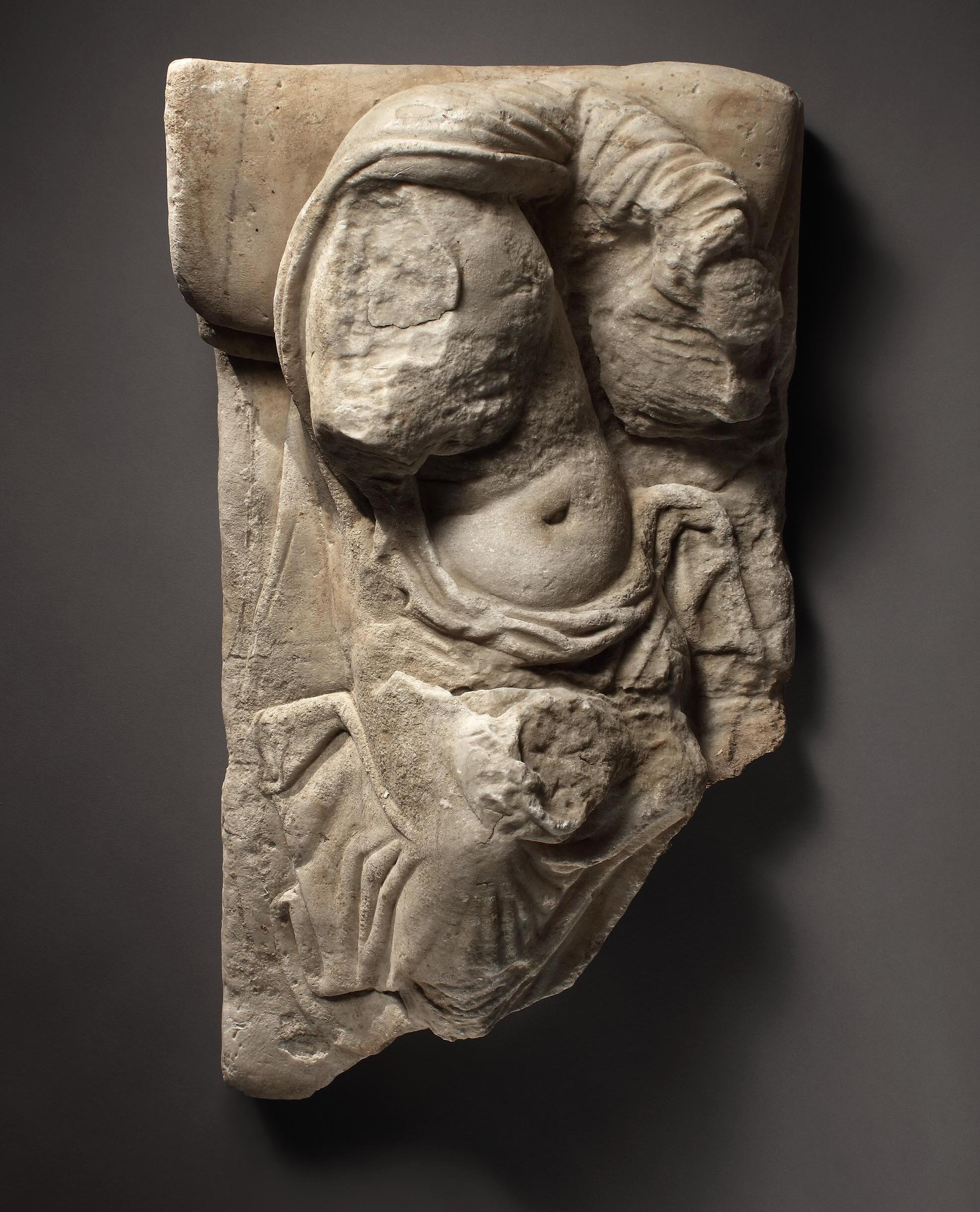
A LID OF A CINERARY URN WITH RECLINING MAN
15 | CHF 16.000
Hellenistic to Early Imperial | 2nd century B.C. - 1st century A.D.
The deceased is shown reclining on his left side, supporting himself on his left elbow on two cushions at the head end of the kline. He is about to straighten up and turns towards the spectator. His right hand, resting on his knee, holds a phiale decorated on the inside. The mantle is wrapped around the hips, covers much of the back, and falls over the left shoulder, enveloping the entire left arm down to the wrist. The broad chest with pronounced nipples and the slightly stocky abdomen are left exposed and are thereby effectively highlighted. The edges of the mantle lie on the kline with a skilfully arranged drapery of folds. The actual urn chest is lost. The practice of depicting the deceased as a reclining lid figure is characteristic of Etruscan ash urns made of limestone, alabaster, tuff, or terracotta during the Hellenistic period (especially in Volterra and Chiusi). It continues in Roman Imperial-period kline monuments, which mostly served as sarcophagus lids. The representation references the symposium, a ritualised banquet common in aristocratic circles, which in funerary contexts is also associated with the funerary banquet (cf. the so-called banquet reliefs) and commemorative ceremonies at the tomb. Head with neck, right arm, and the front
right corner of the kline missing. Minor surface chipping in places.
PROVENANCE
Formerly priv. coll. C. A., Genève, collected between 1961 and 2000. Thereafter Marcucci Umberto; acquired from Cahn Auktionen AG, Basel, Auction 3, 19.09.2008, lot 128.

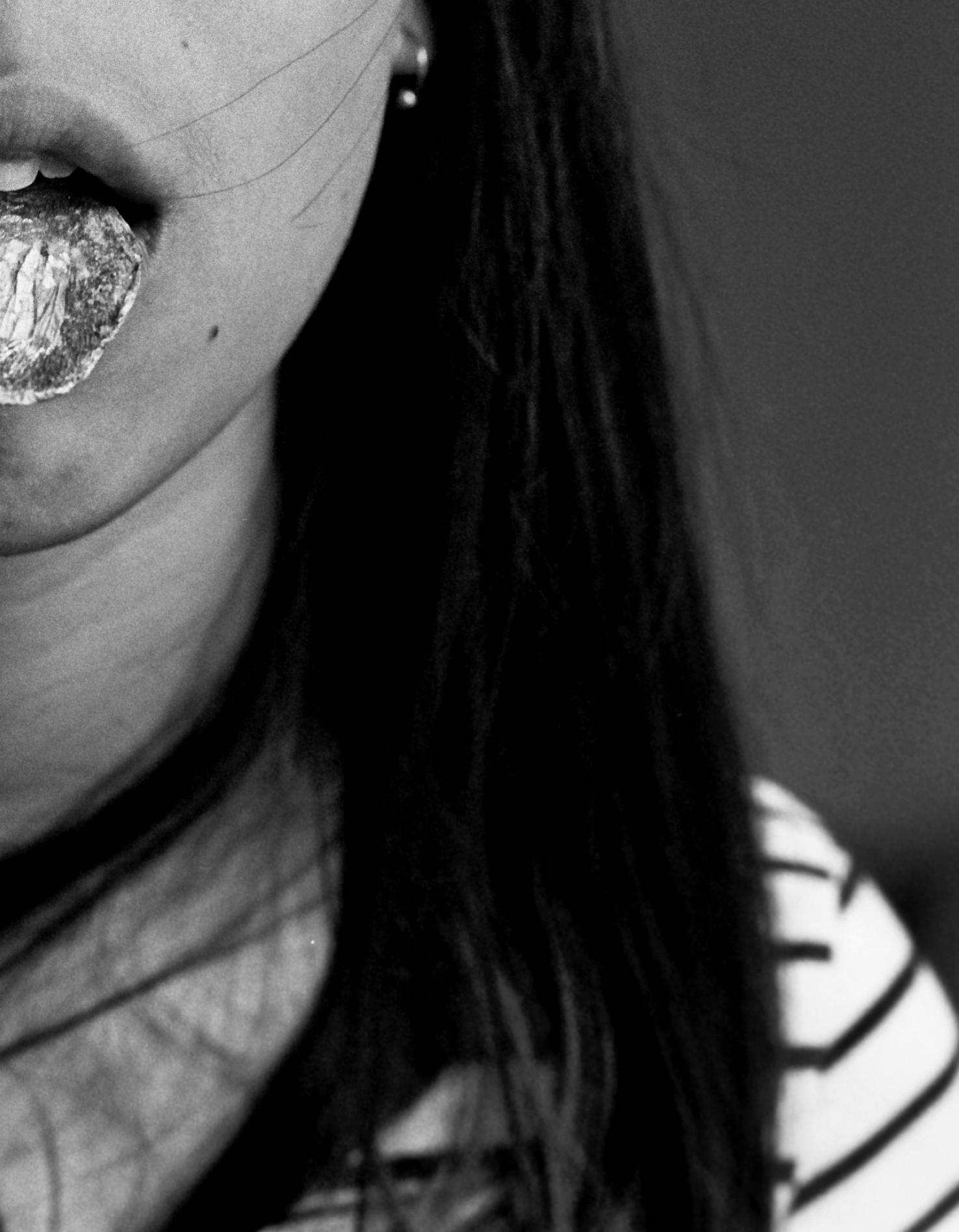
Katinka Bock, Toxic, 2018, Silver gelatin print, 30.0 x 41.0 cm, Ed. 4/4 + 2 A.P.
CONDITIONS OF SALE
September 2025
Place of Execution is Basel
1) Jean-David Cahn AG (hereafter „the Seller“) hereby confirms that it has the right of disposal over the objects for sale according to Art. 18 KGTG. Any further warranty is excluded.
2) The specifications and descriptions given in this catalog are provided in good faith. Nevertheless, their accuracy cannot be guaranteed.
3) The seller guarantees that the sales objects were made in Antiquity. This guarantee, which is granted to the buyer only, is valid for two years after the conclusion of the sales contract.
4) The objects are sold in the condition they were in at the time of the sale („sold as seen“). Complaints regarding the authenticity of a piece (subject to lit. 3) shall be communicated to the Seller in writing at its domicile (Jean-David Cahn, Malzgasse 23, P.O. Box 217, 4010 Basel) upon detection and at the last two years after the conclusion of the sales contract. Other substantiated complaints shall be communicated to the Seller in writing at its domicile, as above, within 14 days of receipt, and at least three months after the conclusion of the sales contract. Any
complaints made later cannot be considered further. All liability for any loss or damage sustained during transportation is excluded. Insurance during transportation is the Buyer‘s responsibility.
5) The delivery and storage of sold objects shall be at the Buyer‘s risk and expense (costs arising from storage, packaging and transportation, any additional costs and expenses, all plus VATs) unless otherwise agreed in writing.
6) Foreign and Swiss customs, duty and shipment shall be borne by the Buyer. Declaration fees for the import into the EU are borne by the Seller if used through the services provided by the Seller. It is the responsibility of the Buyer to comply with foreign and Swiss customs and foreign exchange regulations and to obtain an EU import license through the services of the Seller. The Buyer is aware of the relevant import and export regulations of the EU and has consulted the website of the Swiss Federal Office of Culture Bern (www. bak.admin.ch/kgt) for details of the Swiss import and export regulations currently in force, as well as further provisions. The Seller declines all responsibility for any consequences arising from the
contravention of such regulations. The Buyer acknowledges that a valid import permit is required for the importation of the artworks transferred under this purchase invoice into the European Union. If such a permit is not available at the time of purchase, the approval process may take between four to six months. The registration and execution of the import procedure will be carried out by an art shipping agent appointed by the Seller within the EU. The Seller will organize this process in the name and on behalf of the Buyer. The Buyer is required to conduct the import procedure through the shipping agent designated by the Seller. Alternatives are the responsibility of the Buyers.
7) The Buyer is personally liable for all acquisitions made; he/she cannot claim to be acting for a third party or person. If a person acts as a representative, written proof of authorization may be requested; the Buyer as well as his/her representative can both be held jointly and severally liable for the purchase and for all other costs. The Buyer shall be liable for any damages caused by delayed payments, in particular for exchange rate and interest losses. Payments by cheque or by the internet shall be deemed to have been received only on clearance by the relevant bank.
8) Payment shall be due upon the conclusion of contract, but at the latest 30 days after the invoice is issued. Interest of 1.5% per month will be charged for payments made after 30 days. Payments can be made in cash, by bank transfer or by cheque. The Seller may ask for proof of creditworthiness. Title shall be transferred only upon receipt of payment in full; all risks, however, shall pass to the Buyer
upon conclusion of the sales contract.
9) If payment is delayed, the Seller can, after giving the Buyer due notice, withdraw from the contract forthwith. This also applies in cases where the object has already been transferred to the Buyer‘s possession at the Buyer‘s cost. The object in such a case must be handed back to the Seller upon request. Additionally, the Seller may claim further damages.
10) If the Buyer does not collect the object, the Seller can choose either to cancel the contract after 30 days and to claim compensation or to store the object at the Buyer‘s expense and to demand that the Buyer collects it.
11) All Sales are transacted in Basel, Switzerland, which is therefore the Place of Fulfillment and the court of jurisdiction The conclusion of contract, the quotation and the negotiations are subject to Swiss law, exclusive of the United Nations Convention on Contracts for the International Sale of Goods (CISG). By buying, the Buyer recognizes the exclusive right of the court of Canton Basel-Stadt, Switzerland, and of its jurisdiction. All sales are subject to Swiss jurisdiction. All parties recognize the exclusive choice of Swiss jurisdiction for the settlement of any matters arising from the conclusion of the sales contract.
12) All purchases and deliveries are performed solely on the basis of these conditions of sale. Any references by the Buyer to his/her terms and conditions are herewith expressly excluded.
13) Should individual provisions become fully or partially void after the conclusion of contract due to changes in the law, the validity of the remaining provisions and of the contract shall remain unaffected. The invalid provision shall be replaced by that provision which is closest in meaning and intention to the original provision.
14) The Buyer accepts the condition of the sales as above. He/She explicitly accepts the exclusive right of the courts of Basel-Stadt, Switzerland, and their jurisdiction, exclusive of the United Nations Convention on Contracts for the International Sale of Goods (CISG), over the quotation, the negotiations, and the sale.
15) The conditions of sale are provided in German and English, the German version being the definitive and legally binding one in the event of any disputes.
GENERAL ABBREVIATIONS
Beazley Archive Pottery Database
Deutsches Archäologisches Institut
H.A.C. KAM
Herbert A. Cahn (1988 - 1999)
Schweizerische Kunst und Antiquitätenmesse
Lexicon Iconographicum Mythologiae Classicae
Münzen und Medaillen AG, Basel (1943 - 1988) BAPD DAI
LIMC MuM
IMPRINT
Texts
Design
Translation
Photos
Dr. Ulrike Haase, Joffrey Nogrette, Charlotte Chauvier
Jonas Hernegger, Jean-David Cahn
Yvonne Yiu
Niklaus Bürgin, Galerie Jocelyn Wolff
Packaging, insurance and transport are at the expense of the purchaser. All prices in CHF net for export.

Galerie Cahn | Malzgasse 23 | CH-4052 Basel