Packaging, insurance and transport are at the expense of the purchaser. All prices in CHF net for export.
Dr. Ulrike Haase
ulrike.haase@cahn.ch
Tel: +41 61 561 67 04
Joffrey Nogrette joffrey.nogrette@cahn.ch
Tel: +41 61 561 67 00
Charlotte Chauvier charlotte.chauvier@cahn.ch
Tel: +41 61 561 67 02
Galerie Cahn
www.cahn.ch
Tel: +41 61 561 67 55
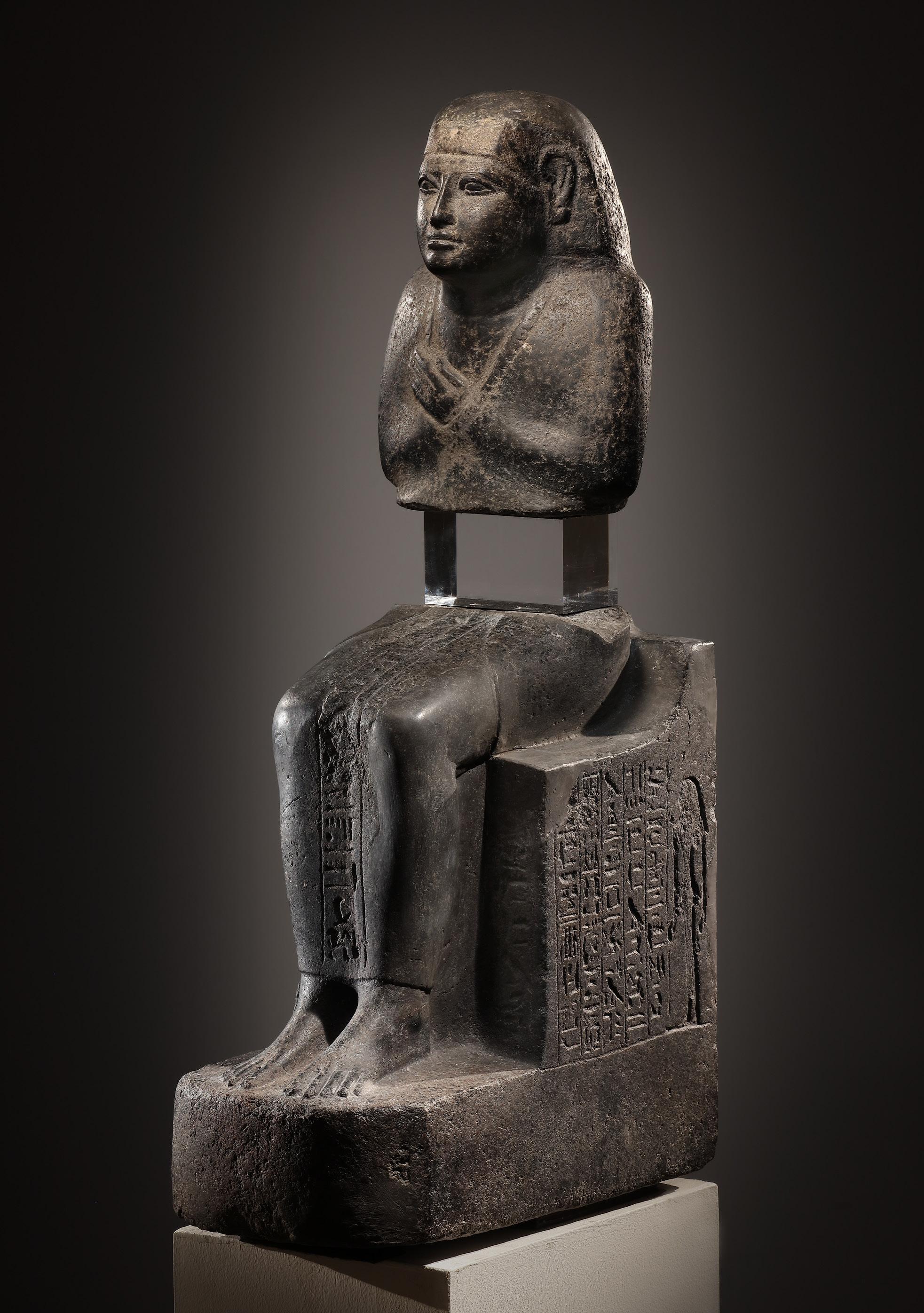
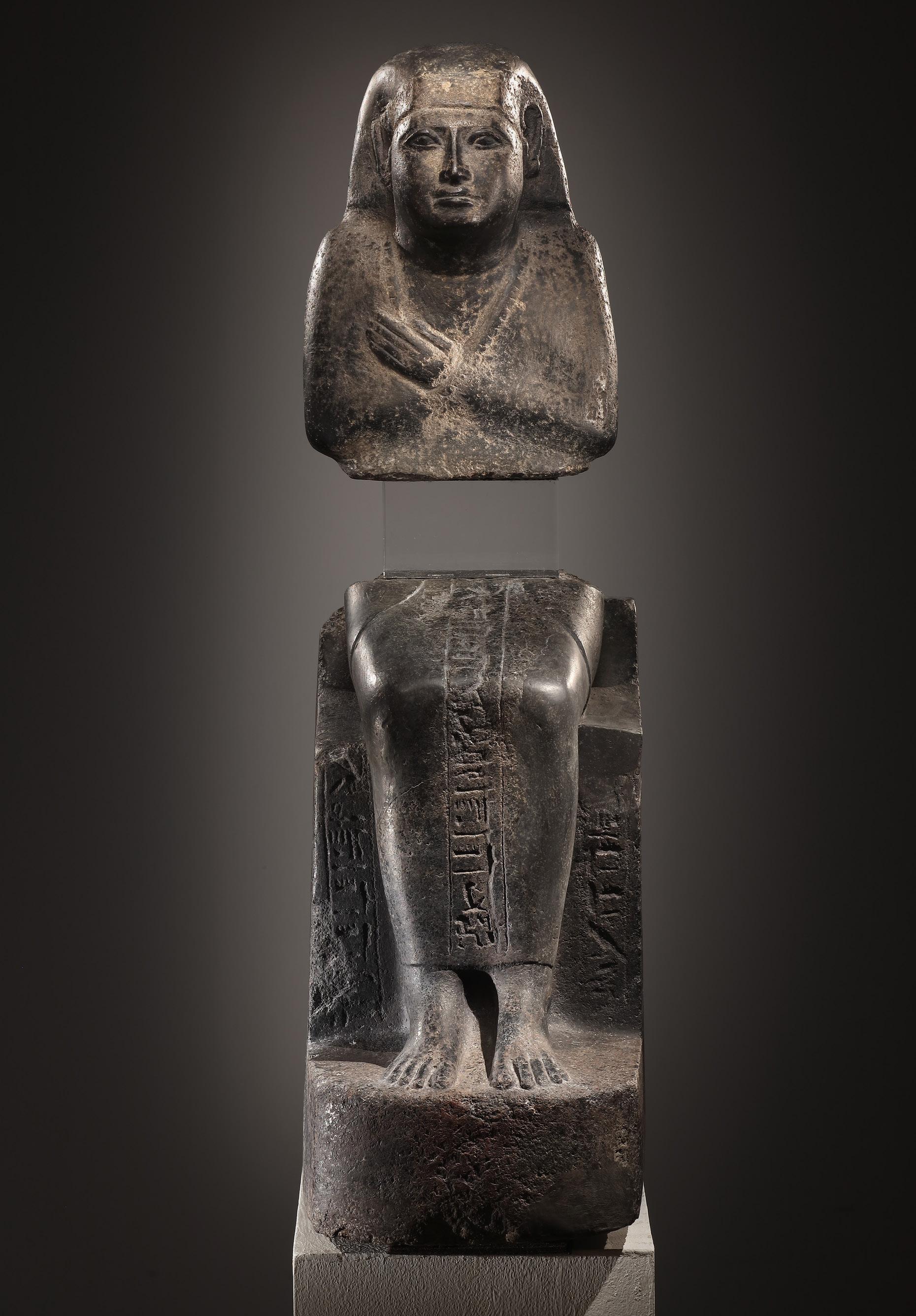
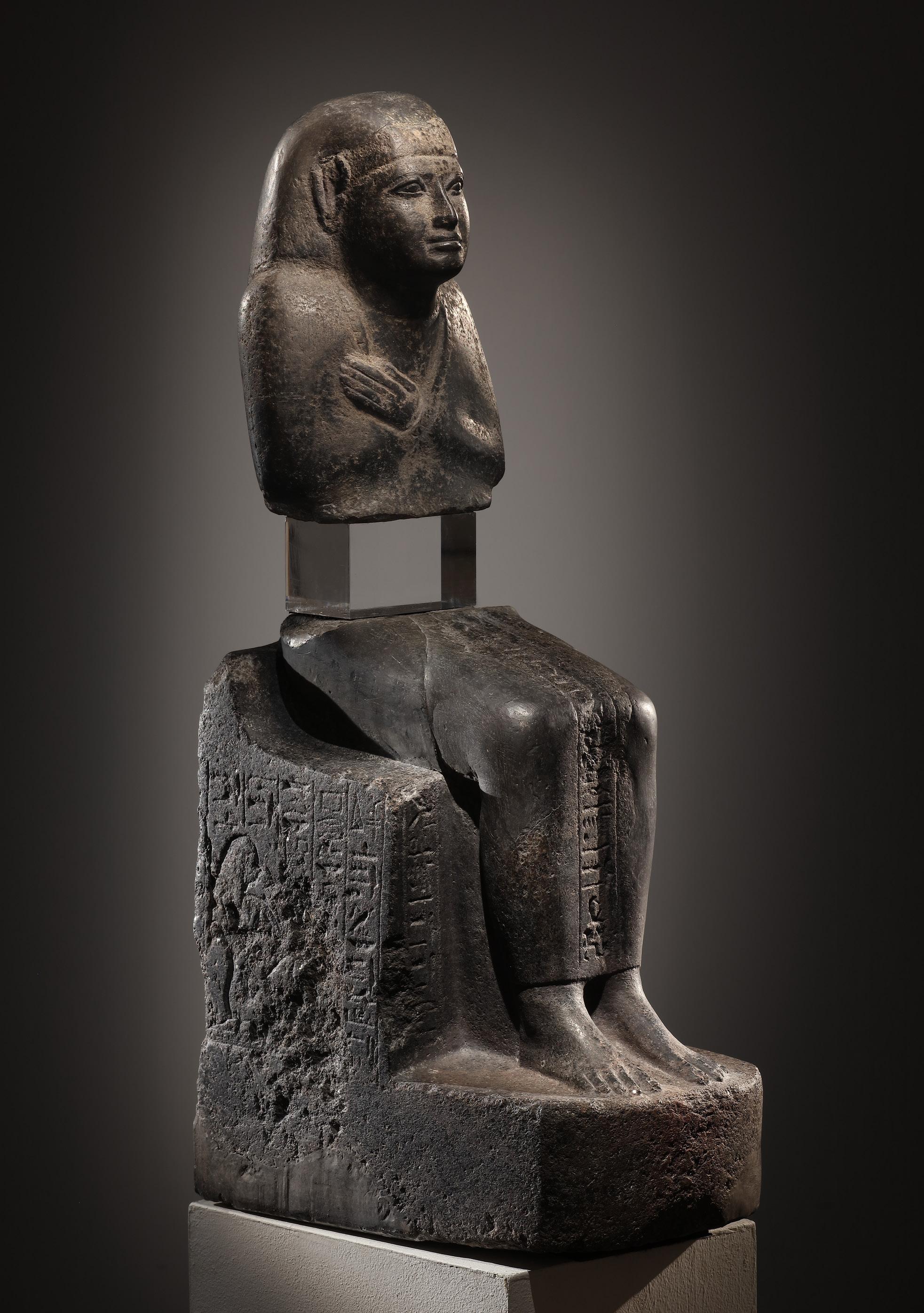
A SEATED STATUE OF AMENEMPHET PRIEST OF AMUN
Price on Request
Egypt, New Kingdom, 18th Dynasty and Late Period
Lower Section: after 1368 B.C. | Upper Section: 6. - 4. century B.C. H. 68,0 cm | W. 21,0 cm | D. 34,5 cm | Black Granite
The statue was assembled in the 19th or early 20th century from two parts that did not originally belong together. The lower body dates from the New Kingdom, and an inscription reveals that the figure represented was Amenemhet, Priest of Amun. The deceased priest wears a short apron and sits hieratically on a block with a low backrest. His feet rest on a footstool that is semicircular at the front. Several columns of hieroglyphs are inscribed on a central strip of the long apron as well as on
the front, both sides (damaged on the right), and back of the seat. They record that Pharaoh Amenophis III (the father of Akhenaten) made an offering to Amun of Thebes and the goddess Mut for Amenemhet, the deceased Third Priest of Amun and Keeper of the King’s Seal, and for his daughter Meret, a singer of the god Amun. On both sides of the seat, the priest Amenemhet is depicted seated on the left while the singer Meret stands on the right. For the deceased, who continues to live in
the afterlife, bread, beer, cattle, birds, alabaster, clothing, milk, incense, and all pure things needed for daily life are to be provided. The upper part of the seated statue dates to the Late Period and shows the upper body of a man with forearms crossed over the chest. His right arm is concealed by a cloak, and only the hand of the left arm is visible. He wears a smooth wig, that transitions into the dorsal pillar. Colour-matched infills on the outer sides of the upper and lower legs, on the front of the footstool (in the lower area), at hip level (where the upper and lower body are joined), on the top of the head, and partially on the rear edges of the seat as well as on its lower right edge.
NOTE
Comes with a transcription by Egyptologist Prof. Dr. Martina Ullmann. — The tomb of the priest Amenemhet mentioned in the inscription, presumably located in West Thebes, has not yet been identified. In the 20th year of the reign of Amenhotep III (1368 B.C.), Amenemhet was still in office. The care that the king lavished on the deceased high priest and official, as documented in the inscription, was granted only to members of the upper class.
PROVENANCE
Formerly priv. coll. of the publisher Diedrich Kenneweg (b. 1895 - d. 1982); acquired in Germany, before 1963. Thereafter, W. M. Muthesius, Germany; acquired in 2018 from Gorny & Mosch, Munich, auction 256, 26.06.2018, lot 395.
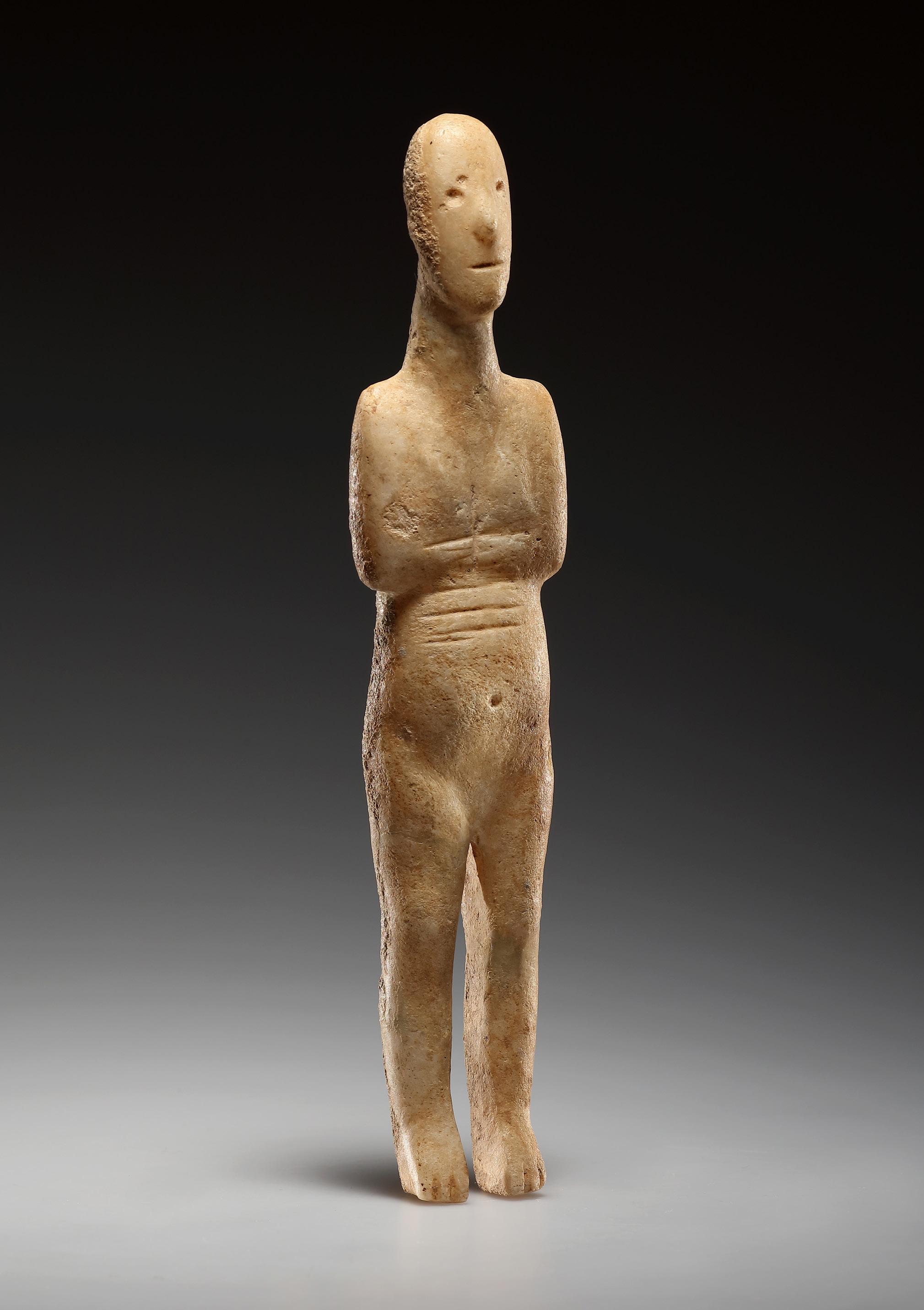
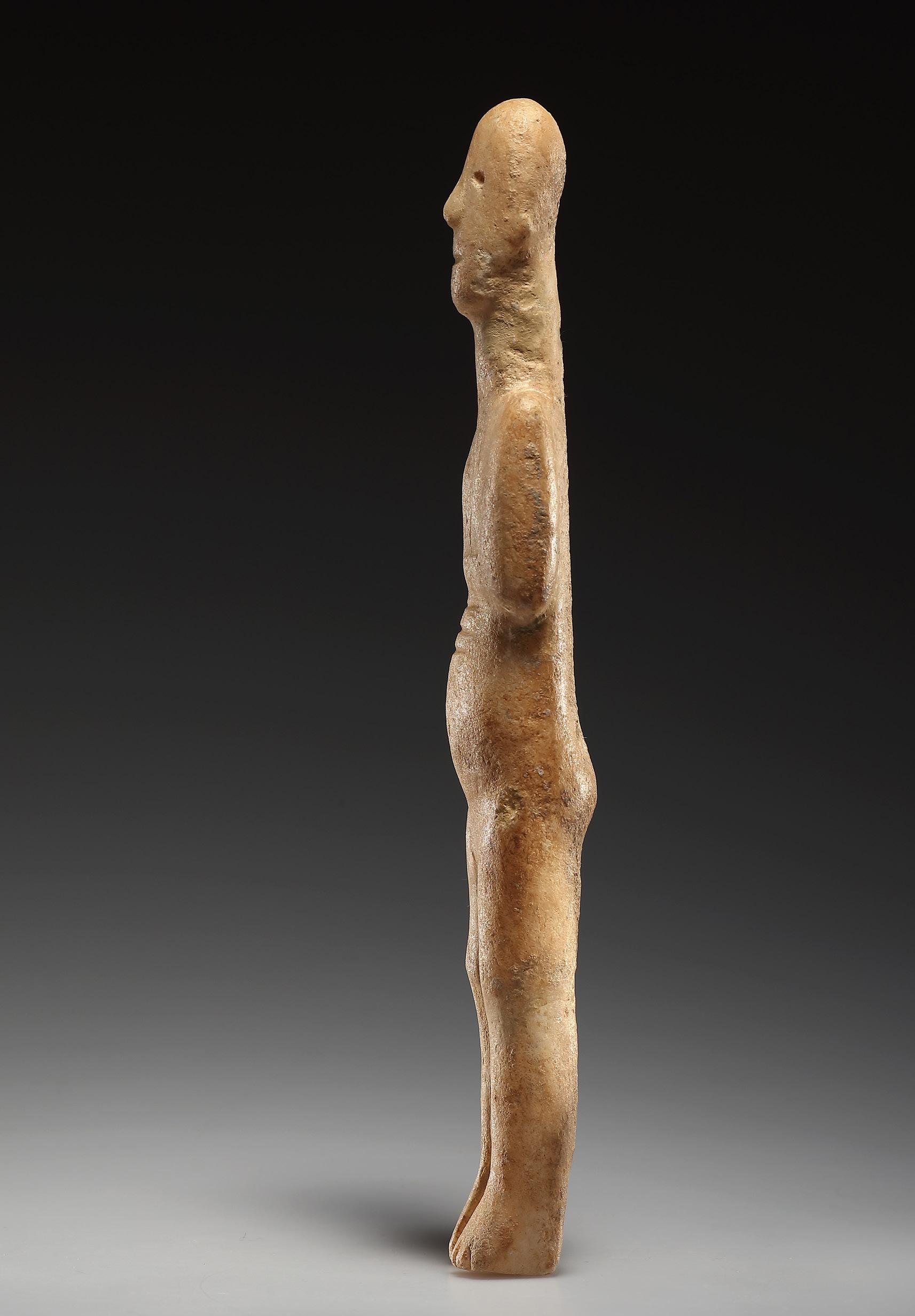
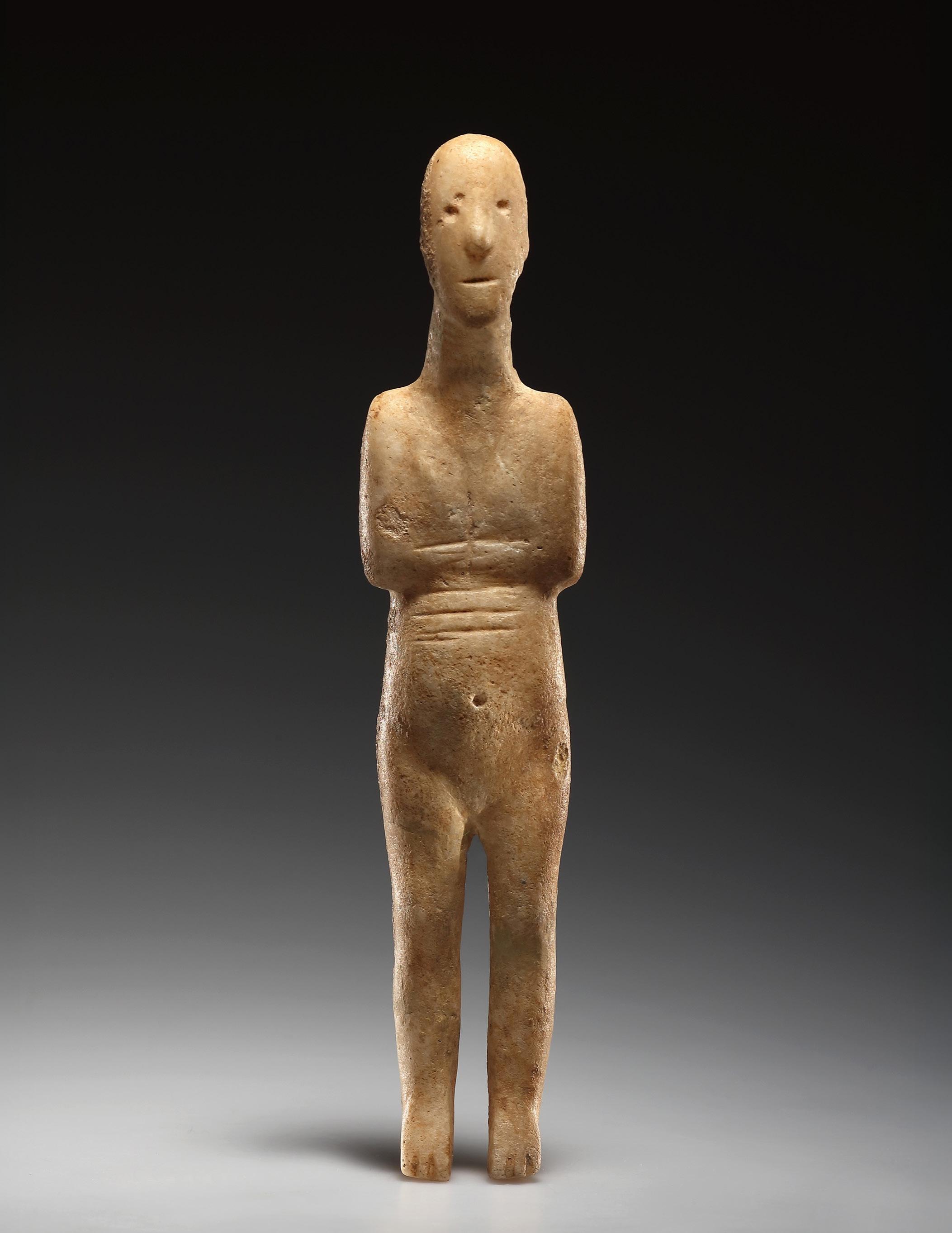
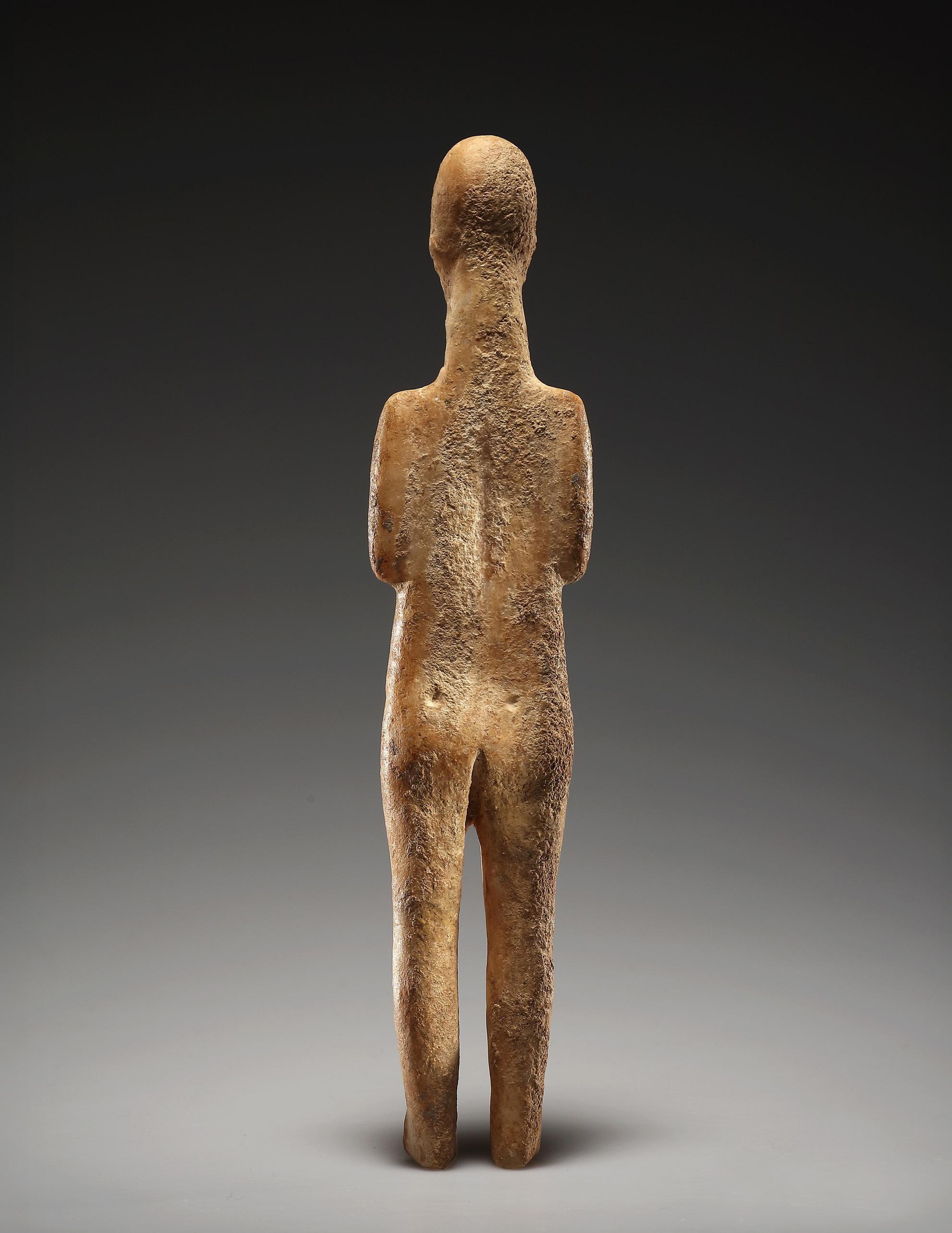
A FEMALE FIGURE OF THE PLASTIRAS TYPE
Price on Request
Early Cycladic | 3200 - 2800 B.C.
H. 18,9 cm | W. 4,0 cm | D. 2,0 cm | Marble with fingers summarily indicated. The abdomen is visibly swollen, with three incised lines at the top edge perhaps indicating the loose skin of a recently post-partum woman. This physiognomic detail occurs in a small group of other known examples, although its significance in the third millennium B.C. is not well understood. Beneath the swell of the belly, a round drilled navel and slightly depressed pubic triangle. The legs are straight and carved separately along their entire length with slightly protruding knees. Block-shaped feet with flat bottoms and three toes indicated on each. The spine is rendered by a shallow groove from nape of the neck to cleft of buttocks. Slightly arched lower back with two „Venus dimples“ over the buttocks,
Although starkly upright, the frontality of the female body is belied here by refined anatomical details at the rear. The face is an elongated oval, mouth indicated by a horizontal line, with drilled eyes not quite aligned. Plastically rendered nose and ears (one covered by encrustations). Remarkably, the skull is sensitively modelled with a continuous line extending from the mandible towards the rear, delineating the occipital bone from the neck, which is comparatively thick and broadening towards the shoulders. The slim shoulders are squared, with arms bent at ninety-degrees at the elbow to rest beneath shallow breasts. The arms are not crossed, but instead hands are separated by a thin vertical line,
rendered by slightly asymmetrical round drill holes. White, mediumgrained marble with encrustations, particularly at the back. Small circular divot above right eye, likely an abandoned attempt to render the right eye. Complete. Joining breaks at upper right thigh and beneath right knee reattached with minor filling. Joining break at neck with small filling laterally. Chip to right heel filled.
PROVENANCE
Formerly priv. coll. Tsekenis, Paris, since the 1960‘s. Thence by descent in the family. Published: Pat GetzPreziosi, “An Early Cycladic sculptor”, Antike Kunst, vol. 18, n°2, 1975, pp. 47-50, pl. 20, 4-6; Pat Getz-Gentle, Personal Styles in Early Cycladic Sculpture, The University of Wisconsin Press, 2001, p. 9-10, Fig. 4.
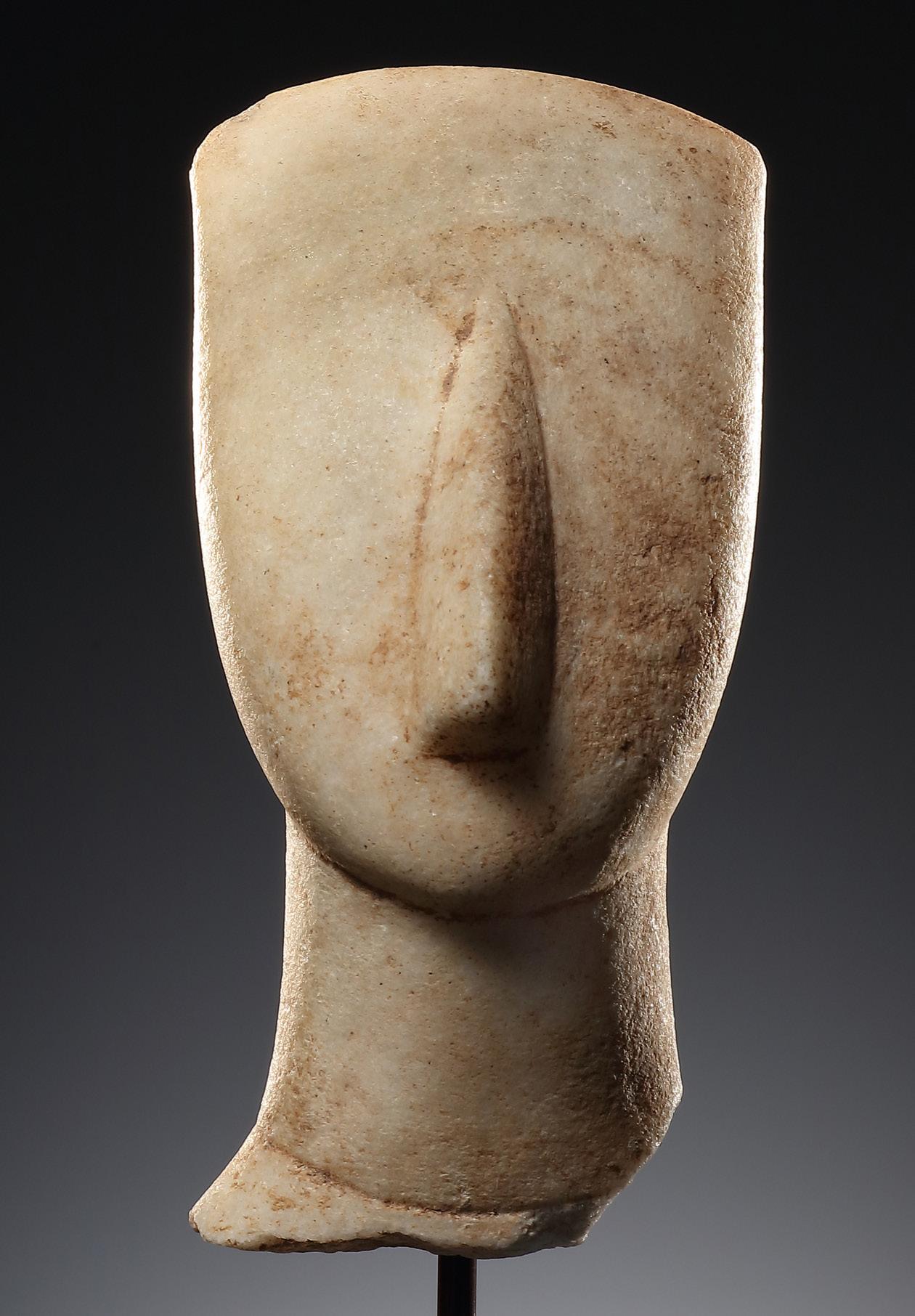
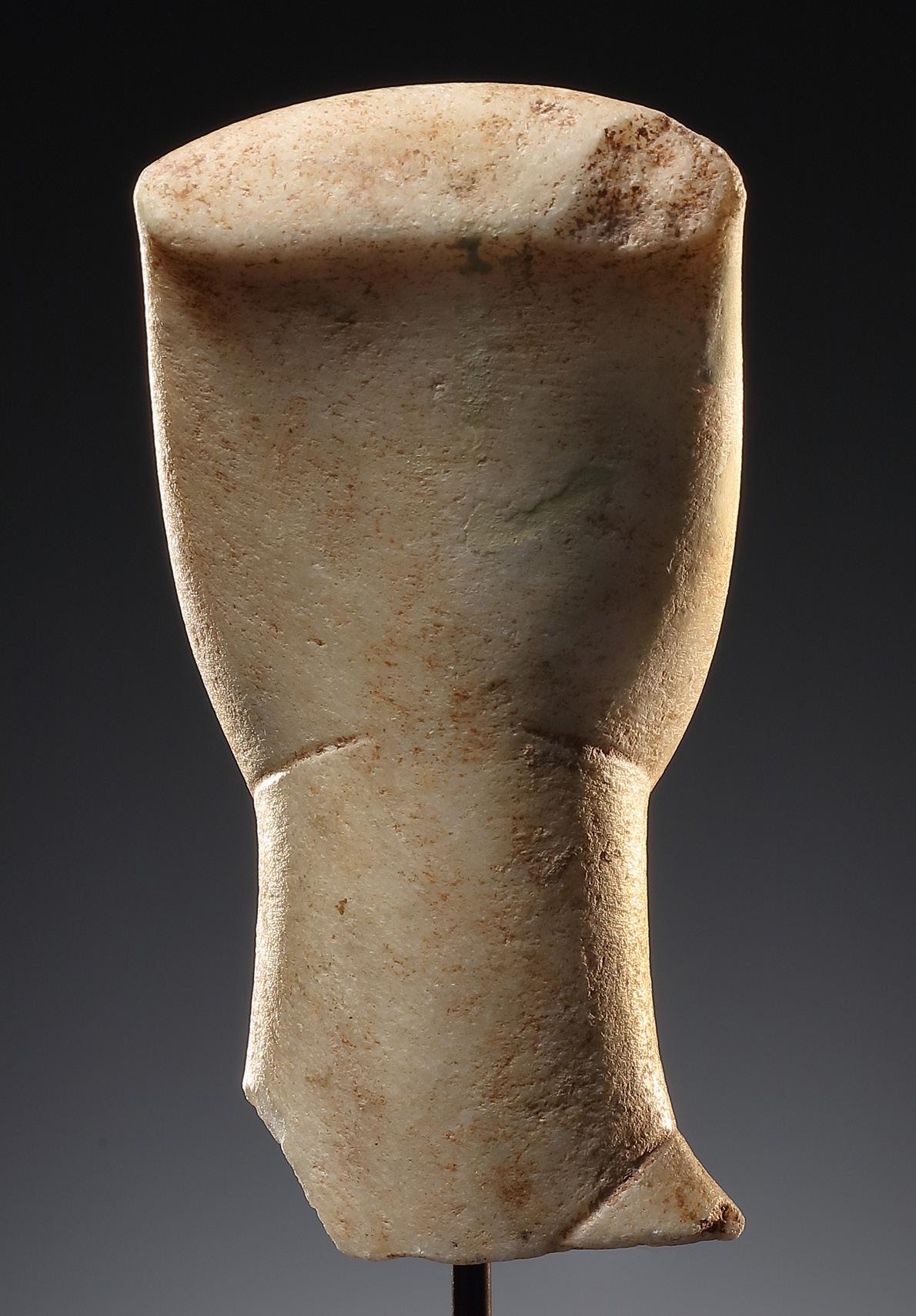
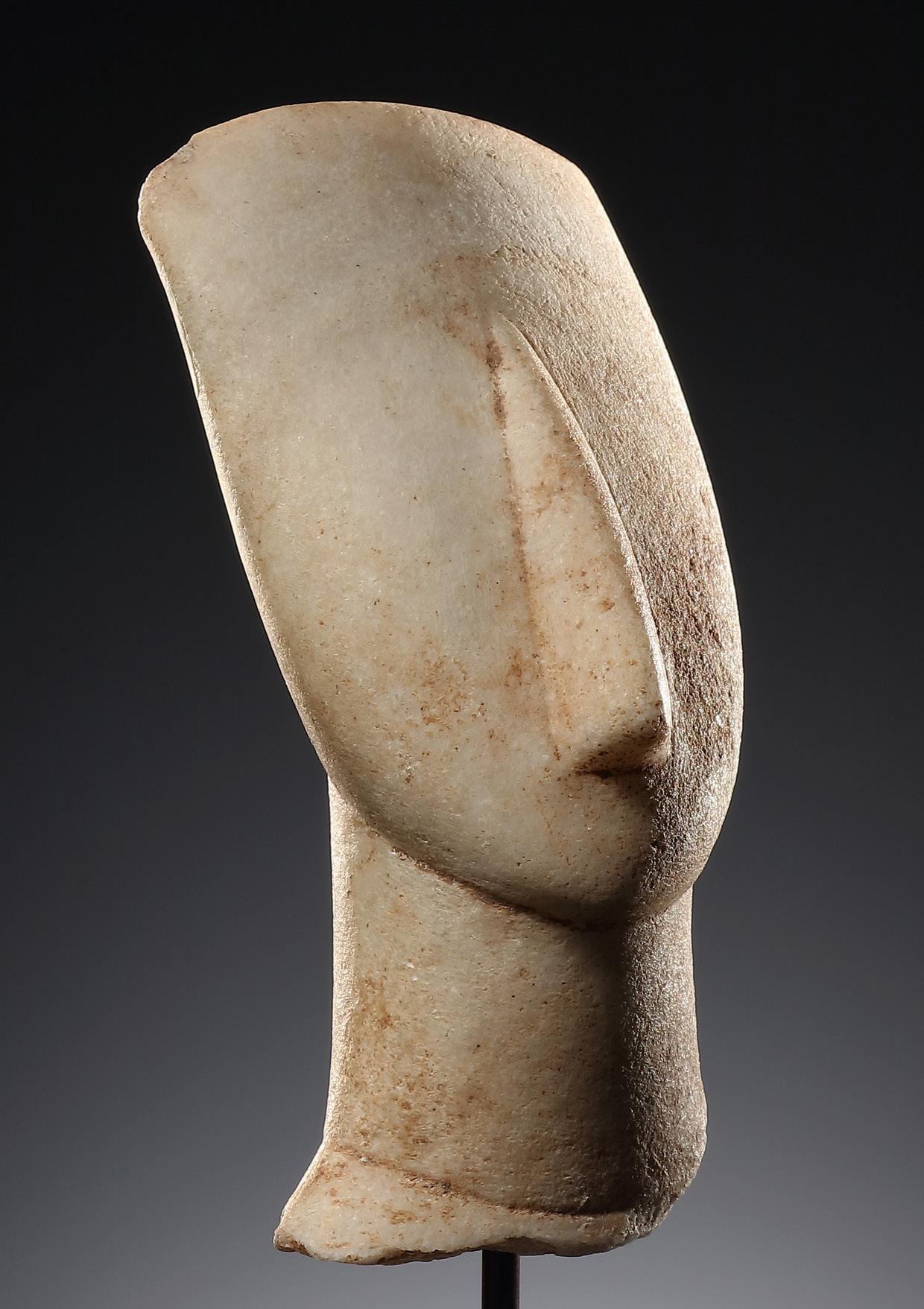
A HEAD OF A CYCLADIC IDOL
ATTRIBUTED TO THE GOULANDRIS
Price on Request
MASTER
Greek, Early Cycladic II, Keros-Syros-Culture | 2500 - 2400 B.C. H. 12,2 cm | W. 6,0 cm | T. 5,0 cm | Marble
Head of a stylized human figure, which can be assigned to the late so-called Spedos type in terms of its shape. Lyre-shaped in its basic form. Prominent nose reaching far into the lower half of the face. Chin with a rounded contour, tapering slightly towards the middle and, viewed from a side perspective, barely protruding beyond the neck. Below the chin there is a flat narrow groove that goes up to the neck and dissolves towards the middle. The upper part of the body, also set off against the neck by
a flat, narrow groove, makes it clear that the shoulders sloped steeply. The formal observations mentioned here are stylistic features of the so-called Goulandris master (see also note). Bump on the upper right corner of the head. Fine brownish deposits.
NOTE
In addition to a form-typological categorization, the attempt was made by archaeological research to assign Cycladic idols to different „artist hands“; see in particular P. Getz-Preziosi, Sculptors of the Cyclades. Individual and Tradition in the Third Millennium B.C. (Ann Arbor 1987); on the Goulandris master see pp. 99-108, plates 34-37; P. Getz-Gentle, Personal styles in Early Cycladic sculpture (Madison 2001). One of the best-known and most productive sculptors is the socalled Goulandris Master (a fictional name named after the Goulandris Museum in Athens), to whom more than a hundred fragments are ascribed. Further style-forming features of the Goulandris master are according to Getz-Preziosi z. B. the small, widely spaced breasts and the horizontal hip line that closes the pubic triangle at the top.
PROVENANCE
Formerly priv. coll. Dr. Walter Veith, Solingen, Germany, 1972. Thereafter priv. coll. I. R., Rhineland, Germany. Priv. coll. J. R., Germany, acquired 2006 from Gordian Weber, Cologne (published: Cat. Antiken 10, 2006, p. 10-12, no. 5 with illus.). Old mount, dated 1960-1970.
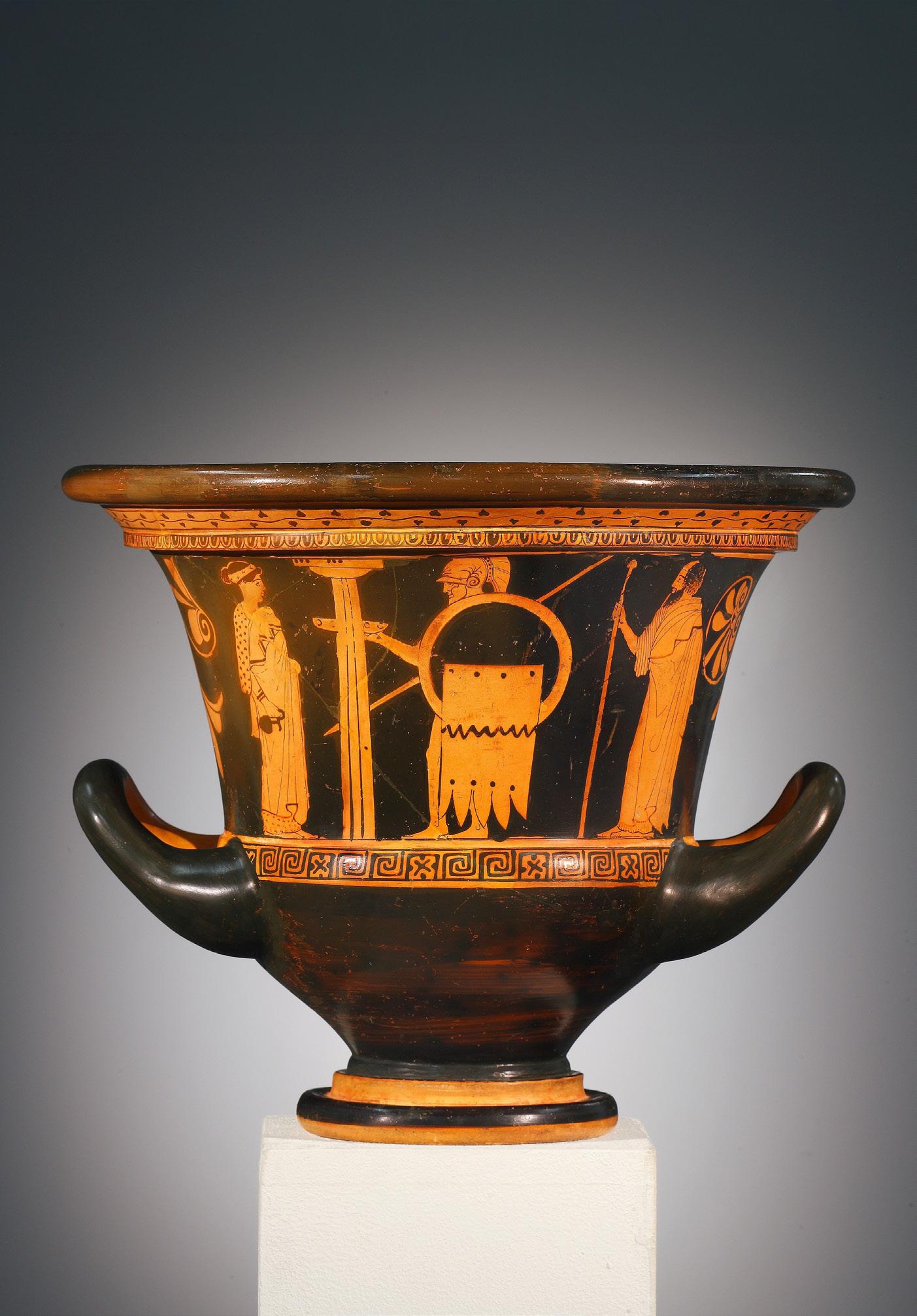
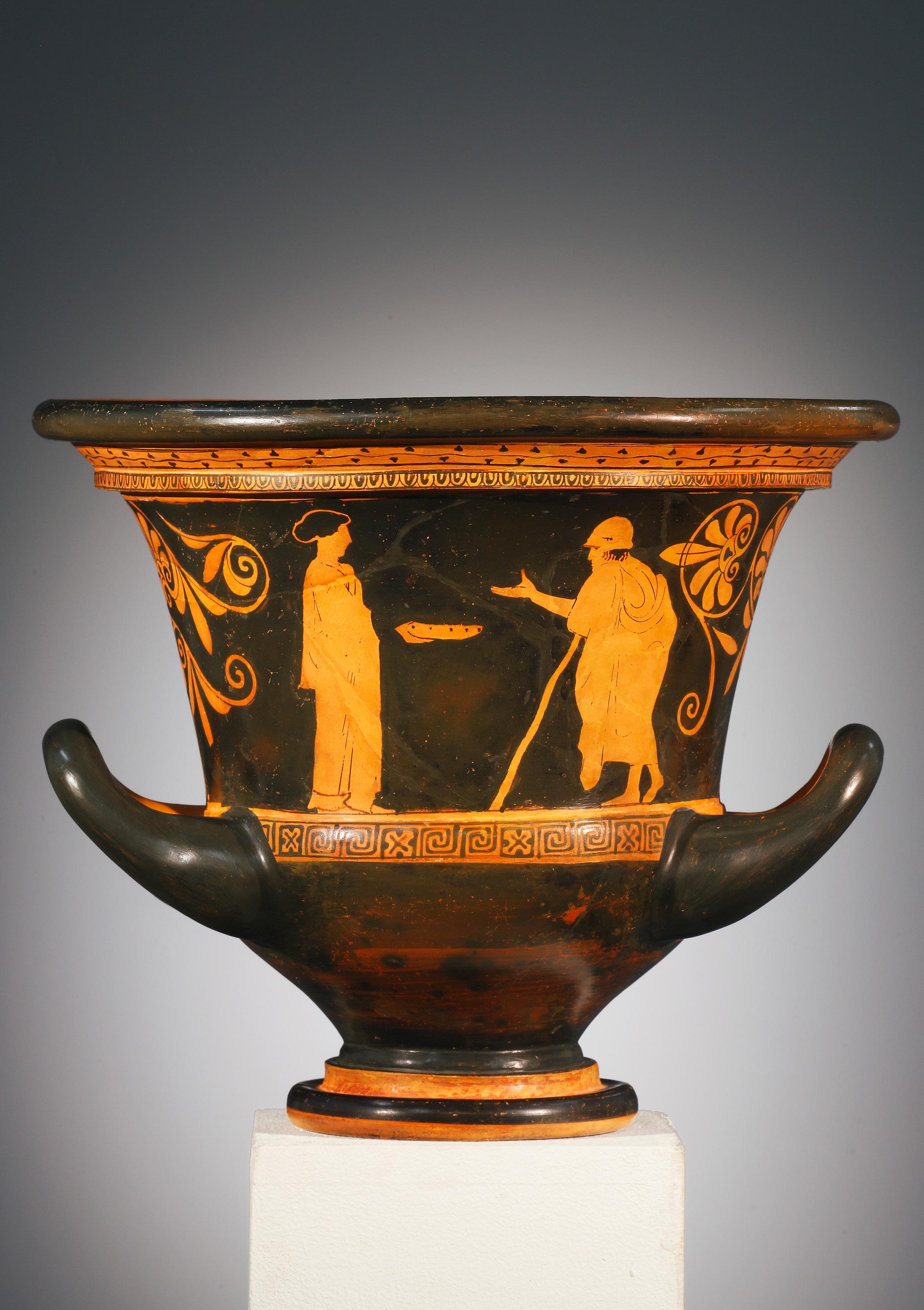
A RED-FIGURE CALYX-KRATER ATTRIBUTED TO THE NIOBID PAINTER
Price on Request
Attic | ca. 440 B.C. H. 26,0 cm | W. with Handles 29,0 cm | Diam. 31,0 cm | Clay
This medium-sized, thick-rimmed krater with short, upturned handles, stands on a double profiled foot with convex ring. Side A shows a warrior departing for battle. On the left a woman facing right, clad in a floral chiton and himation with a fillet in her hair, holding an oinochoe in her hand. The warrior in the centre faces her. He is clad in full armour with Attic helmet, lance and large round shield, and holds a phial for the parting libation in his right hand. Unusually, a shield apron drapes down from the middle of the outside of his shield. The Doric
column between the two figures partially obscures the phial. Behind the warrior is the bearded master of the house with cloak and sceptre, facing left. Side B shows another valedictory scene: The woman on the left wears a chiton and cloak. She hands a phiale to a warrior with pilos helmet who leans on a staff.
A profiled edge juts out above the figural scenes. It is adorned by a band of ovolos; above it a band of ivy, both in black and finely framed. Adorning the outside of the step defining the shoulder of the vessel is a frieze of double, right-facing
meanders interrupted by crossed tiles. Above the handles on either side are two palmettes leading into elaborate, volute-like coiled tendrils, some with lotus flowers. The black glaze has been unevenly fired and is discoloured greenish and orange in areas. At some point in its history, probably in the 19th or early 20th century, the vase was covered with a resin-based paint, which has since been removed, as have the “invisible” restorations (mostly on side B). Reassembled from fragments; restoration in toned plaster along cracks and for a missing fragment of the rim; surface losses refilled; handle restored; foot not original.
NOTE
For the helmet and ornamental palmettes, cf. a volute krater in Ferrara, Museo Archeologico 2652, M. Prange, Der Niobidenmaler und seine Werkstatt. Untersuchungen zu einer Vasenwerkstatt frühklassischer Zeit (Frankfurt 1989) 181, N 7, pl. 6, 1; an amphora in the Vatican, Museo Gregoriano Etrusco 17.854, ibid. 197, N 76, pl. 44; and a calyx krater fragment in Reggio di Calabria 10555, ibid. 187, N 29, pl. 50, on
which the face of the female helmet wearer is almost completely covered by the helmet. For the phiale behind a column, cf. an amphora in the Vatican, Museo Gregoriano Etrusco 16528, ibid. 227, GN 98, pl. 44, in the manner of the Niobid Painter.
For the hem of the mantle of the woman at left, cf. a hydria in Ferrara, Museo Archeologico 2683, ibid. 200 N 96 pl. 8; and a pelike in London, British Museum E 381, ibid. 192, N 57, pl. 15. The warrior‘s farewell in front of a Doric column occurs frequently in the work of the Niobid Painter, e.g. pelike in Würzburg, Martin von Wagner-Museum ZA 25, ibid. 194, N 64, pl. 16.
PROVENANCE
Formerly private coll., Paris, before 1970. With Auction Pierre Bergé, 17 January 2009, lot 351. With Royal Athena Galleries, New York, 2010. With Galerie Antoine Tarantino, Paris. Published: Eisenberg J., Art of the Ancient World, 2010, n° 148; Eisenberg J., One Thousand Years of Ancient Greek Vases II, 2010, n° 103. Old 19th century restorations.
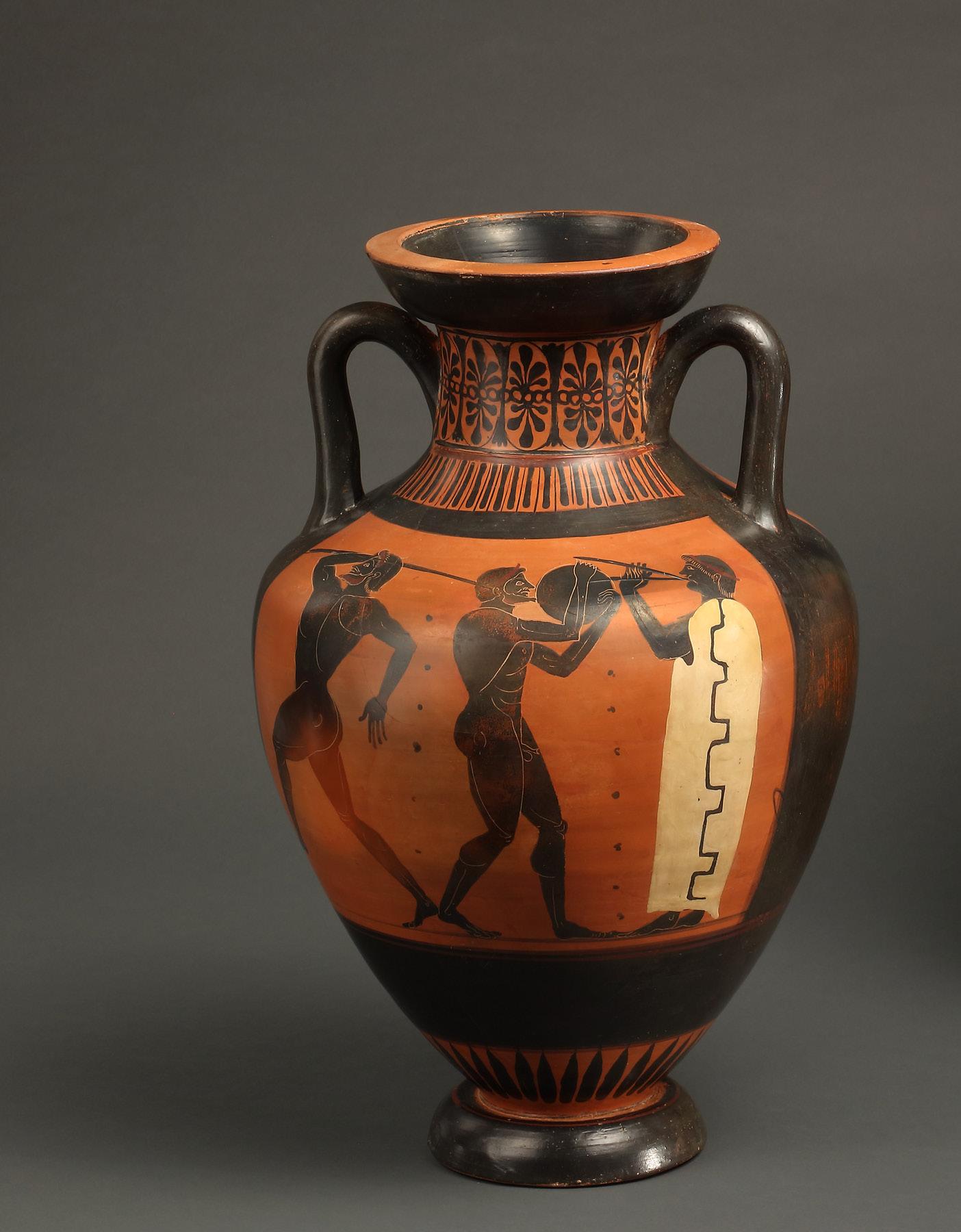
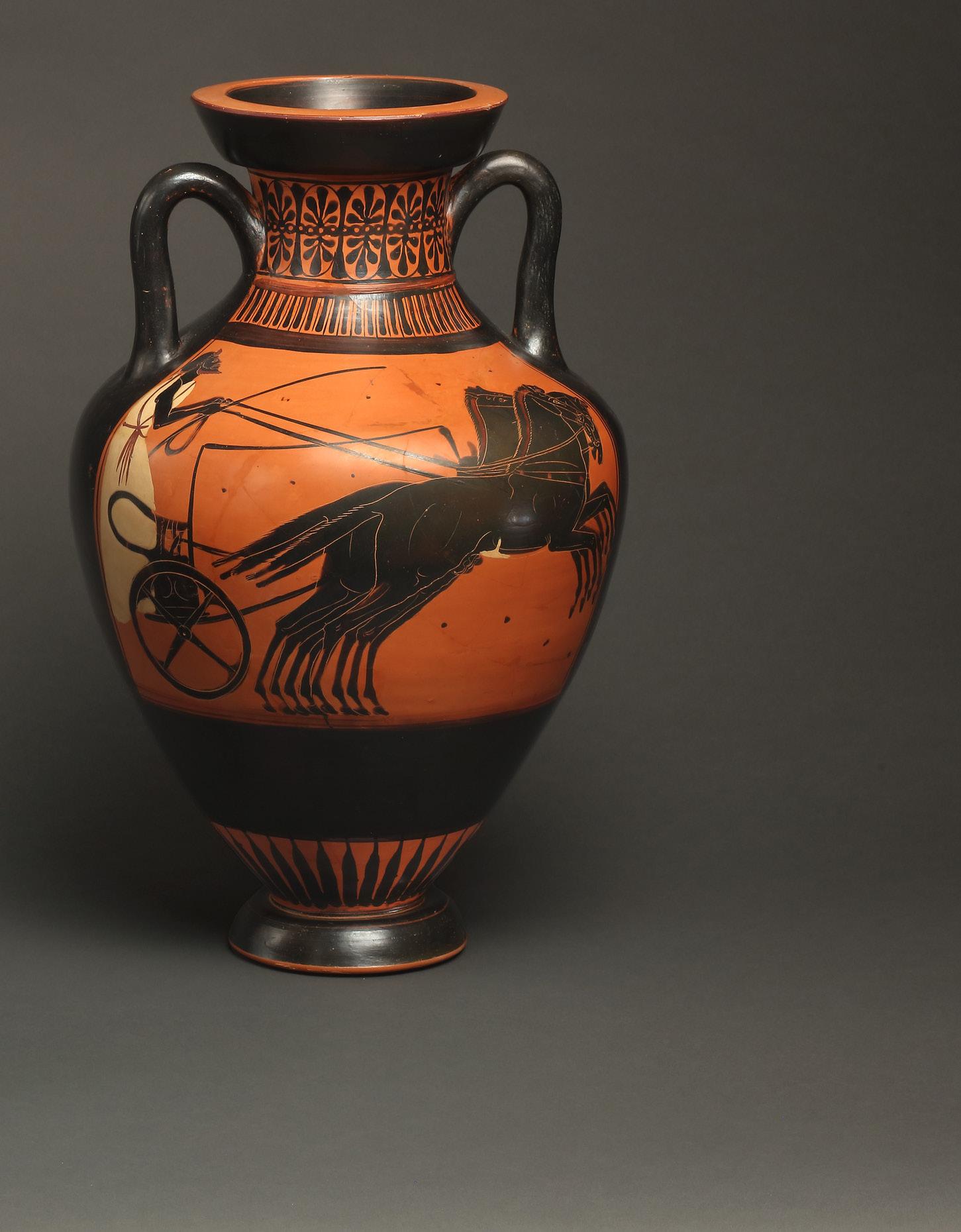
A PAIR OF AMPHORAE OF PANATHENAIC SHAPE ATTR. TO THE ACHELOOS PAINTER
Price on Request
Attic, Late Archaic | Ca. 500 B.C. | Clay | H. 43,0 cm
Dm. Rim. 15,4 cm | Dm. Body. 27,9 cm | Dm. Foot. 12,2 cm
Attic, Late Archaic | Ca. 500 B.C. | Clay | H. 39,6 cm
Dm. Rim. 14,8 cm | Dm. Body. 25,8 cm | Dm. Foot. 11,9 cm
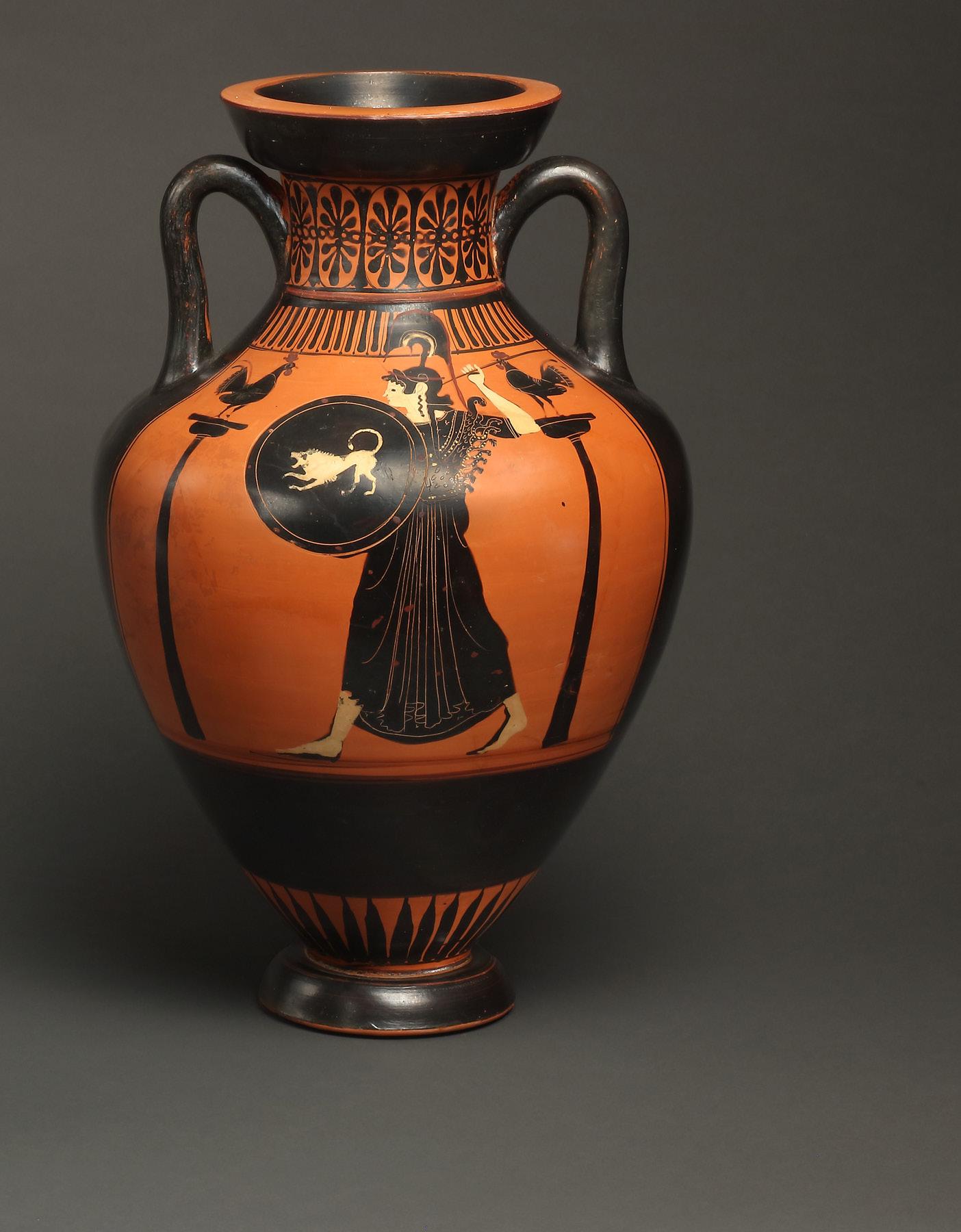
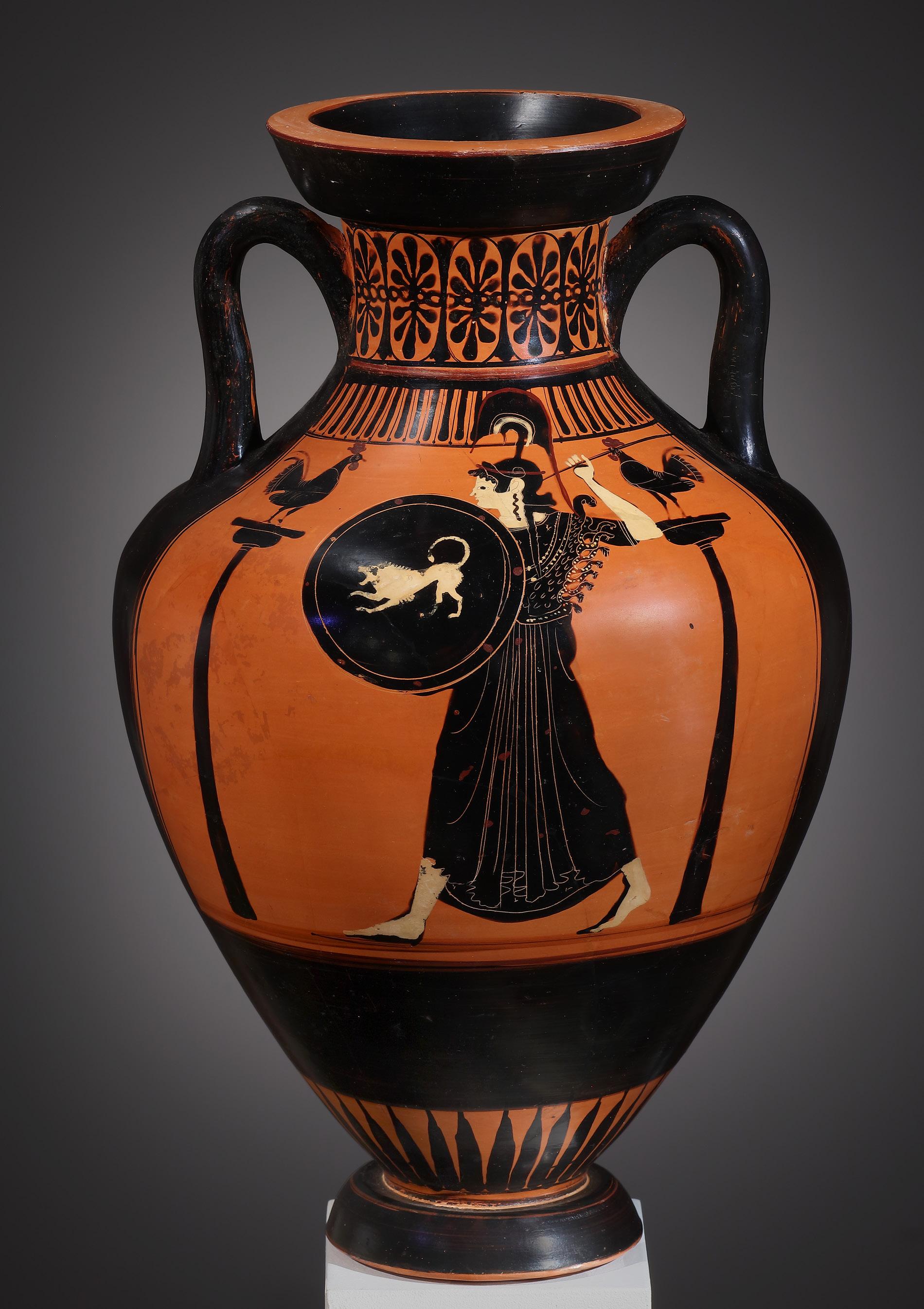
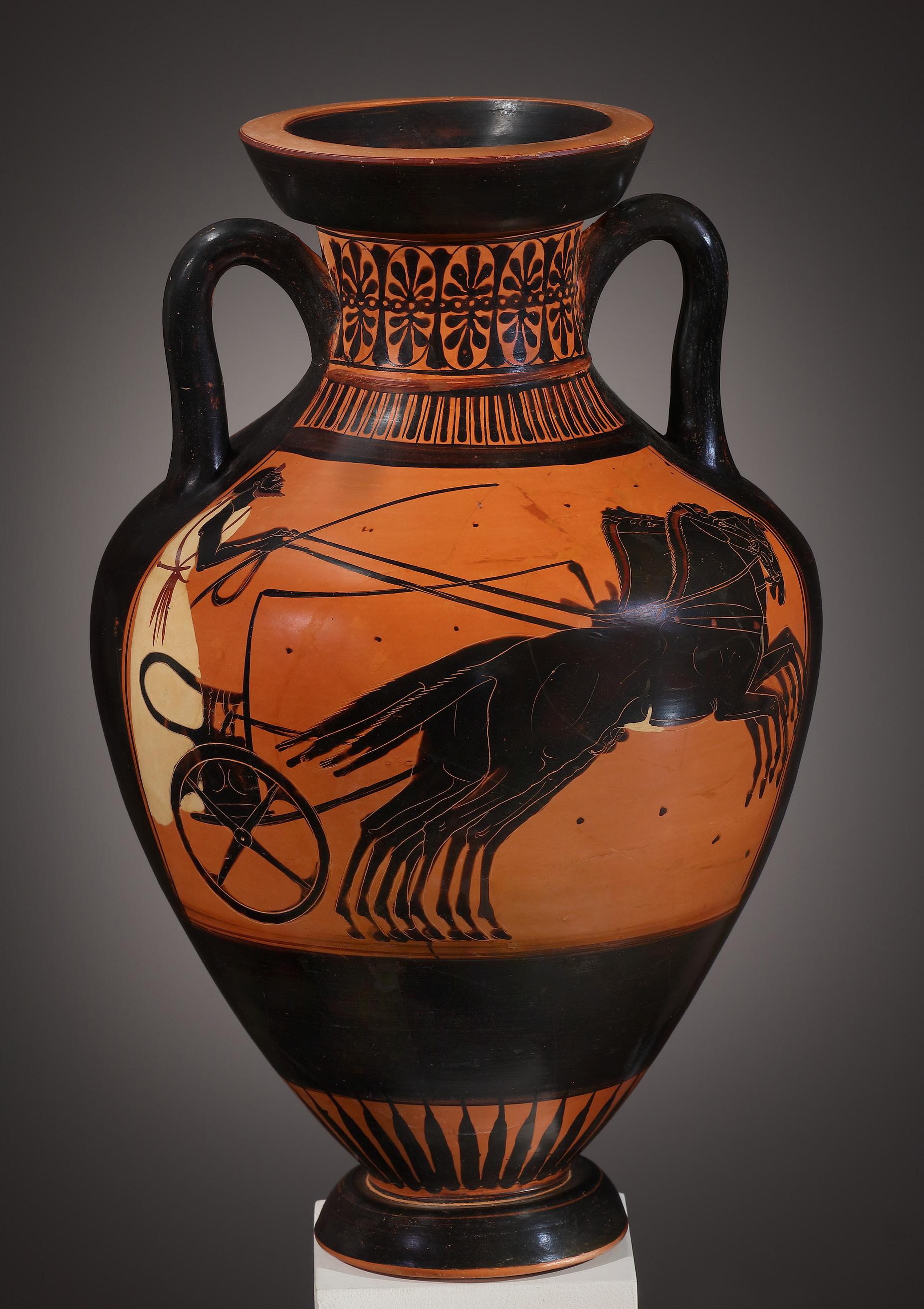
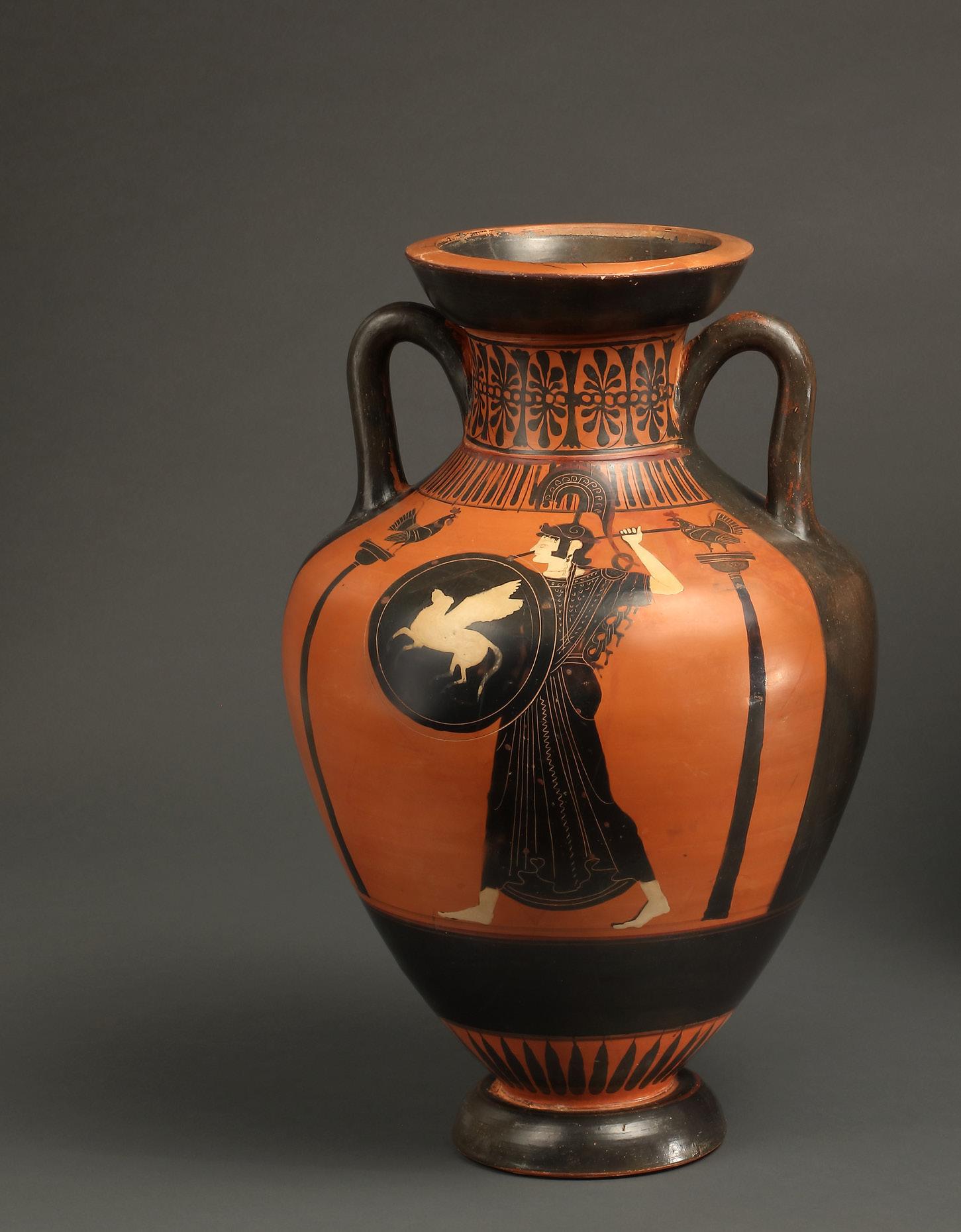
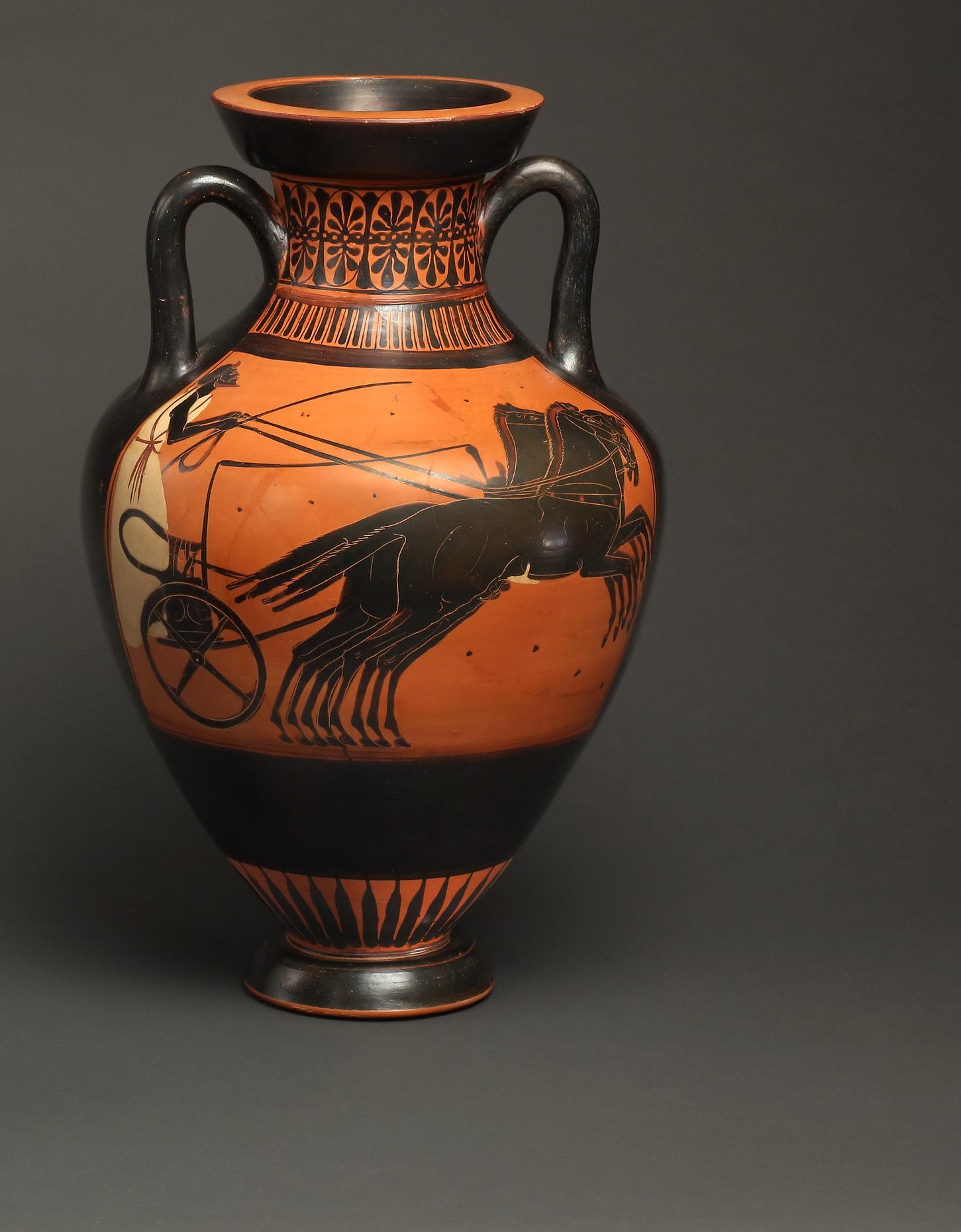
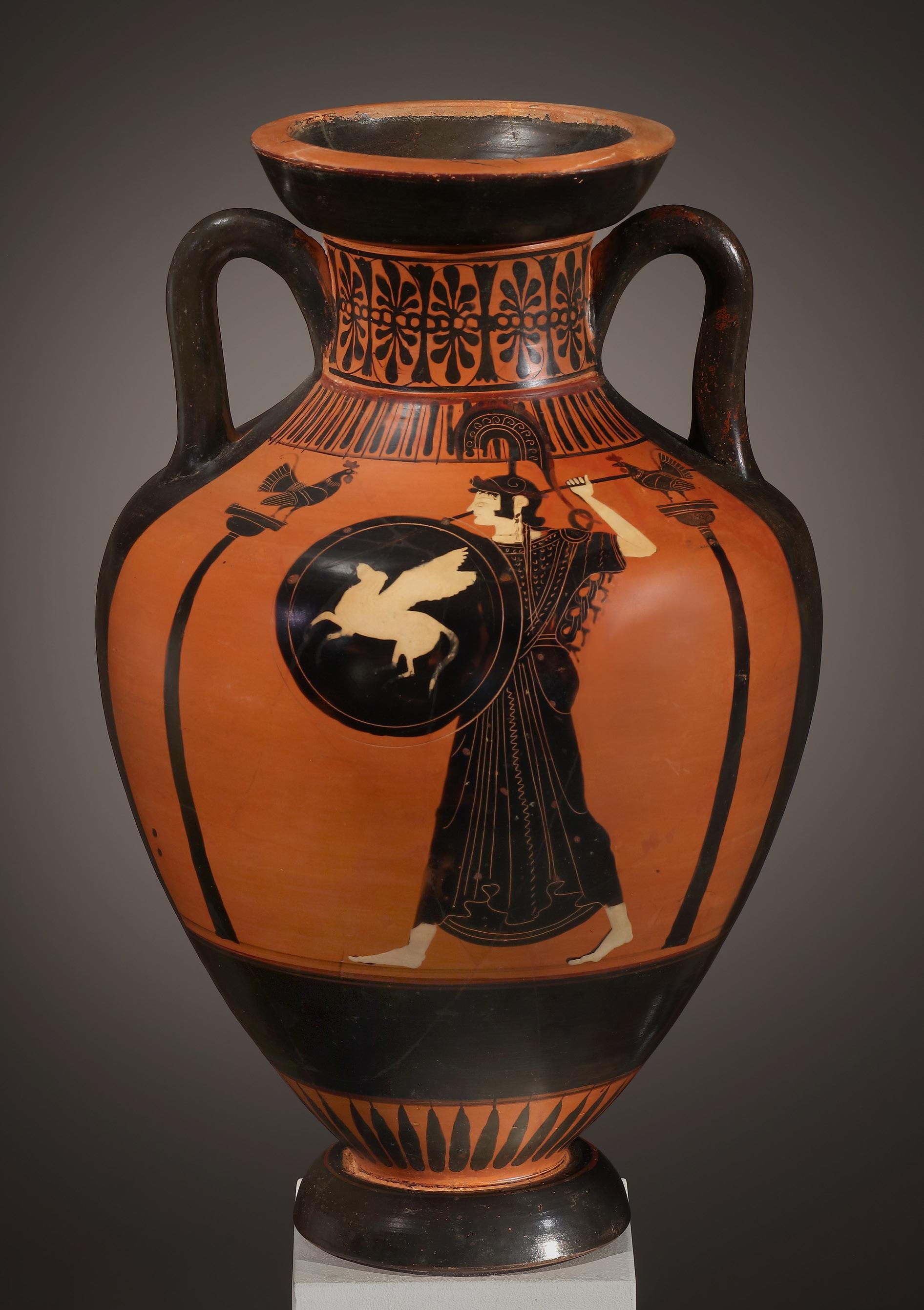
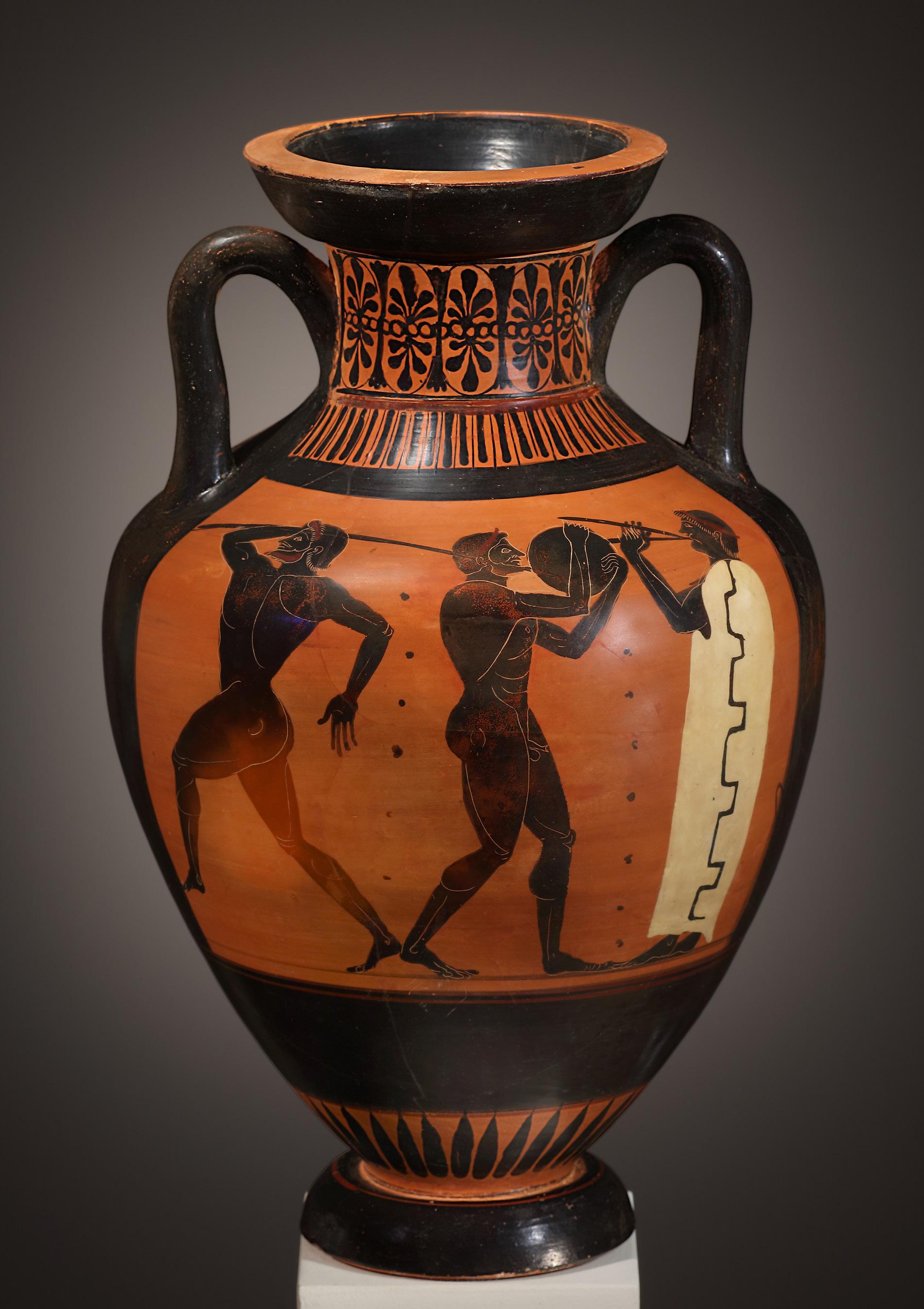
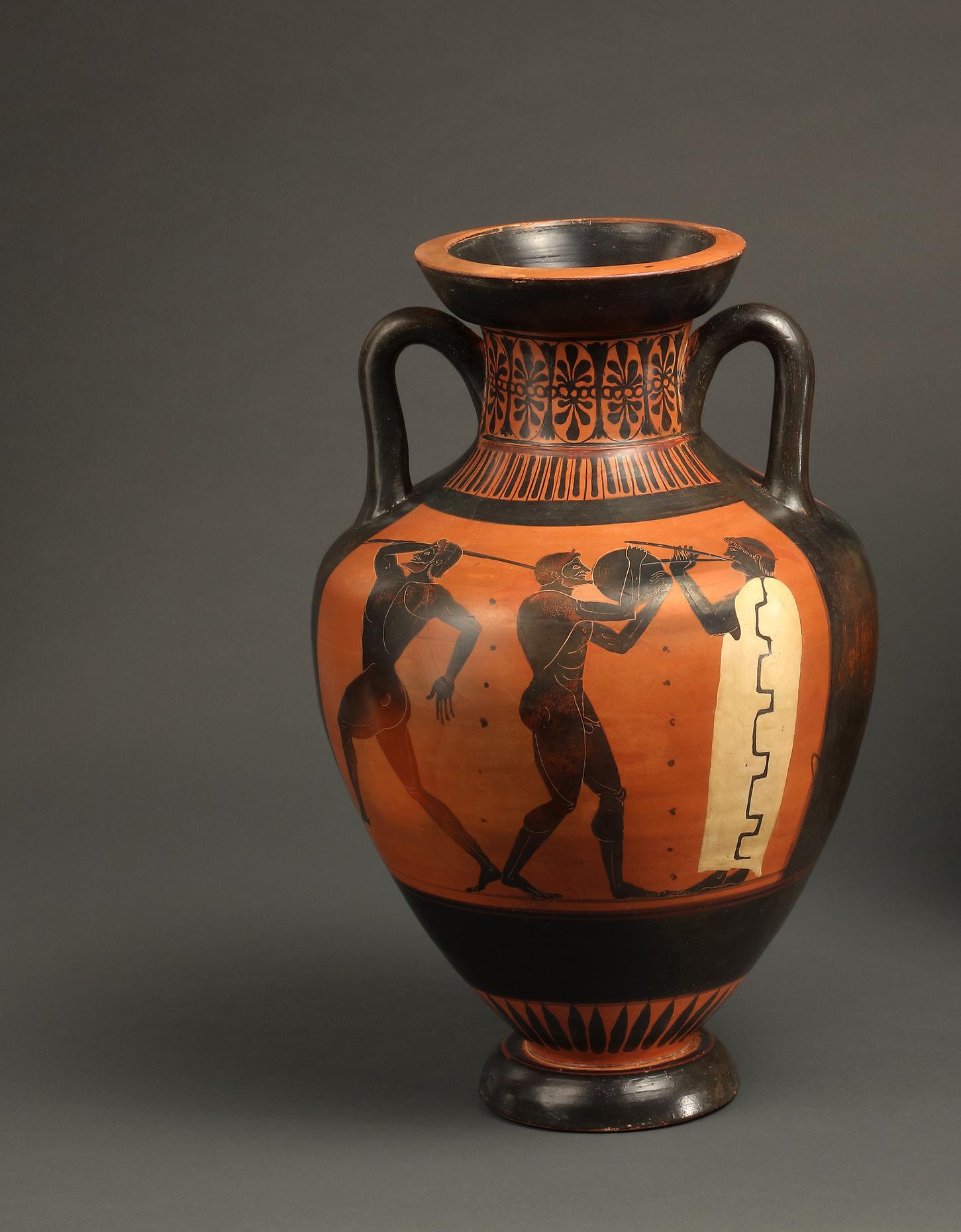
This pair of amphorae, with a broad body tapering sharply downwards, follows the typology of the Panathenaic amphorae: vessels well defined by their shape, proportions, uniform iconography, and prize inscriptions. These were awarded in Athens to the victors of athletic contests held every four years in honour of the city’s patron goddess, Athena. However, these specimens do not bear the customary prize inscription, and their dimensions are smaller than those of the official prize amphorae, which generally
1
2
exceed 60 cm in height. This is characteristic of small-scale copies, likely produced for the trade and as commemorative souvenirs. On each amphora, one side depicts Athena Promachos (‚foremost in battle‘) standing between two Doric columns surmounted by cocks – ‚symbols of the fighting spirit‘, as noted by Beazley (Development of the Attic Black-figure, 1951, p. 84). The device on her round shield differs between the two vessels: on one, Pegasus; on the other, a rearing lion. The reverse presents different athletic events.
One shows a pentathlon scene, with an acontist throwing his spear to the left, a discus-thrower to the right, and a flute player, dressed in a long white chiton with a simple battlement design, to the left. The other depicts a bearded charioteer, clad in a long white chiton, driving a quadriga at full gallop to right. The chariot race was one of the most prestigious contests of the Panathenaea. In the field of both scenes, nonsense inscriptions. On both vessels, a mirrored palmette chain without incision between the handles. Black tongues at the shoulder. Rays at the base. Much of the original added white and red colour preserved. Underside of foot with an incised mark: a single letter, perhaps a lambda, gamma, or ypsilon. Both reassembled from fragments. Toned plaster along the cracks.
NOTE
Two works attributed to the Acheloos Painter, one of the foremost masters of the late Attic black-figure style and a prominent member of the Leagros Group (cf. ABV 382), the “last great group of Attic black-figured vases“. The „chariot race“ one faithfully reproduces the scheme of official prize amphorae, for instance ABV (1956), 404/6, New York, Metropolitan Museum of Art, inv. no. 07.286.79, attributed to the Kleophrades Painter. The „Pentathlon“ iconography however, is less conventional. For a very close iconography by the same painter, see a neck-amphora in Würzburg, Martin von Wagner Museum, inv. no. L204, BAPD 302401, ABV
383.8 and a ‚Type B‘ amphora in Basel, Antikenmuseum, inv. BS 1906. 294, BAPD 302861, ABV
384.16. For a discussion on pseudoPanathenaic amphorae, cf. Martin Bentz ‚Schwarzfigurige Amphoren panathenäischer Form. Typologie, Funktion und Verbreitung‘ in Panathenaïka (Mainz 1998) p. 111117. For a discussion on pseudoPanathenaic amphorae, cf. Martin Bentz ‚Schwarzfigurige Amphoren
panathenäischer Form. Typologie, Funktion und Verbreitung‘ in Panathenaïka (Mainz 1998) pp. 111-117.
PROVENANCE
Formerly Michelangelo Mazarrelli (b. 1938) ; bought in 1972 from Alexander von der Pahlen (b. 1946), New York; inherited from his father Alexis von der Pahlen, who in turn received it as a gift from his father, Count Constantin von der Pahlen (1861-1923), Russia. The family had owned them since the 19th century. The pieces were brought to Switzerland before the First World War (see declaration of honour dated 1993). With NAAG Numismatic & Ancient art Gallery, Zurich, 1993. Publ.: Journal du Musée d‘art et d‘histoire, no. 8, May-August 1993; Bentz Martin, Norbert Eschbach, Panathenaïka: Symposion zu den Panathenäischen Preisamphoren Rauischlozhhausen, 25.11.-29.11.1998, Appendix 1, nos. 320, 321.
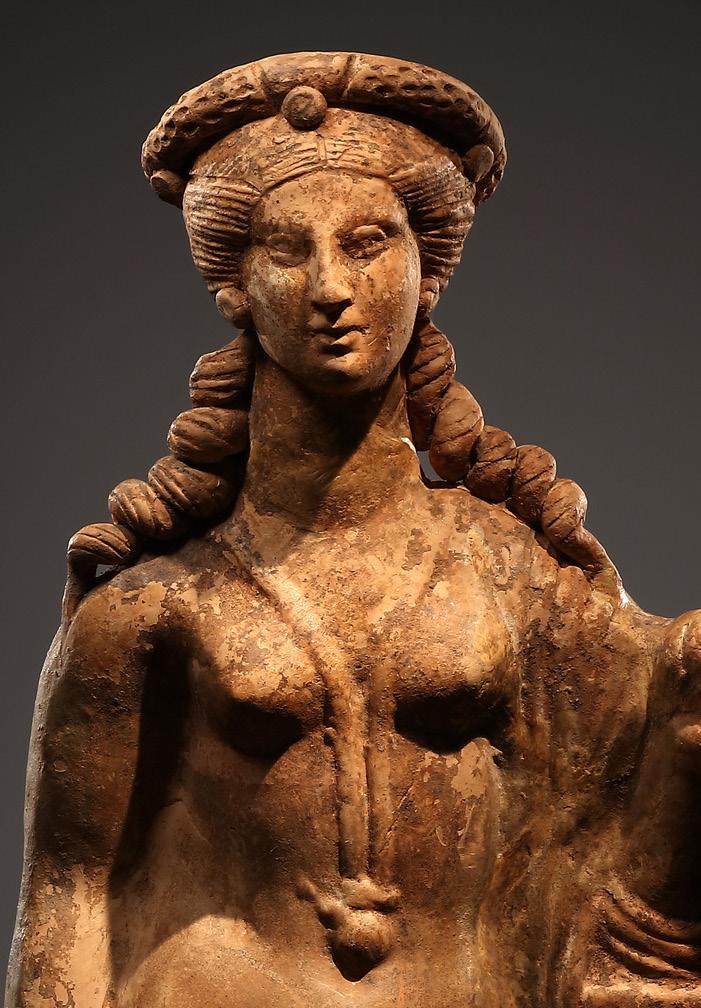
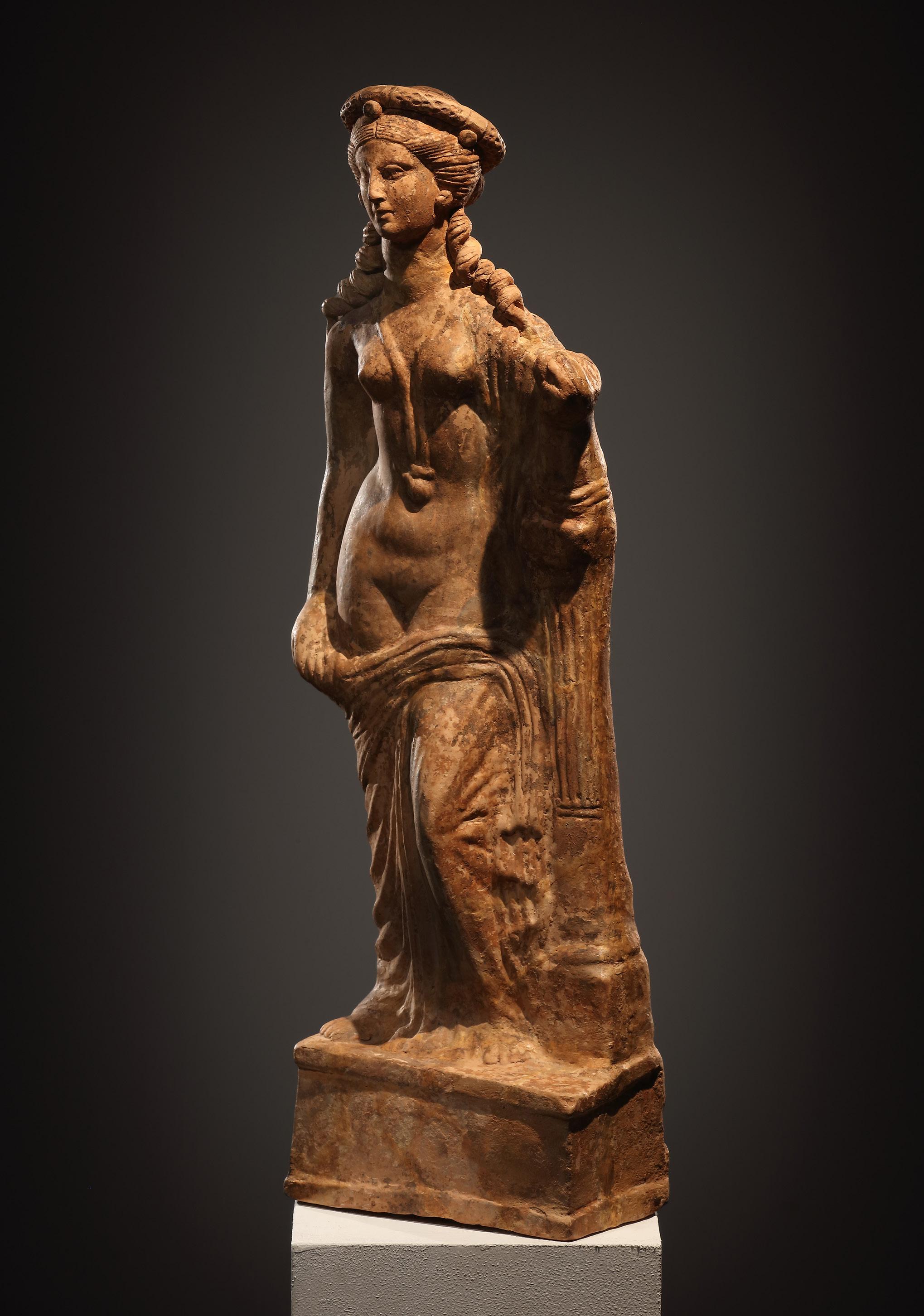
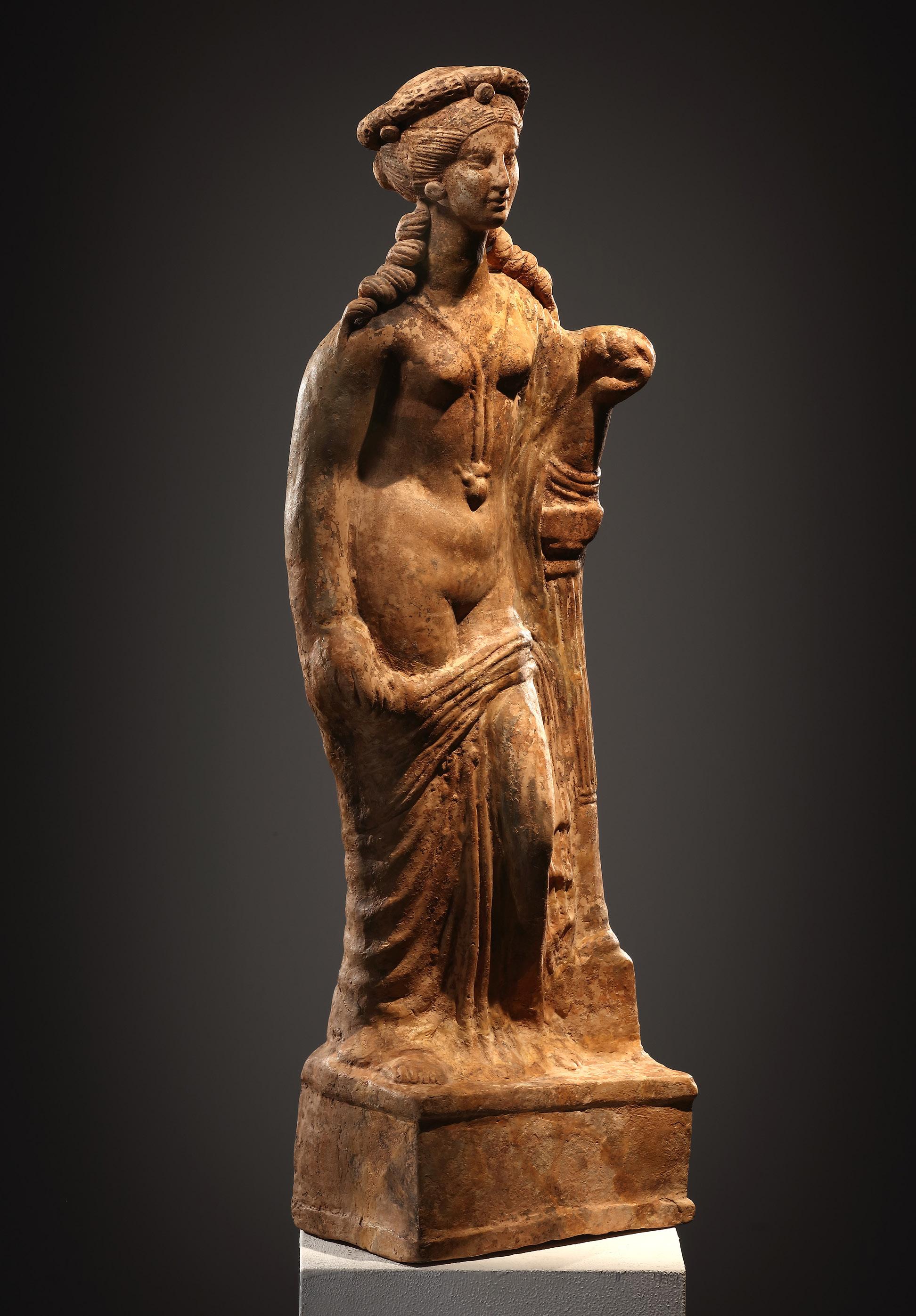
A MONUMENTAL TERRACOTTA STATUETTE OF A SEMI-NUDE APHRODITE
Price on Request
Eastern Mediterranean | 1st century B.C. H. 63,0 cm | W. 19,0 cm | D. 12,5 cm | Clay
The goddess stands frontally, her left elbow resting on a partly fluted column. She holds a corner of her cloak, which is draped around her elbow and back, in her raised hand. The other end rests loosely on the thigh of her relaxed left leg. She grasps the folded edge of the cloak with her lowered right hand. The hair is combed backwards from the temples and tied together at the nape of the neck, forming a bow. Two thick spiral curls rest on her shoulders. The goddess wears a wreath with three inserted flowers and disc earrings. A long necklace
with a bulla hangs around her neck, passing between her breasts and reaching down to her navel. The figure is modelled in the round. The back of the head is modelled in detail whilst the back of the body is treated in a cursory manner. A leafshaped firing hole on the reverse. The high rectangular base with rims is open at the base. Statuettes measuring 50 cm and above are exceedingly rare, due to their particular fragility. Reassembled, a few small restorations. The layer of engobe is largely preserved but is partially sintered and has partially
flaked off. Remains of polychromy, mostly discoloured; a pink band below the chest.
NOTE
The closest stylistic and typological parallels to our Aphrodite can be found in statuettes of Eros and Dionysos from Myrina; cf. S. Mollard-Besques, Catalogue Raisonné des Figurines et Reliefs en terre-cuite Grecs et Romains II. Myrina (Paris 1963), pl. 55 g (Myrina 681); pl. 54 f (LY 1501); pl. 93 a–f; for the distinctive shoulder curls, cf. pl. 15 d; pl. 94 e (Myrina 1134). The Leaning Aphrodite type is preserved in numerous variants, cf. in particular the so-called Urania type from Cyrene, see LIMC II (1984) 70 f. nos. 605–622, pls. 60–61 s.v. Aphrodite (A. Delivorrias). The coroplast of our terracotta modified the prototype so that the arms could be cast together with the body rather than being attached separately.
PROVENANCE
Formerly Prof. Bieter Wyss, Germany, prior to 1982. Thereafter, priv. coll. Mr. Pedro Benda (19182001), Lausanne; acquired in 1982 from MuM AG, Basel, Auction 60, 1982, lot 62. Since then in the family.
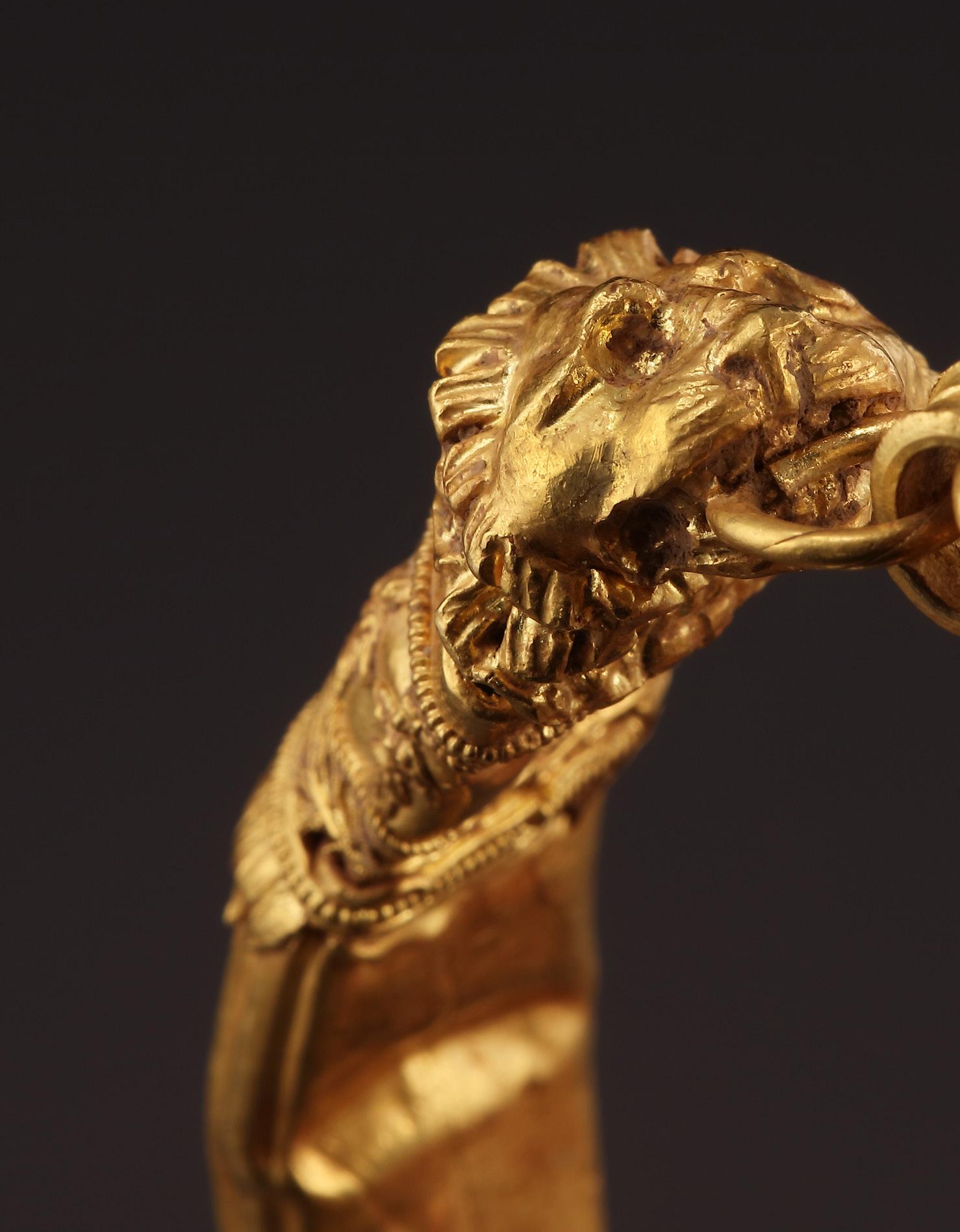
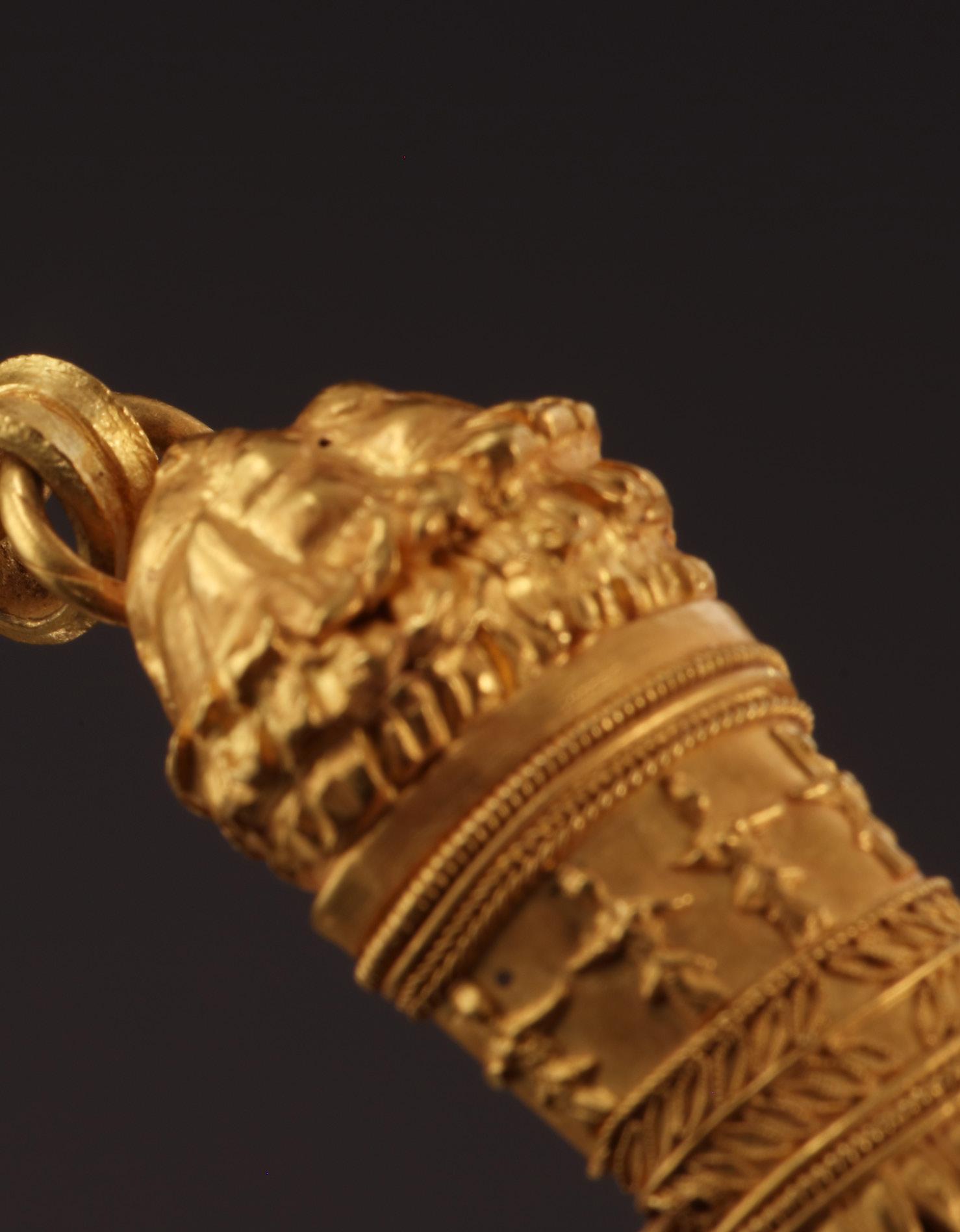
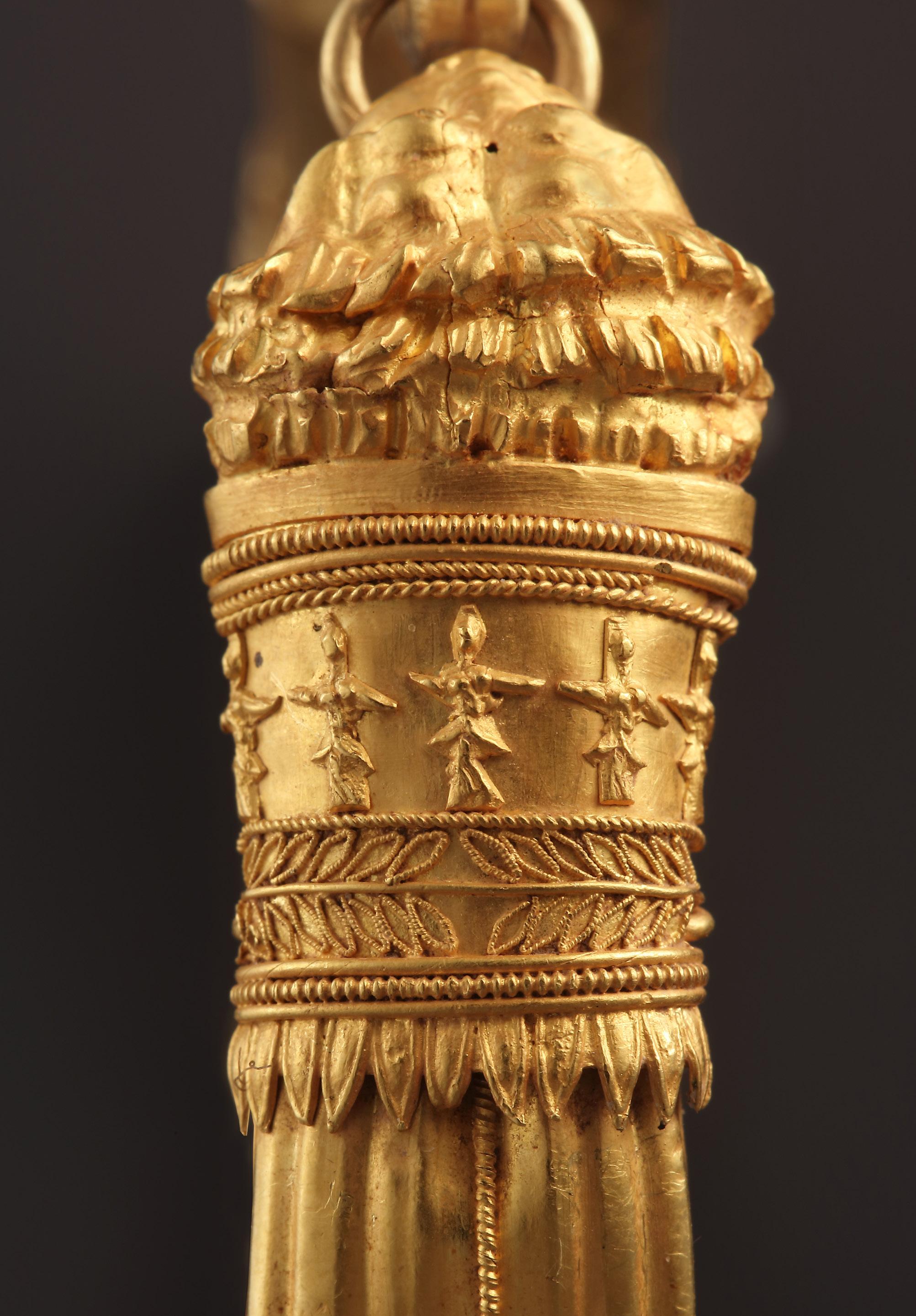
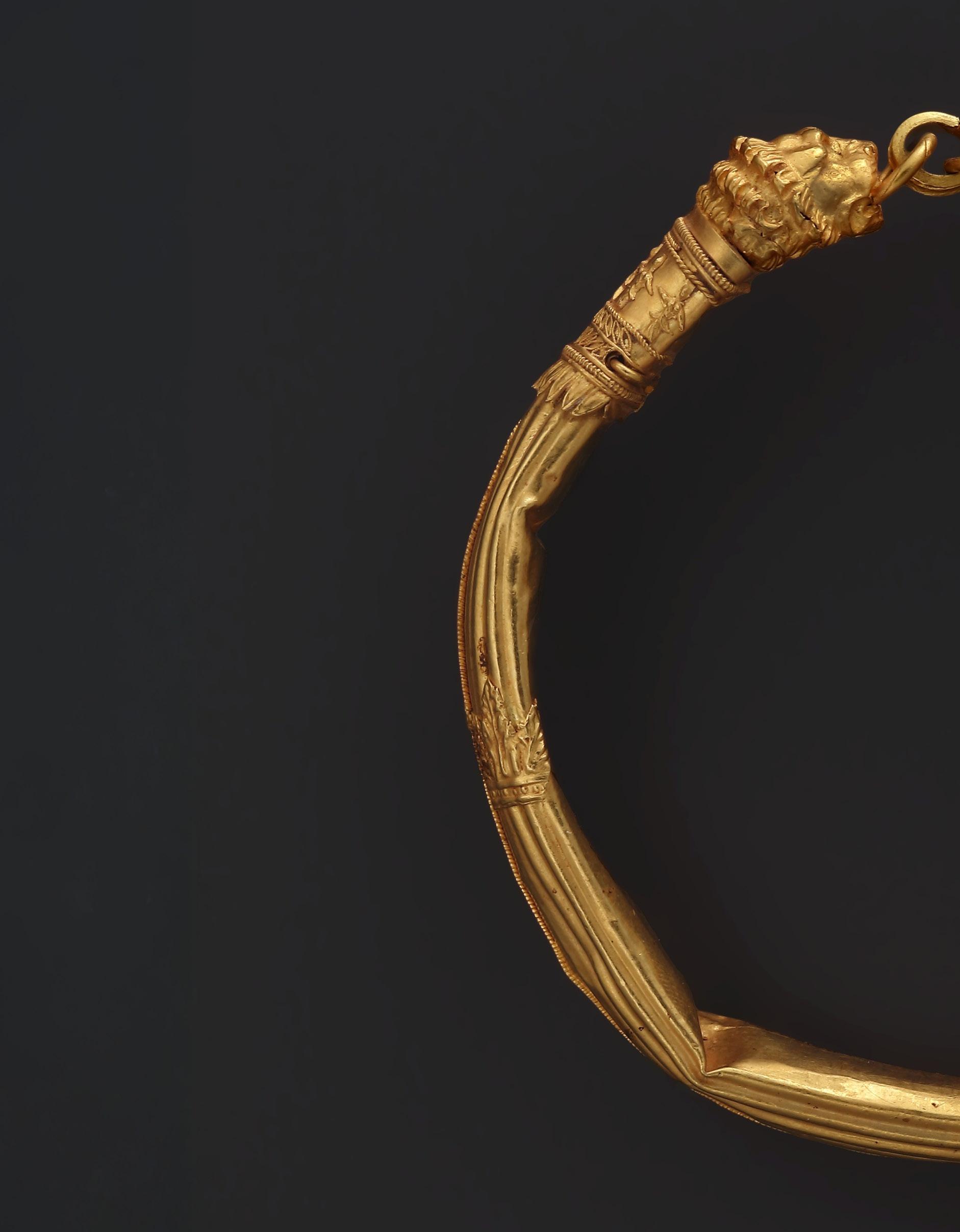
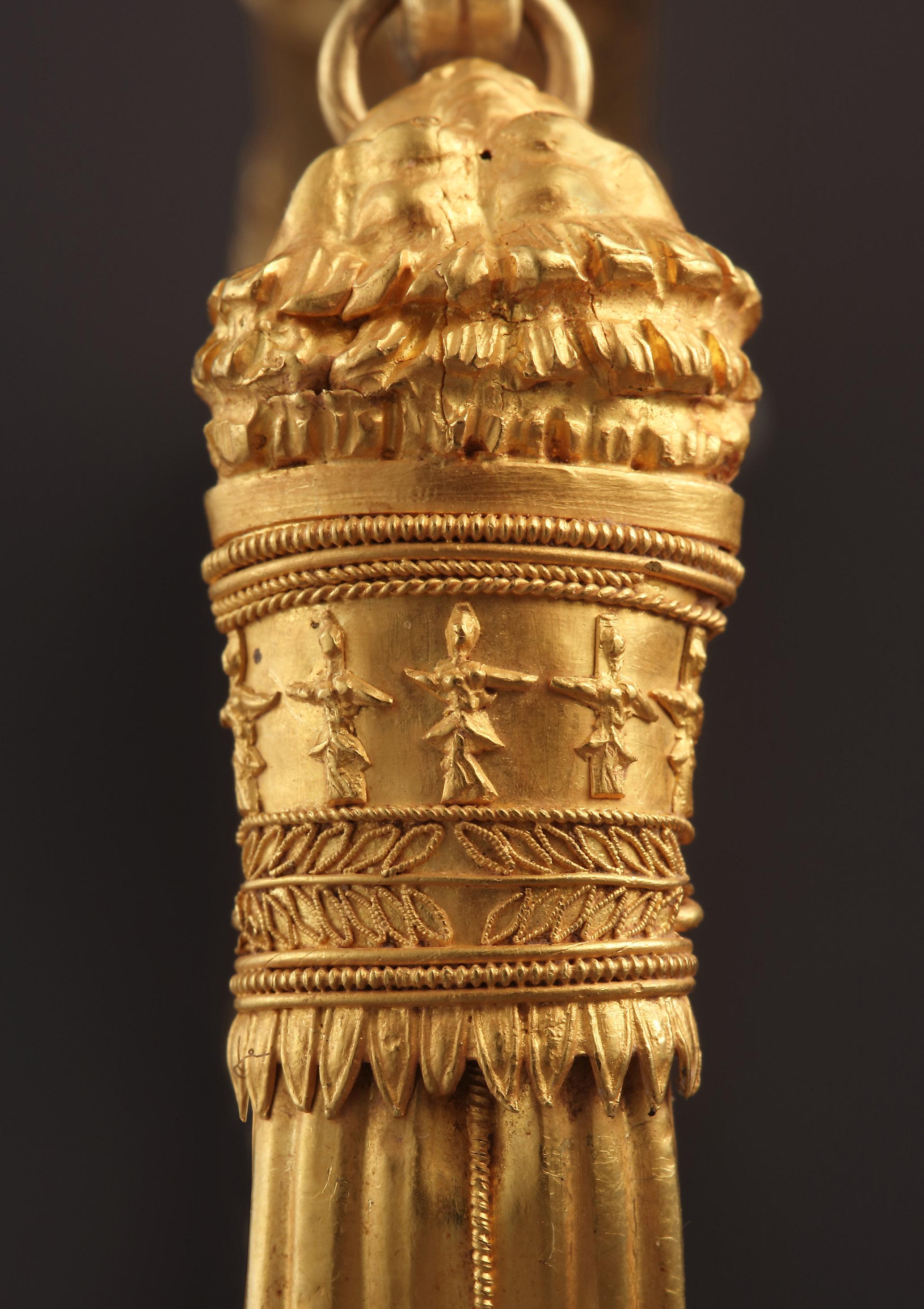
A MAGNIFICENT GOLD BRACELET WITH LION HEADS AND KALATHISKOS DANCERS
Price on Request
Greek or Western Greek | late 4th century B.C. H. 9,2 cm | W. Hoop. 1,8 cm | Interior Diam. 7,1 cm | Gold
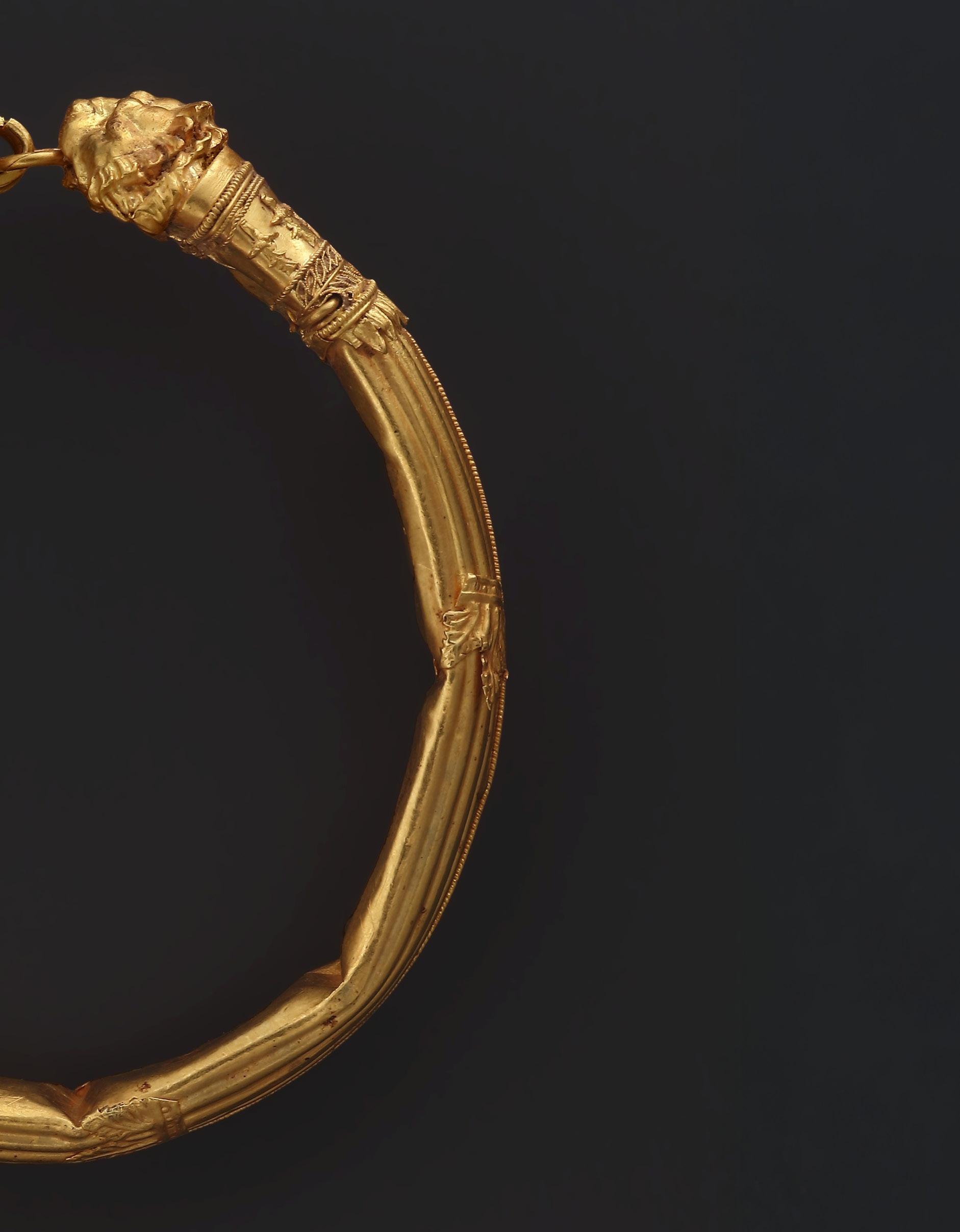
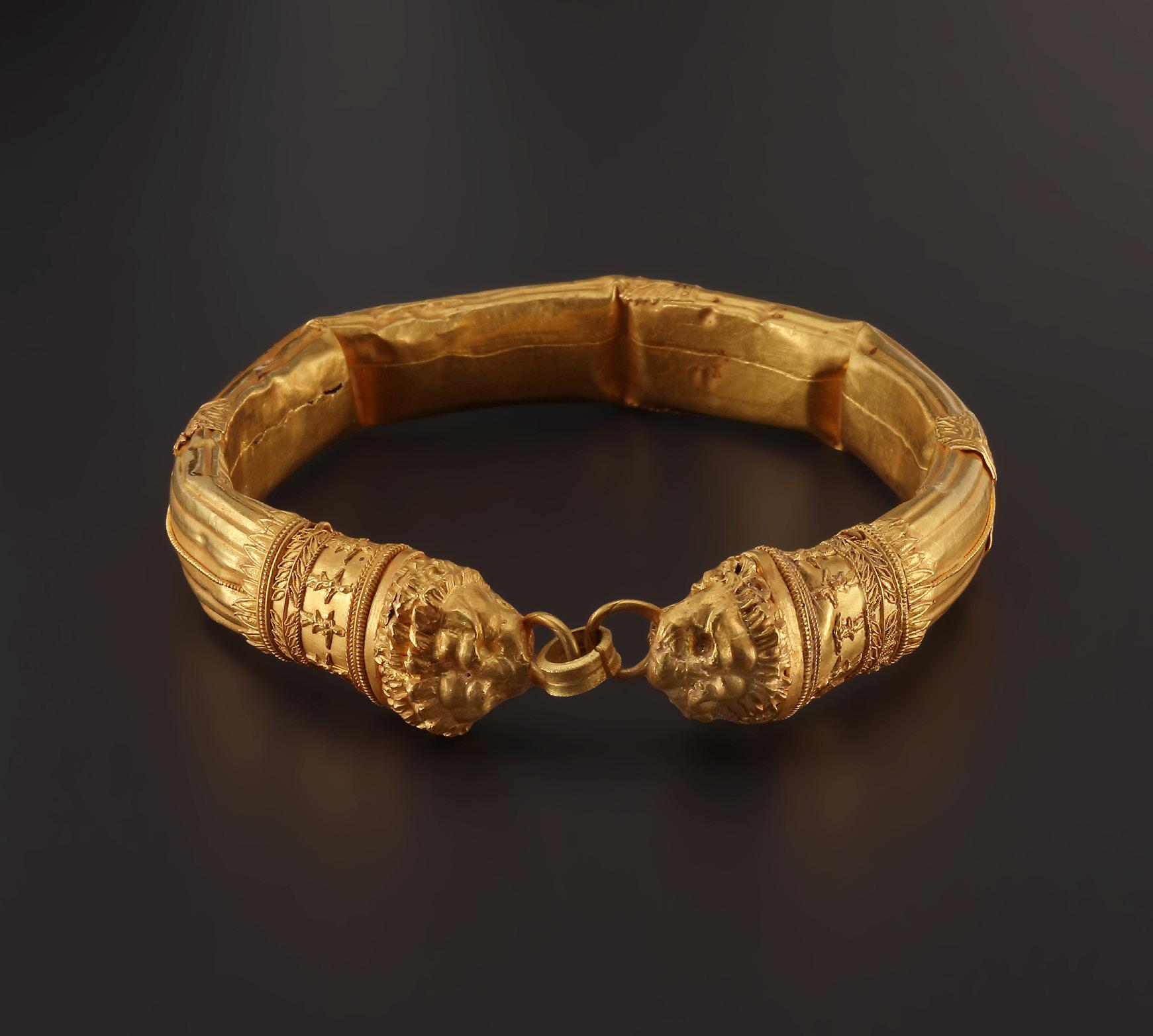
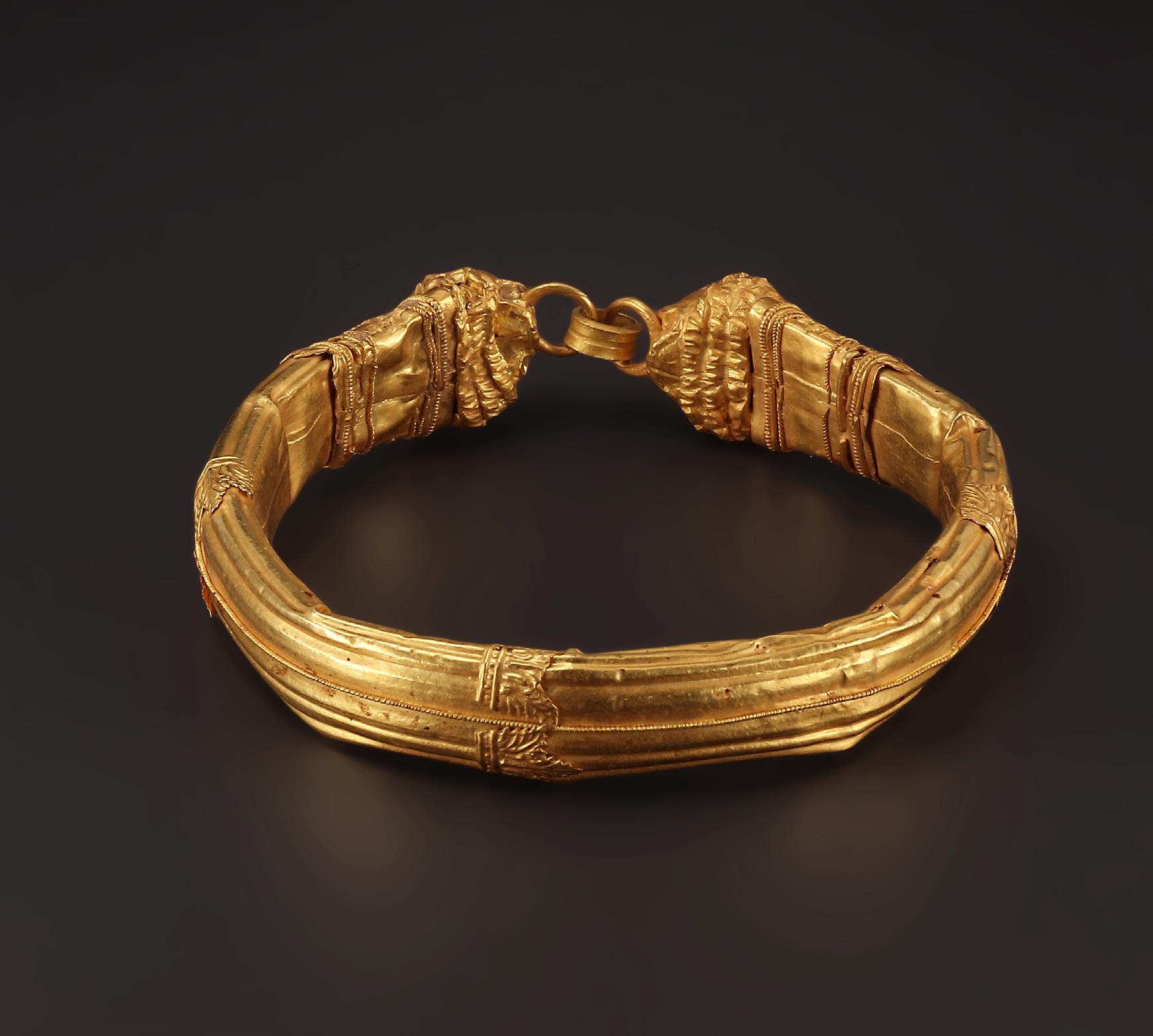
The open hoop, with relief decoration and a central twisted gold wire, is made from sheet gold sheet wrapped around a core of resin, copper alloy or another material. The exterior is adorned with three pairs of acanthus leaves, that are spaced at equal intervals. The ends of the bracelet are masterfully crafted into naturalistic lion’s heads. A loop is attached to each lion’s head, and these in turn are connected by an open ring. The cuffs behind the lion’s heads are richly decorated with twisted rods and petals. A particularly rare feature
is the delicate frieze of Kalathiskos dancers, who usually performed at cult festivals, dancing on tiptoe with arms outstretched. They wear basket-like headdresses (kalathiskoi) and flowing garments. Clips made of gold wire secure the cuff to the hoop. The bracelet is a masterpiece from the zenith of Greek goldsmithing. The bends of the bracelets interior are of ancient origin and were intended from the outset. Slightly dented in a few places. A few fissures. The eyes of the lions were originally inlaid.
NOTE
Accompanied by a report by Dr. Jack Ogden. - Cf. D. Williams - J. Ogden, Greek Gold. Jewellery of the Classical World (London 1994) 218, cat. no. 152. Kalathiskos dancers are known to have performed in various cultic contexts and are frequently associated with the “saltantes Lacanae” (the dancing
Lacedaemonian women of Sparta), created by the Greek goldsmith and sculptor Kallimachos, active in the late 5th cent. B.C. (cf. Pliny, Nat. Hist. 34, 92).
PROVENANCE
Formerly priv. coll. Ian Thomas Roper, Bishop‘s Stortford, Hertfordshire; acquired on the London art market in the mid-1970s. With Christie’s auction, 25.10.2014, London, lot 128. Thereafter priv. coll.; acquired on 14.08.2015 from Ariadne Galleries, New York.
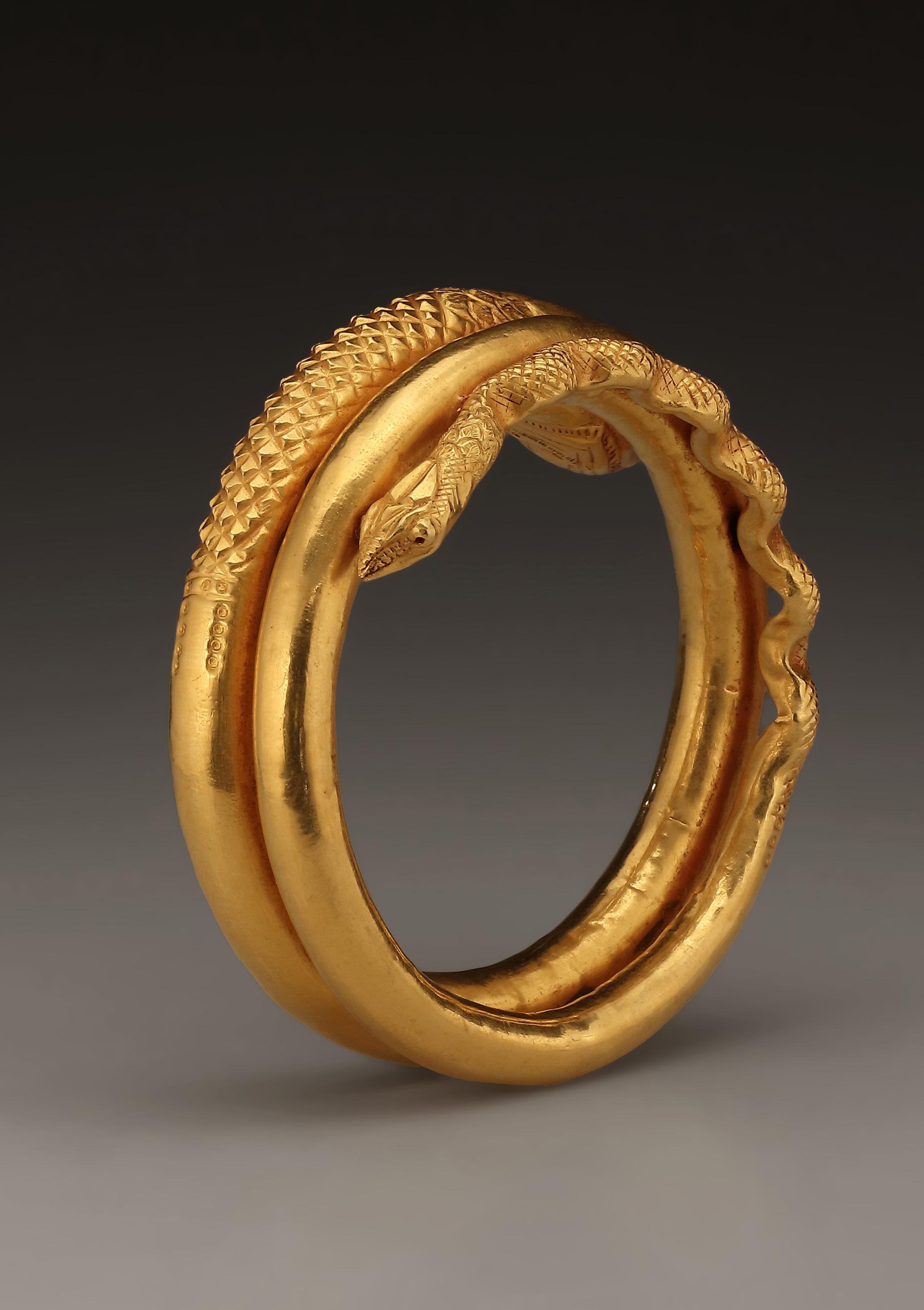
A MONUMENTAL GOLD SNAKE BRACELET
Price on Request
Roman Egypt | 1st - 2nd century A.D.
H. 10,0 cm | W. 3,9 cm | Interior Diam. 7,3 cm | Gold
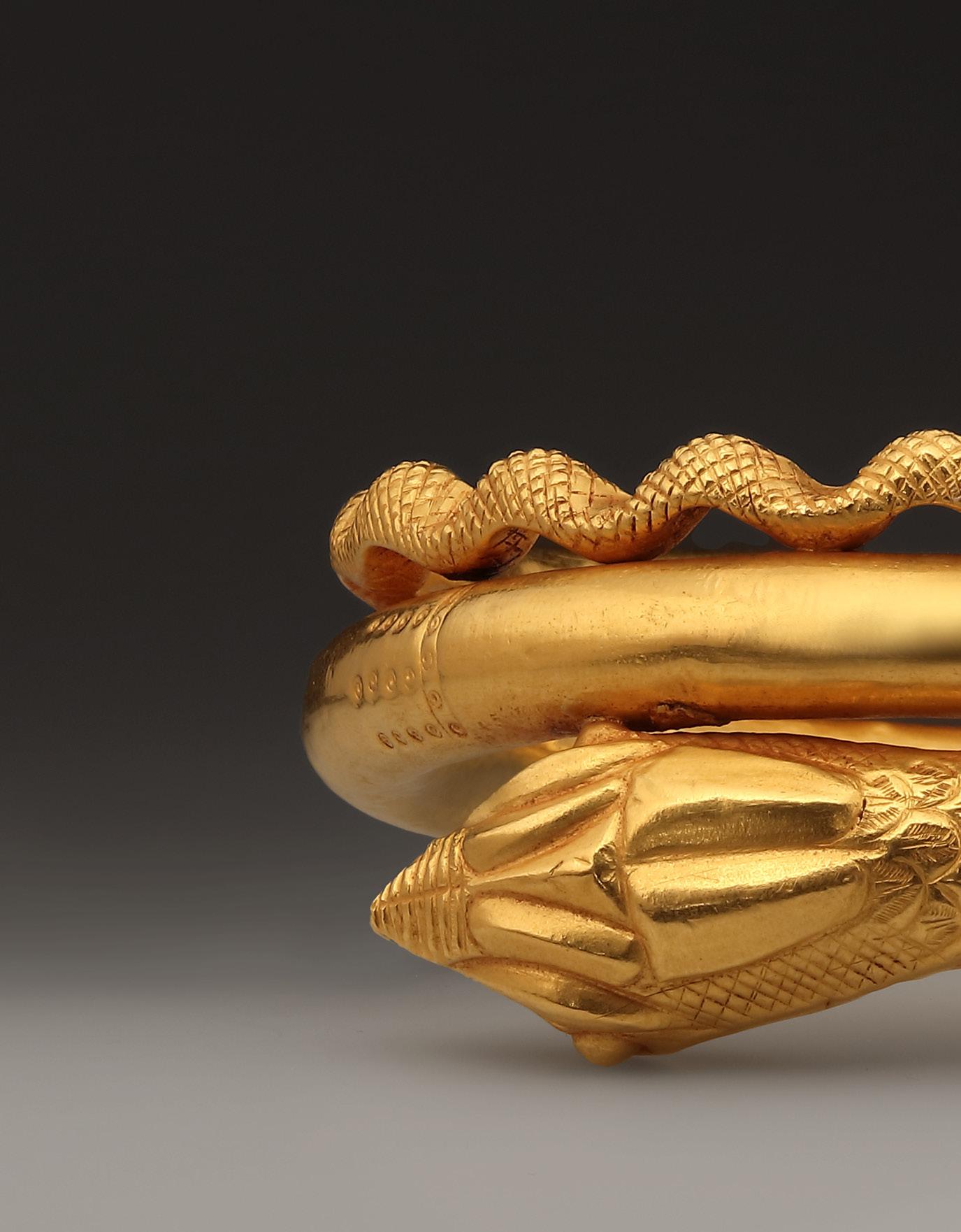
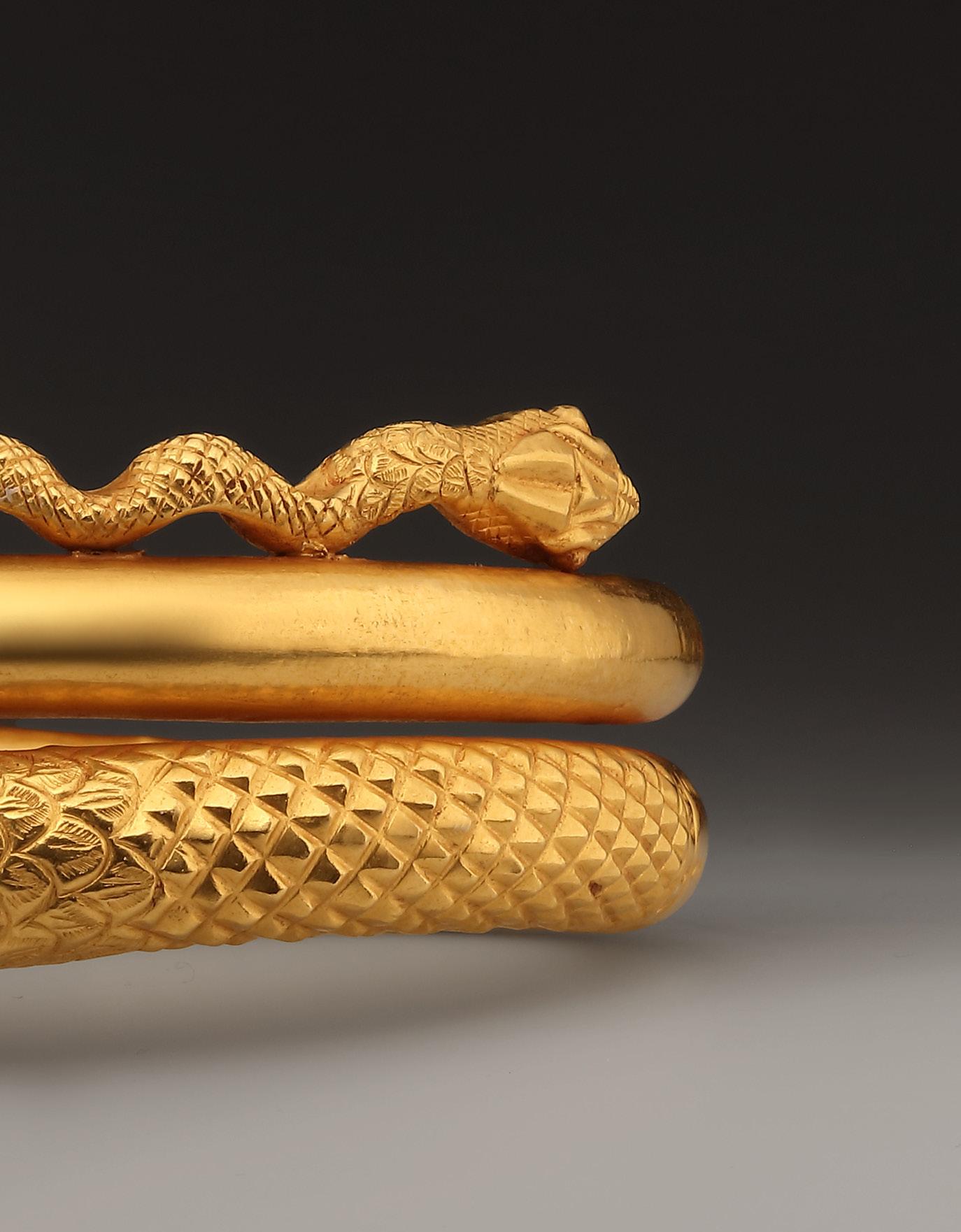
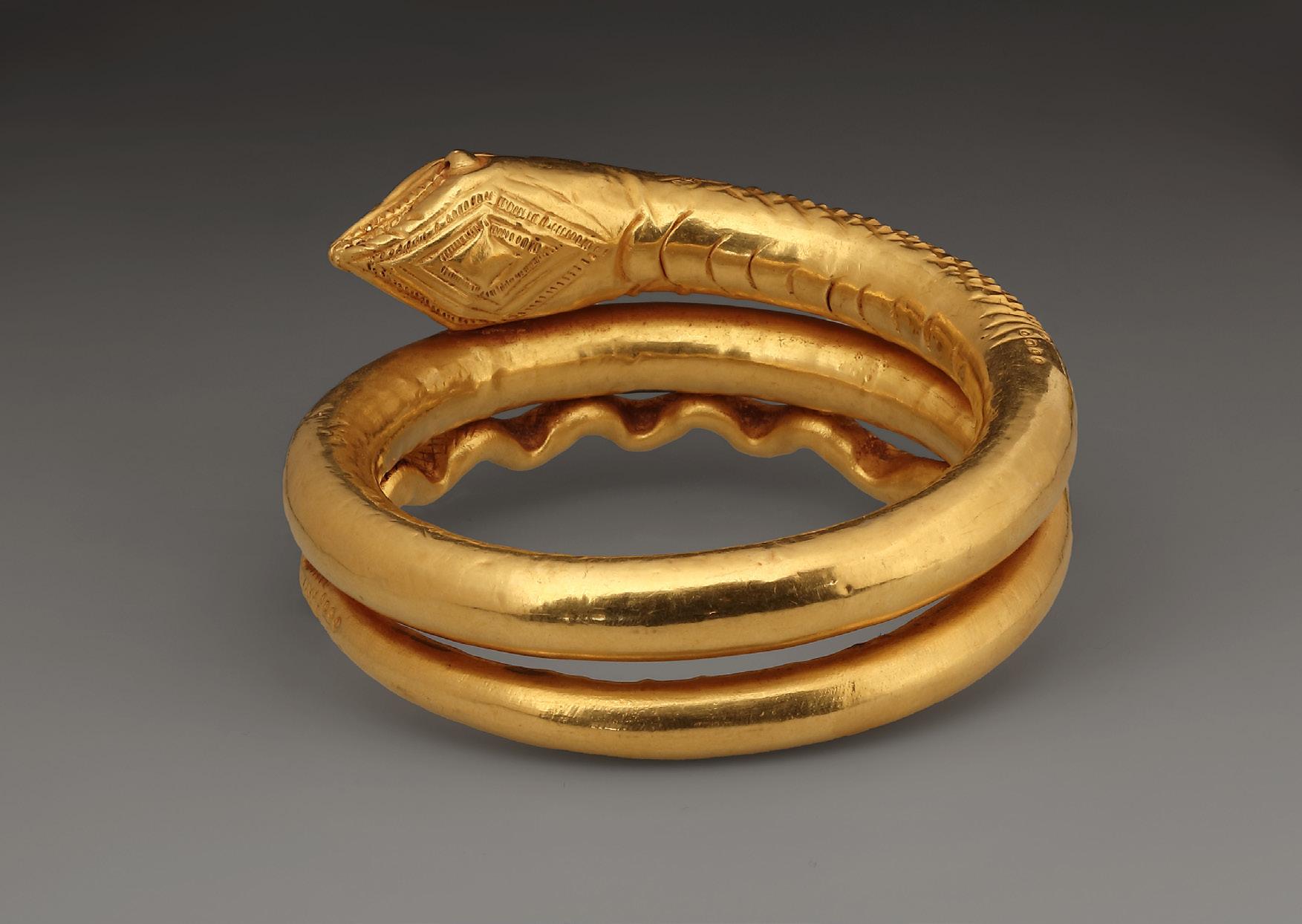
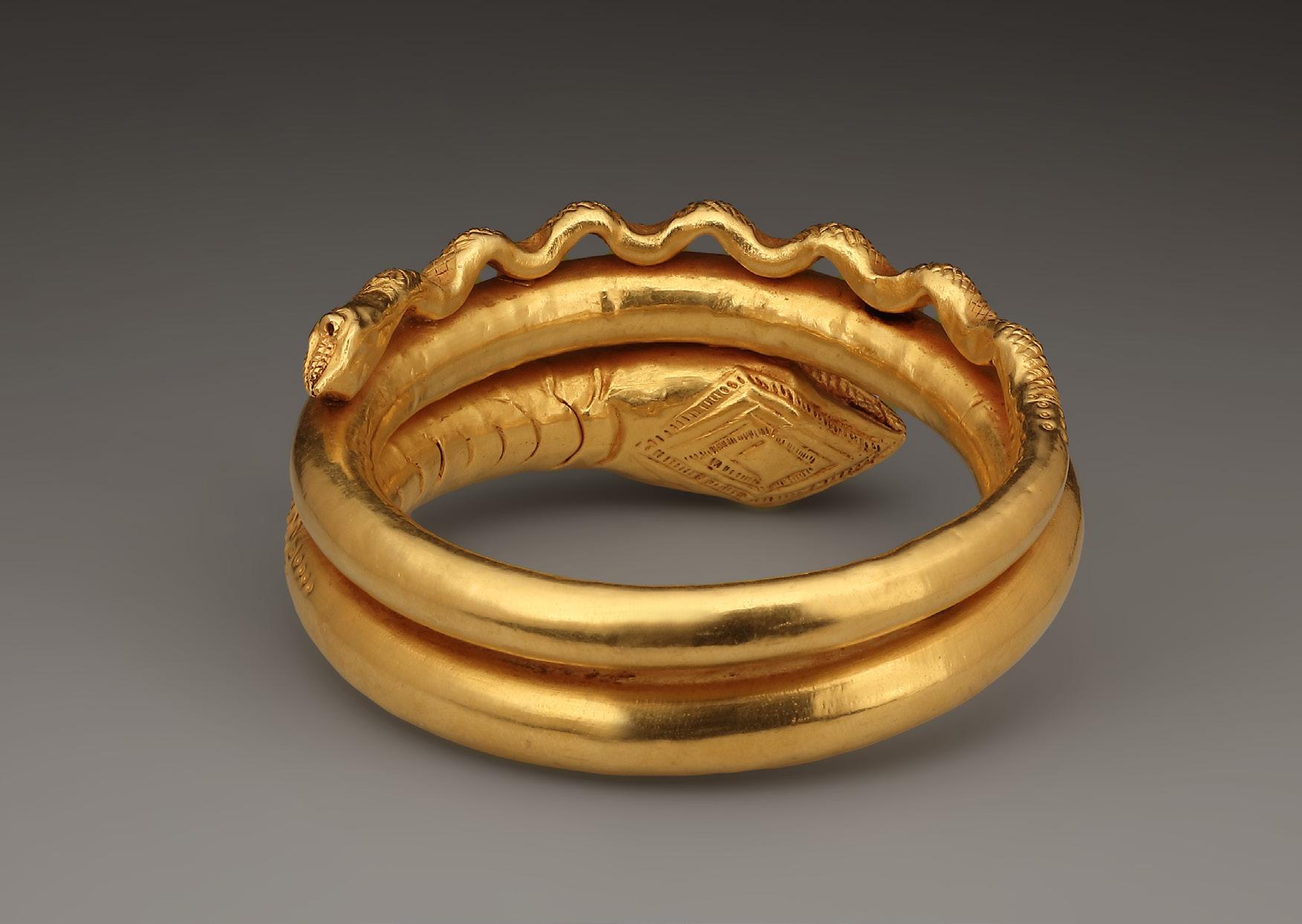
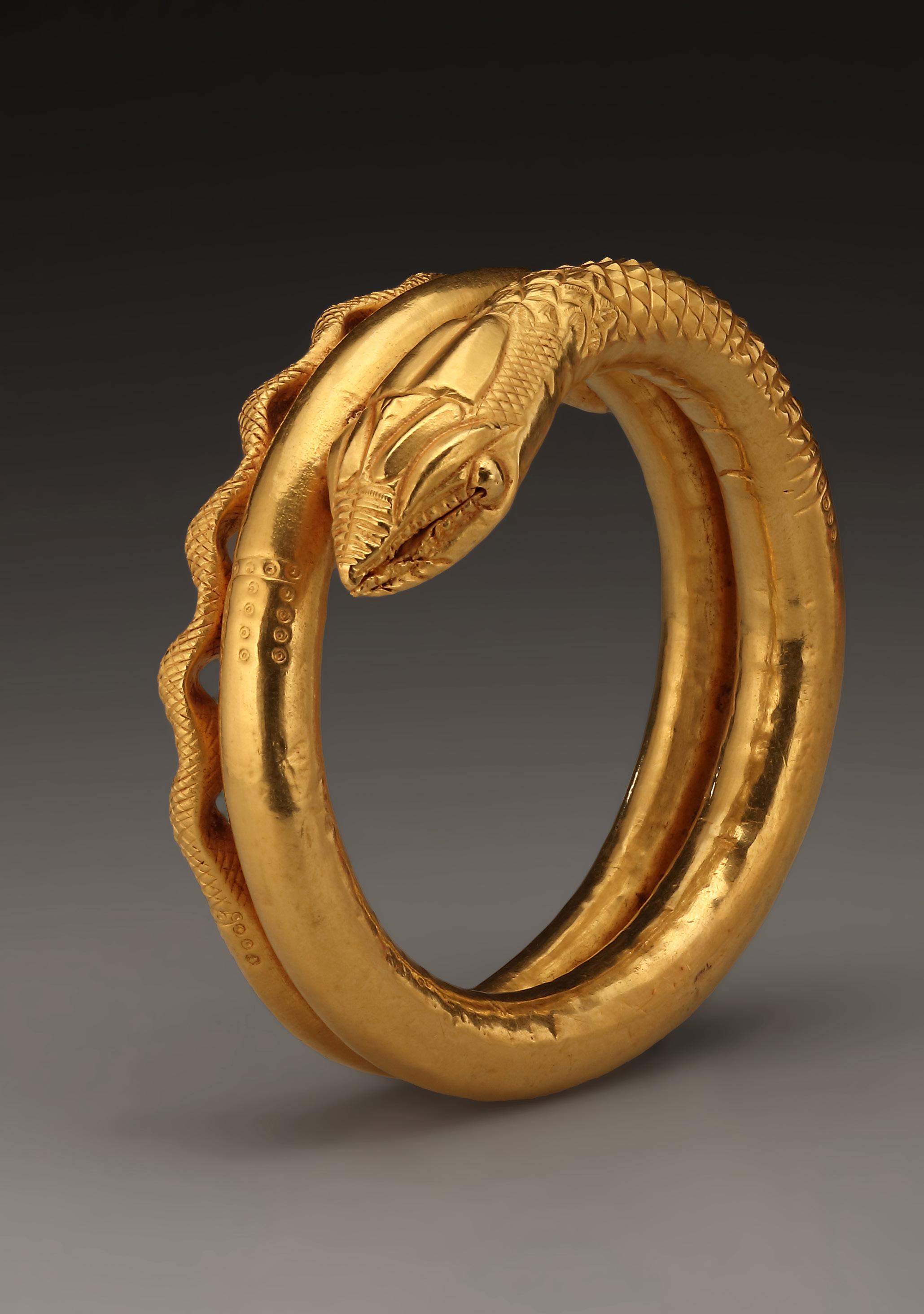
A monumental bracelet made of thick sheet gold sheet in the form of a snake coiled in 2¼ turns. The head and body form the beginning of the bracelet, while the undulating tail end forms its termination.
Remarkably, the tail also ends in a snake’s head, creating the impression that two creatures are joined together. A pattern of carefully executed lozenges render the snake’s skin in relief. A delicate scale pattern marks the transition to both of the snake heads which are modelled fully in the round and are richly detailed through meticulous hammering and engraving. The raised eyes have a spherical form. The underside of the larger snake’s body is enlivened by curved engraved lines. The outwardfacing and thus visible eye of each
snake was presumably once inlaid. A consistently arranged pattern of circular punch marks is found at the transition from the snake’s body and tail end to the undecorated central section of the bracelet, as well as at its center. Parts of the tail and the inward-facing eyes of both snakes are attached to the bracelet by means of cast gold. Already in the Archaic Period, snake-shaped bracelets were widespread in the Near East and in Greece. In the Hellenistic and Roman Periods, the type of spiral snake armlet documented by the present example enjoyed particular popularity in Egypt, where the addition of a second snake head at the tail end appears to have been an iconographic peculiarity of local workshops. Given the multivalent
symbolism of the snake, the precise function of such armlets remains elusive. However, they probably served primarily as protective amulets. The snake is associated with various cults, especially that of the Greek healing deity Asklepios, thereby opening up numerous further interpretative possibilities. In Egyptian religion, snakes are associated, among others, with the deities Isis and Serapis (cf., for example, a gold finger ring in the form of a snake in which the snake heads are replaced by busts of Isis and Serapis; British Museum, inv. 1926,0407.12). Mouth of the larger snake head slightly dented on one side.
NOTE
Examined by the jewellery expert Dr. Jack Ogden; report available. – For the type, cf. a smaller and more slender snake bracelet whose structure and certain decorative details that are very similar to our specimen: Metropolitan Museum of Art, New York, inv. no. 18.2.19; furthermore, an example in the J. Paul Getty Museum, Malibu, inv. no. 96.AM.205. Typologically and stylistically related examples
are also known from the Vesuvian region, though without a snake head at the undulating tail end. Cf. British Museum, London, inv. no. 1946,0702.2 (from Pompeii). In other spiral snake armlets originating from Egypt, the snake motif is varied. Cf. several specimens in the J. Paul Getty Museum with rearing snakes, either with two independent creatures spirally intertwined (inv. no. 92.AM.8.7) or as a spiral bracelet consisting of a single snake with only one head (inv. no. 92.AM.8.6). The cartonnage masks of two women show how such snake bracelets may have been worn. Cf. S. Walker - M. Bierbrier, Ancient Faces. Mummy Portraits from Roman Egypt (London 1997) 80 f., cat. nos. 58–59; cf. also p. 133, cat. no. 136.
PROVENANCE
Formerly priv. coll. Ernst (b. 1903 - d. 1990) and Marthe Kofler-Truniger (b. 1918 - d. 1999), Lucerne, collection built up between 1950 - 1960. Thereafter, priv coll. Albert Bollinger, Switzerland; acquired in 2000 from the heirs Anita Palfalvi-Kofler and Sylvia Kofler, Lucerne, who inherited it in 1999 after Marthe‘s death in her residence of Gesegnetenmattstrasse, Lucerne (see the purchase agreement dated 2002 and the document from the official gazette of the canton of Lucerne dated 2003).
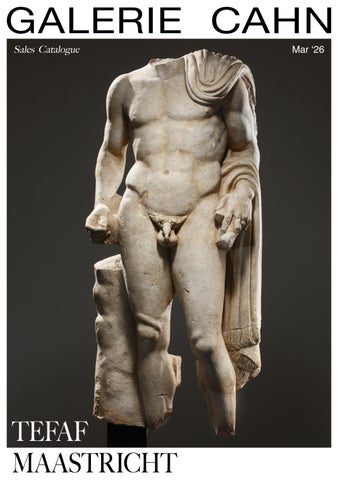
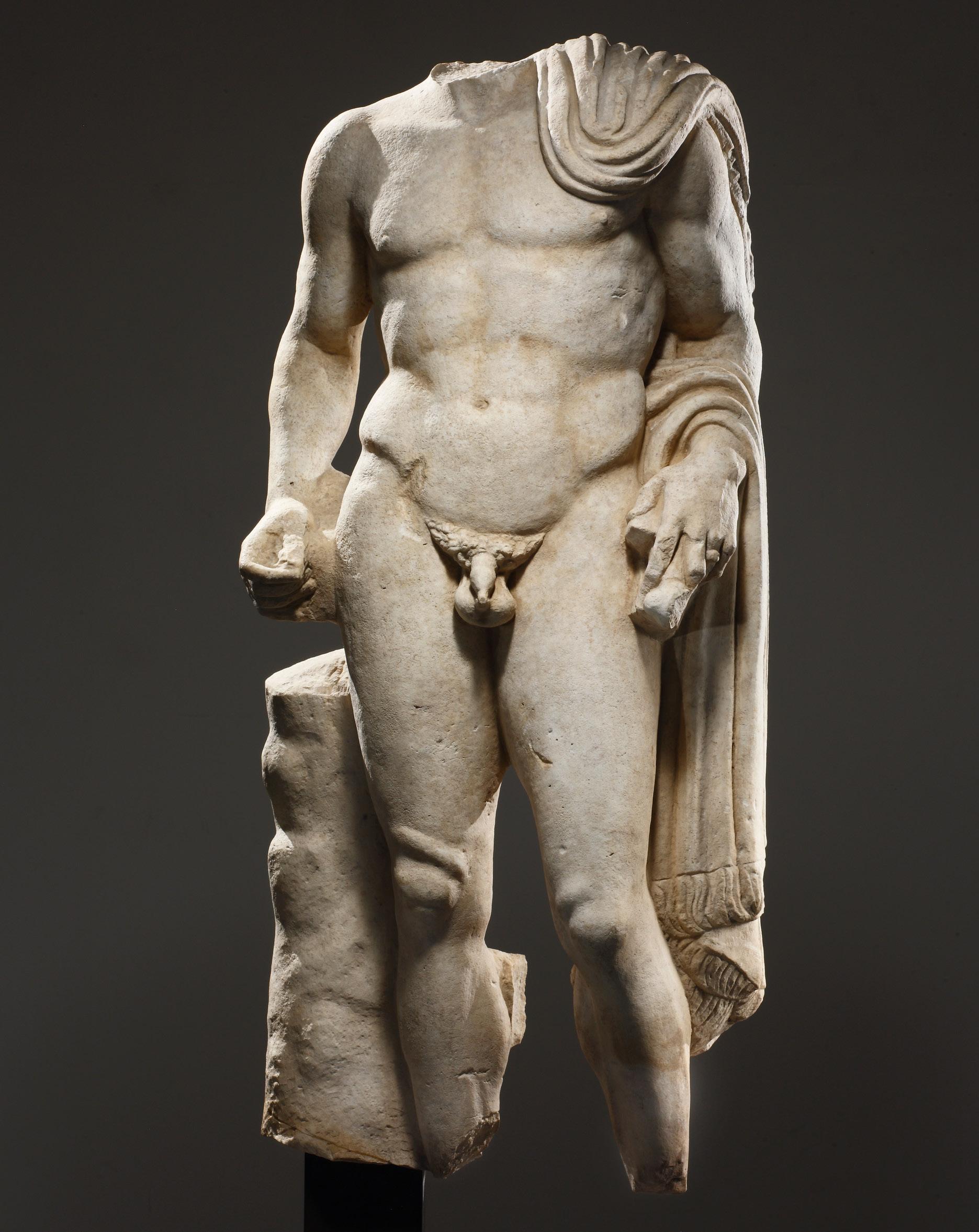
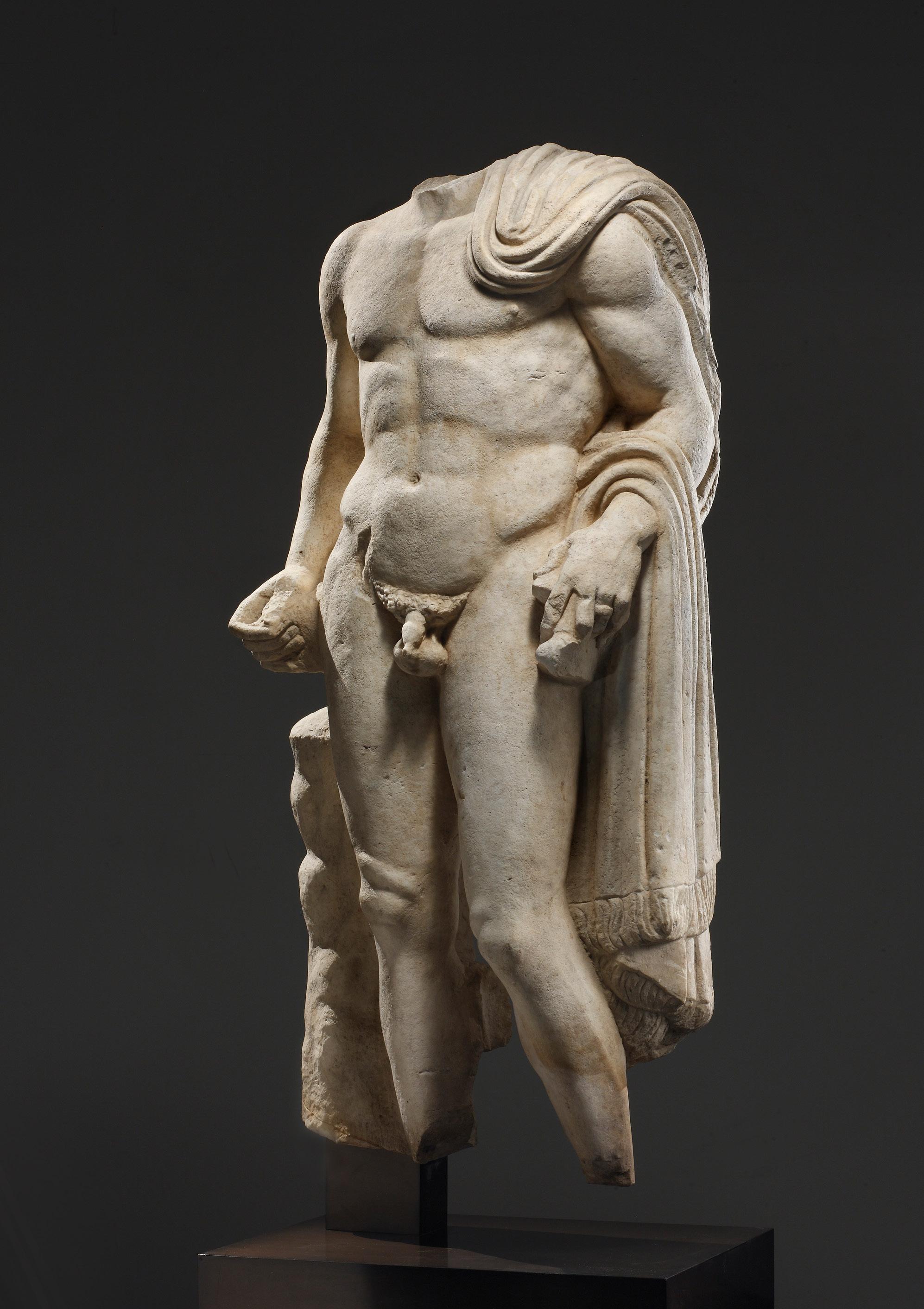
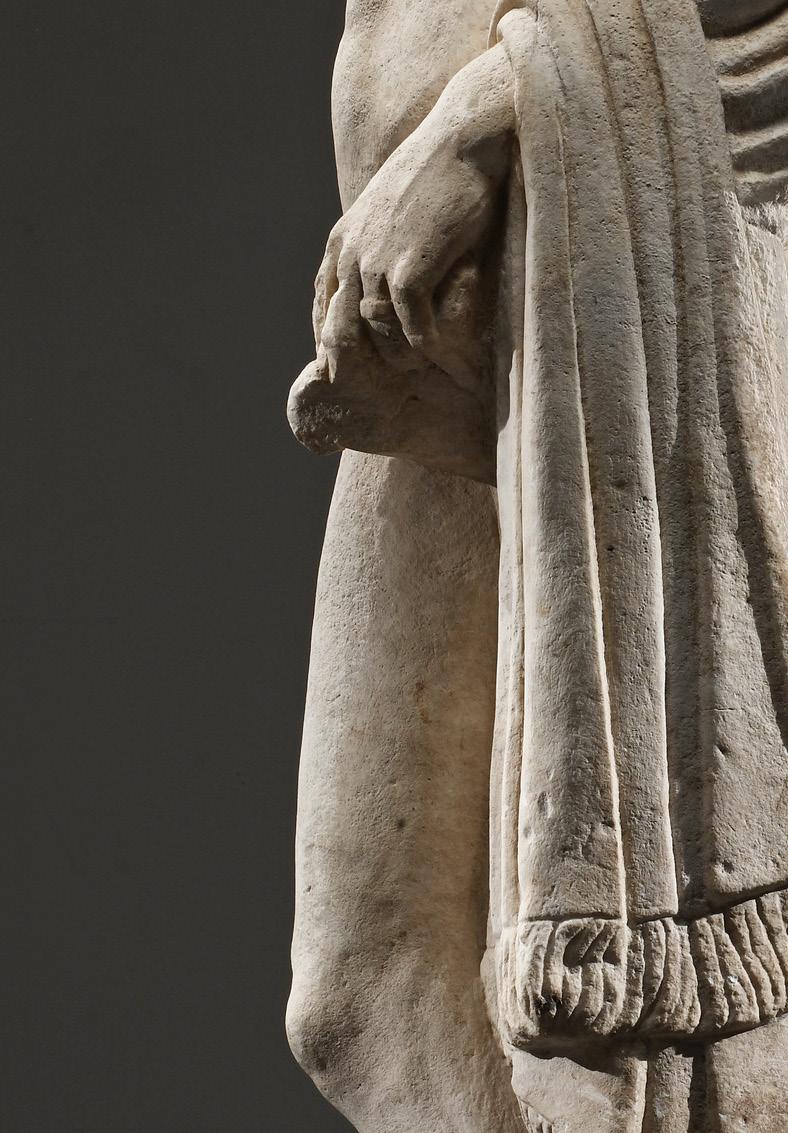
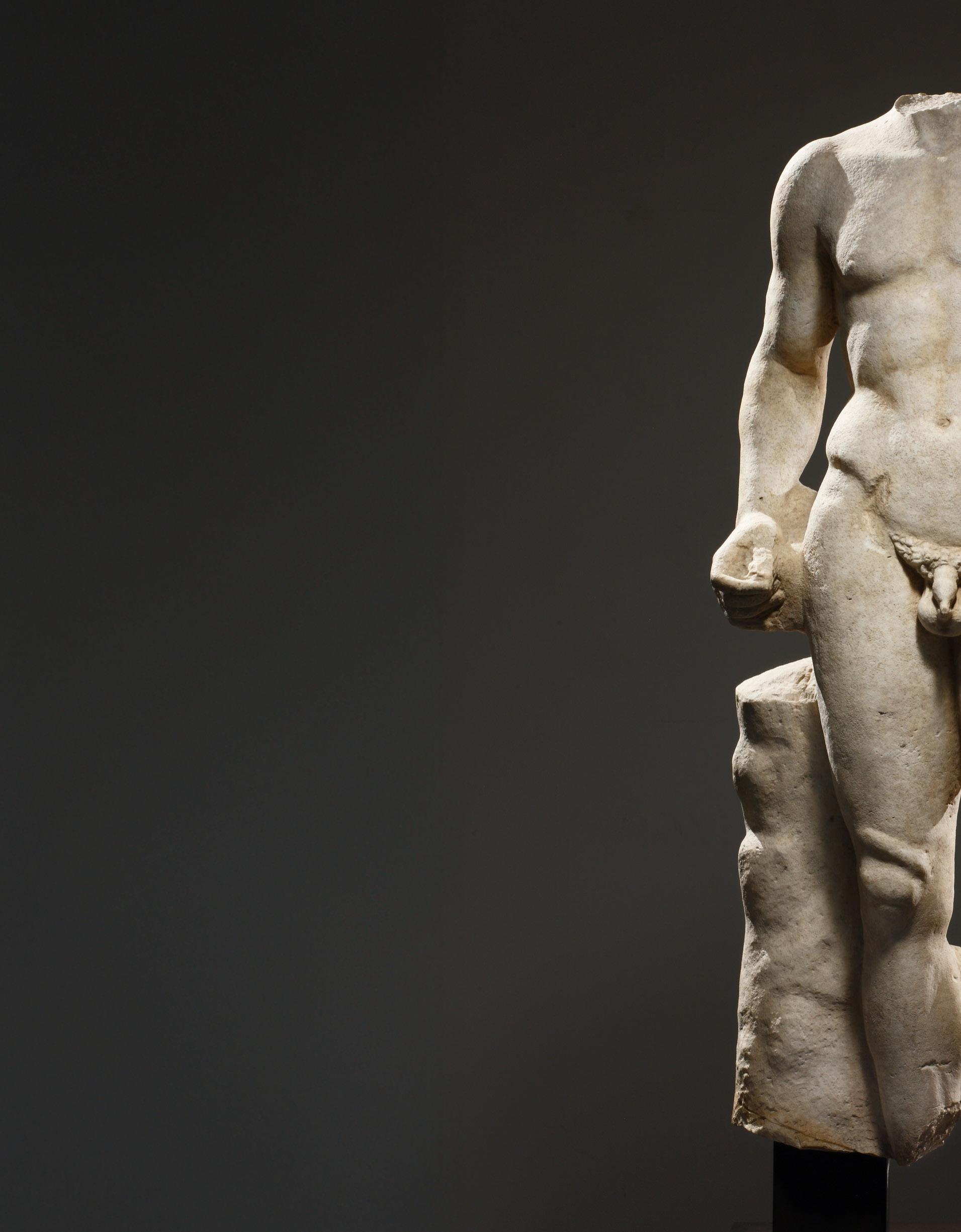
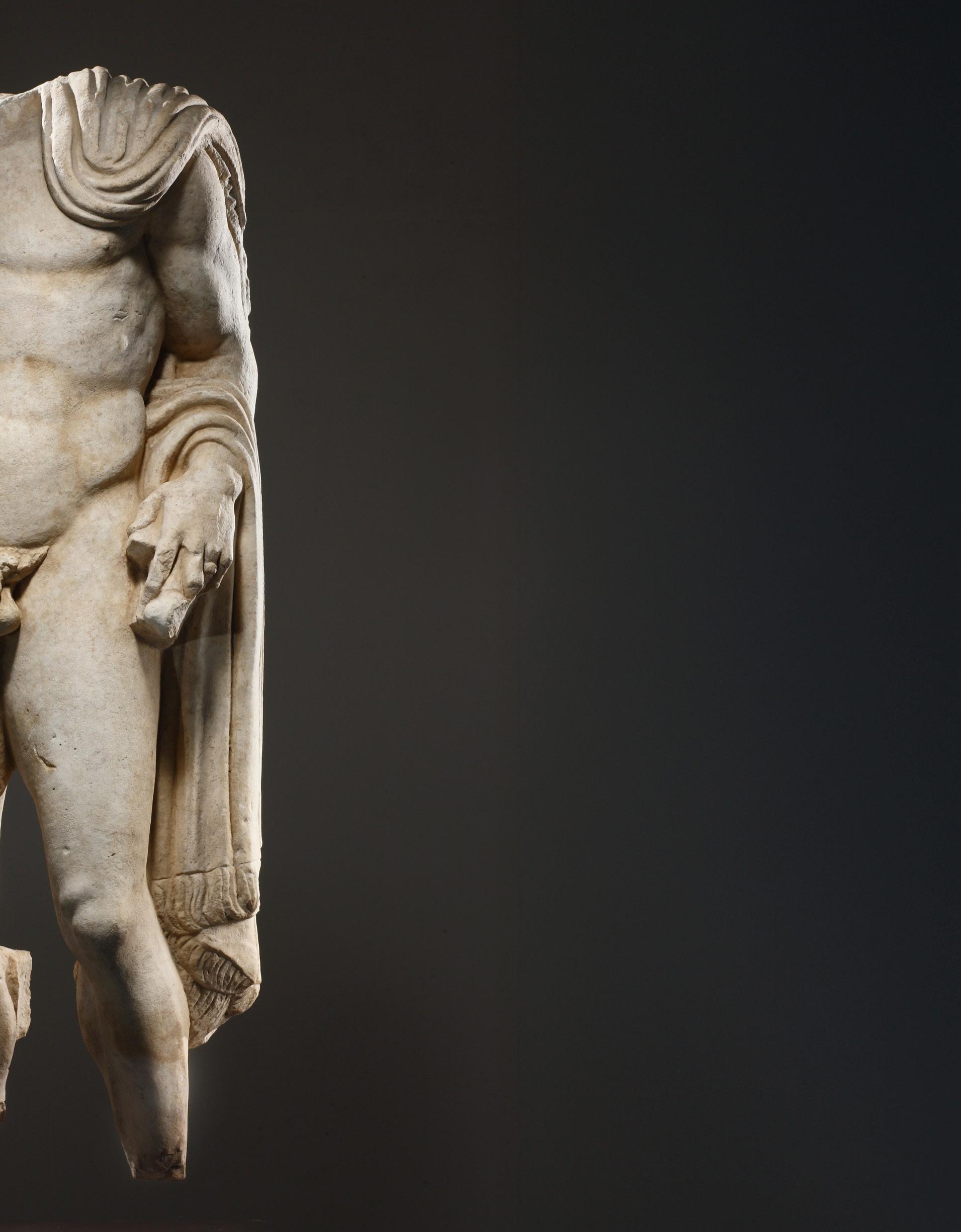
A TORSO OF A HEROIC STATESMAN OR GENERAL
Price on Request
Roman | 1st century B.C. - 2nd century A.D.
H. 165,1 cm | Marble representation was, however, less frequently used than that of the toga statue. The statue of C. Ofellius Ferus from Delos and the so-called General of Tivoli are impressive examples of the former. Head and feet lost. Repairs (probably ancient) to the lower end of the tree trunk.
The torso, represented in heroic nudity, shows the figure‘s powerful, athletically built body to advantage. The individual muscles are precisely defined. The figure stands in easy contrapposto, which its weight resting on its left leg. The left shoulder is covered with a cloak that cascades down the back, is wrapped around the left arm and continues down to the calf. The figure holds a short sword in its left hand, the hilt of which is preserved. The ring finger is adorned by a ring. In the late Roman Republic, honorary statues employing the convention of heroic nudity, which doubtlessly stood in the tradition of HellenisticGreek models or types, were set up to honour meritorious citizens or municipalities. This form of
Formerly, priv. coll. Marie Claude Wegner, Paris ; acquired in 1965 from priv. coll. Rose Lacau-Pansini (1890-1985) French actress and film director of the silent era, Paris, rue de la Trémoille (See a letter from Mme Wegner dated 1998). With Antiquarium Ltd., New York; acquired in 1999 from Blair Wilson, London (see invoice and related American customs documents dated 1999).
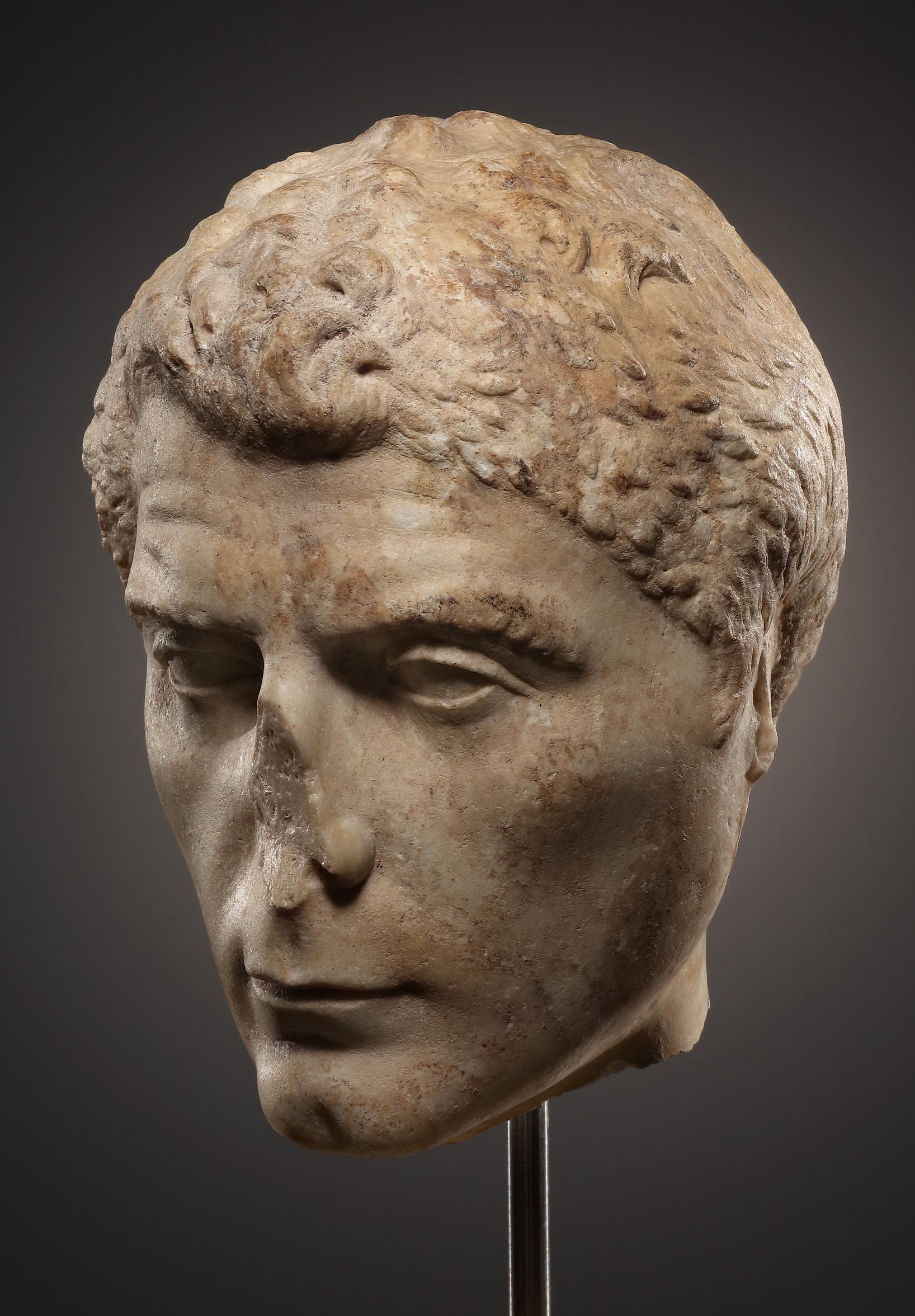
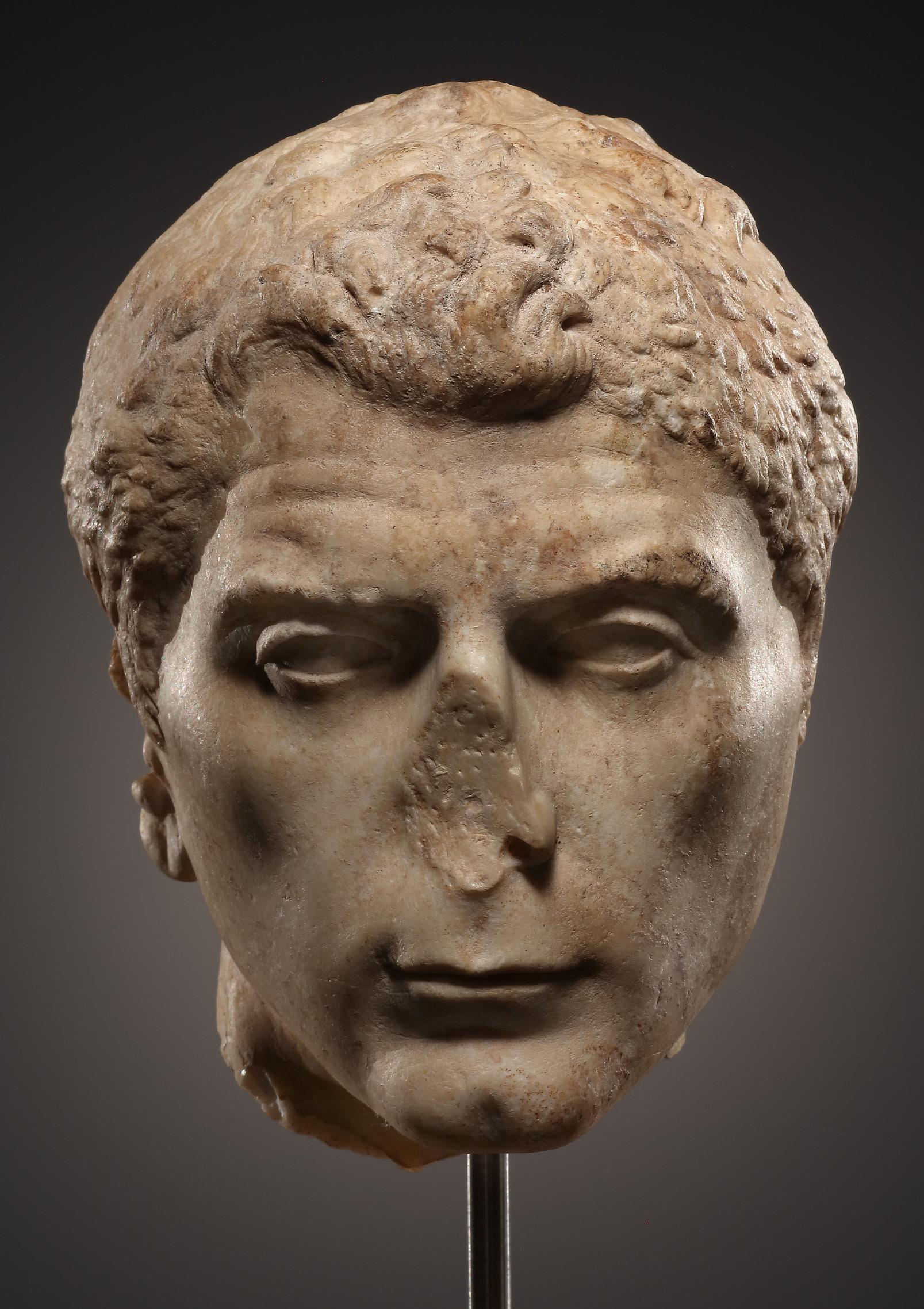
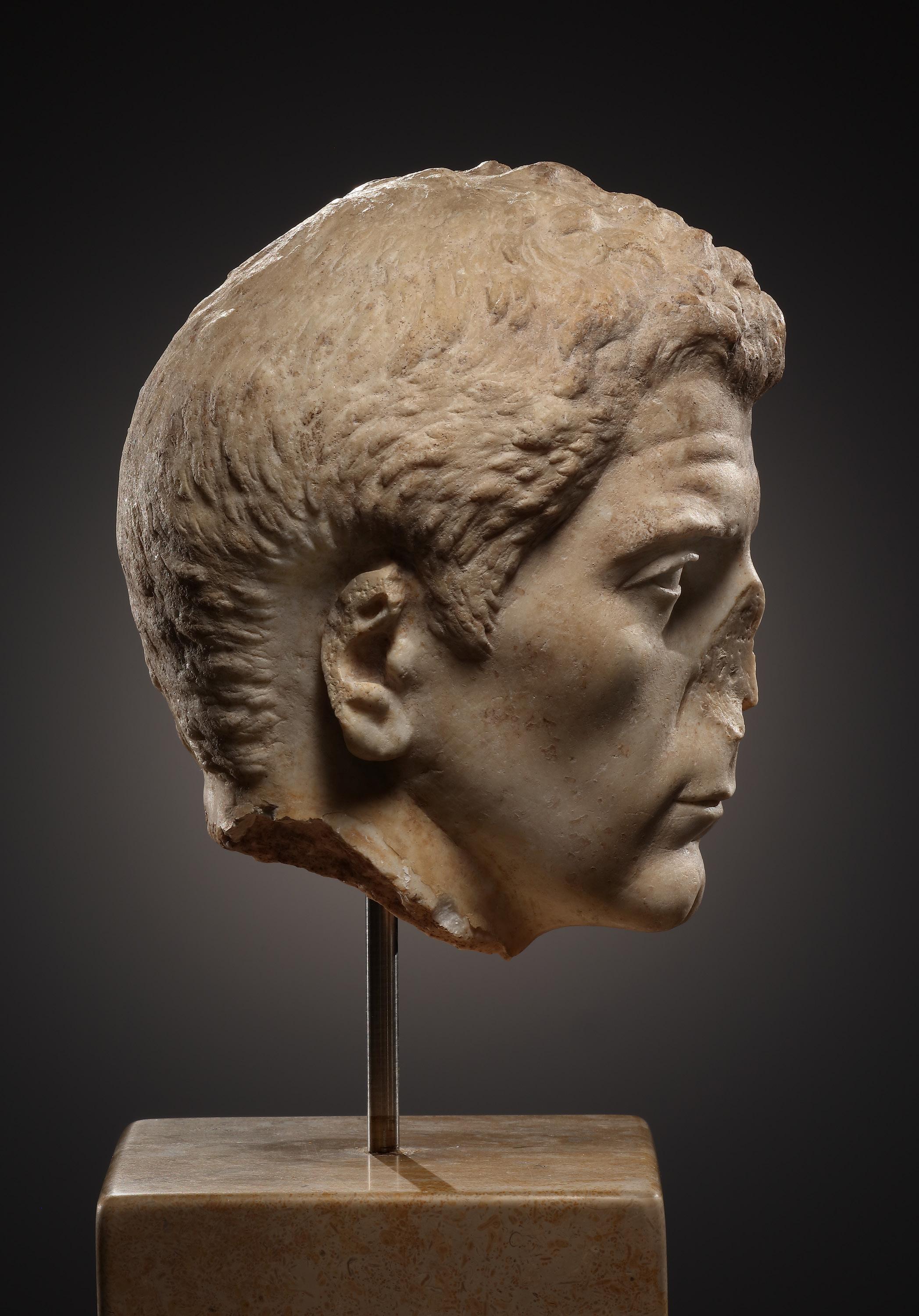
A PORTRAIT HEAD OF A MAN, POSSIBLY OF THE ROMAN EMPEROR NERVA
Price on Request
Roman | 2nd half of 1st century A.D.
Head: H. 24,5 cm | W. 14,0 cm | D. 19,0 cm | Marble
Mounted on Bust: H. 44,5 cm | W. 30,0 cm | D. 19,0 cm
This high-quality portrait of a man with gaunt features is characterised by a degree verism and strongly individualised features. Furrowed forehead. The protruding brows cast a shadow over the deep-set eyes. Sculpturally emphasised eyelids. Prominent cheekbones. Cheeks slightly sunken. The upper jaw protrudes conspiciously. Very narrow lips. Dimpled chin. The portrait was already reworked in Antiquity. This is particularly evident in the rendering of the hair. In addition to a general reduction of volume, short, close-fitting strands of hair which
are in part merely engraved contrast with sickle-shaped curls from the first version of the head that are sculpturally emphasized, partially by deep chisel marks. The voluminous curls are limited to the area above the centre of the forehead, where the hair is slightly raised and end at the hair whorl on the top of the head. The rendering of the hair above the forehead and the fleshy brows with curved furrows are characteristic of depictions of satyrs. Furthermore, the right ear tapers towards the top and may well have originally ended in a point. The shape of the
face with the slender lower section and the small, slightly receding chin with its distinctive dimple are the result of the reworking of the head. These physiognomic features are also found in portraits of Emperor Nerva (96-98 A.D.). Mounted on a bust of the 19th century; the break runs through the upper part of the neck. The left ear and about two thirds of the nose are missing; broken surfaces with historical restoration. Part of the right ear lost. Brows slightly worn.
PROVENANCE
Formerly priv. coll. Edouard Sarasin, prior 1917, Grand-Saconnex family estate, chemin Edouard Sarasin, Geneva. Inherited by his great-greatgrandson, prior to 1998, Cara estate, Commune of Presinge. Thence in the family. Published: Waldemar Deonna, (1909), „Nos Anciens et leurs oeuvres“, in Musée d‘Histoire de Genève magazine, p. 24, no. 21 (with illus.); Georges Nicole, (1914), Catalogue des sculptures grecques et romaines du Musée de Genève et des collections particulières genevoises, p. 21, nos. 19221923; Waldemar Deonna, (1924), Catalogue des sculptures antiques, pp. 152-153 (without illus.); Jacques Chamay, (2010) „A propos de trois portraits antiques“, in Geneva 58, pp. 25-32, no. 4 (with illus.); Jacques Chamay, (2014), „Deux sculptures antiques retrouvées dans un grenier“ in Antiquité, pp. 448-450 (without illus.).
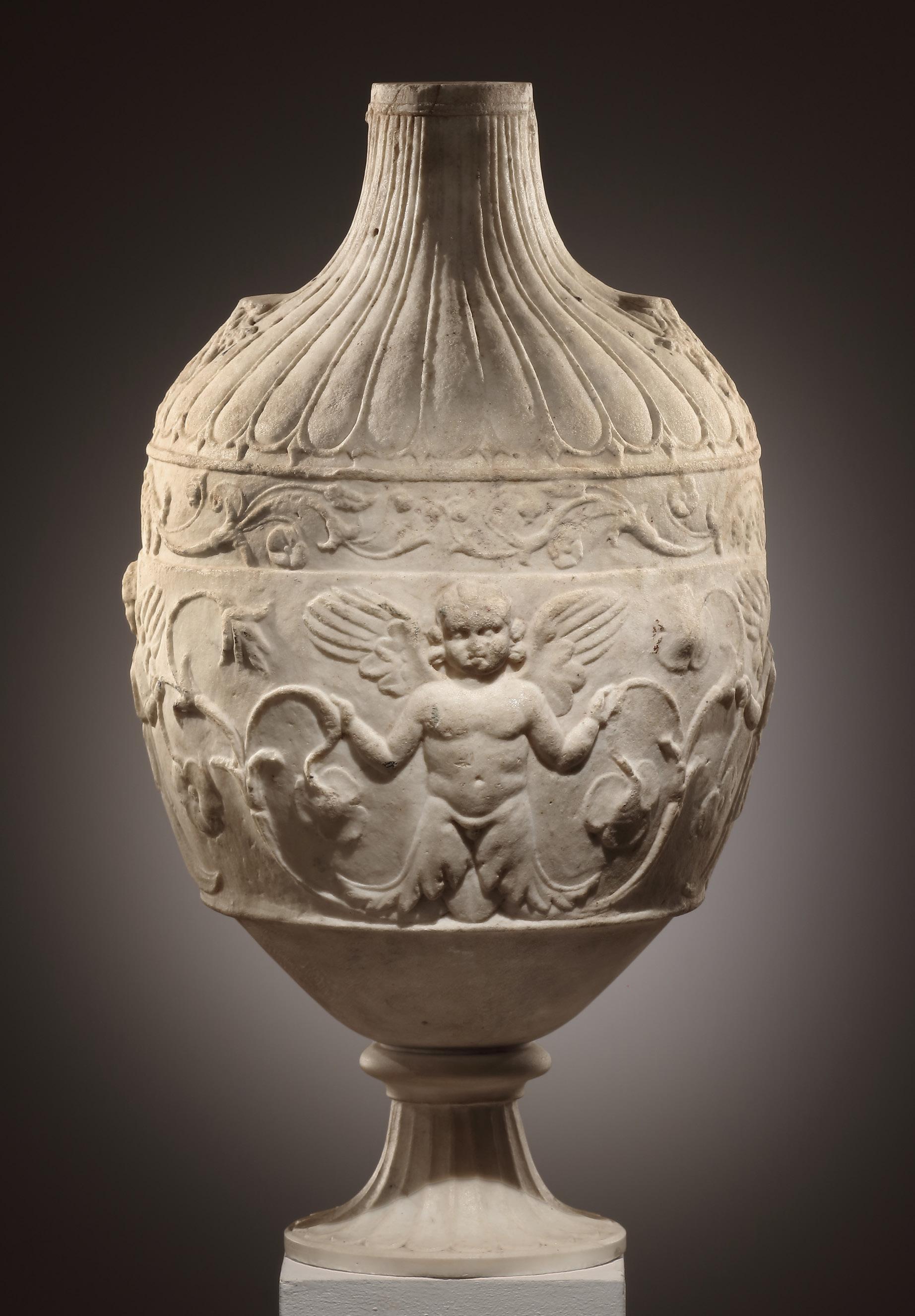
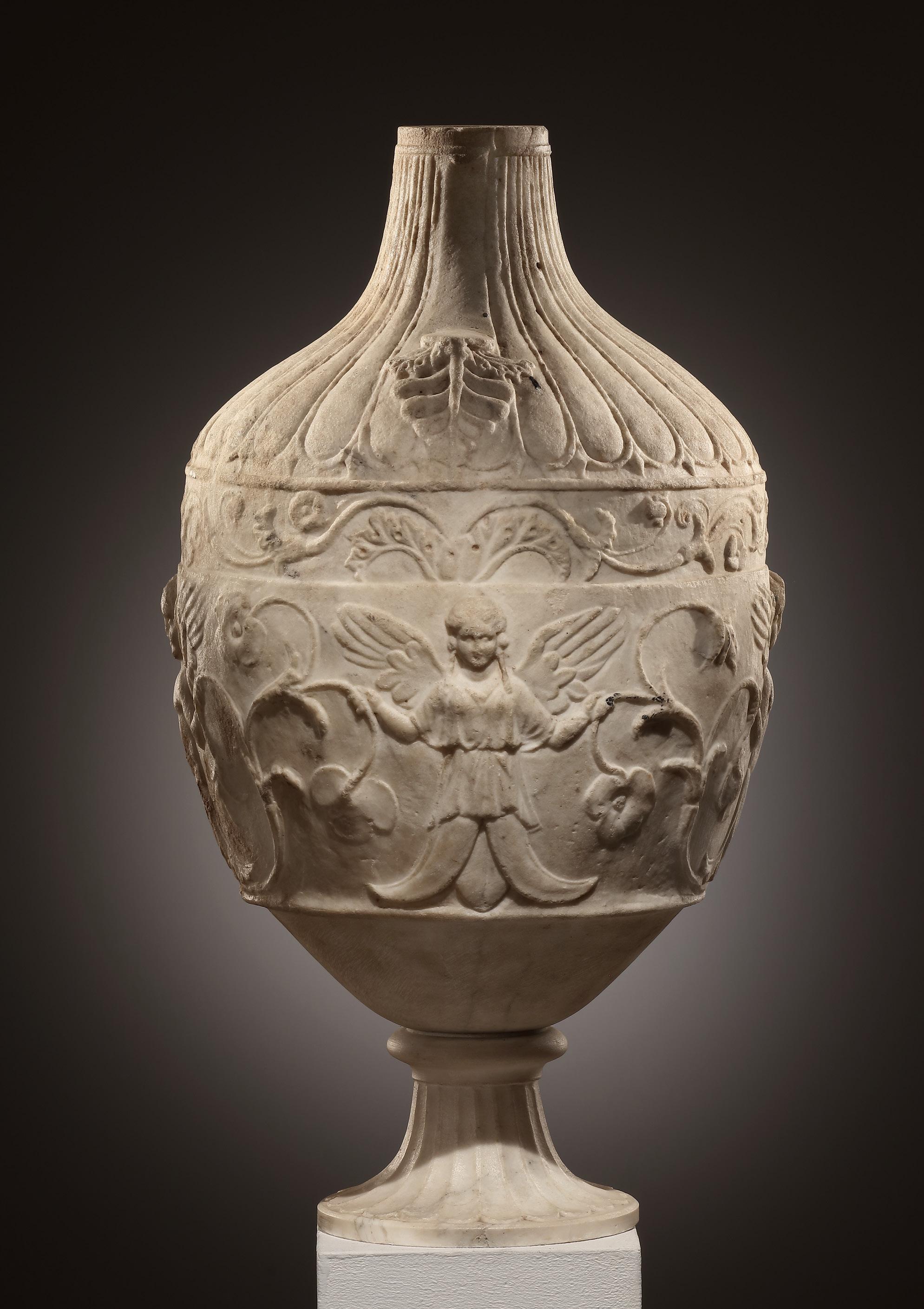
A MARBLE AMPHORA WITH RELIEF DECOR
Price on Request
Roman, Late Republican | 1st century B.C.
H. 50,0 cm | W. 30,0 cm | Diam. Foot 15,0 cm | Marble
Finely carved marble vase in the shape of an amphora. The principal frieze on the vessel‘s body is sculpted in shallow relief with frontal figures, repeated, of Eros and Psyche, both winged and emerging, respectively, from acanthus leaves and a lotus flower, while holding aloft floral tendrils in each hand. Above, a narrow band of intertwining floral tendrils that rise from a base of acanthus leaves. The sloping shoulder is ribbed, with a pendant palmette at the base of each missing handle. A small, circular opening with a rill around it at the top of the neck. Ribs of neck, left arm of one of the Psyche figures and a tendril slightly worn. The foot has been restored in the 18th cent. Very close parallels can be found in a group of eight marble vases (four
amphoras and four cauldrons) which have been found in the santuary of Diana Nemorensis (Lake Nemi), all with votive inscription CHIO on the shoulder.
NOTE
Two of the mentioned marble vases from the santuary of Diana at Lake Nemi are kept in the Ny Carlsberg Glyptothek Copenhagen (inv. nos. 1518 and 1519), the others in the Penn Museum (Inv. MS3446; MS3447A; MS3449; MS3448; MS3451; published online).
PROVENANCE
Formerly priv. coll. Pierre Crozat (1661-1740), Paris, French financier and art collector; probably brought back from Italy ca. 1714-1715. Inherited by his nephew LouisFrançois Crozat (1691-1750), Paris, French general officer and Marquis du Châtel, Brittany. Thereafter, priv. coll. Comte de Caylus (16921765), Paris; probably acquired in 15.12.1750 from the unknown and named auction „Cabinet de feu Mr. Crozat“, Paris, lot 37. Published: Comte de Caylus, Recueil d’Antiquités, 1752 (Vol. 1, p. 268, cat. no. IV, pl. XCVIII). Probably with Pierre-Jean Mariette (16941794), Paris. Published: F. Basan, Catalogue raisonné des différens objets de curiosités dans les sciences et arts, qui composaient le Cabinet de feu Mr. Mariette, 1775, p. 12, no. 63 (without illus.). Thereafter French private coll., from a château, since the 1920s. With Galerie Alain Chenel, Paris, prior to 2011. Thereafter priv. coll. David N. Silich (1944- 2018), Switzerland; acquired in 2013 from Jean-David Cahn AG, Basel.
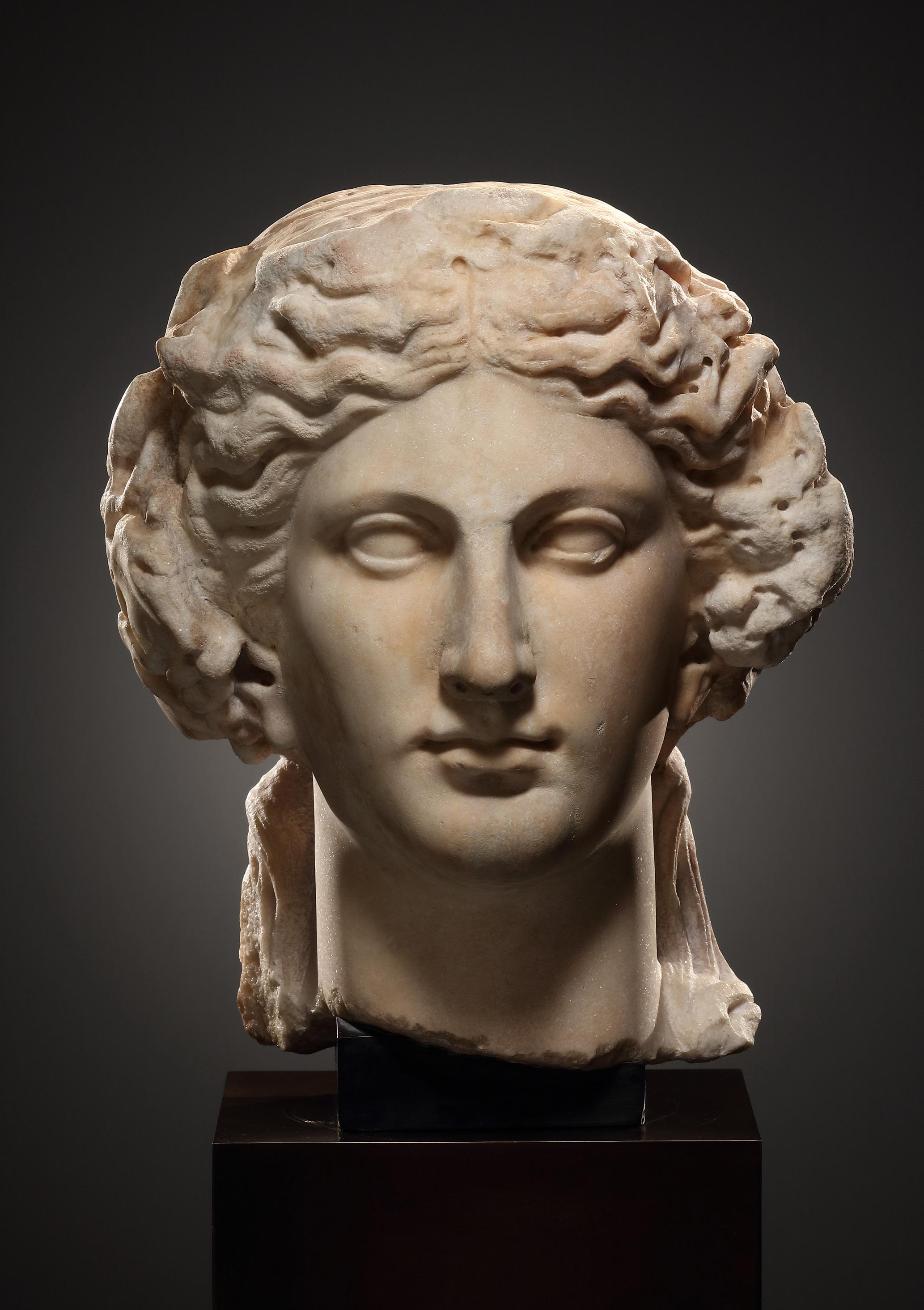
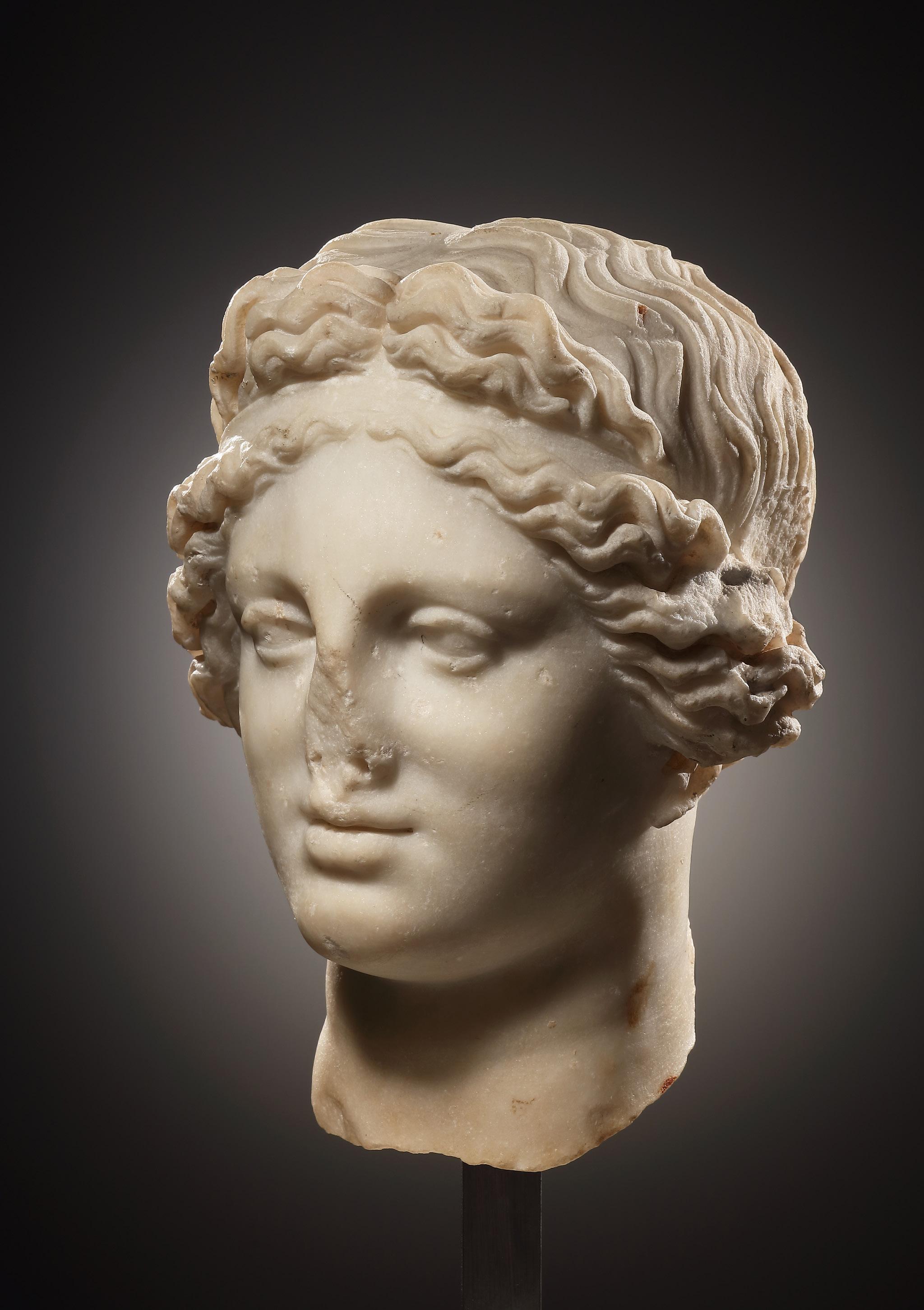
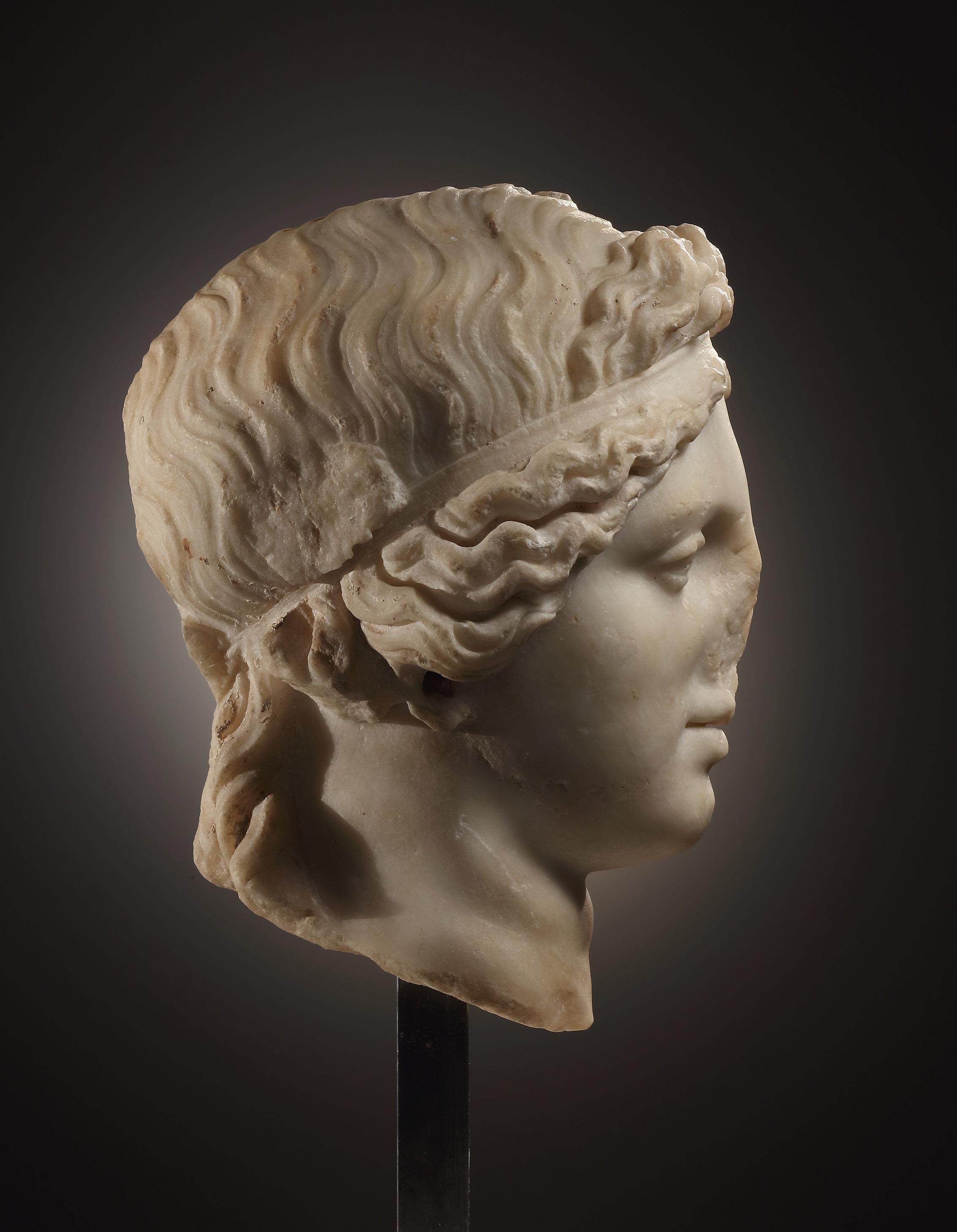
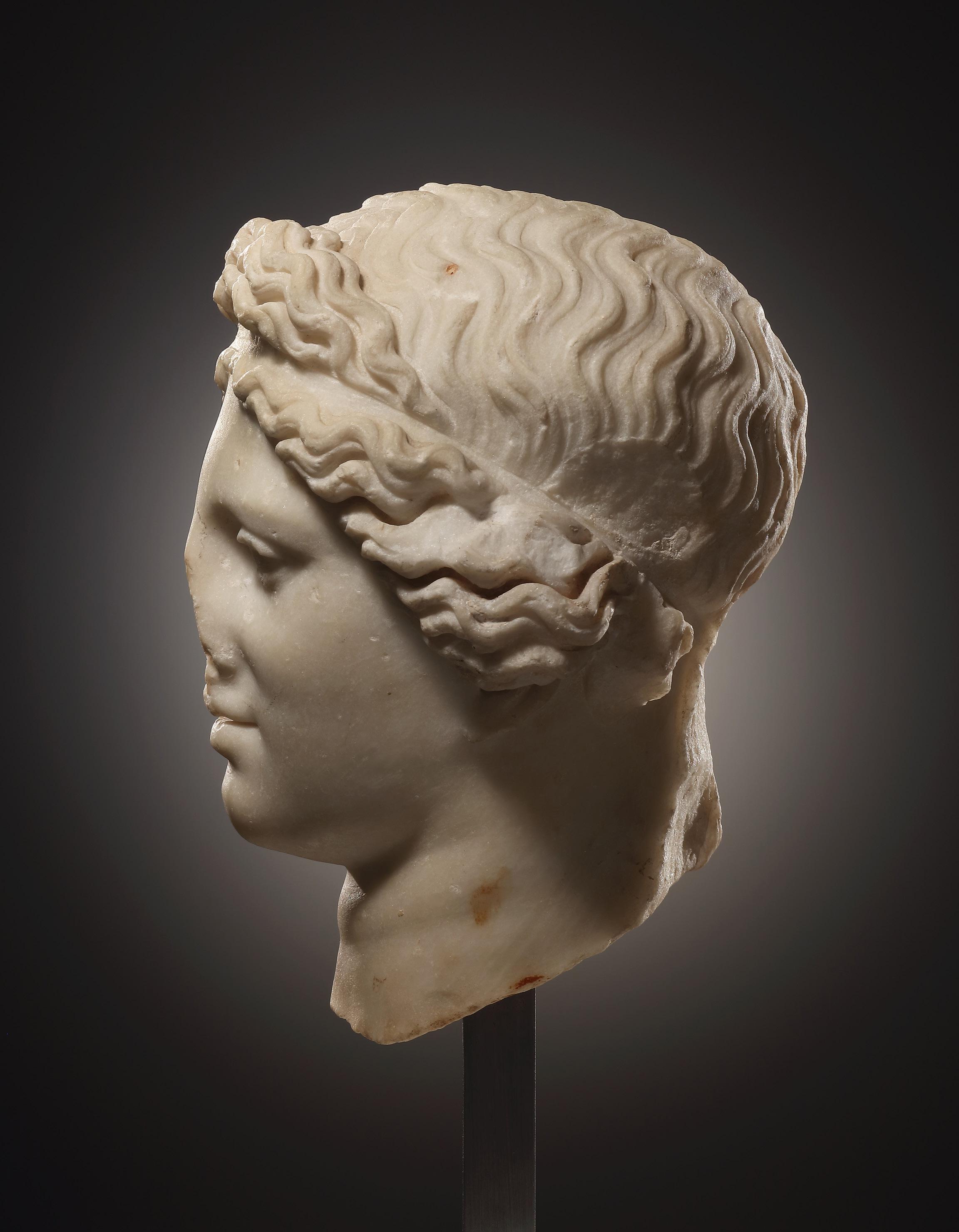
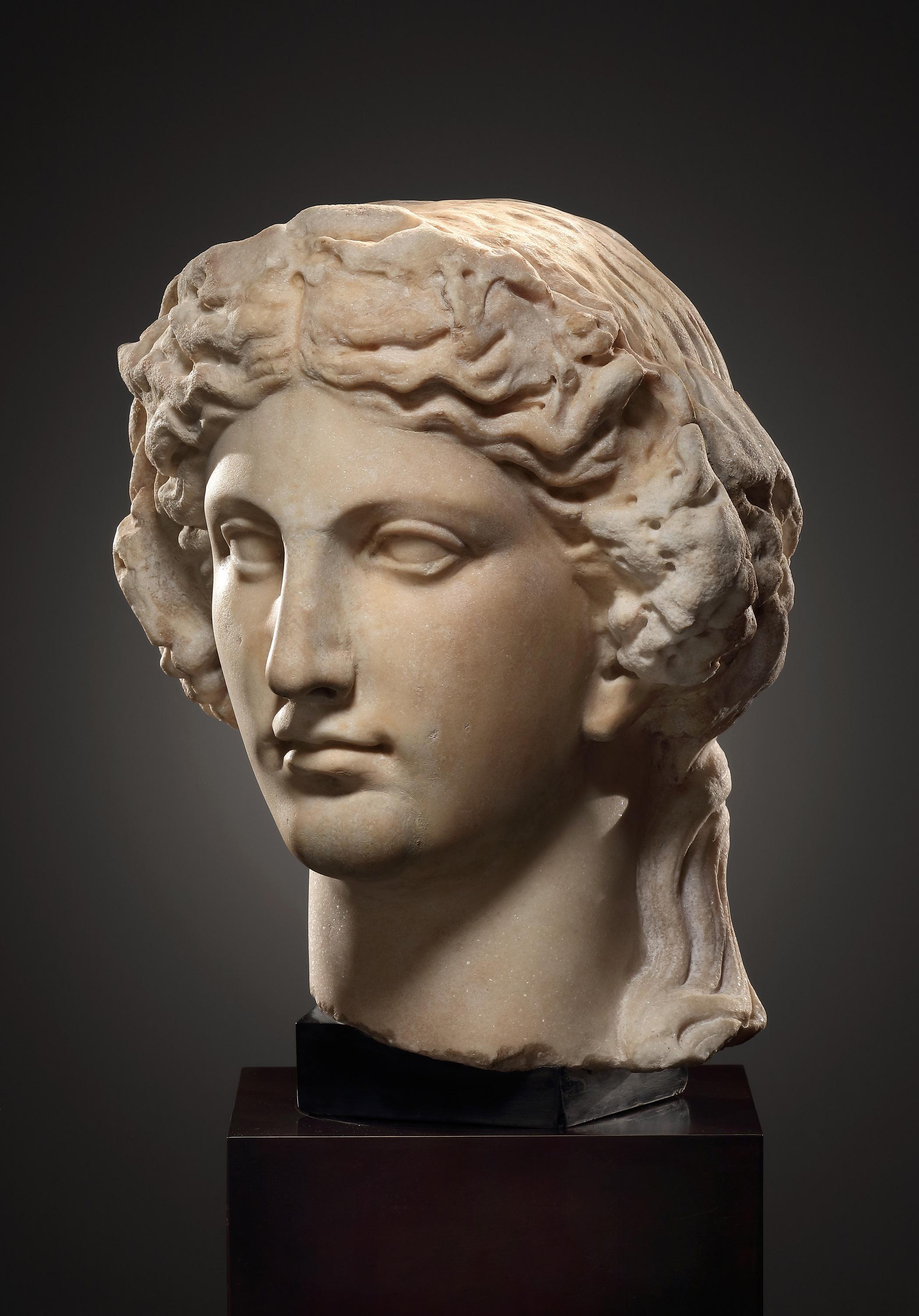
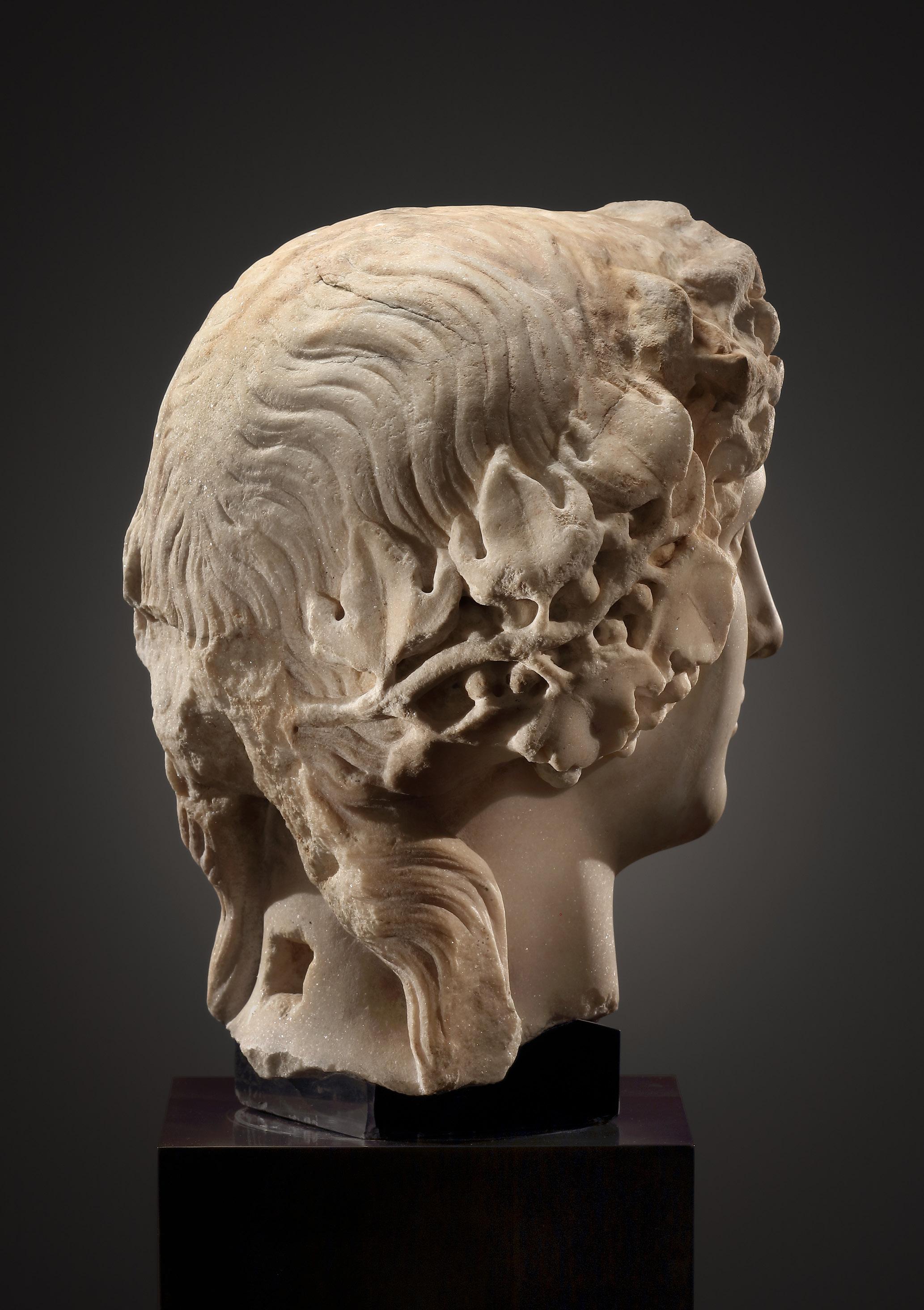
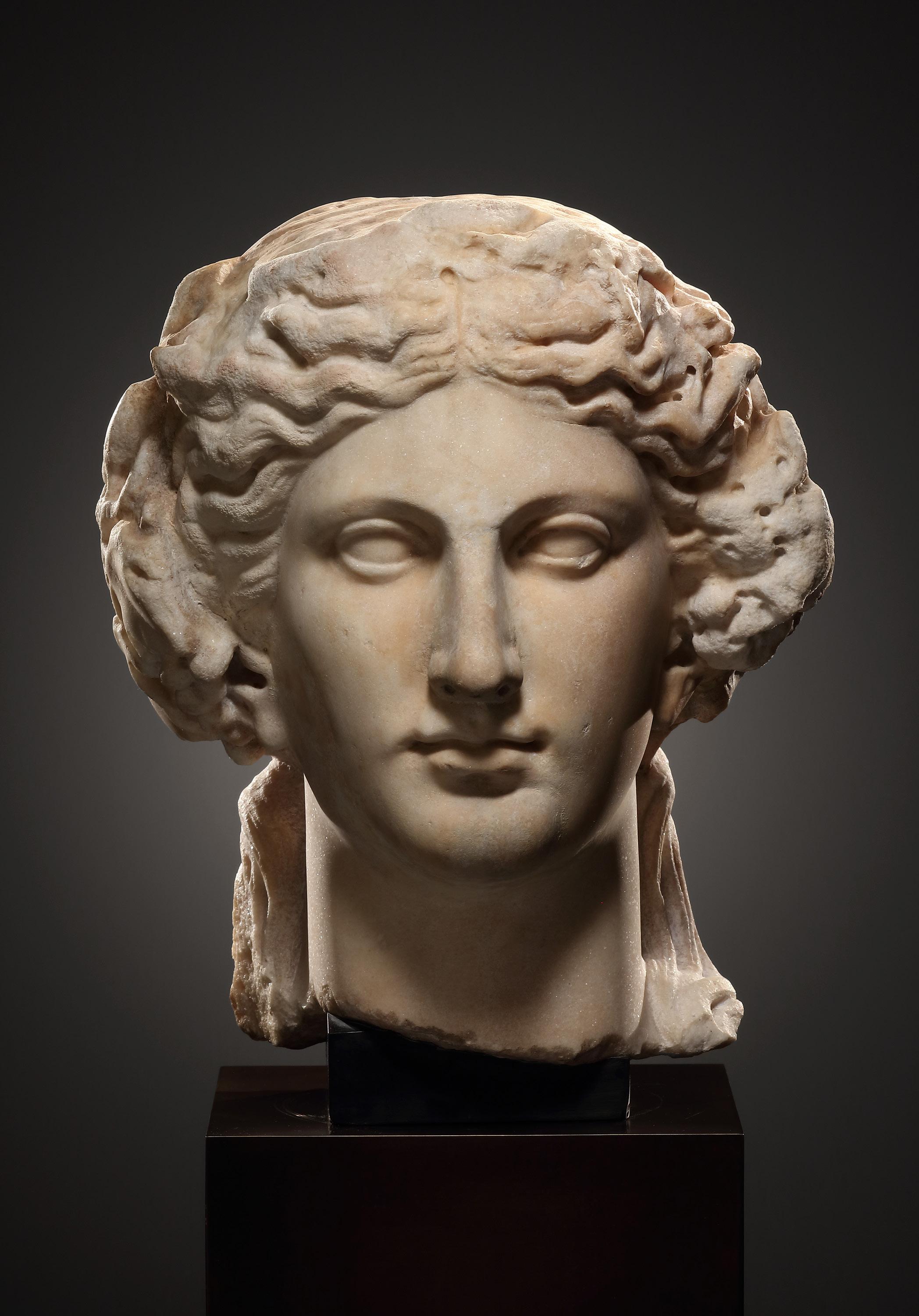
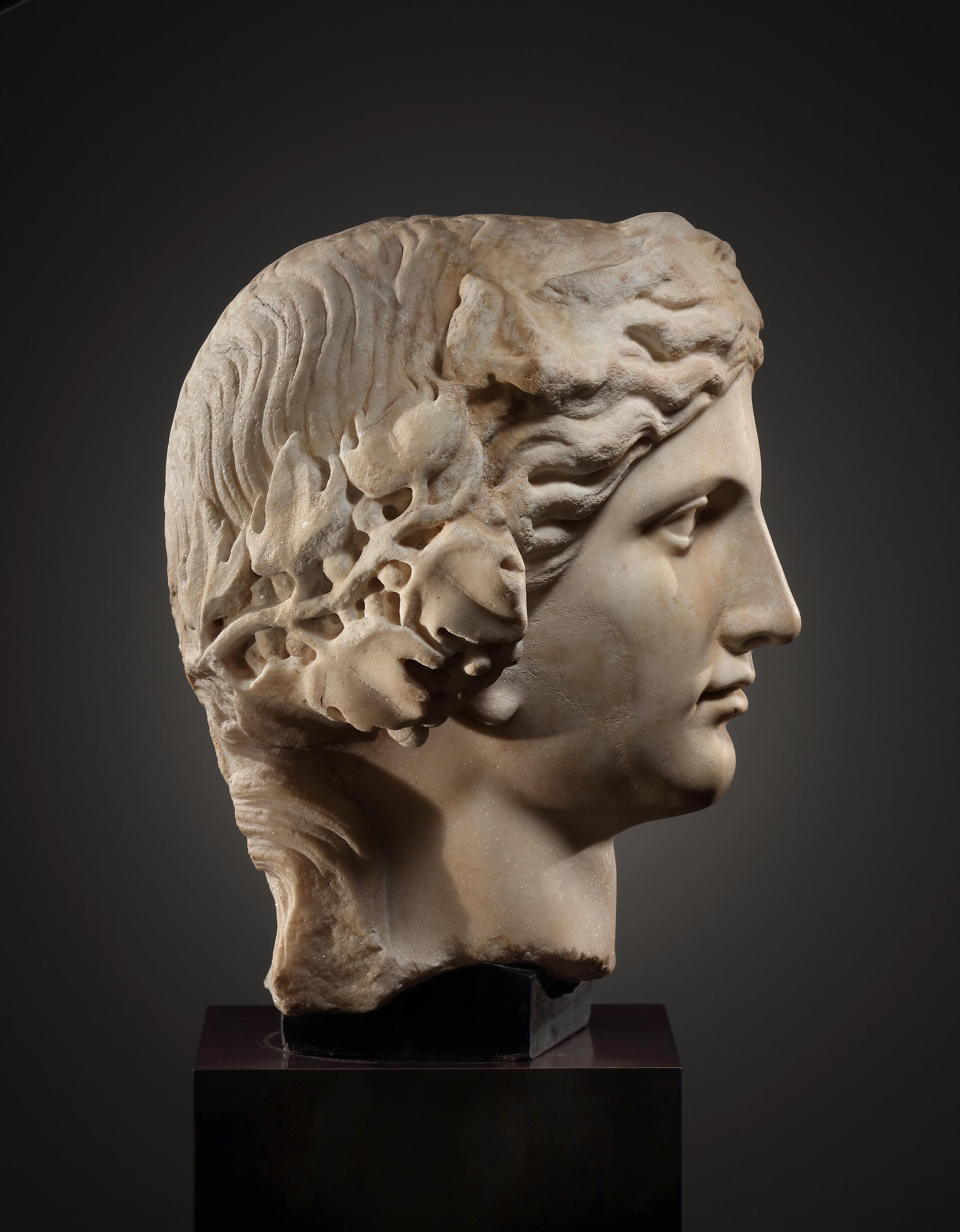
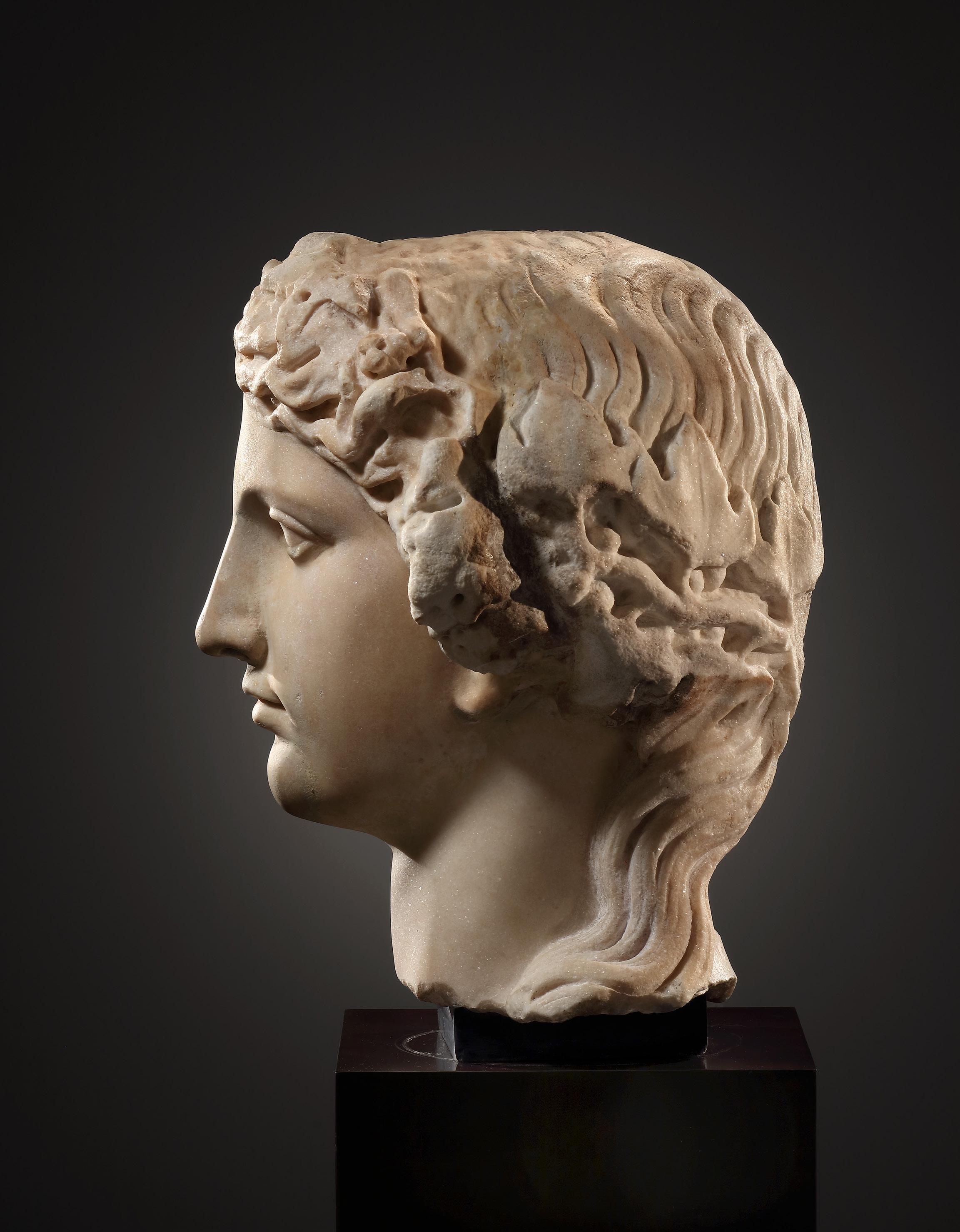
A HEAD OF THE YOUTHFUL DIONYSOS
Price on Request
Roman | ca. 50 A.D.
H. 24,0 cm | W. 16,0 cm | D. 17,0 cm | White, fine-grained Marble
The youthful, idealised face is characterised by very fine, even features. Almond-shaped eyes with heavy, slightly drooping lids. The sensuous mouth is small, the opening marked by a deep groove. The wavy hair is parted in the middle and held in place by a fillet above the forehead. The ample curls, which half cover the ears, are drawn to the back of the head where they were once tied together and from where they cascade onto the shoulders in two long strands. Rings of Venus on the neck. Scaled-down Claudian marble copy of an original from the late 2nd or early 1st century B.C.
PROVENANCE
Formerly Coll. Dr. Dietrich Schwencke, acquired when he was
working for the German Embassy in London, prior to 1939. Thence by descent, Germany. Thereafter priv. coll. Switzerland, since 2007.
AN OVERLIFE-SIZED HEAD OF DIONYSOS
Price on Request
Roman | 2nd Half of 1st century A.D.
H. 35,0 cm | W. 30,0 cm | D. 29,0 cm | Marble
Adorning the god‘s over-life size head is a splendid wreath of vine leaves. His hair, finely articulated as centrally parted, long wavy tresses forming a gable-shaped frame around the forehead, continues as soft strands over the crown, tied at the nape in a now lost ponytail, from which two loosely tied braids tumble down onto the shoulders on either side of the neck. The god‘s face with emphatically feminine facial features radiates the idealized beauty of youth. Overhanging the alert, deepset eyes framed by prominent eyelids are sharply modelled eyebrows. The mouth, whose thin, sensuously curved lips end in finely drilled corners, is surrounded by the firm flesh of the cheeks. Both the coiffure and youthful countenance recall the
„leaning Dionysos“, a statue type known to us from some twenty Roman replicas and variants of a Greek original of the 4th century B.C. It shows the god in casual pose with his head turned to one side and with his left arm leaning against a tree trunk or such like. That our head cannot have belonged to such a statue, however, is apparent from the stiff head position. There are further deviations in the articulation of the wreath, and the headband usually present on such statues is missing entirely from our head. Face historically recarved, nose restored and not belonging. Historical restorations on the right cheek and chin. Damage to the back of the head. Hair, wreath and left lower lid worn.
NOTE
In type closely related to a face fragment in the Antikensammlung Berlin, Inv. Sk 124, there, too, without headband (dated by Furtwängler to the 4th cent. B.C., by Blümel to the late 5th cent. B.C.), see A. Furtwängler, Die Sammlung Sabouroff (Berlin 1883 1887); C. Blümel, Die klassisch griechischen Skulpturen der Staatlichen Museen zu Berlin (Berlin 1966). Allgemein zum Typus des „Angelehnten Dionysos“, see LIMC III (1986) 434-437 pls. 305-309 s.v. Dionysos (C. Gasparri). In style related to the portrait of Julia Titi in the Getty Museum in Malibu, see J. Frel, Roman Portraits. The Paul Getty Museum (Malibu 1981) 52 f. no. 36, also comparable in the rendering of the eyelids and eyebrows and the firm flesh of the face.
PROVENANCE
European private collection, 18th/19th century (based on restoration techniques). French family private collection, Paris, formed between 1920 and 1930. The family made their money owning an insurance company. Part of this collection was sold to the Louvre the other part was sold in Paris. With Emmanuel Prunier, 23.01.2011, lot 112; Galerie Chenel, Paris, 2011. Thereafter, Aaron Gallery, acquired in 2011.
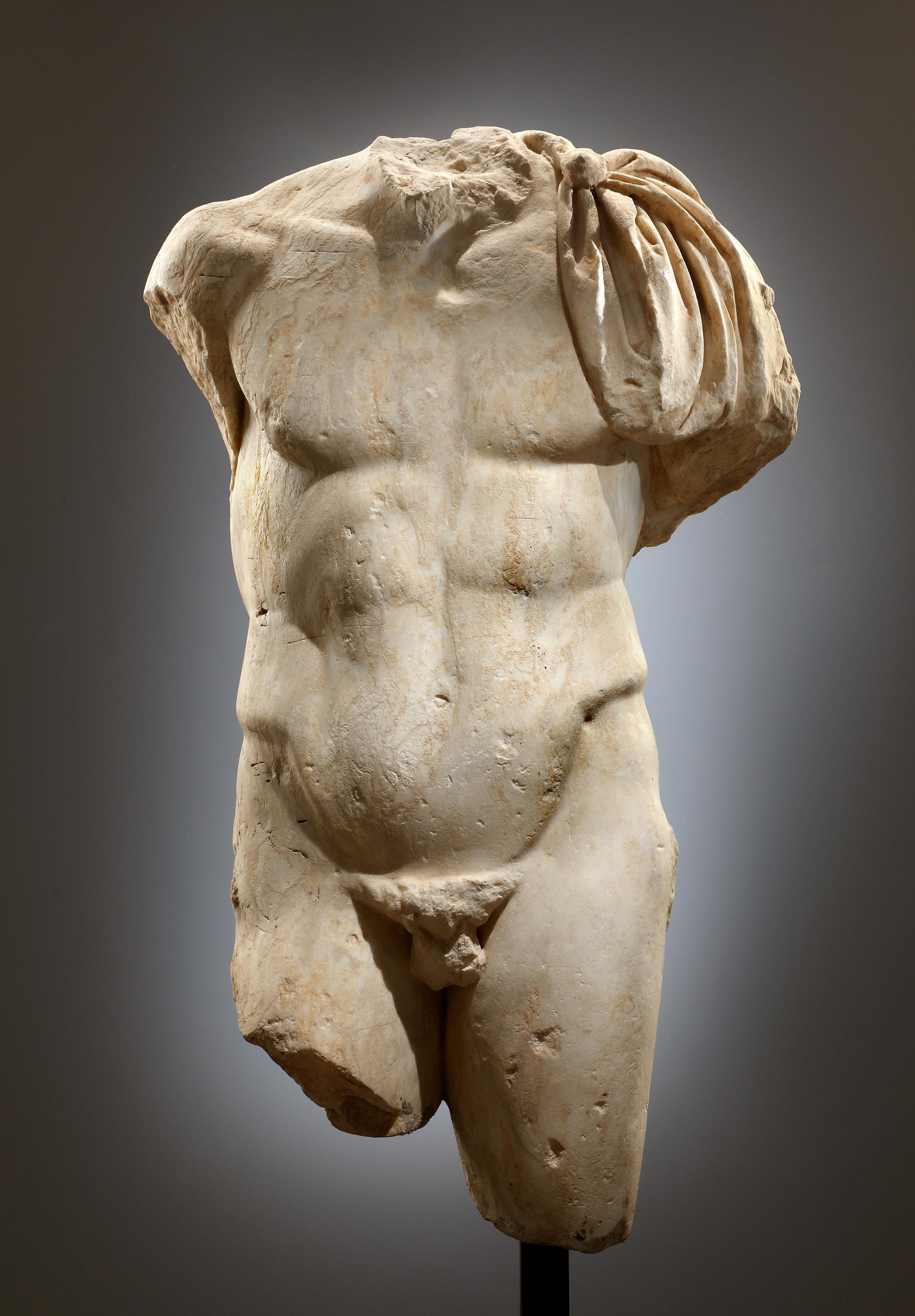
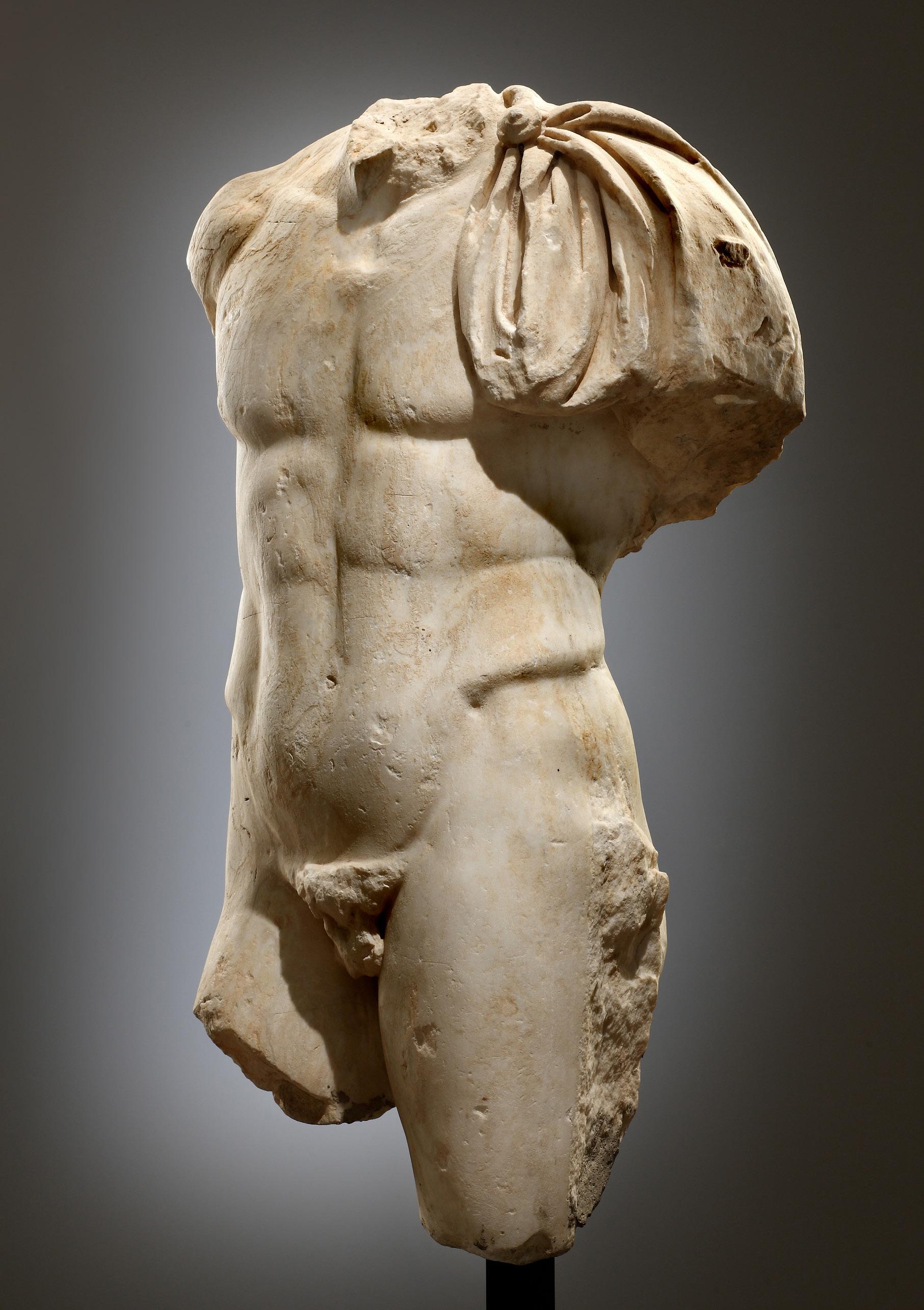
A TORSO OF A MAN (HERMES RICHELIEU OR PITTI-LANSDOWNE TYPE)
Price on Request
Roman, Imperial | 1st - 2nd century A.D. H. 82,0 cm | W. Shoulders 48,6 cm | Marble
Life-size torso of a man in contrapposto. The upper body with the base of the neck, the beginnings of both upper arms, the buttocks, one third of the right thigh, and two thirds of the left thigh are preserved. The weight rests on the left leg; the right was turned slightly outward and set a little forward. The head was originally turned toward the side of the supporting leg. The left arm was lowered and angled away from the body; the right arm hung down alongside it.
The upper body is characterized by clearly defined musculature, with a distinct hip and groin line. Pubic area indicated. Roman copy after a High- or Late-Classical statue type, whose body structure and posture show an unmistakable Polykleitan influence. If the chlamys fastened over the shoulder with a round brooch is not an addition by the Roman copyist, then our torso could be associated with two statue types: the Pitti-Lansdowne Hermes and the Richelieu, the latter probably
inspired by the former. Both types are preserved in several replicas, each reproducing the same posture with the head turned toward the side of the supporting leg, as well as the chlamys draped over the left shoulder and only touching the torso below the hip, as is the case with our sculpture. In some replicas, the cloak transitions into a support. Since the head type and the position of the feet can no longer be determined, it is not possible to say with certainty on which of the two statue types our torso is based. However, the treatment of the chlamys, with its bag-like folds of varying depth, corresponds closely to that found in the replicas of the Richelieu type. Unless the copyist had chosen to alter the design, the god would, in this case, have cradled his characteristic kerykeion in the left arm. The now lost sculptural element, the attachment points of which are visible on the chlamys below the left side of shoulder, may then have belonged to the kerykeion. The round brooch is found in replicas of both types but is not an obligatory feature. Nothing definite can be said about the now-lost head. However, as
numerous portrait-bearing examples of the Richelieu type are known, it is quite conceivable that our statue was originally fitted with a portrait head, perhaps a public (imperial) likeness, though more likely a private one. It is, of course, also possible that the copyist—depending on the commission—retained the head type of the Classical bronze original. The entire back is only cursorily worked, suggesting that the statue was originally intended for placement in a niche. On the outer side of the right thigh, there are traces of a connecting strut, apparently removed, that once supported the lowered right arm. Dowel hole at the back of the neck join. Horizontal incisions in various places, as well as stippling at the left transition from hip to groin, may represent markings made by the copyist. Crack through the right buttock. Minor surface wear and chipping.
NOTE
On the Pitti-Lansdowne type Hermes, cf. S. Kantsteiner, Der Hermes Typus Pitti-Lansdowne. Rekonstruktion, Datierung und Rezeption einer Bronzestatue des Hermes aus der Zeit der Hohen Klassik, AA 2018, 211–230; for the Richelieu type Hermes, cf. Sascha Kansteiner, Der Hermes Typus Richelieu, AA 2017, 77–98, with a list of all replicas. See also LIMC V (1990) 366 f., nos. 943–949, pls. 276 f. With regard to the drapery of the shoulder cloak, the most closely related example is the replica in the National Museum, Athens, inv. no. 241 (see Arachne, database of the DAI – 1061264), which also has a round fibula. However, Kansteiner assigns this piece to the PittiLansdowne type.
PROVENANCE
Formerly Coll. Louis Maury, Geneva, acquired Hôtel Drouot Christian Grandin, Paris, 13th February 1982, no. 198. Thence by descent.
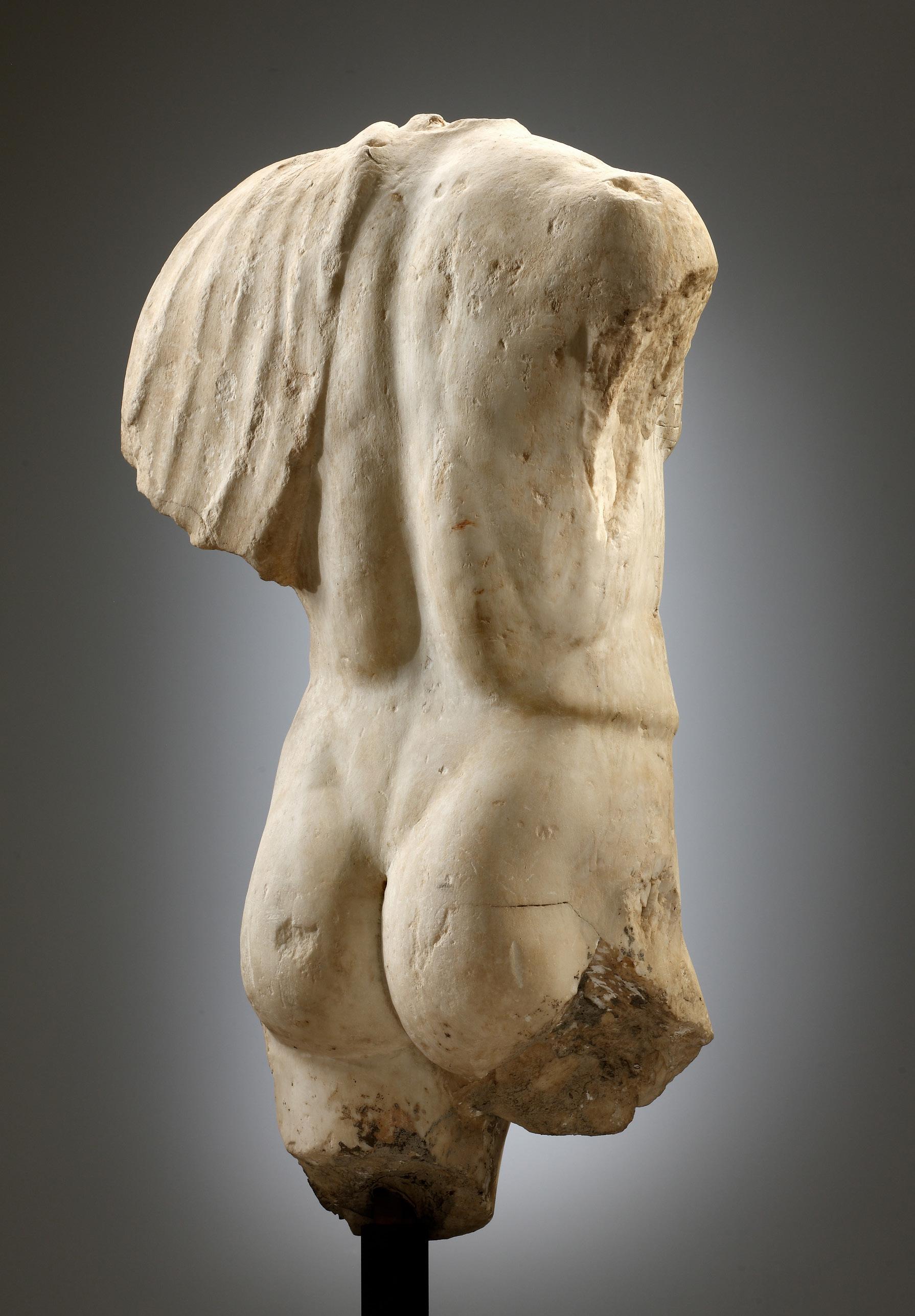
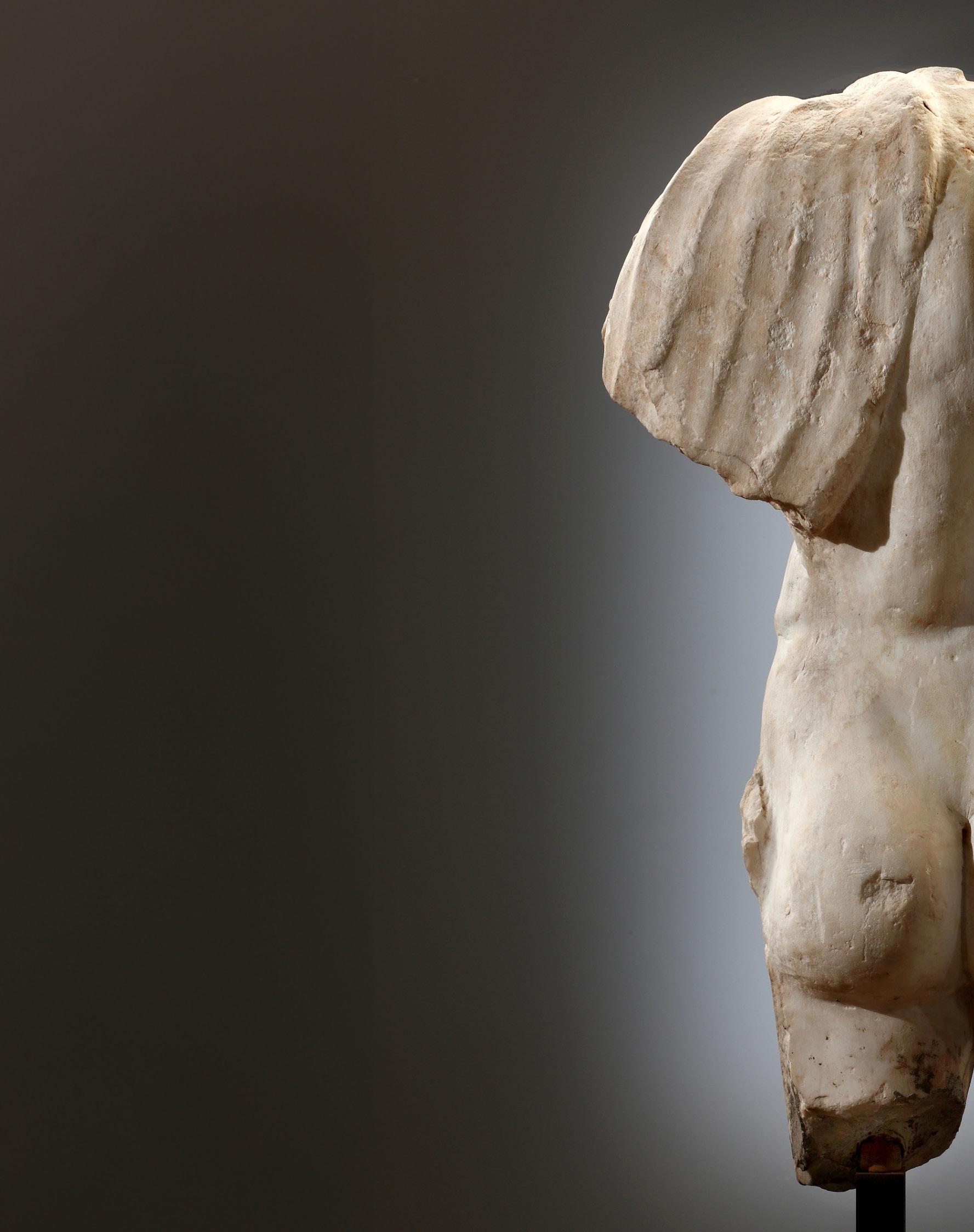
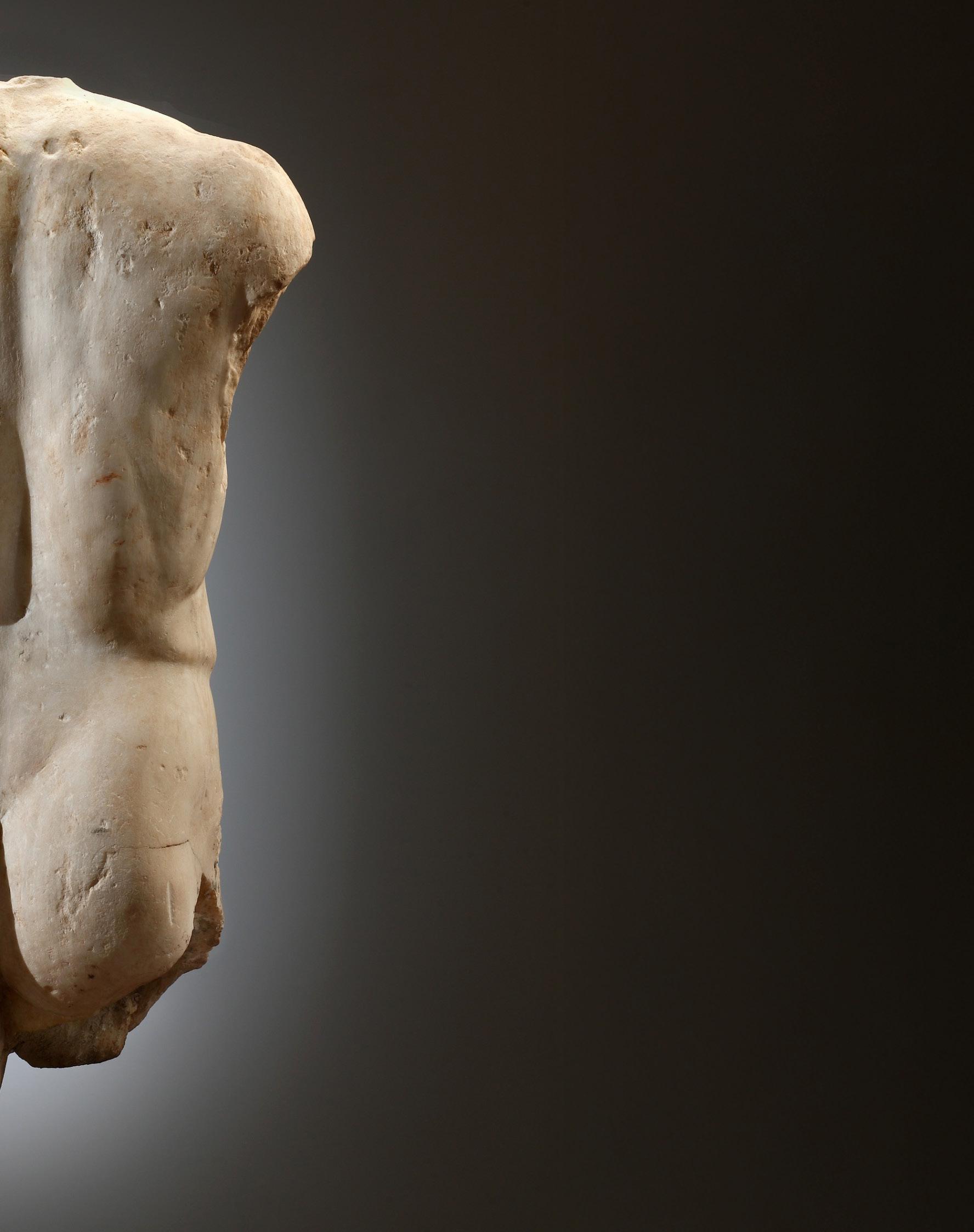
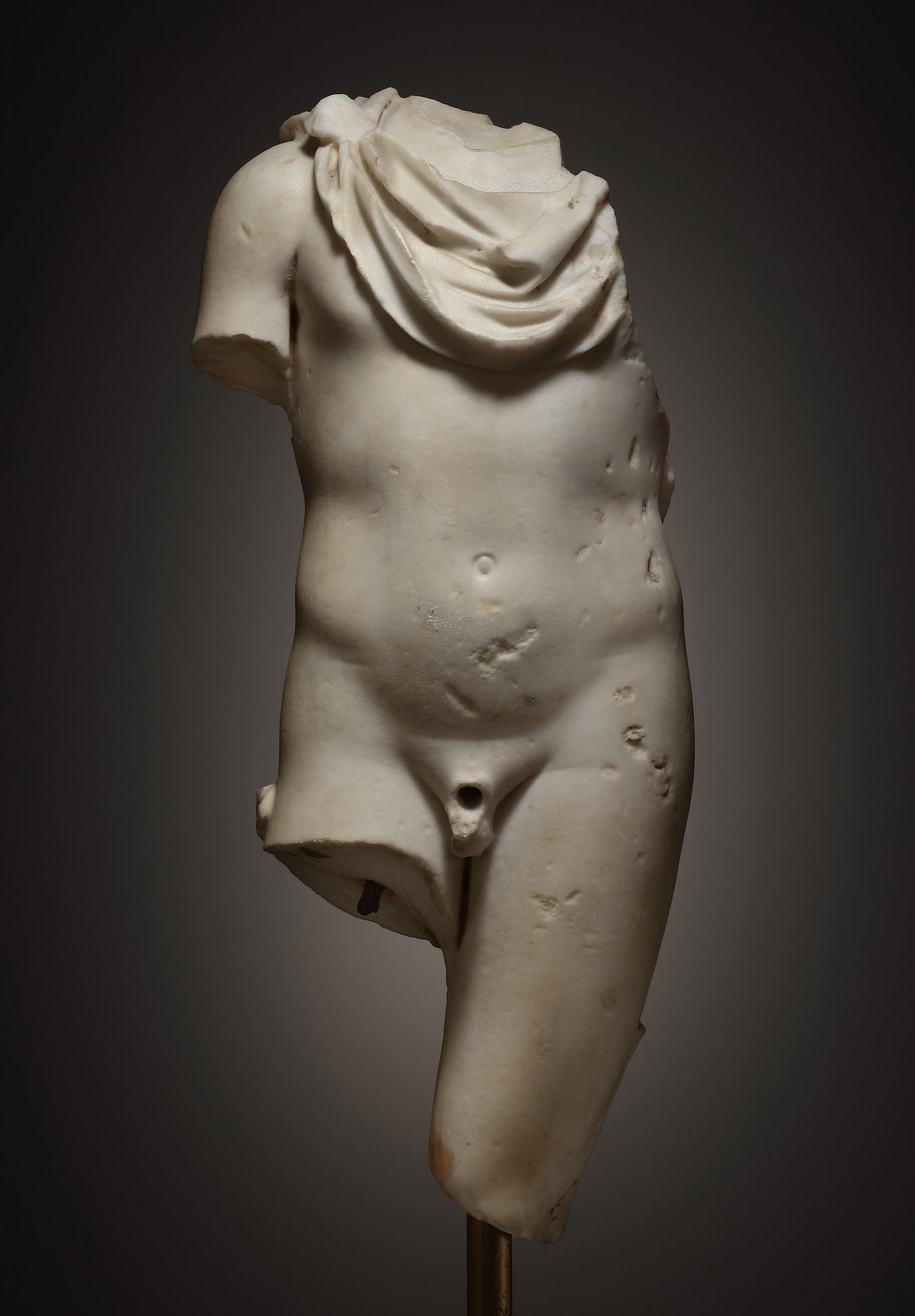
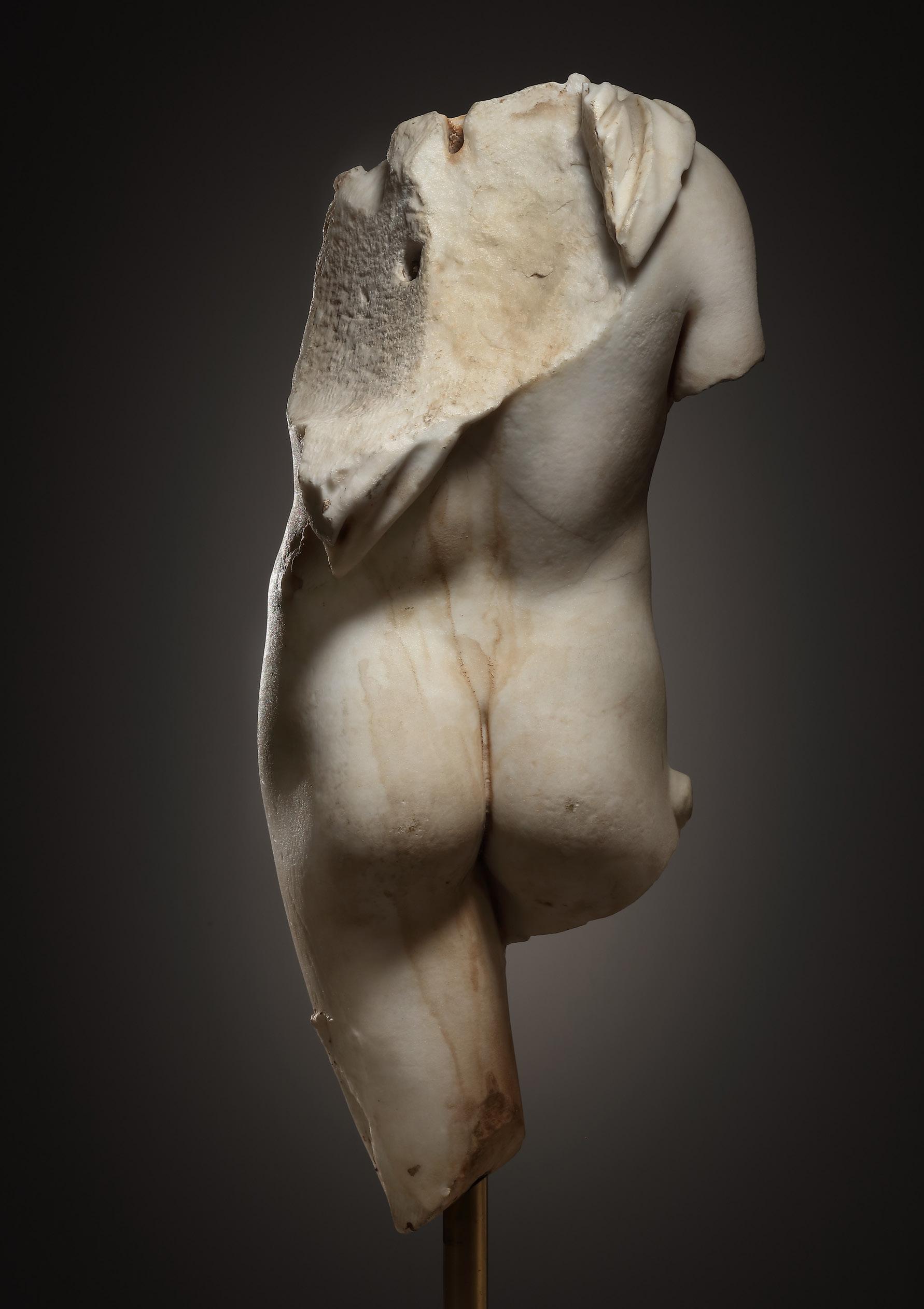
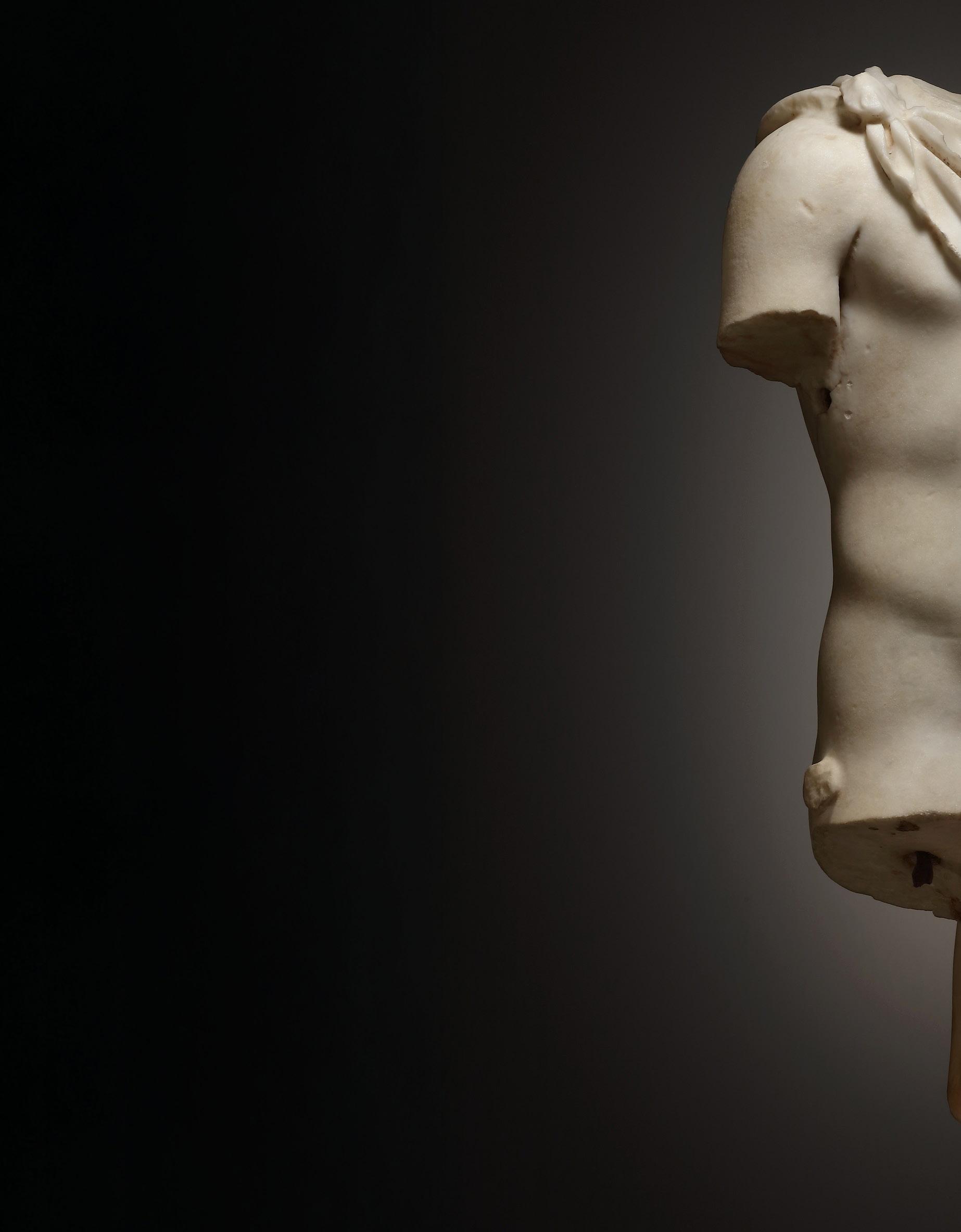
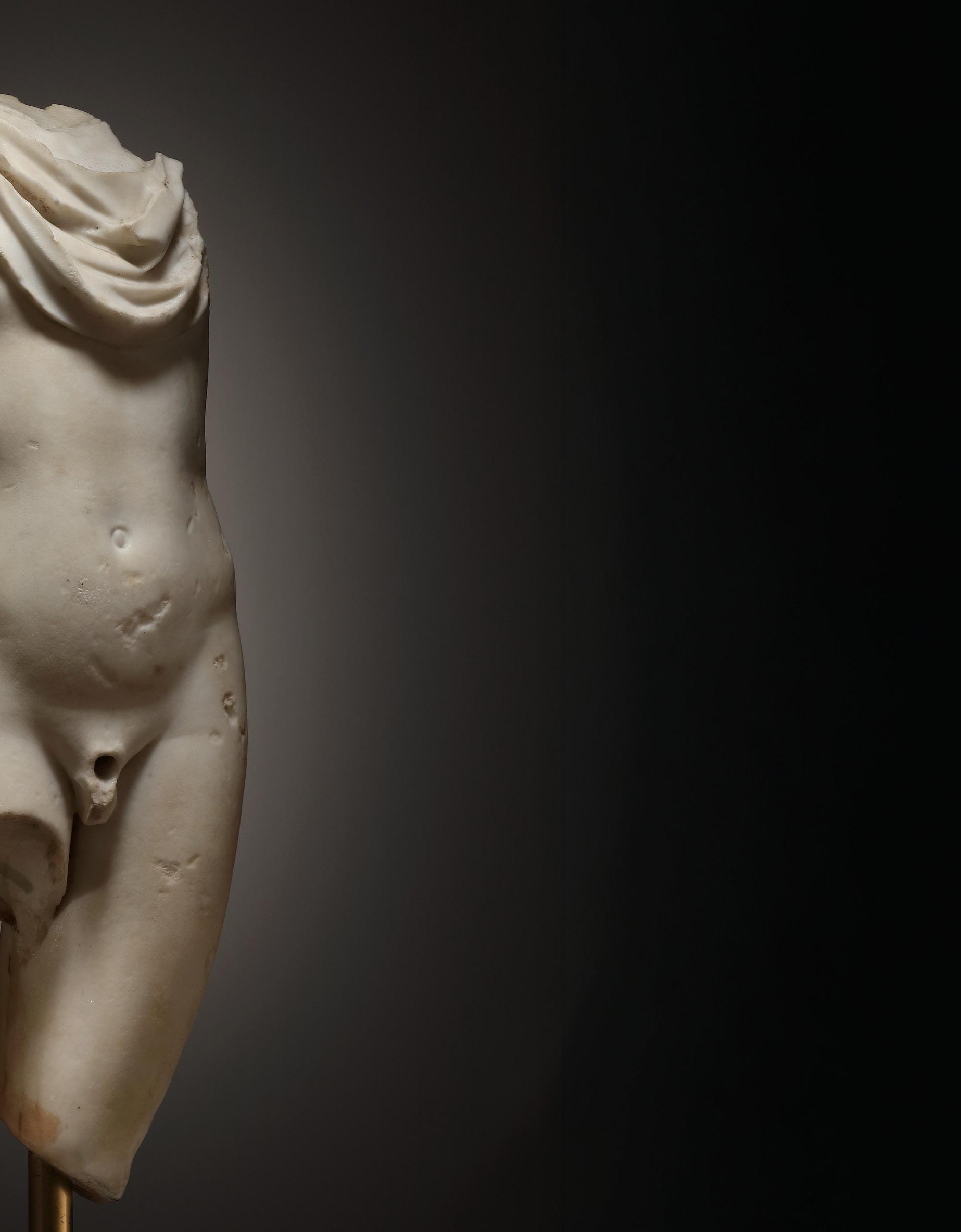
A TORSO OF A YOUTH POSSIBLY GANYMEDE
Price on Request
Roman | 2nd century A.D.
H. 58,9 cm | W. 22,5 cm | Marble
Softly modelled transitions, the reduced accentuation of musculature, the slightly protruding lower abdomen and the lack of pubic hair lend the slender, under life-sized torso a boyish appearance. When viewed from the front, there is a striking contrast between the relaxed contrapposto of the legs and the almost static torso, whose posture allows virtually no shift of the body axes. The chest is covered with a chlamys, which is fastened above the right shoulder by a round brooch and cascades diagonally across the back. A large section of the back, mainly the area with the garment, as well as the left shoulder and arm were attached by means of an iron dowel, the remains of which are still preserved. The area where
they were attached shows the typical preparatory tooling. The adjoining break surface on the right may date from a different point in time. Its edges reveal traces of a toothed chisel which continue along the edge of the prepared surface and partially over it. This tooling must, therefore, be of more recent date. A second round, but much smaller dowel hole is located on the left at the hip line, and a third that contains about one third of the dowel can be found below the right upper arm. On the lower outer part of the completely preserved left thigh, the remains of an adjoining support are visible. The beginning of the right thigh with a puntello on the outward facing side is preserved. The underside is smoothed and has an iron dowel in
the centre, which was used to attach the rest of the thigh or leg. This addition was probably made at the same time as the other attachments for which the toothed chisel was used to prepare the surfaces. The head and penis were also attached separately. At the back, a pronounced drill channel separates the small, firm buttocks. It is not easy to determine the statue type and to identify who was represented. The upright posture in combination with the accentuated boyishness of the statue permit different interpretations (cf. a small statue of Hermes in Berlin, inv. no. Sk 198; Eros type Centocelle or its reinterpretation, e.g. as Apollo). The chlamys could be a typical but at the same time unspecific addition by the Roman copyist. The question also arises as to whether the historical additions were in tune with the ancient subject matter or whether the sculpture was reinterpreted. The comparatively large attachment surface(s) on the back could indicate a larger addition (which probably made the dowel at the left hip necessary). Possibly the sculpture represented Ganymede with an eagle on his shoulder. The edges of
the folds of the chlamys are slightly chipped. Some small superficial flaking on the left side. Surface cleaned.
PROVENANCE
The old restorations (now removed) would probably have been executed in Italy 17th/18th century. On the Zurich art market, prior to 1988. With Sotheby‘s, London, 12.02.1988, lot 98; Sotheby‘s New York, 25.06.1992, lot 106; Sotheby‘s, New York, 07.12.2001, lot 78.
GENERAL ABBREVIATIONS
BAPD
DAI
H.A.C.
KAM
LIMC
MuM
Beazley Archive Pottery Database
Deutsches Archäologisches Institut
Herbert A. Cahn (1988 - 1999)
Schweizerische Kunst und Antiquitätenmesse
Lexicon Iconographicum Mythologiae Classicae
Münzen und Medaillen AG, Basel (1943 - 1988)
IMPRINT
Texts Design
Translation
Photos
Dr. Ulrike Haase, Joffrey Nogrette, Charlotte Chauvier
Jonas Hernegger, Jean-David Cahn
Yvonne Yiu
Niklaus Bürgin
Published by Galerie Cahn. Your Partner in the Antique Trade since 1863.
CONDITIONS OF SALE
September 2025. Place of execution is Basel
1) Jean-David Cahn AG (hereafter „the Seller“) hereby confirms that it has the right of disposal over the objects for sale according to Art. 18 KGTG. Any further warranty is excluded.
2) The specifications and descriptions given in this catalog are provided in good faith. Nevertheless, their accuracy cannot be guaranteed.
3) The seller guarantees that the sales objects were made in Antiquity. This guarantee, which is granted to the buyer only, is valid for two years after the conclusion of the sales contract.
4) The objects are sold in the condition they were in at the time of the sale („sold as seen“). Complaints regarding the authenticity of a piece (subject to lit. 3) shall be communicated to the Seller in writing at its domicile (Jean-David Cahn,
Malzgasse 23, P.O. Box 217, 4010 Basel) upon detection and at the last two years after the conclusion of the sales contract. Other substantiated complaints shall be communicated to the Seller in writing at its domicile, as above, within 14 days of receipt, and at least three months after the conclusion of the sales contract. Any complaints made later cannot be considered further. All liability for any loss or damage sustained during transportation is excluded. Insurance during transportation is the Buyer‘s responsibility.
5) The delivery and storage of sold objects shall be at the Buyer‘s risk and expense (costs arising from storage, packaging and transportation, any additional costs and expenses, all plus VATs) unless otherwise agreed in writing.
6) Foreign and Swiss customs, duty and shipment shall be borne by the Buyer. Declaration fees for the import into the EU are borne by the Seller if used through the services provided by the Seller. It is the responsibility of the Buyer to comply with foreign and Swiss customs and foreign exchange regulations and to obtain an EU import license through the services of the Seller. The Buyer is aware of the relevant import and export regulations of the EU and has consulted the website of the Swiss Federal Office of Culture Bern (www. bak.admin.ch/kgt) for details of the Swiss import and export regulations currently in force, as well as further provisions. The Seller declines all responsibility for any consequences arising from the contravention of such regulations. The Buyer acknowledges that a valid import permit is required for the importation of the artworks transferred under this purchase invoice into the European Union. If such a permit is not available at the time of purchase, the approval process may take between four to six months. The registration and execution of the import procedure
will be carried out by an art shipping agent appointed by the Seller within the EU. The Seller will organize this process in the name and on behalf of the Buyer. The Buyer is required to conduct the import procedure through the shipping agent designated by the Seller. Alternatives are the responsibility of the Buyers.
7) The Buyer is personally liable for all acquisitions made; he/she cannot claim to be acting for a third party or person. If a person acts as a representative, written proof of authorization may be requested; the Buyer as well as his/her representative can both be held jointly and severally liable for the purchase and for all other costs. The Buyer shall be liable for any damages caused by delayed payments, in particular for exchange rate and interest losses. Payments by cheque or by the internet shall be deemed to have been received only on clearance by the relevant bank.
8) Payment shall be due upon the conclusion of contract, but at the latest 30 days after the invoice is issued. Interest of 1.5% per month will be charged for payments made after 30 days. Payments can be made in cash, by bank transfer or
by cheque. The Seller may ask for proof of creditworthiness. Title shall be transferred only upon receipt of payment in full; all risks, however, shall pass to the Buyer upon conclusion of the sales contract.
9) If payment is delayed, the Seller can, after giving the Buyer due notice, withdraw from the contract forthwith. This also applies in cases where the object has already been transferred to the Buyer‘s possession at the Buyer‘s cost. The object in such a case must be handed back to the Seller upon request. Additionally, the Seller may claim further damages.
10) If the Buyer does not collect the object, the Seller can choose either to cancel the contract after 30 days and to claim compensation or to store the object at the Buyer‘s expense and to demand that the Buyer collects it.
11)
ALL SALES ARE TRANSACTED IN BASEL, SWITZERLAND, WHICH IS THEREFORE THE PLACE OF FULFILLMENT AND THE COURT OF JURISDICTION.
The conclusion of contract, the quotation and the negotiations are subject to Swiss law, exclusive of the United Nations Convention on
Contracts for the International Sale of Goods (CISG). By buying, the Buyer recognizes the exclusive right of the court of Canton Basel-Stadt, Switzerland, and of its jurisdiction. All sales are subject to Swiss jurisdiction. All parties recognize the exclusive choice of Swiss jurisdiction for the settlement of any matters arising from the conclusion of the sales contract.
12) All purchases and deliveries are performed solely on the basis of these conditions of sale. Any references by the Buyer to his/her terms and conditions are herewith expressly excluded.
13) Should individual provisions become fully or partially void after the conclusion of contract due to changes in the law, the validity of the remaining provisions and of the contract shall remain unaffected. The invalid provision shall be replaced by that provision which is closest in meaning and intention to the original provision.
14) The Buyer accepts the condition of the sales as above. He/She explicitly accepts the exclusive right of the courts of Basel-Stadt, Switzerland, and their jurisdiction,
exclusive of the United Nations Convention on Contracts for the International Sale of Goods (CISG), over the quotation, the negotiations, and the sale.
15) The conditions of sale are provided in German and English, the German version being the definitive and legally binding one in the event of any disputes.