10/26
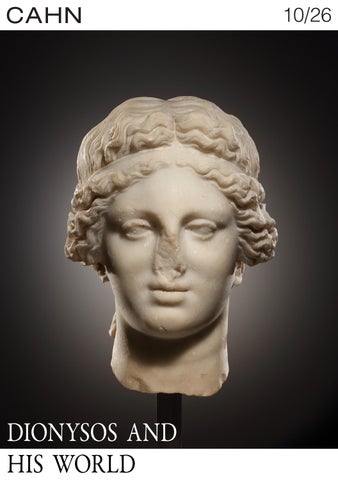
DIONYSOS AND HIS WORLD
CONTACT Dr. Ulrike Haase
ulrike.haase@cahn.ch
De. | En. | It.
Tel: +41 61 561 67 04
Joffrey Nogrette
joffrey.nogrette@cahn.ch
Fr. | En.
Tel: +41 61 561 67 00
Charlotte Chauvier
charlotte.chauvier@cahn.ch
Fr. | En. | Es.
Tel: +41 61 561 67 02
Galerie Cahn
www.cahn.ch Tel: +41 61 561 67 55
UPCOMING 2027 MAZE Palm Beach: 12 Jan – 14 Jan, 2027 in Palm Beach, Glazer Hall The Winter Show New York: 22 Jan – 31 Jan, 2027 in NY, Park Avenue Armory MAZE Art St. Moritz: 11 Feb – 14 Feb, 2027 in St. Moritz, Hotel Reina Victoria MAZE Art Gstaad: 18 Feb – 21 Feb, 2027 in Gstaad, Festival-Zelt TEFAF Maastricht: 13 Mar – 18 Mar, 2027 in Maastricht, MECC Forum 100
2
3
4
DIONYSOS AND HIS WORLD by Ulrike Haase
With autumn marking the height of the grape harvest, the season may invite us to reflect on the significance of wine and the traditions, practices and beliefs associated with it across different cultures and social contexts. In the Greco-Roman world, wine was far more than an everyday indulgence: it played a central role in celebrations of all kinds, religious practices, and social gatherings, most notably the highly ritualized symposia. In Dionysos, the world of wine and festivity found its divine patron, depicted with a human yet idealized appearance. Whenever wine played a role, Dionysos was present in some form. As the god of intoxication and ecstasy, he embodied forces that could temporarily suspend the established order and blur the boundaries between reality and imagination. This divine capacity for transgression and transformation may be one of the reasons for the striking complexity of his appearance, which changed over time and gradually acquired more youthful forms. Dionysos appears as a mature man, a beautiful youth, and a boy. Depending on the context, he may be shown wearing a long chiton and mantle, a short garment with an animal skin draped around his body, or entirely nude. He may appear as a bearded, paternal figure, as well as with effeminate bodily features, long, wavy locks, and Venus rings on the neck.
Just as multifaceted as his physical appearance is his character, which, like the effects of wine, exhibits a certain ambivalence. As Bakchos, Dionysos brought joy, but the intoxication and ecstasy he induced could also lead to loss of control and madness, unleashing destructive forces. Alongside his role as a god of fertility and his lifeaffirming connection with celebration, the Dionysian Mysteries, an initiatory cult with secret rites, were also connected with specific eschatological concepts. This may account for the popularity of depictions of Dionysos on South Italian vases found in funerary contexts. As Dionysos Thriambos, he was the triumphant conqueror of India, while at the same time embodying the concept of tryphē, a life of affluence and indulgence, which, in the Hellenistic Period, became an ideal of rulership. Ptolemy XII and Mark Antony accordingly presented themselves as “Neos Dionysos”. The god, whose existence is attested as early as the late 2nd mill. B.C., defies clear categorization and represents a world in which identities and roles can temporarily shift and transform. It is therefore hardly surprising that Dionysos was also worshipped as the god of theatre. Particularly noteworthy in this context is the fact that he was one of the few Olympian gods for whom the mask was considered an appropriate form of cult image, and in whose worship the wearing of a mask could serve as a means of ritually uniting 5
the worshipper with the deity. Throughout the winter months of the Attic year, various festivals were held in his honour, nearly all accompanied by dramatic performances. The Rural Dionysia, organized by the Attic demes in late December and early January, were followed over the next two months by the Lenaia and the Anthesteria. The series of festivities concluded in late March and early April with the Great Dionysia in Athens, attested from the 2nd half of the 6th cent. B.C. onwards. These multi-day celebrations, which were also of considerable political significance, comprised dramatic performances followed by the honouring of the victorious poets and choregoi, as well as ritual practices such as the ceremonial return of the sacred cult statue of Dionysos and a magnificent procession involving almost the entire city. The famous theatre on the southern slope of the Acropolis, which served as their venue, was at the same time a place of religious significance, with the sanctuary of Dionysos situated directly behind the stage building. In the visual record, the god rarely appears alone, but rather amidst a diverse and frequently riotous entourage, sometimes accompanied by Ariadne, his originally mortal and later deified wife. Satyrs, characterized by their uninhibited nature and animalistic features, and Maenads, his ecstatic female companions, are among the characteristic figures of the Dionysian thiasos, which is often connected with music, dance, erotic allusions, and various forms of sexuality. His retinue is complemented by the older, bearded Silenoi, nymphs, and the rustic god Pan. Together, these mythological figures create a world in which the human 6
and the animalistic, order and wildness, reality and intoxication seem to merge. In Roman times, Dionysos was worshipped as Bacchus and assimilated with Liber Pater, an indigenous fertility god. His characteristic entourage continued to feature in Roman representations of the god, who was predominantly depicted as a handsome youth, often crowned with a wreath. Evolving from the Dionysia through traditions that spread via southern Italy and Etruria, the Bacchanalia were celebrated annually in Rome with such uninhibited revelry that in 186 B.C. the Bacchanalian Affair prompted the Senate to impose strict regulations on the celebrations. The ancient artworks assembled here offer a glimpse into the multifaceted nature and complex world of Dionysuo. They illustrate the various functions attributed to him: he is the god of wine, who invented viticulture and introduced it to humankind; the leader of a riotous thiasos; an embodiment of intoxication and transformation; and, at the same time, the patron deity of the theatre, which was closely associated with his cult. Grapevines, ivy, the thyrsos, drinking vessels, and the panther, his animal companion, recur as his characteristic attributes. Dating from the Greek Archaic period to the early Roman Imperial period and thus spanning seven centuries, the carefully selected objects provide a broad perspective on the world of Dionysos and illustrate how notions associated with this fascinating deity found expression in various artistic media.
7
A BLACK-FIGURE PROTO-A DRINKING CUP ATTRIBUTED TO THE WORKSHOP OF LYDOS 01 | Price on Request
Attic | ca. 540 B.C. Clay | H. 13,3 cm | Diam. with handles 29,2 cm | Diam. foot 8,7 cm
A rare Proto-A cup, with a deep hemispherical bowl set on a high, slender foot, comparable to those of the LittleMaster cups. The handle zone is decorated on either side with a procession of hoplites advancing to the left, their spears held forward with the points raised. All the warriors wear Corinthian helmets, save one (the fifth warrior from the left, on side B). Their large round shields completely conceal the body from the neck to mid-thigh. Their shins are protected by greaves. Ghosts of shield devices (episemata), once in added white, remains visible, including a tripod and a cross. A mock inscription occupies the field between the fourth and fifth warriors on side A. Beneath each handle appears a water bird facing right. The lower part of the bowl is ornamented with a lotus chain and a band. The interior has a reserved tondo, with a central circle enclosing a dot. Reassembled from fragments; toned plaster along the break lines. A triangular lacuna in the area of the fifth warrior on side B, restored. Attributed to a close collaborator of Lydos („In the manner of Lydos“ by B. Kreuzer and P. Heesen). PROVENANCE Formerly priv. coll. Prof. Martin Heinrich 8
Burckhardt (b. 1973 - d. 1997), Basel; acquired in 1980 at KAM from Münzen und Medaillen AG, Basel (see KAM fair list, 14.22.06.1980, lot 80). With Cahn Auktionen AG, Basel, Auction 2, 21 September 2007, lot 341. Thereafter in a private collection in Switzerland. Three undated photographs of the cup appears in the Beazley Archive‘s photographic collection (BAPD 9029758).
9
NOTE Comparable decorative scheme, albeit with the hoplites running rather than walking, appears on a fragment of a Siana cup, in Göttingen, Georg August Universität, inv. no. K340, attributed to the Camel Painter (Tiverios) / to Lydos (Beazley), BAPD 350353; and on another Siana cup, in Taranto, Museo Archeologico, inv. no. 20273, attributed to Lydos (Beazley), BAPD 310215. On proto-A cups with a high foot, and other early forms of type A cups, see especially Bloesch, FAS, p. 1–4, and F. Villard, REA 48, 1946, p. 173–176. The water bird motif beneath the handles was used by Lydos, and also by painters of proto-A cups, notably on the example in Amsterdam, Allard Pierson Museum, inv. no. 400, by the Painter of New York 06.1021.159 (Beazley), BAPD 302574; it also bears mock inscriptions.
10
11
12
13
14
15
16
A RECLINING SYMPOSIAST 02 | CHF 12.800 net for export
Etruscan | 1st quarter of 5th cent. B.C. Bronze | L. 6.2 cm | H. 3.3 cm | D. 1.7 cm
The beardless male figure reclines to the right with his legs almost fully extended, supporting his upper body on his bent left arm, while his right arm rests on his thigh. This specific pose is characteristic of a symposiast. He gestures with his hands as if speaking. A cloak is wrapped around his body in broad folds, leaving his chest and right arm bare. With its precisely delineated, almond-shaped eyes and subtle smile, the face exhibits characteristic Archaic features, which were adopted in Etruscan art somewhat later than on the Greek mainland. A narrow fillet confines the shoulder-length hair, creating a pronounced roll above the forehead. Fingers and feet slightly worn. The recessed underside indicates that the piece was used as an applique, probably for a vessel. Feet and upper parts of the fingers missing. Traces of azurite and cuprite in places. Surface weathering. PROVENANCE Formerly priv. coll. Franz Trau (b. 1881- d. 1931), Vienna, prior 1931. Formerly MuM AG Basel, July 1953 (see Widmer negative no 276), inv. no 24412. Sold in 1955 to Galerie Fischer Luzern. With Galerie Fischer, Luzern, auction 21.06.1955, lot 183. Thereafter, priv. coll. Jean-Marie Talleux,
Grand Fort Philippe, France; acquired in 1982 at KAM, Basel from MuM AG, Basel. With Drouot auction Paul Renaud, 06.12.1995, Paris. With Galerie Jean-David Cahn AG, Basel; acquired in 2004 at RoyalAthena Galleries, New York. Since then in a private coll. J. T., Switzerland. Published: Cahn Auktionen, A5, 2010, lot 179. NOTE Cf. similar appliques from Etruscan bowls of the 5th-4th cent. B.C. The Ernest Brummer Collection, Ancient Art Vol. II, Auction Zurich 16-19 October 1979, pp. 96 f., nos. 547 C-H. with illus; two vessel appliqués in the form of reclining symposiasts in the Fine Arts Museums of San Francisco, inv. no. 1952.26 and in the Cleveland Museum of Art, inv. no. 1987.158. The motif of the reclining symposiast is frequently found in Etruscan art, particularly in funerary contexts, for instance on reliefs and lids of urns; see G. Schade et al., Die Welt der Etrusker, Catalogue Staatliche Museen zu Berlin, Altes Museum (Berlin 1988), 212 f.; 218, cat. nos. B 10.1. (also gesturing with their hands) and B 10.10.
17
18
19
20
A LARGE ATTIC BLACK-FIGURE VOLUTE-KRATER FRAGMENT ATTRIBUTED TO THE GOLVOL GROUP 03 | CHF 32.000 net for export
Attic | ca. 520 - 500 B.C. Clay | H. 14,5 cm | Diam. 40,0 cm
A fragment of the mouth and neck of a blackfigure volute-krater. It features a flared lip, reserved on the top. The inside of the neck is glazed, with a red line at the top and another one below. The side of the lip is reserved with a maeander to left between lines. The neck is divided into two sections, each reserved with figured decoration. The upper section, offset, is framed on both sides, next to the handle zones, by a sphinx and an apotropaic eye. Side A, upper frieze: to the left, next to the eye, two deities, Dionysos and Ariadne (or a maenad), each seated on a stool. Dionysos, bearded and wrapped in a himation, holds a kantharos and an ivy tendril. In the center, the struggle between Herakles and Antaios is flanked by two attendant goddesses: on the left, Athena, seated, the aegis extended; and on the right, Antaios‘ wife or his mother Gaia (the Earth). Behind her, Iolaos carries Herakles‘ club and spears. Herakles is depicted naked and unarmed, with his quiver and sword suspended above him. In the lower register, a war scene with hoplites and quadrigas marching to right. Among the soldiers, an archer dressed in a short tunic and Scythian cap, with a quiver hanging on his back from a baldric. Side B, upper frieze: four symposiasts recline on cushions. One examines the tondo of his cup, another
plays the krotala, a third plays the aulos. To the left, in front of the apotropaic eye, two standing servants: a youth clad in a himation, holding a skyphos and a maid behind him. The lower register is quite lacunose, but it features the departure of heroic warriors, with quadrigae, one of which is escorted by Hermes, who is bearded and holds the caduceus. The frequent use of white and red paint is especially striking, highlighting the vestments and elements of armor, as well as the women‘s skin. This work belongs to the Golvol Group. The body of the vessel was likely painted solid black with rays at the base. Assembled from fragments. Restoration in toned plaster along cracks and to fill the lacunae. PROVENANCE Possibly from Charles Ratton‘s stock, Paris. 19th century label with ink inscription „Wolfram / Les Montmins / Allier / n° 2098“. Thereafter, priv. coll. Michel Meignan (1947-2022), Paris.
21
NOTE For the Golvol Group, cf. Beazley, John D. ABV, pp. 194-195, 689; Para, pp. 79-80; Hitzl, Konrad, Die Entstehung und Entwicklung des Volutenkraters von den Anfängen bis zur Ausprägung des kanonischen Stils in der attisch schwarzfigurigen Vasenmalerei (Frankfurt, 1982, pp. 123-125, 129, cat. nos. 37, 4548, 51-52, 16). The scene of Herakles fighting Antaios can be compared to that of Herakles and the Nemean Lion with Iolaos in attendance, flanked by two seated goddesses, possibly Athena and Hera, on a volute-krater in the Royal Ontario Museum, Toronto, inv. no. 959.17.212, BAPD 5992.
22
23
24
25
26
A RED-FIGURE OINOCHOE, ATTRIBUTED TO THE PAINTER OF FERRARA T. 271 04 | CHF 24.000 net for export
Attic | ca. 430 - 420 B.C. Clay | H. 19,4 cm | W. 12,9 cm | Diam. foot 7,8 cm
An Attic red-figure oinochoe (Shape 2), with an ovoid body, trefoil mouth, rounded handle, and low disk foot. The body is decorated with a Dionysiac scene of somewhat uncertain interpretation. At the centre, a Silen to left, seated upon a pointed amphora lying on its side, the nature of its contents made explicit by the vine that winds around the vessel’s body. He holds a drinking horn in his right hand. He holds a drinking horn in his right hand. A thyrsus with an ivy-bunch top rests upon his left shoulder. Two maenads flank him. The one facing the Silen is clothed in a chiton and grips a thyrsos near the stalk‘s top; with her other hand she appears to gesture towards the Silen, perhaps towards his drinking horn. The second maenad, wearing a chiton, himation, and patterned sakkos, extends a spray of ivy in her right hand. An abbreviated egg-pattern encircles the vase at the base of the neck and is repeated beneath the figured zone. The style is elegant and notably free in execution, with an attractive and lustrous black glaze. Attributed to the Painter of Ferrara T. 271 (by Lezzi-Hafter). Intact, apart from two minor chips to the lower edge of the ring foot. Surfaces abraded in places, notably the silen, but the figurework is free of retouching.
PROVENANCE Formerly priv. coll. Mr. and Mrs. Paul K. Stahnke, Virginia; acquired in 1946, Florence. With Jean-David Cahn AG, Basel; acquired in 2011 from Charles Ede LTD, London (Inv. no 9092/W). Since then in a Swiss private collection. On loan to The Museum of Fine Arts, Boston, 24.06.1969 27 .06.1995. NOTE A small group of vases of similar shape and with comparable scenes, all from the same provenance, was grouped by Beazley around a pair of oinochoai found in the female Tomb 271 (BAPD 240130) of the Valle Trebba necropolis at Spina. The tomb gives its name to a painter whose style has been compared with that of the Shuvalov Painter. See J. D. Beazley, ARV² 1356, 1–4, and 1691; Para. 484; BAdd² 369. The muchdamaged oinochoe in the Museo Nazionale di Spina, Ferrara (inv. T. 663; ARV² 1356; BAPD 240134), is a close replica.
27
28
29
30
A TERRACOTTA FIGURINE OF A GROTESQUE 05 | CHF 6.500 net for export
Greek | 2nd half of 5th century B.C. Terracotta | H. 16,4 cm | W. 5,3 cm | D. 4,9 cm
Statuette of a man whose body is almost entirely wrapped up in a himation. Large, sticking-out ears, slightly bulging eyes, a broad nose and fleshy lips lend him a somewhat grotesque appearance. On his head he wears a conical cap. On a low base. Our terracotta perhaps has to do with the rituals that formed part of the theatre performances at the Kabeiroi sanctuary of Thebes. Large areas of white engobe preserved. Traces of reddish paint in the face, on the neck and in the lower third of the legs (possibly indicating trousers). Pupils defined in black. Traces of ochre paint on the himation. A reddish-brown stripe on the base. PROVENANCE Formerly priv. coll. (d. 1991), London, 1960s. Inherited by his daughter, (d. 2005) and then by his son-in-law R. J. M.-P., London. NOTE For a figurine of the same type, cf. B. Schmaltz, Terrakotten aus dem Kabirenheiligtum bei Theben (Berlin : W. de Gruyter, 1974), p, 177, pl. 25, cat. no. 318. For a close variante with an open mouth, cf. London, British Museum, inv. no. 1996,0326.2. 31
32
A BLACK-GLAZED CUP-SKYPHOS 06 | CHF 2.800 net for export
Attic | 490 - 480 B.C. Clay, black glaze | H. 9,4 cm | Diam. with handles 22,0 cm
The sloping handles of this large drinking vessel extend above the concavely curving rim, which is set off by a broad groove. The greater part of the vessel is coated with a lustrous, metallic-looking glaze. In the distribution of the reserved, unglazed zones, our vessel follows the scheme commonly found on Attic cup-skyphoi: left unglazed are the inner sides of the handles, the handle zones, the exterior and underside of the foot, and the underside of the vessel base, which is decorated with three concentric rings arranged around a central point. Traces of applied red are still visible in the handle zones. Intact, partially misfired, some black glaze retouches. PROVENANCE Formerly Coll. Prof. Kurt Alder, Riehen, Switzerland; acquired in November 1979 from Galerie Koller AG, Zurich, no. 2404. Thence by descent in the family. NOTE Cf. B. A. Sparks - L. Talcott, The Athenian Agora XII. Black and Plain Pottery of the 6th, 5th and 4th centuries B.C. Princeton 1970), 109-110, pl. 25, nos. 567-578 (all late 6th-early 5th cent. B.C.). 33
34
35
36
AN ACTOR WITH SILENUS MASK (PAPPOSILENUS) 07 | CHF 34.000 net for export
Greek or Western Greek | 4th century B.C. Terracotta | H. 21,3 cm | W. 13,1 cm | D. 9,4 cm
Statuette of an actor in contrapposto wearing a silenus mask. He is dressed in a sleeved chiton and long trousers, with a himation knotted over the left hip below the slightly protruding abdomen, concealing much of the legs. The feet appear to be shod. The left arm is raised in an oratorical gesture, the open hand extended flat, while the right arm, held close to the body, is slightly bent, the fingers gently curved inward. The mask, with its pointed, finely striated beard, displays the characteristic features of a Silenus: a furrowed brow, prominent ridged eyebrows, bulging eyes, and a rounded snub nose. The smoothed back of the head is left unfinished rather than fully modelled in the round and may have served for the attachment of an additional element, such as a wreath. The ears were likewise probably attached separately. In Greek theatre, the silenus (resp. an actor portraying him) appears, among others, in the satyr play, which was introduced in Athens during the 5th cent. B.C. In this context, he assumes the role of Papposilenus (pappos = grandfather), the eldest and wisest of the silenoi and leader of the chorus of satyrs. The costume of the present figure - a close-fitting body suit (normally conceived as being of animal skin), the himation tied around the hips, and shoes - corresponds
well to the characteristic stage costume of Papposilenus. The raised oratorical gesture may likewise allude to his role as leader of the chorus. A small oval firing hole on the back above the buttocks. Mould-made, with details refined with a modelling tool; the hands were modelled separately by hand. Extensive areas of the white slip preserved, with rests of the original polychromy in pink, yellow, blue, and red. Minor superficial chipping. PROVENANCE Formerly priv. coll. Dr. Ertel. With JeanDavid Cahn AG, Basel; acquired in 1999 from Antiken Kabinett, Frankfurt (see 1999 invoice). Thence, Swiss private collection. Publ.: Das Theater und Seine Welt, Katalog 12, 2000, Jean-David Cahn AG, Basel. NOTE One of the most impressive freestanding representations of a Papposilenus is a marble statue in the Antikensammlung Berlin (inv. no. Sk 278); for terracotta statuettes of a Papposilenus cf. Louvre, Paris, inv. CA 942; CA 463.
37
38
39
40
A RARE DRINKING VESSEL WITH A DEDICATORY INSCRIPTION TO DIONYSOS 08 | CHF 6.800 net for export
Greek | 2nd half of 4th - 3rd century B.C. Bronze | H. 6,7 cm | Diam. rim 9,6 cm
The cup-like bronze vessel has a distinct, convex base and recalls in its shape the body of a kantharos. Two rectangular cut-outs are positioned opposite one another along the rim, presumably serving to accommodate now-lost handles. However, no corresponding traces of attachment are visible on the lower part of the vessel. Likewise, the underside of the vessel shows no evidence of a former foot, as would be a characteristic feature of kantharoi. Accordingly, our vessel more closely resembles a skyphos. A punched inscription in large Greek letters runs around the body of the vessel: ΒΙΛΑ ΔΙΟΝΥΣΩΙ. Bila is presumably a non-Greek name, possibly of eastern origin. The dative form of ΔΙΟΝΥΣΩΙ suggests that the vessel was intended as a votive offering, with the inscription to be read as “Bila, to Dionysus“. Intact; partially reddish-brown corrosion spots on the surface.
Descamps et al., Au royaume d’Alexandre le Grand. La Macédoine antique, Cat. Paris (Paris 2011) 401 f., nos. 253-255 with illus. (all ca. mid to 2nd half of 4th cent. B.C.). With regard to the vessel‘s shape, a silver cup from Palaikastron/Crete is most closely related (mid-3rd cent. B.C., in the MFA Boston, inv. no. 48.253), cf. M. Pfrommer, Studien zu alexandrinischer und grossgriechischer Toreutik frühhellenistsicher Zeit (Berlin 1987) 219, no. KaB A 64, pl. 44d-f. The form of our beaker may have been inspired by Attic drinking vessels of the 5th century B.C., cf., for example, B.A. Sparks-L. Talcott, Black and Plain Pottery of the 6th, 5th and 4th Centuries B.C., The Athenian Agora, vol. 12 (Princeton 1970), 280, nos. 628-629, pl. 27. Comparable vessel forms are also known from the Achaemenid regions.
PROVENANCE With Sasson Ancient Art Ltd, Jerusalem, Israël; acquired between 1980-1990 on the London art market. NOTE For the style and form, cf. the bronze kantharoi and cups with handles in: S. 41
42
43
44
A LUCANIAN BELL KRATER ATTRIBUTED TO THE DOLON PAINTER 09 | CHF 18.000 net for export
Magna Graecia, Lucanian | ca. 380 - 370 B.C. Clay | H. 26,9 cm | Diam. mouth 28,0 cm | Diam. foot 12,5 cm
A Lucanian bell-krater of canonical shape, with a disk foot reserved on the underside, a tapering lower body, upturned handles, and a flaring rim. A laurel wreath encircles the vase below the lip. The groundlines of the figural zone on either side consists of a group of stopped meanders to the left and a saltire-square. A: A pot-bellied silen and a Maenad holding a thyrsos. The silen wears soft boots; he rests one hand on his hip and stands with his legs crossed. The woman stands before him with dignified composure, leaning on a staff topped with a lotus blossom. She wears a chiton, a black beads necklace and earrings. Her hair is bound in an ornamented kekryphalos. B: Two draped youths, on other side of a post, perhaps an athletic marker. The drawing on the principal side is characterized by fluid, assured relief lines, contrasting with details rendered in dilute glazed, such as the beard and hair of the figures. The vase belongs to the Dolon Painter‘s mature work. Assembled from fragments. Toned plaster along the cracks.
LCS Suppl. III, 61, no. D 36). It includes a silen wearing soft boots - a costume detail introduced by the Dolon Painter and adopted by his fellows in the Dolon– Creusa Workshop (M. Denoyelle, „Some Little Vases by the Creusa and Dolon Painters“ in Essays in Honor of Dietrich von Bothmer (Amsterdam 2002) 108). PROVENANCE With H.A.C. AG (1988-1999), Basel. Thereafter, priv. coll. Josy Kraft, Switzerland; acquired in 2000 from Jean-David Cahn AG, Basel (see catalogue 12, 2000, lot 38). Thereafter, Swiss private collection.
NOTE On the Dolon Painter, see Trendall, LCS, 97-104. Close in style and iconography is a bell krater formerly in the Van der Wielen–van Ommeren collection (Trendall, 45
46
A TERRACOTTA STATUETTE OF A COMIC ACTOR 10 | CHF 4.600 net for export
Greek, probably Boeotian | 4th century B.C. Orange clay | H. 12,0 cm | W. 7,3 cm | D. 6,4 cm
The grotesque-looking male figurine wears the typical costume of a comic actor, also known from Attic vase painting and the South Italian phlyax vases: a close-fitting short tunic padded at the belly and buttocks, and a tied-on phallus of which the base is still preserved. On his head he wears a conical cap. The mask, with an opening for the mouth, has satyr-like facial features and ends on the sides in large protruding ears. The upper body is covered with a cloak; the bent arms and hands, completely hidden beneath it, hold it together. The still-preserved bent right thigh suggests that the actor is depicted standing in a slightly stooped posture. Made from a two-part mold, with the joining seams still clearly visible. Legs lost except for the right thigh. Head reattached. Rests of the white slip (ground layer) preserved; the figure was once painted, and a trace of red color is still visible on the underside of the garment.
photograph in the Brummer Archive shows the figurine presented in a showcase in the „Classical Room“ of the gallery. With Sotheby‘s New York, 08.06.1949. Thereafter Belgian priv. collection. Thence by descent.
PROVENANCE With Galerie Brummer, Manhattan, New York; acquired 21.09.1938 from Theodoros A. Zoumpoulakis, antique dealer (active between 1920-1934) in Athens (according to an inventory card on which the actor is illustrated with inv. P15088). A 1948 47
NOTE On the type, cf. Louvre, Paris, Inv. CA 376; MFA Boston, Inv. 01.8013; on the posture a terracotta figurine of an actor from Olynthos, see D. M. Robinson, Excavations at Olynthos, Part VII. The terracottas of Olynthos found in 1931 (Baltimore 1933) 78, no. 297, pl. 37. – The Greek theater has its origins in the cult of Dionysos. At the Great Dionysia, the multi-day festival held in honor of the god Dionysos, tragic and comic agones were staged in the Theater of Dionysos in Athens from the late 6th cent. B.C. onward, followed by the honoring of the victors. From the so-called Old Comedy (ca. 425–388 BC), the New Comedy (floruit ca. 320–280 BC) developed during the course of the 4th century B.C. after a brief transitional phase. Turning away from topical, often political affairs, it now focused on everyday problems within Athenian society and the humorous entanglements arising from them, drawing on a repertoire of recurring motifs and stock characters. The collective significance of the theater is reflected in contemporary monuments, especially in coroplastic art and vase painting. From the 5th cent. B.C. onward, an standardization of actor types can be observed. In the late Classical and Hellenistic period the mouldmade figurines enjoyed great popularity and appear in domestic, sacred, and also funerary contexts. A striking example of the latter use is a group of fourteen terracotta actor figurines from an Attic grave find in the Metropolitan Museum of Art, New York, Inv. 13.225.13 (as part of the group). As a literary source for the various mask types, the primary reference is the lexicon of the rhetor Julius Pollux, who lived in the 2nd cent. 48
A.D. and, in his Greek work Onomastikon, lists several mask types from Greek tragedy, New Comedy, and the satyr play (4, 133– 154).
49
50
A RED-FIGURE KALYX KRATER, ATTRIBUTED TO THE PAINTER OF RODIN 966 11 | CHF 16.000 net for export
Attic, Kertch Style | ca. 360 - 350 B.C. Clay, added white | H. 34,7 cm | Diam. Mouth 28,4 cm | Diam. Foot 12,2 cm
Calyx-krater of slender proportion. On the lip, vertical lines. Inner surface glazed except for a reserved band. The handles are round in section, raised, and curve inwards. Two-degree foot. Fillet around the stem. Hollow and reserved underneath. Under the lip, a reserved laurel-wreath with the leaves pointing to the left. Below the figural scene, between the handles, a band containing, in A, a line of black wave scrolls with dots in the interstices, and in B, a reserved laurelwreath. A: Bacchic procession. At the head, moving left, a bearded satyr playing the aulos. Behind him, Dionysios, crowned with grapevines, with a himation over his shoulders, rides a white panther striding to left, with its left forepaw raised. The god holds a thyrsos in one hand and a phiale in the other. The last figure is a Maenad dressed in a peplos with apoptygma, holding a large tympanon. B: Three youths draped in himations. On the left, an ephebe turned to the right holding a triangular vase (?). In the middle, an ephebe turned to right holding a strigil. On the right, a third ephebe turned to the left. Large black dot on the faces of the three figures, perhaps to suggest the mouth. Diluted black lines for the contour and details of the figures‘ bodies. Added white only on side A for the panther, thyrsos,
vegetal crowns and scrolls. Attributed to the Painter of Rodin 966. Reassembled from fragments. The vase, placed on a funeral pyre, was shattered into several pieces, some of which, due to the fire, have taken on a gray coloration. PROVENANCE Acquired by Captain Charles Huus (b. 1869) in Athens on 10.01.1908 (acquisition document in French, signed, dated and marked with a Greek stamp). Probably the ‘antik Vase af Terracotta’ that Captain Huus mentions in the account of his stopover in Piraeus in the winter of 1907: ‘Et Levnedsløb’ (Copenhagen, 1938), p. 61. An undated photograph (before 1943). Later passed down in the family as a wedding gift.
51
52
53
NOTE The eponymous vase by the Painter of Rodin 966 (Musée Rodin, inv. no. Co.00215), ARV. 1449.6, offers precise points of resemblance. Compare in particular the face and torso of Dionysus with the figure with pilos. The secondary decoration is identical. For a very close representation of a maenad with tympanum by the Painter of Rodin 966, see the Athens crater (MNA, inv. no. 13893), ARV. 1449,5.
54
55
56
A VESSEL FRAGMENT WITH SATYR AND MAENAD 12 | CHF 4.800 net for export
South Italian | late 4th century B.C. Clay | H. 11,0 cm | W. 13,2 cm
The relief decoration shows a maenad, hastening to right with a thyrsos in her hand and turning her head backwards. Her chiton has slipped from her left shoulder, exposing her breast. She is harassed by the naked youth behind her, probably a satyr, who holds a torch. His upper body is adorned with a ribbon and a cloak seems to be fluttering up behind his back. The scene is flanked by two Erotes. From the rim edge of a large circular vessel. Engobe and polychromy (red, pink, light blue and black) preserved over a large area. The colouring and style are reminiscent of Canosa. The ceramic workshops there are known for their imposing vases with elaborate figure decoration in relief. Scenes with erotic connotations are a recurring theme. The broken edges of this fragment clearly show how the figural decoration, which continued to the left and right, was applied to the wall of the vessel; fingerprints of the ancient potter are still visible on the partially visible back of the appliqué. Reassembled from a few fragments; breaks retouched. Head and part of the arm of one of the flying Erotes lost.
Antiquities London, 25.10.2006, lot 118. Priv. coll. J. R. G. NOTE Cf. stylistically and for the subject the relief decoration of a pyxis lid from Canosa in the Metropolitan Museum New York, inv. no. 06.1021.253 (online).
PROVENANCE Formerly priv. coll., acquired in the early 1980s. London trade. With Christie‘s 57
58
59
60
A TERRACOTTA HEAD OF THE GOD PAN 13 | CHF 18.000 net for export
Western Greek | 3rd - 2nd century B.C. Terracotta | H. 13,8 cm | W. 10,8 cm | D. 9,9 cm
The shaggy forehead hair and beard defined by incising together with the alert-looking, wide-open eyes that stare out at the viewer from under sharply protruding eyebrows lend this head of Pan an exceptionally lively appearance. With the lips slightly parted, it is as if the shepherd god were telling us something. A markedly hooked nose, prominent cheekbones and large, pointed ears complete the iconography typical of Pan, which bears a close affinity to representations of satyrs and silens. The shaggy hair is likewise characteristic of all three creatures and serves to emphasize their wild nature. Behind the high, piled-up locks of hair on the forehead are traces of attachments that may have belonged to a wreath. Horns characteristic of Pan, but occasionally also found on satyrs, cannot be clearly identified. Front mould-made and then reworked with a modelling stick. Reverse convex and smoothed; fingerprints of the coroplast are preserved in several places. Hair and beard hand-modelled and attached separately. Ears likewise added subsequently and fixed onto the reverse with smoothed clay. The head does not appear to be broken along the lower edge. Minor superficial chips. Remains of white slip are preserved across the face. Traces of red and brown
pigment remain on the eyes, ears, hair and beard. Possibly Tarentine. An outstanding example of Hellenistic terracotta sculpture, distinguished also by its unusual size. PROVENANCE Formerly priv. coll. Damià Mateu (b. 1864 - d. 1935), Barcelona. With Prunier auction, 13.11.2016, lot 172. NOTE For a stylistically related work, cf. J. P. Uhlenbrock, The Coroplast‘s Art. Greek Terracottas of the Hellenistic World (New York 1990) 160 f. cat. no. 50.
61
62
63
A STATUETTE OF A YOUTHFUL DRUNKEN SATYR 14 | CHF 12.800 net for export
Greek, Hellenistic | 2nd - 1st century B.C. Bronze | H. 11.6 | W. 6,8 cm | D. 3,8 cm
Nude satyr standing with his upper body tilted backwards, probably indicating a state of inebriation frequently encountered amongst these members of Dionysos’s entourage. Head with short hair, pointed ears, and, as far as can be seen, short, stubby horns. A smooth cap at the back of the head. The left arm extends outwards from the body and is angled. The right arm is raised and may once have held a thyrsus. Given the characteristic arm posture, a thematic or iconographic connection to the “Pouring Satyr” attributed to Praxiteles (ca. 370–350 B.C.) is possible. An identification as Pan is also possible, whose iconography closely resembles that of the satyrs and for whom horns are particularly characteristic. However, there is no indication of fur on the legs, which is commonly but not always found on representation of the half goatshaped god. The pubic hair is indicated by fine incised lines. The tense, almost dramatic articulation of the musculature, which animates even the smallest muscles on both the front and back of the body, produces in a “restless” surface typical of the Late Hellenistic Period. Lower part of legs, left hand and part of the right arm missing. Surface slightly corroded in places. Cuprite patina. 64
PROVENANCE From the estate of Dr. Roland Maly, (19272006), Bern; acquired from Ars Antiqua AG, Lucerne, 07.11.1964, lot 53. NOTE For the modeling of the surface, cf. a bronze in the Walters Art Gallery, Baltimore, in: E.D. Reeder, Hellenistic Art in the Walters Art Gallery (Baltimore 1988) 156 f., no. 66.
65
66
67
68
69
70
A BUST OF A YOUNG VEILED WOMAN 15 | CHF 28.000 net for export
Roman, Late Hellenistic | 1st century B.C. White fine-grained marble | H. 16,0 cm | W. 10,0 cm | D. 8,0 cm
Bust of a young woman (capite velato) whose veiled head is inclined to the right as if lost in thought. The idealized face is characterized by a low, markedly receding forehead; small eyes framed by broad upper and lower lids, shaded beneath prominent, slightly projecting eyebrows; a short, broad nose; and a small mouth with full lips. Above her forehead, the young woman wears a wreath decorated with flowers or corymbs, from beneath which a few waves of hair emerge. A short, ample neck transitions into to the unclothed bust. The idealized features and the veil suggest that the figure represents a goddess. As the figure’s youthfulness is emphasized, it might depict Persephone. However, if the wreath were indeed composed of ivy, the sculpture might represent a maenad/bacchante or a nymph. Both belong to the Dionysian retinue, although it would be unusual for a maenad to wear a veil. Thalia, the muse of comic poetry and entertainment, is also depicted with an ivy wreath. If one interprets the raised feature above the left earlobe as a pointed ear, a reading as a Paniska (satyr girl) is conceivable. Ariadne, as consort of Dionysus, is also occasionally shown wearing an ivy wreath. In general, the veiling of the head (capite velato) can be understood as an
expression of religious pietas and associated with ritual practices.The narrow eyes with slightly puffy lids and the small mouth with full lips, that taper only slightly towards the corners, suggest a date of creation in the Late Hellenistic Period. The lower end of the bust is conically shaped and only roughly smoothed on the outside, suggesting that the head was originally inserted, possibly into the body of a statuette. As the head is carved fully in the round, with the reverse finished, it was probably intended for freestanding display. The underside was also smoothed, presumably only in modern times; at the centre of the elongated oval area, the remains of a bronze dowel are preserved, fully embedded in the stone. Traces of root growth are visible throughout the sculpture’s surface. A flake lost above the centre of the forehead. Slightly worn in a few places.
71
PROVENANCE Formerly priv. coll. Mark Sanders, Princeton, New Jersey; acquired in 1985 from Münzen und Medaillen AG, Basel. With Acanthus Gallery (see invoice 11.17.1992). With Jerome Eisenberg, New York; acquired in December 1995. Publ.: J. Eisenberg, Art of the Ancient World, vol. IX, 1997, no 23. NOTE For the style, cf. a head of Aphrodite in the Staatliche Museen Berlin, inv. no. 1993.13 (s. Arachne, Database of the DAI - 1121081).
72
74
A GRYLLOS WITH PAN AND SILENUS 16 | CHF 3.600 net for export
Roman | 1st - 2nd century A.D. Carnelian | H. 1,3 cm | W. 1,0 cm | D. 0,3 cm
Upright oval intaglio with bevelled edge. The masks of a bald, bearded Silenus and a horned Pan, shown in profile, are joined together at the back. The term gryllos, commonly used for such fusions of different motifs, is derived from Greek and originally referred to a misshapen, comic figure. Images of this kind, already found on Phoenician scarabs of the 6th century B.C., were highly popular gem motifs during the Roman Imperial period. They usually depict grotesque composite masks or figures composed of several human or animal heads. The gem was probably set in a piece of jewelry, possibly a ring. Intact. PROVENANCE Formerly H.A.C. AG, Basel, between 19881999 (Label: --- Coll./ M X 301/Kib 240-). Since then in the family. NOTE Cf. M. Henig, Classical Gems. Ancient and Modern Intaglios and Cameos in the Fitzwilliam Museum Cambridge (Cambridge 1994), 167, no. 355, there a combination of a Silenus and a Paniska.
75
76
A BRONZE STATUETTE OF THE YOUTHFUL BACCHUS 17 | CHF 2.200 net for export
Roman | 1st - 2nd century A.D. Bronze | H. 8,4 cm | W. 5,5 cm | D. 1,9 cm
The youthful, almost boyish god of wine, drunkenness, and ecstasy wears a belted chiton that reaches down to the knees. The fastening over the left shoulder has come loose, so that the corners are fall forwards and backwards respectively. This presumably alludes to the animal skin that is often draped around the god’s body in this manner. Below the belt, the small, slightly rounded belly is visible through the thin fabric of the garment. The relaxed stance, with the upper body leaning slightly back, subtly alludes to the god’s frequently inebriated state. The left arm is angled and held slightly away from the body. The hand is clenched into a fist and once held a staff-like object, of which a small remnant has survived in the perforation. The right arm is raised upwards. The now-lost hand probably also held an object. Like his Greek counterpart Dionysos, Bacchus was depicted with attributes that refer to wine and the associated revelry. In our case, the left hand probably held a thyrsos. In the right hand, he might have held a rhyton (the position of the arm resembles that of Lares carrying rhyta), a kantharos, or a bunch of grapes. The god’s full face is framed by short, curly hair. The figure stands on a small, transversely oval plinth. Right hand and attributes lost; otherwise intact.
PROVENANCE Formerly priv. coll. priv. coll. Erika (b. 1934 - d. 2025) and Jakob (b. 1927 - d. 2025) Binkert, Binningen, Switzerland; inherited from Jakob‘s father, August Binkert-Textor (b. 1896 - d. 1979), collected between 1940-1970, Basel. With Jean-David Cahn AG, Basel, auction 2, 26.06.2000, lot 254c, unsold. Since then in the family. NOTE A good overview over bronze statuettes of Bacchus from the Hellenistic and Roman Periods is provided by Y. Manfrini-Aragno, Bacchus dans les bronzes hellénistiques et romains. Les artisans et leur répertoire (Lausanne 1987).
77
78
79
80
81
A HEAD OF THE YOUTHFUL DIONYSOS 18 | Price on Request
Roman, Early Imperial period | late 1st century B.C.-1st half of 1st century A.D. White, fine-grained marble | H. 24,0 cm | W. 16,0 cm | D. 17,0 cm
Slightly under life-size head of the god Dionysos, depicted with youthful, idealised features. The small, almond-shaped eyes are framed by pronounced lids; the slightly lowered upper lids lend the gaze a distant, almost contemplative expression. Full lips define the relatively small mouth. The slightly asymmetrical, sensuously curved lip line, accentuated by a narrow, deeply drilled groove, suggests a gently parted mouth, while the raised corners indicate a faint smile. The head is characterised by an overall androgynous physiognomy, further accentuated by delicate Venus rings at the neck and a luxuriant coiffure. The finely differentiated hair frames the forehead in a gable-like arrangement and continues across the calotte in closely spaced, parallel waves lying flat against the skull and extending towards the back of the head. A narrow fillet gathers the luxuriant mass of curls, articulated by narrow, deeply drilled channels, above the forehead and along the temples and sides. The ears are approximately half concealed by the hair. At the nape, several locks emerge beneath the fillet and continue down towards the back. In identifying the prototype of the present head, particular significance attaches to the elaborate coiffure, the youthful physiognomy, the pronounced androgyny 82
and, not least, the conspicuously nearfrontal orientation of the head. The first three features are combined in a statuary type of the youthful Dionysos dating ca. 100 B.C. (after B. Andreae), which is known through several replicas and depicts the god in a boyish guise. Slight divergences in the treatment of the hair at the back of the head, the forehead fillet, and the inclination of the head indicate that our head is not directly dependent upon this type; the prototype of our sculpture, however, may perhaps be sought within the same artistic milieu. The almost strictly frontal orientation of the head, however, could also indicate that the head was originally conceived as a herm. Youthfulness and long, wavy locks are features that Dionysus shares with his halfbrother Apollo, which sometimes makes it difficult to distinguish between the two deities. This is particularly the case when characteristic attributes are absent or the statue type cannot be reliably reconstructed. The hairstyle of our head, for example, shows affinities with that of the Apollo Sauroktonos (although the shoulder locks are absent in the latter; an identification with the Sauroktonos is in any case ruled out by the absence of the motif-determined leftward turn of the head, which is dictated by the
83
84
motif). As a high-quality (probably reducedscale) copy of an original dating to the late 2nd or early 1st cent. B.C., our Dionysos may be dated to the early Imperial period, adopting, in an eclectic manner, different stylistic elements. Thus, the modelling of the flesh, with its pronounced cheekbones, rounded chin and small, full-lipped mouth seemingly “embedded” between them, appears distinctly archaising, recalling representations of korai of the Archaic period. At the same time, the modelling of the forehead, with its subtly indicated frontal eminence, and the treatment of the eyes point to the Hellenistic origins of the prototype. The conspicuously near-frontal orientation of the head may suggest that the head was originally intended as part of a herm. Front of the nose lost. Only the bases of the lateral locks originally projecting above the fillet are preserved. At the lower back of the head, a fragment of the crown and the adjoining krobylos (lock of hair) are missing; a section of the shoulder lock survives on the right side. Minor superficial losses. The surface of the face has been smoothed to a porcelain-like finish.
PROVENANCE Formerly Coll. Dr. Dietrich Schwencke, acquired when he was working for the German Embassy in London, prior to 1939. Thence by descent, Germany. Thereafter priv. coll. Switzerland, since 2007.
NOTE For the above-mentioned Late Hellenistic statuary type of the youthful Dionysos, see in particular the replica from Baiae (Castello Aragonese) and further replicas, H.-U. Cain, Dionysos. „Die Locken lang, ein halbes Weib?“, exhibition catalogue, Munich (Munich 1997), pp. 44-45, pls. 7–9; cf. also Arachne, Database of the German Archaeological Institute (DAI), no. 1121636 (Berlin, Antikensammlung, inv. no. Sk 85). 85
86
87
CONDITIONS OF SALE September 2025
Place of Execution is Basel 1) Jean-David Cahn AG (hereafter „the Seller“) hereby confirms that it has the right of disposal over the objects for sale according to Art. 18 KGTG. Any further warranty is excluded.
complaints made later cannot be considered further. All liability for any loss or damage sustained during transportation is excluded. Insurance during transportation is the Buyer‘s responsibility.
2) The specifications and descriptions given in this catalog are provided in good faith. Nevertheless, their accuracy cannot be guaranteed.
5) The delivery and storage of sold objects shall be at the Buyer‘s risk and expense (costs arising from storage, packaging and transportation, any additional costs and expenses, all plus VATs) unless otherwise agreed in writing.
3) The seller guarantees that the sales objects were made in Antiquity. This guarantee, which is granted to the buyer only, is valid for two years after the conclusion of the sales contract. 4) The objects are sold in the condition they were in at the time of the sale („sold as seen“). Complaints regarding the authenticity of a piece (subject to lit. 3) shall be communicated to the Seller in writing at its domicile ( Jean-David Cahn, Malzgasse 23, P.O. Box 217, 4010 Basel) upon detection and at the last two years after the conclusion of the sales contract. Other substantiated complaints shall be communicated to the Seller in writing at its domicile, as above, within 14 days of receipt, and at least three months after the conclusion of the sales contract. Any 88
6) Foreign and Swiss customs, duty and shipment shall be borne by the Buyer. Declaration fees for the import into the EU are borne by the Seller if used through the services provided by the Seller. It is the responsibility of the Buyer to comply with foreign and Swiss customs and foreign exchange regulations and to obtain an EU import license through the services of the Seller. The Buyer is aware of the relevant import and export regulations of the EU and has consulted the website of the Swiss Federal Office of Culture Bern (www. bak.admin.ch/kgt) for details of the Swiss import and export regulations currently in force, as well as further provisions. The Seller declines all responsibility for any consequences arising from the
contravention of such regulations. The Buyer acknowledges that a valid import permit is required for the importation of the artworks transferred under this purchase invoice into the European Union. If such a permit is not available at the time of purchase, the approval process may take between four to six months. The registration and execution of the import procedure will be carried out by an art shipping agent appointed by the Seller within the EU. The Seller will organize this process in the name and on behalf of the Buyer. The Buyer is required to conduct the import procedure through the shipping agent designated by the Seller. Alternatives are the responsibility of the Buyers. 7) The Buyer is personally liable for all acquisitions made; he/she cannot claim to be acting for a third party or person. If a person acts as a representative, written proof of authorization may be requested; the Buyer as well as his/her representative can both be held jointly and severally liable for the purchase and for all other costs. The Buyer shall be liable for any damages caused by delayed payments, in particular for exchange rate and interest losses. Payments by cheque or by the internet shall be deemed to have been received only on clearance by the relevant bank. 8) Payment shall be due upon the conclusion of contract, but at the latest 30 days after the invoice is issued. Interest of 1.5% per month will be charged for payments made after 30 days. Payments can be made in cash, by bank transfer or by cheque. The Seller may ask for proof of creditworthiness. Title shall be transferred only upon receipt of payment in full; all risks, however, shall pass to the Buyer
upon conclusion of the sales contract. 9) If payment is delayed, the Seller can, after giving the Buyer due notice, withdraw from the contract forthwith. This also applies in cases where the object has already been transferred to the Buyer‘s possession at the Buyer‘s cost. The object in such a case must be handed back to the Seller upon request. Additionally, the Seller may claim further damages. 10) If the Buyer does not collect the object, the Seller can choose either to cancel the contract after 30 days and to claim compensation or to store the object at the Buyer‘s expense and to demand that the Buyer collects it. 11) All Sales are transacted in Basel, Switzerland, which is therefore the Place of Fulfillment and the court of jurisdiction. The conclusion of contract, the quotation and the negotiations are subject to Swiss law, exclusive of the United Nations Convention on Contracts for the International Sale of Goods (CISG). By buying, the Buyer recognizes the exclusive right of the court of Canton Basel-Stadt, Switzerland, and of its jurisdiction. All sales are subject to Swiss jurisdiction. All parties recognize the exclusive choice of Swiss jurisdiction for the settlement of any matters arising from the conclusion of the sales contract. 12) All purchases and deliveries are performed solely on the basis of these conditions of sale. Any references by the Buyer to his/her terms and conditions are herewith expressly excluded.
13) Should individual provisions become fully or partially void after the conclusion of contract due to changes in the law, the validity of the remaining provisions and of the contract shall remain unaffected. The invalid provision shall be replaced by that provision which is closest in meaning and intention to the original provision. 14) The Buyer accepts the condition of the sales as above. He/She explicitly accepts the exclusive right of the courts of Basel-Stadt, Switzerland, and their jurisdiction, exclusive of the United Nations Convention on Contracts for the International Sale of Goods (CISG), over the quotation, the negotiations, and the sale. 15) The conditions of sale are provided in German and English, the German version being the definitive and legally binding one in the event of any disputes.
90
GENERAL ABBREVIATIONS BAPD
Beazley Archive Pottery Database
DAI
Deutsches Archäologisches Institut
H.A.C.
Herbert A. Cahn (1988 - 1999)
KAM
Schweizerische Kunst und Antiquitätenmesse
LIMC
Lexicon Iconographicum Mythologiae Classicae
MuM
Münzen und Medaillen AG, Basel (1943 - 1988)
IMPRINT Texts
Ulrike Haase, Joffrey Nogrette, Charlotte Chauvier
Design
Jonas Hernegger, Ulrike Haase
Photos
Niklaus Bürgin
Packaging, insurance and transport are at the expense of the purchaser. All prices in CHF net for export. 91
Galerie Cahn | Malzgasse 23 | CH-4052 Basel