Ancient Objects Found in the Ground, the Hadrianic Division of Finds and the German Treasure Law (Schatzregal) (Part 2)
By Horst Hammen
In the first part of the article “Ancient Objects Found in the Ground, the Hadrianic Division of Finds and the German Treasure Law (Schatzregal)” ( Cahn’s Quarterly 1/2025, pp. 5-9), it was shown that, apart from exceptional cases such as the Weekday Gods Stone from Sasbach, neither the landowner nor the finder acquires exclusive ownership of an ancient object discovered in the ground. Instead, German law provides for a specific legal framework to govern such cases: the Hadrianic Division of Finds.
The Decree of the Roman Emperor Hadrian (117-138 A.D.)
Upon the discovery of a treasure (thesaurus)1 that had been hidden on a property for so long that its original owner could no longer be identified, Roman law initially awarded ownership to the landowner. Later, however, the law was modified to grant ownership to the finder.2 Finally, Emperor Hadrian decreed that half of the treasure should belong to the finder and half to the owner of the land. This provision, which
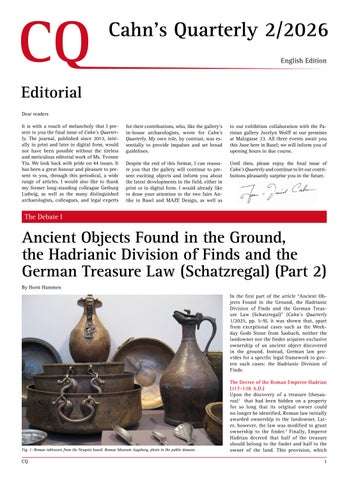
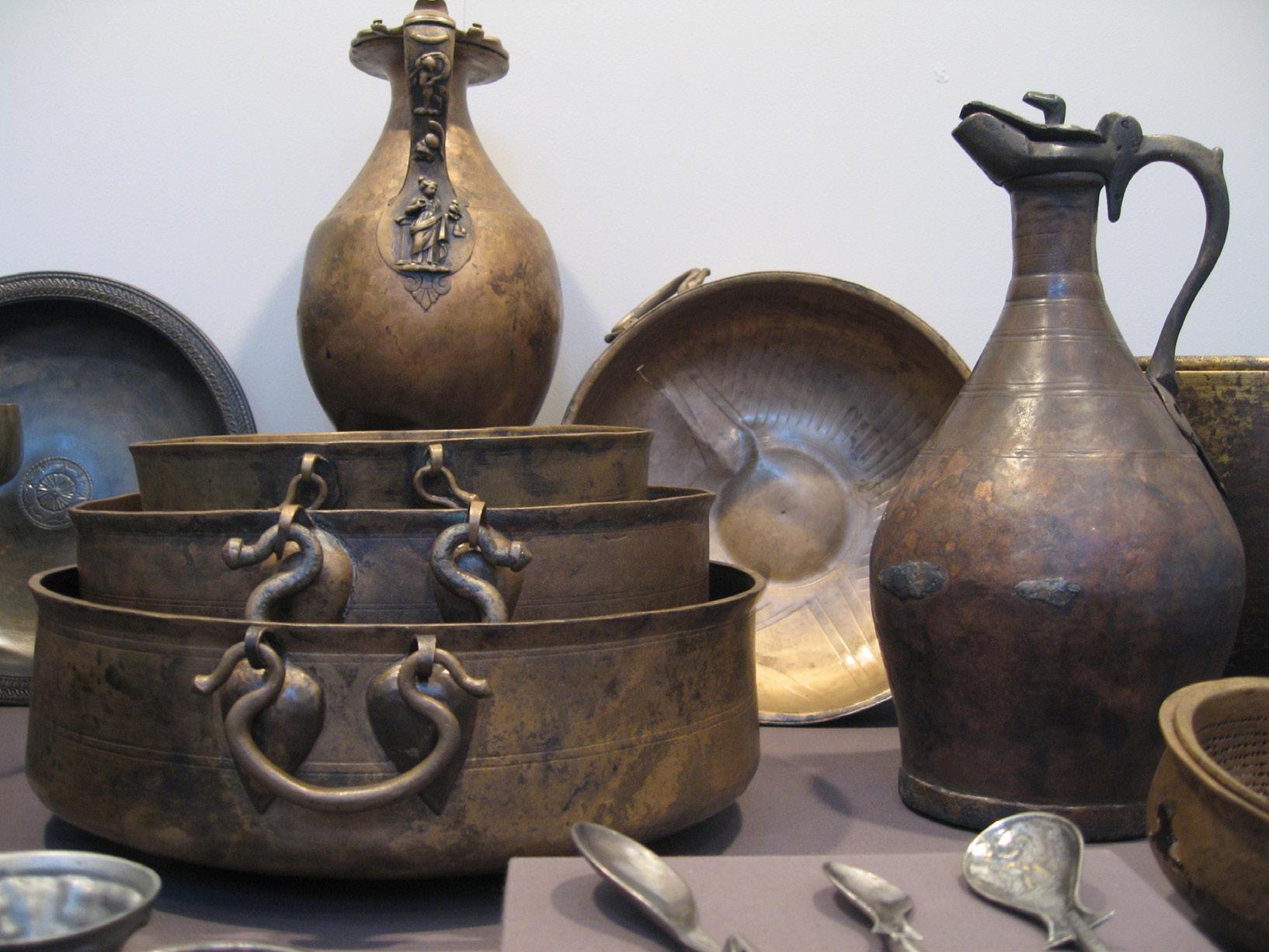
Fig. 1: Roman tableware from the Neupotz hoard. Roman Museum Augsburg, photo in the public domain.
now bears his name, is known as the Hadrianic Division of Finds.3 This regulation generally applied regardless of the nature of the treasure or the characteristics of the land. A particular difficulty arose, however, when a treasure was discovered on a burial site. Under Roman law, burial places were classified as res religiosae and, once used for interment, were removed from private ownership and placed beyond the owner’s power of disposal.4 As a result, unlike ordinary land, there was no landowner who could participate in ownership alongside the finder. Marcus Aurelius and Lucius Verus resolved this issue pragmatically by assigning the second half of the treasure to the imperial treasury (fiscus). 5 Thus, in contrast to the approach later adopted by the German federal states – most recently Bavaria – under the so-called Schatzregal (Treasure Law), the Roman state claimed a share of discovered treasure only in this exceptional circumstance.
The Hadrianic Division of Finds continues to apply in German law. When a treasure is discovered in the ground, ownership is divided equally: one half accrues to the finder (finder’s share), the other to the landowner6 (landowner’s share; § 984 of the German Civil Code7). The allocation of a finder’s share is intended to reward the individual who brought the object to light, thereby making it available again for human use.8 The finder becomes the sole owner only if the treasure is discovered on his own property.9 A notable example occurred in 1979, when a private individual unearthed the Weissenburg Treasure while carrying out work in his garden. The hoard comprised 114 objects, possibly temple inventory or part of a merchant’s stock, including Roman bronze statuettes, silver votive plaques, and iron implements. As Bavaria had not yet introduced a treasure trove law at the time, the Free State of Bavaria was required to purchase the hoard from the landowner, after which it was placed on display in the Roman Museum in Weissenburg.10
Occasionally, however, matters are resolved differently. This was the case with the Neupotz Hoard (fig. 1), the largest group of metal objects from the Roman Period discovered in Europe, comprising 1,062 items. These objects may have been plunder lost around 260 A.D. by returning Alamannic warriors while crossing the Rhine. The items were recovered over a period of several years during gravel extraction in a former branch of the Rhine, and in accordance with the Hadrianic Division of Finds, the gravel pit owners acquired full ownership of the finds. After an odyssey through numerous museums in Germany and abroad, including the Historical Museum of the Palatinate in Spey-
er and the Knauf Museum in Iphofen,11 the Speyer heritage authority placed the hoard under protection to prevent its dispersal.12 Eventually, the owners entrusted the hoard to the Neues Museum in Berlin as a longterm loan.
Attic Finds
In Roman law, the Hadrianic Division of Finds applied only to treasures discovered on a plot of land (“in … loco”).13 From time to time, however, so-called attic finds appear on the art market – ancient objects and other artworks found not in the ground, but tucked away in old cupboards or wooden chests. Under current German law, the Hadrianic Division of Finds may nonetheless also apply in such cases, since German law covers not only treasures discovered in the ground, but also those hidden in movable objects, most commonly pieces of furniture.14
In some instances, however, ownership is clear, and consequently the Hadrianic Division of Finds does not apply. This was the case with an 18th century Famille Rose vase from the reign of the Chinese emperor Qianlong, discovered in an attic and subsequently sold at Sotheby’s for 16.2 million Euros, where the seller was able to demonstrate that his grandparents had inherited it from an uncle who had died in 1947. 15 A family from Bolzano was less fortunate. After discovering eight Etruscan artifacts in the attic of a property they had acquired through an inheritance settlement, they reported the find to the South Tyrolean authorities. An investigation by the Carabinieri unit for the protection of cultural heritage revealed that the objects had been illegally excavated in the Lazio region.16
Under Italian law, all archaeological finds automatically pass into state ownership. Thus, here too, the Hadrianic Division of Finds was not applicable.
Occasionally, the antiquities trade is also offered items discovered in old pieces of furniture stored in an attic, where there is no indication that they originate from illicit excavation or theft that would give rise to state ownership – this can be ascertained by checking with the Italian Carabinieri, Interpol, or the Art Loss Register – but where the finder is likewise unable to prove acquisition of the object by inheritance or as inventory contractually included in the purchase of the house,17 and no other owner can be identified. Notwithstanding the fact that the reputable art trade treats such objects with caution due to the lack of adequate provenance documentation, ownership is in such cases acquired in accordance with the Hadrianic Division of Finds.18
Movable and Immovable Property
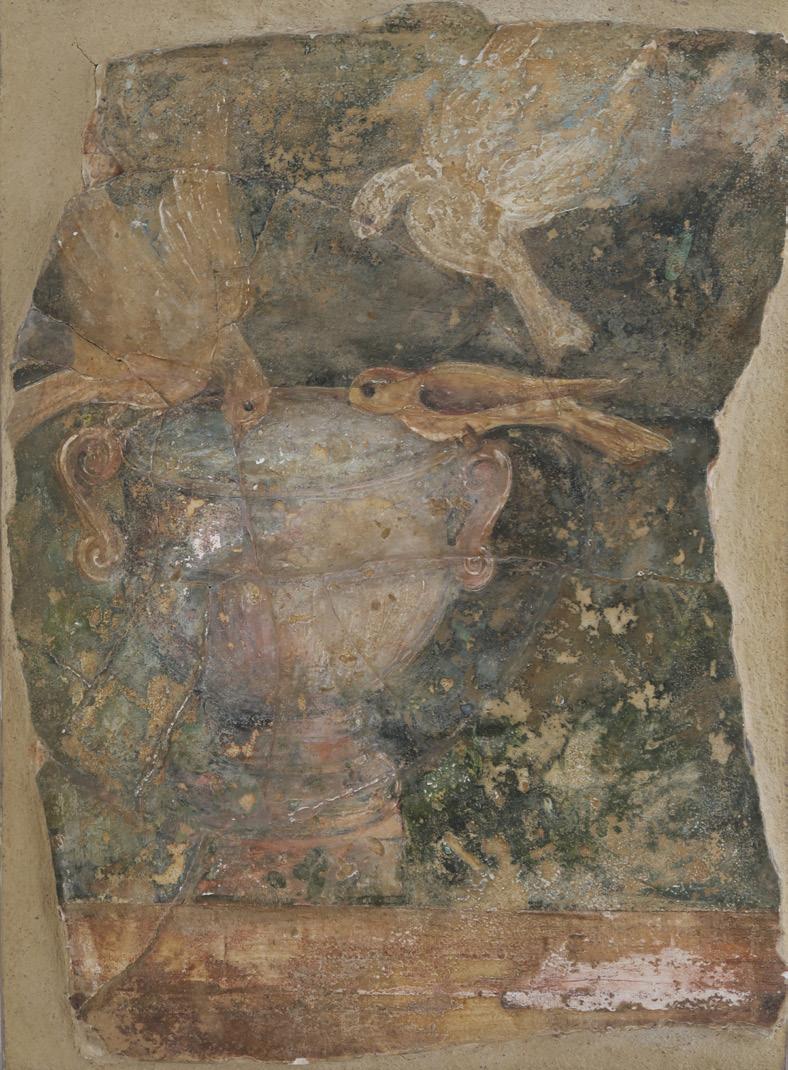
Attics can hold more in store than Chinese vases or Etruscan vessels. Occasionally, valuable paintings are discovered there as well. In 2024, an art expert discovered the painting Portrait of a Girl, attributed to or after Rembrandt and executed on oak panel, in the attic of a property in the U.S. state of Maine. It was later auctioned for 1.4 million US dollars.19 In ancient Roman times, large-scale portraits were usually rendered as frescoes or mosaics. Fragments of such works are not infrequently offered on the antiquities market (fig. 2). Like other antiquities, fragments of ancient frescoes or mosaics found in attic furniture or lying loose in the ground are subject to the Hadrianic Division of Finds if no owner can be identified. However, in the case of frescoes and mosaics, closer scrutiny is required. The Hadrianic Division of Finds applies only to movable items, such as statues or parts thereof, vessels, jewellery, coins, and the like. Different rules apply to objects that are permanently attached to a property.20 This can be illustrated by ancient mosaics such as the Nennig mosaic, the largest Roman figurative mosaic north of the Alps.
The Mosaic of Nennig
The Nennig mosaic once graced the floor of the entrance hall in an opulent rural villa in Nennig, a settlement some 40 kilometers from the Roman city of Augusta Treverorum (modern Trier) on the Saar.21 Composed of around three million tesserae and covering more than 160 square meters, it was created in the 1st century A.D. – not, to be sure, by the villa’s owner himself, but by craftsmen of considerable artistic skill. In the article published in Cahn’s Quarterly 1/2025, we noted that the names of crea-
Fig. 2: Roman fresco fragment depicting three birds on a krater. Photo: Dietmar Jung, Frankfurt.
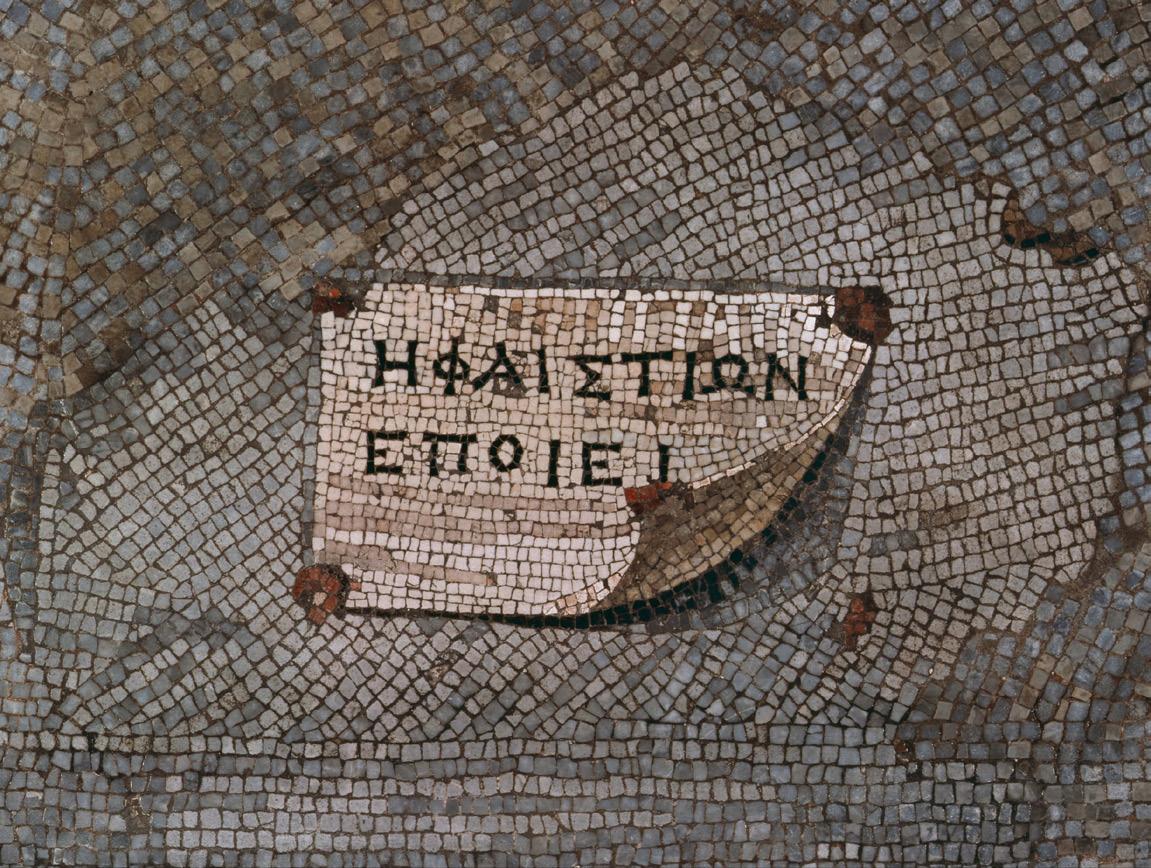
tors are sometimes recorded on ancient objects, and we saw that, under Roman law, a maker who produced an item from his own materials acquired ownership of it.22 Mosaicists, too, occasionally inscribed their names on their works. A case in point is a mosaic from the palace on the acropolis of Pergamon, made around 160 B.C. under Attalus II and now on display in the Pergamon Museum in Berlin. Its creator, Hephaistion, immortalized himself by rendering his name on a tessellated cartellino within the mosaic (fig. 3). Nevertheless, even if Hephaistion had fashioned the mosaic from tesserae that previously belonged to him, he would at no point have become its owner. As already illustrated by the object history of the Weekday Gods Stone from Sasbach, under Roman law, materials permanently affixed to a property are subsumed into the ownership of that property.23
This legal rule, however, did not benefit the builder of the villa, whose identity – and how he acquired the property – remain unknown. The reason for this was that the villa estate was not located in Italy, but in the province of Gallia Belgica. As a provincial property, it was subject to inalienable state ownership. Private individuals, including Roman citizens, could acquire only rights of possession and use of such land, but not title.24 There is no evidence to suggest a different legal situation. It is true that certain provincial towns25 were granted the Ius Italicum, giving their citizens the right to hold private ownership of provincial land.26 However, according to a report by the jurist Julius Paulus from the early 3rd century A.D., Vienna (Vienne on the Rhône), Lugdunum (Lyon), and the Colonia Claudia Ara Agrippinensium (Cologne) possessed the Ius Italicum,27 whereas such a privilege is not attested for any other cities in the Gallic and Germanic provinces,28 not even for Trier, located close to Nennig, which was elevated to
the status of a colonia in the mid-1st century A.D.29
The sources are silent on whether anything changed in the legal situation described above when Trier became an imperial residence at the beginning of the 4th century A.D. The question may indeed be left open, as the estate was abandoned in the late 4th century A.D., some time after a fire had occurred in one of the villa’s agricultural outbuildings.30 The owner’s final departure from the property entailed the loss of all rights to it.31 Our knowledge of the legal fate of the villa at Nennig and its mosaic in the 5th century A.D., and in the subsequent period of Frankish rule over the Trier region, is limited. We do not know whether it later found a new owner, and if so, when. Nor do we fully understand the law then in force as to whether essential components, such as a floor mosaic, were considered part of the property. It may be assumed that Roman (land) law remained in force during the transitional period between Roman and Frankish rule in the middle Mosel region, up to around 480 A.D. under the western Roman comes Treverorum Arbogast the Younger, but then soon disappeared.32 It is possible that in the 6th century A.D. the villa
complex at Nennig was used by a Frankish noble.33 However, the legal status of mosaic floors after the end of the Gallo-Roman administration of Trier remains unclear, since written Frankish law, the Lex Salica (ca. 510 A.D.), which also applied in the middle Mosel region after the conquest of Trier by the Merovingian king Clovis I around 500 A.D., contained no provisions on the ownership of essential components of a property.
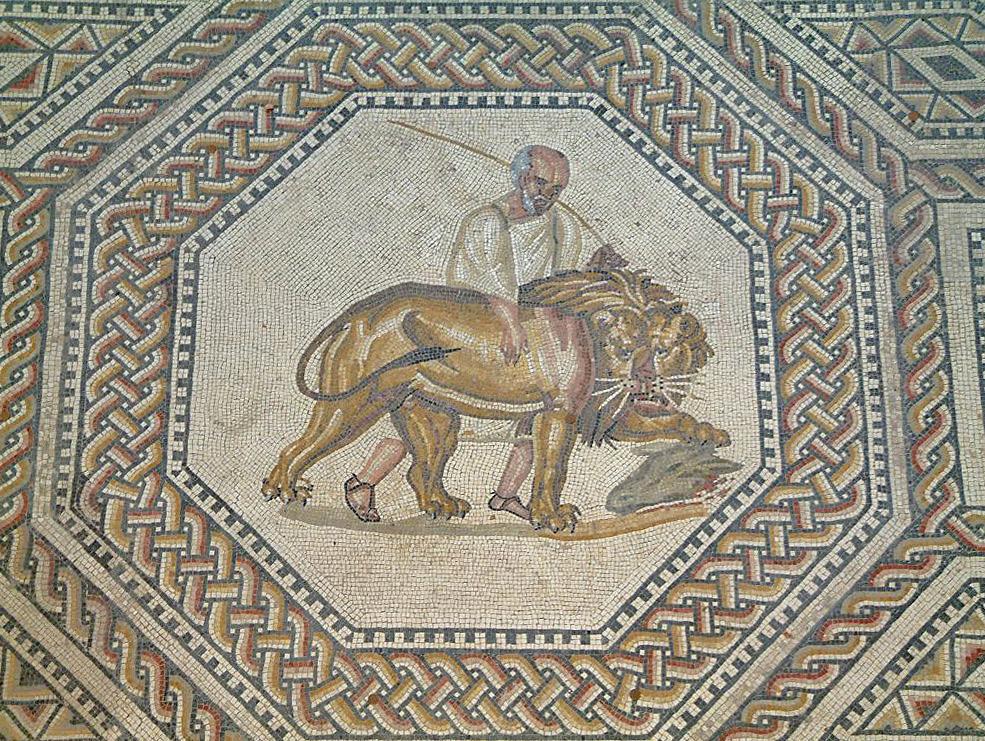
Forgotten over the following centuries, the mosaic came to light again in 1852, when the agricultural labourer Peter Reuter, during excavation work on his garden plot near Nennig, discovered the “Lion Medallion” (fig. 4)34 – one of seven surviving medallions depicting scenes from the amphitheatre. At that time, the French Code civil of 1804 applied in the Prussian territories on the left bank of the Rhine, including the Trier region.35 Like Roman law, the Code civil also provided for the Hadrianic Division of Finds (Art. 716). However, this rule was not applicable to the mosaic at Nennig. A mosaic is a “construction” on the land which is subsumed under ownership of the land itself (Art. 554), irrespective of the circumstances of its discovery. In the same year, the Gesellschaft für nützliche Forschung (Society for Useful Research) in Trier, which had been founded in 1801, purchased the garden plots beneath which the mosaic was hidden, in order to protect it from damage and theft.36 As under French law, so too under the current German Civil Code, which replaced French law on 1 January 1900 in the Prussian Rhine provinces, the Society’s ownership of the garden plots still extends
Fig. 3: Mosaic bearing the signature “Hephaistion”. Pergamon Museum, Berlin, photo in the public domain.
Fig. 4: Medallion from the floor mosaic of the Roman villa at Nennig. Photo: roemer-tour.de/roemerspuren/deutschland/ saarland/roemische-villa-nennig/
to the mosaic at Nennig. It remains, even after more than 170 years, the highlight of its collection.
Finds in Excavation Material
Treasure is discovered not only when someone happens upon objects still buried in the ground while gardening or carrying out agricultural work. Rather, it is not uncommon for such items to turn up in soil that has been excavated during construction work. One example is the discovery in 1984 of the “Great Lübeck Coin Hoard,” buried in the 16th century and the largest coin hoard ever found in Germany. During earthworks for a new building on a property owned by the Federal State of Schleswig-Holstein, a front-end loader operator working for the construction company noticed coins in the soil that had been dug up and dumped. The coins were then salvaged by archaeologists from the heritage conservation authority.37 The construction company claimed a half share of the hoard, arguing that it had acquired ownership of the excavated soil within which the coins had been found, based on a contractual right to appropriate the excavated material. This line of reasoning, however, was rejected. The Federal Court of Justice held that ownership depended on the object in which the treasure was originally hidden – in this case, the land owned by the federal state – where it had stayed until excavation brought it to light.38
Construction Contractors, Building Site Workers, and Archaeologists
Attention must be paid not only to the place in which an ancient object is hidden, but also to the question of who, in legal terms, is to be regarded as its discoverer. Occasionally, a treasure is not found by a single person; rather, as in the case of the Trier hoard of gold coins, several individuals may be involved in the discovery.39 One of those involved in the discovery process at the time was a truck driver who transported excavated soil from the construction site to a more distant location. However, he only became aware of the gold coins after several amateur collectors had already recovered coins from the dumped material. For this reason, he could not be regarded as the discoverer of these coins, still less of the hoard as a whole. However, the circumstances are not always like this. The aforementioned Lübeck coin hoard, for example, was discovered by a front-end loader operator when he noticed coins in the soil excavated from the construction site. This made him, and not the construction company that employed him, the discoverer of the treasure. The Federal Court of Justice held that such an unusual and accidental event as the discovery of a treasure by an employee cannot be regarded as part of their professional activity
and therefore cannot be attributed to the employer.40
Only if an employee discovers a treasure during a systematic and targeted search can the employer, as organiser of the search, be regarded as its discoverer.41 An example of a treasure acquired by an employer is the recovery of several hundred Spanish gold coins from the wrecks of a Spanish treasure fleet. In July 2015, this find was made by divers working for 1715 Fleet-Queens Jewels LLC, a company specialising in underwater treasure hunting, some 300 years after the ships sank off the coast of Florida.42 The company knew that the fleet had been carrying large quantities of gold and had an approximate idea of the location where it had gone down. Under German law, therefore, the company itself and not the divers employed by it, would have been regarded as the discoverers, and thus owners, of the treasure.
The example of the gold hoard from Neupfarrplatz in Regensburg shows, however, that the person who first notices a treasure may still be denied the finder’s share, even if the discovery was not the result of a planned and deliberate treasure hunt, but occurred during work conducted under archaeological and heritage supervision because historically valuable structures were being uncovered. The City of Regensburg, which owned the square and planned its redevelopment, knew that beneath it lay the remains of a former Jewish ghetto and, deeper still, the foundations of a Roman legionary camp. The city, however, had no reason to suspect that the archaeologically supervised site contained a hoard of what later proved to be 624 late medieval gold ducats. Nevertheless, the Higher Regional Court of Nuremberg dismissed the excavator contractor’s claim to the coins on the ground that he had been the first to notice them. The court held that when earthworks are carried out under the supervision and control of archaeologists, it is clear to all involved that archaeologically significant finds are the result of a purpose-driven excavation. Since the discovery of coins is not unusual in the excavation of a medieval settlement, the uncovering of the coins could not be regarded as a chance treasure find; nor, therefore, could the earthworks contractor who found them be considered the discoverer.43
The Merovingian Burial Site
It is fairly common for a treasure not to be recovered “in one piece,” but in stages: after one person discovers part of it, further portions may later be uncovered by others or might have been recovered through subsequent excavations. In such cases, the find-
er’s share in the entire treasure belongs to the discoverer of the first partial find. This legal principle benefited the discoverer of a Merovingian burial ground found in Hesse. The discovery of burial goods in two graves within the burial ground was made by a volunteer using a metal detector who had a heritage-law excavation permit. Although he realized that the two graves formed part of a larger burial ground, he refrained from further excavation and reported the find to the State Office for Heritage Management, as required by heritage protection law.44 Nevertheless, he was awarded the finder’s share not only in the grave goods from the two graves, but also in the entire additional treasure located at the site. The decisive consideration was that the discoverer should not be disadvantaged for complying with the heritage-law prohibition on further digging and for enabling the complete archaeological preservation of the site by reporting the discovery to the heritage authorities.45
Gold, Jewellery, and Other Precious Items
Only a person who has discovered a treasure has the good fortune of acquiring (co-) ownership of a buried find under the Hadrianic Division of Finds (§ 984 of the German Civil Code, “Schatzfund” i.e. Treasure Trove). For the purposes of German treasure law, it is irrelevant whether the objects in question date from, say, the early 20th century or from Antiquity. Ancient finds, however, often raise a question that rarely arises in connection with objects from the early 20th century: are bones, pottery shards, or isolated finds of poorly preserved Roman coins treasures? The Duden, still probably the authoritative dictionary of the German language, defines treasures primarily as collections of valuable objects (jewellery, items made of precious metals, and the like).46 As an example, it cites the legendary Nibelung treasure,47 which, according to the Nibelungenlied, contained so much gold and so many precious stones “that it required twelve wagons fully loaded to carry it away, and even then it took four days and nights, making three journeys each day, to transport it from the mountain where it had been hidden.”48 Although the ancient hoards brought to light to date, even those weighing 18.5 kilograms,49 such as the Trier gold hoard, cannot compare with such a treasure, hoards of this kind and other significant buried finds are, in ordinary usage, nonetheless regarded as treasure, even where they consist neither of gold nor precious stones. Examples include the sandstone Celtic prince of Glauberg and the Alemannic helmet from the princely grave of Gammertingen, made of copper and iron plates and listed in Baden-Württemberg’s register of nationally valuable cultural property.
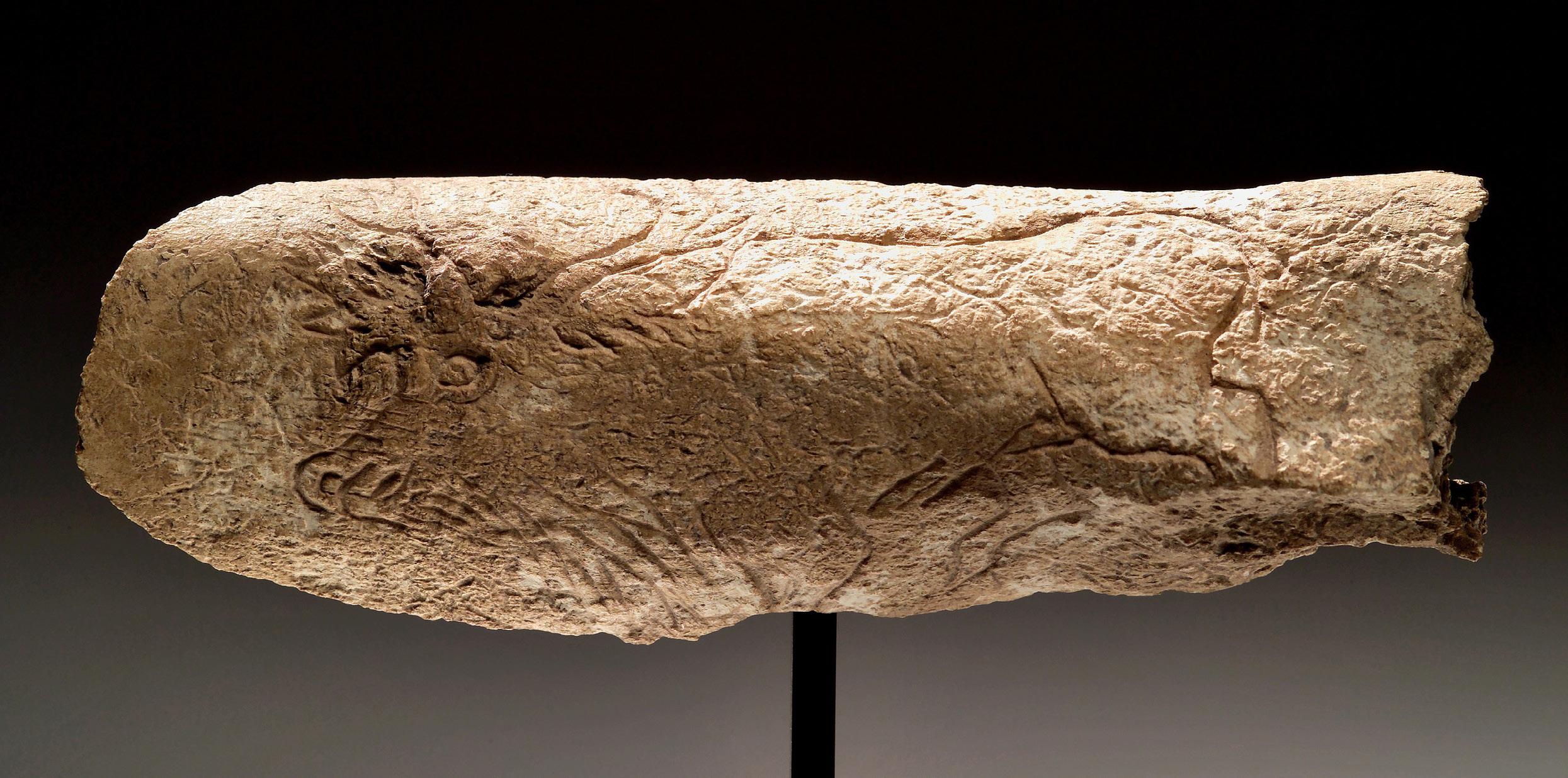
The Neolithic Bone with Engraved Decoration and the Sarcophagus of Agrigento But what about seemingly worthless objects such as ancient bones or pottery shards? Occasionally, a bone is not merely a bone, but an artwork of considerable significance. One example is a tubular bone engraved with a depiction of a prehistoric stag from the Magdalenian Period (ca. 15,000 B.C.), published in Cahn’s Quarterly 1/2013 (fig. 5),50 which was probably already regarded as a work of art by its creator. Similarly, unremarkable pottery shards can prove to be of archaeological value. This was the case with a large collection of ancient terracotta fragments that had lain unnoticed in a private collection for over 40 years and were almost discarded, but were ultimately preserved and reassembled. The restored sarcophagus is now on display at the Archaeological Museum of Agrigento in Sicily.51 It should be noted that German law defines the concept of a “treasure” more broadly than ordinary usage. The term also includes excavated remains of prehistoric animals, in which ownership never existed at any point, as well as ancient artefacts that became ownerless because they had been discarded in Antiquity, insofar as they are of archaeological interest.52
“...having been hidden for several centuries”
Not every discovery of valuable objects results in the finder and the landowner becoming co-owners. Rather, a statutory division of the find only arises where the object has remained concealed for so long that the owner can no longer be identified. The
relevant time threshold varies according to the nature of the item concerned. Thus, it is by no means uncommon for wedding rings lost on agricultural land to be recovered by metal detectorists after more than 50 years and returned to their elderly owners. Since names are often engraved on the inside of such rings, it remains quite feasible to trace the owners even many years after the loss.53
By contrast, as already provided in the General Land Law for the Prussian States of 1794, it is generally unnecessary to search for an owner “where it is apparent from the nature of the discovered treasure itself that it must already have been hidden for a century or more.”54
In the case of ancient objects that have lain hidden for 1,500 years or longer, no such calculations are required. As noted in the first part of this article, any attempt to identify the owner of objects recovered from the ground is futile. Therefore, in principle, there is nothing to prevent the acquisition of ownership under the Hadrianic Division of Finds.
Outlook
When an ancient find is recovered from the ground, the Hadrianic Division of Finds generally allows two parties – the finder and the landowner – to share in the discovery, each acquiring a half share in the object: shared joy is double joy, as the saying goes. At times, however, that joy is quickly dampened. In many cases, the Hadrianic Division of Finds is overruled by the treasure trove prerogatives (Schatzregalien) of the
German federal states. In such situations, neither the finder nor the landowner acquires any ownership interest in the find at all: shared sorrow, here, truly means double sorrow. Yet there is sometimes still room for hope. For this reason, the various forms of the treasure trove prerogative in Germany, and the fact that the finder of an ancient object and the owner of the land in which it is discovered do not always come away entirely empty-handed, will be discussed on another occasion, in another place.
References
1 Paulus, Digesta 41,1,31,1: pecunia; Codex Theodosianus 10,18,2: monilia (necklaces, jewellery); Codex Justiniani 10,15,1: mobilia.
2 Max Kaser, Das römische Privatrecht, Erster Abschnitt, 2nd ed. 1971, § 102, p. 427 with note 16; Ralf Fischer zu Cramburg, Das Schatzregal, 2001, pp. 47 f.
3 Institutiones Justiniani 2,1,39, Hist. Aug. Hadr. 18, 6. On the further development of Roman law cf. Ralf Fischer zu Cramburg, Das Schatzregal, p. 54 ff.
4 Ulpian, Digesta 8,5,1; Codex Justiniani 3,44,2,9.
5 Callistratus, Digesta 49,14,3,10 f.
6 I am not aware of any treasure finds on land without an owner. In this case, the landowner’s share is ownerless and, under German find law, accrues to the finder (Staudinger/C. Heinze, Kommentar zum Bürgerlichen Gesetzbuch, Buch 3, §§ 925-984, revised ed. 2020, § 984 Rn. 15).
7 See also Allgemeines Landrecht für die preussischen Staaten (ALR) aus dem Jahre 1794, Erster Theil, Neunter Titel, Dritter Abschnitt § 82.
8 Federal Court of Justice, judgment of 20.1.1988, case no. VIII ZR 296/86, Rn. 27.
Fig. 5: Tubular bone engraved with a depiction of a prehistoric stag. Southwestern Europe, Magdalenian, Upper Palaeolithic, ca. 15,000 B.C. Photo: Niklaus Bürgin.
9 Cf. already Institutiones Justiniani 2,1,39 and ALR Erster Theil, Neunter Titel, Dritter Abschnitt § 81; cf. also Staudinger/C. Heinze, Kommentar zum Bürgerlichen Gesetzbuch, Buch 3, § 984 Rn. 12, note 49.
10 Hans-Jörg Kellner/Gisela Zahlhaas, Der römische Tempelschatz von Weißenburg i. Bay., 1993, pp. 5 ff.; Michael Donderer, Zur Interpretation des Weissenburger Schatzfundes, Germania, vol. 82, 2004, pp. 235, 242.
11 Pfalz Express, Barbarenschatz von Neupotz auf Berliner Museumsinsel ausgestellt, 17.1.2017, https://www.pfalz-express.de/barbarenschatz-von-neupotz-auf-berliner-museumsinsel-ausgestellt/.
12 Die Rheinpfalz, Barbarenschatz: Verhandlung um Neupotzer Fund, 5.4.2016, https://www.rheinpfalz.de/ lokal/kaiserslautern_artikel,-barbarenschatz-verhandlung-um-neupotzer-fund-_arid,569830.html.
13 Institutiones Justiniani 2,1,39.
14 Staudinger/C. Heinze, Kommentar zum Bürgerlichen Gesetzbuch, Buch 3, § 984 Rn. 1. However, objects left in plain view in an attic do not fall under the Hadrianic Division of Finds, even if no one has looked at them for a long time. (OLG Köln, judgement of 11.6.1991, case no. 13 W 32/91).
15 Ludwigsburger Kreiszeitung, Dachbodenfund: Vase für 16 Millionen Euro versteigert, 12.6.2018, https:// www.lkz.de/lokales_artikel,-dachbodenfund-vasefuer-16-millionen-euro-versteigert-_arid,483074. html.
16 Südtirol News, Jahrtausende alt: Spektakulärer Dachbodenfund, 2.4.2025, https://www.suedtirolnews. it/unterhaltung/kultur/jahrtausende-alt-spektakulaerer-dachbodenfund.
17 In the absence of such an agreement, the seller of the property may demand the return of an item inadvertently left in the house, since ownership of it has not passed to the buyer.
18 Staudinger/C. Heinze, Kommentar zum Bürgerlichen Gesetzbuch, Buch 3, § 984 Rn. 1.
19 Welt, Auf Dachboden entdeckter Rembrandt für 1,4 Millionen Dollar versteigert, 11.9.2024, https:// www.welt.de/vermischtes/article253361184/USAAuf-Dachboden-entdeckter-Rembrandt-fuer-1-4Millionen-Dollar-versteigert.html.
20 Staudinger/C. Heinze, Kommentar zum Bürgerlichen Gesetzbuch, Buch 3, § 984 Rn. 1 for excavated mosaic floors of ancient houses.
21 Rudolf Echt, Endlich entdeckt: “Das Drum und Dran der landwirtschaftlichen Anwesen”, in: Monumente der Macht, Die gallo-römischen Grossvillen vom längsaxialen Typ, eds. R. Echt, B. Birkenhagen and F. Sarateanu-Müller, 2016, pp. 303, 307 f., 320.
22 Cf. Institutiones Justiniani 2,1,28.
23 Ulpian, Digesta 47,3,1 pr. and 1; Horst Hammen, Antike Bodenfunde, Hadrianische Fundteilung und deutsches Schatzregal (Teil 1), Cahn's Quarterly 1/2025, p. 5, 8.
24 Max Kaser, Das römische Privatrecht, Erster Abschnitt, § 97 II 2., p. 402; Gottfried Schiemann, Ius, in: Der Neue Pauly, vol. 6, 1998, col. 97.
25 The Ius Italicum was also granted to cities that were not colonies. Cf. v. Premerstein, Ius Italicum, in: Paulys Realencyclopädie der klassischen Alterumswissenschaft, vol. X,1, 1918, col. 1240.
26 On the question whether the Ius Italicum had not only fiscal effects but also effects in property law, cf. Friedrich Carl v. Savigny, Vermischte Schriften, Erster Band, pp. 43 f., 44-49, 57-60; cf. also Andreas Zack, Forschungen über die rechtlichen Grundlagen der römischen Aussenbeziehungen während der Republik bis zum Beginn des Prinzipats. V. Teil, GFA 17, 2014, pp. 247, 269, 280 ff.
27 Paulus, Digesta 50,15,8,1 and 2; cf. also Antipolis (Antibes) in Gallia Narbonensis, v. Premerstein, Ius Italicum, in: Paulys Realencyclopädie, vol. X, 1, col. 1240.
28 Kornemann, Coloniae, in: Paulys Realencyclopädie, vol. IV, 1, 1900, col. 580 f.
29 Cf. Tacitus, Historia 4, 72: “colonia Trevirorum”. –The elevation to the status of a colonia was by no means always accompanied by the grant of the Ius Italicum. Cf. Ulpian, Digesta 50,15,1,4 and 6.
30 Rudolf Echt (note 21), pp. 303, 317, 320 f.
31 Cf. Paulus, Digesta 41,7,2; Rene Roy, Die Aufgabe des Eigentums an Grundstücken gemäss § 928 BGB, 2017, p. 23; Hans Ankum, Das Verlassen von Liegenschaften, Sav. Zschr. Rom. Abt. Bd. 114 (1997), p. 402, 410 ff.
32 Sidonius Apollinaris, Ep. IV, 17, 2: “etsi apud limitem Latina iura ceciderunt”; Hans Herbert Anton, Trier im Übergang von der römischen zur fränkischen Herrschaft, in: Francia. Forschungen zur westeuropäischen Geschichte, vol. 12 (1984), pp. 1, 22 ff., 33, 35 f.
33 Hans Herbert Anton in Hans Herbert Anton/Alfred Haverkamp (ed.), Trier im Mittelalter, 1996, pp. 17, 29 f.
34 Jahresbericht der Gesellschaft für nützliche Forschung zu Trier vom Jahre 1852, 1853, p. 4, https://digi.ub.uni-heidelberg.de/diglit/jahresbericht_ trier1852/0010/image,info,thumbs; Harald Jansen, Römische Villa Nennig: Als ein Trierer Fälscher bei Ausgrabungen aufflog, Trierischer Volksfreund, 25.5.2022, https://www.volksfreund.de/region/trier-trierer-land/ villa-nennig-als-ein-faelscher-aus-trier-bei-ausgrabungen-aufflog_aid-70283425.
35 Therefore, neither Roman property law, including the Hadrianic Division of Finds, as it applied as ius commune in the Holy Roman Empire from the late Middle Ages onward (Bernhard Windscheid, Lehrbuch des Pandektenrechts, vol. 1, 3rd ed. 1870, § 1 p. 2 ff., § 139 p. 381 note 3, § 184 p. 525), nor the Electoral Trier territorial law (from 1668; cf. Maria Dirks, Das Landrecht des Kurfürstentums Trier, 1965, pp. 16-17, 28 f., 34), was applicable.
36 Jahresbericht der Gesellschaft für nützliche Forschung zu Trier vom Jahre 1852, p. 5.
37 Doris Mührenberg, Baggerführer findet 23.000 Münzen in einer Baugrube, Lübeckische Blätter 2009, issue 11, p. 161.
38 Federal Court of Justice, judgment of 20.1.1988, case no. VIII ZR 296/86 Rn. 33.
39 Karl-Joseph Gilles, Der römische Goldmünzenschatz aus der Feldstrasse in Trier, Trierer Zeitschrift, supplementary vol. 34, 2013, p. 15.
40 Federal Court of Justice, judgment of 20.1.1988, case no. VIII ZR 296/86 Rn. 23.
41 Federal Court of Justice, judgment of 20.1.1988, case no. VIII ZR 296/86 Rn. 21.
42 Hubert Walker, Divers Discover $ 4.5 Mil More 1715
Fleet Gold off Florida Coast, Coinweek 21.8.2015.
43 OLG Nürnberg, judgement of 13.5.1998, case no. 4 U 4119/97.
44 Till Kemper, Der Entdeckeranteil an einem nicht ausgegrabenen fränkischen Gräberfeld (OLG Frankfurt am Main, Urteil vom 20.8.2013) – Fluch und Segen für den Finder, Archäologische Informationen vol. 36 (2013), pp. 121-122.
45 OLG Frankfurt, judgement of 20.8.2013, case no. 11 U 113/12 Rn. 35; cf. OLG Düsseldorf, judgement of 20.1.1993, case no. 11 U 58/92 on a Roman burial site.
46 Likewise, § 398 of the Austrian General Civil Code defines a treasure as money, jewellery, “or other valuables.”
47 Duden, Onlinewörterbuch, keyword “Schatz”, https://www.duden.de/rechtschreibung/Schatz.
48 Nibelungenlied, Adventure 19, line 1158, Hatto, A. T., trans. The Nibelungenlied. Harmondsworth: Penguin Books, 1965.
49 Karl-Josef Gilles, Der Trierer Goldmünzenschatz aus der Feldstrasse in Trier, p. 262.
50 Yvonne Yiu, Steinzeitlicher Artenschutz, Cahn’s Quarterly 1/2013, p. 1.
51 Jean-David Cahn, Eine pragmatische Lösung, Cahn’s Quarterly 1/2024, p. 10.
52 Staudinger/C. Heinze, Kommentar zum Bürgerlichen Gesetzbuch, Buch 3, § 984 Rn. 3 a.
53 OLG Hamburg, order of 16.1.1981, case no. 1 U 83/81.; cf. the example in FOCUS online, Ehepaar bekommt 50 Jahre lang verlorenen Ehering zur diamantenen Hochzeit zurück, 16.1.2024, https:// www.focus.de/panorama/welt/goldener-schatz-ehepaar-bekommt-50-jahre-verlorenen-ehering-zurdiamantenen-hochzeit-zurueck_id_259581176.html.
54 ALR Erster Theil, Neunter Titel, Dritter Abschnitt § 79.
Prof. Dr. Horst Hammen held the Chair of Civil and Commercial Law at the Justus Liebig University, Giessen. His main area of research is Stock Market and Capital Market Law. Furthermore, he publishes articles on legal history and other historical themes.
Ambrosial Oil that Blooms on the Eternal Gods
Invisible Archaeology – Following the Scent
By Gerburg Ludwig
Homer’s strikingly vivid language in the epics and hymns stimulates the reader’s senses and imagination. Beyond the sheer pleasure of reading, this imagery helps us reconstruct aspects of ancient life that have left no tangible traces in the form of archaeological remains –aspects that encompass everything perceived through the senses, be it a sight, a sound, or a scent.
In the Hymn to Aphrodite, Homer describes how the goddess, seized by love for the Trojan prince Anchises, prepares herself for a rendezvous on Mount Ida.
“Going to Cyprus, to Paphos, she disappeared into her fragrant temple; it is there that she has her precinct and scented altar. There she went in, and closed the gleaming doors, and there the Graces bathed her and rubbed her with olive oil, divine oil, as blooms upon the eternal gods, ambrosial bridal oil that she had ready perfumed.” (Hymn to Aphrodite 58-63, trans. Martin L. West).
These few lines eloquently illustrate the power of scent as a stimulus to the human senses. Viewed from a less poetic, purely physiological perspective, odour molecules enter the olfactory epithelium of the nose as a scent is inhaled. Its olfactory receptors send out a neurobiological signal that stimulates the limbic system in the brain, which, together with other brain regions, governs memory, emotions, and behaviour. Despite its fleeting nature, a scent can be recalled at any time. When it is perceived again, we respond without conscious reflection: smoke alerts us; the smell of sweat is unpleasant; fragrance induces a sense of well-being. We associate scents with specific events or personal memories. In this way, responses to smell shape
human behaviour as well as social and cultural interaction.
Since the 3rd millennium B.C., the Egyptians employed perfumed oils to anoint statues of gods, participants in sacrificial rituals, the deceased, at funerary banquets, for medicinal purposes, or as personal fragrance. A relief in the Musée du Louvre, Paris (664341 B.C., inv. no. E 11162) depicts two women pressing oil with a screw press, while a third approaches carrying a basket of flowers, possibly lilies or irises. In the palaces of Mesopotamia, perfumed oils were used in similar contexts from around 2000 B.C. The renowned clay tablet archive of the palace of Mari (Tell Hariri, Syria, 1800 B.C.) documents the oils employed, such as olive, henna, and sesame, alongside aromatic plants like myrtle, cypress, and fragrant reed, as well as resins including galbanum (Persian gum resin).
In the 2nd millennium B.C., essential and exotic ingredients traveled westward along flourishing trade networks, accompanied by the transfer of technical knowledge. Mycenaean Linear B tablets from the archives of
Knossos and Pylos record shipments of sesame, thistle, and olive oils, as well as the presence of specialized perfumers and their workshops (14th-13th centuries B.C.).
In Homer’s Iliad, goddesses make lavish use of scented oils. Hera anoints herself with “olive oil, ambrosial, very soft, and scented specially for herself,” in order to seduce Zeus (Homer, Iliad 14.171 f., translation by Samuel Butler). Aphrodite anoints Hector’s body “with ambrosial oil of rose,” as she watches over him (Homer, Iliad 23.185-187, same translation).
Initially, in Greece during the first half of the 1st millennium B.C., perfume was reserved for the aristocratic elite. An increase in the trade of perfumed oils and their ingredients in the 6th century B.C. led to broader usage, reflected in the production of various types of perfume vessels such as alabastra, aryballoi, and lekythoi. This trend gained momentum in the Classical and Hellenistic Periods. While the upper classes favoured particularly high-quality, rare perfumes, more common varieties were used in the palaestrae and the baths. The French archaeologist J.P. Brun refers to this as the “democratization of perfume use.”1 Literary sources mention several perfumeries located in a specific area of the Athenian Agora, which also served as a popular place for social gatherings (Lysias 24.20; Demosthenes 25.52).
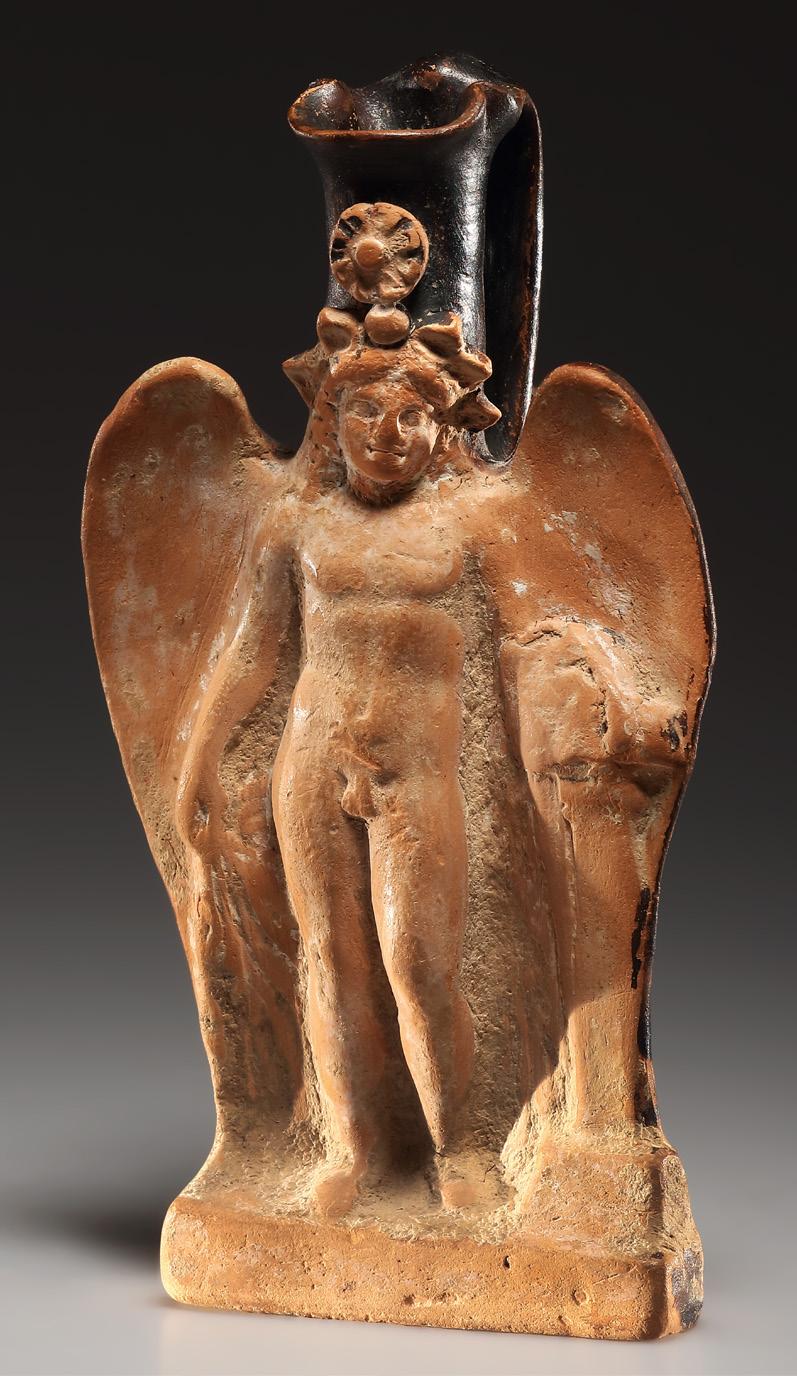
A refined example of a Late Classical perfume vessel is available at the Cahn Gallery (fig. 2). The front is decorated in relief and depicts a standing youthful Eros who smiles gently. A wreath adorns his head. He holds a sprig (?) in his left hand and rests his right hand on a pillar. His outstretched wings transition into the smooth, black-glazed reverse, where the handle is attached and rises to the trefoil
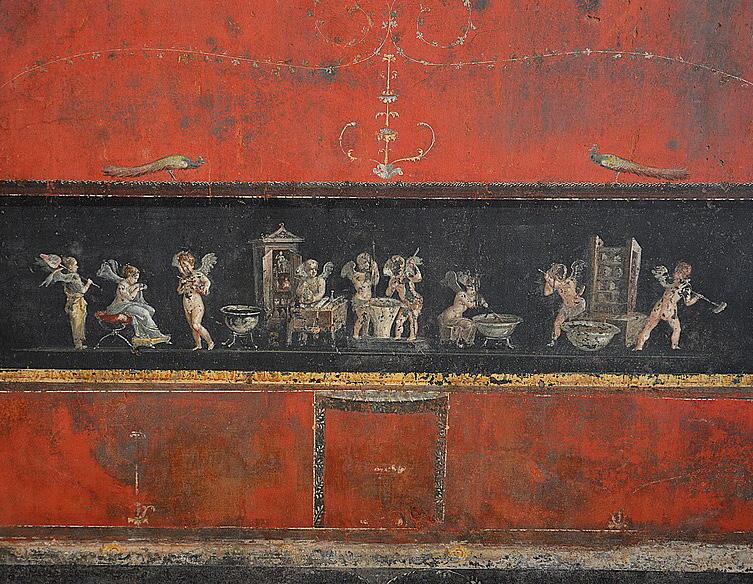
Fig. 1: Erotes and Psyches producing perfume. Detail from a wall-painting in the Fourth Style, dating from the 3rd quarter of the 1st century A.D., Casa dei Vettii in Pompeii (VI 15,1) © MentNFG, CC BY-SA 4.
mouth. While the rosette-decorated neck was wheel-thrown, the vessel itself, including its rectangular base, was mould-made, as was generally the case in the production of terracotta statuettes. The trefoil mouth, otherwise typical of oinochoai, is a distinctive feature of these figural vessels, which were used as votive offerings or grave goods.
Archaeological evidence of a Late Hellenistic perfume workshop was identified by J.-P. Brun in 1997 in House I, B, in the Stadium district on the island of Delos. Two marble tables for wedge presses, carefully crafted and decorated, were found in situ. Brun compared these with a closely related press table in Paestum, Campania, which had previously been associated with perfume production. Deeply anchored postholes beside the tables supported a wooden press frame resembling a shelf. This frame held baskets of olive paste, which were pressed using wedges. The oil flowed from the press table into a collecting vessel and was subsequently heated in cauldrons over four adjacent hearths for further processing.
Our knowledge of perfume production, ingredients, and products comes from Theophrastus’ treatises De odoribus and De sensibus (late 4th century B.C.), which are based, amongst other things, on first hand experience with perfumers in Athens. Other authors such as Callimachus, Cicero, Pliny the Elder, Dioscorides, and Columella, as well as inscriptions, for example from the sanctuary of
Apollo on Delos, provide additional information, with Callimachus and Dioscorides even giving specific recipes.
A frieze of a wall painting depicting Erotes and Psyches in the Casa dei Vettii in Pompeii (VI 15,1; fig. 1) vividly illustrates the workflow in a perfume workshop, with meticulous attention to detail. From left to right, two Erotes swing large hammers to drive wedges into baskets, sending oil streaming from the press into a large bowl. The oil is then heated and scented with aromatic substances (enfleurage) in a cauldron. Nearby, two more Erotes energetically grind or stir additional ingredients in a tall mortar. On the far left, the perfume is carefully bottled, displayed in the shop, and tested by a customer.
Whereas in modern perfume production high-proof alcohol is used as carrier, to which natural essences dissolved in distilled water or synthetic fragrance compounds are added, ancient perfumes used unrefined plant oils as their base. These included sesame oil, bitter almond oil, ben oil (from the ben-nut tree), and later especially oil from crushed green olives. These oils contain triglycerides, i.e. molecules made of one glycerol linked to three fatty acids by ester bonds. Over the centuries, and depending on the time and region, the oil was also obtained using spindle, lever, or torsion presses. The aim was not to produce large quantities, but to ensure the exceptional quality and fineness of the perfume oil through the slowest possible pressing
process. Fragrances extracted beforehand by grinding and macerating aromatic substances such as iris, rose petals, and fragrant woods were absorbed into the oil upon heating. The further application of heat was helpful, but not essential, in the enfleurage process. Added resins reduced volatility; salts were used for preservation; and dyes such as madder red provided additional visual appeal. For storage, opaque bottles made of ceramic or stone were used, and for sale, the perfume was transferred into smaller containers.
As the frieze from the Casa dei Vettii shows, the use and production of perfumes spread to Italy with the onset of Roman expansion into the East, eventually leading to large-scale production and consumption in the Imperial Period. Campania became the main centre of production, particularly Paestum (from around 270 B.C.). Famous for its rose gardens that bloomed twice a year, it is not surprising that perfumers there specialized in rose fragrances. Production methods were similar to those used in Greece and, over time, approached an almost industrial scale. As in Athens, several perfumeries were situated in the north-western corner of the forum. It was there as well that the previously mentioned wedge press, resembling the Delian specimen, was found.
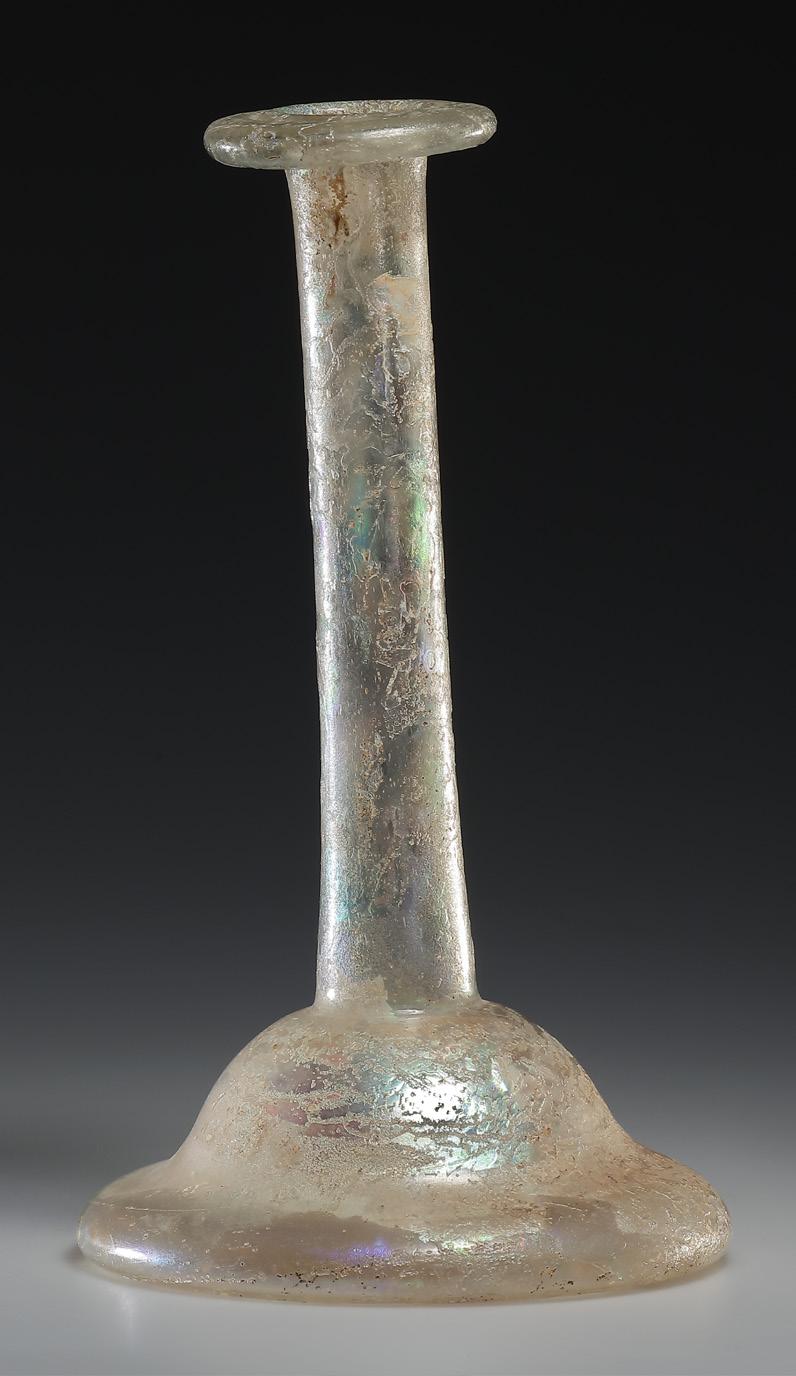
In Campanian Puteoli, glassblowers supplied perfumers in the vicinity with suitable vessels, often unguentaria, such as the intact candlestick unguentarium available at the Cahn Gallery (fig. 3). The vessel, whose shape is typical of the period, contained perfume in its shallow, bell-shaped body with a slightly domed base. The precious liquid could be easily dispensed through the long neck with its wide, flared rim. The iridescence of the colorless glass adds an extra charm to the piece.
Literature:
1J.-P. Brun, The Production of Perfumes in Antiquitiy: The Cases of Delos and Paestum, American Journal of Archaeology 104, Nr. 2; April 2000, 277-308, here 277.
Imprint
Publisher Jean-David Cahn Malzgasse 23 CH-4052 Basel www.cahn.ch ISSN 2624-6368
Editors Jean-David Cahn Yvonne Yiu
Authors Jean-David Cahn Ulrike Haase Horst Hammen Gerburg Ludwig Tim Wright
Translations Yvonne Yiu
Photos Niklaus Bürgin
Ulrike Haase
Layout Michael Joos Yvonne Yiu
Fig. 3: AN UNGUENTARIUM. H. 20.5 cm. Colorless glass. Roman, late 1st-3rd century B.C. CHF 3,800
Fig. 2: AN ATTIC OINOCHOE IN THE FORM OF EROS. H. 13 cm. Terracotta. Greek, around 350 B.C. CHF 4,800
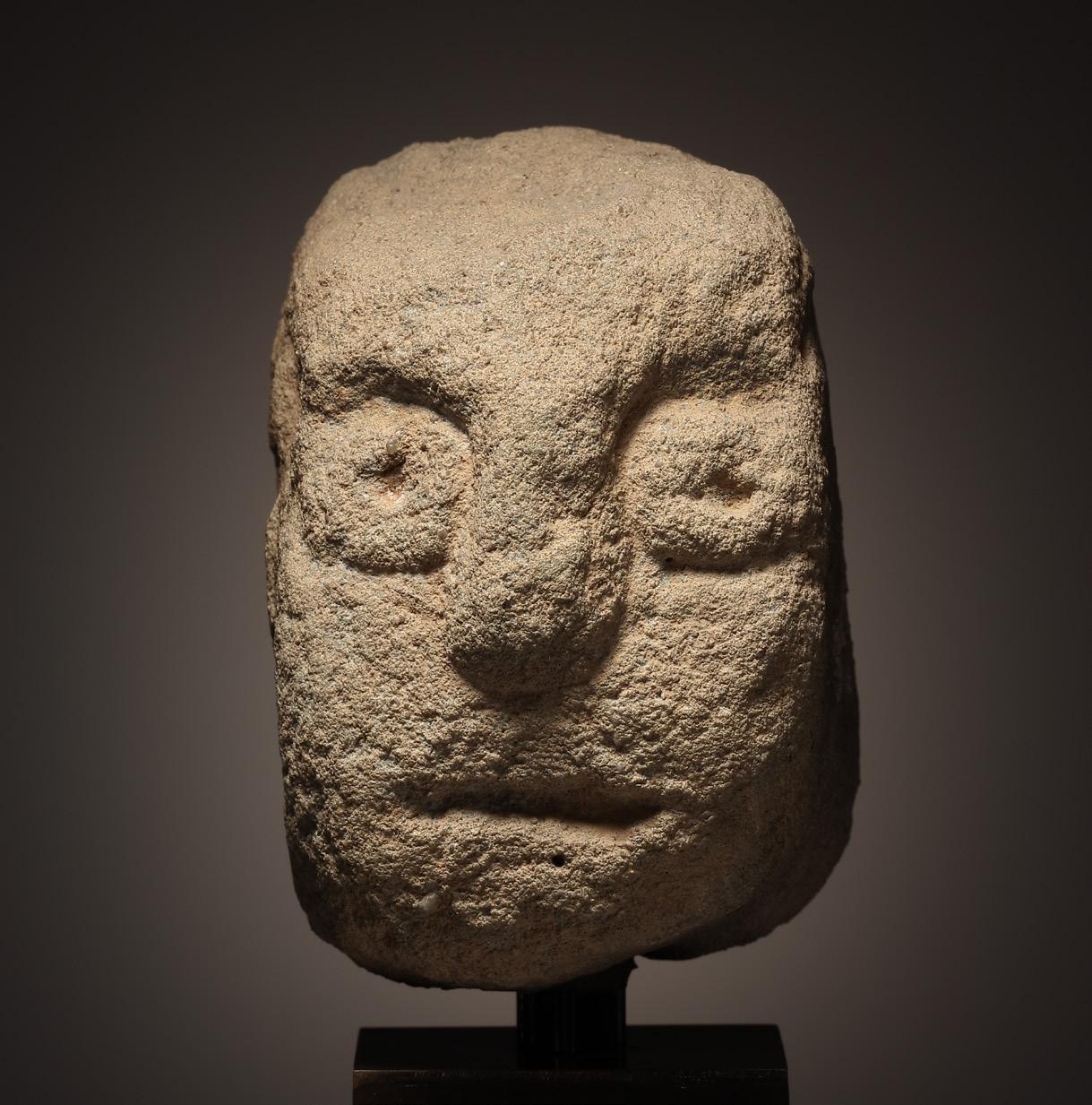
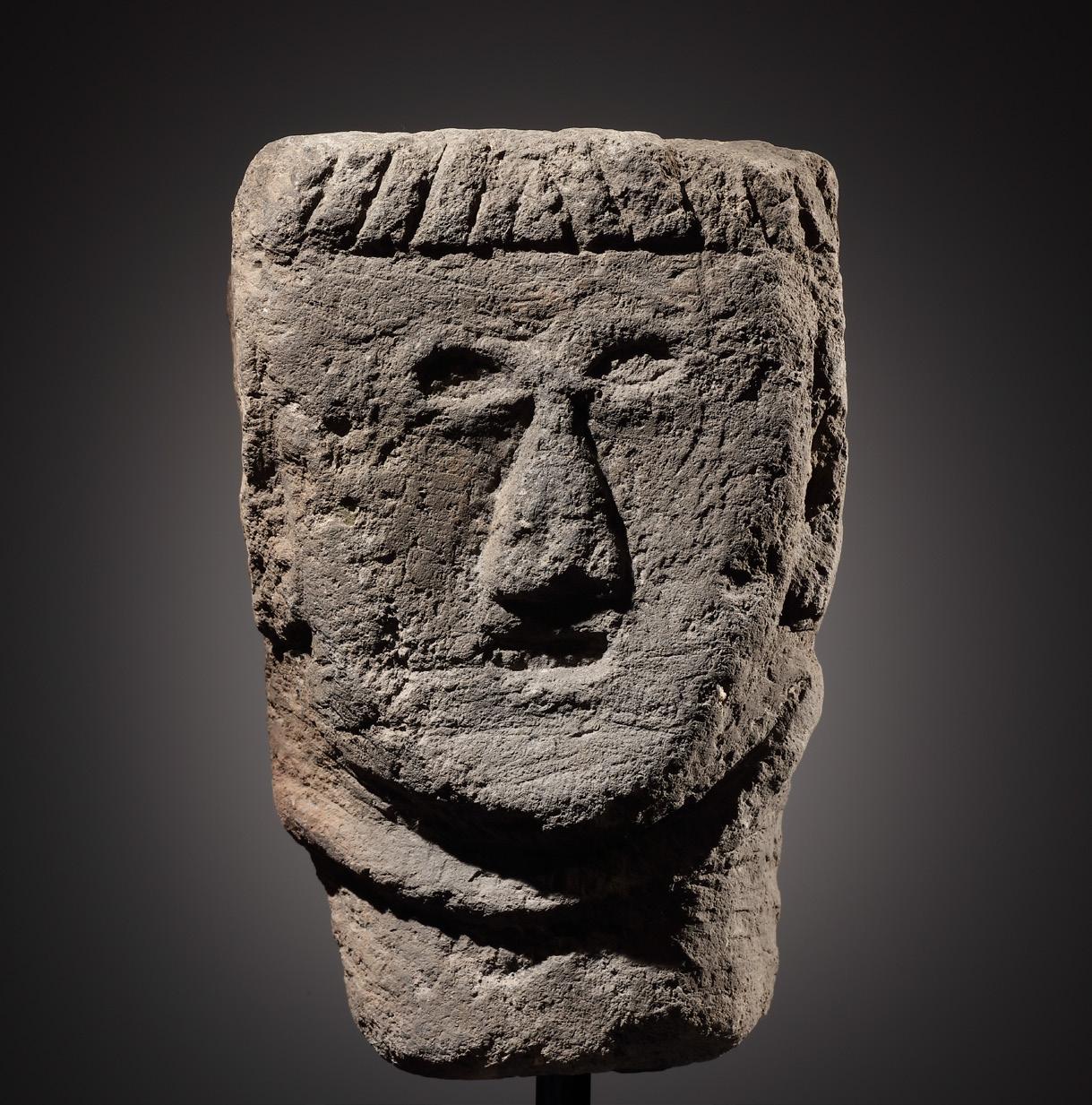
A CELTIC HEAD. H. 12.5 cm. W. 8.2 cm. D. 11.3 cm. Sandstone. Formerly priv. English collection; acquired from Chris Russ Antiquities, prior to 1998 (see List 32). With Finch&Co priv. coll. Thereafter, priv. coll. J. P. Keane. With French market since 2025. Said to have been found near Wroxeter, Shropshire, once the Roman Town of Viroconium, in the territory of the Celtic Cornovii. Celtic, 1st cent. B.C.-1st cent. A.D. CHF 14,000
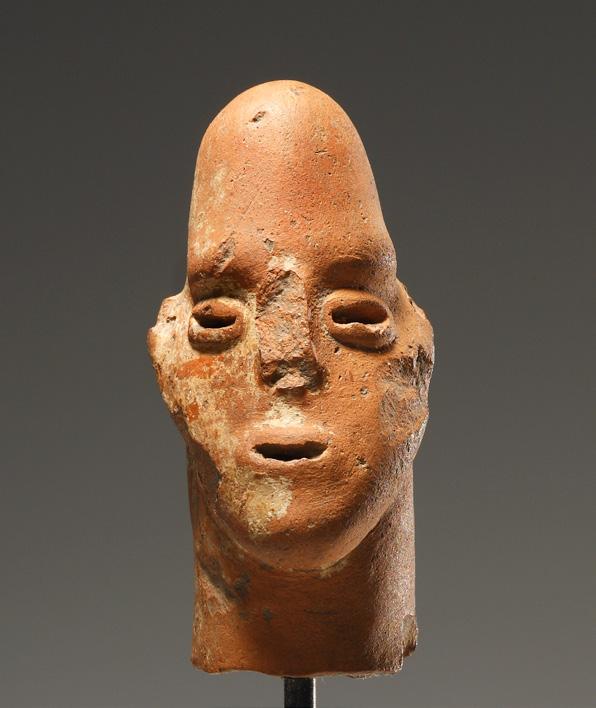
A HEAD OF AN IDOL. H. 5.8 cm. W. 2.8 cm. D. 3.4 cm. Terracotta. Formerly London priv. coll. Thereafter Rupert Wace Ancient Art, Ltd., London, 2007 or earlier, acquired from U.K. art market. Thessaly, Sesklo Culture, 7th-6th mill. B.C. CHF 6,800
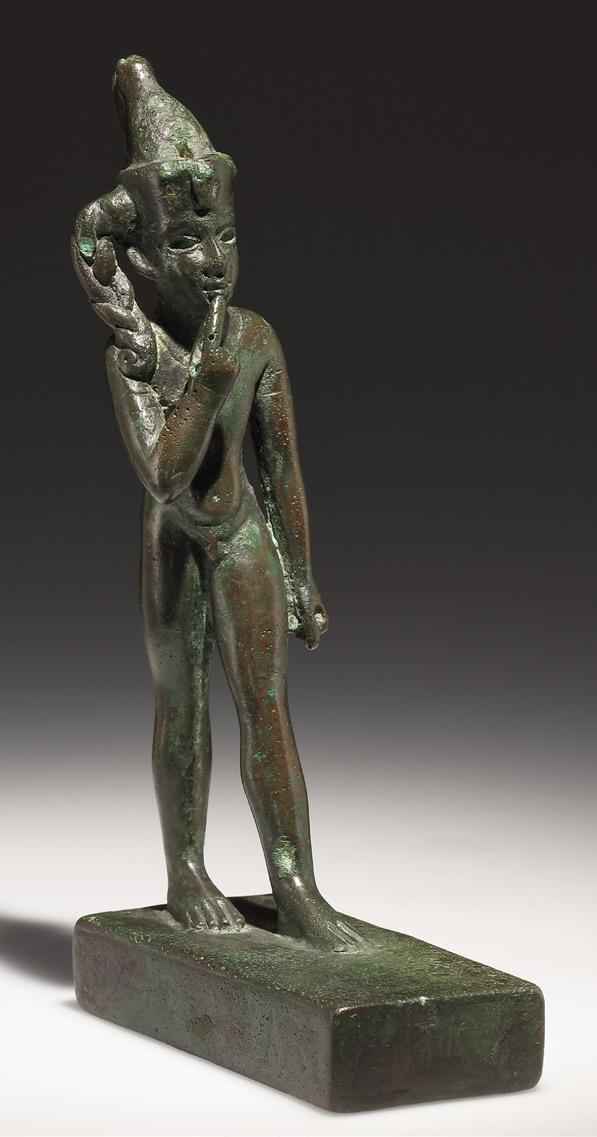
BRONZE STATUETTE OF HARPOKRATES. H. 16.4 cm. Bronze. Formerly priv. coll. Roger Liechti (1934-2010), Petit-Lancy, Switzerland (inv. no. E. 747); acquired in 1958, Piazza San Carlo, Turin. Egypt, Late Period to Roman, 2nd half of 1st mill. B.C. CHF 9,800
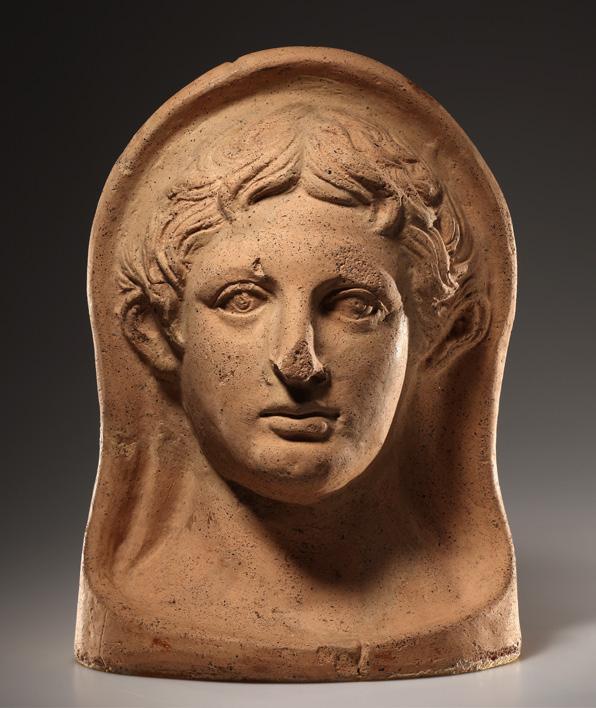
A VOTIVE HEAD OF A YOUNG MAN. H. 30 cm. Reddish brown, slightly micaceous clay with black inclusions. Formerly priv. coll. Ms. E. C. (1923-2014), Israel; acquired in 1970 (see invoice). Inherited by her son D. L., Switzerland. Etruscan or Central Italy, 3rd-2nd cent. B.C. CHF 6,800
HEAD OF A CELT. H. 31
by his
W. 20
until 1986, then in his cottage at
D.
2nd-3rd cent. A.D. CHF 38,000
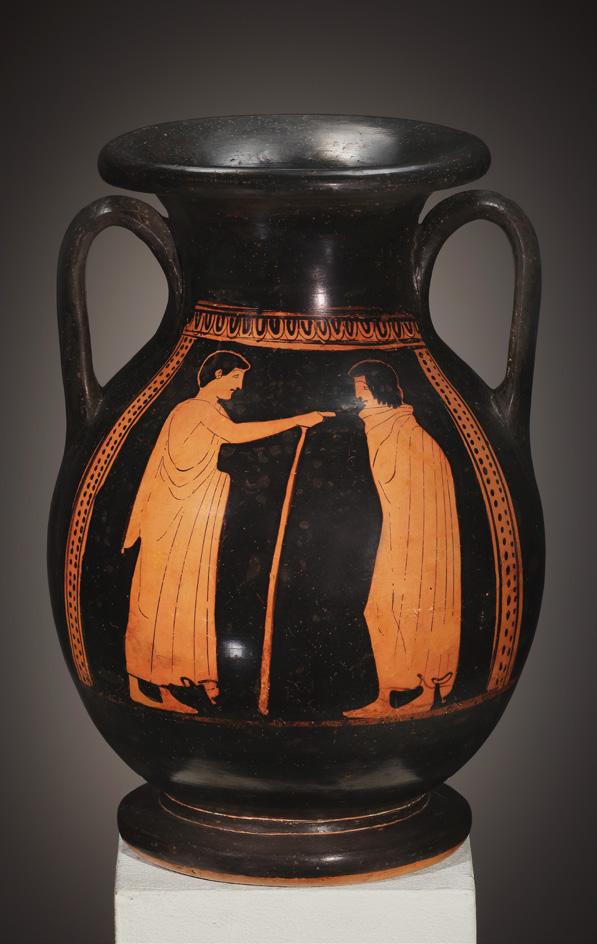
AN ATTIC RED-FIGURE PELIKE ATTRIBUTED TO THE FLORENCE PAINTER. H. 30.5 cm. Dm. rim
body 21.3 cm. Dm. foot 14.9 cm. Clay. Formerly priv. coll. Erika (1934-2025) and Jakob (1927-2025) Binkert, Binningen, Switzerland; acquired in 1956 from Gallery Otto Markees, antiquarian, Spalenberg, Basel. Since then in the family. Attic, Early classical, ca. 460 B.C. CHF 9,800
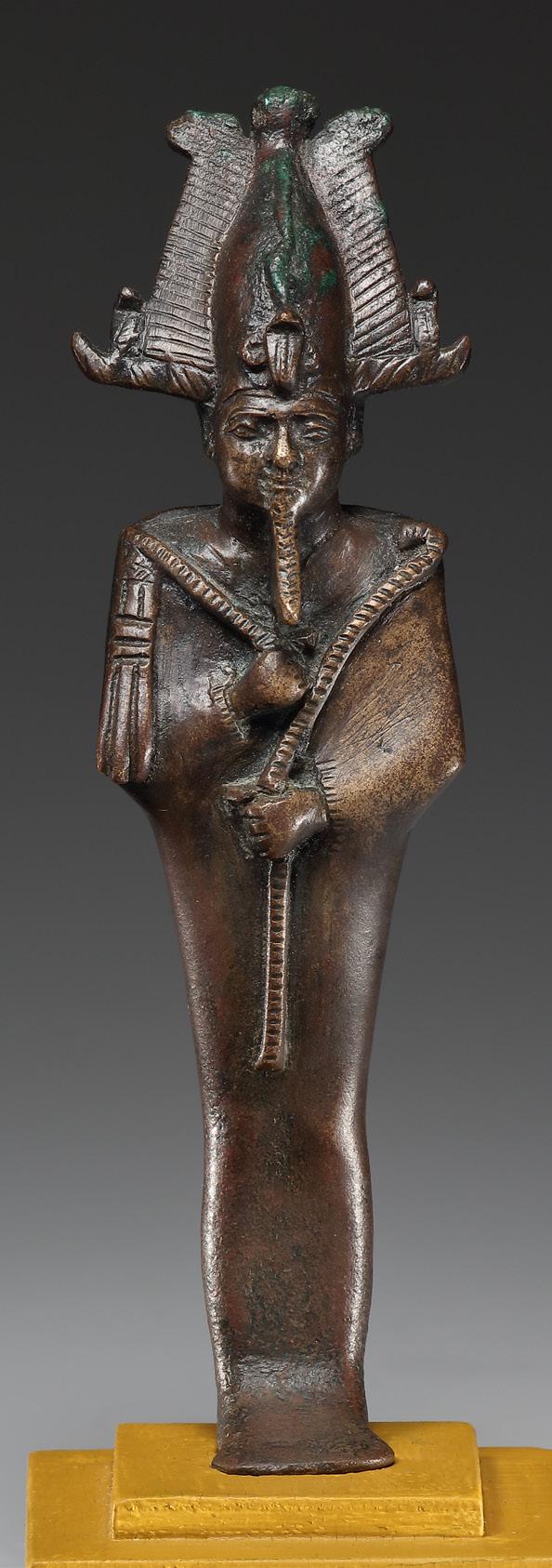
BRONZE STATUETTE OF OSIRIS. H. 14.5 cm. Bronze. Formerly priv. coll. Roger Liechti (1934-2010), Petit-Lancy, Switzerland; acquired in 1957, Zurich (see handwritten note on the underside of the wooden base). Thence by descent in the family, Switzerland. Egypt, Third Intermediate Period to Late Period, 900-332 B.C. CHF 7,600
A
cm.
cm.
11.5 cm. Sandstone. Formerly priv. coll. Robert Wyndham Ketton-Cremer, Felbrigg Hall, Norfolk, England. Thereafter, priv. coll. Norman Brett. Subsequently owned
nephew James Brett, 1966 (it remained in his office at his shop in Elm Hill
Gunton Park, Gunton, Norfolk.). Since then, priv. coll. S. G. Basel. Celtic,
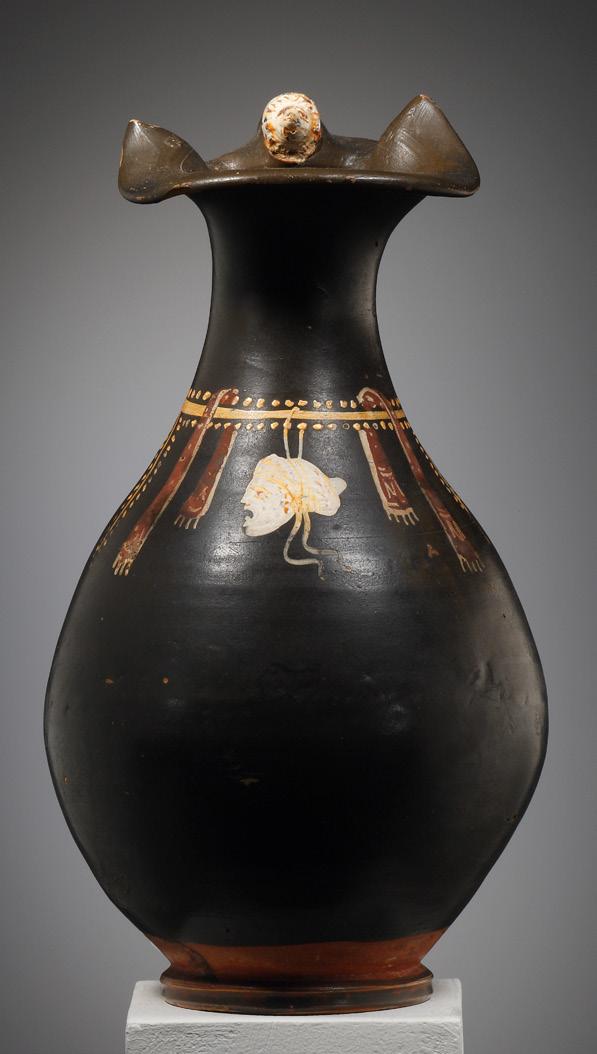
AN OINOCHOE WITH LION'S HEAD APPLIQUE (GNATHIA WARE). H. 21.7 cm. Dm. body: 11.5 cm. D. 12.1 cm. Clay, black glaze, red, white and yellow paint. Formerly Coll. Alphonse Raifé (1802-1860). Published: F. Lenormant, Description des antiquités, égyptiennes, babyloniennes, assyriennes, mèdes, perses, phéniciennes, grecques, romaines, étrusques et américaines composant la collection de feu M. A. Raifé, Paris, 1867, 181, no. 1420 (old collection label on the underside of the vase). Thereafter Paris priv. coll., acquired 1990. Western Greek, Apulian, last quarter of 4th cent. B.C. CHF 8,800
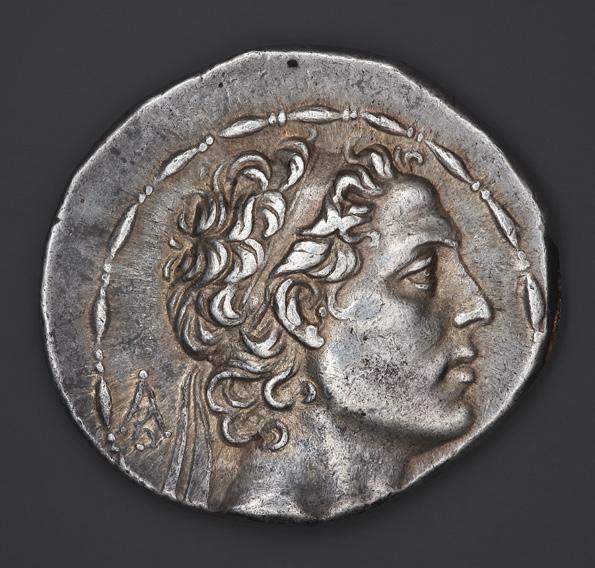
A TETRADRACHM, ANTIOCHOS IV EPIPHANES. W. 17.18 g. Dm. max. 32 mm. Silver. Formerly priv. coll. A. Houghton (b. 1940), New York, American numismatist, prior to 1983. Thereafter, priv. coll. Dr. G. Wiedner, Germany; acquired from Monetarium SKA (Schweizerische Kreditanstalt). Published: A. Houghton. Coins of the Seleucid Empire from the collection of Arthur Houghton. Ancient Coins in North American Collections. The American Numismatic Society (New York 1983) 78, no. 781 (with illus. pl. 46). Hellenistic, Palestine, Ake-Ptolemais (modern Acre), ca. 168-164 B.C. CHF 6,800
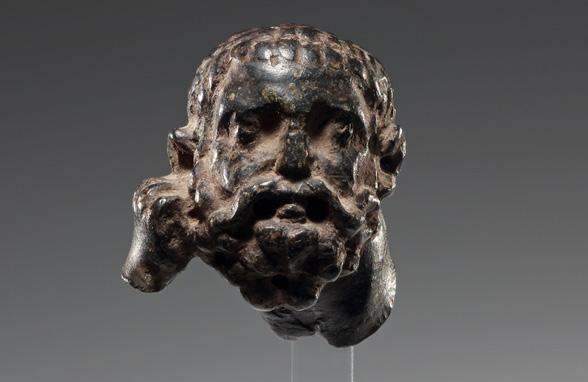
A SMALL HEAD OF A BEARDED MAN (POSSIBLY AJAX). H. 3.3 cm. Soapstone. Previously Coll. Friedlinger-Brandt, ca. 19501960, ambassador in Cairo before 1920. Greek, Hellenistic, 2nd cent. B.C. CHF 1,200
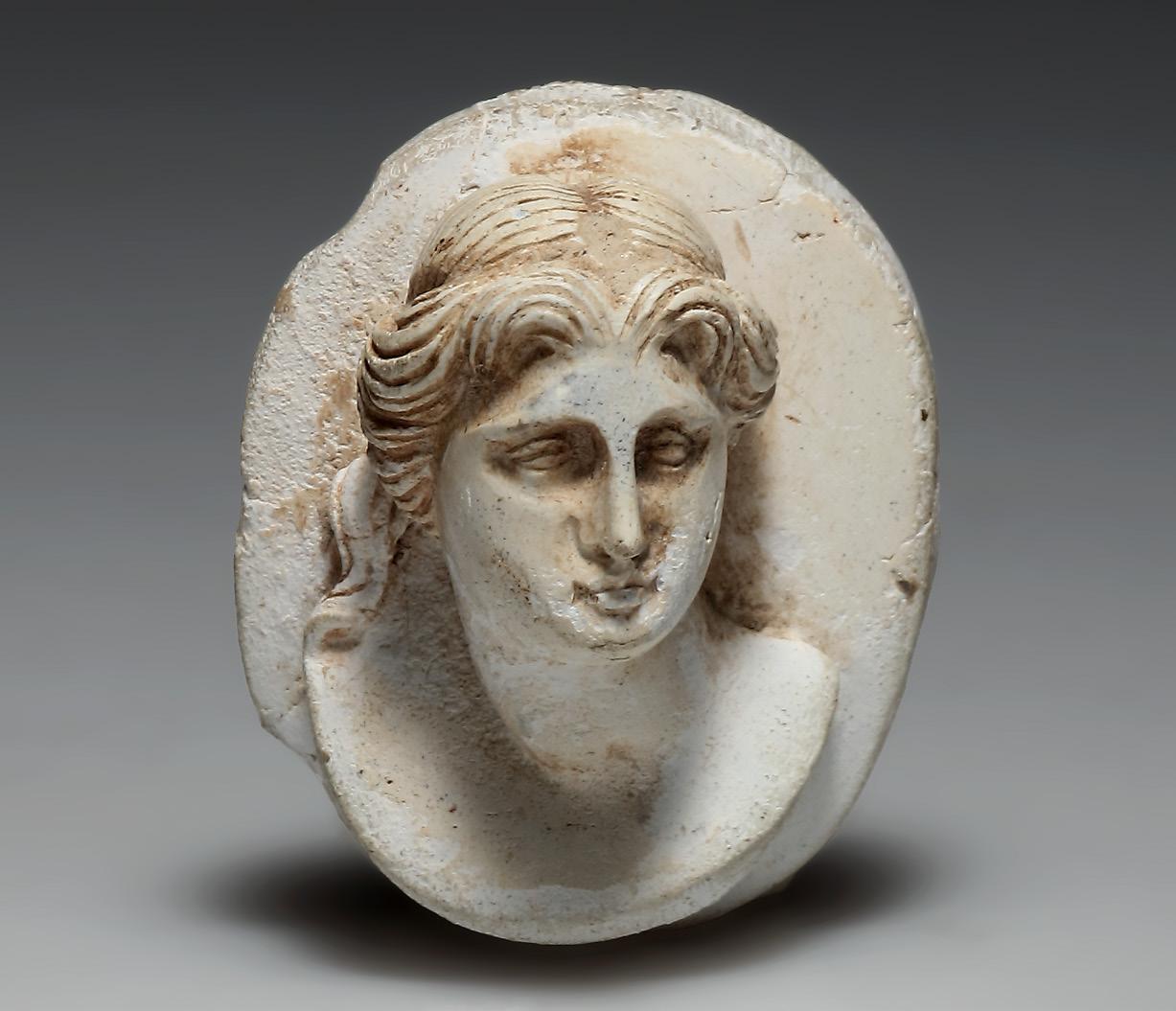
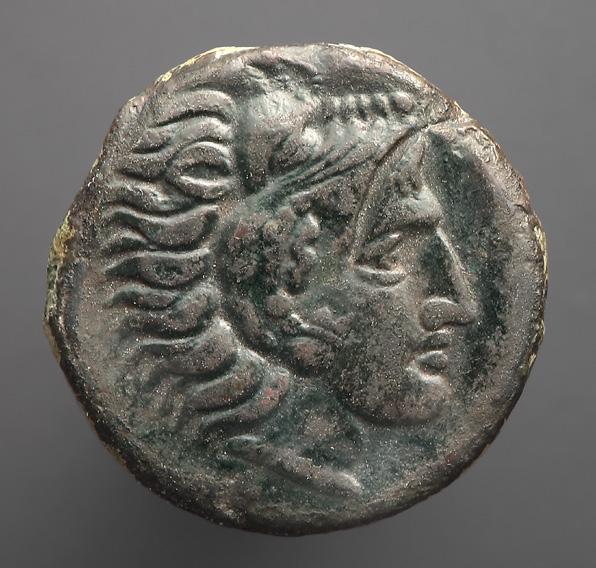
A CAMEO WITH THE BUST OF A WOMAN, POSSIBLY APHRODITE. H. 3.4 cm. W. 2.7 cm. D. 2.4 cm. Silicate stone (burnt chalcedony). Formerly English priv. coll., formed 1965-2018. Greek, Hellenistic, 3rd-1st cent. B.C. CHF 26,000
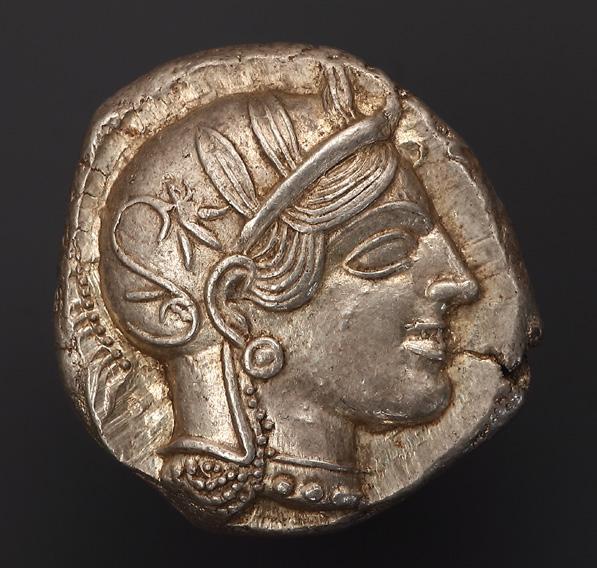
A TETRADRACHM, ATHENS. W. 17.25 g. Dm. 2.5 cm. Silver. Formerly priv. coll. Bavaria, Germany. Thereafter German art market, 2018. Greek, Attic, 449-413 B.C. CHF 6,500
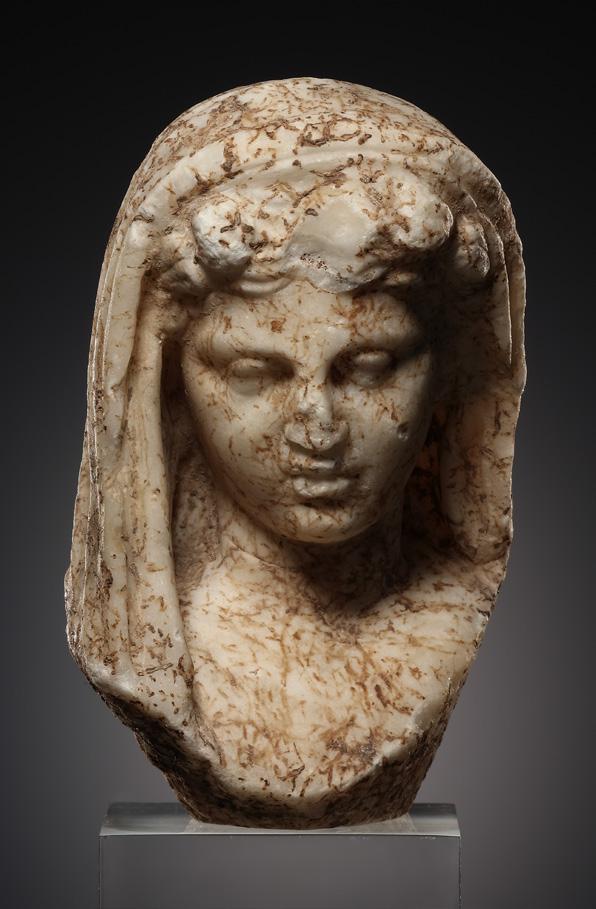
A BUST OF A YOUNG VEILED WOMAN. H. 16 cm. W. 10 cm. D. 8 cm. White finegrained marble. Formerly priv. coll. Mark Sanders, Princeton, New Jersey; acquired in 1985 from Münzen und Medaillen AG, Basel. With Acanthus Gallery (see invoice 11.17.1992). With Jerome Eisenberg, New York; acquired in December 1995. Publ.: J. Eisenberg, Art of the Ancient World, vol. IX, 1997, no 23. Mediterranean, Late Hellenistic, 1st cent. B.C. CHF 34,000
A BRONZE COIN, SOLUS. W. 4.95 g. Dm. 1.6 cm. Bronze. Formerly priv. coll. Dr. Frank Hieronymus (1930-2022), Basel, bookseller and classical philologist; acquired in 1984 from Münzen und Medaillen AG, Basel (see invoice no. 27). Sicily, Solus (Solunto), ca. 380-350 B.C. CHF 1,800
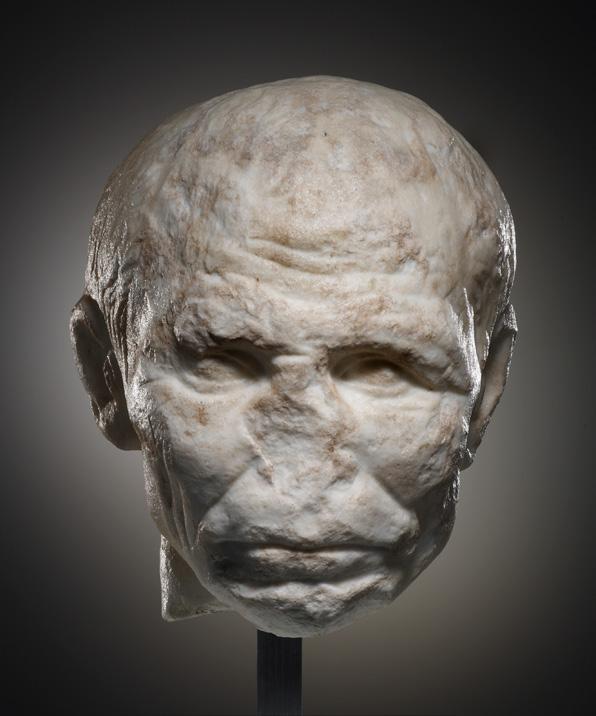
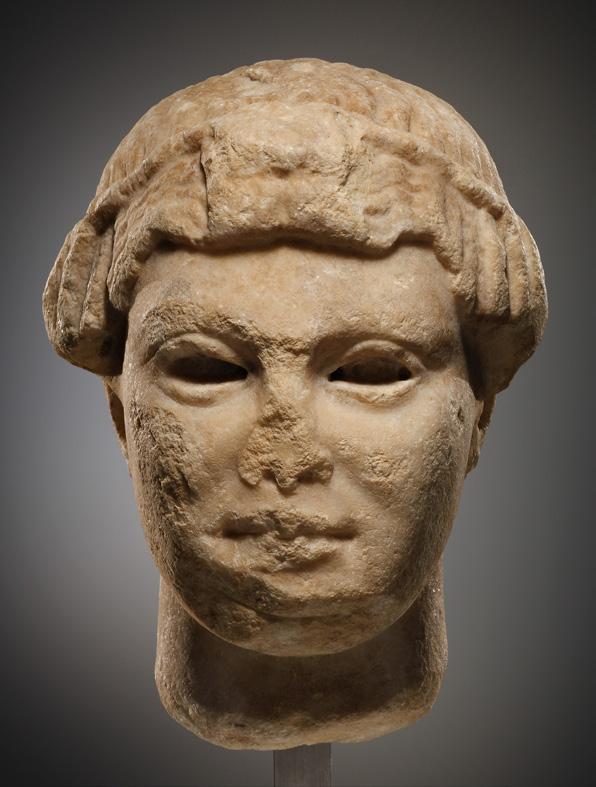
A PORTRAIT HEAD OF A MAN. H. 24 cm. W. 19 cm. D. 24 cm. Marble. French art market, 2018. Roman, Late Republican, 2nd-3rd quarter of 1st cent. B.C. CHF 16,000
ARCHAISTIC HEAD OF A YOUTH, POSSIBLY APOLLO. H. 25.5 cm. Marble. Formerly priv. coll. Christen Sandberg (1861-1918), Norway. Christen Sandberg was German vice-consul, but it was his friendship with Danish and Norwegian artists that made him a public figure. He was portrayed by Edvard Munch. Roman, late 1st cent. B.C.-1st cent. A.D. CHF 38,000
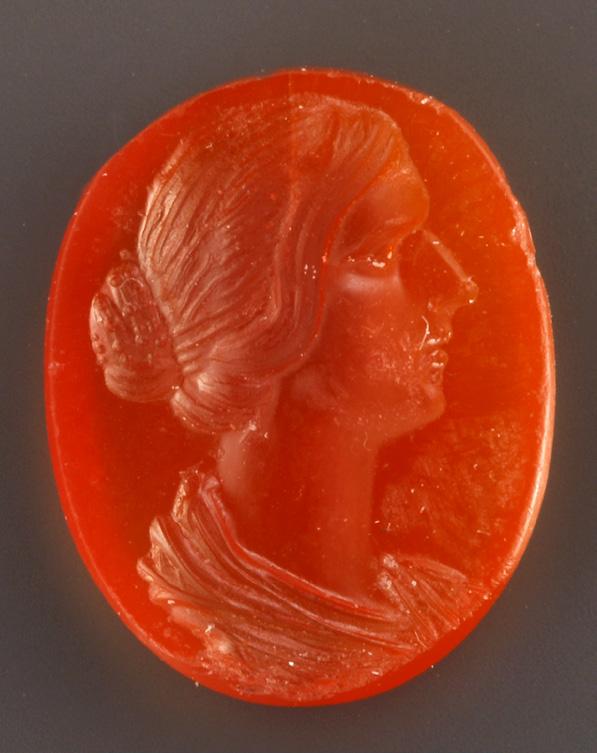
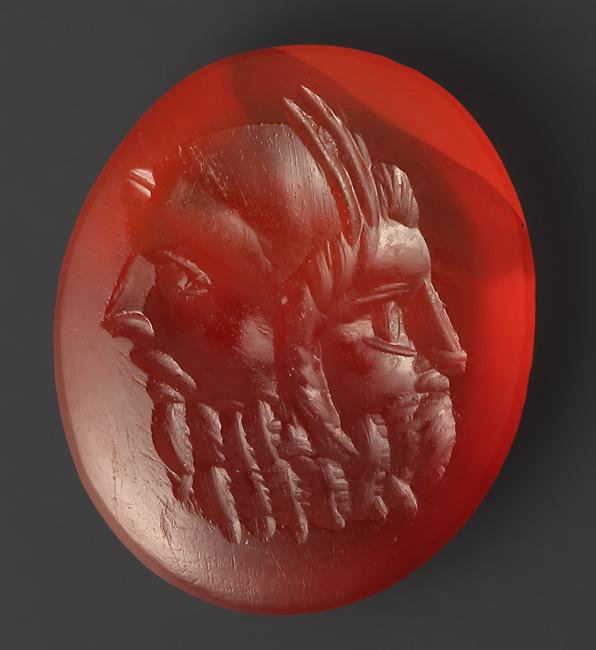
AN INTAGLIO WITH WOMAN'S BUST, PROBABLY FAUSTINA THE YOUNGER. H. 1.3 cm. Carnelian. Formerly priv. coll. Koppenwallner, since the 1970s, Cologne, Germany; thereafter by descent in the family. Roman, 2nd cent. A.D. CHF 6,800
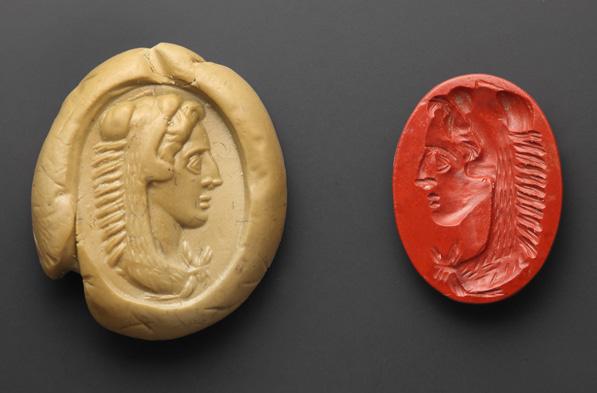
AN INTAGLIO WITH THE BUST OF HERAKLES. H. 1.7 cm. Red jasper. Formerly H.A.C. AG, Basel, between 1988-1999. Since then in the family. Late Hellenistic/Roman Republican to Early Imperial, 1st cent. B.C.-1st
CHF 5,800
A GRYLLOS WITH PAN AND SILENUS. H. 1.3 cm. Carnelian. Formerly H.A.C. AG, Basel, between 1988-1999 (Label: --- Coll./ M X 301/Kib 240-). Since then in the family. Roman, 1st-2nd cent. A.D. CHF 3,800
cent. A.D.
Naxos Masterpiece?
By Tim Wright
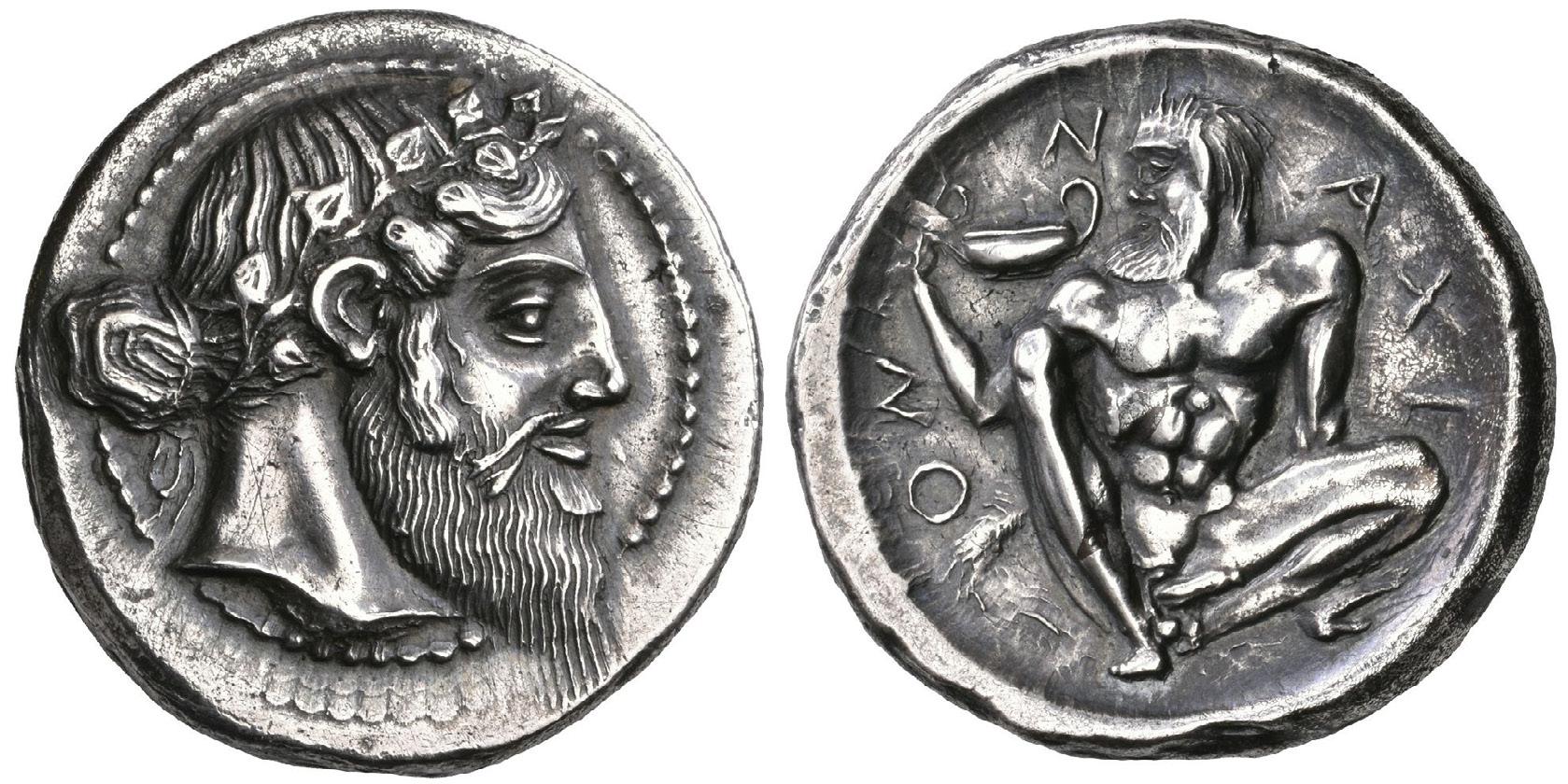
When one of the ca. 460 B.C. Naxos tetradrachms comes to auction, superlatives abound. In the last sixteen sales, it has variously been described as “most famous”, “universally celebrated”, “desirable”, “perhaps unique”, “iconic”, “impressive”, “prestigious and fascinating”. Its artist is described as “clearly a master engraver and arguably the finest of his time anywhere in the Greek world, known today as the Aitna Master” (Classical Numismatic Group, Auction 112, lot 112, 11.9.2019). It is noted that “critics have historically judged it not merely by comparison to other coins, but as a work of art on its own, regardless of medium” (Morton & Eden, Auction 124, lot 112, 26.9.2023). In one of the most famous ancient numismatic sales, it is described as “one of the greatest of all fifth century Greek coins” (Prospero Sale, lot 149, 4.1.2012). Almost half of the auction catalogues conclude with words to the effect that it is “a masterpiece of Greek numismatic art” (e.g. Morton & Eden, Auction 95-96, lot 312, 24.10.2018).
It is tempting to dismiss these descriptions as the self-serving hyperbole of auction catalogues but there are at least three sources of potential corroboration. First, in his authoritative study of the Naxos series (Die Münzen der sizilischen Stadt Naxos, 1944), Herbert A. Cahn (1915-2002) described the coin as the work of an “Olympic master engraver”, whose dies were considered irreplaceable by the Naxians, even after obvious wear and breaks appeared. Second, when Harlan Berk polled academics, museum curators, dealers and collectors on the 100 Greatest Ancient
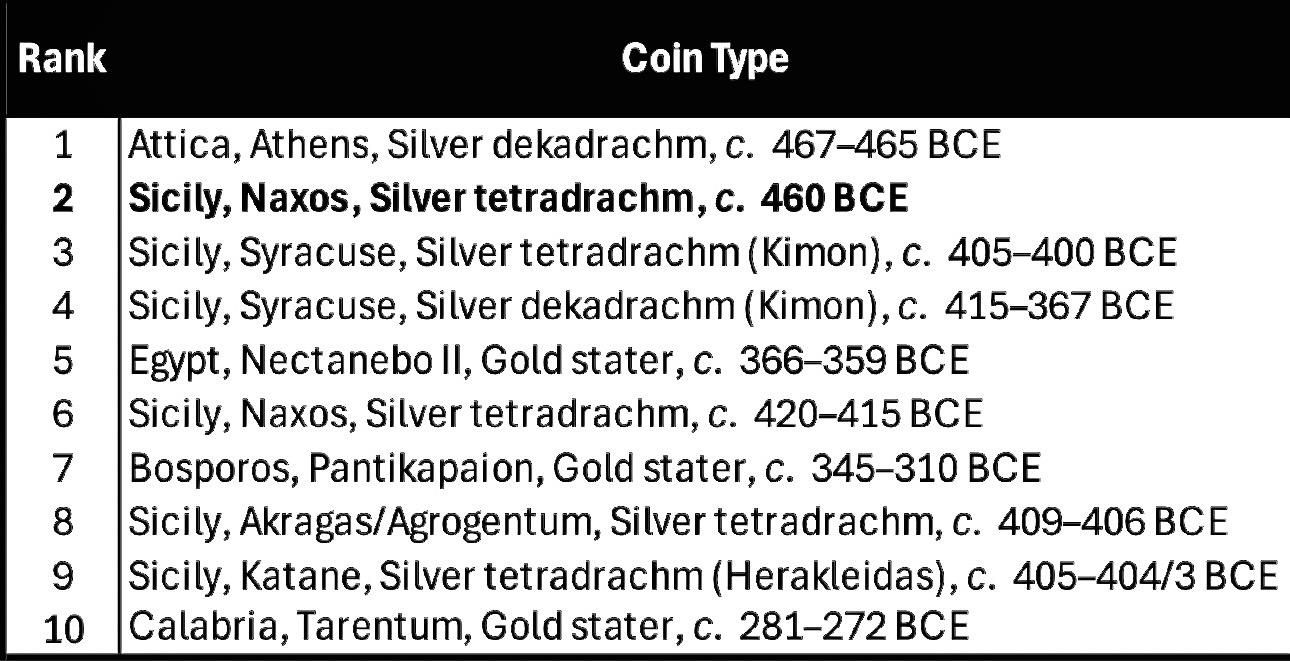
Coins in 2008, the Naxos coin ranked fourth (and third among the Greeks). Finally, the Naxos coin has consistently hammered at some of the highest prices among ancient Greek coins that have come to auction in the past twenty-five years (see fig. 2).
Clearly, the Naxos coin is valued by both the numismatic community and the market, but does this make it a numismatic masterpiece? To answer this question, we need to revisit the origins of the term “masterpiece”, explore its applicability to ancient coins and then evaluate the Naxos coin on this basis.
Masterpiece and its equivalents (Meisterstück, chef-d'œuvre), have their origins in European medieval guilds, which were
tightly controlled monopolies over anything from goldsmiths to saddlers. As its name suggests, it is the work of a master: for an apprentice to qualify for full guild membership and the title “master” they would have to produce one or more works, without aid or supervision, that met the standards of that particular craft. The stakes were high, as membership determined not only economic but sometimes also matrimonial opportunities. Inherently conservative, the focus was on faithful technical execution against an ideal prototype, with defined standards of proportion, harmony and beauty. The “work” was invariably a tangible object, despite Richard Wagner’s flight of fancy into the intangible world of crafting song (Die Meistersinger von Nürnberg, 1868).
The use of the term evolved to apply to works of outstanding skill and excellence in painting, music or literature. At the same time, a growing distinction emerged between the “craft” of producing a faithful copy and the “art” of innovating in composition, subject or execution. Masterpieces gravitated towards the latter but retained the singularity of their origins, as the word was used to describe the greatest single work of the artist, or their magnum opus (literally, great work). This, in turn, was considered overly restrictive, suggesting both that every great artist produces a masterpiece, and that the greatest are only allowed one! Moreover, as conceptions of art have evolved, especially in a more inclusive post-colonial era, so too have the inherently elitist and masculine connotations of the masterpiece been challenged.
Fig. 1
Fig. 2
Fig. 2: Top 10 Greek coins. Source: Ranking of ancient Greek coins by average real auction hammers, 2000-2024. Source: CoinArchives. © Tim Wright 2025.
Fig. 1: The Naxos Tetradrachm, ca. 460 B.C. Source: Morton & Eden, Auction 124, lot 112 © Morton & Eden, 2023.
Returning to the Naxos coin, is it appropriately described as a “numismatic masterpiece”? When voting for the “greatest” ancient coins, those surveyed by Harlan Berk adopted a range of criteria, the most common of which were artistry, history, rarity and value. While not explicitly responding to the masterpiece question, this appears a good place to start our evaluation of the Naxos coin.
The Naxos coin (see fig. 1) is admired for both its innovative composition and superb execution. Even if the subjects of Dionysus on the obverse and Silenus on the reverse are not unique to this issue, their composition is original in several important respects. Many have focused on the reverse image of Silenus, the satyr companion of Dionysus, crouched precariously, with a complex composition that provides one of the earliest examples of foreshortening or perspective in a coin image. The obverse of the god of wine himself is if anything as important, with a constrained or “severe” Dionysus, groomed yet bursting through the beaded frame with vitality. The two present contrasts, both in themselves and with each other, as Cahn puts it, like the pediments of a Greek temple. They also present what Cahn identifies as the transition between archaic and classical styles.
Fig. 4
As previously mentioned, the coin is attributed to the Aitna Master, so named because of the attribution to him of what is regarded by some as the ‘Mona Lisa of Coins’, the near-contemporary Aitna tetradrachm. Cahn
was in no doubt that the Naxos coin was produced by the same engraver. This view was endorsed by the Italian archaeologist, Giuli Emanuele Rizzo (1865-1950) and by the curator of the KBR (Royal Library of Belgium) in Brussels (which includes the unique example of the Aitna coin), Francois de Callataÿ. Taking the restrictive (magnum opus) view, this might work against the Naxos coin, as the engraver is named after another work, but this appears overly narrow-minded, and the attribution should rather add to the case.
As Richard Bradley, the archaeologist, tells us, art without an historic backstory is at best “art”, for without contemporary narrative we can only speculate as to the intentions of the artist and reactions of his audience. Classical sources, even if they
were far from contemporary, like Diodorus Siculus, tell the dramatic story of exile at the hands of the Syracuse tyrant, Hieron I, and return a year before the coin was issued. We are left with the attractive idea that the coin was minted to celebrate the return and intrigued by the possibility that the severe Dionysus (patron god of Naxos) was, like the Naxians, constrained by exile and liberated by return.
Alfred Gell, the anthropologist of art, proposes that the defining feature of art is the agency that it both reflects and produces. We can only speculate about the historic context, but we are also faced with an apparent contradiction. This coin appears intended to have a major impact yet that appears to go well beyond what the classical sources and historians like Sir Moses Finley describe as
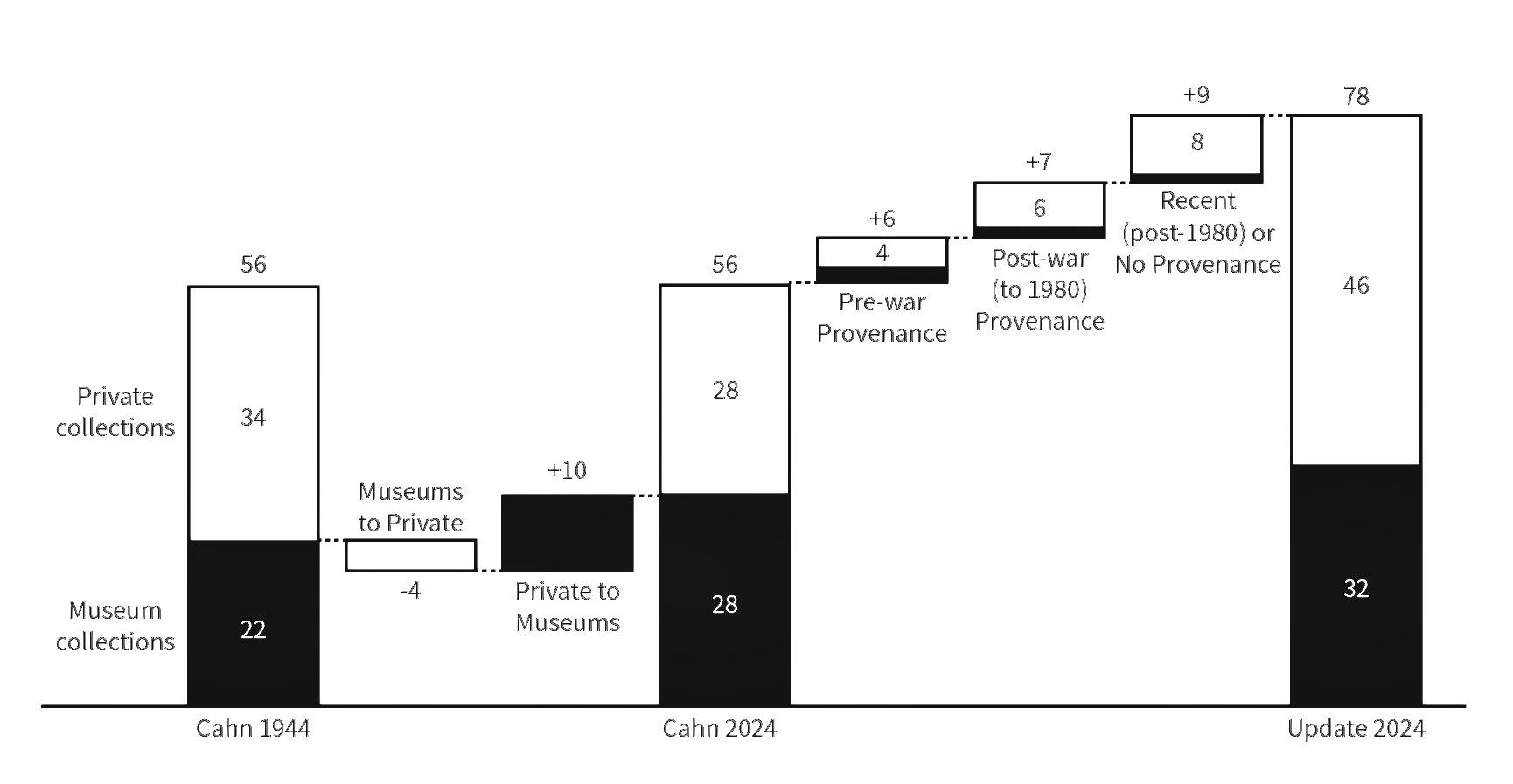
Source: After Cahn 1944; updated from auctions, private collections, publications and museums © Tim Wright 2025
Fig. 3: Known examples of the Naxos tetradrachm. Source: After Cahn 1944; updated from auctions, private collections, publications and museums. © Tim Wright 2025.
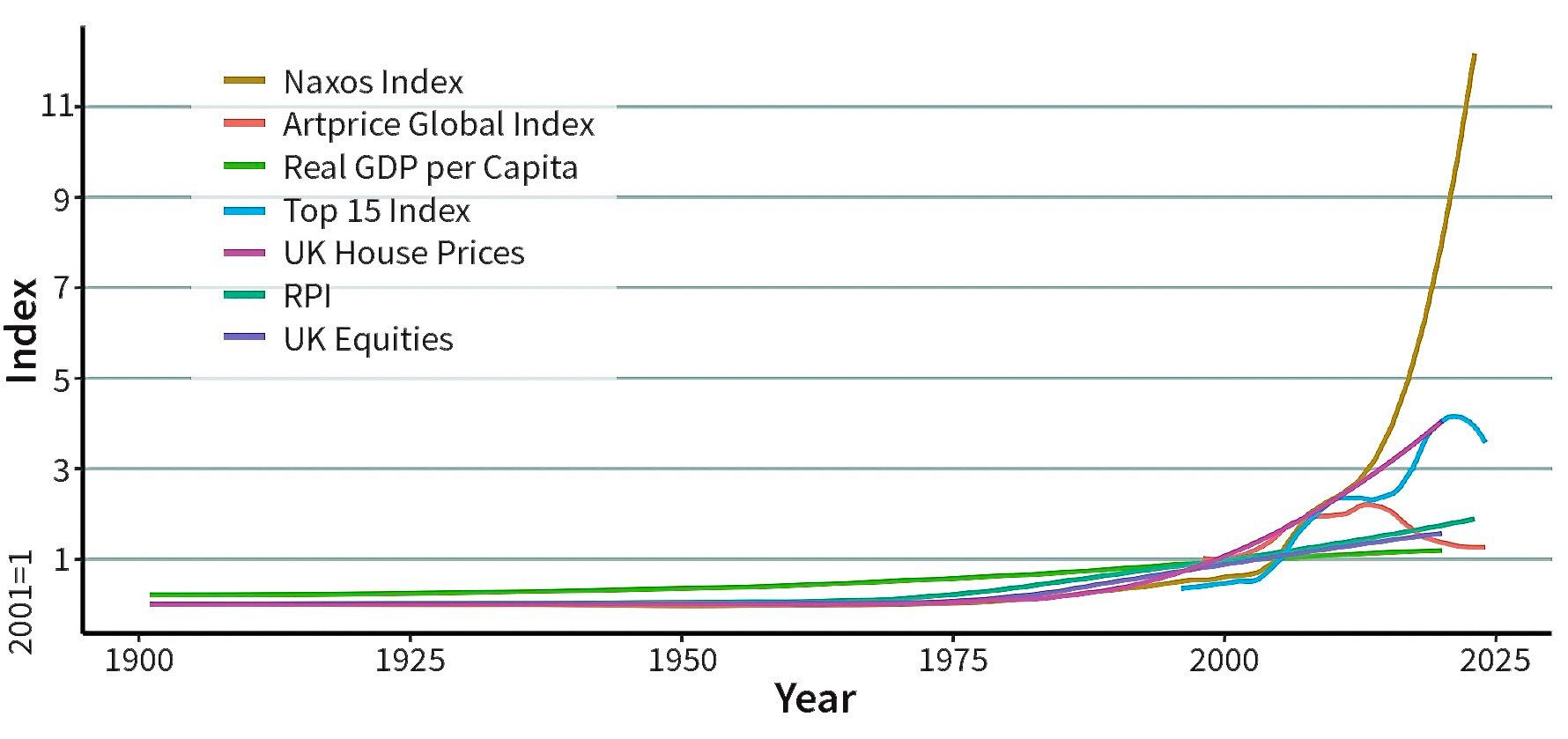
Fig. 4: Index of Naxos tetradrachm hammers versus other asset classes: Source: Auction catalogues/sites and various. © Tim Wright 2025.
the sub-scale, follower city of Naxos. This apparent paradox is only resolved if we take into account relatively recent archaeological excavations that have recast Naxos as an important religious centre from which Sicilian Greeks returning to the motherland set out after making sacrifices. Such traditions are referenced by Thucydides but brought to life by recent archaeological finds that help us appreciate the importance of Naxos and why it may have punched above its apparent weight.
History and artistry combined to make the Naxos coin highly desirable. Unlike other works of art that are described as masterpieces, multiple ancient coins are produced from a single die-pair. Perhaps this means that the masterpiece is the engraved die rather than the coins that it produced? Yet, the coins are the output or “work”, and in the case of the Naxos coin they are relatively rare. Cahn’s study identified 56 examples, which may be updated to 78 (see fig. 3), through a combination of a few missed examples and further examples that have been “discovered” since, including through the well-known Randazzo Hoard of 1980. This means that the coin remains rare, even if less rare than it appeared to be eighty years ago.
Rarity and desirability combine to make the Naxos coin one of the highest hammering of all ancient Greek coins. The first recorded sale of the Naxos coin was two centuries ago, that of Thomas Dimsdale (1712-1800), famously made Baron by Catherine the
Great for his inoculation of the Russian royal family, and distinguished doctor, banker and politician. This coin was sold for the princely sum of £5 at Sotheby’s a quarter of a century after his death. A recent example, owned by the Countess Martine de Béhague (1869-1939) and Prince Saud bin Mohammed Al Thani (1966-2014) sold for almost 100,000 times that amount at an Numismatica Ars Classica auction in 2023. Even considering inflation, that is a 1,000-fold increase, well above all other asset classes. This reflects a general trend of well-documented asset inflation, including art and collectables but also shows an acceleration in the market value of the Naxos coin (see fig. 4).