Cahn’s Quarterly 4/2020 English Edition
Editorial Dear readers Last October, we exhibited at Highlights International Art Fair Munich. It was a very pleasant experience, the fair being small but very fine – indeed most charming and exclusive and with thorough security and hygiene measures implemented. Our booth was literally inside the splendid late-sixteenth-century entrance lobby of the Residenz. There, my ancient sculpture of Dionysos looked towards a great Renaissance bronze of Artemis in the most suggestive way. The reception was most positive and business was solid. It shows that fairs are irreplaceable, though perhaps there should be fewer of them. Several weeks later, we presented the exhibition Animals and Hybrids at the gallery as part of Antike in Basel, which much to our delight was attended by many old friends. It is clear that art lovers cannot be satisfied with even the most sophisticated of online devices. We all need the real thing. Nonetheless, we are placing considerable emphasis on digitalization by redeveloping the website and strengthening our online presence. You will see our new digital face in the Spring.
On the other hand, Cahn Contemporary has had (under the most difficult of circumstances) a successful exhibition in Paris with important individual visits by leading figures in Paris's contemporary art world. I am particularly grateful that Cahn Contemporary is now an official member of the Comité Professionnel des galleries d’art and will be included in FIAC's digital programme even this year. An exciting project this winter will be the preparation of a new large exhibition space in the heart of Basel, dedicated to contemporary art projects combined with archaeological material – we will keep you updated on this. This issue of Cahn’s Quarterly presents an important collection of ancient silver, that of Christian and Hedy Schmassmann, who with the assistance of my former employee, the archaeologist Gerburg Ludwig, published a beautiful catalogue. It is a pleasure to accompany collections in this way. The catalogue is reviewed independently by none other than Friederike Nau-
mann-Steckner, who was deputy director of the Römisch-Germanisches Museum in Cologne from 1994 until her retirement in 2019. We have our usual sales catalogue, selected by Ulrike Haase, as well as various pieces discussed in greater detail by Gerburg Ludwig, Martin Flashar and myself. At the heart of this edition, however, lies an eight-page tribute to the memory of our cherished friend and colleague, John Robert Guy, who sadly passed away on July 4, 2020. My sincere thanks go to all who contributed to this tribute with texts and photographs. With it, we hope, if not to erect a monumentum aere perennius, at least to make tangible in a fairly lasting form, some of the important stations and outstanding achievements in Robert’s life.
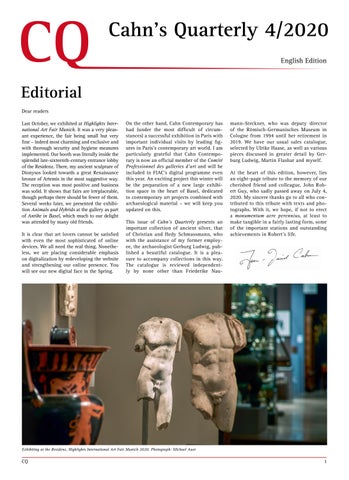
Exhibiting at the Residenz, Highlights International Art Fair Munich 2020. Photograph: Michael Aust
CQ
1
Cahn’s Quarterly 4/2020
Discovered for You
Looking over the Master’s Shoulder Ancient Goldsmithing Techniques By Gerburg Ludwig
Fig. 2: A PAIR OF EARRINGS. H. 4.1 cm. Gold, sardonyx. Roman, 3rd cent. A.D. CHF 3,800
Fig. 1: A TUTULUS FIBULA. W. 3.3 cm. Gold, bronze, carnelian. Roman, 4th-5th cent. A.D.
The Argonaut saga of Jason, who with the help of Medea, daughter of the King of Colchis (today’s Georgia), robs that kingdom of its Golden Fleece and brings it back to Thessaly, tells of the importance of gold in Antiquity – and of the conflicts that its possession was liable to spark. When King Pelias refuses him the throne that was his promised reward, Jason has him slain, though it is he and Medea who are ultimately driven away. Rulers and sanctuaries hoarded gold, for example in the form of cast vessels. The Law of the Twelve Tables (5th cent. B.C.) attests to its importance in Rome, stipulating that the deceased were to be stripped of all their gold, with the exception of any gold used to fasten their teeth. The main gold deposits exploited in Antiquity were located in Upper Egypt, Nubia, Lydia, the Balkans, the Alps and in Spain. In 2004 researchers from the Ruhr University of Bochum discovered the oldest gold mine as yet known to us (4th mill. B.C.) in Sakdrisi in Georgia. Analyses of ancient gold objects reveal a silver content of between 1 and 25 per cent. If more silver was present, the alloy has a pale yellow colour and is termed electrum. Adding copper (25 per cent instead of the natural 2 per cent) resulted in a reddish hue, as is seen in Egyptian jewellery. The systematic purification of gold can be linked to the beginning of gold coin minting (7th/6th cent. B.C.). Purity in jewellery, meanwhile, continued to vary: Hellenistic and Roman jewellery had a fineness of 85–99 per cent (Ogden, 1992, 261-264). 2
CHF 4,600
Using self-made tools, the goldsmiths of Antiquity worked mainly with gold sheet, which they hammered into the desired shape and cut to size with a blade or fine chisel. Solid casting was rarely an option owing to the overspill and sprue wastes, for which the material – often supplied by customers in the form of coins/a specific quantity – was simply too dear. The other techniques for shaping and decorating gold included hammering it into a negative mould or over a positive model, modelling by means of a round stylus over a positive model, punching with a sharp negative punch (openwork technique) and striking with positive punches. Sturdier pieces might also be ornamented by having lines engraved into them with a gouge or burin, or appliqued onto them. Goldsmiths used a pointed stylus for drawing and the same tool, nudged along with gentle hammer blows, for chasing. They also had punches for striking triangular, round, ring- or crescent-shaped ornaments. Two techniques imported from the East also had a crucial influence on ornamentation. One was filigree work: strips of gold sheet were twisted and then rolled between a piece of wood and another hard surface to form round or flat wires. These, either one- or two-ply, were then worked into rows of beads, spirals, coils or cords. The other was granulation, which entailed smelting tiny pieces of gold wire on a bed of charcoal dust to obtain granules. Both these and the wire were then attached to the piece of jewellery as decoration using a glue and copper-salt compound.
The Etruscans perfected this art with granules both large and miniscule. Separate parts could be joined together by welding, riveting or hinges. Rounded tools were used to smooth undecorated surfaces; a mixture of saliva and clay, chalk or fine sand served as polish. How the jewellery was worn can be observed on black-figure vases, coins, sculptures, reliefs and wall paintings. The items of jewellery on offer at the Cahn Gallery demonstrate some of the above techniques. The oval fibula (fig. 1) made of gold sheet was beaten into a mould and then crimped onto a bronze plate with pin spiral, pin and pin rest for attaching it. The box-mounted carnelian is surrounded by filigree work and granulation arranged in an oval: twisted wire with tiny granules on the inside surrounded by a row of granules, some of them with round wire encircling them. The remaining area is decorated with little wire arches arranged like scales with granules in between them, especially in the spandrels. The goldsmith who made the earrings (fig. 2) in openwork technique punched the disc and crosspiece out of gold sheet and then soldered them together. He then used triangular and crescent-shaped punches to form little calyxes, and large, comma-shaped punches for the tendrils of the crosspiece. The middle ribs and tiny hooks for the stamens were drawn with a pointed stylus. In the mould-made depression in the middle of the piece is a sardonyx bead threaded onto a gold band. Underpinning this on the reverse is the vertical round wire that forms the hook. Attached to the crosspiece are CQ
Cahn’s Quarterly 4/2020
four vertical strips of gold sheet that end in eyelets, each with a ring, a conical tube and a natural pearl on gold wire. The child’s bracelet (fig. 3) was hammered out of a silver blank to rather more than two thirds of a circle and the two termini rounded to form snakes’ heads. The goldsmith defined the wide-open eyes with a ring punch. The outline of all the scales, the double zigzag on the crown and the nostrils were all engraved.
My Choice
A Bucchero Hydria By Jean-David Cahn
Fig. 3: A CHILD’S BRACELET WITH SNAKES’ HEADS. Dm. max. 4.2 cm. Silver. Greek, 5th cent. B.C. CHF 1,600
The remaining surface of the hoop was roughly smoothed and polished. An incised zigzag line can be seen in places. The child’s finger ring (fig. 4) was formed out of a plain hoop of gold sheet, which the goldsmith filled with a sand or clay core to stabilize it. This is evident from the various dents around the soldered-on box setting. The unusual size of the octagonally cut intaglio makes the weight of the hoop difficult to estimate, so that it cannot be ruled out that it was worked from solid gold. A gem-cutter engraved a striding eagle with a wreath in its beak into the top face of the intaglio.
Fig. 4: A RING WITH EAGLE INTAGLIO. Dm. 1.3 cm. Gold, carnelian. Roman, 1st–3rd cent. A.D. CHF 3,200
Further technical analyses using methods such as scanning electron microscopy or x-ray fluorescence as well as written sources and archaeological finds will provide us with further insights into the technological skills of ancient goldsmiths and the trade in gold jewellery. Bibliography: J. Ogden, Gold in Antiquity, in: Interdisciplinary Science Reviews, vol. 17, 3, 1992, 261-270.
CQ
A BUCCHERO HYDRIA WITH FIGURAL RELIEF DECORATION. H. 40 cm. Clay (Bucchero Pesante). Etruscan, ca. 550 B.C. Price on request
When I look at this extraordinarily sturdy vessel, it immediately strikes me as highly unusual. I am surprised by the choice of shape – a truly Greek shape, the three handled hydria – as much as I am struck by the decision to use such a quintessentially Etruscan mode of manufacture as bucchero. The handles are strongly reminiscent of metal parallels from the Greek world, and this inspiration is also evident in the ornament, notably the applied tear-drop shapes so familiar from embossed examples in bronze. Obviously, the Etruscans were influenced by early hydriae seen or imported from Greece. However, something entirely autochthonous has been achieved, using a totally different system of aesthetics, with a visceral, powerful result. With the heavily potted walls of the vase, the relief decoration and stamped motifs initially seem quite coarse. One might think, at first glance, that the figural decoration is primitive, but not at all. It is a deliberate choice, a phenomenon we encounter so often in Etrus-
can art. They were perfect masters, technically, but frequently chose proportions at odds with contemporary Greek taste. Here the artist has created two different architectural planes. Warriors in profile are shown from the waist upwards, as if the shoulder of the vase acted as a window frame and the warriors were marching past – an unusual concept. The application of a regular pattern of frontal female faces gives the impression the vase is looking at you, but at the same time exhibiting a separate plane behind. The frontal peplophoros on the rear, vertical handle confirms the different visual layers, rendering this vase highly three-dimensional as an object and very alive. The vase wants to communicate, although the narrative remains enigmatic to us, as much of Etruscan art does. Only very few examples of monumental bucchero vessels with such extensive relief decoration are known. This hydria was published by my father in 1975, and has remained in a Basel collection until now. 3
Cahn’s Quarterly 4/2020
The Collector’s Point of View
A Passion for Ancient Silver Over a period of many years, Christian and Hedy Schmassmann have built up a comprehensive collection of ancient silver objects. They frequently had occasion to share their passion with Jean-David Cahn, and it was during a conversation with him that the idea of cataloguing their collection first arose.
A NIKE WITH QUADRIGA. H. 6.9 cm. Gilded silver sheet. Greek, 540-525 B.C. Sold
G. Ludwig: Argentum – Silber aus der Antike. Die Sammlung Christian und Hedy Schmassmann 144 pages, 103 illustrations, 2 fold-out plates, Basel 2018
Review by Friederike Naumann-Steckner “Fashions in silver plate undergo marvellous variations owing to the vagaries of human taste, no kind of workmanship remaining long in favour. At one time Furnian plate is in demand, at another Clodian, at another Gratian […] at another time the demand is for embossed plate,” lamented the Roman officer and writer Pliny the Elder in his Natural History (XXXIII 139), underscoring all the more emphatically the pleasure the Romans took in amassing beautiful old silver. It was this delight in collecting, the thrill of the protean forms this precious metal can take, that induced Christian Schmassmann, with the critical support of his wife Hedy (1936-2018), to amass, within less than twenty years, more than fifty silver objects from Antiquity. In 2018 the collection was published in a most attractively designed catalogue authored by Gerburg Ludwig with the enthusiastic support of Jean-David Cahn. Selecting any one highlight from that work is not easy. Could it be the finely chased applique of Nike driving a quadriga from a northern Greek workshop of the late 6th cen4
tury B.C.? Or the Pontic rhyton, which with its expressive figural frieze in high relief showing scenes of combat by bearded, “barbaric” warriors in long trousers it is impossible not to marvel at? And when admiring the elegance of the double-walled skyphos, whose outer wall is adorned with fine tendrils and graceful little birds, is it not the vine frieze on the Ara Pacis that instantly springs to mind? A wealthy Roman lady might have cherished the hand mirror with grip modelled on the knotty club of Hercules. And doubtless a Gallo-Roman family would have taken pride in their silver charger with broad floral rim and large central medallion weighing more than eleven (Roman) pounds. The most recent piece in the Schmassmann Collection is a comparatively delicate Sassanid dish dating from the 6th century, which, being adorned on the inside by a dancer festively clad in diadem, necklace, bracelets, anklets and fluttering veil, was perhaps a votive offering of the Anahita cult. While Gerburg Ludwig devotes one double page to each of the minor pieces, some especially important works are accorded two. After naming each work, she specifies its probable place of origin, date, material, technique, size and weight. Also documented in some detail is the provenance, which only rarely can be traced any further back than the 1950s, something that is not unusual for such (upper-class) everyday objects. The modalities of acquisition and possible mentions in publications are presented in depth. After a brief text outlining the essentials, Ludwig embarks on a cautious, nuanced description and brief appraisal of each object. She sets great store by their state of preservation and the manufacturing process, which is a theme close to the collector’s heart. The archaeological discourse complete with numerous, meticulously researched parallels is then presented in a separate section printed in a smaller typeface at the bottom of each page – a welcome treasure trove of information for the expert. Ludwig organizes the objects according to four themes: Everyday Life – Ornament: Protection and Vanity – Roman Dinner Parties – Drinking with the Persians, Greeks and Romans. This unusual, and at first rather perplexing, ordering system – which silver object might not fall under the heading “Everyday
Life” or “Ornament”? – soon turns out to be helpful, as it binds the objects together in groups. The customary chronological order, by contrast, would have resulted in confusion, given that objects acquired on the art market tend to lack the context that would be helpful in dating them, and that traditionally crafted artefacts in particular can only ever be allocated to a very broad timespan. Ludwig prefaces the catalogue with an essay about the history of silver mining in the mines of the Laureion Mountains. Having read that piece, the reader cannot help but regret that it was not followed by another on the Romans’ silver mining activities in Spain, as described by Pliny (Natural History XXXIII 95–98). The catalogue also shines on account of Niklaus Bürgin’s outstanding colour photos. Each object is beautifully illuminated without any showy special effects. Because every engraving, every graffito, every crack is visible, the viewer gets a feel for the statuettes’ and vessels’ plasticity. The interaction of superb objects and the art of photography allows the little appliques and busts to be reproduced at twice their actual size, while the magnificent charger does not suffer from being reduced by half to make it fit one of the fold-out plates. Only Jean-David Cahn’s praise for the “dynamic approach” of private collections in his foreword causes the museum professional to stumble, given that works of art in private hands tend to remain out of sight for many years – though admittedly, much the same could be said of the works languishing in storage at the museum.
Friederike Naumann-Steckner was scientific advisor and then deputy director of the Römisch-Germanisches Museum in Cologne from 1985–2019. CQ
Cahn’s Quarterly 4/2020
In Memoriam
In Memory of John Robert Guy 1949-2020 Dear readers When looking at the contributions in this tribute to the memory of Robert Guy, one becomes aware of Robert’s enormous depth in his specific field. His generosity in sharing his unparalleled knowledge with others is repeatedly evident. One also senses that while he could be very witty, there was an unhappy current that accompanied him consistently throughout his life. The picture that emerges is of a rich personality with a genius rarely seen, who influenced a generation of archaeologists worldwide in a very specific way. I am very grateful for these testimonials, because I would be the wrong person to comment as a colleague – our relationship was of a different nature. The sense of loss is palpable. For decades, the study of Attic vase painting has diminished alarmingly in the way it is taught and
supported financially. The growing tendency to look at vases as mere containers ignores the wealth of information they can give us about mythology, as well as the societies that produced and used them. They are dialectic. And they are enchantingly beautiful. The remarkable intensity and density with which the largely uncelebrated ancient vase-painters and potters toiled in ancient Athens, is increasingly dismissed or rationalized into obscurity. How ironic that this depth of evidence is not utilized in full, given that we have so much written documentation from the epoch of this great civilisation. Robert’s way of approaching vases should continue.
Robert in the Galleries of Greek Vases at the Louvre, 2016.
The Life and Work of John Robert Guy By Dyfri Williams, Former Keeper of Greek and Roman Antiquities, British Museum, Research Fellow, Université libre de Bruxelles ing in the footsteps of the great Oxford scholar J. D. Beazley. We talked all night long – photographs and sketches strewn across my floor – as he had to leave the next day. Thereafter, we were to remain good friends throughout our different careers and challenges.
Dyfri Williams (l.) and Robert Guy (r.) in the British Museum, 2005. Robert is laughing and Dyfri is trying not to.
I first met the Canadian scholar Robert Guy in 1974 in Oxford. He had just finished his MA thesis on the early 5th century B.C. Athenian red-figure vase-painter, the Triptolemos Painter, for the University of Cincinnati, and was on his way out to Athens to stay at the American School of Classical Studies as a Canada Council Doctoral Fellow (he had done his first degree at Queens College, Kingston, Ontario). He came round to my room on the suitably named Museum Street and we began discussing red-figure cup-painters. I think it was a revelation for both of us: Here was someone else with the same urge to study Athenian vases and in particular their painters, followCQ
While in Athens, Guy composed his first publication, a review of Kezia Knauer’s monograph on the recently acquired skyphos by the Triptolemos Painter in Berlin. Then, in late 1975, he returned to Oxford and embarked on a D.Phil. thesis at Lincoln College (supported by the Canada Council until 1978), under the gentle guidance of Professor Martin Robertson. His subject was the cup-painter Douris, which he narrowed down to the painter's Late Manner and Followers. His path ahead on the Triptolemos Painter had been blocked by the work of Kezia Knauer and her promise of a forthcoming monograph (which never materialised), while the situation proved much the same with Douris, since Diana Buitron finished a PhD thesis on the painter in 1976 (published in 1995, with a section on the Dourian followers drawn from Guy’s thesis). Both the Triptolemos Painter and Douris, however,
were to stay with him as close friends for the rest of his life and his understanding of both continued to grow. Indeed, in 1981 he published an important article on a ram’s head rhyton decorated by the Triptolemos Painter and signed by the potter Charinos recently acquired by the Virginia Museum. He dealt thoroughly with both potter and painter and in so doing made very important comments on both, in particular the connections with Douris and the Brygan circle, while also opening up our view of the specialist potter Charinos. The Dourian thesis was finished in 1982 but, like his MA thesis, it was never published. It is a fundamental work on a complex area of Early Classical vase-painting, providing insights into both painter and potter connections. It is therefore to be hoped that it, and its predecessor, can be made more widely available to students and scholars. The years in Oxford, 1975–1984, were crucial to the development of Guy’s talent: his extraordinary eye for style, his visual memory and his ability to reconstruct figures and scenes in his mind’s eye. There were two paths to this end, both driven by the intellectual desire to study I
Cahn’s Quarterly 4/2020
for Campana on his property at Cerveteri in the early 19th century. For in this way Guy was actually giving back to innocent material something of its context and history.
Robert Guy (top row far right) in Corinth, 1975.
as many Athenian vases as possible, especially those unpublished or previously unknown. The first path was to study in detail the most important museum collections and to this end he began, from 1977, to work especially in the Réserve Campana of the Louvre. He made numerous joins and connections among the huge scatter of fragments stored there. He also made trips to the Getty to study their fast growing collection and began to travel to Rome to study the fragments in the Villa Giulia, and to continue the work begun by J.D. Beazley on the Italian part of the Campana collection. At the Villa Giulia Guy was similarly able to make many new connections between pieces there and elsewhere, charting further the diaspora of the truly immense Campana collection. Indeed, after his last visit in 1994 he began to entertain plans for producing a sequel to Beazley’s rightly famous Campana Fragments of 1933. The second research path for Guy was the study of private collections and the antiquities market. Among the growing private collections that he visited regularly were those of Dr. Dietrich von Bothmer at the Metropolitan Museum of Art in New York and Dr. Herbert Cahn in Basel, both composed almost entirely of fragments. At the same time he began to follow antiquities sales in London and saw all the material that went through the market, whether in auction houses or with dealers – an exposure that quickly embraced other European and American markets. His extraordinarily gifted eye for the style of individual Athenian vase-painters, from the 6th century to the 4th, soon made him an important resource to acquiring museums, private collectors and those in the antiquities trade. The ethics of major dealers was yet to be seriously questioned, while the role of the academic in assessing antiquities on the market, whether for authenticity or attribution, had a perfectly respectable history, although the world was changing fast. The unacknowledged but vital importance of this element of Guy’s work was the way that it enabled him to make connections and joins between old Campana vases and the newly emerged fragments that were the result of illegal “gleanings” around tombs excavated II
In parallel to his work with Athenian vases, we should note the invitation in 1983 by Dale Trendall, the doyen of South Italian vase-painting, to accompany him on a tour of museums in southern Italy: Guy was supported by grants from Oxford’s Meyerstein Fund and London’s Institute of Classical Studies. He spent some five very happy months helping Trendall, then 74 years old, with all the exigencies of travel, while both learning directly from a master and enjoying his impish spirit, in many ways so like Guy’s own. In 1984 Guy was appointed Associate Curator of Ancient Art at the Art Museum of Princeton University. Under the benevolent eye of the Director, Allen Rosenbaum, Guy was to make important acquisitions for the Museum and to complete a redisplay of the highlights of the collection, proving himself a museum man as well as a research scholar. His major acquisitions for the Museum, either by purchase or gift, range across the full spectrum of ancient art, including large-scale marble sculptures, bronzes, glass, terracotta vases and figurines. Among the important sculptures worthy of note were a Classical Greek gravestone of the boy Mnesikles, part of a Roman funerary monument of a charioteer, the head of a priest of the imperial cult from a votive pillar, and the fine head of a boy of Antonine date. He also acquired, of course, many Greek vases and fragments of all periods, including from the best moment of Athenian vase-painting in the early 5th century B.C. One of the finest Athenian vases purchased by Princeton during Guy’s tenure was to cause controversy both in and beyond the world of a curator. Indeed, it was eventually returned to Italy as having been looted and then illegally exported by the dealer Robert Hecht in 1989. This was a psykter (wine cooler) which Guy recognised as an early work of the Kleophrades Painter. Dietrich von Bothmer in the Metropolitan Museum of Art and Marion True of the J. Paul Getty Museum had both declared it a fake, but Guy rightly ignored these somewhat spiteful opinions. His knowledge of the vase-painter was deep – he had lectured on him in 1979 and was to do so again in 1991 – and his judgement was absolutely sound. His willingness to harry such “opponents" always reminds me of the lion on a fragment in Herbert Cahn’s collection that he attributed to the Berlin Painter (HC 1753). In many ways, this period at Princeton was perhaps the most stable and productive part of Guy's increasingly peripatetic career. Not only did he set in motion the important, multiauthored publication of the museum’s Greek sculpture collection (Greek Sculpture 1994), but
he also lectured for Princeton’s Department of Art and Archaeology, held a graduate seminar on Archaic Athenian pottery in 1987, and supervised Liz Langridge-Noti’s important thesis on the Eucharides Painter. During these years he also began to collect pottery fragments for himself, recognising their special value as a teaching aid. His collection was later to go to the Harvard Art Museums, where it was published in 1997 by Aaron Paul. In addition, Guy lectured abroad, in Toronto (1984), London (1985), Copenhagen (1987), Lausanne (1987), New York (1987 and 1991) and Paris (1990).
Fragments of a red-figure kalpis attributed to the Berlin Painter. Greek, Attic, ca. 500-490 B.C. Cahn Collection, Basel (HC 1753).
In the autumn of 1991, as his U.S. work permit ended, he was offered the first Humfry Payne Senior Research Fellowship at Corpus Christi College, Oxford. This seemed an ideal position, freeing him to concentrate on research alone, but was perhaps something of a mixed blessing, since there had been opposition to the source of the funding and the lack of open competition for the post. At the end of 1991 he published a short but important piece in the Ackland Museum’s Quarterly on the black-figure Bucci Painter, thus demonstrating the range of his knowledge. In 1992 he was invited to join a publication project of vases in the Vatican with François Lissarrague and François Villard. This ran until 1995, but was then suspended. In parallel, his work on private collections, which had included entries for a 1984 catalogue of the Borowski collection, culminated in entries for the catalogue of the 1994 exhibition of the Fleischman Collection at the J. Paul Getty Museum. Writing, however, and even the submission for publication of what he had given as lectures or papers at conferences, was always extremely difficult for Guy. He was a perfectionist in his language, but also someone who was inhibited by a serious reluctance to let anything go – the result perhaps of his constant re-thinking and re-assessment. When, in 1998, the first term of his Oxford fellowship ended, Guy declined to renew it as the origin of the majority of the funding had been revealed to be the by then notorious dealer Robin Symes. Feeling betrayed and disapCQ
Cahn’s Quarterly 4/2020
pointed, Guy decided it would be improper to continue. With his prospects thus self-diminished, he moved to New York in 1999 to work with Michael Ward, a private antiquities dealer. He was there until 2002, when he moved back to Oxford to concentrate on his research, while also acting as a private art consultant. In 2009, Jean-David Cahn invited him to join the Cahn Gallery in Basel and was appointed curator of Herbert Cahn’s large collection of pottery fragments. Guy had known Jean-David's father well and had indeed become very much a family friend; he also served as an advisor to the Gallery. With a secure position in Basel, Guy was once again able to think more freely about scholarly matters and he began speaking again at conferences – Lausanne (2012), Graz (2013) and Munich (2014). In these lectures many of his important trains of thought were brought into focus, whether about the
potters Syriskos and Pistoxenos, together with their painters, or the interconnections between the Brygan Group and the Triptolemos Painter, while with his precious insights he also opened up many new avenues for future scholars. At the end of 2014, however, Guy had to retire from the Gallery, although he was soon re-employed by a Basel private collector, cataloguing his collection of vases. It was the Princeton project of a special exhibition on the Berlin Painter that gave Guy a final, joyful sense of purpose. Michael Padgett, Guy’s successor at Princeton, had developed the idea and at the end of 2015 asked Guy to collaborate with an essay, but it quickly became clear that Guy’s long term attachment to the painter and his unrivalled knowledge of all his preserved works meant that he would be required to do much more. Indeed, he was to become
joint author with Padgett of the complete catalogue of the painter’s works, a prodigious work of immense connoisseurship. His essay, “In the Shadow of the Berlin Painter,” dedicated to his inspirational Cincinnati teacher Cedric Boulter, showed exactly what he could produce. Its perceptiveness, precision and total mastery of the field are all the result of what Beazley had called “keen and patient scrutiny." He was to make important contributions to one last exhibition, that on the potter and painter Exekias, in Zurich in 2018–19. These included an excursus, with Martin Bürne, on his detailed observations of an Exekian amphora rim. But, little more than a year later, he passed away. His eye and mind were capable of so very much more, yet we have his many, many attributions and joins which, together with his precious publications, are such a fitting reminder and memorial of the Robert we knew.
A Preternatural Skill By Jasper Gaunt, London these might belong together in what he sometimes called a “whisper join," one without any point of physical contact. It fast emerged that a telephone conversation would be much clearer, and so I called him with our respective fragments in front of us. Turn them over, he said; there should be a band on the reserved surface that looks as if it has been worked over with a spatula to make the Fragment of an amphora by the Berlin Painter, HC 1736, obverse and reverse. clay more glossy. He had Philologists regard the successful emendation described perfectly the surface of the sherds in of a thorny classical text as one of the disci- my hands: he was right. As with the philolopline’s highest achievements: it requires excep- gist’s emendation, Robert’s join (which was the tional sensitivity to the author’s thought and basis of further significant discoveries) is reexpression. In print, however, only the trans- corded in the catalogue merely with the three position or substitution of one or two letters is letters of his name between square brackets. recorded. For the archaeologist specializing in vase-painting, the ability to recognize the hand I first met Robert in Paris at the Euphronios of an ancient artist even in the tiniest scrap re- colloquium organized by Martine Denoyelle quires a no less intimate level of understand- at the Ecole du Louvre in October 1990. Later ing. Very few scholars have had this preternat- that winter I saw him again in New York when ural skill. Robert Guy was one of them. he came up for the day from Princeton. One of his afternoon errands was to examine carefulDuring the months of collaboration on Michael ly the Pan Painter’s impressive column-krater Padgett’s exhibition on the Berlin Painter, Rob- now in the Antikenmuseum Basel, which was ert was at his very best. Only he would have passing through the market. My task was to recognized the hand of the Berlin Painter on an supply ashtray and coffee. To a novice in the amphora fragment in Herbert Cahn’s collection field of archaeology, Robert was generous (HC 1736) and realized from the small scale of in taking the time to show me the extensive drawing that the extremely unusual shoulder preliminary sketch that he had found on the panel decoration recurred on fragments that obverse, and to explain the attribution. More Dietrich von Bothmer had donated to Emory than twenty-five years later, he extended the University. He emailed with the suggestion that same generosity to two graduate students of CQ
mine from Emory. They not only met with him in Basel but were fortunate to exchange emails; and he continued to ask after them. Robert’s magisterial grasp of Beazley’s structure for vase-painters, indeed his refinement of it, is widely acknowledged. It enabled him, for example, to identify simply from a telephone description the red-figure psykter with a symposium (that he later acquired for Princeton) as a work of the early Kleophrades Painter. His mastery came in no small part from his constant exposure to original pieces of pottery as they passed through the market, where he could refine yet further his feel for the character of the glaze and the way incision, relief line, dilute or added glaze were applied. The level of trust widely placed in his discretion by dealers was in itself a remarkable achievement. It enabled him to see practically every piece of Attic pottery in their hands, and often to record contextual information. Equally widespread was the respect he enjoyed among museums and collectors, particularly in the United States. His attributions provided a reliable basis for them as well as for countless scholars. Over thirty odd years of friendship, it was not only Robert’s academic precision that was memorable, but perhaps more importantly, his love and respect for objects, and the cultivated pleasure he took in sharing them. We spoke often by telephone during his last illness, occasionally in reminiscence about giants of our field such as Cornelius and Emily Vermeule and Dietrich von Bothmer, and the dealers of their day. “We have been fortunate to spend time with them,” he said thoughtfully. The same for me is true of Robert: he is the only archaeologist from whom I always learned something. III
Cahn’s Quarterly 4/2020
The Princeton Years By J. Michael Padgett, Ph.D., Curator of Ancient Art, Princeton University Art Museum
A snapshot from the opening of The Berlin Painter and his World, 2017, at Princeton. Michael Padgett (left), Allen Rosenbaum (middle), Robert Guy (right).
I met J. Robert Guy in the late 1980s, when I was a graduate student at Harvard and working at the Museum of Fine Arts, Boston. At that time he was the Associate Curator of Ancient Art at the Princeton University Art Museum. I wanted to study Attic vase-painting, but my academic advisor, Emily Vermeule, was not a vase specialist. She consequently asked Dietrich von Bothmer, the Curator of Greek and Roman Art at the Metropolitan Museum of Art, to guide my dissertation research. I probably wrote Robert with queries about this pot or that cup, and he may have passed through the MFA at some point, as did a rising young curator named Carlos Picón, who was then Curator of Western Antiquities at the San Antonio Museum of Art. Robert had a formidable reputation as “the new Beazley,” and was said to possess Sir J. D. Beazley’s legendary acumen and visual memory. He, too, was able to recognize joining vase fragments in different museums, and to detect the hand of Makron or the Kleophrades Painter from no more than an ankle and a scrap of himation. I worked hard to improve my own knowledge and eye; I revered Emily, but I wanted to be a vase man like Robert Guy. That I felt this way while under Dietrich’s tutelage was awkward, as he was jealous of Robert’s rapid rise. It would infuriate him whenever Robert pointed out that a fragment in Dietrich’s personal collection not only could be attributed to a prominent vase-painter, but joined another piece in a different cabinet. Sometimes Robert would donate fragments that joined vases in the Met, as when he filled critical lacunae in a splendid red-figure amphora by the Berlin Painter; the one with a citharode that they gave to Italy. This required Dietrich to write polite letters of thanks to the donor, when he would sooner have seen him taken down a peg. “New Beazley!” IV
I have nothing bad to say about my lamented Doktorvater. Dietrich von Bothmer made his own considerable contributions to the field of Attic vase-painting, and during his long career he accomplished more as a curator and published many more works of scholarship than Robert Guy. Robert could have done more... He knew this as well as anyone, and he could not fully mask the pain that it caused him. He was a proud man – deservedly so – but sometimes he was his own worst enemy, as when he would agree to give a paper at a scholarly conference but then fail to submit it for publication. How many of us honestly feel that we have accomplished as much as we might have? In Robert’s case, his brilliance was repeatedly proven with one attribution after another — and indeed, the occasional article — until he was acknowledged by all as the finest vase connoisseur of his generation. His iconographic observations were learned but conservative; it was in style that his authority became magisterial. I cannot tell you how many times I labored over an attribution that I then proudly shared with Robert, only to learn that he had been there ahead of me, sometimes by decades! He revered Beazley, and did not lightly contradict him. He himself considered Dyfri Williams to be the leading scholar in the field. If he fought duels, he also collected friends, for he was handsome and debonair, with an easy manner and a wicked sense of humor. He and I were always sneaking off for a smoke. I loved him, and so did my wife Judy. His generosity was limitless, and he was always welcoming to students. When he decided to leave Princeton in 1991 to become a Senior Research Fellow at Corpus Christi, Oxford, he recommended to Princeton
director Allen Rosenbaum that I be considered as his replacement. Allen later confirmed that Robert’s endorsement was a deciding factor, and twenty-nine years later I am still grateful to both of them for giving me my career. When I decided to organize the exhibition, The Berlin Painter and his World (fig. 1), I felt that the catalogue must include a thorough re-examination of the oeuvre of that important but anonymous Athenian artist, building on the attributions of Beazley and subsequent scholars. As I came to realize what a huge project I was undertaking, I began to ask Robert’s opinion of this or that piece. Although at times an unfaithful correspondent – he would disappear for weeks when afflicted by the "black dog" – he took an increasing interest in the project, and we began exchanging daily images and emails. One day I simply told him that he was now the co-editor of the Berlin Painter’s revised corpus raisonné, and would be credited on the title page. Fragment by fragment we worked through the list, often arguing about what new works should be admitted to the canon and which relegated to the “Salon des Refusés.” He also agreed to contribute an essay on the expanding oeuvre of the Painter of Goluchow 37; I read it again recently and was struck by its insights. Whenever I was uncertain, or needed a sounding board, he was there. He was a rock of patience and persistence, and a refuge from ignorance and self-doubt. He never let me down, and I shall always be grateful to him. People like Robert Guy are special. He deserves to be remembered, and to assume a place of honor in the long history of classical scholarship.
Herbert Cahn (left), Vera Slehofer (middle) and Robert Guy (right) in front of Blackwell's Rare Books, Oxford, August 1987.
CQ
Cahn’s Quarterly 4/2020
A Memorable Purchase By Allen Rosenbaum, Director Emeritus, Princeton University Art Museum J. Robert Guy was Associate Curator of Ancient Art at the Princeton University Art Museum from 1984 to 1991. In addition to his impressive scholarly training and credentials, his broad knowledge of ancient art and his gift as a specialist in Greek vase painting, I knew Robert was a perfect fit for the museum. From the job interview I was very much taken with, and reassured by, his curiosity and the interest and excitement he found in even a minor object. Robert and I always looked forward to Herbert Cahn's visit every year. This courtly, sympathetic gentleman epitomized the old school scholar/dealer. And incidentally, Herbert and I also had the same birthday, Aquarians. But it was not during one of these visits that Princeton made a memorable purchase, memorable for many reasons, from the Cahn Gallery. Robert was followed on his return from a buying trip to Europe by two enormous crates filled with fragments of a Clazomenian sarcophagus, most no bigger than a foot but of a density and surprising weight that belied their size. I was understandably alarmed as the restoration of the sarcophagus seemed an overwhelming and expensive undertaking with no guarantee of the outcome. I told Robert that this would be his "Egyptian wall." I was referring to the gift of an Egyptian wall, mostly plaster, which
had been given to Princeton by the Metropolitan Museum of Art in the 1940s and was never assembled, instead filling countless shelves in storage. But Robert sought to calm me and reassured me that he would raise the money to restore the sarcophagus. And then he left for Oxford. Robert was much loved by everyone in the museum and although often something of a handful and a bit of a prima donna, he was mostly indulged. He in turn was very happy and thrived at Princeton. I often wonder how things would have turned out had Robert remained at the museum. But the position at Oxford was too grand – a dream come true for Robert – for the museum to make a counteroffer, or indeed any effort to have Robert stay on. And we were happy for him. I did, eventually, raise the funds for the restoration of the sarcophagus, which was overseen by Michael Padgett who succeeded Robert. And while Robert couldn't possibly have known how it would turn out when done, after three years, he was vindicated. The sarcophagus is magnificent, one of the prides of the collection. An amusing footnote to the story is that a fragment of a very fine Egyptian wall painting was in one of the crates and we thought, naively, it had been included as a gift. Alas, it was there by accident and we had to buy it.
Rim of a painted sarcophagus. Ceramic. East Greek, Clazomenae, ca. 500-475 B.C. Courtesy Princeton University Art Museum (y1990-9).
A Life-long Friend By Ariel Herrmann, Independent Scholar The first time I ever heard of Robert Guy was from Herbert Cahn, some time in the late 1970s. Dr. Cahn spoke to me about the young scholar’s dedication and his uncanny skill as an attributionist. I got to know Robert in person soon afterwards, during his visits to study vase fragments at the Museum of Fine Arts, Boston. We had close friends in common from his student days at Oxford, Carlos Picòn and Brian Aitken. Robert was a boyish, even waif-like figure who captivated everyone. Although he radiated seriousness, he had a subversive streak and a cheeky sense of humour. We met often in New York during his years at the Princeton University Art Museum, where he had a supportive director in Allen Rosenbaum. I sensed that it was refreshing for him to deal with the practicalities of museum work and with ancient art outside his immediate CQ
specialty. He was able to acquire many small, interesting objects and some important ones, greatly raising the level of a once-dormant collection. He even began to look beyond the Mediterranean world, developing a taste for (what else?) Mayan painted pottery. His advice influenced a generation of collectors. After Jean-David Cahn persuaded him to settle in Basel, Robert’s enthusiasm for academic work seemed to revive. Adrienne Lezzi also gave him constant encouragement and support. The Berlin Painter exhibition, organized by Michael Padgett at the Princeton Museum, was a high point, and an opportunity for Robert to collaborate with Dyfri Williams and Jasper Gaunt, and to listen, at the congress, to another long-time friend and colleague, François Lissarrague. In recent years, Robert’s presence was one of the things that drew me to Basel. As a friend he was subtle, intuitive and utterly discreet. He will be terribly missed.
International Vase Symposium Amsterdam, 1984.
V
Cahn’s Quarterly 4/2020
An Eye for Style and Attribution By Carlos Arturo Picón, Curator in Charge (retired) 1990-2017, Department of Greek and Roman Art, Metropolitan Museum of Art, New York Few people ever succeeded in turning Robert’s attention away from Greek pottery. Dear Gillett certainly did, with his wonderful talent for putting friends together, his infectious sense of humour, and above all his profound connoisseurship. Pre-Columbian antiquities were a revelation for Robert – and one which brought him much joy.
Carlos Picon (left) and Robert Guy (right), the day they both received their DPhil from Oxford University, May 1984.
I first met Robert in the early 1970s when I was an undergraduate at Haverford College, double-majoring in Classical Archaeology and Art History at neighbouring Bryn Mawr College. He was a great admirer of my legendary teacher and mentor Brunilde Sismondo Ridgway, who arranged for me to pursue graduate studies at Oxford under the guidance of John Boardman and Martin Robertson. It was at Oxford that Robert and I became close friends. I remember vividly to this day our first encounter in Michaelmas Term of 1976, at the very beginning of the academic year. Robert was exiting the Ashmolean Museum Library with Dyfri Williams whom I had not previously met, and who became an esteemed friend of all of us. Indeed, Dyfri was to remain the one Oxford colleague Robert would always turn to in matters of Athenian vase-painting and vase connoisseurship in general. It is fortunate that Dyfri has contributed an account of Robert’s career here as he is the most qualified scholar of our generation to evaluate Robert’s contribution to his chosen field of expertise. Robert also introduced me to another North American VI
graduate student who had recently returned to Oxford from Boston in order to continue his research on Archaic Greek sculpture. His name was Brian Aitken and they both rented lodgings in the same house in Polstead Road. Brian was already well acquainted with the London art market and brought Robert to the attention of some of the leading galleries and auction houses in the capital. By 1979, the year of the historic Brummer sale of antiquities in Zurich, which Brian himself attended, he had also introduced Robert and me to Ariel Herrmann; all of us were to remain loyal friends for the rest of our lives. Robert’s tenure as Curator of Antiquities at the Princeton University Art Museum was arguably his happiest and most productive time. He was very fortunate to have benefited from the unerring guidance and nurturing friendship of two great Princeton personalities: his museum director Allen Rosenbaum who patiently gave him free rein to transform the collection, and the beloved scholar and astute collector Gillett Griffin, who opened his eyes to the wonders of Pre-Columbian art.
Robert did not do much teaching at Princeton, but he greatly enjoyed the handful of pupils he mentored, and he did take teaching quite seriously. What gave him most pleasure, however, was enriching the museum’s collection – and this he did with great knowledge and gusto. We used to joke that his predecessors at Princeton had seldom bought anything larger than a few inches. Robert knew the art market intimately and acquired wisely across the board, and not just Greek pots as others in his field were so inclined to do. He also cultivated donors who often encouraged and supported him. Here of course he was lucky to have a director who could not have been more helpful and understanding. Among the donors the name of John Elliott stands apart. I will never forget an evening when Elliott had us both for dinner at his Princeton home. Over drinks he casually asked us to each make a list of ten classical antiquities currently on the market we would (in an ideal world) recommend for purchase. When it turned out that Robert and I independently chose many of the same objects, Elliott went ahead and systematically acquired a good number of them for Princeton. Of course collecting was not always that easy, and museum acquisitions of antiquities have indeed become increasingly challenging in recent years, especially in North America. One can cope with these difficulties, but it is to be hoped that the next generation of antiquities curators will remember the sense of duty and respect for the objects that Robert exemplified. He always gave objects the benefit of the doubt. He also cared deeply about books and managed to assemble (at significant personal sacrifice) a great antiquities library, especially in the field of Greek pottery – not to mention a formidable archive of photographs and annotated sale catalogues that will fortunately be transferred in their entirety to Paris, under the able guidance of François Lissarrague. There are other curators and scholars who have been more prolific in the field of vase-painting, but very rarely has one encountered an eye for style and attribution sharper than Robert’s. He had a special gift, and for that as well as for his enduring friendship we will always remain grateful. CQ
Cahn’s Quarterly 4/2020
Three Enduring Memories By Oliver Forge, Forge and Lynch Ltd., Consultants in Antiquities and Islamic and Indian Art, London/New York I have three enduring memories of Robert. The first is in about 1981 at Sotheby’s. Felicity Nicholson, the Head of the Antiquities Department, is seated at a long table, Robert seated next to her; I am a nineteen-year-old porter standing beside them with a trolley full of Greek vases of varying importance and size. On the table, cups of half-drunk coffee, ashtrays overflowing with Felicity’s Gitane and Robert’s ever-present Marlboro, together with a near-empty bottle or two of Bulgarian red. It is 8.30pm and for the last two hours (Robert’s time-keeping was always unpredictable) I have stood there handing to Robert vase after vase after vase for him to look at, comment on, discuss and attribute; Felicity takes copious notes. I am catatonic. Now, however, forty years later, I realise what a missed opportunity it was.
Fast forward twenty-five years and Robert is now seated in our office in St James’s looking at a beautiful red-figure cup by the Dokimasia Painter from the collection of Sir Christopher Cockerell, which we were in the process of selling to the Fitzwilliam Museum. A stack of 500 Christmas cards next to him which he has kindly offered to put into envelopes. Brendan Lynch and I had left Sotheby’s in 1997 to establish our own business. Robert had proved to be a generous and fiercely loyal friend; he arranged for us to take over his office in New York on 82nd Street, which we had for fourteen years and for which we will be forever grateful. The third memory is the last I have of him, in his flat in Basel in April 2019. As in 1981 at Sotheby’s, the table he sat at was strewn with
coffee cups, ashtrays, packets of Marlboro Reds (he remained one of the last committed smokers I knew), a few vases and above all books; books everywhere. He was in an ebullient mood with much on his mind: the trade, the state of the art market, objects he had seen in forthcoming auctions, and people he liked and, more amusingly, disliked. When Robert was on top form he really was wonderful company, with his open empathetic and ever-enquiring mind, his brilliant eye and memory for works of art, his humour and, when called for, his sharp turn of phrase. He talked so much that the restaurant was closed by the time we arrived, but now, knowing it was to be the last time I saw him, it was all worth it. He will be much missed.
Robert Guy in Copenhagen By Bodil Bundgaard Rasmussen, Former Head of Research, Ancient Cultures of Denmark and the Mediterranean, National Museum of Denmark jects, exchanging experiences and opinions and sharing many a good laugh.
The name piece of the former Copenhagen Painter, created by J. D. Beazley. The vase now counts as a work of the painter Syriskos. Attic. ca. 470 BC. Inv. no. Chr. VIII 320
To have known Robert is a gift to treasure. I cannot claim to have been a lifelong friend or even a close friend, yet nonetheless I shall be eternally grateful for having met Robert and experienced his enthusiasm and dedicated approach to scholarship – and not least his kindness. Robert came only twice to Copenhagen, first in 1987 to attend the 3rd Symposium on Ancient Greek and Related Pottery in early September. We did not meet, but I learned he was there later as we met at a "Greek vase event." More meetings followed in various cities around Europe – always enlightening and CQ
great fun. His next visit was not until the autumn of 2010. His purpose was to have a look at a Roman portrait up for auction in Copenhagen – and to pick the brain of my husband, Flemming Johansen, by then the retired director of the Ny Carlsberg Glyptotek. They had never met as my husband spent his life working in portraits and only occasionally strayed into Greek vases. We got together on the evening of Robert’s arrival and, as anticipated, they connected immediately. I think it is fair to say that they got on like a house on fire and we had the most delightful evening moving from portraits into many other sub-
The next day Robert came to the National Museum, in which I was at the time head of the Classical and Near Eastern Department. We had arranged to meet in the morning as he wanted to have a close look at the amphora by the – now former – Copenhagen Painter in the museum’s Greek collection. To the mild surprise of my colleagues, I had the amphora moved from the gallery to the library for Robert to study. We rarely move objects from the gallery at short notice, but everybody acknowledged Robert’s long-standing interest in the “Copenhagen Painter” as justification. At the time we had just launched the series Gösta Enbom Monographs connected to an ongoing research initiative in our department, “Pots, Potters and Society in Ancient Greece." Consequently, we promptly offered to publish Robert’s study whenever he felt ready. After his return from Copenhagen, Robert told me how the idea for publishing was an encouragement and that he wanted to press on with the writing: “My need to write is there.” Robert did not actually share his thoughts on the vase that morning, but I was confident then, and still am, that the result would be hugely interesting. Sadly, the planned publication never came to fruition. But just watching the delight and care, reverence really, with which Robert handled and scrutinized the vase, the motif and its details was a rewarding experience. VII
Cahn’s Quarterly 4/2020
The Fascination of a Masterpiece By Heide Mommsen, former co-worker at the Corpus Vasorum Antiquorum Not much of Robert Guy´s research in the field of Attic vase painting has ever been published, even though he was very communicative by nature and owing to his remarkable gift for identifying painters and joining fragments from different collections had so much to tell. I heard some excellent papers of his at various vase conferences, which much to my regret were never actually published. In the following lines, an excerpt from a letter dated spring 2010 (written in reply to my reconstruction of the Nearchos kantharos in the Studies in Honour of Herman Brijder), Robert describes the fascination of a masterpiece that never failed to inspire him. The desire to keep this inspiration
alive and to improve his understanding may have influenced his reluctance to fix his thoughts in printed texts. “The Athens kantharos by Nearchos was my first ‘vaselove.’ When I came across it on display in the summer of 1971, I was utterly enchanted even though Greek sculpture was at that moment, under the stimulating influence of Bruni Ridgway, my main focus. I came back to Attic pottery in graduate school the next year, the ‘Year of Euphronios,’ and never looked back. Perhaps odd that such an exquisite work in black-figure should have inspired someone who is really much more at home in red-figure, but whenever I look at it, it never fails to give me a lift. To have yet more of it, after the passage of so many years, is a heavenly gift. […]
Right down to the preliminary sketch for the inscriptions, it is miraculous in design and execution.” His ability to identify vase painters by their drawing style alone was perhaps in itself a “heavenly gift”; but it was above all a skill acquired through the assiduous, indefatigable study of vase paintings. Fortunately, his attributions to certain painters and his joins of fragments have been handed down to us through his many friendships with fellow archeologists. They serve as a confirmation that the identification of individual masters, their teachers, their pupils and their workshops is vital to any nuanced approach to the spirit of the age. His judgment will be sorely missed.
The Basel Years By Jean-David Cahn The first time I met Robert was in the kitchen with my mother, on a summer’s day in Basel. He had a mug in his hand, wore Indian sandals barefooted, and had an abundance of hair. Initially, he came off as soft-spoken, almost timid. My mother had a natural curiosity and was asking this young Canadian about anything and everything – not archaeology. She was not shy at all and he opened up. They would sit in this kitchen for hours, then he would disappear again, into the small vase room filled with open shelves stacked one above one another, poring over vase fragments – quite a messy business I thought. My father would be there, and they would retreat into serious discussions on a remote world, accessed through these shards which they both loved so dearly. This was the 1970s, and I was a boy wanting to participate. My contribution was convincing my father (not easy, as he preferred spending money on interesting fragments) to acquire a system of shelves (super solid Swiss quality) covering an entire wall of the room in order to house the fragments. The collection nowadays is still in these numbered shelves, protected. Vera Slehofer would often join in – also in the chats over coffee with my mother. She was then a student of archaeology in Basel, full of energy and character, and in charge of organizing my father’s fragment collection. She would go on to become the vase curator at the Basel Antikenmuseum. VIII
I was a dozen years younger and far removed from this world, but was immediately impressed by the passion of these three and the intensity of their discussions. They were like a deeply connected musical trio. Sometimes other academics would join, as visitors. There would be lunch or dinner and then they would withdraw again. The drawers of fragments remain filled with notes by different scholars – for once harmoniously together, even if the personalities who wrote them were not on speaking terms in the real world. Robert was then like a distant, very friendly, half-brother. As a young boy, my interests at the time were elsewhere. I encountered Robert years later at Oxford, and had a very rare glimpse of his extraordinary and gentle aptitude as a teacher, even in a topic as remote as Greek armour. Later still, I met him working in New York for a dealer and he sold me something. His manner was most gracious and elegant, and extremely effective. It was the object that triggered him, not the commerce. Based on these good memories, I convinced him to join me in Basel at the gallery. I knew him to be fiercely independent in all areas. The Churchillian "black dog" had by then virtually taken over. The move to Basel was not easy for him, but sitting in his own office at my late father’s desk overlooking the garden, with photographs of Beazley on the wall, and the Corpus Vasorum Antiquorum at hand, he gradually revived.
Robert with a skyphos decorated with palmettes in the Cahn Gallery, 2013.
Within a year, thanks to the good care of his dear friend Adrienne Lezzi-Hafter, his health improved and he began researching again. He was very selective, and preferred to concentrate on vases, of course. As a scholar clearly in his element, his contributions were always brilliantly written, leaving me with the hopeless problem of having to ruthlessly shorten his texts into catalogue entries for auction sales. The density and precision of his descriptions was such that this proved nearly impossible. This created some strife, but Robert ultimately remained sanguine – genuine in his belief that the object should remain the centre of attention and admirably consistent in his approach. Writing about Robert leaves a void and a feeling of loss. What could have been achieved…. CQ
Cahn’s Quarterly 4/2020
Memories
Masterpieces by Ancient Silversmiths under Scrutiny
By Christian Schmassmann
By Gerburg Ludwig
As a schoolboy and in my youth my interest in ancient works was aroused in part by the Villa Munzach, a Roman country estate near Liestal. We local boys helped out with the painstaking excavations being done there. Another factor, somewhat later, was a request from a relative of mine, an archaeologist, who asked me to develop dozens of blackand-white photos for him in a lab at Basel University. That was always an experience, watching the objects slowly looming up on the photographic paper immersed in the developing baths. In 1955 I was given a photo of the bronze Boy with Thorn, which Pope Sixtus IV gave to the City of Rome on 15 December 1471 and which was subsequently exhibited on the Capitol. The boy is trying to extract a thorn from his foot. So absorbed is he in this task that he has become utterly unmindful of everything else.
While studying and gathering data on the Schmassmann Collection, I carefully removed the appliqué plaque of Nike with quadriga (illus. p. 4) from its mount and held it in my hand. I was struck – and fascinated – by how light it is. Made of wafer-thin, gilded silver sheet, it felt like a handful of nothing at all. Such is its precision that there can be no doubt that a supremely skilled craftsman was at work here. After beating the silver sheet over a positive model, he lent the image a certain structure by softly outlining Nike’s head and wings as well as the two outermost horses. Details such as the goddess’s magnificent wings, the delicate floral pattern of her peplos and the finely stranded manes of the horses, he articulated by ultrafine engraving, stippling and chasing.
The many impressions that I received from these activities lay dormant within me for many years, during which I was preoccupied with my professional development and career, even if the occasional visit to a museum or an exhibition added a dab of colour and excitement here and there. When, many years later, I acquired my first object, it was not yet clear to me that it marked the beginning of a collection; but not long afterwards I did indeed decide that I would henceforth focus on silver objects from the period 500 B.C. to 500 A.D. When marvelling at the objects crafted by the ancient masters, I find myself in a state of attentive absorption not unlike that expressed by the Boy with Thorn (with slightly parted lips).
Christian Schmassmann spent his youth and school days in his native Basel. He was commercial director of a family business with factories in Germany and Switzerland and sales branches all over the world. The company made machines to process glass and other hard materials, especially high quality optical components and spectacle lenses. CQ
The research I then embarked upon took me to the online collection of Princeton University Art Museum, where I discovered an almost idenINKWELL WITH AMAZONOMACHY H. 3.9 cm. Bronze, silver, tical piece that was, however, only AN niello technique. Roman, 3rd–4th cent. A.D. Sold fragmentarily preserved (inv. no. 2002-283, dated 540-525 B.C.). The match content and then engraved the figures, their is truly astounding! It is at such moments robes and ornaments in great detail. After that the archaeologist’s heart beats faster, inserting silver into these lines and areas for the Princeton plaque was almost certain- he coated the whole frieze with a pulverous ly made by the same craftsman using the compound of silver, copper, lead and sulsame model. The discrepancies are confined phur, previously prepared by smelting and to just a few minor details, such as the dis- then drying. Heated over the fire, this niello tribution of flowers on the peplos and the compound fused onto the selected areas. Afstructure of the manes. Both plaques belong ter cooling, the residues were removed and to a group of ornamental appliqués for arms the surface polished. The result: the silvered and breastplates. The choice of Nike, god- areas such as the figures, robes and attridess of victory, conveys a clear message: butes contrast perfectly with the residual Her wearer was proclaiming past victories black of the background and other areas. and/or programmatically anticipating new ones. The near-canonical motif of the fronImprint tal quadriga provides an even wider context, being found almost exactly as it appears Publisher Jean-David Cahn Carlos Arturo Picón here – right down to the position of the Malzgasse 23 J. Michael Padgett horses’ heads – on coins, vases and archiCH-4052 Basel Allen Rosenbaum tectural elements. www.cahn.ch Christian Schmassmann The little inkwell (illus. above) belonging to the Schmassmann Collection is some 800 years younger. It is decorated with a figural frieze showing the mythical battle between Herakles and Hippolyte with two of her fellow Amazons. By rendering the figures and ornaments in niello, a metalworking technique practised since Egyptian and Mycenaean times, the silversmith achieved some exceptionally powerful optical effects, as if by way of a substitute for the light and shade effect of relief. The artist first cast the cylinder in bronze with a high copper
ISSN 2624-6368
Dyfri Williams
Editors Jean-David Cahn Yvonne Yiu
Photos Niklaus Bürgin Ulrike Haase Raymond Jourdain Cornelius Steckner
Authors Bodil Bundgaard Rasmussen Jean-David Cahn Martin Flashar Oliver Forge Jasper Gaunt Ulrike Haase Ariel Herrmann Gerburg Ludwig Heide Mommsen Friederike Naumann-Steckner
Translations Bronwen Saunders Design and Layout Michael Joos Yvonne Yiu Printer Rösch Printservice GmbH
5
Cahn’s Quarterly 4/2020
New Artworks Monthly on www.cahn.ch
Skilfully Staged – The Human Body in Motion
A BLACK-GLAZED CUP. Dm. 20.6 cm. Clay, black glaze. Shallow cup on a low, profiled foot. Silhouette painting of an athlete with spear inside the reserved tondo. Ring moulding on the foot and base reserved. Reassembled; breaks retouched. Formerly Coll. G. Lüll, Basel, prior to 1982. Campanian, 4th cent. B.C. CHF 9,800
A FRAGMENT OF A RECLINING WOMAN. L. 13 cm. Clay, light grey and black-grey paint. High relief. Reclining woman with left arm outstretched and right arm angled. The leg of a second figure in front of her belly. Formerly Estate Herbert A. Cahn (acquired before 1970). JDC AG Basel, Auction 3, 18.10.2002, lot 56, illus. Thereafter, Cahn Auktionen AG Basel, Auction Sale 4, 18.9.2009, lot 202, illus.; Coll. A., Switzerland. Old inv. no. in red “1094". Eastern Greek, late 6th cent. B.C. CHF 3,400
A BRONZE STATUETTE OF A BEGGAR. H. 4.4 cm. Bronze. Statuette of a small, balding, old man with turgid face standing on a low, circular base. With Bonhams London, 30.10.2003, lot 404. Alexandrian, 2nd–1st cent. B.C. CHF 500
A SLAVE WITH LONG PHALLOS. H. 14.5 cm. Clay. Grotesque representation of a striding slave on a base, rounded at the back. He shoulders a pointed amphora with his left, his right pressed to his temple in horror. Loincloth around his waist, between his legs dangles a long phallos. Formerly ‘Per-neb' Coll. Thereafter Christie's, London, 9.12.1992, lot 1 with illus. Thereafter The Erotica Collection Christian von Faber-Castell, Kusnacht ZH, Switzerland. Alexandrian, Late Hellenistic-Roman, 2nd–1st cent. B.C. CHF 3,800
A TERRACOTTA STATUETTE OF A YOUTH. H. 10.5 cm. Terracotta. He wears a shortsleeved chiton under a finely pleated chlamys which is fastened by a fibula on his right shoulder. Reverse only summarily sculpted. Formerly The Fine Arts Museums, San Francisco, California, acquired by the museum in the late 19th/early 20th century, and subsequently sold to benefit The Acquisition Fund. Old label “28" on the back, two hand-written inv. nos. on the inside of the statuette. Greek, Boeotia, 3rd cent. B.C. CHF 2,600
6
A RED-FIGURE KYLIX WITH ATHLETES. Dm. 16.5 cm. Clay. Cup on ring-foot with high wall and loop handles. Central medallion with an athlete to right, his right arm akimbo. He holds a strigil in his left hand and stands in front of a turning post in a palaestra. Formerly private coll., acquired from Charles Ede Ltd., London, 1977. Attic, ca. 430–420 B.C. CHF 12,000
AN ATTIC BAND-CUP WITH LIVELY FIGURAL SCENES. Dm. 22.3 (excluding handles). Clay. A mythological scene juxtaposed with an athletic one: On the obverse a nude warrior (presumably Herakles) grapples with a lion. On the other, an athletic youth engages in a wrestling match with a somewhat portly adversary. Both pairs of combants are flanked by six onlookers displaying various degrees of interest. Palmettes on either side of handles. Centre of tondo in reserve, decorated with concentric circles. Formerly Coll. Prof. Hans Dahn (1919–2019), Lausanne; acquired 7.4.1954. Greek, Attic, ca. 530 B.C. CHF 7,000
A RELIEF FRAGMENT WITH MALE FIGURE. H. 15.5 cm. Limestone. Part of a figure lunging, wearing a chiton and a cloak that flutters backwards as a result of the movement. Formerly Coll. Prof. Hans Dahn (1919–2019), Lausanne; acquired 21.6.1955 from Donati. Western Greek, 4th cent. B.C. CHF 4,400
A STATUETTE OF APHRODITE. H. 23 cm. Terracotta. The thin chiton and the mantle draped diagonally over her chest expose her right breast; her shapely figure shimmers through the drapery. Formerly priv. coll., Zurich. Greek, Boeotian or Euboean, ca. 300 B.C. CHF 7,000
CQ
Cahn’s Quarterly 4/2020
A FIGURE OF A KNEELING NIKE. W. 8.9 cm. Bronze, silver. A graceful figure of Nike, kneeling full front, with slender wings outspread, grasps a snake by her side in each hand. Her head is slightly bowed, and her hair is bound in a long Greek-style chignon at back. She wears a short belted garment (chiton) with double overfold, rendered in archaising style, which is centrally parted to leave the abdomen and legs exposed. Eyes inlaid in silver. Details of wing feathers finely engraved. Part of the snake is missing. Part of round tang preserved on flattened underside, once serving to affix the figure to an object. Formerly priv. coll. London, acquired from Artemis, Munich, 26.10.1978. Thereafter Bonhams London, 27.4.2006, lot 122. Roman, 1st–2nd cent. A.D. CHF 8,800
A STATER (ASPENDOS). 10.4 g. Silver. Obverse: Wrestling youths. Between them: ΠΟ. Reverse: ΕΣΤFΕΔΙΙΥC. A slinger dressed in chiton facing right. Horse protome and Phrygian helmet. Formerly ACAMA (Dr. Hans Voegtli), 2007. Pamphylia, Aspendos, ca. 360 B.C. CHF 4,200
A PLAQUE WITH A HUNTING SCENE. H. 6 cm. Tin-plated bronze. Representation of a tigress rearing up in front of a tree as Eros drives his spear into her belly. Formerly priv. coll., Austria, acquired on the Vienna art market in the 1980s. Roman, 2nd–4th cent. A.D. CHF 2,200
A SCARABOID SEAL WITH WARRIOR. H. 1.4 cm. Carnelian. The engraving on the underside depicts a crouching warrior with a helmet holding a lance. A band with dashes frames the composition. Slightly worn. Formerly priv. coll., France. Etruscan, late 6th5th cent. B.C. CHF 5,000
AN INTAGLIO WITH HUNTSMAN. H. 1.7 cm. Carnelian. Hunter striding to the right. He wears a short tunic, a cap and boots and in his hands holds a spear or lance. Formerly priv. coll. K., Switzerland, built up since the 1960s. Thence by descent. Roman, 1st cent. A.D. CHF 12,000
AN INTAGLIO WITH ATHENA PARTHENOS. H. 1.2 cm. Agate. The engraving depicts the cult statue of Athena Parthenos by Phidias in Athens. In her outstretched hand the goddess holds a Nike who is about to place a wreath on her head. With Hôtel Drouot Paris, 2001. Roman, 1st cent. A.D. CHF 2,600
A RELIEF FRAGMENT WITH FEMALE FIGURE. H. max. 14.8 cm. Limestone. A young woman wearing a belted, sleeveless chiton is shown hastening to left (possibly fleeing) and looking back. She holds an object in her outstretched right hand. Upper edge of relief preserved (surface smoothed); part of a profile projects forwards over the figural scene. Fine traces of breaks on the relief ground indicate that possibly suspended objects were once represented. Formerly Coll. Prof. Hans Dahn (1919–2019), Lausanne; acquired 9.9.1952 from Donati. Western Greek, 4th cent. B.C. CHF 6,600
A TETRADRACHM. 16 g. Silver. Obverse: Head of Herakles with lion's skin. Reverse: Zeus holding a sceptre in his hand and an eagle on his outstretched right hand. Behind him: ΑΛΕΞΑΝΔΡΟΥ. Formerly Coll. A. u. E. Offermann, Cologne (1970–2012), acquired on the London art market, ca. 1970–1980. Greek, Macedonia, last quarter 4th cent. B.C. CHF 2,600
A TETRADRACHM, KINGDOM OF THRACE, LYSIMACHOS (305–281 B.C.). 17 g. Silver. Lampsakos. Obverse: Head of Alexander the Great with diadem and Ammon's horns to right. Reverse: ΒΑΣΙΛΕΩΣ ΛΥΣΙΜΑΧΟΥ. Athena Nikephoros with spear held diagonally, her shield with Gorgo resting against the throne on the right. A monogramm in a circle on the throne. Formerly Numismatik Lanz, Munich, 2011. Greece, Thrace, 297/6-282/1 B.C. CHF 3,800
CQ
A HEAD OF A MAN IN RELIEF. H. 21 cm. Marble. Probably a fragment of a fallen hunter from a sarcophagus depicting a lion hunt. The head is largely detached from the ground of the relief and faces to right. The curly hair continues into his whiskers. Formerly private coll. of a sculptor, Munich; acquired in the 1970s on the Munich art market (Ohlendorf). Roman, 2nd quarter 3rd cent. A.D. CHF 18,000
7
Cahn’s Quarterly 4/2020
Highlight
A Satyr Writhing in Ecstasy By Martin Flashar tion as desirable qualities of the art of oratory. Ancient writers applauded Myron’s most famous work, a bronze of a young cow on the Acropolis in Athens (ca. 460 B.C.), primarily on grounds of its naturalism.
A TORSO OF A SATYR. H. 33 cm. Marble. Late Hellenistic, 1st cent. B.C. Previously in the collection of the Cuban artist Olga Maidique (1916–2010). In Madrid by the early 1960s. Price on request
This distinctly under life-size male figure shows a nude torso, undoubtedly that of a satyr (or faun), from which the head, both arms and both legs are missing. Draped down his back like a little cloak is an animal hide, which when the work is viewed from the front serves to frame the right outline of the body. The hind paws – probably those of a panther – are knotted together across the breast, while the front paws hang down behind. Recognizable at the front is the figure’s vertically erect phallus, which being rather small and slender and without pubic hair is evidently that of a young creature. The figure’s dramatic twist to the left starts in the engaged right leg and continues all the way up to the head, which would have been thrown up and back. Both arms would have been stretched far upwards – the right one especially – and to judge by its beginnings on the front side, the left leg was so sharply angled to the right as to be almost horizontal. The torsion of the body in this sculpture has been taken to such an extreme that it seems to have been the sculptor’s principal concern – and as such also the piece’s key content and theme. Extreme torsion remains something very special as much in reality as in renditions of it in the visual arts. There is even a 8
locus classicus concerning it in ancient literature: “The body when held bolt upright has but little grace, for the face looks straight forward, the arms hang by the side, the feet are joined and the whole figure is stiff from top to toe. But that curve, I might almost call it motion, with which we are so familiar, gives an impression of action and animation [...] Where can we find a more violent and elaborate attitude than that of the Discobolus of Myron? Yet the critic who disapproved of the figure because it was not upright, would merely show his utter failure to understand the sculptor’s art, in which the very novelty and difficulty of execution is what most deserves our praise.” Thus remarked the Roman orator Quintilian in his textbook on rhetoric, Institutio Oratoria written in ca. 90 A.D. He was describing, with hindsight, the developmental leap from Archaic to ponderated Classical sculpture that took place in the early 5th century B.C. To justify his aesthetic judgment, he cites the example of the most intensely twisted statue of the Early Classical Period (and for a long time thereafter), namely Myron’s famous Discobolus. This serves Quintilian as a metaphor with which he advocates surprise and varia-
The diminutive, roguish satyrs engaged in all kinds of mischief in Dionysos’ retinue are all too familiar to us from Greek vase painting of the Late Archaic and Classical Periods. Not until the 4th century B.C. did the satyr become a subject of sculpture – initially standing at ease or leaning against something, then performing some discreet action or prancing on the spot. Genre themes and more inward-looking visual concepts, however, did not take hold until the ensuing Hellenistic Period. Among the typological precursors of our statuette is the so-called Schwänzchenhascher that has been handed down to us (and thoroughly researched) in the form of likewise distinctly under life-size marble and bronze copies. The differences reside in the motif and the underlying concept. The head, which in the majority of cases has been preserved, features the small goat’s horns of the shepherd god Pan, while the left hand is shown reaching for the little tail projecting from just above the buttocks. Stylistically, a persuasive case can be made for a dating to the mid-3rd century B.C. What grew out of this playful, egocentric motif was a much more demonstrative action aimed far beyond the satyr himself, who is now in a state of ecstasy. He is probably playing an instrument – a tympanon or double flute – or is perhaps listening to music from elsewhere and flourishing his attribute (a thyrsos, perhaps, as on the marble Borghese krater) in time to it. The statuette fits in very well with the Late Hellenistic repertoire. The expressive stylistic traits of the muscles and the technique used to attach the body parts that have not survived all point in this direction. We encounter satyrs such as this in the decorative reliefs – candelabras, kraters, puteals and such like – of “neo-Attic” art. Yet there is also plenty of evidence of their having been sculpted in the round, often in gardens, parks and villas, especially in a fountain or basin context. It was now Roman patrons who were dictating the market. This particular sculpture is of an exceptionally high quality. CQ