Cahn’s Quarterly 4/2020 Deutsche Ausgabe
Editorial Liebe Leserinnen und Leser Im vergangenen Oktober haben wir auf der HIGHLIGHTS Internationale Kunstmesse in München ausgestellt. Es war eine sehr angenehme Erfahrung: Die Messe war klein, aber fein, wirklich sehr charmant und exklusiv, und die Sicherheits- und Hygienemassnahmen wurden konsequent durchgesetzt. Unser Stand erhielt einen wunderbaren Platz in der prächtigen Eingangshalle der Residenz aus dem späten 16. Jahrhundert, und so konnte unsere antike Skulptur des Dionysos auf höchst suggestive Weise ihren Blick auf eine grosse Renaissancebronze der Artemis richten. Der Empfang war sehr positiv und das Geschäft verlief solide. Dies zeigte deutlich, dass Messen unersetzbar sind, obschon es vielleicht in Zukunft wenigere sein sollten. Einige Wochen später präsentierten wir im Rahmen von Antike in Basel die Ausstellung Tiere und Mischwesen in unseren Galerieräumlichkeiten. Es war eine grosse Freude, alte Freunde wiederzusehen. Es ist klar, dass für Kunstliebhaber selbst die anspruchsvollste Online-Plattform keinen vollwertigen Ersatz für die echte, unmittelbare Begegnung mit den Objekten sein kann. Dennoch legen wir grossen Wert auf die Digitalisierung und werden in den kommenden
Monaten unsere Website überarbeiten, unsere Online-Präsenz stärken und vieles mehr. Wir freuen uns darauf, Ihnen im Frühjahr unser neues digitales Gesicht zu präsentieren. Erfreulich war, dass Cahn Contemporary (unter schwierigsten Umständen) eine erfolgreiche Ausstellung in Paris mit wichtigen Einzelbesuchen führender Persönlichkeiten der zeitgenössischen Kunstszene hatte. Ich bin besonders dankbar, dass Cahn Contemporary nun offizielles Mitglied des Comité Professionnel des Galleries d’Art ist und bereits in diesem Jahr in das digitale Programm der FIAC aufgenommen wurde. Ein spannendes Projekt in diesem Winter ist die Vorbereitung eines neuen, grossen Ausstellungsraumes im Herzen Basels, in dem zeitgenössische Kunstprojekte in Kombination mit archäologischem Material verwirklicht werden können. Wir werden Sie darüber auf dem Laufenden halten. Einen Schwerpunkt dieser Ausgabe von Cahn’s Quarterly bildet die bedeutende Sammlung antiker Silberobjekte von Christian und Hedy Schmassmann. Sie publizierten diese in einem schönen, von unserer ehemaligen Mitarbeiterin, der Archäologin Gerburg Ludwig, verfassten Katalog. Es ist eine Freude, Samm-
lungen auf diese Weise zu begleiten. Der Katalog wurde von Friederike Naumann-Steckner, der langjährigen stellvertretenden Direktorin des Römisch-Germanischen Museums in Köln und ausgewiesene Kennerin antiken Silbers, rezensiert. Wie üblich enthält die Zeitschrift den von Ulrike Haase zusammengestellten Verkaufskatalog; des Weiteren werden verschiedene Stücke von Gerburg Ludwig, Martin Flashar und mir ausführlicher besprochen. Im Mittelpunkt dieser Ausgabe steht jedoch eine 8-seitige Hommage an unseren geschätzten Freund und Kollegen John Robert Guy, der am 4. Juli 2020 verstorben ist. Mein aufrichtiger Dank gilt allen Autorinnen und Autoren, die Texte und Fotografien beigesteuert haben. Mit dieser kleinen Gedenkschrift hoffen wir, zwar kein monumentum aere perennius zu errichten, aber doch zumindest die wichtigsten Stationen in Roberts Leben und einige seiner herausragenden Errungenschaften für die Nachwelt festzuhalten.
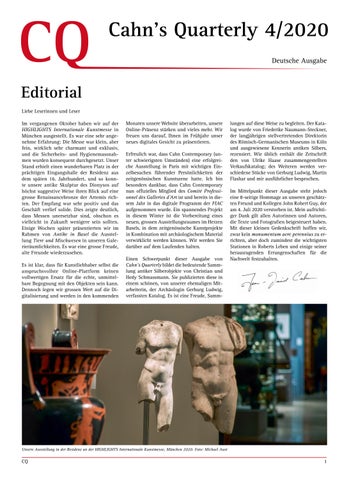
Unsere Ausstellung in der Residenz an der HIGHLIGHTS Internationale Kunstmesse, München 2020. Foto: Michael Aust
CQ
1
Cahn’s Quarterly 4/2020
Für Sie entdeckt
Dem Meister über die Schulter geschaut Antike Goldschmiedetechniken Von Gerburg Ludwig
Abb. 2: BÜGELOHRRINGE. H. 4,1 cm. Gold, Sardonyx. Römisch, 3. Jh. n. Chr. CHF 3’800
Abb. 1: TUTULUSFIBEL. B. 3,3 cm. Gold, Bronze, Karneol. Römisch, 4.-5. Jh. n. Chr.
Die Argonauten-Sage von Iason, der aus Kolchis (heutiges Georgien) das Goldene Vlies mit Hilfe der kolchischen Königstochter Medea raubt und nach Thessalien zurückbringt, reflektiert die Bedeutung von Gold in der Antike, aber auch die Konflikte, die sein Besitz auslösen konnte. König Pelias entlohnt ihn nicht mit dem versprochenen thessalischen Thron, woraufhin Iason ihn töten lässt, schlussendlich aber mit Medea vertrieben wird. Herrscher und Heiligtümer horteten Gold, z. B. in Form gegossener Gefässe. Das sog. Zwölftafelgesetz (5. Jh. v. Chr.) spiegelt die Bedeutung in Rom: Im Todesfall war Gold dem Verstorbenen abzunehmen, mit einer Ausnahme: Gold zur Fixation eines Zahns. Antike Goldlagerstätten befanden sich u. a. in Oberägypten, Nubien, Lydien, im Balkan- und Alpenbereich und in Spanien. In Sakdrisi/Georgien entdeckten Forscher der Ruhr-Universität Bochum 2004 das bislang älteste Goldbergwerk (4. Jt. v. Chr.). Analysen antiker Goldobjekte ergaben einen Silberanteil von 1%–25%. Lag er höher, war der Farbton hellgelb – das sog. Elektron. Aus dem Zusatz von Kupfer (25%, statt der natürlichen 2%) resultierte der rötliche Farbton wie bei ägyptischem Schmuck. Die gezielte Läuterung wird mit dem Beginn der Gold-Münzprägung (7./6. Jh. v. Chr.) verbunden. Bei Schmuck variierte der Reinheitsgrad weiter: Hellenistischer und 2
CHF 4’600
römischer Schmuck hat einen Feingehalt von 85%–99% (Ogden, 1992, 261–264). Mit selbstgefertigten Werkzeugen bearbeiteten antike Goldschmiede vor allem Goldblech, das sie in die Form schmiedeten und mit dem Messer oder einem feinen Meissel zurechtschnitten. Das Vollgussverfahren kam wegen der Gussüberstände kaum in Frage, zu teuer das häufig vom Kunden mit Gewichtsvorgabe/als Münzen gelieferte Material. Weitere Techniken zur Formgebung, Vervielfältigung, Verzierung: das Treiben mit dem Hammer in eine Negativform oder über ein positives Modell, das Modellieren mit Rundgriffel über einem positiven Modell, das Ausstanzen mit scharfen negativen Stempeln (Durchbruchstechnik) sowie das Prägen mit positiven Stempeln. Andere Verzierungen arbeitete der Meister ein oder trug sie auf: Spanabhebend gravierte er mit dem Stichel Linien in kräftige Werkstücke. Mit spitzem Griffel zeichnete er ein; zum Ziselieren bewegte er diesen mit dezenten Hammerschlägen. Dreieckige, runde, ring-, mondförmige Ornamente hieb er mit der Punze. Zusätzlich belebten zwei alte östliche Techniken massgeblich die Ornamentik. Die Filigranarbeit: Goldblechstreifen, zwischen Holz und harter Unterlage zu feinen Rund- oder Flachdrähten und dann ein- oder zweiphasig zu Perlenreihen, Spiralen, Spulen oder Kordeln geformt bzw. gelegt. Bei der Granulation
schmolz er abgeschnittene Drahtstückchen auf einem Holzkohlestaubbett zu Kügelchen. Diese und die Zierdrähte fixierte er ornamental mit einem Klebstoff-Kupfersalz-Gemisch auf dem Schmuckstück. Etrusker führten diese Kunst mit feinsten bis grossen Kugeln zur Perfektion. Einzelteile konnten durch Schweissung, Nietung oder Scharniere miteinander verbunden werden. Abgerundete Werkzeuge glätteten unverzierte Flächen; als Politur diente ein Gemisch von Speichel und Ton, Kreide oder feinem Sand. Die Tragweise des Schmucks ist auf schwarzfigurigen Vasen, Münzen, bei Skulpturen, Reliefs oder Wandmalerei gut zu beobachten. Von der Galerie Cahn hier angebotene Schmuckstücke stellen einige Techniken vor: Die ovale Fibel (Abb. 1) wurde aus Goldblech formgetrieben und um eine Bronzeplatte mit Nadelspirale, Nadel und Nadelrast zur Fixation gebördelt. Um den Karneol in Kastenfassung liegt oval angelegte Filigranarbeit und Granulation: innen ein Spiralspuldraht mit Kügelchen, dann eine Reihe Kugeln, z. T. von Runddraht gerahmt. Die übrige Fläche zieren schuppenartig gelegte Runddraht-Bögen und bes. in den Zwickeln aufgesetzte Kügelchen. Die Zierscheibe und den Quersteg der Ohrringe, miteinander verlötet, stanzte der Goldschmied in Durchbruchstechnik aus Goldblech (Abb. 2). Mit dreieckigen und mondsichelförmigen Stempeln arbeitete er die Blütenkelche heraus, mit grossen kommaförmigen die Ranken des Querstegs. Mit spitzem Griffel zeichnete er Mittelrippen und kleine Häkchen für die Staubblätter ein. Mittig in formgetriebener Mulde eine auf Goldband gezogene SardonyxCQ
Cahn’s Quarterly 4/2020
Perle. Rückseitig unterfängt ein Runddraht vertikal die Mulde und bildet den Tragehaken. Vier vertikale Goldblechstreifen münden in Ösen mit je einem Ring, konischer Tülle und Natur-Perlen auf Golddraht. Der Kinder-Armreif (Abb. 3) wurde aus einem Silberrohling zu mehr als einem Zweidrittelkreis gehämmert, seine Enden zu Schlangenköpfen gerundet. Die weit geöffneten Augen setzte der Meister mit der Ringpunze. Konturen aller Schuppen, eine Doppelzacke auf der
Meine Auswahl
Eine Bucchero-Hydria Von Jean-David Cahn
Abb. 3: KINDERARMREIF MIT SCHLANGENKÖPFEN. Dm. max. 4,2 cm. Silber. Griechisch, 5. Jh. v. Chr. CHF 1’600
Kalotte, die Nasenöffnung gravierte er. Die übrige Reiffläche wurde grob geglättet und poliert. Punktuell ist eine geritzte Zickzack-Linie zu beobachten. Für den Kinder-Fingerring (Abb. 4) formte der Goldschmied einen schlichten Reif aus Goldblech und füllte ihn zur Stabilisierung mit einem Sand- oder Tonkern. Dafür sprechen einige Druckstellen um die angelötete Kastenfassung. Wegen der auffallenden Grösse der oktogonal geschnittenen Gemme ist das Gewicht des Reifs schwer einzuschätzen, eine massive Fertigung also nicht vollständig auszuschliessen. In die Fläche schnitt der Gemmenmeister einen schreitenden Adler mit Kranz im Schnabel.
Abb. 4: FINGERRING MIT ADLERGEMME. Dm. 1,3 cm. Gold, Karneol. Römisch, 1.-3. Jh. n. Chr. CHF 3’200
Untersuchungsmethoden wie Rasterelektronenmikroskopie oder Röntgenfluoreszenzanalyse werden uns, zusammen mit Schriftquellen und archäologischen Befunden, weitere Kenntnisse über technologische Fähigkeiten und den Handel mit Goldschmuck vermitteln. Literatur: J. Ogden, Gold in Antiquity, in: Interdisciplinary Science Reviews, Bd. 17, 3, 1992, 261-270.
CQ
HYDRIA MIT RELIEFDEKOR. H. 40 cm. Ton (Bucchero Pesante). Etruskisch, ca. 550 v. Chr.
Wenn ich dieses aussergewöhnlich kräftige Gefäss betrachte, so frappiert mich jedes Mal seine Fremdartigkeit. Die Wahl der Form – die dreihenklige Hydria ist eine wahrhaft griechische Form – finde ich ebenso überraschend wie die Entscheidung, eine so ureigene etruskische Herstellungsart wie den Bucchero zu verwenden. Die Griffe erinnern stark an metallene Parallelen aus der griechischen Welt, und derselbe Einfluss zeigt sich auch in der Ornamentik, vor allem in den applizierten Tropfenformen, die uns von getriebenen Bronzegefässen so vertraut sind. Offensichtlich wurden die Etrusker von frühen Hydrien beeinflusst, die sie in Griechenland gesehen oder aus Griechenland importiert hatten. Sie schufen jedoch etwas völlig Autochthones unter Verwendung einer grundlegend anderen Ästhetik; das Ergebnis ist kraftvoll und ergreifend. Das dickwandige Gefäss, die Reliefdekoration und die gestempelten Motive erscheinen zunächst recht grob. Man könnte auf den ersten Blick denken, die figürliche Dekoration sei primitiv, doch ist dies keineswegs der Fall. Vielmehr ist es eine bewusste Wahl, ein Phänomen, dem wir in der etruskischen Kunst oft begegnen.
Preis auf Anfrage
Technisch gesehen waren die Etrusker Meister der Perfektion, wählten jedoch häufig Proportionen, die dem zeitgenössischen griechischen Geschmack widersprachen. Hier hat der Künstler zwei verschiedene architektonische Ebenen geschaffen. Krieger im Profil werden von der Hüfte aufwärts gezeigt, als ob die Schulter der Vase ein Fensterrahmen wäre und die Krieger vorbeimarschierten – ein ungewöhnliches Konzept. Das regelmässige Muster von applizierten, frontalen, weiblichen Gesichtern vermittelt den Eindruck, dass die Vase einen anblickt; gleichzeitig weist sie dahinter eine separate Ebene auf. Die frontale Peplophoros des vertikalen Henkels an der Rückseite trägt ebenfalls zu den verschiedenen visuellen Schichten bei, welche diese Vase als Objekt sehr dreidimensional und lebendig machen. Die Vase will uns etwas mitteilen, auch wenn die Erzählung für uns rätselhaft bleibt, wie so häufig in der etruskischen Kunst. Es sind nur sehr wenige Beispiele für monumentale Bucchero-Gefässe mit einer derart umfangreichen Reliefdekoration bekannt. Diese Hydria wurde 1975 von meinem Vater veröffentlicht und gehörte, bis sie der Galerie anvertraut wurde, einer Basler Sammlung an. 3
Cahn’s Quarterly 4/2020
Aus Sicht des Sammlers
Eine Leidenschaft für antikes Silber Christian und Hedy Schmassmann haben im Verlauf vieler Jahre eine umfassende Sammlung antiker Silberobjekte aufgebaut. Sie hatten immer wieder Gelegenheit, sich mit Jean-David Cahn auszutauschen und dabei entstand die Idee, ihre Sammlung in Form eines Katalogs zu dokumentieren.
NIKE UND QUADRIGA. H. 6,9 cm. Vergoldetes Silberblech. Griechisch, 540-525 v. Chr. Verkauft
G. Ludwig: Argentum – Silber aus der Antike. Die Sammlung Christian und Hedy Schmassmann 144 Seiten, 103 Abbildungen, 2 Falttafeln, Basel 2018
Rezension von Friederike Naumann-Steckner «Die Unbeständigkeit menschlicher Sinnesart unterwirft auf sonderbare Weise die Gefässe aus Silber einem dauernden Wechsel, da man auf lange Zeit keinen Werkstattstil bevorzugt. Bald verlangen wir nach furianischen, bald nach clodianischen, bald nach gratanischen [Gefässen...], bald nach ziselierten Arbeiten», moniert der römische Offizier und Schriftsteller Plinius d. Ältere in seiner Naturgeschichte (XXXIII 139) – und unterstreicht damit umso mehr die Lust der Römer am Zusammentragen schönen alten Silbers. Diese Sammlerfreude, die Begeisterung für die Gestaltungsvielfalt des edlen Materials, leitete auch Christian Schmassmann, kritisch unterstützt von seiner Frau Hedy (1936-2018), in weniger als zwanzig Jahren über fünfzig Silberobjekte der Antike zusammenzutragen. Gerburg Ludwig veröffentlicht die Sammlung in einem sehr ansprechenden, 2018 mit besonderem Engagement von Jean-David Cahn gestalteten Katalogwerk. Es fällt schwer, nur ein Highlight zu benennen. Ist es die fein ziselierte Applike mit der eine Quadriga lenkenden Nike aus einer nord4
griechischen Werkstatt des späteren 6. Jahrhunderts v. Chr. (Abb. links)? Bestaunt man das pontische Rhyton mit ausdrucksstarkem Figurenfries in Hochrelief, das Szenen eines Kampfes bärtiger, mit langen Hosen bekleideter «barbarischer» Krieger zeigt? Bewundert man die Eleganz des doppelwandigen Skyphos, dessen Aussenwand filigrane Ranken mit grazilen Vögelchen schmücken, ein Dekor, der spontan an die Rankenfriese der Ara Pacis erinnert? Eine vermögende Römerin mag insbesondere ihren Handspiegel geschätzt haben, dessen Griff als knorrige Herakles-Keule gestaltet ist. Stolz war eine gallo-römische Familie sicherlich auf ihre mehr als elf (römische) Pfund schwere silberne Auftrageplatte mit breitem floralem Rand und grossem Mittelmedaillon. Jüngstes Stück der Sammlung Schmassmann ist eine eher zarte sassanidische Schale des 6. Jahrhunderts, deren Innenseite das Bild einer mit Diadem, Halskette, Armund Fussringen und wehendem Schleiertuch festlich bekleideten Tänzerin ziert – möglicherweise eine Votivgabe im Anahita-Kult. Gerburg Ludwig hat jedes Kleinkunstwerk auf einer Doppelseite gewürdigt, einige besondere Werke auf deren zwei. Nach der Ansprache nennt sie jeweils vermutete Herkunft, Datierung, Material, Technik, Grösse und Gewicht. Ausführlich dokumentiert sie die Provenienz, die bei kaum einem Stück über die 1950-Jahre zurückreicht – nicht ungewöhnlich für Gegenstände des (gehobenen) Alltags. Die Modalitäten der Erwerbung und evtl. Veröffentlichungen werden eingehend dargestellt. Nach einem kurzen Kerntext gibt Ludwig eine behutsame, differenzierte Objektbeschreibung und eine knappe Würdigung. Wert legt sie auf Erhaltung und Herstellungsprozess, letzteres ein Thema, das dem Sammler am Herzen lag. Die archäologische Fachdiskussion inklusive zahlreicher, sorgfältig recherchierter Parallelen findet man in kleinerer Schrifttype als eigenen Abschnitt ans Ende jeder Seite verlagert – dem Fachmann eine besonders willkommene Fundgrube. Ludwig hat das Silber vier Themen zugeordnet: Lebenswelt – Schmuck: Schutz und Eitelkeit – Zu Gast bei den Römern – Zum Umtrunk geladen bei Persern, Griechen und Römern. Diese unübliche und zunächst etwas befremdende Gliederung – was liesse sich nicht unter «Lebenswelt», welcher Gegenstand aus Silber
nicht unter «Schmuck» fassen? – erweist sich rasch als hilfreich, da sie zu Gruppen bindet. Die gewohnte chronologische Anordnung würde zur Unübersichtlichkeit führen, lassen sich doch aus dem Kunsthandel ohne Kontext überlieferte Gegenstände, und gerade solche aus traditionellem Kunsthandwerk, nur in grössere Zeitfenster einordnen. Vorangestellt hat Ludwig ein Essay über die Gewinnung von Silber in den Bergwerken im Laureion-Gebirge und deren Geschichte. Nach dessen Lektüre bedauert man nur, dass kein Abschnitt über den Silberabbau der Römer in Spanien folgt – das kann man aber bei Plinius (Naturgeschichte XXXIII 95-98) nachlesen. Der Katalog glänzt auch durch die brillanten Farbfotos von Niklaus Bürgin. Ohne Effekthascherei ist jedes Objekt sorgfältig ins Licht gerückt. Man erkennt jede Gravur, jedes Graffito, jeden Riss und gewinnt ein Gefühl für die Plastizität der Statuetten und Gefässe. Im Zusammenspiel von Objektqualität und Fotokunst gelingt es, die kleinen Appliken und Büsten in doppelter Grösse abzubilden oder die prachtvolle Auftrageplatte auf der Falttafel ohne Verlust auf halbe Grösse zu reduzieren. Die Museumsfrau stolpert ausschliesslich beim Geleitwort von Jean-David Cahn über seinen «dynamischen Ansatz» von privaten Sammlungen, sind doch Kleinkunstwerke in Privathand oft über viele Jahre der öffentlichen Wahrnehmung entzogen. Letzteres kann freilich beim Bewahren im Museumsdepot nicht viel anders sein.
Friederike Naumann-Steckner war von 1985 – 2019 wissenschaftliche Referentin, dann stellvertretende Direktorin des Römisch-Germanischen Museums der Stadt Köln. CQ
Cahn’s Quarterly 4/2020
In Memoriam
In Memory of John Robert Guy 1949-2020 Dear readers When looking at the contributions in this tribute to the memory of Robert Guy, one becomes aware of Robert’s enormous depth in his specific field. His generosity in sharing his unparalleled knowledge with others is repeatedly evident. One also senses that while he could be very witty, there was an unhappy current that accompanied him consistently throughout his life. What comes out of these contributions is a rich personality with a genius rarely seen, who influenced a generation of archaeologists worldwide in his very specific way. I am very grateful for these contributions, because I would be the wrong person to comment as a colleague – our relationship was of a different nature.
supported financially. The growing tendency to look at vases as mere containers, ignores the wealth of information they can tell us about mythology, as well as the societies that produced and used them. They are dialectic. And they are enchantingly beautiful. The remarkable intensity and density with which the largely uncelebrated ancient vase-painters and potters toiled in ancient Athens, is increasingly dismissed or rationalized into obscurity. Ironic, that this depth of evidence is not utilized in full, given that we have so much written documentation from the epoch of this great civilisation. Robert’s way of approaching vases should continue.
The sense of loss is palpable. For decades, the study of Attic vase painting has diminished alarmingly in the way it is taught and
Robert in the Galleries of Greek Vases at the Louvre, 2016.
The Life and Work of John Robert Guy By Dyfri Williams, Former Keeper of Greek and Roman Antiquities, British Museum, Research Fellow, Université libre de Bruxelles the footsteps of the great Oxford scholar J. D. Beazley. We talked all night long, photographs and sketches strewn across my floor – he had to leave the next day. Thereafter, we were to remain good friends throughout our different careers and challenges.
Dyfri Williams (l.) and Robert Guy (r.) in the British Museum, 2005. Robert is laughing and Dyfri is trying not to.
I first met the Canadian scholar Robert Guy in 1974 in Oxford. He had just finished his MA thesis on the early 5th century B.C. Athenian red-figure vase-painter, the Triptolemos Painter, for the University of Cincinnati, and was on his way out to Athens to stay in the American School of Classical Studies as a Canada Council Doctoral Fellow (he had done his first degree at Queens College, Kingston, Ontario). He came round to my room on the suitably named Museum Street and we began discussing red-figure cup-painters. I think it was a revelation for both of us – here was someone else with the same urge to study Athenian vases and in particular their painters, following in CQ
While in Athens, Guy composed his first publication, a review of Kezia Knauer’s monograph on the recently acquired skyphos by the Triptolemos Painter in Berlin. Then, in late 1975 he returned to Oxford and embarked on a D.Phil. thesis at Lincoln College (supported by the Canada Council until 1978), under the gentle guidance of Professor Martin Robertson on the cup-painter Douris, which narrowed down to the painter’s Late Manner and Followers. His path ahead on the Triptolemos Painter had been blocked by the work of Kezia Knauer and her promise of a forthcoming monograph (which never materialised), while the situation proved much the same with Douris, since Diana Buitron finished a PhD thesis on the painter in 1976 (published in 1995, with a section on the Dourian followers drawn from Guy’s thesis). Both the Triptolemos Painter and Douris, however, were to stay with him
as close friends for the rest of his life and his understanding of both continued to grow. Indeed, in 1981 he published an important article on a ram’s head rhyton decorated by the Triptolemos Painter and signed by the potter Charinos recently acquired by the Virginia Museum. He dealt thoroughly with both potter and painter and in so doing made very important comments on both, in particular the connections with Douris and the Brygan circle, while also opening up our view of the specialist potter Charinos. The Dourian thesis was finished in 1982 but, like his MA thesis, it was never published. It is a fundamental work on a complex area of Early Classical vase-painting, providing insights into both painter and potter connections, and it is to be hoped that it, and its predecessor, can be made more widely available to students and scholars. The years in Oxford, 1975–1984, were crucial to the development of Guy’s talent – his extraordinary eye for style, his visual memory and his ability to reconstruct figures and scenes in his mind’s eye. There were two paths to this end, both driven by the intellectual desire to study as many Athenian vases as I
Cahn’s Quarterly 4/2020
for Campana on his property at Cerveteri in the early 19th century. For, in this way, he was actually giving back to innocent material something of its context and history.
Robert Guy (top row far right) in Corinth, 1975.
possible, especially those unpublished or previously unknown. The first path was to study in detail the most important museum collections and to this end he began, from 1977, to work especially in the Réserve Campana of the Louvre. He made numerous joins and connections among the huge scatter of fragments stored there. He also made trips to the Getty to study their fast growing collection and began to travel to Rome to study the fragments in the Villa Giulia, to continue the work begun by J.D. Beazley on the Italian part of the Campana collection. At the Villa Giulia Guy was similarly able to make many new connections between pieces there and elsewhere, charting further the diaspora of the truly immense Campana collection. Indeed, after his last visit in 1994 he began to entertain plans for producing a sequel to Beazley’s rightly famous Campana Fragments of 1933. The second research path for Guy was the study of private collections and the antiquities market. Among the growing private collections that he visited regularly were those of Dr. Dietrich von Bothmer at the Metropolitan Museum of Art in New York and Dr. Herbert Cahn in Basel, both composed almost entirely of fragments. At the same time he began to follow the antiquities sales in London. He saw all the material that went through the market, whether in auction houses or with dealers, an exposure that quickly embraced other European and American markets. His extraordinarily gifted eye for the style of individual Athenian vase-painters, from the 6th century to the 4th, soon made him an important resource to acquiring museums, private collectors and those in the antiquities trade. The ethics of major dealers was yet to be seriously questioned, while the role of the academic in assessing antiquities on the market, whether for authenticity or attribution, had a perfectly respectable history, but the world was changing fast. The unacknowledged but vital importance of this element of Guy’s work was the way that it enabled him to make connections and joins between old Campana vases and the newly emerged fragments, which were the result of illegal “gleanings” around tombs excavated II
In parallel to his work with Athenian vases, we should note the invitation in 1983 by Dale Trendall, the doyen of South Italian vase-painting, to accompany him on a tour of museums in southern Italy: Guy was supported by grants from Oxford’s Meyerstein Fund and London’s Institute of Classical Studies. He spent some five very happy months helping Trendall, then 74 years old, with all the exigencies of travel, while both learning directly from a master and enjoying his impish spirit, in many ways so like Guy’s own. In 1984 Guy was appointed Associate Curator of Ancient Art at the Art Museum of Princeton University. Under the benevolent eye of the Director, Allen Rosenbaum, Guy was to make important acquisitions for the Museum and to complete a redisplay of the highlights of the collection, proving himself a Museum man as well as a research scholar. His major acquisitions for the Museum, either by purchase or gift, range across the full spectrum of ancient art including large scale marble sculptures, bronzes, glass, terracotta vases and figurines. We might note, especially some important sculptures: a Classical Greek gravestone of the boy Mnesikles, part of a Roman funerary monument of a charioteer, the head of a priest of the imperial cult from a votive pillar, and the fine head of a boy of Antonine date. He also acquired, of course, many Greek vases and fragments of all periods, including from the best moment of Athenian vase-painting in the early 5th century B.C. One of the finest Athenian vases purchased by Princeton during Guy’s tenure, was to cause controversy both in and beyond the world of a curator, indeed it was eventually returned to Italy as having been looted and then illegally exported by the dealer Robert Hecht in 1989. This was a psykter (wine cooler) which Guy recognised as an early work of the Kleophrades Painter. Dietrich von Bothmer in the Metropolitan Museum of Art and Marion True of the J. Paul Getty Museum had both declared it a fake, but Guy rightly ignored these somewhat spiteful opinions. His knowledge of the vase-painter was deep – he had lectured on him in 1979 and was to do so again in 1991 – and his judgement was absolutely sound. His willingness to harry such “opponents" always reminds me of the lion on a fragment in Herbert Cahn’s collection that he attributed to the Berlin Painter (HC 1753). In many ways, this period at Princeton was perhaps the most stable and productive part of his increasingly peripatetic career. Not only did he set in motion the important, multi-authored publication of the museum’s Greek sculpture collection (Greek Sculpture 1994), but he also
lectured for Princeton’s Department of Art and Archaeology, held a graduate seminar on Archaic Athenian pottery in 1987, and supervised Liz Langridge-Noti’s important thesis on the Eucharides Painter. During these years he also began to collect pottery fragments for himself recognising their special value as a teaching aid – his collection was later to go to the Harvard Art Museums, where it was published in 1997 by Aaron Paul. In addition, Guy lectured abroad, in Toronto (1984), London (1985), Copenhagen (1987), Lausanne (1987), New York (1987 and 1991) and Paris (1990).
Fragments of a red-figure kalpis attributed to the Berlin Painter. Greek, Attic, ca. 500-490 B.C. Cahn Collection, Basel (HC 1753).
In the autumn of 1991, as his U.S. work permit ended, he was offered the first Humfry Payne Senior Research Fellowship at Corpus Christi College, Oxford. This seemed an ideal position, freeing him to concentrate on research alone, but it was perhaps something of a mixed blessing, for there had been opposition to the source of the funding and the lack of an open competition for the post. At the end of 1991 he published a short but important piece in the Ackland Museum’s Quarterly on the black-figure Bucci Painter, thus demonstrating the range of his knowledge. In 1992 he was invited to join a publication project of vases in the Vatican with François Lissarrague and François Villard. This ran until 1995, but was then suspended. In parallel, his work on private collections, which had included entries for a 1984 catalogue of the Borowski collection, culminated in entries for the catalogue of the 1994 exhibition at the J. Paul Getty Museum of the Fleischman collection. Writing, however, and even the submission for publication of what he had given as lectures or papers at conferences, was always extremely difficult for Guy. He was a perfectionist in his language, but also someone who was inhibited by a serious reluctance to let anything go, the result perhaps of his constant re-thinking and re-assessment. When in 1998 the first term of his Oxford fellowship ended, Guy declined to renew it: the origin of the majority of the funding had been revealed to be the by then notorious dealer Robin Symes. Feeling betrayed and disapCQ
Cahn’s Quarterly 4/2020
pointed, Guy decided it would be improper to continue. With his prospects thus self-diminished, he moved to New York in 1999 to work with Michael Ward, a private antiquities dealer. He was there until 2002, when he moved back to Oxford to concentrate on his research, while also acting as a private art consultant, but in 2009, he was invited to join the Cahn Gallery in Basel by Jean-David Cahn. He was appointed the Curator of Herbert Cahn’s large collection of pottery fragments, Jean-David’s father, whom Guy had known well, becoming indeed very much a family friend; he also served as an advisor to the Gallery. With a secure position in Basel, Guy was once again able to think more freely about scholarly matters and he began speaking again at conferences – Lausanne (2012), Graz (2013) and Munich (2014). In these lectures many of his important trains of thought were brought into focus, wheth-
er about the potters Syriskos and Pistoxenos, together with their painters, or the interconnections between the Brygan Group and the Triptolemos Painter, while with his precious insights he also opened up many new avenues for future scholars. At the end of 2014, however, Guy had to retire from the Gallery, although he was soon re-employed by a Basel private collector, cataloguing his collection of vases. It was the Princeton project of a special exhibition on the Berlin Painter that gave Guy a final, joyful sense of purpose. Michael Padgett, Guy’s successor at Princeton, had developed the idea and at the end of 2015 asked Guy to collaborate with an essay, but it quickly became clear that Guy’s long term attachment to the painter and an unrivalled knowledge of all his preserved works meant he was required to do much more. Indeed, he was to become joint
author with Padgett of the complete catalogue of the painter’s works, a prodigious work of immense connoisseurship. His essay, “In the Shadow of the Berlin Painter”, dedicated to his inspirational Cincinnati teacher Cedric Boulter, showed exactly what he could produce in its perceptiveness and precision and its total mastery of the field, all the result of what Beazley had called “keen and patient scrutiny”. He was to make important contributions to one last exhibition, that on the potter and painter Exekias, in Zurich in 2018-19, including an excursus, with Martin Bürne, on his detailed observations of an Exekian amphora rim. But, little more than a year later, he passed away. His eye and mind were capable of so very much more, yet we have his many, many attributions and joins which, together with his precious publications, are such a fitting reminder and memorial of the Robert we knew.
A Preternatural Skill By Jasper Gaunt, London these might belong together in what he sometimes called a “whisper join”, one without any point of physical contact. It fast emerged that a telephone conversation would be much clearer, and so I called him with our respective fragments in front of us. Turn them over, he said; there should be a band on the reserved surface that looks as if it has been worked over with a spatula to make the Fragment of an amphora by the Berlin Painter, HC 1736, obverse and reverse. clay more glossy. He had Philologists regard the successful emendation described perfectly the surface of the sherds in of a thorny classical text as one of the disci- my hands: he was right. As with the philolopline’s highest achievements: it requires excep- gist’s emendation, Robert’s join (which was the tional sensitivity to the author’s thought and basis of further significant discoveries) is reexpression. In print, however, only the trans- corded in the catalogue merely with the three position or substitution of one or two letters is letters of his name between square brackets. recorded. For the archaeologist specializing in vase-painting, the ability to recognize the hand I first met Robert in Paris at the Euphronios of an ancient artist even in the tiniest scrap re- colloquium organized by Martine Denoyelle quires a no less intimate level of understand- at the Ecole du Louvre in October 1990. Later ing. Very few scholars have had this preternat- that winter I saw him again in New York when ural skill. Robert Guy was one of them. he came up for the day from Princeton. One of his afternoon errands was to examine carefulDuring the months of collaboration on Michael ly the Pan Painter’s impressive column-krater Padgett’s exhibition on the Berlin Painter, Rob- now in the Antikenmuseum, Basel, which was ert was at his very best. Only he would have passing through the market. My task was to recognized the hand of the Berlin Painter on an supply ashtray and coffee. To a novice in the amphora fragment in Herbert Cahn’s collection field of archaeology, Robert was generous in (HC 1736) and realized from the small scale of taking time to show me the extensive prelimidrawing that the extremely unusual shoulder nary sketch that he had found on the obverse, panel decoration recurred on fragments that and to explain the attribution. More than Dietrich von Bothmer had donated to Emory twenty-five years later, he extended the same University. He emailed with the suggestion that generosity to two graduate students of mine CQ
from Emory. They not only met with him in Basel but were fortunate to exchange emails; and he continued to ask after them. Robert’s magisterial grasp of Beazley’s structure for vase-painters, indeed his refinement of it, is widely acknowledged. It enabled him, for example, to identify simply from a telephone description the red-figure psykter with a symposium (that he later acquired for Princeton) as a work of the early Kleophrades Painter. His mastery came in no small part from his constant exposure to original pieces of pottery as they passed through the market, where he could refine yet further his feel for the character of the glaze and the way incision, relief line, dilute or added glaze were applied. The level of trust widely placed in his discretion by dealers was in itself a remarkable achievement. It enabled him to see practically every piece of Attic pottery in their hands, and often to record contextual information. Equally widespread was the respect he enjoyed among museums and collectors, particularly in the United States. His attributions provided a reliable basis for them as well as for countless scholars. Over thirty odd years of friendship, it was not only Robert’s academic precision that was memorable, but perhaps more importantly, his love and respect for objects, and the cultivated pleasure he took in sharing them. We spoke often by telephone during his last illness, occasionally in reminiscence about giants of our field such as Cornelius and Emily Vermeule and Dietrich von Bothmer, and the dealers of their day. “We have been fortunate to spend time with them,” he said thoughtfully. The same for me is true of Robert: he is the only archaeologist from whom I always learned something. III
Cahn’s Quarterly 4/2020
The Princeton Years By J. Michael Padgett, Ph.D., Curator of Ancient Art, Princeton University Art Museum
A snapshot from the opening of The Berlin Painter and his World, 2017, at Princeton. Michael Padgett (left), Allen Rosenbaum (middle), Robert Guy (right).
I met J. Robert Guy in the late 1980s, when I was a graduate student at Harvard and working at the Museum of Fine Arts, Boston. At that time he was the Associate Curator of Ancient Art at the Princeton University Art Museum. I wanted to study Attic vase-painting, but my academic advisor, Emily Vermeule, was not a vase specialist. She consequently asked Dietrich von Bothmer, the Curator of Greek and Roman Art at the Metropolitan Museum of Art, to guide my dissertation research. I probably wrote Robert with queries about this pot or that cup, and he may have passed through the MFA at some point, as did a rising young curator named Carlos Picón, who was then Curator of Western Antiquities at the San Antonio Museum of Art. Robert had a formidable reputation as “the new Beazley,” said to possess Sir J. D. Beazley’s legendary acumen and visual memory. He, too, was able to recognize joining vase fragments in different museums, and to detect the hand of Makron or the Kleophrades Painter from no more than an ankle and a scrap of himation. I worked hard to improve my own knowledge and eye; I revered Emily, but I wanted to be a vase man like Robert Guy. That I felt this way while under Dietrich’s tutelage was awkward, as he was jealous of Robert’s rapid rise. It would infuriate him whenever Robert pointed out that a fragment in Dietrich’s personal collection not only could be attributed to a prominent vase-painter, but joined another piece in a different cabinet. Sometimes Robert would donate fragments that joined vases in the Met, as when he filled critical lacunae in a splendid red-figure amphora by the Berlin Painter; the one with a citharode that they gave to Italy. This required Dietrich to write polite letters of thanks to the donor, when he would sooner have seen him taken down a peg. “New Beazley!” IV
I have nothing bad to say about my lamented Doktorvater. Dietrich von Bothmer made his own considerable contributions to the field of Attic vase-painting, and during his long career he accomplished more as a curator and published many more works of scholarship than Robert Guy. Robert could have done more... He knew this as well as anyone, and he could not fully mask the pain that it caused him. He was a proud man – deservedly so – but sometimes he was his own worst enemy, as when he would agree to give a paper at a scholarly conference but then fail to submit it for publication. How many of us honestly feel that we have accomplished as much as we might have? In Robert’s case, his brilliance was repeatedly proven with one attribution after another—and indeed, the occasional article—until he was acknowledged by all as the finest vase connoisseur of his generation. His iconographic observations were learned but conservative; it was in style that his authority became magisterial. I cannot tell you how many times I labored over an attribution that I then proudly shared with Robert, only to learn that he had been there ahead of me, sometimes by decades! He revered Beazley, and did not lightly contradict him. He himself considered Dyfri Williams to be the leading scholar in the field. If he fought duels, he also collected friends, for he was handsome and debonair, with an easy manner and a wicked sense of humor. He and I were always sneaking off for a smoke. I loved him, and so did my wife Judy. His generosity was limitless, and he was always welcoming to students. When he decided to leave Princeton in 1991 to become a Senior Research Fellow at Corpus Christi, Oxford, he recommended to Princeton
director Allen Rosenbaum that I be considered as his replacement. Allen later confirmed that Robert’s endorsement was a deciding factor, and twenty-nine years later I am still grateful to both of them for giving me my career. When I decided to organize the exhibition, The Berlin Painter and his World (fig. 1), I felt that the catalogue must include a thorough re-examination of the oeuvre of that important but anonymous Athenian artist, building on the attributions of Beazley and subsequent scholars. As I came to realize what a huge project I was undertaking, I began to ask Robert’s opinion of this or that piece. Although at times an unfaithful correspondent—he would disappear for weeks when afflicted by “Black Dog”—he took an increasing interest in the project, and we began exchanging daily images and emails. One day I simply told him that he was now the co-editor of the Berlin Painter’s revised corpus raisonné, and would be credited on the title page. Fragment by fragment we worked through the list, often arguing about what new works should be admitted to the canon and which relegated to the “Salon des Refusés.” He also agreed to contribute an essay on the expanding oeuvre of the Painter of Goluchow 37; I read it again recently and was struck by its insights. Whenever I was uncertain, or needed a sounding board, he was there. He was a rock of patience and persistence, and a refuge from ignorance and self-doubt. He never let me down, and I shall always be grateful to him. People like Robert Guy are special. He deserves to be remembered, and to assume a place of honor in the long history of classical scholarship.
Herbert Cahn (left), Vera Slehofer (middle) and Robert Guy (right) in front of Blackwell's Rare Books, Oxford, August 1987.
CQ
Cahn’s Quarterly 4/2020
A Memorable Purchase By Allen Rosenbaum, Director Emeritus, The Princeton University Art Museum J. Robert Guy was Associate Curator of Ancient Art at the Princeton University Art Museum from 1984 to 1991. In addition to his impressive scholarly training and credentials, his broad knowledge of ancient art and his gift as a specialist in Greek vase painting, I knew Robert was a perfect fit for the museum. From the job interview I was very much taken and reassured by his curiosity and the interest and even excitement he found in even a minor object. Robert and I always looked forward to Herbert Cahn's visit every year. This courtly, sympathetic gentleman epitomized the old school scholar/dealer. And incidentally, Herbert and I also had the same birthday, Aquarians. But it was not during one of these visits that Princeton made a memorable purchase, memorable for many reasons, from the Cahn gallery. Robert was followed on his return from a buying trip to Europe by two enormous crates filled with fragments of a Clazomenian sarcophagus most no bigger than a foot but of a density and surprising weight that belied their size. I was understandably alarmed as the restoration of the sarcophagus seemed an overwhelming and expensive undertaking with no guarantee of the outcome. I told Robert that this would be his Egyptian wall, referring to the gift of an Egyptian wall, mostly plaster, which had
been given to Princeton by the Metropolitan Museum of Art in the 1940s and was never assembled and filled countless shelves in storage. But Robert sought to calm me and reassured me that he would raise the money to restore the sarcophagus. And then he left for Oxford. Robert was much loved by everyone in the museum and although often something of a handful and a bit of a prima donna, he was mostly indulged. He in turn was very happy and thrived at Princeton. I often wonder how things would have turned out had Robert remained at the museum. But the position at Oxford was too grand, a dream come true for Robert, for the museum to make a counteroffer, or any effort to have Robert stay on. And we were happy for him. I did, eventually, raise the funds for the restoration of the sarcophagus, which was overseen by Michael Padgett who succeeded Robert. And while Robert couldn't possibly have known how it would turn out when done, after three years, Robert was vindicated. The sarcophagus is magnificent, one of the prides of the collection. An amusing footnote to the story is that a fragment of a very fine Egyptian wall painting was in one of the crates and we thought, naively, it had been included as a gift. Alas, it was there by accident and we had to buy it.
Rim of a painted sarcophagus. Ceramic. East Greek, Clazomenae, ca. 500-475 B.C. Courtesy Princeton University Art Museum (y1990-9).
A Life-long Friend By Ariel Herrmann, Independent Scholar The first time I ever heard of Robert Guy was from Herbert Cahn, some time in the late 1970s. Dr. Cahn spoke about to me about the young scholar’s dedication and his uncanny skill as an attributionist. I got to know Robert in person soon afterwards, during his visits to study vase fragments at the Museum of Fine Arts, Boston. We had close friends in common from his student days at Oxford, Carlos Picòn and Brian Aitken. Robert was a boyish, even waif-like figure who captivated everyone. Although he radiated seriousness, he had a subversive streak and a cheeky sense of humour. We met often in New York during his years at the Princeton University Art Museum, where he had a supportive director in Allen Rosenbaum. I sensed that it was refreshing for him to deal with the practicalities of museum work and with ancient art outside his immediate CQ
specialty. He was able to acquire many small, interesting objects and some important ones, greatly raising the level of a once-dormant collection. He even began to look beyond the Mediterranean world, developing a taste for (what else?) Mayan painted pottery. His advice influenced a generation of collectors. After Jean-David Cahn persuaded him to settle in Basel, Robert’s enthusiasm for academic work seemed to revive. Adrienne Lezzi gave constant encouragement and support. The Berlin Painter exhibition, organized by Michael Padgett at the Princeton Museum, was a high point, and an opportunity for Robert to collaborate with Dyfri Williams and Jasper Gaunt, and to listen, at the congress, to his also long-time friend and colleague, François Lissarrague. In recent years, Robert’s presence was one of the things that drew me to Basel. As a friend he was subtle, intuitive and utterly discreet. He will be terribly missed.
International Vase Symposium Amsterdam, 1984.
V
Cahn’s Quarterly 4/2020
An Eye for Style and Attribution By Carlos Arturo Picón, Curator in Charge (Retired) 1990-2017, Department of Greek and Roman Art, Metropolitan Museum of Art, New York Few people ever succeeded in turning Robert’s attention away from Greek pottery. Dear Gillett certainly did, with his wonderful talent for putting friends together, his infectious sense of humour, and above all his profound connoisseurship. Pre-Columbian antiquities were a revelation for Robert – and one which brought him much joy.
Carlos Picon (left) and Robert Guy (right), the day they both received their DPhil from Oxford University, May 1984.
I first met Robert in the early 1970s when I was an undergraduate at Haverford College, double-majoring in Classical Archaeology and Art History at neighbouring Bryn Mawr College. He was a great admirer of my legendary teacher and mentor Brunilde Sismondo Ridgway who arranged for me to pursue graduate studies at Oxford under the guidance of John Boardman and Martin Robertson. It was at Oxford that Robert and I became close friends. I remember vividly to this day our first encounter in Michaelmas Term of 1976, at the very beginning of the academic year. Robert was exiting the Ashmolean Museum Library with Dyfri Williams whom I had not previously met, and who became an esteemed friend of all of us. Indeed, Dyfri was to remain the one Oxford colleague Robert would always turn to in matters of Athenian vase-painting and vase connoisseurship in general. It is fortunate that Dyfri has contributed an account of Robert’s career here as he is the most qualified scholar of our generation to evaluate Robert’s contribution to his chosen field of expertise. Robert also introduced me to another North American VI
graduate student who had recently returned to Oxford from Boston in order to continue his research on Archaic Greek sculpture. His name was Brian Aitken and they both rented lodgings in the same house in Polstead Road. Brian was already well acquainted with the London art market and brought Robert to the attention of some of the leading galleries and auction houses in the capital. By 1979, the year of the historic Brummer sale of antiquities in Zurich which Brian attended, he had also introduced Robert and me to Ariel Herrmann; all of us were to remain loyal friends for the rest of our lives. Robert’s tenure as Curator of Antiquities at the Princeton University Art Museum was arguably his happiest and most productive time. He was very fortunate to have benefited from the unerring guidance and nurturing friendship of two great Princeton personalities: his museum director Allen Rosenbaum who patiently gave him free rein to transform the collection; and the beloved scholar and astute collector Gillett Griffin who opened his eyes to the wonders of Pre-Columbian art.
Robert did not do much teaching at Princeton but he greatly enjoyed the handful of pupils he mentored, and he did take teaching quite seriously. What gave him most pleasure, however, was enriching the museum’s collection – and this he did with great knowledge and gusto. We used to joke that his predecessors at Princeton had seldom bought anything larger than a few inches. Robert knew the art market intimately and acquired wisely across the board, and not just Greek pots as others in his field were so inclined to do. He also cultivated donors who often encouraged and supported him. Here of course he was lucky to have a director who couldn’t have been more helpful and understanding. Among the donors the name of John Elliott stands apart. I will never forget an evening when Elliott had us both for dinner at his Princeton home. Over drinks he casually asked us to each draw a list of ten classical antiquities currently on the market we would (in an ideal world) recommend for purchase. When it turned out that Robert and I independently chose many of the same objects, Elliott went ahead and systematically acquired a good number of them for Princeton. Of course collecting wasn’t always that easy, and museum acquisitions of antiquities have indeed become increasingly more challenging in recent years, especially in North America. One can cope with these difficulties, but it is to be hoped that the next generation of antiquities curators will remember the sense of duty and respect for the objects that Robert exemplified. He always gave objects the benefit of the doubt. He also cared deeply about books and managed to assemble (at a significant personal sacrifice) a great antiquities library, especially in the field of Greek pottery – not to mention a formidable archive of photographs and annotated sale catalogues that will fortunately be transferred in their entirety to Paris, under the able guidance of François Lissarrague. There are other curators and scholars who have been more prolific in the field of vase-painting, but very rarely has one encountered an eye for style and attribution sharper than Robert’s. He had a special gift, and for that as well as for his enduring friendship we will always remain grateful. CQ
Cahn’s Quarterly 4/2020
Three Enduring Memories By Oliver Forge, Forge and Lynch Ltd., Consultants in Antiquities and Islamic and Indian Art, London/New York I have three enduring memories of Robert. The first is in about 1981 at Sotheby’s. Felicity Nicholson, the head of the Antiquities department, is seated at a long table, Robert seated next to her; me, a 19 year old porter standing beside them with a trolley full of Greek vases of varying importance and size. The table with cups of half-drunk coffee, ashtrays overflowing with Felicity’s Gitane and Robert’s ever-present Marlboro, together with a near-empty bottle or two of Bulgarian red. It is 8.30pm and for the last 2 hours (Robert’s time-keeping was always unpredictable) I have stood there handing to Robert vase after vase after vase for him to look at, comment, discuss and attribute; Felicity takes copious notes. I am catatonic but now forty years later I realise what a missed opportunity it was.
Fast forward 25 years and Robert is now seated in our office in St James’s looking at a beautiful red-figure cup by the Dokimasia Painter from the collection of Sir Christopher Cockerell which we were in the process of selling to the Fitzwilliam Museum. A stack of 500 Christmas cards next to him which he has kindly offered to put into envelopes. Brendan Lynch and I had left Sotheby’s in 1997 to establish our own business. Robert had proved to be a generous and fiercely loyal friend; he arranged for us to take over his office in New York on 82nd Street which we had for 14 years and for which we will be forever grateful. The third memory is the last I have of him, in his flat in Basel in April 2019. As in 1981 at Sotheby’s, the table he sat at had coffee cups,
ash trays, packets of Marlboro Reds (he remained one of the last committed smokers I knew), a few vases and above all books; books everywhere. He was in an ebullient mood with much on his mind; the trade, the state of the art market, objects he had seen in forthcoming auctions, and people he liked and more amusingly disliked. When Robert was on top form he really was wonderful company, with his open empathetic and ever-enquiring mind, his brilliant eye and memory for works of art, his humour and, when called for, his sharp turn of phrase. He talked so much that the restaurant was closed by the time we arrived but now knowing it was to be the last time I saw him it was all worth it. He will be much missed.
Robert Guy in Copenhagen By Bodil Bundgaard Rasmussen, Former Head of Research, Ancient Cultures of Denmark and the Mediterranean, National Museum of Denmark jects, exchanging experiences and opinions and sharing many a good laugh.
The name piece of the former Copenhagen Painter, created by J. D. Beazley. The vase now counts as a work of the painter Syriskos. Attic. ca. 470 BC. Inv. no. Chr. VIII 320
To have known Robert is a gift to treasure. I cannot claim to have been a lifelong friend or even a close friend, yet nonetheless I shall be eternally grateful to have met Robert and experienced his enthusiasm and dedicated approach to scholarship – and not least his kindness. Robert came only twice to Copenhagen, first in 1987 to attend the 3rd Symposium on Ancient Greek and Related Pottery in early September. We did not meet, but I learned he was there later as we met at a ‘Greek vase event’. More meetings followed suit in various cities around Europe - always enlightCQ
ening and great fun. His next visit was not until the autumn of 2010. His purpose was to have a look at a Roman portrait up for auction in Copenhagen – and to ‘pick the brain’ of my husband, then retired director of the Ny Carlsberg Glyptotek, Flemming Johansen. They had never met as my husband spent his life working in portraits and only occasionally strayed into Greek vases. We got together on the evening of Robert’s arrival and, as anticipated, they connected immediately. I think it’s fair to say, they got on “like a house on fire” and we had the most delightful evening moving from portraits into many other sub-
The next day Robert came to the National Museum, in which I was at the time head of the Classical and Near Eastern department. During the evening we had arranged to meet in the morning as he wanted to have a close look at the amphora by the – now former – Copenhagen Painter in the museum’s Greek collection. To the mild surprise of my colleagues, I had the amphora moved from the gallery to the library for Robert to study. We rarely move objects from the gallery on short notice but everybody acknowledged Robert’s long ongoing interest in the “Copenhagen Painter” as justification. At the time we had just launched the series Gösta Enbom Monographs connected to an ongoing research initiative in our department, “Pots, Potters and Society in Ancient Greece”. Consequently, we promptly offered to publish Robert’s study whenever he felt ready. After his return from Copenhagen, Robert told me how the idea for publishing was an encouragement and that he wanted to press on with the writing, “My need to write is there.” During the morning Robert did not really share his thoughts on the vase, but I was confident then and still am, that the result would be hugely interesting. Sadly, the plan of publication never got to fruition. But just watching the delight and care, reverence really, with which Robert handled and scrutinized the vase, the motif and its details was a rewarding experience. VII
Cahn’s Quarterly 4/2020
The Fascination of a Masterpiece By Heide Mommsen, former co-worker at the Corpus Vasorum Antiquorum Not much of Robert Guy´s research in the field of Attic vase painting has ever been published, even though he was very communicative by nature and owing to his remarkable gift for identifying painters and joining fragments from different collections he had so much to tell. I heard some excellent papers of his at various vase conferences, ready for printing, but when I wanted to read them later on in the conference proceedings, they were missing. In the following lines, an excerpt from a letter dated spring 2010 (written in reply to my reconstruction of the Nearchos kantharos in the Studies in Honour of Herman Brijder), Robert describes the fascination of a masterpiece that never failed to inspire him.
The desire to keep this inspiration alive and to improve his understanding may have influenced his reluctance to fix his thoughts in printed texts. “The Athens kantharos by Nearchos was my first ‘vase-love.’ When I came across it on display in the summer of 1971, I was utterly enchanted even though Greek sculpture was at that moment, under the stimulating influence of Bruni Ridgway, my main focus. I came back to Attic pottery in graduate school the next year, the ‘Year of Euphronios,’ and never looked back. Perhaps odd that such an exquisite work in black-figure should have inspired someone who is really much more at home in red-figure, but whenever I look at it, it never fails to give me a lift. To have yet more of it, after the passage of so many years, is a heavenly gift. […]
Right down to the preliminary sketch for the inscriptions, it is miraculous in design and execution.” His ability to identify vase painters by their drawing style alone was perhaps in itself a “heavenly gift”; but it was above all a skill acquired through the assiduous, indefatigable study of vase paintings. Fortunately, his attributions to certain painters and his joins of fragments have been handed down to us through his many friendships with fellow archeologists. They serve as a confirmation that the identification of individual masters, their teachers, their pupils and their workshops is vital to any nuanced approach to the spirit of the age. His judgment will be sorely missed.
The Basel Years By Jean-David Cahn The first time I met Robert was in the kitchen with my mother, on a summer’s day in Basel. He had a mug in his hand, wore Indian sandals barefooted, and had an abundance of hair. Initially, he came off as soft-spoken, nearly timid. My mother had a natural curiosity and was asking this young Canadian about anything and everything – not archaeology. She was not shy at all and he opened up. They would sit in this kitchen for hours, then he would disappear again, into the small vase room filled with open shelves stacked one above one another, poring over vase fragments – quite a messy business I thought. My father would be there, and they would retreat into serious discussions on a remote world, accessed through these shards which they both loved so dearly. This was the 1970s, and I was a boy wanting to participate. My contribution was convincing my father (not easy, as he preferred spending money on interesting fragments) to acquire a system of shelves (super solid Swiss quality) covering an entire wall of the room in order to house the fragments. The collection nowadays is still in these numbered shelves, protected. Vera Slehofer would join very often – also the coffee chats with my mother. She was then a student of archaeology in Basel, full of energy and character, and in charge of organizing my father’s fragment collection. She would go on to become the vase curator at the Basel Antikenmuseum. VIII
I was a dozen years younger, and remote from this world, but was immediately impressed by the passion of these three and the intensity of these discussions: like a deeply connected musical trio. Sometimes other academics would join, as visitors. There would be lunch or dinner. They would withdraw again. The drawers of fragments remain filled with notes by different scholars – for once harmoniously together, even if the involved personalities were not on speaking terms in the real world. Robert was then like a distant, very friendly, half-brother. As a young boy, my interests at the time were elsewhere. I encountered Robert years later at Oxford, and had a very rare glimpse of his extraordinary and gentle aptitude as a teacher, even in a topic so remote as Greek armour. Later still, I met him working in New York for a dealer and he sold me something. His manner was most gracious and elegant, and extremely effective. It was the object that triggered him, not the commerce. Based on these good memories, I convinced him to join me in Basel at the gallery. I knew him to be fiercely independent in all areas. The Churchillian Black Dog, then, had virtually taken over. The move to Basel was not easy for him, but sitting in his own office at my late father’s desk overlooking the garden, with photographs of Beazley on the wall, and the Corpus Vasorum Antiquorum at hand, he gradually revived. Within a year, thanks to the good care of his
Robert with a skyphos decorated with palmettes in the Cahn Gallery, 2013.
dear friend Adrienne Lezzi-Hafter, his health improved and he began researching again. He was very selective, and preferred to concentrate on vases, of course. His contributions were always brilliantly written, by a scholar clearly in his element, and leaving me with the hopeless problem of ruthlessly shortening his texts into catalogue entries for auction sales. The density and precision of his descriptions was such that this proved nearly impossible. This created some strife, but Robert ultimately remained sanguine – genuine in his belief that the object remained the centre of attention and thus was admirably consequent in his approach. To write about Robert leaves a feeling of void and loss. What could have been achieved…. CQ
Cahn’s Quarterly 4/2020
Erinnerungen
Meisterwerke antiker Silberschmiede im Fokus
Von Christian Schmassmann
Von Gerburg Ludwig
Während meiner Jugend- und Schulzeit wurde mein Interesse an antiken Werken geweckt, einerseits beim römischen Gutshof Munzach bei Liestal. Da haben wir Burschen mit sorgfältiger Handarbeit bei den Ausgrabungen mitgewirkt. Andererseits habe ich etwas später für einen Verwandten, der Archäologe war, in einem Labor der Universität Basel Dutzende von Schwarz-Weiss-Fotos entwickelt. Es war immer ein Erlebnis, zu sehen, wie in den Entwicklungsbädern auf dem Fotopapier sich langsam ein Objekt abbildete. 1955 bekam ich ein Foto mit dem Dornauszieher aus Bronze geschenkt, der am 15. Dezember 1471 von Papst Sixtus IV. der Stadt Rom geschenkt und auf dem Kapitol ausgestellt wurde. Der Knabe ist bemüht, sich einen Dorn aus dem Fuss zu ziehen. Er ist so sehr vertieft in seine Beschäftigung, dass er die Welt um sich herum vergisst.
Als ich bei der Sichtung und Datenaufnahme der Sammlung Schmassmann die Applik der Nike mit Quadriga (Abb. Seite 4) vorsichtig vom Sockel löste und sie dann in der Hand hielt, faszinierte mich zunächst ihr Gewicht – federleicht, hauchdünnes vergoldetes Silberblech; fast schien es, als hielte ich nichts in der Hand. In Anbetracht der präzisen Ausführung war hier ein ganz grosser Könner seines Fachs am Werk: Er trieb das Silberblech über einer Patrize. Weiche Umrisslinien um Nikes Kopf und Flügel und die äusseren Pferde geben dem Bild eine gewisse Struktur. Details, wie die prächtigen Flügel, die zarte Blüten-Musterung des Peplos oder die fein gesträhnten Pferdemähnen, arbeitete er mit feinster Gravur, Punktierung und mit Ziselierung ein.
Die vielen Eindrücke, die ich bei diesen Tätigkeiten gewonnen habe, schlummerten dann während vieler Jahre eines überaus aktiven Berufslebens und vieler Weiterbildungen; doch gelegentliche Museumsbesuche und Ausstellungen gaben immer wieder Farbtupfer und Anregung. Als ich viele Jahre später das erste Objekt erwarb, war noch nicht klar, dass daraus eine Sammlung entstehen würde; doch sehr schnell habe ich bestimmt, dass Silberobjekte aus der Zeit von 500 v. Chr. bis 500 n. Chr. Aufnahme darin finden sollen. Auch bei mir kommt immer beim Bestaunen der Objekte, wie beim Dornauszieher, gespannte Aufmerksamkeit (mit leicht geöffnetem Mund) zum Ausdruck.
Christian Schmassmann verbrachte seine Jugend und Schulzeit in seiner Geburtsstadt Basel. Er war als kaufmännischer Leiter in einem Familienunternehmen tätig, welches Fabriken in Deutschland und der Schweiz betrieb und mit Vertriebsfirmen weltweit aktiv war. Das Unternehmen stellte Maschinen zur Bearbeitung von Glas und anderen harten Werkstoffen her, die insbesondere der Produktion hochwertiger optischer Komponenten und Brillengläser dienten. CQ
Bei der sich anschliessenden Recherche stiess ich in der Online Collection des Princeton University Art Museum auf ein fast identisches, fragmenMIT AMAZONOMACHIE. H. 3,9 cm. Bronze, tarisch erhaltenes Schwesterstück TINTENFÄSSCHEN Silber, Niellotechnik. Römisch, 3.–4. Jh. n. Chr. Verkauft (Inv.-Nr. 2002-283, datiert 540-525 v. Chr.). Die Übereinstimmungen sind äus- ren, deren Gewänder und Ornamente bis in serst frappierend! In solchen Momenten kleinste Details vor und liess in diese Linien schlägt das Archäologenherz definitiv höher. und Flächen das Silber ein. Auf die gesamEs handelt sich mit grosser Sicherheit um te Friesfläche trug er dann ein zuvor durch die gleiche Hand und Patrize. Abweichun- Schmelzung und Trocknung präpariertes gen beschränken sich auf geringe Details, Pulver-Gemisch aus Silber, Kupfer, Blei und so die Verteilung der Blüten auf dem Peplos Schwefel auf. Durch Erhitzung über dem oder die Mähnenstruktur. Beide Appliken Feuer schmolz dieses Niello-Gemisch auf, zählen zu einer Gruppe von Zierblechen für wurde nach Abkühlung abgetragen und die Waffen und Brustpanzer. Die Siegesgöttin Oberfläche poliert. Das Resultat: Versilberte Nike verdeutlicht die Intention: Ihr Träger Flächen, wie Figuren, Gewänder und beikündete von errungenen Siegen oder nahm gefügte Attribute, kontrastieren perfekt mit zukünftige programmatisch vorweg. Das dem schwarz verbliebenen Hintergrund der Motiv der frontal ausgerichteten Quadriga übrigen Bereiche. rückt die Applik zudem in einen grösseren Kontext: Gleichsam kanonisch, samt idenImpressum tischer Kopfhaltung der Pferde, begegnet es uns zeitgleich auf Münzen, Vasen und in der Herausgeber Jean-David Cahn Bauplastik. Rund 800 Jahre jünger das kleine Tintenfässchen der Sammlung Schmassmann (Abb. oben) mit seinem Figurenfries des mythischen Kampfes Herakles’ gegen die Amazone Hippolyte und zwei ihrer Gefährtinnen. Der Silberschmied erreichte hier auf kleinster Bildfläche mit der schon seit ägyptischer und mykenischer Zeit praktizierten sog. Niello-Technik eine für Figuren und Ornamente besonders ausdrucksstarke optische Wirkung – gleichsam als Ersatz der Licht-Schatten-Wirkung von Reliefs. Der Künstler goss den Zylinder aus Bronze mit hohem Kupfergehalt, gravierte Figu-
Malzgasse 23 CH-4052 Basel www.cahn.ch ISSN 2624-6368 Redaktion Jean-David Cahn Yvonne Yiu
Friederike Naumann-Steckner Carlos Arturo Picón J. Michael Padgett Allen Rosenbaum Christian Schmassmann Dyfri Williams
Fotos Niklaus Bürgin Ulrike Haase Autoren Bodil Bundgaard Rasmussen Raymond Jourdain Cornelius Steckner Jean-David Cahn Martin Flashar Gestaltung Oliver Forge Michael Joos Jasper Gaunt Yvonne Yiu Ulrike Haase Ariel Herrmann Druck Gerburg Ludwig Rösch Printservice GmbH Heide Mommsen
5
Cahn’s Quarterly 4/2020
Gekonnt in Szene gesetzt – Der menschliche Körper in Bewegung
SCHWARZGEFIRNISSTE SCHALE. Dm. 20,6 cm. Ton, schwarzer Glanzton. Flache Schale auf niedrigem, profiliertem Fuss. Im tongrundigen Tondo ein Athlet mit Speer in Silhouettenmalerei. Wulstförmiger Abschluss des Fusses und Gefässboden tongrundig belassen. Vollständig, zusammengesetzt, Brüche retuschiert. Ehem. Privatslg. G. Lüll, Basel, vor 1982. Kampanisch, 4. Jh. v. Chr. CHF 9'800
RELIEFFRAGMENT EINER LIEGENDEN FRAU. L. 13 cm. Ton, hell- und schwarzgraue Farbe. Hochrelief. Liegende Frau, die Linke ausgestreckt, die Rechte angewinkelt. Ihre Bauchpartie bedeckt vom Unterschenkel einer zweiten Gestalt. Vorm. Nachlass Herbert A. Cahn (erworben vor 1970). JDC AG Basel, Auktion 3, 18.10.2002, Los 56 mit Abb. Danach Cahn Auktionen AG Basel, Auktion 4, Los 202 mit Abb. Ehem. Slg. A., Schweiz. Alte Inv.-Nr. in Rot «1094». Ostgriechisch, spätes 6. Jh. v. Chr. CHF 3'400
BETTLER. H. 4,4 cm. Bronze. Statuette eines kleinen, alten Mannes mit Halbglatze und aufgedunsenem Gesicht. An seinem rechten Unterarm hängt ein zum Beutel geknotetes Tuch. Mit Bonhams London, 30.10.2003, Los 404. Alexandrinisch, 2.–1. Jh. v. Chr. CHF 500
SKLAVE MIT LANGEM PHALLOS. H. 14,5 cm. Ton. Groteskendarstellung eines Sklaven; Kopf mit gravierter Halbglatze. Mit der Linken hat er eine Spitzamphora geschultert; die Rechte führt er entsetzt zur Schläfe. Becken mit einem Lendentuch umwunden; zwischen den Beinen baumelt der lange Phallos. Vorm. «Per-neb»–Slg. Danach Christie's London, 9.12.1992, Los 1 mit Abb. Danach Erotika-Slg. Christian v. Faber-Castell, Küsnacht, Schweiz. Alexandrinisch, späthellenistisch-römisch, 2.–1. Jh. v. Chr. CHF 3'800
STATUETTE EINES JÜNGLINGS. H. 10,5 cm. Terrakotta. Ihn kleidet ein kurzärmeliger Chiton, darüber eine Chlamys. Der Kopf war wohl mit einer Kopfbedeckung ausgestattet. Rechter Fuss abgebrochen; ansonsten sehr gut erhalten. Ehem. The Fine Arts Museums, San Francisco, Kalifornien, erworben im späten 19. oder frühen 20. Jh. Verkauft zugunsten des Acquisition Fund. Altes Nummernetikett «28» auf dem Rücken; zwei handschriftl. Inv.-Nrn. im Inneren der Statuette. Griechisch, Böotien, 3. Jh. v. Chr. CHF 2'600
6
Jeden Monat Neues auf www.cahn.ch
ROTFIGURIGE KYLIX MIT SPORTLERN. Dm. 16,5 cm. Ton. Schale mit doppelt profiliertem Standring. Innen: Athlet vor einer Stele in einer Palaestra, die rechte Hand in die Seite gestemmt, in der linken eine Strigilis emporhaltend. Aussen je ein Athlet, gerahmt von Ranken mit stilisierten Lotosblüten, die unter den Henkeln in je eine Palmette münden. Ehem. Privatslg., erworben bei Charles Ede Ltd., London, 1977. Attisch, um 430–420 v. Chr. CHF 12'000
ATTISCHE BANDSCHALE MIT FIGÜRLICHER KOMPOSITION. Dm. 22,3 cm (ohne Henkel). Ton. Eine mythologische Szene und eine Darstellung aus dem athletischen Kontext sind einander gegenübergestellt. Auf der Vorderseite ringt ein nackter Krieger (vermutlich Herakles) mit einem Löwen. Die andere Seite zeigt einen athletischen Jüngling im Ringkampf mit einem etwas korpulenteren Gegner. Beide Kampfgruppen werden von sechs Zuschauern flankiert. Tondo mit konzentrischen Kreisen verziert. Vorm. Slg. Prof. Hans Dahn (1919–2019), Lausanne; erworben am 7.4.1954. Griechisch, attisch, ca. 530 v. Chr. CHF 7'000
RELIEFFRAGMENT MIT MÄNNLICHER FIGUR. H. 15,5 cm. Kalkstein. Figur im Ausfallschritt, bekleidet mit einem knielangen, ärmellosen Chiton und einem Mantel. Vorm. Slg. Prof. Hans Dahn (1919-2019), Lausanne; erworben am 21.6.1955 bei Donati. Westgriechisch, Tarent, 4 Jh. v. Chr. CHF 4'400
STATUETTE DER APHRODITE. H. 23 cm. Terrakotta. Die Linke hält eine Frucht oder einen Ball. Sowohl der dünne Chiton als auch der die Brust querende Mantel lassen die rechte Brust fast vollständig frei. Ehem. Privatslg. Zürich. Griechisch, Böotien oder Euböa (?), um 300 v. Chr. CHF 7'000
CQ
Cahn’s Quarterly 4/2020
KNIENDE NIKE. B. 8,9 cm. H. 5,2 cm. Bronze, Silber. Grazile Statuette einer knienden Nike mit frontal ausgerichtetem Körper und weit ausgebreiteten Flügeln. Sie ergreift mit beiden Händen Kopf und Schwanz einer Schlange. Ihr Kopf ist leicht nach vorn geneigt, das Haar im Nacken zu einem Chignon zusammengebunden. Sie trägt einen kurzen, gegürteten Chiton mit doppeltem Überschlag. Das Gewand ist archaisierend gestaltet und lässt den Unterleib und die Beine frei. Augen mit Silber eingelegt. Die Details der Federn sind fein graviert. Der Teil eines runden Dorns, mit dem die Figur an einem Gegenstand befestigt war, ist auf der Unterseite erhalten. Vorm. Privatslg. London, erworben bei Artemis Galerie, München, 26.10.1978. Danach Bonhams London, 27.4.2006, Los 122. Römisch, 1.–2. Jh. n. Chr. CHF 8'800
STATER (ASPENDOS). 10,4 g. Silber. Av: Zwei ringende Jünglinge. Zwischen ihnen ΠΟ. Rv: ΕΣΤFΕΔΙΙΥΣ. Schleuderer nach rechts; Pferdeprotome und phrygischer Helm. Ehem. ACAMA (Dr. Hans Voegtli), 2007. Pamphylien, Aspendos, um 360 v. Chr.
CHF 4'200
BESCHLAG MIT JAGDSZENE. H. 6 cm. Zinnbeschichtete Bronze. Tigerweibchen vor einem Baum, das von Eros im Ausfallschritt mit einer Lanze im Unterleib durchbohrt wird. Ehem. Privatslg. Österreich, erworben in den 1980er Jahren im Wiener Kunsthandel. Römisch, 2.–4. Jh. n. Chr. CHF 2'200
SKARABOID MIT KRIEGER. H. 1,4 cm. Karneol. Längs durchbohrter Skaraboid. Unterseite mit der Darstellung eines kauernden behelmten Kriegers, sich auf eine Lanze stützend, hinter ihm sein Schwert (?). Strichband am Bildfeldrand. Ehem. Privatslg. Frankreich. Etruskisch, spätes 6.–5. Jh. v. Chr. CHF 5'000
GEMME MIT JÄGER. H. 1,7 cm. Karneol. Jäger nach rechts schreitend, der linke Fuss erhöht. In den Händen Speer oder Lanze. Im Hintergrund ein Baum oder Strauch. Vorm. Privatslg. K., Schweiz, aufgebaut seit den 1960er Jahren. Danach im Familienbesitz. Römisch, 1. Jh. n. Chr. CHF 12'000
GEMME MIT ATHENA PARTHENOS. H. 1,2 cm. Achat. Wiedergabe der Kultstatue der Athena Parthenos des Phidias in Athen. In der Hand eine Nike und in der gesenkten Hand einen Rundschild. Zu ihren Füssen eine sich windende Schlange. Mit Hôtel Drouot Paris, 2001. Römisch, 1. Jh. n. Chr. CHF 2'600
RELIEFFRAGMENT MIT WEIBLICHER FIGUR. H. max. 14,8 cm. Kalkstein. Junge Frau im gegürteten, ärmellosen Chiton, nach links eilend (möglicherweise fliehend) und zurückblickend. Die in Laufrichtung nach vorne gestreckte rechte Hand hält einen Gegenstand. Oberer Reliefabschluss (auf Oberseite geglättet) mit dachartig vorspringendem Rest erhalten. Links schliesst das Relieffragment ab (mit ebenfalls geglätteter Aussenseite), rechts setzt es sich fort. Vorm. Slg. Prof. Hans Dahn (1919–2019), Lausanne; erworben am 9.9.1952 bei Donati. Westgriechisch, 4. Jh. v. Chr. CHF 6'600
TETRADRACHME. 16 g. Silber. Av: Herakleskopf mit Löwenskalp. Rv: thronender Zeus mit Szepter und Adler in der Rechten. Rechts ΑΛΕΞΑΝΔΡΟΥ. Beidseitig Perlstab als Bildfeldbegrenzung. Ehem. Slg. A. u. E. Offermann, Köln (1970–2012), erworben am Londoner Kunstmarkt, ca. 1970–1980. Griechisch, Makedonien, letztes Viertel 4. Jh. v. Chr. CHF 2'600
TETRADRACHME, THRAKISCHES KÖNIGREICH, LYSIMACHOS (305–281 v. Chr.). 17 g. Silber. Lampsakos. Av: Kopf Alexanders des Grossen mit Diadem und Ammonshorn. Rv: ΒΑΣΙΛΕΩΣ. ΛΥΣΙΜΑΧΟΥ. Athena Nikephoros mit diagonal gehaltenem Speer nach links thronend, ihren Gorgonenschild rechts an den Sitz gelehnt. Auf dem Thron Monogramm im Kreis. Ehem. Numismatik Lanz, München, 2011. Griechisch, Thrakien, 297/6–282/1 v. Chr. CHF 3'800
CQ
RELIEFKOPF EINES MANNES. H. 21 cm. Marmor. Wohl Fragment des gestürzten Jagdhelfers von einem Löwenjagdsarkophag. Der Kopf ist weitgehend vom Reliefgrund gelöst und blickt nach rechts. Das wirre, dicht gelockte Haar geht in eine Art Backenbart über. Ehem. Privatslg. eines Bildhauers, München; erworben in den 1970er Jahren im Münchner Kunsthandel (Ohlendorf). Römisch, 2. Viertel 3. Jh. n. Chr. CHF 18'000
7
Cahn’s Quarterly 4/2020
Highlight
Satyr in Verdrehung und Ekstase Von Martin Flashar berühmtestes Werk, eine junge Kuh aus Bronze auf der Athener Akropolis (um 460 v. Chr.), wird in den antiken Schriftquellen vor allem für ihre Naturtreue gepriesen. Die kleinen, ihr schalkhaftes Unwesen treibenden Satyrn im Gefolge des Dionysos kennen wir aus der griechischen Vasenmalerei der Spätarchaik und Klassik zu Genüge. Erst im 4. Jh. v. Chr. avanciert der Satyr zum Gegenstand der Skulptur, zunächst noch ruhig stehend, angelehnt, eine verhaltene Aktion ausführend, bald dann auf der Stelle tänzelnd. Doch erst der nachfolgende Hellenismus begründete Genre-Themen, in sich gekehrte motivische Konzepte. Zu dieser typologischen Vorstufe unserer Statuette gehört der sogenannte Schwänzchenhascher. Er ist durch Repliken, in Marmor und Bronze, gut überliefert (und erforscht), ebenfalls deutlich unterlebensgross. Die Unterschiede liegen im Motiv und der grundsätzlichen Auffassung: Der hier mehrfach TORSO EINES SATYRS. H. 33 cm. Marmor. Späthellenistisch, 1. Jh. v. Chr. Vormals in der Sammlung der kubanischen erhaltene Kopf zeigt mit seinen BocksKünstlerin Olga Maidique (1916–2010), in den 1960er Jahren in Madrid. Preis auf Anfrage hörnchen an, dass der Hirtengott Pan geDie deutlich unterlebensgrosse männliche Fi- in der antiken Literatur: «Der gerade stehende meint ist, der sich rückwärts mit seiner Linken gur zeigt einen nackten Torso, zweifelsfrei ei- Körper zeigt wohl am wenigsten Anmut. Lasse zu dem kleinen Schwänzchen wendet, das ihm nen Satyr (oder Faun): Der Kopf, beide Arme man doch nur das Gesicht geradeaus blicken, im Rücken oberhalb der Glutäen entspringt. und auch die Beine fehlen. Im Rücken fällt die Arme herabhängen, die Füsse nebenein- Stilistisch kann das Vorbild überzeugend in ein Tierfell wie ein umgehängtes Mäntelchen ander gestellt: Ein starres Werk wird es sein das mittlere 3. Jh. v. Chr. datiert werden. herab, das in der Vorderansicht den rechten von oben bis unten. Die Drehung des Körpers Körperkontur rahmend begleitet; es ist auf und seine Bewegung vermitteln dagegen den Jetzt wurde aus dem selbstverspielten, ich-beder Brust mit den Hintertatzen, wohl eines Eindruck von Handlung und Gefühlsregung. zogenen Motiv eine stärker nach aussen gePanthers, verknotet; hinten hängen die vor- […] Gibt es etwas so Verrenktes und Artifizi- richtete, präsentative Handlung: Der Satyr bederen Pranken. Vorn erkennt man den senk- elles wie jenen berühmten Diskuswerfer des findet sich in Ekstase. Vermutlich beim Spielen recht nach oben erigierten Phallos, eher zier- Myron? Wenn indessen jemand dieses Werk eines Instruments, eines Tympanons oder eilich dünn, keine Schambehaarung: Es ist ein als nicht natürlich genug tadeln wollte, zeig- ner Doppelflöte; vielleicht hört er die Musik noch junges Wesen. Vom rechten Standbein te er da nicht nur, wie fern er ist von dem auch von irgendwo anders her und schwingt ausgehend entwickelt sich eine jähe Drehung Verständnis der Kunst, in der doch gerade das Attribute, etwa einen Thyrsosstab (wie auf der Figur nach links bis in den Kopf, der nach Neue und Schwierige besonders zu loben ist?» dem Marmorkrater des Typus Borghese). oben und zurückgeworfen war. Beide Arme waren weit in die Höhe gereckt, besonders So notierte der römische Redner Quintilian in Die Statuette passt sehr gut in das Repertoire der rechte. Das linke Bein führte, wie der seinem Rhetoriklehrbuch Institutio Oratoria des ausgehenden Hellenismus. Dahin weisen Oberschenkelansatz auf der Vorderseite zeigt, in den Jahren um 90 n. Chr. Er charakterisier- die expressiven Stilzüge der Körpermuskulaeinst steil angewinkelt nahezu waagerecht te im Rückblick den Entwicklungsschritt von tur und auch die Anstückungstechnik für die schräg nach rechts. der archaischen zur ponderierten klassischen nicht erhaltenen Teile. Im dekorativen Relief Skulptur im frühen 5. Jh. v. Chr. Zugleich der sogenannten neuattischen Kunst begegnen Die Drehung des Körpers ist bei dieser Skulp- begründete er sein Geschmacksurteil durch uns solche Satyrn: auf Kandelabern, Krateren, tur auf die Spitze getrieben, sie scheint das das Beispiel der zur frühen Klassik (und weit Putealen etc. Aber auch rundplastisch sind formale Anliegen des Bildhauers zu sein – also darüber hinaus) am intensivsten tordierten sie reichlich bezeugt, oft in Gärten und Parks auch inhaltlich das zentrale Thema. Extreme Statue überhaupt, dem berühmten Diskobol und Villen, vielfach im Kontext von Brunnen, Torsion, in der Wirklichkeit ebenso wie in der des Myron. Quintilian nutzt das Exempel, um Bassins und Wasserspielen. Die römischen Wiedergabe der Bildenden Kunst, bleibt etwas auch für die Redekunst Überraschung und Auftraggeber bestimmten nun den Markt. Die Besonderes. Dazu existiert ein locus classicus den Reiz der Variation zu fordern. Myrons Qualität der Skulptur ist besonders gut. 8
CQ