Cahn’s Quarterly 3/2022 English Edition
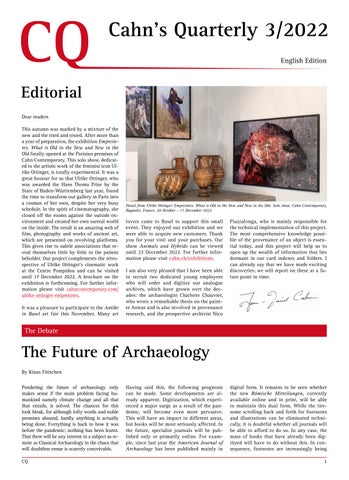
Editorial Dear readers This autumn was marked by a mixture of the new and the tried and tested. After more than a year of preparation, the exhibition Empreintes. What is Old in the New and New in the Old finally opened at the Parisian premises of Cahn Contemporary. This solo show, dedicated to the artistic work of the feminist icon Ulrike Ottinger, is totally experimental. It was a great honour for us that Ulrike Ottinger, who was awarded the Hans Thoma Prize by the State of Baden-Württemberg last year, found the time to transform our gallery in Paris into a cosmos of her own, despite her very busy schedule. In the spirit of cinematography, she closed off the rooms against the outside environment and created her own surreal world on the inside. The result is an amazing web of film, photography and works of ancient art, which are presented on revolving platforms. This gives rise to subtle associations that reveal themselves little by little to the patient beholder. Our project complements the retrospective of Ulrike Ottinger's cinematic work at the Centre Pompidou and can be visited until 17 December 2022. A brochure on the exhibition is forthcoming. For further information please visit cahncontemporary.com/ ulrike-ottinger-empreintes. It was a pleasure to participate in the Antike in Basel art fair this November. Many art
Detail from Ulrike Ottinger: Empreintes. What is Old in the New and New in the Old. Solo show, Cahn Contemporary, Bagnolet, France, 20 October – 17 December 2022
lovers came to Basel to support this small event. They enjoyed our exhibition and we were able to acquire new customers. Thank you for your visit and your purchases. Our show Animals and Hybrids can be viewed until 22 December 2022. For further information please visit cahn.ch/exhibitions. I am also very pleased that I have been able to recruit two dedicated young employees who will order and digitize our analogue archives, which have grown over the decades: the archaeologist Charlotte Chauvier, who wrote a remarkable thesis on the painter Asteas and is also involved in provenance research, and the prospective archivist Nico
Piazzalonga, who is mainly responsible for the technical implementation of this project. The most comprehensive knowledge possible of the provenance of an object is essential today, and this project will help us to open up the wealth of information that lies dormant in our card indexes and folders. I can already say that we have made exciting discoveries; we will report on these at a future point in time.
The Debate
The Future of Archaeology By Klaus Fittschen Pondering the future of archaeology only makes sense if the main problem facing humankind namely climate change and all that that entails, is solved. The chances for this look bleak, for although lofty words and noble promises abound, hardly anything is actually being done. Everything is back to how it was before the pandemic; nothing has been learnt. That there will be any interest in a subject as remote as Classical Archaeology in the chaos that will doubtless ensue is scarcely conceivable. CQ
Having said this, the following prognosis can be made. Some developments are already apparent. Digitization, which experienced a major surge as a result of the pandemic, will become even more pervasive. This will have an impact in different areas, but books will be most seriously affected. In the future, specialist journals will be published only or primarily online. For example, since last year the American Journal of Archaeology has been published mainly in
digital form. It remains to be seen whether the new Römische Mitteilungen, currently available online and in print, will be able to maintain this dual form. While the tiresome scrolling back and forth for footnotes and illustrations can be eliminated technically, it is doubtful whether all journals will be able to afford to do so. In any case, the mass of books that have already been digitized will have to do without this. In consequence, footnotes are increasingly being 1
Cahn’s Quarterly 3/2022
marginalized, a tendency that can already be seen in the numerous publications that mention only the author and year of publication, but no page numbers. This citation method, which is outrageous to many readers, can even be found in publications of the Deutsches Archäologisches Institut. In the future, we will be able to dispense with such notes entirely. Furthermore, the number of illustrations in scientific publications will continue to decrease. On the one hand, photographs taken by museums are too expensive, and on the other hand, copyright issues are becoming more and more of a problem. To be sure, richly illustrated coffee table books will continue to be printed because many people, especially amateurs, do not want to miss the pleasure of leafing through real books. However, this does not necessarily apply to scholarly books. They, too, will increasingly be published online (there will be a growing number of “free access” publications). A digitized book needs no shelf space and the day when whole libraries are turned into closed storerooms is undoubtedly fast approaching. Since the younger generation, as experience has shown, takes note only of what is published on the internet, many books could in fact be moved there right now. The reading rooms of libraries are often empty (because the students are using their laptops). The finance ministers have good reason to rejoice, as this will lead to smaller rooms and thus to lower heating and cleaning costs. In the future, every ambitious archaeologist will probably have his or her own excavation. Sufficient money and excavation sites are available, after all, and the copyright problem will be eliminated as everyone will only publish their own finds. Wherever possible, images will be replaced by digital reconstructions, which have the additional advantage of lulling the reader into a pretense of exact knowledge. There is already plenty of material that illustrates this: for instance, the Forum Romanum, which developed gradually over many centuries and whose earlier phases are not sufficiently known. Digitization will also have an impact on research methods. An increasing number of studies will focus on quantitative research, which will most directly benefit excavation finds. It is well known that many of our research objects were excavated in pre-scientific times, and it was these objects that scholars of the past focused on. These objects, however, are gradually being ousted from this privileged position in favour of 2
finds from observed excavations, not least because, more and more often there are doubts about their authenticity. This too will have significant consequences. Studies on stylistic phenomena, which used to be a dominant concern of archaeology, will become even rarer and the attention paid to specific archaeological artefacts will further decrease. It will be interesting to see how digitital facial recognition will cope with the problems posed by copies after Greek sculptures or Roman imperial portraits (that is, whether the corpus of portraits of Augustus, say, will morph into individual creations. I touched on this topic in CQ 1/2021, pp. 4-5)). The use of English, or rather of American English, will become ever more widespread. Colloquia in Germany are now already held almost exclusively in English. It is only a matter of time before lectures in archaeology may (and later must) be held in English. The next generation of archaeologists will therefore no longer learn the language that was specially developed for scholarship focussing on the object itself. Apart from the language, not much will change in academic teaching. The adjustments made to the curricula in the course of the Bologna Process, and the tendency towards a “regimented”, more school-like form of teaching will remain. However, the current number of teaching staff, which is fairly high, will certainly not be sustainable in the long term. Even now, it is evident that the humanities are being downgraded on the scale of importance in favour of the so-called exact sciences. Only a privileged few will secure a job with tenure. The bulk of the work will be done – as is already the case – by dependent employees on short-term contracts, at least as long as this caste does not rebel against its exploitation. However, it is hardly to be expected that the impetus to change this untenable situation will come from a subject such as archaeology. Although a doctorate is still the entry requirement for teaching staff in many subjects, dissertations are already becoming rarer. The standard degree will continue to be the Master's, although it will remain difficult to find employment at a university whilst studying for a Master's or even after graduation. The reason for this is that students with a Master's or higher degree are considered overqualified. Indeed, that was probably the real intention of these reforms. Only the art trade will continue to focus on the individual object, and the art trade will continue to exist. Reputable art dealers will replenish their stock from old collections, of which there are enough for the time being. Sadly, they will struggle to find well-trained
specialists amongst the archaeologists with whom to discuss their findings. The tendency to ostracize the art trade as a whole is obvious. The Deutsches Archäologisches Institut endorsed the UNESCO 1970 Convention on Cultural Property in 2007, and more recently the Deutscher Archäologen Verband followed suit, albeit in a slightly more moderate form. Some people believe (or hope) that many of the above-mentioned developments are part of a fashion trend and will be followed by better times. I do not think so, for many of the changes that have already taken place or are to be expected will not be reversible. Researchers who were part of the old university and helped shape it will die out, and soon there will be no one left who still knows what it was like. I, for one, would not – under today's conditions – study Classical Archaeology again.
Klaus Fittschen, born 1936; studied in Tübingen, Rome and Athens (1956– 1964), Associate Professor of Classical Archaeology at the Ruhr University of Bochum (1971–1976), Professor of Classical Archaeology at the Georg August University of Göttingen (1976–1989), first Director of the German Archaeological Institute Athens (1989–2001), since his retirement (2001) resident in Wolfenbüttel. Main fields of research: Roman portraiture and sarcophagi, the reception of ancient art in the Modern Era.
Imprint Publisher Jean-David Cahn Malzgasse 23 CH-4052 Basel www.cahn.ch ISSN 2624-6368 Editors Jean-David Cahn Yvonne Yiu Authors Manon Burg Jean-David Cahn Klaus Fittschen Ulrike Haase
Gerburg Ludwig Léopoldine Turbat Photos Martin Argyroglo Niklaus Bürgin Ulrike Haase Design and Layout Michael Joos Yvonne Yiu
CQ
Cahn’s Quarterly 3/2022
Cahn Contemporary
Ulrike Ottinger: Empreintes. What is Old in the New and New in the Old. Solo show, Cahn Contemporary, Bagnolet, France, 20 October - 17 December 2022 Text by Léopoldine Turbat and Manon Burg Photos by Martin Argyroglo The exhibition Empreintes by the artist Ulrike Ottinger is an imagined encounter between her work and archaeological objects from the Cahn Gallery. Throughout her work, Ulrike Ottinger unearths and revisits millennia-old myths, narratives from nonWestern cultures and popular culture, and breaks with a history of stereotyped and dominant representations. In this context, photographs and excerpts from her films – both documentaries and features from the 1970s to the 2000s – enter into dialogue with prehistoric and ancient artefacts: vases,
CQ
flints, sculptures, statuettes and tableware. A new film composed of excerpts from previous films forms part of the exhibition. Artist, photographer and film-maker, Ulrike Ottinger was born in 1942 in Constance. She lives and works in Berlin. Having been a creator of Pop Art in 1960s Paris, she went on to direct some twenty films while continuing to work as a photographer and set designer. She is considered a leading artistic figure of the German avant-garde and was awarded the Berlinale Camera for
her filmography in 2020. Since the 1970s, Ulrike Ottinger has developed a signature style in which the themes of travel, ritual and exclusion are pivotal. Often referred to as the “Queen of Berlin's underground", she produces films that support the process of empowerment for gender minorities. She has worked with Delphine Seyrig, Tabea Blumenschein, Magdalena Montezuma, Veruschka von Lehndorff, Eddie Constantine and Kurt Raab, among others.
3
Cahn’s Quarterly 3/2022
4
CQ
Cahn’s Quarterly 3/2022
CQ
5
Cahn’s Quarterly 3/2022
Discovered for You
The Ancient World in Crisis The End of the Late Bronze Age in the Eastern Mediterranean By Gerburg Ludwig The filling hole at the back of the head and the muzzle that serves as spout are pointers to the vessel’s function in the cult of the dead, where it was used for anointing or libations. Such vessels are typically found in Cypriot graves. The bull askos, whose iconography and function reveal a Minoan or Mycenaean influence, symbolizes strength, power and fertility.
Fig. 1: The fleet of Ramses III repels an attack by the “Sea Peoples”. Drawn from a relief of Ramses III, Medinet Habu, Egypt. © Source: D. Gray in: Archaeologia Homerica I (Göttingen 1974) 166-167.
Fig. 2: A BULL ASKOS. L. 12.4 cm. Clay. Cyprus, Late Bronze Age, ca. 1450-1200 B.C. CHF 2,600
“My Father, the enemy ships have arrived. They are burning down my cities and devastating the land,” Ugarit’s king Ammurapi wrote in about 1200 B.C. to the king of Alashiya/Cyprus (Ugaritica 5.24=RS 20.238, 12ff, trans. after E.H. Cline/G. Beckman). These lines dramatically highlight the far-reaching, disruptive events that shook many places in the eastern Mediterranean, the ancient Near East and Egypt at the end of the Late Bronze Age. In the last issue of Cahn’s Quarterly, we examined the flowering of the great empires and city states that was characterised by extensive cultural and economic exchange (CQ 2/2022, pp. 1-3). Here, we will take a closer look at the alarming signs of a great crisis.
Who were the assailants and where did they come from? Egyptian written sources from the reigns of Merneptah (1213–1204 B.C.) and Ramses III (1187–1156 B.C.) record attacks on Egypt and other states by foreign peoples coming from the “islands". For more than a hundred years, historians and archaeologists believed the wave of destruction to have been caused solely by the incursions of the “Sea Peoples". The term “peuples de la mer" was coined by the French Egyptologist Emmanuel de Rougé in his description of the reliefs in the mortuary temple of Ramses III in Medinet Habu, which include a representation of the Pharaoh’s victory over the “Sea Peoples” (1177 B.C., fig. 1). Outlandish warriors girt in short loincloths and wearing either a brush-shaped feather headdress, a cap or a horned helmet pitch themselves against Ramses' troops, are slain, thrown overboard or taken prisoner. Others are trampled down by the Pharaoh. The Egyptians, who had managed to repel the first onslaught of the “Sea Peoples" in around 1207 B.C., once again emerged victorious.
By instrumentalising cross-regional trade for their own interests, various centres of power disrupted established trade chains and weakened the palace economies that were dependent on imports and exports. Mycenae's Linear B tablets record a shortage of metals, which is corroborated by the smaller number of bronze finds dating from that time. Already in the 13th century B.C., the fortifications of Mycenaean palaces were strengthened with cyclopean or polygonal masonry, which still impresses the beholder even today. Important workshops, such as weapon forges, were located within the walls. Significant increases in population density overwhelmed palace-regulated agricultural production, whilst 6
climate change had a detrimental effect on harvests. Texts from Ugarit's archives reveal that the city continued to function as a centre of trade until shortly before its sudden annihilation. Excavators documented a destruction horizon that was up to two meters high and consisted of ashes, building rubble and burnt clay. In many places the debris was mixed with arrowheads and in a few locations hoards of gold and bronze objects were found (1190–1185 B.C.): The city had been attacked, destroyed and burnt down. Similar destruction layers found in Mycenae, Cyprus, Anatolia and in the Levant include evidence of widespread fire (1190/80 B.C.-1130 B.C.); on occasion arrowheads or sling leads document military conflicts. Human skeletons were found in Troy's layer VIIA. The origin of the attackers remains a mystery. Could it be that this layer was Homer's Troy? Elsewhere no weapons are documented, or only public buildings and the city walls were destroyed. In Pylos, Mycenae and Tiryns, tremendous damage to the masonry, buckled, warped walls and skeletal finds beneath the rubble are suggestive of an earthquake. A bull askos currently with the Cahn Gallery (fig. 2) dates from these troubled times. It is decorated with a dark brown coating and white stripes, and belonged to the collection of the art dealer Eugene V. Thaw (1927-2018).
New findings and scientific analyses, however, have led to a consensus that we are dealing with a series of multi-causal, longer-term events that occurred at different times within a period of at least 50 years. The “Sea Peoples" may have formed part of a larger migratory movement from the north to the eastern Mediterranean. The Italic regions, the Balkans, the CQ
Cahn’s Quarterly 3/2022
Black Sea region and Anatolia have all been suggested as possible starting points.
My Choice
Climate change and geological upheavals also occurred, and these have since been thoroughly analysed using scientific methods. As of the mid-13th century B.C. a significant change in the climate was caused in part by the third eruption of the volcano Hekla in Iceland, leading to a drop in the surface temperature of the Mediterranean Sea. Precipitation decreased and groundwater levels sank. Written sources speak of droughts and famines, which in turn would have triggered conflict, insurrection and migration. The situation was further aggravated by an earthquake storm – a series of earthquakes that occurred between 1225– 1175 B.C. A striking number of sites are located above the subduction zone, where the African Plate slides beneath the Eurasian Plate, a zone that is also influenced by movements of smaller plates such as the Aegean Plate and the Anatolian Plate.
Horse and Rider
One or more of these factors, together with the disruption of trade, destabilised the previously flourishing individual states and the multilateral system linking them. In a kind of domino effect, these dysfunctions caused the entire system to break down, a phenomenon that is termed the Late Bronze Age Collapse. The stirrup jug offered for sale here (fig. 3) dates from the final phase of Mycenaean pottery. Such jugs were made in of varying sizes; larger ones were used to transport and store olive oil, whilst smaller ones served as grave goods. In the course of time these jugs became increasingly bulbous and also conspicuously squat. The stripes and the motifs on the shoulder, which are painted in a seemingly nonchalant manner, foreshadow the restrained decoration of Protogeometric vases. Our jug bears witness to the time immediately after the radical decline described above, whose reverberations were felt well beyond the turn of the millennium: The Dark Ages had dawned.In the light of new findings, the duration of this period has been steadily shortened and is currently fixed at around 1050-800 B.C. We will take a closer look at this very different time in the next issue.
Fig. 3: A BICONICAL STIRRUP JUG. H. 17 cm. Clay. Greek, sub-Mycenaean, ca. 11th cent. B.C. CHF 2,600
CQ
By Ulrike Haase The horse is captured in mid-gallop just as it prepares to leap with its forelegs vigorously lunging forwards. The plastically modelled body testifies to the artist’s desire to create a highly naturalistic representation. The anatomical details are carefully rendered, as are the muscle movements, thus vividly highlighting the animal’s exertion. The proudly reared head and outstretched legs underscore the impression of dynamism that is also conveyed by the rider’s posture. He is depicted in a moment of great tension with his legs sharply angled and his right arm raised energetically. Thus, horse and rider form a thematic entity. The striking helmet with cow horns unmistakably identifies the rider as a warrior who is charging forwards ready to attack his adversary. His A HORSE AND RIDER. H. 32.2 cm. Clay, polychromy. Western Greek, probfluttering cloak, which is ably Canosa, ca. 300 B.C. From the estate of Prof. Frank Vischer (19232015), Professor of Law and Rector of Basel University; acquired from Herbert partially preserved, further A. Cahn, Basel, in 1996. CHF 32,000 heightens the impression of great speed. His clenched right hand indi- horse's bridle and reins are red, the decorative discs are painted blue. An ochre tone has cates that he once held a lance or spear. been preserved on the horse's forelegs. The The terracotta group presented here belongs colour spectrum used is characteristic of the to the repertoire of types popular with Ca- Canosan workshops. With its polychromy, nosan workshops. In the 4th and 3rd cen- our terracotta group recalls an aspect that is turies B.C., these workshops were important usually lost to the modern viewer when lookWestern Greek production centres of figural ing at marble sculptures or architectural decterracottas and, in particular, of vases with oration, namely that the ancient world was plastic figural decoration. The horse-and- full of colour. The polychromy of an object rider motif was obviously much beloved or building enhanced its aesthetic effect and and can be found as applied decoration on contributed significantly to its lifelike apcontemporary figural vases from Canosa/ pearance. Often, it also provided important Canusium. Furthermore, protomes in the information, for instance when the skin was shape of galloping horses adorn the ends of gilded or ornaments on clothing were indired-figure rhyta. The moulds used to shape cated. horse and rider were employed across genre The fact that brightly painted terracottas of boundaries. a specific type or theme were used without Traces of polychromy on a white ground distinction in residential, cult and funerary are found throughout the group. The col- contexts reveals how closely connected this ours were applied in an additional step af- world and the afterlife were. Thus, at least in ter the firing process. Pink was chosen for the imagination of the bereaved, a dead perthe rider's skin and blue for his helmet. The son never really lost touch with earthly life. 7
Cahn’s Quarterly 3/2022
New Artworks Monthly on www.cahn.ch
Jewellery of Antiquity
A GOLD DIADEM AND SIXTEEN GOLD APPLIQUES. L. 39.1 cm. Appliques: ca. 1 cm x 1 cm. Gold. Formerly Coll. Louis de Clercq (1836-1901), Paris. Thereafter priv. coll. Dr. Krüger, Hannover, acquired 1969 from A. Neuhaus, Würzburg. Greek, 4th-2nd cent. B.C. CHF 12,000
A NECKLACE WITH AGATES AND GOLD PENDANTS. L. 43.8 cm. Banded agate, gold. Magnificent necklace composed of elongated, polished agate beads of varying shapes and sizes. Formerly priv. coll. F. Artuner, USA, 1990. Hellenistic, 3rd-2nd cent. B.C. CHF 12,000
A GOLD LUNULA PENDANT. W. 5.9 cm. Gold, enamel. Crescent-shaped, sheet gold pendant with filigree, floral decoration consisting of leaves, curled tendrils and flowers. Formerly priv. coll. Frances Artuner, Belgium, 1960s. Greek, 4th-2nd cent. B.C. CHF 6,800
LUNATE EARRING. D. 1.4 cm. Gold. Formerly priv. coll. S. A., London, formed before 1980. Near Eastern, ca. 2370-2200 B.C. CHF 1,300
LION'S HEAD EARRINGS. H. 1.6 cm. Gold. Formerly priv. coll. Basel 1990s. Greek or Western Greek, 4th-3rd cent. B.C. CHF 800
A PAIR OF GOLD EARRINGS WITH GOAT'S HEADS. L. (with hooks) 3.9 cm and 4.0 cm. Gold, chalcedony. Formerly priv. coll. Frances Artuner, Belgium, 1960s. Greek, late 4th-2nd cent. B.C. CHF 13,500
A PAIR OF GOLD EARRINGS. L. max. 5 cm. Gold. Formerly priv. coll. Southern France. Eastern Greek, 3rd-1st cent. B.C. CHF 12,400
EARRINGS WITH ANTELOPE HEADS. Dm. 2.5 cm. Gold. Formerly M.C. and R. C.-B., Basel. Greek, 4th-2nd cent. B.C. CHF 2,000
A RING WITH PORTRAIT. H. 2.1 cm. Silver, partially gilded. Formerly S. Y., London. Roman, late 1st-early 2nd cent. A.D. CHF 4,800
A RING WITH CABOCHON. Dm. max. 1.3 cm. Gold, garnet. Formerly Saeed Motamed. Roman, 1st-3rd cent. A.D. CHF 800
A PAIR OF GOLD EARRINGS. H. 2.4 cm and 2.5 cm. Gold. Formerly Dr. Rudi Neumeister. Roman, 1st-2nd cent. A.D. CHF 1,800
8
A RING WITH INTAGLIO. Dm. 1.3 cm. Gold, carnelian. Formerly Rhineland, Germany. Roman, 1st-3rd cent. A.D. CHF 3,200
CQ
Cahn’s Quarterly 3/2022
A PAIR OF GOLD EARRINGS. H. 4.3 cm. Gold. Formerly priv. coll. Frances Artuner, Belgium, 1960s. Roman, 1st-2nd cent. A.D. CHF 4,800
ROMAN PERIOD GOLD AND GLASS BRACELET. Dm. 7.3 cm. Glass, gold. Formerly coll. Petra Schamelmann, Breitenbach, Germany, acquired from the collection of Fernand Adda, formed in the 1920s. Thereafter priv. coll. London. Roman, 3rd-5th cent. A.D. CHF 3,800
AN ORNATE GOLD BRACELET. Dm. (max.) 7.9 cm. Gold. Composed of a hammered gold sheet tube, with intricate details giving the effect of faceting and granulation. Formerly M. C. (b. 1933) and R. C.-B. (b. 1929), Basel. Thereafter by descent in the family. Late Roman, 3rd-4th cent. A.D. CHF 2,800
AN INTAGLIO WITH A WOMAN'S BUST. H. 1.3 cm. Carnelian. Formerly priv. coll. Koppenwallner, since the 1970s, Cologne, Germany; thereafter by descent in the family. Roman, 2nd cent. A.D. CHF 3,800
CQ
A PAIR OF EMERALD EARRINGS. H. 2.3 cm and H. 2.1 cm (incl. hangers). L. of emeralds 1.1 cm and 0.5 cm. Gold and Emerald. Formerly priv. coll. Vienna, formed since 1970. Roman, 1st cent. A.D. CHF 2,200
A GOLD CROSS PENDANT WITH INLAYS. H. 5.2 cm (incl. hook). Gold, green agate, glass, garnet. Formerly priv. coll. Germany. Byzantine, 6th-9th cent. A.D. CHF 9,800
AN INTAGLIO WITH THE BUST OF DIONYSOS. H. 1.6 cm. Chalcedony. Formerly priv. coll. Geneva, Switzerland, acquired 1962; thence by descent in the family. Roman, 1st cent. B.C.-1st cent. A.D. CHF 1,800
AN INTAGLIO WITH A WOMAN'S BUST. H. 1.3 cm. Red jasper. Formerly priv. coll. K., Switzerland, built up since the 1960s. Thence by descent. Greek, Hellenistic, 3rd-2nd cent. B.C. CHF 4,600
A VIKING AGE BAR-SHAPED PENDANT. L. 4 cm. Gold. Hammered gold, with hoop. Formerly priv. coll. Europe, formed between 1979-1989. Thereafter priv. coll. London. Viking, 9th-11th cent. A.D. CHF 1,200
9