Cahn’s Quarterly 2/2024 English Edition
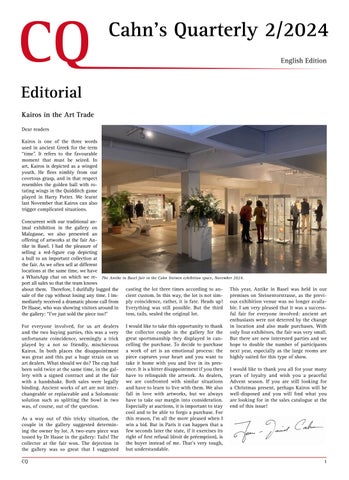
Editorial Kairos in the Art Trade Dear readers Kairos is one of the three words used in ancient Greek for the term “time”. It refers to the favourable moment that must be seized. In art, Kairos is depicted as a winged youth. He flees nimbly from our covetous grasp, and in that respect resembles the golden ball with rotating wings in the Quidditch game played in Harry Potter. We learnt last November that Kairos can also trigger complicated situations. Concurrent with our traditional animal exhibition in the gallery on Malzgasse, we also presented an offering of artworks at the fair Antike in Basel. I had the pleasure of selling a red-figure cup depicting a bull to an important collection at the fair. As we often sell at different locations at the same time, we have a WhatsApp chat on which we re- The Antike in Basel fair in the Cahn Steinen exhibition space, November 2024. port all sales so that the team knows about them. Therefore, I dutifully logged the casting the lot three times according to an- This year, Antike in Basel was held in our sale of the cup without losing any time. I im- cient custom. In this way, the lot is not sim- premises on Steinentorstrasse, as the previmediately received a dramatic phone call from ply coincidence, rather, it is fate. Heads up! ous exhibition venue was no longer availaDr Haase, who was showing visitors around in Everything was still possible. But the third ble. I am very pleased that it was a successtoss, tails, sealed the original lot. ful fair for everyone involved: ancient art the gallery: “I've just sold the piece too!” enthusiasts were not deterred by the change For everyone involved, for us art dealers I would like to take this opportunity to thank in location and also made purchases. With and the two buying parties, this was a very the collector couple in the gallery for the only four exhibitors, the fair was very small. unfortunate coincidence, seemingly a trick great sportsmanship they displayed in can- But there are new interested parties and we played by a not so friendly, mischievous celling the purchase. To decide to purchase hope to double the number of participants Kairos. In both places the disappointment a work of art is an emotional process: the next year, especially as the large rooms are was great and this put a huge strain on us piece captures your heart and you want to highly suited for this type of show. art dealers. What should we do? The cup had take it home with you and live in its presbeen sold twice at the same time, in the gal- ence. It is a bitter disappointment if you then I would like to thank you all for your many lery with a signed contract and at the fair have to relinquish the artwork. As dealers, years of loyalty and wish you a peaceful with a handshake. Both sales were legally we are confronted with similar situations Advent season. If you are still looking for binding. Ancient works of art are not inter- and have to learn to live with them. We also a Christmas present, perhaps Kairos will be changeable or replaceable and a Solomonic fall in love with artworks, but we always well-disposed and you will find what you solution such as splitting the bowl in two have to take our margin into consideration. are looking for in the sales catalogue at the Especially at auctions, it is important to stay end of this issue! was, of course, out of the question. cool and to be able to forgo a purchase. For As a way out of this tricky situation, the this reason, I'm all the more pleased when I couple in the gallery suggested determin- win a bid. But in Paris it can happen that a ing the owner by lot. A two-euro piece was few seconds later the state, if it exercises its tossed by Dr Haase in the gallery: Tails! The right of first refusal (droit de préemption), is collector at the fair won. The dejection in the buyer instead of me. That's very tough, the gallery was so great that I suggested but understandable. CQ
1
Cahn’s Quarterly 2/2024
Discovered for you
Ambivalent Neighbours Carthaginians and Greeks in Sicily from the Archaic Period to the Early Classical Period By Gerburg Ludwig
Fig. 1: Cultures in Sicily ca. 431 B.C. © Abu America Wikimedia Commons
The founding of Carthage (Phoenician: Qart Hadasht, New City), ca. 814/13 B.C., gave fresh impetus to the Phoenician expansion in the West which was discussed in the preceding issue (CQ 1/2024, pp. 6-7). Situated on a headland on the Gulf of Tunis, the region was a hub in the western Mediterranean, linking coastal trade routes with those leading from the desert to the sea. Highly sought-after goods were exchanged with neighbouring peoples and were also shipped across the Mediterranean. This is also how the Roman historiographer Justin describes it in the well-known founding myth of Elissa/Dido (XVIII 5.8-14). Many citizens from Tyre were involved in the founding of the city. Carthage developed remarkably quickly in response to the economic decline of the mother country that was occupied by enemy forces. Already in the 8th century B.C., Carthage was a large city covering an area of roughly 25 hectares. It had both a commercial and a military harbour and was protected by several defence rings on the isthmus as well as by coastal forts on the seaward side. Carthage confidently continued its expansion, exerting its influence on existing Phoenician settlements whose agricultural activities in the hinterland in part served to ensure Carthage's food supply. Carthage also scouted out western Sicily, the part of the island closest to the North African coast. However, Greek settlers were also interested in Sicily and founded numerous colonies between the mid-8th and mid-6th century B.C., a phenomenon termed the Great Colonisation. The most important 2
Phoenician settlements were established in the late 8th or 7th century B.C. and include Panormos/Palermo, Solunt and Motya/Mozia on the Isola di San Pantaleo which is located in a lagoon off the west coast of Sicily. The remains of the Phoenician town on the 45-hectare island were hardly built over and are clearly visible in satellite images, thus providing optimal conditions for its reconstruction. A necropolis dating from the late 8th century B.C. close to the beach in the north forms the oldest part of the settlement. The Youth of Mozia, a famous marble statue from the Classical Period, was found in the workshops located next to the necropolis, although it was probably originally erected in the sanctuary of Cappidazzu to the south. On the north-west beach there is a tophet (late 8th century B.C.), one of those typical Phoenician sanctuaries with
finds of children's and/or animal bones, some in urns, as well as stelae with religious symbols and dedicatory inscriptions to the gods Baal Hammon and Tanit. Ancient historiographers negatively associated the site with alleged child sacrifices and our knowledge of the cult remains incomplete to this day. A paved road which is still visible at the bottom of the lagoon led from the north to the necropolis on the main island and is indicative of the close connection between the settlements on Motya and Sicily proper. A rectangular basin with access to the lagoon in the south is interpreted as a harbour or sacred basin for a nearby temple. In the centre of the island there are the remains of residential buildings and traces of a grid of roads. The town was surrounded by a wall with gates and watchtowers. Up to the 6th century B.C., relations with the Greeks centered mainly around trade and diplomacy. In the Greek poleis, powerful autocratic rulers who were called tyrants emerged from the oligarchic upper class. Two dynasties set the tone: the Deinomenids in Gela and Syracuse with Gelon and later Hieron I (491-478 B.C.; 485-466/67 B.C.) and the Emmenids with Theron (489-472 B.C.) in Akragas. In 485 B.C., Gelon of Gela used the political unrest in Syracuse to bring the city under his control. Over time, Syracuse assumed a position of supremacy among the Greek poleis. The aggressive expansionist policy of the tyrants and their constantly changing alliances amongst each other as well as with other poleis led to conflicts that affected not only the Greek settlers but also the ancient peoples of Sicily – the Sicels, the Sicani and the Elymians – some of whom were allied with the Phoenicians.
Fig. 2: A DIDRACHM, AKRAGAS. 8.58 g. Dm. 2 cm. Silver. Sicily, Akragas (Agrigento), ca. 480/478-ca. 470 B.C. CHF 3,800
CQ
Cahn’s Quarterly 2/2024
The didrachm from Akragas offered here by the Cahn Gallery dates from this unsettled period (fig. 2). From 500 B.C. onwards, the Sicilian poleis minted coins whose motifs and quality very soon reached the highest standards of the art. The eagle standing to left on the obverse of the didrachm underlines the special relationship between the polis and Zeus. The inscription around the bird “AK – PA” is an abbreviation of the name of the polis. The extremely vivid and lifelike crab on the reverse refers to the river Akragas to the east of the city. The coin thus symbolises the self-concept and identity of the polis which was founded by Rhodian emigrants on the southern coast of Sicily in 580 B.C. Good trade contacts with the Phoenicians enabled Akragas to become particularly wealthy through the export of wine and oil to North Africa. However, Akragas' tyrant Theron strove to expand to the north coast and expelled Terillos, tyrant of Himera, who called on Carthage for protection. The Punic general Hamilkar sailed to Sicily in 480 B.C. with a considerable fleet. A coalition formed between the Carthaginians, the Phoenicians living in Sicily and the poleis of Rhegion, Messene, Himera and Selinunte fought the Battle of Himera against the powerful south-east Sicilian allies Theron and Gelon I of Syracuse. The coalition was defeated, Hamilkar fell, and the Carthaginian fleet was destroyed. For propaganda purposes, Greek historiographers asserted that the tyrants won this victory on the very day of the naval battle at Salamis (480 B.C.). The construction of some of the archaic temples in Sicily that are still famous today was made possible by Carthaginian war reparations and the manpower of prisoners of war. The tetradrachm from Syracuse offered here (fig. 3) belongs to this war period. The quadriga on the obverse refers to the founding of the polis by Corinthian settlers in the presence of a priest of Zeus from Olympia (733 B.C.), and to the victorious participation of Gelon and Hieron I in the chariot races held during the Olympic Games of 488/87 B.C. and 476 B.C. On the reverse, the spring nymph Are-
thusa, surrounded by four dolphins, points to the eponymous spring on the peninsula of Ortygia located just off the coast of Sicily. Here too, the motifs and the city’s name “ΣYPAKOΣIO-N” symbolise the identity of the polis. After a period of peace and the introduction of democracy following the overthrow of the tyranny (470/66 B.C.), territorial conflicts in Sicily broke out again towards the end of the 5th century B.C. They were fueled from the outside
was used for trade with its neighbours and to pay the mercenaries who were deployed on the island and came from all corners of the world. The hexas offered by the Cahn Gallery was used as everyday money, like all bronze coins (fig. 4). It was worth one-sixth of a Sicilian litra. The obverse shows the head of a young man to right with wide-open eyes and curls that form small bumps. He cannot be identified more precisely. On the reverse we see
Fig. 4: HEXAS, MOTYA. W. 2.48 g. Dm. 1.3 cm. Bronze. Punic, Sicily, island of San Pantaleo, Motya (Mozzia), ca. 400-397 B.C. CHF 1,800
by Athens' increased interest in the island that led to the Sicilian Expedition and the Siege of Syracuse, both of which ended in failure (415-413 B.C.). The fiercest rivals were Syracuse, which strove to augment its power and influence, and the Carthaginians who sought to expand along the southern coast. Victory alternated with defeat and peace treaties were made only to be broken again. Historians refer to the expansion of the Punic sphere of influence on Sicily as the Carthaginian Eparchy (Province from 406/05 B.C. onwards). It was not until the peace treaty at the end of the First Punic War against the Romans (241 B.C.) that Carthage withdrew from the island. But back to Motya, where the first Punic mint in Sicily was established before 480 B.C. Possibly with the aid of Greek specialists, it minted coins with Greek as well as own motifs in accordance with the Attic coin standard. Some coins have Phoenician inscriptions. The money
the crab again, somewhat more schematically than on the didrachm from Akragas. The Punic inscription is an abbreviation of the city’s name: from right to left “MTW” for Motya. Long after 480 B.C., Motya's coins reflect the Akragantine pictorial programme, also in combination with the eagle or even with a crab on both the obverse and reverse. For a protracted period after its decline (472/70 B.C.), the Emmenid tyranny continued to influence the coinage of western Sicily, not only in Motya but in other locations as well. Scholars today are of divided opinion. Perhaps the motifs initially reflected continuing control over the area by the tyrant Theron? Were they signs of a political-economic alliance or were the motifs imitated for other reasons such as the proximity to the sea? The latter can also be assumed for our hexas that dates from the beginning of the 4th century B.C. The issue of this coin type ended with the destruction of Motya by Dionysius I of Syracuse in 397 B.C. In the 4th to 3rd centuries B.C., coins spread throughout the Carthaginian sphere of influence. In Carthage itself, bronze coins minted both in Sicily and in Carthage were used initially. In the early 3rd century B.C., the city minted its first silver coin: the shekel with its multiples and fractions. The coinage varied over time, depending on the ups and downs during the Punic Wars.
Fig. 3: A TETRADRACHM, SYRACUSE. 17.33 g. Dm. 2.3 cm. Silver. Sicily, Syracuse, ca. 480-475 B.C. (Gelon I and Hieron I). CHF 7,000
CQ
For us today, the study of the West Sicilian and Punic coins offers a valuable addition to the texts of the Greek historiographers, which are biased to a certain extent and focus mainly on the Greek side of the story. 3
Cahn’s Quarterly 2/2024
The Debate
The Acquistion of Ownership in Good Faith of Ancient Art By Horst Hammen, translated by Yvonne Yiu When a private collector purchases a modern or ancient work of art, he undoubtedly wishes to be sure that he will not have to give it back. As a rule, he should be certain that he will acquire ownership of the object if it is offered to him by a reputable dealer who can demonstrate that no circumstances are known that would give rise to reservations regarding its acquisition. The dealer will often be able to do this easily, for example if the provenance of an item, for example the Neoattic marble amphora with relief decoration (fig. 1), is documented to the beginning of the 18th century. The same holds true for artefacts found in England that were released and returned to the finder or to the owner of the property on which it was found in accordance with the Portable Antiquities Scheme of 1997.1 But things are not always that simple. It is not uncommon for the former owner of an artwork or his descendants to dispute the ownership of the current possessor. In such a situation, the legal institution of acquisition in good faith can sometimes help. For example, if the former owner loans the artwork to an exhibitor and the latter then sells this piece within the scope of German law as if it belonged to him, the buyer becomes the owner if he acted in good faith at the time of acquisition. He only lacks this good faith if he was aware that the artwork did not belong to the seller or if he remained unaware of this due to gross negligence. Of course, it is far more common for the owner of an (ancient) artwork to be confronted with the demand for restitution on the grounds that the object was stolen from the previous owner, for instance, the bull's head from the Eschmun Temple near Sidon, Lebanon (fig. 2),2 or that it was lost for other reasons such as, for example, confiscation contrary to due process of law by the Nazi state or the GDR criminal authorities.3 It can happen, although rarely, that a seller claims that the sale of an artwork was invalid because he or she did not have legal capacity due to a mental disorder (“Weltempfänger” by the artist Isa Genzken).4 If the property was acquired by the current owner or his legal predecessors more than 30 years ago, he need not fear civil claims for restitution under German law. Claims for res4
restitution. Of course, even if the owner can no longer demand the return of the artwork, it remains his property for the time being. However, any subsequent acquisition of the object, even if the owner can no longer take action against the buyer or a legal successor, is tainted. And it certainly is not a pleasant prospect to have to wait 30 years to be safe from an action for restitution.
Fig. 1: A MARBLE AMPHORA WITH RELIEF DECORATION. H. 50 cm. Marble. Roman, Late Republican, 1st cent. B.C. Provenance: Formerly priv. coll. Pierre Crozat (1661-1740), Paris, French financier and art collector; probably brought back from Italy ca. 17141715. Inherited by his nephew Louis-François Crozat (1691-1750), Paris, French general officer and Marquis du Châtel in Brittany. Thereafter, priv. coll. Comte de Caylus (1692-1765), Paris; probably acquired on 15.12.1750 from Louis-François Delatour auction, Paris, lot 37. Published: Comte de Caylus, Recueil d’Antiquités, 1752 (Vol. 1, p. 268, cat. no. IV, pl. XCVIII). Probably with Pierre-Jean Mariette (16941794), Paris. Published: F. Basan, Catalogue raisonné des différens objets de curiosités dans les sciences et arts, qui composaient le Cabinet de feu Mr. Mariette, 1775, p. 12, no. 63 (without illus.). Thereafter French private coll., from a château, since the 1920s. With Galerie Alain Chenel, Paris, prior to 2011. Thereafter priv. coll. David N. Silich (1944- 2018), Switzerland; acquired in 2013 from Jean-David Cahn AG, Basel. Price on request.
titution of property under civil law become time-barred after 30 years and are thus unenforceable in court. This even applies if the buyer knew at the time of his purchase that he could not become the owner, for example if he was aware of the fact that the item had been stolen. In this case, the lack of good faith on the part of the purchaser is not of relevance for the cancellation of the claim for
German law grants the purchaser of an artwork a somewhat more favourable position with the legal institution of acquisitive prescription, which is of considerable importance especially in connection with stolen or otherwise lost works of art. According to this institution, the buyer of such an object does not immediately acquire ownership of it upon purchase, but he does so if he has had it in his possession as his property for a period of 10 years, was in good faith when acquiring possession and did not later learn that he was not entitled to ownership. It is important to note that acquisitive prescription is also possible for stolen property.5 The legal institution of acquisitive prescription serves to ensure peace under law and protection of transactions because it enables ownership to be acquired after a longer period of possession. It has not yet been decided by the supreme court6 whether this also applies to national
Fig. 2: The bull’s head from the Eshmun Temple which was restituted to Lebanon in 2018. Photo: Rolf A. Stucky et al., Das Eschmun-Heiligtum von Sidon. Architektur und Inschriften. Antike Kunst, Beiheft 19, 2005, cat. C 17.
CQ
Cahn’s Quarterly 2/2024
ister checked all the objects to be exhibited at TEFAF New York in 2019, a stolen stele dedicated to the Hathor priest Pa-di-Sena was detected and returned to Egypt.14
Fig. 3: Under close scrutiny during vetting at TEFAF: A HEAD OF A SATYR. H. 27.5 cm. Marble (possibly Carrara). Late Hellenistic, 1st cent. B.C. Price on request. Photo: © TEFAF. Source: VETTING | A main pillar of Maastricht's success | TEFAF (site visited 16.9.2024).
cultural assets as defined by the German Cultural Property Protection Act.7 These include ancient works of art such as the Augustan gilded bronze horse's head from Waldgirmes and the Nebra sky disc. Depending on who the purchaser is, different requirements must be fulfilled in order to qualify for good faith. It is subject to debate as to whether it is sufficient that a professional art dealer who purchases an ancient artwork is obliged to gather provenance information by means of generally accessible databases or information services specifically employed by the art trade, or whether he should also be required to carry out detailed provenance research. However, amateurs in the field of art and the art trade are only under the duty to investigate if they acquire the item under unusual circumstances, for example if the price demanded is conspicuously low or if the sales situation deviates from normal practice.8 Incidentally, the professional ancient art trade has also set itself the task of exercising such caution. The Due Diligence Guidelines of the International Association of Dealers in Ancient Art (IADAA), to which over 30 renowned dealers from Europe and the USA belong, stipulate that a dealer should be particularly cautious when offered an object at a price that does not correspond to its market value9 – although, in contrast to ancient artefacts such as Roman oil lamps that are offered in large quantities, it is, of CQ
course, not always easy to define the market value of exceptional, unique pieces.10 Especial caution should be exercised when a little-known seller offers an object without provenance and without export documents that originates from a culture in whose geographical area of distribution looting may have occurred. This is why the IADAA's Due Diligence Guidelines urge members of the association to only purchase objects “from trouble spots” if they have a good provenance.11 Similarly, while Timeline Auctions generally only checks ancient artworks against the Art Loss Register if their value exceeds £1,000, it always carries out such a check on objects from the West Asian region, regardless of their value.12 On the other hand, the good faith of a private collector will hardly be called into question if he buys an ancient artwork from a dealer who, as a member of a reputable art dealers' association, has subjected himself by strict ethical standards. His good faith will be strengthened if he buys the piece at a prestigious art fair which, like TEFAF Maastricht, sets high standards for the objects exhibited in its Vetting Guidelines, which incidentally pertain not only to the provenance but also to the authenticity of the artworks (fig. 3).13 As a result, many a piece has found its way back to its rightful owner. For example, when, at the fair’s request, the Art Loss Reg-
Of course, even works exhibited at major art fairs may subsequently turn out to be of dubious ownership, without the fair or the dealer being to blame. One example is the painting “Vrouwenkop” by Cornelisz van Haarlem (1562-1638), which was exhibited unchallenged at TEFAF Maastricht in 1995, but was then reported to the Art Loss Register in October 2019 as a Nazi-confiscated cultural asset.15 The collector can therefore substantiate his good faith by asking the dealer for the most detailed provenance information possible within the limits set by data protection legislation,16 as well as certificates or confirmations from relevant private or public institutions (The Art Loss Register, The INTERPOL Database of Stolen Art, Italian Carabinieri), which show that the piece has not been reported as lost or stolen. In any case, the buyer should also ask for extracts from old auction or sales catalogues, invoices from previous purchases and state export licenses, if they are available. It should, however, be emphasised that export licenses only prove that the object was exported legally from the country in question, but do not in principle say anything about its ownership. The legal situation described above could soon change in Germany, namely during the current legislative period. The coalition agreement of the current federal government plans to restrict the use of time-barring with regard to claims for restitution (only) in the case of cultural assets seized in the context of Nazi persecution.17 On 17 April 2024, the Federal Ministry of Justice published a draft law according to which an owner of such an item of cultural property, which may also be an ancient object, should only be able to invoke the fact that the claim for restitution against him is time-barred if he acquired possession in good faith. However, as the regulations on the acquisition of ownership through acquisitive prescription are to remain unaffected by this,18 the planned amendment to the German statute of limitations law is unlikely to have much practical impact.19 If you wish to find out whether an object could be Nazi-looted property or whether it is cultural property that was relocated due to the war, you can also search the Lost Art Database of the German Lost Art Foundation. Here there are, amongst other things, entries pertaining to ancient vases that were lost or found, as well as an entry on a Celtic-Germanic gold coin (“Regenbogenschüsselchen”) that was acquired in 1922 from Adolph E. Cahn, Frankfurt, auction catalogue no. 49 (1922) no. 220, plate 8, and was reported as Nazi-looted cultural property (fig. 4).20 5
Cahn’s Quarterly 2/2024
My Choice
A Late Classical Lion’s Head By Jean-David Cahn
Fig. 4: A Celtic-Germanic gold coin. 1st cent. B.C. Cahn, Frankfurt, Auction Catalogue no. 49 (1922) no. 220, pl. 8. Source: Keltisch-germanische Münze | Lost Art-Datenbank (site visited 16.9.2024) 1. Cf. Michael Lewis, Preserving the Past: Recording Archaeological Finds Made by the Public, Cahn’s Quarterly 1/2018, p. 4. 2. Cf. Rolf A. Stucky/Jean-David Cahn, Cahn’s Quarterly 3/2019, p. 4 and Cahn’s Quarterly 4/2019, p. 7. 3. Cf. Staudinger/C. Heinze, Kommentar zum Bürgerlichen Gesetzbuch, Buch 3, Sachenrecht, revi-sed ed. 2020, § 935 Rn. 18. 4. Frankfurter Allgemeine Zeitung, 25.11.2023, p. 16. 5. OLG Nürnberg, court decision on 6.9.2017, Case 12 U 2086/15 Rn. 84. The prohibition on the marketing of lost cultural property in § 40 of the German Cultural Property Protection Act does not preclude acquisitive prescription (Rn. 148). 6. Bundesgerichtshof, court decision on 19.7.2019, Case V ZR 255/17 Rn. 36. 7. The provisions of the German Cultural Property Protection Act are not taken into account in this article. 8. Bundesgerichtshof, court decision on 19.7.2019, Case V ZR 255/17 Rn. 47. 9. https://iadaa.org/ueber-uns/?lang=de (site visited: 10.9.2024). 10.On this topic in general, cf. Heike Krischok, “Billig und gerecht”. Aktuelle Fragen der Bewertung archäologischer Funde, in: Recker, Udo/Davydov, Dimitrij (ed.), Archäologie und Recht II - Wohin mit dem Bodendenkmal, 2018, pp. 97, 100 f. 11.https://iadaa.org/ueber-uns/?lang=de (site visited: 10.9.2024). 12.https://timelineauctions.com/ (site visited: 10.9.2024). 13.https://www.tefaf.com/about/vetting (site visited: 10.9.2024). 14.https://www.artloss.com/looted-egyptian-stele-repatriated-following-alr-research/ (site visited: 10.9.2024). 15.https://www.lostart.de/de/verlust/objekt/vrouwenkop-frauen-kopf/584403?term=Vrouwenkop%20/%20Frauenkopf&filter%5Btype%5D%5B0%5D=Objektdaten&position=0 (site visited: 10.9.2024). 16.Cf. Jean-David Cahn, Editorial: Provenance Research and Data Protection, Cahn’s Quarterly 1/2024, p. 1. 17.Mehr Fortschritt wagen. Bündnis für die Freiheit, Gerechtigkeit und Nachhaltigkeit zwischen der Sozialdemokratischen Partei Deutschlands (SPD), BÜNDNIS 90/DIE GRÜNEN und den Freien Demokraten (FDP), p. 125. 18.Federal Ministry of Justice, press release no. 31/2024. 19.Stahl, Zeitschrift für die gesamte Privatrechtswissenschaft 2024, pp. 21, 26. 20. https://www.lostart.de/de/verlust/objekt/keltisch-germanische-muen-ze/522352?term=regenbogensch%C3%BCsselchen&filter%5Btype%5D%5B0%5D=Objektdaten&position=0 (site visited: 10.9.2024).
Prof. Dr. Horst Hammen held the Chair of Civil and Commercial Law at the Justus Liebig University, Giessen. His main area of research is Stock Market and Capital Market Law. Furthermore, he publishes articles on legal history and other historical themes. 6
A LION’S HEAD GARGOYLE. W. 22.1 cm. Grey marble with white inclusions. Greek, 4th cent. B.C. Price on request
A short while ago a lion roared at me! Riveted by this lively, expressive sculpture in grey and white marble, I stood still and looked at it for a long time. The lion is depicted frontally. It stares at the beholder with its spherical eyes beneath accentuated, drooping brows. Although the lower jaw is missing, one can see how the lion bares its teeth. The furrowed forehead and flaring nostrils reinforce the impression of strength and ferocity. A mane with crescent-shaped strands frames the head. Behind the mane there is a section that is flattened at the top which possibly marks the base of a sima or the transition to a fountain. In any case, the figure served as a gargoyle, because the back is hollowed out in the centre and there is a shallow channel beneath the upper jaw. The water that flowed through it has deposited a thick layer of sinter. Imagine twenty or thirty such lion's heads, which were moreover brightly painted, staring down from the sima of a temple! It must have been a truly terrifying sight. And indeed, these sculptures with their apotropaic
powers also served to protect the building from harm. It is rare to find a Greek marble lion from the Late Classical Period that fits in so well with other known examples. The lion-head gargoyles from the Artemision in Ephesus, the Temple of Despoina in Lycosura, the Temple of Hera in Argos and the Temple of Apollo in Delphi are similar stylistically. The ferocity of our head differs from the much tamer lions of later times. Its loose yet powerful lines and the way the fur grows directly out of the forehead are typical of an original Greek work. The restless eyes and the fleshy arch of the brows point forwards to Early Hellenism. It is interesting to note that this head of a lion heralds a conception of volume, musculature and flesh that is only found a generation or two later in representations of the human face, in the wake of the portraits of Alexander the Great. In the secondary arenas of art, artists have a greater freedom to experiment and innovate than in the main genres. CQ
Cahn’s Quarterly 2/2024
New Artworks Monthly on www.cahn.ch
Faces of Antiquity
A HEAD OF AN IDOL. H. 5.8 cm. Terracotta. Rupert Wace Ancient Art, Ltd., London, 2007 or earlier, acquired from UK art market. Thessaly, 7th-6th mill. B.C. CHF 6,600
A HEAD OF A YOUTH. H. 3.1 cm. Bronze. Marta Bryl, Galerie Keramion, Paris. Thence Australian priv. coll. Greek, possibly Peloponnesian, mid-6th cent. B.C. CHF 2,800
LARGE HEAD OF A SYMPOSIAST. H. 12.6 cm. Terracotta. Formerly Collection Carl Leonhard Burckhardt (1902-1965), acquired before 1966. Thence by descent. Western Greek, 4th cent. B.C. CHF 8,800
A HEAD OF A WOMAN. H. 10.5 cm. Terracotta. Formerly Coll. Walter Kropatscheck (1882-1955), Germany. Coll. A. P., United Kingdom. Western Greek, ca. 500 B.C. CHF 6,800
A FRAGMENT OF A PAINTING WITH A GODDESS. H. max. 38.7 cm. Wood, stuccoed and painted. Formerly priv. coll. Roger Liechti (1934-2010), Petit-Lancy, Switzerland (inv. no. E. 489). Egypt, Ptolemaic, 4th-1st cent. B.C. CHF 5,400
SMALL HEAD OF EROS. H. 4.8 cm. Terracotta. Formerly Collection Carl Leonhard Burckhardt (1902-1965), acquired before 1966. Greek or Western Greek, 4th-2nd cent. B.C. CHF 1,200
AN OINOCHOE IN THE SHAPE OF A FEMALE HEAD, ATTRIBUTED TO THE COOK CLASS (CLASS N). H. 12.8 cm. Clay. Coll. Michael Waltz. Attic, ca. 480-470 B.C. CHF 6,500
Imprint Publisher Jean-David Cahn Malzgasse 23 CH-4052 Basel www.cahn.ch ISSN 2624-6368 Editors Jean-David Cahn Yvonne Yiu Authors Jean-David Cahn Ulrike Haase Horst Hammen Detlev Kreikenbom Gerburg Ludwig
CQ
Translations Yvonne Yiu Photos Niklaus Bürgin Ulrike Haase Layout Michael Joos Yvonne Yiu
A GLASS PENDANT IN THE FORM OF A BEARDED HEAD. H. 4.6 cm. Blue, amber, green, yellow, white and red glass. Formerly M. William Eagletone, former Tunisian ambassador in 1977. Thereafter, priv. coll. André Ronde, Saint-Cyr-l’Ecole, France, 2011; acquired in 2011 from Galerie Noujaim at the Louvre des Antiquaires, Paris. Phoenician, 5th-4th cent. B.C. CHF 9,000
7
Cahn’s Quarterly 2/2024
A TETRADRACHM, ANTIOCHOS IV EPIPHANES. 17.18 g. Dm. 32 mm. Silver. Publ.: A. Houghton. Coins of the Seleucid Empire from the Coll. of Arthur Houghton. Ancient Coins in North American Collections. The American Numismatic Society (New York 1983) 78, no. 781 (with illus. pl. 46). Hellenistic Palestine, Ake-Ptolemais (modern Acre), ca. 168-164 B.C. CHF 5,800
A GRYLLOS WITH PAN AND SILENUS. H. 1.3 cm. Carnelian. Formerly HAC AG, Basel, between 1988-1999 (Label: --- Coll./ M X 301/Kib 240-). Since then in the family. Roman, 1st-2nd cent. A.D. CHF 4,200
AN INTAGLIO WITH THE BUST OF A WOMAN. H. 1.3 cm. Red jasper. Upright oval gemstone. Bust of a woman facing left with diadem and bared left breast inviting an interpretation of her as the goddess Aphrodite. Long hair tucked into a fillet and bound together at the nape of the neck. Formerly priv. coll. K., Switzerland, built up since the 1960s. Thence by descent. Greek, Hellenistic, 3rd-2nd cent. B.C. CHF 6,600
A BRONZE COIN, MACEDONIA UNDER ROMAN RULE, D. JUNIUS SILANUS. W. 13.27 g. Dm. 2.4 cm. Bronze. Formerly priv. coll. Dr. Guy Sylvain Paul Bastin; acquired on 26.1.2006 from CGF, Paris. With Fritz Rudolf Künker, Auction 367, Osnabrück, Germany, 2022, lot 7159. Macedonia, Thessalonica, 142-141 B.C. CHF 1,300
A CELTIC ANTHROPOMORPHIC BUST. H. 12.2 cm. Stone (possibly sandstone). Formerly priv. coll., UK. Celtic, Iron Age, 2nd1st cent. B.C. or later. CHF 3,800
A SMALL HEAD OF A BEARDED MAN (POSSIBLY AJAX). H. 3.3 cm. Soapstone. The type can be linked to the so-called Ajax in the Munich Glyptothek, which sculpture represents the hero sitting on a rock, resting his right hand on the grip of his sword. Previously Coll. Friedlinger-Brandt, ca. 1950-1960, ambassador in Cairo before 1920. Greek, Hellenistic, 2nd cent. B.C. CHF 1,200
A SMALL HEAD OF EROS. H. 11.3 cm. W. 8.3 cm. D. 9.7 cm. Marble, fine-grained. Possibly the head belonged to a copy or replica of Eros Stringing his Bow by Lysippos (3rd quarter 4th cent. B.C.). Formerly American priv. coll., acquired ca. 1960. Thereafter Sotheby's, New York, 6.12.2006, lot 128b. Roman, early 2nd cent. A.D. CHF 6,800
A HEAD OF A YOUTH IN RELIEF. H. 21 cm. W. max. 14.7 cm. Marble. Formerly French priv. coll., 1986. Thereafter Aphrodite Ancient Art, New York, Auction 12.12.2016, lot 17. Roman, 2nd cent. A.D. CHF 8,500
8
A RELIEF HEAD OF THE EMPEROR MARCUS AURELIUS OR COMMODUS. H. 19 cm. Marble. High quality, slightly under life-size profile head to left of Emperor Marcus Aurelius (r. 161-180 A.D.) or his son Commodus (r. 180-192 A.D.) with short curls, incised moustache and slightly raised, dense cheek and chin beard, heavy upper eyelid and arched eyebrow. The famous reliefs now in the staircase of the Palace of the Conservators in the Capitol in Rome which show the emperor Marcus Aurelius setting off to war (profectio), making sacrifices and arriving after winning a battle (adventus), give impression of such so-called "historical reliefs". Formerly priv. coll. M. U., Paris, acquired in the 1980s. Roman, 145-160 A.D. or 180-185 A.D. CHF 18,000
CQ
Cahn’s Quarterly 2/2024
Highlight
Further Reflections on an Augustan Portrait By Detlev Kreikenbom
Fig. 1: A PORTRAIT HEAD OF A YOUNG WOMAN. H. 25.1 cm. Marble. Roman, Early Augustan, ca. 40-30 B.C. Price on request
In Cahn’s Quarterly 2/2023 I discussed an Augustan portrait head of a young woman currently with the Cahn Gallery (fig. 1). At the end of the article, I mentioned that some unusual technical features still required indepth study and that the findings would be published at a later point in time. The following contribution redeems this promise. The early Augustan date of the head and the tribute paid to its unquestionably outstanding artistic quality in the earlier essay retain their validity and remain unaffected by these further reflections. This also applies to the discussion of the physiognomic similarities with portraits of Octavian (who was called Augustus only from 27 B.C. onwards), which I will now analyse in greater detail and also illustrate with an additional comparative example (fig. 2). The facial features in question are the not very large mouth with recessed corners, the soft nasolabial folds, the slender nose with a slight “hump,” the brows which CQ
Fig. 2: A PORTRAIT OF OCTAVIAN ON A NOT BELONGING STATUE. Roman, after 40 B.C. Florence, Uffizi, inv. no. 1914.76. Photo: Deutsches Archäologisches Institut, Rome.
emerge from the root of the nose almost at a right angle, the slightly bulging forehead, and the drawn-in cheeks below accentuated cheekbones, whereby the latter provide the facial structure with a framing support. These similarities exceed the usual degree of physiognomic assimilation to other portraits found in representations of Roman women, regardless of their social class. It is hard to suppress the heretical question as to whether this face, which as a whole seems rather masculine, might in fact originally have been a representation of Octavian himself. This would, however, have entailed a radical reworking of the entire top and back of the head, something that would not have been possible because the back of the head has a larger volume than could have been carved out of the comparatively flat back of the head of a portrait of Octavian. Likewise, there would not have been enough material at the temples to rework the portrait. Moreover, the sloping arch of the brow which is
well preserved above the right eye and the narrower lower eyelids are features that point towards female portraiture.
Fig. 3: A PORTRAIT HEAD OF A YOUNG WOMAN. Side view.
9
Cahn’s Quarterly 2/2024
Highlight The hypothesis that the sculpture was reworked in Antiquity can also be considered from a different angle. The side views show a remarkably high, spherical bulge at the top of the head, the apex of which is shifted backwards (fig. 3). On both sides it is offset from the wavy hair below by a furrow. This gives the impression of an isolated mass, which could theoretically have emerged from a former coiffure. In this case, the remodeling of the hair would only have been completed in the front half of the head with the two curved sections of hair separated by a central parting which could have been continued on the otherwise undifferentiated back. As a possible reconstruction, a fashionable hairstyle popular at the time – around 40/30 B.C. – which was worn by women of different ages and is documented in numerous variations comes into question: the nodus type, in which the hair forms a roll above the forehead and is then swept back over the top of the head and down to the nape of the neck, where it is gathered together in a bun. As exemplified by a gold coin depicting Octavia, Octavian's sister, further sections of hair would have formed the transition between the hair on the crown of the head and the wavy strands of hair leading from the forehead over the ears to the back of the head (fig. 4). Such a reconstruction of an earlier state cannot be ruled out with certainty. However, there is no compelling evidence that
hair there. One would have to posit that the hairline was undercut to an extraordinary degree.
Fig. 4: A COIN PORTAIT OF OCTAVIA ON AN AUREUS. Roman, 40-30 B.C. Berlin, Staatliche Museen, Numismatic Collection.
speaks for a reworking. Most importantly, there are no traces of the first version, although such remains which were not chiseled away are found in many places on reworked portraits, which incidentally almost always represent men. The rear view of a sculpture is particularly “tell-tale” with regard to this. One detail of the head in question even speaks decisively against a reworking. The forehead, with its uniformly smoothed, in no way altered surface, rises so far up in the centre that it is difficult to imagine that there could have been a roll of
Fig. 5: A PORTRAIT HEAD OF A YOUNG WOMAN. Detail of the ear.
10
In contrast, unfinished sections can be identified without a doubt in many places. Their distribution follows a certain logic. They have in common that the beholder does not notice them when viewing the head from the front. Thus, for instance, the ears are only roughly hewn at the back (fig. 5) and on the smoothed reverse of the head there are incisions which define the structure of the coiffure, but the hair itself was not executed (fig. 6). Only the wreath of wavy hair running along the sides of the head was completed in its entirety, as parts of it can be seen behind the ears when the head is viewed at an angle. These phenomena were initially highly irritating and gave rise to lengthy discussions over the past months. However, careful study has revealed that the unusual features are due to the incomplete execution of the back of the head. To all appearances, the original intention was to sculpt the back of the head in full detail as well, as the preparatory dividing lines indicate. In the spirit of Roman portraiture, however, the head is nonetheless a completed work, also with regard to its quality. The person depicted remains unidentified, but there is a high probability that the head represents a member of Octavian's family.
Fig. 6: A PORTRAIT HEAD OF A YOUNG WOMAN. Back view.
CQ