Cahn’s Quarterly 2/2023 English Edition
Editorial Dear readers When I look back on the year, the wonderful project with Portuguese artist Francisco Tropa, staged this summer during Art Basel, stands out as a highlight (see pp. 5-7 of this issue). In this project, the collaboration between the artist and myself was particularly close and I even visited him at his studio in Lisbon. The idea of the gaze and its relationship to the other world in analogy to Plato's Allegory of the Cave emerged in the course of numerous conversations. In Basel, Francisco selected three ancient heads onto which he projected polished crystals. We noticed that the gaze of the two Roman private portraits was directed into the other world, into the cave. We set up these heads in the skylight room of the Cahn Kunstraum. In contrast, the Herm of Dionysus from the Greek Classical period fixes the viewer with its gaze. We placed this sculpture in the dark, windowless room below, with a chair in front of it, so that people could engage in a silent visual dialogue with the god.
ed at the Treasure House Fair in London. Like Masterpiece before it, the fair was held in the park of the Royal Chelsea Hospital. The logistics, set-up and atmosphere were very pleasant. Summer in London is simply wonderful! Furthermore, the organisers worked a minor miracle: the fair visitors were once again the educated, curious British public that we got to know many years ago at the Grosvernor House Fair.
Thus encouraged, we have started a collaboration with Pierre Sugier, the former curator of the Fondation Fernet-Branca. A first exhibition with works by French photographer Jean-Christophe Ballot and Iranian artist Saba Niknam was staged this autumn at the Cahn Kunstraum. We will feature this show in the next issue of Cahn's Quarterly. Further exhibitions will follow, to which you will be invited in due course.
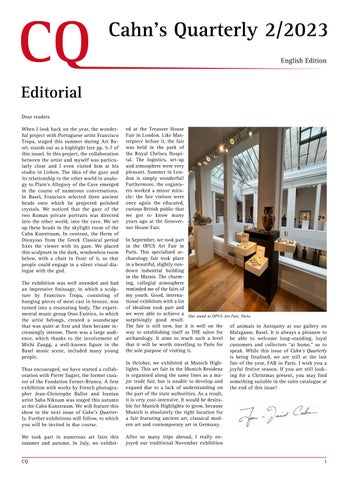
In September, we took part in the OPUS Art Fair in Paris. This specialised archaeology fair took place in a beautiful, slightly rundown industrial building in the Marais. The charming, collegial atmosphere reminded me of the fairs of my youth. Good, international exhibitors with a lot of idealism took part and we were able to achieve a Our stand at OPUS Art Fair, Paris. surprisingly good result. The fair is still new, but it is well on the of animals in Antiquity at our gallery on way to establishing itself as THE salon for Malzgasse, Basel. It is always a pleasure to archaeology. It aims to reach such a level be able to welcome long-standing, loyal that it will be worth travelling to Paris for customers and collectors “at home," so to the sole purpose of visiting it. speak. While this issue of Cahn's Quarterly is being finalised, we are still at the last In October, we exhibited at Munich High- fair of the year, FAB in Paris. I wish you a lights. This art fair in the Munich Residenz joyful festive season. If you are still lookis organised along the same lines as a ma- ing for a Christmas present, you may find jor trade fair, but is unable to develop and something suitable in the sales catalogue at expand due to a lack of understanding on the end of this issue! the part of the state authorities. As a result, it is very cost-intensive. It would be desirable for Munich Highlights to grow, because Munich is absolutely the right location for a fair featuring ancient art, classical modern art and contemporary art in Germany.
We took part in numerous art fairs this summer and autumn. In July, we exhibit-
After so many trips abroad, I really enjoyed our traditional November exhibition
The exhibition was well attended and had an impressive finissage, in which a sculpture by Francisco Tropa, consisting of hanging pieces of meat cast in bronze, was turned into a resonating body. The experimental music group Osso Exótico, to which the artist belongs, created a soundscape that was quiet at first and then became increasingly intense. There was a large audience, which thanks to the involvement of Michi Zaugg, a well-known figure in the Basel music scene, included many young people.
CQ
1
Cahn’s Quarterly 2/2023
Discovered for you
Time to Reboot On the Iron Age in Greece By Gerburg Ludwig Homer wrote the Iliad and Odyssey in around 740-730 B.C. and 700 B.C. respectively, thereby giving the stories that rhapsodes had long been handing down orally their definitive form. In addition to relating mythological tales and the dramatic fate of the heroes of the Trojan War, these epic poems reflect the self-image, customs and religion of the social elite of the time. This privileged class owned farmland and herds of cattle; in addition to the family, their household (oikos) included unfree dependants. Persons of equal rank invited each other to banquets and and took part in sports competitions, though they also waged war against each other.
Fig. 1: The geographical distribution of the dialects of ancient Greek in the Classical era. After R. D. Woodard, "Greek Dialects," in The Ancient Languages of Europe (Cambridge 2008) 50. © Future Perfect at Sunrise, Isssabellla, Wikimedia Commons
The Late Bronze Age period of decline towards the end of the 2nd millenium B.C. was followed by a period of renewal in Ancient Greece. The first signs of revival can be discerned as early as the Dark Ages (1050-800 B.C.) in the flourishing of the princely seat of Lefkandi on Euboea around 1000 B.C., which remained unparalleled at the time (CQ 1/2023, pp. 8-9). What was the situation elsewhere? After the decline of the Mycenaean palaces, many left the country in search of better living conditions, and a lengthy process of migration ensued. Our knowledge about this phenomenon remains fragmentary, but some routes have been reconstructed with the help of linguistic research. The distribution of dialects in the Classical period, as illustrated in fig. 1, sheds light on earlier periods. There were four dialects: Doric-Northwestern, Ionian-Attic, Aeolian and Arcadian Greek. Three migratory movements can be discerned in the 11th century B.C.: firstly, the Dorian migration from 2
northern central Greece to the depopulated Peloponnese; secondly, the Ionian movement from Athens, Attica, Achaea and Messenia to Asia Minor, where the Mycenaeans had already settled (CQ 2/2022, p. 3); and thirdly, the Aeolian translocation from Boeotia and Thessaly to northern Asia Minor. At their destination, the migrants founded new settlements such as Old Smyrna, 1050 B.C., an Aeolian city inhabited some 350 years later by around 2000 people. Contacts between neighbouring peoples were close and trade flourished again. The emergence of a new writing system was literally in the air. Around 800 B.C., the Greeks adopted the script of the Phoenicians (Levant) which contained symbols for consonants only and added letters for vowels in order to adapt it to the spoken language. Thus the Greek alphabet was born. The earliest examples of the new script are the prize inscription on the Dipylon jug (ca. 740 B.C.) and the three-line inscription on Nestor’s Cup from Pithekoussai/ Ischia (ca. 720 B.C.) which refers to the Iliad.
In view of its material value, striking size and decoration, the garment pin offered here by the Cahn Gallery probably belonged to an aristocratic outfit (fig. 2). The very well-preserved, long pin with rectangular cross-section is adorned with a large spherical applique framed by profiled edges and beads, with a flat disc as terminus. The craftsman adorned the rectangular element between the pin head and the needle with incised and punched decoration. Numerous bronze pins of this type as well as fibulae are known, mainly from burial contexts. The reliability of the epics as historical sources is the subject of ongoing debate. The Homeric
Fig. 2: A LONG PIN WITH DECORATIVE SPHERE. L. 17.7 cm. Bronze. Greek, Late Geometric, late 8th-1st half 7th cent. B.C. CHF 1,600
CQ
Cahn’s Quarterly 2/2023
Fig. 3: A FRAGMENT OF AN OINOCHOE WITH ANTILOPES AND SWANS. H. 20.5 cm. Clay. Attic, Late Geometric, last quarter 8th cent. B.C. CHF 5,600
Question addresses the issue of whether Homer actually composed the Iliad and Odyssey and whether the poems are the work of a single or several authors. The historicity of the Trojan War is also a topic of discussion. In his didactic poem Works and Days, Hesiod (born ca. 700 B.C.), describes the rural life of which he had first-hand knowledge, writing rules for life and touching on ethical topics. His work thus enriches our picture of Iron Age society. Both authors name the material that gave the new era its name: iron (sidēros). The earliest evidence for the smelting of iron ore was found in Hittite Central Anatolia and dates from the
2nd millennium B.C. Iron finds and techniques such as the extraction of iron that were spread by travelling craftsmen are documented by the beginning of the 1st millennium B.C., if not before, for instance in the southern Levant. In the Late Bronze Age, iron was still a prestigious material and used first to make weapons, gradually replacing or being combined with bronze. The advantage of iron was that only one raw material was required for its production, and that the sources for iron ore were closer and more plentiful. Furthermore, the end product was easier to process. The question along which routes the transfer of technology took place has been debated repeatedly due to new findings. It appears that the techniques reached the motherland via Cyprus and the new settlements in Ionia. New iron-working centres that exploited the iron ore deposits closer to home, such as those in Crete, Argolis, Attica, western and northern Greece, emerged in the 10th century B.C. In addition to iron, pottery became particularly important in the Geometric period, developing from ca. 1050–900 B.C. onwards. The vessels produced in this time span are termed Proto-Geometric. Initially, they were only sparsely decorated with individual ornaments such as circles and stripes. New vessel forms such as amphorae, oinochoai and skyphoi were rather squat at first, but gradually became more elongated. The ornamental vocabulary became increasingly rich, varied and dense. The maeander established itself as the typical ornament of the period. Human
and animal figures appeared for the first time since the Bronze Age around 800 B.C.. The scenes representing the laying out of the dead (prothesis) and the funeral procession (ekphora) on the famous monumental funerary vessels of Athens (Late Geometric, 750 B.C.) are especially remarkable. Similarly striking are the long-legged human figures with triangular torsos and plaintively raised arms, as well as the chariot teams with thin-legged horses or warriors with large Boeotian shields in silhouette manner. The fragment of an Attic oinochoe offered for sale by the Cahn Gallery (fig. 3) also dates from this period and is lavishly decorated with ornaments and figural “windows." It belonged to a rather large, bulbous wine jug. The shoulder and large parts of the vessel's belly are decorated with zigzag bands, lozenges, line friezes and rosettes, arranged in a grid formed by horizontal and vertical lines. The figures in silhouette, recumbent antelopes and swans with a cygnet, surrounded by filling ornaments, are particularly eye-catching. Towards the end of the century, the Orientalising style with animal friezes and rich, sometimes floral ornamentation replaced the Geometric style. New settlements, the revival of trade, the development of the alphabet and the mastery of iron technology were among the achievements of the Geometric period and laid the foundations for further prosperity and new political developments.
The Debate
Provenance: Reconstructing a Fragmented Past By Charlotte Chauvier
Fig. 1: THE UPPER PART OF A HANDLE OF A HYDRIA WITH LION PROTOMES. W. 10.7 cm. Bronze. Laconian, mid-6th century B.C. CHF 2,800
CQ
A graduate with a Master’s degree in Classical Studies, my research focused on the universe of Western Greek ceramics, in particular on the mythological and divine representations by Asteas, a painter active in Paestum in the 4th century B.C. I was particularly interested in the social reception of these depictions by the Greeks, Etruscans and Italic peoples at the time. I then continued my studies by specialising in orphan archaeological items on the classical antiquity art market. Orphans are works of art that lack documentary evidence such as export licenses, invoices, old photographs and other records. In 2022, I joined the team at the Cahn Gallery, my principal mission being to create a Provenance Department. By bringing together, classifying and recording the extensive archives available in 3
Cahn’s Quarterly 2/2023
the company we hope to be able to reconstruct the fragmented history of art works. The Cahn Gallery, which has a history spanning four generations, is eminently suited to this undertaking as it has extensive archives including those of the Münzen und Medaillen AG (19421988) and the H.A.C. AG (1988-1999). Our method, which is called Forensic, consists in investigating archaeological objects carefully and attempting to reconstruct their provenance by studying all the documentation available. This includes administrative documents such as purchase receipts, sales records and consignment contracts for auction sales. Unfortunately, these documents often paint only a fragmentary picture. Before 2005, records had to be kept for only ten years and one day to comply with Swiss commercial law and many documents were discarded after the specified period. Not until the end of the last century did the art market, particularly in the field of antiquities, become aware of the importance of scrupulous record-keeping. The question of provenance was the main topic at the 13th International Congress of Classical Archaeology in Berlin that was held from 24-30 July 1988. Furthermore, the European Directive No. 92-1477 of 31 December 1992 established a uniform system of forms for export licenses and passports, though the handling and time needed to get the permit varies from country to country. In Switzerland, it took more than 10 years for the legislation to follow. The Swiss Federal Act on the International Transfer of Cultural Property that came into force on 1 June 2005 was an answer to both the European Directive of 1992 and the UNESCO Convention of 1972. It made it compulsory to keep records on items of cultural property for thirty years, bringing Switzerland into line with the above-mentioned standards. If we are lucky, we can trace the provenance of certain objects as far back as 1942, the year in which Münzen und Medaillen AG was founded by Herbert A. Cahn. But in most cases, there is no photograph and the administrative documents are very cursory, making an identification difficult. That all publications by Herbert A. Cahn and Jean-David Cahn have been preserved is tremendously helpful. These include sales catalogues, stock catalogues, fair lists, exhibition ledgers, prospectuses and invitation cards. In addition to this, library catalogues enable us to trace the purchases of former customers as well as
the location of the art works. Herbert A. Cahn was scrupulous about documenting all the art works that passed through his hands. Today, we benefit greatly both from his picture archive with photographs of the objects made by Dieter Widmer and from his customer cards which recorded the purchases made by his clients, often over the course of many years. A further archive with the correspondence of Herbert A. Cahn is also of great importance, as it records not only commercial but also scholarly discussions on specific subjects between him and other archaeologists and dealers. These in-house archives are supplemented by the archives of several other dealers in ancient art that we have bought in recent years. This mass of material will hopefully be able to shed light on the provenance of many art works. To achieve this, many hours of work will be necessary, and I am more than happy to begin studying this vast corpus of information. There have been some interesting discoveries already. For instance, whilst studying an Archaic bronze handle of a hydria (fig. 1) that we had recently acquired, I realised that more of its provenance was documented than mentioned in the sales catalogue. In the photographic archive, which is organized according to the typology of works commonly used in archaeology, we found the negative of the photograph of the handle. On its protective envelope (fig. 2), the photographer Dieter Widmer had recorded the dealer’s name (Cahn), negative number (6571), and date (January 1975). By searching through all the catalogues around this date, I found the object, listed as
Fig. 2: Widmer negative envelope with handwritten notes: dealer’s name, negative number and date.
lot 225 (fig. 3) in the catalogue of the Münzen und Medaillen AG Auction no. 51, that was held in March 1975. The catalogue contains handwritten notes by Herbert A. Cahn specifying the lot number, estimate (CHF 3000/3200), consigner’s code (PL77), buyer’s name (Hieronymus) and hammer price (CHF 2200). This is corroborated by the Münzen und Medaillen AG client’s card, which records the items that Mr Hieronymus bought at that auction (March 1975, A 51: 172, 225) as well as their total price (fig. 4). It certainly is rewarding to put effort into provenance research and to reconstruct a fragmented past!
Fig. 3: Münzen und Medaillen AG Auction no. 51, March 1975, lot 225. Handwritten notes by Herbert A. Cahn with lot number, estimate, consigner’s code, buyer’s name and hammer price.
Fig. 4: Münzen und Medaillen AG client’s card recording the purchases made by Mr Hieronymus.
A digital database that would make all documents available on a single platform and thus facilitate research in our archives would be highly desirable. This is, however, an ambitious undertaking that requires time and courage. For this reason, we would welcome job applications from trainees who would assist us with our provenance research. We hope to start working on this project next year and look forward to sharing our discoveries with you.
Imprint Publisher Jean-David Cahn Malzgasse 23 CH-4052 Basel www.cahn.ch ISSN 2624-6368 Editors Jean-David Cahn Yvonne Yiu Authors Jean-David Cahn Charlotte Chauvier Ulrike Haase
Detlef Kreikenbom Gerburg Ludwig Jocelyn Wolff Photos Martin Argyroglo Niklaus Bürgin Ulrike Haase Design and Layout Michael Joos Yvonne Yiu
We are now selling catalogues published by Jean-David Cahn AG, H.A.C. Kunst der Antike and Münzen und Medaillen AG. For further information please contact Charlotte Chauvier: charlotte.chauvier@cahn.ch 4
CQ
Cahn’s Quarterly 2/2023
Cahn Kunstraum
Francisco Tropa, The RM Enigma Jocelyn Wolff and Jean-David Cahn invited Portugese artist Francisco Tropa to exhibit his most recent work, The RM Enigma, at the Cahn Kunstraum from 12-30 June 2023. For this solo show that coincided with Art Basel, the artist also created an installation including ancient sculptures. The Awakening of the Sculptures By Jean-David Cahn When I look at a work by Francisco, I come to realise that appearances are deceptive. They move in multiple directions. Everything is present at the same time and with no chronology. There is no visual hierarchy. This disconcerting arrangement of objects creates the illusion that one has nothing to do with the other. An object that we know to be soft and fleshly appears in bronze. Heavy matter floats in the air, hanging from a thread. These assemblages are positioned in a pluralistic system that forces the spectator to look. The gaze on the object is key. Francisco invites us to look at the faces of the past, which themselves are gazing at indefinite space. The light beam of the installation projects their silhouettes onto the wall, framed by crystals. An allusion to Plato’s cave. Is it a gaze towards the afterlife or towards the absolute? A gaze across time? The moment of looking interrupts eternity. We are open to any interpretation. Thus, by referring to the imagination, the moment becomes immaterial. Francisco plays with the immaterial projection of light onto a stone object, itself material, to create an illusion by means of the gaze.
A Dialectical Respiration By Jocelyn Wolff We like to create a certain vertigo in our projects. This exhibition is part of a significant series of projects involving the Galerie Jocelyn Wolff and the Cahn Gallery, with each project exploring the complex relationship between contemporary art and archaeology. The aim of these confrontations and dialogues is to refresh our gaze; for audiences who have followed the history of art over the past few decades, the mysterious aura of archaeological objects enables striking new readings and mises en abyme; the same is true for the enlightened archaeology enthusiast, who will see in contemporary creations objects that in their involuntary esotericism are difficult to apprehend. CQ
Since Francisco Tropa’s work emerges from the dialectical respiration between the traditional materials of sculpture (bronze, stone, etc.) and the classical devices of Western art (trompe-l’oeil, composition) on the one hand, and, on the other, contributions from conceptual art or the use of techniques that blur the status of the object in the field of sculpture – the direct projection of objects, for example, transforms them into images rather than shadows – it might even be described as a paroxysm of the dialogue between archaeology and contemporary art. But it is also possible that having passed the tipping point, the confrontation reverts to a natural simplicity, a harmonious, more literary relationship, and with it the emergence of new metaphors.
The gaze has a numinous power. Here, it is the face of Dionysus, the god of the afterlife and the unconscious, that looks at us. We recall that the gaze is his attribute. His eyes adorn the Greek ships that part the seas on Attic cups, a red sea like wine that makes one sway and in which one can drown. Those eyes look at us when we drink. A herm of Dionysus, an object that served as a protective monument marking the border of his sanctuary, was chosen for the installation in the basement. It refers to the experience of the cave, of mystery, of the enigmatic. This numinous power awakens the moment we look at it. It is the moment in which the past and the present become one, simultaneous. Time stops. With his installations, Francisco creates a nature morte which, in German, is not dead at all, but life brought to a standstill, Stillleben or still life, evoking the frozen instant. For me, that brief awakening of the sculptures was an unexpected experience. 5
Cahn’s Quarterly 2/2023
6
CQ
Cahn’s Quarterly 2/2023
CQ
7
Cahn’s Quarterly 2/2023
New Artworks Monthly on www.cahn.ch
Splendour from Antiquity
A STATUETTE OF THE DRUNKEN HERAKLES. H. 8.9 cm. Silver. Late Hellenistic, 1st cent. B.C.-1st cent. A.D.
CHF 16,000
A BLACK-GLAZED OINOCHOE. H. 24.8 cm. Clay, black glaze. Greek, probably Attic, 5th-4th cent. B.C. CHF 3,400
A SMALL TUREEN. H. 8.5 cm. Clay. Formerly priv. coll. Dr. Siegried Zimmer. Thereafter priv. coll. F. T., Baden-Württemberg, Germany, acquired from Hirsch, Auction sale 228, 2003, lot 397. Silesia (Poland), Lusatian Culture, Bronze to Iron Age, ca. 1300-500 B.C. CHF 2,800 PAIR OF GOLD BRACELETS WITH SNAKE'S HEADS. Inner Dm. max. 5.3 cm and 5.5 cm. H. 6.0 cm and 6.2 cm. Gold. Greek, 3rd cent. B.C. CHF 8,800
A STATUETTE OF HARPOCRATES. H. 4 cm. Silver-plated copper alloy. Egyptian, Late Period, 664-332 B.C. CHF 2,800
8
GOLD RING WITH INTAGLIO (HERMES). H. 2.3 cm. Gold, lapis lazuli. Greek, Mediterranean region, 3rd-2nd cent. B.C. CHF 3,800
AN INTAGLIO WITH A GOAT. W. 1.3 cm. Chalcedony. Formerly Herbert A. Cahn, Basel, 1990s. Roman, 1st-2nd cent. A.D. CHF 700
A BLACK-GLAZED KANTHAROS. H. (without handles): 10.5 cm. Clay, black glaze. Formerly priv. coll. Gérard Lüll, Basel; acquired from Münzen und Medaillen A.G., Basel according to a list dating 1982. Thence by descent in the family. Western Greek, 4th cent. B.C. CHF 1,500
A CROSS PENDANT WITH INLAYS. H. 5.2 cm (incl. hook). Gold, green agate, glass, garnet. Formerly priv. coll. Germany, before 2011. Byzantine, 6th-9th cent. A.D. CHF 12,000
CQ
Cahn’s Quarterly 2/2023
AN ORNATE GOLD BRACELET. Diam. (max.) 7.9 cm. Gold. Formerly priv. coll. M. C. and R. C.-Burckhardt, Basel. Late Roman, 3rd-4th cent. A.D. CHF 3,800
A PAIR OF GOLD EARRINGS WITH GARNETS. L. 3.8 cm. Gold, garnet, emerald (or green glass). Formerly priv. coll. Germany, ca. 1972. Roman, 3rd cent. A.D. CHF 5,600
ROMAN PERIOD GOLD AND GLASS BRACELET. Dm. 7.3 cm. Glass, gold. Formerly coll. Petra Schamelmann, Breitenbach, Germany, acquired from the collection of Fernand Adda, formed in the 1920s. Thereafter priv. coll. London. Roman, 3rd-5th cent. A.D. CHF 3,800
A PAIR OF GOLD EARRINGS WITH GARNETS AND GLASS BEADS. H. 3 cm. Gold, garnet, glass. Formerly priv. coll. Mr L.; listed in an inventory dated July 1982. Roman, 2nd-3rd cent. A.D. CHF 2,400
A PAIR OF GOLD EARRINGS WITH CHALCEDONY. L. (with hooks) 3.8 cm. Gold, bluish chalcedony. Formerly priv. coll. Mr L.. Roman, 1st-2nd cent. A.D. CHF 2,200
A STATER, ARGOS AMPHILOCHIKON. 10 g. Silver. Formerly art market Frankfurt, 2007. Greek, Argos Amphilochikon, 270 B.C. CHF 600
CQ
AN ARYBALLOS. H. 9 cm. Aubergine and greenish glass. Formerly priv. coll. Peter Boehm, Larchmont, New York. Thereafter priv. coll. Nicolas Christol, Switzerland. Roman, 2nd-3rd cent. A.D. CHF 3,400
A PAIR OF GOLD EARRINGS WITH CARNELIAN. L. 3.6 cm. Gold, carnelian. With Coins and Antiquities Ltd., undated catalogue (between 1975 and 1978), no. 60, AN 821. Roman, 1st-2nd cent. A.D. CHF 2,400
A TWISTED GOLD BRACELET WITH HINGED CLOSURE. W. 6.1 cm. Gold. Formerly English priv. coll., acquired in the late 1990s from John Moor, York, U.K. Roman, 3rd cent. A.D. CHF 5,800
A RIBBED BOWL. Dm. 15.6 cm. H. 4.2 cm. Greenish glass. Slight rainbow iridescence. Formerly Collection Carl Leonhard Burckhardt (1902-1965), acquired before 1966. Thence by descent. Roman, 1st cent. A.D. CHF 5,800
A RIBBED BOWL. H. 6.8 cm. Yellowish and white glass. Formerly Christopher Sheppard, London art market until 1980. With a New York art gallery until 1990. Priv. Coll. Martin Wunsch, New York, 1980s-1990s. Roman, 1st-2nd cent. A.D. CHF 5,500
9
Cahn’s Quarterly 2/2023
Highlight
An Augustan Portrait of a Woman By Detlev Kreikenbom
Figs. 1-2: A PORTRAIT HEAD OF A YOUNG WOMAN. H. 25.1 cm. Marble. Roman, Early Augustan, ca. 40-30 B.C.
In the Roman Republic, portraits of men outnumbered those of women to such an extreme extent that for the years from 500 to 50 B.C. the term portrait seems to be associated almost exclusively with masculine depictions. In contrast to the numerous honorary and dedicatory statues of men that are documented by written sources, we have credible information on only two cases of analogous tributes to women: for Quinta Claudia, who was actively involved in the introduction of the Magna Mater cult in Rome in the 3rd century B.C., and Cornelia, the mother of the two Gracchi, who distinguished themselves as reform politicians in the 2nd century B.C. The pedestal of a statue of the mother still exists. It is highly probable that it is the original base of the statue attested to by the sources, although it was restored in the Augustan period. The picture painted by written sources is incomplete, as it is restricted to representative state monuments. The extent to which im10
ages of women were assigned a role in funerary culture remains unclear. In any case, they were not represented among the ancestral portraits in the homes of noble families. And there are no surviving Roman portraits of women dating from before the middle of the 1st century B.C. From this point in time onwards, the preserved monuments present an entirely different picture. With the transition from the Republic to imperial rule, a dramatic change can be observed. Portraits of women are now regularly found on sepulchral monuments, especially in the box-shaped reliefs with portrait busts of entire families (German: Kastengrabrelief). The women are shown in their marital or extended family context, sometimes even in groups representing several generations. The reliefs belonged to citizens of lower social groups, predominantly freed slaves. However, the phenomenon itself was not class-specific. The elaborate tombs of noble families with
Price on request
portrait busts sculpted in the round form the counterpart to these reliefs, and maybe even served as their model. Furthermore, statues of women occasionally accompanied those of their publicly honoured husbands. In addition, women were deemed worthy of being honoured by a statue in their own right if they had rendered outstanding services to the public good through donations or endowments. With regard to the way the honour bestowed was legitimised there was no fundamental difference to the few precedents. The social roles of the women portrayed and the personal qualities assigned to them within the context of the family also remained unchanged. What was new, however, was the sheer quantity of depictions and the esteem accorded to women that was thereby visually expressed. The proliferation of representations of women from the 2nd half of the 1st century B.C. onwards is closely connected with a legal provision of the year 35 B.C. in which Octavian, the future emperor Augustus, had CQ
Cahn’s Quarterly 2/2023
Highlight public honorary statues granted to his wife Livia and his sister Octavia. Furthermore, Livia and Octavia were awarded sweeping personal rights that included immunity and exemption from guardianship. Nonetheless, this cannot conceal the fact that the sculptures were also, indirectly, about family propaganda. The depictions of female members of the ruling family rapidly gave rise to portraits not only of women belonging to the top echelons of society but also of women from merely local elites. Remarkably, one third of all Roman portraits are official or private representations of women dating from the Imperial period. The head currently with the Cahn Gallery was created during those years of radical change in the 1st century B.C. (figs. 1-2). It can be assigned to this period with as much certainty as chronological dating based on formal analysis can provide. Several criteria mutually confirm each other, without running the risk of circular reasoning. The eyes alone are characteristic, having narrow, sharply defined lids under angular, protruding brows, which emerge from the root of the nose almost at a right angle, rise slightly towards either side and then curve down in an elongated arc above the outer corners of the eyes, transitioning into the gently modeled temples. The skin of the face is stretched tautly over the cheekbones in a manner characteristic of Augustan art and finds a consistent answer in the drawn-in cheeks.
Fig. 3: A BUST OF A WOMAN. Marble. Roman, Augustan-Tiberian, 10 B.C.-20 A.D. Copenhagen, Ny Carlsberg Glyptotek, inv. no. 761. Photo: Jo Selsing.
CQ
The hair is parted in the middle and on either side forms a wreath that is composed of strands of hair that are brushed upwards and folded inwards – a hairstyle that is attested to several times in the early Imperial period, for instance by a somewhat later female head in the Ny Carlsberg Glyptotek in Copenhagen (fig. 3). However, one stylistic difference that can be observed in the rendering of the hair is that the strands in this portrait are finer. Unobtrusively grouped, the impression is created that every single hair is visible. In the case of the head with the Cahn Gallery, however, several strands of hair are joined together in broader sections enlivened only by some faint graphic structuring within. The ensuing contrast to the sculptural design of the face should not be misunderstood as a sign of inferior quality. Rather, the “blunt" appearance of the hair indicates that the sculpture still has a direct connection to Republican art. The hairstyles of women's heads dated to the decade of 50-40 B.C. evince related phenomena. Due to the progressive facial features, the head with the Cahn Gallery was probably created somewhat later, around 30 B.C. The small curls in front of the ears are also congruent with an early Augustan date (cf. fig. 4).
dominated the political scene in Rome at the time. In addition to stylistic similarities, there are physiognomic resemblances that cannot be overlooked. The facial outline is remarkably close to that of Octavia (fig. 4), and even more so to that of Octavian/ Augustus himself (fig. 5). Parallels between the portraits of the emperor and the young woman in the Cahn Gallery can be found even in the hollow cheeks, the slight hump on the bridge of the nose and the only slightly recessed top part of the nose – in details, that is, which are characteristic of a specific individual. From a systematic archaeological point of view, however, there is no basis for attributing the female portrait to a family member. Iulia, the daughter of Octavian, can be ruled out from the outset, as she was barely more than ten years old at the time when the sculpture was presumably created. It is of fundamental importance that the head cannot be assigned to any known portrait type due to the hairstyle lacking the nodus above the forehead worn by Octavia and Livia. Deciding whether the head with the Cahn Gallery is an “official" portrait of an unknown type or a “private" portrait deliberately modelled on the ruler and his family does not seem possible at present.
The head presented here is noteworthy not only because of its artistic value and the remarkable period in which it was made, but also because it raises the question of whether the person portrayed was connected to the family of Octavian, which already
Some unusual technical features of the sculpture that have been observed only recently need to be studied in depth. The results will be published at a later point in time.
Fig. 4: A BUST OF OCTAVIA. Marble. Roman, Augustan, 30-0 B.C. Rome, Museo Nazionale Romano, inv. no. 121221 Photo: Deutsches Archäologisches Institut, Rome.
Fig. 5: A BUST OF AUGUSTUS. Marble. Roman, Augustan, 20 B.C.-10 A.D. Rome, Capitoline Museum, inv. no. 495. Photo: Deutsches Archäologisches Institut, Rome.
11