Cahn’s Quarterly 2/2022 English Edition
Editorial Dear readers It was a pleasure for me to participate in two major events before the summer break. During Art Basel, Cahn Contemporary, in collaboration with Jocelyn Wolff of Paris, presented a very enriching project by artist Katinka Bock at the Cahn Kunstraum in Basel. It is extremely exciting for me to see how every artist works differently with ancient art. Sometimes it is fully integrated, sometimes only quoted. Katinka Bock's way of working differs greatly from that of Laura Lamiel; she has her very own, subtle and reserved way of interacting with the objects. The solo exhibition with her works set a very high standard. It fascinated viewers and generated a great deal of interest, particularly amongst professionals, including museum curators. The texts by Jocelyn Wolff and myself, and the photos by François Doury on pp. 9-14 provide an insight into this exhibition. The second important event was TEFAF Maastricht, which was held again for the first time after a long break, albeit in a shorter form. I was pleased to see that our policy of presenting high-quality art works, which are nonetheless within the scope of small or medium-sized budgets, continued to appeal to collectors. We were able to record a sales frequency similar to that before the Covid crisis and I would like to take this opportunity to thank you, dear clients, for your loyalty. I was delighted to welcome both new and old,
loyal collectors at the fair. The next TEFAF Maastricht will be held as usual in March 2023. We are now looking forward to an eventful autumn, commencing with the exhibition The Schmassmann Collection of Ancient Silver at the Cahn Kunstraum from 1–4 September 2022. The collection, which is published in a monograph by Gerburg Ludwig, will be shown in its entirety and offered for sale as a whole. You are cordially invited to the opening on 1 September from 5 p.m. to 9 p.m. For an introductory text and photos of some of the major pieces on display, see pp. 4-8. I would also like to draw your attention to an exciting project with Ulrike Ottinger that we will be showing in Paris in October. The film director and photographer was awarded the Berlinale Camera in 2020 and a retrospective of her work will be held at the Centre Pompidou parallel to our project. We will send you details of this exhibition and other projects by the Cahn Gallery at a later date.
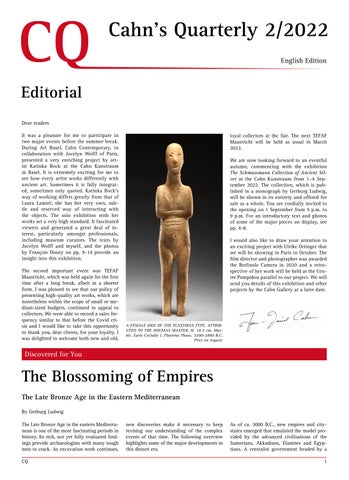
A FEMALE IDOL OF THE PLASTIRAS TYPE, ATTRIBUTED TO THE DOUMAS MASTER. H. 18.9 cm. Marble. Early Cycladic I, Plastiras Phase, 3200-2800 B.C. Price on request
Discovered for You
The Blossoming of Empires The Late Bronze Age in the Eastern Mediterranean By Gerburg Ludwig The Late Bronze Age in the eastern Mediterranean is one of the most fascinating periods in history. Its rich, not yet fully evaluated findings provide archaeologists with many tough nuts to crack. As excavation work continues, CQ
new discoveries make it necessary to keep revising our understanding of the complex events of that time. The following overview highlights some of the major developments in this distant era.
As of ca. 3000 B.C., new empires and citystates emerged that emulated the model provided by the advanced civilisations of the Sumerians, Akkadians, Elamites and Egyptians. A centralist government headed by a 1
Cahn’s Quarterly 2/2022
as diplomatic, religious, mythological, historical and literary texts. In short, they grant us a profound insight into the rich and diverse society of Ugarit. The Uluburun shipwreck, discovered off the Turkish coast in 1982, is like a time capsule that can be used to reconstruct trade routes. The goods on board came from at least seven countries and included Mesopotamian glass, tin, copper oxhide ingots, and many different types of ceramics. The evidence provided by the ceramics, a golden scarab inscribed with Nefertiti's name and the scientific analysis of the wood and plant remains were used to obtain a date of ca. 1300 B.C. for the ship’s last voyage. It was probably sailing from the south along the Levantine coast via Cyprus towards the Aegean.
Fig. 1: Overview over the kingdoms and states in the Late Bronze Age, ca. 1500 B.C. © Enyavar, Wikimedia Commons
king or prince had control of politics, diplomacy, religion, trade and the distribution of goods. The driving force of the time was the bronze casting process, which spread through the Ancient Near East from the 3rd millennium B.C. onwards. The import of raw materials such as copper from Cyprus and rare tin from Badakhshan/Afghanistan, amongst other places, had a positive effect on trade, which by 1500 B.C. had developed into a flourishing international network.
both seated on a chair with their arms around each other. Their distinctive attire comprises a pleated robe and an elaborate wig. The stonemason succeeded in teasing out the finest details of the faces, wigs and robes from the serpentine. The panel on the reverse is decorated in sunken relief and places the sculpture in a religious context as it shows the wife making a sacrifice. Her husband, wearing a long apron and standing in front of her, participates in the ritual act.
Important centres of power (fig. 1) included the Hittites/Hatti (capital Hattuša), Troy (Wilusa) in Anatolia, the kingdom of Mitanni and the Kassites in the Near East, Levantine citystates such as Ugarit and Megiddo, Cyprus/ Alashiya, the Minoans in Crete (political centre Knossos) and later the Mycenaeans on the Greek mainland (political centre Mycenae?). These empires competed with each other and engaged in territorial disputes, especially in the east. Small states, such as Ugarit, were at times pawns of the major powers, but there were also periods in which they were able to assert their autonomy.
Egypt's key role is demonstrated by several phases of territorial expansion in the northeast and its control of Levantine areas (fig. 1). A military highlight: in the Battle of Megiddo (1479/1457 B.C.) Thutmose III, Hatshepsut's successor, defeated the rebellious Canaanite princes after the siege of Megiddo. When, about 200 years later, the Hittites surging southwards faced the Egyptians at Qadesh (1274 B.C.), the conflict ended in a draw – the two mighty powers were evenly matched.
One perennial force to be reckoned with was the great power of Egypt. With the advent of the New Kingdom (as of 1550 B.C.), the country once again experienced a golden age. Queen Hatshepsut, for instance, promoted trade, diplomatic contacts and cultural exchange. The Minoan frescoes, painted in wonderfully bright colours, which were found in the palace of Thutmose III in Tell el-Dab’a, testify to this cross-pollination.
Ugarit on the Levantine coast was also temporarily under Egyptian control (fig. 1). The city’s location predestined it for maritime trade and repeatedly aroused the covetousness of the great empires. In the 14th century B.C. Ugarit was allied with Egypt, though not long afterwards the Hittites conquered it and turned it into a vassal state. The numerous inscribed clay tablets found there are a treasure trove of information. They document the regular import and export of goods and also include private correspondence as well
The funerary statuette (fig. 2) on offer at the Cahn Gallery is impressive testimony to Egypt's prosperity. The deceased civil servant is depicted together with his wife. They are 2
Was the ship’s destination Mycenae? Its inhabitants, the Achaeans (Hittite: Ahhiyawa), maintained close trade relations with the south-east, especially after they conquered Crete and thus secured an important strategic base. Numerous clay tablets in Linear B, a syllabic script that may have been a precursor of the Greek alphabet, were found in palaces such as those of Pylos and Mycenae. The evidence furnished by these inscriptions is invaluable for the reconstruction of the palatial economies. Mycenaean pottery, with its distinctive decoration that was initially influenced by the Minoans, has been found throughout the Mediterranean. It features plants, sea and land animals, human figures and patterns painted boldly in dark colours on a pale buff background, the designs grow-
Fig. 2: A FUNERARY STATUETTE WITH A SEATED COUPLE. H. 24.5 cm. Serpentine. Provenance: From the estate of the artist Margo Veillon (1907−2003), Lausanne. Egypt, New Kingdom, 19th Dynasty, 13th cent. B.C. CHF 38,000
CQ
Cahn’s Quarterly 2/2022
ing increasingly abstract in the course of time.
My Choice
The kylix (fig. 3) presented by the Cahn Gallery is a typical Mycenaean drinking vessel that came into vogue around 1400 B.C. The conical shape of the bowl is based on Minoan models of the 15th-14th centuries B.C., whereas the tall, slender stem is a feature introduced by the Mycenaeans. Two vertical strap handles run from the offset lip to the wall of the cup. On the foot, traces of the pale orange slip that originally covered the light buff fabric are clearly visible.
A Drunken Herakles
Fig. 3: A KYLIX. H. 15.4 cm. Clay. Mycenaean, Late Helladic IIIB, 1300-1190 B.C. CHF 6,600
The Mycenaeans expanded into Asia Minor. Hittite clay tablets from Hattuša bear witness to the diplomatic exchanges with the Ahhiyawa. However, their relations deteriorated when the Hittites became a major power for the last time (ca. 1350 B.C.). The archaeological finds document a strikingly low level of trade between the kingdoms during this period. Furthermore, in 1225 B.C. the Hittite king reacted to the growing threat posed by the Assyrians by contractually prohibiting trade between Mycenae and Assyria in what amounted to an ancient trade embargo. Towards the end of the Late Bronze Age the Near East and Mediterranean could boast an extensive economic, diplomatic and cultural network. The desire for territorial expansion and the instrumentalisation of trade nevertheless created potential for conflict. How dramatically the situation finally came to a head will be the subject of the next issue.
Imprint Publisher Jean-David Cahn Malzgasse 23 CH-4052 Basel www.cahn.ch ISSN 2624-6368 Editors Jean-David Cahn Yvonne Yiu Authors Jean-David Cahn Ulrike Haase Gerburg Ludwig
CQ
Lillian Bartlett Stoner Joceleyn Wolff Translations Yvonne Yiu Photos Niklaus Bürgin François Doury Ulrike Haase Design and Layout Michael Joos Yvonne Yiu
By Lillian Bartlett Stoner While he might be small in scale, our drunken Herakles in silver is the very embodiment of hedonistic excess. The hero stands with much of his weight planted on his right foot, but gives the impression of being slightly unbalanced with his long torso drooping backwards and to the left. His right hand is outstretched and cupping a deep kantharos, whereas the other is held at hip level and might have originally held a club. His hair is worn neatly curled against the head, but the deeply set eyes are slightly askew giving this erstwhile hero a stupefied expression. The broad fillet tied around his head to trail over his chest indicates that he is in the mode of symposiast, recalling his famous drinking contest with Dionysos that left the hero somewhat worse for wear. Herakles behaving badly had been a favourite subject in the Greek world since the Archaic period, with the later Classical period seeing his superhuman misdeeds (incorrigible womanizing, gluttony, drunkenness, and general carousing) beginning to overshadow his heroic feats. The image of the hero banqueting (e.g. Lysippos’ Herakles Epitrapezios) or his comedic excesses while stumbling home afterwards (sometimes stopping to casually urinate) became a favoured choice to decorate gardens and triclinia by the 1st cent. B.C.
A DRUNKEN HERAKLES. H. 8.9 cm. Silver. Late Hellenistic, 1st cent. B.C.-1st cent. A.D. CHF 26,000
It is striking to me that this popularity coincided with a political turning point when the desire to emulate the eastern decadence (tryphe) of Hellenistic kings and to maintain a sense of traditional Roman decorum collided in public and private discourse. Nothing about this was subtle. Alongside his consort Cleopatra, Mark Antony deliberately assumed the luxurious persona and lifestyle of semi-divine Hellenistic kings (becoming quite portly through his enjoyment of the good life), which was diametrically opposed to the “traditional” Roman austerity promoted by his young rival Octavian. Yet throughout this political turbulence and high-stakes virtue signalling, Romans remained captivated by the Hellenistic model of luxury and excess, decorating their pri-
vate spaces and entertaining their guests with the most evocative imagery they could manage. The small scale of our Herakles makes it a likely candidate for display in one such setting, perhaps in a space used for banqueting, and most likely upon a table. Whatever the dubious moral implications of his indulgences, they are instantly offset by his prior heroic feats; his incorrigible appetites become charming rather than ugly. All is forgiven. While it would be unwise to read ownership of such a statuette as a political statement, it seems logical that the display of this drunken Herakles in such a costly and flashy material can best be explained by an alignment with and light-hearted longing for the unattainable riches and ribaldry of Alexander the Great and his Successors, even for an evening. 3
Cahn’s Quarterly 2/2022
Exhibition in Cahn Kunstraum, Basel, 1–4 September 2022
The Schmassmann Collection of Ancient Silver By Jean-David Cahn reducing the size of the collection, bringing it into a new context or even dissolving it. Thus, the nature of a collection evolves continuously as does the foundation for the beholder’s engagement with it. The mutability of private collections contrasts starkly with the stasis of many museum collections, where the overriding aim is to accumulate ever more objects. This policy, in which almost all of the objects are permanently hoarded and consequently removed forever from the cycle of ownership change, goes hand in hand with a finality that needs to be critically debated.
A GORGONEION. Dm. max 6.7 cm. Silver, gilding. Greek, late 6th-early 5th cent. B.C.
In this exhibition at the Cahn Kunstraum the spectacular private collection of ancient silver built up by Christian und Hedy Schmassmann in the course of several decades will be shown to the public for the very first time. The collection is published in a monograph by Gerburg Ludwig: Argentum – Silber aus der Antike. Die Sammlung Christian und Hedy Schmassmann. Basel 2018. I have known Mr and Mrs Schmassmann for many years. From the very beginning, they were fascinated by ancient silver and it was a pleasure for me to accompany and advise them in the process of assembling a representative collection. Their acquisition strategy was based, among other things, on the wise principle of concentrating on a very specific area. By means of this precise focus, they succeeded in gaining a deeper insight into the mentality and mores of past cultures. The objects in this collection were used during religious activities. Religion was omni4
present in ancient societies and most strikingly expressed by its rich and complex imagery. The people who looked at and used the silver objects now on display were intimately familiar with this visual language – indeed it was part of their daily lives. We modern beholders will never be able to fully grasp the ideas and concepts governing past cultures, and thus topics such as religiosity remain elusive. Nevertheless, the objects presented here invite critical engagement with this theme and give us an approximate sense of the beliefs of Antiquity. A collection is, by definition, a group of objects brought together on the basis of certain principles of selection. At the same time, the collection itself is an artefact in its own right whose status quo is defined by the collector and also reflects the zeitgeist of the period in which it was built. In most cases, private collections are of a temporary nature. The owner of the objects is free to make changes at his own discretion, for instance augmenting or
In my opinion, the dynamic approach of private collections in which objects are not only acquired but also released again, represents one of the keys to the responsible and sustainable handling of antiquities. By changing owners with a certain regularity, the objects in question satisfy the collectors’ desire for a rich, lively and legitimate market. When objects are permanently removed from this cycle, as often happens when they enter museum collections, this leads to a scarcity of art works available on the antiquities market and may, unfortunately, encourage trade with illegally excavated artefacts. Against this background, private collections and their active management are undoubtedly a present-time necessity. The structure of the exhibition is governed primarily by aspects related to content, reflecting Mr and Mrs Schmassmann’s curiosity and open-mindedness: they never focused solely on the objects’ decorative value, but always brought their content to the fore. I am delighted to invite you to delve into the world of ancient silver in which the smallest everyday object is imbued with religiosity.
The Schmassmann Collection 1-4 September 2022 Opening: 1 September 5-9 p.m. Exhibition: 2-4 September 10 a.m.-6 p.m. Cahn Kunstraum Steinentorstrasse 19, Basel
CQ
Cahn’s Quarterly 2/2022
A LARGE SERVING PLATTER WITH MAGNIFICENT FOLIATE SCROLLWORK FRIEZE. Dm. max. 50 cm. Silver. Gallo-Roman, 2nd half of 3rd–1st half of 4th cent. A.D.
CQ
5
Cahn’s Quarterly 2/2022
A HERM OF PRIAPOS (ANASYRMA TYPE). H 4.6 cm. Silver. Roman, 1st cent. A.D.
6
A STATUETTE OF VENUS PUDICA. H. 9 cm. Silver. Roman, 2nd cent. A.D.
CQ
Cahn’s Quarterly 2/2022
A LID OF A BOX WITH THE SLEEPING ARIADNE AND EROS. L. 25.5. cm. Silver, traces of gilding. Roman, late 4th-early 5th cent. A.D.
A SKYPHOS WITH BIRDS ON SPIRAL TENDRILS. H. 8.7 cm. Silver. Roman, late 1st cent. B.C.-1st half of 1st cent. A.D.
CQ
7
Cahn’s Quarterly 2/2022
A RHYTON. H. 22 cm. Silver. Pontic, 4th-3rd cent. A.D.
A BOWL WITH HANDLE. L. 29.8 cm. Silver. Roman, Campanian, 1st cent. B.C.-1st cent. A.D.
AN OVAL LANX WITH SACRO-IDYLLIC FRIEZE. L. 25.8. cm. Silver. Roman, mid-2nd half of 2nd cent. A.D.
8
CQ
Cahn’s Quarterly 2/2022
Exhibition at the Cahn Kunstraum, Basel, 14 June–2 July 2022
Katinka Bock – Some and any, fleeting A “Stress Test” of Contemporaneity
Why Should Archaeology Engage in Projects with Contemporary Artists?
By Jocelyn Wolff
By Jean-David Cahn
Some and any, fleeting is our sixth exhibition in partnership with the Cahn Gallery, and the second solo show dedicated to the work of Katinka Bock. For this exhibition, the artist chose to integrate archaeological objects in her work by means of photography. Thus, what we witness is not the classical confrontation between the work of a contemporary artist and carefully chosen archaeological objects, but rather a more subtle relationship. To me this suggests a reversal of classical concepts of contemporaneity akin to that described a few years ago by Giorgio Agamben in his essay What is the Contemporary? Keenly appropriate is his particularly inspired observation: “Contemporariness inscribes itself in the present by marking it above all as archaic. Only he who perceives the indices and signatures of the archaic in the most modern and recent can be contemporary.” (Giorgio Agamben, “What is the Contemporary?" In: What is an Apparatus, and other Essays trans. D. Kishik and S. Petadella, Stanford University Press, 2009, p. 50).
With their exceptional perceptiveness, artists are subtle seismographs of our environment. Their encounter with objects of the past often has a sensual and instinctive dimension which is not necessarily influenced by historical or archaeological interpretations. This can lead to surprising perspectives, giving new life to the objects when they are exhibited. Once the event is over, they then return to their usual context. Artists do not impose scientific or museological interpretations on archaeological objects, nor do they expect them to please. Rather, they let them take on a new appearance and become a reflection of the viewers’ interpretation. Would it not be fascinating to take
part in this sensual experience through the eyes of an artist? Archaeology should not have a monopoly on the interpretation of artefacts from the past. The pieces are remnants of human activities, be they functional or ritual. They have not ceased to live, but change with the passage of time and are interpreted anew by each epoch. Katinka Bock has always pursued a very free approach to the distribution of objects in space, sometimes placing them contrary to their usual purpose or in surprising contexts, generating unexpected effects. Ultimately, she strips away certainty from things we take for granted.
There is a quality inherent in Katinka Bock’s work, namely the will not to yield to the temptation of a form that would be the embodiment of a (very fleeting) zeitgeist – something that advertisers are experts in – that appears to offer an alternative to this dialectic between the contemporary and the archaic. This parallel path, with its ethical dimension, may characterise an aesthetic, which, although it has not yet been given a name, appears to have established a methodology and a formal vocabulary of its own. Thus, every time the Cahn Gallery makes its rich collections available to contemporary artists, authorising appropriations, misappropriations, dialogues or confrontations, we can observe a deepening of that critical exploration of contemporaneity that Giorgio Agamben calls into question. We now invite you to a new chapter of this undertaking, a form of “stress test” of contemporaneity.
CQ
9
Cahn’s Quarterly 2/2022
10
CQ
Cahn’s Quarterly 2/2022
CQ
11
Cahn’s Quarterly 2/2022
12
CQ
Cahn’s Quarterly 2/2022
14
CQ
Cahn’s Quarterly 2/2022
From Delicate Touches to Rich Decoration - Ornamentation in Antiquity
New Artworks Monthly on www.cahn.ch
A BIRD BOWL. Dm. 18.3 cm (without handles). H. 7.8 cm. Clay, beige coating, red and dark brown matt glaze. Deep bowl on ring foot with inwards-curving lip. The top third of the exterior is decorated by a frieze with two antithetical birds with cross-hatched bodies facing a rosette, the whole framed by two metopes composed of a lozenge and vertical lines. The central section is adorned by encircling bands. A corona of rays and two encircling bands at the base. The interior of the vessel is embellished by a central rosette and compact stripes. Formerly Coll. Wladimir Rosenbaum, Ascona, Switzerland, since the late 1970s. East Greek, possibly Rhodian, 2nd half of 7th cent. B.C. CHF 12,000 ONE-HANDLED GEOMETRIC CUP. H. 9.8 cm. Clay. Slim body with high slung strap handle standing on a flat base. Concave wall densely decorated with stripes and friezes of dots, lozenges and linked circles; line frieze on the handle. Body undamaged; stabilised crack in the base. Formerly Coll. A. L., Basel, 1970s. Publ.: Cahn Auktionen AG, Young Collectors Auktion 1, 26 September 2015, lot 29 (illus.). Attic, Geometric, 2nd quarter to mid-8th cent. B.C. CHF 3,600 A LATE GEOMETRIC OINOCHOE WITH BIRDS. H. 22 cm. Clay. An oinochoe with globular body, trefoil mouth, and strap handle. The body is decorated by parallel lines in dilute glaze with a broader band at the shoulder. A square panel is centred on the neck, bordered by parallel lines. Formerly Coll. Prof. Hans Dahn (1919-2019), Lausanne. Greek, Attic, Late Geometric (I b), ca. 750-735 B.C. CHF 12,800
A SILVER DUCK-HEAD PROTOME. L. 4.9 cm. Silver with gilding. Formerly European art market prior to 2000. Thereafter priv. coll. Surrey, UK, acquired on the UK art market. Caucasus, 6th cent. A.D. CHF 2,600
A SMALL TUREEN. H. 8.5 cm. Clay. A biconical bowl of black, polished clay. The vase's lip is flat and leads to a short, smoothed neck. Formerly priv. coll. Dr. Siegried Zimmer. Thereafter priv. coll. F. T., Baden-Württemberg, Germany, acquired from Hirsch, Auction sale 228, 2003, lot 397. Inside, a label with handwritten note “Kl. Bresa/ Schlesien". Silesia (Poland), Lusatian Culture, Bronze to Iron Age, ca. 1300-500 B.C. CHF 2,200
A BRONZE HANDLE WITH FEMALE HEAD PROTOME. H. 11.5 cm. Bronze. Curved handle of a bronze oinochoe (jug). Formerly Richard Wagner Collection, Cape Cod, Massachusetts, USA, 1960s. Thereafter priv. coll. USA. Greek, 6th cent. B.C. CHF 2,800
CQ
A CUP WITH RAM PROTOME. Dm. max. 13.5 cm. Clay. Tripartite vessel with tapering neck and slightly flaring rim. Offset, rounded shoulder. Conical lower section. The carefully smoothed surface is richly decorated. At the transition to the shoulder, the neck is decorated by encircling grooves. On three sides of the body a boss below semi-circular grooves. In each of the interstices two antithetical groups of parallel grooves form a chevron (German: Sparren). A spout in the shape of a ram protome emerges from the vessel's belly. Formerly Coll. Dr. Siegfried Zimmer, ca. 1950. Label with “262" and “Petschkendorf". A second label with: “Schlesien". Eastern Central Europe, Early Iron Age, 7th-6th cent. B.C.. CHF 12,800
A GOLD CROSS PENDANT WITH INLAYS. H. 5.2 cm (incl. hook). Gold, green agate, glass, garnet. A Greek cross in gold with central green agate cabochon, with four flat green glass squares surrounding. Formerly priv. coll. Germany, before 2011. Byzantine, 6th-9th cent. A.D. CHF 12,000 A POSAMENTERIE FIBULA. L. 20.1 cm. Bronze. Type with spiral disks attached to the bow. A long piece of wire with circular cross-section is coiled to form a spiral made of 14 loops (foot of the fibula). Lateral pairs of spiral disks are attached to the bow. Formerly South German priv. coll., acquired in the 1970s-1980s. Eastern Europe, Late Bronze Age, ca. 1100-900 B.C. CHF 1,200
15
Cahn’s Quarterly 2/2022
A LITTLE-MASTER CUP. H. 9.4 cm. Clay. A Little Master Cup with an unintelligible inscription in Greek on either side. Pairs of small palmettes with added red centres emerging from beneath the handles. Tondo with two concentric circles in reserve. Reassembled from fragments. Formerly German priv. coll., acquired between 1970 and 1990 Greek, Attic, ca. 550-540 B.C. CHF 4,600
A LEKANIS WITH ANIMAL FRIEZE AND BOAR. Dm. (without handles) 26.6 cm. Clay. A lekanis (dish) on a low foot with two ring handles. Grazing quadripeds (one a horse, one assinine) are watched by three lions. With Münzen und Medaillen AG, Basel, 1980; published: Catalogue MuM Auktion 56, 19 February 1980, lot 45 (with illus.). Thereafter priv. coll. E. W., Riehen, Switzerland. Thence by descent in the family. Boeotian, late 6th-early 5th cent. B.C. CHF 9,600
AN AMPHORISKOS. H. 15 cm. Clay. A thin-walled amphoriskos with tall neck, slightly flaring mouth, and a small round foot. Formerly French priv. coll., acquired in the 1970s. Attic, 4th cent. B.C. CHF 2,800
A JAR WITH ZIG-ZAG TRAILING. H. 9.1 cm. Glass. Squat vessel with broad funnel-shaped mouth with collar and rounded rim. Translucent, light green glass. Formerly French priv. coll. 1980s. Thereafter Pierre Bergé, Paris, Auction, 1 December 2007. Roman, 3rd-4th cent. A.D. CHF 3,800
16
AN ALABASTRON WITH STRIDING FELINE AND OWL. H. 9.1 cm. Clay. A powerfully built feline striding to the right dominates the vase. Opposite, an owl. Both turn their heads to gaze frontally. Formerly priv. coll. N. Pellaton, Bienne, Switzerland; acquired from Münzen und Medaillen AG 12 March, 1978. Thereafter by descent in the family. Greek, Corinthian, late 7th-early 6th cent. B.C. CHF 5,800
A SPRINKLER. H. 9.8 cm. Glass. Formerly German priv. coll. G. Z., acquired in 1977 on the German art market. Roman, 3rd-4th cent. A.D. CHF 2,800
A PAIR OF GOLD EARRINGS. L. 3.2 cm and 3.4 cm. Gold. Formerly Sothebys' London, 16 July 1962, lot 86 with illus. With Ars Antiqua, Lucerne, Auction 5, 7 November 1964, lot 151 with illus. Thereafter estate of Dr. Roland Maly (died 2005), Switzerland. Greek, 2nd half of 4th-3rd cent. B.C. CHF 5,600
A GOLD LUNULA PENDANT. W. 5.9 cm. Gold, enamel. Magnificent example of the jewellery made in the late Classical and Hellenistic periods. Tendrils, flowers and fruit are typical decorative motifs of the time. Formerly priv. coll. Frances Artuner, Belgium, 1960s. Greek, 4th-2nd cent. B.C. CHF 6,800
A FRAGMENT OF A PILASTER CAPITAL. H. 28 cm, W. 29 cm. Marble. A volute curls upwards between two acanthus leaves. Above it, a row of alternating acanthus and lanceolate leaves crowned by a Lesbian cymation. Formerly Coll. Marchioness of Dufferin and Ava, 1960s-1970s. Previously Coll. Julian Sands. Roman, 2nd half 1st cent. A.D. CHF 12,000
CQ