Cahn’s Quarterly 2/2021 English Edition
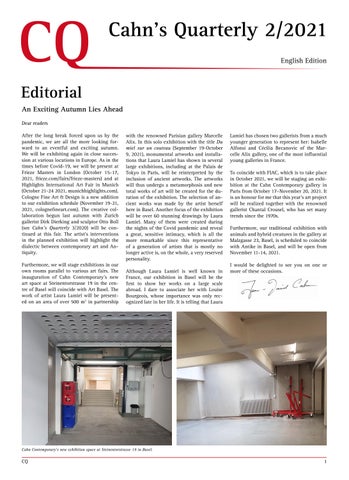
Editorial An Exciting Autumn Lies Ahead Dear readers After the long break forced upon us by the pandemic, we are all the more looking forward to an eventful and exciting autumn. We will be exhibiting again in close succession at various locations in Europe. As in the times before Covid-19, we will be present at Frieze Masters in London (October 15-17, 2021, frieze.com/fairs/frieze-masters) and at Highlights International Art Fair in Munich (October 21-24 2021, munichhighlights.com). Cologne Fine Art & Design is a new addition to our exhibition schedule (November 19-21, 2021, colognefineart.com). The creative collaboration begun last autumn with Zurich gallerist Dirk Dierking and sculptor Otto Boll (see Cahn’s Quarterly 3/2020) will be continued at this fair. The artist's interventions in the planned exhibition will highlight the dialectic between contemporary art and Antiquity. Furthermore, we will stage exhibitions in our own rooms parallel to various art fairs. The inauguration of Cahn Contemporary’s new art space at Steinentorstrasse 19 in the centre of Basel will coincide with Art Basel. The work of artist Laura Lamiel will be presented on an area of over 500 m2 in partnership
with the renowned Parisian gallery Marcelle Alix. In this solo exhibition with the title Du miel sur un couteau (September 19-October 9, 2021), monumental artworks and installations that Laura Lamiel has shown in several large exhibitions, including at the Palais de Tokyo in Paris, will be reinterpreted by the inclusion of ancient artworks. The artworks will thus undergo a metamorphosis and new total works of art will be created for the duration of the exhibition. The selection of ancient works was made by the artist herself here in Basel. Another focus of the exhibition will be over 60 stunning drawings by Laura Lamiel. Many of them were created during the nights of the Covid pandemic and reveal a great, sensitive intimacy, which is all the more remarkable since this representative of a generation of artists that is mostly no longer active is, on the whole, a very reserved personality. Although Laura Lamiel is well known in France, our exhibition in Basel will be the first to show her works on a large scale abroad. I dare to associate her with Louise Bourgeois, whose importance was only recognized late in her life. It is telling that Laura
Lamiel has chosen two gallerists from a much younger generation to represent her: Isabelle Alfonsi and Cécilia Becanovic of the Marcelle Alix gallery, one of the most influential young galleries in France. To coincide with FIAC, which is to take place in October 2021, we will be staging an exhibition at the Cahn Contemporary gallery in Paris from October 17–November 20, 2021. It is an honour for me that this year’s art project will be realized together with the renowned gallerist Chantal Crousel, who has set many trends since the 1970s. Furthermore, our traditional exhibition with animals and hybrid creatures in the gallery at Malzgasse 23, Basel, is scheduled to coincide with Antike in Basel, and will be open from November 11-14, 2021. I would be delighted to see you on one or more of these occasions.
Cahn Contemporary’s new exhibition space at Steinentorstrasse 19 in Basel.
CQ
1
Cahn’s Quarterly 2/2021
Discovered for you
Architectural Decoration By Gerburg Ludwig
Von Gerburg Ludwig
Fig. 1: AN ANTEFIX. H. 16.1 cm. Marble. Greek, 4th cent. B.C.
In CQ 1/2021, pp. 2–3 we had a closer look at the three Classical orders. Let us now raise our gaze up to the beams and roof and study their decoration. The pediments and entablatures of the Parthenon (448-432 B.C.) on the Athenian Acropolis, for instance, were embellished with figures and scenes, whilst the Erechtheion (420-406 B.C.) also boasted rich ornamental decoration. However, the visual effect remains fragmentary. Well-preserved architectural sculpture can be found in museums. Some of it was "saved" in the 19th century or acquired and taken abroad, as was the case with the socalled Elgin Marbles, including most of the well-preserved South Metopes, parts of the cella frieze and the statues from the Parthenon pediments, all of which entered the British Museum. The Munich Glyptothek houses the “Aeginetes”, all of them sculptures from the pediments of the Aphaia temple on the island of Aegina (510/480 B.C.). Written sources enable us to understand better the overall impression made by these buildings. Pausanias, for instance, describes the decoration of the Temple of Zeus and Hera at Olympia and of the Parthenon. Archaeological reconstructions, such as Ernst Berger's important "Parthenon Project" in the Skulpturhalle Basel, enhance the picture. There, casts of all the surviving architectur2
CHF 3,400
Fig. 2: A SPOUT. H. 12 cm. Terracotta. Western Greek, 4th-3rd cent. B.C. CHF 2,800
al sculpture of the Parthenon are presented in their original group context. Digitization makes more detailed and precise reconstructions possible, and these can be modified immediately in the event of new findings, as exemplified by the 3D-reconstruction of the Temple of Zeus in Olympia (470/456 B.C.) by the University of Eötvös Loránd, Budapest. How impressive these mythological scenes hewn in stone must have been for visitors in Antiquity! On the west pediment of the Parthenon, elevated some 18 metres above the ground, they would have seen the dispute between Athena and Poseidon for Attica. The dynamic movements of the figures, the fluttering robes, the chariots with rearing horses all increase in intensity towards the centre of the composition, where the quarrelling protagonists seem to recoil from each other. Such frenetic scenes were familiar to visitors only from vase painting, if at all. The Panathenaic Procession depicted on the cella frieze reflected the Athenians' religious ceremonies. The Erechtheion in the north was magnificently ornamented with interlaced patterns, anthemia (lotus palmette friezes) and cymatia on the columns, entablature and cornice as well as with further decorative elements on the roof. Today, the view of the roofs if replaced by that of the sky, even in the case of well-pre-
served buildings such as the Hephaisteion on the Athenian Agora (450/415 B.C.). Ancient roof trusses were made of wood and were thus not fireproof. Furthermore, everything that was not solidly connected with the building was liable to be dismantled, reused or simply taken elsewhere. Roof tiles were made of clay, especially in Western Greece and Etruria, where they were often painted, or marble, as in the Temple of Zeus at Olympia. As written and epigraphic sources do not describe roofs in detail, archaeologists and building researchers often need to go through the tedious process of identifying the original position of individual fragments found in the surroundings of a building or already moved to storage areas. The shape of the roof tiles varied from region to region. The joins between the flat or concave tiles (stroter) placed on the rafters were covered by curved or angular tiles (calypter). The open end of the calypters was closed by a front tile (antefix) that was decorated with painted or relief palmettes. Other motifs that were popular, especially with the Etruscans, included Gorgoneia, masks, the heads of korai and hybrid creatures. The gutter (sima) featured spouts or lion’s heads that let the rainwater escape. Vitruvius stresses their correct placement: the openings should be located above the columns, not between them (De architecCQ
Cahn’s Quarterly 2/2021
tura 3, 5, 15). Ridge ends and roof corners were embellished with floral or figural acroteria. Architects gave free rein to their imagination when choosing decorative motifs, which included single figures or groups (especially abduction scenes), hybrid creatures and Gorgoneia. The ridge of the Temple of Zeus at Olympia was adorned with hovering Victories and the corners of the roof with tripods, whilst the roofs of the Parthenon and the Arsinoeion of Samothrace (3rd century B.C.) boasted imposing palmette-tendril ornaments. The beams and roof were built using perfect proportions. A decisive factor for the beholder on the ground was that the building’s perspective was adjusted slightly by a minimal forward inclination of the façade (Vitruvius, De architectura 3, 5, 12–13). The reconstructed Stoa of Attalos on the Athenian Agora (159–138 B.C.) provides an opportunity to experience the overall effect of an ancient building. Viewers who let their gaze wander upwards will see palmette antefixes and slightly inclined lion's head waterspouts on the edge of the roof. Friedrich Adler's engraving (fig. 3) shows the sima from different angles (G. Erbkam (ed.), Atlas zur Zeitschrift für Bauwesen 25, 1875, loose plate 16). Similarly, the marble antefix with a palmette (fig. 1) on offer at the Cahn Gallery once graced the sima of a building. Seven leaves, each with a central groove, fan out from a lily-shaped base. The whole is framed by a broad profile. A step in the profile marks the transition to the next identical antefix. The back and underside reveal some technical details: the stonemason only roughly smoothed them, so that many tool marks are still visible. The convex back of the antefix rests vertically on the 13.8-cm-deep, horizontally arched sima in a manner resembling that of the sima of the Stoa of Attalos, as drawn by Adler in his plan view. The lion’s head waterspout (fig. 2) at the Cahn Gallery likewise once adorned the clay sima on the roof of a building. It was originally surrounded by a flat plaque which was integrated in the sima. The coroplast took into account that the figure was meant to be viewed from a distance. Using his hands and different modelling sticks he made deep grooves on the head and flat curved ones around the mouth to represent the mane. He punched the pupils of the deep-set eyes with a circular stick and carved herringbone grooves on the nose and curved ones around the mouth. The mouth is wide open for the water to gush out, revealing the upper teeth and lolling tongue. The smoothed, slightly concave reverse has an oval recess at mouth level. CQ
My Choice
An Oriental Devotee By Jean-David Cahn During a recent visit to Paris, I discovered an extraordinarily interesting bronze applique in high relief which probably adorned an altar originally. As early as 1963, this impressive statuette from M. La Tournerie's private collection was shown on loan to the Louvre and published in the exhibition catalogue: F. Braemer, L'art dans l'occident romain. Trésors d'argenterie. Sculptures de bronze et de pierre (Paris 1963) no. 768. The work was also included in the corpus of the representations of Attis and Cybele: Corpus Cultus Cybelae Attidisque V, 1986, 78, no. 214. Artistically, the bronze is of a high quality with finest details executed in cold work, especially in the hair and face. The cast itself is heavy and thick-walled. The statuette represents a woman striding to left, with her open right hand raised in a distinctive gesture. In her left hand, which is slightly lowered, she holds a square box, probably a casket containing a votive offering. She A BRONZE APPLIQUE OF A DEVOTEE. H. 17.3 cm. Bronze. Roman, 1st-2nd has a beautiful face with cent. A.D. CHF 26,000 large, open eyes. The wavy hair is parted in the middle and care- ther god of the Phrygians and Thracians, fully combed to the back of the head, where the cult of Mithras with its seven levels of it forms a chignon at the nape of the neck. initiation, or the cult of Attis and Cybele, The woman wears an outer garment with with its excesses of ecstasy culminating in long sleeves that is belted below the breasts, the self-mutilation of its priests. The figure long trousers (anaxyrides or braccae) that probably represents a devotee or priestess are rolled up at waist level, and a long coat performing a rite of some kind, but much that is fastened in the middle with a round remains a mystery. fibula just below the neck. Her laced, closed shoes are folded back at ankle height. A In terms of religious history, this fine statubracelet adorns her left wrist. The conical ette is of the greatest importance. I am decap looks particularly exotic. The costume lighted to be able to offer you such a muis indicative of an oriental cult, such as the seum piece with an impeccable provenance cult of Sabazios, the horseman and sky fa- and that has also been published. 3
Cahn’s Quarterly 2/2021
The Debate
Healing Stones and Images By Véronique Dasen in astrological and medico-magical treatises. He was associated with the decan (one tenday-long segment of the zodiac) of Leo, which governed heart and belly, in particular the stomach and the uterus. Chnoubis also controlled the lactation process which was compared by medical authors with the digestion of menstrual blood. Sometimes, inscriptions like the one on the reverse of the gem illustrated invoke Orôriouth, the deity controlling the opening of the uterus for delivery (fig. 1b). Others are inscribed with three kappas, KKK, which probably stand for kolike, a word denoting uterine pain caused either by menstruation or childbirth.
Fig. 1a-b: A MAGIC GEM WITH UTERUS SYMBOL. H. 1.7 cm. Haematite. Roman, 2nd-3rd cent. A.D. Private collection. Owner’s photograph.
The so-called “magical” intaglios of the Roman period (2nd-3rd century A.D.), usually made from semi-precious stones worn as rings or pendants, illuminate the network of correspondences believed to link the body to the natural and divine worlds in Antiquity. They form a specialised category of amulets promoting success, warding off malevolent influences, or healing diseases. They combine different powers: the efficiency of the selected stones, often associated with specific colours, divine images and names, formulas and symbols from Egyptian, Jewish and Graeco-Roman repertoires, carved on both sides of the stone and even on its rim. Unlike “normal” intaglios (fig. 4), these gems were not usually produced to serve as seals.
selected for the gem illustrated above with a symbolical image of the uterus in the form of a medical cupping device (fig. 1a). The gem unites metaphorically the masculine generative energy of the stone – a dark grey iron ore thought to be the coagulated blood of Uranus, who was emasculated by Chronos – and the capacity of attraction of the suction cup. This imaginary womb is kept closed by a key symbolising the expected control of blood flows during menstruation or delivery, as well as of the blood feeding the foetus during pregnancy. Two Egyptian deities, a mummiform Anubis, guardian of passages, and Isis, patron of the new life to come, surround the lion-headed snake Chnoubis on top of the cupping device. The competences of Chnoubis are described
Magical stones for children? One category of stones depicting the lion-headed snake Chnoubis represents a special subtype of the milk stones used by mothers or hired wetnurses. A veined chalcedony with the triple sign of Chnoubis, SSS (fig. 2ab), corresponds to the galaxias described as “traversed by blood-red or white streaks” in Pliny’s Natural History (37, 59). The figure of Chnoubis on a large series of white or milky stones, is also associated with the injunction “pesse” (digest!), a command which was perhaps an exhortation to lactation. According to Pliny, milk stones were melted in the mouth. This could explain the soft oval shape like a seed or a sweet of most gems engraved with Chnoubis. Ancient medical doctors, like Galen, recommended remedies to be put under one’s tongue. Chnoubis stones worn as pendants may have been sucked by babies and could be the oldest preserved lollies.
The system of pictures and signs on these miniaturised spaces functions as a rebus, conveying collective memory and knowledge in the manner of glyphs. A large number of stones had a therapeutic function for children as well as for adults. They evidence the development in the Roman period of a religious experience relating to individual concern for health care, implying a personal communication with the divine. Caring for the female body In the gendered world of stones that were believed to be male or female, many aimed at safeguarding the unborn child and fertility, which were major anxieties of everyday life. They also show the powers at work in the female body. Haematite (“blood stone”) was 4
Fig. 2 a-b: A MAGIC GEM WITH THE LION-HEADED SNAKE CHNOUBIS AND THE TRIPLE SIGN OF CHNOUBIS. H. 2.0 cm. Chalcedony. Roman, 2nd-3rd cent. A.D. Private collection. © Photo Magdalena Depowska.
CQ
Cahn’s Quarterly 2/2021
This type of stone might also have been intended to prevent infants’ colics. A few gems are engraved with the name of a child. The inscription on a green jasper stone formerly in Istanbul seeks to “Avert all tension, all indigestion, and all pain from the stomach of Julian, whom Nonna bore.” The trouble could be due to intestinal parasites mastered by Chnoubis, as inscriptions indicate. Some
Roman Period and were thought to ward off evil. Omphale’s defensive gesture operates as a pun: the donkey and the woman use the same weapon, the skutale, the same word designating both the club and the phallus. It simultaneously defines both the sexual nature of the threat and its full control. The name Omphale, after omphalos, stresses her competences as it refers both to the
Fig. 3 a-b: A MAGIC GEM WITH OMPHALE AND DONKEY. H. 1.6 cm. Red jasper. Roman, 2nd-3rd cent. A.D. The J. Paul Getty Museum 82.AN.162.80. © The J. Paul Getty Museum, Villa Collection, Malibu, California.
call Chnoubis “gigantorektes, barophites”, (giant-slayer, crusher of snakes). The giant snakes could be internal, and the heroic feat very intimate. Stomach pains caused by parasitic infections were ubiquitous in ancient times. The lion-headed snake, guardian of the belly, was the right warrior to fight off an invasion of serpents, albeit miniature ones. These might have been pinworms, which are white in colour and look like the triple S of the Chnoubis sign. Omphale and Hercules One specific category of magical stones is made of dark red jasper. These depict a naked, squatting woman, often with a swollen, pregnant belly, wearing the leonte and brandishing a club, as, for instance, in fig. 3 a. Her attributes and the inscriptions allow her to be identified as the mythical queen Omphale. She is often paired with her lover Hercules strangling the Nemean lion. Her adversary is an ithyphallic donkey which, in ancient Egypt, embodies the dark forces that cause accidents, diseases and evil in general. The donkey with lowered head on the Getty gem (fig. 3b) along with the club as the weapon Hercules uses to defeat dangerous creatures allude to Omphale’s successful action. The club’s symbolic function can be equated with that of the phallus. Charms in the shape of phalloi were widespread in the CQ
cord uniting mother and child and to sexual excitement on a metaphorical level. The elements drawn from Greek and Egyptian iconography thus construct a new discourse about women’s agency. An unexpected Omphale substitutes for Hercules as a powerful patron of women’s health combining the role of lover, mother, ruler and magician.
For further reading: V. Dasen, Le sourire d’Omphale. Maternité et petite enfance dans l’Antiquité. 2015. V. Dasen, Á.M. Nagy, Gems, in: D. Frankfurter (ed.), Guide to the Study of Ancient Magic, 2019, 406-445. V. Dasen, Magical Milk Stones? in: J.F. Martos Montiel, C. Macias Villalobos, R. Caballero Sanchez (eds.), Plutarco, entre dioses y astros. Homenaje al profesor Aurelio Pérez Jiménez de sus discípulos, colegas y amigos, vol. 2, 2019, 1035-1048. V. Dasen, F. Sapdini (eds.), Bijoux antiques: de l'ornement au talisman. Identités et pratiques sociales. Gemmae. An International Journal on Glyptic Studies, 2, 2020, and 3, 2021.
Véronique Dasen is professor of classical archaeology at the University of Fribourg and associate member of ANHIMA Paris (UMR 8210). Her research is guided by a multidisciplinary and anthropological perspective. She has published extensively on ancient iconography and material culture, the history of the body, medicine and magical practices, gender studies, history of childhood and ludic culture, with several major exhibitions (2010-2015 Quoi de neuf docteur? La médecine et la santé à l’époque romaine, 2014-2020 Veni, vidi, ludique. Ancient Games and Toys). She is currently leading a five year research project funded by the European Research Council, Locus Ludi: The Cultural Fabric of Play and Games in Classical Antiquity (ERC advanced #741520). Websites: www.pentelitha.ch and www.locusludi.ch
Imprint Publisher Jean-David Cahn Malzgasse 23 CH-4052 Basel www.cahn.ch ISSN 2624-6368 Fig. 4: A GEM WITH SPHINX. W. 1.9 cm. Carnelian. Roman, 2nd half of 1st cent. B.C.-1st half of 1st cent. A.D. At the start of his political career, Octavius used two seals bearing the image of a sphinx that had belonged to his mother Atia. The caduceus in front of the sphinx on this carnelian stone might refer to the Emperor Augustus who liked to identify himself with Hermes, the messenger of the gods. CHF 26,000
Editors Jean-David Cahn Yvonne Yiu Authors Jean-David Cahn Véronique Dasen Martin Flashar
Ulrike Haase Gerburg Ludwig Photos Niklaus Bürgin Ulrike Haase Translations Yvonne Yiu Design and Layout Michael Joos Yvonne Yiu
5
Cahn’s Quarterly 2/2021
Clever Combinations - Objects Made of Different Materials
AN ATTIC BLACK-FIGURE LITTLE-MASTER CASSEL CUP WITH SIRENS. H. 9.5 cm; Dm. 14.2 cm (without handles). Clay. Formerly Coll. Dr. K. Deppert, Frankfurt. Subsequently Coll. Päselt (inv. no. 29), since the 1970s. Greek, Attic, ca. 530-520 B.C. CHF 8,000
New Artworks Monthly on www.cahn.ch
A SMALL RED-FIGURE LEKYTHOS. H. 11.8 cm. Clay. Formerly Coll. J. M. E., New York, acquired from Gallery G. Puhze, Freiburg, in October 1984. Attic, 450-425 B.C. CHF 1,800
A KNIFE WITH BIRD HANDLE. L. 17.2 cm. Bronze with high percentage of tin, iron. Formerly priv. coll. W. L., USA, early 1990s. Northeastern Urals/Western Siberia, 5th-10th cent. A.D. CHF 5,000
A THEATRE MASK OF A SLAVE. H. 9.8 cm. Terracotta. Mask of a slave from Attic Comedy with beady eyes set beneath prominent eyebrows, a furrowed forehead, a broad mouth opening and an ample wreath of hair. Formerly Galerie Serres, Paris. Thereafter priv. coll. B. D., Paris, 1987. Greek or Western Greek, 4th-2nd cent. B.C. CHF 4,000
A BRONZE FITTING IN THE SHAPE OF BUST. H. 6.6 cm. Bronze, gilding. The bust is crafted in great detail and probably represents a deity. The extensively preserved gilding suggests that the fitting once decorated a precious object, perhaps a piece of furniture. Formerly priv. coll. Austria, acquired in the 1990s on the art market. Greek, Hellenistic, 3rd-1st cent. B.C. CHF 3,000
A STATUETTE OF A DRAPED WOMAN. H. 21.7 cm. Terracotta. From the estate of the Swiss art dealer and collector Elsa Bloch-Diener (1922-2012), Bern, acquired between 1968 and 1983. Greek or Western Greek, 4th-2nd cent. B.C. CHF 5,500
6
A KNIFE WITH DUCK HEAD. L. 14.7 cm. Bronze (solid cast), iron. Formerly priv. coll., Great Britain, 1990s. Thereafter priv. coll. P. R., London. Roman, 1st-3rd cent. A.D. CHF 1,800
A WHITE-GROUND LEKYTHOS, ATTRIBUTED TO THE MANNER OF THE BIRD PAINTER H. 24 cm. Clay. Formerly Basel art market, Münzen und Medaillen A.G., 1956 (publ.: Auction 12, 19 June 1956, no. 150, illus.). Thereafter priv. coll. of the publisher M. Hagemann, Basel. Thence by descent in the family. Attic, 430-410 B.C. CHF 12,800
CQ
Cahn’s Quarterly 2/2021
A GROUP OF SIX DICE. W. 0.9-1.3 cm. Bone, lead, bronze. Formerly Munich priv. coll., since the early 1980s. Roman, 1st-3rd cent. A.D. CHF 750
A NECKLACE WITH AGATES AND GOLD PENDANTS. L. 43.8 cm. Banded agate, gold. Formerly priv. coll. F. Artuner, USA, 1990. Late Hellenistic, 2nd-1st cent. B.C. CHF 16,200
A PAIR OF GOLD EARRINGS. L. 3.2 cm. Gold, glass. Formerly priv. coll. R., England. Roman, 1st-2nd cent. A.D. CHF 1,200
A PLAQUE WITH A HUNTING SCENE. H. 6 cm. Tin-plated bronze. Formerly priv. coll., Austria, acquired on the Viennese art market in the 1980s. Roman, 2nd-4th cent. A.D. CHF 2,200
A PAIR OF GOLD EARRINGS WITH GLASS INLAY. L. max. 6 cm. Gold, glass. Black and white glass inlay (probably imitating layered agate) in a gold setting surrounded by spirals. Palmette above, three chain pendants with glass and mother of pearl beads below. Formerly priv. coll. of Maurice Bouvier (1901-1981). Thereafter by descent to his son Jean-Francois Bouvier. Mediterranean, Hellenistic, 2nd-1st cent. B.C. CHF 4,200
A FOLDING KNIFE WITH PANTHER OR LEOPARD HANDLE. L. handle: 5.8 cm. L. chain with key: 15 cm. Bone, iron, bronze. Formerly property of a private collector, acquired prior to 1975. Roman, 4th cent. A.D. CHF 4,400
A GOLD RING WITH CARNELIAN INTAGLIO (MINERVA OR ROMA). H. 2.2 cm. Gold, carnelian. Formerly priv. coll. B. and E. P., acquired 1997 from Galerie Puhze, Freiburg i. Br.; published: Galerie Günter Puhze, Cat. Kunst der Antike 12, 1997, no. 30. Roman, 1st-3rd cent. A.D. CHF 8,800
A RING Dm. 1.9 cm. Gold, garnet. Formerly Frank Sternberg, Zurich, Before 2000. Roman, 2nd-3rd cent. A.D. CHF 1,200 A TUTULUS FIBULA. W. 3.3 cm. Gold, bronze, carnelian. Domed oval brooch made of sheet gold ornamented with a net of gold filigree and set with a carnelian. Formerly priv. coll., Germany, 1970s-1980s. Roman, 4th-5th cent. A.D. CHF 4,600 A ROSETTE FIBULA. Dm. 3.6 cm. Silver, gold. Intricately worked fibula in the form of a silver rosette inlaid with fine gold wire. Central gold blossom set with a carnelian. Formerly priv. coll. J. M., England, 1990s. Europe, Late Roman-Migration Period, 4th6th cent. A.D. CHF 4,900
CQ
AN ARCHAISTIC HEAD OF A YOUTH, POSSIBLY APOLLO. H. 25.5 cm. Marble. Formerly priv. coll. Christen Sandberg (1861-1918), Norway. Thence by descent in the family. Christen Sandberg was an importer of coal and corn and German vice-consul, but it was his friendship with Danish and Norwegian artists that made him a public figure. He was portrayed by Edvard Munch. Roman, late 1st cent. B.C.-1st cent. A.D. Price on request
7
Cahn’s Quarterly 2/2021
Highlight
A Torso in the Classical Tradition By Martin Flashar The sculpture presented here raises two questions. The first is of a fundamental nature: What is a torso? Generally speaking, it is an incompletely preserved sculpture of a human body, without a head, arms or legs – a straightforward definition, behind which, however, lies an aesthetic debate with a long history. The ancient Torso Belvedere, that marble sculpture of the seated Silen Marsyas which entered the Vatican collections after 1530, occupies a special position. It was left in its fragmentary state, as no one dared to restore it for museum display, Michelangelo having refused a request from Pope Julius II to complete the missing parts. From the Renaissance to the 19th century the incompleteness of ancient sculpture was found unbearable as a rule and this resulted in countless additions, such as the “reconstruction" of the Aeginetes by the neoclassical Danish sculptor Bertel Thorvaldsen commissioned by the Bavarian King Ludwig I for their first installation in the Munich Glyptothek (1827). It was not until the advent of modernity, epitomised in the field of sculpture by the works of Auguste Rodin (1840–1917), that taste changed in such a manner that the fragment achieved autarky. Now, after an initial wave of fierce criticism, the torso attained acceptance as an autonomous art form. L’homme qui marche (1877), the bronze statue of a striding man got by without a head or arms because, as Rodin pithily observed: “What do you need a head to walk!"
tle upward motion of the left side.” He assigned the piece a fairly vague date: “after 300 B.C.”.
Indeed, some striking details of the statuette actually lead us to the Late Hellenistic Period. The lower lateral abdominal muscle bulges out in a way that would not have been possible previously (cf. the Torso Malibu, J. Paul Getty Museum, inv. no. 79.AA.146). The upper body is elongated, a common phenomenon in the 1st century B.C., as evidenced by the Youth from Magdalensberg in Vienna as well as by marble statuettes from the island of Delos. And last but not least, the abdominal area is noticeably “swollen” und the skin has a fragile, almost diaphanous appearance. The surfaces of bodies and faces of this period that evince this phenomenon are often described as “porcelain-like”. An interesting comparison is the statuette in Dresden, inv. no. ZV 2600 / A 39 from the expedition to Alexandreia led by Ernst von Sieglin (1898–1902). The figure was originally just under a meter high and thus belongs to the category of large statuettes. These are found in conspicuously large numbers in the Late Hellenistic Period, where they were used to adorn private villas. Who is portrayed? It can hardly be a A TORSO OF A YOUNG ATHLETE. H. 58 cm. Marble. Late Hellenmythological figure, which would need a istic, 1st cent. A.D., after Greek models of the 5th and 4th cent. B.C. context of action or an unambiguous atFormerly Coll. Prof. Hans Dahn (1919-2019), Lausanne; acquired tribute. Because of its close ties to Clas15.1.1957 in Basel. Published: K. Schefold, Meisterwerke griechischer sical models, it seems most likely that Kunst (Basel 1960) 268 f., no. VII 361 with illus. Price on request the sculpture represents a youth, and as However, this structure is overlaid, so to such embodies the qualities of the ephebe, the The second question is an archaeological one: speak, by a second layer in which the rhythm epitome of athletic prowess. In which period was this high-quality, attrac- of the body is further developed and loses its tive, slightly under life-size torso made? The fluidity, jutting upwards on the left side as the The sculpture formed part of the collection youth (without pubes) is completely naked. linea alba recedes. Such variations point in of Hans Dahn (1919–2019), which included He stands frontally, his pose deliberately ech- the direction of the followers of Polykleitos, other works of ancient art. An internationoing the contrapposto of Greek art. Invented to the Post-Classical Period of the 4th century ally renowned chemist, Dahn was a lecturer in the Early Classical Period, it served as a B.C. Related ideas can be encountered in the at the University of Basel and professor at perfect mirror, also of the delicate equilibri- school of the famous sculptor Praxiteles, for the University of Lausanne, where he headed um between the new democracy's political example in the Hermes of the Andros-Farnese the Institute of Organic Chemistry. In 1960, bodies and offices. Its consummate form is type, which is dated to around 350 B.C. But just a few years after its acquisition in 1957, inseparably linked to the name of Polyklei- there is also a third stylistic moment. As Karl the sculpture was displayed in the exhibition tos. Thus, the concept and execution of the Schefold sensitively observed: “The delicately Masterpieces of Greek Art (which marked an sculpture initially seem wholly Classical: The animated surface is free of anything academic important milestone leading to the foundaslight slant of the hips caused by the right [...], but it also lacks the unified movement of tion of the Antikenmuseum Basel in 1961). engaged leg and left free leg is answered by the Classical Period. On the contrary, what is This more recent history of the torso, in adthe countermovement of the raised and low- felt as a new stimulus is how the contraction dition to its quality, striking appearance and ered chest and shoulder lines. The head was of the right side of the body results in gentle archaeological significance, makes it all the originally gently inclined to the left. breaks in rhythm and contrasts with the gen- more attractive. 8
CQ