Cahn’s Quarterly 1/2026 English Edition
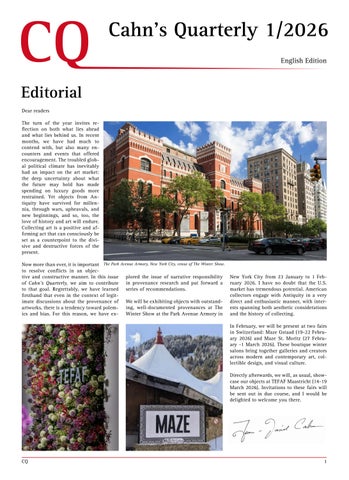
Editorial Dear readers The turn of the year invites reflection on both what lies ahead and what lies behind us. In recent months, we have had much to contend with, but also many encounters and events that offered encouragement. The troubled global political climate has inevitably had an impact on the art market: the deep uncertainty about what the future may hold has made spending on luxury goods more restrained. Yet objects from Antiquity have survived for millennia, through wars, upheavals, and new beginnings, and so, too, the love of history and art will endure. Collecting art is a positive and affirming act that can consciously be set as a counterpoint to the divisive and destructive forces of the present. Now more than ever, it is important The Park Avenue Armory, New York City, venue of The Winter Show. to resolve conflicts in an objective and constructive manner. In this issue plored the issue of narrative responsibility of Cahn’s Quarterly, we aim to contribute in provenance research and put forward a to that goal. Regrettably, we have learned series of recommendations. firsthand that even in the context of legitimate discussions about the provenance of We will be exhibiting objects with outstandartworks, there is a tendency toward polem- ing, well-documented provenances at The ics and bias. For this reason, we have ex- Winter Show at the Park Avenue Armory in
New York City from 23 January to 1 February 2026. I have no doubt that the U.S. market has tremendous potential. American collectors engage with Antiquity in a very direct and enthusiastic manner, with interests spanning both aesthetic considerations and the history of collecting. In February, we will be present at two fairs in Switzerland: Maze Gstaad (19-22 February 2026) and Maze St. Moritz (27 February -1 March 2026). These boutique winter salons bring together galleries and creators across modern and contemporary art, collectible design, and visual culture. Directly afterwards, we will, as usual, showcase our objects at TEFAF Maastricht (14-19 March 2026). Invitations to these fairs will be sent out in due course, and I would be delighted to welcome you there.
CQ
1
Cahn’s Quarterly 1/2026
The Debate
Narrative Responsibility in Provenance Research By Jean-David Cahn
Fig. 1: Auction catalogue of the collection of Salahaddin Refik Sırmalı, an important Turkish interior architect, art and antiquities dealer, and collector of the early to mid-decades of the 20th century.
In the art market, the question of provenance has become central, and the traceability of artworks is a crucial factor in all transactions. In this context, the provenance researcher has emerged as an indispensable figure. They investigate the history of objects, retracing their journeys through collections and sales, and documenting both private and public transfers of ownership. However, this new role comes with equally new responsibilities. Provenance research is not merely a technical task; it is also a form of narrative. Like any narrative, its relationship to the truth is influenced by the structure of language, the possibilities of omission, and the power of rhetoric. This article seeks to explore this responsibility. Provenance researchers must gather all relevant facts but also go beyond mere collection: they must embrace an ethic of comprehensiveness and nuance. They construct narratives by selecting documents, establishing relationships between events, and organizing chronologies. As Paul Ricœur observes in Temps et récit, a narrative is not an addition of facts but a configuration that gives them meaning (Ricœur, 1983). This process is invaluable, as it sheds light on blind spots and 2
Fig. 2: Document pertaining to the sale of various works of ancient art under the supervision of the Egyptian Ministry of Antiquities including “One fragment of Greek white marble of the king of kings Ptolemaios, that is, the face and a part of the head, the hair and neck incomplete, measuring 31 cm.”
draws attention to irregularities. Yet it is also inherently fragile, as it can transform fragments of reality into a shaped or even biased narrative, sometimes without the researcher being aware of it. A narrative can have immediate consequences for the reputation of those involved in the art trade, where a good reputation is essential to their very existence (Velthuis, 2005). Even the slightest imprecision or ambiguous phrasing can lead to a serious challenge to professional standing. Dealers, museums, and auction houses may have their credibility questioned on the basis of an incomplete account. This places a twofold ethical responsibility on the provenance researcher: not only should they detail the full sequence of events, but they should also be attentive to the ways in which their words shape public perception. Case Study: An Article by Lynda Albertson A case in point is the article published by analyst Lynda Albertson on the blog of the Association for Research into Crimes against Art (ARCA) on August 28, 2025.1 It refers to a portrait of Severus Alexander acquired in 2012 and a Ptolemaic portrait acquired in 2018.
Both were purchased at Christie’s by the Cahn Gallery and exhibited at TEFAF Maastricht from March 7-15, 2020. Albertson’s article discusses these objects within the context of the case of Ashraf Omar Eldarir, an antiquities trafficker arrested in New York on February 28, 2020, just a few days before the opening of the fair. His arrest was first made public on July 2, 2020, in an official press release from the Homeland Security Investigations branch of U.S. Immigration and Customs Enforcement (ICE/HIS)2, some four months after TEFAF had taken place. He was convicted in the United States on February 10, 2025, almost five years after his arrest. This example will help illustrate how rhetorical strategies, while not actually stating anything false, can still create a misleading and potentially damaging impression. The reader is led to believe that I knowingly continued to offer questionable objects for sale, or at least that I was negligent. In reality, however, the situation was quite different: I had acquired these pieces at public auctions, complete with provenance documents. The portrait of Severus was acquired with the following provenance, as stated in the catalogue: “Acquired by the grandfather of the current owner and brought to New York, prior to 1948; thence by descent.” The head, possibly of Ptolemy III, was purchased with the same provenance. I requested further information from Christie’s regarding this sculpture, and they provided the name of the collector: “Collection of Mr. Ashraf Eldarir, Brooklyn, New York. This was acquired by his grandfather, Ezeldeen Eldarir.” Christie’s also provided documents in Arabic dated 1941 and 1948, along with a translation of a 1941 letter stating that the object had been acquired by Mr. Salahaddin Sirmali (figs. 1-2). These documents made it possible to establish a connection between this sculpture and the portrait of Severus. Both sculptures were checked several times by the Art Loss Register and specialized police departments, without any negative findings. I was so confident in their legitimacy that I even published an article on the Ptolemaic head in Cahn’s Quarterly 1/2019, p. 5, confirming its provenance. A few days before the fair, rumors surfaced concerning the Eldarir provenance. We were unaware of Mr. Eldarir’s arrest, which had taken place just a few days before the fair opened and which was only made public several months later. Following discussions with TEFAF, it was decided that as long as the rumours were not substantiated, the objects should not be offered for sale but nonetheless exhibited, as they had already been listed on the fair’s official inventory during our gallery preparations in January 2020 and transportCQ
Cahn’s Quarterly 1/2026
ed to the Netherlands. The labels read “Price on Request”, accompanied by an internal note specifying that the pieces were not for sale. This is a common practice to avoid confusion amongst fair visitors, who might otherwise misinterpret the fact that an item is not being offered for sale. I then asked Christie’s to provide the original provenance documents. Auction houses often keep the originals and only give buyers copies or scans. Christie’s was ultimately obliged to take back the two pieces. However, they refunded only the hammer price, without covering the additional costs, which led to significant losses. Other dealers were also affected by issues related to the Eldarir provenance. To this day, it remains unclear whether the provenance documents were actually forged. It seems more likely that Christie’s decision to take back the pieces was motivated by other considerations, since Mr. Eldarir was arrested for trafficking, and not for the forgery of documents. Taken individually, the statements in Ms. Albertson’s article are not incorrect. But the way they are arranged rhetorically creates a misleading impression. It only takes a few stylistic choices to turn a neutral presentation into an insinuation: Juxtaposition: By placing two unrelated facts in the same paragraph, such as an artwork being displayed at a fair and a trafficker’s conviction, a mental link that suggests complicity is created, even when no direct connection exists. Selective omission: By describing an artwork as “still for sale”, but failing to clarify that, although it was on display, it was not actually offered for sale and therefore did not find a buyer before being returned, the impression of negligence on my part is created. Temporal framing: To use the phrase “despite the trafficker’s arrest” although the chronology is more complex can mislead the reader. These techniques do not involve making false statements. Rather, they rely on skillfully shaping the narrative, exploiting what communication theorists call “conversational implicatures” (Grice, 1975), to influence how the audience perceives the situation and to lead them to infer things that are not explicitly stated. In matters of reputation, such implicatures can be just as damaging as a direct accusation. Such narrative strategies radically change the way the facts are interpreted. This case illustrates the power of rhetoric: even a partial account can be enough to damage a professional’s reputation. In the art market, where trust CQ
is the most valuable form of capital (Velthuis, 2005), a distorted or incomplete narrative can have irreversible consequences. This is not to say that rhetoric is inherently negative. As Aristotle observed in his Rhetoric, rhetoric is the art of persuasion, aimed at identifying and using the most effective means to convince an audience. When applied to the sensitive area of provenance, it can, however, become pernicious and counterproductive. Finally, it is regrettable that Ms. Albertson did not take the trouble to contact me directly, neither to interview me nor to hear my version of the facts. This absence of dialogue undermines any claim her account might have to completeness and has denied me the basic right to be heard. Guiding Principles in Provenance Research In light of these risks, we propose five guiding principles for provenance researchers: Contextual completeness: It is not enough to describe an isolated fact (e.g. the display of an artwork on a specific date). It is also essential to provide information on what happened afterwards (removal, return, refund). Without this context, the account becomes misleading.
Conclusion The antiquities art market relies heavily on the work of provenance researchers, whose activity is essential for ensuring the legitimacy of transactions, preventing the circulation of illicit works, and facilitating their restitution. This mission is grounded in high ethical principles, and therefore requires methodological rigor and careful judgment. The partial presentation of facts, poorly managed rhetorical emphasis, or strategic omission can produce effects comparable to an unwarranted public condemnation. Each researcher, as a narrator, assumes a scientific and ethical responsibility: not to distort the facts through inappropriate or misleading rhetorical choices. In this context, safeguarding cultural heritage must go hand in hand with the protection of the individuals involved, be they dealers, collectors, or institutions, against unwarranted reputational harm. Provenance research must follow an objective and rigorous approach, that focuses on verifying facts and fully contextualizing events. The pursuit of truth may not be reduced to an art of insinuation; it must remain, in all its complexity, a pursuit of the most objective truth possible.
Cross-checking: As in journalism (Kovach & Rosenstiel, 2014), the researcher should obtain the viewpoint of all parties involved. To omit the account of a person concerned is to judge without giving them a chance to respond.
Bibliography Aristotle. (1991). On Rhetoric: A Theory of Civic Discourse (G. A. Kennedy, Trans.). Oxford University Press.
Rhetorical awareness: It should not be the aim to ban rhetoric, but to be aware of its effects. The juxtaposition of grave matters with neutral ones must be handled with care. Chronological clarity should be established. The use of expressions such as “despite,” “again,” or “still” must be justified and verified.
Kovach, B., & Rosenstiel, T. (2014). The Elements of Journalism. New York: Three Rivers Press.
Grice, H. P. (1975). Logic and Conversation. In: Cole, P. & Morgan, J. (eds.), Syntax and Semantics, (Vol. 3, pp. 41–58) New York: Academic Press.
Ricœur, P. (1983). Temps et récit I. Paris: Seuil Velthuis, O. (2005). Talking Prices: Symbolic Meanings of Prices on the Market for Contemporary Art. Princeton: Princeton University Press. Links
Scientific focus: Provenance researchers should conduct their work with a strictly scientific focus, and refrain from provoking controversy, writing sensationalist articles, or stirring up conflict. Any approach motivated by sensationalism or provocation undermines not only the reputation of the individuals involved but also the credibility and legitimacy of the entire field of provenance research. Discretion and cooperation: Researchers should handle provenance-related conflicts with discretion and a spirit of professional cooperation. The public display of emotional or hostile reactions, such as anger or outrage, tend to deepen distrust and hinder cooperation amongst the parties involved. Conversely, interactions based on mutual understanding and careful communication promote transparency, strengthen trust, and contribute overall to the preservation of our archaeological heritage.
https://art-crime.blogspot.com/2025/08/sixmonths-for-590-artefacts-case-of-us.html?m=1 1
https://www.justice.gov/usao-edny/pr/brooklyn-man-indicted-cultural-artifacts-smuggling-charges?utm_source=chatgpt.com 2
Imprint Publisher Jean-David Cahn Malzgasse 23 CH-4052 Basel www.cahn.ch ISSN 2624-6368 Editors Jean-David Cahn Yvonne Yiu Authors Jean-David Cahn Charlotte Chauvier Ulrike Haase
Translations Yvonne Yiu Photos Niklaus Bürgin Ulrike Haase Layout Michael Joos Yvonne Yiu
3
Cahn’s Quarterly 1/2026
Discovered for You
The Depths of Eternity On the Chthonic Symbolism of the Ichthyocentaur By Charlotte Chauvier
Fig. 1: A SCARAB WITH NYMPH AND HIPPOCAMPUS. L. 3.1 cm. Hard red stone, perhaps jasper. Late Hellenistic (scarab) and Roman (engraving), 2nd cent. B.C.-2nd cent. A.D. CHF 5’800
The bestiary of mythical sea creatures lists more than sixty hybrid beings combining human features with those of fish, among them Triton, the Tritons (Tritones), and hippocampi (fig. 1). Some chimeras possess elements originating from a third creature, such as the forelegs of a horse. Among these composite beings, the ichthyocentaur – or “marine centaur” – is remarkable for its easily recognizable iconography. By contrast, representations of the god Triton, with whom the ichthyocentaur is sometimes confused, remain more ambiguous. Originally, Triton was a local
divinity venerated by fishermen and sailors, who is attested as early as the 2nd millennium B.C., notably in Boeotia and Crete. It was only in the 6th century B.C., when Poseidon established himself as ruler of the seas, that Triton became a secondary deity, relegated to the rank of son of the god of the oceans.1 The marine centaur appears only rarely in ancient literature. The Greek term ἰχθυοκένταυρος is recorded on just two occasions: first, around 398 A.D., by the Latin poet Claudian,2 and later, in the 12th century A.D.,
Fig. 2: A wooden chest from Anapa, early 3rd cent. B.C. State Hermitage Museum, St. Petersburg, inv. no. Gp 1882.45. © The State Hermitage Museum, St. Petersburg.
4
by the Byzantine poet Ioannes Tzetzes.3 From an iconographic perspective, the earliest known depiction4 of this hybrid creature occurs on a wooden chest from Anapa (fig. 2), dated to the early 3rd century B.C. The scene shows Nereids riding sea creatures as they cross the threshold into the afterlife to bring the deceased Achilles his weapons. The ichthyocentaur is typically distinguished by a range of maritime attributes, including fish, dolphins, a rudder, an anchor, a trident, an oar, a mask, or crustacean pincers. He is also often shown holding musical instruments, mostly a conch shell, but occasionally also a double flute, lyre, or syrinx. At times, the
Fig. 3: A terracotta figurine, Boeotian, Tanagra, 2nd quarter 6th cent. Musée du Louvre, Paris, inv. no. MNB 1313. © RMN.
CQ
Cahn’s Quarterly 1/2026
Fig. 4: A foot of an Apulian vase, 400-380 B.C. Museum Schloss Hohentübingen, inv. no. 5790. © Münzen und Medaillen AG, Basel.
brid creatures, considered to be his companions or sons. In the 4th century B.C., the iconography of the ichthyocentaur gradually took form through the fusion of elements derived from Triton and the hippocampus. This visual interplay is particularly evident on the foot of an Apulian vase (fig. 4), where the long fins that emerge from the lower body of a Triton in combat with Heracles recall the outstretched legs of a galloping hippocampus, as depicted, for instance, on a contemporary relief (fig. 5).6 A major iconographic turning point occurs with the Great Altar of Pergamon (fig. 6), created toward the end of the reign of Eumenes II. This monumental work contains the only known marble depiction in which Triton is explicitly identified by an inscription. It marks
Fig. 5: A relief from a Roman mausoleum called the Tomb of Julius, Saint Rémy, 2nd half 1st cent. B.C. © Espérandieu, E., 1922, p. 97.
figure is represented with traits characteristic of satyrs, such as pointed ears, or wearing a nebris and carrying a lagobolon, pedum, simple staff or torch, thereby associating him with the realm of Dionysos. He is also depicted with objects from convivial or cult settings such as the skyphos, kantharos, thyrsus and kalathos, as well as with feminine or domestic accessories such as jewellery, mirrors, chests, or baskets filled with food.
The figure of Triton experiences a process of pluralization in which the iconographic boundaries between certain marine deities begin to blur or are redefined, eventually giving rise to entirely new forms. This phenomenon can be traced as far back as the 6th century B.C., as shown by a terracotta statuette with two opposing Tritons painted on its chest (fig. 3).5 At this stage, the figures no longer represent the god Triton himself, but rather minor hy-
Fig. 6: North and south-west friezes of the Great Altar of Zeus from Pergamon, 170-160 B.C. Staatliche Museen zu Berlin, Antikensammlung, inv. Pergamonaltar. © Staatliche Museen zu Berlin, Antikensammlung.
CQ
a decisive break with earlier visual tradition, introducing a new conception of the marine deity. By the following century, in Roman art, this evolution culminates in a profusion of hybrid marine figures, reflecting the richness and adaptability of the aquatic pantheon. Ichthyocentaurs are mostly found, in a variety of iconographic contexts, on Roman sarcophagi dating from the 2nd to 4th centuries A.D. One of the most popular themes explored from the 2nd century A.D. onwards, was that of Venus emerging from the sea, carried in a shell by two sea centaurs (fig. 7), evoking her mythical journey to the island of Cythera. Around 160 A.D., sarcophagi with sea monsters holding up a clipeus with the portrait of the deceased person emerged (fig. 8).7 Some twenty years later, around 190 A.D., sarcophagi in which the clipeus is replaced by a shell developed (fig. 9), probably as the result of a formal and thematic fusion with the motif of Venus in the shell.8 The imagines, or mythological masks, form another iconographic group that appeared at the beginning of the 2nd century A.D. Frequently represented figures include Oceanus (fig. 10), the embodiment of the life force of water, and the Gorgon (fig. 11), an ambivalent deity, mistress of life and death. These figures play an apotropaic role, symbolically protecting the deceased in their passage to the afterlife.9 The same period witnesses the elaboration of the marine thiasos (fig. 12). Here, in analogy to Bacchic processions, a cortege of marine beings — Tritons, Nereids, sea centaurs — glides through an aquatic universe redolent with mythological and funer5
Cahn’s Quarterly 1/2026
Fig. 7: A sarcophagus, Roman, late 2nd cent.-early 3rd cent. A.D. Gregoriano Profano Museum, Vatican, inv. no. 10567. © MVF.II.18.23.
Fig. 8: A sarcophagus from the city of Rome, last quarter 2nd cent. A.D. Museo Nazionale delle Terme, Rome, inv. no. 104479. © With permission of the Ministero dei beni e delle attività culturali e del turismo.
ary connotations.10 This motif harks back to that of the Nereids on sea creatures bringing the deceased Achilles his weapons, which was already laden with funerary associations and the concept of immortality in classical Greek times.11 On a pelike (fig. 13), Nereids and sea monsters form a frieze around the belly of the vase, while a female figure stands in a funerary naiskos on the shoulder, reinforcing the connection between marine iconography and the commemoration of the dead. Roman depictions of marine centaurs carrying a clipeus or a shell have given rise to numerous interpretations over the centuries. As early as 1698, Filippo Buonarroti12 proposed a symbolic reading of these scenes, which he regarded as an allegory of the deceased’s voyage to the Isles of the Blessed. According to him, the floating draperies of the Nereids, swirling around their bodies, evoke the breeze with which the wind gods speed their mythical journey. This interpretation was radically challenged in 1939 by Andreas Rumpf,13 who ascribed to these compositions a purely ornamental role, devoid of any eschatological meaning. Three decades later, in 1969, Hugo Brandenburg14 likewise distanced himself from Buonarroti’s symbolist reading, arguing that these images had more of a civic rather than religious dimension, as the portrayal of the deceased within a clipeus conferred him 6
dignity and solemnity, whilst the marine procession, with or without the imago clipeata, referred to eternal pleasures and to a peaceful vision of the afterlife. In 1970, Hellmut Sichtermann15 entered the debate, partly diverging from Brandenburg’s position. Taking up the theses of Friedrich Matz,16 which are shared by a broad majority of archaeologists,17 he argued that the imago clipeata borne by mythical creatures was not merely a portrait, but in fact the apotheosis of the deceased, who was thereby raised to the rank of a hero. He nonetheless rejected the hypothesis of a voyage to the Isles of the Blessed, interpreting the scenes surrounding the clipeus as an idealized image of happiness in the afterlife. This message of posthumous felicity seems reinforced by the amorous iconography: Nereids and ichthyocentaurs embrace, exchange glances or kisses, thereby evocating the pleasures of love transposed into a funerary setting. More recent research, notably that of Josef Engemann and Henning Wrede, continues along the lines of Hellmut Sichtermann’s work, consolidating this symbolic reading of a harmonious and idealized hereafter.18 Today, archaeologists increasingly concur that the ichthyocentaur served as a psychopomp or guide of souls. In this regard, Francesca Brizzi's study of the Great Altar of Pergamon provides significant insights.19 On the northwest side of
the front façade, there is a young, beardless Triton with short hair – an iconography that seems to derive from that of satyrs. This Triton has a slender tail, horse's legs and, most notably, wings, a rare element in his iconography.20 Covered with scales, the wings resemble those of aquatic or reptilian creatures rather than birds. This detail acquires particular significance in the context of Archaic art, where Triton and Nereus are sometimes depicted with the tail of a fish or snake. This visual interchangeability between the aquatic and reptilian spheres reflects, in the Greek mentality, a symbolic proximity to the chthonic world – that is, the realm of the dead.21 The composition of the sculptural program on the west façade of the Great Altar, with its symmetrical arrangement22 juxtaposing two mythological thiasoi, reinforces this interpretation. The representation of Amphitrite accompanied by her son Triton on the north risalit is mirrored by Semele in combat alongside her son Dionysos on the south risalit. This double scene establishes a symbolic parallel between the mothers, Amphitrite and Semele, and their sons, Triton and Dionysos.23 The equine component of Triton evokes both the centaur, a figure associated with the Dionysian world, and the horse of Poseidon, god of the sea, earthquakes, and horses. Dionysos is likewise a chthonic divinity: according to certain Orphic traditions, he experienced death before being reborn, and is thus intimately connected with the mysteries of the afterlife.24 Moreover, a symbolic analogy between the sea and wine can be found as early as the epics of Homer,25 and is most strikingly illustrated on the famous cup by Exekias. Both the sea and wine were thought capable of inducing a state of self-transcendence or loss of control, which could lead to the violation of social norms if not properly mastered. The sea was perceived as a perilous space that could deprive the deceased of a worthy burial,26 while wine, consumed improperly, engendered violence and hubris. The placement of these scenes on the west façade of the Great Altar, the side of the setting sun, is not without significance. In ancient Greek thought, and especially in Hesiod,27 the West is a metaphor for the end of life and the entrance into the realm of the dead. From this perspective, the presence of Triton in this zone seems a deliberate allusion to his chthonic nature and reinforces his role as ferryman, entrusted with escorting souls on their final journey. According to the archaeologist Fabio Fabini, the iconography of the ichthyocentaur is closely connected with the funerary realm, by analogy with the figure of the centaur, whose chthonic function is attested to in ancient literature.28 This hypothesis rests in particular on the analysis of a disc discovered in a funerary context (fig. 14). At the centre of the CQ
Cahn’s Quarterly 1/2026
Fig. 9: A sarcophagus, Roman, late 2nd cent.-early 3rd cent. A.D. From the cathedral of Siena, now in the Museo dell'Opera del Duomo, Siena, inv. no. 635. © Arachne.
Fig. 10: A sarcophagus, Roman, 130-140 A.D. National Museum, Rome, inv. no. 465. © With permission of the Ministero per i Beni e le Attività Culturali - Soprintendenza Archeologica di Roma.
Fig. 11: A sarcophagus, City of Rome, early to 3rd quarter 2nd cent. A.D. Lapidary Gallery, Vatican Museums. © Arachne.
Fig. 12: A sarcophagus, Roman, ca. 140-150 A.D. Musée du Louvre, Paris, inv. no. MA 342. © RMN.
disc, Eros, who drives a quadriga, is accompanied by Dionysus and Semele, the latter holding a thyrsus in one hand and a kantharos in the other. A thunderbolt is depicted behind Eros. At the top of the composition, the busts of Helios on the left and Selene on the right frame three spheres, that are interpreted as the Moirai, deities of fate and guardians of cosmic cycles. The chariot is led to the right by Hermes, messenger of the gods and guide of souls, who walks towards the astrological sign of Scorpio that forms part of the zodiac adorning the rim of the disc. This detail is not insignificant, for in ancient tradition Scorpio is frequently associated with death, transformation, and the passage to the invisible. The celestial vault, depicted as a starry sky, is supported by two Atlantes, emphasising the cosmic and universal dimension of the cycle of life and death. Among the signs of the zodiac, the unique appearance of Sagittarius, who is represented with the tail of a fish, CQ
is noteworthy. This iconographic anomaly is significant, for the hybrid representation of Sagittarius strongly recalls the ichthyocentaur, thereby underscoring the interconnectedness of the celestial world, individual destiny, and the afterlife. This disc depicts the triumphant ascent of Semele. She is accompanied by her son Dionysus who brought her back from the underworld and granted her immortality.29 This scene, deeply marked by the symbolism of rebirth and apotheosis, finds a literary echo in an epigram from the Palatine Anthology: “On Dionysus conducing his mother Semele to heaven, preceded by Hermes, and escorted by Satyrs and Sileni bearing torches. The fair-haired daughter of Cadmus and Harmonia, slain in childbirth by the bolt of Zeus, is being led up from Acheron by her son Dionysus, the thyrsus-lover, who avengeth the godless insolence of Pentheus.”30
Fig. 13: An Apulian pelike by the Lycurgus Painter, 340330 B.C. National Museum of Jatta, Ruvo di Puglia, inv. no. J 1500. © Soprintendenza Archeologica per la Puglia.
In ancient thought, the signs of the zodiac represented the gates of heaven,31 through which the souls had to pass in order to gain access to the divine. The sign of Scorpio, in particular, is singled out in several late sources, especially at the end of the 4th century A.D., where a text observes that it was by this path that Heracles accomplished his anodos, his ascent to Olympus.32 On the disc, Semele follows this same route, thereby suggesting a form of heroisation, in keeping with certain Orphic and Pythagorean interpretations of the myth.33 According to a variant of the myth of Orpheus,34 he too was struck by the thunderbolt of Zeus for revealing the secrets of the mysteries to men.35 Death by lightning does not always signify the person’s annihilation but, on the contrary, can become the very means of divinization. Semele, who was struck by lightning36 whilst pregnant with Dionysus, attained immortality thanks to the intervention of her son. The thunderbolt on the disc therefore recalls no only her tragic death but also her divine rebirth and apotheosis, as is pointed out by the geographer Isidore of Charax, who was active between the 1st century B.C. and the 1st century A.D.37 The presence of Eros can be interpreted as an allusion to filial love, but also as a reference to the winged god’s role as psychopomp. This scene may be compared to another example of maternal apotheosis, depicted on a temple in Cyzicus erected by King Attalus II of Pergamon in honour of his mother Apollonis, wife of Eumenes II. Finally, the anomalous representation of Sagittarius with a fish tail, which seems to reinforce the chthonic dimension of the hybrid figure, situates the scene even more firmly within the sphere of funerary symbolism. The ichthyocentaur may have played a central role in emphasizing Triton’s chthonic character, situating him within a symbolic constel7
Cahn’s Quarterly 1/2026
20. With the exception of a mosaic in Delos (LIMC VIII, p. 74, no. 12), a frieze on the triumphal arch of Glanum in St Remy (LIMC VIII, p. 76, no. 31) and the Tritons represented on the tomb of Julius in Pompeii (LAMER, 1914, p. 841). 21. BRIZZI, 2008, p. 290. 22. SCHMIDT-DOUNAS, 1992, pp. 295-301. 23. QUEYREL, 2005, p. 128. 24. On the rebirth of Dionysos-Zagreus: Diodorus Siculus, Bibliotheca historica, V, 75, 4. 25. Homer, Iliad, XI, 298; Odyssey, I, 183; II, 421; IV, 474; V, 56; VI, 170; XI, 107; XIX, 172. 26. BRIZZI, 2008, p. 292. 27. Cf. Hesiod, Erga, v. 687. 28. On the centaurs in hell, cf. Virgil, Aeneid, VI, vv. 268287; Seneca, The Madness of Hercules, vv. 768-781. 29. BOYANCE, 1942. 30. ANTHOLOGIE PALATINE, 1928. W. R. Paton, The Greek Anthology, Book III, §3.1. 31. Cf. Heraclides Ponticus, myth of Empedotimus (known through an account by Varro). 32. SERVIUS, 1826. 33. BOYANCE, 1942, p. 212. 34. Cf. Pausanias, Description of Greece, IX, 30, 5. 35. In another version of the myth, Orpheus was torn apart by the Bacchantes, recalling the analogous death of the Orphic Dionysus, who was dismembered by the Titans. 36. Cf. Pindar, frag. 144; Olympic Odes, 4, 1 ff.; Euripides, The Madness of Heracles, 177 ff. 37. Hymne orphique, XV, Zeus, v. 8.; BOYANCE, p. 209. Bibliography Fig. 14: An Apulian terracotta disc, 50-31 B.C. From Brindisi, now in the Provincial Archaeological Museum Francesco Ribezzo, Brindisi, inv. no. 656. © Pierre Boyancé, 1942.
lation shared with Dionysus and Poseidon, two deities likewise associated with the underworld. In these depictions, where death is cast in a positive light, the ichthyocentaur assumes the role of a psychopomp, guiding the soul of the deceased towards eternal bliss. Some of these images may also allude to scenes from Dionysian mystery cults that convey an Orphic message of salvation and rebirth after death. Such beliefs, disseminated through the mysteries, gained wider currency in Pergamon during the 2nd century B.C. before gradually spreading throughout the Roman world. This religious development was doubtlessly shaped by historical circumstances, with the Roman annexation of Pergamon in 133 B.C. playing a decisive role in the cultural transfer between the Hellenistic East and the Latin West. From then on, this region could be seen as a spiritual crossroads, a site of transmission where local theologies, new iconographies, and eschatological aspirations emerged. 1. Cf. Hesiod, Theogony, vv. 930-933. 2. CLAUDIAN, 1922, vv. 155-160. 3. Cf. trans. G. Müller, 1811: v. 34, v. 886, v. 892: He draws on the text of Alexandra, written by Lycophron of Chalcis in the 3rd century B.C.
8
4. The mosaic of the destroyed Temple of Zeus in Olympia or the frieze of Lamia, National Museum, Athens, inv. no. 221-222 (date controversial) are possibly the earliest representations of ichthyocentaures (BALIL, 1960, p. 44).
Balil, A., (1960): “El mosaico romano de la Iglesia de San Miguel”, Cuadernos de Arqueologia e Historia de la Ciudad I, pp. 21-74, Barcelona: Museo de Historia de la Ciudad. Boyancé, P., (1942): “Le disque de Brindisi et l’apothéose de Sémélé”, Revue des études anciennes, vol. 44, nos. 3-4, pp. 191-216, Pessac: Maison de l'Archéologie, Université Michel de Montaigne-Bordeaux 3. Brandenburg, H., (1969): Repertorium der christlich-antiken Sarkophage, Mainz: von Zabern.
5. For the earliest mention of Tritons, cf. Moschos, Buccolica, 2, 122-124.
Brizzi, F., (2008) “Il Tritone del grande altare: nascita e morte di un’iconografia”, ACME, 61.1, pp. 283-298.
6. LAMER, 1914, p. 831.
Buonarotti, F., (1698): Osservazioni Istoriche sopra alcuni medaglioni antichi all'Altezza Serenissima di Cosimo III Granduca di Toscana, Rome: Ercole.
7. EBERLE, 1990, p. 77. 8. EBERLE, 1990, p. 77. 9. WREDE, 1976, p. 153. 10. The altar of Domitius Ahenobarbus, 107 B.C., Glyptothek, Munich, and the frieze of Lamia (cited above) are the earliest examples of a marine thiasos. 11. SCHEFOLD, 1965, p. 3127; WREDE, 1976, p. 171. 12. BUONAROTTI, 1698. 13. RUMPF, 1939. 14. BRANDENBURG, 1969. 15. SICHTERMANN, 1970. 16. MATZ, F., “Stufen der Sepulkralsymbolik in der Kaiserzeit”, Archäologischer Anzeiger, 1971, pp. 102-116. 17. According to A. A. Barb, JWCI 16, (1953), p. 206, the Romans believed that the deceased were reborn in a shell and could attain immortality. 18. J. Engemann, Untersuchungen zur Sepulkralsymbolik der späteren römischen Kaiserzeit, 1973, p. 35, p. 60; H. Wrede, “Lebenssymbole und Bildnisse zwischen Meerwesen”, Festschrift G. Kleiner (1976), pp. 147-178. 19. BRIZZI, 2008.
Eberle, A., (1990): “Un sarcophage d’enfant au J. Paul Getty Museum”, Roman funerary monuments in the J. Paul Getty museum, vol. 1, pp. 47-82, Malibu: The J.P. Getty Museum. Matz, F., (1968): Die Dionysischen Sarkophage, Berlin: Mann. Queyrel F., (2005): L’autel de Pergame: Images et pouvoir en Grèce d’Asie, Paris: Picard. Lamer, H., (1914): “Ichtyokentauros”, Paulys Realencyclopädie der classischen Altertumswissenschaft, vol. IX, 1, pp. 830-843, Stuttgart, Metzler. Rumpf, A., (1939): Die Meerwesen auf den antiken Sarkophagreliefs, Berlin: Grote, 1939. Schefold, K., (1965): “Triton”, Lexicon der alten Welt, p. 3127, Zurich, Stuttgart: Artemis Verlag. Sichtermann, H., (1970): “Beiträge zu den Meerwesensarkophagen”, Jahrbuch des Deutschen Archäologischen Instituts, p. 214-241. Wrede, H., (1976): “Lebenssymbole und Bildnisse zwischen Meerwesen”, Festschrift für Gerhard Kleiner, pp. 147-178, Tübingen: E. Wasmuth.
CQ
Cahn’s Quarterly 1/2026
New Artworks Monthly on www.cahn.ch
Glass in Ancient Times
A GLASS PLATE. Dm. 13.9 cm. Greenish, translucent glass. Formerly priv. coll. Lotti Hohl, Switzerland; acquired in 1984 from Galerie Stucker AG, Bern, Auction 12.6.1984, lot 2611. Roman, 1st cent. A.D. CHF 2,200
A SMALL BOWL. H. 4.3 cm. Clear glass with olive cast. Formerly priv. coll. Genève, 1970s-1980s. With Antiquarium, Ltd., New York, 13.8.1997. On the underside a label with handwritten note “ANT 1773". Roman, 1st-3rd cent. A.D. CHF 2,000
A MOSAIC GLASS INLAY WITH THEATRE MASK. H. 2.9 cm. W. 3.4 cm. Light blue, black, white, green, yellow and red glass, opaque and translucent. Formerly priv. coll. Julien Gréau (1810-1895), France. Thereafter, priv. coll. John Pierpoint Morgan Sr. (1837-1913), London; and thence by descent to John Pierpoint Morgan Jr. (1867-1943), New York. Gifted in 1917 to the Metropolitan Museum of Art, New York; consigned to Anderson Galleries, New York. Roman Egypt, 1st cent. B.C.-1st cent. A.D. CHF 12,000
A RIBBED BOWL. Dm. 15.6 cm. Greenish glass. Formerly priv. coll. Carl Leonhard Burckhardt (1902-1965), acquired before 1966. Thence by descent. Roman, 1st cent. A.D. CHF 5,400
A GLASS BOTTLE. H. 10.1 cm. Green glass. Formerly priv. coll. Carl Leonhard Burckhardt-Reinhard (1902-1965), collection built up since 1922, Egypt. Roman, 1st-3rd cent. A.D. CHF 2,800
AN AMPHORISKOS. H. 14.9 cm. Greenish, translucent glass. Formerly priv. coll. Selim Dere, New Jersey, USA, acquired around 1997 from a German collector. Roman, 1st-3rd cent. A.D. CHF 4,600
SMALL BOTTLE WITH TRAILING. H. 8.1 cm. Yellowish-brown and white glass. Formerly priv. coll. L. B., South Germany, acquired 1993 on the London art market. Roman, 1st cent. A.D. CHF 2,800
A BOWL. H. 5.8 cm. Translucent, greenish blue glass. Formerly priv. coll. Dr. F.-J. and M. E., Wehr, Germany, acquired 1980 from Haering, Freiburg. Roman, 1st-3rd cent. A.D. CHF 2,400
CQ
A BEAKER. H. 10.5 cm. Colourless glass. Formerly Collection Edward and Rosalie Ginsberg, Cleveland, OH, acquired in Israel during the late 1960s-1970s. Eastern Mediterranean, 2nd-3rd cent. A.D. CHF 1,600
A BEAKER. H. 7.5 cm. Bluish, translucent glass. Roman, 2nd-3rd cent. A.D. CHF 1,800
9
Cahn’s Quarterly 1/2026
A SQUAT VASE WITH HANDLES. H. 7.9 cm. Colourless and green glass. Formerly priv. coll. Lotti Hohl, Switzerland; acquired in 1972 from Münzen und Medaillen AG, Basel. On the underside of the glass a label “179" and a handwritten note in red ink “39.75". Roman, 3rd4th cent. A.D. CHF 4,500
A BOTTLE WITH THREE HANDLES. H. 15.9 cm. Dark green and yellowish translucent glass. Formerly priv. coll. Lotti Hohl, Switzerland; acquired in 1965 from Münzen und Medaillen AG, Basel, no. 188. With Jean-David Cahn AG, Basel, Auction 4, 19.10.2002, lot 407. Roman, Eastern Mediterranean, 3rd-4th cent. A.D. CHF 5,800
A SPRINKLER. H. 13.5 cm. Light green glass. Formerly priv. coll. Lotti Hohl, Switzerland; acquired in 1983 from Auctiones AG, Basel, Auction 14, 2.12.1983, lot 37. Roman, 3rd4th cent. A.D. CHF 1,400 A MOLAR BOTTLE. H. 5.8 cm. Colourless translucent glass. Formerly priv. coll. Werner Wollek, München, before 2000. Islamic, 9th10th cent. A.D. CHF 500
A SPRINKLER. H. 11.1 cm. Green glass. Formerly coll. A. Reinhart (1873-1935). Inherited by C. L. Burckhardt (1902-1965). Thereafter by descent in the family. Roman, 2nd-4th cent. A.D. CHF 1,600
A SPRINKLER. H. 10.7 cm. Green glass. Formerly priv. coll. G.F., Sachsen, acquired between 1997 and 2002. Roman, 3rd-4th cent. A.D. CHF 1,800 A BOTTLE. H. 10.1 cm. Aubergine glass. Intact. Deposits in the interior. Iridescence (partially covering the entire surface). Formerly priv. coll. Lotti Hohl, Switzerland; acquired in 1983 from Auctiones AG, Basel, Auction 14, 2.12.1983, lot 161. Roman, 3rd4th cent. A.D. CHF 900
A BELL-SHAPED BEAKER. H. 9 cm. Colourless glass. Slightly arched base with traces of the pontil mark. Mould-blown. Intact. Formerly priv. coll. USA. With Gorny & Mosch, Munich, Auction 11.7.2006, lot 111. Late Roman, 4th5th cent. A.D. CHF 1,600
10
A SMALL BOWL. H. 5.7 cm. Colourless highly iridescent glass. Formerly priv. coll. Lotti Hohl, Switzerland; acquired in 1984 from Galerie Stucker AG, Bern, Auction 12.6.1984, lot 2617. Roman, 1st-4th cent. A.D. CHF 800
CQ