Cahn’s Quarterly 1/2025 English Edition
Editorial Why Buy Art Today? Dear readers We are witnessing turbulent times marked by surprising and unpredictable events, in which the post-war order, that served as a guard rail for political and social action for many decades, has been shaken to its foundations. A new order is being established: economically, militarily and culturally. The current uncertainty is great. The stock markets are going berserk, gold prices are soaring and the economy is heading for a recession. How should we deal with this? Instead of allowing yourself to be paralysed by the hypnotic maelstrom of news, it seems more sensible to me to engage with works of art that inspire you. Be they ancient or contemporary, the main thing is that they are art. Art makes us aware of positive things and gives us strength. I have chosen to surround myself with such objects and to withdraw somewhat from current affairs. The latter are too chaotic, too loud, too irrational. Art, on the other hand, decelerates, especially ancient art. These artworks have survived so much. They show their scars and yet have lost none of their radiance. They rest in themselves. Apart from that, ancient art –
despite all the negative news and accusations – is a robust and stable market, provided certain conditions are met. Despite the manifold uncertainties and turbulences, the year got off to a good start for the Cahn Gallery. I hope that you will continue to want to commune with the art of Antiquity at home and that it can become a source of inspiration and serenity. Among the various articles featured in this issue of Cahn's Quarterly, all of which are well worth reading, I would particularly like to recommend the thoroughly researched contribution by Professor Dr. Horst Hammen. Its rigorous and consistent legal approach is, on occasion, not without a degree surrealism. I found it highly rewarding to read the article.
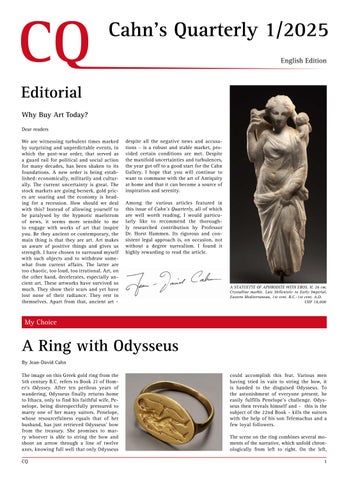
A STATUETTE OF APHRODITE WITH EROS. H. 26 cm. Crystalline marble. Late Hellenistic to Early Imperial, Eastern Mediterranean, 1st cent. B.C.-1st cent. A.D. CHF 18,000
My Choice
A Ring with Odysseus By Jean-David Cahn The image on this Greek gold ring from the 5th century B.C. refers to Book 21 of Homer's Odyssey. After ten perilous years of wandering, Odysseus finally returns home to Ithaca, only to find his faithful wife, Penelope, being disrespectfully pressured to marry one of her many suitors. Penelope, whose resourcefulness equals that of her husband, has just retrieved Odysseus' bow from the treasury. She promises to marry whoever is able to string the bow and shoot an arrow through a line of twelve axes, knowing full well that only Odysseus CQ
could accomplish this feat. Various men having tried in vain to string the bow, it is handed to the disguised Odysseus. To the astonishment of everyone present, he easily fulfills Penelope’s challenge. Odysseus then reveals himself and – this is the subject of the 22nd Book – kills the suitors with the help of his son Telemachus and a few loyal followers. The scene on the ring combines several moments of the narrative, which unfold chronologically from left to right. On the left, 1
In Memoriam
My Memories of Fritz Hugelmann (1943-2024) By Jean-David Cahn
A GOLD RING WITH ODYSSEUS. Dm. max. 2.2 cm. Gold. Greek, 5th cent. B.C. CHF 36,000
Odysseus leans on a gnarled staff like a feeble beggar. In the center, his posture is still bent, but his cloak has slipped from his right shoulder, revealing the toned, athletic body of a hero in his prime. He strides to the right, holding bow and arrow before him, and the viewer knows that in the next moment, Odysseus, the king and victor, will restore law and order in his household. The quality of the gold engraving is exceptionally fine and detailed. The horizontal, flat shape of the ring plate and the way it transitions into the hoop of the ring suggest a date of creation in the late first half of the 5th century B.C. I take great pleasure in occasionally wearing this ring. I acquired it years ago from a very good colleague, who had purchased it from a collector in New York. The iconography is extremely rare and remarkable. This raises the question of what the person who commissioned the ring intended to convey with this theme. Recent research has shown that jewellery is not decorated arbitrarily; rather, it reflects the self-image of the wearer. Odysseus was regarded as highly resourceful and indomitable; Troy fell thanks to his cunning. However, it was due to his hubris that he had to wander for ten years before he could return home, losing his entire crew in the process. He is, therefore, a decidedly ambivalent hero. However, the commissioner and subsequent wearers of the ring will probably have identified more with the positive values embodied by Odysseus. CQ
Fritz Hugelmann in his booth at BAAF Basel Ancient Art Fair in 2013.
In November 2024 I received the sad news that my valued colleague Fritz Hugelmann had passed away at the age of 81. I first met Fritz and Yvonne Hugelmann when I was a teenager and have fond memories of them both. Back then, when I occasionally helped my father at the fairs, I always enjoyed visiting the Hugelmanns’ booth. Fritz had a gift for explaining artworks in a way that was easy to understand, combining unwavering enthusiasm with simple words. His approach to Antiquity was marked by passion and a sense of wonder. He was a keen, precise observer and had the ability to draw the world of Antiquity into the present; when speaking with him, it felt as though ancient times were part of the here and now. Fritz learnt the trade of art dealer as an assistant to the legendary Wladimir Rosenbaum, whose gallery was located in
the magnificent Casa Serodine in Ascona. When Rosenbaum retired in the mid1980s, Fritz and Yvonne Hugelmann took over the business and founded Galeria Serodine. For many years, Fritz and Yvonne were welcome participants at the various art fairs in Basel, including KAM – Kunst- & Antiquitätenmesse Basel, TEFAF Basel, its successor CULTURA, and BAAF Basel Ancient Art Fair at the Wenkenhof in Riehen near Basel. From the early 1990s until his retirement in 2016, Fritz was a member of the International Association of Dealers in Ancient Art. Fritz and Yvonne Hugelmann specialised in the art of Ancient Greece and the Etruscans. They had a particular fondness for the art of the Cyclades. Many outstanding objects from Galeria Serodine now grace private collections and museums around the world. 2
Cahn’s Quarterly 1/2025
Discovered for you
Weapons and Mythical Creatures from the Mountains Luristan in the Iron Age By Gerburg Ludwig moved between the mountains and Everyone knows them, the famous, valleys, a practice that continued distinctively stylized bronzes from well into the 20th century. Luristan. But what region and culture gave rise to these remarkable arteThe names given to the tribes vary confacts? Luristan bronzes first appeared siderably across the different sources. on the art market in large quantities Neo-Assyrian texts mention the Elliat the end of the 1920s and were pi and Kassites in relation to military acquired by museums and private conflicts and tribute payments, whilst collectors. Archaeologists embarked Greek and Roman authors speaking of on the task of cataloging and interevents in Achaemenid times such as preting them. Since the 1930s, varithe Battle of Thermopylae, the Alexous excavations have been carried ander campaign and Seleucid times, out in northwestern Iran, including refer to the Cissians or Cossaians. The the Holmes Expedition led by Erich names appear to be etymologically F. Schmidt in Sorkh Dum-e Lori, the related and may designate the same French campaign by G. Contenau and people. In the sources they are consistR. Ghirshman in Tepe Giyan, Belently described as extremely warlike, gian excavations under the aegis of sometimes also as rapacious. On the L. Vanden Berghe, B. Overlaet and E. other hand, grave goods such as seals Haerinck in Pošt-e Kuh and, more reand imported ceramics attest to peacecently, also Iranian excavations. The ful relations not only with their direct Tehran Times aptly referred to anneighbours in Piš-e Kuh and Pošt-e cient Luristan as an “under-the-radar Kuh, but especially with the city states destination” (Tehran Times, 22 January 2022, Luristan Bronzes: a glimpse Fig. 1: The location of Iron Age Luristan in northwest Iran. © Captain of Mesopotamia. into their mystery). In the following, Blood, Wikimedia Commons (adapted). we will focus on the region and its people in the west by the Iraqi border, in the north by However, Luristan was not spared from the the Iron Age as well as the development of the cities of Kermanshah and Sahneh on the conflicts that ravaged the 1st millenium B.C. the bronzes they produced, aiming to deepen Great Khurasan Road, which formed part of Rivalries between the Kingdom of Urartu our understanding of Luristan culture. the Silk Road that connected Mesopotamia (858-590 B.C.) and the Neo-Assyrian Empire with Asia, in the east by Nahavand, Borud- (9th-6th century B.C.), which sought to exIn his chapter on the Medes (836-550 B.C.), sherd and Dorud and in the south by the Dez pand westwards towards the Mediterranean, the Greek historian Polybios described, River, the Dezful Plain and the city of Dehlo- also affected the Zagros region, not least beamongst other things, their southern border ran. The Kabīr Kūh, a 2790 m high moun- cause of its location on the Great Khorasan region: “It is protected from Persia by the tain range, divided ancient Luristan into two Road and its mountain passes which were barrier of Mount Zagrus, which has an as- parts: the larger Piš-e Kuh (in front of the controlled by hill tribes. Their strategic imporcent of a hundred stades, and containing in mountains) in the east and the smaller Pošt-e tance continued to play a role in later times, its range many separate peaks and defiles is Kuh (behind the mountains) in the west. Pre- under the Medes and Achaemenids, during the subdivided by deep valleys, and at certain cipitation is high in the mountains, while the campaigns of Alexander the Great and under points by canyons, inhabited by Cosseans, Pošt-e Kuh and the Dez region are very dry his successors, the Seleucids. Corbrenians, Carchi, and several other barba- with temperatures often exceeding 40 °C. The location on the Great Khorasan Road also rous tribes who have the reputation of being excellent warriors.” (Polybios, Historíai 5, 44, Traces of habitation dating from the Late facilitated the import of tin ore – a raw mate7, Translation E.S. Shuckburgh). Neolithic period (6500-5500 B.C.) onwards rial necessary for the production of bronze – have been found, with the number of ne- from Central Asia and Afghanistan. HowevThe Zagros Mountains, a mountain range cropolises exceeding the number of set- er, geological and archaeometric analyses of in southwestern Iran, is about 1,500 km long tlements. Although further excavations in samples from the ancient mine of Deh Hosein, and extends northwest-southeast from the target areas and archaeometric studies have northeast of Dorud, revealed that copper-tin border areas of eastern Turkey and north- yet to be carried out, the evidence strong- ore had been mined there from the 3rd to 1st ern Iraq to the Strait of Hormuz. Research ly suggests that this area was inhabited by millennium B.C. Comparisons of the copper suggests that the territory of Bronze and nomadic peoples who relied primarily on and tin contents as well as of the lead isoIron Age Luristan corresponded to the cen- livestock herding and who, in response to tope ratios in the ore and in bronze artefacts tral Zagros area (fig. 1) and was delimited in the geographical and climatic conditions, revealed that the Deh Hosein mine supplied CQ
3
Cahn’s Quarterly 1/2025
Fig. 2: AN IBEX HEAD PROTOME AS WHETSTONE HANDLE. L. 12 cm. Bronze. Luristan, 9th-7th cent. B.C. CHF 3,400
much of the raw material used by craftsmen in Luristan. The ore was also exported to Anatolia, Mesopotamia and the southern Persian Gulf. The Greek name for tin or tin ore, κασσίτερος (coming from the Cassites, Latin: cassiterum, English: cassiterite), underscores the importance of the ore from Luristan. With the exception of the earliest bronze objects from Luristan, which are rare and include knives, axes with blades and jewellery found in graves dating from the late 4th to early 3rd millennium B.C., scholars have divided the development of Luristan bronzes into five phases: Phases I-III in the Bronze Age, 2900-1200 B.C. and Phases IV and V in the Iron Age, 1300/1250-650/600 B.C. The repertoire and number of bronze artefacts dating from the Bronze Age is fairly small and includes, for example, shaft-hole axes made of folded sheet bronze and bronze vessels found at Godin Tepe, northeast of Sahneh, and Tepe Giyan, west of Nahavand, amongst other places. Around 1000 B.C., the types, quality and quantity of bronzes increased significantly. Shortly afterwards, iron began to be used, initially only sparingly as a luxury item, for instance for jewellery. Despite the small number of bronzes found in context, it was also possible to define the repertoire of types and to list and classify the bronzes preserved in museums and collections. O. White Muscarella coined the term “canonical Luristan bronzes” for the Iron Age bronzes. Their stylized decoration was initially simple but became increasingly complex as time progressed. They include animals cast using the lost wax method, human figures such as the Lord of Animals and floral ornaments like the Tree of Life. Tools and weapons were also cast. With increasing proficiency, smiths began 4
to add bronze weapon parts or appliques to the harder iron using casting techniques. The hammered, engraved and punched decorative plates typically display a horror vacui or fear of empty spaces: the entire available space is filled, usually with ornamentation. One of the most important classes of bronzes is formed by elements from horse harnesses such as snaffles and cheekpieces that are mostly adorned with pairs of striding animals or mythical creatures. A further significant class is formed by weapons, including daggers, short swords, flat axes (adzes), halberd axes and axes that occasionally have sharply curved blades and slanted edges. Weapons could be decorated with applied thorns or animals and axe blades were on occasion enlivened with engravings.
Fig. 3: A TERMINAL OF A PIN WITH FELINES. H. 6.4 cm. Bronze. Luristan, 8th cent. B.C. CHF 1,200
Whetstone handles in the shape of animals, such as the handle protome with an ibex head offered here by the Cahn Gallery, also belong to the canonical bronzes (fig. 2). The horn-shaped handle curves upwards from the socket that is decorated with a torus and zigzag band in high relief. It ends in a graceful ibex head with elegantly curved horns and alertly raised ears. Eyes, nostrils and mouth were engraved – deeply in some places – by the bronzesmith in cold work technique. A rod-shaped whetstone used to sharpen swords, daggers and axes could be inserted in the oval recess of the socket. The canonical bronzes also include the centrepieces of standards on cylindrical or bottle-shaped bases, crowned by pairs of animals or by the Lord of the Animals as a flat idol flanked by two animals. There are also simple idols, some in the form of mythical creatures. Canonical bronze jewellery includes bracelets, finger rings, rattle bells and pins with relief appliques of varying sizes and thicknesses. The terminal of a pin with the Cahn Gallery is shaped as a stylised Tree of Life with a grooved trunk and a crown that is divided into two sections by engraved volute decoration (fig. 3). As on the standard centrepieces, the tree is flanked by two felines with slender bodies that are stretched upwards and long tails that are rolled up to form an eyelet. Details such as the mouths, eyes, protruding ears and hindquarters are partly rendered in relief and partly engraved. The applique probably decorated a large garment pin. At the turn of the Bronze Age to the Iron Age, the flourishing of art and technology in Luristan was reflected in a series of highly characteristic, increasingly stylised bronzes. At the same time, first signs that iron was to displace bronze in metalworking became evident. Our knowledge of this period is still fragmentary. However, further surveys, excavations and archaeometric analyses, such as trace element and radioisotope analyses, will continue to further our knowledge of the ore deposits used, the processing of bronze and iron, and the chronology and culture of Luristan. CQ
Cahn’s Quarterly 1/2025
The Debate
Ancient Objects Found in the Ground, the Hadrianic Division of Finds and the German Treasure Law (Schatzregal) (Part 1) By Horst Hammen, translated by Yvonne Yiu Introduction: The Trier Gold Coin Hoard On 9 September 1993, a hoard of Roman aurei was found during excavation work in the remains of the cellar of a Roman residential building. The building was located on a plot of land belonging to the Sisters of Mercy of St. Carlo Borromeo in the centre of Trier, on the site of the Roman city of Augusta Treverorum. 2,518 coins from this find eventually came into the possession of the Rheinisches Landesmuseum Trier (fig. 1). After the employees of the Landesmuseum had, in the afternoon, finished the work planned for that day, amateur coin collectors and other people searched for artefacts. Within a very short time, they found several hundred coins, both in the excavated material that had been stored on the site shortly beforehand and in the soil that a truck driver employed by the company commissioned with the excavation work had taken to a more distant location, as instructed. However, by far the greatest number of the gold coins that had originally been stored in a bronze vessel, an amazing 2,104 pieces, were discovered by one of the amateur coin collectors in a niche in the cellar on the evening of the same day.1 The find was a sensation. It was not only the largest hoard of Roman gold coins in the world discovered to date, but it also brought to light around eighty coin types and variants previously unknown to numismatists. But who was the owner of all these coins, or at least of some of them? The owner of the building site? The hobby collectors or the truck driver or his employer? Or did the Federal State of Rhineland-Palatinate acquire ownership of the Trier gold coin hoard? In this series of articles, we will encounter this remarkable hoard which raises so many questions time and again. Objects Without an Owner To whom did found objects, especially prehistoric or ancient artefacts, once belong and to whom do they belong now? It is a complex undertaking to answer this question from a legal point of view. Let it be said right at the beginning: The idea that archaeological cultural artefacts belong to the general public, or at least should beCQ
Fig. 1: The Roman gold coin hoard from Trier’s Feldstrasse at the Rheinisches Landesmuseum Trier. Photo: Th. Zühmer, Rheinisches Landesmuseum Trier, CC BY-SA 3.0. (Site visited 10.4.2025).
long to them, is legally incorrect.2 Rather, we have no alternative but to examine a multitude of different cases and several levels of legal regulation. It should be noted that there are artefacts that were never owned by anyone in prehistoric and ancient times or to which ownership was relinquished. The former includes corpses which, as is still the case today, could not be acquired by anyone. This is why ancient skeletal parts, mummies and bog bodies are ownerless until they are found.3 Likewise, res sacrae, these being objects consecrated to the gods such as altars and votive columns and which were subject to Roman law, were not owned by any human being. These items were understood to have been transferred to the sacred property of the god and were therefore eternally exempt from sale or acquisitive prescription.4 It is, however, important to take a closer look. Not all altars and votive columns were res sacrae, but only those consecrated by a magistrate on the basis of a lex (a law) or a senatus consultum (a decree by the senate), or in later times an imperial authorisation.5 A private dedication by the owner, like the one on the Jupiter column erected by Victorinus, a councillor of the Civitas Auder-
iensium, on his property in 239 A.D.,6 did not turn the object into a res sacra.7 Grave goods also became objects without an owner. When, in Antiquity, weapons, jewellery, vessels etc. were placed in the grave of the deceased, this amounted to the intentional abandonment of this property (dereliction) since it would have been inconceivable for any family member to retrieve such objects from the grave.8 Such acts of dereliction were not uncommon in profane contexts, too. Fragments of crockery that are often found nowadays in ancient rubbish pits were disposed of there in Antiquity and thus became free of ownership. In Antiquity, money was also subject to dereliction. But, you might ask, who would throw money away? Well, in the last 200 years, due to the reduction of the water level of the Moselle, almost one million Roman coins and several dozen Celtic coins were found below the Roman bridge across the river in Trier. And these coins were not lost, although coins always have been and always will be lost. Rather, they were deliberately thrown from the bridge into the Moselle, as it was the custom at the time to make a river sacrifice when leaving Trier to ensure a safe return home.9 5
Cahn’s Quarterly 1/2025
Fig. 2: The folding chair from Rülzheim. Photo: https://ceza.de/referenzen/projekte/der-barbarenschatz-von-ruelzheim (Site visited 10.4.2025).
Fig. 3: A CINERARY URN. H. 21 cm. Clay, white, red and yellow paint. Etruscan, 3rd-2nd cent. B.C. Sold.
Ancient Booty? - The Barbarian Treasure of Rülzheim Of course, there are all kinds of ancient objects (jewellery, coins, household goods, etc.) that are found in the ground today or were discovered in the recent past that, unlike the aforementioned artefacts, had an owner. Needless to say, the attempt to identify the original owner (and his legal successors) is difficult. For instance, neither the name nor the social status of the person who hid the Trier coin hoard in the cellar of the residential building in Augusta Treverorum is known.
can be explored either by starting with the original owner and moving forwards in time or by beginning with the current situation and working backwards. If the succession of owners is examined from the time of an object’s creation, it is sometimes possible to identify the name of the person who first owned an ancient artefact, and who may then have sold, inherited, concealed, discarded or lost it before it was rediscovered in the modern era. It is not unusual for an ancient find to bear an inscription with the name of the person for whom it was made. Of course, the person whose name was inscribed on the object was by no means always identical with its owner. A couple of years ago, the Cahn Gallery sold an Etruscan urn with the name Thesia Lavtnita Arntnis13 written on its rim. Her cremated remains were still preserved inside the vessel more than 2000 years later (fig. 3).14 Probably, the relatives of Thesia Lavtnita Arntnis bought the urn after her death, or had it made. In this case, the deceased lady would never have been the vessel’s owner, as in Antiquity the dead could not own property.15
Occasionally, it is even likely that the objects in a hoard did not belong to the person who buried them. This might be the case with the Barbarian Treasure of Rülzheim (near Landau in the Palatinate) which dates from the Migration Period and consists of silver tableware that was partly chopped to pieces, silver statuettes, golden garment decorations and the unique remains of an aristocratic folding travelling chair that was partially gilded and covered with silver foil (fig. 2). The treasure may have been the booty of Hunnic-Alanian warriors.10 The circumstances of the find provide no clue as to which ancient laws governing the acquisition of property would have been applicable to the silverware, the folding chair and the other objects from the Rülzheim treasure, provided they had been stolen. Ancient Roman law permitted the legal appropriation of enemy property in a war, whereas current German law does not allow a thief or robber to become the owner under any circumstances.11 Loot taken by Roman soldiers in a war presumably became the property of the Roman state.12 The Names of Owners on Ancient Objects Research into the ownership of an ancient artefact is a feature of an object biography that seeks to understand the history of an item and its relationship to the people who came into contact with it. This relationship 6
Inscriptions on many other objects, however, do reveal their historical owner, and occasionally even his or her direct legal successors. Objects of this kind can be found in all Mediterranean cultures from the beginning of the Iron Age to the early Middle Ages. One such example is an obelos from the second half of the 11th century B.C. that was discovered at Palaipaphos on Cyprus. The inscription on the roasting spit, “of Opheltas”, refers to its owner.16 Similarly, the Runic inscription on the mouth plate of a sword scabbard found in Bergakker in the Netherlands and made in the 4th/5th century, can be translated as “(I am) Hathur’s (property)”.17 The name of the first owner of an object, however, provides no clues about the item’s further fate and its subsequent owners. Very rarely, however, it is possible to trace the ownership of an ancient
artefact one step further. For example, the Etruscan bucchero amphora from Formello from the late 7th century B.C. is inscribed not only with the name of the potter who doubles as its first owner (“Velthur made (this vessel)”) and the buyer (“I (am the) vessel of Atinai”), but also the name of the buyer’s first legal successor (“She (Atinai) gave (it) to Venel (as a gift)”). Greek drinking vessels also have inscriptions recording that they were given as gifts.18 The names engraved on pieces of the Hildesheim silver treasure may be evidence of a legal succession due to inheritance. The fact that five different owners' names are found on tableware belonging to this treasure suggests that it was not “acquired as a uniform ensemble all at once, but was purchased or inherited from various sources.”19 Provenances Of course, evidence of this kind can usually contribute little to the question of who currently owns an ancient object, because, as history progresses, we lose track of the sequence of successors who acquired title to the object through sale, inheritance, acquisitive prescription, etc. For objects offered on the antiquities market, one therefore tries to trace previous owners beginning from the present day. Provenances are quite often provided, albeit occasionally in anonymized form, that reach back as far as the 1970s. By contrast, it is rather rare for the previous owners of an object to be traceable over a span of 200 or 300 years. One of these exceptional art works is a marble head of Odysseus that was sold
Fig. 4: A HEAD OF ODYSSEUS. H. 49.5 cm. Marble. Roman, late 1st or early 2nd cent. A.D. Sold.
CQ
Cahn’s Quarterly 1/2025
on the French art market (fig. 4), which, as research revealed, once belonged to Frederick Hervey (1730-1803), the fourth Earl of Bristol, Bishop of Derry and a renowned collector, in the late 18th century.20 Only very rarely can the provenance of a piece be traced back to anywhere near the end of Antiquity. One of these, admittedly not frequent, exceptions is the Holy Lance, which forms part of the regalia of the Holy Roman Empire of the German Nation. According to a pious legend that originated in the 5th century and was elaborated further in the 13th century, the Roman centurion Longinus21 is said to have pierced the side of Jesus as he hung on the cross to determine whether he was already dead.22 It is assumed that the lance was crafted in the 8th century. It is also thought by some to be identical with the romphaea victoriae mentioned in the Liber Pontificalis, which Pope Hadrian I is said to have gifted to Charlemagne in 774. Around the year 900, it may have been located in Modena.23 According to Liutprand of Cremona (920-972), the lance was given to King Rudolf II of Burgundy by the Upper Italian comes illustris Samson in 922; during the Diet of Worms in 926, Rudolf II presented the lance to King Henry I of Germany who later bequeathed it to his son, Otto I.24 When Otto III made his ceremonial entry into Rome in 998, the Holy Lance was carried before him. It was the oldest item among what would later be called the Imperial Regalia (Reichskleinodien), whose places of safekeeping, probably beginning with the Abbey of Limburg25 in 1042, are well documented.26 In 1423, the regalia were entrusted to the care of the Imperial City of Nuremberg “for all time”. From there, they were transferred to Vienna in 1800, where the lance is now on display in the Imperial Treasury of the Hofburg. The Ownership of Objects Found in the Ground If the earth yields up an ancient object nowadays, the names of owners on these artefacts and provenance research are of no help in determining the ownership of the piece. This is because the provenance preceeding its discovery is missing. And even if the name of the item’s owner in Antiquity were inscribed on such an object, it is, as we have seen, impossible to trace the line of potential heirs or purchasers from Antiquity to the present – although it is conceivable that there is a person who has become the owner through inheritance, but is unaware of this. Thus, the object is initially in a state of legal uncertainty. The question therefore arises as to whether the law allows ownership of such an object to be reassigned to a person connected with its discovery. The person most closely connected to the object would seem to be the owner of the property in whose soil it was buried. This CQ
is because, under German law, ownership of a piece of land is not restricted to its surface, but also includes the space above and below the ground. Therefore, the owner of a piece of land – as was the case with the Borromaean Sisters at the time of the discovery of the Trier gold coin hoard – is permitted to carry out excavation work on his or her property, e.g. for the construction of an underground car park or a cellar, but may also to excavate and sell sand and gravel.27 In some very rare cases, however, the attempt to assign ownership of an ancient or fossilised object to a property owner must fail from the outset, because the site where it was found is not a property and therefore has no owner. An example of this is the frontal bone of a Neanderthal man who was given the name “Krijn”. The bone was discovered on Middeldiep, a sandbank area 15 kilometres off the coast of the Dutch province of Zeeland, in shell debris that a shell fisherman had dredged from the floor of the North Sea.28 For (German) lawyers, however, a property is defined as a parcel of land on the surface of the earth that has been surveyed by the land registry.29 This does not include the seabed or sandbanks.30 The degree of legal nuance required becomes apparent
Fig. 5: The jawbone from Spiekeroog. Source: cf. note 31. (Site visited 10.4.2025).
did not become an integral part of the latter, but remained independent. And since it was ownerless when it fell to earth, the finder – this seems to have been the view of the Regional Court of Augsburg33 – became the sole owner through lawful appropriation. Ancient objects, however, do not fall from the sky. Nevertheless, the legal situation pertaining to the earth beneath the surface of a property is comparable to that above the surface. Only the soil beneath the surface belongs to the owner of the property, not what someone else has hidden in this soil. Burying something does not result in the loss of ownership, as long as the original owner did not intend to relinquish it, which is regularly, but not always, the case with ancient hoards. The Trier gold coin hoard, for example, was so valuable, so well packaged, and so perfectly hidden that it cannot be assumed that the unknown owner intended to part with it forever. But even if the owner has derelinquished his property, as is the case with ancient grave goods, this does not lead to the automatic acquisition of (sole) ownership by the landowner. This is because a sword, a piece of jewellery or a vessel placed with the deceased is, unlike soil or rock, not part of the physical substance of the land itself, to which alone ownership of the property can extend. But even things that, according to common understanding, belong to the soil can have a fate different from that of the land. This was something the owners of a quarry had to learn, in whose rock layers the fossil of a prehistoric bird – Archaeopteryx No. 6, which is now on display in the Bürgermeister-Müller-Museum in Solnhofen – was (allegedly) found (fig. 6). The scientific no-
in the case of a 7,500-year-old human jawbone found on the sandy beach of the North Sea island of Spiekeroog (fig. 5)31, for indeed, there is ownership of beaches.32 The Meteorite Neuschwanstein 3 and der Primeval Bird Archaeopteryx No. 6 Although quite a few artifacts have been recovered from the seabed – especially in the Mediterranean, with the bronze Poseidon found off Cape Artemision being a notable example – it is the ground that yields the majority of ancient objects. However, not everything that enters the space above a parcel of land or becomes embedded in its soil automatically becomes the property of the landowner. This is illustrated by the case of the meteorite Neuschwanstein 3, which landed on private property and was subsequently found there by a meteorite collector who had been specifically searching for it. Ownership of the meteorite was not subsumed under the ownership of the property as the former
Fig. 6: Archaeopteryx No. 6, Solnhofen specimen, holotype of Wellnhoferia grandis. Photo: H. Raab (User:Vesta) – own work, CC BY-SA 3.0. (Site visited 10.4.2025).
7
Cahn’s Quarterly 1/2025
tion that such fossils are integral physical components of the ground prior to their discovery was not accepted by the court. Instead, the court argued that fossils consist of preserved plant or animal remains which have not yet been entirely transformed by the surrounding soil into purely mineral substances.34 In view of the archaeological, historical and scientific interests in making such objects accessible, Archaeopteryx No. 6 was treated in the same manner as an ancient object that had ended up in the ground in one way or another35 and was, therefore, not automatically included in the ownership of the property. The “Wochengötterstein” of Sasbach Admittedly it is rare, but from time to time a property may contain an ancient object to which the landowner and his or her legal successors have acquired sole ownership, contrary to the legal situations described in the preceding sections. One example of this is the “Wochengötterstein” (Weekday Gods Stone) of Sasbach near Achern (fig. 7). In the 1970s, the owner of a three-hundredyear-old half-timbered house, which was slated for demolition, noticed that a supporting beam carrying the upper floor of the house rested on a stone decorated with figures. It turned out that this stone, made around the turn of the 2nd and 3rd centuries A.D., with reliefs of the gods representing the days of the week carved into its sides, formed the base of a now lost Jupiter column.36 When the house was demolished, the stone was removed from the ground, kept by the owner of the property for a few years and then consigned to the art trade by his heirs.37 Originally, if the Jupiter column had indeed been transferred into the sacred ownership of the god, the stone would no longer have been the property of any person. According to Roman law, as we have seen, it would therefore have been forever excluded from acquisition by mortals. It is presumed that the column was destroyed after the Christianisation of the region by the Franks in the 6th century. As a result, the stone would have lost its status as a res sacra and could therefore once again have become private property. It is possible that it was later incorporated into the enclosing wall of a church whose origins date back to 720 and which was destroyed in 1675 during the Dutch War. The stone was probably taken from there and reused as a base in the house that was demolished three hundred years later.38 We may set aside the nearly impossible task of tracing the stone’s ownership between the 6th and 18th centuries, as its incorporation into the half-timbered house built around 1720 made the owner of the house the legal owner of the “Wochengötterstein”. 8
This acquisition is based on the principles of Roman law, which, since its reception in the late Middle Ages, functioned as “common” law and was applied subsidiarily to territorial laws throughout the Holy Roman Empire of the German Nation until the beginning of the 20th century. Already the oldest body of Roman legislation, the XII Tables written around 451/450 B.C., stipulated that the owner of a beam that was firmly attached to another person's building was no longer allowed to remove it.39 This was later generalized into the principle that if someone constructed a building on their property using materials owned by another, they became the owner of these materials, because everything built on a property became part of the property itself.40 Under current German law, this principle still applies, provided that the material used has become an essential component of the property, as was the case with the foundation stone beneath the beam which supported the projecting upper storey of the house. In this context, it is irrelevant whether the “Wochengötterstein” of Sasbach was ownerless or stolen before its incorporation,41 and therefore we could set aside the stone’s fate between the 6th and the early 18th century. When the timber-framed house was constructed in the
Fig. 7: “Wochengötterstein”. Copyright: AlteRoemer.de. Source: cf. note 37. (Site visited 10.4.2025).
early 18th century, the owner of the property at the time also acquired ownership of the “Wochengötterstein”, and that ownership was then passed on by inheritance or sale of the property until the stone was removed from the demolished house. The severing of the stone’s physical connection to the ground meant that ownership of the property now extended to an object that had regained its status as an independently ownable item.42 From that point on, the fate of the “Wochengötterstein” of Sasbach could follow a path separate of the property, and thus it could enter the art trade as a legally autonomous ancient object.
The Dinklage Gold Treasure If, with the exception of specific cases such as that of the “Wochengötterstein” of Sasbach, the landowner does not automatically acquire sole ownership of ancient objects that come to light on his or her property, the question arises whether the discoverer, as the person closest to the object after the landowner, may acquire sole ownership. Here, a distinction must be made. If the discoverer finds ancient grave goods, prehistoric human bones, or ceramics discarded in ancient refuse pits, i.e. items which are ownerless, it must be considered whether he or she can acquire ownership by appropriation, a question to which we shall return shortly. On the other hand, if someone discovers objects that have been deliberately hidden, the legal situation requires closer examination. The court case concerning the Dinklage gold treasure revealed that not everyone who discovers something buried in the ground can be considered its finder. In autumn 2016, during excavation work at a cemetery in Dinklage (Lower Saxony), containers filled with modern gold coins were uncovered in the upper soil. The youngest coin in the hoard was also dated 2016, indicating that the coins had been hidden only a short time before. The person who discovered the coins was of the opinion that, under the law governing found property (Fundrecht), he had become the owner, as no rightful owner had come forward within six months after he had surrendered the coins to the competent authority. However, the court ruled otherwise, arguing that the owner had not lost the coins – as required by law – when he hid them. Instead, since the owner could have retrieved them at any time, he retained possession up until the time of the excavation work at the cemetery. The court even went so far as to state that, should the owner have died before the coins were discovered, they could still not be considered lost, because the heirs were entitled to them.43 This cannot be applied to ancient hoards. While it is true that a person in Antiquity may have hidden valuables to protect them from war and looting and may have been in a position for some time to later reclaim possession, and while it is also possible that heirs may have succeeded to that person's possession of the hidden hoard,44 over the course of decades and centuries, such hoards were eventually forgotten, and possession was ultimately lost. Nevertheless, a modernday finder who uncovers such a hoard does not acquire sole ownership of the hidden objects. This is because German lost property law is designed for cases in which it can still be reasonably expected that the owner might search for their lost CQ
Cahn’s Quarterly 1/2025
item, for instance by making an inquiry at the lost property authority. This is the reason why the finder does not acquire ownership of a discovered object until six months have passed – namely, when the original owner has failed to assert his or her ownership within that time. This framework, however, is not appropriate for ancient finds, where there is no prospect of identifying the owner from the outset. The same applies to objects that never belonged to anyone, or that may have already become ownerless in Antiquity. That does not mean, of course, that such finds exist in a legal vacuum. On the contrary, the law has long provided a special legal framework for treasure finds: the Hadrianic division of finds which will be addressed in Part 2 of this article series. 1. On the circumstances of discovery, cf. Karl-Josef Gilles, Der römische Goldmünzenschatz aus der Feldstrasse in Trier, Trierer Zeitschrift, Beiheft 34, 2013, pp. 10 ff. 2. Cf. Raimund Karl, Unseres? Deins? Meins? – Wem gehören archäologische Kulturgüter?, Archäologische Informationen, vol. 36 (2013), pp. 139 ff. 3. Staudinger/C. Heinze, Kommentar zum Bürgerlichen Gesetzbuch, Buch 3, §§ 925-984, new edition 2020, § 984 Rn. 3 a. On the treatment of human remains from an archaeological and legal perspective, cf. Reinhard Dietrich, Nicht die Toten, sondern die Lebenden: Menschliche Überreste als Bodenfunde, Archäologische Informationen 36, 2013, pp. 113 ff. 4. Gaius, Institutiones 2, 4; Max Kaser, Das römische Privatrecht, Erster Abschnitt, 2nd ed. 1971, § 92, p. 378. Cf. The inscription MERCURI PROPTIUM (= PROPRIUM) on a bronze statuette from the Weissenburger Treasure (Michael Donderer, Zur Interpretation des Weissenburger Schatzfundes, Germania vol. 82, 2004, pp. 235, 240). 5. Gaius, Institutiones, 2,5; Ulpian Digesta 1,8,9,1. 6. Archaeological Museum Frankfurt, Carmelite monastery, Jupiter column no. 9. 7. Marcianus Digesta 1,8,6,3; Max Kaser, Das römische Privatrecht, § 92, p. 378. 8. Staudinger /C. Heinze, Kommentar zum Bürgerlichen Gesetzbuch, Buch 3, § 984 Rn. 3 a.
17. Theo Vennemann, Note on the Runic Inscription of the Bergakker Scabbard Mount – Neue Untersuchungen zu Runeninschriften, Historische Sprachforschung, Ergänzungsheft 41, 1999, p. 152. 18. Cf. Celia Krause, Möglichkeiten der Interaktion von Vasenbild und Inschriften mit wörtlicher Rede auf Keramik, 2007 p. 2, note 4: «X hat mich Y geschenkt», http://archiv.ub.uni-heidelberg.de/propylaeumdok/volltexte/2007/29 (site visited 22.2.2025). 19. Reinhard Stupperich, Der Hildesheimer Silberschatz. Griechisches Tafelgeschirr aus der augusteischen Zeit, in: M. Boetzkes, H. Stein (ed.) Der Hildesheimer Silberfund. Original und Nachbildung, 1997, pp. 166, 173. 20. Jean-David Cahn, Kunst und Recht 5/2010, pp. 164165. 21. Gospel of Nicodemus/Acta Pilati, XVI, 7, cf. Evangelia Apocrypha, collegit et recensuit Constantinus de Tischendorf, Editio altera, MDCCCLXXVI, Acta Pilati A XVI, p. 283: Longinos stratiotes, Gesta Pilati XVI, p. 387: Longinus miles. Jacobi a Voragine, Legenda Aurea, recensuit Dr. Th. Graesse, Editio tertia, 1890, Cap. XLVII de Santo London, p. 202: Longinus …centurio. – In Mt. 27:54, Mk. 15:39, 44 f. and Lk. 23:47 a centurio (hekatonarchos) is mentioned, but his name is not given and he is not reported to have pierced Jesus’s side with his lance. 22. Jn. 19:34. In Jn. 19:16-37 there is no mention of a centurion or a person named Longinus.
15. Cf. Max Kaser, Das römische Privatrecht, § 64, p. 273. 16. Eric. H. Cline, Nach 1177 v. Chr., 2024, p. 132 f.
CQ
38. Alte Römer, Galerie für Antike Kunst und Antiquitäten, Wochengötterstein einer Jupitersäule. 39. XII T. 7, 8. 40. Institutiones Justiniani, 2,1, 29,1. 41. Vgl. Staudinger/C. Heinze, Kommentar zum Bürgerlichen Gesetzbuch, Buch 3, § 946 Rn. 6. 42. Vgl. Staudinger/C. Heinze, Kommentar zum Bürgerlichen Gesetzbuch, Buch 3, § 953 Rn. 4. 43. OLG Oldenburg Urteil vom 7.10. 2020 – 1 W 17/20 Rn. 22-24. 44. On the question of whether Roman law already recognized possession by heirs, cf. Jörg Domisch, Zur Frage eines Besitzübergangs auf den Erben im klassischen römischen Recht, 2015.
26. Bettina Jost, Die Übergabe der Reichskleinodien 1246 an Konrad IV. auf dem Trifels, in: Burgen und Schlösser 4/2001, pp. 236 ff. 27. These are termed “grundeigene Bodenschätze”, i.e. natural resources owned by the property owner. In contrast, ownership of a property does not include ownership of natural resources termed “bergfreie Bodenschätze”, such as gold and silver. 28. Spectacular discovery of first-ever Dutch Neanderthal, the first fossil hominin ever yielded by a submarine site, Max Planck Institute for Evolutionary Anthropology, Press Release 15.6.2009, https://www.eva. mpg.de/fileadmin/content_files/institute/pdf/press/ english/2009-06-15_News_NorthSeaFossil.pdf (site visited 22.2.2025).
31. Ostfriesische Landschaft, Nachrichten aus Kultur, Wissenschaft und Bildung, issue 36, 19.12.2018. p. 6, https://www.ostfriesischelandschaft.de/fileadmin/ user_upload/KULTUR/Dokumente/Newsletter/Newsletter_OL_aktuell_Nr_36_Dezember_Ausgabe_2018.pdf (site visited 22.2.2025).
14. Yvonne Yiu, Wohin mit Oemialarnpnim?, Cahn’s Quarterly 2/2014, pp. 1 f.; idem, Nochmals die Aschenurne, Cahn’s Quarterly 3/2014, p. 2.
37. Alte Römer, Galerie für Antike Kunst und Antiquitäten, Wochengötterstein einer Jupitersäule, https:// www.alteroemer.de/de/wochengoetterstein-der-jupitersaeule-von-achern.html (site visited 22.2.2025).
25. Niklaus Grass, Cistercienser als Hüter der deutschen Reichskleinodien, in: Zisterzienser Chronik 1966, p. 97.
10. Eckhard Fuhr, “Barbarenschatz” gefunden und alle Spuren zerstört, Welt, 1.4.2014, https://www.welt. de/kultur/article126430434/Barbarenschatz-gefunden-und-alle-Spuren-zerstoert.html (site visited 22.2.2025). Anders Ulrich Himmelmann/Richard Petrovszky, Der “Schatz von Rülzheim” und die Folgen: Zum vorläufigen Forschungsstand und über die Zusammenarbeit mit ehrenamtlichen Sondengängern in der Pfalz, Germersheimer Geschichtsblätter, 5, 2018, pp. 7, 17 f.: Totenopfer.
13. Oder: Arnthis?
36. Hugo Schneider, Der Wochengötterstein von Sasbach bei Achtern, Die Ortenau, vol. 60 (1980), pp. 342 ff.
24. Liutprand of Cremona, Antapodosis IV, 25. The story recounted there, that the lance once belonged to Constantine the Great, is a legend.
29. Marina Wellenhofer, Sachenrecht, 39th edition 2024, § 17 S. 244 Rn. 2.
12. Max Kaser, Das römische Privatrecht, § 102, p. 425.
35. OLG Nürnberg, Urteil vom 12.9.2001, Aktenzeichen 4 U 857/98. I.2.a).
23. Mechthild Schulze-Dörrlamm, Heilige Nägel und heilige Lanzen, in: F. Daim and J. Drauschke (eds.), Byzanz – Das Römerreich im Mittelalter, Part 1, 2010, pp. 97, 140, 143-144.
9. Karl-Josef Gilles/Bernhard Weisser, Griechische Souvenirs – Antike Münzen aus Philippopolis und Perinth aus der Mosel bei Trier, Trierer Zeitschrift, vol. 69/70, 2006/07, p. 127.
11. Gaius, Institutiones 2, 69.
34. OLG Frankfurt, Urteil vom 27.8.2014, Aktenzeichen 12 U 42/13 A.1.(1) a) regarding “Ida”, the fossil of prehistoric primate found in the Grube Messel.
Prof. Dr. Horst Hammen held the Chair of Civil and Commercial Law at the Justus Liebig University, Giessen. His main area of research is Stock Market and Capital Market Law. Furthermore, he publishes articles on legal history and other historical themes.
30. Issues pertaining to maritime law are not addressed.
32. BVerwG Urteil vom 13.9.2017, Aktenzeichen 10 C 7.16 Rn. 37-39; Oberverwaltungsgericht Lüneburg Urteil vom 19.1.2016, Aktenzeichen 10 LC 87/15 Rn. 4: The federal state of Lower Saxony is the owner of the beach. In contrast to this, Roman law held that no-one could acquire ownership of the seashore (Institutiones Justiniani 2.1.5). 33. Landgericht Augsburg, Urteil vom 6.7.2007, Aktenzeichen 8 O 1758/06 (pursuant to Austrian law); cf. Arne Nordmeyer/Jasmin Kassid, Wem gehört der gestrandete Meteorit? Ad Legendum 2011, pp. 30 ff.; Thorsten Süss, Von Meteoriten, Skeletten und anderen Kostbarkeiten, Jura 2011, 332. The legal situation was apparently not unequivocal. That is probably why the parties reached a settlement in the second instance. (OLG München, Vergleich vom 8.1.2008, 30 U 474/07).
Imprint Publisher Jean-David Cahn Malzgasse 23 CH-4052 Basel www.cahn.ch ISSN 2624-6368 Editors Jean-David Cahn Yvonne Yiu Authors Jean-David Cahn Ulrike Haase Horst Hammen Gerburg Ludwig Joffrey Nogrette
Translations Yvonne Yiu Photos Niklaus Bürgin Ulrike Haase Layout Michael Joos Yvonne Yiu
9
Cahn’s Quarterly 1/2025
New Artworks Monthly on www.cahn.ch
Colourful Antiquity
A DOUBLE RHYTON WITH TWO HORSEMEN. H. 23.7 cm. L. 27.9 cm. Clay. Formerly priv. coll. Sam Dubiner, Israel, formed between 1954-1958. With Aaron Gallery, London. Thereafter priv. coll. L. K., Basel, acquired from Jean-David Cahn AG, Auction 8, 9.11.2013, lot 9. On the underside the handwritten inv. nos. "58" and "251". Gilan/Amlash, 9th-8th cent. B.C. CHF 18,000
A COFFIN MASK. H. 15 cm. Wood, painted stucco. Formerly priv. coll. Roger Liechti (1934-2010), Petit-Lancy, Switzerland (inv. no. E. 379); acquired in 1970 from the art dealer Ms. Sophie Podgórska, Geneva. Thence by descent in the family. Egypt, Late Period to Ptolemaic, 664-30 B.C. CHF 8,800
A HEAD OF A SYMPOSIAST. H. 12.6 cm. W. 12.1 cm. Terracotta. Formerly Coll. Carl Leonhard Burckhardt (1902-1965), acquired before 1966. Thence by descent. Western Greek, 4th cent. B.C. CHF 8,800 AN USCHABTI. H. 12.6 cm. Green faience. Formerly Coll. Carl Leonhard Burckhardt (1902-1965). Thence by descent. Egypt, Late Period, 26th-30th Dynasty, ca. 500-300 B.C. CHF 2,600
A TERRACOTTA FIGURINE OF A GROTESQUE. H. 16.2 cm. Terracotta. Formerly priv. coll. (d. 1991), London, 1960s. Inherited by his daughter, (d. 2005) and then by his son-in-law R. J. M.-P., London. Greek, 5th cent. B.C. CHF 4,800
A STATUETTE OF APHRODITE KNEELING IN A SHELL. H. 18.8 cm. Terracotta. With MuM AG, Basel, before 1985 (see Widmer negative). Formerly priv. coll. Mr. Pedro Benda (1918-2001), Lausanne; acquired in 1987 at KAM, MuM AG, Basel, list no. 111. Western Greek, 4th cent. B.C. CHF 16,000
A RED-FIGURE KALYX KRATER, ATTRIBUTED TO THE PAINTER OF RODIN 966. H. 34.7 cm. Dm. of rim 28.4 cm. Clay, added white. Acquired by Captain Charles Huus (b. 1869) in Athens on 10.1.1908 (acquisition document in French, signed, dated and marked with a Greek stamp). Probably the “antik Vase af Terracotta” that Captain Huus mentions in the account of his stopover in Piraeus in the winter of 1907: “Et Levnedsløb” (Copenhagen, 1938), p. 61. An undated photograph (before 1943). Attic, Kertch Style, ca. 360-350 B.C. CHF 18,000
10
A STATUETTE OF EROS. H. 11.5 cm. Terracotta. Formerly priv. coll. Ernest Stanislas Le Véel (1874-1951), Paris, antiquarian and art dealer. Inherited by Ernest Armand Georges Le Véel (1905-2000), finally by M. R., born Bélorgey (1935-2016), Paris. Greek, probably Tanagra or Myrina, 4th-2nd cent. B.C. CHF 8,600
A SLAVE WITH OVERSIZED PHALLOS. H. 19.5 cm. Dark brown clay. Part of The Erotica Collection of Christian von Faber-Castell, Kusnacht ZH, Switzerland, acquired 19.3.1999 from Charles Ede Ltd, London. With Cahn Auktionen, Basel, Auction 8, 10.11.2013, lot 5. Alexandrian, 1st cent B.C-1st half of 1st cent. A.D. CHF 4,600
CQ
Cahn’s Quarterly 1/2025
A LARGE SCARABOID WITH MAGNIFICENT BULL. W. 3.9 cm. H. 3.3 cm. Chalcedony. Formerly H.A.C. AG, Basel, before 1999. Greek, 5th cent. B.C. CHF 16,000
AN INTAGLIO WITH THE BUST OF HERAKLES. H. 1.7 cm. Red jasper. Formerly H.A.C. AG, Basel, between 1988-1999 (label: A 4301 / Ist / 1600). Since then in the family. Roman, Late Hellenistic/Republican to Early Imperial, 1st cent. B.C.-1st cent. A.D. CHF 6,800 A STATUETTE OF GANYMEDE ABDUCTED BY ZEUS. H. 29.3 cm. Terracotta. Western Greek, probably Canosa, 3rd-2nd cent. B.C. CHF 28,000
A LARGE TERRACOTTA STATUETTE OF A SEMI-NUDE APHRODITE. H. 62.1 cm. Yellow-brown micaceous clay. Formerly Prof. Bieter Wyss, Germany, before 1982. Acquired in 1982 from MuM AG, Basel, Auction 60, 1982, lot 62. Eastern Mediterranean, probably Asia Minor, 1st cent. B.C.-1st cent. A.D. CHF 42,000
AN INTAGLIO WITH WINGED HORSE. W. 2.1 cm. H. 2 cm. Brownish chalcedony. With MuM AG, Basel, 1987 (see list 500, no. 439); HAC AG, Basel, until 1999. Greco-Persian, 5th-4th cent. B.C. CHF 1,200
A GLASS BOTTLE. Formerly Collection Carl Leonhard Burckhardt (1902-1965). Thence by descent. CHF 1,600 A MOSAIC GLASS INLAY WITH THEATRE MASK. H. 2.9 cm. W. 3.4 cm. Light blue, black, white, green, yellow and red glass, opaque and translucent. Formerly priv. coll. Julien Gréau (1810-1895), France. Thereafter, priv. coll. John Pierpoint Morgan Sr. (1837-1913), London; and thence by descent to John Pierpoint Morgan Jr. (1867-1943), New York. Gifted in 1917 to the Metropolitan Museum of Art, New York; consigned to Anderson Galleries, New York. Roman Egypt, 1st cent. B.C.-1st cent. A.D. CHF 12,000
A RIBBED BOWL. Dm. 15.6 cm. H. 4.2 cm. Greenish glass. Formerly Coll. Carl Leonhard Burckhardt (1902-1965), acquired before 1966. Thence by descent. Roman, 1st cent. A.D. CHF 6,800 A BEAKER. H. 10.5 cm. Colourless glass. Formerly Coll. Edward and Rosalie Ginsberg, Cleveland, OH, acquired in Israel during the late 1960s-1970s. Eastern Mediterranean, 2nd-3rd cent. A.D. CHF 1,200
CQ
A SPRINKLER. H. 11.1 cm. Light green, translucent glass. Formerly priv. coll. Alfred Reinhart (1873-1935), Egypt; inherited by Carl Leonhard Burckhardt (19021965) and Marianne Burckhardt-Reinhart (1905-1981), Egypt, collecting period 1930-1950. Thereafter by descent to Rosmarin Cereghetti-Burckhardt (1929-2022). By descent in the family. Roman, 2nd-4th cent. A.D. CHF 1,600
11
Cahn’s Quarterly 1/2025
Highlight
A Marble Vase from the “Cabinet de Monsieur Crozat” By Joffrey Nogrette
Fig. 1: A MARBLE AMPHORA WITH RELIEF DECORATION. H. 50 cm. Marble. Roman, Late Republican, 1st cent. B.C.
The Maison Crozat in Rue Richelieu, Paris, housed one of the most important private art collections at the beginning of 18th century. Its owner, the wealthy financier Pierre Crozat (1665-1740) was a major figure in artistic patronage, notably fostering the careers of artists like Antoine Watteau. The connoisseurs admitted to this museum avant la lettre could admire works by Titian, Raphael, Rubens and Rembrandt, most of which are now in the State Hermitage Museum, St. Petersburg. There was also a fine collection of Roman sculptures including, as its centerpiece, the Girardon Bacchus, now in the Musée du Louvre, Paris. In the main gallery of the house (fig. 2), “several vases and urns made in Rome, along with other rare pieces” were displayed between the paintings. The vase featured in this essay (fig. 1) was likely one of them. Published and illustrated 12
Price on request
in 1752 by the Comte de Caylus in the first volume of his Recueil d’antiquités (fig. 3), this marble vessel was brought back from Rome by Crozat following his stay in Italy between September 1714 and June 1715. After Pierre Crozat's death in 1740, his house was bequeathed to his nephew, the Marquis du Châtel. When he died ten years later, the collection of sculptures, busts and marble vases that deco-
Fig. 2: Nicolas Lancret, Concert in the Gallery of the Maison Crozat, ca. 1738, Bayerische Staatsgemäldesammlungen, Alte Pinakothek München. Public Domain.
CQ
Cahn’s Quarterly 1/2025
Highlight a smaller scale. On this occasion, the “Crozat vase” was sold to the prominent auctioneer and art dealer Alexandre-Joseph Paillet (1743-1814). Its whereabouts were then lost. When it reappeared on the Parisian art market in 2011, its prestigious provenance had sunken into oblivion. It was reported as being with a French family of château owners since the 1920s.
Fig. 3 : Caylus, Recueil d’antiquités, pl. XCVIII. Public domain.
Fig. 5: Portrait of Pierre Jean Mariette, 1765, Rijksmuseum, Amsterdam, The Netherlands. Public domain.
rated the house was sold in a public auction, and the Comte de Caylus bought our vase along with three others. He did not keep it for long, as by 1752, the date of the publication of the first volume of his Recueil d’antiquités, he had already passed it on to his friend and fellow connoisseur Pierre-Jean Mariette.
grecques et romaines, published in seven volumes between 1752 and 1767. With its meticulous descriptions and illustrations, it aimed to make his vast collection of ancient artefacts accessible to the scientific community.
Since its discovery on Italian soil and its subsequent journey through various French collections, the vase has undergone several changes in appearance, starting with the loss of the upper neck and the high vertical handles that were still present when Caylus depicted the vessel. It is unclear whether these parts were original or later additions. However, it is certain that the foot is a modern reconstruction from the 18th century or earlier. In fact, it does not match the typology of the vessel, which mimics the shape of a Panathenaic prize amphora. Instead, the restorer referred to the bases of large marble kraters, well-known since the Renaissance, such as the Borghese Vase. In its present state, the vase is approximately 50 cm high. The neck and shoulder are decorated with a tongue pattern separated at the bottom by darts. Beneath this motif runs a band decorated with acanthus scrolls. Four frontal figures carved in low relief, occupy the register that encircles the body. Two representations of Eros, whose legs take the shape of acanthus leaves, alternate with two depictions of a vegetal goddess dressed in a tunic and whose lower body terminates in a lotus flower. Both hold acanthus scrolls in each of their outstretched hands.
These two men belonged to Pierre Crozat’s close circle. A leading antiquarian of his time, Anne-Claude-Philippe de Tubières-Grimoard de Pestels de Lévis, Comte de Caylus (1692-1765) (fig. 4), helped to pave the way to modern archaeology. His most remarkable work is the Recueil d’antiquités égyptiennes, étrusques,
The name Pierre-Jean Mariette (1694-1774) (fig. 5) is no less renowned in the historiography of art. Heir to a dynasty of printers, publishers and art dealers, he primarily collected graphic arts (a large part of his collection is now in the Musée du Louvre) and was regarded as a leading authority in the field. His posthumous sale in 1775 reveals that he also collected antiquities, though on
Fig. 4: Portrait of the Comte de Caylus by Alexander Roslin, ca. 1752-1753, National Museum in Warsaw. Public domain.
Fig. 6: Pilaster capital from Didyma, Musée du Louvre, inv. no. Ma 2779.
CQ
13
Cahn’s Quarterly 1/2025
These plant divinities are part of an iconography that appeared in the second half of the 4th century B.C. The feminine type can be found in the corners of the well-known pebble mosaic floor of room E in the “oikos” of the palace at Aigai, as well as in the architectural decoration of certain temples in Asia Minor, for instance the Temple of Artemis Leucophryene in Magnesia on the Maeander or the Temple of Apollo in Didyma (fig. 6). The posture is reminiscent of that of the Oriental Potnia Theron, which can be equated to an early form of Artemis.
Fig. 9: Marble amphora, inv. no. 1518, Ny Carlsberg Glyptotek, © Jamie Heath, CC BY-SA 2.0 (original photo altered).
Fig. 7: Roman candelabrum base, inv. no. 2564, Galleria dei Candelabri, Vatican Museums, © Fabrizio Garrisi, Own work, CC BY-SA 4.0 (original photo altered).
The vegetal Eros motif probably appeared later. Six “Neo-Attic” candelabra from the Julio-Claudian period bear this figure on their bases (fig. 7). They were found in the 18th century near Sant'Agnese Fuori le Mura, and five of them are now housed in the Candelabra Gallery at the Museo Pio Clementino, Rome. In terms of shape, size and secondary decoration, the Crozat amphora belongs to a group of three other votive marble amphorae, marked on the shoulder with the dedication “CHIO D(edit) D(onum)”, “Chio has offered this gift”. They were found by Eliseo Borghi in 1895 during excavations on the site of the sanctuary dedicated to Diana Nemorensis, near the shores of Lake Nemi. These three vases, now divided between the Penn Museum in Philadelphia and the Ny Carlsberg Glyptotek in Copenhagen, bear a different main decoration: a pair of griffins attacking a doe on the Philadelphia amphora; two satyrs quarrelling around a crater (fig. 8), and a horse race contested by a young satyr and an Eros (fig. 9), for the Copenhagen amphorae.
Fig. 8: Marble amphora, inv. no. 1519, Ny Carlsberg Glyptotek, © Jamie Heath, CC BY-SA 2.0 (original photo altered).
14
These three vases, to which we must add our own, likely all come from the same “Neo-Attic” workshop, which must have been active somewhere between the Late Hellenistic and
Early Imperial Period. The fact that they follow an old Greek tradition of crafting solid vases, combined with a shape reminiscent of those awarded to winners of the Panathenaic Games, strongly suggests that the sculptors were of Athenian origin. 1.
Paris, Musée du Louvre, inv. no. Ma 337.
2.
“… une galerie très riche, ornée de plusieurs vases et urnes faits à Rome, & d’autres piéces rares”, Anon. (Claude-Marin Saugrain), Les Curiositez de Paris… Paris: 1742, p. 212.
3.
On “Akanthos figures” linked to Artemis, cf. WEBB, Pamela A. Hellenistic Architectural Sculpture: Figural Motifs in Western Anatolia and the Aegean Islands, Madison: The University of Wisconsin Press, 1996, pp. 32-33; and KAHIL, Lilly, “Artémis” in Lexicon Iconographicum Mythologiae Classicae, II, Zurich and Munich, Artemis Verlag, 1984, nos. 265-267, p. 629.
4.
BLANC, Nicole, GURY Francoise, “Eros / Amor, Cupido” in Lexicon Iconographicum Mythologiae Classicae, II, Zurich and Munich, Artemis Verlag, 1984, nos. 128-131, p. 973.
5.
On the “CHIO Dedication”, cf. ROMANO, Irène Bals, Classical Sculpture: Catalogue of the Cypriot, Greek, and Roman Stone Sculpture in the University of Pennsylvania Museum of Archaeology and Anthropology, Philadelphia, University of Pennsylvania Press, 2014, pp. 146-159.
6.
Philadelphia, Penn Museum, inv. no. MS3446.
7.
Copenhagen, Ny Carlsberg Glyptothek, inv. nos. 1518, 1519.
CQ