Cahn’s Quarterly 1/2024 English Edition
Editorial Dear readers Provenance Research and Data Protection Recently, I attended a conference on provenance research at the University of Fribourg. Among other things, the new standards for provenance research employed by the Verband der Museen der Schweiz/ICOM Switzerland and the Federal Office of Culture's programme for researching the history of museum collections were presented. I understand the legitimate demand that the history and provenance of artworks on display in museums should be clarified. This primarily concerns looted art from the Nazi era and cultural artefacts from colonial contexts, but but also illegal excavations. When, however, I asked how provenance research could be reconciled with data protection, especially since a new, stricter data protection law came into force on 1.9.2023, I unfortunately had to observe a certain speechlessness. During the break, I was even congratulated on bringing up the subject: the problem was known but no one knew how to solve it. This raises the question of whether the research programme was launched without first developing a solution to the data protection problems together with the data protection officers working on both the federal and cantonal levels. There appears to have been only a preliminary clarification with the Federal Data Protection and Information Commissioner from 2021, on the basis of which the FOC made recommendations. In these Recommendations of the Federal Office of Culture on Provenance Research and Data Protection, reference is made to the former Federal Act on Data Protection: “Justification grounds pursuant to Art. 13 para. 1 FADP, which can legitimise the processing or disclosure of personal data in the aforementioned sense, are a corresponding legal basis, the consent of the person concerned or the existence of an overriding private or public interest. Whether such justifications exist must be examined on a case-by-case basis.” I would wish for a more clearly defined legal framework in which not everything is permitted simultaneously. However, what is stated in the following section should be examined critically: “In genCQ
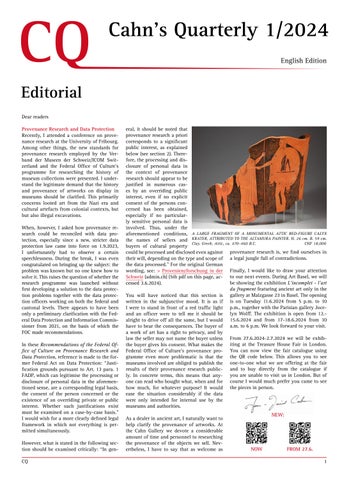
eral, it should be noted that provenance research a priori corresponds to a significant public interest, as explained below (see section 2). Therefore, the processing and disclosure of personal data in the context of provenance research should appear to be justified in numerous cases by an overriding public interest, even if no explicit consent of the persons concerned has been obtained, especially if no particularly sensitive personal data is involved. Thus, under the aforementioned conditions, A LARGE FRAGMENT OF A MONUMENTAL ATTIC RED-FIGURE CALYX the names of sellers and KRATER, ATTRIBUTED TO THE ALTAMURA PAINTER. H. 26 cm. B. 59 cm. Clay. Greek, Attic, ca. 470–460 B.C. CHF 18,000 buyers of cultural property could be processed and disclosed even against provenance research is, we find ourselves in their will, depending on the type and scope of a legal jungle full of contradictions. the data processed.” For the original German wording, see: > Provenienzforschung in der Finally, I would like to draw your attention Schweiz (admin.ch) (5th pdf on this page, ac- to our next events. During Art Basel, we will be showing the exhibition L'incomplet - l'art cessed 3.6.2024). du fragment featuring ancient art only in the You will have noticed that this section is gallery at Malzgasse 23 in Basel. The opening written in the subjunctive mood. It is as if is on Tuesday 11.6.2024 from 5 p.m. to 10 I were to stand in front of a red traffic light p.m., together with the Parisian gallery Joceand an officer were to tell me it should be lyn Wolff. The exhibition is open from 12.alright to drive off all the same, but I would 15.6.2024 and from 17-18.6.2024 from 10 have to bear the consequences. The buyer of a.m. to 6 p.m. We look forward to your visit. a work of art has a right to privacy, and by law the seller may not name the buyer unless From 27.6.2024-2.7.2024 we will be exhibthe buyer gives his consent. What makes the iting at the Treasure House Fair in London. Federal Office of Culture's provenance pro- You can now view the fair catalogue using gramme even more problematic is that the the QR code below. This allows you to see museums involved are obliged to publish the one-to-one what we are offering at the fair results of their provenance research public- and to buy directly from the catalogue if ly. In concrete terms, this means that any- you are unable to visit us in London. But of one can read who bought what, when and for course I would much prefer you came to see how much, for whatever purpose! It would the pieces in person. ease the situation considerably if the data were only intended for internal use by the museums and authorities. As a dealer in ancient art, I naturally want to help clarify the provenance of artworks. At the Cahn Gallery we devote a considerable amount of time and personnel to researching the provenance of the objects we sell. Nevertheless, I have to say that as welcome as
NEW:
NOW
FROM 27.6. 1
Cahn’s Quarterly 1/2024
Die Debatte The Debate I
Archaeometry What Materials and Techniques tell us about Ancient Ceramics By Charlotte Chauvier Introduction A fascinating and instructive way of looking at ancient ceramics is to consider their materiality and technology. Different raw materials for fabrics and glazes, as well as different manufacturing technologies, in particular firing techniques, explain the enormous diversity of possible end products and serve as a testament to human ingenuity thousands of years ago. The analysis of the physical components that characterise a ceramic allows us to understand the production process, from the extraction of the raw material to the firing of the finished product. By means of a macroscopic approach, i.e. the examination of the object with the naked eye, it is possible to answer questions relating to the technology used to produce the artefact. Such an autopsy is useful for highly processed materials but has its limits in the case of other substances such as marble, where the material does not undergo any transformation. In the latter case, laboratory analyses can provide clues as to the geographical origin of the material. The archaeometry of ancient ceramics also makes it possible to determine an object’s function. The term “ancient ceramics” refers to the totality of items made from clay and includes household vessels, the vast majority of which served as kitchenware, as well as the more select vases for display, fine ceramics and decorative items. Terracotta figurines and building materials such as bricks and tiles are also subsumed in this category. The word “ceramic" comes from the Greek term keramos (kέραμος) which denotes the treated, refined clay from which terracotta objects were made. The raw material used is natural clay which, from a mineralogical point of view, belongs to the silicate family. It is formed by the weathering and erosion of rocks. Over time, sediment particles are enriched with minerals and other abiogenic substances (iron, pebbles, sand, etc.) as well as organic matter (plant residues), which contribute to the sometimes greyish, greenish or blackish colour of the clay. In order to make the pottery clay used by artisans, the natural clay is treated by washing and decantation and transformed by the addition 2
of tempering agents such as quartz sand or crushed calcite. Ceramics are by definition fired objects. Analysis The analysis of a ceramic begins with an examination of the clay. Clays differ as a result of the various clay minerals they contain, for instance calcite, which reacts to cold dilute hydrochloric acid, or siliceous minerals and kaolinite. Clay is also differentiated by its colour. For example, the orangy or even rose colour of Athenian clay indicates a significant quantity of iron oxide. In Corinth, the clay was pale, usually beige or yellowish, but could also have greenish or pinkish hue. Colour also provides information about the firing methods employed. Ceramics fired in bonfires on the level ground (en meule) or in pits (en fosse) have colours ranging from grey to blackish. These vessels were often used for cooking, as the production method is simple and requires few resources. Firing in the closed environment of a kiln is the more effective method as it produces harder ceramics. The gradual increases and decreases in temperature reduce the risk of breakage caused by the evaporation water. Kiln firing also makes it possible to control the colour of ceramics by regulating the oxygen supply using three distinct firing methods: Type A (oxidation firing/reduction firing/oxidation cooling), Type B (reduction firing/reduction cooling) and Type C (oxidation firing/oxidation cooling). Type A fired ceramics made from non-calcareous clay will generally have a brick-red hue, but may also have a violet tinge if overfired, or a beige tinge if underfired. In the case of calcareous clays, the colours can range from beige, brown or white, to greenish if overfired, or yellow if they contain a large quantity of iron. Type B fired ceramics are grey to blackish in colour due to the presence of carbon monoxide in the kiln. This is exemplified, for instance, by Etruscan impasto wares, which have brownish-black surfaces (fig. 1). These vases predate the Archaic Period and were made from coarse clay that was, in general, not thrown on the wheel. At the late 7th to early 6th centuries B.C., potters transformed this technique by refining the clay, thus creating
Fig. 1: IMPASTO BOWL WITH TWO SMALLER BOWLS. Dm. rim 26.1 cm. H. 11.4 cm. Clay (impasto). Villanovan, late 7th cent. B.C. CHF 3,800
Fig. 2: A BUCCHERO SKYPHOS. H. 10.6 cm. Clay. Etruscan, late 7th cent. B.C. CHF 2,400
Fig. 3: A BUCCHERO CHALICE. H. 17.1 cm. Clay (Bucchero). Etruscan, 1st quarter of 6th cent. B.C. CHF 3,600
CQ
Cahn’s Quarterly 1/2024
bucchero wares. It is called sottile (fig. 2) or pesante (fig. 3) depending on the thickness of the wall and decoration and has an intense black colour. Type C fired ceramics are completely red, as exemplified by the Roman sigillata wares produced in Northern Italy, most notably the fine, bright red wares from Arretium (modern Arezzo) (fig. 4), and the terra sigillata wares made in Gaul and the sigillata chiara wares of North Africa which are light orange in colour.
such as lead or uranium will have a compact structure. An artisan could reduce the porosity of ceramics that were intended to contain liquids by polishing the surface with his fingers, a bone, a piece of wood or even an agate, thereby also adding a lustrous patina. The most effective way to waterproof a vessel was, however, to coat the surface. This also had an aesthetic advantage, as the potter could use the coating to modify the vessel’s colour and glossiness.
The analysis of the surface provides further information. Traces of the shaping process, which are especially visible on the inside of the vase, can indicate whether the vessel was formed from coils of clay, a method used for monumental Attic funerary vases from the Geometric Period, or thrown on the potter’s wheel, the procedure most commonly employed, or mould-made as is the case with plastic vases (fig. 6). The way in which the surface is treated has an influence on the porosity and lustre of the pottery, which in turn provides information pertaining to the function of the vessel. Before clay can be turned or modelled, it needs to be made supple by the addition of water. During drying and firing, the water evaporates, thereby creating small pores which render the core permeable and lighter. The density also varies according to the chemical composition of the clay. A ceramic containing heavy elements
Clay coatings, also known as engobe, slip or barbotine, contain a large amount of water and are therefore slightly permeable. The engobe adheres poorly to the vessel and becomes powdery with age. Such coatings were frequently used between the 11th-6th centuries B.C. The slip on the vases from Chios is considered to number amongst the thickest and most exceptional of the Archaic Period. Corinthian and Athenian ceramics did not need engobe. However, potters could enliven the natural colour of the clay by applying a clay slip called miltos wash or coral red in a process invented by Exekias around 530 B.C. In this period, Corinthian craftsmen were facing competition from Athens, and some Corinthian vases were coated with this material in order to imitate the typical orange-red colour of Attic vases. The Gallo-Roman bowl below (fig. 7) may serve as an example of a vessel coated with slip.
Coatings termed grésés in French, such as vernis and crème argileuse have a different clay composition from that used for the vase itself, but a very similar colour. In English, the term glaze is used. The glaze is harder and more impermeable than the engobe due to the clay mineral illite, which enables it to
Fig. 7: A SMALL BOWL. H. 6.4 cm. Dm. mouth: 10.9 cm. Clay. Gallo-Roman, late 2nd cent. A.D. CHF 850
Fig. 4: A TERRA SIGILLATA BOWL WITH STAMP DECORATION. Dm. 15.4 cm. H. 4.6 cm. Terra Sigillata. Roman, Arezzo, 30 B.C.-20 A.D. CHF 4,800
Fig. 8: AN ATTIC BLACK-FIGURE LEKYTHOS WITH FIGHTING HOPLITES. H. 16.1 cm. Clay, red paint. Greek, Attic, ca. 510-500 B.C. CHF 6,800
Fig. 5: A JUG WITH RELIEF DECORATION. H. 20.1 cm. Terra Sigillata. Roman, North Africa, 3rd-4th cent. A.D. Sold
CQ
Fig. 6: OINOCHOE IN THE FORM OF AN AFRICAN MALE HEAD. H. with handle: 22 cm; without handle: 19 cm. Clay. Greek, Attic, ca. 470 B.C. CHF 40,000
Fig. 9: A RED-FIGURE CALYX-KRATER, ATTRIBUTED TO THE NIOBID PAINTER. H. 26 cm. Clay. Greek, Attic, ca. 450-440 B.C. CHF 54,000
3
Cahn’s Quarterly 1/2024
reach a melting point and adhere completely to the vessel’s body. Potters applied this iron oxide-rich coating with a brush. When fired in a kiln using the Type A method, it usually becomes black (brown in the Mycenaean and Geometric Periods), making it possible to produce bichrome ceramics with black figures (fig. 8) or red figures (fig. 9). Pottery was frequently misfired and the changes to the vessel can be detected with the naked eye. If the glaze is too thin, the black layer turns red again and if the firing process is too strong, the painted layer takes on a metallic greenish hue. Red patches occur where vessels touch each other in the kiln, for instance if they are stacked, as these areas are not fired correctly (fig. 10). Another phenomenon caused by faulty firing is that of ghosts: the presence of a vessel placed too close to another in the kiln can be discernable in a section of the wall that is fired to a different shade (fig. 11). Examples of such glazed vases are black-glazed Attic ceramics which reached the height of their development in the last third of the 6th century B.C. (fig. 12) and the later Western Greek ceramics (fig. 13). Both were often decorated with incised, stamped or moulded decoration and are very hard to distinguish. One can try to tell them apart based on the quality of the glaze. Although there are numerous exceptions, the glaze on Attic wares is in general smoother, denser and of a more metallic black colour than that found on Italian wares. However, this criterion is not always applicable, as the glaze of ceramics produced in Southern Italy in
the 4th century B.C. is of a quality akin to that used in the motherland. Several other factors need to be taken into consideration in order to determine the place of production. For example, the handles of Southern Italian cups were first rather square and flat, but curved towards the centre at the end of the period. When it comes to differentiating between Campanian, Lucanian, Apulian and Sicilian ceramics, things become even more complex, as the shapes are often very similar. Apulian ceramics seem to be heavier and coarser, with moulded decoration, whereas Campanian and Lucanian wares may be finer, blacker, of better quality and with moulded or hand-engraved decoration, like the ceramics from the town of Cales (modern Calvi). When fired with the Type C method, the glaze applied produces brilliant reds such as those found on this Gallo-Roman bowl of the 2nd century A.D. (fig. 14). Finally, vitreous coatings (glaze or enamel) are based on molten glass and silica, which stabilises the melting point. This type of glaze has the advantage of completely waterproofing the surface, as it vitrifies over the entire body. It also reflects light in an exceptional way, creating extremely varied effects and shades that cannot be obtained with coatings of the grésé type, which are mostly restricted to red, black or white colours. Glazing was first used in Pharaonic times, as of 1500 B.C., and then in Eastern Greece, especially in Rhodes during the Archaic Period in the 6th century B.C. (fig. 15), and later by the Romans. There are two types
of vitreous coating: alkaline glazes and lead glazes. Based on sodium and potassium, alkaline glazes melt at high temperatures (900-1000 degrees) and can therefore only be applied to hard clays. They are colourless and transparent, allowing the potter to add pigments. In ancient Egypt, this glaze generally contained a natron base and pigments such as cobalt blue and copper. This can be seen in faiences such as the statuette of the god Bes (fig. 16). Lead glaze can be used on many different clays because the presence of lead and silica lowers the fusion level to 700-800 degrees. It was developed by the Romans between the 1st century B.C. and the 4th century A.D., with the greenish vases found in Asia Minor in Tarsus, in Northern Italy as well as in Lyon and Vienne in Gaul. It is also transparent, but becomes opaque with the addition of tin, giving it an aesthetic advantage. However, it is less durable than alkaline glaze. Tripod separators are placed between the pieces to prevent the ceramics from sticking together during firing, and these can leave marks. The examination of vases and fragments enables us to understand the production chain of ceramics. It complements the contribution made by images, texts, signatures and archaeological data. But of course there are many exceptions and contradictory elements when technique, style, form and also periods are combined. Only an expert who has worked with and seen these objects throughout his or her career can fully address the complexity of ceramic analysis.
Fig. 12: A FLAT CUP WITHOUT HANDLES ON A LOW FOOT. H. 9.1 cm, Dm. 21 cm. Clay, black glaze. Greek, Attic, 2nd half 5th cent. B.C. CHF 4,500
Fig. 10: AN ATTIC BLACK-FIGURE LEKYTHOS WITH BOXERS. H. 19.3 cm. Clay, added red. Greek, Attic, late 6th cent. B.C. CHF 4,600
4
Fig. 11: A RED-FIGURE LEKYTHOS WITH SEATED WOMAN. H. 28.6 cm. Clay. Greek, Attic, ca. 470-460 B.C. CHF 14,800
Fig. 13: A BLACK-GLAZED STEMLESS CUP. Dm. 18.2 cm. Clay. Western Greek, 4th cent. B.C. CHF 1,400
CQ
Cahn’s Quarterly 1/2024
For further reading: Dubel Sandrine (et al.), L'univers du vase grec au Musée du Louvre : potiers, peintres et poètes de la Grèce antique, [Paris] : Musée du Louvre ; Mare & Martin, 2023.
Obituary
In Memory of Michael Petropoulos (1939-2024) By Jean-David Cahn
Fig. 14: A BOWL. H. 15.1 cm. Clay. Gallo-Roman, 2nd cent. A.D. Sold
Fig. 15: A LARGE FAIENCE ARYBALLOS. H. 10.9 cm. Faience (glazed siliceous paste). Eastern Greece, ca. 575550 B.C. CHF 16,000
I would like to share with you the sad news that our valued colleague, Michael Petropoulos, passed away on 28 January 2024 at the age of 83. Many of you will have known him as an exhibitor at TEFAF and BAAF, and I would like to share a few memories of Michael with you. I met Michael Petropoulos for the first time when I was working on the exhibition Schutz und Zier, which was shown at the Antikenmuseum Basel und Sammlung Ludwig in 1988-1989. He was an extremely elegant and polite person who always remained calm, even though he knew how to defend his point of view with firmness and persistency. For me, he was like a representative of Old Europe in the Imperial and Royal era. Fig. 16: A FIGURINE OF THE GOD BES. H. 21.5 cm. W. 8 cm. Faience. Roman Egypt, 1st-2nd cent. A.D. CHF 2,400
CQ
Michael originally worked in the tourism industry where he was mainly involved in
planning and managing luxury hotels. At the age of 48, he decided to do something completely different and worked as a “trainee” at a renowned antiquities gallery. To quote his own words, he “got absolutely fascinated, taken, and became a passionate addict” and so it was a logical step that, in 1990, he should found Galerie Rhéa in Zurich. He was a dealer who loved his objects with genuine enthusiasm. He was particularly fond of small works of art that told a story. In Maastricht he did not exhibit for effect; rather, his booth resembled an exquisite studiolo – that, too, reminded me of Old Europe. It was always very touching to see his children helping him at the fairs. I have lost a dear colleague in Michael. I was always happy to see him and have a chat with him. Our relationship was characterised by mutual respect and esteem. We will miss him. 5
Cahn’s Quarterly 1/2024
Discovered for you
Towards New Shores Phoenicia in the Iron Age – Artists, Merchants and Seafarers By Gerburg Ludwig Greeks...including writing..." (Herodotus, Histories 5, 58, ed. J. Feix; see CQ 2/2023, p. 2). Odysseus, however, calls the Phoenician who takes him in kindly but wants to make a profit by selling him as a slave in Libya, a "swindler and crook" (Homer, Odyssey 14, 287-297). The critical attitude towards the Phoenicians was partly due to envy and a spirit of competition engendered by their success. Archaeological evidence remains incomplete due to the political situation in the region.
Fig. 1: The Phoenician motherland. © Kordas, based on Alvaro's work/Wikimedia Commons
In the chapter “Strange Finds”, a travel guide to the Azores lists a now lost coin find, partly of Carthaginian origin, which turned up on the coast of the island of Corvo at low tide in 1749 (R. Osang, Azoren, Cologne 1998, p. 225). Any archaeologist would raise his eyebrows over such a piece of information. Phoenicians in the Azores and, of all places, on the westernmost island? This anecdote is in line with the image of the Phoenicians as talented craftsmen, bold seafarers and excellently organised and crafty traders that has been handed down for centuries. They explored the western Mediter-
ranean with their sailing ships, founding trading bases and settlements. They ventured out onto the Atlantic through the "Pillars of Hercules", as the Strait of Gibraltar was called in Antiquity. As the Phoenicians wrote on papyrus which fell prey to the Mediterranean climate, the scant written evidence on their activities has been preserved in the form of inscriptions. Their neighbours shaped their reputation which is very ambivalent: Homer praises the silver krater crafted by "skilled Sidonians" which was offered as a prize at the funeral games for Patroclus (Homer, Iliad 23, 741-743). According to Herodotus, the Phoenicians "brought science and the arts...to the
The period following the Late Bronze Age collapse around 1180 B.C. (CQ 3/2022, pp.67; CQ 1/2023, p. 8) witnessed a redistribution of territory by the peoples of the Levant. The Phoenician city-states were lined up along the northern coast, the most important being Byblos, Sidon and Tyre. In addition, there was the hinterland with the Lebanon Mountains and the fertile Bekaa Plain (fig. 1). The mostly Canaanite, Semitic-speaking population identified themselves through family descent and affiliation to their own city-state. The term "Phoenicians" was first used by Greek authors (8th century B.C.) and its etymological origins are disputed: φοῖνιξ (Greek for red) could refer to the Phoenician ancestor Phoenix or to the purple dye they exclusively produced. Three hundred years later, the Levant, a strategically and economically important contact zone between the Orient and the Mediterranean, aroused the covetousness of its powerful neighbours, and it was occupied in sequence by the Egyptians, Assyrians, Neo-Babylonians and Achaemenids. The Phoenicians succeeded in adapting to this situation with remarkable resilience and remained relatively autonomous, paying tribute and forming alliances when necessary. Some city kings revolted against the occupying powers. The latter benefited from the flourishing Phoenician trade in luxury goods and tax revenues. The Phoenicians were particularly skilled in the production of and trade in luxury goods. For example, they supplied the famed cedar wood from Lebanon for the construction of the royal palace and temple in Jerusalem and also provided the craftsmen. Reliefs in the palace of King Sargon II illustrate the Fig. 2: Phoenician trade routes. © Reedside/Wikimedia Commons
6
CQ
Cahn’s Quarterly 1/2024
Fig. 3: The transport of Lebanese cedar. King Sargon II's palace at Dur Sharrukin Fig. 4: A NECKLACE WITH SHEET GOLD AND CARNELIAN BEADS. L. max. 2 cm. (Khorsabad, Iraq), alabaster, Neo-Assyrian, 721-705 B.C. Musée du Louvre, Paris, Restrung on modern silver gilt wire. Phoenician, Hellenistic, 4th-3rd cent. B.C. inv. no. AO 19890 © Marie-Lan Nguyen/Wikimedia Commons CHF 2,800
shipment of goods (fig. 3). In a tedious and time-consuming process, the Phoenicians manufactured a purple dye from the glandular secretion of the sea snails and used it to dye highly prized textiles. Other luxury goods that reflect both Egyptian and Greek influences include skillfully hammered, ornamentally and figuratively embossed and engraved metal vessels, vividly carved ivory reliefs, stone intaglios, faience and glass. These products and travelling artisans in turn influenced Greek and Etruscan craftsmen. The necklace made of carnelian and hammered gold beads offered here by the Cahn Gallery is a testimony to the Phoenician jewellers’ high level of artistic accomplishment (fig. 4). Already in the Bronze Age, they were crafting exquisite items influenced by Egypt and Mesopotamia, and in the Iron Arge, they also looked towards Greece for inspiration. The red carnelian from the Indus Valley with its subtle play of colours is particularly well paired with the gold elements that are embossed with grooves, lozenges and rows of beads. This combination of materials had been used since around 600 B.C. Necklaces in this style were produced in specialised workshops in the Phoenician motherland and, from the 7th-6th century B.C. onwards, also in Carthage, Gades/Cádiz and Tharros/ Sardinia. The three gold beads with filigree, cone-shaped, partly granulated pendants emCQ
ulate Greek models or were perhaps made by a Greek goldsmith. The lack of ore deposits in the motherland prompted the Phoenicians to search for new sources of ore in the West. Sailing along the coasts on stout cargo ships and warships, they reached Malta, Sicily, Sardinia, southern Spain and North Africa (fig. 2). From the late 9th century B.C. onwards, they founded trading bases and coastal settlements such as Lixos on the Moroccan coast, Gades on Spain’s Atlantic coast and Utica on the Tunisian coast. Traders' associations co-operated with indigenous people in inland areas, benefiting from their knowledge of resources and, in turn, sharing a part of their own profits as well as imported vines and olive plants from the East with them. Finds from shipwrecks provide evidence for trade in both directions. For instance, a wreck off the coast of Ashkelon dating from the 8th century B.C. contained a cargo of wine amphorae and textiles destined for the West, whilst a wreck off the coast of Murcia from the 7th century B.C. was laden with ingots of Portuguese lead and tin as well as elephants’ tusks with Phoenician inscriptions intended for the East. The Phoenician expansion reached its peak in the 8th-6th centuries B.C. The founding of Carthage as an apoikie (daughter settlement) of Tyre in the last quar-
ter of the 9th century B.C. gave the whole process a fresh impetus. In the next issue of Cahn’s Quarterly we will examine how the city became a major political power. With the rise of Carthage, a gradual shift of Phoenician activities to the West can be observed from the 6th-5th centuries B.C. onwards, to the detriment of the motherland that was fettered by the occupying powers. Archaeological finds stretching from the rocky island of Mogador/Morocco to Abul on the Rio Sado/ Portugal reveal an ongoing interest in the Atlantic coast which was both explored and settled. Whether the Phoenicians actually ventured out to the Atlantic islands such as Madeira or even the Azores remains speculative as archaeological evidence is lacking.
Imprint Publisher Jean-David Cahn Malzgasse 23 CH-4052 Basel www.cahn.ch ISSN 2624-6368
Ulrike Haase Gerburg Ludwig Übersetzungen Yvonne Yiu
Editors Jean-David Cahn Yvonne Yiu
Photos Niklaus Bürgin Ulrike Haase
Authors Jean-David Cahn Charlotte Chauvier
Design and Layout Michael Joos Yvonne Yiu
7
Cahn’s Quarterly 1/2024
New Artworks Monthly on www.cahn.ch
The Human Body in Antiquity
A LIBATION VESSEL IN THE SHAPE OF A NAKED WOMAN. H. 10.1 cm. Terracotta. Formerly priv. coll. Döpp, Germany. Thereafter The Erotica Collection C. v. Faber-Castell, Küsnacht, Switzerland. Egypt, Ptolemaic to Roman Period, 3rd cent. B.C.-2nd. cent. A.D. CHF 1,600
A BRONZE STATUETTE OF HARPOKRATES. H. 16.4 cm. Bronze. Formerly priv. coll. Roger Liechti (1934–2010), Petit-Lancy, Switzerland (inv. no. E. 747); acquired in 1958, Piazza St. Carlo, Turin. Egypt, Late Period to Roman, 2nd half of 1st mill. B.C. CHF 9,800
A STATUETTE OF A FLUTE PLAYER. 7.8 cm. Bronze (solid cast). Formerly with H.A.C AG, Basel, 1997. Published: Kunstwerke archaischer Zeit, Cat. 9, 1998, no. 1. Thereafter Stanford Place Collection, Oxfordshire. Eastern Greek, ca. 530 B.C. CHF 15,000
A PHI IDOL. H. 12.7 cm. W. 5.7 cm. Clay, dark brown clay. Formerly W. Rosenbaum (b. 1894 - d. 1983), Galerie Serodine (1946-1982), Ascona. Thereafter, priv. coll. Yvonne and Fritz Hugelmann, Ascona, since 1982. Mycenaean, LH III, 14th-13th cent. B.C. CHF 8,500
A STATUETTE OF AN ENTHRONED GODDESS. H. 13.3 cm. Terracotta. Priv. coll. Dr. Frank Hieronymus (1930-2022), Basel. Western Greek, ca. 500 B.C. CHF 2,600 A STATUETTE OF A DANCING SATYR. Bronze (solid cast). With Sasson Gallery, Jerusalem, before 2000. Priv. coll. Canada, acquired in 2001. Priv. coll. USA, acquired at Bonham's London, Auction 7.7.2016, lot 22. English art market, 2022. Etruscan, late 6th-early 5th cent. B.C. CHF 6,800
8
AN ATTIC BLACK-FIGURE LEKYTHOS WITH FIGHTING HOPLITES. H. 16.1 cm. Clay. Formerly Coll. Comtesse d'Escayrac, Gingins (Vaud). Thereafter Coll. Bontemps-Sarasin, Geneva, by inheritance. Thereafter Piguet Hôtel des Ventes, Geneva, Auction 30.9.2013, lot 239. Attic, ca. 510-500 B.C. CHF 6,800
A TREFOIL OINOCHOE, ATTRIBUTED TO THE CLASS AND GROUP OF RED-BODIED OINOCHOAI III. H. 9.5 cm. Clay. Formerly Coll. Bernard and Bertrand Bottet, before 1960. Thereafter priv. coll. Dr. Frank Hieronymus (1930-2022), Basel. Greek, Attic, early 5th cent. B.C. CHF 1,200
CQ
Cahn’s Quarterly 1/2024
A SMALL BLACK-FIGURE AMPHORA WITH HORSEMEN. H. 17.9 cm. Clay. Formerly priv. coll. Prof. Kurt Alder, Riehen; acquired in November 1978 from his uncle Dr. Werner Alder, Lugano. Thence by descent in the family. Etruscan, last quarter 6th - 1st quarter 5th cent. B.C. CHF 8,800
A STATUETTE OF A YOUTHFUL SATYR. H. 11.6 cm. Bronze. From the estate of Dr. Roland Maly (died 2005), Switzerland; the main part of this collection comes from Coll. Dr. Jacob Hirsch (1874-1955). Greek, Hellenistic, 2nd-1st cent. B.C. CHF 9,800
A RECUMBANT SYMPOSIAST. L. 6.1 cm. Bronze. Formerly MuM AG Basel, July 1953, then Franz Trau Collection, Vienna. Afterwards Antikensammlung Nachlass Franz Trau, II. Teil, Auction Galerie Fischer Lucerne, 1955, 18, no. 183, pl. 7. Etruscan, ca. 480 B.C. CHF 12,500 A TERRACOTTA FIGURINE OF A GROTESQUE. H. 16.2 cm. Terracotta. Formerly priv. coll. London, acquired in the 1960s. Greek, 5th cent. B.C. CHF 4,800
A STATUETTE OF A DANCER. H. 25.8 cm. Terracotta. Formerly priv. coll, England, acquired in the 1890s (collector's label "26" on back). With Christie's London, 1992, lot 96 (“sold on behalf of a charitable foundation”). Greek, Attic, ca. 330 B.C. CHF 5,800
A STATUETTE OF A COMIC ACTOR. H. 15.2 cm. Terracotta. Formerly Cornelius Wihelm Baron von Heyl (1843-1923) Collection. With Hugo Helbing, Munich, Die Kunstsammlungen Baron Heyl, Darmstadt, Vol. II, Auction sale 30 October 1930, lot 82. Thereafter Collection Jacob Hirsch (1874-1955), New York/ Lucerne/Paris. With Ars Antiqua, Lucerne, Antike Kunstwerke, Nachlass Dr. Jacob Hirsch II. Teil und anderer Besitz, Auction sale 2 May 1959, LOT 60. Western Greek, 3rd cent. B.C. CHF 13,500
A STATUETTE OF THE DRUNKEN HERAKLES. H. 8.9 cm. Silver. Late Hellenistic, 1st cent. B.C.-1st cent. A.D. CHF 16,000
A STATUETTE OF PRIAPOS. H. 2.4 cm. Gold. With Galerie Nefer, Zurich, 1990. Greek, late 4th-3rd cent. B.C. CHF 5,800
AN INTAGLIO WITH THE BUST OF A WOMAN. H. 1.3 cm. Red jasper. Formerly priv. coll. K., Switzerland, built up since the 1960s. Thence by descent. Greek, Hellenistic, 3rd-2nd cent. B.C. CHF 6,600
CQ
A DIDRACHM, GELA. Dm. 2.2 cm. Silver. With Dr. Busso Peus Nachf., Frankfurt, 2007. Western Greek, Sicily, Gela, 490-475 B.C. CHF 3,800 A FRAGMENT OF A SARCOPHAGUS. H. 50 cm. Marble. Roman, Early Severan, 1st quarter of 3rd cent. A.D. CHF 18,000
9
Cahn’s Quarterly 1/2024
The Debate II
A Pragmatic Solution By Jean-David Cahn
The sarcophagus during restoration.
The restored sarcophagus is now exhibited in the Archaeological Museum of Agrigento.
Many years ago, I travelled to Lausanne for auction negotiations with the heir of a collector of ancient art who had moved to Switzerland in the 1950s. In the course of our conversation, the heir mentioned that a few boxes full of terracotta fragments had been in storage for over 40 years. He had no idea what they were and what he should do with them. He had no room in his house for the fragments, all the more so as they were meaningless to him.
scientific value due to its iconography, but a low commercial value. Neither today nor in Antiquity were such sarcophagi sought after on the art market.
On examining the fragments, I quickly realised that they came from a terracotta sarcophagus with delicate relief decoration. Based on the type and style, the only possible place of origin was southern Sicily. The numerous fragments were quite well preserved, but it was obvious that restoration would be very costly. The sarcophagus had a high
The heir was unsure what to do and seemed to be inclined to throw away the fragments rather than to risk long and cumbersome proceedings. For me it was clear that the sarcophagus should be saved in its entirety – unfortunately often only the decorative reliefs are preserved, but not the plain sides and base. To do this, it was necessary to transfer the sarcophagus to an institution that was capable of dealing with such an object. I was able to persuade the heir that it would be best to follow an informal procedure in which his anonymity was preserved. First of all, I moved the sarcophagus to a different storage space so that it could not be destroyed. Then
I contacted the relevant authorities in Italy and explained the problem to them. As there were no criminal charges in either Switzerland or Italy, the Italian authorities were able to organise the informal, direct transfer of the object to the Archaeological Museum of Agrigento. In December 2023, to my great delight, I received pictures of the freshly restored sacrophagus and the message: “Il nostro sarcofago di terracotta restaurato ed esposto al museo di Agrigento. Grazie alla vostra cooperazione e sensibilità.”
SO THAT YOUR MAIL REACHES US... Dear clients Sometimes important mail does not reach us because it is not addressed correctly. We would therefore ask you to address all mail as follows: Jean David Cahn AG, Malzgasse 23, P.O. Box 217, 4010 Basel It is also important that you write the sender's name and address on the letter or parcel in case the post office has to return it for whatever reason.
Clay impressions of the reliefs are made.
10
CQ