Cahn’s Quarterly 1/2022 English Edition
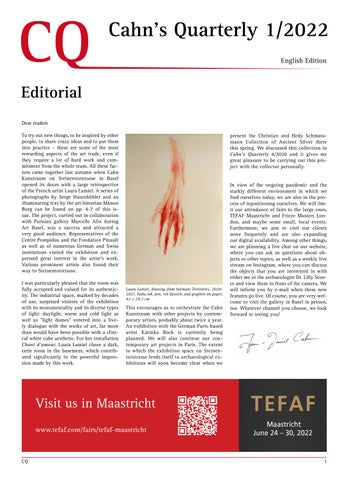
Editorial Dear readers To try out new things, to be inspired by other people, to share crazy ideas and to put them into practice – these are some of the most rewarding aspects of the art trade, even if they require a lot of hard work and commitment from the whole team. All these factors came together last autumn when Cahn Kunstraum on Steinentorstrasse in Basel opened its doors with a large retrospective of the French artist Laura Lamiel. A series of photographs by Serge Hasenböhler and an illuminating text by the art historian Manon Burg can be found on pp. 4-7 of this issue. The project, carried out in collaboration with Parisian gallery Marcelle Alix during Art Basel, was a success and attracted a very good audience. Representatives of the Centre Pompidou and the Fondation Pinault as well as of numerous German and Swiss institutions visited the exhibition and expressed great interest in the artist's work. Various prominent artists also found their way to Steinentorstrasse. I was particularly pleased that the room was fully accepted and valued for its authenticity. The industrial space, marked by decades of use, surprised visitors of the exhibition with its monumentality and its diverse types of light: daylight, warm and cold light as well as "light domes" entered into a lively dialogue with the works of art, far more than would have been possible with a clinical white cube aesthetic. For her installation Chant d'amour, Laura Lamiel chose a dark, eerie room in the basement, which contributed significantly to the powerful impression made by this work.
present the Christian and Hedy Schmassmann Collection of Ancient Silver there this spring. We discussed this collection in Cahn's Quarterly 4/2020 and it gives me great pleasure to be carrying out this project with the collector personally.
Laura Lamiel, drawing from Intimate Territories, 20202021. India ink, pen, red lipstick, and graphite on paper, 42 × 29.7 cm
This encourages us to orchestrate the Cahn Kunstraum with other projects by contemporary artists, probably about twice a year. An exhibition with the German Paris-based artist Katinka Bock is currently being planned. We will also continue our contemporary art projects in Paris. The extent to which the exhibition space on Steinentorstrasse lends itself to archaeological exhibitions will soon become clear when we
In view of the ongoing pandemic and the starkly different environment in which we find ourselves today, we are also in the process of repositioning ourselves. We will limit our attendance of fairs to the large ones, TEFAF Maastricht and Frieze Masters London, and maybe some small, local events. Furthermore, we aim to visit our clients more frequently and are also expanding our digital availability. Among other things, we are planning a live chat on our website, where you can ask us questions about objects or other topics, as well as a weekly live stream on Instagram, where you can discuss the objects that you are interested in with either me or the archaeologist Dr. Lilly Stoner and view them in front of the camera. We will inform you by e-mail when these new features go live. Of course, you are very welcome to visit the gallery in Basel in person, too. Whatever channel you choose, we look forward to seeing you!
Visit us in Maastricht www.tefaf.com/fairs/tefaf-maastricht
CQ
1
Cahn’s Quarterly 1/2022
Discovered for You
Healing “Iron” On the Use of Surgical Instruments in Antiquity By Gerburg Ludwig
Fig. 1: A GROUP OF ANCIENT SURGICAL INSTRUMENTS. From top to bottom: two spoon probes, four ear probes alternating with two instrument handles; a pair of tweezers. L. 9.3–19.1 cm. Bronze. Roman, 1st–2nd cent A.D. CHF 1,600
“Those diseases that medicines do not cure are cured by the iron. Those that the iron does not cure are cured by fire. Those that fire does not cure must be considered incurable.” (Corpus Hippocraticum, Aphorisms 7.87). This excerpt from a collection of medical texts composed in the 5th-3rd centuries B.C. and compiled in Alexandria in the 3rd century B.C. describes the remarkably clearcut course of action taken by doctors in Antiquity. “Iron” refers to surgical instruments that were mostly made of bronze, whilst "fire" stands for the technique of cauterisation using a heated piece of metal. If neither procedure helped, the doctor should modestly acknowledge the limitations of his art. There is evidence for the medical treatment of illnesses or traumata from the Neolithic Period onwards. For instance, traces of surgical interventions on human bones have been found. Nonetheless, people initially considered both illness and recovery to be God-given. In the event of illness, Greeks would mostly turn to Asclepius, the god of healing, for help. His sons, Machaon and Podalirius, who fought on the side of the Greeks, acted as doctors during the Trojan War (Homer, Iliad, 2.731 f., 11.833). In a remarkably knowledgeable manner, Homer describes how wounds were inflicted, what their effects on the body were and how they were treated: occasionally with a cauterising iron, but mostly with medication and bandages (Homer, Iliad, 4.204 ff.). 2
In the Archaic Period, the pre-Socratics furthered the development of medicine as a techné or science with their studies on nature and human life. A generation later, doctors like Hippocrates began researching the causes of diseases and their symptoms, epidemics, and therapeutic and prognostic methods. In the 4th century B.C., Aristotle comprehended the close connection between anatomy and physiology. Empirical anatomical studies and dissections were first conducted in the Hellenistic Period and Roman medical practitioners such as Celsus and Galenos continued research in this field. The medical knowledge of Antiquity was influential throughout the Middle Ages and the Renaissance, and its impact continues to be felt in modern times. The Corpus Hippocraticum included advice on various surgical methods, including the repositioning of joints, the splinting of fractures, the treatment of head injuries (including trepanation, a method in which a hole is made in the skull) or embryotomy (removal of the fetus from the uterus to save the mother’s life when normal delivery is not possible). Apart from the use of opium, little was known about anaesthetics. Greek medical knowledge was passed on to the doctors in Rome and the procedures employed by surgeons became increasingly complex and sophisticated. New surgical techniques were developed, such as the operation of abscesses and blood vessels, the removal of urinary stones and the treatment of cataracts.
With regard to surgical instruments, the treatise On the Physician recommended that they should be “well fitted for their use in size, weight, and fineness.” (Corpus Hippocraticum, Περὶ ἰητροῦ 9.208). Hardly any instruments from ancient Greece have survived, but we know the broad variety of types employed by Roman surgeons all the better. Pompeii provides a snapshot: in the vicinity of the amphitheatre, a human skeleton was found lying on top of a medical toolbox containing sets of various probes, tweezers, retractors, scalpels with iron blades and a cataract needle. Doctors also used tubes with lids or folding cases to transport their instruments. From Greek times onwards, funerary and votive reliefs might depict open tool kits, as for instance in the relief with a doctor in Berlin (2nd century B.C., Antikensammlung, inv. no. Sk 804). The instruments contained in these kits make it possible for those found in large numbers in the tombs of doctors, for instance in Bingen (Germany) and Reims (France), to be compared and identified. A Pompeiian wall painting in the Casa di Sirico (Regio VII, Naples, Museo Nazionale) shows ancient surgery in progress: it depicts the doctor Iapyx using pliers to remove an arrowhead from Aeneas' thigh.
Cahn’s Quarterly 1/2022
body orifices and assess the depth of wounds and abscess cavities. It could also serve as a lever during operations. The Greek surgeon Antyllus described the following procedure: “... after we ... have placed a probe button below the (blood) vessel and lifted it, we will pass a needle with a double spun thread along the probe button so that it is positioned underneath the artery...” (On Vasodilation in: Oribasius, Coll. med. rel. XLV 24). The other end of the probe varied in shape and use. The sharp edges of the spoon probe were used to remove plaque from wounds or bony cavities. Today, these “sharp spoons” are used to treat wounds on both outpatients and patients undergoing surgery in hospital (fig. 2). The more delicate ear probes with round spoons and pointed handle ends were used to clean ears, small wounds, and fistulas, to remove bladder stones or to treat haemorrhoids. Their modern equivalent is the ear curette used in ENT medicine. By means of comparison, two instrument handles can be identified as another spoon probe and as an ear or spatula probe. The pair of tweezers with their distinctive inward-bent tips belong to the category of smooth tweezers. They were used by doctors to remove ingrown eyelashes and foreign bodies or to grasp soft tissue, for instance in tonsil and uvula operations or during surgical haemorrhoid treatment. Their modern equivalent are the ciliary forceps used by ophthalmologists to remove eyelashes (fig. 2); in microelectronics, wafer tweezers are used to handle semiconductors. Thus, not only the origins of medical research, but also the roots of the design and practical use of today’s surgical instruments lie in Greek and Roman Antiquity.
Smiths crafted the surgical instruments from silver, bronze or zinc-rich brass. In soft tissue surgery, scalpels, scissors, retractors, needles and cauterising irons were employed. Special bladder stone scalpels and roughened hooks served to remove stones, and cataract needles were used to treat cataracts. Bone surgeons used saws, chisels, bone lifters, pliers, drills and scrapers. For trepanation a trephine drill was employed – such an instrument was included in the grave goods of the doctor buried in Bingen. It is tubular in shape with a guide pin in the interior and a round saw at one end that was made to rotate using a kind of fiddle bow. The Cahn Gallery is currently offering a selection of two other typical instrument types used in soft tissue surgery: a variety of probes and a pair of tweezers (fig. 1). They functioned as the “extended fingers of the doctor” (A. Krug, Heilkunst und Heilkult. Medizin in der Antike, Munich2 1993, 93). The probes were often double-ended, a principle still used today (fig. 2). Using the oval end of the probe (probe button), the doctor could gain an “insight" into natural CQ
My Choice
A Head of a Boy By Jean-David Cahn I am fascinated by this life-size head of a boy, who must be two to four years old, because of its very subtle combination of individual features with a degree of idealization. The little boy's face expresses a seriousness found only in children. The melancholy gaze from under sleepy, heavy lids and the slightly sceptical smile combine to form a facial expression replete with premonition: the boy seems to be aware that he has to go, that he must cross the threshold into the afterlife. The head is practically intact, with only a few minor in-fills. The tang below the chin reveals that the head was designed to be inserted into a statue that may have formed part of a funerary monument. The back of the head is particularly voluminous, perhaps indicating that the boy’s head was tilted forwards so HEAD OF A BOY. H. 21.1 cm. Marble. Greek, Late Classical, 1st half of 4th that he looked diagonal- cent. B.C. Price on request ly downwards. The hair is of a particularly high quality, showing the class sculptors drawn to the city by such typical Late Classical hair tufts, subdivid- major building projects as the Parthenon. In ed by incisions, to advantage. A few stray the wake of these civic building activities, a curls at the nape of the neck make for a wealth of tombstones of the highest quality charming detail. The lively surface created was sculpted. Our exquisite head may be sitby the curly tufts is strongly reminiscent of uated in this context. metalwork.
Imprint
Fig. 2: Modern surgical instruments, some double-ended. From left to right: a button probe, a series of sharp spoons; below: a pair of ciliary forceps. © Drawing: R-E-A-L, Wikimedia Commons (site visited 21.9.2021) © Photo: Zephyris, Wikimedia Commons (site visited 1.10.2021)
CQ
Our sculpture is undoubtedly a Greek original of the Late Classical Period (first half of the 4th century B.C.), something that is very rarely found on the art market. The clearest pointers for such a date of creation are the sculpture’s precise formal language and also the immediacy of its emotional expression – the poignant melancholy of parting that provokes a visceral response in the beholder. In late 5th and early 4th century B.C. Athens, the representation of emotions in sculpture reached an acme not to be surpassed in later times due to the large numbers of first-
Publisher Jean-David Cahn Malzgasse 23 CH-4052 Basel www.cahn.ch ISSN 2624-6368 Editors Jean-David Cahn Yvonne Yiu Authors Manon Burg Jean-David Cahn Ulrike Haase Gerburg Ludwig
Translations Yvonne Yiu Photos Niklaus Bürgin Ulrike Haase Serge Hasenböhler Design and Layout Michael Joos Yvonne Yiu
3
Cahn’s Quarterly 1/2022
Cahn’s Quarterly 1/2022
Cahn Kunstraum
Laura Lamiel's Exhibition Honey on a Knife A Journey to Other Realities By Manon Burg
Laura Lamiel, Intimate Territories, 2020-2021. India ink, pen, red lipstick, graphite on paper, copper tables. Each drawing 42 × 29.7 cm
The solo exhibition of French artist Laura Lamiel (born 1948), the first show hosted by Cahn Kunstraum and certainly the largest exhibition of her work ever shown outside France, ended on 20 November 2021. For some it was an opportunity to discover her work, and for those who were already familiar with her artistic practice, it was a chance to re-discover it in the light of a selection of archaeological objects made by the artist during a stay at the Cahn Gallery in Basel. For this exhibition, the artist was able to brilliantly exploit Cahn Kunstraum’s brutalist architecture, itself a receptacle of different temporalities and previous activities, to present five monumental installations, all original in their own way. Immersive installations, red ink drawings, older pieces and new creations: Laura Lamiel's works were transformed by the integration of ancient objects, thus multiplying the affective, poetic and political charge of her work. This encounter with archaeology can be both symbolic or evocative, but is also caught in a fusional relationship. In Untitled (2000-2020) – which revives a minimalist heritage of which she claims to be a part – the artist arranges enamelled metal bars in a quadrilateral manner reminiscent of the method of stratigraphic 4
excavation. In the four other installations – I’ve Seen Water Buffalo (2019-2021), Intimate Territories (2020-2021), Honey on a Knife (2021), A Song of Love (2019-2021) – contemporary artifacts from the artist's collection are combined with those from the past, without hierarchy or distinction. Laura Lamiel speaks of “a shifting of memories from 2020 that intermingle with those of older centuries and vice versa," for which the suitcase constitutes a visual leitmotif throughout the exhibition. These suitcases were often bought at flea markets by the artist; some of them may have belonged to immigrants and would have contained “a shirt and a bar of soap," to use the artist's words. For the exhibition, she filled them with photos of her collection of objects and/or plants and, most strikingly, with Roman glass vessels. Receptacles of previous memories, these suitcases constitute a mise en abîme, reiterating the principle underlying the exhibition on a microcosmic scale: Laura Lamiel aims to subvert the linear chronological model based on past, present, and future in order to access other realities beyond this physical world. The suitcases thus become the “ferrymen” or “gate-keepers” of this trans-temporal journey orchestrated by the artist.
The question of the threshold is indeed central to Laura Lamiel’s work, as can be seen by her frequent use of the mirror to suggest the passage to other realities. Among the hundreds of broken glasses on the ground that constitute Honey on a Knife, a few Roman glasses – travellers through the millennia – seem to be, miraculously, the sole survivors of this catastrophe. Oscillating between a psychoanalytical approach and spiritual cosmology, the mirror inspires access to these plural worlds beyond the material realities. In the same vein, the artist confided in me that in A Song of Love, which is a tribute to Jean Genet's only film, the Roman colossi that adorned her "cell" accentuated the gravity of her piece and anchored it. To this I replied: “Despite the sheer physicality of this colossus that weighs almost a ton, our reflection projected into infinity invites us to let ourselves be uprooted from this physical world." Laura Lamiel looks for the gaps, she seeks to create a tension between opposites that is so intense that they meet and become one. This is perhaps one of the greatest forces that can be experienced in her work. When I interviewed the artist in Basel on the eve of the opening in September, she told me that she did not yet know what her encounter with these ancient objects, these cultures from the past, would generate in her work. One thing is certain, Laura Lamiel still has a lot to show us through her eyes. To learn more about the exhibition and the artist's work, an audio interview in French will be available on the Cahn Contemporary website as of March 2022. Page 5 above: Laura Lamiel, I’ve Seen Water Buffalo, 2019-2021. Tempered glass, paintings fixed under glass, metal frames, fluorescent tubes, books, cactus and plant moss, suitcases, objects from the artist’s collection. Variable dimensions. Page 5 below: Laura Lamiel, Honey on a knife, 2021. Glass, mirror, raw steel chair, fluorescent tubes, objects from the artist’s collection, Roman glass vessels. Variable dimensions. Page 6: Laura Lamiel, A Song of Love, 20192021. Steel, one-way mirrors, copper table, objects from the artist’s collection, raw steel units, fluorescent tubes. 190 × 200 × 160 cm © Photos: Serge Hasenböhler CQ
CQ
5
Cahn’s Quarterly 1/2022
Cahn’s Quarterly 1/2022
New Artworks Monthly on www.cahn.ch
Insights into Everyday Life in Antiquity
A BLACK-FIGURE SIANA CUP WITH SYMPOSIASTS (ATTRIBUTED TO THE C PAINTER). Dm. 26.3 cm (excluding handles). Clay. A deep cup with broad, everted rim. Formerly with Galerie Arete, Zurich. Thereafter priv. coll. London, acquired Galerie Arete 24 June 1981. Publ.: H.A.G. Brijder, Siana Cups I and Komast Cups, Amsterdam, 1983, p. 245, no. 109 (without illus.). Greek (Attic), ca. 575-560 B.C. Sold
A STATUETTE OF AN ACTOR. H. 13.7 cm. Bronze. Formerly French private collection. Roman, 2nd-3rd cent. A.D. CHF 10,000
A DOUBLE SPIRAL ORNAMENT. W. 15.1 cm. Bronze. Double spiral made from a thin bronze rod with a rhomboid cross-section. The outermost coil is decorated with incisions. Joined together in the centre by a round wire spiral. Originally a dress ornament. Green patina. Intact. Formerly Swiss priv. coll. Dr. R. H. (1922-2007). Danubian region, 1st half of Late Bronze Age, ca. 14th-12th cent. B.C. CHF 3,800
A RED-FIGURE CUP, ATTRIBUTED TO THE PAINTER OF LOUVRE G 456. Dm. 28.5 cm. Clay. Formerly Collection Cavadini, Sorengo-Lugano, Switzerland, acquired in the 1960s. Attic, ca. 440 B.C. CHF 24,000
A HAND AXE. H. 15.5 cm. Stone (silex). Yellowish-beige stone. Formerly priv. coll. Hervé Bouraly, Saint Ouen, France, between 1965-1990. Inscription on object: “1953. Champley (Yonne)". France, Lower Palaeolithic, ca. 800.000-100.000 B.P. CHF 2,800
6
CQ
CQ
A HAND AXE. H. 17.5 cm. Stone. Symmetrically worked tool. Formerly coll. Dalomba, France. Inscription on object: “JABLINE. Set M. 1877". France, Middle Palaeolithic, Mousterian in Acheulean tradition, ca. 120.00040.000 B.P. CHF 2,800
A MONUMENTAL LEAF POINT. H. 20 cm. Silex. Tool with symmetrical, leaf-shaped form. Formerly priv. coll. Hervé Bouraly, SaintOuen, France, between 1965-1974. France, Upper Palaeolithic, Solutrean, ca. 22,00017,000 B.C. CHF 4,600
A DAGGER BLADE. L. 15.5 cm. Silex. Beige stone with dark veins. Austrian priv. coll., acquired in the 1990s on the art market. Nordic area (Scandinavia, North Germany), Final Neolithic to Early Bronze Age, ca. 2200-1000 B.C. CHF 6,800
7
Cahn’s Quarterly 1/2022
A BEAKER WITH TRAILING. H. 8 cm. W. 7.3 cm. Translucent, bluish green glass. On the body a thin spiral thread. Free-blown. Formerly priv. coll. Dr. F.-J. and M. E., Wehr, acquired 1980 on the German art market. Roman, 1st-3rd cent. A.D. CHF 1,600
AN AMPHORISKOS. H. 8.9 cm. W. 7.8 cm. Light blue glass. Two-handled jar with bulbous body and arched base. Short, wide neck. Free-blown. Formerly Coll. Shlomo Moussaieff, Israel, 1948-2000. Roman, 1st3rd cent. A.D. CHF 2,200
A LARGE BOTTLE. H. 24.9 cm. Greenish glass. Formerly priv. coll. H. W.-W. (1901-1979), Switzerland. On the underside two old labels: “Römische Flasche aus Lyoner Privatbesitz" and “Collection ... Paul Bie". Roman, 2nd-3rd cent. A.D. CHF 4,800
A PAIR OF GOLD EARRINGS. L. 3.2 cm and 3.4 cm. Gold. "Navicella" type. Formerly Sothebys London, 16 July 1962, lot 86 with illus. Thereafter estate of Dr. Roland Maly (died 2005), Switzerland. Greek, 2nd half of 4th-3rd cent. B.C. CHF 5,600
A PAIR OF GOLD EARRINGS. L. max. 5 cm. Gold. The outstanding quality of these earrings is evident in the filigree intricacy of the gold work. Formerly priv. coll. Southern France, acquired in the 1990s. Eastern Greek, 3rd-1st cent. B.C. CHF 15,000
A RING WITH AN EAGLE INTAGLIO. Dm. 1.3 cm. Gold, carnelian. Roman, 1st-3rd cent. A.D. CHF 3,200
AN INTAGLIO WITH HUNTSMAN. H. 1.7 cm. Carnelian. Formerly priv. coll. K., Switzerland.Roman, 1st cent. A.D. CHF 12,000
A LENTOID INTAGLIO WITH THEATRE MASK. H. 1.4 cm. Formerly Herbert A. Cahn, Basel, 1990s. Roman, 1st cent. B.C. CHF 800
A FOLDING KNIFE WITH ANIMAL GROUP. L. 6.1 cm. Bone, iron. Folding knife with a handle in the form of sexually active animals. Formerly South London priv. coll., acquired on the European art market between 1970 and 1980. Roman Provinces, 3rd cent. A.D. CHF 3,600
A TETRADRACHM, SYRACUSE. Dm. 2.3 cm. Silver. Obverse: Charioteer driving a quadriga; Reverse: Head of Arethusa. Inscription: ΣΥΡΑΚΟΣΙΟΝ. Formerly Coll. A. Maly, 1966 from Bank Leu, Zurich. Western Greek, Sicily, Syracuse, ca. 480-475 B.C. (Gelon I and Hieron I) CHF 6,600
NOMOS, TARANTO. Dm. 1.9 cm. Silver. Obverse: Nude horseman galloping towards the right. ΓΥ in field. Reverse: Phalanthos, the mythical founder of Tarentum, nude astride a dolphin. Formerly UBS, Zurich, Auction 56, 2003, lot 22. Magna Graecia, 302-281 B.C. CHF 1,500
8
A RING WITH A GARNET. Dm. 1.2 cm. Gold, garnet. Western Greek, Hellenistic, 3rd-1st cent. B.C. CHF 1,200
CQ