Cahn’s Quarterly 1/2021 English Edition
Editorial Dear readers I hope 2021 finds you well. Here in Basel, the calmer winter months have allowed us time to scrutinize and reorganize our archives. We are also looking forward to utilizing our enormous new showroom to present projects organized by Cahn Contemporary. Since we were all feeling the isolation of working at home, we resumed shooting videos in the gallery. Retaining the format of homespun iPhone cinematography, we have produced improvised, off-the-cuff discussions of a range of topics to share with you. It is a fun diversion for us, and we hope for you as well. We will be posting these videos on YouTube and Instagram, as well as emailing them to you on a bi-weekly basis. Also in the technological realm, we are delighted to announce the launch of a new website this spring. This will enable us to share more of our artworks, exhibitions, and musings with you. I am very honoured that Klaus Fittschen contributed an essay on photographic documentation in classical archaeology to this issue of Cahn’s Quarterly. I would like to take this as an opportunity to discuss my own experience with light and sculpture, a theme which confronts me on a daily basis. Lighting is an extremely important tool for displaying sculpture, and it is astonishing how little attention is given to it in the training of archaeologists – all the more so, as its importance was highlighted by Ernst Langlotz as long ago as the early twentieth century. Depending on the angle of the light, the added drama through shadows, and so forth, one’s impression of a sculpture changes drastically. In museums, the subject of light is all too readily delegated away to light technicians. Without critical reflection, every new technology is immediately embraced, and money spent to be up to date, although as with all new technologies, there are bound to be teething problems to be overcome. In the extreme, one could argue that the best light is, in fact, found in Greek provincial museums, where there is simply only daylight – depending on the weather either crisp or soft. We forget that in ancient contexts, sculptures were either displayed outside – thus with their appearance changing throughout the CQ
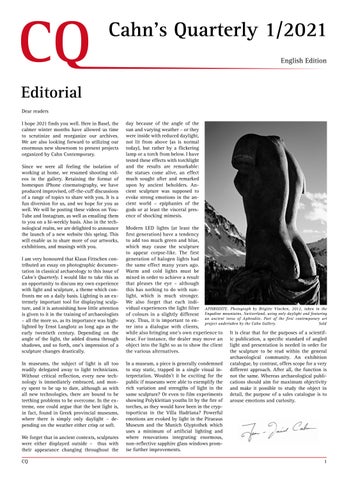
day because of the angle of the sun and varying weather – or they were inside with reduced daylight, not lit from above (as is normal today), but rather by a flickering lamp or a torch from below. I have tested these effects with torchlight and the results are remarkable: the statues come alive, an effect much sought after and remarked upon by ancient beholders. Ancient sculpture was supposed to evoke strong emotions in the ancient world – epiphanies of the gods or at least the visceral presence of shocking mimesis. Modern LED lights (at least the first generation) have a tendency to add too much green and blue, which may cause the sculpture to appear corpse-like. The first generation of halogen lights had the same effect many years ago. Warm and cold lights must be mixed in order to achieve a result that pleases the eye – although this has nothing to do with sunlight, which is much stronger. We also forget that each individual experiences the light filter APHRODITE. Photograph by Brigitte Vincken, 2012, taken in the of colours in a slightly different Engadine mountains, Switzerland, using only daylight and featuring way. Thus, it is important to en- an ancient torso of Aphrodite. Part of the first contemporary art project undertaken by the Cahn Gallery. Sold ter into a dialogue with clients, while also bringing one's own experience to It is clear that for the purposes of a scientifbear. For instance, the dealer may move an ic publication, a specific standard of angled object into the light so as to show the client light and presentation is needed in order for the various alternatives. the sculpture to be read within the general archaeological community. An exhibition In a museum, a piece is generally condemned catalogue, by contrast, offers scope for a very to stay static, trapped in a single visual in- different approach. After all, the function is terpretation. Wouldn’t it be exciting for the not the same. Whereas archaeological publipublic if museums were able to exemplify the cations should aim for maximum objectivity rich variation and strengths of light in the and make it possible to study the object in same sculpture? Or even to film experiments detail, the purpose of a sales catalogue is to showing Polykleitian youths lit by the fire of arouse emotions and curiosity. torches, as they would have been in the cryptoporticus in the Villa Hadriana? Powerful emotions are evoked by light in the Piraeaus Museum and the Munich Glyptothek which uses a minimum of artificial lighting and where renovations integrating enormous, non-reflective sapphire glass windows promise further improvements. 1
Cahn’s Quarterly 1/2021
Discovered for You
Proportion: The Key to Perfection By Gerburg Ludwig
Fig. 1: A RED-FIGURE CALYX KRATER, ATTRIBUTED TO THE NIOBID PAINTER. H. 26 cm. Clay. Attic, ca. 450–440 B.C. Price on request
Anyone who engages with ancient architecture will find that a vast field soon opens up: The Roman architect Vitruvius (b. 80/70 B.C.) devoted no fewer than six of the ten volumes of his De Architectura to “aedificatio” (buildings). In this treatise, which is peppered with anecdotes, he discusses the development of architecture since Grecian times and systematically examines both public and private buildings (Book 3–5/Book 6). His focus is on the consummate overall appearance of a temple achieved with the aid of perfect proportions. “The design of Temples depends on symmetry,” writes Vitruvius. “Symmetry is dependent on proportion … Proportion is a due adjustment of the size of the different parts to each other and to the whole … Hence no building can be said to be well designed which wants symmetry and proportion. In truth they are as necessary to the beauty of a building as to that of a well formed human figure.” (De Architectura 3,1,1, trans. Joseph Gwilt). The Archaic Period temple with peristyle developed out of early cult buildings, such as the slim, rectangular edifice with oval peristyle (10th/8th cent. B.C.) in the Sanctuary of Apollo in Thermos/Aetolia. It was also influenced by Egyptian hypostyle structures like the complex in Karnak. It spread from the Greek heartland to the whole of the Grecian world following the shift from wood to stone as building material in ca. 700 B.C. It is Vitruvius we have to thank for our knowledge of the Classical orders, which he called “genera” 2
Fig. 2: A FRAGMENT OF A PILASTER CAPITAL. H. 28 cm. Marble, polychromy. Roman, 2nd half of 1st cent. A.D. CHF 16’000
(fig. 3, Doric: De Architectura 4,3; Ionic: 3,5; Corinthian: 4,1), the term “order” being a Renaissance coinage. The topographical names are based on Vitruvius’ attributions of some exceptionally striking temples. All the orders combine load-bearing with load-exerting parts proportioned harmoniously in relation to each other. The columns stand on a stepped foundation (krepis) either without (Doric) or with a base (Ionic, Corinthian). Their shafts can swell and taper (entasis) and their surfaces are usually channelled with parallel, vertical flutes. The capitals, entablature with architrave, frieze and horizontal cornice (geison) vary. A raking geison frames the often figural tympanon. The geisa can be ornamentally embellished, while waterspouts, figures or ornaments (antefixes, akroteria) adorn the edge, corners and ridge ends of the roof. The trademark qualities of the Doric order are simplicity and austerity, as evidenced by the temples of southern Italy, e.g. in Agrigento (5th cent. B.C.). The capital is a bulging circular block (echinus) surmounted by a square slab (abacus). This is followed by a smooth architrave and then the frieze above it, consisting of metopes, often decorated with figures, alternating with triglyphs aligned with the axis of the column or the intercolumnar space. For the frieze to end cleanly at the corner of the temple, the triglyphs there had to be pushed to the edge, out of the axis of the column. This “Doric corner conflict” disturbed the rhythm of
the frieze. The various solutions to it – stretching the triglyphs or the neighbouring metope or spacing the columns more closely – could only ever be a compromise. The impressive innovations being made in architecture are reflected in the work of contemporary vase painters. In the warrior’s farewell on the front of the Cahn Gallery’s calyx krater (fig. 1), for example, a Doric column partially conceals the phiale, which the warrior – helmeted and armed with a lance and round shield with shield apron – holds in his right hand. It has just been filled with the valedictory offering by the young woman on the left, doubtless his sister or wife, from whom he is taking his leave. The older figure on the right is presumably his father. The Niobid Painter drew the column with fluting and capital, to which he added six guttae (droplets) marking the position of the triglyphs. A single architectural element is thus sufficient to transport the scene into the inside of a building, peristyle or courtyard. The Archaic Temple of Artemis in Ephesus (ca. 550 B.C.), one of the Seven Wonders of the World, is a typical Ionic temple. The column bases resting on square plinths are enlivened by concave mouldings and tori, some of them fluted. The capitals have two conjoined spirals or volutes. Ornamental bands, frequently with beading or egg and dart, are located between them and a flat abacus forms the top. The capital and temple are clearly conceived to be viewed frontally. This, too, results in a CQ
Cahn’s Quarterly 1/2021
corner conflict, which is resolved by angling the volutes. Architects influenced by the Orient added interest to the entablature and roof structure with toothed and ornamental bands as well as figural or ornamental column feet or abacuses. The Ionic order thus has a very individual character. The oldest version of the Corinthian order, which is a variation of the Ionic, is evidenced by the Temple of Apollo in Bassae/Arcadia (420–400 B.C.). The most striking difference is in the capitals, whose basket of acanthus leaves (kalathos) growing over a torus sprouts forked volute vines at the top. Whether merely touching their neighbouring volutes or fused together with them, these project out from the capital, which is topped by a possibly ornamental abacus. With capitals sculpted in the round, this order precludes any corner conflict. The Corinthian order therefore became increasingly popular, especially when paired with playful floral décor. Hellenistic and Roman architects would later avail themselves of the other orders, too, and by varying them relaxed the strict rules governing them. The result was ever greater architectural variety. One such variation is the Cahn Gallery’s Corinthianizing pilaster capital (fig. 2). A deep-cut volute vine grows out of fanned acanthus leaves. The beginnings of its sister vine are visible on the right. A profile edge separates this zone from the abacus. The latter is decorated with a cavetto containing acanthus leaves alternating with a stylized cymation and lancet leaves. Egg and dart with downward-pointing lancet leaves tops off the capital. Well-preserved remains of the original polychromy tell of the architecture’s optical impact. The influence of the Classical orders was to endure far beyond Antiquity. Their reception in the Renaissance, classicism and historicism has shaped architecture to this day.
Fig. 3: The Classical orders. © Emma Kelly, https:// www.theguardian.com/artanddesign/2011/sep/11/identify-greek-orders-architecture (accessed: 19.2.2021)
CQ
My Choice
A Pre-Canonical Cycladic Idol By Jean-David Cahn Cycladic idols, as we usually perceive them, are mostly of the Spedos type with a characteristically elongated, slender body, crossed arms, clearly defined limbs, and a marked triangle for the pubis. The neck is usually separated from the body and the head is clearly delineated. However, what I find most interesting in any culture are the moments before a formal language has been defined, when there is a rich variety of possibilities with no clear trajectory. Our knowledge of the early Cycladic societies is based on remote field sites and hoard finds, and especially on the material culture expressed through their figurines. There is enormous room for interpretation, which remains of a clearly hypothetical nature. It is nevertheless notable that a canonization of forms and shapes could be based on the homogenization of a visual culture and the evolution of social structures. Our powerful pre-canonical idol comes from before this homogenization, dating between Early Cycladic I and II, around A RARE PRE-CANONICAL CYCLADIC IDOL. H. 17.8 cm. 3000 B.C. It is intact, with some minor Marble. Early Cycladic I/beginning of Early Cycladic II, 3200damage to the surfaces at the back and 2500 B.C. J. Thimme, Kunst und Kultur der Kykladeninseln Price on request the right shoulder. The well-defined face im 3. Jt. v. Chr., 246, 446, no. 108. is reduced to the minimum, with a central This very rare idol is large and has a good ridge for the nose, and a slight recess for provenance. It comes from the collection of the mouth and chin. It already demonstrates Michael Walz, an archaeologist and dealer, a profound understanding of volumes, and and was published in the landmark catalogue was perhaps influenced by parallel cultures of the Karlsruhe collection in 1976, where to the East. The back of the head is like- Jürgen Thimme assigned it to a rare group of wise clearly defined, with a soft ridge at hybrid idols. It is remarkable in its stark and the crown sloping towards the nape of the essential power. neck. The neck itself is sturdy, giving way to angular shoulders. The crossed arms are Imprint only roughly indicated through a coarsely Publisher ground groove. The sides of the abdomen Jean-David Cahn are smoothed to a beveled edge, only visible Malzgasse 23 Gerburg Ludwig under raking light. The crotch is softly arCH-4052 Basel www.cahn.ch Translations ticulated by a groove. It is possible that the ISSN 2624-6368 Bronwen Saunders legs were left unfinished, as there seems to be some chiseling on the surface, or a subseEditors Photos Jean-David Cahn Niklaus Bürgin quent break was chiseled at a later intervenYvonne Yiu Eugen Leu tion. These idols were never meant to stand, but were rather laid horizontally in sanctuAuthors Design and Layout Jean-David Cahn Michael Joos aries. It is informative to examine them in Klaus Fittschen this way; resting them in the palm of your Ulrike Haase Printer hand you get a feeling for how ergonomical Detlev Kreikenbom Rösch Printservice GmbH they are to touch and hold. 3
Cahn’s Quarterly 1/2021
The Debate
Photographic Documentation in Classical Archaeology In this third essay in Cahn’s Quarterly on photography and archaeology, Klaus Fittschen discusses the use of photographic techniques in contemporary archaeology. His article follows Detlev Kreikenbom’s historical review of the subject (CQ 4/2018) and Tomas Lochman’s musings on the relationship between photography and the plaster cast (CQ 1/2019). By Klaus Fittschen cussion are still being published, even if mainly owing to insufficient awareness of what is at stake. Such a catalogue is actually no better than an illustrated inventory, and is of no real value as a research resource. That scholarly progress can be severely impeded by the absence of other views has been proven time and again.
Fig. 1: Portrait of a priest, after S. Dillon, in Essays in Honour of R.R.R. Smith (2018) 130, fig. 12.
Fig. 2: Portrait of a priest, plaster cast, Göttingen, after a photo by St. Eckardt.
Photography has long been the most important working tool in any discipline that entails the study of objects. Without photography (and the images it generates), researchers involved in a particular field would not be able to communicate at all; for not even the most detailed descriptions can ever substitute for a photograph. Of course, objects made in the round still have to be studied in the original – for example to ascertain their exact dimensions and corporeality; but the main purpose of such work is generally to affirm the “accuracy” of the photographs, which sadly is now more vital than ever (see below). The question of colour photography that sparked such fierce debates in the second half of the twentieth century has, in the meantime, been settled and these days is more about costs than principles.
wide-ranging tasks that science requires of it. This condition is generally met nowadays, photography having in the course of the twentieth century become ever more the preserve of dedicated professionals. What has also emerged over the years is a kind of standardized selection procedure for images. It is generally agreed, for example, that sculptures in the round must be documented from all four sides, even if a divergent main view (where the head of a statue or bust is turned, for example) may be added. That this pattern is now standard practice worldwide is evident from the latest crop of scholarly catalogues, published as far afield as Athens, Dresden, Munich and New York. Serious art dealers have also adopted it – at least for especially worthwhile objects.
Only when it meets the highest possible quality criteria can photography fulfil the 4
The “all four sides” principle is not applied across the board, however. Catalogues showing only one aspect of the object under dis-
Some of those types of documentation that were very much in favour in the last century have fortunately not proved their worth. I am thinking here of the practice of photographing statues, and heads especially, from a low angle. While it is indeed the case that many statues in Antiquity were mounted so high up that they could only ever be viewed from below, it must also be said that ancient sculptors took no heed of this and designed their works as if they were to be viewed eye to eye. This also holds true of over life-sized portraits (and even colossal portraits). For the purposes of scientific inquiry, therefore, it made sense to photograph objects just as their ancient sculptors conceived them, in other words, eye to eye. The expressionistic images that were so popular in the mid-twentieth century (views from above or from an angle, or close-ups of facial details) were never widely embraced, therefore, even if they are still to be found in sales catalogues. All in all, it can be said that documentary photography, at least in archaeology, has now reached a standard that can indeed be described as at once adequate and pleasing. Doubts as to whether this standard can be upheld are nevertheless warranted, for there are also signs of some very troubling developments. The acquisition of professional photographs for scientific purposes is too expensive as a rule (despite the now standard digital mode of delivery). This has become even more of a problem since museums have begun contracting out their photographic needs to proCQ
Cahn’s Quarterly 1/2021
fessional image agencies. It is not just young researchers who are hard hit by these high prices; even established scientists and scholars can count on the availability of free or affordable photographs only if they have personal connections to museum directors. Regrettably, the major academic organizations have not yet taken any steps to obtain special terms with which researchers’ needs might better be met. Two – contrary – consequences of this can already be observed: First, archaeological publications that are only sparingly illustrated or perhaps not illustrated at all are becoming increasingly common. Many of these content themselves with images that can be obtained cheaply and easily (for example from the DAI or Arachne, Cologne) and that are not under copyright, claims for which are being pursued ever more stridently in some countries. (It is indeed striking just how often the DAI and Arachne crop up in picture credits – especially in American publications.) Second, and conversely, the high price of photographs has prompted many authors to produce the photographs needed for their illustrations themselves, assuming they have an opportunity to do so. Photography has become so much easier in recent years that even laypeople can produce images on which at least something can be made out, even in poor light. That the quality of such images is not comparable with that of professional photographers goes without saying. The optimum lighting of sculptures is an especially critical factor, all the more so since many museums have now opted for the use of spotlights to illuminate their three-dimensional works. But these are all shortcomings that we can live with. After all, archaeology has always had to contend with inadequate illustrations made after substandard photographs. A much greater danger is that facing scientific photography from the use of digital technology. While brightening up an underexposed photograph or enhancing its contrasts is now very easy, as is the removal of distracting backgrounds (which compared with the old airbrushing method really does constitute progress), that same digital toolkit can also be used to change the objects themselves, for example by distorting their proportions. While such manipulation soon becomes apparent when applied to a widely illustrated piece (cf. fig. 1 from a new publication of 2018 and fig. 2 showing a plaster cast of the same piece in Göttingen), what if it is a new find? Even more dangerous is a practice that has only just recently come to light, namely that of “morphing.” Anyone who has followed how a digital portrait of German Chancellor CQ
Angela Merkel, say, can be made to morph into one of Queen Elizabeth II (or vice versa), or who has seen the facial features of Barack Obama metamorphose into those of Vladimir Putin, will already have some inkling of the scope for manipulation that digital photography opens up, for instance when it comes to the secondary use of portraits (through reworking) and the timeless phenomenon of portrait assimilation, both of which have been the subject of fruitful debate in recent decades. Scientists and scholars are helpless in the face of such opportunities for manipulation. In principle, every photo supplied by a museum or an image agency should come
that is something that scholars and historians must come to terms with. The news item, “Putting a Face to Emperor Augustus” (FAZ, 1 August 2014) thus falls into the category of “fake news.” But how should the lay reader know that? Only a cynic might be reassured by the observation that the world of science and the world inhabited by the public at large have drifted so far apart in recent years that the process described here is no longer relevant. However, scientists themselves were complicit in this particular case. Where these new technologies might yet lead is thus something that no one at present can accurately predict.
Fig. 3: Portrait of Augustus (modern photofit), after J. Raeder, Gymnasium 122, 2015, 75 ff., fig. 1.
Fig. 4: Portrait of Augustus of the Primaporta type after D. Boschung, Die Bildnisse des Augustus (1993), pl. 69.
with a certificate of authenticity in future. But not even that would provide a hard and fast guarantee against abuse. A product that rests on just such a procedure attracted media attention even a good five years ago. The North Rhine-Westphalian Bureau of Criminal Investigation had teamed up with the Department of Ancient History at the Technical University of Aachen (a serious scientific institution, in other words) to reconstruct the true face of Emperor Augustus (fig. 3). Professor Scherberich of Aachen had taken umbrage at the fact that we have countless idealized portraits of Augustus, but not a single true likeness. The new photofit of Augustus was generated by feeding some of the surviving (idealized) portrait types of the emperor (fig. 4) into the crime squad’s “visual search tool” along with descriptions from ancient literary sources. Yet the resulting image is pure fantasy. Since we have no idea to what extent the idealized portrait types were informed by the emperor’s actual physiognomy, we lack any methodological means of retrieving his true appearance;
Klaus Fittschen, born 1936; studied in Tübingen, Rome and Athens (1956– 1964), Associate Professor of Classical Archaeology at the Ruhr University of Bochum (1971–1976), Professor of Classical Archaeology at the Georg August University of Göttingen (1976–1989), first Director of the German Archaeological Institute Athens (1989–2001), since his retirement (2001) resident in Wolfenbüttel. Main fields of research: Roman portraiture and sarcophagi, the reception of ancient art in the Modern Era. 5
Cahn’s Quarterly 1/2021
New Artworks Monthly on www.cahn.ch
Ancient Hairstyles
A LITTLE-MASTER CUP WITH SIRENS. H. 12.9 cm. Clay. A Little-Master cup with unusually tall and flaring lip. Sirens with outspread wings on either side. Small palmettes on either side of handles. Added red on palmettes and the wings and breast of the sirens. Added white to faces of sirens and in dotted lines on wings. Body in reserve, glossy black foot and handles. Formerly priv. coll. E. W., Zurich, acquired in the 1960s; thence by descent in the family. Attic, ca. 560-540 B.C. CHF 12,000
A VOTIVE HEAD OF A YOUTH. H. 27 cm. Terracotta (reddish-grey clay with black inclusions). Formerly priv. coll. Yvette and Jacques Deschamps, France. Etruscan, 4th3rd cent. B.C. CHF 6,800
A HEAD OF A SYMPOSIAST. H. 9.4 cm. Terracotta. Fragment of a statuette representing a man reclining on his side and wearing an elaborate headdress (so-called Tarentine symposiast). Formerly priv. coll. Tom Virzi (1881-1974), New York. With Galleria Serodine, Ascona (publ.: Galleria Serodine, Terrakotten aus Westgriechenland, Casa Serodine Ascona, 1.4.-23.5.1994). Thereafter priv. coll. Switzerland. Western Greek, 2nd-3rd quarter of 4th cent. B.C. CHF 2,200 A HEAD OF A FEMALE STATUETTE WITH WREATH. H. 6.3 cm. Terracotta. Head of a young woman to right with melon hairstyle, wreath and earrings. Part of the neck with Venus rings preserved. Mould-made. Hair, wreath and earrings made separately or structured with a modelling stick. Back of head roughly smoothed. Remains of white engobe (painting ground) and traces of reddish paint. Parts of the wreath and an earring lost. From a draped statuette (from the repertoire of the so-called Tanagra women). Priv. coll. S., Germany. Greek or Western Greek, 4th-2nd cent. B.C. CHF 2,800
6
A LEKYTHOS WITH HEPHAISTOS. H. 19.1 cm. Clay. Formerly priv. coll. E. W., Zurich acquired in the early 1970s. Attic, Greek, ca. 520-510 B.C. CHF 7,800
AN OINOCHOE WITH LION'S HEAD APPLIQUE (GNATHIA WARE). H. 21.7 cm. Clay, black glaze, red, white and yellow paint. A pear-shaped, black-glazed jug with trefoil mouth and flat, profiled ring foot. The neck is adorned by a white-yellow tendril from which a female theatre mask, red fillets and white-yellow twigs are suspended. A reddish, reserved band above the foot. Formerly Coll. A. Raifé (1802-1860). Publ.: F. Lenormant, Description des antiquités ... composant la collection de feu M. A. Raifé, Paris, 1867, 181, no. 1420 (old collection label on the underside of the vase). Thereafter Paris priv. coll., acquired 1990. Western Greek, Apulian, last quarter of 4th cent. B.C. CHF 12,000
CQ
Cahn’s Quarterly 1/2021
A GILDED BRONZE FITTING IN THE SHAPE OF BUST. H. 6.6 cm. W. 3.6 cm. Bronze, gilding. High quality bronze fitting in the form of bust, likely representing a deity. Formerly priv. coll. Austria, acquired in the 1990s on the art market. Greek, Hellenistic, 3rd-1st cent. B.C. CHF 3,000
A NECKLACE WITH THREE PENDANTS IN THE FORM OF A WOMAN'S BUST. H. (pendants) ca. 2.8 cm. Gold. Chain links added in modern times. Formerly priv. coll R. S., Los Angeles County, USA, before 1997. Greek, Hellenistic, 3rd-1st cent. B.C. CHF 9,400
A HANDLE OF AN OINOCHOE WITH GORGONEION. H. 14 cm. Bronze. Formerly Coll. Louis-Gabriel Bellon (1819-1899). Roman, 1st cent. B.C.-1st cent. A.D. CHF 1,600
AN ARM OF A BRONZE LAMP WITH COMIC MASK. L. 21 cm. Bronze. This impressive fragment, which is formed like an independent lamp, originally belonged to a multi-armed bronze lamp. The disc is adorned by a comedian's mask. Formerly Baidun Coll., Jerusalem, since 1976. Roman, 1st-2nd cent. A.D. CHF 10,000
A TETRADRACHM, SYRACUSE, REIGN OF AGATHOKLES. Silver. 17 g. Formerly Zurich art market, 2000. Western Greek, Sicily, Syracuse, 310-305 B.C. CHF 10,500
A TETRADRACHM, LEONTINOI. Silver. 17 g. With Dr. Busso Peus Nachf., Frankfurt a. M., Auction 4.5.2007, lot 4141. Western Greek, Sicily, Leontini, 470-430 B.C. CHF 5,500
AN INTAGLIO WITH WOMAN'S BUST. H. 1.3 cm. Carnelian. Formerly priv. coll. Koppenwallner, since the 1970s, Cologne, Germany; thereafter by descent in the family. Roman, 2nd cent. A.D. CHF 4,800
CQ
A HEAD OF EROS. H. 14.5 cm. Marble. Formerly priv. coll. G., Normandy, France, by inheritance from her father. In possession of the family since 1960 or earlier. Roman, late 1st cent. B.C.-1st cent. A.D. CHF 8,800
ARCHAISTIC RELIEF FRAGMENT WITH THE HEAD OF A DEITY. H. 14 cm. Marble. Formerly Coll. Prof. Hans Dahn (1919-2019), Lausanne; acquired 25.2.1953 in Paris (Kalebdjian). Roman, Late Republican to Early Imperial Period, late 1st cent. B.C.-early 1st cent. A.D. CHF 28,000
7
Cahn’s Quarterly 1/2021
Highlight
A Cheerful Satyr By Detlev Kreikenbom
A HEAD OF A SATYR. H. 27.5 cm. White marble. Hellenistic, 3rd/1st cent. B.C.
Satyrs, companions of the wine god Dionysos who as mythical creatures are half-man, halfbeast, are typically cast as headstrong and mainly cheerful characters. They might almost have been intended as a foil to the moral probity of the staid Greek citizen. Simply the fact that they live not in houses, but outdoors is sufficient to underscore the fundamental cultural divide. Much the same can be said of their behaviour. Seemingly unbound by any strictures whatsoever, they seek only to satisfy their appetites. The imbibing of wine is central to their festive, and often musical, processions. Their preferred object of sexual desire are the nymphs indigenous to the world of nature that they themselves inhabit, but also, if less so, the maenads who join in the ecstatic Thiasos and beat the tympanon – a tambourine without bells – to the satyrs’ flute-playing. This image of the Other, however, is only half the truth. For reflected in the satyrs’ unusual behaviour is a key element of Greek social culture, namely the symposion. After all, this event entails comparable transgressions, and while it may well include intellectually stimulating dialogue, as Plato would have us believe, it is primarily a convivial occasion for men only, involving a lot of carousing and, thanks to the attendant hetaerae, a lot of womanizing. And just as satyrs roamed the 8
Price on request
world of nature in drunken procession (komos), so the mortal komasts of the symposion took their music and dance from one place to the next. Symposion culture for its part had an influence on how satyrs were imagined. In the latter stages of the Classical Period in the 4th century B.C., possibly earlier, they took on a purely human countenance – both literally and metaphorically. The bestial elements were at the same time reduced to just a few cipher-like motifs. It is against this backdrop that the Cahn Gallery’s head of a satyr presented here comes into its own. The viewer cannot tell with certainty whether the youthful face is laughing or just smiling. The deeply drawn-in corners of the mouth, the taut skin arching over the cheekbones and the raised eyebrows all speak more for the former than the latter: The satyr is clearly taking pleasure in his own happy presence. Nor is he afraid of appearing in public with what, by ancient standards, would count as unkempt hair. His long, pointed ears are carefully positioned so as to be half hidden behind his curls. In fact, when he is viewed en face, they barely register at all. The ears are those of a billy goat, but have deliberately not been
brought to the fore. So when, by looking at either side of the head from an angle, we do at last spot them, they make us suddenly aware that we are looking not, as we perhaps imagined, at a lusty, if somewhat scruffy young man, but at a satyr. The little horn tips on either side of the forehead confirm the iconography; they are now worn, though even originally they would scarcely have stood out as tell-tale features amid such a tangle of locks. Here, too, the object depicted is presented with great subtly and understatement. Yet it is just when the human aspect appears to be the dominant one that the deviations from the norms of “human” representation stand out most vividly. The facial expression is definitely at odds with the binding social paradigms of serenity and self-control attested to by countless works of art; and that a young man of Athens would appear in public with such tousled hair is all but inconceivable, especially not while the preference was for “athletic,” close-cropped styles. Then there are features such as the short, wide nose and high forehead, both of which were considered unattractive. In short, for all the ambivalence, the satyr remains a satyr, even if he is not so much impetuous as a cheerful chap with an open, friendly face. Finally, even the characterization of his age seems ambivalent, since his very youthful-looking facial features seem not to match the tufty beard on his chin. The satyr, moreover, is shown performing a very specific action, which at first glance is not so easy to decipher. Filling the right corner of his mouth is not his tongue, as we might spontaneously have thought, but rather the broken, and later reworked, remains of the mouthpiece of a flute. Numerous statues of flute-playing satyrs were made during the Late Classical Period, and even more so during the Hellenistic Period. Some were represented playing a transverse flute, but in the case of the Cahn Gallery satyr, it can be assumed with certainty that he was playing a double aulos. Thus, his music would have been more “civilized” than “wild.” The conception of this masterfully executed work can be dated to the 3rd century B.C. To judge by the brilliantly done hair, this particular rendition of it also belongs firmly in the Hellenistic Period, albeit somewhat later, most likely the 1st century B.C. CQ