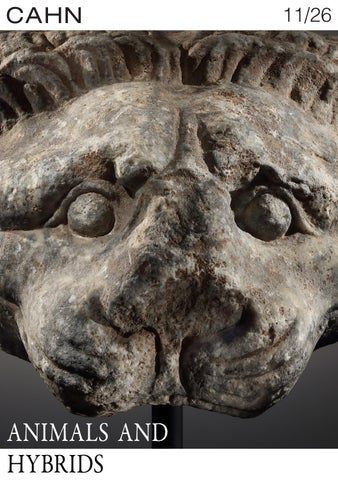
11/26
ANIMALS AND HYBRIDS
CONTACT Dr. Ulrike Haase
ulrike.haase@cahn.ch
De. | En. | It.
Tel: +41 61 561 67 04
Joffrey Nogrette
joffrey.nogrette@cahn.ch
Fr. | En.
Tel: +41 61 561 67 00
Charlotte Chauvier
charlotte.chauvier@cahn.ch
Fr. | En. | Es.
Tel: +41 61 561 67 02
Galerie Cahn
www.cahn.ch Tel: +41 61 561 67 55
UPCOMING 2027 The Winter Show New York: 22 Jan – 31 Jan, 2027 in NY, Park Avenue Armory MAZE Art St. Moritz: 11 Feb – 14 Feb, 2027 in St. Moritz, Hotel Reina Victoria MAZE Art Gstaad: 18 Feb – 21 Feb, 2027 in Gstaad, Festival-Zelt TEFAF Maastricht: 13 Mar – 18 Mar, 2027 in Maastricht, MECC Forum 100
2
3
A CRANIAL FRAGMENT WITH A WILD HORSE 01 | CHF 4.800 net for export
France, Upper Palaeolithic, Magdalenian | ca. 18.000-12.000 B.C. Bone | H. 3.2 cm | W. 6.4 cm | D. max. 0.6 cm
Fragment of a cranial bone with incisions on the exterior. In the centre, the stylised outline of an animal, probably a wild horse, viewed from the side. At least three phases of incisions can be recognised. The representation of the horse is superimposed on older lines, but is itself covered by more recent lines. The latter do not seem to depict a specific motif. The phenomenon of superimposed incisions is often found in this period. Within the geographic range of the Magdalenian (Aquitaine – Cantabria – Basque Region) the representation of the horse corresponds to the artistic style IV after Leroi-Gourhan (1971, 254-262, 581). R. Pigeaud (2007, 410) points out that schematic representations of animals („silhouette art“) are found outside the Magdalenian area both in earlier as well as in later periods. The function of this small art work remains unclear. Within the given context, the act of drawing or incision certainly had an exceptional, almost transcendental meaning. The preserved traces suggest that the piece was originally larger (esp. towards the top). PROVENANCE Formerly priv. coll. Hervé Bouraly, collector and antiques dealer at Marché Dauphine, 4
Saint Ouen; collection assembled between 1965-1974. NOTE Related literature: A. Leroi-Gourhan, Prähistorische Kunst. Die Ursprünge der Kunst in Europa (Freiburg 1971); R. Pigeaud, Determining style in Palaeolithic cave art: a new method derived from horse images, Antiquity 81/312, 2007, pp. 409422.
5
A PECTORAL DISC (CARDIOPHYLAX) WITH THE RARE DEPICTION OF A HIPPOCAMP 02 | CHF 9.600 net for export
Central Italy | 7th cent. B.C. Bronze | Diam. 14,7 - 15,0 cm | D. max. 1,3 cm
Disc made of solid bronze sheet, featuring figural decoration in repoussé. The lowrelief depiction shows a stylised hippocamp moving to the left. The lower part of this hybrid creature, usually rendered as a fish tail, is shaped like the coiled end of a snake. The horned head and the two outstretched, slightly bent forelegs are slightly small in proportion to the body. Flat, button-like projections of different sizes decorate the space above and below the mythical creature, as well as its body. Body armour discs, also referred to by the ancient (although chronologically later) term kardiophylakes (cf. Polybius VI, 23), served to protect the chest area, particularly the region of the heart, in combat. Each disc was generally accompanied by a matching, usually somewhat smaller counterpart, attached to the back at the corresponding position. Four pairs of perforations and two individual ones are irregularly spaced along the edge of the disc. They were most probably intended to accommodate button-like rivets used to attach the disc to leather straps; on some examples, they also served to secure an iron ring to the reverse, reinforcing the edge, although no corresponding traces, such as discolouration, are discernible on our example. Pectoral discs formed part 6
of the typical defensive equipment of the pre-Roman populations of central Italy and were particularly widespread among the Piceni, Umbrians and Samnites. The limestone statue of the so-called Warrior of Capestrano (Abruzzo) provides a good idea of how such a protective plate may have been worn (in this case suspended by means of ring-shaped loops). Among pectoral discs with figural decoration, chimera-like creatures predominate, while the hippocamp appears to be an exceptionally rare motif, possibly even unique. Small, irregular loss between the horns, with the edge stabilised; otherwise intact. Brownish-green patina. PROVENANCE Formerly priv. coll. Abraham Rosen, New York. Tel-Aviv art market, 2026.
7
8
NOTE On Italic cardiophylakes, see G. Tomedi, Italische Panzerplatten und Panzerscheiben, Prähistorische Bronzefunde, Series III, Volume 3 (Stuttgart, 2000), who provides a typological classification of the material. Our disc can most plausibly be assigned to the “Capena Group” (pp. 39–42, pls. 17–22), although the hippocamp is not represented among the chimera-like creatures characteristic of this group; cf., for example, Louvre, Paris, inv. no. Br 3450 (online). See also G. Colonna, “Su una classe di dischi-corazza centro Italici”, Atti dell’VIII Convegno Nazionale di Studi Etruschi ed Italici, Orvieto 1972 (Florence 1974), 193–205; W. Schiering, “Orientalisierende Kardiophylakes”, RM 85, 1978, pp. 1–26; Eroi e Regine. Piceni popolo d’Europa, exhibition catalogue, Rome 2001 (Rome 2001), pp. 120–122, 252–254. On the development of the hippocamp motif and its iconographic relations with other sea monsters, see R. Denson, “Between Ancient Animal Studies and Mythology: The Case of the Hippocamps and Other Mixokētē”, Greece and Rome 73/2, 2026, pp. 274–297.
9
A CAPENATE HOLMOS 03 | CHF 34.000 net for export
Capenate (pre-Roman Italic Culture) | ca. 630-600 B.C. Buccheroid Impasto | H. 53,0 cm | Diam. base 30,0 cm
This impasto stand (holmos), originally took the form of a tripartite structure. However, it has lost its upper, cup-shaped section, which was designed to receive the olla, a vessel used for holding wine. What remains is the bulbous central portion and the large, bell-shaped foot. The piece is a characteristic example of Capena’s Orientalising production, marked by a clear predilection for the depiction of fantastical, often composite, creatures. These are rendered in exquisitely refined incised decoration. The globular section bears motifs of buds and palmettes, while the foot is adorned with three fantastic horse-like creatures. The extravagant character of these figures, with their mannerist silhouettes, is heightened by the presence of wing-like elements grafted onto their bodies, as well as by the addition, for one of them, of an animal head at the end of its tail. This type of ceramic was a central element in aristocratic banqueting events involving ritualised wine drinking, typical of the Orientalising period. These would be used as funerary equipment to signify the status of the deceased. Minor dents and scratches. Some cracks at the base.
10
11
12
13
14
PROVENANCE Formerly priv. coll. Prof. Hans Erlenmeyer (1900 -1967), Swiss chemist and his second wife, Marie-Louise Erlenmeyer (1912 -1997), Basel; collected between 19431960s. Thereafter, acquired in 1998 by R. B., Basel, upon purchase of the property, where the object was discovered. NOTE For a complete ensemble composed of stand and olla, cf. Metropolitan Museum of Art, New York, inv. no. 28.57.22a, b (online). Capenate wares in Copenhagen National Museum afford interesting parallels to our vase; notably the ollae inv. no. 8717 and 8718 from Capena (CVA Copenhagen 5, 1937, p. 153, pl. 195, 2 and 3.)
15
A CRESCENT-SHAPED RAZOR 04 | CHF 1.600 net for export
Europe, Iron Age, Villanova | 8th cent. B.C. Bronze | L. 10,5 cm | L. handle 2,9 cm | W. 7,0 cm
Razor with a rescent-shaped blade made of solid bronze sheet. The handle is formed by a round bar ending in a loop with two stylised duck’s heads. A characteristic type of the Iron Age Villanovan culture. Cast. Lower tip broken off; three small chips along the blade edge. By analogy with comparable examples, a knob-shaped ornament may originally have been attached to the upper end of the blade. PROVENANCE Formerly, priv. coll. Albert Schenk, Germany, collecting period between 1950 and 1977. Inherited in 2001 by his daughter Gisela van Driesum-Schenck, Aschaffenburg, Germany and sold in the same year to Antiken-Kabinett, Gackstätter, Frankfurt. Thereafter, priv. coll. Klaus Jürgen Büchler (1923-2003), Baden-Baden, Germany; acquired in 2001 from Gackstätter. Since then in the family. Thereafter, German art market. NOTE Cf. G. Schade, et al., Die Welt der Etrusker. Archäologische Denkmäler aus Museen der sozialistischen Länder (Berlin 1988), pp. 63-64, cat. no. A 4.24; I. Jucker, Italy of the Etruscans (Jerusalem 1991) p. 71, cat. nos. 76-78; National Museum Liverpool, inv. no. 16
M4574 (online), there described as Grotta Gramicella Type A; Museo Archeologico e Paleoambientale E. Silvestri, Budrio (Emilia-Romagna), inv. no. 14468.
17
18
19
20
A HEADDRESS FROM A STATUETTE OF A LUNAR DEITY (PROBABLY THOT-IAH) 05 | CHF 10.000 net for export
Egypt, Late Period, 26th-31st Dynasty | 664-332 B.C. Bronze | H. 9,3 cm | W. 5,8 cm | D. 3,3 cm
Headdress consisting of a sun disc decorated with an ibis applique, above which rises the finely engraved atef crown with rams‘ horns, ostrich feathers and an uraeus on each side. The headdress refers to several Egyptian gods: the sun disc is associated with Ra, but can also refer to a lunar deity; the ibis is considered the sacred animal of Thoth; the atef crown is usually worn by Osiris. On the reverse a low relief depicts Harpocrates sitting on a lotus blossom. From a statuette of an Egyptian deity, presumably Thoth in his syncretistic manifestation, highly probably as the lunar deity Thot-Iah. Tip of crown lost. A small area of breakage where the crown rested on the wearer‘s head.
the head of an ibis and the Atef crown. The figure is identified as Thoth-Iah.
PROVENANCE Formerly priv. coll. Roger Liechti (b. 1934 d. 2010), Petit-Lancy, Switzerland (inv. no. E. 313, noted on the back of the old wooden mount); acquired from Galerie Nicolas Koutoulakis (b. 1910 - d. 1996), Geneva. Thence by descent in the family, Switzerland. NOTE The headdress of a bronze statuette of a human-shaped god in the Walters Art Museum, Baltimore, inv. no. 54.2068 (online) likewise combines a moon disc, 21
22
23
A DOUBLE RHYTON WITH TWO HORSEMEN 06 | CHF 16.000 net for export
Gilan/Amlash | 9th-8th cent. B.C. Orange-red clay | H. 23,2 cm | L. 28,5 cm | Diam. bodies 13,3 cm
The vessel consists of two interconnected globular bodies, each terminating in a sturdy neck that tapers upwards and ends in a funnel-shaped mouth. The two halves are further connected by a broad bridge with a small rectangular aperture, attached to the arches on the shoulders and to the rims of the mouths. At its upper end, the bridge is shaped into a square projection, the two side walls facing the vessel mouths each featuring a perforation. A helmeted rider on the forepart of a horse emerges from the outwardfacing side of each of the flaring necks. The forelegs of the horses rest on strap handles attached to the outer sides of the vessel. The globular bodies are flattened underneath to form circular bases. At the level of these bases, on the outer sides of each body, is a small, slightly protruding, circular spout. With the exception of the lower sections and the funnel-shaped mouths, the vessel is decorated with lines and triangles in red matt glaze, with some of the triangles featuring curled tips. The presence of the two spouts allows the vessel to be securely identified as a libation vessel (rhyton). Liquids, such as wine or water, could be poured into the square projection at the top, from where they flowed through the two perforations into the funnel-shaped mouths and down through 24
the necks into the globular bodies, eventually emerging through the spouts at the bottom. Libations, or ritual offerings of liquid, formed an essential part of cultic practices associated with sacrificial rites. The zoomorphic vessels from the Gilan region are distinguished by their particular aesthetic, characterised above all by pronounced stylisation and elegantly curving contours. Their surfaces are generally highly polished. Most vessels feature spouts for pouring liquids. It is quite conceivable that the animal depicted was cultically associated with the deity to whom the offering was made. Our vessel adopts a characteristic vessel type with a globular double body, but replaces the upper section, which conventionally terminates in an animal head, with lateral protomes. The frequent presence of these vessels in funerary contexts suggests that their significance extended beyond their cultic function, potentially reflecting contemporary beliefs about the afterlife and funerary practices. Horse figurines are particularly common in burial contexts and are likely to have referred primarily to the social status of the deceased. Muzzle of one horse and one arm of each rider missing. Small chips along the vessel rims and on the cap-like head covering of one of the riders. Glaze slightly abraded in places.
25
PROVENANCE Formerly priv. coll. Sam Dubiner, Israel, formed between 1954-1958. With Aaron Gallery, London. Thereafter priv. coll. L. K., Basel, acquired from Cahn Auktionen AG, Auction 8, 9.11.2013, lot 9. On the underside the handwritten inv. nos. „58“ and „251“. NOTE For the vessel type, cf. J. G. Belloni, L‘art iranien. Bibliothèque des Arts (Milan 1968) pl. 11 and for the horseman applique pl. 33.
26
27
28
29
AN IBEX HEAD PROTOME 07 | CHF 3.400 net for export
Luristan | 9th-7th cent. B.C. Bronze | L. 12,0 cm | W. 1,8 cm | H. 10,0 cm
Horn-shaped, hollow fixture with ibex protome. The animal‘s head with pointed muzzle, indented eyes which were probably inlaid, pointed ears and elegantly curved horns. A zig-zag band and torus in high relief at the base of the fixture. Oval opening. Probably a handle of a whetstone. Small repairs on the surface. PROVENANCE With Bonham‘s London, Auction 27.04.2006, lot 402. Thereafter, priv. coll. Alioth, Switzerland, acquired in 2006 from Jean-David Cahn AG, Basel. NOTE Cf. J.A.H. Potratz, Luristanbronzen. Die einstmalige Slg. Prof. Sarre, Berlin (1968) pp. 14-15, pl. XI, figs. 56-57; Potratz identifies them as mouflons. Cf. also A. Godard, Les Bronzes de Luristan (1931), pp. 43-44, pl. XII, 31.
30
31
A RECUMBANT IBEX APPLIQUE 08 | CHF 1.900 net for export
Central Asia, Scythian Steppe People | 5th-1st cent. B.C. Bronze, solid cast | H. 4,9 cm | W. 4,9 cm | D. 0,2 cm
This openwork applique of an ibex resting on its folded legs originally adorned a bridle. The curved body forms an entity with the horns and legs folded below the body in a manner typical of Scythian art. Drill holes enliven the head and body. Engraved grooves on the curved horns. The reverse is slightly concave for attachment to a fabric or leather. Intact. PROVENANCE Formerly priv. coll. Mr. Ben Taylor, Australia. Thereafter priv. coll. Oliver Vit, Basel, collecting period 2000-2019, acquired from Archaeo Gallery, Australia, 26.9.2009. NOTE For an openwork applique of an ibex whose curved body, horns and folded legs are connected in the same way, cf. Harvard Art Museums, inv. no. 1992.299, for the style and the typical drill holes, cf. the ibex protome from a standard in the Yale University Art Gallery, inv. no. 1952.52.36 (both online).
32
33
34
35
A CORINTHIAN ROUND ARYBALLOS WITH PALMETTE CROSS FLANKED BY FELINES 09 | CHF 2.600 net for export
Middle Corinthian | ca. 600-570 B.C. Buff Clay | H. 7,5 cm | Diam. max. 6,8 cm | Diam. mouth 4,2 cm
A spherical aryballos (H. Payne, shape B 2) with discoid rim and a vertical strap handle. The lip is decorated with four concentric glazed rings around the mouth, and dots on its flat edges. Two glazed lines border the handle. The central motif on the body is a palmette cross built on knotted tendrils forming four rings, flanked by a seated lion and a panther. Rosettes appears sporadically in the field. Applied purple on petals and here and there, on the body of the felines. Five concentric glazed rings on the bottom. A depression on the body, at the level of the lion. Abrasions; cracks; fragment of the rim reattached. PROVENANCE With Françoise Holz auction, Arles, France, 15.10.2000 (bordereau). Thereafter, priv. coll. Michel Meignan (1947-2022), Paris. NOTE For the design of a floral centerpiece flanked by felines, cf. a flat-bottomed aryballos by the Painter of Gela G.9, Gela, Coll, Navarra, inv. no. G.9, CVA, Gela I (Italy 52), pl. 40. More broadly, the painter of our aryballos may have been influenced by creations of the Chimaera Group. 36
37
38
39
FRAGMENTS OF AN ATTIC BLACK FIGURE AMPHORA WITH ANIMAL FRIEZE DECORATION 10 | CHF 3.600 net for export
Attic | ca. 600-580 B.C. Buff Clay | H. max. 13,0 cm | L. max. 22,5 cm
Four fragments of an Attic belly amphora, type B, with animal frieze decoration. a) Large fragment of shoulder, neck and rim, reassembled from three fragments: rosettes on the rim; part of a lion and a panther confronted on the neck; the upper part of a swan to right, between two confronted sphinxes or sirens on the shoulder. b) Rim and neck sherd: rosettes on the rim; below on neck, upper part of a panther. c) Neck and shoulder sherd: lower part of a lion or panther on the neck; upper part of a sphinx or siren on shoulder. d) Body sherd: tongues and upper part of a panther. Blob rosettes as filling ornament. The belly amphora was invented by Athenian potters in the late 7th century B.C. Early Athenian vase painters adapted the Corinthianising animal frieze style to this shape. Surface weathered. PROVENANCE Formerly priv. coll. Prof. Gottfried Gruben (1929-2003), archaeologist, author of major works on Greek architecture, Germany, prior 1983. Thence by descent in the family. NOTE For a similar pattern, cf. Musée du Louvre, Paris, inv. no. E 817. 40
41
42
43
44
A LARGE STATUETTE OF A HORSE 11 | CHF 4.600 net for export
Greek, Late Geometric to Early Archaic, Attic or Boeotian | 7th cent. B.C. Terracotta | H. 17,2 cm | W. 6,7 cm | L. 20,1 cm
Stylised statuette of a horse with flat muzzle, narrow, elongated body, splayed legs and protruding tail. The abstract body shapes are in the tradition of the Geometric Period. Linear decoration in dark brown to black matt glaze. Funerary or votive offering. Reassembled from several fragments, breaks retouched. Tail probably restored. Crack in the neck closed. Retouches in colour. PROVENANCE Formerly from a German private collection. Thereafter, priv. coll. Dr. med. Sylvia Legrain (1936-2022), Switzerland; acquired 10.10.2012 from Galleria Serodine, Ascona.
45
A STATUETTE OF A HORSE 12 | CHF 2.200 net for export
Greek, possibly Boeotian | late 6th-early 5th cent. B.C. Terracotta | H. 10,0 cm | W. 6,1 cm | L. 9,6 cm
Hand-modelled horse with a slim rump and long, slightly splayed legs. In a lively and unusual movement, the horse turns its head and the tail swishes over its back. The statuette shows the stylistic characteristics typical of the Geometric Period, which, however, continued into the Archaic Period. Tip of the right ear broken off. Whole right leg restored. Traces of red paint preserved, especially in the neck area and on the left hind leg. Striped decoration visible on the left front leg. PROVENANCE Formerly priv. coll., Germany, 1975-2013. With German art market, 2021. NOTE Cf. British Museum, London, inv. no. 1912, 0626.269 (online). The shape of the head and the striped decoration on the forelegs are particularly similar, although our specimen shows a variation or further development of the type in terms of the turn of the head, the position of the tail and the curvature of the neck; stylistically related is also Metropolitan Museum, New York, inv. no. 62.67 (online, there described as a bull).
46
47
A BLACK-FIGURE PROTO-A DRINKING CUP, ATTRIBUTED TO THE WORKSHOP OF LYDOS 13 | Price on Request
Attic | ca. 540 B.C. Clay | H. 13,3 cm | Diam. with handles 29,2 cm | Diam. foot 8,7 cm
A rare Proto-A cup, with a deep hemispherical bowl set on a high, slender foot, comparable to those of the LittleMaster cups. The handle zone is decorated on either side with a procession of hoplites advancing to the left, their spears held forward with the points raised. All the warriors wear Corinthian helmets, save one (the fifth warrior from the left, on side B). Their large round shields completely conceal the body from the neck to mid-thigh. Their shins are protected by greaves. Ghosts of shield devices (episemata), once in added white, remains visible, including a tripod and a cross. A mock inscription occupies the field between the fourth and fifth warriors on side A. Beneath each handle appears a water bird facing right. The lower part of the bowl is ornamented with a lotus chain and a band. The interior has a reserved tondo, with a central circle enclosing a dot. Reassembled from fragments; toned plaster along the break lines. A triangular lacuna in the area of the fifth warrior on side B, restored. Attributed to a close collaborator of Lydos („In the manner of Lydos“ by B. Kreuzer and P. Heesen). PROVENANCE Formerly priv. coll. Prof. Martin Heinrich 48
Burckhardt (b. 1973 - d. 1997), Basel; acquired in 1980 at KAM from Münzen und Medaillen AG, Basel (see KAM fair list, 14.22.06.1980, lot 80). With Cahn Auktionen AG, Basel, Auction 2, 21 September 2007, lot 341. Thereafter in a private collection in Switzerland. Three undated photographs of the cup appears in the Beazley Archive‘s photographic collection (BAPD 9029758).
49
NOTE Comparable decorative scheme, albeit with the hoplites running rather than walking, appears on a fragment of a Siana cup, in Göttingen, Georg August Universität, inv. no. K340, attributed to the Camel Painter (Tiverios) / to Lydos (Beazley), BAPD 350353; and on another Siana cup, in Taranto, Museo Archeologico, inv. no. 20273, attributed to Lydos (Beazley), BAPD 310215. On proto-A cups with a high foot, and other early forms of type A cups, see especially Bloesch, FAS, p. 1–4, and F. Villard, REA 48, 1946, p. 173–176. The water bird motif beneath the handles was used by Lydos, and also by painters of proto-A cups, notably on the example in Amsterdam, Allard Pierson Museum, inv. no. 400, by the Painter of New York 06.1021.159 (Beazley), BAPD 302574; it also bears mock inscriptions.
50
51
52
53
A BLACK-FIGURE NECK-AMPHORA, ATTRIBUTED TO THE POLYPHEMUS GROUP 14 | Price on Request
Pseudo-Chalcidian | ca. 540-520 B.C. Clay | H. 35,2 cm | Diam. body 21,8 cm | Diam. foot 13,1 cm
Lotos buds and flowers on neck (red for buds and chalices); red fillet at base of neck; tongues on shoulder, alternating red and black; red fillet between foot and rays above at body‘s base; broad black band edged above and below with red lines. A: Combat: Near the left handle, a warrior attacking to left, with Boeotian shield, and a fallen enemy with Chalcidian helmet at his feet to the right. In the centre two hoplites fighting over a third fallen warrior, a bird between them. A female onlooker on far right. Red for helmet crests, chitoniskoi of the two central fighters, pupils. B: Two lions attacking a bull (red for necks and hindquarters, lotus bud at upper left). Restored from fragments; upper part of neck and mouth restored, and the left handle probably modern; surfaces retouched, especially the black band below figure zone. PROVENANCE Formerly, priv. coll. B. G., Munich. before 1999. With Galeria Serodine (1982-2016), Ascona; consigned to Cahn Auktionen AG, Basel, Auction 5, 17.09.2010, lot 178.
54
55
56
57
58
NOTE Compare the warriors on the amphora Würzburg L 265: Rumpf - 1927 pls. 218219 and the animals New York (once Bourgignon Collection): Rumpf-1927, pl. 210; for the Polyphemus Group, see M. Iozzo, Ceramica ‚Calcidese‘, Atti e Memorie della Società Magna Grecia 3. Ser. 2 (Rome, 1994) 109-115.
59
60
A BLACK-FIGURE OINOCHOE OF THE CLASS OF VATICAN G.47 DEPICTING HERAKLES PURSUING A CENTAUR 15 | CHF 24.000 net for export Attic, Late Archaic | ca. 520-500 B.C. Clay | H. with handle 24,4 cm | Diam. body 13,8 cm | Diam. foot 8,8 cm
Black-figured oinochoe with trefoil mouth. High, concave handle attached to the mouth with two cross-pieces. Collar round the lower part of the neck, with profiled ridges. It is reserved on the front side and decorated with a double row of ivy-leaves. Above the pannel, a row of tongue. On the panel, Herakles pursuing a Centaur, either Eurytion or Nessos. The heros seizes the centaur by his arm and is about to strike him with his club. On the left, a cloaked woman is watching the combat. Opposite her stands an old man dressed in a himation and holding a staff in his right hand. His advanced age was signalled by a beard and a ring of hair, originally rendered in added white, now lost. In the Heraclean Cycle, the hero confronts two lustful centaurs in separate episodes: Eurytion, whom Herakles slew after he attempted to force Mnesimache, the daughter of King Dexamenus, into marriage; and Nessos, who tried to violate Herakles’ wife, Deianira. In the absence of inscriptions, it is impossible to determine which of the two is represented here. The accompanying figures may therefore be identified either as Mnesimache and Dexamenus, or as Deianira and her father, Oeneus, king of Kalydon. Class of Vatican G. 47. Black glaze applied too thinly in places. Otherwise intact, with
only a small chip to the rim. Some minor retouching to the figural scene. PROVENANCE With Piasa auction, Paris, 29.09.2004, lot 362. Thereafter in a USA private collection; acquired at Cahn Auktionen AG, Basel, 22.09.2006, lot 317. Since then in a Swiss private collection. NOTE The composition is almost identical to that on an oenochoe from Vulci, in Leiden, Rijksmuseum van Oudheden, inv. no. PC39, attributed to the class of Vatican 440 by Beazley (BAPD 303208, LIMC, VI, pl. 540, „Nessos“ no. 29), except that there, Herakles is about to plunge a sword into the centaur‘s flank, while the centaur defends himself with a stone in his left hand. The variant on our vase is probably later, as the way Herakles holds his club appears to derive from the earlier motif in which he wielded the sword. For the Vatican G.47 Class, see ABV 429–30.
61
62
63
A STATUETTE OF A DANCING SATYR 16 | CHF. 5.800 net for export
Etruscan | 1st half of 5th cent. B.C. Bronze, solid cast | H. 8,1 cm | W. 4,3 cm | D. 3,3 cm
The satyr dances or balances his body weight on his distinctly bent left leg and raises this right leg. His left hand is akimbo whilst his right arm is raised and turned inwards towards his head with the hand touching the ear. Hair, beard and nipples finely engraved. Right lower leg and part of left foot lost. The beginning of the tail is preserved. The now missing penis was made separately and attached. The figure probably adorned a bronze candelabrum. PROVENANCE With Sasson Gallery, Jerusalem, before 2000. Priv. coll. Canada, acquired in 2001. Priv. coll. USA, acquired at Bonham‘s London, Auction 7.7.2016, lot 22. English art market, 2023. NOTE For a satyr adorning a candelabra, cf. S. Haynes, Etruscan Bronzes (London, 1985) 203, fig. 135. For various dancing bronze satyrs, cf. British Museum London, inv. no. 1905,0710.2 and Metropolitan Museum of Art, New York, inv. nos. 23.160.51 and 1972.118.68 (all online). The dancing satyr in the Cleveland Museum of Art, inv. no. 1974.16, belongs to a stand that was used during symposia for the kottabos game. 64
65
AN ATTIC PATCH BAND-CUP WITH A BULL 17 | CHF 28.000 net for export
Attic | ca. 550-540 B.C. Clay | H. 9,0 cm | W. 22,0 cm | Diam. 15,3 cm
Centrally placed on the bowl of the cup, just below the offset lip, is a reserved rectangular panel, the so-called „patch“, which contains the figure of a bull striding to right. With only slight variation in detail, principally in the use of added white, the animal is repeated on both sides of the vase‘s exterior, the panels standing proud against an allblack ground. This type of cup is clearly experimental and short-lived. To date, there are only thirteen recorded examples, the majority small and lipped, which are decorated in this innovative fashion, with subject matter that is remarkably varied. The style is comparable to that of little-master lip-cups and band-cups produced in Athens in the decades ca. 560-540 B.C. A narrow band in added red overlies both the exterior edge of the lip and its offset just above the figured patches. Added red for the necks of each bull; added white for the underbelly and genitals of one bull, for the mottling of the hide of the other. The cup‘s interior is allblack. Glaze on the upper half of one side has in part misfired greenish. Reassembled with minor losses, principally to the blackglazed body, made good. The left arm of one handle, and a section of the cups‘s wall about the right root of the same, are restored. 66
PROVENANCE Formerly priv. coll. Rolf Blatter, Bern; acquired in the early 1960s. Thereafter, priv. coll. Jacques Theodor, Brussels. acquired in 2012 at TEFAF from Jean-David Cahn AG, Basel. Published: R. Blatter, “Eine ungewöhnliche Kleinmeisterschale”, AA (1967) 12-14, figs. 1-2; N. Malagardis, Coupe à lucarne à figures noires: une creation attique. Un étranger attelage au service d‘Héraclès sur une coupe à lucarne de Sellada, Théra, in E.M. Moormann and V.V. Stissi (edss.), Shapes and Images. Studies on Attic Black Figure and Related Topics in Honour of Herman A. G. Brijder, BABesch Supplement 14 (2009) 104, no 7, fig. 13a-b; Harmakhis Gallery, Brussels, Attic cups from the J.L. Theodor Collection, Brussels 2018, p. 36. BAPD no. 2473. NOTE The subject and the miniature style is to be compared to contemporary lip-cups, for instance Seattle Art Museum 50.100 (BAPD no. 350731).
67
68
69
A STATUETTE OF A BULL 18 | CHF 12.800 net for export
Greek | ca. 500 B.C. Bronze, solid cast | H. 6,6 cm | L. 9,1 cm | W. 2,4 cm
Statuette of a bull standing at rest, but with its head raised on the alert. Slim, plastically modelled body. Trapezoid head; long, pointed muzzle with a groove for the mouth and circular, drilled nostrils. Deeply punched, almond-shaped eyes. The horns curve upwards; very small, grooved ears below them. The dewlap, rendered as a sharp ridge, extends as far as the forelegs. The sturdy haunches with schematic contours stand out clearly from the body; small, offset hooves with a central groove. Long, drooping tail. Pronounced rendering of the genitals. Probably a votive offering. Surface at the tip of right horn slightly worn; some encrustation; figure intact. PROVENANCE Formerly priv. coll. Charles Ratton (1895-1986), Paris. Thereafter, priv. coll. Madeleine Meunier (1921-2009), Paris, acquired in the 1950s-1970s. With French art market, prior 2016. Thereafter, priv. coll. T. Aliot, Switzerland; acquired in 2017 from Jean-David Cahn AG, Basel. NOTE The bronze bull statuettes found at the Cabeiros Sanctuary near Thebes provide plenty of material for stylistic comparisons, 70
see B. Schmaltz, Metallfiguren aus dem Kabirenheiltum bei Theben (Berlin 1980). The bulls of Group 24 after Schmaltz are related to our specimen with regard to their slender, organic shape, balanced proportions and modelling. Cf. ibid. 75 ff., 109, esp. nos. 296, 302-202, 305, pls. 15-16. The schematic rendering of the haunches is reminiscent of the Archaic Period. Cf. a related Early Archaic bull: W. D. Heilmeyer, Frühe Olympische Bronzefiguren. Die Tiervotive, OF XII (Berlin 1979), 160, 260, no. 805, pl. 98.
71
A BLACK-FIGURE SKYPHOS WITH GRAZING DEER 19 | CHF 5.800 net for export
Attic | 3rd quarter of 6th cent. B.C. Clay | H. 9,6 cm | Diam. without handles 17,0 cm | L. max. 23,0 cm
Large skyphos with deep bowl, inverted echinus foot and handles round in section. Inside glazed, except for a reserved line around the rim. Lip and lower part of the bowl glazed. Above the foot, a band of rays in dilute glaze. Foot glazed. Underside reserved with one glaze circle around a central glaze dot. A-B: Animal frieze with two grazing deer, facing each other, between palmettes. Added white on the underbellies and hindquarters of the deer. Red highlights on the necks and thighs and on the palmettes. Reassembled from several fragments. A lacuna in the rim restored. A few retouches. PROVENANCE Formerly priv. coll. I. L., Austria, acquired between 1960 and 1990. Thereafter, Munich art market. With Austrian export license. NOTE The skyphos, Beazley Archive no. 350912, ‚compare Hermogenes‘ (Beazley), is decorated with the same scene, cf. Hermogenes (Beazley). The grazing deer motif appears fairly frequently on contemporary Little Master cups.
72
73
A BRONZE STATUETTE OF A RECLINGING LION WITH HINGE 20 | CHF 2.800 net for export
Greek | early 5th cent. B.C. Bronze, solid cast | H. 2,9 cm | L. 6,2 cm | W. 1,7 cm
A bronze fitting in the form of a recumbent lion, with its slightly oversized head turned to the right. The expressive face is finely modelled, the mouth deeply incised. Bold linear engravings define the mane, which is arranged at the back in four layers. The left forepaw crosses over the outstretched right one. A hinge mechanism projects at a right angle from the hindquarters, taking the form of a perforated pin secured by an iron rivet; the connecting arm terminates at a slight angle, with its terminal edge bevelled and smoothed. On the underside, traces of an attachment loop survive in the area of the forepaws. Lions of this type and size served primarily as fittings for bronze vessels, usually attached to their rims or handles. Such a function, however, can be ruled out for this lion. The particular arrangement, with a hinge and a loop, may indicate that it formed part of a bolt lock. PROVENANCE Formerly Paul Haelg, Baden; acquired in 2008 at BAAF, Basel from Galerie Rhéa, Zurich (see invoice). NOTE Cf. H.-P. Isler – M. Sguaitamatti, La Collezione Collisani / Die Sammlung 74
Collisani (Zurich 1990), 160 f., no. 230, pl. 38, with an almost identical functional design, there described as a bolt lock; cf. also British Museum, London, inv. no. 1859,1129.32 (online).
75
76
A TETRADRACHM, ATHENS 21 | CHF 6.500 net for export
Greek, Attic | ca. 449-413 B.C. Silver | Diam. 2,5 cm | Wt. 17,25 g
Obverse: Helmeted head of Athena in profile, the crest partially visible. The goddess‘ necklace and hair are only partially covered by the neck-plate. She is further adorned with a large earring and a diadem with upright leaves. Reverse: An owl stands to right, its head turned to look at the beholder frontally with its over-large eyes. A sprig of olive leaves and a crescent in the upper left field. Minor edge split in the lower right quadrant, possibly a test cut. Pale gray toning. Extremely fine. PROVENANCE Formerly priv. coll. Bavaria, Germany. Thereafter German art market, 2018. NOTE Cf. SNG COP 32 ff.; Svoronos pl. 12-16; Chester G. Starr, „Athenian coinage after 449 B.C.“ in: Athenian Coinage 480-449 B.C. (Oxford 1970) 64-75.
77
78
A STATER, CAULONIA 22 | CHF 3.400 net for export
Bruttium, Caulonia | ca. 475-425 B.C. Silver | Diam. 2,5 cm | Wt. 7,84 g
Obverse: The naked Apollo Katharsius strides to right, holding a branch in his raised right hand. Behind him the letters ΚΑVΛ. A small figure (daimon) is still faintly visible, running along his outstretched left arm. A stag stands before him, its head turned back. Reverse: Stag standing alertly to right, a branch before the animal. Above its back retrograde ΚΑVΛ. Extremely fine. PROVENANCE Formerly Gerhard Hirsch Nachfolger, Munich, auction 221, 2002, lot 63. NOTE Cf. Noe, Caulonia, 93. SNG ANS 180.
79
AN OBOL, MYSIA, KYZIKOS 23 | CHF 1.200 net for export
Kyzikos | ca. 480-450 B.C. Silver | Wt. 0,85 g
Obverse: Forepart of a wild boar to left; on shoulder retrograde E; in right field, tuna fish swimming upwards. Reverse: Head of a roaring lion to left within incuse square. Located on the coast of the Propontis, Kyzikos was founded as a colony of Miletus. Tuna fishing and trade constituted an important source of livelihood for the city, making the fish a natural choice as its heraldic emblem. The roaring lion on the reverse, meanwhile, derives from the emblematic animal of its metropole. Very fine. PROVENANCE Formerly priv. coll. Menasche Landman, Haifa. Tel-Aviv art market, 2026. NOTE H. von Fritz II 11.
80
81
AN OBOL, THRACE, MARONEIA 24 | CHF 800 net for export
Thrace, Maroneia | ca. 420-389 B.C. Silver | Diam. 0,9 cm | Wt. 0,79 g
Obverse: A facing Gorgoneion; Reverse: Μ-Α/Ρ/Ω (First letters of Maroneia) around a bunch of grapes, all within an incuse square. Nearly extremely fine. Rare. PROVENANCE Formerly Münzen und Medaillen AG, Basel, 08.07.1976 (hors catalogue). German art market, 2024. NOTE Schönert-Geiss 354 (V1/R1). Klein, KM 24,92.
82
83
84
85
86
AN EXCEPTIONALLY LARGE SCARABOID WITH MAGNIFICENT BULL 25 | CHF 14.000 net for export
Greek | 5th cent. B.C. Yellow light brown chalcedony | H. 3,3 cm | W. 3,9 cm | D. max. 2,1 cm
Horizontal oval stone with a high rim tapering towards the slightly convex reverse. A magnificent bull strides to left on a ground line. Short, slightly curved horns. Powerful neck. The elongated body tapers towards the centre. The ribs and the fur on the chest are indicated by fine incisions. Long, bushy tail. Genitals indicated. An object, possibly an ear of grain, between the ground line and the bull‘s belly. A double line with short diagonal strokes in between frames the picture. Drill holes at the top and bottom, presumably to attach the intaglio to a piece of jewellery or its setting. Possibly GraecoPersian. A crack directly above the bull that extends all the way to the rim.
classical depictions of bulls. It is conceivable that the craftsman may have misjudged the animal‘s proportions, but nevertheless wanted to make use of the entire picturel field. Scaraboids are a simplified form of the scarab and belong to the gem forms that were widespread in Greece in the late 6th and 5th centuries B.C.; cf. Museum of Fine Arts, Boston, inv. no. 01.7545 (also with a bull). It is interesting to note that both the top and the bottom of our specimen, are convex and that the engraving is located on the top. However, there are parallels for both these special features.
PROVENANCE Formerly MuM AG, Basel, between 19421987. Thereafter, H. A. C., AG, between 1988-1999. NOTE The rendering of the bull on the intaglio can be compared stylistically with the numerous bronze votives from the Kabeiroi sanctuary near Thebes, cf. B. Schmaltz, Metallfiguren aus dem Kabirenheiltum bei Theben (Berlin 1980). The elongated, somewhat disproportionate torso is rather unusual for 87
88
A DOLPHIN COIN WITH INSCRIPTION, OLBIA 26 | CHF 1.200 net for export
Greek, Olbia (Black Sea coast) | 5th cent. B.C. Bronze | H. 1,1 cm | L. 4,3 cm | D. 0,1 cm | Wt. 3,23 g
Flat bronze plaque in the form of a dolphin swimming to the right, the body rendered in low relief. The object represents a precursor to standardized coinage and was used in Olbia. This Greek colonial city, founded by Miletus, was situated directly on the Black Sea coast at the mouth of the river Bug, in a region initially inhabited by the Scythians and later by the Sarmatians. The numerous dolphins inhabiting the local waters were known to accompany passing merchant ships for stretches of their journey, and over time the animals became a symbol of the city’s intensive mercantile activity. Furthermore, in Olbia the god Apollo was worshipped as Apollo Delphinios. As a particular feature, our dolphin bears on its smoothly finished reverse the letters ΑΡΙΧΟ, executed in low relief. The significance of this inscription, which does not occur on all of the numerous known dolphin coins, has not been conclusively established. It appears that the legend was added only on later specimens; possibly it was intended to legitimize the plaques as a an official medium of exchange. In addition to ΑΡΙΧΟ, a considerably rarer variant bearing the letters Θ and Υ is also attested. The earliest examples, dating to the late 6th cent. B.C., initially functioned as votive offerings to
Apollo. Following the introduction of standardized coinage, dolphin plaques were occasionally discovered together with coins in hoards — an indication that they were indeed employed as a medium of exchange. The dolphin motif subsequently also appears on the coinage of Olbia. The weight of the dolphin coins varies slightly; however, nearly all known specimens fall within a range of between 3 and 4 grams. Bronze-coloured to brownish patina, indicative of prolonged deposition in freshwater conditions. PROVENANCE From the collection of a teacher of classical languages. According to the collector’s note; acquired in September 1997 from Münzengalerie Grunow, Berlin (see label with note „SNG BMC: IX Nr. 375)“. NOTE Cf. SNG BM Black Sea 374-376.
89
90
91
A CHOUS ATTRIBUTED TO THE TARQUINIA PAINTER 27 | Price on Request
Attic, Early Classical | ca 470-460 B.C. Clay | H. 21,8 cm | Diam. body 16,4 cm | Diam. foot 10,8 cm
On a thick reserved stand line, an infibulated horseman stands beside his bridled horse. The youth is depicted nude, save for his himation, which is draped over his right shoulder and wrapped around his left arm. He grasps the reins with his right hand while tightening them with his left hand drawn back. The horse throws its head upward; the white of its eye is visible in the front corner, lending an inner dynamism to an otherwise calm composition. Inscription “…LAOS” above the horse’s head. KALOS inscription behind the youth’s head and back. Palmette frieze on the neck. Palmette on the centrally placed, slightly profiled handle. Incised graffito on the underside: “AX”. Attributed to the Tarquinia Painter (Beazley). Reassembled from fragments. PROVENANCE With Hesperia Art, Philadelphia, prior 1959; probably acquired by Ernest G. Allen, Tarrytown, New York. Thereafter New York State private collection; consigned to Sotheby‘s, New York, 17 December 1998, lot 134. With Charles Ede, London, 2000. With Jean-David Cahn AG, Basel; acquired at Christie‘s, New York, 16.06.2006, lot 117. Thereafter, Swiss private collection. Publ.: Archaeology journal, Vol. 12, No. 2, (June 92
1959), p. 145; Hesperia Art, Philadelphie, Bulletin VII, c. 1961-1962, no. 216; Beazley, ARV² (1963, 1984), 871, 91; Charles Ede, New York Show Catalogue, 2000, no. 38. BAPD 211484. NOTE G. Allen has drawn on the static pose of the figures and the thick, undecorated ground line on which they stand to interpret the scene as depicting a bronze statue group of a victorious horseman (an hypothesis mentioned in Hemingway 2004). However, this feature is also found on two other choes attributed to the same painter: one depicting a dancing satyr, in the British Museum, London (BAPD 211485), and the other depicting a draped youth holding a spear, in the Thorvaldsen Museum, Copenhagen. In these two cases, the interpretation of the scenes as representations of bronze sculptural groups appears less convincing.
93
94
95
A LION HEAD WATERSPOUT 28 | CHF 38.000 net for export
Greek | 4th cent. B.C. Grey marble with white inclusions | H. 14,5 cm | W. 22,3 cm | D. 17,5 cm
Expressive head of a lion that served as a waterspout. The forehead and face are surrounded by a mane composed of short tufts of fur. In the first row they curve outwards from the centre, whereas in the second row, the strands point in the opposite direction. The right ear has been preserved. Spherical eyes with plastically emphasized, drooping upper lids lie below bulging eyebrows. Two vertical wrinkles above the root of the nose. The bridge of the nose is convex in profile and widens considerably towards the bottom. Two deep vertical folds lead to the curved upper row of teeth that mark the end of the water channel. Three curved grooves on both sides for the whiskers. Behind the mane there is an area that is flattened at the top. Possibly, it is the base of the sima. A chiseled edge behind the ear. The reverse has a shallow cavity in the centre which transitions into a shallow groove beneath the upper jaw. Sinter deposits in this area, presumably from the passage of water. Lower jaw lost or not sculpted from the outset. Slightly worn. PROVENANCE Formerly priv. coll. Jürgen Ritter (19412021), Münzhandlung Ritter GmbH, Düsseldorf; formed between 1960 and 1990 96
within the European art market, primarily through London auction houses during the 1970s and 1980s. Thence by descent. On the German art market, prior to 2024. NOTE For the style, cf. a lion’s head waterspout from the Artemision in Ephesos: V. M. Strocka, Griechische Löwenkopfwasserspeier in Ephesos, in: B. Brandt (ed.), Synergia. Festschrift für Friedrich Krinzinger (Wien 2005) 337-348, fig. 1; the face of a lion’s head waterspout from the Temple of Despoina in Lykosura: Arachne, Database of the DAI -144578; a lion’s head waterspout from the sima of the Temple of Hera in Argos: NM Athen, inv. no. 1579 α, Arachne, Database of the DAI - 1179054; a lion’s head waterspout from the Temple of Apollo in Delphi.
97
98
99
100
A GALLOPING HORSE WITH RIDER 29 | CHF 26.000 net for export
Western Greek, probably Canosa | 3rd cent. B.C. Clay with polychromy | H. 32,9 cm | L. 24,8 cm | W. 12,9 cm
Terracotta statuette of a galloping horse with carefully modelled body forms. The outstretched forelegs vividly convey the animal’s powerful movement. The compact chest is set in contrast with the slender body and the finely articulated modelling of the legs. Disk-like ornaments adorn the horse’s bridle. The separately modelled rider wears a short, belted chiton and a helmet with bull horns and ears, a crest knob and an enclosed cheek and chin guard. The remains of the cloak, shown billowing backwards with the movement, are preserved on the shoulders. The boots or sandals appear to have been painted red. His right arm is raised, presumably holding a lance, while in his left hand he holds the reins. Remarkable traces of polychromy are preserved across the entire group, applied over a white ground: the rider‘s skin is pale pink, his helmet light blue, his chiton pink; the bridle and reins are red, the disk ornaments blue. Reassembled. The tail, originally attached separately, is missing and the ears are worn. Finger tips of the rider‘s right hand lost.
Professor of Laws and Rector of Basel University, at TEFAF Basel in 1996. Since then in the family. NOTE Cf., for example, Museum of Fine Arts, Boston, inv. no. 1981.388a–b (online); E. Simon, The Kurashiki Ninagawa Museum. Greek, Etruscan and Roman Antiquities, cat. Okayama (Mainz 1982), 216 f., no. 147. Horse figurines and protomes that served as sculptural decoration on askoi and other vessel types from Canosa also offer close stylistic parallels. They were presumably produced in the same workshops as the free-standing statuettes; cf., for example, Metropolitan Museum, New York, inv. no. 11.43.
PROVENANCE Formerly H.A.C., Basel, May 1996 (see Widmer negative no 9686). Purchased from him by Prof. Frank Vischer (1923-2015), 101
102
103
104
A LARGE TERRACOTTA HEAD OF THE GOD PAN 30 | CHF 18.000 net for export
Western Greek | 3rd-2nd cent. B.C. Clay | H. 13,8 cm | W. 10,8 cm | D. 9,9 cm
The shaggy forehead hair and beard defined by incising together with the alert-looking, wide-open eyes that stare out at the viewer from under sharply protruding eyebrows lend this head of Pan an exceptionally lively appearance. With the lips slightly parted, it is as if the shepherd god were telling us something. A markedly hooked nose, prominent cheekbones and large, pointed ears complete the iconography typical of Pan, which bears a close affinity to representations of satyrs and silens. The shaggy hair is likewise characteristic of all three creatures and serves to emphasize their wild nature. Behind the high, piled-up locks of hair on the forehead are traces of attachments that may have belonged to a wreath. Horns characteristic of Pan, but occasionally also found on satyrs, cannot be clearly identified. Front mould-made and then reworked with a modelling stick. Reverse convex and smoothed; fingerprints of the coroplast are preserved in several places. Hair and beard hand-modelled and attached separately. Ears likewise added subsequently and fixed onto the reverse with smoothed clay. Minor superficial chips. Remains of white slip are preserved across the face. Traces of red and brown pigment remain on the eyes, ears, hair and beard. Possibly Tarentine. A remarkable
example of Hellenistic terracotta sculpture, distinguished also by its unusual size. PROVENANCE Formerly priv. coll. Damià Mateu (b. 1864 - d. 1935), Barcelona. With Prunier auction, 13.11.2016, lot 172 NOTE For a stylistically related work, cf. J. P. Uhlenbrock, The Coroplast‘s Art. Greek Terracottas of the Hellenistic World (New York 1990) 160 f. cat. no. 50.
105
A TERRACOTTA GROUP WITH EROS AND SWAN 31 | CHF 2.600 net for export
Greek | 3rd-1st cent. B.C. Terracotta | H. 10,8 cm | W. 9,3 cm | D. 4,6 cm
Statuette of a swan, modelled in the round, which turns its head back and tucks its beak into its feathers. Traces of red paint on the beak and both wings, and black paint around the eye. The feet are shaped like those of a waterfowl. Eros, who is depicted as a chubby boy, stands in front of the imposing animal and grasps its right wing. The gesture may perhaps signify an embrace. Eros in nude except for a short cloak draped over his right shoulder and back. His feet are shod in boots. The figures stand on an elongated oval base. Eros is the constant companion of the goddess of love, Aphrodite, whose attendant animals include the swan, on which she is sometimes borne through the air. According to myth, Zeus assumed the form of a swan to seduce and impregnate Leda, and consequently the swan became a symbol of erotic attraction and seductive love in Hellenistic art. Made using a two-part mould; the smoothed seams are still clearly visible. Parts of the face, cloak, and the right wing of Eros are chipped. Small fragment missing from the base. Two minor lacunae on the swan‘s neck and on the left wing of Eros date from Antiquity, as they occurred during the firing process. A few white sinter deposits. 106
PROVENANCE With Galerie Brummer, Manhattan, New York, (see inventory card: inv. no. A78); acquired in 1926 from Theodoros A. Zoumpoulakis, antique dealer active between 1920-1934, Athens. With Piero Tozzi (1883-1974), Italian painter, restorer and antique dealer, Manhattan, New York. Acquired 07.03.1949 from Galerie Brummer, Manhattan, New York. Thereafter, Belgian priv. coll. Thence by descent. Inside of the object an old collection label „A 78“. NOTE For group compositions featuring Eros and a swan in Hellenistic coroplastic art, cf. Metropolitan Museum of Art, New York, inv. no. 74.51.1596; Louvre, Paris, inv. no. Myr 311 (both online).
107
108
109
A RED-FIGURE LUCANIAN GUTTUS (FEEDER) 32 | CHF 42.000 net for export
Lucanian | Early 4th cent. B.C. Clay, black glaze | H. 15,6 cm | Diam. body 15,4 cm | Diam. rim (lip) 9,0 cm
Squat, bellied body on flat base, wide neck with everted rim, broad strap handle that juts over the rim and tubular spout on the shoulder. To the right of the spout, a nude satyr wearing shoes and holding a thyrsos staff in his left hand is seated on wine amphora. He holds an offering bowl with his left hand. A stele and an open window before him. To the left of the spout, a nude satyr shouldering a thyrsos staff dances in front of a krater that stands on the ground. A suspended ivy vine and a drinking horn on ground enliven the background. A band of ovolos around the neck, wave pattern around the rim and a frieze of lines around the base of the spout. Palmettes below the handle. Polychromy partially faded, red preliminary drawing visible. Reassembled from fragments, smaller lacunae restored. PROVENANCE Formerly New York collection. With IDOL Ancient Art LLC, USA; consigned to Cahn Auktionen, Auction 1, 22.09.2006, lot 441. Thereafter Swiss private collection. NOTE Gutti of this unusual shape are very rare. Cf. London, British Museum, attributed to the Schwerin Group, inv. no. 1920,0315.5; 110
LCSCf. CVA Copenhagen, Musée National 6, pl. 237, 2; Rheinisches Landesmuseum (ed.), Antiken aus rheinischem Privatbesitz, Cat. Bonn (Cologne 1973) 57 f., no. 82, pl. 39.
111
112
113
114
115
116
A TERRACOTTA STATUETTE OF EROS 33 | CHF 12.000 net for export
Greek, possibly Tanagra | 4th-2nd cent. B.C. Terracotta | H. 11,3 cm | W. 6,1 cm | D. base 2,3 cm
Eros is depicted as a winged boy who strides forwards. He is completely wrapped in a cloak, beneath which his round belly is discernable. A wreath of ivy on his head. On a rectangular base. Remains of white engobe on the front. Traces of gilding (on both wings) as well as blue, yellow and pink paint. Both wings reattached. Tip of the right wing restored. Minor chipping at wreath and base. PROVENANCE Formerly priv. coll. Ernest Stanislas Le Véel (1874-1951), Paris, antiquarian and art dealer. Inherited by Ernest Armand Georges Le Véel (1905-2000), thereafter by his wife Louise Clémence Escoffier and finally by her daughter M. R., née Bélorgey (1935-2016), Paris. Since then in the family until 2024. NOTE Related to the type: S. Mollard-Besques, Catalogue Raisonné des Figurines et Reliefs en terre-cuite Grecs et Romains II. Myrina (Paris 1963) 54, M 52, pl. 65 e (from Myrina); S. Mollard-Besques, Catalogue Raisonné des Figurines et Reliefs en terrecuite Grecs et Romains III. Epoques hellénistique et Romaine Grèce et Asie Mineure (Paris 1971) 32, D 171, pl. 39 b (from Tanagra). 117
118
119
A GROUP OF FIVE ASTRAGALOI 34 | CHF 3.600 net for export
Greek or Roman | 4th cent. B.C.-3rd cent. A.D. Rock crystal, carnelian, haematite, agate, steatite H. 0,9-1,1 cm | L. 1,3-1,6 cm | W. 0,9-1,2 cm
A group of five astragaloi varying in material and size. Astragaloi imitated the shape of the ankle bones of sheep or goats and were used in Antiquity for various dice and skill games. In the five-stone game (Pentelitha), for example, five astragaloi were tossed into the air, and the player had to try to catch as many of the bones as possible on the back of the hand (cf. Poll. Onomastikon 10, 119). Playing with astragaloi has a long tradition and is even mentioned by Plato in one of his dialogues (Lysis 206 e). Early examples were found in a Late Minoan tomb as well as in Egyptian tombs dating from the New Kingdom. In the Roman Imperial Period, playing with knucklebones was very popular among children, as evidenced by finds of astragaloi in children’s graves. The so-called “Knucklebone Player” in the Antikensammlung Berlin (inv. no. Sk 494), a Roman reinterpretation of a late Hellenistic statue type enhanced with the gesture of play, provides an impressive threedimensional example of a child playing with astragaloi, in this case a young girl. In the context of divination using astragaloi (astragalomanteia), the bones functioned as oracles of love and fate and were there associated with the goddess Aphrodite. This explains why they are sometimes 120
found as votive offerings in her sanctuaries. In Roman times, the best throw (when all four astragaloi landed on different sides) was known as Iactus Veneris (cf. Cic. Divinatio 1, 28). Propertius uses the metaphor of Cupid as a player with astragaloi (Prop. 3, 10, 27–28). Our astragaloi are somewhat smaller than usual, suggesting that they were originally intended for a child. Often made in terracotta, bronze, bone, or glass, the choice of materials for our set - especially in this specific combination (assuming that the pieces originally belonged together) - is unusual. Intact.
121
122
PROVENANCE Formerly priv. coll. Eberhard W. Kornfeld (1923-2023), art dealer in Switzerland; acquired in 2002 from Galerie Jürgen Haering, Freiburg (see invoice). NOTE For examples of astragaloi, cf. British Museum, London; inv. no. 1867,0508.563 (rock crystal); inv. no. 1927,1115.18 (steatite); inv. no. 1772,0311.206 (agate). For very early examples of astragaloi, cf. Metropolitan Museum of Art, New York, inv. no. 16.10.505a–c. For a Hellenistic terracotta group of two girls playing with astragaloi, cf. British Museum, London, inv. no. 1867,0510.1. On astragalomanteia, especially in connection with Aphrodite/ Venus, cf. S. Constanza, Venus Playing with Astragals: Erotic Oracles and Prayers in Astragalomancy (2023).
123
AN INTAGLIO WITH THE BUST OF HERAKLES 35 | CHF 5.800 net for export
Late Hellenistic to Roman, Early Imperial | 1st cent. B.C.-1st cent. A.D. Red Jasper | H. 1,7 cm | W. 1,3 cm | D. 0,3 cm
Upright oval intaglio with bevelled edge depicting the head of Heracles in profile to left wearing a lion‘s scalp, the ends of which are knotted above his chest. The wide-open eyes are framed by pronounced upper and lower eyelids. The bridge of the nose is slightly curved and offset from the somewhat bulging forehead. Small mouth with full lips. Small, rounded chin. The lion’s scalp refers to the skin of the Nemean lion, which Heracles killed in order to complete the first labour assigned to him by King Eurystheus. The lion’s skin and scalp, which he wore as a helmet, are among the most distinctive attributes of Heracles and symbolise his superhuman strength and his role as an invincible hero. This specific symbolism was adopted, amongst other things, in the coinage of Hellenistic rulers, most notably by Alexander the Great. In light of this, the possibility that the facial features described above indicate a portrait representation should certainly be taken into account, although no firm conclusions can be drawn. Finely executed carving. Originally an inlay for a piece of jewellery, probably a ring. Intact.
124
125
126
PROVENANCE Formerly H.A.C. AG, Basel, between 19881999. Since then in the family. NOTE A carnelian intaglio in the Kunsthistorisches Museum, Vienna, is stylistically related, cf. E. Zwierlein-Diehl, Die Antiken Gemmen des Kunsthistorischen Museums in Wien I. Die Gemmen von der minoischen Zeit bis zur frühen römischen Kaiserzeit (Munich 1973) 43, cat. no. 38, pl. 8, 38 (dated 1st cent. B.C.). For the motif, cf. a carnelian intaglio in a private collection, see F. Knauß, Antike unter der Lupe, Meisterwerke antiker Steinschneidekunst aus Privatbesitz (Munich 2024) 87, no. 73. The depiction of the unbearded, i.e. youthful Hercules with curly forehead hair and lion skin, the ends of which are knotted in front of the chest, is already found on Greek coins of the late 5th cent. B.C. In Hellenistic times, the type was widespread and is found on coins, gems, plastic vases and statues (Cf., for example, the Hercules Borghese). For examples from Hellenistic glyptic art, see LIMC IV (1988) pl. 451 f., nos. 100-108 s. v. Heracles (O. Palagia); D. Plantzos, Hellenistic Engraved Gems (New York 1999) cat. nos. 388-397, pl. 59.
127
128
129
A LARGE KEY HANDLE IN THE FORM OF A RECUMBENT LION 36 | CHF 4.600 net for export
Roman | 2nd-3rd cent. A.D. Bronze, solid cast | H. 4,0 cm | L. 9,5 cm | W. 3,1 cm
A key handle in the form of a recumbent lion. The naturalistically modelled head is crowned by a voluminous, finely detailed mane. The mouth is slightly open. Between its forepaws, the lion holds an object that may be its prey. The slender body is decorated with fine engravings in places to indicate the texture of the fur. The hindquarters emerge from a four-petalled calyx, into which the shaft or bit, preserved only at its base, was fitted. The key was presumably used in a liftand-slide lock. Dark green patina. PROVENANCE Formerly Paul Haelg, Baden; acquired in 1996 at KAM from Galerie Rhéa, Zurich, lot 157 (see invoice). An illegible collection label is attached to the underside of the object. NOTE For the type, cf. a key from Augst, see A. Kaufmann-Heinimann, Die Römischen Bronzen der Schweiz I. Augst und das Gebiet der Colonia Augusta Raurica (Mainz 1977), 133, no. 221, pl. 143. For a stylistic parallel, cf. a key handle in the form of a lion’s head from Trier, see H. Menzel, Die Römischen Bronzen aus Deutschland II. Trier (Mainz 1966), 89, no. 216, pl. 66. 130
131
132
133
TWO TOKENS IN THE SHAPE OF A PLUCKED GOOSE 37 | CHF 2.400 net for export
Roman | 1st-2nd cent. A.D. Bronze | H. 5,4-5,5 cm | W. 1,9 cm | D. 0,7 cm
Two flat bronze plaques shaped like a plucked and trussed bird, probably a goose. The engraved lines on the reverse probably represent the string used to tie up the bird. The Roman numeral III is inscribed in the center. Plaques or tesserae with numbers are usually interpreted as admission tokens for theaters or baths, lottery tokens, or gaming counters. Such objects were made in a variety of shapes, including animals. Exact parallels for this goose form were found in various sites, for instance in the legionary camp at Mainz/Mogontiacum (made of bone), at Ostia, and in a grave find in Athens. These tokens are often found in sets, leading scholars to propose that they served as lots to determine the seating order at Roman banquets (triclinia). If so, the goose shape may allude thematically to the banquet setting. Intact. PROVENANCE Formerly priv. coll. Julien Bessonneau (18421916), Angers (see succession inventory, 1916, probably no 316). Thereafter, priv. coll. Jean-Pierre et Liliane Leveilley, Angers; acquired ca. 1970-1980 from the heirs of Julien Bessonneau.
134
NOTE For the type, cf. G. Behrens, Römische Lose in Tiergestalt, Germania 24, 1 (1940), pp. 20–22, pls. 4–7. In the grave find from Athens (National Museum, inv. 3738), twelve bronze plaques of the goose type (engraved with the numerals I to XII) were originally arranged on a twelve-pointed silver plate. For further animal-shaped tesserae inscribed with Roman numerals, cf. A. S. Walker, Animals in Ancient Art from the Leo Mildenberg Collection, Part III (Mainz 1996), pp. 12–14, nos. 15a–b (shrimps) and 17a–b (dolphins); pp. 50 f., no. 71 (hens). Numerous specimens are preserved in the Kestner Museum, Hanover, including examples of our type.
135
136
137
A SIMA PLAQUE WITH EROTES CARRYING A GARLAND (SO-CALLED CAMPANA RELIEF) 38 | CHF 21.000 net for export
Roman, Late Republican to Early Imperial | 2nd half of 1st cent. B.C.-1st cent. A.D. Reddish-brown clay with coarse inclusions | H. 20,8 cm | L. 48,5 cm | D. 6,1 cm
Terracotta plaque with a relief frieze depicting three Erotes carrying a luxuriant fruit garland, set on a projecting groundline. An egg-and-dart moulding forms the upper border of the figured zone. A groove runs along the entire length of the upper surface of the plaque and was intended to accommodate an ornamental crowning element. The reverse is smoothed and bears two oval (post-antique) fixing holes; the lower end still preserves a remnant of the adjoining flat roof tile, whose broken edge was smoothed in post-antique times; a rounded projection along the left edge served to prevent rainwater from penetrating the seam between adjoining sima plaques. The so-called ‘Campana reliefs’, named after the famous collection of Marchese Giampietro Campana (1808–1880), comprise a group of relief-decorated, richly painted terracotta plaques that adorned sacred buildings, such as temples. Subsequently, they also came to be used in secular architecture, serving as decorative elements in both the interior and exterior of public and private buildings, including theatres, baths and columbaria. In addition to sima plaques, which decorated the roof gables, the group includes revetment plaques, usually nailed onto wooden structures, plaques for insertion into 138
walls, and antefixes. The terracotta reliefs were richly painted and used to decorate the exteriors and interiors of temples and, subsequently, particularly those of public and private buildings. Their iconographic repertoire is extensive and encompasses myths involving gods and heroes, cult scenes, imagery associated with the Dionysiac sphere, representations of Roman daily life, such as circus and theatrical scenes, landscapes, particularly Nilotic scenes, and floral and ornamental motifs. Most of these reliefs originate from Rome and its immediate surroundings. Their distribution was largely confined to central and northern Italy, probably reflecting the continuation of the Etruscan tradition of architectural terracotta decoration. Mould-made. All four corners and the right lateral edge broken off. Chipping and flaking in places.
139
140
PROVENANCE Formerly Collection of the Swiss industrialist, philosopher and avid collector of antiquities Dr. Arnold Ruesch (18821929), Zurich. The object was displayed on a wall in the vestibule of his villa located on the Zürichberg and built in 1920-21. (photograph published in: Das Haus Arnold Ruesch: Architekten Müller & Freytag, in: Das Werk: Architektur und Kunst, vol. 17 (1930), issue 12, p. 380). With Galerie Fischer, Luzern, Sammlung A. Ruesch, Zürich, Griechische, Etruskische und Römische Altertümer, 1-2.9.1936, lot 89. With the Swiss trade; consigned to an english art market, 2018. NOTE For examples of this type, see: Museum of Fine Arts, Budapest, inv. no. T.590; Louvre, Paris, inv. no. Cp 4230; and, in a slightly modified form without the egg-and-dart moulding, inv. no. Cp 4211. For Campana reliefs in general, see: H. von Rohden – H. Winnefeld, Architektonische römische Tonreliefs der Kaiserzeit, Die antiken Terrakotten IV (Berlin, 1911), esp. pp. 187–189 (‘Eroten mit Fruchtgewinden’); A. Borbein, Campanareliefs. Typologische und stilkritische Untersuchungen (Heidelberg, 1968).
141
A SILVER RING WITH INTAGLIO DEPICTING APHRODITE WITH THE WEAPONS OF ARES 39 | CHF 5.800 net for export Late Hellenistic to Roman, Early Imperial | 1st cent. B.C. -1st cent. A.D. Silver (solid cast), carnelian | Diam. max. 2,2 cm | H. 2,7 cm | W. 3,2 cm
Upright oval intaglio set in the belonging ancient ring. Aphrodite is shown from behind, standing in three-quarter profile to left. The goddess wears a diadem and is nude except for a cloak draped around her right upper arm and both lower legs. She holds a sword and baldric in her left hand and turns her head to the left, so that it appears in profile. She rests her right upper arm on a shield standing on the ground to her right. In her right hand holds a spear or lance. Eros, the constant companion of Aphrodite, is depicted as a naked, chubby child with wings. He stands to the left of the goddess and offers her a helmet with both hands. The motif of the goddess of love, Aphrodite, with the weapons of her lover Ares, the god of war, is attested both iconographically and in literature at least since the 4th century B.C. Depending on the context, a variety of interpretations are possible. The particular appeal of the motif resides in the contrast or even clash of the inherently contradictory forces of love and war. In Sparta and Taras (Tarentum), the cult of the armed Aphrodite Areia was widespread (Pausanias 3.17.5). Similarly, the armed Aphrodite Urania was worshiped on Kythira. In an epigram attributed to the Greek lyric poet Anacreon, Ares lays down his weapons before 142
approaching the goddess; Aphrodite then picks them up and regards them playfully (Anthologia Palatina 5.31). Here, the motif appears to reflect the subjugation of war by love. The weapons that are laid down may be read as an allegory for the powerlessness of violence in the face of erotic attraction. The quality of the carving is high, with the gemcutter placing particular emphasis on the careful and lifelike modelling of the body. Set in a solid silver ring. Small chip at the right edge of the gem, otherwise intact.
143
PROVENANCE Formerly priv. coll. Erika (b. 1934 - d. 2025) and Jakob (b. 1927 - d. 2025) Binkert, Binningen, Switzerland, before 2000. Thence by descent. NOTE Cf. a garnet intaglio from Eretria in the Museum of Fine Arts, Boston, inv. no. 21.1213 (online), on which Aphrodite is likewise depicted wearing only a loosely draped cloak, while holding a shield and spear. The theme is also found in sculpture, in the statue type of Aphrodite with a sword baldric, which is preserved in several copies; cf. Louvre, Paris, inv. no. Ma 370, and Galleria degli Uffizi, Florence, inv. no. 611. A marble statue found in the sanctuary of Asclepius at Epidaurus (National Archaeological Museum, Athens, inv. no. 262) depicts the goddess with a sword and baldric, but wearing a chiton and himation. The exposed breast, however, preserves the erotic connotation of the representation. Further reading: J. Lemberg, Venus armata. Zur bewaffneten Aphrodite in der griechisch-römischen Kunst, PhD. Stockholm 1991.
144
145
146
A FOLDING KNIFE WITH DOG APPLIQUE 40 | CHF 1.800 net for export
Roman | 1st-3rd cent. A.D. Bronze, iron | L. 9,1 cm | L. handle 8,8 cm | W. 3,0 cm | L. blade 8,5 cm
The curved iron blade is attached to the openwork bronze handle in a hinged manner by means of a rivet. The handle has a rectangular form, slightly tapering towards the top, and is surmounted by a small, fully modelled dog (possibly a Spitz) with an elongated snout rounded at the front, small erect ears, and a short, inward-curving tail. The internal ornamentation of the handle consists of a central rib terminating in two cross motifs. Blade and handle surfaces corroded. The blade is no longer movable. PROVENANCE Formerly priv. coll. Maxime Legrand (b. 1854 – d. 1924), lawyer, local historian, and vice-president of the Etampes City Museum, France. Since then, in the family.
147
A FOLDING KNIFE WITH ANIMAL GROUP 41 | CHF 2.200 net for export
Roman | 3rd cent. A.D. Bone, iron | L. 6,1 cm
Folding knife with a handle in the form of a sexually active group of animals: a dog copulates with a sheep or another dog. Finely carved lines indicate the fur structure of each animal. The triangular blade is in folded position and attached to the handle with an iron pin. Prestige object that was not affordable for everyone. Blade slightly corroded. Handle with a few fine cracks due to tension. Some greenish discolorations on the surface. PROVENANCE Formerly South London priv. coll., acquired on the European art market between 1970 and 1980. NOTE A typological parallel can be found in the collection of the University of Reading, England.
148
149
A DISTAFF (SO-CALLED FINGERKUNKEL) WITH ROOSTER APPLIQUE 42 | CHF 1.500 net for export
Roman | 3rd-4th cent. A.D. Bone | L. 20,8 cm | W. 2,8 cm | D. 1,1 cm
The slender distaff has an oval cross-section and is divided into two biconical sections, separated at the centre by a spool-shaped element. Each section bears three grooves at both its upper and lower ends. The lower terminal is formed by a ring with a serrated outer edge, nearly half of which is preserved. The distaff is surmounted by an appliqué in the form of a stylised rooster. Its eyes, beak, comb and plumage are rendered on both sides by incised lines. The finger distaff („Fingerkunkel“) represents a special type of distaff onto which the washed and teased raw wool was mounted in the form of a bundle. The wool could subsequently be spun into yarn using a spindle. This particular type is characterised by a ring at its lower end, which the spinner slipped over her finger. In antiquity, spinning was among the domestic activities traditionally associated with women. Particularly during the Roman period, the spindle and distaff represented the ideal of the virtuous and respectable ‚matrona‘ and are therefore frequently found in funerary contexts. Several funerary reliefs depict the deceased with spinning implements (cf., for example, the funerary stele of Blussus and Menimane, RömischGermanisches Zentralmuseum Mainz, inv. no. S.146, as well as various Palmyrene 150
reliefs in the Louvre, inv. nos. AO 1557, AO 1558, AO 1562, AO 14925 and AO 5004). Surface polished. Traces of pink pigment preserved in the fine grooves delineating the rooster’s plumage and on the shaft. Approximately half of the ring is missing; a small fragment has been reattached. Rear tip of the rooster‘s comb broken off. A few minor superficial chips. PROVENANCE Formerly priv. coll. K. A., Paris, before 2000. With Germand art market, 2026. NOTE Cf. a finger distaff with rooster appliqué in the Archaeological Museum of the University of Münster, inv. no. 2263, see M. Cremer, Antike Spinnrocken, in: Boreas. Münstersche Beiträge zur Archäologie 19, 1996, pp. 241–245, pl. 25, fig. 5; see also M. Cremer, Fingerkunkel und Zettelstecker, in: Boreas. Münstersche Beiträge zur Archäologie 21, 1998, pp. 327–333.
151
152
153
A BRONZE KNIFE WITH LION-SHAPED HANDLE 43 | CHF 3.800 net for export
Roman | 1st-3rd cent. A.D. Bronze | L. 21,7 cm | L. lion 7,5 cm | W. 1,9 cm
A knife with a handle in the form of a solidcast, fully three-dimensional representation of a lion with outstretched forepaws, in an attacking stance. The lion’s mane is accentuated by cross-hatching and the ribs are indicated by linear grooves. The small, round ears lie close against the head. The lion’s mouth is closed, and the lips are plastically accentuated. The knife itself was soldered in between the lion’s outstretched hind legs and terminates in a curved, singleedged blade. Handle appliques in the form of recumbent animals or animal protomes were a popular motif in Roman times and were used to adorn both knives and keys. The haptic quality of our lion handle is particularly noteworthy. The lion is modeled so that the handle fits comfortably and securely in the hand. The closely set ears and the tail, positioned alongside the blade, further enhance the handle’s ergonomic quality. Minor chips in the cutting edge of the blade. The upper edge of the blade has been ground down. Surface slightly corroded in places, particularly on the blade. NOTE Handle fittings in the form of recumbent animals were a particularly common decorative feature of Roman knives and keys. 154
PROVENANCE Formerly priv. coll. Erika (b. 1934 - d. 2025) and Jakob (b. 1927 - d. 2025) Binkert, Binningen, Switzerland, before 2000. Since then in the family.
155
156
157
A RARE RELIEF FRAGMENT WITH BUCRANIUM 44 | CHF 16.800 net for export
Levant, probably Herodian | late 1st cent. B.C.-early 1st cent. A.D. Limestone | H. 45,0 cm | W. 58,0 cm | D. 8,0 cm
Relief fragment depicting two Doric columns supporting an entablature consisting of a three-fascia architrave, a frieze with alternating metopes and triglyphs, and a geison. A bull’s skull is suspended centrally between the columns. Traces of the original painted decoration are still preserved: pink garlands hang between the columns and the bull’s skull, together forming a bucranium motif, a popular decorative element in Roman art. The echinus of both columns and the geison retain traces of red paint, while black pigment is preserved on the triglyphs. The reverse of the relief is partly left rough and partly smoothed; tool marks remain visible in places. The relief originally continued to the left, right and below. Its dimensions and decoration, which presumably imitates temple architecture, may point to a sarcophagus relief; in keeping with this interpretation, the sarcophagus lid may have been shaped in the form of a temple roof. Reassembled from a few large fragments. PROVENANCE Formerly Israeli priv. coll., by inheritance. Thereafter Jerusalem art market, 2012 and 2015. With export license. 158
NOTE Limestone sarcophagi are known from Israel; cf. three sarcophagi from Herodium associated with Herod the Great, see S. Rozenberg – D. Mevorah, Herod the Great. The King‘s Final Journey, The Israel Museum, Jerusalem (Jerusalem 2013), pp. 266–277. The bucranium motif, particularly common in cultic contexts, is also found on Roman sarcophagi and funerary altars, cf. the so-called Caffarelli Sarcophagus in the Antikensammlung Berlin, inv. no. Sk 843 a (dated ca. 40 A.D.).
159
160
161
A BUST OF A YOUNG VEILED WOMAN 45 | CHF 28.000 net for export
Late Hellenistic to Roman, Early Imperial | 1st cent. B.C. White fine-grained marble | H. 16,0 cm | W. 10,0 cm | D. 8,0 cm
Bust of a young woman (capite velato) whose veiled head is inclined to the right as if lost in thought. The idealized face is characterized by a low, markedly receding forehead; small eyes framed by broad upper and lower lids, shaded beneath prominent, slightly projecting eyebrows; a short, broad nose; and a small mouth with full lips. Above her forehead, the young woman wears a wreath decorated with flowers or corymbs, from beneath which a few waves of hair emerge. A short, ample neck transitions into to the unclothed bust. The idealized features and the veil suggest that the figure represents a goddess. As the figure’s youthfulness is emphasized, it might depict Persephone. However, if the wreath were indeed composed of ivy, the sculpture might represent a maenad/bacchante or a nymph. Both belong to the Dionysian retinue, although it would be unusual for a maenad to wear a veil. Thalia, the muse of comic poetry and entertainment, is also depicted with an ivy wreath. If one interprets the raised feature above the left earlobe as a pointed ear, a reading as a Paniska (female satyr) is conceivable. Ariadne, as consort of Dionysus, is also occasionally shown wearing an ivy wreath. In general, the veiling of the head (capite velato) can be understood as an 162
expression of religious pietas and associated with ritual practices.The narrow eyes with slightly puffy lids and the small mouth with full lips, that taper only slightly towards the corners, suggest a date of creation in the Late Hellenistic Period. The lower end of the bust is conically shaped and only roughly smoothed on the outside, suggesting that the head was originally inserted, possibly into the body of a statuette. As the head is carved fully in the round, with the reverse finished, it was probably intended for freestanding display. The underside was also smoothed, presumably only in modern times; at the centre of the elongated oval area, the remains of a bronze dowel are preserved, fully embedded in the stone. Traces of root growth are visible throughout the sculpture’s surface. A flake lost above the centre of the forehead. Slightly worn in a few places.
163
PROVENANCE Formerly priv. coll. Mark Sanders, Princeton, New Jersey; acquired in 1985 from Münzen und Medaillen AG, Basel. With Acanthus Gallery (see invoice 11.17.1992). With Jerome Eisenberg, New York; acquired in December 1995. Publ.: J. Eisenberg, Art of the Ancient World, vol. IX, 1997, no 23. NOTE Cf. stylistically, a head of Aphrodite in the Antikensammlung Berlin, inv. no. 1993.13 (s. Arachne, Database of the DAI - 1121081).
164
165
166
167
168
A SCULPTURAL GROUP WITH SEATED YOUTH (BRANCHUS?) AND BOAR 46 | Price on Request
Roman | 1st-2nd cent. A.D. Marble | H. 73,0 cm | W. 41,0 cm | D. 31,0 cm
The nude youth is seated on his coat and leans against a tree stump. His upper body is turned to the right. A dead boar lies on the ground, at the very edge of the profiled plinth. The sculpture is typologically closely related to a sculptural group in the Museum of Fine Arts Boston, inv. no. 1984.167. The Boston youth is identified as a hunter by the lagobolon (a throwing stick for hare hunting), which he holds in his left hand; he is accompanied by his dog, that stands on its hindlegs, pawing the tree support. Various traces of additions reveal that our sculpture should be supplemented accordingly. The subject matter may be related to a text by Lucian of Samosata (De domo 24). He mentions a sculpture of Branchus, who rests after a successful hunt and plays with his dog whilst Apollo looks on. After having been kissed by the god, Branchus receives the gift of divination and becomes a priest in Didyma, where he eventually founds the Branchid dynasty of priests. The youth’s body is not fully sculpted in the round; rather, he appears to emerge directly from the tree trunk. His head, arms and legs are lost. In analogy to the Boston sculpture, a dog, a lagobolon and perhaps also a hare may have completed the group. Surface slightly worn, slight chipping (partially filled at the chest and shoulder).
PROVENANCE Formerly important midwestern coll., USA. With Harlan J. Berk auction, 2005, Chicago. Thereafter priv. coll. of the archaeologist J. H., Massachusetts with an expertise. Thereafter art market, Chicago.
169
170
171
CONDITIONS OF SALE September 2025
Place of Execution is Basel 1) Jean-David Cahn AG (hereafter „the Seller“) hereby confirms that it has the right of disposal over the objects for sale according to Art. 18 KGTG. Any further warranty is excluded.
complaints made later cannot be considered further. All liability for any loss or damage sustained during transportation is excluded. Insurance during transportation is the Buyer‘s responsibility.
2) The specifications and descriptions given in this catalog are provided in good faith. Nevertheless, their accuracy cannot be guaranteed.
5) The delivery and storage of sold objects shall be at the Buyer‘s risk and expense (costs arising from storage, packaging and transportation, any additional costs and expenses, all plus VATs) unless otherwise agreed in writing.
3) The seller guarantees that the sales objects were made in Antiquity. This guarantee, which is granted to the buyer only, is valid for two years after the conclusion of the sales contract. 4) The objects are sold in the condition they were in at the time of the sale („sold as seen“). Complaints regarding the authenticity of a piece (subject to lit. 3) shall be communicated to the Seller in writing at its domicile ( Jean-David Cahn, Malzgasse 23, P.O. Box 217, 4010 Basel) upon detection and at the last two years after the conclusion of the sales contract. Other substantiated complaints shall be communicated to the Seller in writing at its domicile, as above, within 14 days of receipt, and at least three months after the conclusion of the sales contract. Any 172
6) Foreign and Swiss customs, duty and shipment shall be borne by the Buyer. Declaration fees for the import into the EU are borne by the Seller if used through the services provided by the Seller. It is the responsibility of the Buyer to comply with foreign and Swiss customs and foreign exchange regulations and to obtain an EU import license through the services of the Seller. The Buyer is aware of the relevant import and export regulations of the EU and has consulted the website of the Swiss Federal Office of Culture Bern (www. bak.admin.ch/kgt) for details of the Swiss import and export regulations currently in force, as well as further provisions. The Seller declines all responsibility for any consequences arising from the
contravention of such regulations. The Buyer acknowledges that a valid import permit is required for the importation of the artworks transferred under this purchase invoice into the European Union. If such a permit is not available at the time of purchase, the approval process may take between four to six months. The registration and execution of the import procedure will be carried out by an art shipping agent appointed by the Seller within the EU. The Seller will organize this process in the name and on behalf of the Buyer. The Buyer is required to conduct the import procedure through the shipping agent designated by the Seller. Alternatives are the responsibility of the Buyers. 7) The Buyer is personally liable for all acquisitions made; he/she cannot claim to be acting for a third party or person. If a person acts as a representative, written proof of authorization may be requested; the Buyer as well as his/her representative can both be held jointly and severally liable for the purchase and for all other costs. The Buyer shall be liable for any damages caused by delayed payments, in particular for exchange rate and interest losses. Payments by cheque or by the internet shall be deemed to have been received only on clearance by the relevant bank. 8) Payment shall be due upon the conclusion of contract, but at the latest 30 days after the invoice is issued. Interest of 1.5% per month will be charged for payments made after 30 days. Payments can be made in cash, by bank transfer or by cheque. The Seller may ask for proof of creditworthiness. Title shall be transferred only upon receipt of payment in full; all risks, however, shall pass to the Buyer
upon conclusion of the sales contract. 9) If payment is delayed, the Seller can, after giving the Buyer due notice, withdraw from the contract forthwith. This also applies in cases where the object has already been transferred to the Buyer‘s possession at the Buyer‘s cost. The object in such a case must be handed back to the Seller upon request. Additionally, the Seller may claim further damages. 10) If the Buyer does not collect the object, the Seller can choose either to cancel the contract after 30 days and to claim compensation or to store the object at the Buyer‘s expense and to demand that the Buyer collects it. 11) All Sales are transacted in Basel, Switzerland, which is therefore the Place of Fulfillment and the court of jurisdiction. The conclusion of contract, the quotation and the negotiations are subject to Swiss law, exclusive of the United Nations Convention on Contracts for the International Sale of Goods (CISG). By buying, the Buyer recognizes the exclusive right of the court of Canton Basel-Stadt, Switzerland, and of its jurisdiction. All sales are subject to Swiss jurisdiction. All parties recognize the exclusive choice of Swiss jurisdiction for the settlement of any matters arising from the conclusion of the sales contract. 12) All purchases and deliveries are performed solely on the basis of these conditions of sale. Any references by the Buyer to his/her terms and conditions are herewith expressly excluded.
13) Should individual provisions become fully or partially void after the conclusion of contract due to changes in the law, the validity of the remaining provisions and of the contract shall remain unaffected. The invalid provision shall be replaced by that provision which is closest in meaning and intention to the original provision. 14) The Buyer accepts the condition of the sales as above. He/She explicitly accepts the exclusive right of the courts of Basel-Stadt, Switzerland, and their jurisdiction, exclusive of the United Nations Convention on Contracts for the International Sale of Goods (CISG), over the quotation, the negotiations, and the sale. 15) The conditions of sale are provided in German and English, the German version being the definitive and legally binding one in the event of any disputes.
174
GENERAL ABBREVIATIONS BAPD
Beazley Archive Pottery Database
DAI
Deutsches Archäologisches Institut
H.A.C.
Herbert A. Cahn (1988 - 1999)
KAM
Schweizerische Kunst und Antiquitätenmesse
LIMC
Lexicon Iconographicum Mythologiae Classicae
MuM
Münzen und Medaillen AG, Basel (1943 - 1988)
IMPRINT Texts
Ulrike Haase, Joffrey Nogrette (Vases / Coins), Charlotte Chauvier (Provenance)
Design
Jonas Hernegger
Photos
Niklaus Bürgin
Packaging, insurance and transport are at the expense of the purchaser. All prices in CHF net for export. 175
Galerie Cahn | Malzgasse 23 | CH-4052 Basel