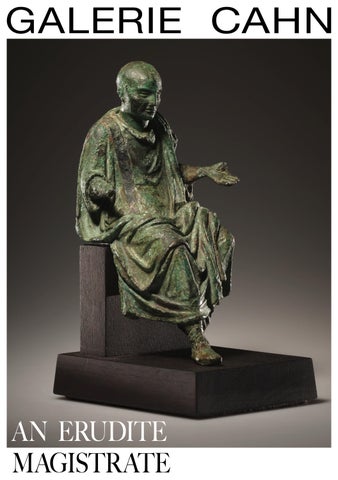
AN ERUDITE MAGISTRATE
CONTACT
Dr. ULRIKE HAASE
En. | De. | It.
JOFFREY NOGRETTE
En. | Fr.
CHARLOTTE CHAUVIER
En. | Fr. | Es.
GALERIE CAHN
ulrike.haase@cahn.ch
+41 061 271 67 04
joffrey.nogrette@cahn.ch
+41 061 271 67 00 charlotte.chauvier@cahn.ch
+41 061 271 67 02
www.cahn.ch
+41 061 271 67 55
OPEN
Monday to Friday Saturday and Sunday
10am - 1pm & 2pm - 6pm Closed
Packaging, insurance and transport are at the expense of the purchaser. All prices in CHF net for export.
UPCOMING
MAZE DESIGN BASEL
14 June 2026 (Soft Opening)
15 June 2026 (VIP-Day)
16 - 17 June 2026 (Public Hours)
18 June 2026 (Public Hours)
Offene Kirche Elisabethen
ANTIKE IN BASEL
15 June 2026 (Opening)
16 - 20 June 2026 (Public Hours)
21 June 2026 (Public Hours)
Cahn Steinen
THE FRUITS OF THE EARTH
16 June 2026 (Opening)
17 - 20 June 2026
Galerie Cahn



www.mazepresents.com
05 pm to 09 pm
10 am to 07:30 pm
11 am to 07 pm
11 am to 06 pm
Elisabethenstrasse 10 - 14, Basel
www.antike-in-basel.com
02 pm to 07 pm
11 am to 07 pm
11 am to 05 pm
Steinentorstrasse 19, Basel
www.cahn.ch | www.galeriewolff.com
06 pm to 09 pm
10 am to 06 pm
Malzgasse 23, Basel
AN ERUDITE MAGISTRATE
The Bronze Statuette of a Seated Togatus from the Stroganoff Collection
By Dr. Ulrike Haase
Not infrequently, the meaning of an ancient object reveals itself only upon closer inspection. The same holds true for the bronze statuette presented here, featured in our monthly catalogue series. Research into its provenance uncovered a collecting history that can be traced back to the influential Russian Stroganoff family, renowned for both their mercantile success and their art collections. Furthermore, closer study of the bronze, acquired as a ‘Statuette of a Seated Philosopher’, has shown that its interpretation is far more complex than first assumed.
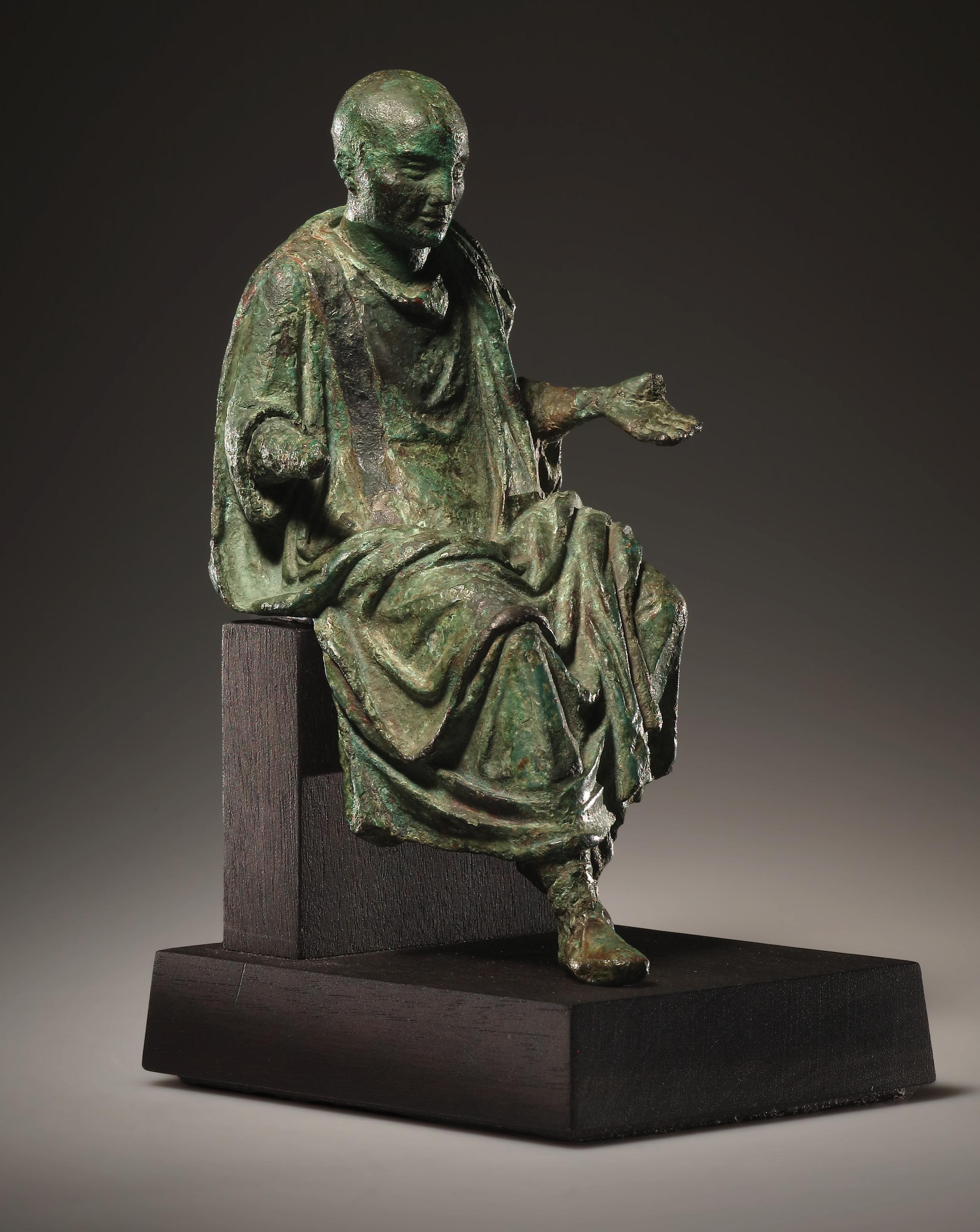
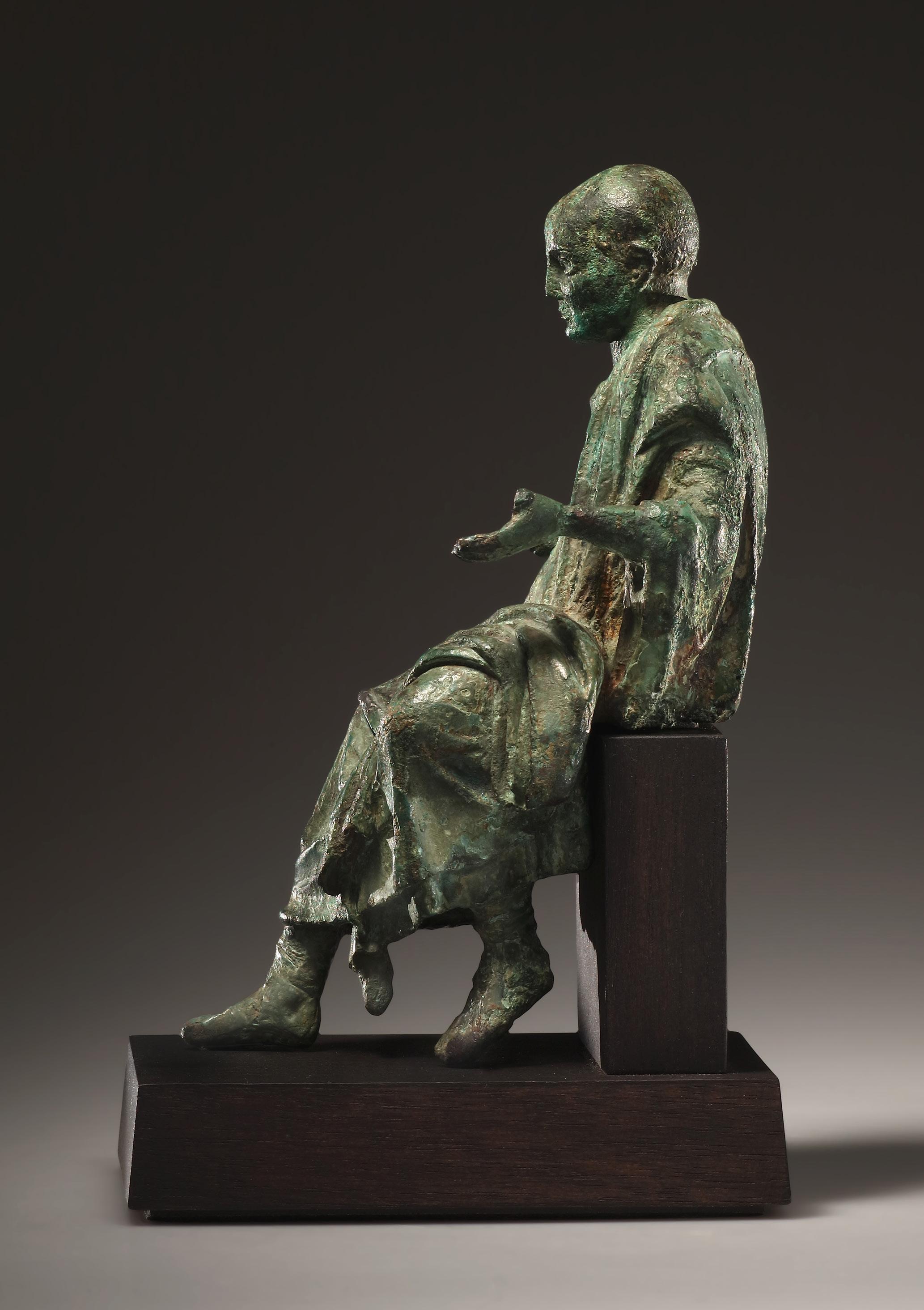
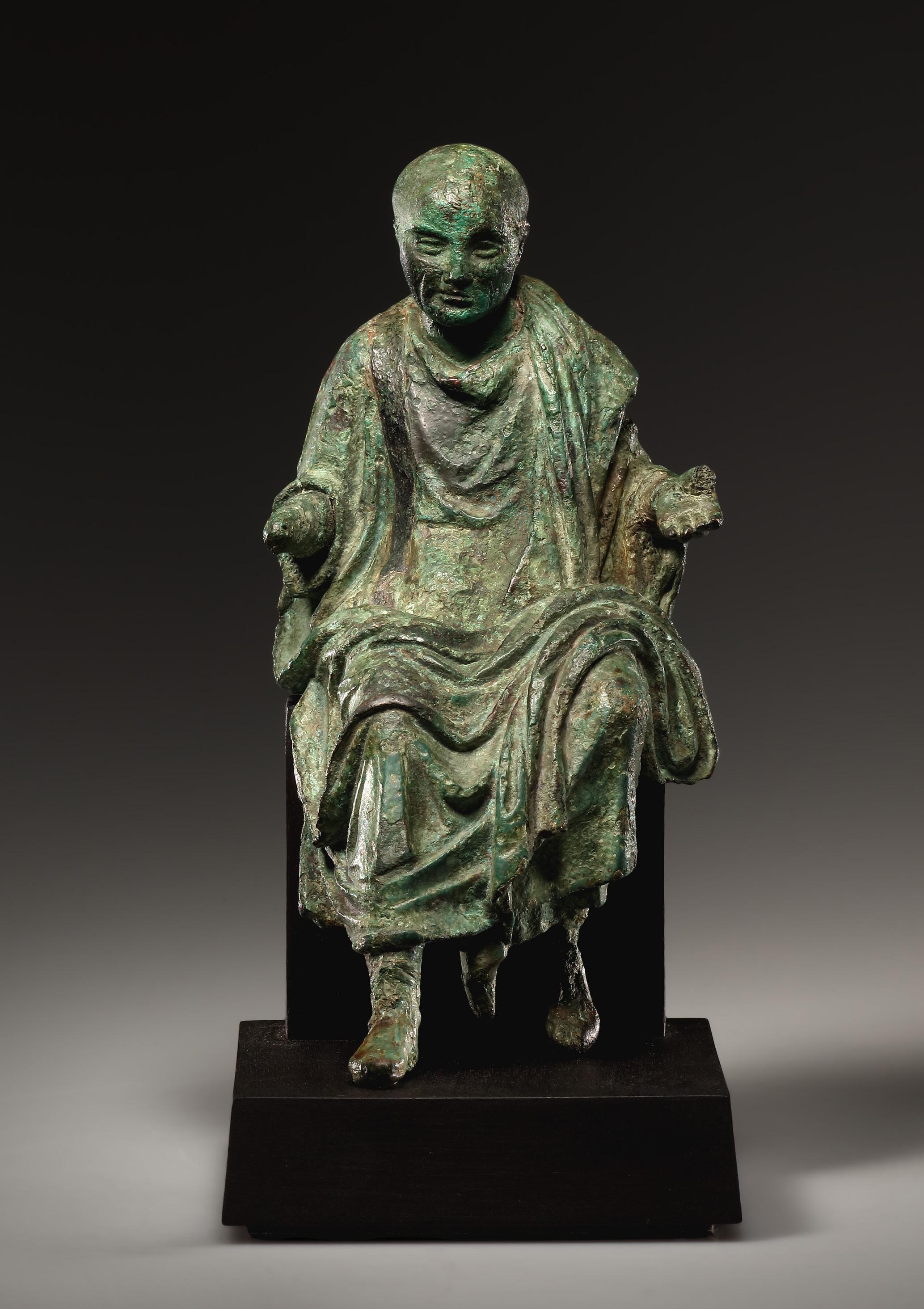
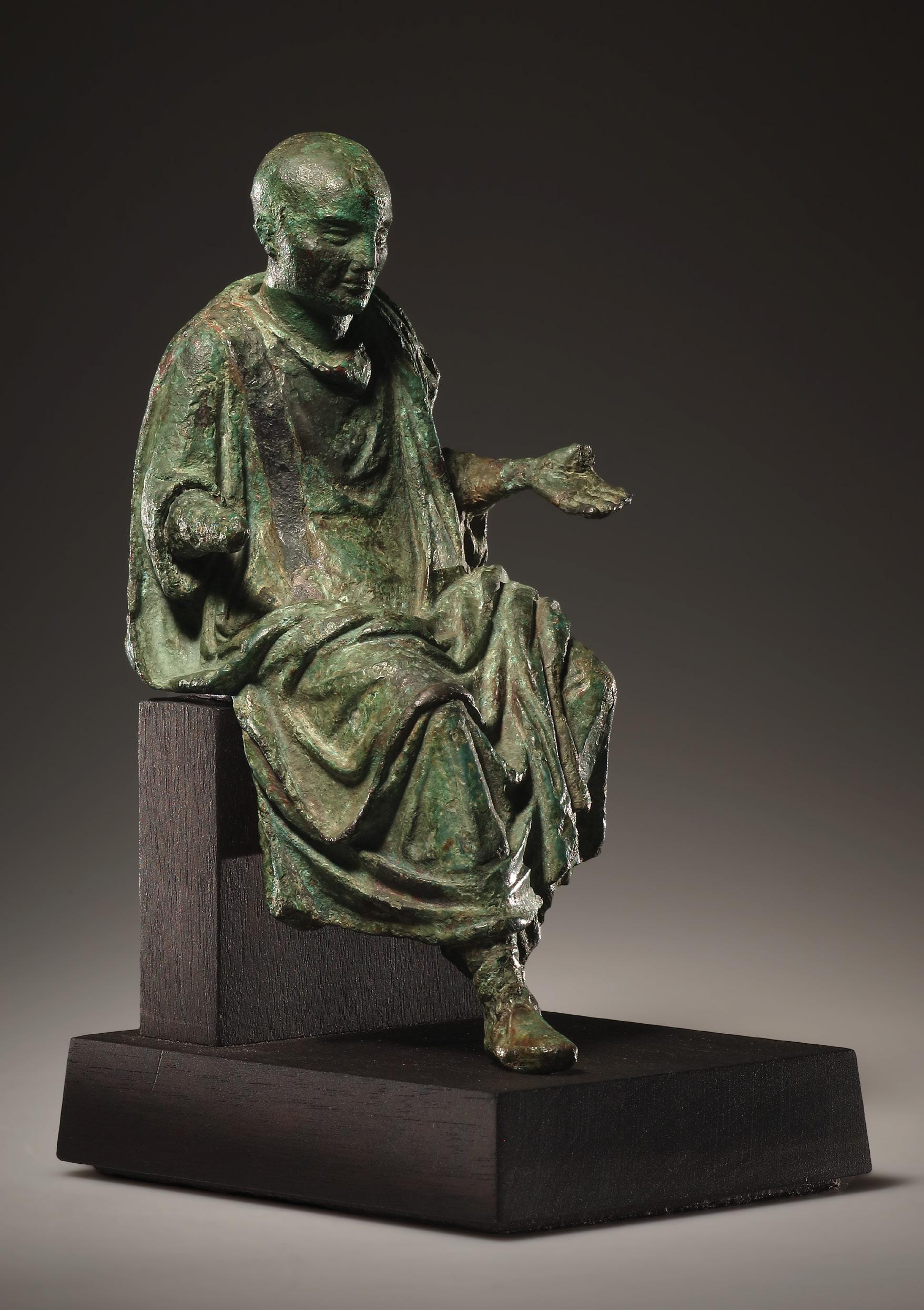
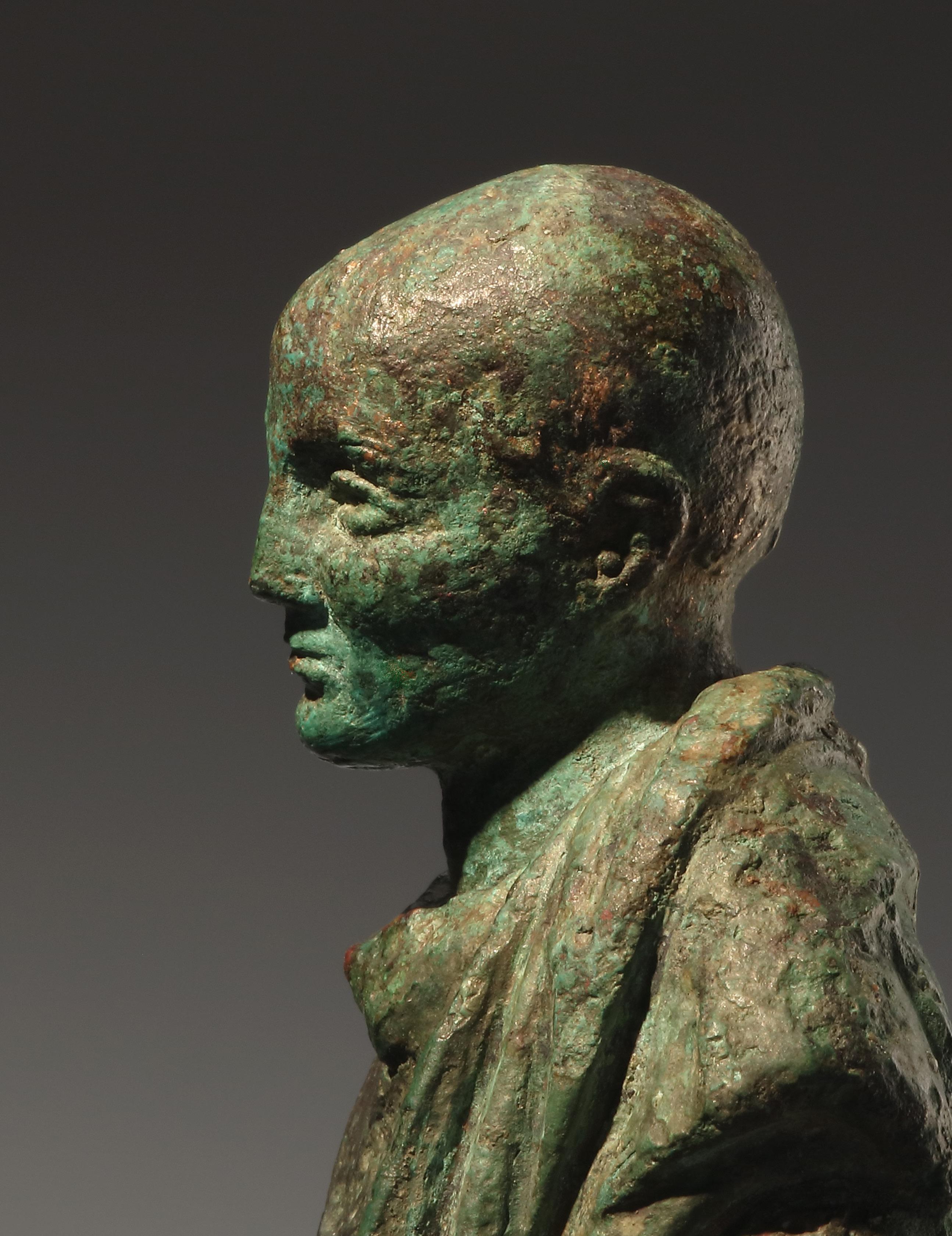
The figure, modelled in the round, depicts a middle-aged man seated in a relaxed posture. His right leg and foot are extended forwards slightly, while the left lower leg is drawn back somewhat, with only the toes touching the ground. The buttocks are not modelled, instead the upper body ends in horizontal, partially smoothed edges. The resulting rectangular opening continues inwards forming an irregularly shaped recess with an oval cross-section and currently serves to accommodate a simple wooden base (cf. Fig. 1). The current positioning of the figure broadly corresponds to its original state. Both arms
are bent at the elbows, with the forearms extended horizontally. The right hand is no longer preserved. The fingers of the flat, open left hand are outstretched, while the thumb, of which only the base is preserved, was slightly splayed. The palm is gently inclined inwards
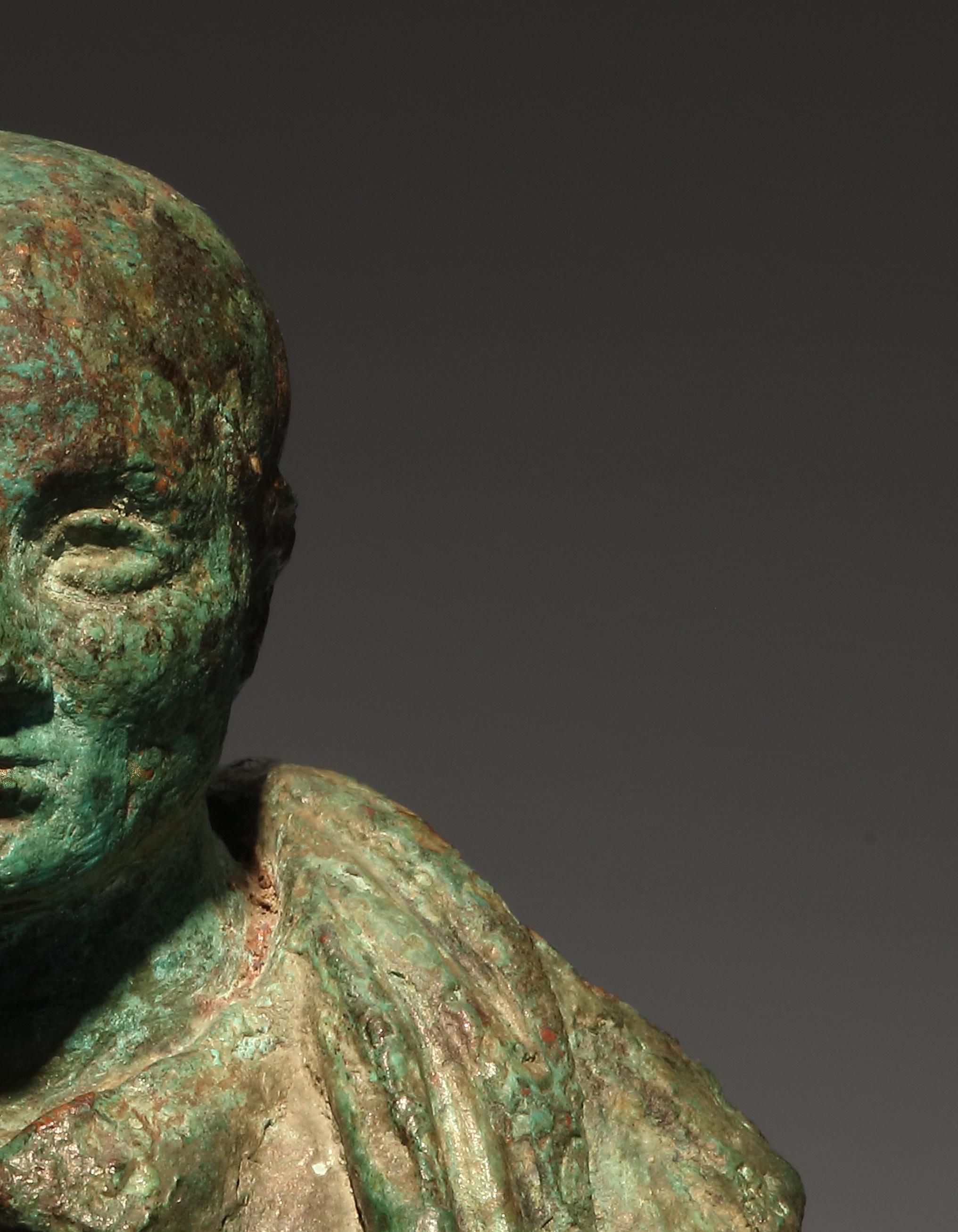
The man’s attire consists of a tunic and a toga, the garment worn by Roman citizens at official functions. The toga is draped loosely due to his seated posture. It descends over the left shoulder, covers the back, and is then gathered in a series of rich folds across the lap. On the basis of its cut and the resulting fullness of the fabric, the garment is probably already the type of toga worn in the Imperial Period, that came into fashion under Augustus.1 The laciniae – the pointed ends of the toga formed by a specific method of folding the cloth –are both clearly visible. One lacinia forms the end of a fold of fabric laid over the left thigh and turned back, while the other emerges beneath the section of the garment draped around the lap. A noteworthy detail on the upper body is a broad band of uniform width that descends vertically from the right shoulder and is set off on both sides by a fine, irregularly executed incised line. Its blackish hue suggests that
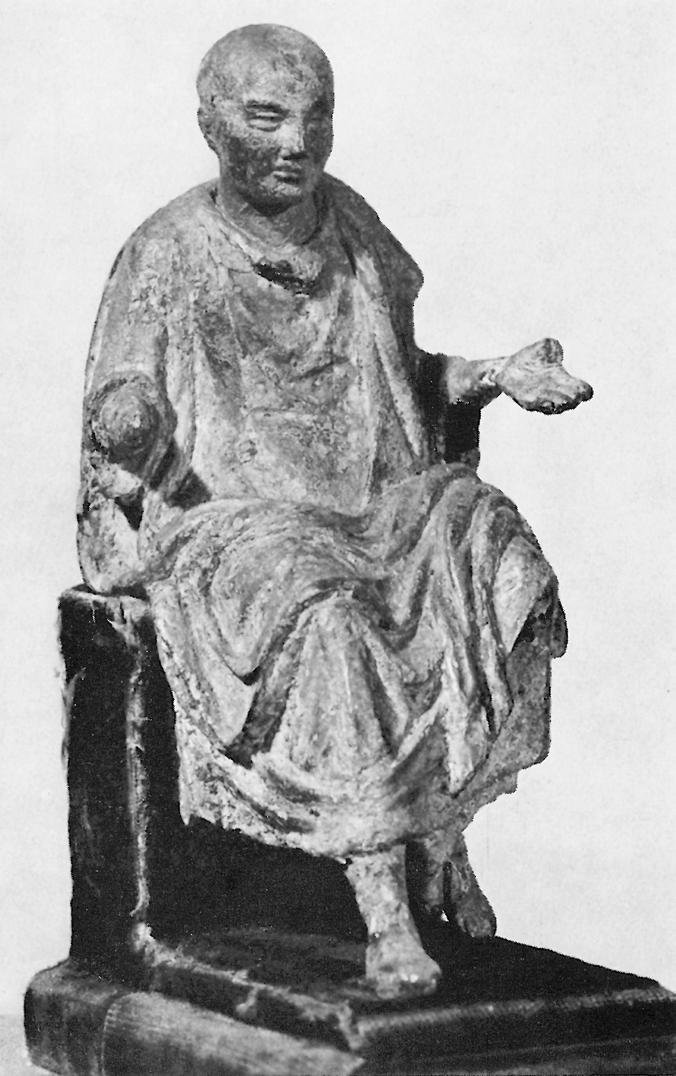
Fig. 1: The black-and-white photograph in the 1957 auction catalogue of Adolph Hess AG attests to the existence of an earlier mount covered with velvet fabric; the same mount, without its fabric covering, is illustrated in the 1988 auction catalogue of Christie’s London.
it was originally accentuated by paint or a thin applied layer, for example in silver or copper. The band does not, however, adorn the toga itself, thereby precluding its interpretation as the characteristic purple border of the toga praetexta. Rather, by virtue of its placement, it can be identified as a clavus belonging to the tunic. A second clavus would have graced the other side, but is concealed by the toga.2 Completing the
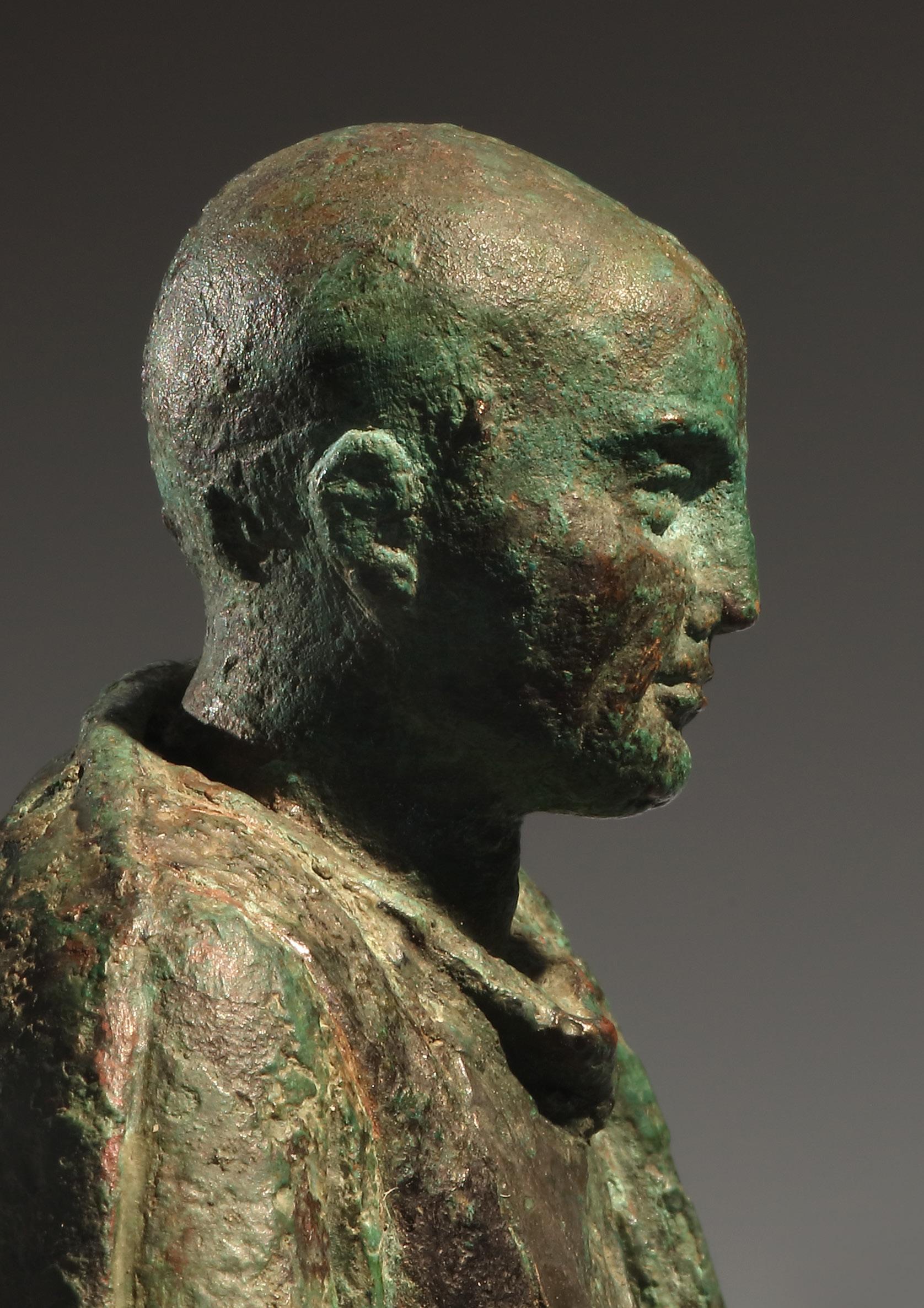
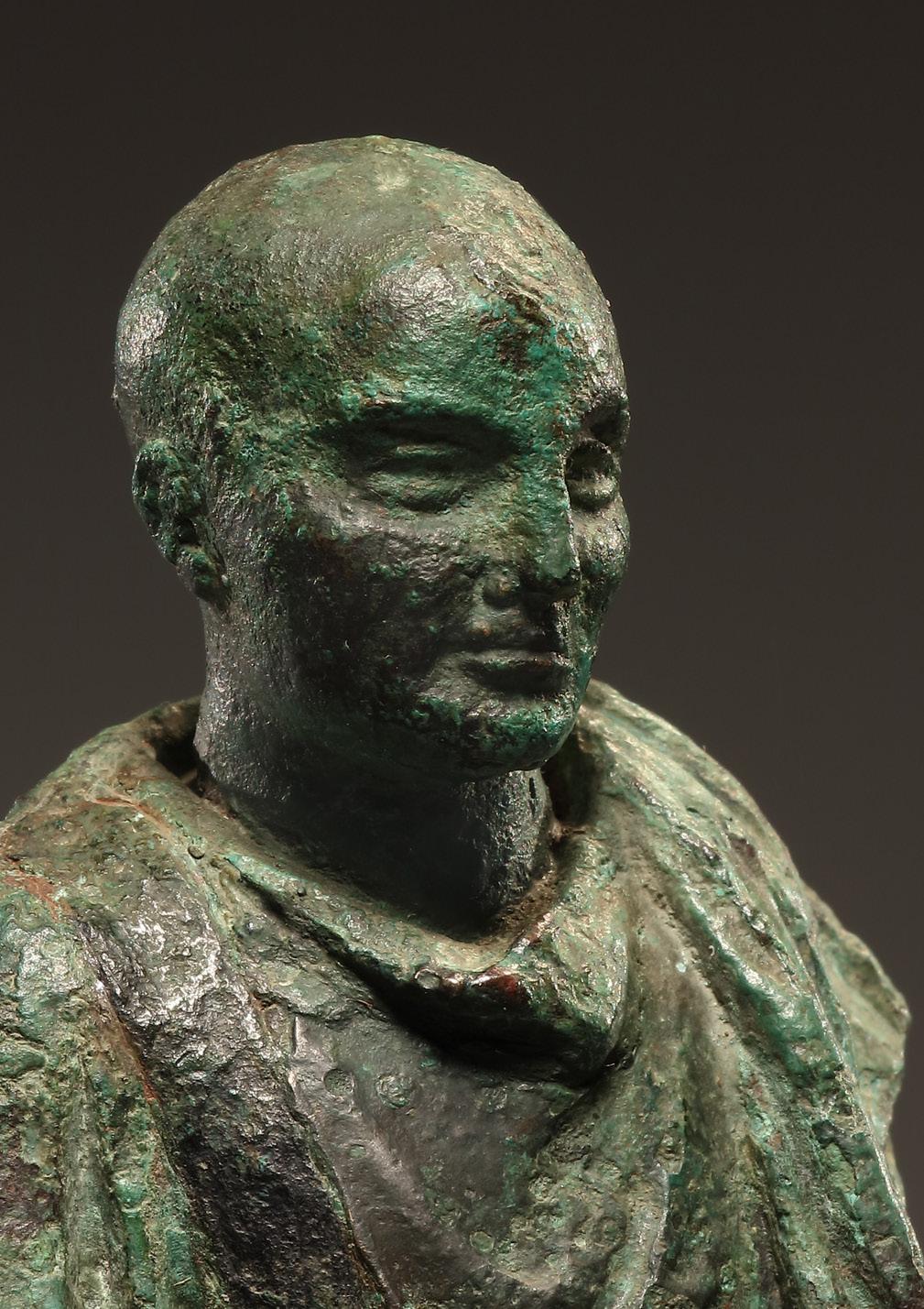
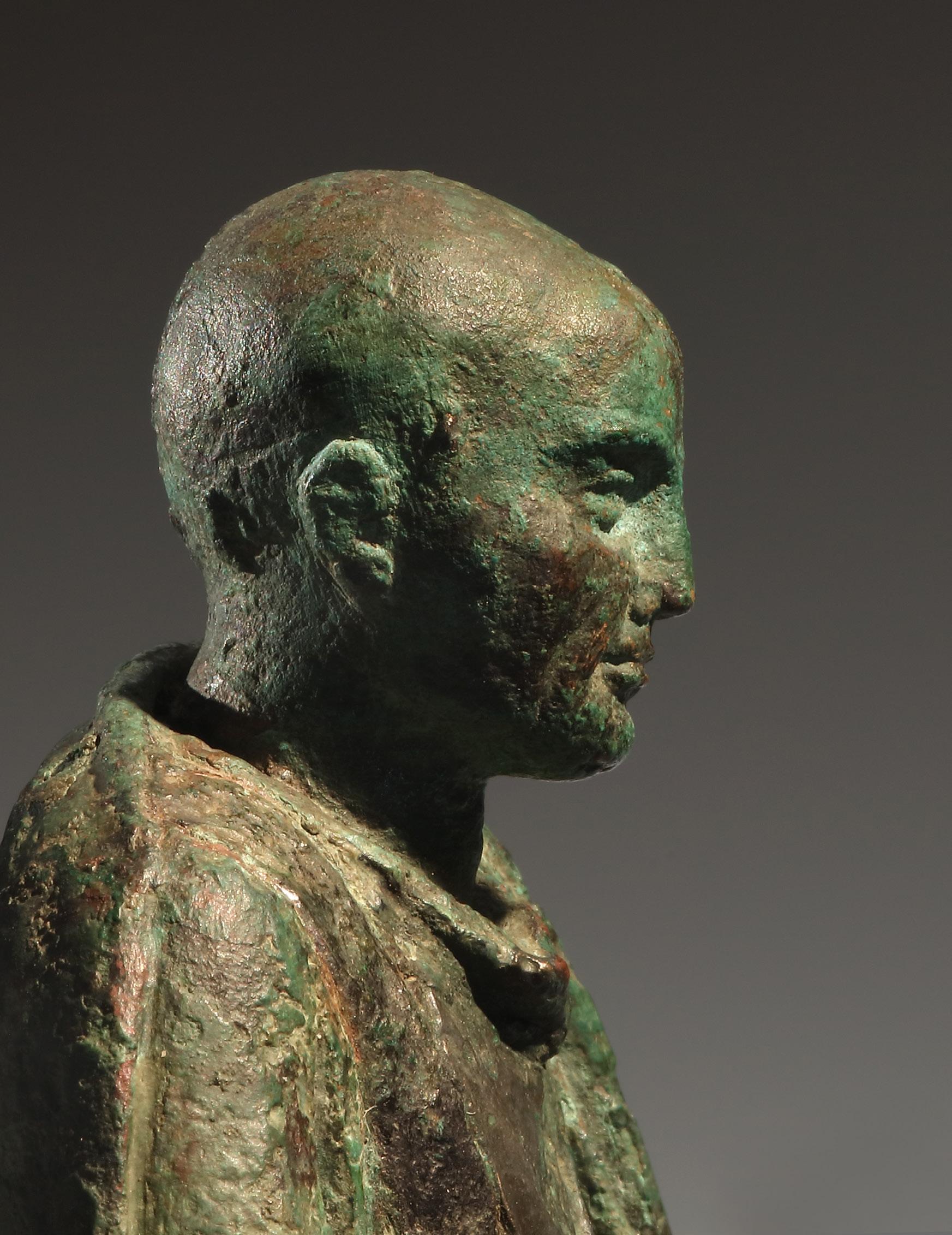
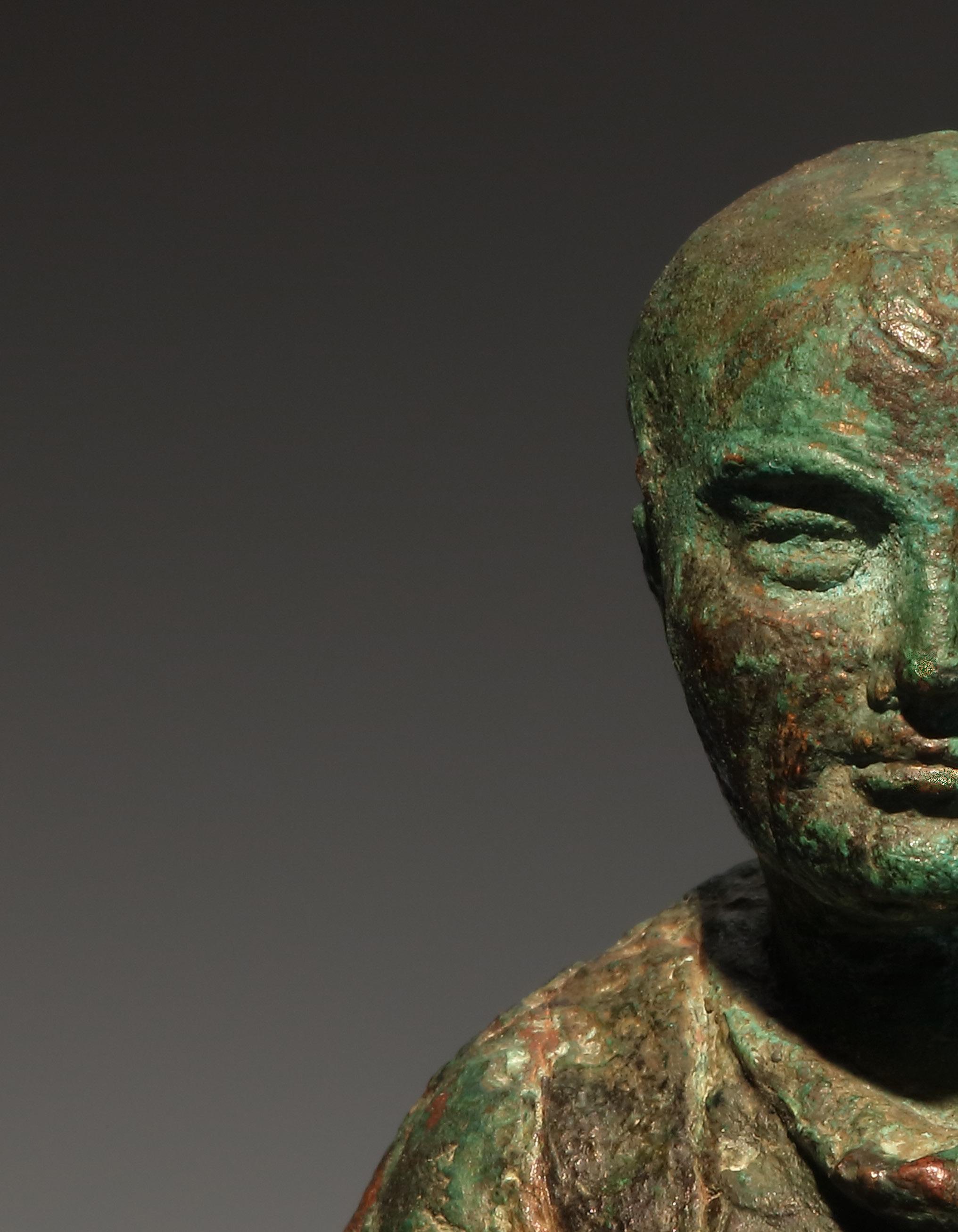
ensemble of tunic and toga are calcei, closed leather shoes whose lacing above the ankle can still be partially discerned (see below). The characteristic leather straps crossing over the instep are also still partly visible. The man’s head is inclined slightly. His physiognomy seems to possess a certain individuality, at least at first glance. The somewhat asymmetrical face, with narrow eyes framed by heavy lids beneath prominently modelled brows, a sharply profiled nose, pronounced cheekbones, slightly hollowed cheeks, a small mouth with full lips, and a rounded, projecting chin, all contribute to this impression. The eyes lack pupils and are shallowly hollowed, suggesting that they may originally have been inlaid. The flesh is stretched taut over the pronounced cheekbones and shows no trace of wrinkles; even the nasolabial folds are only faintly indicated. The arc-shaped notch on the right cheek is probably a small area of surface damage or a facial crease. The ears are set far back on the head. The cranial dome, slightly projecting in profile and strongly rounded at the back, displays irregularities reminiscent of hair. These follow no discernible pattern and, upon closer inspection, can be divided into two categories. The small raised projections of varying and undefined form above the centre of the forehead, behind both temples (at the same level), and along the nape of the neck may be remnants of the casting process. The remaining features resemble the corrosionrelated surface unevenness that extends over large areas of the statuette. The figure is conceived primarily for frontal viewing. Its sculptural volume is most effectively revealed in right three-quarter
reconstructed only in part. It is evident, however, that two corrigiae (straps) were tied well above the ankle, corresponding to the so-called calceus senatorius. This type of shoe was worn by senators of plebeian origin, whereas the calceus patricius, tied with two (rather than one) knots and four corrigiae, served as a status symbol for senators of patrician descent.6 Since the lower ankle area is obscured by surface corrosion, a second knot cannot be reconstructed with certainty, nor can its presence be ruled out. Through his clothing, the ancient observer could immediately recognize that the figure held senatorial rank and had probably progressed through the political offices of the cursus honorum, perhaps even reaching the highest office of consul. The specific treatment of the figure’s back, with omitted buttock area, suggests that it was originally seated on a now lost piece of furniture.7 This may have been a sella curulis, which would have further emphasized the individual’s official status. Comparable examples are known from large-scale seated statues.8 The position of the magistrate’s arms suggests that he originally held something in his hands. A brief survey of late Republican and imperial representations of officeholders shows that these figures were, due to their official role, often depicted holding a rolled-up scroll (rotulus). However, based on the position of the fingers, our togatus could not have held such a scroll in his preserved left hand. Rather, it appears that something rested on the outstretched fingers. Another notable feature is the positioning of the forearms which are almost parallel but slightly staggered in height. This particular posture is known view, which simultaneously directs the viewer’s gaze to the striking band of the tunic. On the reverse, the folds of the toga are rendered in a more schematic and less plastic manner. Furthermore, the volume of the back is slightly reduced.
In its conception, our bronze follows a representational convention widely employed in the Hellenistic Period for poets and philosophers.3 In the Late Republic, this compositional scheme was adopted for the depiction of Roman magistrates and distinguished citizens and subsequently also served as a mode of representation for the emperor himself.4 Thus, the figure’s being clad in a toga sets it apart from the depiction of a philosopher, who is typically shown wearing a simple cloak. The voluminous garment, which was fairly complex to put on, clearly signaled that the wearer possessed Roman citizenship. Beyond that, variations in the quality of the fabric, the style of draping, and above all the color scheme could provide insight into the wearer’s social standing. In our case, however, it is not the toga but the tunic, a shirt-like undergarment, that is adorned with a coloured band. Here too, its prominent placement is not due to merely decorative considerations. Rather, the width of the purple clavi conveyed the wearer’s social rank or status. Senators and, from the time of the emperor Augustus, their sons along with individuals of senatorial rank, were entitled to broad lati clavi, whereas knights (equites) wore the narrower angusti clavi.5 Finally, the footwear was also part of the social “dress code.” Due to surface corrosion, the lacing of the calcei can be
from standardized depictions of reading poets and philosophers in Hellenistic and imperial glyptics (Fig. 2).9 It is possible that our magistrate was also originally depicted holding an unfurled scroll.10 On engraved gems, the two-dimensional nature of the medium meant that the front forearm was always depicted slightly lower, so that the scroll could be properly shown. When the statuette is viewed from the angle giving the best visual effect, as noted above, this detail corresponds with the representations on engraved gems. The official’s slightly lowered head may have been intended to indicate that he was reading. If this interpretation is correct, our bronze would acquire a special typological significance, since depictions of figures actively reading from an open scroll are otherwise unattested in three-dimensional sculpture, both for philosophers and intellectuals as well as for officials.11
It may be concluded so far, that our bronze statuette represents a high-ranking Roman official of senatorial rank, possibly a consul, who is presented within the visual tradition of Greek poets and philosophers, perhaps engaged in the scholarly activity of reading. Education and intellectual competence were already regarded as central ideals of Roman conduct within the value system of the Roman Republic, and the viewer of the bronze was meant to associate these qualities with the individual represented. Furthermore, the statuette also highlighted the magistrates’ membership in the social and political elite.
Now that the figure’s status and type of representation are largely clear, the
question of his identity naturally arises, given the man’s physiognomic features described above. However, a brief look at late Republican portraits, with their stereotypical “Zeitgesichter” (faces in the period-specific style) calls for caution. The hairstyle, which is generally a reliable means to identify portraits, especially in the Roman Imperial period, cannot be used here due to the uncertainties already noted.
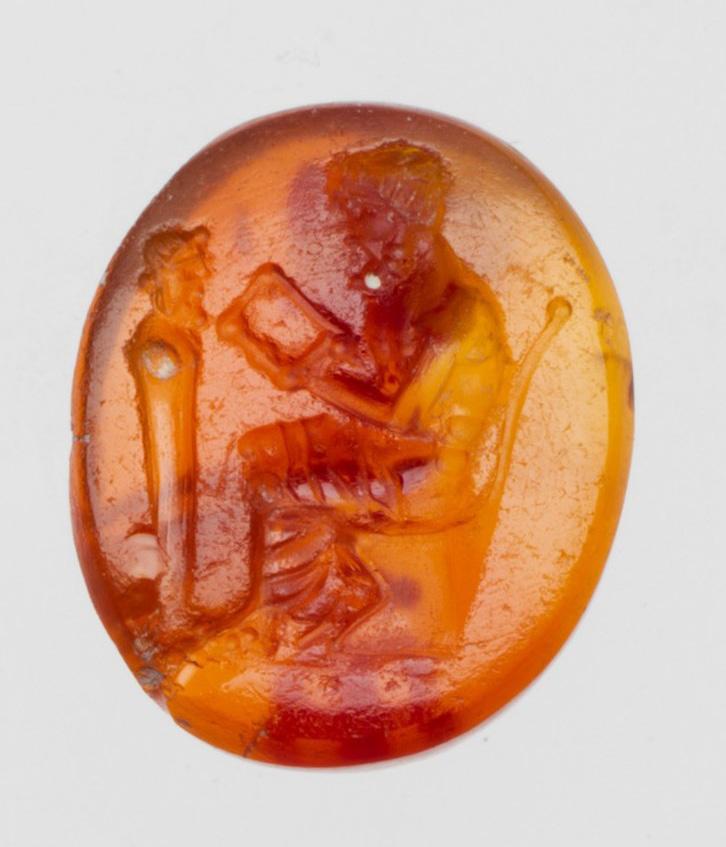
Fig. 2: Carnelian intaglio with seated philosopher. Roman, 1st–3rd century
A.D. (Metropolitan Museum of Art, New York, inv. no. 81.6.49)
Thus, it seems of little value to associate bald-headed portraits, such as the socalled Scipio Berlin12, with our figure. In any case, an identification as an Isis priest, as male portraits of this type are generally interpreted, can be ruled out in the light of the man’s clothing. Undoubtedly, it would be tempting to
associate our togatus with an intellectually prominent and also politically active figure. However, the number of portraits that can be assigned to this category with any degree of certainty is limited, and at first glance their study yields no conclusive results. Individual features such as the hooked nose, the small mouth positioned just below the nose, and the rounded, prominent chin in profile, might appear to bear some resemblance to the comparatively well-known portrait of Cicero.13 Yet the modelling of the flesh on our togatus differs significantly from the Cicero portrait. Moreover, the relevant portraits exhibit a specific hairstyle, which, unless one assumes either a complete loss of the original cranial surface or an addition in another material, is not evident on our bronze in any form. The almost total lack of wrinkles in the face is indeed unusual and can hardly be explained by the choice of sculptural medium, a smallscale bronze. For portraits of high-ranking officials with established political careers, one would typically expect an emphasis on age, such as under-eye bags, forehead wrinkles, and pronounced nasolabial folds, which are visual conventions typically employed in Roman private portraiture.14 Physiognomic characteristics such as the restrained emphasis on age, combined with the pronounced cheekbones and the rounded, projecting chin, can therefore indeed be understood as individualizing fea-tures. Yet they provide no assistance in identifying our figure. Ultimately, it cannot be ruled out that, in antiquity, a now-lost base may have borne the name of the official.15 In the statuette’s current state, however, his identity cannot be
determined.16
As with all anonymous portraits, it is impossible to determine whether the subject actually looked as represented.17 The need for recognizability through a highly realistic rendering of the individual’s features was not necessarily required in antiquity, since the beholder could readily establish the intended connection to the statue’s or bust’s portraited owner or recipient through the predetermined (and now mostly lost) display context, and sometimes through accompanying inscriptions. Unlike the large-scale marble togati, which were permanently installed in a fixed location, the small size of our bronze allowed it to be moved and displayed in a variety of settings as needed. It is therefore quite conceivable that it formed part of the decoration of a Roman villa, where it would have been displayed in a private setting, thereby complementing the numerous attested portraits of mostly anonymous, that is, unknown individuals.18
In addition, the placement of portraits of famous poets and thinkers in private villas is well documented, not least thanks to the excellent archaeological record from the cities of the Bay of Naples.19 Rome’s expansion into the eastern Mediterranean led, by the 2nd century B.C. at the latest, to a lively cultural exchange. Greek education (paideia) became an important ele-ment of aristocratic life and called for representative expression in the visual realm as well. Thematically, our magistrate, who is perhaps reading, would fit well into this context. Moreover, the flexibility of the location in which the bronze statuette was displayed allowed for ever-changing
possibilities of reception and interpretation. Following the detailed discussion above, the question arises as to the archaeological significance of our bronze, particularly with regard to comparable small-scale bronze representations of Roman magistrates with individualized physiognomy. Of interest in this context is a fragment of a bronze relief in the Getty Museum, which depicts two men standing close together, dressed in toga, tunica, and calcei, with pronounced portrait features (Fig. 3).20 Due to its relieflike design and the treatment of the back, the fragment, which continues to the right, served as an applique. Further examples of appliques with togati, some with portrait features, can be associated with this
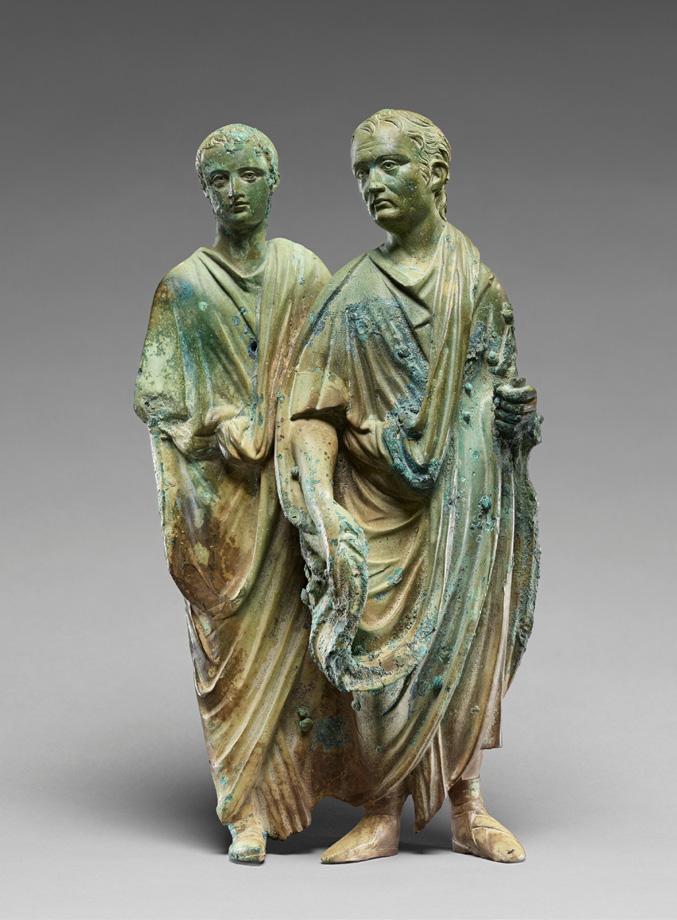
Abb. 3: Relief fragment of two men wearing togas. Roman, 1st century A.D. (J. Paul Getty Museum, Malibu, inv. no. 85.AB.109)
fragment.21
Given that our bronze was produced as a hollow cast with an open base, the possibility that it served as a finial or attachment merits consideration. The exact context of its placement remains unclear, but it would have been positioned in a way that allowed it to be viewed from the angle giving the best visual effect. In terms of conception, however, our bronze remains unique. Comparable examples of small-scale, three-dimensional bronze statuettes of seated officials with portrait features are, as far as I am aware, unknown. The typological singularity of a reading magistrate in three-dimensional sculpture has already been noted.
Finally, the chronological placement of our bronze remains to be established. It seems to me that a date in the 2nd-3rd century A.D., as suggested by J. Lang, may be somewhat too late.22 As already noted, the style of the toga worn by our magistrate came into fashion during the Augustan period. For stylistic evaluation, the head and drapery are particularly relevant. In addition to indicating individual traits, certain facial features may also be typical of a specific period and thus help date the work, as suggested by the concept of Zeitgesicht, developed by the German archaeologist Paul Zanker. The broad, somewhat compact face, along with the shape of the skull that widens at the sides, but is slightly recessed behind the temples, thereby emphasizing the central forehead, recall portraits of Emperor Vespasian (69-79 A.D.). The slightly puffy lower eyelids also are characteristic of the
Flavian period. The hairstyle, however, cannot be used as a dating criterion due to the uncertainties mentioned above. If, however, one assumes that our magistrate is depicted with very sparse or even no hair, this provides an additional argument for placing the work within Vespasian’s reign. The broadly arranged folds of the drapery, whose valleys show little shading, further support a date not long after the 1st century A.D. The absence of a beard, which came into fashion with the official portraits of Emperor Hadrian (117-138 A.D.) and was subsequently adopted in private portraiture as well, may be cited as a further argument for the proposed chronological classification.
Even if not all aspects examined here can be conclusively resolved, and some observations may invite further (explicitly welcome) discussion, it is hoped that the bronze statuette from the Stroganoff collection recently acquired by Galerie Cahn can now be appreciated as far more significant than a mere “Seated Philosopher.”
Price on Request
TEXT · Dr. Ulrike Haase
DESIGN · Jonas Hernegger
PHOTOS · Niklaus Bürgin
TRANSLATION · Yvonne Yiu
A BRONZE STATUETTE OF A SEATED MAGISTRATE
Roman, ate 1st century B.C. - 1st century A.D.
Bronze (hollow cast)
H. 14,1 cm · W. 7,4 cm · T. 9,2 cm
H. Head (crown-chin) 2,9 cm
CONDITION
The head was cast separately from the neck. The right hand and left thumb are missing. The surface exhibits corrosion, several internal encrustations; in the leg area, orange–reddish discoloration results from corroded iron, and a square hole at the center indicates the former presence of a metal pin, which functioned as a spacer to maintain the correct distance between the core and the mould during the lost-wax casting process (Fig. 4). Azurite deposits and cuprite efflorescence in places.
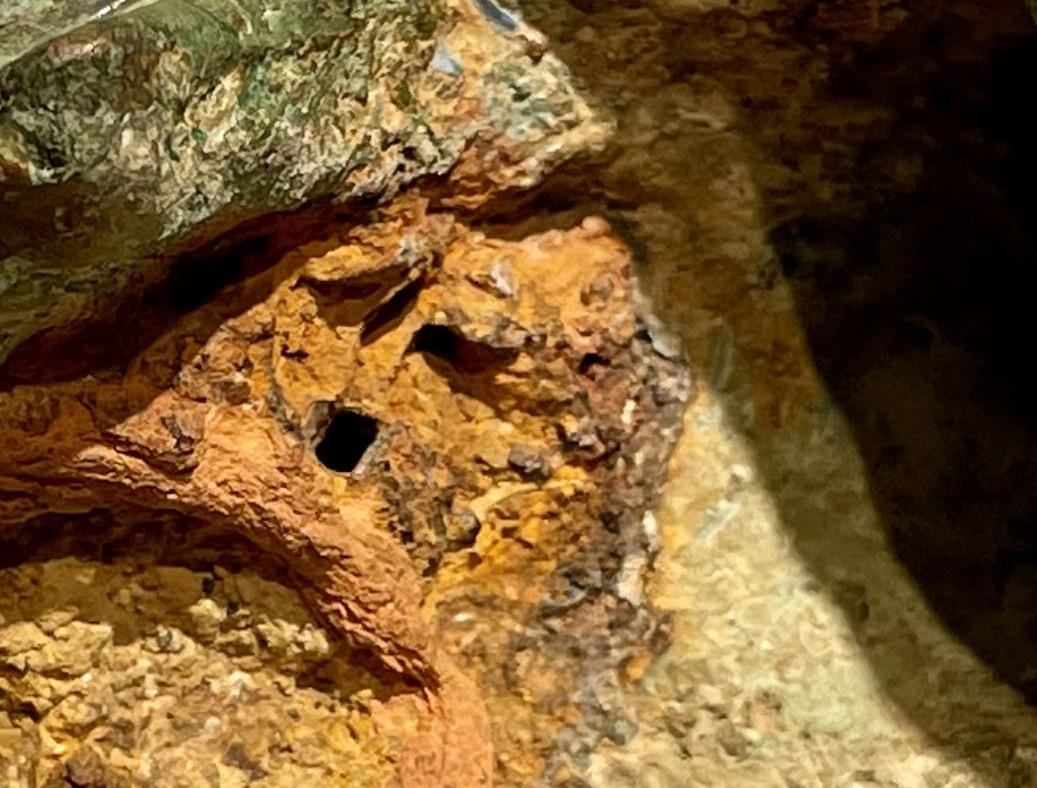
Fig. 4: Detail of the back with square hole and traces of corroded iron.
PROVENANCE
Formerly Collection Stroganoff, possibly Count Grigorij Sergeevič Stroganoff (1829-1910), St. Petersburg, Paris and Rome.
Estate of Dr. Jacob Hirsch; auctioned 7 December 1957, Adolph Hess AG, Lucerne.
Private collection of industrialist Henning Throne-Holst (1895–1980), Djursholm, Sweden; auctioned in 1988 at Christie’s, London.
Robin Symes, London, 1988.
Private collection R. S. L., London, acquired before 2000.
London art market, 2026.
On the back of the object two labels with inv. nos. “298“ and “88.418“.
PUBLICATIONS
Auction catalogue Adolph Hess AG, Lucerne, Bedeutende Kunstwerke aus dem Nach-lass Dr. Jacob Hirsch, 7 December 1957, lot 56, with illus.
Auction catalogue Christie’s London, The Collection of the Late Henning Throne-Holst, 8 June 1988, lot 16, with illus.
J. Lang, Mit Wissen geschmückt? Zur bildlichen Rezeption griechischer Dichter und Denker in der römischen Lebenswelt, MAR 39 (Wiesbaden 2012) 188, without illus.
Arachne, Database of the DAI – 1186696, arachne.dainst.org/ entity/1186696 (27.04.2026), without illus.
NOTES
1 See H. R. Goette, Studien zu römischen Togadarstellungen (Mainz 1990), pp. 3–4.
2 In the shoulder area, copper-coloured discolourations with a metallic lustre are visible within the incised boundary lines of the clavus. Cf. the bronze statue of Aulus Metellus (the so-called Arringatore), Florence, Museo Archeologico: here the clavus of the tunic is accentuated by means of an inlaid copper strip, for which a corresponding band was already reserved on the front and back of the torso during the casting process; see T. Dohrn, Der Arringatore. Bronzestatuette im Museo Archeologico von Florenz (Berlin 1968), pp. 6–7, pls. 16–17. By contrast, our statuette does not have the recessed channel typically associated with inlaid decoration. The black discoloration may indicate remnants of solder.
3 See J. Lang, Mit Wissen geschmückt? Zur bildlichen Rezeption griechischer Dichter und Denker in der römischen Lebenswelt, MAR 39 (Wiesbaden 2012); our bronze is listed in the category “Typisierte Darstellungen” (p. 188, cat. no. S TypA1; see also Lang’s remarks pp. 80–98), albeit without any reference to the toga. The Arachne database of the German Archaeological Institute (DAI) publishes our togatus as “Statuette eines sitzenden Denkers, in Buchrolle lesend”, see arachne.dainst. org/entity/1186696 (27 April 2026), although it is incorrectly described there as “bekleidet mit freiem Oberkörper; Mantel”; moreover, there is no indication that the figure is “bärtig”.
4 On representations of seated togati of the Imperial period as a form of self-representation of Roman officials, see Goette, op. cit. (note 1), pp. 75–79, with examples.
5 Goette, op. cit. (note 1), p. 8. However, there was no fixed standard governing the precise width of the clavi; see also K. Fittschen, “Der Arringatore: kein römischer Bürger?”, in: E. La Rocca – P. León – C. P. Pres-icce (eds.), Le due patrie acquisite. Studi di archeologia dedicati a Walter Trillmich (Rome 2008), p. 178.
6 Cf. H. R. Goette, “Die römische ›Staatstracht‹ – toga, tunica und calcei,” in: M. Tellenbach – R. Schulz – A. Wieczorek (eds.), Die Macht der Toga: DressCode im Römischen Weltreich, exhibition catalogue, Roem-
er- und Pelizaeus-Museum Hildesheim (Regensburg 2013), pp. 49–50, noting that the distinctions be-tween calceus patricius, calceus senatorius, and calceus equester as attested in literary sources were not always consistently applied in practice, and that the different shoe types are often difficult to distinguish in the archaeological evidence; see also Goette, op. cit. (note 1), pp. 449-450. In addition, potential use of colour should also be taken into account, although evidence for this has been lost in most cases.
7 For the specific treatment of the reverse, see the so-called Dea Artio from Muri; given the composition of the group to which she belongs, the figure can be reconstructed as seated on a piece of furniture, see A. Leibundgut, Die römischen Bronzen der Schweiz III. Westschweiz, Bern und Wallis (Mainz 1980), pp. 66–70, pls. 88–90.
8 Cf., for example, T. Schäfer, Imperii Insignia: Sella curulis und Fasces. Zur Repräsentation römischer Magistrate (Mainz 1989), pls. 16, 18. Depictions of this folding seat, which formed part of the insignia of office of curule magistrates as well as certain non-curule offices, are attested in various forms across the archaeological record (e.g. on coins and funerary reliefs); however, no examples of small-scale bronze seated statuettes are known to me.
9 Cf. Lang, op. cit. (note 3), pp. 81–85, pls. 20–22, esp. pl. 20, fig. 154, see arachne.dainst.org/entity/1127949 (29 April 2026).
10 Already Lang, op. cit. (note 3), p. 188, classifies our bronze as “Typus A: Lesende”. In the 1957 auction catalogue of Adolph Hess AG, our togatus is described as an elderly philosopher or scholar “der in beiden Händen eine Buchrolle gehalten hat” (p. 24). In principle, however, a communicative gesture (cf., for example, a silver skyphos from Boscoreale depicting the emperor Augusts) or attributes attested for magistrates, such as a libation bowl (although in such a case a veiled head would be expected), would also be conceivable.
11 See also the remarks by Lang, op. cit. (note 3), p. 81; an exception is the bronze statuette of a seated, reading thinker published by Lang, which was presumably used as a decorative element of a folding table (p. 191, pl. 48, fig. 275).
12 Staatliche Museen Berlin, Antikensammlung, inv. no. Sk 332, see
https://arachne.dainst.org/entity/1062541 (27 April 2026).
13 A (partly restored) bust in London, Apsley House (inv. no. WM 14431948) can be securely identified as a portrait of the Roman orator Marcus Tullius Cicero, as it bears an ancient inscription of his name.
14 Cf., for example, the above-mentioned so-called Arringatore.
15 The convention of accompanying Roman private portraits with name inscriptions is attested several times. See, for example, G. Lahusen – E. Formigli, Römische Bildnisse aus Bronze. Kunst und Technik (Munich 2001), cat. nos. 94, 97.
16 There are Roman private portraits that display individual facial features recalling those of our magistrate, although they do not correspond to him in terms of overall physiognomic likeness. Cf., for example, K. Fittschen – P. Zanker – P. Cain, Catalogue of Roman Portraits in the Capitoline Museums and Other Municipal Collections of the City of Rome II: Male Private Portraits (Berlin 2010), cat. no. 17, pls. 23.1–2; cat. no. 19, pls. 23.5–6. A notable physiognomic resemblance is also evident in a portrait head at the Museo Irpino, Avellino, Inv. no. 86, arachne.dainst.org/entity/4302721 (7 May 2026), there listed as the so-called Cicero.
17 In recent decades, the question of how closely physiognomic representation corresponds to the actual appearance of the portrayed individual has been the subject of a considerable body of research, especially in German classical archaeology. See, among others, P. Zanker, “Individuum und Typus. Zur Be-deutung des realistischen Individualporträts in der späten Republik,” AA 1995, 473–481; V. Kockel, “Ty-pus und Individuum. Zur Interpretation des »Realismus« im Porträt der Späten Republik,” in: M. Büchsel – P. Schmidt (eds.), Realität und Projektion. Neue Frankfurter Forschungen zur Kunst 1 (Berlin 2005), 73–85. Among the most significant recent contributions is K. Fittschen’s comprehensive catalogue Privatporträts mit Repliken. Zur Sozialgeschichte römischer Bildnisse der mittleren Kaiserzeit (Wiesbaden 2021), which demonstrates that the practice of producing portrait replicas – well known from imperial portraits – was also widespread within private portraiture. If such replicas can be associated with a single individual, it is reasonable to assume a certain degree of correspondence with the sitter’s actual appearance.
18 For the display of private portraits in Roman villas, see R. Neudecker, Die Skulpturenausstattung römischer Villen in Italien (Mainz 1988), pp. 75–84.
19 Cf. Lang, op. cit. (note 3), 124–130.
20 J. Paul Getty Museum, Malibu, inv. no. 85.AB.109; H. 26 cm (online).
21 See U. Kreilinger, Römische Bronzeappliken. Historische Reliefs im Kleinformat (Heidelberg 1996), 95–99, pls. 45–47. Further examples are known from the art market; cf., for example, Christie’s New York, Ancient Art from the James and Marilynn Alsdorf Collection, Sale 21 April 2021, lot 38; H. 10.4 cm (online); Gerhard Hirsch Nachfolger, Munich, Sale 377, 14 February 2023, lot 113 (online), where the figure is shown capite velato, i.e. as a person making an offering.
22 Lang, op. cit. (note 3), 188, without detailed comment.
FIGURE CREDITS
Fig. 1: Auction catalogue Adolph Hess AG, Lucerne, Auction 7 December 1957, p. 25, fig. 56
Fig. 2: Metropolitan Museum of Art, New York (Public Domain)
Fig. 3: J. Paul Getty Museum, Malibu (Public Domain)
Fig. 4: UH
CONDITIONS OF SALE
September 2025. Place of Execution is Basel
1) Jean-David Cahn AG (hereafter „the Seller“) hereby confirms that it has the right of disposal over the objects for sale according to Art. 18 KGTG. Any further warranty is excluded.
2) The specifications and descriptions given in this catalog are provided in good faith. Nevertheless, their accuracy cannot be guaranteed.
3) The seller guarantees that the sales objects were made in Antiquity. This guarantee, which is granted to the buyer only, is valid for two years after the conclusion of the sales contract.
4) The objects are sold in the condition they were in at the time of the sale („sold as seen“). Complaints regarding the authenticity of a piece (subject to lit. 3) shall be communicated to the Seller in writing at its domicile (Jean-David Cahn, Malzgasse 23, P.O. Box 217, 4010 Basel) upon detection and at the last two years after the conclusion of the sales contract. Other substantiated complaints shall be communicated to the Seller in writing at its domicile, as above, within 14 days of receipt, and at least three months after the conclusion of the sales contract. Any
complaints made later cannot be considered further. All liability for any loss or damage sustained during transportation is excluded. Insurance during transportation is the Buyer‘s responsibility.
5) The delivery and storage of sold objects shall be at the Buyer‘s risk and expense (costs arising from storage, packaging and transportation, any additional costs and expenses, all plus VATs) unless otherwise agreed in writing.
6) Foreign and Swiss customs, duty and shipment shall be borne by the Buyer. Declaration fees for the import into the EU are borne by the Seller if used through the services provided by the Seller. It is the responsibility of the Buyer to comply with foreign and Swiss customs and foreign exchange regulations and to obtain an EU import license through the services of the Seller. The Buyer is aware of the relevant import and export regulations of the EU and has consulted the website of the Swiss Federal Office of Culture Bern (www. bak.admin.ch/kgt) for details of the Swiss import and export regulations currently in force, as well as further provisions. The Seller declines all responsibility for any consequences arising from the
contravention of such regulations. The Buyer acknowledges that a valid import permit is required for the importation of the artworks transferred under this purchase invoice into the European Union. If such a permit is not available at the time of purchase, the approval process may take between four to six months. The registration and execution of the import procedure will be carried out by an art shipping agent appointed by the Seller within the EU. The Seller will organize this process in the name and on behalf of the Buyer. The Buyer is required to conduct the import procedure through the shipping agent designated by the Seller. Alternatives are the responsibility of the Buyers.
7) The Buyer is personally liable for all acquisitions made; he/she cannot claim to be acting for a third party or person. If a person acts as a representative, written proof of authorization may be requested; the Buyer as well as his/her representative can both be held jointly and severally liable for the purchase and for all other costs. The Buyer shall be liable for any damages caused by delayed payments, in particular for exchange rate and interest losses. Payments by cheque or by the internet shall be deemed to have been received only on clearance by the relevant bank.
8) Payment shall be due upon the conclusion of contract, but at the latest 30 days after the invoice is issued. Interest of 1.5% per month will be charged for payments made after 30 days. Payments can be made in cash, by bank transfer or by cheque. The Seller may ask for proof of creditworthiness. Title shall be transferred only upon receipt of payment in full; all risks, however, shall pass to the Buyer
upon conclusion of the sales contract.
9) If payment is delayed, the Seller can, after giving the Buyer due notice, withdraw from the contract forthwith. This also applies in cases where the object has already been transferred to the Buyer‘s possession at the Buyer‘s cost. The object in such a case must be handed back to the Seller upon request. Additionally, the Seller may claim further damages.
10) If the Buyer does not collect the object, the Seller can choose either to cancel the contract after 30 days and to claim compensation or to store the object at the Buyer‘s expense and to demand that the Buyer collects it.
11) All Sales are transacted in Basel, Switzerland, which is therefore the Place of Fulfillment and the court of jurisdiction The conclusion of contract, the quotation and the negotiations are subject to Swiss law, exclusive of the United Nations Convention on Contracts for the International Sale of Goods (CISG). By buying, the Buyer recognizes the exclusive right of the court of Canton Basel-Stadt, Switzerland, and of its jurisdiction. All sales are subject to Swiss jurisdiction. All parties recognize the exclusive choice of Swiss jurisdiction for the settlement of any matters arising from the conclusion of the sales contract.
12) All purchases and deliveries are performed solely on the basis of these conditions of sale. Any references by the Buyer to his/her terms and conditions are herewith expressly excluded.
13) Should individual provisions become fully or partially void after the conclusion of contract due to changes in the law, the validity of the remaining provisions and of the contract shall remain unaffected. The invalid provision shall be replaced by that provision which is closest in meaning and intention to the original provision.
14) The Buyer accepts the condition of the sales as above. He/She explicitly accepts the exclusive right of the courts of Basel-Stadt, Switzerland, and their jurisdiction, exclusive of the United Nations Convention on Contracts for the International Sale of Goods (CISG), over the quotation, the negotiations, and the sale.
15) The conditions of sale are provided in German and English, the German version being the definitive and legally binding one in the event of any disputes.
Published by Galerie Cahn. Your Partner in the Antique Trade
since 1863.

Galerie Cahn | Malzgasse 23 | CH-4052 Basel