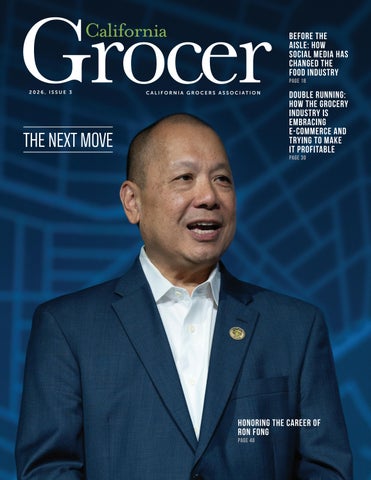
BEFORE THE AISLE: HOW SOCIAL MEDIA HAS CHANGED THE FOOD INDUSTRY PAGE 18 2026, ISSUE 3
CALIFORNIA GROCERS ASSOCIATION
THE NEXT MOVE
DOUBLE RUNNING: HOW THE GROCERY INDUSTRY IS EMBRACING E-COMMERCE AND TRYING TO MAKE IT PROFITABLE PAGE 30
HONORING THE CAREER OF RON FONG PAGE 48
RON. HERE’S TO YOU,
For your leadership. For your advocacy.
And mmt of aa, for your friendship.
For nearly two decades, you have been a tireless champion for California Grocers and a trusted friend and partner to North State Grocery. Through boardrooms, conferences, store visits and more than a few good times along the way, we’re grateful not only for your leadership, but for your friendship.
Congratulations on an incredible carrr and a wee-earned retirement
Yoo friends at
CGA | BOARD OF DIRECTORS
EXECUTIVE COMMITTEE
CHAIR APPOINTMENTS Independent Operators Committee Chair DIRECTORS
Chair Richard Wardwell Superior Grocers
First Vice Chair Jonson Chen Tawa Supermarket, Inc.
Treasurer Elliott Stone Mollie Stone’s Market
Immediate Past Chair Michel LeClerc North State Grocery, Inc.
Second Vice Chair Bertha Luna Stater Bros. Markets
Secretary Sergio Gonzalez Northgate Markets
Joe Mueller Kellanova
Subriana Pierce C.A. Fortune
Brenda Palomino Amazon
Dom Engels Bronco Wine Co.
Brendan McAbee Bimbo Bakeries USA
Nick Sass The Hershey Company
Anthony Escobar NuCal Foods
Kelli McGannon The Kroger Company
Casey Scharetg Gallo
Shant Fermanian Super King Markets
JR Medina Super A Foods
Kristen Sherwood Grocery Outlet, Inc.
Jon Gianinni Nutricion Fundamental
Candace Minto PepsiCo Beverages
Diane Snyder Whole Foods Market
Justin Hyer Molson Coors
Michael Molinar Food 4 Less Stockton
Brad Thomas Kimberly-Clark Corporation
Tyler Kidd Mar-Val Food Stores
Kelly Mullin Albertsons Companies
Joe Toscano Nestle Purina PetCare
Andrew Knight Instacart
Bethany Pautsch Tyson Foods, Inc.
Steve Tsujimoto Berkeley Bowl Marketplace
Brandon Lombardi Sprouts Farmers Markets
Eric Pearlman C&S Wholesale Grocers
Priyanka Vijay Keurig Dr Pepper
Nick Malm Reyes Coca-Cola Bottling
Karen Reid Post Consumer Brands
Stephanie Wu The Save Mart Companies
Brady Matoian OK Produce
Adam Salgado Heritage Grocers/Cardenas Markets
Kevin Young Young’s Payless IGA
Vice President Communications & Public Affairs Nate Rose
Government Relations Associate Amandeep Kaur
For association members, subscription is included in membership dues. Subscription rate for non-members is $150.
Chang So Hollister Super HeeSook Alden Certified Federal Credit Union Joe Angulo El Super/Smart & Final Steve Brancamp UNFI Elaina Budge Costco Wholesale (Bay Area) Adam Caldecott Good Food Holdings, Inc. Rocky Campbell C & K Market, Inc. Paul Cassara Mother’s Market & Kitchen Taylor Chappell Anheuser Busch InBev Adam Deardorff FMS Solutions Chris Dehoff Dehoff’s Key Markets
CALIFORNIA GROCERS ASSOCIATION
President/CEO Ronald Fong Senior Vice President & Chief Operating Officer Doug Scholz Vice President Government Relations Rachael O’Brien Manager CGA Educational Foundation Jamie Cowden Business Development Manager David Cook Director Events & Sponsorship Pascale Senejoux
2 | CAL I FOR N I A G RO C E R
Director Local Government Relations Tim James Senior Director CGA Educational Foundation Brianne Page Vice President People Operations & Administration Jennifer Gold Communications Manager Grace Becker Controller Scott Inman
Administrative Assistant Delilah Augustine Senior Accountant & Assistant Office Manager William Quenga California Grocer is the official publication of the California Grocers Association. 1005 12th Street, Suite 200 Sacramento, CA 95814 (916) 448-3545 (916) 448-2793 Fax cagrocers.com
© 2026 California Grocers Association Publisher Ronald Fong rfong@cagrocers.com Editor Nate Rose nrose@cagrocers.com Managing Editor Grace Becker gbecker@cagrocers.com For advertising information contact: Dave Cook dcook@cagrocers.com
CONTENTS | ISSUE 3
FEATURES
6 2
18
NOV
The Aisle Before the Aisle: How Social Media Has Changed the Food Industry Why Gen Z decides what to buy before they walk into your store
24
California Races to Watch
Elections that could shape the grocery industry this November
30 Double Running
President’s Message Signing Off. . . . . . . . . . . . . . . . . . . . . . . . . . . .
5
Chair’s Message From Summer to Autumn .. . . . . . . . . . . . .
6
Viewpoint Make. People. Hungry.. . . . . . . . . . . . . . . . .
8
Inside the Beltway Shoppers Balance Affordability, Family Meals, and the Daily Lunch. . . . . . . . . . . . . 10 Washington Report The Greedy Grocery Myth. . . . . . . . . . . . . . 12 Capitol Insider The More Things Change.. . . . . . . . . . . . . . 14 Mommy Blogger The Algorithm Is My Grocery Aisle. . . . . 64
CA
How the grocery industry is embracing e-commerce, and trying to make it profitable
36
COLUMNS
DEPARTMENTS Outside the Box New Retail Perspectives. . . . . . . . . . . . . . . . 58 CGA News. . . . . . . . . . . . . . . . . . . . . . . . . . . . 60 CGA New Members. . . . . . . . . . . . . . . . . . . 61
SB 54
What California’s recycling rules mean for grocers and the road ahead
42 C-Suite
Shuffles in grocery accelerate amid multiple pressures
48 Honoring the Career of Ron Fong
Outgoing President, CEO reflects on nearly 2 decades at helm of CGA
CAL I FORNIA G RO CER | 3
On behalf of all of us at Mars Snacking, we wish CGA President Ron Fong congratulations on his retirement!
Thank you, Ron, for your years of remarkable leadership, advocacy and partnership. Enjoy your well-earned retirement.
PRESIDENT ’S MESSAGE
Signing Off
RO N F O N G PR ES IDEN T AN D CEO CALIFOR N IA GR OCER S AS SO CIATIO N
The stories I’ll take with me The experts say we understand the past through storytelling. Back when the human race was comprised of simple hunters and gatherers, our ancestors would gather around the fire at the end of a day and swap stories. Oral traditions played host to the lessons stored across time. Narratives compel the way we conceive of the past, present, and our ideas about the future.
There was the time a member would ignore my calls and would not even look my way for months. I kept at him throughout the months with what my staff has now termed, “Dim Sum Diplomacy.” It’s the art of bringing food and breaking bread, instead of talking shop. We finally earned their membership, and they are the most supportive people ever.
Over a time that spanned nearly two decades I’ve had the privilege of collecting many such stories with all of you. I went from being new to serving the industry in a lobbying and leadership capacity to a longtime steward of our grocery community. Of course, there were many highs and even some lows over the last 19 years, and it’s strange to say you’ll remember good times and bad times, but you certainly will. Somehow you need both, even though you imagine you only want the wins. I can also affirm all the faith that carried me through the time spent in between both defeat and victory.
There are the relationships with board chairs— all business for a year since they are my boss— but as soon as the gavel goes down, magic happens and I can rely on them as my closest friends. There was the time when my chairs, our board, and the world misunderstood social justice. We tackled it right head on. After that, we named Mary Kasper the first of five woman executives that would add “CGA Chair” to their titles.
I remember everyone around me believing the prospective merger with the California Independent Grocers Association would never work. Something told me they were wrong, and we persisted and united California’s grocery industry. The merger was only one battle among many. Politics is nothing if not battles. We collected many battle scars, didn’t we? Yet, the faith this industry entrusted in me has carried the day on many occasions, and I’m proud to say together we’ve built one of California’s leading business trade associations.
Finally, there was the time my dear friend Ruth Darling passed away just a few days into her well-deserved retirement. I was having dinner with two of my chairs, and we pledged not to overstay our sell-by date. We have Ruth to thank for this amazing change we will have with my successor Susan Bonilla. Having grown up in the industry, I’ve found myself lately wondering if it all wasn’t meant to be. Steve Jobs famously told a Stanford graduating class that “the dots always connect looking backwards.” This beautiful sentiment warms my heart when I reflect on where life has taken me. When my family prepared to
sell its small grocery business and I entered law school, I could hardly assume the places life would bring me and the stories I’d collect. There are now more personalities and stories than I have the space to share in this column. I also know these stories are not just about me, but each of you who shared in these experiences. They will exist after I step away too; they will shape the future. Time spent together is my legacy as are the experiences that give these stories their meaning. From the CGA Board of Directors to the individuals at the Association and all my friends throughout the industry who remain, those of you who continue to serve after my retirement will carry these stories along with you. They’ll shape future actions and experiences. They will drive this industry forward across new business challenges and political hurdles. In this way, our life’s narratives will ripple out and outlast each of us. I return to the central question. How do I account for time’s passing? I can recount the milestones and reflect on the accomplishments. We’ve achieved so much together! But in the end, I can tell you the things that really count: It’s the relationships you form along the way. I think about all the people, my friends, and smile, knowing just how much you changed my life for the better. From the bottom of my heart, thank you for the joy of a lifetime and all the stories along the way. ■
CAL I FORNIA G RO CER | 5
CHAIR’S MESSAGE
From Summer to Autumn
R I C H A R D WA R DW EL L S UPE R IOR GR OCE R S
This Autumn marks an exciting period of transition and celebration for the California Grocers Association. Let’s start with CGA’s big win at the Capitol this legislative session. In partnership with our members, for the second year in a row CGA managed to kill surveillance pricing bill AB 2564 by Assemblymember Christopher Ward. Over the past several months I’m sure you’ve all noticed a wave of what lawmakers like to call “surveillance pricing” legislation being introduced across the U.S. At the time of writing, 89 bills have been introduced across 27 states targeting algorithmic pricing disclosure mandates, prohibitions on personalized pricing using personal data, and consumer opt-out rights. Here in California, Asm. Ward’s second attempt intended to target surveillance pricing, but in reality, it would have put an end to rewards and loyalty programs and made grocers vulnerable to tremendous legal jeopardy. Ask any grocer and they’ll tell you it’s not a smart move to cost shoppers valuable savings when their purse strings are already tightening, especially under the guise of affordability. Ironically, the bill more closely applied to airlines or ticketing companies who use algorithmic pricing, not to grocers who want to reward loyal customers and keep them coming back. Fighting off AB 2564 was a battle until the bitter end, with members meeting with their elected officials, submitting letters through CGA’s portal, and the Association intensely lobbying up until the wee hours on the last day of session. Ultimately, all these
6 | CAL I FOR N I A G RO C E R
efforts paid off and Asm. Ward conceded after failing to garner support from members of the Moderate Democratic Caucus. You and I both know how competitive the grocery industry is, which incentivizes retailers to keep prices low and give customers a reason to come back to our stores. The “greedy grocer” accusation from our very own elected officials is downright disheartening and dishonest. Similar surveillance pricing laws have already been passed in states including Maryland, Connecticut, New Jersey, and New York. I am grateful to the Association and all our grocery members who engaged to kill this bill for the second year in a row. Though this more than likely isn’t the end of surveillance pricing legislation in California, I’m proud that CGA stopped the industry’s top priority bill from becoming law for the third year running. Now onto this season of transition. After nearly 19 years at the helm of CGA, President and CEO Ron Fong is retiring this December. On behalf of the Executive Board, CGA Board of Directors, and our membership, I would like to extend my sincere thanks to Ron for his leadership and service over nearly two decades. He will be sorely missed. This transition left CGA with the task of finding the Association’s next leader. Following a months-long search, I’m thrilled to welcome Susan Bonilla as the Association’s
next President and CEO, and President of the CGA Educational Foundation. Susan boasts an impressive resume, having spent six years as a member of the California State Assembly. Before representing Contra Costa and Solano counties in the Assembly, she was a Concord City Councilmember and Mayor, and she also served as a Contra Costa County Supervisor. Most recently, she led the California Pharmacists Association for the past six years. Read more about Susan’s background in the CGA News section. Her executive leadership skills combined with her background as a political insider will be an invaluable asset to the Association and its members for years to come. You’re likely reading this at CGA’s annual Gather California conference where Susan will take the stage for the first time to introduce herself to the industry. We look forward to her leadership starting this fall. Speaking of Gather, thank you to all those who traveled to Rancho Mirage to make quality business connections, hear insights about the state of retail, and have a little bit of fun with peers. I look forward to it every year and hope you do too. As we embrace transition at CGA these coming months, we hope the feature stories in the pages that follow help your business do the same. ■
Thank You Ron! From all of us at The Save Mart Companies, congratulations to Ron Fong on his retirement after a remarkable career dedicated to California’s grocery industry and public advocacy. We thank Ron for his many contributions and wish him, his wife Carol, and their family all the best in this well-deserved next chapter.
VIEWPOINT
Make. People. Hungry.
K EV I N CO UPE FOUN DER MOR N IN GN EWS BE AT.COM
At the risk of being declared a heretic and tortured, excommunicated (from what, I’m not sure) and then burned at the stake, I’m just going to say it: I’m really, really tired of AI. There. I said it. Dare I go a step farther? I’m really, really tired of all the attention that the supermarket industry devotes to technology. I say that as someone who has spent a fair amount of his professional life writing and talking about how the supermarket industry does and should use technology to improve their businesses—to be more efficient, yes, but even more importantly to be more effective. I firmly believe that retailers have to find ways to invest in continuous technological innovation. But that’s not where innovation investment should end. As I wrote in these pages a few months ago in a slightly different context, it is not like I’m a technophobe or a Luddite. Far from it. My entire business is built on the ability to gather news quickly and easily via the internet, and then use it to distill my take on the important stories that I think will affect the industry. I have a MacBook Air, an iPad and an iPhone, plus an Apple Watch.
8 | CAL I FOR N I A G RO C E R
Now, as I have said, I do think there is a kind of techlash taking place in the country as people become more suspicious of and hostile to technologies and platforms (especially social media) that they see as invasive. Hence the growing and pervasive enmity toward data centers, which have become the manifestation of all the technologies that people see as a threat to their welfare and economic well-being. I can see it in my own life. I have a new grandson, my first, but my son and his wife have decided that his picture and name should not be posted anywhere on social media, where they could become so much fodder for companies that use data and images for their own profit. I respect
that, and think it reflects a broader caution among young people about their privacy— an attitude that could impact the degree to which they’re willing to engage in things like retailer loyalty programs. I’ve been conscious in some shifts in my own behavior. I’ve been trying to reduce the amount of time I spend looking at screens. I’ve taken to exchanging my Apple Watch for a four-decade old Seiko when I’m not working out and trying to compile certain kinds of data. And I’ve even found myself reading old-fashioned library books from time to time instead of using the Kindle app on my iPad. (Go figure—I’m becoming more analog in an increasingly digital world.) That doesn’t mean that retailers should be stepping away from technology. My friend and associate Tom Furphy, formerly of Amazon and currently of Consumer Equity Partners (CEP), likes to say that one of the most important things a retailer can do is develop the muscles that lead to “identifying, evaluating, engaging, funding, piloting, and scaling” technological innovations, iStock and that learning, by its very nature,
VIEWPOINT
iStock
compounds—it provides geometric rather than arithmetic advancement. I agree with all of that. But here’s my challenge: Food. Retailers should be devoting the same kind of rigor to food. Because food also is a place where retailers can create for themselves differential advantages by creating for shoppers memorable experiences. Perhaps the best sandwich I’ve ever eaten— and certainly the best sandwich I’ve ever had from a supermarket—was at a Lunds & Byerlys store in Minnesota. Smoked Turkey. Bacon. Jarlsberg cheese. Served on—wait for it—toasted cinnamon croissant bread and smeared liberally with cranberry mayonnaise. It was an extraordinary and unexpected combination, and just recounting the experience I have to be careful not to drool on my keyboard. I remember some 30 years ago or more shooting a video project at a Rouse’s Supermarket in Houma, Louisiana, about 60 miles southwest of New Orleans. The food there wasn’t fancy, but the gumbo, red beans and rice, and seafood was utterly delicious, filling the store with aromas that instantly made you hungry. It wasn’t just a supermarket—it was a food store. (Our video crew was so happy that they didn’t want to go back to work. They just wanted to spend the afternoon eating.)
Closer to where you live (but, alas, 2,830 miles from where I live, but who’s counting?) I had some really remarkable Mexican food at Northgate’s Mercado González in Costa Mesa. Fresh tortillas. Street tacos. Quesabirria. And how about the outstanding doughnuts— that almost always sell out on a daily basis— made at the Susanville IGA in Susanville, California, which have proven to be a tangible differentiator for the single store operator. (It is amazing how far I will go for an outstanding blueberry fritter. As it happens, the Susanville IGA is 2,807 miles from where I live. Just sayin’.) Food forward. Food first. Food that creates memories. (Clearly.) Tom Furphy likes to point out that when it comes to technology, retailers have to develop four disciplines: Continuous learning. Methodical and rigorous experimentation. Intentional capital allocation. Institutional knowledge that compounds over time. All of which I agree with and heartily endorse. I just think that the same disciplines need to be developed on the food side of retailers’ businesses. You have to continuously be learning about food—new cuisines and dishes, many of which shoppers are being exposed
to via various cooking shows and online platforms. Be an active part of that ongoing conversation. You have to be willing to experiment. Not everything appeals to everybody, and if you find something that does, you’re probably embarked on a journey to the lowest common denominator. Not a recipe for culinary success. You have to be willing to invest. Smartly. Systematically. In training and travel, with strict benchmarks for ROI. But knowing that you can’t succeed in the food business without trying different kinds of foods in different places. And, having done all this and then repeated the process persistently, understanding that it all results in a culture of food knowledge that, in fact, does compound over time. The bottom line for me is that while technologies like AI are incredibly valuable in making a supermarket effective and efficient in many ways, almost no customer ever will walk into a store and immediately detect what tech is being implemented there. But the aroma of a great blueberry fritter, or gumbo, or quesabirria? Makes people hungry. Which, when effectively marketed, makes people buy more food from stores that are defined by their food culture. ■
CAL I FORNIA G RO CER | 9
INSIDE THE BELTWAY
Shoppers Balance Affordability, Family Meals, and the Daily Lunch S T EPH A N I E H A R R I S CHIE F PUBLIC POLICY OFFICER AND GENERAL CO UNSEL , FMI – THE FOOD IN DUS TRY AS S OCIATIO N
As summer winds down and households return to school and work routines, shoppers are navigating a familiar tension: stretching their budgets while preserving the meals and rituals that matter most. FMI’s U.S. Grocery Shopper Trends 2026 - Return to Routine report finds renewed anxiety among consumers about affordability; however, it also shows their remarkable resilience. Consumers are adapting by eating more meals at home through home-sourced lunches and intentional grocery choices—while continuing to give food retailers credit for helping them manage household budgets. Affordability Returns to the Forefront Concern about rising grocery prices increased seven percentage points from February, with 68% of shoppers now extremely or very concerned. At the same time, 75% of shoppers say they feel in control of their grocery spending, down five percentage points. It’s important to note, however, that the strain is broader than food: confidence also softened across other household expenses, especially gasoline. Additionally, six in 10 shoppers believe they are spending more on groceries than a year ago, and most attribute the increase directly to higher prices rather than buying more products or choosing more expensive brands. Seventy percent report that household
10 | CAL I FOR N I A G RO C E R
income has not kept pace with food price inflation over the past two years. Even so, two-thirds describe their financial situation as comfortable or “doing fine,” suggesting many households have adjusted their routines to a demanding marketplace. In fact, average weekly household grocery spending remains steady at $169. Resilience at the Grocery Store Despite shoppers’ heightened focus on price, their relationship with grocery stores remains strong. FMI’s U.S. Grocery Shopper Sentiment Index stands at 69—down from a record 73 in February, but still near its sixyear average. Importantly, 67% of shoppers say retailers try hard to provide options that help them stay within budget, including through promotions, coupons, private brands and varied package sizes. That recognition underscores an opportunity for retailers to make value visible and easy to access. Clear price communication, dependable assortments and solutions that combine affordability with convenience can strengthen trust when household confidence is under pressure.
Family Meals Anchor Home Life While budgets shape decisions, shoppers are not evaluating meals on cost alone. Family meals remain a centerpiece of home life: 91% see benefits in them, and 66% say those benefits outweigh the time, effort and expense involved.
N early half of shoppers report having more meals at home than a year ago, while 35% are cooking more. At the same time, half are eating fewer restaurant meals with family and nearly as many are ordering less takeout or delivery. The appeal extends beyond savings. Shoppers view family meals as more balanced, healthier and more enjoyable than eating alone. Seventy-two percent say family meals are a good time to teach respectful interaction, and 76% say homemade meals make it easier to include nutritious options.
INSIDE THE BELTWAY
Those who believe the benefits outweigh the costs are also more likely to feel closer to loved ones than they did several years ago. Lunch Reflects the New Routine Lunch is another important expression of value, health, and convenience. More than half of workday lunches are sourced from home—54% when employees work away from home and 62% when they work remotely. Shoppers most often cite lower cost, convenience and health as reasons to
make or bring lunch. Prepared, ready-to-eat or ready-to-heat foods from grocery stores account for a smaller but meaningful share, with shoppers emphasizing speed and ease. Parents face a similar calculation as the school year begins. Among households with children ages 5 to 14 who will eat lunch at school five days a week, 55% expect their child to bring lunch from home most days. Health is the leading reason for homepacked lunches, while convenience leads for school meals. Yet 65% of parents say lunch preparation takes too much time and energy. A Clear Invitation for Retailers
iStock
These findings point to a straightforward opportunity: help shoppers turn good intentions into manageable routines. Better-value lunch options top consumers’ wish list, followed by healthier, fresher,
better-tasting and more varied prepared meal offerings. Easy-to-assemble foods, lunch meal kits, order-ahead pickup and clearly merchandised solutions can meet consumers where cost, health and convenience intersect. As households return to fall schedules, shoppers are not simply cutting back. They are reorganizing how they eat—bringing more meals back inside the home, seeking practical shortcuts and preserving the social value of eating together. Retailers that deliver transparent value and flexible meal solutions can help make the return to routine feel less like a burden and more like a fresh start. ■ To download the U.S. Grocery Shopper Trends 2026 – Return to Routine report, visit www.fmi.org/grocerytrends.
CAL I FORNIA G RO CER | 11
WA SHINGTON REPORT
The Gree dy Grocery Myth
G R EG F ER R A R A PR ES IDEN T AN D CEO N ATION AL GR OCE R S AS S OCIATIO N
A false narrative is spreading through statehouses, social media feeds, and news coverage across the country: that grocers are gouging their customers, and that new in-store technology is about to make it worse. You have likely heard the claims that electronic shelf labels (ESLs) will enable “dynamic pricing” or “surge pricing,” with the cost of ice cream jumping on a hot afternoon or bottled water spiking before a storm. Lawmakers in several states have introduced legislation to restrict or ban these tools based on little more than speculation. For those of us who have spent our lives in this industry, these accusations are not just wrong. They are backward. And for California’s independent grocers, who already contend with some of the highest labor, energy and operating costs in the nation, the stakes of getting this debate right could not be higher. Here is the truth: independent community grocers operate on net margins of one to two percent. For every dollar that crosses the register, a penny or two remains after paying for product, labor, rent, refrigeration, and freight. That is not the profile of an industry gouging anyone. Our members price the way they always have, based on cost, and they pass along savings through promotions, loyalty programs, and discounts whenever they can. They do not use surge pricing. Period.
12 | CAL I FOR N I A G RO C E R
We have seen this movie before. In 1974, the first supermarket barcode was scanned on a pack of chewing gum in Ohio, and consumer advocates warned that scanners would let grocers manipulate and inflate prices.
A half-century later, the barcode stands as one of the most powerful affordability tools in retail history, speeding checkout, improving accuracy, and driving down costs across the entire supply chain. The predicted gouging never materialized.
Today we are re-enacting the same panic with a new piece of hardware, and we risk legislating away an affordability tool in the name of protecting consumers from it. Because that is what ESLs actually are. These labels do not determine prices. They display them, with one critical improvement over paper: the price on the shelf always matches the price at the register. When a store’s system flags that rotisserie chickens need to be marked down before closing, an ESL updates that price in seconds instead of waiting for an employee to print a tag and walk the aisle. The result is a lower price for the shopper, less food in the dumpster, and staff hours redirected from swapping paper tags to serving customers. In a market like California, where every mandate, every kilowatt and every hour of labor adds cost, these efficiencies flow directly to keeping shelf prices down. NGA is fighting this misinformation on every front, and in California we are proud to stand alongside the California Grocers Association (CGA) in that effort. In Washington and in state capitals, NGA’s government relations team is meeting directly with lawmakers and pushing back
WASHINGTON REPORT
against misguided legislation, armed with the data and the real stories of community grocers. We are organizing store tours that bring elected officials inside our members’ stores to see firsthand how pricing actually works, because nothing corrects a false narrative faster than a legislator standing in the aisle of a family-owned market. And we have launched a digital awareness effort across social media and earned media, including op-eds in national trade press, to reach consumers and lawmakers directly with a simple message: data-based pricing tools are how independent grocers cut prices faster, reduce waste, manage labor, and keep shelf prices honest. Restricting them will raise grocery bills, not lower them.
iStock
But an association is only as strong as its membership. If your company is not yet an NGA member, I am asking you directly: join us. Your voice, the voice of a grocer who serves California communities, sponsors local teams and knows customers
by name, is the most credible one in this debate. Membership connects you to our advocacy team, gives you a seat at the table when policy is written, and links you with thousands of independent operators facing the same fights. If you are already a member, get engaged: host a store tour for your legislators, share our campaign content, and tell your story. The independent grocery sector will always answer false narratives with facts and hard work. Together with partners like the California Grocers Association, we will set this record straight, too. Visit nationalgrocers.org to learn more or to become a member. ■
Congratulations on Your Retirement, Ron!
YOU’VE HATCHED A LASTING L GA As one of the world's leading egg suppliers, Eggs Unlimited has always believed our business is about more than eggs, it's about people and partnerships. Ron, your dedication to California's grocery industry reflects those same values. We're proud to celebrate your remarkable career and wish you a retirement filled with happiness and new adventures.
Learn More
www.eggsunlimited.com
(557) 207 9390
CAL I FORNIA G RO CER | 13
CAPITOL INSIDER
The More Things Change…
LO U I E B ROW N IN THE S ACR AMEN TO OFFICE O F KAHN, S OAR ES AN D CON WAY, LLP
Why Sacramento’s Affordability Dilemma Isn’t Going Away Soon Brown
Every legislative cycle in Sacramento arrives with a familiar rhythm. Swearing-in ceremonies bring a wave of new faces to the State Capitol, fresh committee assignments are announced with great anticipation, and leadership speeches emphasize a renewed commitment to addressing the everyday pressures facing California families. Chief among these public declarations is almost always a promise to tackle the state’s pressing cost-of-living and affordability crisis. Yet, for those who have walked the hallways of the Capitol through multiple legislative cycles, a persistent reality quickly reasserts itself: the more the Legislature changes, the more it stays the same. Despite recurring turnover in legislative seats and shifting political titles, the underlying structural drivers of policy in Sacramento remain remarkably constant. And as long as those core dynamics dominate, the issue of affordability will not be meaningfully addressed in the State Capitol anytime soon. It is easy to assume that a fresh roster of lawmakers will usher in a fresh approach to economic policy. After all, new legislators often come from local governments, small businesses, or community organizations where budget constraints and operational overhead are daily concerns.
14 | CAL I FOR N I A G RO C E R
However, the institutional pressures of Sacramento work quickly. Once in office, incoming lawmakers are immediately immersed in a policy environment driven by well-established interest groups, entrenched caucus priorities, and an enduring appetite for regulatory expansion. Rather than re-evaluating the cumulative economic impact of state regulations on main street businesses, the Legislature routinely defaults to its traditional playbook: introducing mandates, expanding employer liabilities, and instituting new compliance requirements. While individual bills are often framed around admirable social or environmental goals, their combined weight creates an increasingly costly environment for retail grocers and suppliers.
T he central paradox in Sacramento today is the sharp disconnect between legislative rhetoric on affordability and legislative action on operational costs.
Lawmakers regularly express concern over food prices and consumer inflation. Yet, in committee rooms across the Capitol, policy proposals continue to advance that directly increase the cost of doing business in California: •
Labor & Employment Mandates: Measures that expand workplace liability, restrict scheduling flexibility, and introduce complex administrative standards steadily drive up labor costs— the largest variable expense for any grocery operator.
•
Operational & Environmental Regulations: Mandates surrounding packaging, waste management, and facility operations require significant capital investments and administrative overhead, disproportionately burdening independent grocers.
•
Supply Chain & Logistics Pressures: State-level restrictions on distribution networks and warehouse development add friction and expense to the movement of goods into retail locations across the state.
Grocery stores operate on razor-thin profit margins—typically between 1% and 2%. When the Legislature enacts measures that drive up operational, logistics, and compliance expenses, grocers simply
CAPITOL INSIDER
do not have the margin to absorb those costs indefinitely. Consequently, stateimposed operational costs inevitably flow downstream to the consumer, undercutting the very affordability goals lawmakers claim to champion.
Furthermore, California’s state budget pressures often lead lawmakers to shift public policy goals onto the private sector through regulatory mandates rather than state spending, further compounding the financial strain on employers.
2. Engaging New Lawmakers Early: We must invite freshmen legislators into store backrooms, distribution centers, and regional operations so they can see firsthand the complex logistics and narrow margins of food delivery.
Why won’t the affordability issue be solved anytime soon in Sacramento? Because doing so would require a fundamental pivot in legislative priorities—a shift from passing new regulatory mandates to evaluating their economic consequences.
While the dynamics of the Capitol may be slow to change, the grocery industry’s advocacy efforts cannot afford to stand still.
3. Building Broad Coalitions: Partnering across the food supply chain—from agricultural producers and processors to logistics providers and local chambers—amplifies our voice against policies that drive up costs.
Currently, state policy is rarely analyzed through a holistic economic lens. Bills are evaluated in isolation rather than as part of a cumulative burden. Until the Legislature adopts a strategy that measures how new laws impact food production, distribution, and retail operations as an interconnected system, affordability will remain a talking point rather than a policy reality.
As the new legislative session unfolds, the California Grocers Association continues to serve as an essential bridge between state policymakers and the realities of running a grocery store. Our primary mission must be education: 1. Connecting Mandates to Price Tags: We must continually demonstrate to lawmakers how individual regulatory bills directly translate to higher prices at the checkout counter.
Sacramento may change its roster every two years, but the economic fundamentals of the grocery industry remain unchanged. Until the Legislature recognizes that business affordability and consumer affordability are two sides of the same coin, our work to defend California grocers remains as vital as ever. ■
CAL I FORNIA G RO CER | 15
Congratulations on your retirement! Thank you for a remarkable career dedicated to serving our industry. Ron, you have been a tireless advocate and trusted leader. Your steady presence in Sacramento helped protect, strengthen, and advance the grocery industry during times of tremendous change. The relationship we have built, the battles we fought together, and the progress you’ve achieved have made a meaningful difference for all of us. Your dedication to the industry has been invaluable during your tenure at CGA. Thank you for your friendship, leadership, and commitment to California’s Grocers. Wishing you happiness and success in your next chapter. Stater Bros. Markets
iStock
18 | CAL I FOR N I A G RO C E R
THE AISLE BEFORE THE AISLE: HOW SOCIAL MEDIA HAS CHANGED THE FOOD INDUSTRY WHY GEN Z DECIDES WHAT TO BUY BEFORE THEY WALK INTO YOUR STORE BY SHARON GAI In December 2023, a food influencer in Dubai filmed herself cracking open a chocolate bar. Inside was pistachio cream and shredded kataifi pastry. The clip has since been viewed more than 120 million times. Nobody in California’s Central Valley was consulted. Nobody was in the video. Yet within eighteen months, pistachio kernel prices had climbed from $7.65 a pound to $10.30, Iran had shipped 40% more pistachios to the UAE in six months than in the entire previous year, and stores from London to Los Angeles were rationing bars. California grows 99% of America’s pistachios. A thirty-second clip filmed 8,000 miles away rewrote the demand curve for one of this state’s signature crops, and the people who grow it found out the same way everyone else did. That is what I want to talk about at Gather California this September, because it is not a novelty story about a chocolate bar. It is a story about where the grocery decision now gets made. Continued on page 20 ▶
CAL I FORNIA G RO CER | 19
◀ Continued from page 19
THE DECISION HAS MOVED UPSTREAM
THE CLOCK IS THE PROBLEM
For a century this industry has optimized the last three feet. Shelf placement, endcaps, planograms, the eye-level premium. All of it rests on one assumption: the shopper arrives undecided, and the store is where the choice happens.
In August 2024, a Canadian creator named Logan Moffitt began posting videos that opened with the line that sometimes you just need to eat an entire cucumber. Within weeks, Icelandic supermarkets had run dry. The country’s growers produce roughly six million cucumbers a year and could not keep pace with a trend that had not existed the month before.
That assumption is quietly breaking. Data presented by IDDBA found that one in five shoppers buy food items as a direct result of social media, viral trends, or influencer collaborations. Add the shoppers who do it monthly and the ones who do it a few times a year, and you reach 68%. Kroger’s data science arm reported this summer that households engaging with social content spend twice as much as the average Kroger customer, and that more than two-thirds of its shoppers say social media led them to buy at least one grocery, household, or personal care product in the past six months. Among Gen Z the picture is starker. In a Rubix Foods survey, 85% said social media influences their purchasing decisions and 77% use TikTok for product discovery. FMI and NielsenIQ put the share of consumers making direct grocery purchases from social or livestream platforms at 55%. It would be convenient to file this under youth marketing and move on. The arithmetic says otherwise. Gen Z already represents roughly a fifth of the U.S. population and hundreds of billions of dollars in annual spending power, and they are entering the years when household grocery budgets get set for the next three decades. They are also, on the survey data, the generation most likely to still prefer buying food in a physical store. They will walk through your doors. They will simply have finished deciding before they do.
Gen Z already represents roughly a fifth of the US population and hundreds of billions of dollars in annual spending power, and they are entering the years when household grocery budgets get set for the next three decades.
Read those numbers together and a different shape appears. The store is no longer where the decision happens. It is where the decision gets fulfilled. The real aisle, the one that determines what lands in the cart, is simply their phone, twelve hours earlier.
20 | CAL I FOR N I A G RO C E R
Matcha followed the same curve with a harder floor underneath it. Tencha, the shade-grown leaf that matcha is milled from, is harvested once a year and cannot be stockpiled as powder. When the wellness feeds turned green, trading prices in Kyoto rose 265% between 2024 and 2025, and the Global Japanese Tea Association called it the first matcha shortage in its history. Tokyo tea shops were still rationing one tin per customer this spring. Closer to home, consider Trader Joe’s $2.99 mini canvas totes. A company spokesperson noted that the bags sold out across the country before Trader Joe’s had any opportunity to promote them. Customers simply found them. Resellers listed them for hundreds. Two years later, a video of shoppers jostling over a restock drew 2.6 million views in March. The pattern in all three is the same. Demand arrived before the organization had any mechanism to see it coming. The traditional trend cycle runs on quarterly category reviews and trade press. The social trend cycle runs on 48 hours. The trend you read about on Friday peaked on Tuesday, and the shopper who saw it is standing in your store right now, looking at an empty facing.
WE HAVE SEEN THIS MOVIE I spent years as an executive at Alibaba, which meant watching this play out in a market roughly a decade ahead of ours. In China, video is not marketing that points toward commerce. Video is commerce. Douyin, TikTok’s domestic sibling, runs a closed loop with content, ads, payment, and fulfillment inside a single app, at roughly 3.5 trillion RMB in merchandise value. Food and beverage, which was the category I managed at the time, is among its fastestgrowing categories.
That is the direction of travel, and it is arriving here faster than most forecasts assumed. TikTok Shop’s U.S. gross merchandise value reached $15.1 billion in 2025, up 68% from $9 billion the year before, and it now accounts for roughly 18% of American social commerce. Lidl became the first UK grocer to open a TikTok Shop. Weee!, headquartered in Fremont, built shoppable video into its own app and lets a customer buy the ingredients from a recipe clip in a single tap. The lesson from China is not that every American grocer should start livestreaming. It is that the platform which owns discovery eventually moves to own the transaction. The retailer who has not decided what role it wants in that loop will have a role assigned to it.
someone senior granting a small standing exception to the normal process before the next trend lands rather than after.
The job is to be the store that is ready when somebody else makes it. That is a listening competency, a merchandising competency, and a supply chain competency.
There is a quieter advantage sitting in this state that I do not think gets enough credit. California’s Asian and Hispanic format stores have been operating inside a version of this loop for years, because the products that go viral are very often the ones already on their shelves. When a creator posts about a Korean snack or a Mexican candy, the trend does not have to travel through a nine-month private label development cycle to reach a store. It is already stocked. Speed to shelf is not a technology problem for those operators. It is an existing strength, and the conventional chains would do well to study how it works.
THREE MOVES WORTH MAKING Watch the feed the way you watch the weather. I would say here is what I’d recommend most retailers and brands to do: build dedicated accounts, spend real time searching your own categories, and use AI to surface what is climbing. This is precisely the kind of work AI is now good at. It can read more signal in an hour than a category team can read in a month, and flag the anomaly worth a human look. The judgment stays with your buyers. The watching should not. Compress the path to shelf. Spotting a trend is worthless if your buy cycle takes a quarter. What’s more needed now is an expedited process that gets product onto shelves while it still matters. That is an operating decision, not a marketing one, and in practice it means
Make the store the last mile of the video. The shopper who saw the clip does not want an ingredient. They want the dish. So bundle it. Tyson reports an 11% lift among core customers on limited-time offers, and hot honey has now sustained its moment for over two years. Kit the SKUs the recipe calls for, tag the shelf so the shopper recognizes what they came for, and make sure your social team is saying the only four words that matter: we have it here.
THE UNCOMFORTABLE PART You cannot manufacture this. Trader Joe’s did not promote the totes, and that is exactly why they worked. The instinct to buy the trend, brief an agency, and produce the content is the instinct most likely to fail, because Gen Z reads a retailer’s own post as an advertisement no matter how relatable the tone. Authenticity is the one input that cannot be procured.
So the job is not to make the video. The job is to be the store that is ready when somebody else makes it. That is a listening competency, a merchandising competency, and a supply chain competency. It is not a content competency, which is good news, because those first three are things this industry already knows how to build. The decision has already moved upstream. The only open question for California grocers is whether you find out on Tuesday or read about it on Friday. ■ Sharon Gai speaks at Gather California on Tuesday, September 29 at The Westin Rancho Mirage Resort Sharon Gai is the author of How to Do More with Less (Wiley, 2026) and a previous Executive at Alibaba. She has spoken at Fortune 500 companies including Mastercard, Walmart, and Coca-Cola on AI transformation, and holds an MS in Knowledge Management from Columbia University.
CAL I FORNIA G RO CER | 21
#novocart
WHERE VERSATILITY MEETS POSSIBILITY
www.rmshq.com
From all of us at RMS, Inc.
Thank you, Ron.
Thanks for 19 years of incredible leadership at CGA, CGAEF, and RMS.
Ron, it’s been a privilege working with you. Wishing you all the best in this next chapter — hope it’s a great one!
Congratulation, Ron.
6 2 V O N
CA 24 | CAL I FOR N I A G RO C E R
CALIFORNIA RACES TO WATCH: ELECTIONS THAT COULD SHAPE THE GROCERY INDUSTRY By Jessica Mause, Rodriguez Strategies As California voters head to the polls this November, much of the attention will be focused on high-profile statewide offices and national politics, with several California congressional seats potentially key to flipping control of the House following the state’s redistricting ballot measure last year. For the grocery industry, however, a series of ballot measures and legislative contests could have a more immediate impact on operating costs, labor policy, environmental regulations and the state’s business climate for years to come. This November’s ballot is a big one: all 80 California Assembly seats are up, 13 of them open with no incumbent running, along with 20 of the state Senate’s 40 seats, eight of those open. Voters will also decide eight statewide offices, including a new governor to replace termed-out, rumored 2028 presidential candidate Gavin Newsom, plus 14 statewide ballot propositions. Continued on page 26 ▶
CAL I FORNIA G RO CER | 25
◀ Continued from page 25
With a lot to digest, here are some of the races—and issues—we think you should keep an eye on.
BALLOT MEASURES STATEWIDE: The two highest profile measures feature a billionaire wealth tax to fund health care (Prop 40) and a voter ID measure (Prop 39), but the proposition most important to retailers is Prop. 43 which raises the approval threshold for all local special taxes from 50% to 2/3 if the revenue is dedicated to a specific purpose.
PROPOSITION 43: HIGHER THRESHOLD FOR LOCAL SPECIAL TAXES Proposition 43 could have huge ramifications for small businesses and local government funding. At the local level, special taxes raise revenue by earmarking funds to specific municipal programs and can be placed on the ballot either by local governments or a citizenled initiative. Currently, some special tax proposals can pass with a simple majority if placed on the ballot by citizens. A series of recent court decisions gave us the confusing situation where how the tax makes it to the ballot determines the level of support it needs to pass. Supporters argue a two-thirds threshold reverts to the original intent for special tax approvals and ensures broader consensus and certainty for long-term investment. Opponents contend it could make it harder for communities to fund essential services. From sugar-sweetened beverage taxes to parcel taxes, raising the bar to pass at the local level would be a win for business.
COUNTY: Alameda County’s Abandoned $30 Minimum Wage Initiative Perhaps no local measure drew more employer attention than Alameda County’s proposal to raise the countywide minimum wage to $30 per hour by July 1, 2037. As the August deadline to place the measure on the ballot neared, Alameda County Supervisors instead voted to conduct a study. As employers breathed a sigh of relief, organizers with the Living Wage for All coalition vowed to fight on and pursue the $30 minimum wage in the city of Oakland. A $30 wage floor would be the highest in the nation. Attempts to raise local and county level minimum wages follow a defeated 2024 state ballot measure for an $18/hour floor, though the existing state minimum wage will hit $17.40 on January 1, 2027.
26 | CAL I FOR N I A G RO C E R
LOCAL: Local ballot measures are relatively quiet this cycle, but that shouldn’t be mistaken for retreat. Many local governments face budget pressures and are searching for new revenue, making the 2028 cycle one to watch for new taxes from gross receipts taxes to sugarsweetened beverage taxes. Indeed, a number of cities discussed, but ultimately decided against, placing taxes on the ballot this cycle.
BERKELEY SSB TAX: Berkeley voters made the city’s Sugar-Sweetened Beverage (SSB) Tax permanent in 2024, and supporters are now pursuing a November 2026 initiative to double the tax from one cent to two cents per fluid ounce while indexing it to the Consumer Price Index. In the City of Berkeley, this effort is likely to pass handily.
SANTA CRUZ SSB TAX UPDATE: Santa Cruz’s two-cent-per-ounce SSB tax survived a legal challenge in June 2026, clearing the way for continued enforcement. While the court case works through the likely appeals process, the city’s oversight committee is now directing revenue toward community health initiatives. Santa Cruz is likely to serve as a testing ground for other jurisdictions considering similar taxes, bucking the state law intended to ban grocery and beverage taxes until January 2031.
LEGISLATIVE RACES TO WATCH While ballot measures often draw the most coverage and attention, legislative races this cycle will determine the legislature’s makeup next year. Who wins will shape labor standards, environmental and packaging regulations, goods movement, energy policy, and digital and privacy standards, among other perennial issues. A handful of open or competitive Senate and Assembly contests will have major implications for next session.
STATE SENATE Senate District 24: Goldsmith vs. Erickson One of the most closely watched primaries carrying into the general election is Senate District 24, covering Los Angeles’ Westside and South Bay, including Santa Monica, Culver City, West Hollywood, Beverly Hills and Torrance, where business-aligned candidate Brian Goldsmith faces labor-backed, UFCW-endorsed West Hollywood City Councilmember John Erickson. Though both candidates are Democrats, their governing philosophies diverge on issues that matter to employers: Goldsmith has drawn support from business interests emphasizing economic competitiveness, public safety and permitting reform, while Erickson has organized labor’s backing for expanded workplace protections. In fact, Councilman Erickson introduced a self-checkout ordinance in the City of West Hollywood in August.
Senate District 26: Open Seat Between Democrats Sara Hernandez and Sarah Rascon District 26’s open seat, covering Los Angeles’ Eastside neighborhoods including Boyle Heights, Highland Park, Los Feliz and Koreatown, is another Democrat-versus-Democrat contest testing where the party’s voters land on economic and regulatory issues. Sara Hernandez, a former staffer for Rep. Jimmy Gomez and Los Angeles Mayor Karen Bass, is viewed as the more moderate candidate; community college trustee and attorney Sarah Rascon is considered the more progressive choice.
Senate District 38: Blakespear vs. Bassett Perhaps the highest-profile Senate race for business interests is District 38. It covers northern San Diego County and southern Orange County, including Carlsbad, Encinitas, Solana Beach and part of San Clemente. Democratic incumbent Catherine Blakespear faces Republican Laura Bassett, an Oceanside small businesswoman. UFCW-backed Blakespear is known for championing plastic waste reduction and sustainability mandates. Blakespear won the primary by about 52% to 48%, a margin of roughly 8,000 votes, keeping the seat on Republicans’ target list. Nonpartisan analysts still rate the district as trending Democratic, though it retains enough Republican lean in its San Diego County precincts to stay competitive.
Senate District 40: Elliott vs. Bruce-Lane Inland San Diego County Senate District 40 gives Democrats a chance to flip a Republican-held, termed-out seat vacated by Senate Minority Leader Brian Jones. Democrat Mara Elliott, San Diego’s former city attorney, advanced to face Republican Kristie Bruce-Lane, a businesswoman backed by Assemblymember Carl DeMaio’s Reform California network. Redistricting made this inland San Diego County district more competitive, and both parties consider it one of the state’s top battlegrounds.
ASSEMBLY RACES Assembly District 7: Hoover Defends Competitive Republican Seat Assemblyman Josh Hoover represents Sacramento County suburbs including Folsom, Citrus Heights and Rancho Cordova. The Republican incumbent edged Democratic challenger Amy Slavensky 50.9% to 47.2% in the primary and has since picked up endorsements from a host of local chambers and business groups. With Republicans facing a tough national midterm environment, this is likely to be one of the closest Assembly races in California.
Assembly District 12: Democrats Lucan vs. Elward Marin County Supervisor Eric Lucan carries moderate backing and a UFCW endorsement into a matchup with Rohnert Park City Councilwoman Jackie Elward, who has the California Federation of Labor Unions and the party’s progressive wing behind her.
Assembly District 36: Vulnerable Republican Seat Republican incumbent Assemblyman Jeff Gonzalez represents the Coachella Valley and all of Imperial County, and Democrats think they can take the seat back after he flipped it two years ago. UFCW-endorsed Democrat Ida Obeso Martinez is his challenger, after Democratic primary candidates combined for more than 55% of the vote.
Assembly District 58: Clarissa Cervantes vs. Leticia Castillo This is a rematch. Democratic Riverside City Councilwoman Clarissa Cervantes, who took 54.5% of the primary vote, is trying again to unseat Republican incumbent Leticia Castillo after losing to her in 2024 in a district covering Jurupa Valley, Corona, Eastvale and Grand Terrace in the Inland Empire.
LOOKING AHEAD Democratic party voters are moving leftward as evidenced by the recent DSA victories in primaries around the country. The Democrats’ supermajority in the California legislature will remain unchanged, but the question remains how far left will this new energy in the party push Sacramento policy making. While November’s ballot measures will have the most immediate impact on business and government, a significant leftward shift in the legislature could signal an even more anti-business and aggressive regulatory environment as expected Governor Xavier Becerra takes over in January. Once the Election Day dust settles and the races are called, take the time to get to know your representatives. The local city council, board of supervisors and state reps. December swearing-ins will quickly transition to new policy making at every level, and it’s always recommended to strike up a relationship before needing to make an ask. ■
CAL I FORNIA G RO CER | 27
Celebrating
Hispanic Heritage Month
C&S Family of Companies offers an extensive Hispanic program — tailored to different nationalities — to meet the needs of your shoppers. We take pride in our ability to adapt our assortment based on the latest market trends. Our Multicultural Teams are ready to provide you with deep insights and innovative marketing programs that will drive your long-term success. For more information, reach out to Ana Cannon at acannon@cswg.com.
w w w. c s w g . c o m
connect with fresh
Find out more about our organic and conventional produce, plus our full floral program.
iStock
30 | CAL I FOR N I A G RO C E R
DOUBLE RUNNING:
By Bill Romanelli
HOW THE GROCERY INDUSTRY IS EMBRACING E-COMMERCE, AND TRYING TO MAKE IT PROFITABLE Hypergrowth. That’s the name for year after year of sustained 20% growth, according to David Bishop, partner with Brick Meets Click, and whether it’s pickup or delivery, all the growth in food retail right now is happening online. It’s coming at a cost, however. Increases in e-commerce are, for many grocers, almost commensurate with decreases in in-store traffic. It’s also more expensive—it simply costs more to service online customers in terms of labor, inventory, time and logistics—which is not welcome news for an industry already facing tight margins. Costs aside, customer demand is leading grocers to embrace online whether they want to or not. Already today, nearly 70% of grocers offer some kind of online option. The challenge is to find ways to make it financially sustainable, if not profitable. That’s inspiring a mix of old tricks and new ideas to attract customers and generate revenue. The ultimate goal, which none have quite yet reached, is to become “channel agnostic,” meaning whether someone buys online or off the shelf makes no difference to the bottom line.
All In, Or Not at All If there’s one thing grocers are learning about e-commerce, it’s that it requires investment in much more than a website.
software, and all the ancillary tools that support the e-commerce site and help grow sales over time. It’s a profit center that must be managed like the business.”
From a strategic standpoint, retailers must think about the long-term role of the online channel and how it can reinforce the brand and reputation people appreciate about the store.
In addition to the back end costs, there are additional labor and logistics costs. Companies that set up their own free standing e-commerce operation must pay employees to do the shopping, packaging, and delivering. Companies can try to minimize these labor costs by working with third parties like Instacart, DoorDash or Uber, but they have to pay a 10–15% fee, which still makes it more expensive to sell online than in store.
“Leadership must have conviction, and know this is going to be a journey that starts with lower margins, if not even a loss at the beginning,” Bishop says. “Beyond a website, they need to invest in marketing, data analytics,
Continued on page 32 ▶
CAL I FORNIA G RO CER | 31
◀ Continued from page 31
For both structures, further investment must be made in the products most popular for delivery—to ensure inventory is available and reduce the dreaded “substitutions” that no one has quite figured out yet—and in finding the space to keep them. “You need to hold inventory in top sellers and understand the buying trends,” says Aaron Jones, vice president of store operations at Bristol Farms. “For example, heavier items like water or pet food—people prefer to have those delivered. So it’s knowing which products to stock up on to meet the online and delivery demand.” Insiders call it the “double running problem,” in that grocers must effectively run two businesses in parallel to perform the same task. It creates a real dilemma for retailers, who must navigate between “making it too easy” to shop online, thus compressing their margins, and giving customers what they want. “It may be more expensive for you to have customers shift to online sales at your store, but that’s better than them shifting to online sales with your competitors... profit doesn’t matter if you don’t make the sale,” Bishop says. “Margin compression is simply a cost of keeping customers. That’s again why the conviction of leadership is so important.”
Offsetting the Cost Left unattended, the margin compression would, inevitably, make online sales unsustainable. That won’t work for anyone, so retailers are working hard to offset those costs, increase efficiencies and create ancillary revenue opportunities. One of the simplest is premium pricing, i.e., charging a little more for purchases made online. “It’s a recognized fact of human nature that people will pay a premium for convenience—it’s why they’ll pay a 200 or 300% markup on milk or a candy bar at a gas station,” says Andrew Krysiak, VP of digital for Good Food Holdings, LLC. “Many grocery retailers are leveraging that.” Of course, retailers can’t make up the entire margin in higher prices alone or they’d price themselves out of the market. Instead many of them are finding new revenue—and customers—through “affinity programs,” where customers pay for a “membership” that entitles them to benefits ranging from low or no cost delivery to free subscriptions for streaming services like Prime and Disney+. These programs cost the retailers very little and require no inventory, but at a price of about $100 annually can bring in healthy revenues. One company that’s even used affinity programs to bring in a whole new demographic of customers is Walmart, which forged an affinity program with American Express to offer Amex Platinum as a benefit of joining Walmart Plus.
32 | CAL I FOR N I A G RO C E R
“Amex Platinum cardholders may not be considered part of Walmart’s core demographic, but it’s well established that once consumers pay to join an affinity program, they tend to use it,” says Bobby Gibbs, partner at Oliver Wyman. “All of a sudden, higher income consumers that might not be a target for ‘discount’ are becoming loyal customers. Affinity programs have become powerful tools for broadening the customer base.” Data monetization, whether through selling customer data or using it to market directly to customers and get a larger “share of wallet” has been shown to pay dividends to grocers willing to invest in it. Likewise “retail media,” selling available real estate on the e-commerce site itself—also offers ROI that helps the bottom line. In the more techy, “cooler sounding” arena, larger retailers are exploring delivery options via drones or autonomous cars. Both have their pros and cons, (drone delivery is limited by weight, size, and distance, for example) but both offer reduced delivery labor costs. On the flip side, retailers are also upping their brick and mortar game by making the store more of a “destination” that brings in the lower-cost foot traffic. Food sampling programs, wine tastings, cooking demonstrations and other forms of “entertainment” are being coupled with “in-store only” coupons. The brick and mortar side has its cool tech to lure customers in as well. “Smart” shopping carts (or as Krysiak calls them, “mobile point of sale devices”) are being deployed in test markets, like one Bristol Farms store in Los Angeles. The carts feature cameras and sensors that do everything from scanning the bar code to weighing produce, finding the most efficient route through the store, making recommendations for additional items, and paying directly at the cart rather than going through the register.
It’s Still a People Business Even with all the technology coming between consumers and their grocery stores, the customer relationship remains paramount. If anything, it’s even more important because of the technology. “First of all, the technology has to actually work,” Krysiak says. “Customers expect to get what they want, when they want, and to be able to order it from wherever they are without any features of your app or online interface breaking down at any point in the process. Every piece of technology has to work and be thought of from the guest lens, and nothing should scale to the whole chain without pilot testing it first.” Any industry observer will also point out that although the growth in online shopping is phenomenal, it “only” represents 20% of sales. Looking at the inverse, 80% of sales are still happening in-store.
“Grocery buying is still a sensory and a social experience. People want to touch and hand-pick their produce, smell the bread baking, and engage the person at the deli counter slicing their ham super thin, just the way they like it,” Bishop says. “The local store is still a microcosm of the community, its where you meet your neighbors, and friends—it’s part of the social fabric.” Finally, being a people business means including employees in the e-commerce side. “Optimizing the efficiency of your team members is what gets them behind you,” Krysiak says. “Focus on the benefits that help them, include their voice in the construction of the e-commerce tools and make sure they can still take advantage of employee discounts and other perks through the e-commerce platform. If you have their buy-in, they become advocates and are much more inclined to help customers adopt and use those tools.”
The Substitution Problem It’s the lament shared around the world by customers and retailers alike. Customers want “Product X,” but it’s not in stock, so what’s the best alternative? It may not be a big deal if it’s just substituting Red Delicious apples with Pink Ladies, but it can be a real problem for the customer who wants Skippy Super Chunk peanut butter, and get Creamy Jif instead. That breeds not just dissatisfaction, but distrust, and if customers don’t trust a retailer’s ability to give them what they want, they won’t shop with that retailer.
Receiving a delivery within three hours of order, however, is nearly glacial compared to “ultra-rapid” delivery, a.k.a. delivery in under an hour (usually 30 minutes) from the time the order is placed. The interesting trend is that customers are now selecting the rapid delivery option for their routine grocery shopping, rather than just for last-minute needs. The more they use it, the more they like it. That has industry experts advising retailers to position their rapid delivery service as a full basket shopping option—provided they have the bandwidth and inventory to support it—to capitalize on growing demand. The challenge with that is it’s harder for grocers to anticipate, and stock up on, what customers are going to order when they request rapid delivery. What used to just be rush orders for forgotten ingredients or medicines now include a full spectrum of household essentials. Another change on the horizon is the dawn of “agentic commerce,” featuring technology that allows consumers to let AI do their shopping for them. Although only in its infancy, this is sure to be a growing trend. Albertson’s and Kroger already offer AI assistants to consumers, as does Walmart, with an AI assistant named “Sparky.” “You can tell these AI assistants that you want to plan a meal for 10 people, for under $200, and they will do all the research, create the list, place the order, and even conduct the checkout transaction for you,” Bishop says. “This is all still very nascent, but the biggies are dabbling in this, so it’s something other retailers need to think about.”
“For us, going online was like opening another store overnight in terms of the greater demand for products on our shelves, “Jones says. “Because of the increase in sales volume, we had to work with our suppliers to enhance the delivery schedule to increase the inventory. We’d much rather give customers the products they want than our best guess at a substitute.”
In a bit of an ironic twist, the advent of e-commerce in retail grocery has brought the industry almost back full circle to its pre-industrial origins. Back in the beginning, customers would go to the general store, hand over a grocery list and the grocer would fetch the items while the customer waited, (and everyone else in line waited their turn.) Then aisles and shopping carts came along and everything changed. Now we’re seeing a return back to the paradigm of handing the grocer our list, but without going to the store or waiting in line.
Even with best intentions however, substitutions will be inevitable. There are software solutions available to help track customer preference data and map to the supply chain, solutions which can even learn over time, but those add more costs to an e-commerce enterprise, and compress margins further.
It’s a much more efficient version of the original model, but it inevitably leads to the question of whether the grocery store model we all grew up with is on its way out, and maybe all our groceries will just come from warehouses that fulfill our online orders. So far however, the answer to that question is “not yet.”
Foundationally, it goes back to the issue of rethinking inventory planning.
What the Future Holds While e-commerce in the grocery industry actually isn’t all that new—some form of it has been around for more than 20 years— the pace of innovation is accelerating. The past two years have seen remarkable adoption of rapid delivery. As of June 2026, nearly two thirds of all delivery orders were being fulfilled within three hours, according to Brick Meets Click data.
“The concept of the supermarket is not going away, but as the market changes there are always players who are slower to adapt,” Gibbs says. “The conditions that have led to consolidation, mergers, and closures will continue, as companies with higher debt levels or declining sales struggle to make the investments needed to meet changing consumer demands and retain their customers. Those who adapt best will continue to win.” ■
CAL I FORNIA G RO CER | 33
Where’s Carl? Carl went missing. Nothing your asset recovery team can't handle with carTrac on the case. Scan to watch the case unfold.
Scan to watch.
www.rmshq.com
SHOP OUR BRANDS:
36 | CAL I FOR N I A G RO C E R
SB 54: WHAT CALIFORNIA’S RECYCLING RULES MEAN FOR GROCERS AND THE ROAD AHEAD By Abby Taylor-Silva, Kahn, Soares & Conway, LLP
In 2022, Governor Newsom signed SB 54, establishing California’s largest extended producer responsibility (EPR) program. An estimated 5,741 producers of single-use packaging and plastic food service ware must now cover end-of-life disposal costs and ensure their products are recyclable or compostable by 2032. This program is being administered by the California Department of Resources Recycling and Recovery (CalRecycle), who has identified a Producer Responsibility Organization (PRO), Circular Action Alliance (CAA), to implement the plan and associated regulatory requirements. California is one of seven states with EPR programs now in statute. In California, Colorado, Oregon, Minnesota, Maryland, and Washington producers are now required to register with the PRO or become an independent producer, as applicable. Continued on page 38 ▶
CAL I FORNIA G RO CER | 37
◀ Continued from page 37
Determining Producer Status in California’s Program Companies should first identify whether they are a producer of a covered material, which may be packaging (e.g., bagged, canned, or boxed food) or plastic foodservice ware (e.g., takeout containers, wraps and bags, utensils, lids, etc.). A common misconception is that if the packaging used by your good is not plastic and/or is compostable or recyclable, this regulation does not apply. Generally, with some exemptions and exclusions, packaging materials are considered covered material. This regulation does not apply to non-plastic foodservice ware. If you are selling, making available for sale, or distributing goods in packaging or plastic foodservice ware, you may be the producer of that covered material. Producers are only responsible for packaging that remains in California, not packaging that leaves the state or country unless they also have an EPR program. The regulation applies to any separable and distinct material component used for the containment, protection, handling, delivery, or presentation of goods by the producer for the user or consumer, ranging from raw materials to processed goods. This includes primary packaging (packaging that directly contacts the product) and tertiary packaging used for shipping, such as cardboard boxes and pallet wrap. Under this regulation plastic foodservice ware or packaging subject to these requirements is called “covered material.” Packaging includes glass, ceramic, metal, paper and fiber, plastic, wood, and other organics. If you sell, make available for sale or distribute products using any of these packaging materials, this regulation may apply to you. However, certain exemptions and exclusions may reduce your compliance obligations, such as whether you are a small producer (e.g., those with gross sales below $1 million in the most recent calendar year) and more.
Immediate Compliance Requirements Producers were required to register with the PRO by June 1, 2026, as well as submit various covered material data, reaching back to 2023 and 2025. These include supply reports for each of those years, as well as a source reduction report for 2025. By August 3, producers were required to submit an Individual Source Reduction Plan, a one-time, forward-looking forecast of how much plastic (by weight and components) a producer plans to reduce for target years 2027, 2030 and 2032. This reporting includes any post-consumer recycled material, reuse/refill activities, transitions to Bring Your Own Container (BYOC)
38 | CAL I FOR N I A G RO C E R
models, switches to alternative materials (from a plastic material to a recyclable or compostable non-plastic material), and rightsizing updates made. Each year producers will be required to submit the previous year’s data by May 31, including supply data and source reduction data. Fees will be associated with the types of packaging or plastic foodservice ware being reported. For those who have not registered and reported yet, you are encouraged to do so as soon as possible. No penalties or fines for late California submissions have been assessed yet.
Packaging Must be Recyclable or Compostable by 2032 The statute mandates that by 2032, all single-use packaging and single-use food service ware sold in California be recyclable or compostable, and that plastic covered material be sourced reduced by 25%. Registered producers must transition to compliant materials unless they receive an exemption or CalRecycle determines their packaging or packaging component qualifies for an exclusion. Categorical Exclusions The regulation also includes a “categorical exclusion” process for entities to notify CalRecycle that SB 54’s requirements cannot reasonably comply with regulations, rules, or guidelines issued by the United States Department of Agriculture (USDA), the United States Food and Drug Administration (FDA), or other applicable food or agricultural regulations. These might include food safety, quality, food waste, or logistical conflicts with established requirements. Producers should consider how such an exclusion might apply to their businesses, including packaging that is specifically necessary to meet regulatory requirements, such as meat trays, fresh-cut produce containers, etc. The regulation sets out a process for notifications and the agency’s response timeframe.
Ongoing Litigation and Advocacy Efforts Earlier this year, several organizations representing producers, including California Grocers Association, filed a lawsuit challenging SB 343 (California League of Food Producers v. Bonta). SB 343 establishes criteria for determining recyclability and implements requirements related to what chasing arrow or other recycling symbols, statements, or directions, may be used on packaging.
The law established by SB 54 identifies when a covered material may be deemed recyclable on the CalRecycle covered material list, which producers rely on for reporting. This definition relies on the pre-existing regulatory recyclability standard and the statutory language that SB 343 added to the California Public Resources Code. Therefore, SB 343 created a law that establishes how recyclability is defined in SB 54. On July 14, 2026, Judge Hayes of the U.S. District Court for the Southern District of California granted a preliminary injunction preventing California Attorney General Rob Bonta from enforcing SB 343 pending resolution of the litigation challenging the statute’s constitutionality. The court held that four provisions of SB 343 are likely unconstitutionally vague because they fail to provide regulated entities with fair notice of what conduct is prohibited: (1) the requirement that a material “routinely becomes feedstock used in the production of new products or packaging”; (2) the Basel Convention requirement; (3) the requirement that plastic packaging comply with the APR Design Guide; and (4) the requirement that products and packaging be “designed to ensure recyclability.” The court also found that the plaintiffs established a likelihood of success on the merits of their challenge under the first amendment. With the preliminary injunction now in place, producers do not need to change recyclability labels or directions on their packaging before the October 4 compliance deadline but should follow the outcome of this case to prepare for making packaging design decisions. Additionally, the Natural Resources Defense Council filed a lawsuit against CalRecycle, arguing that the regulation’s exemptions are too broad, that chemical recycling should not qualify as a recycling method, and source reduction requirements have been weakened. Notably, their filing challenges the categorical exclusion provision discussed above.
In tandem, as we near the close of this year’s California legislative session, more than 60 organizations, including California Grocers Association, farmers, dairies, food and beverage producers, manufacturers, retailers, restaurants and their union workforces have asked the legislature to pause SB 54 during this session, providing the legislature time to substantially repair the law next year. The coalition cites the $2 billion in fees expected to be invoiced in 2026, with larger invoices in January; the $17.2 billion in fees expected over the next five years, based on the initial PRO’s budget figures, the $78 billion in compliance costs over the coming five years (3.5 times what CalRecycle originally projected), and up to $1,000 in higher annual consumer good prices per household starting this fall. This pending litigation and legislative push will continue to evolve over the coming months and may directly influence future compliance obligations under SB 54 and SB 343. As of January 1, 2027, producers are legally required not to sell, offer for sale, import, or distribute covered materials in the state unless they are approved to participate in the PRO, comply individually, or are otherwise excluded from the regulation’s requirements. Those who haven’t already should start the process of registering and reporting prior to that date. ■ For guidance on this regulation, please contact Abby Taylor-Silva at ataylorsilva@ksclawyers.com or (831) 676-0958. This article is provided for informational purposes only and does not constitute legal advice. Kahn, Soares & Conway, LLP is a full-service law and lobbying firm that has engaged in legal representation and governmental advocacy for over 40 years, with offices in Bakersfield, Hanford, Sacramento and Salinas, California.
On June 22, a complaint was filed by 17 states, led by Nebraska, and the National Association of Wholesaler-Distributors (NAW) claiming SB 54 is unconstitutional by regulating commerce outside of California, limiting access to California’s markets and unconstitutionally delegating Circular Action Alliance as the sole PRO. Petitioners are seeking a permanent injunction enjoining CalRecycle’s Director Heller and CAA from implementing or enforcing the Act. Lawsuits have also been filed by NAW in Oregon and Colorado, alleging violations of 14th Amendment’s Due Process Clause, dormant Commerce Clause violations and more.
CAL I FORNIA G RO CER | 39
Honoring Ron Fong Celebrating a Remarkable Career and Lasting Legacy
T
A
s Ron Fong retires from the California Grocers Association, we extend our sincere gratitude for his many years of exceptional leadership and unwavering dedication to California’s grocery industry.
hank you, Ron, for your leadership, advocacy, and steadfast commitment to our industry. Wishing you a happy, healthy, and well-deserved retirement.
40 | CAL I FOR N I A G RO C E R
C
ongratulations on an extraordinary career. With gratitude and appreciation,
CONGRATULATIONS ON AN EXTRAORDINARY CAREER, RON!
It has been a privilege to work alongside you. We are grateful for your partnership, your trust, and the opportunity to support the California Grocers Association throughout the years.
With appreciation and best wishes,
KSCLAWYERS.COM
CAL I FORNIA G RO CER | 41
iStock
42 | CAL I FOR N I A G RO C E R
C-SUITE SHUFFLES
IN GROCERY ACCELERATE AMID MULTIPLE PRESSURES By Dorsey Griffith
L
ike the NFL’s coaching switch-ups or MLB’s surge of manager firings, grocery industry leadership turnover has revved up recently and shows no signs of slowing. Triggered by various factors, C-suite executives are coming and going, moving up or moving out. Structural leadership transitions have recently occurred at companies as diverse as Gelson’s and Raley’s, Heritage Market, and Walmart. Driving the changes, say industry insiders, is a mix of pressures, including evolving customer demands, the need for AI and digital capabilities and tighter margins, driven in part by global economic and political crises. As pressures mount or demands shift, executive leadership is updated in response. Continued on page 44 ▶
CAL I FORNIA G RO CER | 43
◀ Continued from page 43
“There are organizations that need strategic change; they need a new direction to achieve their goals,” said Craig Rosenblum, Principal and Grocery Lead at Columbus Consulting. “There are those who have a good strategy but need better operational and executional change leaders. Others also need technological change because they are behind the times, or need brand modification to attract customers, be more competitive, grow baskets and improve margins.” Evolving customer demands Attracting and retaining customers is a constant challenge for grocery leaders. Shoppers continue to feel stretched by cost of living challenges while value retailers with large scale siphon off market share from conventional grocers. “High-end retailers continue to struggle to compete for younger shoppers, and against lower-priced competitors in today’s value-driven marketplace,” said Rosenblum. Gelson’s recently replaced Ryan Adams just two years after his hiring as part of an overall shake-up of the company’s executive leadership. In June, Koichi Toyo, of the company’s private equity team, Pan Pacific International Holdings, was hired to expand Gelson’s customer footprint, modernize and grow the business. Adams has since landed with Cardenas as division president. Phil Lempert, a food marketing expert, argues that grocery chain failures can stem from a company’s inability or unwillingness to meet its customers’ demands.
“It’s time to address what consumers are looking for, and if we look at the future, whether it’s millennials or Gen Z, both really want value and quality as it relates to food. A typical 40,000-square-foot market doesn’t work for them. They are looking for retailers to help them decide what they want.” He and others cite Aldi as an example of a company that leads the pack in keeping customers loyal through a streamlined product selection and private-label goods it touts as “free of certified synthetic colors, added MSG, and partially hydrogenated oils.” “They have strict standards,” he said. “When you walk into an Aldi, they have a list of over 100 ingredients they will never use. They are really focused on the consumer and making it easier for them.” Similarly, companies that respond to the changing realities of grocery shoppers tend to deliver better results, added Michael Sansolo, a business consultant and blogger. He cited the jump in the use of GLP-1 drugs for weight loss and diabetes management, which has quadrupled in just the past two years, from 3% to 11% of all U.S. adults.
44 | CAL I FOR N I A G RO C E R
“These customers spend less at supermarkets. They spend differently. They may want to eat higher quality products,” he said. “It’s a marvelous industry because it’s constantly evolving because the customer is always evolving. You have to be current with consumer demand and have the answers consumers are looking for at that moment.”
Adopting new technologies C-suite changes in grocery reflect the need for savvy use of new technologies. AI, for example, provides simple solutions for customers, who can now go online and shop based on their budgets, their planned meal ingredients and the individual tastes of everyone at the table.
“In nanoseconds, they can print a shopping list,” said Lempert, adding that CartHappy, a browser extension, allows customers to compare prices and clip coupons while online shopping from multiple stores. “In an era where we want to save money, something like this is game-changing,” he said. “Retailers are very nervous.” This has led grocers to add technology experts to the C-suite or promote them to higher-level positions, shifting them from backoffice roles to business partners and leaders. For example, Kroger recently hired digital retail veteran Nate Faust as its Executive Vice President and first Chief E-Commerce Officer to help scale Kroger’s e-commerce efforts. Competition for online sales is reflected in the growth of Instacart and Amazon, as well as heavy-hitting online retailers like Walmart. “The reality is that without digital capabilities, including e-commerce, social and AI, you will continue to lose sales,” said Rosenblum. “Walmart shopping is taking place online as much as in-store. If you are not doing everything you need to do to meet the shopper where they are, you will continue to struggle and lose share.”
Corporate boards are responding. “Boards are refreshing leadership to match the demands of a more complex, data-driven and efficiencyfocused operating environment,” Rosenblum added. “They are deliberately tilting toward operator CEOs with digital and data fluency, using leadership changes as a visible lever to reset strategy, cost structure and investor confidence.”
“When an Aldi comes into a town, every other retailer has to lower prices,” he said, leading to price wars at the expense of the manufacturers.
United Natural Foods, Inc., for example, recently named its first chief digital services officer, Alexis (Lex) Josephs, “to strengthen our digital services offerings and create more value for our customers and suppliers,” according to a company statement published in Grocery Dive. Josephs is noted for her successful use of data and digital technologies to drive business growth.
Uncertainty surrounding consolidation efforts also has led to C-suite shake-ups. Both Kroger and Albertsons changed out CEOs following their costly, failed merger attempt in late 2024.
Walmart stands out for consistently and successfully hiring and replacing executives to meet increasing technological demands. Most recently, for example, longtime Walmart Inc. CEO Doug McMillon, who transformed Walmart into a global omnichannel retailer, retired after 12 years and was replaced by John Furner, formerly Walmart U.S. president and CEO, whose job is to figure out how to scale the business with operational discipline while continuing to build market share.
Tough times and uncertain solutions The demographic and technological challenges facing the grocery industry are occurring during a time of financial strain for both consumers and businesses. Grocery experts cite the lingering effects of the COVID-19 pandemic, global trade wars and tariffs, labor shortages, gas prices and ever-tightening margins. These and other pressures have, in some cases, led to failed attempts at shoring up sales growth. Sansolo said many grocery retailers are still trying to figure out how to be both online and maintain brick-and-mortar stores. “That adds a lot of stress,” he said. “On top of that are inflation, tariffs, the war in Iran and a rise in gas and diesel prices. The food industry, like any, rides on logistics, and that means prices go up, and consumers get unhappy, and it’s more pressure on companies to make it happen.”
Lempert noted the nationwide shortage of long-haul truck drivers, whose numbers have fallen by 100,000 since the pandemic, as a major cost driver, along with higher fuel prices. He added that some grocers have struggled to retain workers due to low wages, and that competition from lower-priced grocers can make things even tougher for grocers already struggling.
“If your costs keep going up for your labor or product, you can’t raise prices because you have competition in the marketplace,” said Rosenblum. “You can’t pass the costs down, so you make less money.”
Just this March, Raley’s announced the departure of Keith Knopf after 11 years as president and CEO. Knopf led the company’s acquisition of Arizona-based Bashas’, with 121 stores. With Knopf ’s departure, Raley’s appointed owner and chairman Mike Teel as CEO, and the promotion of two leaders to president and CFO, and to president and COO.
“Raley’s is now much larger with more stores and in different markets,” offered Rosenblum. “You need the right team to execute strategy so you can drive brand differentiation and then drive operational efficiency across the banners, upgrade your tech to be better, smarter and faster, and make sure you have the leadership capability of competing in this omnichannel, multi-market landscape.” Change is hard, he noted, pointing to Suzy Monford’s brief tenure at Heritage Grocers in 2025. Brought in to accelerate modernization, she advanced initiatives in technology and strategy that highlighted key opportunities, even if the organization wasn’t ready for the full scope of her agenda. Heritage Grocers has since turned to David Hinojosa, who is applying a back to basics focus on core fundamentals—shopping experience, customer service, leadership and organization development, and cultural roots. “Culture is very important,” Rosenblum stressed, adding that forcing change makes the pill harder to swallow and is more apt to fail. “You have to make sure you have the right leader so that you can make the changes you need.” ■
CAL I FORNIA G RO CER | 45
congratulations on your retirement Ron Fong Thank you for your leadership in our industry and the strong legacy of service you leave behind. We wish you much success and happiness in your next chapter.
46 | CAL I FOR N I A G RO C E R
-
Honoring a True Champion of California’s Grocery Industry.
, t n e m e r i t e R Happy
Ron Fong
For Albertsons Companies, Ron’s partnership was pivotal. On behalf of our entire store family across Northern and Southern California, thank you, Ron, for your unwavering partnership, leadership, and service to our industry. We wish you a happy, restful, and well-deserved retirement!
26801_NC_RonFongTributeAd_CAGroceryMagAd_HalfPageAd_7.5x4.75.indd 1
RON FONG
President & CEO, California Grocers Association
8/13/26 1:00 PM
CAL I FORNIA G RO CER | 47
HONORING THE CAREER OF
RON FONG By Bob Reeves — The Shelby Report of the West
OUTGOING PRESIDENT, CEO REFLECTS ON NEARLY 2 DECADES AT HELM OF CGA Ron Fong, president and CEO of the California Grocers Association, will retire at the end of the 2026, closing a tenure of nearly two decades in which he reshaped the association’s political strategy, grew it from one organization into five and helped keep California’s grocery stores open through a global pandemic. Fong assumed leadership of the Sacramento-based association on March 31, 2008, after a nationwide search. He sat down with The Shelby Report’s Bob Reeves to look back on a career that took him from the aisles of his family’s independent grocery stores to the governor’s kitchen cabinet.
48 | CAL I FOR N I A G RO C E R
HONORING THE CAREER OF RON FONG
THE LAWYER WHO BECAME A LOBBYIST Fong never planned on association work; he planned on a courtroom. While his family was preparing to sell their Sacramento-area grocery stores in the early 1990s, Fong enrolled in law school at Golden Gate University with his sights set on criminal law. He interned at the Sacramento County District Attorney’s office and had a job offer waiting as a prosecutor. The starting salary was $39,000. Then a friend mentioned that a lobbyist opening a new office for the state’s credit union association needed summer help reading and writing briefs for $15 an hour. Fong took the work and hit it off with his new boss, Bob Arnold. Arnold told him, “You can do this job. What is the DA offering you?” Fong told him the dollar figure and he said, “What if I offered you $69,000 plus full benefits?” Fong’s response: “Where do I sign?” Thus, he spent the next 13 years with the California Credit Union League, working his way up to chief lobbyist. When a friend told him the California Ron Fong Grocers Association was searching for a new CEO, Fong threw his resume into a nationwide pool of numerous applicants that he later learned included sitting congressmen. “Ignorance is bliss sometimes,” he said. “I didn’t know at the time how many competitors I had.” His first interview for the CGA job was with the hiring committee, which included then-Chairman Richie Morgan of Holiday Market,
He ‘more than proved’ CGA made right choice “Ron, it is hard to believe that almost 20 years have gone by. I still remember the first interviews with all the candidates—I think we had 12 people hoping to fill the role Peter [Larkin] had vacated. It was a big job to fill, and with that being my year as chairman, I felt the weight of choosing the right person: someone who could not only pick up where Peter left off and take things even further but also be committed for the long haul. We needed someone with passion for the grocery industry and a true desire to be part of it. “After your first interview, I knew you were the right candidate. I still had to persuade the search committee... I will never forget making the call to tell you we had found our new president. “Now, almost 20 years later, I can say with complete confidence that you more than proved we made the right choice. I want to thank you for making that year of my chairmanship, during such an important transition, a truly great one. “More importantly, what you have done for the California Grocers Association—elevating its standing among trade organizations and earning the ear of state and local government in what is without question the toughest state for business—has been nothing short of remarkable. Congratulations Ron, and thank you so much for your leadership, your dedication and the lasting impact you have made.”
Richie Morgan, Executive Chairman, North State Grocery
Consistently stood up for what mattered “Over the years, Ron’s leadership and advocacy have been invaluable to The Save Mart Companies and to our industry. He consistently stood up for what mattered, and was always generous with time, insight and support. “Ron has been a true partner and friend to so many of us, and the impact of his work will be felt long after this next chapter begins. We are deeply grateful for everything Ron has done for the grocery business and our people, and we wish him all the best in retirement.”
Jim Perkins, President and CEO, The Save Mart Companies
George Frahm of Stater Bros. Markets and Jim Amen of Super A Foods. The conversation quickly turned into talking shop. “I knew as soon as I started talking to these fellas that I had a home,” Fong said. “You know when you’re with your own people.” That sense of belonging carried into his first year on the job, when Fong made it his goal to meet the industry’s icons, including Bob Piccinini, whose Save Mart empire numbered more than 200 stores. “I had no business being in his company,” said Fong, adding that after months of trying, Piccinini finally took the appointment. The two never discussed the grocery business. They talked racing and the Golden State Warriors, and by the end of the day Piccinini had invited Fong to a game. “He was just ordinary people,” Fong said of the late leader. Continued on page 50 ▶
CAL I FORNIA G RO CER | 49
HONORING THE CAREER OF RON FONG ◀ Continued from page 49
Defines what it means to be servant leader “Ron’s remarkable legacy will be long lasting in the grocery industry and beyond for generations to come. His impact not only on the customers in our stores but the communities we are honored to serve is meaningful and powerful.
SECURING SEAT AT THE GOVERNOR’S TABLE When Gavin Newsom emerged as the likely successor to Gov. Jerry Brown, Fong went back to his board with a simple question: Do we want to wait on the sidelines for eight years, or be relevant? They told him the decision was his. He decided on relevance, spending years building a working relationship with Newsom through negotiation and cooperation on legislation.
“He is a warrior leader, an insightful negotiator and a true friend ... He defines what it means to be a servant leader.”
Kendra Doyel, President, Ralphs Grocery Company Ron Fong and California Gov. Gavin Newsom
PIVOT TO POLITICAL RELEVANCE Possibly the boldest move of Fong’s tenure came early. For decades, CGA had aligned itself with the California Republican Party, a natural fit for business owners wary of regulation. But Fong, drawing on his years as a lobbyist, saw the Republican caucus shrinking with each election cycle in a state with a Democratic supermajority. “I went to our board and said, ‘Look, here’s my analysis. If you want to be relevant and actually get some legislation done, or killed, we need to quit ignoring the Democratic Party,’” Fong said. “‘I’m not saying we need to be progressive, but we need to be in what is called the moderate Democratic caucus.’” The moderates, Fong explained, are Democrats by party affiliation but businessminded in philosophy, and willing to listen. Selling that shift to a board stocked with strong-minded Republican businesspeople was another matter. “Try going to tell Jack Brown Ron Fong addresses the media. that we are going to have to negotiate with the Democrats,” said Fong, referring to the late Stater Bros. Markets chairman. “Back then, Jack Brown, Bob Piccinini— these are the legends in our field—and you have this newbie coming up and telling them we need to change if we want to be relevant.” It took a year or two of persuasion, but the board came around. The payoff would arrive years later, in the middle of a crisis.
50 | CAL I FOR N I A G RO C E R
When COVID-19 hit in 2020 and the governor faced the question of whether to close grocery stores the way he had restaurants, he called Fong.
“I was able to convince him, ‘Governor, that’s the last thing you want to do. You close the grocery stores, you already don’t have restaurants, there’s no outlet for food, and then you’re going to have riots,’” Fong said.
Visionary leadership and uplifting spirit “Ron—what I admire most is how you have always wrapped your transformative and visionary leadership in a warm, generous and uplifting spirit. You never led with ego; you led with heart. You brought people together— store owners and corporate executives, Democrats and Republicans, competitors and collaborators—and you made them all feel heard, respected and valued. That is a rare gift. “Under your leadership, the California Grocers Association has become one of—if not the— most respected state trade associations in the entire country. You guided the California grocery industry to new heights, led the merger with the California Independent Grocers Association, championed the statewide plastic bag ban, steered the industry through a global pandemic and built an organization that represents nearly 500 retail members and over 250 suppliers. That is a legacy that will endure for generations.”
Phil Miller, Founder and Principal, RPM Global Holdings
3 GENERATIONS, 4 STORES AND A GRANDSON NAMED FOR CALIFORNIA’S THEN GOVERNOR Before Ron Fong represented California’s grocery industry in the state capitol, he stocked its shelves. The Fong family’s grocery story began with Ron’s grandfather, Dan Fong, who immigrated from China in the 1930s and took every hard job available to Chinese men in that era. He worked the railroads, the laundromats and the restaurants before landing at a grocery store owned by another family. “He said, ‘This is something I can do,’” Fong recounted.
“My dad was happy that my grandfather and I have basically the same personality. We can talk to anybody, very social,” Fong said. “I really took after him.”
Neighborhood stores, neighborhood credit The Fong stores were not big by today’s standards, but they offered full-service meat, produce and customer service, and the family knew its neighbors by name. Sometimes, Fong jokes, a little too well. On the first and the 15th of each month, his father carried extra cash in his pocket to cash payroll checks for customers who did not want to visit a bank or did not have a banking relationship. When customers ran short before payday, he extended credit.
Dan Fong bought his own small store, Highway Market in West Sacramento, with his two brothers, and soon brought the rest of the family over from China, including Ron’s father. Over the next 50 years and three generations, the Fongs worked their way up to four neighborhood stores in the Sacramento area.
‘We are going to adapt’
Dan Fong and his brother Howard
Dan Fong ran his stores, and his family, with a clear philosophy of belonging.
His dad kept it all in his head. He could say, “Hey, John, you know you owe me $49. I’ll take it out of this check,” Fong recalled.
“He said, ‘We are in America, we are doing business with Americans, we are going to speak the language that our customers speak, and we are going to adapt to the lifestyle they have, not ours,’” Fong said. Thus, the grandchildren were required to speak English, not Chinese, inside the stores.
He would tell them, “Get what you need, take care of your family, and when the 15th comes or the first comes, come cash your check and pay off your bill,” Fong said. “That was the cycle.”
“That’s where the independents come in, relationships where you do things for your neighbors.”
Handwriting on the wall Highway Market circa 1941
That philosophy extended to the grandchildren’s names. Dan Fong named each of them after the American movie stars and public figures who had influenced him. The oldest cousin, Marilyn, was named for Marilyn Monroe. Ginger was named for Ginger Rogers. Richard was named for Richard Burton. And Ronald was named for Ronald Reagan, who by then had traded Hollywood for the governor’s office. “He said, ‘You’re going to go into politics and you’re going to be as famous as Governor Reagan,’” Fong said. “I didn’t quite make it to governorship, but I get to speak to the governor.” Fong’s father was his grandfather’s opposite, a hard worker but deeply introverted. The gregariousness skipped a generation.
The family’s run ended in the early 1990s, when a young warehouse club now known as Costco opened two blocks from the Fongs’ best store. “My dad saw the handwriting on the wall,” Fong said. “He said, ‘We’re gonna sell. Your mom and I are ready to be grandparents, and we’ve been working hard all these years.’” But first, his parents made him an offer: they would keep working a few more years while Ron finished his education and pursued what he really wanted. Fong chose law school. The summer after he graduated, the stores were sold. “He just could not wait,” Fong said. The plan his grandfather and father had drawn up for him, a Sacramento State degree, afternoon shifts, no football games and an eventual takeover of the family business, never came to pass. Instead, the store aisles led to the state capitol.
Continued on page 52 ▶ CAL I FORNIA G RO CER | 51
HONORING THE CAREER OF RON FONG ◀ Continued from page 51
“After days of conversations, he said, ‘OK, we will keep you open but under some restrictions.’ I said I’m fine with that, just keep us open.” Grocers adapted to limited hours, plexiglass shields and enhanced cleaning protocols, and stores stayed open. Newsom, recognizing a reasonable negotiating partner, appointed Fong to the governor’s bipartisan task force on business and jobs recovery, a group of about 50 business leaders that included Apple CEO Tim Cook. “We were almost like a little kitchen cabinet for him,” Fong said. “Whenever he needed advice, he would draw on the task force. We met every week and established a really nice relationship.”
He’s a leader who fosters collaboration “The greatness of Ron Fong’s legacy can be seen and felt with his unique ability to bring together grocery leaders from every corner of our industry, whether large or small chains, independents, ethnic retailers or traditional retailers, and bring them together at the same table.
“He is a leader who builds bridges, fosters collaboration and inspires people to work together for the good of our industry. With his humility, respect for others and servant leadership approach, Ron has created a culture that will continue to influence and strengthen our industry for years to come.”
Sergio Arturo Gonzalez, Director of Customer Journey, Northgate González Market
VETERAN LOBBYIST’S PLAYBOOK: LESSONS FROM 19 YEARS AT THE TOP • Listen before you decide. Early in his tenure, Ron Fong told a senior staffer to abandon an emergency protocol manual she had spent three years building so she could help with lobbying. Her reaction, tears in her eyes, told him he had misjudged. “I didn’t ask the right questions. I put myself ahead of it. My attitude was, if it is not important to me, it should not be important to you,” he said. “That was an important lesson in listening to your employees.” • Meet people where they are. Board chairs arrive with different levels of experience. Jonathan Mayes needed no coaching. Bob Parriott, a one-store operator from Twain Harte who had never sat on a board before chairing CGA’s 52-member panel, once announced on a live microphone that he had lost his place in the script. Fong learned to simplify, letting Parriott handle basic motions while Fong did more of the reporting. “Communication with people needs to be based on the individual,” he said. • You can only connect the dots looking backward. Fong’s favorite life lesson comes from Steve Jobs. “You can never predict what’s going to happen the next three steps moving forward. Nobody has a perfect plan,” he said. “You can only connect the dots by looking backward.” Fong’s own dots run from a family grocery business ended by Costco, to law school, to a $15-an-hour summer job that turned into
52 | CAL I FOR N I A G RO C E R
a lobbying career, to a resume tossed into a nationwide CEO search he never expected to win. “Now I know why I went here and here and here, and why I was placed here at CGA.” • Buy the turkeys. Every elected official will call member Lobbying to end food deserts stores around Thanksgiving and Christmas asking for a donation of turkeys to give away. Write the check, Fong advises. “That is the cheapest $5,000 you’ve ever spent. They’re going to remember you forever. That’s my little turkey story.” • Deputize everyone. If Fong could inspire one movement, it would be mass advocacy. His six lobbyists cannot cover 120 state legislators and 300 cities, so he built a program assigning key members to shadow and build relationships with their local legislators. “Politics is all about personal relationships,” he said. “Elected officials want to listen to people that can vote for them, not so much the registered lobbyists. If all 500 of our members were politically active, that would make our job easier in the state capital.”
HONORING THE CAREER OF RON FONG
ONE ORGANIZATION BECOMES FIVE When Fong arrived at CGA, it was a single association. He leaves behind five distinct entities. CGA remains the parent organization, alongside the CGA Educational Foundation, which funds college scholarships and career development for member company employees and their dependents. Aisle 3 Concepts LLC was formed to purchase the association’s headquarters building in downtown Sacramento, separating its real estate holdings from association work. RMS Inc., formerly known as Shopping Cart Corporation, handles back-end and logistical services. The newest addition, Circular CRV, is a recycling company launched last year. “We are five strong now,” Fong said.
Trusted source of guidance during challenging times “Ron Fong has been an influential and respected leader in the food industry, and it has been my privilege to serve on the board of directors during his tenure in various capacities, most notably as board chair during the pandemic, a challenging and transformative time from which I learned so much. “Over the years, Ron has been more than a colleague. He has been a good friend, mentor and trusted source of guidance. I am truly grateful for his friendship, leadership and the many lessons we have shared. “I sincerely appreciate all that Ron has contributed to our industry and to those fortunate enough to work alongside him.”
HeeSook Alden, SVP, Marketing, Strategic Growth and Leadership Development, Certified Federal Credit Union The deal took years of relationship building, and none required more patience than the one with Mike Stone of Mollie Stone’s Markets, the association’s largest independent and the merger’s most vocal skeptic. “He really embodies the independent. He didn’t want to be mixed up with the large chains and be lost in the shuffle,” Fong said.
Judy and Jim Van Gorkom, Brianne Page and Ron Fong
‘DIM SUM DIPLOMACY’ AND CIGA MERGER Among the milestones of Fong’s tenure was the 2014 acquisition of the California Independent Grocers Association, which brought the state’s independents under the CGA umbrella while preserving their own agenda. Under the merged bylaws, an independent is defined as an operator with 11 stores or fewer.
‘ Forever grateful’ for friendship, mentoring “I had the pleasure of working with Ron on the CGAEF board for 16 years. Over those years I witnessed firsthand his tremendous leadership and passion for our industry ... most importantly, I am forever grateful for his friendship and mentorship.”
Brad Askeland, President and CEO, North State Grocery
Rather than pitch Stone on membership, Fong tried a different approach his staff came to call “dim sum diplomacy.” Whenever he was in the Bay Area, he would pick up dim sum in San Francisco’s Chinatown, swing by and simply sit down to eat and talk. “We did that for years,” Fong said. “That’s when he found out I came from an independent background. My parents owned grocery stores. Had we not had these conversations, the trust wouldn’t have been built.” Stone became one of the association’s biggest supporters, and his son Elliott, COO of Mollie Stone’s Markets, now sits on the CGA board.
Ron Fong received The Sacramento Business Journal Most Admired CEO award in 2024.
Winning over CIGA’s leadership took similar legwork. Fong made repeated trips to Twain Harte, California, to take single-store operator Bob Parriott to lunch. Part of the merger agreement placed Parriott on CGA’s executive committee, and he became board chairman the following year. Continued on page 54 ▶
CAL I FORNIA G RO CER | 53
HONORING THE CAREER OF RON FONG ◀ Continued from page 53
Fong a favorite with FIM program students Ask Ron Fong how he has used his career to make the world a better place, and he does not point to the California state capitol. He points to the classroom. For the past 12 years, Fong has guest-lectured annually in the University of Southern California Food Industry Management Program, the executive education program long associated with the Western Association of Food Chains. He credits Cynthia McCloud and WAFC’s Pat Posey with opening the door.
USC FIM Class of 2023
The exercise makes a larger point that Fong believes every rising grocery executive needs to hear: there is more to the business than selling groceries off the shelf. “You have to be politically aware,” he said. His commitment does not end when the lecture does. Fong extends an open invitation to every capstone group in the programs he works with, which also include Cal Poly and Sacramento State. “I tell them I’m not going to be any one group’s coach; I’ll coach all of you. Whenever you have a question on whether your idea is going to work or not, you just call me,” he said. “Every one of the capstones called me. We spent hours on the phone. You teach them things that you learned along the way.” With McCloud now retired, this year marked Fong’s first working with Andrea Dimond.
“She was the first person to ask me to speak, and it was so successful,” Fong said of McCloud. He added that she has shared that he is always among the most popular guest lecturers. Fong’s formula is simple: no textbook, no test. He takes the entire class for a full Friday morning session, from 9 a.m. to noon, and turns it into a working legislature. After a session on advocacy, he breaks the students into their six capstone groups and hands each a scenario drawn from real-life legislation. Each group must write a bill and present it to the room, with classmates voting yes or vetoing after grilling the presenters. “I tell them, ‘Those of you in the audience, I want you to ask the tough questions, just like they drill me in the legislature,’” Fong said. “‘How are you going to pay for this? What makes you think this or that?’ Boy, do they love it. They get up out of their chairs. It is something brand new to them.”
54 | CAL I FOR N I A G RO C E R
Cal Poly Capstone group with Ron Fong at NGA Show “She said, ‘Ron, I have no idea what you do,’ so she took a video of it and she posted it herself,” Fong said. “We have become fast friends since that session.” For a man stepping away from the industry’s front lines, the teaching may be the part he treasures most. “That’s how I make the world a better place, by teaching our students,” he said. “It’s been the most enjoyable part of my off time.”
HONORING THE CAREER OF RON FONG
Championed food industry with integrity, heart “Few leaders have shaped California’s grocery industry as profoundly as Ron Fong.
Ron Fong handles frequent media appearances.
BATTLES IN THE STATEHOUSE
“Throughout his remarkable career, Ron brought people together, championed our industry and led with integrity, vision and heart. His impact will be felt for generations, and we are proud to have called him a trusted partner and friend.”
Fong is candid about the association’s toughest recurring opponent: organized labor.
Kelly Mullin, President of Merchandising, Albertsons Companies/California Region
“Most of the bills that they introduce, we don’t like. They always want more bodies in the grocery stores,” he said. “Labor and electricity are two of the most expensive line items for stores, and grocery stores operate on a small margin.”
“The restrictions would have cost us more money to hire the people to watch over the checkstands than it would save having self-checkout,” Fong said. “The bill was unreasonable.”
Asked whether the state has helped or hindered grocers, Fong put the ledger at a little better than 50/50. The most recent victory was the defeat of self-checkout legislation two years running, labor’s top priority. The bill would have required one dedicated employee to monitor no more than two self-checkout stations, barred purchases of more than 15 items and prohibited sales of items from locked cabinets through the machines.
Grocery advocate and superior negotiator “Ron Fong has done a fantastic and exemplary job as president and CEO of CGA since he became our leader in 2008. He and his colleagues have lobbied tirelessly and successfully with tenacity, to regularly defeat proposed legislation adverse to the grocers in California.
Not every fight can be won outright, and Fong points to the state’s single-use plastic bag ban a decade ago as a case study in reading the political tea leaves. The bill was going to pass with or without CGA’s blessing, he said, because legislative leadership had the votes and the governor wanted the environmental win. So the association negotiated an amendment allowing grocers to charge 10 cents for paper bags to offset their higher cost. “I took so much heat for supporting that idea among my own members,” Fong said. “What they did not understand was that bill was going to pass that year, with or without Ron’s blessings. Had we not weighed in, that bill still would have passed, but our industry would have gotten nothing.”
“Ron is a strong leader and grocer advocate with superior negotiating skills, who is respected by both his colleagues and opponents. “Ron is a selfless, humble, intelligent and polished leader, who makes smart business decisions to protect all of us grocers. I send a big thank you to Ron for everything he has done for us and wish him the best in life.”
Jim Van Gorkom, Renee Amen and Ron Fong
Bruce Brandlin, VP/Corporate Counsel, Northgate Gonzalez Market
Continued on page 56 ▶
CAL I FORNIA G RO CER | 55
HONORING THE CAREER OF RON FONG ◀ Continued from page 55
19 CHAIRS, 19 RELATIONSHIPS Fong has worked alongside 19 CGA board chairs during his tenure, including Mary Kasper, the association’s first woman chair. He resists ranking them but allows that certain personalities stood out: Richie Morgan, who chaired the board when Fong was hired; HeeSook Alden, with whom he shared an Asian cultural understanding; Kendra Doyel; and Jonathan Mayes. “With Jonathan Mayes, we have very similar backgrounds. His personality and the way he approaches people, I learned a lot from watching him,” Fong said. “But I had special relationships with all 19 of my chairs, every single one of them.”
Always open to listen to concerns, issues “Ron always had such class and was always open to listen to any of our concerns or issues. We will surely miss his leadership and friendship”
Steve Weakley, President, CEO, Certified Federal Credit Union
One chair changed the way Fong saw the world. In 2020, as protests over the murder of George Floyd broke windows at CGA’s downtown Sacramento headquarters night after night, Fong went to thenChairman Phil Miller of C&S Wholesale Grocers and admitted he was missing something.
HeeSook Alden and Ron Fong
“He explained the whole history of African-Americans being marginalized over the years—the pent-up frustrations—from his perspective,” Fong said. “That was when I understood there is another opinion which matters. Had Phil not been in the chair’s seat at the time, I would not have been able to have that conversation with him.”
Fong took the lesson to the board, urging it to become intentional about reflecting the diversity of California’s grocery community, from the Hispanic-dominated Southern California market to the state’s growing Asian-format stores.
CGA Independent Operators Symposium Today’s executive board includes Chairman Richard Wardwell of Superior Grocers, First Vice Chair Jonson Chen of 99 Ranch Market parent Tawa Supermarkets and Second Vice Chair Bertha Luna of Stater Bros. Markets. “Why shouldn’t our board reflect the grocery community? Those are CGA members,” Fong said. “That is one of the proudest moments I have from a board standpoint, how accepting our board has been to embrace this change.”
Ron Fong and Lori Brown Joe Perez and Ron Fong
56 | CAL I FOR N I A G RO C E R
HONORING THE CAREER OF RON FONG
ONE-YEAR GOODBYE AND A LASTING GIFT Fong’s departure has followed a careful script. He gave the board its required one-year notice last December. The membership learned early this year, and the broader industry is learning now, with The Shelby Report sharing the news first. Before he goes, Fong is giving something back. At this year’s CGA Educational Foundation Hall of Achievement Dinner, his last, he established a legacy scholarship with an unusual structure: It supports a single student for all five years it typically takes to graduate. The recipient must be a first-generation college student attending Sacramento State, Fong’s alma mater. The inspiration is his mother, who came from Hong Kong at age 18, raised a family and returned to school at 40 to earn her degree from Sacramento State.
Ron Fong and other distinguished panelists at the FISMC 2026 Leadership Summit in Anaheim, CA
“English is her second language. I would wake up in the middle of the night and she would be doing her homework, translating words she didn’t understand into a Chinese dictionary,” Fong said. “It took her hours to read things that would take us 20 minutes. Her graduation was an inspiration to all of us.” ■
Ron Fong and Wendy Coldesina
‘YOU’RE ONE OF US’: FONG ON FRIENDSHIP WITH SHELBY EXEC Before a single question was asked in his retirement interview, Ron Fong wanted something on the record. “You were one of my first friends when I came into the CGA world 19 years ago,” Fong told his interviewer, The Shelby Report’s Bob Reeves. “I remember distinctly meeting you, and not knowing who you were, I thought, ‘Do I trust this person? What’s The Shelby Report?’ None of the paranoia came through. You’re just a genuine person that writes in the right way, and I really appreciate your friendship, Bob.” For Fong, the friendship reflects something larger about how trust is earned in the industry he has represented for nearly two decades. “In journalism, the reporters and writers that you want to talk to are people that are writing the article for the right reason. They want to get the news out, not to opine on it, not to judge,” he said. “You’re not judgmental on anything. It is what it is, the facts are the facts. And you show up for all of our events, so people just naturally trust you because you’re one of us.”
Ron Fong and Bob Reeves
CAL I FORNIA G RO CER | 57
!
OUTSIDE THE BOX N EW RETAIL PERS PECTIV ES BY G RACE BECK ER
Wasted Pasta is out to prove that reducing food waste can be responsible and delicious. The brand upcycles unused bread flour into dried pasta, giving it a second life. Since serving its first bowl of Wasted Pasta two years ago, the company has hosted hundreds of pasta dinners around the world, saved over 50,000 slices of bread, and donated 5,500 portions of pasta.
Podcaster and influencer Alex Cooper’s functional Unwell Beverage Co. announced its closure shortly after launching last year in partnership with Nestlé SA. The beverage space has become saturated with influencer and celebrity brands—from coffee brands to energy drinks. Sunny Bonnell, founder and CEO of branding agency Motto, told Modern Retail, “Alex Cooper has obviously built an enormous cultural equity around her voice, her point of view and has a big audience, but that does not automatically equate to the audience wanting to buy a beverage from her. There is a big difference between having attention and having permission to enter a category.” Alex Cooper speaks on SiriusXM with Unwell beverages in New Orleans. (Bloomberg)
Routine Building Buddy Skylight Buddy is a kids’ routine device meant to make mornings and bedtimes smoother with less intervention from parents. Buddy helps kids develop independence and healthy habits by guiding them through their morning, after-school, and bedtime routines. It’s designed for a single user to ensure each child gets a personalized experience. Standard features include chores & routines, alarm clock, nightlight, sound machine, weather updates, and a customizable character to personalize the experience.
58 | CAL I FOR N I A G RO C E R
OUTSIDE THE BOX
Lil’ Melts gives you clean, pre-portioned cubes of real cooking fat. Lil’ Melts are individually wrapped cubes of 100% grass-fed & grass-finished beef tallow. They’re a mess free, portioned way to cook with real fat — just drop a cube in your pan and go.
Gloss Games
Sephora was named the U.S. Open’s first-ever Beauty Retailer partner. Starting off the festivities, the beauty retailer hosted a “Gloss Games” event with haircare brand Kerastase featuring giveaways and product samples. During Finals Weekend, Sephora offered its foundation shade-matching service at Finals FanFest, which will include exclusive giveaways. Fans had the opportunity to get color-matched for cosmetic brands such as Haus Labs, Merit, and Armani.
iStock
Courtesy of Nuuly
What’s Old is Nuuly Again Urban Outfitters Inc.—which operates Urban Outfitters, Nuuly, Anthropologie and Free People— reported a second-quarter net sales of $1.7 billion, a 10.4% increase year over year. The company partly attributes its growth to a 28% net sales increase at its clothing rental business Nuuly. Nuuly sales reached $179 million in Q2 driven by the addition of nearly 113,000 new average active subscribers, a 30.4% year-over-year increase. Clothing rental services have become a popular option for shoppers in recent years as clothing prices have climbed due to tariffs and inflation. The industry was worth $2.6 billion in 2025 and is expected to double in value by 2035, according to NPR.
CAL I FORNIA G RO CER | 59
CGA NEWS
CGA AND CGAEF NAME SUSAN BONILLA NEW PRESIDENT AND CEO Former state legislator and local elected official to lead California grocery lobby The California Grocers Association is pleased to announce Susan Bonilla as its next President and CEO, and President of the CGA Educational Foundation, effective November 2, 2026.
Susan Bonilla, CGA President and CEO, and President of the CGA Educational Foundation
A seasoned political leader, Bonilla spent six years as a member of the California State Assembly. Before representing Contra Costa and Solano counties in the Assembly, she was a Concord City Councilmember and Mayor. She also served as a Contra Costa County Supervisor. Bonilla joins the Association from the California Pharmacists Association, which she has led for the past six years.
“With strong executive leadership skills and the invaluable knowledge of a true political insider, Susan brings vital expertise that will be a difference maker for grocers,” said CGA Board Chair Richard Wardwell. “She knows what it takes to make policy and impact change at all levels of government, and this will be a key asset for the Association and its members.” Prior to her career as an elected official, Bonilla began her working life as a high school English teacher in Concord and Walnut Creek. She then spent the next 14 years in public service after being elected to the Concord City Council in 2002. Following her time in elected office, Bonilla was California Director for the Council for a Strong America, a nonprofit focused on equity, educational opportunity, and long-term policy solutions for California children and families. Since 2020, she has led the California Pharmacists Association as its chief executive. “The last several years have demonstrated just how important the grocery industry is to our communities,” Bonilla said. “Whether it’s food access or affordability, grocers are top of mind for every Californian right now, as well as for elected officials. My experiences position me to connect the dots for policymakers between their work and its impacts on grocers and shoppers.” As part of her new role, Bonilla will also oversee the CGA Educational Foundation. The Foundation is a 501(c)(3), nonprofit tax-exempt organization that supports and provides educational opportunities for the grocery industry. In 2026, CGAEF celebrated awarding a record-breaking $1,150,000 in scholarships for the industry. She will replace current and retiring CGA President and CEO, and CGA Educational Foundation President, Ronald Fong, who has been at the Association and Foundation’s helm for the last 19 years. The California Grocers Association is a non‐profit, statewide trade association that has represented the food industry since 1898. CGA membership includes approximately 300 retail members operating over 6,000 brick-and-mortar food stores, and more than 150 grocery supplier companies. The Association is recognized as the leading resource in the areas of government and industry relations for California’s food industry and its customers while also providing continuing education opportunities for industry employees and their children. ■
60 | CAL I FOR N I A G RO C E R
CGA NEW MEMBERS
New Members CGA welcomes the following members:
BSK Packaging 752 Anita St Chula Vista, CA 91911 Contact: Abraham Cheikka, CEO E-mail: acheikka@bskpac.com Website: www.bskpac.com
Bundaberg Brewed Drinks 251 Little Falls Dr Wilmington, DE 19808 Contact: Christie Koerner, GM-Head of Sales E-mail: C.Koerner@bundaberg.com Phone: (503) 730-1964 Website: www.bundaberg.com/en-us/
California Blueberry Commission 2565 Alluvial Ave Ste 152 Clovis, CA 93611 Contact: Mary McDonnell, Program Supervisor E-mail: mmcdonnell@calapple.org Phone: (559) 221-1800 Website: www.calblueberry.org
Denali 220 S Commerce Ave Russellville, AR 72801-5000 Contact: Maddie McNeill, Marketing Coordinator E-mail: maddie.mcneill@denaliwater.com Phone: (707) 876-8885 Website: denalicorp.com
El Toro Loco Supermarkets 560 Central Ave Shafter, CA 93263 Contact: Alfredo Felix, COO E-mail: Alfredo.Felix@etlsuper.com Website: etlsupermarket.com
Gia Insurance Brokers LLC 2187 7th St Mendota, CA 93640 Contact: Antonio Gonzales, Principal E-mail: antonio@giainsurance.com Phone: (866) 442-4671 Website: www.giainsurance.com
Oak Farm Vineyards 23627 N Devries Rd Lodi, CA 95242 Contact: Rob Newhouse, National Sales Manager E-mail: rob@oakfarmvineyards.com Phone: (209) 365-6565 Website: www.oakfarmvineyards.com
PICS Inventory Specialist 4150 Grange Hall Rd Holly, MI 48442 Contact: Jessica Wright, Senior Administrative Assistant E-mail: jessica.wright@picsinv.com Phone: (808) 303-8482 Website: http://picsinv.com
Tree Top, Inc. 220 E 2nd Ave Selah, WA 98942 Contact: Ha Ramirez, Regional Sales Manager E-mail: ha.ramirez@treetop.com Phone: (509) 697-7251 Website: www.treetop.com
Unilever 800 Sylvan Ave Englewood Cliffs, NJ 07632 Contact: Ashley Somers, Associate Director, Food – UNFI/Natural/Value Channels E-mail: ashley.somers@unilever.com Website: www.unilever.com
Xaca Cantina 31 Hudson Yards 11th Floor New York, NY 10001-2170 Contact: Ali Aksu, CEO E-mail: ali@alyfoods.com Phone: (310) 867-0954 Website: xacacantina.com
CAL I FORNIA G RO CER | 61
Celebrating a Remarkable Career
Honoring Your Years of Leadership & Service
With gratitude and appreciation from your partners at
62 | CAL I FOR N I A G RO C E R
CONGRATULATIONS
Ron Fong ON YOUR RETIREMENT On behalf of the Illuminators we congratulate you on your retirement and thank you for your outstanding leadership and years of dedicated service to the California Grocers Association and our industry.
WE APPRECIATE THE MANY YEARS OF PARTNERSHIP, DEDICATION, AND SUPPORT YOU HAVE SHOWN OUR INDUSTRY. THANK YOU FOR MAKING A LASTING IMPACT. With gratitude,
THE ILLUMINATORS
CAL I FORNIA G RO CER | 63
MOMMY BLOGGER
The Algorithm Is My Grocery Aisle K I M B ER LY R A E M I L L ER WR IT E R
I currently have a subscription to seaweed soup. I like it. Maybe. I think? Probably not enough to pay $60 a month for it. But it came with big promises to regulate my hormones, improve my digestion and make my skin glow. For now, the subscription stays. The protein coffee, not so much. I’m still on the fence about the green gummy vitamins that promise to keep my whole family happily pooping on a regular schedule. Long gone are the days of nice ladies offering samples in little cups at the grocery store. Today, curiosity requires commitment. If you want to try something, you had better be prepared for a long-term relationship with it. The strange thing is, I didn’t go looking for most of these products. They found me. I paused on one Instagram post about getting more protein, and the algorithm immediately diagnosed me with a new personality. Suddenly, every woman on my feed was putting protein powder in her coffee, blending cottage cheese into tomato sauce and calmly explaining that I had been eating breakfast wrong my entire life. Then came the seaweed soup. Three clicks later, it was on its way to my house.
64 | CAL I FOR N I A G RO C E R
Not everything arrives in a subscription box. I currently have six tubs of cottage cheese in my refrigerator because cottage cheese has somehow become the dietary darling of the perimenopausal crowd. Because I’m apparently incapable of finding other opportunities to eat protein, I now pick up another tub every time I pass the dairy aisle.
They appear in someone else’s beautifully staged kitchen, where children who are nothing like my own happily eat organic lentil snacks from coordinated, nontoxic lunch containers.
The radius of my physical life has grown smaller in recent years. I work from home. I order groceries online. I can buy almost anything I need without putting on real pants. Yet the radius of my consumer life has become almost limitless. Foods that once would have required a trip to a specialty market in another city, or perhaps another country, now arrive on my doorstep within days. Before these products travel to my home, they travel through my feed.
The subscription model, meanwhile, banks on the reality that we are still the same overworked, sleep-deprived people we were before. We’re too distracted to remember why the packages keep arriving and too tired to figure out how to make them stop.
The algorithm doesn’t simply sell us food. It sells us the healthier, calmer, more organized people we might become if we buy it.
Limitless access doesn’t always make us freer. Sometimes it leaves us overwhelmed, overstocked, and receiving monthly shipments of a product we don’t particularly like. Our physical radius may be shrinking, but the world still comes to our doors, one beautifully packaged, algorithmically selected box at a time. Now, if you’ll excuse me, I need to eat several pounds of cottage cheese. ■
iStock
PET SPECIALTY
SUPPLIER PERSPECTIVES
Creating Change at Both Ends of the Leash: How Retailers Can Help Make Communities Safer for People and Pets By Joe Toscano, Vice President, Trade & Industry Development at Purina
The Purple Leash® Project is helping Purina® transform the domestic violence landscape, and retailers have an important role to play. For millions of people experiencing domestic violence, leaving an unsafe situation is not as simple as walking out the door. When a beloved pet is involved, the decision can become even more complicated. In fact, nearly half of abuse survivors delay leaving because they cannot take their pets with them – yet just 20% of U.S. domestic abuse shelters currently accept pets. At Purina, we believe pets and people are better together. No one should have to choose between their own safety and the safety of their pet. That belief inspired Purina and our nonprofit partner RedRover® to launch the Purple Leash Project in 2019, with the goal of helping more domestic abuse shelters become pet friendly so survivors and their pets can escape and heal together. Since its creation, the Purple Leash Project has provided more than 65 grants to domestic violence shelters, helping fund the improvements and resources needed to accommodate pets. These grants are helping shelters create more safe spaces where survivors can arrive with the pets they love, rather than face the impossible choice of leaving them behind. Awareness is a key part of creating meaningful change in the domestic violence landscape. Purina works to elevate the issue on a national scale, including through its partnership with Variety to create the Variety Courage Award, presented by Purina. Since 2024, the award has honored advocates for domestic abuse survivors at the Variety Power of Women event in Los Angeles. Purina will continue the award in 2026 at the Variety Power of Women event in Los Angeles this September, helping amplify the voices of survivors and advocates while challenging the stigma that so many survivors face. But raising awareness is only the beginning. Retailers have an opportunity to turn visibility into action by helping to share this important cause with their customers and communities. Starting September 1 through November 15, Purina and its brands will support the Purple Leash Project through a special
consumer giving program. For every purchase of specially marked Purina packages during the promotion period, Purina will donate $0.05 to RedRover, up to $500,000. This creates an opportunity for retailers to engage their shoppers around a meaningful cause while helping fund safe spaces for survivors and their pets. Retailers can also make an impact beyond the point of purchase. By partnering with Purina and the Purple Leash Project, retailers can help raise awareness and connect customers with resources and opportunities to support survivors in their own communities. There are many ways to get involved, including in-store and online merchandising, promotions, donation or round-up programs, supply drives, retail gift card donations and volunteer partnerships with local shelters. We’ve seen retailers and customers create meaningful change through these efforts, and shelters tell us that strong community support can provide the resources and encouragement they need to expand their services, including becoming pet friendly.
For retailers, supporting the Purple Leash Project is an opportunity to do more than demonstrate social responsibility. It is a chance to use their reach, resources and community relationships to address a critical need while supporting the people and pets who live in the communities they serve. We are proud of the progress we’ve made with RedRover, but with just 20% of domestic abuse shelters currently accepting pets, there is still significant work ahead. Creating more pet-friendly shelters requires continued investment, awareness and collaboration across communities. Together, retailers, brands, nonprofits and consumers can help create a future where no survivor has to choose between their own safety and the safety of their pet. To learn more about the Purple Leash Project and ways to get involved, visit Purina.com/Together or reach out to your Purina representative.
Purina trademarks are owned by Société des Produits Nestlé S.A. Any other marks are property of their respective owners.
California Grocer Online
PRSRT STD US Postage Paid Permit No. 1401 Sacramento, CA
Read California Grocer on your mobile device, or share with an associate.
cagrocers.com
Happy Re rement RON FONG!
We celebrate your outstanding inspired many, and your legacy