Counterpoint: It’s not a K-shaped recovery
PAGE 24
Fiber: the next big nutrition trend
PAGE 20
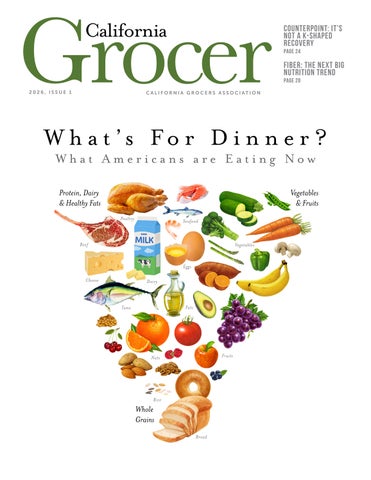
Counterpoint: It’s not a K-shaped recovery
PAGE 24
Fiber: the next big nutrition trend
PAGE 20



EXECUTIVE COMMITTEE
CHAIR APPOINTMENTS
Chair Richard Wardwell
Superior Grocers
Immediate Past Chair
Michel LeClerc
North State Grocery, Inc.
Joe Mueller Kellanova
Independent Operators Committee Chair Chang So Hollister Super
DIRECTORS Ryan Adams Gelson’s Markets
HeeSook Alden
Certified Federal Credit Union
Joe Angulo
El Super/Smart & Final
Steve Brancamp UNFI
Elaina Budge
Costco Wholesale (Bay Area)
Adam Caldecott
Good Food Holdings, Inc.
Rocky Campbell
C & K Market, Inc.
Dorothy Carlow Mother’s Market & Kitchen
Taylor Chappell
Anheuser Busch InBev
Adam Deardorff
FMS Solutions
Chris Dehoff
Dehoff’s Key Markets
CALIFORNIA GROCERS ASSOCIATION
President/CEO
Ronald Fong
Senior Vice President &
Chief Operating Officer
Doug Scholz
Vice President Government Relations
Rachael O’Brien
Manager CGA Educational Foundation
Jamie Cowden
Business Development
Manager
David Cook
Director Events & Sponsorship
Pascale Senejoux
First Vice Chair
Jonson Chen
Tawa Supermarket, Inc.
Second Vice Chair
Bertha Luna
Stater Bros. Markets
Subriana Pierce C.A. Fortune
Dom Engels
Bronco Wine Co.
Anthony Escobar
NuCal Foods
Shant Fermanian
Super King Markets
Jon Gianinni
Nutricion Fundamental
Amber Hammond
KeHE Distributors, LLC
Justin Hyer Molson Coors
Tyler Kidd Mar-Val Food Stores
Andrew Knight Instacart
Brandon Lombardi
Sprouts Farmers Markets
Nick Malm
Reyes Coca-Cola Bottling
Brady Matoian OK Produce
Vice President
Communications & Public Affairs
Nate Rose
Director Local Government Relations
Tim James
Senior Director CGA
Educational Foundation
Brianne Page
Vice President
People Operations & Administration
Jennifer Gold
Senior Manager
Marketing & Membership
Sunny Porter
Communications Manager
Grace Becker
Treasurer
Elliott Stone
Mollie Stone’s Market
Secretary
Sergio Gonzalez Northgate Markets
Brenda Palomino Amazon
Brendan McAbee
Bimbo Bakeries USA
Kelli McGannon
The Kroger Company
JR Medina
Super A Foods
Candace Minto
PepsiCo Beverages
Michael Molinar
Food 4 Less Stockton
Tim Nowell Procter & Gamble
Bethany Pautsch
Tyson Foods, Inc.
Eric Pearlman
C&S Wholesale Grocers
Karen Reid
Post Consumer Brands
Adam Salgado
Heritage Grocers/Cardenas Markets
Nick Sass
The Hershey Company
Controller
Scott Inman
Administrative Assistant
Delilah Augustine
Senior Accountant & Assistant Office Manager
William Quenga
California Grocer is the official publication of the California Grocers Association.
1005 12th Street, Suite 200 Sacramento, CA 95814 (916) 448-3545 (916) 448-2793 Fax cagrocers.com
Casey Scharetg Gallo
Kelly Mullin
Albertsons Companies
Kristen Sherwood Grocery Outlet, Inc.
Diane Snyder Whole Foods Market
Brad Thomas
Kimberly-Clark Corporation
Joe Toscano
Nestle Purina PetCare
Steve Tsujimoto
Berkeley Bowl Marketplace
Priyanka Vijay Keurig Dr Pepper
Stephanie Wu
The Save Mart Companies
Kevin Young Young’s Payless IGA
For association members, subscription is included in membership dues.
Subscription rate for non-members is $150.
© 2026 California Grocers Association
Publisher Ronald Fong
rfong@cagrocers.com
Editor
Nate Rose
nrose@cagrocers.com
Managing Editor Grace Becker
gbecker@cagrocers.com
For advertising information contact: Dave Cook
dcook@cagrocers.com







At C&S, we have an integral role in serving our country’s most important infrastructure. From our offices to our warehouses and in our grocery stores — our teams help feed our families, our neighbors and our communities.
We demonstrate our values through a culture that embraces differences, promotes innovation and is focused on giving back.
It’s our passion to continuously make our communities better that fuels our efforts to:
» Keep our communities fed — that means every person, including those facing food insecurity and hunger;
» Support the health and well-being of our children, and;
» Do business in a way that protects and improves the environment, so that we can all enjoy a healthy future.
www.cswg.com

RON FONG PRESIDENT AND CEO
CALIFORNIA GROCERS ASSOCIATION
These days there’s no such thing as easing into a new year, and 2026 has been no different.
At the Association’s recent Annual Meeting I announced my plans to retire from my president and CEO role after nearly 19 years serving the California grocery industry. Having begun my grocery career in my family’s independent grocery stores, it’s been the honor of a lifetime to work for the betterment of grocers and I’m tremendously proud of all we accomplished together.
Over my time we grew CGA into an effective and professional advocacy organization. We successfully merged the California Independent Grocers Association into the fold, strengthening our collective voice. We built out a new headquarters just blocks from the Capitol. We found steady ground by building robust financial reserves for the organization. Together, we survived a global pandemic that pushed us all operationally and politically to our limits but found new resolve in seizing the moment to keep Californians fed.
It’s not merely my personal news that has me in a reflective mood, it feels like transition is all around. The headlines in Sacramento are fixated with Gov. Gavin Newsom, what his aspirations are and who will replace him as California’s leader.
My tenure at the helm of CGA began with Gov. Arnold Schwarzenegger in office, followed by Gov. Jerry Brown, and of course, Newsom. Three governors with unique styles and forceful personalities. Who comes next is anyone’s guess, but my replacement will have the task of nurturing a new relationship with this changing of the guard and passing that opportunity to the Association’s next leader will position CGA to continue thriving in its advocacy.
amount of cottage cheese flying off your shelves (who would’ve thought!), food trends continue to come thick and fast as people reevaluate how they eat.
In this first magazine issue of the year, we’re also diving into the assorted transitions happening in the food industry. There’s no shortage of changes afoot in the country’s food system and in Issue 1 we start by exploring the USDA’s new food pyramid. Focused on whole foods turned upside down, its impact remains to be seen but we can expect it to change how people eat and fill out their plates.
Issue 1 continues to tug on this thread by projecting fiber as the next big trend, following hot on the heels of protein, of course. As you all know from the crazy
We also catch up with the industry’s favorite economist, Dr. Thornberg. And let me tell you…he’s not holding back in his summation of the economy and how it’s positioned in the media. I hope you find these stories useful in guiding how you think about the big picture for your business.
As my own big picture for the Association draws to a close, I want you all to know what I’m most proud of is this California grocery community, the relationships and many small moments of joy and camaraderie we shared together.
Thank you for the opportunity to serve over these past 19 years! ■
RICHARD WARDWELL SUPERIOR GROCERS
Though the measure passed by a landslide, funding has fallen short
In November of 2024, Californians sent a clear message to state leaders: they did not like the way things were going in their state, and something needed to change. This was signaled, in part, by overwhelming support for Prop 36 that passed by a whopping 70%. The measure reclassified some misdemeanor theft and drug crimes into felonies and offered a new treatment-mandated felony option for repeat offenders, undoing some of the damage done by Prop 47.
Now, a year and change later, where are we on Prop 36 implementation? Disappointingly, for the second year in a row, the Governor’s 2026-27 state budget did not account for any funding to help counties implement Prop 36 and cover treatment-mandated felonies. This did not come as a total surprise as Governor Newsom opposed the measure from the start. But, without state support, the intention behind the measure to curb retail theft falls flat.
Because no funding mechanism was specified in the measure and state leaders have failed to allocate adequate funds, already strained counties and cities are left to bear the burden to implement Prop 36— amounting to millions of dollars. According to the Public Policy Institute of California, early estimates of Prop 36-related felon
filings added up to about 1,700–2,600 cases filed per month, representing a 10%–15% share of the roughly 15,000 felony cases filed in an average month.
All the while, California counties that have had the resources to allocate their own funding to implement Prop 36 have seen early returns. Those jurisdictions have reported lower crime rates as a result of Prop 36. For example, according to San Diego Police Department data, theft, robbery and property crimes downtown have dropped by 23% compared to last year. The same goes for Orange County where police data indicates that retail theft has been on a steady decline in the area since the passage of Prop 36. This uneven implementation from jurisdiction to jurisdiction is hardly fair to the state’s voter base.
While the state fails to deliver on the will of California voters, the burden of retail theft continues to fall on grocers.
Over the past several months we’ve seen harmful self-checkout ordinances emerge in Long Beach, Costa Mesa, and now, Anaheim. Chief among the reasons for justifying these ordinances is retail theft—though all of us in the industry know restricting self-checkout is nowhere near a solution to the problem. Even though grocers are the victims of retail theft, we are still receiving the blame.
On the bright side for our industry, CGA has been involved from the beginning and has not let up on meeting with stakeholders and discussing tactics for implementation. After 10 years of living under Prop 47, we know that reform will take time. CGA will continue to share guidance and learnings on behalf of the grocery industry. It’s high time for lawmakers to deliver on the promise made to California voters and create reliable funding for Prop 36. ■



KEVIN COUPE FOUNDER MORNINGNEWSBEAT.COM
It is amazing where one can find inspiration, aspiration, and education.
I found all three late last year on a small stage, making a first attempt at doing standup comedy.
No joke.
I bring this up not because I’m willing to do weddings, birthdays, and bar mitzvahs and am looking for gigs, but because the inspiration, aspiration, and education added up to four relevant business lessons that I’d like to share.

There were a number of contributing factors to my decision to take a standup comedy class at the Second City school in Brooklyn,
New York. I’ve always been fascinated by the unique art that is standup, as well as the various forms it can take.
Part of my fascination, to be honest, was my sense that it was going to take me outside my comfort zone. I knew I wouldn’t be intimidated by standing in front of an audience—I’ve given 500+ speeches and talks over the years, and once flirted with an acting career. (In fact, I’ve had more theater/ film training than any sort of education in the sectors where I’ve spent most of my adult life—I’ve never taken a business class, nor a journalism class. Ever. My critics now are nodding, thinking to themselves that this explains a lot.)
But I was pretty sure that I had no idea how to write a joke. I can tell a story, and even tell a funny story in an amusing way, but do setup-punchline-setup-punchline-setuppunchline? And get consistent laughs? I was the opposite of confident. It scared the hell out of me.
So I booked the class for eight Tuesday afternoons in October-November-December of last year, and embarked on my adventure in standup. If nothing else, I figured, I’d end up being better at giving speeches for the experience. And maybe even get some business lessons.
Lesson One. Hang out with young people.
The first day of class, I arrived early. Catholic school training, I guess. (In elementary school and high school, the Dominican nuns and Irish Christian Brothers would smack me if I was late. In college, the Jesuits would just look at me with disappointed eyes.)
When the other half-dozen members of class showed up, they all thought I was the teacher because I was 40 years older than them. Then the teacher showed up. I was 40 years older than him, too.
(I did get a joke out of this: I told my wife that I have socks older than my classmates and teacher. She said, “That’s disgusting.” I replied, “But I’ve washed them.”)
One of the first things we did in class was talk about the comedians we liked and admired, with the idea being that this would help inform our own styles and approaches.
To be honest, I had heard of almost none of the comedians cited by my classmates—they just weren’t on my radar at all. And while they’d at least heard of the comedians I referred to—Marc Maron, Mike Birbiglia, Seth Meyers, John Mulaney—they were too mainstream for their tastes. (For a moment I wanted to point to the Shecky Greene oeuvre, but figured that would be more than they could handle.)
But as time went on, the differences in our approaches and influences seemed less important than what we brought to the table—stories and even, occasionally, jokes, born out of our very different life experiences.
There were straight males and females in class. A gay man and woman. One person who was trans. One guy who was born in Turkey but also had German ancestors—boy, did he have some stories. The point was that our diversity made us more interesting and less limited in our world views.
Don’t let anyone ever tell you that diversity doesn’t matter.
Trust me—as the sole 71-year-old straight white male from Connecticut in a class filled with very urban and yet highly varied sensibilities, I learned a ton. Some of it even had to do with comedy.
Lesson Two: Breaking old habits is a good thing.
One of the best things about my class was how it got me out of a rut. Every Tuesday, I got on a train from Connecticut to Grand Central Terminal in Manhattan and then walked from 42nd Street to 14th Street. (Beyond getting some exercise, it also gave me time to work on my comedy sets as I walked. Go figure—in New York, a grown man walking down the street talking to himself doesn’t attract any attention.)
From there, I would take the “L” subway to Brooklyn, where I’d get off at Bedford Avenue station to walk several blocks to Second City. I was a long way from Connecticut.
In Manhattan and Brooklyn, I made a habit of taking different routes as I walked. After class, I’d go off looking for an unusual pub or restaurant where I could have dinner— someplace I’d never tried before. The point was simply to expose myself to a variety of experiences. I saw some retailers that I’d never heard of before, architecture I’d never seen before, and a panoply of people, places and things that made the experience a little bit richer.
Stay in your own lane? Terrible advice, as it turns out. Life is so much richer for varying the path. And business can be richer for encouraging people to get beyond old habits, to not just do things because they’ve always been done that way.

Lesson Three: It’s okay not to be very good at something. That’s how you learn.
Each week in class, we had to bring in a “set” that we’d prepared. It didn’t take long for my teacher to say to me, in front of the entire class, “Y’know, you have some pretty funny stories. But you’re not telling jokes and you don’t have any punchlines, so you’re not really getting laughs. Which is sort of the point of what we’re doing here.”
Ouch.
Actually, it didn’t hurt that much. I kind of knew it, and he was just making clear that everybody else knew it, too. It clarified what I needed to work on, which I did. Over and over and over. I got better, though nobody is signing me up for an HBO special anytime soon. And I know that what really will make me better is continued practice, and being willing to bomb in front of an audience.
In business, it is critical to create an environment in which teaching is not threatening, and learning and improvement are the ultimate goals. That’s not easy—we live in a world where some people can be more sensitive than perhaps they should be. But that’s the job of leaders, to transcend those feelings for the sake of the business and the employee.
Lesson Four: The next five minutes
To this point, I’ve done one showcase at Second City and one open mic night at a local comedy club. They basically were the same routine, sharpened and edited so the second time around was (I think) funnier than the first.
Afterwards, one of my sons said to me, “What are your next five minutes going to be about?”
Great question. I’m working on them now, and the five minutes after that.
In life, business and, yes, standup comedy, we’re never finished. Thinking that leads to complacency, and that leads nowhere good.
It reminds me of something my old friend Norman Mayne once said about his Dorothy Lane Markets: “A reputation is what we had yesterday. Today, we have to earn it all over again.”
Guess what. He wasn’t joking. ■
JENNIFER HATCHER CHIEF PUBLIC POLICY OFFICER AND SVP, GOVERNMENT AND
FOOD MARKETING INSTITUTE
The advocacy and policy landscape in 2025 moved at extraordinary speed.
Shifting political dynamics, regulatory uncertainty and evolving consumer expectations created both challenges and opportunities for the food industry. Through strong collaboration among members and association partners, the year ultimately delivered meaningful policy victories that will benefit food retailers, wholesalers, suppliers and most importantly consumers.
Securing
With several provisions of the Tax Cuts and Jobs Act approaching expiration, FMI’s advocacy focused on preserving policies that support investment, innovation and job creation.
These efforts helped advance permanence for key provisions, including Section 199A deductions, full expensing and research and development incentives, as well as the estate tax exemption. Equally important, we worked to prevent increases to the corporate tax rate, preserved pass-through entity tax (PTET) treatment and protected the long-standing LIFO accounting method relied upon across the food sector. Together, these outcomes—secured through inclusion in the “One Big Beautiful Bill”—provide long-term certainty that allows food companies to plan strategic investments back into their businesses.
Regulations on traceability must be practical, achievable and result in demonstrated value to FDA and to consumers. In 2025, we worked with Congress and the Trump administration to secure adjustments to the Food Traceability Rule that provided additional compliance time and helped shape a more workable implementation framework. A legislative rider—included in one of only three appropriations bills enacted during the year—ensured that food companies are able to continue advancing traceability goals without unnecessary cost burdens.
Retailers faced significant challenges regarding new EPA refrigeration requirements.
The industry responded through a strategy that combined litigation, executive branch engagement and regulatory advocacy.
These efforts resulted in a U.S. Department of Justice stay followed by a revised EPA rulemaking that granted retailers additional time and flexibility to comply. The outcome allows companies to transition to new technologies in a way that allows for the production of new systems and technicians to be trained at sufficient levels. We also gathered broad support for EPA reconsidering the Management Rule, which impacts all units with 15 pounds of refrigerant or more. We will continue to press for a resolution in early 2026.
FMI also successfully safeguarded critical nutrition assistance programs. Through an extensive communications and advocacy campaign, we were able to preserve the average $6 per-day per person SNAP benefit, minimizing the impact of proposed state cost-sharing requirements while also coordinating with states and USDA officials to manage varying waiver requests. Importantly, the industry successfully protected the prohibition on transaction fees charged to retailers or customers. By keeping SNAP strong and workable, these efforts reinforced the program’s role in supporting families in need.
Global trade policy continued to influence food affordability and product availability. FMI’s efforts helped reduce tariffs on key food products, including goods covered under USMCA and items not produced domestically at all or in significant quantities to meet consumer demand.
Promoting National Uniformity in Ingredient Transparency
One of the most complex policy debates of the year centered on ingredient disclosure and labeling requirements. Without federal action, companies face the risk of navigating a costly patchwork of state-by-state rules. FMI co-founded the Americans for Ingredient Transparency (AFIT) coalition, which is seeking to advance a national uniform standard for consistent labeling and ingredient disclosure. Our engagement focuses on GRAS reform, front-of-package labeling discussions and expanded use of digital disclosure tools.
As states advanced Extended Producer Responsibility (EPR) legislation, our efforts focused on ensuring policies recognized the complexity of packaging systems and protected affordable access to essential goods. We provided members with tools such as the EPR Guide 2025 and statespecific implementation resources to help them navigate emerging requirements.
Supporting Legal and Regulatory Compliance
FMI continued serving as the leading resource on food, product, legal and compliance issues in an increasingly challenging regulatory environment.
Beyond federal policy, issues at the state and local level impact the food industry, from alcohol regulations and worker scheduling laws to artificial intelligence and pricing policy and weights-and-measures requirements. Dedicated staff leadership and industry-focused newsletters ensured members remained informed and prepared across 18 different state policy areas.
None of these accomplishments would have been possible without strong leadership from the FMI Board of Directors, active engagement from member companies and deep collaboration with association partners and coalition allies.
In a year defined by speed, uncertainty and complexity, collective advocacy delivered measurable progress across tax policy, food safety, nutrition programs, trade, sustainability and regulatory modernization. The successes of 2025 demonstrate what is possible when the food industry speaks with a unified voice. With strong partnerships in place and a proven advocacy framework, the industry enters the year ahead well positioned to meet new challenges, seize emerging opportunities and continue delivering for the communities we serve. ■
GREG FERRARA PRESIDENT AND CEO NATIONAL GROCERS ASSOCIATION
California’s independent grocers have always understood something that policymakers sometimes overlook.
We are not just retailers. We are employers, sponsors of local teams, and a steady presence in neighborhoods that depend on us every day, during good times and bad. From rural communities in the Central Valley to neighborhoods in Los Angeles and the Bay Area, Main Street grocers are often the last local business standing and the first place neighbors turn when they need help.
That is exactly why your voice is needed in Washington this spring.
On May 19–20, 2026, independent grocers from across the country will gather in our nation’s capital for the National Grocers Association’s Legislative Fly-In for Fair Competition. I am personally urging California’s grocers to join us. When we show up on Capitol Hill, we do more than attend meetings. We put a face on the policies that affect our stores, our employees, and the families we serve. And the conversations you have in Washington are strengthened by the leadership and advocacy you carry forward when returning home.
Lawmakers need to hear directly from the people who operate grocery stores on thin margins and long hours. They need to understand what it means when nutrition policies change without input
from retailers on the front lines. They need to see how compliance mandates and evolving traceability requirements impact supply chains and food costs.
Lawmakers need to hear how regulatory decisions ripple through distribution networks and ultimately land at the checkout lane.
This fly-in is about making those realities clear in a constructive, bipartisan way.
One of our central priorities is to strengthen and modernize the Supplemental Nutrition Assistance Program. Independent grocers have been trusted partners in delivering SNAP benefits for decades. We see firsthand how essential this program is to families working hard to put food on the table. At the same time, California grocers know the program must be protected and improved. That includes ensuring benefits are used as intended and exploring responsible guardrails to address waste, fraud, and abuse that undermine public confidence.
It means modernizing EBT systems to reduce skimming and enhance transaction security. It means streamlining administration so retailers can focus on serving customers rather than navigating unnecessary red tape. When California grocers come to Washington, you bring practical solutions rooted in real-world experience.
We will also continue to advocate for policies that protect fair competition and prevent market distortions that disadvantage independents. When regulatory frameworks or marketplace practices tilt the playing field, consumer choice is reduced, and local economies are weakened. California’s grocery landscape is diverse and innovative, but that diversity depends on fair rules and thoughtful oversight.
The power of the fly-in is simple. When grocers walk into a congressional office, they bring authenticity that no policy memo can replicate. Members of Congress and their staff consistently tell us how valuable it is to hear directly from store owners and operators. They want to understand how federal nutrition policy, traceability requirements, and regulatory decisions play out in their districts. They want practical insight, not abstract theory.
California has a proud tradition of entrepreneurship and innovation in food retail. Your participation sends a powerful message that independent grocers are engaged, informed, and ready to lead. Whether you operate a neighborhood market in a coastal community or multiple stores across the state, your experience matters. We will provide policy briefings, talking points, and logistical support. What we
cannot provide is your story. Only you can explain how SNAP modernization, fraud prevention, and the lack of antitrust enforcement affect your employees and customers. Only you can describe the responsibility of serving your community while navigating an increasingly complex regulatory environment.
I hope you will join us in Washington this May. Together, we can ensure that the voice
of California’s Main Street grocers is heard clearly on Capitol Hill. When independent grocers speak with unity and purpose, we shape policy rather than react to it. And when we shape policy, we strengthen not just our businesses, but the communities that rely on us every day.
I look forward to standing alongside you in Washington. ■








LOUIE BROWN
California is in a moment of
As the state debates its 2026–27 budget, watches the early jockeying in the governor’s race, and ends a legislative session, there is one unifying theme: it’s too soon to tell.
Too soon to tell whether the economy will hold steady. Too soon to tell who will lead the state next. Too soon to tell how aggressively the Legislature will regulate (or not) the industries that keep California running, including grocery.
Governor Newsom’s final budget cycle comes at a time when California’s fiscal outlook is deeply tied to one sector: technology. Capital gains revenues from tech stock performance and IPO activity have become a major driver of state revenue.
But what happens if that engine sputters? Is there a tech bubble forming? Or are we simply in a period of change after years of rapid growth? Regardless, California’s fund volatility means that even modest market corrections can create large budget swings. When capital gains rise, Sacramento surges with new spending commitments. When they fall, deficits follow.
For grocers, fiscal whiplash at the state level often translates into regulatory or tax instability, but is that true in the age of unaffordability? A budget surplus can encourage new mandates. Either way,
unpredictability is the enemy of operational certainty. And right now, predictability is in short supply.
With the Governor term limited, the 2026 race for governor is wide open. Under California’s top-two primary system, also known as the Jungle Primary, with a strong democratic base, party labels matter less than coalition-building, but no candidate has yet consolidated a clear base. Is this a year for a progressive standard-bearer? A businessminded moderate? A regional candidate who can bridge coastal and inland interests? It’s too soon to tell.
For the grocery industry, leadership matters.
The next governor will shape appointments to agencies, drive labor enforcement, environmental goals, and the tone of engagement with employers. But at this stage, the field is fluid, endorsements are starting, but fundraising numbers only tell part of the story. Political momentum can shift quickly in California. Today’s headline candidate can be tomorrow’s afterthought.
Meanwhile, the Legislature is just beginning to show its hand. Bill introductions provide clues, but not conclusions. With hundreds of
“spot bills” yet to show themselves, it’s too soon to tell which issues will dominate committee agendas and which will gain traction.
For grocers, that uncertainty spans everything from wage policy to energy costs, labor standards, supply chain rules, and product regulations. One ambitious bill can reshape compliance costs statewide, while a trailer bill can quietly alter the law overnight. Some sessions are predictable, while others evolve rapidly based on budget, politics or political sentiment. This year appears to be the latter.
California thrives on innovation. But its finances are increasingly linked to volatile revenue sources; its political leadership is in transition; and its legislative priorities are still coalescing.
For now, the wisest course for businesses and policymakers alike may be measured patience. Responsible budgeting, thoughtful lawmaking and recognition that in uncertain times, stability is not stagnation, it is stewardship.
California’s story in 2026 is still being written. And today, the honest answer to many of the biggest questions is the simplest: it’s too soon to tell. ■



September 27 – 29, 2026
The Westin Rancho Mirage | Rancho Mirage, CA
I am so amazed by the CGA team and the Illuminator team! This conference is unlike any other. It is truly three days of well-orchestrated events - including meals prepped from the bounty of food, drinks, and snacks provided by the many manufacturers to the one-on-one meetings meticulously timed to be respectful to all involved, to the many networking opportunities to see old friends, and make new ones. This conference is the best kept secret in the industry.”
Cathy Barsotti, VP, Sales & Marketing Barsotti Family Juice Company

By Katie Bressack

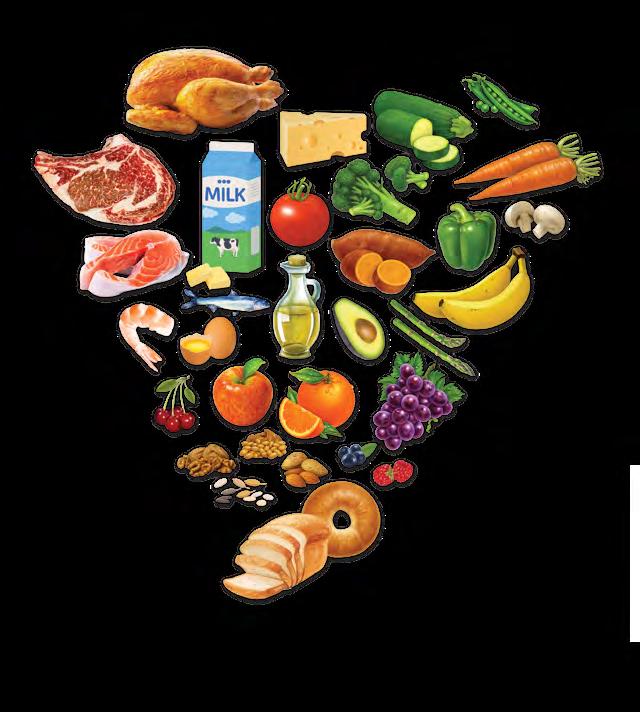
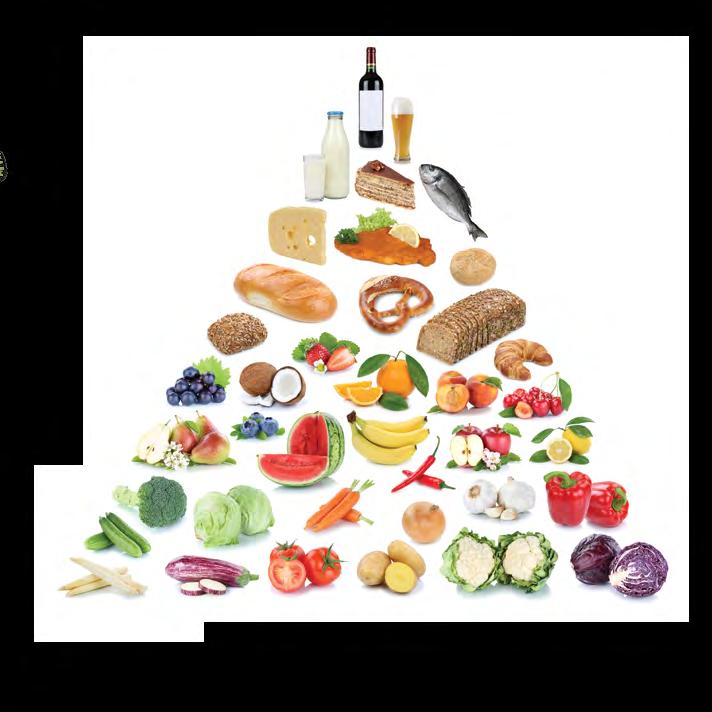
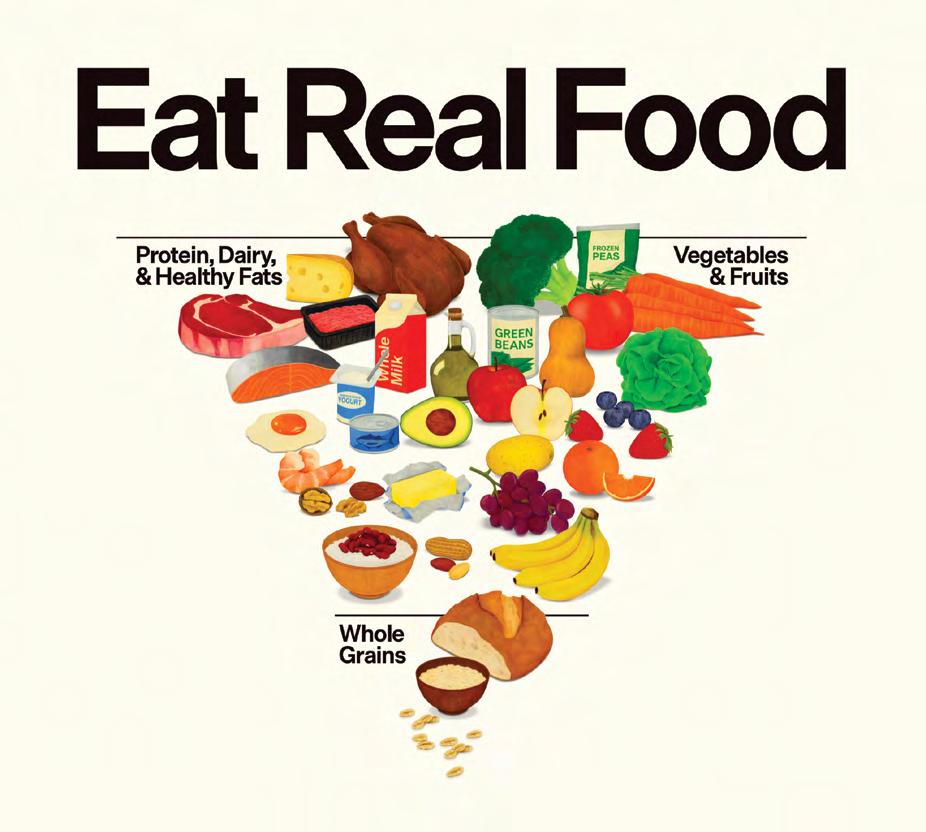
The USDA and Department of Health and Human Services updated their Dietary Guidelines for Americans (DGAs) for 2025–2030 by reintroducing the food pyramid, officially retiring the 2011 “MyPlate” recommendation.
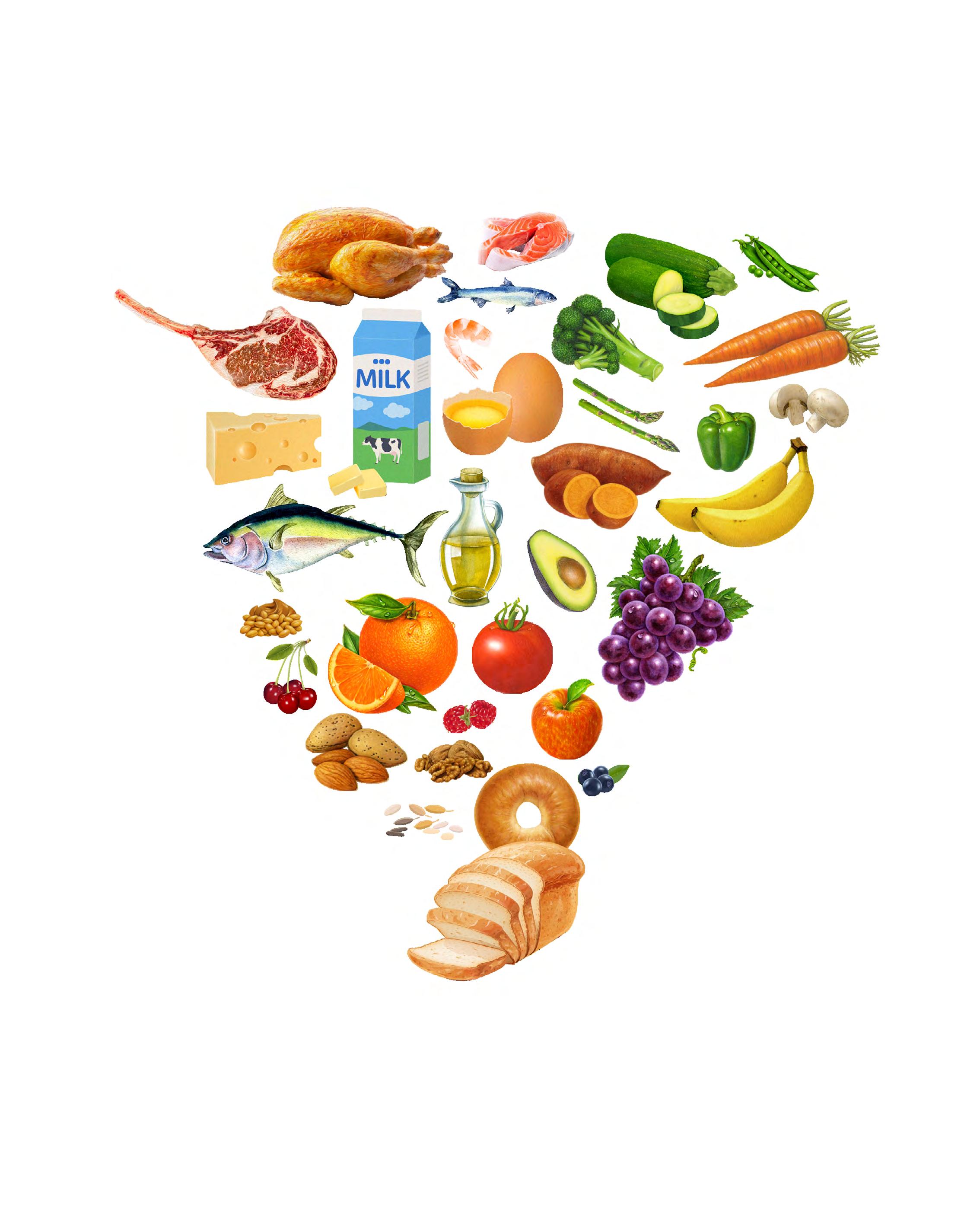
With a new tagline of “Eat Real Food”, the reimagined pyramid is designed to help people focus on whole foods and presents an opportunity for both consumers and grocery stores to reimagine their shopping experience.
This inverted pyramid has the top (widest) section featuring whole foods like animal proteins, full-fat dairy, vegetables, fruits, and healthy fats, while refined grains and refined sugars are at the narrow bottom. Continued on page 18
Theresa Gentile, MS, RDN, CDN, and national spokesperson for the Academy of Nutrition and Dietetics shares insights of the 2011 MyPlate DGAs compared to the new guidelines.
The 2011 MyPlate was a plate-shaped graphic that showed how to portion foods for a meal. “It was intuitive and practical; you could literally divide your dinner plate to match the recommendations. It promoted portion balance at every meal.”
Gentile followed up with half the plate was for fruits and vegetables, one-fourth for whole grains, with the encouragement of mostly whole grains, and one-fourth was for protein with dairy on the side.
The new, inverted pyramid, emphasizes nutrient density and eating “real foods” with a heavy emphasis on avoiding ultraprocessed foods, added sugars, and refined carbohydrates, said Gentile.
“Although fruits and vegetables appear lower in the visual hierarchy compared to proteins and fats, vegetables are still strongly encouraged and the science supports this as vegetables play a big role in disease prevention and balanced eating,” emphasized Gentile.
Benjamin Lorr, author of The Secret Life of Groceries shared his thoughts with the California Grocers Association on how the new inverted food pyramid might impact consumer’s shopping habits at the grocery store.
“I think it will have a subtle effect, on the level of vibes and Zeitgeist, blowing a little more wind with the current prevailing trend telling us to avoid the hyper-processed and pick up “whole” foods, simple foods, and single ingredients. Which to me was the dominant message of the new pyramid,” Lorr said.
“There’s also a decreased emphasis on whole grains, those are shifted towards the smaller part of the pyramid, and an increased emphasis on animal proteins shown in the largest part of the pyramid. This coincides with the new guideline to consume more protein; 1.2–1.6 g per kg vs. the 0.8 g per kg that was previously recommended.”
Gentile notes that the pyramid showcases full-fat dairy and a stick of butter, but that’s inconsistent with the Dietary Guidelines for Americans report which continues to recommend that saturated fat make up less than 10% of total daily calories, as it did in 2011.
“Translating any guideline to individual needs is difficult, especially as the new pyramid does not suggest portions, so you should visit with a registered dietitian nutritionist to assess where this fits in your health goals, metabolic conditions, and lifestyle,” said Gentile.
He elaborated by sharing, “what’s interesting is I don’t actually think this will affect the amount of produce or whole foods people buy in a substantial way—we are pretty stuck in our ways—and vibes alone won’t shift those decisions— but instead it will change the types of food people buy for convenience. So ironically, we might see the biggest shift in the way those hyper-processed foods are dressed up and presented.”
Lorr said that he expects marketing of packaged foods to adopt the lingo of MAHA, highlighting a limited ingredient list or calling out “whole milk,” or “cane sugar”, and the specific sources for artificial sweeteners instead of their more chemical names. “We will continue to test the outer bounds of how much protein you can cram into a product and discover there is no maximum that will slake America in 2026,” Lorr added.
“I also think we’ll see a lot more minimally processed foods—like roast beets or chocolate dipped frozen bananas not exactly a single ingredient, maybe a preservative or two in there, but also presented as simple. Products that evoke the homemade, allowing you to forget it was processed along with everything else,” Lorr said.
Krystal Register, MS, RDN, LDN, Vice President, Health & Well-being of the Food Industry Association FMI sees symmetry between consumers and their grocery store of choice.
“Consumers view their primary food store as a partner in this effort, with 80% of shoppers saying their grocery stores do at least a good job supporting their health and well-being,” said Register.
Register added that the grocery store is well positioned as an accessible destination for today’s consumer seeking to align with these new recommendations, given the abundance of choice on their shelves. She also shared that retailers are responding with an emphasis on personalized strategies to support individual health goals.
The Dietary Guidelines present an opportunity to meet consumers where they are and lean into the expertise and guidance of registered dietitians across the industry. “Specific notations around quality protein, increased fiber and attention to gut microbiome are positive and all reflective of timely nutrition topics of focus,” she said.
It might take some time for consumers to shift their shopping habits, but since the “inverted” pyramid prioritizes whole foods over processed snacks, we’ll likely see changing store layouts, promoting cleaner labels, and healthier eating habits.
Register explained that new recommendations include limiting foods and beverages that include artificial flavors, synthetic dyes, artificial preservatives, and non-nutritive sweeteners.
“The recommendations to avoid highly processed packaged, prepared and ready-to-eat foods align with recommendations to limit added sugars and sodium,” said Register.
Gentile added that “grocery shoppers may read food labels more carefully to avoid added sugars or artificial food dyes.”
For the first time the DGAs encourage using healthy fats from whole sources like avocados, nuts, olives, and even traditional fats like butter or tallow. This might also take time to shift consumer shopping habits but over time we might see people choosing these fats over processed low-fat, non-fat and products with seed oils.
We may see an increase of consumers purchasing more animal protein like meat, dairy and eggs. There is also an emphasis on full-fat, not lowfat foods when it comes to dairy.
“Although grocers may be inclined to purchase full-fat dairy and include a lot of high fat meat products, they should take into consideration their own health profile and the Dietary Guidelines for saturated fat consumption”, Gentile shared.
Register noted that a full-fat dairy recommendation opens the door for whole milk products (equivalent to ~3% milk when compared to other dairy options) without much additional saturated fat and welcomes other essential nutrients (protein, calcium, Vitamin D, etc.).
Flexibility with the fat content allows for the consumption of fullfat dairy within the suggested saturated fat limits, though the new guidelines do not mention appropriate soy-based substitutions for those who cannot or choose not to include dairy.
Register added, “it is important to remember that even with guidance in the new DGAs to include full-fat dairy, red meat and butter, the suggested limit on saturated fat of no more than 10% of total daily calories remains,” said Register.
Lorr agreed that some of the guidelines might be confusing for people and the grocery store has an opportunity to help support its consumers to make healthy shopping decisions.
“I think the fact that they left the saturated fat guidelines relatively intact but also included an emphasis on whole foods that include a lot more saturated fat is very confusing for most people and difficult to put in action. I think it would be great for stores to help navigate consumers through that confusion, and there is probably a lot of customer loyalty to be had from a chain that figures out how to simplify the complexities of our macro-nutrient recommendations within a limited calories budget,” Lorr said.
Overall, Register is optimistic in sharing that these efforts lead to simple swaps, behavior change, improved health, motivation, repeat behavior and trust in a primary food store that helps support their personal health.
Time will tell how this new inverted pyramid shifts both shopping habits and health issues in this country and will impact future guidelines. But there is no question that consumer preferences are being shaped by the many outside influences making recommendations on health and wellness. The grocers who craft their customer engagement strategy around the needs and purchase behavior of their customers, no matter their source of inspiration, will drive foot traffic and foster loyalty as the “new” food pyramid takes shape. ■
At time of publication The California Department of Public Health (CDPH) was not available for an interview. CDPH is still evaluating the new federal dietary guidelines.
Benjamin Lorr, author of The Secret Life of Groceries https:// www.amazon.com/Secret-Life-Groceries-American-Supermarket/ dp/0553459414
Theresa Gentile, MS, RDN, CDN, and national spokesperson for the Academy of Nutrition and Dietetics
Krystal Register, MS, RDN, LDN, Vice President, Health & Well-being of the Food Industry Association FMI

By Katie Bressack

Inthe world of nutrition, protein has received outsized attention over the past few years with the uptick of protein shakes, protein cereals, and even protein seltzer water and coffee foam on menus and in grocery stores.
While the protein market in the United States was estimated at $114.4 billion in 2024 with a projected 1.9% annual growth rate through 2028, fiber is what’s top of mind for both brands and consumers this year.
With consumers paying more attention to gut health, products are being reformulated using prebiotic ingredients and fiber is getting a lot more attention this year.
One of the simplest and most effective ways to support gut health is by eating enough and diverse sources of fiber. So, as the conversation around gut health has grown, fiber is getting the attention it deserves.
“Fiber is essential fuel for our gut microbes. When we don’t get enough, the beneficial bacteria in our gut can become depleted or imbalanced, leading to a less diverse microbiome,” shared registered dietitian Erika Jacobson, MS, RD, CDN. “Fiber also plays a key role in supporting healthy bowel movements and stool consistency. When we feed our gut the right types of
fiber, those microbes produce short-chain fatty acids, which are metabolites that support immune function, regularity, mood, metabolic health, and reduce inflammation. In short, fiber is foundational for whole-body health.”
Another reason people are paying more attention to fiber is the GLP-1 effect, Mike Lee, author of Mise: On the Future of Food shared. “As millions of people take appetite-suppressing medications, they’re paying closer attention to what their reduced calories actually do for them. Fiber checks a lot of those boxes—gut health, satiety, blood sugar regulation, and the emerging science on the gutmicrobiome-brain axis,” said Lee.
Continued on page 22
In its 2026 trends report research firm Datassential found that fiber is on track to be the “next big health trend following on the heels of protein.” The dietary fiber market is anticipated to reach a value of USD $13.6 billion in 2026 and is forecasted to expand at a compound annual growth rate (CAGR) of 10.3% through 2036. Brands are currently highlighting fiber in their products, not only with updated packaging but with new product launches and supplements. “Gut health is a real, structural shift in how people think about food and their bodies, and fiber is the most accessible entry point,” said Lee. Coca-Cola recently developed a prebiotic soda called Simply Pop, which promotes “six grams of prebiotic fiber in five flavors” to encourage gut health, while Nestlé unveiled a new protein shake last June with four grams of prebiotic fiber designed specifically to support the digestive health of adults on GLP-1 medications. PepsiCo also launched Smartfood Fiber Pop and SunChips Fiber this February, while their prebiotic soda brand Poppi ponied up an estimated $8 million for their 60 second SuperBowl ad. Consumers, for their part, are also searching for and spending money on premium fiber supplements to manage digestion and immunity.
Lee emphasized the importance of building a diet around vegetables, legumes, fruits, and whole grains, “you don’t need a fiber supplement or a fortified snack—you’re already there.” He said that he recognizes that’s not realistic for everyone. Time, cost, access, cooking ability—these are real barriers.”
“So supplements and fortified products have a role, especially for people who need convenience. Prebiotic sodas are blurring the line between supplement and food in interesting ways. But I’d rather see the industry invest as much energy in making whole foods accessible as it does in engineering fiber into packaged products,” Lee explained.
You can thank social media, in part, for putting fiber on the map. With the viral trend “Fibermaxxing”, the idea is to increase fiber intake as a part of every meal and snack. This trend encourages people to aim for between 30 and up to 40 or 50 grams, which is a huge increase on current consumption for the average person.
Studies show that only 5% of Americans are consuming enough fiber with an average of about 15 to 17 grams a fiber a day. Current recommendations suggest adults consume on average 25 to 38 grams of fiber daily, revealing a massive gap between reality and the ideal state.
Fiber doesn’t need to be the next anything. It just needs to be a part of people’s diets— which, for most Americans, it isn’t, Lee said.

“There’s a massive gap between what people consume (~15g/day) and what they need (~25-30g), and that gap has been there for decades. The problem isn’t that fiber lacked scientific backing. It’s that the industry has a habit of waiting for trend forecasters to validate what should already be obvious. The smarter brands won’t wait for that coronation. They’ll just start building fiber into their products because it’s the right thing to do and consumers are ready for it.”
When we dig a little deeper the amount of fiber ranges with sex and age.
It’s important to consider daily activity, weight, and overall health to determine the best amount of fiber daily. Ideally, it’s best to slowly increase the amount of fiber to help reduce bloating and support the digestive system.
Research consistently shows that people who consume adequate fiber have better blood sugar control and lower rates of type two diabetes and lower risk of disease overall. Not eating enough fiber significantly increases the risk of type two diabetes, heart disease, colorectal cancer, obesity, and diverticulitis.
Ancestral diets had as much as 100 grams of fiber daily, since their diets were more plant based than modern diets. Animal protein, once a luxury, became readily available as we evolved and despite ample evidence of the benefits of plant-based diets, fiber has definitely taken a back seat these past few years with most consumers focused solely on eating enough protein.
“As a gut health dietitian, I do believe most people would benefit from increasing their fiber intake but how you do it matters”, said Jacobson. “Too much fiber too quickly, relying on ultra-processed fiber from protein bars, or not drinking enough water while increasing fiber can lead to bloating, gas, or
irregular stools. Fiber should be increased slowly and strategically, based on the types of fiber your body tolerates best.”
When incorporating whole grains, legumes, fruits, and vegetables into every meal you can easily hit 30 grams of fiber. Some ideas are oatmeal with berries for breakfast, a black bean soup and side salad, nuts and fruit for a snack and a veggie packed stir-fry for dinner.

stripped out,” Lee said.
With the increase of disease plaguing Americans, putting a burden on the already taxed healthcare system, now is the time to focus on fiber for preventive health purposes.
understanding will be the ones still leading five years from now.”
It’s important to remember a balanced diet is the best diet. Focusing on whole foods of protein, fiber and healthy fats is the best way to reduce disease, manage cravings and support health goals. Prioritizing fiber will naturally mean eating more whole, minimally processed foods, and likely fewer nutrient-poor ones. ■
“It’s worth noting that people who build their diets around whole foods—fruits, vegetables, legumes, whole grains—tend to get plenty of fiber without thinking about it.
This is really a processed food problem. The fiber conversation is happening now because CPG needs to solve for what processing
“And if I’m being honest, the conversation I’d most like to see this industry have isn’t about which nutrient is trending—it’s about why so many people struggle to eat well in the first place, Lee shared.
“That’s a problem that goes beyond food. It involves time, wages, childcare, food access, housing—the systems that shape what people can realistically put on the table. The brands and retailers who build around that broader
https://pmc.ncbi.nlm.nih.gov/articles/ PMC6944853/
https://pmc.ncbi.nlm.nih.gov/articles/ PMC9298262/
https://www.convenience.org/Media/ Daily/2025/December/15/3-Fiber-MovesToward-the-Forefront_Catman
https://www.futuremarketinsights.com/ reports/dietary-fibres-market

WHY THE NARRATIVE SHAPING THE WAY WE UNDERSTAND THE ECONOMY IS DEAD WRONG.
By Nate Rose
Nearly every recent story written about the economy has framed the post-pandemic economy as a “K-Shaped Recovery” or “K-Shaped Economy.”
The term references the shape of economic growth where the upper part of the K signals highincome Americans with rising incomes and wealth while the lower part of the K foretells low-income households in decline.
It’s an enticing story but is it true? To find out we turned to renowned economist Dr. Chris Thornberg, who is a founding partner at Beacon Economics and formerly Director of the University of California, Riverside, School of Business Center for Economic Forecasting and Development, to separate fact from fiction.
Continued on page 26 ▶
◀ Continued from page 25
The following conversation was edited for clarity.
California Grocer: There’s a lot of talk right now about the K-Shaped Economy or K-Shaped Recovery. See, I knew I’d get chuckles. I’ll start with the K-Shaped Economy, is it real? Is that what’s happening?
Dr. Thornberg: What people are calling a “K-shaped recovery” is really just a recycled version of a standard narrative that has been around for years— the idea that we are living in a period when inequality is at an all-time high, where a small, privileged group is surging ahead economically while everyone else is falling behind. That story gets repeated often, but the data simply do not support it—either over the last two decades or in the few years since the pandemic ended.
California Grocer: What’s the reality of the situation, then?
Dr. Thornberg: The reality is that the recovery has been broad-based. If you look at median household income by quintile over the last decade, inflation-adjusted, the top 5% of US households have seen roughly a 30% increase in real income. The bottom 80% have seen about a 23% increase in real terms. That is not a “K.” A true K-shaped recovery would show one group rising while another declines. Instead, incomes have risen across the distribution. At most, you could argue that the very top has grown somewhat faster— but the gap is modest.
Dr. Thornberg: Airline passenger miles overall are near record highs—despite the fact that air travel is 35% more expensive today than in 2021 according to the price data. This shift only tells me that a higher share of passengers want to sit in the front—which sounds like the whole economy is doing better, no? And in any case, you have to ask: And who flies premium cabins? Primarily business travelers, not only “the rich” whereas coach is typically occupied by tourists and families, not simply “the poor”. That is my personal pattern—and I know a lot of folks who do the same.
That is not a “K.”
A true K-shaped recovery would show one group rising while another declines. Instead, incomes have risen across the distribution.
And importantly, those figures are based on gross income. Gross income does not reflect the full picture because it excludes most government transfers. Today, government pays $4.4 trillion for various sorts of subsidies for US households—unemployment insurance, Social Security, Medicare, Medicaid, housing subsidies, SNAP, and many other programs. Roughly one out of every five dollars of household income in the United States now comes directly through a federal transfer, the highest ever. You can’t seriously discuss inequality or the shape of recoveries unless you account for all of this spending, and most measures of inequality don’t.
What this all says is that regardless of looking at gross or net income, the recent trends do not describe a one-sided recovery. It describes an economy where both ends of the distribution have seen meaningful income gains.
California Grocer: What do you think when you see a headline that Delta Airlines reports their main cabin sales are down 7% and the premium is up 9%. Their CEO says, well, we actually think we’re going to keep growing that premium line. That is where all the money is going to be made. That’s the narrative around the K-Shaped Recovery, right?
What that suggests to me is that business travel—which was absolutely crushed during the downturn—is rebounding. Delta is structured around business travel, so that shift benefits them. Leisure travel may be cooling somewhat, but that tells us nothing about a supposed bifurcation of the entire economy if it is only that middle-class families are responding to high air ticket prices by driving to their next family destination instead of flying.
California Grocer: So that doesn’t really tell you much about how a company is placing its bets on a K-Shape. Instead, it’s just specific to Delta’s business and who they serve too, right? Because they’re built to serve those business travelers.
Dr. Thornberg: Headlines like that describe sector-specific dynamics. They do not prove a structural K-shaped recovery. In fact, business travel improving is a positive development.
But your point is right on, which is one of my frustrations; how quickly isolated data points get stretched into sweeping narratives. A single sector shift becomes more “proof” of a grand economic divide. That leap simply isn’t supported by broader data.
And this is what makes me a little kooky, right?
California Grocer: Maybe a little kooky!
Dr. Thornberg: Look, here’s an example for you. Food prices are up. If food prices are so high, why are Americans spending a record of their food dollars (half!) out at restaurants rather than from supermarkets? This trend continues to grow. And by the way, the share of consumer spending going to food overall is at a record low level of overall consumer spending right now.
California Grocer: Yeah, this gets to the argument about the donut-shaped hole in the economy, arguing the initial poverty line was built off of an assumption where your food spending is actually a really high amount of your income. The squeeze is much more concentrated now in childcare, education, housing costs, and insurance.
Dr. Thornberg: Yeah, and guess what? Education costs are not up that much. That’s a complete myth.
California Grocer: You’re ruining all my points here.
Dr. Thornberg: In the last 20 years there’s been an enormous increase in university prices, right? But look a little closer. Who’s actually paying that? And the answer is almost no one.
Every single college student today gets two letters. #1, Whether or not I got in and then #2 how much they’re offering me in terms of support relative to the retail tuition. The university system in the United States starts with a high retail price, and then they basically give you discounts depending on what they think you’re willing (or your parents are able) to pay. I mean, you have to love the fact that the university industry is one of the only industries out there that gets to demand of a prospective buyer of their services “Hey, how much can you pay? Give me you and your family’s income data” and we do! Can you imagine if you walk into an auto dealer and the auto dealer said to you, well, before I sell you a car, I need to see your net worth!”
California Grocer: Let me give you a grocery example. There’s a lot of talk about grocers that serve lower-end consumers planning huge growth. At the same time, others are divesting from conventional, mainstream—middle class even—stores to invest in higher end formats. What do you make of those types of investments and do you think that’s a trend?
Dr. Thornberg: Let’s not confuse business decisions with economic trends. Okay, sure, it’s affordable food. Those formats are doing well. Okay, great. My sister loves all these stores. She lives back east, and she thinks Aldi is the best thing ever. My sister’s not low income; she’s just a value shopper. That’s her.
It does appeal to people, and yeah, Aldi seems to be doing well. Then again I have a Japanese wife, and so we end up shopping at the Japanese supermarkets here in town. And many others, particularly younger people, who prefer high end shopping such as Erewhon even though they can barely pay the rent! Different strokes for different folks—it isn’t all about your income.
California Grocer: It’s more consumer preference…There’s also been headlines about Gen Z and Millennials, for example, arguing if they’re struggling economically, why are they splurging on healthy items.
Dr. Thornberg: Wow, there’s a recent article in The Economist showing how Gen Z is unprecedently rich—the highest paid cohort ever at that age, in a time of mostly peace and amazing technology. And all we see is this awful trend of trying to make these kids feel sorry for themselves. Why?
California Grocer: Okay, so now that you’ve dispensed with the K-Shape Economy theory, what should a grocer be paying attention to when it comes to the economy and understanding where their consumer sits right now?
Dr. Thornberg: Consumers are doing fine. That’s the answer, number one. Supermarkets are struggling with labor costs and input costs and competition from restaurants. They are not dealing with an impoverished population. And it’s a very competitive industry. Restaurants too, in their own way. You know, one of the reasons restaurants are struggling so much is that there’s too many restaurants. No one ever points this out. We have more restaurants per capita in California right now than we’ve had ever.
Think about retail. A lot of traditional retail is going online. As a result of that, you know where are retail stores doing well? Supermarkets. We know that buying food is something people still do. They still like to do it. The result is a lot of building. Where I live in West L.A., and in the last 10 years, I cannot believe the number of new supermarkets that have been built.
California Grocer: Anything else they should be worried about?
Dr. Thornberg: Well, the real worry here is not that people are suffering, but rather the people are doing too well. Go back to record high disposable incomes and $4.4 trillion in government benefits. This relative affluence is in large part due to the $2 trillion our government will be borrowing this year (more now with tariffs shot down)—spending they get to do without raising our taxes. The official household savings rate is 4%, but if you throw in the Federal deficit (which is appropriate) then the real household savings rate is -5%. Well, some point in time, we’re going to have to deal with the deficit. This can’t go on.
I would argue that ultimately the federal government’s going to have to start cutting back on spending. And that’s where it starts to get really ugly as they will have to reduce some of those $4.4 trillion in transfers and if those subsidies are cut back, then suddenly you’re going to see actual net incomes for low-income houses going down. And that’s when you’re going to start feeling the pinch.
California Grocer: That’s what keeps you up at night about the economy, not the K-Shape Recovery.
Dr. Thornberg: Our state policy focus is almost exclusively on issues of distribution. That concept of issues of distribution keeps us from what we really need to be focused on, which is: How do we make this economy bigger. So connect us back to the beginning of our conversation, the narrative of decline is driving bad policy choices, which are ultimately going to cause more harm than good in the end. ■
FROM A COMMUNITY ENGAGEMENT AND WELLNESS DIRECTOR, TO A SENIOR CATEGORY MANAGER, TO A BEVERAGE RETAIL SALES DIRECTOR, THIS YEAR’S RISING STARS LIST HIGHLIGHTS THE BEST AND BRIGHTEST TALENT IN THE GROCERY INDUSTRY.

Courtney Carranza
Director of Communications and Public Affairs, Albertsons, Vons, Pavilions Southern California
How did you come to work in the grocery industry?
My path to the grocery industry began early. Growing up in Sacramento, I developed a love for food and grocery shopping while tagging along with my mom on weekly trips to Lucky’s, where persistence eventually landed me my first job as a bagger. In my early twenties, while attending college in Southern California, I returned to grocery for its flexibility and benefits and was hired at Pavilions in Newport Beach, earning a promotion within my first year. After graduating with a B.A. in Anthropology, I entered Vons’ Assistant Store Manager training program in 2001, launching a long‑term career that has included roles as a Store Director for 16 years, an E‑Commerce Operations Manager, and now Director of Communications and Public Affairs.
What unique perspective do you think you bring to your work in the industry?
I bring an end‑to‑end perspective shaped by building my career from the store level up. Years in retail operations allow me to understand how decisions made at the corporate, government, or advocacy level affect associates and customers in real time. That foundation helps me ground public affairs and communications work in what is practical, effective, and supportive of the people doing the work every day.
I also bring a strong focus on community connection and associate engagement. Having seen the role grocery stores play at the neighborhood level, I’m passionate about creating opportunities for meaningful community involvement while strengthening internal communication. By elevating associate voices and aligning teams around purpose and impact, I work to build trust, both within our organization and in the communities we serve.
What’s your favorite thing about being a grocer/supplier?
My favorite thing about being part of the grocery industry is that no two days are ever the same. The work is constantly evolving, which keeps it engaging and exciting, and I love the variety, from the people I collaborate with to the communities we serve. Grocery is fast‑paced and deeply connected to what’s happening in the world, whether that’s shifting consumer needs, emerging technologies, or changing regulations. Keeping up with that constant change means there is always something new to learn or solve, which has proven to be both rewarding and fun.
What inspires me most at this stage of my career is the opportunity to lift others up. Being in a position where I can mentor, support growth, and help people see what’s possible for their own careers is incredibly meaningful to me. I’m also inspired by the ability my role gives me to facilitate our stores and division giving back to the community in tangible ways, whether through financial support, partnerships, or hands‑on volunteer efforts. Seeing associates take pride in serving their neighborhoods, and witnessing the real impact those efforts have on community members, is deeply rewarding.
What’s the best piece of career advice you’ve ever received?
The best career advice I’ve received centers on leadership, courage, and the power of your voice. Early in my career, I learned the importance of leading by example, never asking someone to do something you aren’t willing to do yourself. Especially in retail management, I saw how setting the tone through your actions builds trust, earns respect, and motivates teams to go the extra mile.
Another piece of advice that stayed with me came from a mentor at a pivotal moment in my career. When my current role opened, I hesitated to apply because I didn’t believe I met every qualification. He simply asked, “What are you waiting for?” and encouraged me to go for it. That question challenged the fear that had been holding me back and reshaped how I think about growth. I’ve since learned that you don’t need to check every box to be ready, you need confidence, curiosity, and the willingness to try. I now share that lesson often, especially with those who doubt themselves, as a reminder that growth rarely happens without a leap of faith.
Finally, I was once told that what you say may spark brilliance in someone else that can change an organization. That idea has had a lasting impact on how I show up in meetings and conversations. In retail, collaboration is essential, and some of the most rewarding moments I’ve experienced have come from open discussions where ideas build on one another. Speaking up, at any level, can lead to innovation, connection, and meaningful change.
Over the next five years, I hope to further strengthen our division’s role as a trusted and engaged partner within the communities we serve. That means deepening relationships with local organizations, nonprofits, and civic leaders, and ensuring our stores are seen not just as places to shop, but as active contributors to community well‑being. I also want to continue building strong, collaborative relationships with local and state government. By aligning our operational realities with public‑sector priorities, I hope to help shape policies and partnerships that support our associates, customers, and communities in meaningful, sustainable ways.
What is a hot take you have about the industry?
My hot take is that grocery is one of the few industries where you can truly start anywhere and go as far as your drive and curiosity will take you, even from bagging groceries to leading a company. If you’re willing to work hard, learn, and speak up, there’s real opportunity to shape your own path. It’s also an industry that never stands still. Grocery constantly adapts to how people live, shop, and eat, finding new ways to meet customers where they are. That mix of possibility, people, and constant change is what makes it such a special place to build a career.
When you’re not working, what are you doing for fun?
When I’m not working, I love slowing down and enjoying the simple things. I’m an avid reader and really value spending time with friends and family, especially when it involves trying new restaurants and discovering great food together. Some of our favorite nights are low‑key ones at home, binge‑watching a good show and relaxing with our two cats. My husband and I also love to travel, and some of our favorite places to unwind and recharge are Yosemite, Maui, and the beautiful towns along California’s Central Coast.

Branden Hester
District Director—North Valley/Reno, Sprouts Farmers Market
How did you come to work in the grocery industry?
After leaving the professional football industry, I knew I wanted to make a bigger impact on other people’s lives. There was a Sprouts opening in my hometown, and when I saw how much our missions aligned, I knew this was the right path for me.
What unique perspective do you think you bring to your work in the industry?
I am very fortunate to be surrounded by leaders who bring value in their own unique ways. My uniqueness tends to show up through analyzing our business processes and our people, which allows me to develop innovative approaches to simplify and elevate processes for my team, as well as identify new development paths tailored to their success and long term careers.
What’s your favorite thing about being a grocer/supplier?
My favorite thing about the industry is the complexity and size of the teams. Each day brings something new! There is plenty that I can challenge myself on, intellectually, as well as so
many diverse people that we get to interact with and coach day to day. It helps bring a multi faceted approach to our career field, which is what keeps it exciting.
What inspires you?
Nothing inspires me more than the people. This industry is complex. It takes a lot of strategy, planning, and disciplined execution. With that said, we don’t get much accomplished without our teams. The pieces that always get me truly excited and reignite passion each week are those little moments when you know you made something click for someone and helped them unlock a new evolution of themselves.
What’s the best piece of career advice you’ve ever received?
The best career advice I’ve received is that leadership isn’t measured by what you personally accomplish, but by what you enable others to achieve. Where all of our roles depend on our ability to deliver on key metrics and driving results; when we focus on developing people and building systems that allow teams to succeed, impact scales far beyond the individual.
What do you hope to accomplish in the next five years?
In the next five years, I hope to continue taking on broader leadership roles within the organization, with the long term goal of becoming a Regional Vice President. In the near term, my focus is on driving meaningful impact across the business by simplifying complex processes that influence key performance indicators, making it easier for our teams to execute at a high level and succeed consistently.
What is a hot take you have about the industry?
My hot take is that, at times, we identify great talent as the people who work the hardest or do the most personally. While effort absolutely matters, I believe true leadership impact comes from those who can simplify complexity, develop others, and build systems that allow entire teams to perform at a higher level—not just the individual.
When you’re not working, what are you doing for fun?
In my free time, I love spending time with my wife and our dog. Aside from spending quality time together, we try to have our loved ones over for dinner as often as we can.
Continued on page 32
Senior Manager, Food Safety, Save Mart Companies
How did you come to work in the grocery industry?
I grew up in California’s Central Valley, surrounded by almond orchards and a diverse range of farms where agriculture is more than an industry, it’s a way of life. From an early age, I understood the deep connection between food, community, and responsibility. That foundation naturally guided me toward a career in the food industry. I am a food safety and environmental health professional with more than 15 years of experience spanning regulatory enforcement, laboratory science, and corporate food safety leadership. My career began in microbiology and quality assurance roles, where I developed a strong technical foundation in food safety systems and risk mitigation. I earned my Bachelor of Science in Biology from California State University, Stanislaus, which further solidified my passion for protecting public health. Prior to joining The Save Mart Companies, I served as a Senior Environmental Health Specialist with the Stanislaus County Department of Environmental Resources.
In that role, I conducted regulatory inspections and contributed to land use, wastewater, and retail food safety programs. I continue to maintain my Registered Environmental Health Specialist (REHS) credential. I am also actively involved as a Central Chapter Board Member with the California Environmental Health Association (CEHA), a nonprofit association committed to supporting the professional growth and development of environmental health professionals and advancing the protection of public health and the environment.
That regulatory background, combined with corporate leadership experience and ongoing professional engagement, allows me to approach food safety with a balanced, collaborative, and forward thinking perspective.
What unique perspective do you think you bring to your work in the industry?
I bring both regulatory and industry perspectives to my work. Having been on both sides of the table, I understand the priorities, pressures, and expectations of regulators as well as operators. That dual perspective allows me to navigate complex situations with empathy, clarity, and practicality.
At the core of my leadership philosophy is partnership and collaboration. I firmly believe that most challenges can be resolved when we pause to listen, share ideas openly, and work toward solutions together. Food safety is not about enforcement alone, it is about education, communication, and shared responsibility. My goal is always to create alignment rather than tension, and to build systems that support both compliance and operational excellence.
What’s your favorite thing about being a grocer/supplier?
Without hesitation, it’s the people.
I truly enjoy working alongside talented, hardworking colleagues who are deeply committed to excellence and to serving our communities. There is something special about the culture within grocery, it takes teamwork at every level to keep stores running and shelves stocked.
Equally meaningful are our customers. Whether it’s sharing a smile, exchanging a brief pleasantry, or helping someone find the last ingredient for a home cooked meal, those everyday interactions matter. Grocery stores are part of people’s daily lives and important family moments. Being even a small part of that experience is incredibly rewarding.
What inspires you?
I am inspired by being part of an organization that is deeply rooted in the communities it serves. Our neighborhood stores operate in the same communities where many of our team members live and raise their families. That connection creates a genuine sense of accountability and pride.
Through our competitive pricing, weekly ads, discount initiatives, and donation programs, we help ensure access to food for a wide range of shoppers. Additionally, our Community Relations team actively participates in local events and service projects, encouraging involvement from across the organization to address real community needs. Seeing our teams show up, not because they have to, but because they care, is incredibly inspiring. It reinforces that we are more than a grocery company; we are a community partner.
What’s the best piece of career advice you’ve ever received?
The best piece of career advice I’ve received is: Failure is not an option. We must rise to the occasion, and if we fall, it is temporary. What ultimately defines us is how we rise after falling.
That advice has stayed with me throughout my career. Challenges are inevitable, especially in leadership. What matters most is resilience, accountability, and the willingness to learn, adapt, and move forward stronger than before.
What do you hope to accomplish in the next five years?
Over the next five years, I hope to continue bridging the gap between regulators and the regulated community. There is tremendous opportunity to strengthen trust, improve communication, and align on the shared goal of protecting public health.
I also want to expand our organization’s involvement in community partnerships that promote food safety education and awareness. By fostering collaboration, both internally and externally, we can elevate standards, build stronger relationships, and create lasting positive impact.
What is a hot take you have about the industry?
My hot take is this: No role is small in grocery. Every single person, from store teams to distribution, from corporate support to suppliers, contributes to the overall success of the organization.
When we focus on people first and intentionally build strong relationships, there is no limit to what we can accomplish. Operational excellence follows cultural excellence. When people feel valued and aligned around a common purpose, performance naturally rises.
When you’re not working, what are you doing for fun?
When I’m not working, I’m spending time with my wife and our two daughters. Family is everything to us. Much of our free time is filled with impromptu dance parties in the living room, backyard camping adventures, traveling, and making memories together.
We especially enjoy family trips to Disneyland. There is something magical about experiencing it through the eyes of our daughters. Those moments keep me grounded and remind me what truly matters.
Vice President of Experiential Growth & Strategic Partnerships, Superior Brands Group
How did you come to work in the grocery industry?
I grew up in the grocery industry—I just didn’t know it would become my career. Between family members who worked in stores and spending more time in grocery aisles than most kids, it was always part of my world.
I formally entered the industry through experiential marketing, working directly in stores and talking to shoppers face to face. That’s when it clicked for me: grocery isn’t just retail—it’s one of the few places where brands, retailers, and communities intersect every single day. Once I saw the power of that, I never wanted to leave.
What unique perspective do you think you bring to your work in the industry?
I approach grocery like a community space, not just a retail environment. As a Gen Z leader, I see firsthand that shoppers don’t respond to traditional marketing—they respond to experiences, authenticity, and being seen.
I focus on turning stores back into places people want to be by designing moments that feel human, memorable, and culturally relevant—not transactional.
What’s your favorite thing about being a grocer/supplier?
The immediacy. You can feel impact in real time— a conversation, a sample, a smile, a shopper discovering something new. Grocery is one of the few industries where you can still influence behavior face to face, and that’s incredibly powerful.
Grocery is personal for me—it’s in my DNA. My grandma was a cake decorator, my grandpa was a store manager, and my mom likes to joke that she practically had me in aisle 13. I grew up in and around stores, watching the same shoppers come in week after week and seeing firsthand how grocery stores quietly become community hubs.
I’ve seen how a store can be more than shelves and transactions—it can be a place of connection, familiarity, and care. That’s what inspires me: honoring that legacy while reimagining what grocery can feel like for the next generation.
What’s the best piece of career advice you’ve ever received?
“Don’t wait to be invited to lead—act like the owner of the problem.”
That mindset changed everything for me. I stopped waiting for permission and started building solutions.
What do you hope to accomplish in the next five years?
I want to help reshape how people experience grocery—making stores feel relevant, social, and alive again. I also want to mentor and open doors for the next generation of leaders who don’t fit the traditional mold but bring creativity, empathy, and bold thinking to the industry.
What is a hot take you have about the industry?
Grocery doesn’t have a foot traffic problem—it has a connection problem.
We’ve optimized stores for efficiency but forgotten emotion. Gen Z doesn’t shop based on price alone; we shop based on how something makes us feel. The brands and retailers that win will be the ones that stop shouting promotions and start creating moments worth showing up for.
When you’re not working, what are you doing for fun?
I recently ran a 52 mile ultramarathon through the mountains, which pretty accurately reflects how I live and work—pushing limits, embracing discomfort, and finding clarity in the process. I also spend as much time as possible outdoors; it’s where I recharge and get my best ideas.

Brie Walker
Account
Executive for Independent Grocers,
Flashfood
How did you come to work in the grocery industry?
I studied Agricultural Business at Cal Poly, which sparked my interest in the business of feeding the world. That curiosity led me into the CPG space with beverage brand Olipop, and eventually to Flashfood, a company I had been following and admiring for its meaningful mission and impact on the world.
What unique perspective do you think you bring to your work in the industry?
I’m fortunate to work in a role where the impact is shared across three massive pillars: supporting grocers, strengthening local communities, and reducing the environmental harm caused by food waste. I care deeply about all three, so I bring a genuine passion to my work every single day.
What’s your favorite thing about being a grocer/supplier?
My favorite thing about working in the grocery industry is the people I’m fortunate to work alongside. The grocery industry is sustained by the kindest, most hard working people, who quietly serve as the backbones of their communities.
I’m inspired by behind the scenes work. People who go the extra mile and people who are willing to lend their support, not for recognition but because it’s the right thing to do for their team or their organization.
What’s the best piece of career advice you’ve ever received?
The best piece of career advice is to ask questions, follow through on the little things, and be kind.
What do you hope to accomplish in the next five years?
I hope to leverage the relationships I’ve built in the grocery industry to support Flashfood’s growth and strengthen the independent grocery community across California. Flashfood has the potential to have a massive impact on the food security of communities that need it the most, while keeping good food from going to waste. California’s agricultural community is the backbone of this state’s economy and no one wants to see the valuable resource, food, end up in the landfill. At the same time, my role is to support grocery stores and help them invest in themselves, serve their neighborhoods, and reduce waste costs. Grocery stores are the pillars of their communities, and if I can play even a small role in supporting my local stores, I believe the ripple effect can be powerful.
What is a hot take you have about the industry?
More creativity in the ready made frozen meals section please!!!
When you’re not working, what are you doing for fun?
Skiing, cooking, drinking great wine with friends, and crushing in Catan!
Katee Gustavson
Community Engagement Coordinator, BriarPatch Food Co-op
How did you come to work in the grocery industry?
My first food related job was with a plant based protein startup where I worked at the end of college and after graduation. The team was only three people when I joined, so I had the chance to learn about every part of getting a food product off the ground and into customers’ hands. It was definitely a crash course on the product side of the industry.
While growing up in Nevada County, I played soccer after school on the field right across the street from BriarPatch Food Co op. After practice, my mom and I would stop in for dinner or groceries. I still remember the delicious hot bar, the friendly cashiers, and the warm, welcoming atmosphere. The co op has always felt like a special place.
Flash forward a few years: I had left the startup job and decided to move back to Nevada County. When on the job hunt, something in me thought to go directly to BriarPatch’s website, where I learned about the Community Engagement Coordinator position. This position truly felt like all professional experience I’ve ever had wrapped up into one opportunity. I was offered the position the same day as my interview and haven’t looked back since. Even now, more than two years in, I’m constantly amazed by how much I continue to learn about the grocery industry every time I come to work.
What unique perspective do you think you bring to your work in the industry?
I bring a unique perspective to the industry and to my position through my background in sustainability and the forward thinking mindset that comes with being early in my career. My sustainability experience helps me think critically and responsibly when it comes to decisions relating to how our company presents itself through the donations we give, the events we put on, the giveaways we offer, etc. At the same time, being an elder of Gen Z gives me a unique perspective on what emerging consumers are expecting at stores, which tends to trend on the side of sustainable and socially conscious offerings. Together, both of these perspectives allow me to give insight that’s grounded in responsible principles and new curiosity, which brings creativity and purpose to the grocery industry.
What’s your favorite thing about being a grocer/supplier?
My favorite thing about being in this industry is how naturally food brings people together. There are so many ways to connect around food, whether it’s chatting with a customer about a recipe, sharing the story of a product at an event, or collecting cans for a local food pantry. There are endless opportunities for meaningful conversations around what we eat.
In my role specifically, I also love the opportunity to positively impact our local area. Through programs like Round Up at the Register, Apples for Gardens, and our PatchWorks Volunteer program I get to see firsthand how partnerships support the people and organizations around us. Being a part of that bigger purpose is incredibly rewarding.
It’s hard to say what isn’t a source of inspiration, but my biggest inspirations are my husband and my parents. My husband’s career is very different than mine, but he is constantly seeking new ideas and finding creative solutions to problems, which helps to push me to want to do the same in my own career. Growing up with my parents owning their own business, it taught me the work ethic that I have today, and seeing how they have grown their business continues to be an inspiration to me.
What’s the best piece of career advice you’ve ever received?
The best piece of career advice I’ve received is “Don’t do everything yourself”. If you’re lucky enough to work with an amazing team, like I am, it’s important to utilize the strengths of those teammates in order to increase efficiency and empower others. Even though it sometimes feels easier to do something alone, I’ve learned that the results are almost always better when we collaborate. Do I always listen to this advice? No, but I do try my best to be intentional and ask for help.
What do you hope to accomplish in the next five years?
Over the next five years, I hope to continue growing in my community focused role by expanding our existing programs and introducing new ideas that respond to real needs. I plan to strengthen my partnerships with local organizations and help guide strategic initiatives that create sustainable change. My goal is to help create a more engaged, empowered community. I’m committed to building the experience and expertise needed to drive positive change at a broader level.
What is a hot take you have about the industry?
Grocery stores shouldn’t just be a place where people buy food; they should serve as a hub for the community. Too often, stores can feel sterile and transactional, which only adds to people’s sense of disconnection and overwhelm. Because everyone needs to eat, we all go to grocery stores, but they don’t need to be a place that a customer speeds through just to check something off their to do list.
Grocers have the opportunity to create warm, welcoming environments that feel reliable and inviting—not just a spot to buy green beans. When stores cultivate spaces where neighbors can chat in the aisles or acquaintances become friends over coffee in the cafe, a simple errand can become a little more meaningful. That sense of comfort and trust encourages people to return more often, not just for the products, but for the community they feel like they are a part of.
When you’re not working, what are you doing for fun? When I can, I love heading out for the weekend to go backpacking or car camping across California. Getting outside feels so refreshing and it’s a great excuse to explore all that the state has to offer. My husband and I also just bought our first house, so I’m pretty sure my free time will soon be filled with house related projects—fun or not!
Christian Spoor
Director of Customer Development, Botticelli Foods Botticelli Foods
How did you come to work in the grocery industry?
Growing up, I had an innate desire to help people live healthier lives. I began college on a pre med track, but a few introductory business classes really piqued my interest and changed my trajectory. My university had a hybrid bachelor’s program between health science and business—‘BioMedical Marketing’. This really played into my variety of passions and let me get a breadth of experience even in undergrad. My turning point that led me to the grocery space, however, was a summer internship in Boulder, Colorado. I moved out West for an internship with Medtronic (medical device manufacturer). When I landed in Boulder, I was blown away by the vibrant natural foods culture and focus on fresh, nutritious options. People cared more about riding your bike to work, and eating right, than they did about any prescription or medical solution.
I realized that summer, I didn’t need to be in the medical field to impact public health; I could do it through the food people put in their bodies every day.
I’ve always loved food—from working in pizza shops in high school to caterers and delis in college—but Boulder showed me it could be a career.
After graduation, I started my professional career in a leadership program with Nestlé and have since navigated a “spiral staircase” career path rather than a traditional ladder,
gaining experience in brand marketing, sponsorships, packaging, operational analytics, merchandising, category management, and now sales at high caliber companies like Chobani and Anheuser Busch among others before joining my latest team.
What is your current role?
In my role at Botticelli Foods, I lead Customer Development for the West. Botticelli Foods is a family owned, authentic, Italian specialty foods producer. We have a lean, high performing team, which means my role is rooted in partnership and collaboration internally and externally. My day to day includes everything from building retail relationships and joint business plans to launching innovations and even chasing trucks with our logistics team to ensure perfect deliveries. It requires a mix of high level strategy and boots on the ground execution to see the forest through the trees, then dive straight back into the weeds to get things done… I wouldn’t have it any other way.
Outside of Botticelli, I also volunteer as a coach and serve on the regional leadership board for the Special Olympics in Southern California. A wise mentor once told me “If everyone in the world threw their problems into a big pile… you would grab yours back as quickly as you can.” My volunteer work keeps me grounded and brings true joy to my life through the relationships and friendships I’ve built with my teammates and co coaches. Lastly, I have invested in and advised various companies over the years and I would not be where I am today without the learnings I’ve gained from each of those experiences.
What unique perspective do you bring to the industry?
I am a firm believer that 1 + 1 can = 3. I would say it is my mantra more than my unique perspective. But to me, this means that through symbiotic relationships, two businesses (or two people) can create something far greater together than they ever could alone.
To make this possible, I lean into radical transparency; I’ve found that when you lay all your cards on the table, it uncovers catalysts for creative problem solving. If we approach every discussion with honesty and respect, there is no limit to the success we can create through partnership.
What is your favorite thing about being a food supplier?
It is a people industry; we just happen to sell groceries.
By far my favorite thing about being a food supplier is the people I have built relationships with along the way. Centered on my life long goal of ‘bringing light to as many people’s lives as I can,’ this industry is refreshingly personal. This is something I really cherish about our space. I see friends and family in industries that are numbers first (and numbers only) in how they do business, and our industry, in my experience, is simply just not that way. We foster relationships, make friendships, help each other, and at the end of the day, work as a system to bring the nourishment people need to live their lives to the fullest.
What inspires you?
That we only get one opportunity to enjoy this gift, that is life on earth.
As long as I am able, I will be doing all I can to use my talents and abilities to lift people up and bring the most positive impact I can to those around me.
From an inspirational role model perspective, I look up to people that change the world—in big ways like Steve Jobs, pushing for excellence beyond what was believed to be possible, and in our industry, folks like Doug Rauch who leveraged a successful career at Trader Joe’s to focus his skills on combating food waste issues and fighting hunger providing nutritious opportunities for those who need it most. I look at excellence in our fields and driving community impact as the most inspiring things around me.
What is the best piece of career advice you’ve ever received?
My father, an engineer turned CEO, taught me at a young age that “any job worth doing is worth doing well.” This could be anything from raking leaves, or putting dishes away, to studying for a test or developing a business plan. My mother, the most creatively talented person I know, taught me to bring her empathetic outside the box problem solving prowess to any situation. Together, their influence formed my professional North Star: If it ain’t broke, break it—always look for ways to improve and innovate, even when things seem fine. I’ve been lucky enough to have managers and mentors in my career that have empowered me to bring this mindset into many scenarios over the years. Sometimes I end up back at square one, but many times, I’ve pushed for improvements and uncovered new, better ways to get things done.
What do you hope to accomplish in the next five years?
In the next five years, I want to continue driving meaningful impact through my work and beyond. I’m particularly passionate about navigating brand and company growth at all levels; my father founded his own company, and, after watching him from a young age, I have learned I love helping emerging brands navigate hurdles as they grow. Ultimately, I want to be a positive light in the industry and help brands reach their full potential.
Outside of work, I hope to start a family, keep focused on my faith, build my volunteer impact, stay stern in my nutrition and fitness, and have fun with the people closest to me along the way.
What is a “hot take” you have about the industry?
My biggest hot take for our industry is: You don’t have to be “revolutionary” to be successful. Our industry is often obsessed with the next “shiny toy,” but I believe the future belongs to companies that master the fundamentals: quality, sustainability, and the “Four P’s.” You can be plenty disruptive in grocery just by bringing the right product to the right person at the right time. We sell experiences and nourishment in this industry, and sometimes people don’t need the wheel recreated to get what they want from products in our space.
I’m a big believer in, amongst other things, the future of private label and the dire need for sustainable practices at all levels. Success in the coming decades won’t necessarily come from being “mega different”; it will come from a relentless focus on quality and the building of a great team. A team with the right coaching, an aligned culture, and genuine passion can truly accomplish anything.
When you’re not working, what are you doing for fun?
I spend my time at church, volunteering, and enjoying everything Southern California has to offer. I love golfing, surfing, cooking, games with friends, travelling back to Massachusetts and North Carolina to see family, and reading (if you think audiobooks count!).
I’ve spent the last couple years focused on strengthening the roots that will grow into my future family tree. By ruthlessly eliminating hurry from my life, I’ve been able to focus on what matters and not stress about what doesn’t. I work very hard, but I continue to have a TON of fun along the way!

Andria Monceaux
Vice President of Sales, Twang Brands
How did you come to work in the grocery industry?
I started as a Team Leader with ConAgra, and fell in love with all things grocery, from merchandising, product assortment, product visibility, promotional tactics, marketing, etc.
What unique perspective do you think you bring to your work in the industry?
I have worked in both large corporations and small, growing companies. Having the background of Large CPG to be able to apply it to a challenger brand is a strength. Understanding a brand’s right to win, looking for white space, setting the strategy, and staying the course is how I have been successful.
What’s your favorite thing about being a grocer/supplier?
Meeting so many great and smart people. I have been in this industry for a while, and I am always surprised at how much I continue to learn and grow not only from my customers, but also from my peers and even my competition.
What inspires you?
My family inspires me. To watch my kids face and navigate challenges to reach their potential is always inspiring to me. Their challenges are so different
than mine were; I enjoy watching them live and learn and I usually learn something from them in the process.
What’s the best piece of career advice you’ve ever received?
Remember to reach out and keep in touch, especially to those who have impacted you personally and professionally. You never know what effect you have when you tell someone how they impacted you positively.
What do you hope to accomplish in the next five years?
To continue to grow my network and understanding of the industry. There is always room to improve your knowledge, understanding, and strategies within this industry.
What is a hot take you have about the industry?
AI will play a big role in the Grocery industry. I think we need to embrace AI and understand how it can help the industry become more efficient in understanding trends, product and promotional impact, ROI’s, etc. However, while AI will impact the industry, we will still need strong connections to be successful. Food has always been a way that people come together, and that coming together can’t be done thru AI, so as an industry, we will need to continue to support each other and understand how people connect thru food to be successful.
When you’re not working, what are you doing for fun?
Looking for fun new recipes to cook with my family or traveling. We especially love to visit National Parks and Beaches! ■


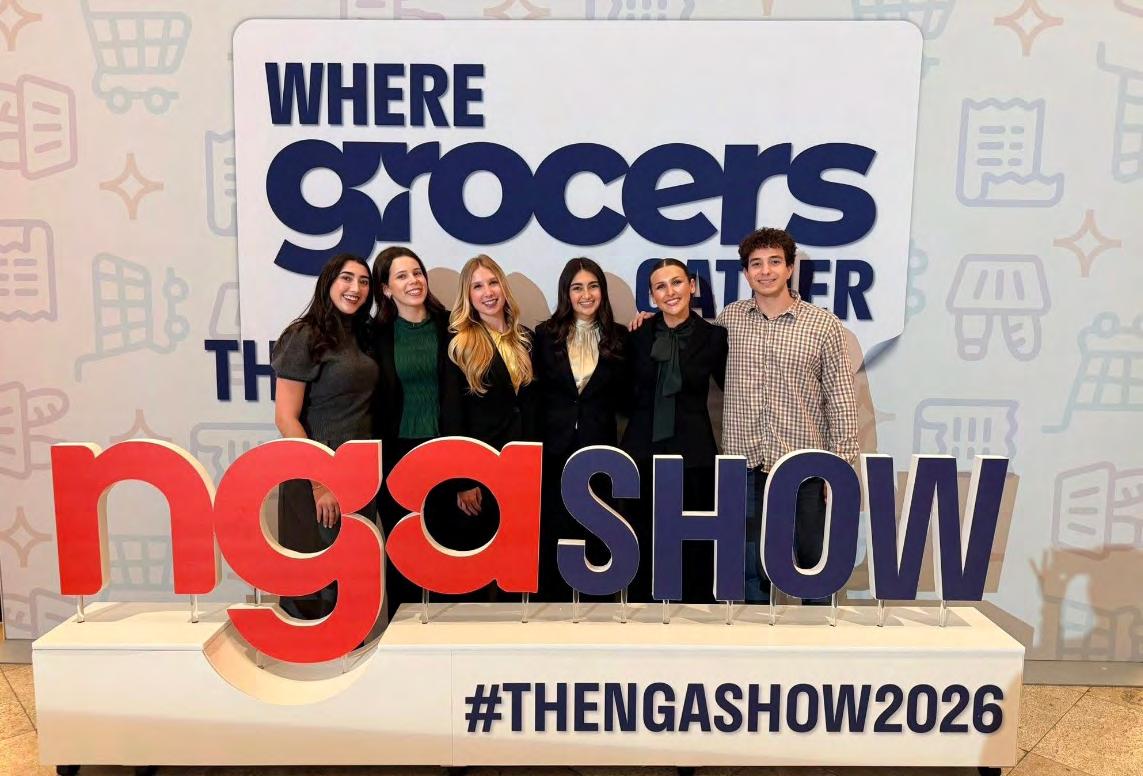
By Delilah Augustine
Six students from Cal Poly San Luis Obispo were recently awarded first place at the NGA Foundation’s Student Case Study Competition in Las Vegas. Kirsten Dehoff, Ava Diefenderfer, Isabella Riberio, Kodi Nairn, Alexandra Esajian, and Charlie Cancellieri each dedicated an entire semester to prepare, competing in internal class rounds to get to the stage at the MGM Grand Conference Center for the final round of the competition. This stage is where all their efforts came to fruition and they took home the prize after an intense face off against Central Michigan University.
The Case Study Competition is where the future of the grocery industry is made. Students from diverse backgrounds and different understandings of the industry decide to dedicate their time and efforts to immersing themselves in the minds of grocers and shoppers, exploring how innovation can reshape the retail food experience. As the Cal Poly team reflected, this competition is where “grocery shopping became an experience, where there is a newfound love and appreciation for the grocery store.”
This year’s case study was “Keeping Shelves Relevant and Customers Inspired”, focused on Nugget Markets, based in Woodland, Calif. with stores throughout Northern California. The challenge: determine how to better engage younger generations while staying ahead of emerging food trends to drive sales.
Cal Poly’s winning students began by digging deeper into the prompt. The strategy centered on utilizing the AI-powered social listening tool Brand24 to identify these trends in real time. This tool also inspired a ‘Trend Analyst’ role, staffed by student interns to monitor, interpret, and implement relevant trends.

By incorporating student interns, the plan addresses technological adaptability, while also connecting the company directly to younger consumers. Who better to understand the younger generation than the generation itself?
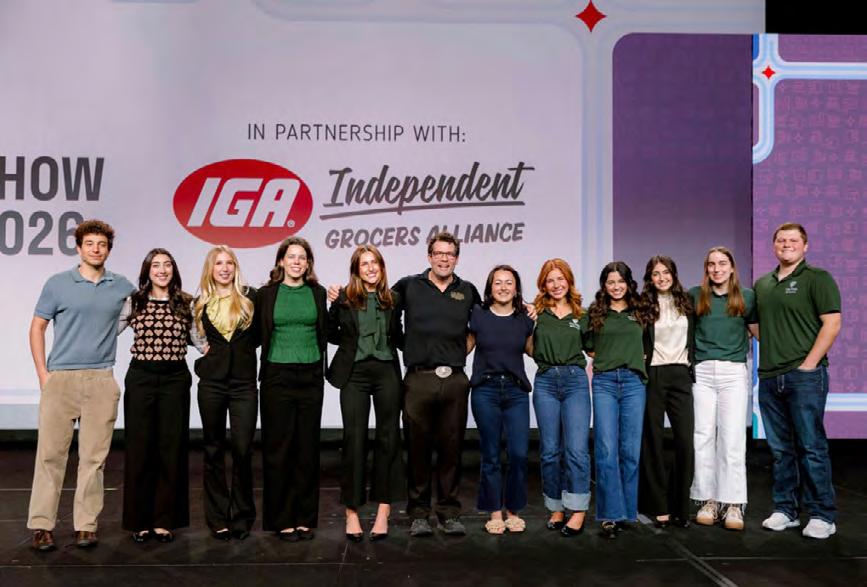
As the team progressed through the university and national rounds, they refined and perfected their concept. What began as “Trend to Table” evolved into “The Trend Tote” which is an in-store feature that showcases viral snacks, meal kits, and trending recipes. Paired with the right engaging marketing materials, shopping becomes a storytelling experience as opposed to a chore.
Their ability to combine fast-moving AI technology with an industry that can struggle to keep pace proved to be a winning formula.
Steve Brancamp of UNFI, a final round judge, praised the team’s attention to detail, noting they were the only group to adhere to Nugget Markets’ company culture by referring to shoppers as “Guests” and employees as “Associates”.
While most of the team came from agricultural backgrounds, Kirsten Dehoff brought firsthand grocery experience from her family’s independent business, Dehoff’s Market. She shared that this perspective helped the team create a solution that was “realistic but able to be scaled and used at a larger level.”
Their presentation and grasp of the study was so polished and compelling that few would have guessed they were navigating technical difficulties with a malfunctioning clicker. But these students, still stated that this final round was also the most fun they had throughout the competition, aside from being able to network and walk the trade show.
This competition showcases what the next generation can accomplish when given the opportunity to lead. Students gained real world experience in solving pressing industry issues, while industry leaders witness firsthand the innovation emerging talent brings.

Under the guidance of their coach Professor Dr. Ricky Volpe, PhD, the Cal Poly team not only secured the first place title, but also forged a promising path into the grocery industry as they prepare to enter the workforce this spring. Their win demonstrates what creativity and adaptability can do in a changing grocery industry. ■
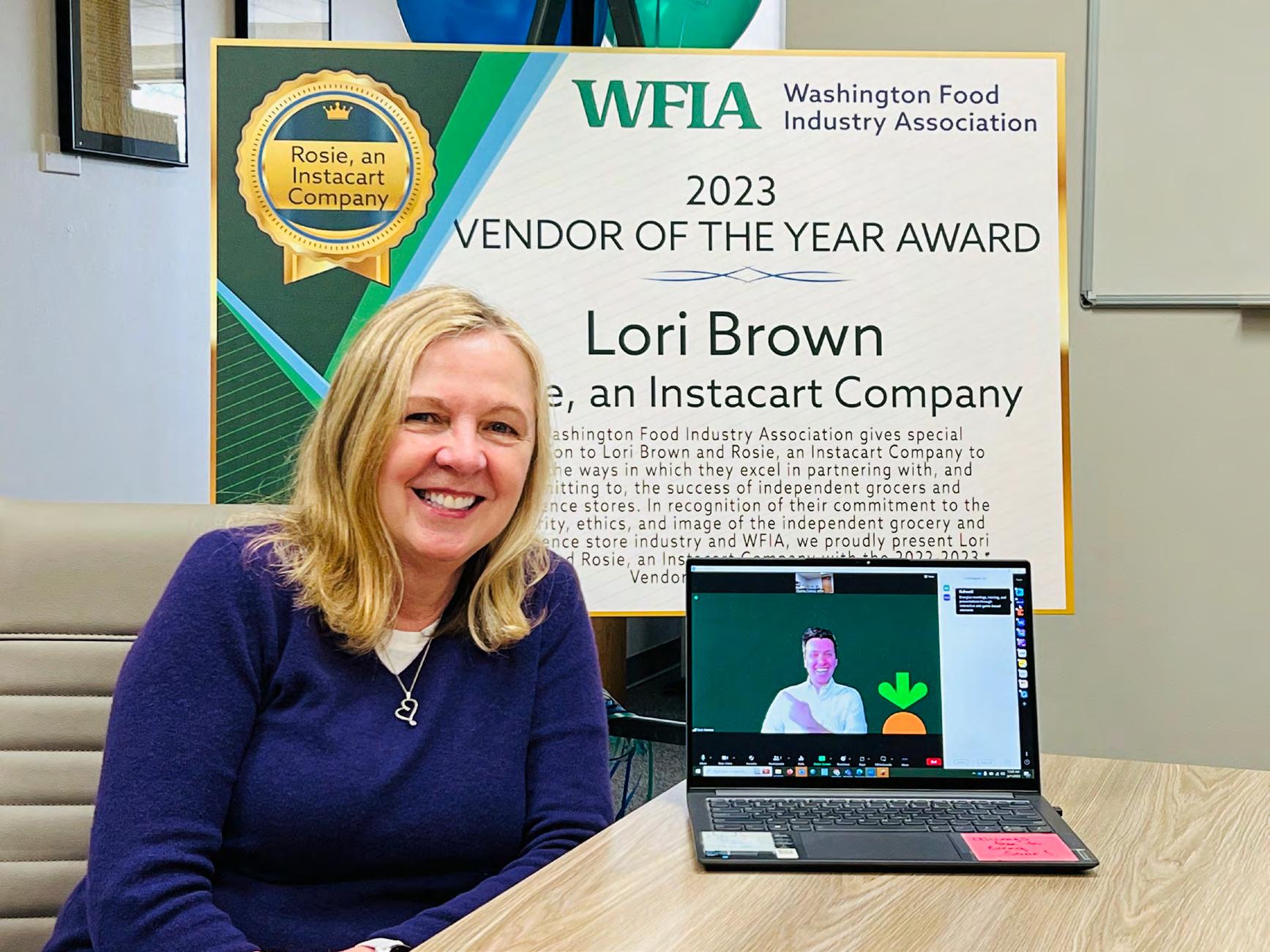
By Dorsey Griffith
Headlite’s long-standing commitment benefits group’s members, grocery industry
Lori Brown has weathered some big swings over her long, illustrious career, including business consolidation, layoffs, and corporate restructurings. Her current role as Director of Business Development for California egg producer NuCal Foods is no exception, as they faced the challenges of avian influenza last year alongside other egg suppliers across the nation.
Through it all, Brown has thrived, powered by a can-do spirit even in the toughest times and enduring relationships. Both qualities have helped her shine as this year’s Headlite for the Illuminators. Brown steps down as Headlite and becomes a board advisor in May after the WAFC Convention in San Antonio.
“The Illuminators’ motto is ‘Spread the lite of good fellowship,’” noted Brown’s close friend and advisor, HeeSook Alden, a vice president of strategy and marketing for Certified Federal Credit Union. “Lori exemplifies that.”
The Illuminators, a nearly 100-year-old organization, is a group of vendors and suppliers dedicated to developing and enhancing key relationships within the grocery industry. It also provides industry education and leadership opportunities and supports the Illuminators Educational Foundation.
The Illuminators are essential to the California Grocers Association (CGA), supporting the annual CGA and Western Association of Food Chains (WAFC) conventions. They serve meals, provide snacks and beverages, and create networking opportunities for the attendees. The Illuminators are the volunteer army of workers at these events.
Leading from behind
Brown is most proud of her ability to “lead from behind, to nurture people and watch them grow.” She allows others to take the lead and shine. The Illuminators’ rallies promoting the WAFC convention are a great example of servant leadership.
“This year we produced four high-quality rallies, two weeks apart, in four different cities,” said Brown. “The volunteer-led committees worked together to fill the rooms and create unforgettable experiences for the attendees, all while doing their demanding day jobs.
“Every board I’ve been on, it’s not about the time you are serving but what is the sustainability going forward?” she said. Facing challenges, as they did navigating the first year of a new
Throughout her career, Brown has shed plenty of light, making connections and creating relationships through relentless hard work and a commitment to service.
Brown entered the grocery business in the early 1980s while in college in Tacoma, Washington. She was hired for $5.64 per hour at a newly opened Fred Meyer store. The job helped pay for her associate’s degree, then a bachelor’s degree in business administration and communication. After graduation, as her friends embarked on their first postcollege jobs, she realized she was earning at least as much as they were at Fred Meyer and decided to stay put. She was promoted to store manager, a job she enjoyed for seven years, but after her first child was born, realized the 6-day workweek, including graveyard shifts and holidays, was taking a toll.

CGA conference venue, for example, was an opportunity to learn, overcome and move forward with confidence.
“I like to solve problems and figure things out,” she added. “Sometimes the hardest part is doing it from the back seat and letting the process work—give the person empowered to lead enough leeway so they can feel like it’s really theirs.”
“I could not figure out how to do retail and raise a family,” she said. “My son was the first to arrive at day care in the morning and the last to leave. I couldn’t do that to him. I had to do something different.”
Brown began exploring career options and discovered that Supervalu, a major grocery retailer and wholesaler, was at the time building its Northwest business in Tacoma. Brown was hired into a promotional manager position for the Northwest region.
“It was a Monday-Friday job, no traveling, a close drive,” she recalled. “I could apply what I had learned and seen in stores—I had experience around what the product looked like on the shelf and consumers’ shopping habits.” She stayed on at the company for five years until the region consolidated and the business moved to the Midwest. But as with other changes Brown would navigate, she quickly found a new opportunity: Supervalu offered her a position in Hopkins, Minnesota, as an in-house broker. After a year, she was tapped to be the brand manager for non-food products at the corporate office in nearby Chanhassen. She happily recalls applying her marketing skills, such as helping create a new line of store-brand diapers, choosing a name, and just the right baby— complete with wrangling a photo shoot—for the packaging.
By now, the COVID-19 pandemic was in full swing, and Brown had obtained a master’s degree in Food Industry Leadership at USC. She couldn’t predict that the capstone project she selected would become a launchpad for yet another career opportunity.
“We selected e-commerce,” she said. “Instacart seemed too big to take on, but Rosie was handling e-commerce for independents.”
Brown had met the founder, Nick Nickitas, while a member of the Washington Food Industry Association board. He supported the project, and her team’s capstone paper became required reading for Rosie new hires. When she lost her job at Post, Nickitas brought Brown on as senior vice president, where she built trusting relationships across the industry. Rosie was acquired by Instacart in 2022, and Brown stayed with Instacart, helping until that company,
Brown worked at Supervalu until 2004, when she was recruited by Malt-O-Meal, a Minnesotabased cereal company, which also produced store-brand cereal, before it was acquired by Post Holdings. She then became the company’s regional vice president for the west, growing product sales at Winco, Albertsons and independent grocers, many of whom she already knew and had worked with. But after 17 years, that role ended too, when the company restructured and adopted a broker model.
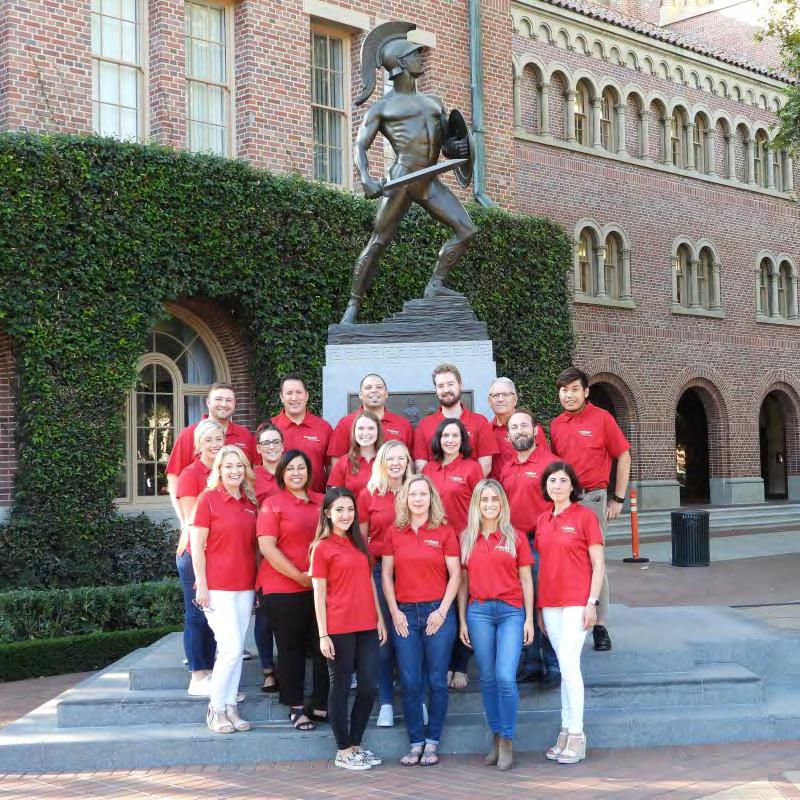
As always, Brown remained eternally optimistic. “You’re in charge of your own destiny,” she said. “When things change, take it as an open door.” Undeterred, she returned to USC for an International Coach Federation Certification.
Unbroken, Brown enters the egg business
A helpful book she read at the time was “Who Moved My Cheese?”
The motivational business fable had good guidance for reframing and embracing change. “I thought, ‘I have a degree. I am smart and can move on. What doors are open for me?”
As with other transitions, the move to NuCal Foods in the summer of 2024 afforded a fresh opportunity. The Ripon, California-based, 50-year-old agricultural cooperative wanted her to build company relationships. She already knew many of the targeted customers. Fortunately, during the avian flu outbreak, she also had experience dealing with product shortages; while at Post during the pandemic, she navigated supply chain crises that required regular check-ins with anxious customers.
“During the pandemic, some of our retailers’ other suppliers ghosted them,” Brown said. “When we experienced egg shortages during the outbreak, it felt familiar. I knew I needed to pick up the phone and explain that it would be tough for a while. It all goes back to relationships and integrity, knowing who you are, and that you will do what you say you will do and show up when you say you are going to show up.”
Although Brown lives in Gig Harbor, Washington, she frequently travels to California in her role as director of business development, forging new relationships with prospective retailers and learning the nuances of the market. Along the way, she’s learned a lot about eggs—“such a perfect protein, but they are fragile and require care to deliver in perfect condition. The sales team represents our multi-generation farmers, and there is a lot of pride in being part of this vertically integrated organization. It feels like a family.
woman to lead the organization in its 115-year history. She is the incoming chair of the organization’s Council Service Territory 1, which represents 15 councils from the far east (Japan) to the Pacific Northwest. Brown is also a member of the Washington Food Industry Association and serves on the Navigator Lighthouse Foundation board. She’s been recognized as being among the Top Women in Grocery-Rising Star in 2015 and the Shelby Report’s Women of Influence in 2020 and 2023. She also received the Silver Beaver award in 2020, recognizing her distinguished volunteer service to her local council in Scouting America.

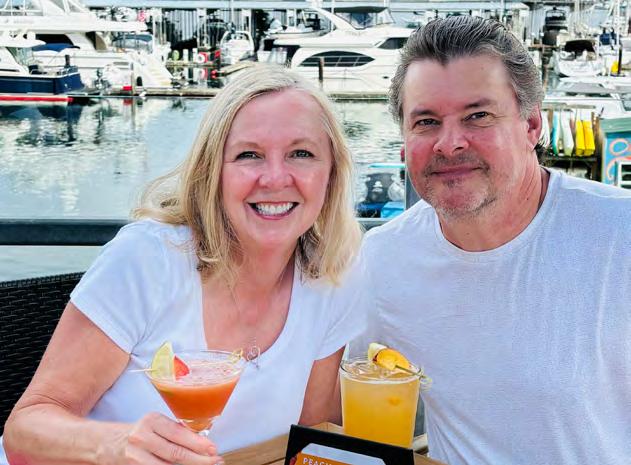
“Also, nothing compares to the complexity of eggs.”
“She doesn’t know how to say no”
In addition to her job and role as the Illuminators headlite, Brown has served on several boards. In 2020, she was president of Scouting America, Pacific Harbors Council, becoming the only
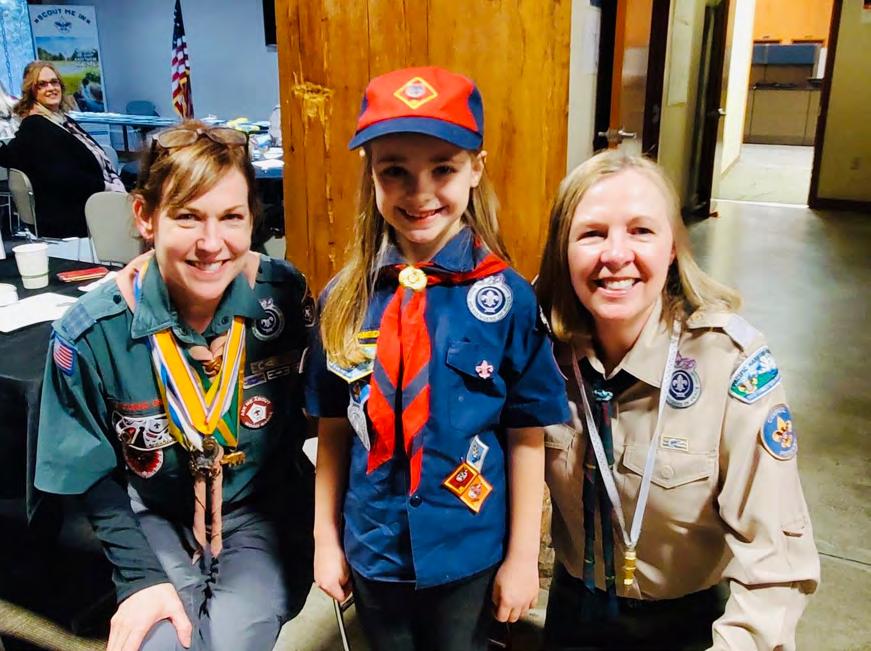

“She is a servant-leader, with an inclusive style of leadership,” said her friend Alden, part of a close-knit sisterhood of grocery industry leaders and volunteers. “She doesn’t know how to say no because she volunteers for everything. She is someone who puts people before herself for the common good. She invests in others.”
Brown has two sons with her partner, Scott Nation. Alec and Ian, both former scouts, are both graduates of Cal Poly Maritime Academy. ■
CGA President and CEO Ron Fong has announced his intent to retire at the end of the year, effective December 31, 2026, following nearly 19 years at the helm of the Association. During his tenure, Fong guided CGA through significant legislative, regulatory, and organizational milestones, advancing the industry’s priorities on issues ranging from plastic and recycling policy to self-checkout operations. He also helped establish C-CRV in response to SB 1013, expanded bipartisan political relationships, and represented the industry at the state level, including serving on two COVID task forces and with the Office of Emergency Services.

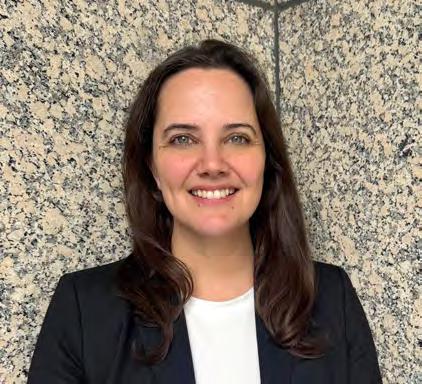
Senior Newsom Political Appointee
Will Lead CGA’s Government Affairs Departments as Chief Lobbyist
The California Grocers Association is pleased to announce that Rachael O’Brien has been hired as Vice President, Government Relations, effective February 9, 2026.
In this position, O’Brien will serve as the Association’s chief lobbyist and be responsible for managing all aspects of CGA’s advocacy efforts. She will represent CGA member companies on strategic advocacy efforts before the State Legislature, regulatory agencies and local municipalities, as well as manage CGA’s government relations staff, contract lobbyists, and political action committee (PAC).
“Rachael will make an outstanding addition to the Association’s government relations program,” said President and CEO Ron Fong. “She is highly skilled in the legislative and regulatory process, an expert at policy negotiations and bill analysis, and maintains excellent relationships within the capitol community. Rachael knows what it takes to feed California and will be a key asset to the Association and its members.”
Under Fong’s leadership, CGA strengthened its financial foundation, responsibly growing its annual budget by 89%, elevating the Educational Foundation to nearly $1 million annually in scholarships and tuition reimbursements, and surpassing $10 million in total college scholarships awarded. He also worked with independent operators to oversee the merger of the California Independent Grocers Association with CGA, further uniting the industry.
The search for Fong’s successor is underway and in the meantime Fong will continue working with CGA staff to advance the Association’s 2026 priorities. ■
Prior to joining CGA, O’Brien served as Deputy Secretary for Legislative Affairs at the California Department of Food and Agriculture for eight years and was a Senior Political Appointee for Governors Brown and Newsom. She played a key role in leading state initiatives including California Partnership for the San Joaquin Valley, California Broadband Council, California Jobs First, and Farm to School Interagency Working Groups. Previously, she served as Manager of Government Affairs for Agricultural Council of California.
O’Brien graduated from CSU Monterey Bay with a Bachelor of Arts degree in International/Global Studies. She is currently a member of California Women Lead and recently served on the Board of Farms Food Future (F3). Previously, she served on the Capitol Network Board of Directors as President and was a mentor for SheShares.
Contact Rachael directly via email at robrien@cagrocers.com. ■
Independent Grocers from all over California traveled to Oahu in January to kick off the new year with CGA at the Independent Operators Symposium. This productive week gave grocers purposeful time away from their stores to unwind and reflect on their business. Throughout the week, attendees heard from inspiring speakers and shared best practices, socialized with peers during group activities including golf and cornhole, and enjoyed free time to explore the island.
The week began with a Sharegroup session with CGA’s President and CEO Ron Fong and Director of Local Government Tim James, to share best practices and discuss hot topics in the industry. Discussions spanned from the national penny shortage to new laws, and current issues facing the industry such as SB 54.
This year’s Symposium featured three education sessions with PPIC President and CEO Tani Cantil-Sakauye and keynotes Jesse Israel, and Seb Terry. Cantil-Sakauye’s session offered insights on navigating multigenerational workplaces and adapting to the challenges of the remote work movement. Israel led a mindful discussion on “The Big Quiet,” exploring how moments of silence can help grocery leaders grow, both professionally and personally. Finally, Terry drew from his own experience overcoming challenges to remind grocers to stay connected to their goals and what truly makes them happy.
CGA welcomes the following members:
ARCO National Construction
2 Park Plz Ste 1120 Irvine, CA 92614-8564
Contact: Brian Westre, Vice President & Operating Partner
E-mail: bwestre@arco1.com
Phone: (314) 914-9901
Website: arconational.com
Keurig Dr Pepper 6425 Hall of Fame Ln Frisco, TX 75034-1954
Contact: Priyanka Vijay, Dir., Regional Accounts
E-mail: priyanka.vijay@kdrp.com
Phone: (925) 349-8582
Website: keurigdrpepper.com
With a blend of business and mindfulness, the week provided a meaningful balance for grocers ready to start the year inspired and equipped to face challenges ahead. ■
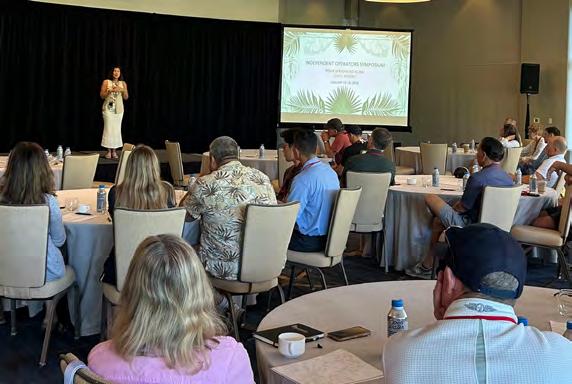

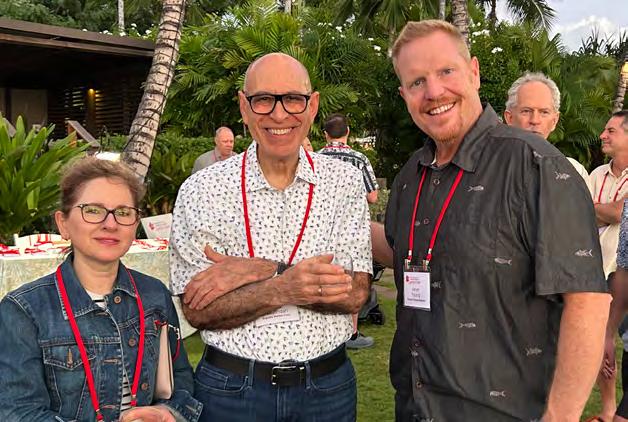
Central Valley Ag Export
345 E Tulare Ave Ste D Visalia, CA 93277-4941
Contact: Didier Vivies, Chief Executive Officer
E-mail: didier@cvae-inc.com
Phone: (559) 623-3307
Website: cvae-inc.com

Mastro & Associates, Inc.
1717 W Orangewood Ave Unit B Orange, CA 92868-2040
Contact: Laura Mastro, CEO/Owner
E-mail: lauram@mastroandassociates.com
Phone: (714) 363-3391
ChicoBag Company
3960 Morrow Ln Chico, CA 95928-7189
Contact: Andrew Keller, President & Inventor
E-mail: andy@chicobag.com
Phone: (530) 717-2151

BY GRACE BECKER

HaircarebrandJupiterturnedanunfortunatetheftintoa360-degree marketingcampaign.Latelastyear,adeliverytruckcarrying27,000 bottlesofJupiter’sbestsellingAnti-DandruffBalancingShampoowas stolen—representingnearly$500,000inpotentialretailrevenue.In response,thebrandlaunchedacheekymarketingcampaign“The ShampooHeist”withthetagline“Yep,it’sthatgood.”Campaign creativesincludedadigital“casefile”withcluesabouttheshampoo, “wanted”postersaroundNewYorkCity,andan in-personscavengerhuntwithhidden productsandprizes.


Puresteel is a plastic-free coffee maker. When on the hunt for a “stainless steel” coffee maker, Founder JC Foster found that every option on the market still had hidden plastic valves, tubes, and reservoirs leaching chemicals into the brew. He set out to make is own machine to be 100% plastic-free (even fittings and connectors). Using only medical-grade stainless steel and glass to ensure a pure brew every morning for only $80. Right now it can only be secured by waitlist.
Affordability remains top of mind for both customers and politicians, putting retailers in a tight spot. To get ahead of the narrative, which doesn’t look to be slowing down any time soon, Axios reports that some corporations are releasing and promoting detailed economic impact reports highlighting contributions to the U.S. economy, job creation, community investments, supply chains and more.











Pinterest is further cementing its role as a trend machine. Its 2026 Pinterest Predicts report forecasted 21 trends across categories from fashion to travel and beyond. This year’s predictions ran the gamut from Gimme Gummy to Poetcore to Afrohemian. Pinterest’s prior trend predictions have had up to 88% accuracy over the past six years. Trends are identified by combining machine learning, predictive analytics, and real-world search behavior data.
Anyone with a smart phone has likely seen videos of Punch, the small monkey who was abandoned by his mom and went viral for cozying up with a plush monkey after being bullied by his peers. Turns out the now infamous plush monkey was from Ikea’s Djungleskog collection. The furniture retailer is leveraging the attention on Instagram while Punch fans flock to purchase their own $19.99 orangutan. In early March Ikea was and sold out at all but five of the chain’s 54 U.S stores.


Toymaker Biggest Little created b is for ball® to support every stage of growth: from tummy time and teething to bath time splashes and big-kid adventures. Made from 100% food-grade silicone, b is for ball® is free from plastics, BPA, and phthalates—safe for teething and tough enough for everyday play. Recognized by TIME as one of the Best Inventions of 2025, it is safe, mold-free, and endlessly versatile. It’s play, bath, and exploration in one simple, beautiful design.
KIMBERLY RAE MILLER WRITER
Based on the clickbait news coverage that appears every time new federal nutrition guidance drops, you would think America’s dinner tables are about to undergo a full renovation.
I read the updates. I really do. After years working in the health and wellness space, I appreciate the newer emphasis on whole foods and the long-overdue softening around fat. As a mother of two skinny kids who barely eat, full-fat dairy has always been part of my playbook anyway. It is oddly validating to see guidance finally catch up to what many of us quietly decided years ago: sometimes the path to nourishment runs straight through the dairy aisle.
That said, the shift in nutritional priorities, particularly the renewed focus on fat and protein, has turned the new guidance into something of a running joke in our house. Whenever anyone asks what is for dinner, the answer is now, “Steak! Covered in cheese!” This is especially funny because my husband is a lifelong vegetarian with a degree in nutrition and exercise physiology.
He knows the science. I know the science. Dinner still looks remarkably familiar. Because if I am being honest, not much is changing from a shopping perspective.
I am the sole grocery shopper and sole meal preparer in my household. I cook what I cook. Nutrition is always top of mind when I build our weekly menu, but I am still largely operating off the four food groups framework of my childhood: a protein, a starch, a vegetable and something with calcium. It is not trendy. It is not algorithmdriven. But it works. My kids grow. My family eats. We move on.
That is the quiet truth I suspect many moms share. Despite new guidelines, viral nutrition advice and a constant stream of wellness marketing, most family grocery carts are not being reinvented. They are being gently edited. We might choose a higher-fiber wrap or a yogurt with more protein. We might read labels more carefully. But we are not rebuilding dinner from scratch every time guidance evolves. We do not have the bandwidth or the budget.
What does give me pause is not macronutrient guidance but food safety. Recent regulatory decisions have allowed increased tolerance levels for certain pesticide residues on some produce. At the same time, ongoing research continues to examine the long-term effects of
cumulative exposure, particularly for children. For many parents, that is the kind of update that quietly influences purchasing decisions.
Not because we are chasing perfection, but because we are doing math in our heads. If residue thresholds rise while produce intake is encouraged, many of us feel nudged toward buying organic in categories where we previously felt comfortable buying conventional. And organic produce can cost significantly more. For households already navigating tight grocery budgets, that shift is not theoretical.
Still, even here, stability wins out. I am not overhauling my entire list. I am being selective, the way most parents are. We weigh cost, nutrition, safety, convenience and the ever-important question: Will anyone actually eat this?
So what is for dinner in American households right now?
Probably what was for dinner last year.
The biggest trend may not be transformation.
It may be consistency. ■
By Joe Toscano, Vice President, Trade & Industry Development at Purina
With nearly a century in this industry, Purina has been a part of and witnessed countless product launches, but few have generated the excitement we’re seeing around Fancy Feast Gems. Our years of working with our retail partners to understand what truly drives consumer sati sfacti on and repeat purchases have shown us that this represents a genuinely innovati ve approach to premium cat nutriti on.
The Science Behind the Innovati on What sets Gems apart isn’t just its striking appearance, though that pyramid shape certainly catches the eye. Many of our nearly 500 Purina scienti sts and veterinarians have spent years studying cat feeding behavior and discovered the pyramid’s increased surface area maximizes gravy distributi on –and any cat owner knows that gravy is where the magic happens.
The genius lies in the details most customers will never see but will absolutely experience. We’ve developed a proprietary fi lling process that maintains perfect gravy viscosity, ensuring that signature cascading eff ect every single ti me. The mousse texture is calibrated for opti mal palatability, whether cats prefer to lap or bite their food. This isn’t marketi ng speak – it’s engineering precision applied to pet nutriti on.
Why Retailers Are Already Calling This a Must-Stock Item
From a merchandising perspecti ve, Gems solves real problems for both pet parents and retailers. The single-serve format eliminates waste and porti on guesswork, while the innovati ve peel-and-plate design makes mealti me genuinely mess-free. At $2.48 for a two-pack, Purina has hit that sweet spot where premium positi oning meets accessible pricing.
But here’s what really excites our team: The repeat purchase potenti al. When cat owners see their pets’ reacti on to that cascading gravy eff ect, they become customers for life. The product’s innovati ve design creates the kind of mealti me experience that builds lasti ng brand loyalty.


The Complete Package: Nutriti on Meets Experience
Gems delivers 100% complete and balanced nutriti on for adult cats across four carefully craft ed recipes – beef, chicken, tuna, and salmon. Each variety features Purina’s signature savory gravy that cats insti ncti vely crave. But beyond nutriti on, Gems delivers an experience. That moment when an owner peels back the top and watches their cat’s reacti on to the cascading gravy – that’s when feeding becomes bonding.
Purina’s patented packaging design isn’t just visually striking – it’s functi onally superior. The 2 oz. porti on size is perfectly calibrated for most cats’ appeti tes, and the pyramid shape ensures even gravy distributi on without requiring any mixing or preparati on from the owner.
Today’s pet parents aren’t just buying cat food – they’re investi ng in their pets’ quality of life. They want products that refl ect the love they have for their cats, and they’re willing to pay for innovati on that delivers


genuine value. Gems represents the convergence of scienti fi c research, premium positi oning, and emoti onal connecti on that defi nes successful pet products in today’s market.
As the #1 gourmet cat food brand, Fancy Feast has always understood that mealti me is about more than nutriti on – it’s about the relati onship between cats and their owners. Gems elevates that relati onship to an enti rely new level.
Experience Gems in Person
If you’re att ending SUPERZOO this year, see Fancy Feast Gems for yourself at Booth #11352. Our team will be on hand to discuss pricing, merchandising strategies, and how Gems can drive category growth in your stores. Can’t att end this year? Reach out to your Purina sales representati ve to talk about ensuring Fancy Feast Gems has space in your aisles.