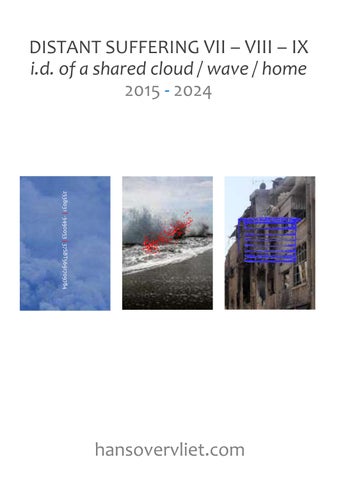
DISTANT SUFFERING VII – VIII – IX i.d. of a shared cloud / wave / home 2015 - 2024
2538031 | -3490053 | 37SBT5691709784
hansovervliet.com
hans overvliet studio-address | Dreesstraat 2 Vlissingen www.hansovervliet.com curiositas@zeelandnet.nl team member of www.caesuur.nu team member of www.ikbeneengod.one supporting www.ikgeefjemijnraam click here for my portfolio click here for my C.V. International reference: DutchCulture Since the start of the art project in 2014, the text has been a sub-stantial, part of my
introduction DISTAND SUFFERING i.d. of a shared cloud /
wave / home a attempt to reframe the vast and continuous flow of information about conflicts in distant places that reaches us through digital networked communication. This information is usually displayed transiently on screens. There is too much of it and it passes too quickly to enable intimate reflection and a sense of physical relation. Paul Virilio informed me by his book The Administration of Fear about the results. Fear has become an environment, an everyday landscape. There was a time when wars, famines, and epidemics were localized and limited by a certain timeframe. Today, it is the world itself that is limited, saturated, and manipulated, the world itself that seizes us and confines us with a stressful claustrophobia. Stockmarket crises, undifferentiated terrorism, lightning pandemics, professional suicides, the results of global warming; fear has become the world we live in. A criminal, convicted of
fraud, assault cq rape became president of the United States in November 2024 with this frame . . . This artwork turns a collection of internet data into a lasting material structure. Reframing the data –also in a literal sense –it consists of three metal frames in which three sets of 1,000 Internet-sourced images are suspended on transparent sheets. The three out-lines of filing cabinets function as a transparent library for three topics that play a role in the background of every contemporary (mediated and mediatized) conversation: war, climate change and the ruins of physical structures and spaces, which result from the first two categories. The images in the installation reflect these three categories: 1,000 explosions, 1,000 seawaves and 1,000 ruins, which are superimposed by open-source meta-data related to the images. The images of explosions and clouds are inscribed with reference codes to the military status of the area concerned, sourced the National Geospatial-Intelligence Agency, Bethesda, MD, USA.
The waves are accompanied by ‘cleaned’ formulas and models on climate change collected from institutes that, without corporate money, conduct research into climate change; the causes and consequences thereof. The images of ruins are superimposed by maps of national libraries of some 50 countries, sent to me during an earlier project (1996) that engaged with the loss of libraries as a physical source of knowledge, information and meeting and - in some cases - outright censorship. The relevance of this data super imposed on these images in terms of the new meanings it might generate, is the juxtapositions between image and model, between the seemingly harmless metadata hidden beneath the image. In nowadays media the difference between the image itself and the model of the image disappears; the simulacra of Beaudrillard are omnipotent present and produce – if we don’t change - more of the same: nullité -zeroness.
DISTANT SUFFERING VII – VIII – IX i.d. of a shared cloud / wave / home 2015 - 2024
DISTANT SUFFERING VII – VIII – IX i.d. of a shared cloud / wave / home - 2015 work 3 ‘out-lines’ of filing cabinets, each 134 cm x 49,5 cm x 71 cm [ h x w x d ] material weathering steel 2x [ 10 x 10 mm] 1x [ 12 x 12 mm.], 84 wooden bars 1 x 1 x 49,5 cm, Nobo OHP Transparency Film, sided acid-free tape filled with 1,000 images of explosions and ‘holiday clouds’ on 50 sheets with codes super imposed on the images: unique location positioning from a military open source website; 1,000 images of waves with statistics Global Warming on 50 sheets; 1,000 images of destroyed houses with ground plans on 50 sheets send to me - in 1996 - on my request from and of 72 national libraries concerning The World Library Art Project.
photo courtesey of ©2017 | Anne Breel
photos courtesey of ©2024 | Bo de Jong
DISTANT SUFFERING XIV
i.d. of a shared cloud | the book work
Cross #2 | 2017
clam book A4+ 1,000 stickers, to be glued on a grid on 100 pages A4, 120 grs. execution #1` Sea foundation | Tilburg - 2018 execution #2 KunstHal 45 | Den Helder – 2019 text Dr. Dani Ploeger
Sea foundation | 2018
KunstHal 45 | 2019
Temporal Disruption and Anti-Efficiency: Hans Overvliet’s critical media practice Dr. Dani Ploeger The proliferation of digital news media over the past two decades has led to the distribution of increasing numbers of news events at ever higher speeds. Through news feeds and live alerts, updates on the latest incidents all over the world are disseminated almost instantly and continuously. In The Administration of Fear (2012), Paul Virilio discusses the paradoxical consequences of this development. Instead of facilitating a more detailed assessment of events and thus trigger empathetic action on the side of the recipient, the fast sequence of detailed mediatization of catastrophes and threats pro-motes a permanent state of fear. Whereas, in previous media eras, fear used to be ‘related to localized, identifiable events that were limited to a certain timeframe’, it has now increasingly become an
environment that determines every-day life in the Global North. It is this paradigm of speed and fear that has formed the starting point for Hans Overvliet’s work since the mid-2000s. In Cross #2 (2007) press photos of violent events during the Second Gulf War are cut into strips and woven into fragments of fashion and architect-ture photography. At first sight, it is not quite clear what the image fragments in the resulting Duratrans print represent. Unlike the original war photographs, the often-graphic nature of which instantly fills you with horror, you need to take some time to decipher their gruesome contents. In addition to the collision of the slick realm of consumer culture with the destruction of warfare, two processes are at work here: On one hand, the cutting up and weaving of the image strips foregrounds that the photos also exist as aesthetic objects in themselves, rather than merely a means of representtation that gives access to a reality elsewhere. Thus, the process of mediation and
the distantiation between the viewer and the events represented are foregrounded. On the other, by making the contents less readily accessible to the beholder, the images are removed from the rapid stream of catastrophic representations Virilio describes. You are compelled to pause and reflect. In distant suffering I: Syrian Skies | 1,000 days (2015), this strategy of foregrounding the process of mediation, while establishing an initial ambiguity of the material’s representtative contents is developed further. Magnifications of clouds scanned from printed newspapers draw attention to their composition of different patterns of dotted ink. At the same time, the absence of the landscapes that were below the clouds in the original images invites you to enjoy the scene like you might contemplate the sky in a 17th century Dutch painting. This beauty and apparent peacefulness of the isolated clouds and the accompanying process of mediation are juxtaposed with the eerie
reference to the war in Syria that is provided by the title of the work. Slowed down by the work’s seductive visual appeal, the confrontation with the painful implications of the source of the clouds unfolds itself in the foreground of your mind. These disruptions of the high-speed digital media landscape that occur during encounters with the finished work are not the only locus of Overvliet’s interventions though. A possibly even more radical interruption of what Virilio calls ‘the cult of speed’ takes place during the creation process. Instead of taking advantage of the latest software solutions to make image processing, graphic design, data collection and categorization faster and easier, Overvliet spends hundreds of hours conducting individual Google searches, cutting and gluing prints of digital images with scissors and a glue stick, and fiddling with the space bar and the return key of his old inefficiency of Overvliet’s engagement with digital technologies is a significant component of his desire to undermine
the ideological framework that surrounds digital media. Overvliet’s work process rejects the logic of process optimization and efficiency that usually accompanies everyday consumer technologies. Thus, the temporally disruptive quality of his work is also established by the often make-shift digital (and non-digital) processing of its materials. In distant suffering IVX, i.d. of a shared cloud, the ‘book’ (2017-18), Overvliet includes us in his laborious creation process. Instead of a finished book, we are offered a box filled with a pile of paper sheets with a grid outline, accompanied by 1000 stickers. Each sticker shows a downloaded image of a cloud on which a set of geographical coordinates – sourced from a publicly accessible online military database – are superimposed. Here, Overvliet revisits the theme of the seemingly innocent cloud, this time connected to mapping technologies, a decisive facilitator of imperialist expansion since colonial times; ‘to conquer […] global life, one must be able to map it’ (Patel and
Moore, 2017). These two components, the clouds and the mapping coordinates, are both sourced from the virtually endless public information pool available through the internet. This makes both the images’ individual contents and the interrelationships between coordinates and clouds appear arbitrary at first. However, Overvliet gives us an assignment: We can only obtain the work if we commit to sticking all 1000 images to the pages, one by one. Over the duration of multiple hours, we are required to make decisions on the order of the images, as well as concentrate on placing each sticker carefully onto the page, an activity reminiscent of the now archaic prac-tice of the picture card album. What seemed like an arbitrary mess of data at first, is turned into puzzle of sorts, where we are invested in giving each piece its proper place. The true relationship between the clouds and the coordinates is never disclosed, but our repetitive, concentrated engagement with each individual instance confronts us with the uncanniness of quantified
space in combination with the clouds as ambiguous double references to the forces of nature and human violence. Instead of providing us with a slick and streamlined finished art object, Overvliet’s ‘book’ challenges us to join him in a slow, detailed – and potentially frustrating – engagement with contemporary media. Thus, the work doesn’t provide us with an end-point but instead creates a breathing space. A moment to step outside the numbing, high-speed stream of fear-inducing media spectacles, and ask ourselves the question: “What must we do?” References Paul Virilio (2012). The Administration of Fear. Los Angeles, CA: Semiotext(e). Raj Patel and Jason W. Moore (2017). A History of the World in Seven Cheap Things: A guide to capitalism, nature, and the future of the planet. Oakland, CA: University of California Press.
Sea foundation | 2018
DISTANT SUFFERING XXXVII i.d. of a shared history of mobility Bewaerschole Burgh-Haamstede August 24 | September 22, 2024
DISTANT SUFFERING VII i.d. of a shared cloud
Aagtekerke | 1945 -2140125 | -2969241 | 31UET3582411116 Unique Feature Identifier: -2140125 Unique Name Identifier: -2969241 Military Grid Reference System coordinates: 31UET3582411116 Aden | 2015 -3189087 | -4507767 | 38PMV8739609369 Unique Feature Identifier: -3189087 Unique Name Identifier: -4507767 Military Grid Reference System coordinates: 38PMV8739609369 Aleppo -2542538 | -3495143 | 37SCV1973385798 Unique Feature Identifier: -2541858 Unique Name Identifier: -3483931 Military Grid Reference System coordinates: 37SCV1973385798 Amsterdam | (05-05) -2140479 | -2969693 | 231UFU3054501696 Unique Feature Identifier: -2140479 Unique Name Identifier: -2969693 Military Grid Reference System coordinates: 31UFU3054501696 Bourg-en-Bresse / Brou | 2006 t/m 2012 -1414325 | -2029528 | 31TFM7102018658 Unique Feature Identifier: -1414325 Unique Name Identifier: -2029528 Military Grid Reference System coordinates: 31TFM7102018658
DISTANT SUFFERING VIII i.d. of a shared wave
DISTANT SUFFERING IX i.d. of a shared home
Context The materialisation and connection to our physical experiences of all hose images is quite a challenge. Jean Baudrillard suggests that we have entered a fundamental process regarding our perception of the image: it is the reflection of a profound reality; it masks and denatures a profound reality; it masks the absence of a profound reality; it has no relation to any reality whatsoever; it is its own pure simulacrum. Zygmunt Bauman, the Polish sociologist, states in Liquid Modernity that everything is temporary, transient or changeable. He also notes that people have never communicated so much before, without any goal or result. For Bauman, the (social) media are like a huge house full of mirrors. In this house we do meet people, but we do not enter into dialogue. There are differences of opinion, but no real, constructive debate. This creates the illusion of connection with others when this is not actually there. In Bauman's fluid culture, insecure relationships, or love without a face and without
commitment, prevail. This fluid culture lives on waves of feelings and ideas that may be there today but will disappear tomorrow at the latest. It amuses people but at the same time keeps us un-der control. Baudrillard's society of spectacles with its nullité is imperative. It destroys context, history, consistent content, distorts realities.
exhibitions AFFAF | Café Spoorzicht – Arnemuiden | 2015 Biënnale Amersfoort Vreemde Gasten | Foreign Guests | 2016 Abby Complex Middelburg | Iconoclastic Fury | 2017 Sea foundation | Tilburg [ residence ] 2018 Pakje Kunst | Toonbeeld / Terneuzen 20 small works | 2024 De Bewaerschole Burgh-Haamstede | 2024 Verbeke Foundation | KemzekeBelgium | 2024-2025 The artwork is now in the permanent collection of Verbeke Click here for the catalogue Burg-Haamstede; click here for the video Burg-Haamstede.
Thanks AFFAF | Café Spoorzicht – Arnemuiden | 2015 Ko de Jonge, Giel Louws. Marjan Allaart en Willem Allaart, Roos Gortzak Biënnale Amersfoort | Foreign Guests | 2016 Lettie Ambagtsheer, Hub Kockelkorn, Anton van Kolfschoten, Puck Snoek, Peter Veeling, Marie-Christine Abby Complex M’burg | Iconoclastic Fury | 2017 Johan de Koning Sea foundation | Tilburg [ residence ] 2018 Riet van Gerven Co-creators: Virginia Lui, Susanne Khalil Yusef, Julia Fidder, Pim Steinmann Text | Dani Ploeger Pakje Kunst | Toonbeeld / Terneuzen | 2024 Ro-Nalt Schrauwen, Bianca Runge, Barbara van Gelder, Rita Vermeersch De Bewaerschole | Burgh-Haamstede | 2024 Geeske Pluimers, Roger Meij, Bert Coenen, Lenet Verzijl, Jeannette Prince Verbeke Foundation | KemzekeBelgium | 2024-2025 Geert Verbeke, Carla Verbeke, Marie Verboven, Tineke Schuurmans Financial support Mondriaan Fund | S.B.K.M. Vleeshal
DISTANT SUFFERING XXXVII i.d. of a shared history of mobility Bewaerschole Burgh-Haamstede August 24 | September 22, 2024