DISTANT SUFFERING i.d.
hans overvliet
.
hans overvliet studio-address | Dreesstraat 2 Vlissingen www.hansovervliet.com | curiositas@zeelandnet.nl click here for my condensed portfolio click here for my extended portfolio click here for my C.V. International reference: DutchCulture
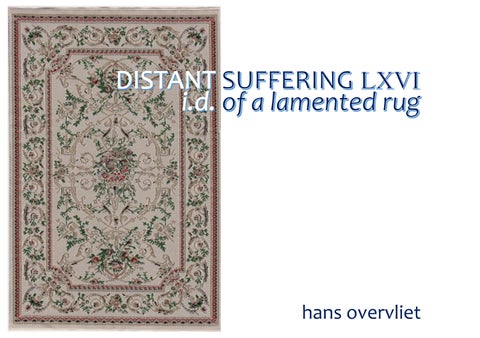
DISTANT SUFFERING LXVI
i.d. of a lamented rug
From the start of the art project in 2014, the text has been a substantial, part of my work. It should be noted however that the text never explains the work. It touches a different category of layering; it speaks to another part of the mind.
How Mr. Karam, a solar eclipse, a sandy beach, a rug, a genocide, Daheisha, Kahn Younis and Majdal Shams came together
In what is left of Khan Younis works a man. He works there with children. With traumatized children. Out of necessity. In the hell, created by Israel at the Mediterranean Sea. A hell called Gaza. Reduced to the surface area of the Dutch island of Texel. An estimated 1.1 million children are trying to survive over there; about half of the total population of over 2.2 million inhabitants. Again: on the surface area of Texel; about 20 by 8 kilometres. Children who have been constantly bombed for their entire lives. Children who, despite their age, have seen and continue to see countless things that we adults here in the West, fortunately, never see in our entire lives. Children whom the man supports in his school he calls We Still Have a Future with a team of specialized artists who are also trained as a therapist. The man in question – Karam Saadoni, better known as Mister Karam – is supported by the Hope Foundation*, based in The Hague. By offering inventive lessons in the fields of art and culture, Hope aims to empower children in conflict areas to build a meaningful life for themselves. We envision a future where children can cope with the effects of war in the best way n the best way possible and where the basic requirements for leading a life that is worthwhile are available to all.
way possible and where the basic requirements for leading a life that is worthwhile are available to all. For the Khan Younis Open Studio team, Academy for Young Talent, Social Media Lab, Breakdance Academy and many more organizations, Hope acts as a source of inspiration and as initiator for projects. The Hope Foundation has been supporting activities like the ones of Mister Karam in Gaza for 35 years now. That makes it possible that he, together with a group of artists working in diverse disciplines, can do his important work with a multi-talented team on a professional basis in a sustainable way. As an aside: Mister Karam was forced to constantly relocate his school We Still Have a Future because it was destroyed time and again by the most moral army in the world, the Israeli Defence Forces; in 2026 for the fifth time. Last year, all the paper for the children to work with ran out. Even the reused food bags from UNWRA aid were gone. The children often paint on the ruins of the bombed houses. Large, cheerful floral paintings featuring messages such as stop bombing, we can love each other too. However, drawing and painting on the ruins had become too dangerous because of the Israelian snipers and
ting on the ruins had become too dangerous because of the Israelian snipers drones. The solution for his lack of paper that Mr. Karam found is both a metaphor and an analogy for his working method: he scrounged together several broken washing-up bowls, repaired them as best he could, filled them with sand, and let the children draw in the sand with their fingers and hands. On August 12, 2026 W. and I are watching the miracle of the solar eclipse. We are doing so on the Westkapelse Sea Dyke, along with thousands of others. We look out over the North Sea, groynes made of wooden poles covered with barnacles, and the sandy beach, decorated with the inevitable potholes. Suddenly, Mister Karam and his washing-up bowls come to mind, and somewhere in my head, the potholes in the sand are connected to the beach in Gaza where I so often enjoyed myself after a day's work. Seconds later, I realize that that same sand is going to conceal the war crimes committed by Israel. At the back of this catalogue, I provide a more detailed account of these criminal acts. In In my mind's eye these thoughts and feelings converge at the carpet I saw being swept clean of sand and dust with a reed broom in 1985 in a Palestinian
being swept clean of sand and dust with a reed broom in 1985 in a Palestinian refugee camp – Daheisha – established by UNWRA in the West Bank in 1949. A split second later, I am back in the Khan Younis refugee camp in the Gaza Strip, established a year earlier in 1948. My memories connect with images from a documentary I saw two days ago. The same kind of broom, the same kind of woman, the same kind of carpet, the same inhumane conditions. A freshly swept carpet without sand for children to play on, as a sign of dignity, of domesticity, of personal and shared customs, of a warm welcome. But in Gaza it is also the metaphor of sweeping genocide under the carpet. In 1985 already we saw with our own eyes how in this context Israel criminally acted in the Syrian Golan Heights. After the Six-Day War of 1967 and the Yom Kippur War of 1973, the apartheid state permanently occupied the heights and subsequently destroyed an estimated 340 Syrian villages and farms. Approximately 95% of the indigenous Syrian population (about 100,000 to 130,000 people) fled or were expelled during the Israeli conquest. Only five original villages with a Druze population were spared. This scorched earth strategy was made irreversible by the systematic destruction and flattening of the empty villages and agricultural communities by the Israeli army. The places violation of international
villages and agricultural communities by the Israeli army. The places where the villages were situated have completely disappeared from the landscape. The remnants have been largely built over with Israeli settlements, classified as military zones, or designated – as the height of cynicism – as nature reserves. Brightened up with barbecue and camping spots, causing the centuries-old history to disappear from the area, by the destruction of every sign that referred to the culture of the Druze, formerly the dominant population group on the Golan. The annexation in 1981 was the provisional endpoint of this process. A process that is now being applied in Gaza and parallel to the West Bank, without the West lifting a finger, despite its international laws and treaties. Sweeping extermination under the carpet. Naturally, the work also plays with Orientalism: the stereotypical Western way of viewing and depicting the Orient (the Middle East and North Africa). Exoticism and the flying carpet are inextricably linked as symbols of the Western fascination with the perceived mysterious and magical East. * Hope Foundation | https://www.hope-foundation.nl/
the work
the materials
DISTANT SUFFERING LXVI | i.d. of a lamented rug
Materials Mini rugs | from Het Houten Poppenhuis (The Wooden Dollhouse) Pretty Floral | The Dolls House Emporium | 17 x 10 cm, Flowers | The Dolls House Emporium | 17 x 10 cm; Cream - Georgian Style | The Dolls House Emporium | 18 x 11 cm; Oval |The Dolls House Emporium | 14.5 x 9.5 cm; Round Ebony-Ray Victorian | The Dolls House Emporium | ø17 cm; Oval – Pink | Streets Ahead | 31 x 20 cm; Pink Ophelia | The Dolls House Emporium | 17 x 10 cm; Oval – Blue | Streets Ahead | 10 x 15 cm; Round Ebony-Ray Victorian | ø 17 cm; Oval | The Dolls House Emporium | 14.5 x 9.5 cm; Square | The Dolls House Emporium | 20 x 20 cm; Papier-mâché: de Volkskrant and Bison wood glue for indoors;
DISTANT SUFFERING LXVI | i.d. of a lamented rug
Materials continued Mould: Dimensions: ±50 x ±31 x ±7 cm; Handson bird netting | green plastic coated | mesh size of 12.7 mm wire thickness of 0.9 mm; Subsurface: Acrylic: Royal Talens / Amsterdam, pigment PR101 | light oxide red; Pigment: Prussian blue; Sand: from the Westkapelse Sea Dyke, the salt washed out; Varnish: Van Beek | Universal end varnish (spray can) matt. Carriers: height between 100 cm and 75 cm, width x length 20 x 45 cm, planed linden wood 2 x 2 cm; In total 8 pieces.
concealed evidence of a genocide
The Israeli army continues to occupy large parts of the Gaza Strip, in viola-tion of all international treaties. Furthermore, well over 60 to 70 percent or more of the area is now under military control. At the same time, Gaza is virtually completely cut off from the outside world; aid organizations are deeply concerned about this. More-over, a very large part of the infrastructure base in the area has been completely destroyed. The renewed occupation serves multiple strategic, military, and domesticpolitical goals. The Israeli government led by Prime Minister Benjamin Netanyahu, who has been accused of war crimes by the International Criminal Court, pursues a two-pronged agenda in this regard: on the one hand, official defence goals, and on the other, ideological and demographic motives of his fascist coalition. The official military and strategic goals: the Israeli government and defence leadership justify the physical presence in Gaza as a necessity for national security with the worn-out refrain of ‘the complete disarmament of Hamas’ and ‘prevention of rearmament,’ alongside physical division and control and the establishment of a permanent buffer zone.
and ‘prevention of rearmament,’ alongside physical division and control and the establishment of a permanent buffer zone. Israel is carrying out a large-scale operation to completely clear the rubble from destroyed buildings, neighbourhoods, and cities in Gaza; rubble clearing as a cover for concealing evidence of genocide. Where have we seen this before? By removing the rubble before independent forensic and humanitarian specialists can conduct investigations, the chain of evidence is irreparably damaged. During the excavation and clearing operations, sites containing human remains are disturbed, making it impossible to identify victims and link bodies to specific incidents. Human rights lawyers argue that the creation of these barren plains not only destroys evidence but also serves to erase all traces of Palestinian life as a prelude to possible colonization. Human rights organizations such as The Rights Forum point out the violation of several international treaties, such as the Minnesota Protocol: This proto-
tion of several international treaties, such as the Minnesota Protocol: This protocol requires a thorough and independent investigation into possible unlawful deaths; the premature clearing of sites is in direct conflict with this. Destroying potential crime scenes prevents international public prosecutors such as those of the International Criminal Court from objectively hinge facts and thereby obstructs the course of justice. Finally, the commercial exploitation or unauthorized removal of debris from private property can be legally regarded as looting and unlawful confiscation. This strategy aligns perfectly with the one followed during the genocide – which, incidentally, is continuing to this day. Independent press freedom watchdogs and many human rights organizations have convincingly documented a pattern of Israeli forces targeting and killing journalists and aid workers, humanitarian personnel, including emergency responders and medical teams. International advocates and media outlets describe this as a delibe-rate campaign to enforce a media blackout and suppress reporting on
deliberate campaign to enforce a media blackout and suppress truthful reporting on the war crimes and genocide. All reasons, therefore, to put international pressure to stop the removal of all the juridical evidence by the Zionist apartheid regime in Tel Aviv.
colophon | the project DISTANT SUFFERING
Thanks to Karam Saadoni was the inspiration for the pieces Ingrid Rollema / the Hope Foundation who shared Karams’ story Hope Foundation makes the planet a better place music
DISTANTIE SUFFERING | the project
Martha Jager, curator Vleeshal in MiddelburgNL about the oeuvre (2023) after a studio visit: The dedication to art as a relational verb is central to Overvliet's work. On the one hand, the balance between poetry and criticism is special, in that the work never becomes bitter or pedantic, while at the same time the dialogue with the viewer is actively maintained. Hans’ artwork is a tender form of activism that moves and urges action and also continuously questions the role of art. www.hansovervliet.com
DISTANT SUFFERING LXVI i.d. of a lamented rug
HANSOVERVLIET.COM
hans overvliet