.
hans overvliet studio-address | Dreesstraat 2 Vlissingen www.hansovervliet.com | curiositas@zeelandnet.nl Portfolio C.V. International reference: DutchCulture
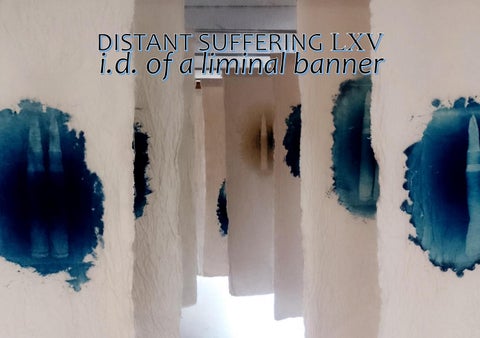
DISTANT SUFFERING LXV
i.d. of a liminal banner
Work DISTANT SUFFERING LXV | i.d. of a liminal banner
Liminal: The concept derives from the Latin words limen, which means threshold. Also from limes, meaning border or border path. The French anthropologist Arnold van Gennep introduced the term in his work Les Rites de Passage (1909). It describes in-between moments, spaces, or feelings where you have left one phase behind but haven't fully entered the next one yet or of a stimulus just strong enough to be consciously experienced. Material / size Cloths 45 unbleached canvas 270 g/m², 60 cm x 160 cm before washing; printed with Jacquard Set two for Cyanotype*; some faded / softened by means of a washing process with varying concentrations of washing powder;
Pergola first edition 13 Garden post square pine wood planed 240 x 6.8 x 6.8 x 240 cm; Rungs below: 4 pieces Garden plank pine wood rough 240 x 1.9 x 9.8 cm; 12 Reinforcements pieces 6.8 x 6.8 x 60 cm | 45°; 4 Post connector for pergola corner piece 3-sided | 7 x 7 cm galvanized; 2 Post connector for pergola T-connector 3-sided | 7 x 7 cm galvanized; Wood bolt screws 5 cm; Total dimensions first edition Hight, measured from the floor: 220 cm; Lengt 480 cm; With 190 cm.
* Sir John Herschel (1792 – 1871) discovered Cyanotype in 1842.
some (personal) remarks
With this piece I developed a new visual work as critical artistic research at the intersection of the changing relationship between technology, power, violence, and human responsibility and accountability. Central to this is the concept of liminal: the threshold space between two states, in which existing structures lose their self-evidence, but a new reality has not yet fully formed. With the iconic central image of the work – the bullet – a historical connection is established between the industralization of physical violence since the First World War and the conceptual violence of the current algorithmize-tion of power. Whereas violence was
lence of the current algorithmization of power. Whereas violence was organized in the past via industrial, material and physical systems, it is now mostly carried out and mediated by digital infrastructures, data, and algorithms. Naturally, outside Western economies, there is discontinuity in this regard: the genocides in Gaza and Sudan, the ethnic cleansing in the West Bank, and the wars in Iran and Ukraine bear witness to physical slaughter on an industrial scale. Admittedly driven by Palantir’s algorithms, but slaughter, nonetheless. We find ourselves at the intersection of the process from visibility to invisibility,
the process from visibility to invisibility, of real to fake, from being visibly present to disappearing silently; at the intersection of object and the immaterial attitude-based concept. A process that is accompanied by a lot of violence. Both administratively, politically and physically. Where, despite the almost psychotic emphasis on our 'identity', the individual disappears: we have become merely tradable manipulable data points; reductions from consumer to suspected target. In this work the audience is invited to wade through it, to come into physical contact with it. My intention is that
contact with it. My intention is that one's own time-space continuum dissolves for a moment - that one loses the familiar frame of reference and is absorbed into a paradoxical reality, in which the external threat and the poetry from within are simultaneously present. Georges Bataille (1897 - 1962) forms the theoretical starting point for the possible experience of this work. His thinking on the excessive and transgression focuses on crossing boundaries that structure human existence, such as those between life and death, violence bullet acquires a meaning that
those between life and death, violence and vulnerability. From this perspective, the bullet acquires a meaning that goes beyond that of an object symbolizing destruction. As an instrument of violence, it finds himself, literally and symbolically, on the border between life and death. By transforming the bullet into art, its original function is radically broken. The object of threat becomes an object of vulnerability. This intervention thereby constitutes a transgressive and excessive act itself. Nietzsche’s thought by showing
This shift opens a second theoretical direction, which aligns with Fridrich Nietzsche (1844–1900). His famous juxtaposition of ‘creation’ and ‘destruction’ makes it possible to view destructtion not exclusively as an end-point, but also as a condition for creation. The transformation of the bullet makes this tension materially visible. A third source is Gilles Deleuze’s Difference and Repetition (2011). He deepens Nietzsche’s thought by showing how repetition, variation, and accumulation can destabilize existing patterns of perception and thought. Where Bataille apart and who has arrived
ception and thought. Where Bataille emphasizes the transgresssion and intensity of this experience, Deleuze shows how transformation and differrence can generate new perceptual possibilities. Thus, the bullet shifts from a fixed symbol of destruction to a changeable art object in which destruction, creation, and vulnerability converge. Let us conclude on a personal note: The work also shows the process of a 74year-old artist, whose body is slowly but steadily falling apart and who has arrived within the liminal reach of the final passage to the absolute silence.
arrived within the liminal reach of the final passage to the absolute silence.
I am flying, spreading my wings Will you miss me when I'm gone? jackie venson - flying july 2017 (single) / january 2023 (album version)
Thanks to Bo de Jong inspired me and taught me how to use cyanotype Willy van Houtum supervised the bleaching process helped edit the theoretical text Cor de Lange helped building the first edition Maria Farantouri & Zülfü Livaneli (1982) music
DISTANT SUFFERING | the project
Martha Jager, curator Vleeshal in MiddelburgNL about the oeuvre (2023) after a studio visit: The dedication to art as a relational verb is central to Overvliet's work. On the one hand, the balance between poetry and criticism is special, in that the work never becomes bitter or pedantic, while at the same time the dialogue with the viewer is actively maintained. Hans’ artwork is a tender form of activism that moves and urges action and also continuously questions the role of art.
www.hansovervliet.com
DISTANT SUFFERING
i HANSOVERVLIET.COM
hans overvliet