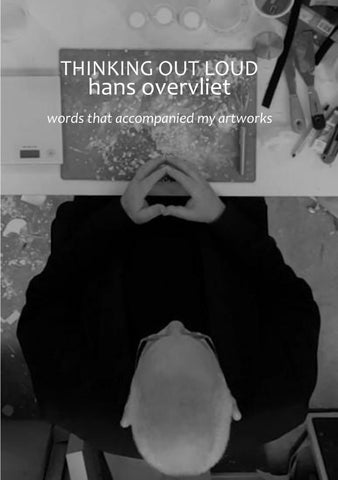
THINKING OUT LOUD
hans overvliet
words that accompanied my artworks
preface From the start of the art project DISTANT SUFFERING in 2014, the text has been a substantial part of the work. It should be noted however that the text never explains the work; it gives it a different category of layering because it speaks to another part of the mind. The texts vary considerably in content, tone, and nature. From factual journalistic approaches to extremely personal reflections on my motives for making the artworks. My profound thanks go to Willy van Houtum, who proofread every text and gave me very valuable advice.
hans overvliet curiositas@zeelandnet.nl team member of www.caesuur.nu team member of www.ikbeneengod.one supporter of ikgeefjemijnraam.nl International reference: DutchCulture Please check my website hansovervliet.com for the artworks
Content M. & cross #2 page 114 about a paper collage | 2018 the panopticon inside out i.d. of inequality | 2020
page 114
Raja Hamid Yahya al-Oud page 114 i.d. of a shared cup of tea | 2021 welcome to liquid mobility page 114 i.d. of liquid mobility | 2021 fading page 114 i.d. of a shared ice bullet | 2022 – 2026 an artist’s portrait page 114 utterly endlessly repurposed naive incantation gesture | 2024 the Other page 114 identification of a deadly pattern revisited | 2025
Sha’ban al-Dalou page 114 i.d. of a lethal clinique | 2025 grandpa Visser i.d. of betrayal | 2025
page 114
Nablus’ soap page 114 i.d. of a vanishing object | 2025 transition page 114 i.d. of a liminal banner | 2026 Mr. Karam page 114 concealed evidence of genocide page 114 i.d. of a lamented rug | 2026
M. & cross #2 Middelburg, March 17, 2018 In the studio complex in Vlissingen, where my studio is situated, an artwork of mine is located on an intermediate platform of the stairwell. From ground level, five steps lie between you and that work. It measures 144 x 244 centimetres. The artwork is an enlargement of a paper collage, printed on Perspex; different images are cut out horizontally and pasted back and thus interlock into a new story with each other. A group of twelve-year-old children of a primary school is visiting the complex in the context of an art education project. A head scarfed girl, called M., sees the artwork and freezes in her movement. And she looks. After some time, she takes the five steps up. Now she is standing still on the intermediate platform. And looks. Then she slowly walks forward. Somewhere in the jumble of images she has discovered the head scarfed girl. That girl stands with her arms widespread amidst the
rubble of a street somewhere in Syria. The iconic picture of a prisoner in the Abu Ghraib Prison is imminent. Our girl now touches the image almost with her nose; the artwork towering above her. Then she moves very, very slowly her hands together until her fingertips touch each other as if she was holding a sphere. Then her hands include the girl's head in the collage. She is standing there, her hands around the head of the other head scarfed girl. Eye in eye. Face à face . . .
the panopticon inside out DISTANT SUFFERING XXII
i.d. of inequality | 2020
Den HaagNL / The HagueNL Vredespaleis / The Peace Palace Photo courtesy of Stef Fridael | 04/06/’20
I am from the era of the passport. The time with real physical borders. Marked by movable red and white barriers over the road. With men – indeed, mostly men - in uniform. Their cap torn almost over the eyes. And you waiting in line. I remember quite clearly what it was like. In the back of the car, very curious about the building in front of those uniformed men. They look stern, grumpy. Gesticulating in short gestures. Their language is made up of strange sounds. Sounds almost a little like barking. The customs officers investigate the bluegrey booklets that my father gives them through the window. They walk around the car searchingly. Look from the book to me, from the book to my brother, to my mother. My father looks a little worried, but he smiles, nonetheless. Then the booklets come back in the car. Short nod. Apparently intended a sign for driving. And, then, suddenly you are 'in another country'. You actually immediately felt what that meant, even if you couldn't find the words for it. Also, the strange notes and the coins, for
example, were indications. And you could hear and read it. Years later, those few meters became some hundred exciting miles in 'no-stopping' territory; the road through East Germany to West Berlin. Later still, except for a single country, for me the whole planet became a completely open area because of my passport. As Arnon Grunberg points out in “Migration is not a crisis – it is collective violence” s: 'The extent of your right to mobility depends mainly on which passport you hap-pened to have obtained, namely through birth. Holders of a Dutch passport can travel to almost one hundred and seventy countries without a visa. Anyone who has to travel with a Pakistani passport can travel visa-free to less than ten countries, including Haiti and The Gambia.'1 The German sociologist Steffen Mau analyses how and by what means what he calls new sorting machines simultaneously create mobility and immobility: 'Borders must open like department store doors for desired travellers, for others they must re-main closed
tighter than ever. Nowhere is the Janus face of globalization more visible than at the national borders of the 21st century.’ (…) ‘Borders have become increasingly selective and – supported by digitization – upgraded to smart borders. And border control has expanded enormously in terms of space, has even become a global enterprise, breaking away from the territory as such.’2 In 1791, Jeremy Bentham presented his solution to the ideal prison. He designed a roundshaped building that consists of a central hall surrounded by rings of cells, con-structed on different floors. Each cell has two windows: one facing the outside and one facing the central hall. One supervisor in the hall is sufficient to monitor, know and control all residents. Bentham called this principle the panopticcon; derived from the Greek all-seeing. The basic principles of the panopticon: individualisation - one cell, one resident, everyone is always every-where fully visible, the guard can see the cell occupants, but they do not see him, they only know his presence. Costly
permanent surveillance turns into cheap disciplining, and repression gives way to voluntary submission. The panopticon, the all-seeing building, can be used for many institutions: as a prison, a school, a workplace or a hospital. Bentham emphasizes that power and knowledge go hand in hand in the panopticon. Goals: checking, disciplining, monitoring, studying, comparing, improving, etc. This was a totally new type of surveillance / inspection that affected the imagination more than the senses. The guard’s omniscient eye meant that instead of being physically punished (affecting the senses), prisoners were controlled only by being visible (influencing the imagination). Michel Foucault described this design as a dispositive*, the architectural expression of a more general mechanism of power in which the abnormal - be it lepers, madmen, criminals or homeless - becomes the subject of control. 3 In these times one could add asylum seekers, terrorists, etc.
The the Korean German sociologist ByungChul Han observes in his The transparent society4 that 'The whole new thing about the digital panopticon is above all that the cell occupants now actively participate in construction and maintenance, namely by exhibitting themselves in all openness'. ‘Today the entire globe is developing into a panopticon. There is no outside space. The panopticon is becoming total. No wall separates inside from outside. Google and social networks, which present themselves as spaces of freedom, are assuming panoptic forms. Today surveillance is not occurring as an attack on freedom, as is normally assumed. Instead, people are voluntarily surrendering to the panoptic gaze. They deliberately collaborate in the digital panopticon by denuding and exhibiting themselves. The prisoner of the digital panopticon is a perpetrator and a victim at the same time. Herein lies the dialectic of freedom. Freedom turns out to be a form of control.’ So, Bentham’s panopticon still applies more than ever and has extra power with the help of a new medium and its language: big data and algorithms.
In our current globalized information society, a very extensive database of almost everyone looks at us in the panopticon way. Nothing that happens on any part of the planet can therefore remains in an outside world. No terra nulla, no blank spots on the mental map, no unknown, let alone unknowable countries and peoples. ‘The world no longer has an exterior where problems can be left out or left behind. What happens in one place in the world affects how elsewhere other people live, hope or expect to live. No well-being is innocent of the other's misery’.5 New security methods are developed and introduced every day. The importance of passports and identity papers, travel permits (invitations) and visas is increasing. The monitoring of individuals shifts from localized, personal encounters with e.g. customs officials at the border to a remote identification technology that is collected and stored in an electronic database. The system of controlling groups of (labor) migrants for example, is steadily changing into proactive selection and ultimo exclusion
due to the rapidly ‘improving’ digital techniques. Globalization divides as much as it unites Zygmunt Bauman notes in the preface to his book Globalization: The Human Consequences.6 For an affluent highly white elite, traveling to faraway places is simply part of their good life. They see it as a primary right. Bucket lists of must-see destinations, preferably illustrated with as many selfies as possible as visual evidence. A completely different use of the d-base. Historian Mark Poster called the electronic database an updated cyber version of the panopticon.7 But unlike the panopticon, which ensures that no one can escape from the monitored area, the primary function of the d-base is to ensure that no one enters under questionable pretences. In that way the d-base be-comes an instrument of selection, separation and exclusion. It keeps the global elite "on the move" and literally keeps the locals in place. However, because of that strategy – selection, separation and exclusion - the d-base cannot be described as a panopticon. In the
words of Didier Bigo in his Globalized (in) Security, this is therefore not a panopticon that has been transposed to a global level, but a Banopticon. The term ban refers to both exclusion and the power of professionnal politicians to suspend the law. The Banopticon aims to actively deprive their mobility of a certain, but very large group of people, excluding an elite; one of the rules of power inequality in the neoliberal ideology of globalization. In 2021 the West developed yet another technology within the Banopticon: the Corona app. ‘While the corona passport facilitates free travel in the global north, people in the global south see their access to large parts of the world only further blocked by QR scanners. As Taylor 8 observes: ‘If you live in a poor country and want to travel – for example to study or visit family, which should be everyone’s right – it is often very difficult to get a visa. The introduction of corona passports makes that even more difficult. Now you not only have to prove that you are financially self-reliant and have a reason to travel into th-e country, you also must
prove that you have been vaccinated with a vaccine that has been approved by that country.’ ‘Even vaccines that are chemically identical to vaccines from Western pharmaceutical companies are not approved. The problem revolves around political recognition.’ So even (?) a global pandemic contributes to a (biopolitical9) inequality in mobility.
* dispositive (social apparatus) that generates, collects and produces ways of looking, speaking, exercising power and subjectivities. 1. Arnon Grunberg, Migratie is geen crisis – wél collectief geweld. NRC 19/11/’2021 2. Steffen Mau, Sortiermaschinen: Die Neuerfindung der Grenze im 21. Jahrhundert, C.H. Beck, 2021 3. Michel Foucault, Discipline, Toezicht en Straf. De geboorte van de gevangenis, Historische uitgeverij, Groningen, 1997. 4. Byung-Chul Han, The Transparency Society, Stanford University Press, 2012 5. Shoshana Zuboff, The Age of Surveillance Capitalism, Public Affairs, Hachette Book Group, 2019 6. Zygmunt Bauman, Liquid Times: Living in an Age of Uncertainty, Cambridge: Polity Press, 2007 7. M. Poster, ‘Database As Discourse, Or Electronic Interpellations’, in: Bauman, Globalization: The Human Consequences, Columbia University Press, 1998
8. Dr. Linnet Taylor, de Groene Amsterdammer – 08/11/’21 9. Michel Foucault, The birth of biopolitics, lecture series from 1978-1979, published posthumously in 2004. The Dutch translation dates from 2013
Raja Hamid Yahya al-Oud DISTANT SUFFERING XVII i.d. of a shared cup of tea
Populist politicians and right-wing critics often dismissively refer to the left's preference for 'drinking tea with terrorists' in their calls for the use of military violence against perceived threats to the ‘Western way of life.’ This di-course to promote resolute, violent action against supposed terrorists plays an important role in the current conflict in Yemen, where weapons manufactured and supplied by the West are used in a crude war effort. This war has taken the lives of thousands of civilian victims, almost all of whom remain anonymous in media and official reports. Finding who exactly are the individual victims of the war in Yemen is a hell of a job. You will find almost exclusively groups: unnamed "families", "wedding guests" and / or "funeral attendants", "(young) children", "bus passengers", "half the village", etc., I have literally read hundreds of UN documents. I found not a single name. These reports also provide a picture of a huge, well-oiled, bureaucratic organization
that is involved in registering war crimes. Without any consequence. The first name I came across was in a newspaper - the Guardian1: 14-year-old Raja Hamid Yahya al-Oud from Sa'na. She died by an American fragmentation bomb dropped by a Saudi Arabian drone. As the media is concerned, the war in Yemen is completely absent. And as such, the war in Yemen has become a museum piece, as can be seen in the Museum of Antiquities Leiden, where I wandered as a child in the late fifties. The brass plates spell strange, often ineffable engraved places and names. Names . . . artifact in history - an epitaph waiting for the last breath. From the Black, the Mediterranean, the Caspian Sea to the Gulf of Aden, all cultures there have a few things in common. One of these is mandatory drinking a glass of tea on every occasion as a sign of contact. Similarly
in Yemen. This makes the work very personal. Because I know the place where 14-yearold Raja Hamid Yahya al-Oud from Sa'na died quit well. It is just outside the old mud city walls of the city of Sa`dah, close to the border with Saudi Arabia. Currently, Sa'dah serves as the main centre of power and the home base of the Houthi movement. When I was there in the mideighties and the city became too busy for me, I would sit either at the centuries-old cemetery or head the other way, to the spot in the dry riverbed, to read a book underneath the acacia trees. The cemetery, incidentally, is a traditional Zaydi Islamic one and the oldest in Yemen. A small fragment of the remains of one of the very detailed and beautiful artfully carved tombstones has adorned my studio for over 30 years. So, I took my warmest memories on those many cups of tea that I was invited to drink in Yemen as the starting point to set up a
monument for 14-year-old Raja Hamid Yahya al-Oud from Sa'na. Raja was killed on 23 March 2018 by a CB 52 B/B cluster bomb manufactured in Jackson, Tennessee, at the Milan Army Ammunition Plant. White drones had circled above the cornfields near Sa'dah for the last few weeks, but there was no sign of them that morning. But they were definitely there. Now operating from higher altitudes, now armed with a cluster bomb instead of a camera. The acacia trees I hold so dear in my memories were to become Raja’s final resting place. The devastating effects that dud bomblets from cluster munitions have inflicted on civilians is well documented. They have killed or injured an estimated 56,000 to 86,000 civilians since World War II. The United States alone has spent more than $ 3.4 billion on demining operations since 1993, including in countries where it re-leased hundreds of mil-
lions of bomblets in past wars that continue to kill and maim civilians.2 The story of the bomb that killed Raja stretches back decades earlier. Using the serial number and other technical information on the CBU-52 B/B’s outer shell, the Guardian traced the munition from its manufacture in Milan, Tennessee, to Sahars’ farm in Yemen, where it ended a child’s life. The cluster bomb that killed Raja was manufactured at the American Milan Army Ammunition Plant in 1977. The large site, just north of Jackson in west Tennessee, is nicknamed Bullet Town by residents. One possible reason a 1977 bomb found its way to Sahar farm in Yemen, in 2018 is because the US has such a large stockpile of the weapons. While other countries were adopting the international convention on cluster munitions in 2008, the Pentagon defended its use of them as a “military necessity”. However, it conceded to international
criticism by instituting a policy to reduce the failure rate of the munitions – i.e. the amount of unexploded ordnance left behind – to 1% or less after 2018, although that policy was scrapped by Donald Trump 2017 in order to sell the weapons to Saudi Arabia. “We are just farmers,” Hamid Yahya al-Oud, Raja’s father, said over a glass of tea in his living room. “Look outside. There’s our well, there’s our goats. Why would there be Houthis here?” Rawan Shaif, the lead Yemen researcher at the open-source investigative organisation Bellingcat: “There’s no military advantage in using a cluster munition on a simple farm, unless your aim is to make that area uninhabitable for generations of civilians and military alike.” Because the deadly submunitions will stay with here forever; will remain a threat for decades once deployed. Those from older designs often resemble shiny silver orbs around the size of a tennis ball, making unexploded ordnance especially attrac-
tive to curious kind. Like the 14-year-old Raja Hamid Yahya al-Oud from Sa'na.
1. Bethan McKernan | October 3, 2019 | A father's grief and the Made in USA bomb dropped in Yemen https://www.theguardian.com/ 2. John Ismay | December 4, 2019 America’s Dark History of Killing Its Own Troops With Cluster Munitions Magazine New York Times
Welcome to liquid mobility DISTANT SUFFERING XXE
i.d. of liquid mobility | 2021
We are grasping for who we are, dangling between the 53 identities Facebook reserved for us in 2019. In the past we were voyagers. We had a purpose and a direction, we knew how far we were from home, who we were and where we belonged. Now we changed into tourists. We settle down for a moment and gain fast experiences, but we aren’t connected to anyone or anything. We lack purpose other than dissolve deep boredom. We interchange totally different countries & cultures almost as easily as we change the coffee brand or anything else we consume. Literally by accident, we occasionally come across our counter tourists when they arrive on a beach that we had just booked. Asylum seekers profiting from the same liquid mobility. Every day updating the necessary elements for building your identity is central in what is your design of your life. So, you find yourself in the midst of the pushing aspect of liquid modernity1 as described by Zygmunt Bau-
man. A liquidity that can be described as infinitely mobile in which everyone and everything has become a 'product' and everything and everyone competes with everyone for the right to exist. Add to this the steady breakdown of statefueled social security in many countries and the shifting of responsibilities from global problems onto the shoulders of local, free, rational individuals and we complete the picture of liquid modernity. This might be the source of our funda-mental uncertainty and fear: major problems such as climate, economic inequality and differences in mobility are global problems for which local solutions cannot be solved due to the nature of these problems. Waste production in the broad sense of the word is at the heart of moder-nity, according to Bauman in Wasted Lives2. Characteristic for that waste production is the remorseless speed with which also human waste is produced, whereby all the redundancies are mercilessly cut away.
S0, we update our programs, our profiles, our identities, we update just about everything on every moment of the day and night. Apparently, we all have a deep desire to be seen. We are all afraid of being left out, not being noticed. Those who are not present sidetrack themselves and become invisible. With the ultimate consequence to become an unsaleable product. Comply or become obsolete. On top of the pushing, there are the pulling aspects: fugitives are held back at E, firestorms in F, bus accident in G, populist H accuses I from doing J, floods in K causes L damage, mass shooting in M, banking crisis in N., etc., etc., etc. You recognize the infinitive repeating news waves. Whatever we do - we can't get a break from the everlasting pushing & pulling updates. Returning to Bauman, together with Verilio3, he emphasises that these daily updates result in institutionalization of fear. As an example: the most obvious result of the antiterrorism policy was the rapid increase in the
magnitude of the fear that saturated society.4 Bau-man wrote. Perhaps that policy of fear becomes even more visible when we look at the category mobility. Because here the two sides of the same coin are most clearly visible. The current tourist flows mainly consist of huge numbers of northerners, Chinese and Japanese who can freely move around the globe. Nobody notices that this is an incredible privilege; forgetting is the byproduct of the obvious. Asylum seekers and economic migrants are, in old-fashioned photographic terms, the negative of the tourist flows - they are the flip side of that fluid mobility - in the globalized world. Both groups - asylum seekers and the tourist elite alike - are using, or - in the case of asylum seekers, trying to make use of global mobility. As for the tourist flows: Baudrillard5 taught me in his The Fatal Strategies: “We live in the age of hyperreality, in a multimedia consumer society in which images and objects lead
a life of their own. Thát reality has nothing to do with reality, it is a collagelike video clip; we live in a spectacle society.” We don't buy things because we need them, but because of the make-believe world they evoke in us. The result: “I am because I am talking and what I am talking does not matter much.” In this context the tourist in addition to environmental and cultural damage, yields only an empty nullité ( zeroness ).
1. Zygmunt Bauman o.a. Liquid Times, 2007 2. Zygmunt Bauman in Wasted Lives, 2003 3. Paul Virilio & Bertrand Richard, in The administration of fear, 2012 4. Zygmunt Bauman in: Liquid Fear, 2006 5. J. Baudrillard & M. Nio in De fatale strategieën, 2002
fading DISTANT SUFFERING XXI i.d. of a shared ice bullet
kunstverein bahnhof25 | KleveBRD November 11, 2023
Reflecting on the conversations during the slow melting of i.d. of a shared bullet, Adorno comes to mind. He too taught me to look at art in a layered, but above all, in a political way. At the roles of the art producer, the art consumer, and all entities that move in between, the ideological angles in art history, etc. All this of course within the economic paradigm of the ruling class. Adorno set me on the content of my artistic path with “Art is not a matter of pointing up alternatives but rather resisting, solely through artistic form, the course of the world, which continues to hold a pistol to the heads of human beings.”1 I also felt almost personally supported by him: Theodor Adorno perhaps came the closest to making the ultimate defence of l'art pour l'art by claiming that “art becomes social by its opposition to society, and it occupies this position only as autonomous art. It criticizes society by merely existing.”2 (italic h.o.)
Back to the beautiful conversations during the melting. My artwork i.d. of a shared ice bullet consists of a frozen bullet in a small bottle provided with a cork and a label carrying the title. The bullet is made with the aid of a mould resembling the cartridge case of an AK-47 Kalashnikov, the most mass produced assault rifle on the planet. The image of this gun is portrayed in many documentations of war. The bullet itself, one rarely sees. The horrific results on the other hand . . . Immediately after the little bottle with the frozen bullet leaves the freezer, the ‘decay’ starts: the bullet begins to melt. It melts from a metaphor of a life-threatening object – a bullet - into a life creating element: water. I presented i.d. of a shared ice bullet for the first time solo in June 2021 in Luxfer Open Space in Česká Skalice, the Czech Republic. As an opening session.
During the Juxtapose Art Fair in Aarhus, Denmark, for the first time we – my wife Willy and I - handed people the artwork one on one. We let the melting decide about the time frame: it guided the conversation almost like an hourglass. The people who thawed the bottle in their hands all became emotional after a very short time. First, they considered the work as beautiful and then – sometimes at a deep personal level – meaningful. Some wanted to stop the process by putting the bottle back into the fridge, others photographed the ongoing process during our conversation, some tried to minimize skin con-tact to slow down the melting process. Many lamented that the work confronted them with their own vulnerability in a way almost how Adorno was quoted by ByungChul Han in his 'Saving beauty': “We should return to the kind of beauty that makes us (…) in Theodor Adorno’s terms, realizing our own finitude.”3
In many cases, the conversation half way down focused on the preliminary result: a small glass bottle with a label and a cork with a little water in it. Apart from the artist, only the owner has seen the artwork in its “original” state. Everyone else must trust that the story is true: that this water was once an ice bullet. So, the only “realistic” image is anchored in the owner’s memory as long as she / he / x remembers that. “Indeed, this escape from reality led to an experience which could (and did) become a powerful force invalidating the actual prevailing bourgeois values, namely by shifting the locus of the individual’s realization from the domain of the performance principle and the inner resources of the human being: passion, imagination, conscience.”4 On a personal level, the specific work also shows the physical dynamics of my physical present; me being 71 years old at the time and survived cancer, be it with a lot of
negative side effects. The vulnerability and transience of myself and others around me are quite realistic facts in my life. So, part of the work of course is sha-ping my own finitude. An experience I share with all those wonderful people I had the privilege to meet while melting the ice bullet under the watchful eye of Adorno . . .
1.
2
3 4
Theodor W. Adorno, “Commitment,” in Notes to Literature, Volume Two, ed. Rolf Tiedemann, (Columbia UP, 1974) p. 80 Theodor W. Adorno, Aesthetic Theory, eds. Gretel Adorno and Rolf Tiedemann, (U Minnesota Press, 1997) p. 225 – p. 226 Byung-Chul Han, Saving Beauty, (Polity, 2018) p. 22 – p. 24 Herbert Marcuse, The Aesthetic Dimension: Toward a Critique of Marxist Aesthetics (Beacon, 1978) p. 4 – p. 5
the Other DISTANT SUFFERING LVIII i.d. of a deadly pattern revisited | 2025
Emmanuel Levinas (1906 – 1995) identifies the personal encounter with another human being – the Other – as the fundamental experience of ethical responsibility. This responsibility in the first person, my responsibility for the other, is at the heart of Levinas' philosophy. In his work, he focuses on what he calls the face à face encounter with the Other, an experience in which an individual, a human being, becomes aware of the mortality and vulnerability of the Other. To emphasise the transcendent otherness of the other, he repeatedly and deliberately writes the Other – as I do here – with a capital letter. Levinas argues that we must see the Other as a unique person, not as a reflection of ourselves. That this fellow human being is not just another person but appears as a strange other. More strongly, as an inaccessible creature that paradoxically appeals to my responsibility.
In his view, avoiding the gaze of one's fellow human beings is the beginning of all violence. In his 1969 essay Freedom and Commandment, he writes: The physical restriction of freedom in captivity is preceded by a fundamental form of violence: Violence and tyranny are characterised by the fact that they do not see what they treat in the eyes; or to be more precise: by the fact that they do not recognise any face at all. And a little later he concludes I am only free in the face of the Other. It is from this perspective that I want to look into the eyes of those murdered by the army of the apartheid state of Israel with this work. They were all Others. Others I did not know, but who nevertheless wanted to inform me, despite all the dangers, of the genocide they were in the midst of and ultimately became victims of themselves. They took photographs, made videos and sound recordings, edited, assisted, blogged, posted on Facebook, Insta, X, you name it.
As eyewitnesses, they merely recorded the horrors. And while they did so, most of them looked me straight in the eye, face to face, until they were forcibly stopped from being the Other.
Sha’ban al-Dalou DISTANT SUFFERING LI
i.d. of a lethal clinique | 2025
I thought the internalised journalist would protect me. Should that fail, there was always the artist in me to keep me from shock. After all, artists sublimate. Right? Then I watched the video. Neither of my protections kicked in. Of course, it happened before. In Colmar, standing in front of the Isenheim Altarpiece. Three times we had driven hundreds of kilometres extra, coming from the Provence. Only to back off: too afraid to go inside. Too afraid of that magical place of suffering. The fourth time proved us right from the moment we finally entered. The retable would haunt me for years in nasty nightmares. Until I saw an image by Jasper Johns. He made an outline out of the soldier being brought down by the resurrection of the christ. Jasper Johns’ image apparently neutralized something in me. The video I referred to captures the effects of an Israeli strike with AGM-114 Hellfire in Deir al Balah on Monday, October 14, 2024, at about one o’clock at night. An already wounded boy was sheltering there in a tent on the compound of al Aqsa Martyrs’ hospi-
tal with his parents and his five siblings when the Israeli rocket hit. That boy was Sha’ban al-Dalou. He was just days away from his 20th birthday. Because of the war in Gaza, he and his family had to leave their home in Gaza City. Shaban was being treated in a tent near al-Aqsa Martyrs Hospital after surviving an Israeli attack on a mosque in Deir al-Balah that killed more than twenty people earlier this month. In the process, he suffered head injuries for which he was treated at the compound of the remains of the hospital. Hence the Intra-Venous drip in his arm. I watched a person burning alive in a tent on a hospital compound in Gaza. I still can't believe what I saw. To the extent that I can't forget it either: a horrible flaring inferno, people screaming their lungs out, and there, amid the flames, a body in spasms; both arms raised, reaching for support, one arm still connected to an IV. An IV that refused to melt. That retained its distinctive form in the flames. Until the very last moment of his life, that healing element remained untouched,
persisted in its function. It also protected me by fixing my gaze away from Shaban's burning body. This horrendous video and pictures with the speed of light made headlines all over the world in all possible media: ‘White House says imagery of Gazans burning alive after Israeli strike is horrifying’, ‘Displaced Palestinian burned alive by Israeli airstrike on tent encampment’, ‘Sha’ban al-Dalou: The Palestinian teen burned alive in Israeli bombing’, ‘Jeder könnte der nächste Sha'ban sein’, ‘Familie slachtoffer Israëlisch bombardement: we konden hem niet redden’, ‘A Gaza, Shaaban Al-Dalou, le brûlé vif de Deir Al-Balah’, ‘Siento que un día mis hijos van a saber esto y me van a preguntar qué hicimos para deter esto.’ It caused actions like the video of Sha’ban AlDalu’s horrific death projected on-to the UK parliament buildings by the Palestine Solidarity Campaign (PSC)’ on October 18, 2024. On national American TV, in this case MSNBC: ‘Chris Hayes honours (sic!) Palestinian teen who burned to death after Israeli strike’: a full 4:14. And of course there was
the conjuring cri de cœur: ‘Sha’ban al-Dalou burned alive before the world. May his death awaken us’. On the day our Sha’ban gruesome died, October 14, 2024 at one o’clock in the morning, more than 42,200 people have been killed in Gaza, mostly women and children, and over 98,400 have been injured. In The Guardian, Zak Wittus wrote: ‘Let the memory of Sha’ban al-Dalou be the memory that brings us back to our common humanity and ends this war . . .’ Two weeks later ‘his’ Mr. Prime Minister, First Lord of the Treasury, Minister for the Civil Service, and Minister for the Union, The Right Honourable Sir Keir Starmer Knight Commander of the Bath, King’s Counsel and Member of Parliament, sold another muti-billion batch of weaponry to the apartheid state Israel. And the deeply concerned ‘White House’ which said that imagery of Gazans burning alive after Israeli strike is 'horrifying'? Well: “The images are very disturbing, and we have conveyed our concerns to the Israeli government,” said a spokesman. “Israel must do more to prevent civilian deaths.”
Only to ship a multi-billion-dollar batch of AGM-114 Hellfire to the-terrorist state the very next day without any reservation and / or demand. As do the Dutch, the French, the Germans, in short, as do everybody. So, in the end Sha’ban’s horrible death was just another human-interest story for the Western media and the memory of his death is already replaced by 1,789 other gruesome events. If all the corporate media remain owned by the billionaire class, we will continue to be stunned with events instead of being informed of the back-grounds of this Epstein parasite class's business model: raking in as much money and power as possible by destroying or turning against us and the institutions that protect us. A while ago they installed the pathological liar Mark Rutte as head of their military NATO-club. Who within weeks reported that war now is the new normal. Speed and fear: Paul Verillio is smiling sadly from his cloud. We again might need the solace of Isenheim very soon; we might need writers to articulate the inexpressible again.
Which also raises the question of whether this work - or any other work of art for that matter- still contributes helping to express the in-expressible . . .
grandfather Visser DISTANT SUFFERING LVI
i.d. of shared betrayal
For over a year now, almost daily I receive videos from my Gazan friend and colleague Myuz Ahmed. Myuz is more than helping traumatised children in the Gaza Strip. In his videos he, without further ado, shows what remains of his world by simply walking in his utterly destroyed habitat. One on one. Myuz’ images pile up in my head with all the other horrors of that day. Of course it does not leave me unmoved, but it does not overwhelm me either. Until 26 July 2025. A reel of just under seven seconds. I see a bearded man crouching down, scraping something out of the sand and putting that something in a brown paper bag. For a moment, I manage to convince myself that I am not seeing what I’m seeing. That this is not a man trying to extract the last remnants of some spilled rice from the sand for his starving family somewhere in a tent. After a few seconds, my defences collapse and I realise what I am seeing. Suddenly, my own grandfather's history becomes a full-colour reality. I see him retur-
ning tired and emaciated from a trip in winter 1944 from Leiden beyond Haarlem. To the polders where his family originated from. He has hung two panniers on his bicycle – indeed with wooden tyres – containing some potatoes and vegetables to feed his family. As he returns at the Morspoort, he is stopped by four German soldiers and forced to throw his hard-earned belongings into the canal - the Morssingel. I would like to point out that my grandfather did not tell this story to vent his hatred for Germans: he always added that “we” would never resort to such practices. As a child, he made me promise that solemnly; I will never forget the look in his eyes when he said that. Watching the man in the video endlessly, I hear Grandfathers Vissers’ voice, I feel his anger, his powerlessness, the sadness, the humiliation, the defeat. The sadness about the man in the video is now hitting me hard and will completely paralyse me for a few days. Because I had solemnly swore to my grandfather that we would never let it come to this again. That
we had drawn up international laws. Indeed, in accordance with the Magna Carta Libertatum from the year 1215 we established the U.N., installed the I.C.C. (in The Hague of all places!) as the successor to the Nuremberg Trials, we set up the Geneva Conventions (Article 47!), etc., etc. Never again exclamation mark. And yet: the man in the video was forced to perform the same humiliating and lifethreatening act my grand-father Visser was forced to do in that extreme cold winter of 1944. We have betrayed ourselves greatly . . .
an artist’s portrait DISTANT SUFFERING XXXX
utterly endlessly repurposed naive incantation gesture 2024
Despite all the preparations, starting in 2022 - finding the ‘proper’ bullet, making the 3D prints from the ‘appropriate’ one, figuring out the right size, making the moulds and starting to cast the bullets from porcelain plaster - I had no idea what I was going for. No idea on what I was working toward. Other than transforming the object ‘bullet’. A bit like the concept of my ice bullet. The first hundred and twenty bullets or so I just focused on the concentration of the making and - I hoped – on the direction. That went well until D. intuitively noticed that merely the making of these bullets was the artwork in itself. From then on, things went awry. After all, if casting the porcelain plaster bullets was the work itself, where did that artwork end? While working on the series, things changed fundamentally in the Middle East: Hamas and affiliated groups on October seven radically altered the resistance to Israel’s occupation of Gaza. As a result, Israel began a genocidal massacre of the Gaza population, i.e. also on my friends.
Bullets, primarily designed to kill and wound, in this artwork are completely transformed from destructive to harmless objects in this context. Bullets from porcelain gypsum completely undermine their destructive potential; placed in grave-like rows, a transformation occurs from an object of violence to an object of reflection and memory. By ‘verwandeln’ the destructive element of the bullet into something fragile, harmless, aesthetically pleasing, the now-appearing ob- ject reaches multiple layers of imagination. Conversations with filmmaker Jochem Weststrate about this project revealed another personal layer. My art is very often composed of a multitude of variations on one form: 250+ cans with plaster keys, 136+ portraits of assassinated journalists, 3,000 images of clouds & explosions, destruction and sea-waves, 38+ “water” paintings, 1,570 casted bullets, etc. Gilles Deleuze’s Difference and Repetition is always present in the back of my mind . . .
So in the end, the video that Jochem and I made, also became an autonomous videoportrait of this visual artist. At the same time, by casting a number of these bullets every day, I hoped, compulsively and against my better judgment, that the people I know, including many people I can call my friends, in Ukraine, Gaza, Yemen, the West-Bank, Israel, Jordan, Syria, Lebanon, etc. would stay alive. Thus, the work and its possible purpose, apart from the making, legitimised itself within itself. Alas: indeed, against my better judgment.
Nablus’ soap DISTANT SUFFERING LIV i.d. of a vanishing object | 2025
In the modern, civilized West, we spend a lot of time and attention on our identity. In which I should restore that singular to plural: Facebooks' algorithm now distinguishes more than 50 different identities of its users. More important: some twenty types of identity are recognized in international law and protected by human rights. One experiences identity, among others, as the result of origins, gender, sexual orientation, as well as experiences, achievements and social ties. An identity may be innate (such as by skin colour), or created later in life (as in survivors of serious illness or trauma), or chosen (such as a political viewpoint). But in many cases, the line between what is self-chosen and what is given is quite fluid. One's own identity is always intertwined with the cultural, economic and social position. Which can also be fluid as Zygmunt Bauman taught me. Where culture is not just a collection of to be experienced elements such as art, music or cuisine, but is comple-
ted by a complex system of (social) norms, values, beliefs and practices that forms us from birth. When your living environment, your society with all its identitarian signs – architecture, libraries, universities, religious buildings, governmental buildings, historical heritage, etc. is destroyed and/or rendered unusable, the physical frame of reference of your past, your present and thus your future simultaneously disappears. The past, not only as memory or idea, but as material. We are dependent on peoples’ testimonies about life in the occupied territories, as it was, as it is and as it may never be again. We need witnesses who paint a picture of daily life in streets, squares and markets. Who tell what the landscape looked like, what trees were there, where the city was and where the countryside was. Who give an insight into people's moods, their dreams and questions, their plans and disappointments.
Which tell of meals, grandmothers’ coffee, feasts, music, song and dance, and which explain how f.i. the Palestinians relate to religion, family, politics and culture. We need stories through which we can understand life in Palestine from the inside and empathize with the large and small events, the dilemmas, conflicts and contradictions and the struggle of every human being to live in impossible circumstances that many describe as genocidal. The vibrant Palestinian culture with its long history is in immediate danger of being completely erased. Moreover, many artists have been killed in Gaza and the West Bank: writers, musicians, poets, and singers, calligraphers, and dancers, photographers, painters, theatre makers, etc. Or they are no longer able to work due to hardship and lack of resources. What does it mean to erase a people – a nation, a culture, an identity? This is beginning to become blatantly clear in Gaza and
eventually leads to a dear friend in Gaza: “My apartment in al-Jalaa, in a five story building, was my daily life. I lived there with my uncle and grandmother under a roof that gave us security and warmth. On the third day of the war, this safe haven, without any warning, turned into a mess. From one moment to the next, everything was gone, everything buried – the walls that embraced our dreams, the corners that held our laughter, even the smell of the coffee my grandmother made in the morning. I write. I write about widows lining up for food at a food distribution point, the last resort for families fighting against hunger. I write about children playing among the rubble, still trying to have a little fun in this tragedy . . . “* I am 72 years old at the time I made this piece of art. In 1959 my uncle Wil Freeke took the picture I use in this piece. It shows his lovely daughter - my niece – Annemieke, my younger brother Marten and me in the backyard
of my paternal grandfather at the Pieter de la Courstraat 67 in Leiden. It’s a verifiable part of my identity. Because we still have the photo, because my grandfather's house recently is beautifully updated into this era, because the small neighbouring square and park with the modest pond adorned with the merry figurine of a fish and a mermaid still exists. It’s a place I visit always whenever I am in my town of birth – Leiden. Materialised past, present and humble future. The gift of the object. I was in the West Bank in 1987 during the First Intifada. In Ramallah I spoke with a woman associated with the P.F.L.P. - the Popular Front of the Liberation of Palestine. She taught me that the moment women hit the street, the street really becomes active. After the interview, she took me to one of the ancient soapmaking factories in Nablus. The scene was what Ramsey Nasr described**: In a large hall, thousands of white cubes lay piled up in circles. Layer upon layer
they formed meters-high white columns of soap, like chimney pipes or some art installation. Sources show how old this industry is: in the 13th century, soap production was already largely industrialized in the Islamic world, with factories in Nablus, Fes, Damascus and Aleppo. In the year I visited the factory in Nablus with Rada, there were still about fifteen left of the more than thirty that existed in 1907. That number had dropped to two in 2008.*** Israeli military raids during the Second Intifada destroyed several soap factories in the historic quarter of Nablus. These two remaining factories currently produce for Palestine and some Arab countries, with by the Israeli occupying forces very limited fairtrade exports to Europe and beyond. Considered being quite an important aspect of Nablus's cultural heritage, the preservation of the Nabulsi soap-making industry has been the focus of several local projects. The restoration and conversion of the old Arafat
soap factory into a Cultural Heritage Enrichment Centre is one of them. In December 2024, Nabulsi soap was recognized by UNESCO as an Intangible cultural heritage in need of urgent safeguarding. In mid-February 2025, the apartheid state of Israel shifted its war crimes from Gaza to the West Bank. In two weeks’, time, more than 20,000 people already made into refugees were forcibly removed from their refugee camps. Again. Dozens of civilians, were murdered, hundreds wounded, hundreds were taken hostage as so called prisoners. The world did not even watch, for these pogroms remain eminently off-screen, notwithstanding the media age we live in. If anything at all appears in the media, it is focused on the crimes against Palestinian civilians by the Israeli occupation army and the barbaric hordes of ultra-rightwing settlers. In which attention to the object understandably loses out.
The centuries-old tradition of Nablus soap making, founded on taking care of the also often centuries-old olive trees, materialized in such a simple cube of soap, I would like to commemorate. Because it incorporates the political, cultural, historical and economic heritage of Palestinian culture. Because that little cube literally comes from the soil of Palestine thanks to the generosity of the olive tree and its roots. Because there is intrinsic value and beauty in the juxtaposetion use / disappearance of the object. Because that little object is also the analogy and metaphor of cleaning. Which Ramsy Nasser described profoundly in the essay mentioned**: I stood there, and the floor in front of me was soap, tiled with bright white cubes. The Palestinian who showed me around, stood across the soap floor. “Come,” he said. I didn't dare, thought it churlish to just walk across. “Don't worry, Ramsey,” echoed down the hall, “It is soap it will clean itself.”
Ethnic cleansing is the opposite of soap. It is violence - it will fight itself.
*
Rita Baroud Ontheemd in Gaza: ik ben 22 jaar en voel me eeuwen ouder Displaced in Gaza: I am 22 years old and feel centuries older NRC | December 20, 2024 ** Wat is verzet? | What is resistance? Het Antwoord van Ramsy Nasr Ramsy Nasr's answer Volkskrant | February 15, 2025 *** This Nablus soap: made by the Mojtaba Adnan Tbeleh family, founded in 1971. The 400-year- old family tradition goes so far that the man who cubes the soap is called Tubeili.
transition DISTANT SUFFERING LXV
i.d. of a liminal banner
Liminal: The concept derives from the Latin words limen, which means threshold or border and limes, meaning border or border path. The French anthropologist Arnold van Gennep introduced the term in his work Les Rites de Passage (1909). It describes in-between moments, spaces, or feelings where you have left one phase behind but haven't fully entered the next one yet or of a stimulus just strong enough to be consciously experienced.
Arriving in April 2026, it appears that, despite decades of promises that globalization, digital communication, and technological innovation would bring humanity closer together, the exact opposite has increasingly become true. If there is one language that the ruling Epstein-parasite class attempts to universalize, it is not the language of democracy, solidarity, or cooperation, but that of violence. Paradoxically, the very forces that promised connection have become the instruments of fragmentation. Social media has transformed public debate into a spectacle in which indignation, manipulation, and polarization spread with unprecedented speed. The long-promised global village has indeed emerged, but instead of fostering mutual understanding, it has become a space in which conflict, division, and fabricated (dis)-agreement spread immediately across the entire planet. Within a fully integrated global economy, in which production, services, fi-
nance, and communication transcend national borders, humanity is increasingly capable of threatening one another—verbally, psychologically, economically, and physically. Violence manifests itself in countless forms. Racism, sexism, gender related violence, femicide, political oppression, systematic exploitation, institutional corruption, and the normalization of abuses committed by powerful parasitic elites have become familiar features of public life — often presented by the corporate media itself as transparency: corruption committed in broad daylight is apparently no longer considered as such. Genocides and war crimes are tolerated or justified by governments that continue to describe themselves as defenders of freedom and democracy. International law as such and f.i. the Criminal Court in The Hague are under great pressure, if they have not already succumbed. Speaking about geno-
cide, let alone criticizing it, has become the crime in the U.K. and Germany . . . Alongside conventional wars and countless regional conflicts, another form of violence remains virtually unnoticed, despite its profound consequences: the ruthless destructtion of ecosystems, biodiversity, and the living planet itself. In which the exploitation of nature has, of course, become inextricably linked to the exploitation of humanity. In recent years, the ruling Epstein parasites, operating through multinational, therefore extra-state corporations, have created the conditions for a new radical transformation of society: artificial intelligence, in short AI. Its rapid rise calls for careful reflection. To understand the political significance of the present moment, it is useful to compare it with an earlier technological turning point formed by institutional violence: the First World War. The lessons from that period are remarkably relevant today.
At first glance, the mechanized battlefields of 1914–1918 appear fundamentally different from current algorithmic warfare. The First World War was fought with trenches, machine guns, poison gas, tanks, and heavy artillery. Contemporary conflicts are increasingly dependent on algorithms, satellite information, predictive analytics, autonomous drones, and massive chip-driven infrastructures. But beneath these technological differences lies a striking continuity. In both periods, technological innovation fundamentally changed not only the way war was waged but also the relationship between man, power, and responsibility. Both the mechanization of war in the twentieth century and the rise of AI in the twenty-first century demonstrate how technological progress is accompanied by new forms of surveillance, control, and dehumanization. The First World War marked the industrialization of violence. For the first time, destruction was organized on an industrial
scale. People became components of immense military systems, in which individual lives were reduced to statistical calculations regarding logistics, ammunition, and casualty figures. Soldiers ‘disappeared’ into technological structures whose primary goal was to maximize the capacity for destruction. War ceased to be primarily a confrontation between individuals and increasingly became a competition between industrial systems and technological efficiency. ‘Mechanization’ drastically changed the battlefield and, consequently, the economy and the labour market. As a result, the speed, productivity, and scale of production increased sharply, which increasingly demanded the concentration of people and places. This called for tighter and more hierarchical command structures, in which planning, efficiency, and central control were central. Thus, Western society developed into a highly industrialized, technologically depen-
dent, and bureaucratically organized society. Currently, artificial intelligence is also drastically changing the relationship between humans and technology. Algorithms are increasingly making decisions in the fields of security, finance, communication, military strategy, logistics, transport, healthcare, and even the operation of everyday household appliances. Autonomous systems can analyse targets, predict behaviour, and filter information with little or no direct human intervention — often at only a fraction of the cost of conventional military technology. While advanced fighter jets require trillions of astronomical investments over their lifecycle, highly effective long-range drones can be designed, assembled, and deployed at costs comparable to those of an ordinary consumer vehicle, using commercially available parts that are difficult to sanction or restrict. Therefore, the military-industrial com-
plex has developed a new revenue model: no longer the production of weapons, but their development through Research and Development is the current cash cow. We must note, quite cynically, that the longest-running war in Europe – the one in Ukraine – has for years bogged down in trench warfare. In this context, concrete acts of war involve striking almost exclusively civilian targets outside that deadlocked front area. Thanks to companies like Palantir, controlled and led by a fascist fan of apartheid, it has become possible to destroy people, homes, villages, cities, industrial infrastructure, and even entire countries with unprecedented industrial efficiency. At the same time, images documenting this destruction in high definition are filtered, prioritized, or suppressed by precisely those AI systems that direct our attention on social media platforms.
Ironically, the moment violence becomes visible worldwide in HD and 4K is simultaneously the moment it becomes invisible. Endless streams of images no longer guarantee actual perception. Con-stant repetition turns horror into spectacle. The destruction is beginning to resemble the logic of digital entertainment, in which destruction is endlessly consumed, forgotten, and replaced by the next series of images. The new cloak of overexposed invisibility is therefore not the absence of information, but rather its overwhelming abundance. So modern technological societies increasingly link technological development to efficiency, optimization, and control. Human activity is judged primarily because of utility, productivity, and measurable results. During the First World War, this logic manifested itself in the industrial organization of warfare. That same logic has expanded further with artificial intelligence but then aimed at manipulating behaviour.
Algorithmic systems therefore increasingly determine what is deemed visible, relevant, credible, or desirable. In doing so, they subtly influence behaviour, perception, and public opinion, while presenting themselves as neutral technologies. AI constantly influences the decisions people make and the reality they perceive. Moreover, digital technologies have created entirely new systems of surveillance and behavioural prediction. Companies like Palantir unconcernedly collect, combine, and analyse vast amounts of personal data to predict, influence, and cash in on human behaviour. In this process, power becomes increasingly less visible while simultaneously becoming more ubiquitous and more intrusive on a daily level. AI shifts power from visible coercion to invisible control. Just as trenches created physical distance between perpetrator and victim, AI creates managerial distance between action and responsibility. Violence becomes more abstract, bureaucratic, and
easier to deny because agency is fragmented and responsibility is spread across increasingly opaque technological infrastructures. Within AI-mediated systems, agency and responsibility become increasinggly obscured. Violence thus be-comes abstract, diffuse, and bureaucratically invisible — and thereby easier to deny. The author disappears, as it were. The central challenge is therefore to make visible the power relations, economic interests, and political structures embedded in artificial intelligence. As we have shown: these are not neutral technologies, but infrastructures that increasingly perpetuate systems of violence against both humanity and the planet — driven by profit and the concentration of monopolistic and authoritarian power. That nearly absolute power is vested by an oligarchy operating from an ideology of an extreme form of locust capitalism, with one thing central to its pursuit: growth. That may
be another explanation for their extremely aggressive implementation of AI. Because just about all the approximately 20 players each hold about 90% of their markets, they can no longer entice investors to invest in those markets. To enable growth, something new must be devised. Do you remember the derivatives trading as a growth model for financial institutions? The Dotcom Bubbel? Or meme stocks, NFTs, SPACs? Then you also know who will pay the price for the failure of expectations surrounding AI. However, all this does not alter the fact that AI currently also poses a concrete threat to matters such as privacy, copyright, democracy, insurance options, job security, etc. A threat that reduces the 99% to a collection of profitable and manipulable data points. Let us begin by refusing to allow ourselves to be reduced to an ongoing revenue model, a data point, a prediction, a target, a cost item, or a statistic. From there, let us take up the political challenge to question not only
AI itself, but also the power relations, economic interests, and institutional structures in which it is embedded. Coupled with radical transparency, we can then create space for democratic scrutiny, criticism, and — where necessary — resistance.
How Mr. Karam, a solar eclipse, a sandy beach, a rug, a genocide, Daheisha, Kahn Younis and Majdal Shams came together
DISTANT SUFFERING LXVI i.d. of a lamented rug
In what is left of Khan Younis works a man. He works there with children. With traumatized children. Out of necessity. In the hell, created by Israel at the Mediterranean Sea. A hell called Gaza. Reduced to the surface area of the Dutch island of Texel. An Estimated 1.1 million children are trying to survive over there; about half of the total population of over 2.2 million inhabitants. Again: on the surface area of Texel; about 20 by 8 kilometres. Children who have been constantly bombed for their entire lives. Children who, despite their age, have seen and continue to see countless things that we adults here in the West, fortunately, never see in our entire lives. Children whom the man supports in his school he calls We Still Have a Future with a team of specialized multi educated artists who are also trained as a therapist. The man in question – Karam Saadoni, better known as Mister Karam – is supported by the Hope Foundation*, based in The Hague.
By offering inventive lessons in the fields of art and culture, Hope aims to empower children in conflict areas to build a meaningful life for themselves. We envision a future where children can cope with the effects of war in the best way possible and where the basic requirements for leading a life that is worthwhile are available to all. For the Khan Younis Open Studio team, Academy for Young Talent, Social Media Lab, Breakdance Academy and many more organizations, Hope acts as a source of inspiration and as initiator for projects. The Hope Foundation has been supporting activities like the ones of Mister Karam in Gaza for 35 years now. That makes it possible that he, together with a group of artists working in diverse disciplines, can do his important work with a multi-talented team on a professional basis in a sustainable way. As an aside: Mister Karam was forced to constantly relocate his school We Still Have a Fut-
ure because it was destroyed time and again by the most moral army in the world, the Israeli Defence Forces; in 2026 for the fifth time. Last year, all the paper for the children to work with ran out. Even the used food bags from UNWRA aid were gone. The children often paint on the ruins of the bombed houses. Large, cheerful floral paintings featuring messages such as stop bombing, we can love each other too. However, drawing and painting on the ruins had become too dangerous because of the Israeli sniper drones. The solution for his lack of paper that Mr. Karam found is both a metaphor and an analogy for his working method: he scrounged together several bro-ken washing-up bowls, repaired them as best he could, filled them with sand, and let the children draw in the sand with their fingers and hands. On August 12, 2026, W. and I are watching the miracle of the solar eclipse. We are doing
so on the Westkapelse Sea Dyke, along with thousands of others. We look out over the North Sea, groynes made of wooden poles covered with barnacles, and the sandy beach, decorated with the inevitable potholes. Suddenly, Mister Karam and his washing-up bowls come to mind, and some-where in my head, the potholes in the sand are connected to the beach in Gaza where I so often enjoyed myself after a day's work. Seconds later, I realize that that same sand is going to conceal the war crimes committed by Israel. At the back of this catalogue, I provide a more detailed account of these criminal acts. In In my mind's eye these thoughts and feelings converge at the carpet I saw being swept clean of sand and dust with a reed broom in 1985 in a Palestinian refugee camp – Daheisha – established by UNWRA in the West Bank in 1949. A split second later, I am back in the Khan Younis refugee camp in the Gaza Strip, established a year earlier in 1948.
My memories connect with images from a documentary I saw two days earlier. The same kind of broom, the same kind of woman, the same kind of carpet, the same inhumane conditions. A freshly swept carpet without sand for children to play on, as a sign of dignity, of domesticity, of personal and shared customs, of a warm welcome. In 1985 already we saw with our own eyes how in this context Israel criminally acted in the Syrian Golan Heights. After the Six-Day War of 1967 and the Yom Kippur War of 1973, the apartheid state permanently occupied the heights and subsequently destroyed an estimated 340 Syrian villages and farms. Approximately 95% of the indigenous Syrian population (about 100,000 to 130,000 people) fled or were expelled during the Israeli conquest. Only five original villages with a Druze population were spared. This scorched earth strategy was made irreversible by the systematic destruction and flattening of the empty villages and agricultural
communities by the Israeli army. The places where the villages were situated have completely disappeared from the landscape. The remnants have been largely built over with Israeli settlements, classified as military zones, or designated – as the height of cynicism – as nature re-serves. Brightened up with barbecue and camping spots, causing the centuries-old history to disappear from the area, by the destruction of every sign that referred to the culture of the Druze, formerly the dominant population group on the Golan. Cultural genocide avant la lettre. The annexation in 1981 was the provisional endpoint of this process. A process that is now being applied in Gaza and parallel to the West Bank, without the West lifting a finger, despite its international laws and treaties.
* Hope Foundation | https://www.hopefoundation.nl/ustoms
concealed evidence of a genocide
The Israeli army continues to occupy large parts of the Gaza Strip, in violation of all international treaties. Furthermore, well over 60 to 70 percent or more of the area is now under military control. At the same time, Gaza is virtually completely cut off from the outside world; aid organizations are deeply concerned about this. Moreover, a very large part of the infrastructure base in the area has been completely destroyed. The renewed occupation serves multiple strategic, military, and domestic-political goals. The Israeli government led by Prime Minister Benjamin Netanyahu, who has been accused of war crimes by the International Criminal Court, pursues a two-pronged agenda in this regard: on the one hand, official defence goals, and on the other, ideological and demographic motives of his fascist coalition. The official military and strategic goals: the Israeli government and defence leadership justify the physical presence in Gaza as a necessity for national security with the
wornout refrain of ‘the complete disarmament of Hamas’ and ‘prevention of rearmament,’ alongside physical division and control and the establishment of a permanent buffer zone. Israel is carrying out a large-scale operation to completely clear the rubble from destroyed buildings, neighbourhoods, and cities in Gaza; rubble clearing as a cover for concealing evidence of genocide. Where have we seen this before? By removing the rubble before independent forensic and humanitarian specialists can conduct investigations, the chain of evidence is irreparably damaged. During the excavation and clearing operations, sites containing human remains are disturbed, making it impossible to identify victims and link bodies to specific incidents. Human rights lawyers argue that the creation of these barren plains not only destroys evidence but also serves to erase all traces of Palestinian life as a prelude to possible colonization.
Human rights organizations such as The Rights Forum point out the violation of several international treaties, such as the Minnesota Protocol: This protocol requires a thorough and independent investigation into possible unlawful deaths; the premature clearing of sites is in direct conflict with this. Destroying potential crime scenes prevents international public prosecutors such as those of the International Criminal Court from objectively hinge facts and thereby obstructs the course of justice. Finally, the commercial exploitation or unauthorized removal of debris from private property can be legally regarded as looting and unlawful confiscation. This strategy aligns perfectly with the one followed during the genocide – which, incidentally, is continuing to this day. Independent press freedom watchdogs and many human rights organizations have convincingly documented a pattern of Israeli forces targeting and killing journalists and aid workers, humanitarian personnel, inclu-
ding emergency responders and medical teams. International advocates and media outlets describe this as a deliberate campaign to enforce a media blackout and suppress truthful reporting on the war crimes and genocide. All reasons, therefore, to put international pressure to stop the removal of all the juridical evidence by the Zionist apartheid regime in Tel Aviv.
Photo courtesy of W.F.T van Houtum Beaune France
THINKING OUT LOUD
hans overvliet