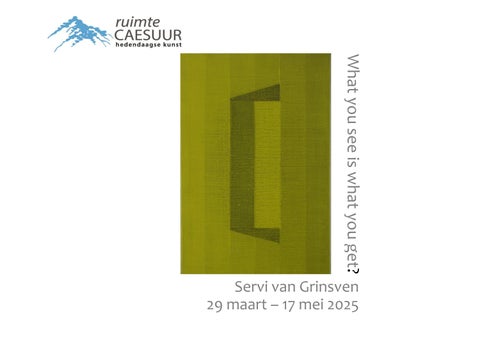
What you see is what you get? Servi van Grinsven 29 maart – 17 mei 2025
content opening tentoonstelling / exhibition werken / works artist talk – tekst / text Giel Louws colofon / colophon ruimteCAESUUR
opening | 29/03/’25
exhibition – tentoonstelling
tentoonstelling | exposition
werken / works
artist talk | o4/05/’25
Inleidende woorden van Giel Louws Het is een eer om gevraagd te worden voor een publiek gesprek met een kunstenaar over zijn werk. Na het kijken naar werk, is het spreken over werk van groot belang. Ik ontmoette Servi voor het eerst toen hij mijn atelier bezocht een paar jaar geleden, en ik denk dat ons gesprek eigenlijk daar is begonnen. Een gesprek onder schilders is als een gesprek tussen goede vrienden, je hoeft niet alles uit te leggen. En in ons geval is dat handig, want ik denk dat ons werk van nature introvert is. Wat natuurlijk tegelijk een probleem is als je een gesprek aangaat; zet twee introverte kunstenaars bij elkaar, en je hebt geen gesprek, althans niet zozeer in woorden. Toen Servi mij vroeg om een gesprek te leiden over zijn werk en tentoonstelling in Caesuur kon ik dat niet weigeren. Ten eerste had Servi het voor mij ook gedaan vorig jaar, en ten tweede was het een
in Caesuur kon ik dat niet weigeren. Ten eerste had Servi het voor mij ook gedaan vorig jaar, en ten tweede was het een reden om eens goed naar zijn werk te gaan kijken. Want om eerlijk te zijn; zijn werk biedt weerstand, het geeft zich niet makkelijk vrij. Althans niet voor mij. Dat ik niet helemaal mee was, bleek maar weer toen zijn tentoonstelling in Caesuur was opgehangen: ik begreep het als tentoonstelling niet. Dit lijkt me echter een uitstekend uitgangspunt voor een vraaggesprek. De meest voor de hand liggende manier om een schilder te plaatsen is om hem te vergelijken met andere schilders. Het is in zekere zin een laffe methode, maar tegelijk is het ook hoe schilderkunst werkt; het is een gestapelde geschiedenis van leren en herhalen. Kijkend naar het werk van Servi, en
werkt; het is een gestapelde geschiedenis van leren en herhalen. Kijkend naar het werk van Servi, en denkend aan zijn praktijk als leraar in het kunstonderwijs, lijkt het me een goede methode. Ik kom in de eerste instantie op twee namen; Morandi en Rothko. Ik denk aan Morandi als het om de aspecten van stilte gaat, en als het over gelijk belang gaat van vorm en tegenvorm. Het object dat wordt geschilderd is alleen van belang als bron om te gaan schilderen. Ik zag laatst de video van Hamza Halloubi over Morandi in De Pont Tilburg, waar hij liet zien dat Morandi de stilte schilderde terwijl de wereld in brand stond. Daar moest ik ook in Caesuur aan denken. Ee Aan Rothko moest ik denken om de vormen die in de ruimte lijken te zweven alsof ze niet aangehecht zijn aan de wereld. Ik moest ook denken aan het idee van
men die in de ruimte lijken te zweven alsof ze niet aangehecht zijn aan de wereld. Ik moest ook denken aan het idee van Rothko dat hij zijn kleurvlakken als acteurs zag in het theater van zijn doek. Ik zie dat zelf ook bij Servi, zijn vormen zetten als Griekse acteurs een archetype neer, maar zijn tegelijk in beweging, ongrijpbaar. Daarbij was Rothko ook een leraar op de academie, en ik denk dat lesgeven net zo veel lesnemen is als geven. Enfin, als je tegenwoordig iets wilt weten over een kunstenaar ga je googelen. Want in een korte kijkgeschiedenis naar het werk van Servi, zou je al snel aannemen dat hij altijd zo heeft geschilderd. Ik zag dat er een uitgave bestond van de galerie William Wauters, en bestelde het online. Ik ben blij dat ik dat heb gedaan, want het werk dat daar in staat geeft iets bloot waar Servi
online. Ik ben blij dat ik dat heb gedaan, want het werk dat daar in staat geeft iets bloot waar Servi vandaan komt. Het laat ook zien dat hij door consequent werken een eigen handschrift heeft gevonden. Misschien laat het ook iets zijn van een universele zoektocht die we allemaal door gaan. Van een soort zekerheden en bravoure in je jeugd, naar het niet weten en het zoeken van de volwassenheid. Van de meer boude uitspraken naar het ‘misschien’, of ‘het zou kunnen dat’. Dat zou kunnen verklaren waarom Servi net zo hard verf weghaalt als dat hij verf opbrengt. Het punt waar ik misschien nog het meest tegenaan liep is; waar gaat het werk eigenlijk over. Een vraag die net zo hard op mij terugslaat als dat het over het werk gaat. Alsof een schilderij per se over iets anders moet gaan als over
hard op mij terugslaat als dat het over het werk gaat. Alsof een schilderij per se over iets anders moet gaan als over zichzelf. Verwijst Servi juist niet steeds naar de vorm die niet het object zelf is? Misschien gaat het niet over het geschilderde object, en niet over zijn tegenvorm, maar over iets wat zich daartussen bevind? Gaat het over de stilte en die kleur die resoneert buitenom het werk zelf? Gaat het om de resonantie die het bij de toeschouwer teweeg brengt? De ruimtelijke objecten van Servi verrasten me, en veroverden me onmiddellijk. Ik weet niet precies waarom maar ze lijken voor mij dichter bij het spelen te staan. Heel direct ook de vraag te behandelen van vorm en niet vorm. Ze laten meer de hand van de maker toe, en daardoor kan ik er makkelijker
laten meer de hand van de maker toe, en daardoor kan ik er makkelijker instappen. Ook dit resoneert natuurlijk mijn eigen blik, en een van mijn uitgangspunten; dat je af en toe iets moet gaan doen wat je niet kan. Dat daar de ontdekkingen liggen, in het niet kunnen. Dit zou ook een van mijn vragen kunnen zijn, kun je dat schilderen niet te goed? Een vraag die je eigenlijk niet kan stellen, maar als je hem opschrijft kun je hem voorlezen, alsof je er niets aan kan doen. Ik denk dat de leraar Servi zelf vast ook deze moeilijke vragen wel heeft gesteld aan zijn studenten, dus zal hij het me vast vergeven. Laten we spreken.
Introductory remarks by Giel Louws It is an honour to be asked to give a public talk to an artist about his work. Upon looking at work, talking about work is very important. I first met Servi when he visited my studio a few years ago, and I think our conversation actual-ly started there. A conversation among painters is like a getting together between good friends: you don't have to explain everything. And in our case, that’s helpful, because I think our work is introverted by nature. Which, of course, is too-quite a problem when you start a conversation; put two introverted art lovers together, and you don't have a conversation, at least not so much in words. When Servi asked me to lead a conversation about his work and exhibition at Caesuut, I couldn't refuse. First, Servi had also done it for me last year, and in Caesuur kon ik dat niet weigeren. Ten
had also done it for me last year, and second, it was a reason to take a closer look at his work. Because to be honest; his work offers resistance, it doesn't release itself easily. At least not for me. That I wasn't fully on board was evident when his exhibition was installed in Caesuur: I didn't understand it as an exhibition. However, this strikes me as an excellent starting point for an artis talk. The most obvious way to place a painter is to compare him to other painters. It is in a sense a cowardly method, but at the same time it is also how painting works; it is a stacked history of learning and repetition. Looking at Servi's work, and thinking about his practice as an art education teacher, it seems like a good method
method to me. I initially come up with two names; Morandi and Rothko. I think of Morandi when it comes to the aspects of stillness, and when it comes to equal importance of form and counter-form. The object being painted only matters as a source to start painting. I recently saw Hamza Halloubi's video on Morandi at De Pont Tilburg, where he showed that Morandi painted silence while the world was on fire. I was reminded of that in Caesura too. I was reminded of Rothko for the shapes that seem to float in space as if they are not attached to the world. I was also reminded of Rothko's idea that he saw his colour surfaces as actors in the theatre of his canvas. I see this with Servi my-self, werk te
myself, his forms set an archetype like Greek actors, but at the same time are in motion, ungraspable. Thereby, Rothko was also a teacher at the academy, and I think teaching is as much teaching as it is giving. Anyway, these days, if you want to know something about an artist you go googling. Because in a brief viewing history of Servi's work, you would quickly assume that he has always painted like this. I saw that there was an issue of the William Wauters gallery, and ordered it online. I'm glad I did, because the work in there reveals something about where Servi is coming from. It also shows that he has found his own handwriting through consistent work. Perhaps it also shows
haps it also shows something of a universal quest we all go through. From a kind of certainties and bravado in one's youth, to not knowing and seeking adulthood. From the more bold statements to the “maybe”, or “it could be that”. That might explain why Servi takes away paint as much as he puts on paint. The point that perhaps bothered me most; what is the work actually about. A ques-tion that strikes back at me as much as it is about the work. As if a painting must necessarily be about something other than itself. Isn't Servi, on the contrary, always referring to the form that is not the object itself? Perhaps it is not about the disputed third object, and not about its counterform, but about something in between? Is it about the silence and
something in between? Is it about the silence and that colour that resonates beyond the work itself? Is it about the resonance it creates in the viewer? Servi's spatial objects surprised me, and conquered me immediately. I don't know exactly why but they seem to be closer to play for me. Very directly also address the question of form and not form. They allow more of the creator's hand, and therefore I can step in more easily. This, too, naturally resonates my own view, and one of my starting points; that once in a while you have to go and do something you can't do. That that's where the discoveries lie, in not being able to. This could also be one of my questions, can't you paint that too well? A question
can't you paint that too well? A question you can't really ask, but if you write it down you can read it out loud, as if you can't do anything about it. I think the teacher Servi himself must have asked these difficult questions of his students, so I am sure he will forgive me. Let's talk.
colophon | ruimteCAESUUR
All works | Servi van Grinsven Photos exhibition | Servi van Grinsven Photos artworks | courtesy of ©2024 Servi van Grinsven Photos opening / artist talk | hans overvliet Moderator artist talk | Giel Louws Catalogue | hans overvliet Thanks to | all the artists the happy shareholders of CAESUUR the municipality of Middelburg
Since 1995, some hundred twenty plus exhibitions of contemporary art have been made in ruimteCAESUUR (spaceCAESUUR). From 1999 on at the Lange Noordstraat 67 in Middelburg. Visual arts, in relation with the contemporary art discourse, are always the guiding principle for an exhibition, but a historical and social perspective also determine our choices. ruimteCAESUUR stands for the autonomy of art embedded in larger systems, and puts the artist’s oeuvre at the center of organizing its (solo) exhibitions. Young, novice as well as "arrived" artists are offered a platform in order to present their work in a noncommercial environment. Real meeting and learning from each other play important roles within our annual planning.
ruimteCAESUUR is a private initiative, without any profit motive, with Willy van Houtum and visual artist Hans Overvliet as its core; they form the board of the CAESUUR foundation. teamCAESUUR is more than completed by the artists Jorieke Rottier and Giel Louws. The exhibitions also in 2024 will be organized as much as possible in cooperation with art initiatives from other countries such as Lípa Art Collection and Luxfer Open Space, both from the Czech Republic, Gallery Durden and Ray uit Los Angeles, U.S.A., Slipvillan from Sweden, etc. Exchange with Dutch artists ensures reciprocity in this process. The unique composition of this team crosses borders of art practices, gender and generations. Visit Would you like to visit us? Please mail us at caesuur (at) zeelandet.nl.
What you see is what you get?
Servi van Grinsven 29 maart – 17 mei 2025