Residential, Commercial, & TERO Certified 304 Mimosa Ln., Tahlequah, OK 74464
918-456-8192
check out our website: www.actionfloors-llc.com
“Quality Flooring at Affordable Prices”
SPECIALIZING IN:
Carpet Tile Vinyl Luxury Vinyl Plank Wood Countertops
CONTENTS 6
8
10
13
18
20
6 8 10 13 18
ALL IN THE FAMILY Gary D. Chapman’s legacy remains alive in his descendants, who follow his path of helping others
20
SPOOKY SPECTACLES With Halloween just around the corner, colorful characters share eerie tales
FRENCH HOUSE Preserving the past, welcoming the future WHEN THE TRAIN ROLLED IN The Ozark and Cherokee Central Railway connected Tahlequah to the outside world GOOD WORKS The venerable venue was springboard of talent that still resonates A HORSE, OF COURSE Some say the famous Mister Ed is buried here, but the truth is elusive
Thank You For Your Business!
Call today for information on how you can volunteer to change the story
McDonald’s • 2100 Mahaney Avenue • Tahlequah, OK 74464 Next to Tahlequah Drug, Holiday Inn & Best Western • (918) 456-4740
4 Tahlequah Grapevine | Fall 2026
918-456-8788 • 403 N. Mission St. Tahlequah, OK 74464 • www.cherokeecasa.org
Note from the Editor I won’t even bother waxing philosophical on the merits of fall, even though it’s my favorite season. As I write this, the temperatures are still in the 90s, so no one’s buying it, anyway. This edition of Tahlequah Grapevine is a little unusual, in that the same people pop up in a couple of stories. That was coincidence, certainly not because I coerced the writers into doing this. It’s simply because when it comes to all things Cherokee County, some folks always seem to be in the mix – even if they no longer live here. That is the case with Eddie Glenn, a 14-year TDP staffer who now teaches university classes in Fort Smith. As he normally does, Eddie has a feature in this fall 2026 edition, so that’s not unusual. This one is about an unimposing structure downtown that has had several incarnations, including music venues and a men’s shelter. But Eddie’s appearance in another story by Kellie Vann, our latest “stringer,” bears further explanation. Kellie has two stories in this magazine – one on the controversy surrounding Mr. Ed’s grave, and another on spooky stuff. I can’t remember whether Eddie wrote a feature for the newspaper specifically about the famous horse, but he mentioned it in other stories. And it didn’t surprise me when he turned up in the tale of local hauntings because, after all, when it comes to all things Bigfoot, Eddie is almost as famous as that horse. Eddie didn’t mention Bigfoot to Kellie for the Halloween story, probably because the hairy, foul-smelling biped doesn’t fit the genre. But he did tell her about the McSpadden House, which used to sit on a hill along Bluff, and was very possibly haunted. But that’s not what makes Eddie’s association with it so – different. Eddie used to joke that he “killed” both living things and inanimate objects by writing stories about them. He did a story about a particular tree, and not long later, it was destroyed. I can’t remember whether someone cut it down or lightning struck it or what. Then there was that house. Among those who either lived or loitered there were Jon Malone, Sarah Hart, Stacy (Patrick) Pratt, Ward Curtin, and of course, Eddie himself. All of those people worked at TDP at some point, except Jon. A few days after Eddie wrote about that old two-story, it burned to the ground. I can’t remember whether arson was suspected. I vaguely recall something bad happening at, or to, a circus about which Eddie wrote. Maybe the big top caught fire or an elephant stomped a whip-wielding ringmaster to death. For a while there, in the wake of Eddie’s stories, artwork got damaged, cars got wrecked, beloved family pets fell prey to drunks behind steering wheels. It got to the point Eddie was reluctant to take certain assignments, if the subject was too valuable, well-loved, or important to put at risk. He had done several stories on World War I veteran Vince Maddox, but when Vince was the last remaining WWI vet alive here, and the opportunity arose to interview him again, Eddie flatly refused. He liked the guy and was convinced he wouldn’t survive the story. Anyway, you get the picture – and you’ll get other pictures with three other stories in this magazine. Nancy Garber has a piece on when the railroad came to town. Teddye Snell wrote about one of the county’s favorite sons, Gary Chapman, and his daughter, Susan, and her family – and the French House, which they have restored to its glory. We hope you enjoy this Grapevine as much as we enjoyed producing it for you.
MEET THE EDITOR
Kim Poindexter has been a member of the TDP news team since 1985. She is in the Oklahoma Journalism Hall of Fame and received the 2022 Oklahoma Press Association Beachy Musselman Award. She has won more than 300 journalism awards on the national and state levels, both individually and as part of the TDP team, which was named CNHI’s Best Newspaper for five consecutive years. A noted editorial and column writer in Oklahoma, she was named OPA Editorial Writer of the Year for 2023 and this year, again for 2025, and by CNHI, Columnist of the Year. She and her husband, Chris, a facilities engineer, have an adult son, Cole, and a daughter-in-law, Dani.
HEATHER KILPATRICK Publisher hkilpatrick@tahlequahdailypress.com
KIM POINDEXTER Executive Editor kpoindexter@tahlequahdailypress.com
KELSEY LINCH Sales Executive CONTRIBUTING WRITERS Nancy M. Garber Eddie Glenn Teddye Snell Kellie Vann JAY JUDAH Graphic Designer
TAHLEQUAH
Grapevine © 2026 Tahlequah Daily Press
Tahlequah Grapevine is a quarterly magazine published by the Tahlequah Daily Press. The contents of this magazine are fully protected by copyright and cannot be reproduced without express permission from CNHI, LLC.
On The Cover
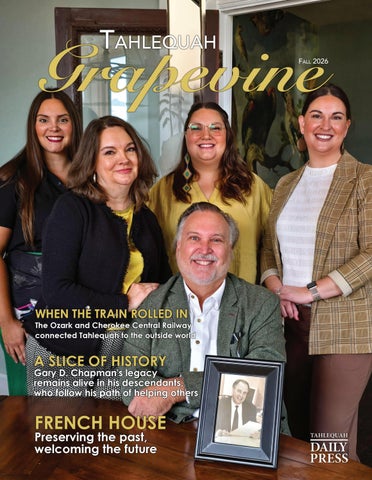
The Plumb family inside the historic French House. From left are: Sunday Plumb White, Susan Chapman Plumb, Sarah Plumb Morrison, Susannah Plumb Scott, Loyal Plumb (seated), and photo of family patriarch, Gary Chapman. Not pictured: daughter Sophie Plumb Rotola. Cover photo by Teddye Snell
Tahlequah Grapevine | Fall 2026 5
All in the family Gary D. Chapman’s legacy remains alive in his descendants, who follow his path of helping others By Teddye Snell Teddye is hospitality director/events manager for Local Bank and the Chapman Center. She served as public relations officer for the Council of the Cherokee Nation, and is a former staff writer and assistant editor at the Daily Press. She lives in Tahlequah with her husband, Sean.
Gary D. Chapman
G
Gary D. Chapman’s life began just a few miles, yet a world away, from where his banking legacy eventually took root. Born Jan. 2, 1938, to Ezekiel “Zeke” Chapman and Elva Sunday Chapman at their home in Grand View in Cherokee County, Gary was raised with deep ties to the community he would spend much of his life serving. He attended Grand Vview School and Bagley School before graduating from Tahlequah High School in 1955. Four years later, he graduated from Northeastern State University with a bachelor’s degree in education. Banking wasn’t Gary’s first career. He spent a year teaching and coaching basketball at Lost City School before becoming a scout executive with the Boy Scouts of America. From there, his career took him into insurance, working for the General Adjustment Bureau. Between 1964 and 1972, Gary supervised hundreds of insurance adjusters responding to some of the largest hurricanes and natural disasters in the country. The work was important, but the constant travel eventually took its toll. Gary wanted to be closer to home. In 1972, he entered the executive training program at Commercial Bank and Trust Co. in Muskogee. It marked the beginning of a banking career that ultimately spanned decades and generations. Gary returned to Tahlequah in 1982 as executive vice president of First National Bank, where he remained until 1993. Then, in 1996, Gary, longtime friend and attorney Harvey Chaffin, and Gary’s daughter, Susan Chapman Plumb, purchased First State Bank in Hulbert. That small community bank eventually became Bank of Cherokee County. For Gary, banking was never simply about financial transactions. His life had already been shaped by service — to his church, his community and the Cherokee Nation — and those commitments naturally influenced the way he approached banking. At the urging of his mother, an original Dawes Commission enrollee, Gary became involved in Cherokee Nation government 6 Tahlequah Grapevine | Fall 2026
Photos provided by the Plumb family and Local Bank.
during a pivotal period in the Nation’s modern history. In 1973, Principal Chief W.W. Keeler appointed him to the first Tribal Council. Gary later helped draft the 1975 Cherokee Nation Constitution and served as an elected tribal councilor until 1991. Among his proudest accomplishments were helping secure funding for new facilities at W.W. Hastings Hospital in the early 1980s and helping establish the Cherokee National Historical Society as the official records repository for the Cherokee Nation. He also served in numerous leadership capacities, including chairman of the Cherokee Nation Industries Board of Directors and president of the Cherokee National Historical Society. His commitment to healthcare continued at home through service to Northeastern Health System and as a founding member and president of the Tahlequah Hospital Foundation. Yet some of Gary’s most lasting influence came through much smaller moments. His home phone rang constantly with people seeking advice or help with business, tribal and personal matters. Gary was known for answering those calls and doing whatever he could to help. His family remembers hundreds of encouraging cards, letters and Post-it notes, along with packs of gum, homemade milkshakes and a willingness to listen. And all the while, his only child, Susan Chapman – now Plumb – observed her father and learned about her heritage, absorbing the importance of public service and community involvement. As the father and grandfather of only girls, Gary was also a passionate advocate for women having equal opportunities to participate and lead in government, churches and the workplace. That belief became particularly meaningful in the future of the bank he helped build. Following Gary’s passing, Susan assumed leadership as CEO and chairman of Bank of Cherokee County. Looking to expand, Bank of Cherokee County rebranded to Local Bank. Under Susan’s leadership, the bank has grown significantly while remaining rooted in the communities that shaped her
The former Bank of Cherokee County at Hulbert.
The new Local Bank at Hulbert.
father’s life. What was once a three-branch bank operating within one county has grown to six branches serving four counties. The organization has expanded from approximately 30 employees to 100, creating jobs, extending its reach and allowing the bank to serve more communities throughout Northeast Oklahoma. Susan believes expansion fosters her father’s legacy by helping more people in more underserved communities. “The growth represents more than additional branches or employees,” said Susan. “It is the growth of a family and community legacy.” Gary’s path — from a rural Cherokee County childhood, to teacher and coach, disaster insurance supervisor, banker, Cherokee Nation leader and ultimately community bank owner — wasn’t a predictable path. But a common thread ran through nearly every chapter: service. Susan’s leadership has carried that foundation into a new generation. The bank is larger today than the institution Gary, Susan and Harvey Chaffin purchased in 1996, but its roots remain firmly planted in the same place. “We are proud to be in Cherokee County for over 120 years,” said Susan. “And we’re eager to expand into northeastern Oklahoma and the Cherokee reservation. As we move into communities like Sallisaw, Grove, and Muskogee, we want our customers to know our mission and values remain strong. We are committed to local, rural and underserved communities. We are older than Oklahoma and are excited to expand community banking to more people in Northeast Oklahoma.” For the Chapman family, the story of Local Bank is not simply a story about owning a bank. It is about stewardship — taking something entrusted to one generation, strengthening it, and preparing it for the next. Gary Chapman spent his life answering the call when his community needed him. Today, the bank he helped build continues answering that call. G
COMFORT Chris French 918-822-2096 OK Mech. #61597 • AR Mech. #1557340 TERO CERTIFIED
Tahlequah Grapevine | Fall 2026 7
The Plumb family on the north balcony at the French House. From left are: Loyal Plumb, Susan Chapman Plumb, Sarah Plumb Morrison, Susannah Plumb Scott, and Sunday Plumb White. Not pictured: daughter Sophie Plumb Rotola.
FRENCH HOUSE Preserving the past, welcoming the future
By Teddye Snell Teddye is hospitality director/events manager for Local Bank and the Chapman Center. She served as public relations officer for the Council of the Cherokee Nation, and is a former staff writer and assistant editor at the Daily Press. She lives in Tahlequah with her husband, Sean.
F
For nearly 150 years, the French House has stood in Tahlequah, on a small rise above the historic Cherokee National History Museum — previously the Cherokee Nation Courthouse — while growth and change occurred all around it. Built around 1880, when Tahlequah was the capital of the Cherokee Nation and Oklahoma statehood was still decades away, the home was originally constructed as a wedding gift for Jane Anna Thompson French and Robert French, both Cherokee citizens. Generations have passed through its doors, but the house remains a beautiful connection to a defining period in Tahlequah’s history. Today, another chapter is beginning. Local Bank is the house’s current owner, but CEO Susan Chapman Plumb; her husband, Loyal Plumb; and bank executive daughters Susannah Plumb Scott, Sarah Plumb Morrison, and Sunday Plumb White, are the tour de force behind the home’s extensive renovation. The project focuses on preserving its historic character, so the house remains on the National Historic Register,
8 Tahlequah Grapevine | Fall 2026
Photos by Teddye Snell
Places like the French House help define a community’s identity. They remind us that Tahlequah’s story is built not only through change, but also through the landmarks, memories, and traditions that endure. – Susan Chapman Plumb
while making it useful for generations to come. Among the most meaningful elements of the project is the return of the main entrance to the east side of the property, restoring the original approach to the home. Local Bank was the first — and remains among the few — federally recognized Community Development Financial Institutions in the U.S. It is the only bank in the U.S. owned by a Native woman. Restoration of the French House is an extension of this moniker, as it preserves a site precious to Tahlequah, and the community members who live here. “Places like the French House help define a community’s identity,” said Susan. “They remind us that Tahlequah’s story is built not only through change, but also through the landmarks, memories, and traditions that endure. By restoring the home with care, Local Bank is helping ensure that this part of the community’s history remains present and meaningful.” When the renovation is complete, the French House will once again be a lived-in and active place. It will serve as a residence and private executive office space for Local Bank, while also providing a distinctive setting for select gatherings and events. “The goal isn’t to turn the French House into something new,” said Susan. “It is to preserve what has made it special for nearly a century and a half while giving it purpose for the future. Preservation is more than protecting an old building; it is an investment in the character of a place and in the generations who will come after us.” Plumb believes through its stewardship of the French House, Local Bank is honoring the past, serving the present, and helping carry Tahlequah’s story into the future. G
Following the renovation, the original entry on the east side of the house has been returned to its former glory. Susan and Loyal inside the French House.
Tahlequah Grapevine | Fall 2026 9
A vintage postcard depicts the Ozark and Cherokee Central Railway bridge over the Illinois River.
WHEN THE TRAIN ROLLED IN The Ozark and Cherokee Central Railway connected Tahlequah to the outside world By Nancy M. Garber Nancy M. Garber, a University of Florida graduate, is a lifelong journalist and photographer. A former member of the TDP editorial and advertising teams, she retired from NSU as director of Communications and Marketing and still likes to pick up the pen and camera now and then.
A 1905 map shows the route of the O&CC Railway entering Indian Territory near Westville, passing through Tahlequah, and on to Muskogee.
A
As the saying goes, some people pass through our lives for a season or a reason. The same could be said about the historic Ozark and Cherokee Central Railway that connected Tahlequah to the outside world from 1902 to 1942. By today’s standards, rail travel seems slow and tedious. But before the first passenger excursion rolled into the depot at the
10 Tahlequah Grapevine | Fall 2026
intersection of Lee and Choctaw Streets on Aug. 5, 1902, goods and travelers arrived at the capital of the Cherokee Nation by horse and carriage. Vintage wagon wheels used today as yard décor took country folk to town on Saturdays, and when need be, along long, rough roads to railway stations in Fort Gibson, Wagoner, Muskogee, Stilwell and Westville. From there, northto-south rails connected Indian Territory to neighboring states. Public sentiment in Tahlequah called for an east-west route from Fayetteville to Muskogee and beyond. In 1899, town leaders organized meetings with railroad builders and a special committee – J.S. Stapler, T. J. Adair, and W.W. Hastings – was appointed to get the project underway. Within a year, $30,000 had been pledged by local businesses. In May 1901, construction commenced on a rail line westward from Fayetteville; in January 1902, grading of rail beds began in Indian Territory and tracks were built leading to the Tahlequah depot. On Saturday, Aug. 2, 1902, downtown businesses closed their doors and citizens flocked to witness the “driving of the golden spike,” as the rail line reached its destination. Three days of celebration commenced in anticipation of the first passenger train that arrived at 11:45 a.m. the following Tuesday.
These pylons once supported tracks for the Ozark and “The train was pulled by Cherokee Central Railway crossing the Illinois River, near engine No. 1 and contained eight Sequoyah Club and the mouth of the Barren Fork Creek. coaches, each of which was loaded Photo courtesy of Terrill White with near one hundred passengers. The train was met by the celebration reception committee, the band and about five hundred citizens,” according to the Tahlequah Arrow, predecessor to the Tahlequah Daily Press. From Arkansas, the O&CC crossed into I.T. near Westville, ran west along the north side of Barren Fork Creek through Christie and Proctor, and entered Cherokee County just north of the creek, passing through Eldon, Robbins, and Welling. Tracks crossed the Illinois River a half mile north of the mouth of the Barren Fork, near Sequoyah Club, then passed through Park Hill. Rails looped around the base of Stick Ross Mountain and skirted present-day Go Ye Village on approach to the Tahlequah depot. The original wooden depot was destroyed by fire in 1910 and replaced with a brick structure, ton gins sprang up in Tahlequah and nearby towns along the which was demolished several years ago. train route. Bulk oil storage tanks were located near the depot. Railway construction continued toward Fort Gibson A local resident reportedly received an automobile shipped by and Muskogee. Tracks meandered northwest from the depot rail in 1903. to the present-day airport, then shifted west-southwest to With easier accessibility, the town’s population began to Crittenden and on up to Gabriel along Double Springs Creek, grow. More housing sprang up in Tahlequah and long-disbefore passing through Hulbert and Melvin. tance telephone lines along the railway enabled communicaAs historian David Campbell describes in his thoroughtion with Fort Gibson. ly researched book “Railroads Through Cherokee County” Just like in TV westerns, the depot was a gathering place (1998), “excitement and optimism literally exploded in the summer of A new brick depot opened in 1902, and life would never be the 1912 after the original structure same again.” was destroyed by fire. A trip to Muskogee that once Photo courtesy of NSU Archives took a day was reduced to a matter of hours. Family stories shared in social media include an account of a young woman walking from the Illinois River to the Tahlequah depot to make that journey. Along the train route were “flag stops,” brief unscheduled opportunities to board passengers or freight. Rail transportation opened the door to shipping heavy machinery and bulky materials needed to build water works and an electric light plant on Water Street. An ice and cold storage plant was constructed, and a grain elevator was built across from the depot, where docks were used to load hay bales and livestock. Steam-powered cotTahlequah Grapevine | Fall 2026 11
for local townsfolk, and the train’s arrival a Local women explore the new tracks just below the Tahlequah depot in 1902. social event. According to a 1979 interview Photo by Jennie Ross Cobb with historian T.L. Ballenger, “To the townspeople, the railroad symbolized the world beyond their view. … Circuses, companies of actors, lecturers, and musicians arrived by rail to entertain and edify the citizens.” Former U.S. President William Howard Taft reportedly “addressed the assembled crowd from the platform of his observation car.” Trains brought the legendary hobos of the Great Depression era seeking food or work. Mary Lou Capps remembers her mother-inlaw, who lived near Crittenden, felt sorry for them but “she simply couldn’t feed them all.” Transportation offered opportunities and progress but also led to tragedy. In openrange Cherokee County, livestock sometimes wandered onto tracks and met their demise. the tracks were systematically pulled from the ground and Tragic loss of life resulted when individuals recycled for use in the war. were caught unawares by the train’s approach. One oft-reFrom time to time, rural residents still report finding remcounted 1920s incident involved three young girls walking nants of railroad ties and spikes when rain turns the ground or across the Illinois River Bridge; two were struck and killed, county roads are freshly graded. In the 1960s, a safe was found and a third jumped to safety. in a pond near Downing Street that was believed to have come The sunset of the O&CC was hastened by the growing from a train. With an old railroad map in hand, historians can popularity of automobiles and bus travel in the late 1930s. trace the path of tracks through the county and areas that are Passenger service ended, although freight service continued neighborhoods today. until the U.S. entered World War II. Tahlequah merchants Some might even say they hear the ghost of a conductor’s lobbied to keep shipping goods to help with the war effort, but whistle signaling an alert: The train is on its way. G the need for scrap metal outweighed their argument. In 1942, The first passenger train arrives in Tahlequah Aug. 5, 1902. Photo courtesy of NSU Archives
12 Tahlequah Grapevine | Fall 2026
A painting by the late Cedar Carrier, a Good Works regular in the early ‘90s, of a teenage Stacy Pratt playing at Good Works.
GOOD WORKS The venerable venue was springboard of talent that still resonates By R.E. “Eddie” Glenn Eddie Glenn was Tahlequah Daily Press’ final “official photographer,” and worked in that capacity and as a writer at TDP for 14 years. He and his wife, Jennifer, live in Fort Smith, where he teaches at the University of Arkansas. He has published two books: “Bigfoot Comes to Town: Theory, Myth and Alleged Truths About Eastern Oklahoma’s Most Wanted,” and “The Sovereign, the Tribe: An Essay on a Relationship.”
R
Randy Pease was already an accomplished guitarist and singer/songwriter when he first walked through the doors of Good Works. But he was hoping a change of both venue and audience would help him reorganize his life. In short, he was tired of being drunk and playing to other drunks. “I wanted a place to play, but I didn’t want to play in bars,” said Pease. “I had friends who were trying to get their lives together, too, and they told me about Good Works.” On the corner of Keetoowah Street and South College Court (the alley that runs north/south, just west of Muskogee Avenue), Good Works was an art venue that imposed few restrictions on the modes of expression artists could present. They just couldn’t be drunk or stoned. Owned and managed by Terra Frederick-Coons, it was the first home of the Tahlequonia Art Show — later organized by the Arts Council of Tahlequah — and the Erotic Art Show, which is still presented at the Tahlequah Creates art cooperative on North Muskogee Avenue. Good Works served as a gallery for visual arts, as well as
a teaching studio for basketry, drawing, painting, and other visual arts. But its most popular event was an open mic every second and fourth Thursday of the month, featuring a headlining performer — most often a musical act or poet — followed by anyone who wanted to get up and share their talents with the audience. There were experiential plays with audience participation, Buddhist chants, group dancing, prayers, preaching, and practically anything else imaginable. Mike Jett helped keep the sound system at Good Works in proper working order, and occasionally got up on stage and performed a few songs himself. “I was captivated by the energy,” said Jett. “There were a lot of people showing up to those things, and I remember people crowding out into the streets after the whole thing was over, and they’d just keep playing out on the grass and in the street.” Those post-performance impromptu gatherings might include guitarists, harmonica players, didgeridoo players, bongo drummers, and hand clappers — all jamming in the empty street of South College Court, often accompanied by Tahlequah Grapevine | Fall 2026 13
The building tucked behind BancFirst has been through many incarnations, including a Stretch as the Tahlequah men’s shelter. Photo by Kim Poindexter.
My mom would drop me off with a guitar and a book of poems, and when it was over, Terra would call her and she’d come pick me up. It was that kind of place – Stacy Pratt
14 Tahlequah Grapevine | Fall 2026
at least one person (usually several) performing with devil sticks, classical circus juggling props that serve well as visual aids for acoustic music that has any semblance of rhythm to it. No one seems to remember exactly when Good Works first opened, but Stacy Pratt, whose performance career began there, said it seems like it existed throughout her youth. “In the grand scheme of things, it probably wasn’t there for very long. But I loved it. It was the best,” she said. Pratt went on to earn a Ph.D. in creative writing, and to front several musical groups, including her current Tulsa-based metal band, Everything That Kills. It all began, however, on the tiny stage of Good Works. “My mom would drop me off with a guitar and a book of poems, and when it was over, Terra would call her and she’d come pick me up. It was that kind of place,” Pratt said. In contrast to Pease, Pratt was not an experienced solo performer when she first began attending Good Works open mics. But she credits Good Works with changing that. At the time of her first headlining performance, Pratt was a member of the Tahlequah High School Orange Express marching band, and she had performed with that band just hours before her first Thursday night gig. “Eighty percent of the marching band was there, so it was packed, and we were all sweaty and gross,” Pratt said. “But I had an audience!” In 1993, Good Works closed, and Coons-Frederick eventually moved back to Kansas, where her family lived. Randy Pease moved into the building, and for a while operated Cafe Keetoowah, a music performance venue, in the location. But he, too, left Tahlequah for his home state of Indiana in 1995, and the building became Ford’s Alley, yet another music performance venue that exists in the memory of many more Tahlequah residents than Good Works does. Pease went on to teach English at the University of Southern Indiana and record five albums of original music. Jett has recorded numerous independent musical artists in his Broken Arrow studio, and Pratt continues to write and perform. All three agree that, for the time it was around, Good Works was the kind of place that comes into one’s life far too infrequently. Much is written in the 2020s about the concepts of diversity, equity, and inclusion. But Good Works, which existed years before those words became popularized, provided all three, and served as a springboard of talent that still resonates. “At Good Works, I had this whole place full of artists, and they all treated me like a peer,” said Pratt. “A young peer, but still a peer.” G
Members of Fear of Lemmings perform at Good Works in 1992. From left are: the late Andy Jenson, Chris Weeks, Eddie Glenn, and Harmon Larimore. Photo courtesy of Stacy Pratt.
A business card from Good Works, an art and performance venue in Tahlequah during the late 1980s and early 1990s. Photo courtesy of Stacy Pratt.
Stacy Pratt and Mike Jett, sometime in the early 1990s, wait to take their turns performing live music on the Good Works stage. Photo courtesy of Stacy Pratt. Tahlequah Grapevine | Fall 2026 15
TAHLEQUAH 130 S Muskogee Ave 1204 E Ross St
16 Tahlequah Grapevine | Fall 2026
2022 26 2022-’26
“Where You Buy the Best for Less”
THANK YOU FOR SHOPPING LOCAL! VOTED #1 FURNITURE STORE
3231 SOUTH MUSKOGEE AVENUE TAHLEQUAH, OK • 918-456-0555 bfurniture2019@gmail.com • bakersfurnitureok.com
B ILL J OHN AND S HERRY B AKER , OWNERS Tahlequah Grapevine | Fall 2026 17
A HORSE, OF COURSE
Some say the famous Mister Ed is buried here, but the truth is elusive
A publicity photo of Bamboo Harvester, who played Mister Ed on TV. Courtesy photo.
By Kellie Vann Kellie Vann is a freelance artist and writer, contributing to the content of several CNHI newspapers. Currently, her art is on display in Tahlequah at Blackbird Diner and River and Word Arts Collective. She co-owns the latter with her close friend Shelley Nation. Her novel, “The Songs Between Daughters and Wolves,” is available on Amazon Kindle.
A
Approximately five miles north of Tahlequah sits a grave marker for one of television’s earliest sitcom stars. His name was Bamboo Harvester, and he was a horse, of course. But not just any horse. He was the horse who played the famous Mister Ed. At least, that’s the identity the marker attributes to the horse allegedly buried in that spot. The “Mister Ed died in Tahlequah” story, which tells of him living out his last days here, has been passed down ever since a horse died in a Tahlequah pasture in 1979 and was identified as the animal that played Mister Ed. However, Alan Young, the man who played Mister Ed’s owner and confidante, Wilbur Post, disputes that claim in a book he wrote about his years playing Wilbur, titled “Mister Ed and Me and More!” His story tells of a mishap with a tranquilizer that led to the death of the famous talking horse in 1970. Comparing that account to the grave marker that attributes his death to 1979, at least one of those stories has to be wrong. Several sources, including a 2017 article from the Tahlequah Daily Press, have explained the horse celebrated as Mister Ed was actually his stand-in for promos and live events after the real Mister Ed passed. That horse’s name was Pumpkin, and he actually did die in 1979. There are so many sources on the matter, making different claims, that it quickly becomes confusing. Even the credibility of some of those sources comes from other sources that have repeated or cited their claims, further compounding the con-
18 Tahlequah Grapevine | Fall 2026
fusion. Looking back to the people who are a part of the stories may help clear things up. Young’s account, given his closeness to the horse, should be compelling. But there’s another account from someone closely involved in the matter, and that’s former Cherokee County Commissioner Doug Hubbard, the man who told the Tulsa World in 1990 that he dug the horse’s grave at Snodgrass Farm. Hubbard, who died two years ago, said the horse he buried was a palomino that didn’t look well. He also said he simply assumed it was Mister Ed. Former Tahlequah resident Eddie Glenn has his own thoughts on the matter. Glenn, who now lives in Fort Smith, is well-versed in Tahlequah history. He has a mental treasure chest of useful anecdotes regarding Bigfoot, hauntings, and even Mister Ed, and he believes the answer is one of logic. “He ain’t up there,” said Glenn, who also happens to be a former Tahlequah Daily Press writer and has heard the story told over again through the years. “Who in their right mind who loved horses would take a horse out of California to Oklahoma, a place full of ticks, and chiggers, and all sorts of things that are
Alan Young and Bamboo Harvester in character as Wilbur Post and Mister Ed. Courtesy photo.
going to make a horse’s life and a human’s life miserable?” Glenn said this story would pop up now and then when he was a journalist. People never seem to get enough of it. He recalled the 1990 Tulsa radio station Z104.5 using the marker as a reason to create a concert fundraising event called Ed-stock. Funds raised for the event were used to purchase the monument for the grave. That monument further popularized the alternate story of Mister Ed’s death, cementing a legend that draws visitors from far and wide every year. Could the answer to this story be that neither story is completely true? Mister Ed was a fictional character, after all. He was never actually written out of his sitcom script, which means he could still be alive and well in some fictional universe. When viewed through that lens, Bamboo Harvester was no more Mister Ed – even when the camera was rolling – than Pumpkin was when he was posing and attending events. Neither horse being buried there necessarily constitutes the claim that Mister Ed died in Tahlequah. But if you take it to heart that the horse who played Mister Ed became Mister Ed, then both horses acted as Mister Ed in some capacity during their careers. If either horse did make Tahlequah its final resting place, then indeed, there lies Mister Ed. The real answer could even be that neither horse is buried in the spot, or for that matter, maybe there’s not really a horse there at all. “Mister Ed’s” story is interesting to the historical record in that the more something not fully understood is revisited, the more distorted it becomes. Perhaps it’s time for Mister Ed fans across the landscape to stop beating a dead horse. G
The field where Mister Ed purportedly spent his last years before passing and being buried in either 1970 or 1979. The monument is visible in the field. Courtesy photo.
Tahlequah Grapevine | Fall 2026 19
SPOOKY SPECTACLES With Halloween just around the corner, colorful characters share eerie tales
By Kellie Vann Kellie Vann is a freelance artist and writer, contributing to the content of several CNHI newspapers. Currently, her art is on display in Tahlequah at Blackbird Diner and River and Word Arts Collective. She co-owns the latter with her close friend Shelley Nation. Her novel, “The Songs Between Daughters and Wolves,” is available on Amazon Kindle.
I
Photos by Kellie Vann
In a city as culturally rich as Tahlequah, with colorful citizens, an abundance of festivals and a history etched by tragedy, it’s only fitting that all the locals have a bit of storyteller in them. With Halloween comes cooler weather and shorter days. It’s a joyful time of year, but don’t rush too far into the merriment just yet. It’s still a good tradition to send a few shivers down your spine first. The Blue Fern Bread and Breakfast, recalled by Kathy Tibbits to A few local citizens had stories to share. Some have once had a porch ceiling painted in the blue haint color. are silly, while others make you wonder: Is there see it occasionally over the three years he worked at the something sinister out there that we don’t undermuseum. stand? Or is there really a peaceful realm of the dead, and “We think it was some kind of monster apparition,” he from time to time, they reveal themselves, mistakenly or said. “That’s what we like to think. Some type of mythointentionally? logical being we hadn’t tracked yet.” Kathy Tibbits, a lifelong Tahlequah resident, retired Eddie Glenn is no longer a Tahlequah resident, but attorney and working artist, pointed out the territorial-era he and his guitar are still fixtures at local art and farmers homes dotted throughout the hills and streets that rise market-style events. No one’s positive it’s really Glenn above the Illinois River. who’s showing up. One thing’s for sure: He’s the former “Haint blue is a certain shade of blue, and when you Tahlequah Daily Press writer credited with starting the paint it on the roof of your porch, it’s supposed to protect Bigfoot frenzy a few decades ago. against ghosts entering your house,” she said. Glenn recalled a two-story house with an attic room Tibbits remembers several homes with blue porch that overlooked downtown Tahlequah called the McSpadceilings while growing up, but she especially remembers den House. He said it was the first house in town to have one home on Chickasaw across from Sequoyah Elemenrunning water. tary. It is now known as Blue Fern Bed and Breakfast. “I had some friends who rented it, and they were all She called her friend, who owns the home, and asked musicians,” he said. “There were two bands, and every if it still had a blue porch roof. The owner said the porch ceiling had since been painted gold, but told Tibbits there member of both bands lived in that house.” He said they would regularly see ghosts in the home, were no ghosts in the home – at this time. Perhaps the haint blue continues to protect beneath that layer of gold. and some of the ghosts even had names. Glenn remembers one specific ghost he was told about. Local artisan Mason Gray worked at the Cherokee “The attic room had a window, and then just a bare Heritage Center around 10 years ago. He said that on wooden floor,” Glenn said. “Several of the guys said they many mornings while driving to work, he would see had seen this same image of a guy in a rocking chair, sitsomething he couldn’t make sense of. “I would see what looked almost like a black kangating there rocking, looking out the window.” roo, but then it actually looked like a dog with no front The residents named the ghost Walter and regularly legs,” he said. “I went to work and brought it up, and heard the squeaks of the rocker’s feet moving back and everyone had seen it. It was scary.” forth across the bare wood floor, the sound carrying He said he’s still not sure what it was, but he would through the house.
20 Tahlequah Grapevine | Fall 2026
The great thing about spooky stories is they are impossible to prove true, but they’re equally impossible to prove false. If you’ve ever been downtown and felt you were being watched from somewhere on one of the bluffs, or you’ve seen a short, dog-like creature on two legs around Park Hill, or caught a glimpse of a figure rising through the fog while walking west of downtown near the creek, you might want to paint the ceiling of your porch the perfect shade of light blue. G
Here’s what is left of the McSpadden house on State Avenue after it was demolished in 2025.
Glenn also recalled another story passed on to him by a friend of a friend. The story took place along Town Branch Creek, near the campus of Northeastern State University. “The guy said he saw an apparition wearing a black bowler hat and black overcoat, clearly dressed in 19th-century clothing,” said Glenn. “He was walking through the ground, just west of NSU, half-submerged; looked like his legs were cut off. And this guy just stood and watched him go by.” Robert Lewis, a local storyteller and Cherokee National Treasure, has a few personal spooky stories he mostly keeps to himself. Perhaps the creepiest one he shared happened, again, at the Cherokee Heritage Center, where Lewis was working at the time. He said that on this particular day, he and Katherine Roastingear were the only people in the museum, although he was expecting another employee, Thelma, to come in later that day. Lewis was downstairs, alone. “I did paperwork, some things on the computer. And when I finished I started making my way up the stairs,” Lewis said. “I got all the way to the top and I heard footsteps behind me.” Thinking his co-worker, Thelma, had arrived, he stopped at the top and held the door open. The footsteps kept coming, and then they stopped. He looked down but didn’t see anything, so he went downstairs and searched the offices. Nobody was there. “So I went back upstairs and I listened and I didn’t hear anything,” Lewis said. “So I turned toward Katherine: ‘Did Thelma come through here?’ She said, ‘No, I haven’t seen her yet.’” Lewis and Roastingear then glanced outside the big open windows of the atrium and saw Thelma pulling in. “I looked at Katherine and said, ‘Well, I’m going outside,’” he said. Lewis didn’t return to the inside of the building until later that day, when he needed to clock out.
The location near Tahlequah’s History Trail and Town Branch Creek where Eddie Glenn’s friend of a friend saw the apparition of a man walking halfway beneath the dirt. Notice where the earth has pushed up from below the asphalt trail.
Tahlequah Grapevine | Fall 2026 21
Family. Friends. Community. Mark Hodson, Agent 914 S Muskogee Ave Tahlequah, OK 74464 Bus: 918-456-8881 mark@markhodson.org
1801075
22 Tahlequah Grapevine | Fall 2026
We're all in this together. State Farm® has a long tradition of being there. That’s one reason why I’m proud to support Newcomers Magazine. Here to help life go right.®
State Farm, Bloomington, IL