B C
www.cabe.org
Vol. 23, No. 1
January, 2019
Actions and Discussions at State Board of Education
View from the Capitol Patrice McCarthy
Deputy Director and General Counsel, CABE
Sheila McKay
Sr. Staff Associate for Government Relations, CABE
CABE’s Executive Director Robert Rader spoke before the State Board on CABE’s diversity efforts in advance of the State Department of Education’s (SDE) Chief Talent Officer Sarah Barzee’s presentation on Goal 3 of the State Board’s five-year comprehensive plan-giving all students access to great teachers and school leaders. CABE is working to bring discussions to communities to support increasing a diverse education workforce and to recognize the need of Boards of Education to reflect a more diverse culture. (See commentary page 3). SDE is making progress with an increase in racially and ethnically diverse educators from 2015’s 8.3 percent to 8.7 percent in 2017 – which is 200 new educators across the state. Barzee described the steps her team has taken recently on working with students, minority teacher recruitment, and a series of workshops on Examining Implicit Bias. Her full See STATE BOARD page 2
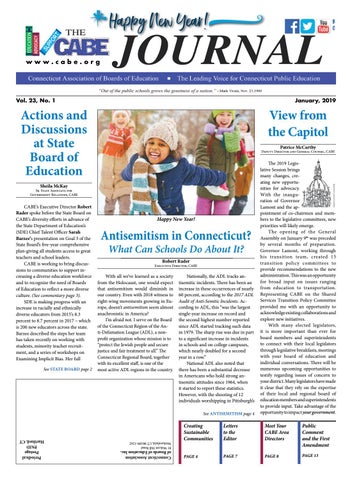
Happy New Year!
Antisemitism in Connecticut? What Can Schools Do About It? Robert Rader
Executive Director, CABE
With all we’ve learned as a society from the Holocaust, one would expect that antisemitism would diminish in our country. Even with 2018 witness to right-wing movements growing in Europe, doesn’t antisemitism seem almost anachronistic in America? I’m afraid not. I serve on the Board of the Connecticut Region of the Anti-Defamation League (ADL), a nonprofit organization whose mission is to “protect the Jewish people and secure justice and fair treatment to all.” The Connecticut Regional Board, together with its excellent staff, is one of the most active ADL regions in the country.
Nationally, the ADL tracks antisemitic incidents. There has been an increase in these occurrences of nearly 60 percent, according to the 2017 ADL Audit of Anti-Semitic Incidents. According to ADL, this “was the largest single-year increase on record and the second highest number reported since ADL started tracking such data in 1979. The sharp rise was due in part to a significant increase in incidents in schools and on college campuses, which nearly doubled for a second year in a row.” National ADL also noted that there has been a substantial decrease in Americans who hold strong antisemitic attitudes since 1964, when it started to report these statistics. However, with the shooting of 12 individuals worshipping in Pittsburgh’s See ANTISEMITISM page 4
The 2019 Legislative Session brings many changes, creating new opportunities for advocacy. With the inauguration of Governor Lamont and the appointment of co-chairmen and members to the legislative committees, new priorities will likely emerge. The opening of the General Assembly on January 9th was preceded by several months of preparation. Governor Lamont, working through his transition team, created 15 transition policy committees to provide recommendations to the new administration. This was an opportunity for broad input on issues ranging from education to transportation. Representing CABE on the Shared Services Transition Policy Committee provided me with an opportunity to acknowledge existing collaborations and explore new initiatives. With many elected legislators, it is more important than ever for board members and superintendents to connect with their local legislators through legislative breakfasts, meetings with your board of education and individual conversations. There will be numerous upcoming opportunities to testify regarding issues of concern to your district. Many legislators have made it clear that they rely on the expertise of their local and regional board of education members and superintendents to provide input. Take advantage of the opportunity to impact your government.
Creating Sustainable Communities
Letters to the Editor
Meet Your CABE Area Directors
Public Comment and the First Amendment
PAGE 4
PAGE 7
PAGE 8
PAGE 13
81 Wolcott Hill Road Wethersfield, CT 06109-1242
Connecticut Association of Boards of Education Inc.
Periodical Postage PAID Hartford, CT
2
The Journal – Connecticut Association of Boards of Education | January 2019 PRESIDENT COMMENTARY
Let Me Tell You What OUR Association Has Done for You Robert Mitchell President, CABE
I am extremely grateful for the confidence CABE members have shown in me by re-electing me their President. I am proud to be a part of such a vital organization – an association I believe is critical to the success of Connecticut’s public schools. As I complete my first year as President, I thought I’d take a look back at how CABE has managed to weather the stormy times Connecticut has endured. While the struggling state economy has hurt every school district in the state with reduce funding and resources, it has also hurt CABE. With the loss of several members and a major grant from the State Department of Education, the Association has had to work hard to maintain the level of service you have come to expect. Frankly, I’m amazed sometimes how the staff has managed to continue the high quality of programming, even as they deal with the same resource issues that boards of education do, including fewer staff. The Board of Directors works hard to provide staff what resources we can to allow that high level of service to continue. In particular, CABE staff and board members alike continue to work hard advocating for our membership. Last year, our Government Relations activities bore dividends by mitigating the looming disaster of the state budget deficit. Through CABE’s efforts (and others) the Legislature and Governor, after months of uncertainly and predictions of doom, agreed on a budget that kept funding for most districts at about the same level as last year. This was a victory for school boards and superintendents, although some towns failed to follow through with passing the restored resources
STATE BOARD
(continued from page 1)
report can be found at https://portal. ct.gov/-/media/SDE/Board/BoardMaterials120518/State_Board_of_Education_Comprehensive_Plan_Goal_3_ Update.pdf?la=en.
back to the districts. Other legislative victories included: • Restoration of funding for TEAM (the mentoring program for new teachers). • Gubernatorial veto of the Act Concerning Classroom Safety and Disruptive Behavior, which could have violated the rights of students, disrupted their educational experience and created a multitude of burdensome administrative processes. A broad-based task force with CABE, CAPSS, CAS and other representation is working on this issue. Also, CABE provided other important services to our membership such as: • Our Leadership Institute graduated its 14th class, having now served over 120 participants. These sessions, provide the class the opportunity to discuss in depth a variety of education issues and develop their leadership skills. • S ince October, 2015, CABE has provided professional development conferences twice a year for superintendents’ secretaries. Between the two programs in 201718, we had 97 participants who were superintendents’ secretaries or otherwise provided support in the central office. •O ver 675 requests for policy information and/or sample policies from member districts were addressed, usually on the same day the request was received. One hundred and two districts subscribed to the Policy Update Service publication. •W ith support provided by the Nellie Mae Foundation and Graustein Memorial Fund, CABE developed a draft toolkit for boards of education to discuss diversity, equity and The State Board voted to hold a public hearing, to conduct an inquiry on the 10-4b complaint from the Ansonia Board of Education. This is a case where the minimum budget requirement for the district has not been met by the City of Ansonia. It could ultimately lead to a reduction in ECS
Mission: To assist local and regional boards of education in providing high quality education for all Connecticut children through effective leadership. Vision: CABE is passionate about strengthening public education through high-performing, transformative local school board/ superintendent leadership teams that inspire success for each child.
Board of Directors excellence in their districts. The Committee continues to meet with thought leaders and to move forward on the critical issues of helping boards better reflect their communities and the hiring of more leaders and teachers of color. • Even with the loss of significant support by the State Department of Education, CABE has continued to offer boards of education the opportunity to participate in Lighthouse training. We’ve had to cut back, but we have kept the program strong and hold a leadership position in this program on the national level. • We provided individual workshops to dozens of school districts in areas such as roles and responsibilities, board evaluation, superintendent search, district goals and others. • CABE attorneys provided legal assistance to numerous boards of education and their staffs. • CABE also provided numerous professional development activities statewide, through workshops including legal issues, our legislative wrap-up, negotiations, and roles and responsibilities. I often say that the benefits of CABE membership are one of our best kept secrets, which is a shame, because boards of education that actively use the services and participate in activities of the Association are better equipped to serve the children in their community. My involvement in CABE has certainly made me a better board member. I strongly encourage you to be a part of it as well. funding to the district as a penalty. The full overview can be found at https://portal.ct.gov/-/media/SDE/ Board/BoardMaterials120518/Ansonia_Section_10_4b_Proceeding_Recommendation_to_Conduct_Inquiry. pdf?la=en.
EXECUTIVE COMMITTEE Robert Mitchell | President, Montville Donald Harris | First Vice President, Bloomfield Elizabeth Brown | Vice President for Government Relations, Waterbury Christopher Wilson | V ice President for Professional Development, Bristol Michael Purcaro | Secretary/Treasurer, Ellington Ann Gruenberg | I mmediate Past President, Hampton Bryan Hall | Member at Large, East Hartford Lydia Tedone | NSBA Director, Simsbury AREA DIRECTORS Bryan Hall | Area 2 Co-Director, East Hartford Leonard Lockhart | Area 2 Co-Director, Windsor Michael Purcaro | Area 3 Co-Director, Ellington Michele Arn | Area 3 Co-Director, Vernon Joan Trivella | Area 4 Director, Brooklyn Mic helle Embree Ku | A rea 5 Co-Director, Newtown Frances Walton | Area 5 Co-Director, Ridgefield Karen Kleine | Area 6 Director, Westport George Kurtyka | Area 7 Director, Derby Lon Seidman | Area 8 Director, Essex Sean Nugent | Area 9 Director, Preston ASSOCIATES Eileen Baker | Associate, Old Saybrook Robert Guthrie | Associate, West Haven John Prins | Associate, Branford Robert Trefry | Associate, CT Technical High School System COMMITTEE CHAIRS Becky Tyrrell | Chair, Federal Relations, Plainville Bryan Hall | Chair, Resolutions, East Hartford Jennifer Dayton | Chair, State Relations, Greenwich CITY REPRESENTATIVES Betsy Allyn| City Representative, Stamford Charles Stango | City Representative, Waterbury STAFF
Robert Rader | Executive Director Patrice McCarthy | Deputy Director and General Counsel Rebecca Adams | Senior Staff Attorney Nicholas Caruso | Senior Staff Associate for Field Service and Coordinator of Technology Sheila McKay | Senior Staff Associate for Government Relations Vincent Mustaro | Senior Staff Associate for Policy Service Lisa Steimer | Senior Staff Associate for Professional Development and Communications Teresa Costa | Coordinator of Finance and Administration Pamela Brooks | S enior Administrative Associate for Policy Service and Search Services Terry DeMars | Administrative Associate for Policy Service Gail Heath | Administrative Associate for Government Relations Wilmarie Newton | Administrative Associate for Labor Relations Nancy Propfe | Administrative Assistant for Membership Services Corliss Ucci | Receptionist and Assistant to Executive Director
The CABE Journal (ISSN 1092-1818) is published monthly except a combined issue for July/ August as a member service of the Connecticut Association of Boards of Education, 81 Wolcott Hill Road, Wethersfield, CT 06109, (860) 5717446. CABE membership dues include $30 per person for each individual who receives The CABE Journal. The subscription rate for nonmembers is $75. Association membership dues include a subscription for each board member, superintendent, assistant superintendent and business manager. The companies and advertisements found in The CABE Journal are not necessarily endorsed by CABE. “Periodicals Postage Paid at Hartford, CT.” POSTMASTER: Send address changes to The CABE Journal, CABE, 81 Wolcott Hill Road, Wethersfield, CT 06109-1242. Email: bcarney@cabe.org. Members can find the CABE Journal online at: www.cabe.org/ page.cfm?p=1024
The Journal – Connecticut Association of Boards of Education | January 2019
CABE Affiliate Members BUSINESS AFFILIATES DIAMOND MEMBER Finalsite PLATINUM MEMBER
Berchem Moses PC GOLD MEMBERS
Pullman & Comley Shipman & Goodwin Support for the Budgetary Process SILVER MEMBERS Anthem Blue Cross and Blue Shield Arthur J. Gallagher & Company Corporate Cost Control Digital Back Office ESS Milliman Milone & MacBroom, Inc. BRONZE PLUS MEMBERS Coordinated Transportation Solutions COUNTABILITY, Inc. JCJ Architecture OneDigital Health and Benefits The S/L/A/M Collaborative BRONZE MEMBERS Albert Risk Management Consultants Brown & Brown Chinni & Meuser LLC Goldstein & Peck, P.C. Kainen, Escalera & McHale, P.C. The Lexington Group Perkins Eastman Zangari Cohn Cuthbertson Duhl & Grello
EDUCATIONAL AFFILIATES
American School for the Deaf Area Cooperative Educational Services Capitol Region Education Council The College Board Connecticut Association for the Gifted Connecticut Association of School Business Officials Connecticut Center for School Change Connecticut School Buildings and Grounds Association Connecticut Technical High Schools Cooperative Educational Services EASTCONN EdAdvance Explorations Charter School Girls Scouts of Connecticut Interdistrict School for the Arts and Communications (ISAAC) LEARN Unified School District #1
3
EXECUTIVE DIRECTOR COMMENTARY
SDE and CABE: Working on Equity and Excellence Robert Rader
Executive Director, CABE
The State Board of Education’s (SBOE) Five Year Plan is subtitled, “Ensuring Equity and Excellence for all Connecticut Students.” Goal 3 of the Plan promises to give all students access to great teachers and school leaders, I thought it might be helpful to share with you what I told the SBOE in public comment about what our Association has been doing to help our members in this area: Two years ago, we established a Diversity Committee, under the Chairmanship of First Vice President Donald Harris, to ensure that there is diversity (in particular, people of color) and sensitivity to diversity in all of CABE’s work. We also encourage boards of education, school and district leaders, as well as State Government to continue to consider the importance of diversity and multiculturalism in public education. A critical part of this mission is to ensure that boards and staff are representative of their communities, especially as more of our students are of color. Research has shown that having board members of color leads to more sensitivity in helping these students be successful. As part of this work, the Committee has developed a Draft Equity Toolkit, developed primarily by CABE Consultant Mary Broderick, focused on helping boards engage their own communities in conversations on equity. We are piloting the toolkit and Mary, together with our new consultant, longtime educator John Ramos, had our first opportunity to use it in Waterbury on November 13th. Waterbury described the work as a Portrait of A Graduate: A Courageous Conversation About Race and Education. It appears to be have been successful and we will be releasing the toolkit to all of our districts in the next few months. In addition, our Committee has had discussions with thought leaders about our work. Among others, the Committee met with State Board Vice Chair Estela Lopez, Eastern State Connecticut University President Elsa Nunez, representatives of the NAACP, former State Board Vice Chair Theresa Hopkins-Staten, Steve Hernandez, Executive Director of the Commission
on Women, Children and Seniors, and Dr. Martha Brackeen-Harris, who worked in independent schools as they tackled these issues. We are starting to plan a statewide conference on equity in education and hope to work with the Commission and others on it. I have focused on this area, both as a way of understanding the issues involved so that I could pass along ideas and information to boards, but also as a personal journey, attempting to understand what people of color are faced with in their lives. I also work on issues of hate and racism and antisemitism as a member of the Connecticut Regional Board of the Anti-Defamation League. I attended all four of the State Department’s Workshops on “Examining Unconscious Bias in the Hiring and Selection Process”. I found these hugely helpful in understanding the issues of privilege, intrinsic bias and institutional racism. While some of the material and comments were tough to hear, I learned a lot about what others go through — on a daily basis. My impressions from these workshops were printed in the CABE Journal for all of our members to see. Even merely triggering curiosity about these issues can lead to first steps in understanding for individuals. We have also printed articles over the last year on the achievement gap, the perspective of black teachers, equity and fairness, diversity (makes us great!), the crisis in black education, policy to promote equity and diversity, cultural competence, BLAC (the new organization representing black administrators), microaggressions, poverty, privilege and educator diversity (benefiting ALL students). We will continue to use our communications capabilities to keep districts aware of what we learn. We have also worked with SDE in order to partner with them to get these messages out. SDE Staff spoke at the 2018 CABE/CAPSS Convention on the Role of Boards of Education and Superintendents in Increasing the Racial and Ethnic Diversity in the Connecticut Educator Workforce. The Convention had a whole strand of nearly 20 workshops on diversity, equity and excellence. Lastly, we have let our members know about SDE tools available to track the impact of their efforts in establish-
ing and practicing culturally competent hiring and selection practices. Our hope is that these activities, services and tools will continue to be supported by the State. As our enrollment of students of color continues to rise, administrators, teachers and school board members of color serve as role models and counselors to those children. We have learned many lessons in these two years. They include: • This is difficult work. It starts with introspection of one’s own internal perspectives and then working with others to understand issues more broadly. • Those involved in this endeavor must develop a shared commitment to do this work. The overall goal is to improve the odds of ALL of our children being successful. If people don’t want to do this work, it is difficult to be successful. • Lessons that might have been learned long ago by some people, are new to many others. • The work often seems slow, because so much of it has to do with the individual’s willingness to not only understand the issues involved, but also to create action. • There is no closure on many of the issues. That is always a difficult concept to understand. These are lifetime issues and the work will never be finished, but we can and must make progress. Ensuring excellence and equity, which are integrally connected, are critical to strengthening our State. There are economic, social and other ramifications of our failure to ensure that every one of our students succeeds. CABE will continue to work with the State Department, the new administration and others to help our members understand the importance of diversity, cultural competence and real effort to provide equity in all of our districts. If anyone would like copies of articles we have written on these issues, please contact me at rrader@cabe.org.
4
The Journal – Connecticut Association of Boards of Education | January 2019
Creating Sustainable Communities:
The Essential Partnership of Government and Education Michael J. Purcaro
Town Administrator, Vernon; Board Member, Ellington Board of Education
At the heart of every successful community is a well-managed and effective school system. A school system where students are prepared academically and socially to analyze problems, engineer solutions, build practical skills, and to approach life’s challenges with confidence. At the heart of every successful school system the future health and integrity of a community is forged. The success and sustainability of a community is predicated on its relationship or partnership between local government and its public school system. What are sustainable communities?
ANTISEMITISM
(continued from page 1)
Tree of Life Synagogue, antisemitism has turned deadly again.
Uncivil Dialogue
Yes, I can hear you say, with the current uncivil tenor of politics in the country, this may be a national problem. Everyone knows about that—the CABE Delegate Assembly unanimously passed a resolution last year urging “public officials at all levels of government to model civil discourse in their deliberations, allowing for the thoughtful, beneficial productive exchange of ideas and perspectives. CABE [also] urges school boards to provide opportunities for students to develop their skills in conflict resolution and consensus building, and for school board members to model these skills in their own conduct.” The National School Boards Association Delegate Assembly also unanimously passed a similar Connecticut-sponsored resolution (both resolutions written by Patrice McCarthy). But, what is the current status of antisemitism in Connecticut? In the same national study a breakdown of incidents, which includes harassment, vandalism and assault, showed that in 2015, there were 26 such incidents, 2016 had 38 and 2017 showed 49. Luckily, only one of them was an assault over those three years, but, overall, the trend is increasing. Connecticut is not immune to the animosity towards Jews found in other states. In New York, for instance, ADL
• Sustainable communities are engaged in actions that achieve long-range goals for the educational, economic, and environmental vitality of its residents; birth through senior hood. • S u s t a i n a b l e c o m mu n i t i e s a r e mindful of the unique roles of its key stakeholders and encourage dialogue and shared problem solving between them to meet town-wide challenges. When valued as a key stakeholder, a public school system, for example, can improve civic involvement as another avenue of communication and engagement in the governmental process; affirming the perspective of community leaders and the benefit of wraparound solutions. • S u s t a i n a b l e c o m mu n i t i e s a r e
collaborative. With a unified vision and purpose, the municipality and public school system form a nucleus where policies and procedures are communicated and reinforced in a cohesive fashion. • Sustainable communities seek to share resources and services, addressing regional needs whenever possible, with the goal of improving service delivery by meeting, and ideally, exceeding taxpayer expectations. The value placed on a public school system can serve as a guiding light that shines brightly when everyone works together. This light is the essence, the very definition of community, showing residents of all ages that only by working together can a community be truly
sustainable. Sustainable-CT was created by towns, for towns to provide municipalities with a menu of coordinated, voluntary actions, to continually become more sustainable; to provide resources and tools to assist municipalities in implementing sustainability actions and advancing their programs for the benefit of all residents. For more information, please visit www.sustainablect.org. Mr. Purcaro is the Town Administrator for the Town of Vernon, Connecticut. He is a certified School Business Administrator and is the Vice Chairperson of the Town of Ellington Board of Education. He currently serves as the Secretary/Treasurer for the Connecticut Association of Boards of Education.
found that 380 incidents had occurred in 2017, which was up about 90 percent from 2016. In 2018, in Connecticut, we saw antisemitism in the posting of swastikas, in name calling and bullying, leading Jewish students in one district to speak out, saying that they did not feel safe. Before the Pittsburgh tragedy, a Jewish student may have laughed off an anti-Semitic episode, but now such an incident may impact a student much differently.
(Student Version) Half or full-day workshop for youth in grades 4 to 12, is an interactive workshop for upper elementary, middle and high school students which provides practical opportunities to engage students in exploring the harms of name-calling and bullying and developing and practicing skills to respond to incidents. • Names Can Really Hurt Us High School Assembly Program is a student-centered assembly program designed to give a voice to the targets of bullying and prejudice, build empathy in the aggressors and inspire bystanders to become allies. A team of students and staff participate in six hours of training with ADL and assist with putting on an assembly in which student participants share their stories and opinions about bullying and namecalling in a safe forum. Following the assembly, students participate in small group discussions led by a student-teacher team. The program culminates with a report of “next step” ideas generated by students to help create a welcoming and supportive school community. • The Truth About Hate High School Assembly Program is designed to help students understand the role they can play in challenging prejudice and hate. Stereotyping, jokes, name-calling, and rumors are all seeds that can blossom into prejudice, discrimination and hate. The key to combating hate is to address these issues before they
grow into major problems. A team of staff and students participate in four hours of training with ADL and assist with putting on the assembly. • Step Up! Middle School Assembly Program is a 1.5 hour interactive anti-bullying assembly program designed to motivate middle school students to be allies. Schools receive an agenda for teacher-led, postassembly discussions and a copy of the Let’s Get Real video and curriculum guide by GroundSpark. • Becoming an Ally: Responding to Name-Calling and Bullying (Educator Version). This half-day to fullday workshop for educators is interactive, participatory and provides practical opportunities for educators to develop and practice skills to respond to incidents of name-calling and bullying among students. • What We Wish Our Parents Knew: Bullying and/or Cyberbullying Programs for Parents and Guardians These workshops are designed to provide caregivers with a forum for dialogue about the impact of bullying, cyberbullying and mean behavior on their children and the school community. The workshop equips participants with the information and tools needed to help their children respond effectively to bullying and mean behavior.
Help Available
What can a Connecticut school district do if faced with antisemitism? ADL worked with several districts to help the schools handle the incidents as learning opportunities. It has programs that deal with these issues on the level of the students who may victimized and those who commit an antisemitic act. To give you some idea of what is available from CT ADL, you might have attended one of the CABE/ CAPSS/CAS/ADL workshops on Protecting Islamic Students, Reacting to Hate Crimes or our most recent event, The December Dilemma and Beyond: Best Practices for Holidays at School, at which Patrice spoke on legal issues confronting districts. ADL staff also spoke at the 2018 CABE/CAPSS Convention on Responding to Hate & Bias Incidents: Lessons from the Field. Here are some of the initiatives, activities and programs offered by CT ADL on bias and bullying: • Becoming an Ally: Responding to Name-Calling and Bullying
For ADL resources, go to https://connecticut.adl.org/initiatives/a-world-of-difference-institute/. The Connecticut ADL Office phone number is 203-780-0211.
The Journal – Connecticut Association of Boards of Education | January 2019
5
See You in Court – The Nutmeg Board of Education
School Security, Executive Session and FOIA Thomas B. Mooney, Esq. Shipman & Goodwin
The Nutmeg Board of Education makes many mistakes. The latest imbroglio created by the board will be reported here each issue, followed by an explanation of what the board should have done. Though not intended as legal advice, these situations may help board members avoid common problems. At a recent meeting of the Nutmeg Board of Education, “security matters” was on the Board agenda. When the Board reached that item, Mrs. Superintendent told the Board that she has some ideas for improving school security, and she suggested that the Board go into executive session for the purpose of holding that discussion. Local reporter Nancy Newshound from the Nutmeg Bugle stood up and demanded to be recognized. Mr. Chairperson sighed and said, “Go ahead Nancy. What’s your problem now?” “If the Board goes into executive session, I will file a complaint with the Freedom of Information Commission! Mrs. Superintendent didn’t mention a specific plan, and you can’t just go into executive session to shoot the breeze about school security. School security affects everyone, and the public has a right to know what you are talking about.” Noah Tall, a local curmudgeon who is free with his opinions, chimed in. “When I was in the service, I learned a lot about security. If you are smart, you will let me be part of the executive session discussion.” Mr. Chairperson interrupted Noah and Nancy. “Look, you two. When you get yourself elected to the Nutmeg Board of Education, you will have a say in how we operate. Until then, we thank you for your comments and ask that you leave now so that the Board can have its executive session.” Once the room was cleared, Mrs. Superintendent told the Board that she has been talking with the Police Chief, and they wanted jointly to suggest that the district hire another SRO to enhance security at Nutmeg Memorial High School. The Board members debated this recommendation, and after some discussion, they authorized Mrs. Superintendent to enter into an agreement with the Nutmeg Police Department providing that the Chief could hire another SRO and send the bill to the Board. With that, the Board reconvened in open session and adjourned the meeting. Nancy carried through on her threat, and the next day she filed a complaint with the Freedom of Infor-
mation Commission. Noah, however, did Nancy one better. Noah made an FOI request for the blueprints of Nutmeg Memorial High School. He explained that he was concerned about some “soft” access points, and that he needs the blueprints to make his suggestions on improving safety at Nutmeg Memorial High School. With his request, he noted that each passing day exposes the students to potential harm, and Noah informed Mrs. Superintendent that he would stop by in the morning to pick up the blueprints. Mrs. Superintendent promptly responded to Noah by email to say that she was not interested in his suggestions and that she would not be making the blueprints available. However, Noah did not take “no” for an answer, and he too filed an FOIA complaint. Citing the provision in the FOIA that provides that members of the public should have “prompt” access to public records during normal business hours, Noah asked the Commission to find the Nutmeg Board of Education in violation of the law. Does either Nancy or Noah have a valid complaint here? • • • • • • • • • • For once, it seems that the Nutmeg Board of Education has acted appropriately (at least in most respects). School security is a significant issue, and confidentiality in such matters can be important. The statutes, therefore, permit boards of education to keep security matters confidential, and the Board did not violate the rights of either Nancy or Noah in denying them access to certain information. The first question relates to the Board’s convening into executive session. Public agencies must first announce the reason for which they are going into executive session, and they may then convene into executive session only upon a two-thirds vote. Presuming that the Board stated that it was going into executive session to discuss security strategy, we may conclude on these limited facts that the executive session was appropriate, at least in part. The FOIA provides that executive session is appropriate to discuss “matters concerning security strategy or the deployment of security personnel, or devices affecting public security.” Accordingly, the Board had every right to discuss the security strategy related to the hiring of an additional SRO in executive session. That said, the Nutmeg Board went too far in (at least) two respects. First, there is more to the story than simply the security strategy of hiring an additional SRO, and once the Board
decided that an additional SRO was warranted for security purposes, its executive session privilege for this purpose ended. Additional questions concerning funding or billing, for example, should have been discussed in open session. The Board also overstepped when it authorized Mrs. Superintendent to communicate to the Police Chief that he could hire an additional SRO and send the Board the bill. Such authorization was essentially a “vote,” which should have occurred in open session. Similarly, there is more to the story than simply denying Noah Tall access to blueprints of Nutmeg Memorial High School. The Freedom of Information Act lists a number of records that public agencies may keep confidential. Conn. Gen. Stat. § 1-210(b). Included on the list is the following: “(19) Records when there are reasonable grounds to believe disclosure may result in a safety risk, including the risk of harm to any person, any government-owned or leased institution or facility or any fixture or appurtenance and equipment attached to, or contained in, such institution or facility.” Given this provision, school offi-
cials can maintain the confidentiality of blueprints, schematic drawings and the like, but it is not simply a matter of denying access to such information. Significantly, the determination of whether there are such reasonable grounds is not left to the public agency. The FOIA goes on to provide that such determination must be made “by the Commissioner of Emergency Services and Public Protection, after consultation with the chief executive officer of a municipal, district or regional agency, with respect to records concerning such agency.” Conn. Gen. Stat. § 1-210(b)(19). Here, we would expect that providing public access to blueprints for a public school would indeed be considered a safety risk, and that Noah’s request will be denied. But it is important to recognize that the FOIA provides that public agencies must ask that the Commissioner of ESPP make this determination. Attorney Thomas B. Mooney is a partner in the Hartford law firm of Shipman & Goodwin who works frequently with boards of education. Mooney is a regular contributor to the CABE Journal.
The Ninth Edition – Now Available!
A Practical Guide to Connecticut School Law by Thomas B. Mooney, Esq. Shipman & Goodwin
CABE is delighted to announce that the Ninth Edition of Tom Mooney’s Practical Guide to Connecticut School Law is now available. PRICING: CABE Members: $54.99; CABE Non-Members: $79.99; Students: $44.99 There have been many changes in school law in the last few years, and the Ninth Edition has been extensively revised to provide updated guidance on the legal issues that govern our schools. Changes include descriptions and commentary on:
• Changes in teacher evaluation and teacher tenure. • New rules regarding employee background checks. • New requirements concerning student data privacy. • New rules for suspension, expulsion and alternative educational opportunities. • Revised requirements governing seclusion and restraint. • The new “Every Student Succeeds Act” and how it has changed “No Child Left Behind Act” requirements. • The CCJEF case and ongoing litigation over equal educational opportunities. • The Minimum Budget Requirement and new duties to collaborate with town officials. • A host of other changes in the rules that boards of education and school administrators must follow.
6
The Journal – Connecticut Association of Boards of Education | January 2019
The Journal – Connecticut Association of Boards of Education | January 2019
7
LETTERS TO THE EDITOR
Do our tests in the United States tell us how well our students will succeed in workplaces; how competent they are compared to the world? Not really. Connecticut and many other states use an effective test, SBAC (Smarter Balanced Assessment Consortium), designed to measure students against the Common Core curriculum standards. If our students do well with SBAC, why do they fall in the middle of the range — average compared with students in other developed countries? The most widely acknowledged international test assesses against established metrics that predict success in later life is the Programme for International Student Assessment — PISA. PISA was developed around the year 2000 under the leadership of Andreas Schleicher within the Organisation for Economic Co-Operation and Development — OECD. The OECD was founded in 1961 and now counts 39 countries as contributors as it promotes policies to improve the economic and social well-being of people around the world. Every few years, PISA takes a sample of 15-year old students from participating countries testing science, mathematics, reading, and occasionally other topics such as financial literacy, well-being, and collaborative problem-solving. The test is revised
Do We Test for the Best? after every use in order to expand and deepen its life applications scope with science, mathematics and reading being the primary focus. PISA has become the world’s report card on how well schools, by country, prepare students for life and work, not just for more schooling. U.S. students have performed at an average level since its inception in 2000. A key objective of PISA is to inform and support educational policy decision-making within countries. Numerous countries have used PISA to re-focus their educational systems after receiving less-than-admirable results; for them, turnarounds have occurred. Do we test for the best in the U.S.A.? Do we test for the characteristics leading to success for students contributing to their personal and our national well-being? Not as well as those countries do. The U.S. sees itself as “better than average,” yet its students are only average compared with Finland, South Korea, Canada (with more immigrants than the U.S.), and Estonia (which has significant child poverty). Connecticut taxpayers spend a lot of money on schools, and some parents send their children to private schools, all believing the students must be doing well. Our own tests and grades may support this belief, yet the international benchmark, PISA, shows 20 countries in
science and nearly three dozen countries in math scored much better than the U.S. in 2016. The usual excuse of the United States’ unsatisfactory scores is having less advantaged students among our test sample. There is no basis for this belief. As Amanda Ripley, the author of The Smartest Kids in the World and one of the most knowledgeable authorities on PISA said when the 2016 results were published, “America’s most advantaged teenagers scored below their well-off peers in science in 20 other countries.” (NYT, 12/6/2016) Private schools are in the samples. There are numerous mistaken beliefs discussed as to why we test as average in math and science on the PISA tests. It has little to do with economic advantage, or spending, as the U.S. and Luxembourg spend the most on education, or amount of homework. Ripley found Finland, the best on PISA, gave less homework than the U.S. What does work? Ripley found that school is harder in the leading countries. And she noted that in the “smartest” countries teaching is “more prestigious and selective; [they] directed more resources to their neediest children; enrolled most children in high-quality preschools; helped schools establish cultures of constant improvement; and applied
rigorous, consistent standards across all classrooms.” The U.S., with SBAC and Common Core in most states, is moving in this direction, but needs to address the other factors. The U.S. is losing its economic edge. Part of the solution is measuring up to the highest PISA standards for life skills. U.S. schools can measure themselves against the best internationally by having their 15-year olds take the PISA test and obtain school-specific results for individual school analysis. To take the 2019-2020 test, email pisabasedtestforschools@ oecd.org, read more at http://www. oecd.org/PISA/pisa-for-schools/ We can learn how PISA tests and use the test in our schools by borrowing their sample questions. Nationally known mathematics consultant Steve Leinwand uses those samples and recommends teachers borrow them for framing their own tests. Connecticut students will benefit, and our country will benefit, if we look beyond ourselves to those countries doing better than the U.S. in educating their students for success in life. David Porteous, Former Board Member, Marlborough Board of Education
LETTER TO THE EDITOR: Violence and Mental Health As leaders, it is important that board of education members and superintendents of schools learn more about mental health, challenge related implicit biases, and seek out opportunities to build inclusive communities that welcome all. Whether students, staff or others, many suffer with such issues. Recovery is possible, but too often, uninformed individuals use mental health challenges to explain violent incidents. Such information is contra-indicated by evidence: research shows there is no significant association between violence and mental illness.1 Those who have received a mental health diagnosis are 11 times more likely to be victims, rather than perpetrators of violence than the gen-
eral population overall.2 While the effects of implicit bias in other areas, such as racism, has received much attention, the effects of stigma in relation to a person’s mental health has not gotten much focus. Biases held by others, make recovery more difficult for those struggling with mental health issues. For those who need help, but have also internalized society’s stigma, asking for help or seeking support is extremely difficult. It should be noted that one out of five adults in America experience a mental health challenge in any given year. This is a public health crisis and should considered as we begin to focus more on social-emotional concerns in the public schools.
1G lied, Sherry and Richard G Frank. “Mental illness and violence: lessons from the evidence” American journal of public health vol. 104,2 (2014): e5-6.
2 Teplin, Linda A et al. “Crime victimization in adults with severe mental illness: comparison with the National Crime Victimization Survey” Archives of general psychiatry vol. 62,8 (2005): 911-21.
Thank you for taking the time to consider my perspective, and I am open to hearing from you.
Michaela I. Fissel Board Member, Windsor Board of Education
CABE Executive Director Robert Rader provided testimony to the CT State Board of Education on December 5 on CABE’s diversity work.
8
The Journal – Connecticut Association of Boards of Education | January 2019
Meet the CABE Area 2 Directors Bryan Hall
Leonard Lockhart
Beginning this month, we will be profiling the CABE Area Directors. As there is currently a vacancy in Area 1, we start with our Area 2 Co-Directors, Bryan Hall (East Hartford) and Leonard Lockhart (Windsor).
What made you want to join your local Board of Education? LOCKHART: I was always active in my children’s school, serving as PTO President for nine years and on the School Governance Council. Joining the Board was an opportunity to continue my advocacy for public education and serve my town and state. HALL: Having served as a Hartford Police Officer and Boy Scout leader for over 20 years, I always had the desire and willingness to serve in the community. I was approached after moving to East Hartford by some of the sitting elected officials who knew of my community service. It seemed like a great opportunity. I also had young children and promised my wife I would get involved with the local school district. Serving on the Board of Education has fulfilled that promise!
the past seven years. What are you most proud of in your work on your local Board of Education? LOCKHART: I’m proud of all of my efforts. I am most proud of the Board acting with civility, being collaborative, supporting the Superintendent and that all decisions are focused on the children. HALL: Although not to identify one thing, I am most proud of making the decision to close a local elementary school in order to start an Early Childhood Learning Center. This took a lot of time and effort with Town Hall meetings that included the parents of students attending the school that closed. East Hartford Public Schools now has the much needed pre-K and early childhood programs of which I am proudest. Why did you join the CABE Board of Directors?
LOCKHART: I was sworn in on January 17, 2012.
LOCKHART: I joined as an opportunity provided by President Mitchell. I’m humbled and honored to serve all children of the State through CABE. I wanted to share the positive experience with CABE in the town of Windsor and promote the invaluable services provided.
HALL: I have served the East Hartford Board of Education for 10 years and have been Chairman for
HALL: Knowing the work that CABE has done over the years, it was an honor to join such a dedicat-
How long have you served on your local Board of Education?
For an update or more information on vacancies go to our website: MARY BRODERICK, ED.D SENIOR CONSULTANT
cabe.org/page. cfm?p=1176
For more information contact
CABE Search Services 81 Wolcott Hill Road, Wethersfield, CT 06109
860-608-1763 Equal Opportunity Employer
ed and professional Board of Directors. I felt that my experience might be an asset to bring in new ideas and offer my services on a state level.
ed and hardworking every day to make sure that their members are fully informed and ready to support them in many capacities.
What do you see as the most important work CABE does?
Looking back to when you first joined your local Board of Education, what one piece of advice would you give to the newly elected you?
LOCKHART: CABE’s most important work is to provide advocacy and support for high quality education for our children via leveraging the voices of every board of education to impact federal and state legislation, policy and budgets to assist our local boards. HALL: I recognize CABE as a strong organization advocating for all students statewide. I am impressed with the great work CABE does including on a national level. It is hard to point out just one of the important things CABE focuses on. I also see the behind the scenes work of the staff who are dedicat-
LOCKHART: Attend more CABE trainings and conferences in order to network. This will provide different perspectives while studying best and worst case experiences and scenarios. HALL: The one piece of advice I would give to a new member of the Board of Education is to listen and to observe what the main issues are. Don’t go in with a mindset of party unity, but to realize the most important service is for the successful education of the students.
The Journal – Connecticut Association of Boards of Education | January 2019
9
10
The Journal – Connecticut Association of Boards of Education | January 2019
The Policy Corner Vincent A. Mustaro
Senior Staff Associate for Policy Service, CABE
New Policy Direction for Independent Educational Evaluations and In-School Observations Toward the end of the last school year, the Connecticut State Department of Education (SDE), issued Guidelines Regarding Independent Educational Evaluations at Public Expense and In-School Observations. The Guidelines resulted from a long period of study, the work of a Task Force, an Advisory Work Group and the involvement of SDE consultants, school district personnel, parent advocates, and others. The document clarifies for Connecticut school districts their obligations with respect to independent educational evaluations (IEEs) pursuant to the federal Individuals with Disabilities Education Act (IDEA). The Guidelines represent the interpretation of the applicable legal requirements for IEEs by the SDE. The IDEA regulations indicate that a parent/guardian may request an IEE at public expense if such parent/guardian disagrees with an evaluation obtained by the school district. A school district, in such a situation, has two options. The district must, without any unnecessary delay, either request a due process hearing to show that its evaluation is appropriate or ensure that an IEE is provided at public expense, unless the district at a due process hearing demonstrates that the evaluation obtained by the parent/guardian does not meet the district’s IEE criteria.
Key Factors Contained in the Guidelines
The Guidelines provide a new option for a voluntary informal resolution period. This option permits for up to 20 school days during the school year or for up to 30 calendar days during the period between school years (the summer) the opportunity to discuss the IEE request of the parent/ guardian without the district having to file for a due process hearing. This time period can be
used to proceed to mediation, without it being considered “an unreasonable delay.” In short, this option can reduce the need for needless litigation by providing an opportunity to first discuss and negotiate prior to the district filing for a due process hearing. The Guidelines provide a best-practice and reasonable timeline for school districts to respond to an IEE request. It is considered reasonable to reply to such request within ten school days during the school year and within 14 calendar days during the summer. In addition, the Guidelines clarify that a parent/guardian has the right to request an IEE at public expense when such parent/guardian disagrees with an evaluation obtained by the school district. However, a parent/guardian is not entitled to an IEE at public expense in those situations in which the district declined to do an evaluation. If the district did not do an evaluation, there is no evaluation with which the parent/ guardian can disagree. Further, if the school district has agreed to a parent/guardian request for an IEE, upon completion of the evaluation, the school district should be provided with the IEE at the same time it is received by the parent/guardian. Upon completion of the IEE report, a PPT is to be scheduled to review and consider the report. However, the PPT is not required to implement the recommendations of the IEE report. Moreover, the Guidelines provide clarification regarding the types of criteria a district may, and may not, include in its IEE criteria, including information about requirements concerning qualifications of the evaluator and location and cost of the evaluation. A school district has the right to set standards which the independent evaluator must meet in order for the school district to publicly fund an IEE. These criteria may in-
clude, for example, the location of the evaluation, the qualifications of the evaluator and maximum allowable costs. The IEE criteria must be the same criteria that a school district would use when it initiates its own evaluation, to the extent those criteria are consistent with a parent’s right to an IEE. Also, the Guidelines clarify and specify how, when and where the parents/guardians may make the evaluation request and the procedure for review of the completed revaluation.
Classroom Observations Guidance
The Guidelines, in addition to its detailed guidance pertaining to IEEs, also provide guidance on in-school observations by independent evaluators as part of the IEE process and also by parents/ guardians generally. School districts are encouraged by SDE to adopt policies and procedures governing observations of children by their parents/ guardians in school. The SDE recommends that such policies and procedures be consistent at all schools within a district. Factors to consider is such situations are provided.
Policy Implications
A new policy, #6171.4, “Independent Educational Evaluations (IEEs)” has been developed and is available upon request. This detailed policy is based on Connecticut’s Guidelines pertaining to IEEs published by the SDE. Due to the amount of detail contained within the policy, it may be considered more appropriate for its inclusion in a district’s special education procedural manual. However, the local district retains the option of placing it in the board of education policy manual. This new policy also contains a section pertaining to in-school observations by independent evaluators, as part of the IEE process.
While this policy is considered to be an optional policy for inclusion in the board of education’s policy manual, it is strongly recommended that the district comply with the SDE Guidelines. In addition, another new policy, #1250.1, “Classroom Observations,” has been developed and is available upon request from the CABE Policy Service. A new administrative regulation to accompany this policy has also been written and is available. This policy and its accompanying regulation pertaining to classroom observations applies to all requests for classroom observations, not only those as part of the IEE request process or observation related to special education in general. This policy is considered optional for placement in a district’s policy manual. This new policy was developed with the principle in mind that parents/guardians have an important role to play in the identification evaluation, and educational placement of their children. Note: Some information contained in this article is based on information contained within “SDE Issues New Guidelines for IEEs and In-School Observations,” by Alyce Alfano and Peter J. Maher, April 17, 2018, published by Shipman and Goodwin.
Did You Know? For the price of CABE dues, your board and superintendent are eligible for: • Unlimited help for your advocacy efforts with the Legislature, the State Board of Education and other state and federal officials • CABE Area Legislative Breakfasts • CABE Education Law Summaries
The Journal – Connecticut Association of Boards of Education | January 2019
11
The Media Message by Ann Baldwin, President, Baldwin Media Marketing, LLC
Start the New Year with Some Good News In the midst of bad news happening in some districts these days, it seems that we are making progress in getting good news out as well. A perfect example of that is at Norwich Free Academy (NFA), where FOX 61 came to the campus on the morning of November 14. This didn’t happen on its own. Working together with NFA’s internal communications people, I pitched a story for the morning show which included three live segments with different themes. One featured the recent news that the NFA marching band placed first in Connecticut in the U.S. Bands Open Championship. The entire band and its director were featured. The second live segment
featured the NFA football team and cheerleaders and their upcoming rivalry game against the New London Whalers. The third segment was a feature on the Norwich Field of Honor outside of the school. Hundreds of flags were on display showcasing NFA’s support of Our Servicemen and Women’s Club. As a result of this, NFA got about 15 minutes of positive live airtime on FOX 61. The value of this is priceless! This is a perfect example of positive communication being delivered to parents and the public. Due to the effort that went into planning for these segments the communication was meaningful, clear and engaging. Please click on
this link to see the first of the three segments that aired https:// fox61.com/2018/11/14/norwich-free-academy-celebrates-students-and-athletes/ or go to FOX 61’s website at www.fox61.com and search Norwich Free Academy Celebrates Students and Athletes. When good news happens, don’t wait to showcase it. As time goes by, the news becomes old and less relevant. You’ll get the most impact from parents and others if you publicize your good news early. Perhaps there are people on staff who like to take photos. These are great additions to social media sites and in today’s world, newspapers with dwindling resources are often
times more than happy to accept a good photo with a descriptive caption provided by the school. Parents and news editors love pictures of students engaged in a learning activity or celebration, so it is well worth the effort to get these visuals and help spread the word of good news happening in your district or school. Make sure that you have releases for any student or staff member photographed or videotaped in advance of any media coverage. This not only covers any potential liability for the school, but it also makes journalists jobs much easier.
12
The Journal – Connecticut Association of Boards of Education | January 2019
What Was Connecticut County Government Really Like? Patrice McCarthy
Deputy Director and General Counsel, CABE
During many discussions about efficiency and collaboration, references are made to county government. There seems to be some nostalgia about what county government was like in Connecticut. Actually, from 1666-1960 there were only “weak” county governments in Connecticut. Each county commission had limited powers delegated to it by the General Assembly. The County Commission
consisted of 3 members appointed by the General Assembly, in addition to an elected chair. County Government had authority over: • County courts (transitioned to the State Judiciary in 1855) • Construction and maintenance of county jails • Resolving road disputes between towns • Constructing and maintaining bridges to link adjacent towns • Maintaining safe houses for neglected and abused children Contrary to popular belief,
Connecticut county governments had no direct taxing authority. They were funded indirectly from state and local taxes. In the early 1900’s, the responsibilities of the counties were transferred by the General Assembly to the state government or local towns. Counties continued to have sheriffs until 2000, when they were replaced with state marshals. On the other hand, Connecticut has used the Regional Educational Service Centers (RESCs) and regional Councils of Governments (COGs) to address common interests and
coordinate services. The RESCs, established in 1972, are governed by representatives of local and regional boards of education. They provide the vehicle to coordinate and address a wide variety of educational programs and services, including special education, transportation, purchasing, human resources and food services, without the added bureaucracy of county government. With these entities in place, Connecticut does not need to revive a structure that had very limited responsibilities.
Developing Partnerships to Transform School Districts Workshop, December 6 With a combination of interaction between participants and engaging commentary, Peg Portscheller, a nationally known facilitator and former superintendent, helped board chairs and superintendents better understand their relationships and what
CABE Executive Director Robert Rader welcomed Board CAPSS Executive Director Fran Rabinowitz introduced Chairs and Superintendents to the program. program facilitator, Peg Portscheller.
drives their work. The series of three workshops was deemed so important to CABE and CAPSS that they are provided free of charge. The next workshop is on Thursday, February 7, 2019, 4 to 7 p.m.
Peg Portscheller facilitated conversations on the Board Chair/Superintendent relationship.
Program participants were very engaged in meaningful conversation.
The Journal – Connecticut Association of Boards of Education | January 2019
13
Public Comment and the First Amendment Christine Chinni, Esq. Craig Meuser, Esq. Chinni and Meuser
This past fall, the Chicago Board of Education emphasized a long-dormant provision of its policy concerning public comment at the board’s regular meeting – no speaker can comment at two consecutive meetings. Is this limitation legally permissible? State and federal courts have ruled that board of education meetings are business sessions and that citizens do not have the right to speak at a meeting, or to speak whenever they want, or on any subject they want during a meeting, unless the board of education allows some form of public comment. Most boards of education in Connecticut allow some form of public comment at some or all of their meetings. To our knowledge, no board of education has adopted the aforementioned prohibition of the Chicago Board of Education. In determining parameters for public comment at board meetings, boards must balance the interests and desires of the members of the public to be heard against the need for board meetings to proceed smoothly. Below, we discuss the potential pitfalls of various approaches to public comment.
Policy
The applicable board policies in Connecticut, found in Series 9000, vary widely in scope. Some limit
public comment to a set, short period of time. Some require that any public comment be addressed to an item on the board’s agenda for the meeting in question. Some have no restrictions on public comment at all. The important question is what type of public forum has your board created with its approach to public comment: an open public forum, where very few restrictions are permitted; or a limited public forum, where the government can enact reasonable time, place, and manner restriction. Which type of forum your board policy creates will control what type of limitations on public comment your board can impose. Any board that allows public comment on any topic has created an open public forum, and cannot restrict speech on any topic. For this reason, a board that allows public comment on any topic cannot prohibit public comment on any topic, including statements about individual schools, staff members, and the like. While such restrictions are fairly common in board policies around the country, they violate the First Amendment.
Limited Public Forum
But, if your board policy creates a limited public forum, only content-based restrictions will run afoul of the First Amendment. Government regulation of speech is content-based if a rule or regulation prohibits particu-
CABE provided Lobbying 101, a workshop facilitated by CABE Sr. Staff Associate for Government Relations Sheila McKay, on December 4. Additional presenters included Representative Jeff Currey and CABE State Relations Chair Jennifer Dayton (Greenwich).
lar speech based on the topic discussed or the idea or message expressed. Even broad restrictions on public comment, if they are content-neutral, will survive a First Amendment challenge if the board policy creates only a limited public forum. The following restrictions are examples of content-neutral restrictions on public comments at a board of education meeting: (a) prohibiting public comment at a special meeting; (b) restricting public comment to items on the published agenda; (c) limiting the time for individual speakers and/ or limiting the overall time for the comment period; (d) placing public comment on some meeting agendas and not others; (e) requiring speakers to sign up prior to speaking; and (f) forbidding any individual speaker from signing up to speak at consecutive meetings. None of these restrictions discriminate against the content of the speech, and, therefore, they are reasonable time, place and manner restrictions. Even with a limited open forum where the board restricts public comment to matters on the meeting agenda, problems can arise. For example, suppose recognition of the district’s teacher of the year is on the meeting agenda. The board could not stop a speaker who wished to make negative comments about the selected teacher, the process by which the teacher was selected, or any other topic directly
related to the subject of the 20182019 teacher of the year. Otherwise, the board is imposing a viewpoint based restriction; prohibiting negative speech about a topic that is on the agenda, and is therefore content that the public can comment about. Unlike content based restrictions, which are allowed under many circumstances, viewpoint based restrictions on speech are almost never permitted under the First Amendment.
No Public Forum?
The only foolproof method to protect against all unwanted or undesirable complaints or criticism of personnel at board meetings is to eliminate public comment altogether, and create no public forum at all. Singling out non-preferred speech about certain topics for different treatment than others, no matter how narrowly defined that speech is, will nearly always constitute a violation of the First Amendment. We recommend that boards of education review existing policy language to consider what type of forum the board has created in its 9000 Series Policy, and work with counsel to make any necessary changes to rules that may prohibit certain content or viewpoints. We recommend that your board undertake this discussion and policy analysis before the board is addressing a specific First Amendment claim concerning public comment restrictions.
CABE Legislative Area Breakfasts
AREA 6: January 8 | 7:30 a.m.
AREA 3: January 15 | 7:30 a.m.
AREA 5: January 15 | 7:30 a.m.
AREA 7: January 16 | 7:30 a.m.
AREA 9: January 18 TBD AREA 4: January 23 | 7:30 a.m.
AREA 2: January 24 | 7:30 a.m.
Westport Town Hall
Ellington High School
Ridgefield Town Annex Derby High School
Brooklyn Middle School State Capitol
14
The Journal – Connecticut Association of Boards of Education | January 2019
CABE: Working for YOU
Individualized Workshops | Professional Development Opportunities Legal Services | Policy Services | Representing You Statewide and Nationally Below are the highlights of activities that the CABE staff has undertaken on your behalf over the last month. We did this:
B y providing opportunities for members to learn how to better govern their districts: z Planned and implemented successful CABE/CAPSS Convention. z Provided policy information in response to 74 requests to 41 districts, 2 newspapers, an attorney, one school boards association and the CT SDE on 68 topics. Further, districts continue to access CABE’s online Core Policy Reference Manual and/or online manuals posted by CABE for policy samples. The topics of greatest interest included restraint/seclusion/exclusionary time outs, student discipline, graduation requirements, crowdfunding, health assessments and related health issues. z Facilitated workshop on diversity issues in Waterbury, entitled, Portrait of A Graduate: A Courageous Conversation About Race and Education. z Held CABE Diversity Committee meeting. z Facilitated Danbury Board of Education discussion of board and superintendent goals.
B y helping school boards to increase student achievement:
z Conducted Lighthouse planning
session for the Greenwich Board of Education. z S ent two issues of “Policy Highlights” via e-mail listserve covering topics that affect student achievement. This included homeless students, student diet, and the observance of religious holidays in schools. zP articipated in meeting of Birth to Grade 3 Leaders. zP articipated in Connecticut Voices for Children’s College and Career Readiness Alliance Steering Committee meeting.
B y promoting public education:
z Attended Teacher of the Year celebration.
B y attending Professional Development to strengthen staff knowledge and skills:
z Participated in State Association Counsel webinar.
B y helping districts operate efficiently and conserve resources:
z Participated in teleconference and a meeting of the WhatWillOurChildrenLose Coalition.
B y providing services to meet member needs:
z Provided a session on being an effec-
tive Board Chair for the New Hartford Board of Education. z Provided board self-evaluation sessions for the Plainville and Newtown Boards of Education. zP repared materials as part of the Custom Update Service for East Hampton, Marlborough, New Fairfield, New Hartford, Newington, Putnam, and Union. z Completed the audit of the policy manual of the North Canaan Public Schools. z Currently in the process of auditing the manual of the Suffield Public Schools and the Montville Public Schools. z Entered into an agreement to do an audit of the policy manual of the Westport Public Schools. z Entered into an agreement to do an audit of the Falls Village Public Schools. z Hosted, together with CAPSS, the first of three workshops strengthening Board Chair/Superintendent relationship across the State.
B y representing Connecticut school boards on the state or national level:
z Participated in meetings of Fingerprinting Task Force. z Participated in meetings of Governor-elect Lamont’s Shared Services Policy Transition workgroup. z Attended Connecticut Voices data walk on school safety. z Attended superintendent area legislative breakfast at EASTCONN. z Attended CREC Council meeting. z Participated in meeting of Connecticut Coalition for Public Education. z Participated in meeting of Campaign for A Working Connecticut. z Participated in meeting of NSBA Liaison Committee, which represents all state school board executive directors. z Attended meeting of Anti-Defamation League CT Regional Board. z Spoke before the CT State Board of Education on Goal 3 of its 5-Year Plan (see page 3).
B y ensuring members receive the most up-to-date communications:
z Prepared materials as part of the Custom Policy Service for Cromwell, Newtown and North Canaan.
z Participated in a meeting of the Connecticut Commission for Educational Technology (CCET). z Attended focus group on special education costs.
C.O.P.S
What will provide YOUR district? • A policy manual updated within days of a board meeting. • Access to your policy manual 24/7 anywhere with Internet capability. • Timesaving links to legal and cross references. • A search engine specifically designed for board policy manuals. • The ability to search other online districts for similar policies or language. • A happier staff that will have less paper to deal with.
If you would like additional information on CABE’s Connecticut Online Policy Service (C.O.P.S.), call Vincent Mustaro at 860-571-7446
or email vmustaro@cabe.org for full details
The CABE State Relations Committee met on December 4 to set legislative priorities for the 2019 Legislative session.
MEETINGS OF INTEREST Opening Day of CT General Assembly January 9
CT School Finance Project – Pension Academy January 11 9 a.m.-3:30 p.m. State Capitol, Room 310
The Journal – Connecticut Association of Boards of Education | January 2019
15
CABE 2018 LEGAL ISSUES WORKSHOP
CABE Deputy Director and General Counsel Patrice McCarthy and CABE Sr. Staff Attorney Rebecca Adams briefed participants on recent legal, legislative and judicial developments that impact school districts.
Attorneys Thomas Mooney, Shipman & Goodwin; and Zach Schurin and Mark Sommaruga, Pullman & Comley; discussed the Janus v. AFSCME decision and the legal obligations of school districts.
Attorney Fred Dorsey, Kainen, Escalera & McHale; Ellington School Business Official Brian Greenleaf; and CABE Sr. Staff Attorney Rebecca Adams discussed legal issues in school funding.
“ Never doubt that a small group of thoughtful, committed citizens can change the world. Indeed, it is the only thing that ever has.” – Margaret Meade
16
The Journal – Connecticut Association of Boards of Education | January 2019