B C
www.cabe.org
Vol. 25, No. 5
May, 2021
Remote and Hybrid Learning Data Offers Recommendations for Real-Time Improvement
NSBA Convenes Delegate Assembly
Stephanie Fakharzadeh
Deputy Director and General Counsel, CABE
Lydia Tedone Assumes Leadership Role Patrice McCarthy
Applied Research & Data Strategist, Connecticut RISE Network
See REMOTE LEARNING page 9
So nice to see you again!
Leonard Lockhart Appointed Vice President for Government Relations Patrice McCarthy
Deputy Director and General Counsel, CABE
Michael Purcaro, CABE’s Vice President for Government Relations, recently resigned from the Ellington Board of Education and now serves as Vice Chair of the Ellington Board of Finance. We thank Michael for his service to CABE. On recommendation of the Executive Committee, the CABE Board of Directors voted to appoint Leonard Lockhart to fulfill the vacancy in the position of Vice President for Government Relations. Leonard is chairman of the Windsor Board of Education, and has been a board member for nine years. Leonard has made many contributions in his community, as well as having significant experience as Chairman of CABE’s Diversity, Equity and Inclusion Committee, Resolutions
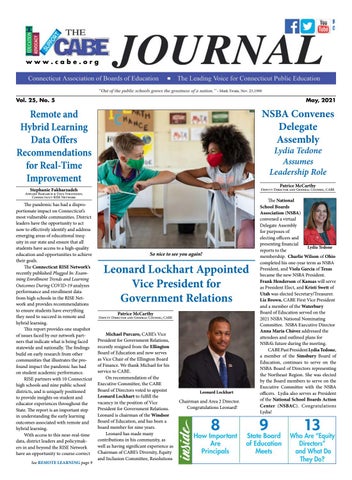
Leonard Lockhart
Chairman and Area 2 Director. Congratulations Leonard!
inside
The pandemic has had a disproportionate impact on Connecticut’s most vulnerable communities. District leaders have the opportunity to act now to effectively identify and address emerging areas of educational inequity in our state and ensure that all students have access to a high-quality education and opportunities to achieve their goals. The Connecticut RISE Network’s recently published Plugged In: Examining Enrollment Trends and Learning Outcomes During COVID-19 analyzes performance and enrollment data from high schools in the RISE Network and provides recommendations to ensure students have everything they need to succeed in remote and hybrid learning. This report provides one snapshot of issues faced by our network partners that indicate what is being faced statewide and nationally. The findings build on early research from other communities that illustrates the profound impact the pandemic has had on student academic performance. RISE partners with 10 Connecticut high schools and nine public school districts, and is uniquely positioned to provide insights on student and educator experiences throughout the State. The report is an important step in understanding the early learning outcomes associated with remote and hybrid learning. With access to this near-real-time data, district leaders and policymakers in and beyond the RISE Network have an opportunity to course-correct
8
How Important Are Principals
The National School Boards Association (NSBA) convened a virtual Delegate Assembly for purposes of electing officers and presenting financial Lydia Tedone reports to the membership. Charlie Wilson of Ohio completed his one-year term as NSBA President, and Viola Garcia of Texas became the new NSBA President. Frank Henderson of Kansas will serve as President Elect, and Kristi Swett of Utah was elected Secretary/Treasurer. Liz Brown, CABE First Vice President and a member of the Waterbury Board of Education served on the 2021 NSBA National Nominating Committee. NSBA Executive Director Anna Maria Chávez addressed the attendees and outlined plans for NSBA’s future during the meeting. CABE Past President Lydia Tedone, a member of the Simsbury Board of Education, continues to serve on the NSBA Board of Directors representing the Northeast Region. She was elected by the Board members to serve on the Executive Committee with the NSBA officers. Lydia also serves as President of the National School Boards Action Center (NSBAC). Congratulations Lydia!
9
State Board of Education Meets
13
Who Are “Equity Directors” and What Do They Do?
2
The Journal – Connecticut Association of Boards of Education | May, 2021 PRESIDENT COMMENTARY
Who or What is in Charge? Donald Harris President, CABE
Before you come up with the thought, “what the heck is he talking about?”, let me explain what I am feeling. It has been an extremely difficult 13 months that included not only a COVID-19 pandemic, but also a contentious Presidential campaign; an insurrection in the nation’s Capitol; attacks on members of the Asian-American community; the trial of Derek Chauvin (fired Minneapolis police officer); and, as of this writing, mass shootings in different portions of the country. That is a picture of the bad news. The best news we have is the development of three vaccines, Pfizer, Moderna, and Johnson & Johnson and the fact that, to date, more than 150,000,000 people from age 16 and above have been inoculated. Today, we are living in extremely dangerous times and my concern is for the children. Children from age 16 and above may soon get their vaccines. They represent 20 percent of the student population. What is going to happen to the rest of the children? When will they get their vaccines? Our children have continued to witness all the violence happening on the television screens and sometimes in their own neighborhoods. How is that affecting their emotional health?
We hope our children have been going to school in person or hybrid or virtual. The fact is some of our children have not been going to school, do not have a computer or may not have a wi-fi connection. We, as educators, have a lot of work ahead of us. Supreme efforts have gone into assuring that all teachers who wanted the vaccine have received their shots. As efforts go forward to begin to bring children back to school full time, they will still have to socially distance and wear masks. Borrowing from a March 29, 2021 joint article authored by the CT Department of Health (DPH) and the State Department of Education (CSDE), school districts need to adopt the statement to “Finish Strong”. What we all can do to make this happen is:
At School:
Know your school’s procedures to protect the school community and in person learning, which includes: • Correct and consistent cloth mask wearing while inside the school building or outside in close contact with others; • Frequent hand washing and sanitizing; • Social distancing from others and avoid large groups; • Staying seated, masked and not interacting with others on the school bus; • Be aware of symptoms that
CABE Board Meets, Sets Dues for 2021-22 Robert Rader
Executive Director, CABE
At its April 13 meeting, the CABE Board of Directors took the following action: •A dopted a 2.5 percent dues increase for the next fiscal year. CABE has not had a dues increase in five years, during which the inflation rate went up approximately 10 percent. The increase in dues will help the Association better serve its members by including changes in our database and e-meeting providers; •O n the recommendation of the Executive Committee, elected Leonard Lockhart (Windsor) as Vice President for Government Relations (see story page 1); •H eard an update on the Legislative Session; and, •H eard reports from President Donald Harris (Bloomfield), First Vice President Liz Brown (Waterbury) and others. Among the issues discussed was the Survey to be disseminated by the Diversity, Equity and Inclusion Committee that will help us better serve our members as we begin establishing affinity groups.
Mission: To assist local and regional boards of education in providing high quality education for all Connecticut children through effective leadership. Vision: CABE is passionate about strengthening public education through high-performing, transformative local school board/ superintendent leadership teams that inspire success for each child.
Board of Directors may develop and stay home or quarantine in the event that they could be COVID-19 related; • Get tested if you suspect any symptoms or have been in contact with another with COVID-19 until you receive a negative test.
Outside of school
• Employ the same mitigation strategies used in school when you are in public, especially during sports events or other group activities; • Never make assumptions that because someone has no symptoms they have not been exposed; • Avoid unnecessary public interactions and keep trips to a minimum; • Move activities outdoors to allow for necessary spacing and better air quality.
When Traveling:
• Individuals or families planning overnight trips either in state or out of state need to recognize that their knowledge of individuals they might encounter present a greater risk because they do not know them. Extra caution needs to be exercised regarding masking and social distancing and testing if necessary. Finish Strong must have the inclusion of a summer school program. Efforts should be made to ensure that we convince parents to enroll their children to help them make up for lost learning with the inclusion of the arts, physical activities and social emotional learning tools. This is not the time for complacency. We must continue to be careful, follow protocols and procedures with the hopes that we can return to a sense of normalcy by the end of 2021!
EXECUTIVE COMMITTEE Donald Harris | President, Bloomfield Elizabeth Brown | First Vice President, Waterbury Leonard Lockhart| Vice President for Government Relations, Windsor Bryan Hall | V ice President for Professional Development, East Hartford John Prins | Secretary/Treasurer, Branford Robert Mitchell | I mmediate Past President, Montville Christopher Wilson | Member at Large, Bristol Lydia Tedone | NSBA Director, Simsbury AREA DIRECTORS Bryan Hall | Area 2 Co-Director, East Hartford Leonard Lockhart | Area 2 Co-Director, Windsor Joan Trivella | Area 4 Director, Brooklyn Mic helle Embree Ku | A rea 5 Director, Newtown Karen Kleine | Area 6 Director, Westport George Kurtyka | Area 7 Co-Director, Derby Robert Guthrie | Area 7 Co-Director, West Haven Lon Seidman | Area 8 Director, Essex Sean Nugent | Area 9 Director, Preston ASSOCIATES Julie Auseré | Associate, Canton Eileen Baker | Associate, Old Saybrook Ethel Grant | Associate, Naugatuck Ann Gruenberg | Associate, Hampton Robert Trefry | A ssociate, CT Technical High School System Elaine Whitney | Associate, Westport COMMITTEE CHAIRS Leonard Lockhart | Chair, Resolutions, Windsor Becky Tyrrell | Chair, Federal Relations, Plainville Michelle Embree Ku | Chair, State Relations, Newtown CITY REPRESENTATIVES John Weldon | City Representative, Bridgeport Ayesha Clarke | City Representative, Hartford Andy George | City Representative, Stamford Yesenia Rivera | City Representative, New Haven Charles Stango | City Representative, Waterbury STAFF
Robert Rader | Executive Director Patrice McCarthy | Deputy Director and General Counsel Nicholas Caruso | Senior Staff Associate for Field Services and Coordinator of Technology Sheila McKay | Senior Staff Associate for Government Relations Vincent Mustaro | Senior Staff Associate for Policy Service Lisa Steimer | Senior Staff Associate for Professional Development and Communications Teresa Costa | Coordinator of Finance and Administration Pamela Brooks | S enior Administrative Associate for Policy Service and Search Services Terry DeMars | Administrative Associate for Policy Service Gail Heath | Administrative Associate for Government Relations Wilmarie Newton | Administrative Associate for Labor Relations Nancy Propfe | Administrative Assistant for Membership Services Corliss Ucci | Receptionist and Assistant to Executive Director
CABE Journal (ISSN 1092-1818) is published bi-monthly by Connecticut Association of Boards of Education, 81Wolcott Hill Road, Wethersfield, CT 06109. Periodicals postage Paid at Hartford, CT.” POSTMASTER: Send address changes to The CABE Journal, CABE, 81 Wolcott Hill Road, Wethersfield, CT 06109-1242. CABE membership dues include $30 per person for each individual who receives The CABE Journal. The subscription rate for nonmembers is $75. Association members dues include a subscription for each Board Member, Superintendent, Assistant Superintendent and Business Manager. The companies and advertisements found in The CABE Journal are not necessarily endorsed by CABE.
The Journal – Connecticut Association of Boards of Education | May, 2021
CABE Affiliate Members BUSINESS AFFILIATES VALEDICTORIAN Connecticut Business Systems – A Xerox Company Finalsite SALUTATORIAN
Berchem Moses PC Shipman & Goodwin HIGH HONORS
Pullman & Comley HONOR ROLL Anthem Blue Cross and Blue Shield ESS JCJ Architecture Newman/DLR Group SCHOLAR Brown & Brown Chinni & Meuser LLC Coordinated Transportation Solutions Dattco, Inc. Goldstein & Peck, P.C. Kainen, Escalera & McHale, P.C. The Lexington Group Network Support Co. OneDigital Health and Benefits Perkins Eastman T-Mobile The S/L/A/M Collaborative Zangari Cohn Cuthbertson Duhl & Grello, P.C.
EDUCATIONAL AFFILIATES American School for the Deaf Area Cooperative Educational Services (ACES) Capitol Region Education Council (CREC) The College Board Communities in Schools Connecticut Arts Administrators Association Connecticut Association of School Business Officials Connecticut School Buildings and Grounds Association Connecticut School Counselor Association Connecticut Technical High Schools Cooperative Educational Services (C.E.S.) EASTCONN EdAdvance Explorations Charter School Integrated Day Charter School ISAAC LEARN
3
EXECUTIVE DIRECTOR COMMENTARY
What Have We Learned From the COVID-19 Crisis? Robert Rader
Executive Director, CABE
In March 2020, our world pivoted to one of isolation, masks, Zoom meetings and constant washing of hands. While we could have guessed that in emergencies, the Governor had powers that would override most laws, for most of us, this would be the first time we saw that power implemented. Schools, along with restaurants, sporting events and most stores were closed. Our 24/7/365 society came to a halt. We lost thousands of lives, just in Connecticut and those we lost will be remembered. In these difficult times, boards and superintendents were making difficult decisions almost daily on how students would be educated. Their decisions were not always greeted with cheers: in many communities, the issue of when and how schools were to be reopened would lead to half of parents agreeing with the decisions and half disagreeing. For the first time in my memory, districts had to figure out what, if anything, they could do to distribute food with schools closed, determine schedules for different cohorts, consider how many students they could fit on buses and define how best to help our most vulnerable students. How could we educate students at home, when so many lacked laptops and broadband? What happens in a household when parents are trying to work at home and so are the three students who also live there?
Positivity and Gratitude
During the National School Boards Association Conference this April, keynote speaker Shawn Achor, a “positive psychologist” and best-selling author of The Happiness Advantage, talked about the importance of staying positive, even in the face of trying times. He spoke about the importance of gratitude and how simple changes to one’s life and our school systems could result in higher achievement and more success in our schools. Let’s look at the positive things that happened, through a lens of gratitude: In an unprecedented period of crisis in our lifetimes, many rose to the occasion. For board members, especially chairs, it was a time of gathering and disseminating information on things like positivity rates and en-
suring that their towns provided the resources to get us through this period. At CABE, we sensed the needs of our members, especially their need for engagement. Our Board Chair Check-Ins would be attended by as many leaders as our most popular workshops—week after week! From a statewide level, Governor Lamont and then-Education Commissioner Cardona set operating guidelines for our schools and supported the idea of reopening schools as soon as possible. SDE provided important information nearly every day and very often depended on CABE to analyze and disseminate it to our members. Realizing the importance of helping all districts, the CABE Board of Directors and Staff opened up our services, programs and other activities to nonmembers for the first three-anda-half months of the crisis. This crisis challenged superintendents with new obstacles to their already difficult work. They had to come up with three plans for reopening during July, a month that is usually a time of recharging and vacations. Their decisions on reopening fully, in a hybrid method or fully remote, taxed them as they dealt with logistical issues that would just about overwhelm General Eisenhower on the eve of D-Day (okay, a bit of exaggeration!) Principals also had to determine how best to open their schools. Would there be enough personal protective gear? How can they establish student “cohorts”, the idea of which is so different from the inclusive, diverse ways in which our schools, especially our high schools, operate? Teachers, school counselors, nurses and other staff were put under pressure as they attempted to carry out their responsibilities. They found that it was difficult to teach or counsel students where so much of teaching and counseling is based on one-to-one relationships. They had to figure out how to teach a class over the internet when half or more of the students have their cameras off.
Resources Delivered
I don’t want to forget those who came forth with resources, such as the Dalio Foundation, others in the nonprofit and business sectors, that provided laptops and wifi to thousands of students. However, we know there
was learning loss for many of our students, and there is the continuing issue of students who did not show up. There are many more to thank, including our entire Congressional delegation as they worked to provide resources to our needy communities. In every one of these actions taken by individuals, whatever their roles or responsibilities during the crisis forced them to exercise their duties in new ways. One example was remote meetings required at least a minimal level of technology skill, even if, a year after the start of the crisis we were still learning about Zoom, GoToMeeting, Teams or Ring—which we’d never heard of prior to the crisis. We learned about remote graduations and some of these ideas will be with us long after COVID-19 is gone. We also learned about social distancing and sports! We understood the trauma many of our students and staff felt in this new world. We continued to focus on equity and social-emotional skills. We were successful in using new communication tools, even if a year after we started, we still have to remind people to unmute themselves. With remote meetings, our Boards learned how to handle greater numbers of the public “showing up.” Public education learned to use new muscles as we ensured the continuous schooling of our students. That, in itself, is a wonderful tribute to all in the public education community. Yes, we hear about how difficult, challenging and frustrating this year has been for our board members, superintendents, principals and teachers, but, let’s not forget about our successes. We learned to handle one of the most traumatic episodes in our history. No, not perfectly, but, with creativity and imagination. Let’s not lose those new leadership and technological skills we acquired. Let’s incorporate them into our post COVID-19 lives. Let’s show gratitude to so many who went “above and beyond”. At the same time, we will continue to mourn what we have lost.
4
The Journal – Connecticut Association of Boards of Education | May, 2021 See You in Court – The Nutmeg Board of Education
The Nutmeg Board and the Freedom of Information Act Thomas B. Mooney, Esq. Shipman & Goodwin The Nutmeg Board of Education makes many mistakes. The latest imbroglio created by the board will be reported here each issue, followed by an explanation of what the board should have done. Though not intended as legal advice, these situations may help board members avoid common problems. Given the fixed costs for negotiated salary increases, higher insurance costs, and much higher projected fuel oil costs, the members of the Nutmeg Board of Education were proud to submit a 2021-2022 budget proposal to the Nutmeg Board of Finance with an increase of only 3.5 percent. They were concerned, however, because Seymour Dollars, the irascible and long-serving chair of the Board of Finance, had publicly announced that he would be voting against any budget increases this year. Hoping that a show of strength would be helpful, all the members of the Board of Education attended the meeting when the Board of Finance took action on the Board of Education budget. True to his word, however, Seymour voted against the Board’s proposed budget, and he reiterated his position that “zero” is the only acceptable number for the 2021-2022 Board of Education budget increase. By contrast, the other members of the Board of Finance were more realistic, and through further discussion (and over Seymour’s objection), its reductions to the Board of Education budget resulted in an increase of some 2%. The Town of Nutmeg finalized the 2021-2022 budget based on the recommendation of the Board of Finance, and the Board of Education scheduled a meeting to revise its budget for the year to conform with the appropriation. At that meeting, veteran Board member Bob Bombast ranted against the actions of the Board of Finance, and he insisted that the Board of Education should not let Seymour Dollars and the Board of Finance push it around. He urged his fellow Board members to stand firm and not make any changes to its budget. “If we need the money we have budgeted for, we will just have to ask the Board of Finance for a supplemental appropriation next spring.” But Board member Penny Pincher brought the Board members back to earth with the observation that a failure to prepare a proper budget could result in some sort of personal liability if the Town did not come through with a supplemental appropriation. Then Bob Bombast moved that the Board go into executive session to discuss “personnel matters.” The other Board members had no idea why they would be discussing personnel matters, but they did like the idea of an executive session. Accordingly, they
voted unanimously to go into executive session, for the purpose as Bob stated. Once the Board was in executive session, Bob explained. “We should figure out what cuts to make now. It would be terrible if some loyal Board employee reads in the newspaper that his job was eliminated before Mr. Superintendent could even give him the heads-up.” The other Board members agreed, and they started discussing potential budget reductions. They identified reductions in equipment and supplies as well as specific positions to cut. Bob took notes and read them back to assure that all the Board members were on the same page. The Board reconvened in open session, and Bob read from those notes to make a motion. With the announced goal of reducing the budget by the 2 percent, Bob’s motion included the specific cuts unrelated to personnel, but it just listed the dollar amounts of “personnel reductions.” The motion passed unanimously. After the meeting, Nancy Newshound, reporter for the Nutmeg Bugle, asked Bob who the “personnel” being discussed were, and she asked for a copy of whatever Bob was reading from. Bob told her to mind her own business and that he would not be sharing his personal notes with her. Can Nancy get a copy of Bob’s notes? Was the executive session appropriate? • • • • • • • • • • • • • • • To start with, by going along with Bob’s proposal for executive session, the Board violated the Freedom of Information Act in various ways. The applicable executive session privilege is to discuss the “appointment, employment, performance, evaluation, health or dismissal of a public officer or employee, provided that such individual may require that discussion be held at an open meeting…” Conn. Gen. Stat. § 1-200(6)(A). This statutory language makes clear that the “personnel” reason for executive session must relate to the discussion of one or more individual employees or public officers (which includes board of education members); the law contemplates that public agencies must provide notice to such individual employees or officers before any such discussion so that he or she may exercise his or her right to require that the discussion as to him be held only in open session. It was thus improper for the Board to discuss staffing and position eliminations in executive session. To make matters worse, the Board failed appropriately to state the reason for the executive session. The Freedom of Information Commission has held repeatedly that the public has the right to know of the nature of any personnel discussion in executive session and that simply stating “personnel matters” as the reason for the executive session
violates the law. It can be a challenge, of course, to strike the correct balance between apprising the public of the nature of the personnel discussion and maintaining the confidentiality that the executive session is intended to preserve. But citing “personnel matters” as the reason for executive session discussion will not pass muster if ever challenged. Bob’s taking notes in executive session raised another FOIA issue. Recorded information about a topic privileged to confidential discussion in executive session may be subject to public disclosure, because the rules governing executive session and the rules about what records are confidential are governed by different statutes. Boards of education can discuss the evaluation of the superintendent confidentially in executive session, for example, but any recorded information on the same subject is subject to public disclosure. Accordingly, the fact that Bob took these notes in executive session is irrelevant. Rather, the status of the notes Bob took in executive session will depend upon whether they are considered personal notes. Personal notes that a public official takes in the course of his or her duties can be considered “preliminary drafts or notes,” which are exempt from disclosure under the FOIA. Conn. Gen. Stat. § 1-210(b) (1). However, after Bob read from the
notes, first in executive session and then in the public board meeting, he lost the ability to claim that these notes remain “preliminary drafts or notes” exempt from disclosure under the FOIA. Finally, we note that the all the Board members attended the meeting of the Nutmeg Board of Finance. Normally any convening of a quorum of a multi-member public agency must be posted, as when board members are all invited to a community event at which a quorum may be discussing board business. However, the FOIA contemplates that members of one public agency may attend a properly-posted meeting of another public agency without posting the meeting. Conn. Gen. Stat. § 1-200(2). In relying on this exception, it is important not to let the meeting morph beyond what was posted. For example, if a quorum of a board of education attends a meeting of the policy committee, those board members not on the committee must be treated as any other members of the public, and should not be afforded special privileges as to speaking or even where to sit. Attorney Thomas B. Mooney is a partner in the Hartford law firm of Shipman & Goodwin who works frequently with boards of education. Mooney is a regular contributor to the CABE Journal. Shipman & Goodwin is a CABE Business Affiliate.
The Ninth Edition – Now Available!
A Practical Guide to Connecticut School Law by Thomas B. Mooney, Esq. Shipman & Goodwin
CABE is delighted to announce that the Ninth Edition of Tom Mooney’s Practical Guide to Connecticut School Law is now available. PRICING: CABE Members: $54.99; CABE Non-Members: $79.99; Students: $44.99 There have been many changes in school law in the last few years, and the Ninth Edition has been extensively revised to provide updated guidance on the legal issues that govern our schools. Changes include descriptions and commentary on:
• Changes in teacher evaluation and teacher tenure. • New rules regarding employee background checks. • New requirements concerning student data privacy. • New rules for suspension, expulsion and alternative educational opportunities. • Revised requirements governing seclusion and restraint. • The new “Every Student Succeeds Act” and how it has changed “No Child Left Behind Act” requirements. • The CCJEF case and ongoing litigation over equal educational opportunities. • The Minimum Budget Requirement and new duties to collaborate with town officials. • A host of other changes in the rules that boards of education and school administrators must follow.
The Journal – Connecticut Association of Boards of Education | May, 2021
5
Aim Higher
Creative legal solutions for Connecticut’s public schools – because sometimes it is rocket science.
Shipman & Goodwin’s school law attorneys have more than 40 years of experience, and represent over 100 public school districts, as well as public school member organizations and associations, on a full range of legal issues that they confront, from general education law to special education matters.
Our school law site, www.ctschoollaw.com is devoted entirely to emerging school law issues. Attorneys counsel clients, monitor legislation and provide periodic alerts and updates. We regularly present seminars, quarterly workshops, webinars and professional development workshops for schools on current topics of interest. Our Practice Group Co-Chair, Tom Mooney, has written A Practical Guide to Connecticut School Law, a comprehensive treatise on Connecticut school law, published by CABE and used by teachers, administrators and board of education members throughout the state.
Education is a core focus of our law firm. www.ctschoollaw.com
Contact: Thomas B. Mooney or Linda L. Yoder | 860.251.5000 | www.shipmangoodwin.com CONNECTICUT
|
NEW YORK
|
WASHINGTON DC
6
The Journal – Connecticut Association of Boards of Education | May, 2021
THE POLICY CORNER Vincent A. Mustaro
Senior Staff Associate for Policy Service, CABE
Board Member’s Standards / Code of Conduct Public oversight of local government is the foundation of American democracy. This is very evident in our public schools where local boards of education are entrusted by their communities to uphold the Constitution, protect the public interest in schools and ensure each student is provided with a high quality education. To gain the public’s confidence, boards of education must govern responsibly and effectively. Professional standards/codes of conduct for board of education members enhance the public’s understanding of the critical responsibilities of local boards and can support boards to govern effectively. Adopting standards or a code of conduct sends a message to the community that the board of education understands its critical role and is dedicated to carrying out its responsibilities focusing on student achievement. In addition, a framework is provided for board members and the superintendent to work effectively as a governance leadership team. The position of being a board member is very complex with no hard and fast rules that deal with all its aspects. Experienced board members believe it takes about two years to learn the role. Some generally accepted guidelines to assist an individual in becoming an effective board member exist. An effective board member: 1. Attends all meetings of the board. 2. Is legally a board member only when the board of education is in session. No one person, unless authorized, should speak on behalf of the board. 3. Recognizes his/her responsibility is not to run the schools, but to see that they are run well by others. 4. Is well acquainted with school policies. 5. Voices opinions frankly in board meetings and votes for what is in the best interest for the children of the district. 6. Is flexible and realizes there are times when changes must be made, when tradition cannot be honored, and when pressure must be ignored. 7. Remembers that board business, at times, requires confidentiality, especially in processes involving personnel, legal matters, security matters, and land acquisition. 8. Is interested in obtaining
facts, but remembers that the administration has the responsibility of operating the schools, not spending a great deal of time gathering data or making reports to the individual board member. 9. Knows that the reputation of the entire school district is reflected in his/her behavior and attitude. 10. I s able to sift fact from fiction, to sort out rumors from realism, and to know the difference. 11. R efers all complaints and requests to the appropriate administrative officer. 12. Maintains harmonious relations with other board members when harmonious relations are consistent with his/her obligations to the schools. 13. Uses good ethical and moral judgment in all decisions that he/she makes. Unfortunately, concerns over the rules of conduct for school board members are on the rise in many communities. The discussion of ethics codes can become divisive if not handled properly. Board members have indicated the need for guidance on issues involving proper conduct, civility and communication within the board and between board members and the public. This takes board leadership to a higher plane. School administrators have a major stake in such discussions because proper board behavior is critical to a district’s success and to a superintendent’s quality of life. Most school board codes of conduct include strong reminders of the limitations of a board member’s power and that the board is responsible for district policy, not day-to-day operations. A common problem cited by superintendents is the board’s difficulty with delegating proper authority to the superintendent and allowing the superintendent to perform his/her job without undue meddling. However, school executives must tread lightly. If they are perceived as either interfering in board policies or being critical of the behavior of certain board members, they could worsen a rift on the board or even become a target themselves. Nationally, some states and state associations have aggressively disseminated codes of conduct to local boards. Sample codes of ethical behavior are
very common. Many states, but not Connecticut, require mandatory school board training. However, most state associations have no enforcement power regarding the adopted codes. Such codes provide board members the ability to police themselves. New Jersey’s code of conduct, created by the state school boards association, has been incorporated into state law. The state legislature folded the code into its existing School Ethics Law, requiring school boards to follow it. The code contains such self-limiting statements for board members as: • “ I will confine my board action to policymaking, planning and appraisal, and I will help to frame policy and plans only after the board has consulted those who will be affected by them;” and • “ I will carry out my responsibility not to administer the schools, but, together with my fellow board members, to see that they are well-run.” New Jersey board members are required to learn about the code. Lack of participation in the ethics training is a violation of the state code. Absent a forceful push from the state, school boards must decide for themselves what type of ethics policy and related code of conduct, if any, they may want to adopt. Nationally, state school board associations recommend codes of conduct. However, some local boards have found that broaching discussions about the civil behavior of board members can quickly turn ugly, especially when they are prompted by the perceived bad conduct of a member. The signing of such a code may be viewed as a potential weapon wielded by the board majority. Consider carefully the timing and motives for introducing or revising such codes of conduct. Do it for the appropriate reasons. A need for trust on the board is essential to its development, passage and use. The process used to adopt and use such a policy is crucial.
Policy Implications
School boards play an important role in the success of the school district. The school board member responsibilities are not accomplished through individual members, but through the collection of these representatives of the community that comprise the board.
Each school board member brings specific talents, skills, and expertise to contribute to the collaboration of accomplishing the work of the board for the benefit of the district and its students. School board members are individuals elected by their community to serve as representatives of the public. As champions for the community, school board members work to make sure the needs and desires of the public are brought to life through successfully carrying out their responsibilities. In addition to a code of ethics, boards should also adopt a code of conduct applicable to board members in order to help the effectiveness of the boards. An ethics policy alone may not cover the proper conduct of board members. Local boards of education are critical to positive, sustained public school reform. The adoption and utilization of a board member code of conduct helps keep the board of education focused on learning and achievement for all students, promotes dialogue about governance, which leads to a greater understanding among members of the governance team about roles and expectations and helps establish a common vocabulary about governance and serve as a framework for building or maintaining a district culture focused on effective governance. Such adoption demonstrates the willingness of board members to be accountable to each other and to the public and provides a tool for boards to evaluate their effectiveness and to identify areas where continuing education would be useful. The code helps formalize a positive governance culture for when new board members or superintendents join the governance team. It also promotes a greater awareness and understanding among parents, the media and the public about what boards do and how they can operate most effectively. A board of education can adopt a board member code of conduct bylaw which contains the standards for board members. Once adopted, the code should be communicated to the school community and public at-large. Some boards may choose to pass a resolution containing such code which is then signed by each member of the board. Samples of a code of conduct for board members, codified as #9274, are readily available from the CABE Policy Department.
The Journal – Connecticut Association of Boards of Education | May, 2021
7
We Are Well Suited to Respond to the Legal Needs of Boards of Education Attorneys and Counselors at Law
Berchem Moses PC is a leading player in the State of Connecticut in the field of Education Law. With 10 attorneys dedicated to this specialized practice, we offer a long history of experience and deep resources. We promise the highest level of service in a more cost effective manner. We work with boards of education to address a myriad of complex issues including labor and employment, student issues, special education, general counsel, and other challenges facing educators today. Be sure to visit www.connecticuteducationlawblog.com where our attorneys regularly cover legal matters that pertain to Connecticut schools.
www.berchemmoses.com Milford
75 Broad Street Milford, CT 06460 Phone: 203-783-1200
Westport
1221 Post Road East Westport, CT 06880 Phone: 203-227-9545
8
The Journal – Connecticut Association of Boards of Education | May, 2021
How Important Are Principals? Robert Rader
Executive Director, CABE
The unsurprising answer, is, in a word, “VERY”. The Wallace Foundation, which has focused on school leadership for many years, has just published a “synthesis” of research on school principals. The report, How Principals Affect Students and Schools: A Systematic Synthesis of Two Decades of Research, found that “effective principals have positive impacts on student achievement and attendance, as well as teacher satisfaction and retention”. Much of the focus of the reform movement in the early 2010s focused on the importance of principals in
evaluations and accountability. The report states that, in spite of the focus, research since 2000 indicates “the impact of an effective principal has likely been understated” with greater impact than previously thought. This report supports the investment of effort towards strengthening the role of principals. Here are some of the “key findings and recommendations”: • Th e report showed that “the importance of principals may not have been stated strongly enough in earlier work, given the magnitude and scope of principals’ impacts on students and schools”. •A principal’s effectiveness is not as large as a single teacher, but,
has much greater effect since it affects the entire school. “The principal’s effects on students are largely indirect, coming in good measure through teachers, with the principal influencing factors including teacher hiring and development as well as the conditions for sound learning”. •E ffective principals carry out “four key behaviors—engaging in ‘high-leverage’ instructional activities, such as teacher evaluation and feedback; establishing a productive climate; building collaboration and professional learning communities; and managing personnel and resources strategically.” In order to carry out the roles, principals need people, organizational and instructional skills, a “broader toolkit of strategies than often assumed.” • Th e authors of the study stated that principals need to embed equity into all of these practices, as more of our students are of color, come from low-income homes, are English learners and students with disabilities. •G iven the strength and scope of the impact of an effective principal, investing in successful strategies is likely to have a very large payoff. The study also states that there have been three key changes in the demography of principals since the 1980s: “(1) the principalship has become markedly more female, (2) principals’ level of experience has fallen on average and especially in high-
need schools, and (3) despite dramatic changes in the racial and ethnic composition of students, racial and ethnic diversity in school leadership has moved only slightly, creating growing racial and ethnic gaps between principals and the students they serve.” The report called attention to the “representation gap” between principals and students—the difference between the percentage of principals of color and that of students. This is particularly of concern because of research “linking principal demographic diversity to better outcomes for students of color”. If you’re wondering about Connecticut, according to SDE, 56 percent of principals are female. Eighty-five percent are white. In a time when our students of color make up approximately 47% of our student enrollment, only nine percent are Black or African American and 5 percent are “Hispanic or Latino of any race”. The Wallace Foundation report can be found at: www.wallacefoundation.org/knowledge-center/pages/howprincipals-affect-students-and-schoolsa-systematic-synthesis-of-two-decadesof-research.aspx.
Meeting of Interest n May 5, 2021: State Board of Education Virtual meetings will be livestreamed for public access. A link to the live stream will be available on the Board’s website the morning of the meeting at 9:30 a.m.
CABE VIRTUAL DAY ON THE HILL – MARCH 17, 2021
CABE Deputy Director and General Counsel Patrice McCarthy and Sr. Staff Associate for Government Relations Sheila McKay were joined by Rep. Kathleen McCarty and Sen. Eric Berthel at CABE’s Virtual Day on the Hill.
CABE Deputy Director and General Counsel Patrice McCarthy and Sr. Staff Associate for Government Relations Sheila McKay, CABE President Donald Harris (Bloomfield), and CABE Executive Director Robert Rader welcome participants to CABE’s Virtual Day on the Hill.
CABE Deputy Director and General Counsel Patrice McCarthy and Sr. Staff Associate for Government Relations Sheila McKay “behind the scenes”.
The Journal – Connecticut Association of Boards of Education | May, 2021
9
State Board of Education Meets Sheila McKay
Sr. Staff Associate for Government Relations, CABE
At its April meeting, the Connecticut State Board of Education had a presentation by the Connecticut Association of Public School Superintendents (CAPSS) on its Blueprint to Transform Connecticut’s Schools. The plan has 30 actions and a 15-year roll out. One particular focus was on special education. The reasons for an increase in costs is due to lack of resources to intervene prior to being identified as in need of special education services and the increase in ser-
REMOTE LEARNING
(continued from page 1)
before this school year ends. RISE analyzed data for more than 12,000 students in Grades 9 through 12, as well as surveyed families within partner districts. The findings revealed the following: •S ignificant Remote Enrollment: 37 percent of students chose to enroll in fully remote learning. •D emographic Differences: Female students, students of color, and special education students were more likely to enroll in remote instruction. •C onnection to Prior Attendance: Though there was no connection to past on-track status, students with prior chronic absenteeism were more likely to enroll in remote learning. •L ow Remote On-Track Rates: 54 percent of remote students were on-track (vs. 74 percent of hybrid) by the end of Quarter 1 •C oncerns about Equity Gaps: Taken together, this data creates concerns about widening opportunity gaps for some historically marginalized populations. At RISE, we believe that all students deserve an engaging, enriching, and meaningful high school experience. This remains true even in a pandemic and regardless of a family’s decision to enroll their child in remote or hybrid learning. We also know students, families, and educators are working incredibly hard, and this past year has required new levels of creativity and perseverance. We must work collaboratively -- in and across school communities -to address gaps and lift up bright spots
vice costs. Members asked about the plan’s emphasis on math instruction, parental involvement and creating innovation in education. The full report can be found on CAPSS’ website, www.capss.org. The agency update began with an overview of the more recent ESSER federal funding in light of COVIC-19. ESSER 2 applications are ongoing. The American Rescue Plan (ARP) ESSER, -ESSER 3 require the local board of education set aside 20 percent of their ESSER funding for learning recovery. The Board was informed of a social emotional screener
(set of questions) that the Connecticut State Department of Education (SDE) has contracted with to help districts implement statewide. Aperture Education will assist the state in using the Devereux Student Strength Assessment. The questions include: during the past four weeks did the child perform the steps of a task in order, during the last four weeks did the student do something nice for someone, and are designed to only take a minute to ask. It is to be utilized three times a year. Roll out will be 100 districts in two cohorts in 2021/2022 and nearly 200 districts the
following year. Interim Commissioner Russell-Tucker informed the Board on plans to test students in school for COVID-19, as is being done in Massachusetts and the ongoing work SDE is doing to directly support parents. A recent webinar was a great success, done in partnership with the State Education Resource Center (SERC) and the CT Children’s Medical Center. Finally, Chair of the Board Allan Taylor has stepped down from his role after 20 years. CABE extends our thanks for his public service, first begun on the Hartford Board of Education!
in schools, classrooms, and remote settings across the state. The report offers recommendations for different stakeholder groups, including six recommendations for district leaders and policymakers: 1. Align resources to need; 2. Translate equity talk into action; 3. Avoid new bureaucratic layers; 4. R eimagine accountability measures; 5. Pursue solutions to scale; and 6. C ommunicate frequently and consistently. As schools enter the second half of the school year and prepare for a new post-pandemic reality, leaders and policymakers must align resources to needs. This requires additional resources, as well as strategic resource allocation. Additional federal funding cannot bridge the gaps around new and unmet needs, especially as state and local budgets shrink as revenues decrease. Resources must also align with student needs at the local level. If nearly 40% of students are pursuing the remote learning model and leaders see that remote learners are struggling relative to their peers, then leaders must align resources to meet those needs. Rather than simply stating a commitment to equity, policies must reinforce this ideal. For example, RISE partners are taking time to reevaluate and reimagine equitable grading practices and policies. To invest in students’ skill development, content mastery, and persistence, grading systems must move away from policies where, for example, midterm exams count for 15 percent of a students’ semester grade and students have just one chance to demonstrate mastery. District leaders should also avoid
new bureaucratic layers and instead engage educators in conversations about how to solve the central goal of improving student engagement. Related, leaders and policymakers must reimagine accountability measures this year. This is not a lowering of expectations; however, traditional measures (e.g., attendance, test scores) feel less and less representative of core learning priorities and goals this year, not to mention the concerns over the accuracy of these “normal” measures in such abnormal times. State and local leaders have the unique opportunity to pursue solutions at scale. For individual work streams, leaders and policymakers must consider who may be most effective and efficient to lead the work. District and state leaders are well-positioned to identify and learn the best online instructional tools at scale. Facing an increased need to communicate frequently with family and community stakeholders, leaders
should pick a recurring communication format and cadence. These updates can communicate major decisions or changes, and the rationale for those shifts. School communities have the opportunity to come together in response to this sobering mid-year data. The pandemic has shown that school communities are responsive and creative when the situation calls on leaders to act. We can improve our practices and adopt innovative approaches from around the state to ensure this isn’t a lost year for students. We can do this and so much more because that’s what our students deserve. For more information about the RISE Network or to read the full report, visit www.ctrise.org. RISE is supported by Dalio Philanthropies. On-Track indicates that the students are on track to earn enough credits to promote to the next grade level and graduate high school.
RISE PARTNERS INCLUDE: •E ast Hartford High School, • • • • • • • • •
East Hartford Public Schools H artford Public High School, Hartford Public Schools H ill Regional Career High School, New Haven Public Schools F rancis T. Maloney High School, Meriden Public Schools O rville H. Platt High School, Meriden Public Schools M anchester High School, Manchester Public Schools B rien McMahon High School, Norwalk Public Schools M iddletown High School, Middletown Public Schools N augatuck High School, Naugatuck Public Schools W esthill High School, Stamford Public Schools
10
The Journal – Connecticut Association of Boards of Education | May, 2021
The Media Message by Ann Baldwin, President & CEO, Baldwin Media Marketing, LLC
TRENDING: How to Make the Grade When It Comes to Planning for a Successful Referendum It may seem like a long way off when it comes to a district referendum. Whether your district is holding a budget referendum, or a special one for the closing of a school, or capital improvements, you need to have a plan in advance. Year after year, many districts approach an upcoming referendum keeping their fingers crossed that 51 percent of their school community votes in favor of the question(s) on the ballot. Some win, some fail. Perhaps a better approach would be to plan for and execute a well thought out, strategic plan that would not only build trust in the community, but also increase knowledge and engagement on public education issues in your community.
Here are some suggestions: As you plan your communication’s efforts: first, you should ALWAYS strive towards transparency. That is number one. You should also figure out and pay close attention on how to effectively communicate in front of a referendum, not only within your school community but also those on the outside looking in, for example, retirees, those with non-school age children, and other stake holders. In what other languages do you need to communicate? Next, do not be afraid to over communicate. Yes, it will feel like you are saying the same thing over and over, but the greatest impact is with using prepared and well-thought-out “key talking points”, as it relates to the
referendum. Repeat. Repeat. Repeat. Make sure your messages are focused on the needs of your district. Figure out how you can best share the story of “your needs,” not only on traditional, but also on social media platforms. Also, perhaps engage your parents groups, students and educators to help with that as well. You can never assume that any community member is on the same page. Make sure that your district effectively communicates with all of the information that voters need to make an informed and educated decision on voting day. It is also very important to remember that any communication when a referendum is pending cannot contain advocacy. It IS acceptable
to encourage community members to vote, but it is NOT acceptable for school leaders to expend public funds to tell people how to vote. A successful referendum strategy with a positive outcome builds trust, not only in your public education system, but also in your community and frankly I have found from personal experience in working with districts that it makes the next one a bit easier. Right now is the time to start thinking about how that is done, with the goal of putting failed efforts behind you and moving the needle towards a positive future for the quality of public education in your community.
BOOK REVIEW
Caste by Isabel Wilkerson
Robert Rader
Executive Director, CABE
Looking at our world through a different lens offers us new perceptions of seemingly-familiar history, stories and events. Caste by the journalist Isabel Wilkerson provides us with a look at the lives of those who live in the caste system in India, the German treatment of its Jews during the 12year Reich and African-Americans in both the South and North since blacks were brought to the “new” continent in the early 1600s.
What is caste? According to the author, it is the “granting or withholding of respect, status, honor, attention and human kindness to someone on the basis of their perceived rank or standing in the [societal] hierarchy.” By example after example, Wilkerson explains that those on the lowest rung in society, whether it is the Untouchables or dalits in India, the Jews under Nazi rule or African-Americans in the U.S., the systematic dehumanization of whole classes of people has had certain similar characteristics. “Beneath each pillar of caste was
Current Vacancies: Superintendent of Schools SCOTLAND PUBLIC SCHOOLS
MARY BRODERICK, ED.D SENIOR CONSULTANT
Principal SCOTLAND ELEMENTARY SCHOOL
For more information contact
CABE Search Services
81 Wolcott Hill Road, Wethersfield, CT 06109
860-608-1763
Equal Opportunity Employer
the presumption and continual reminder of the inborn superiority of the dominant caste [whites] and the inherent inferiority of the subordinate”, Wilkerson explains. During the 1930s, Nazis looked to the American Jim Crow laws for those that the “dominant caste” (whites) had written to keep blacks “in their place” on the lowest rung of society. Everything from the clothes that African-Americans were permitted to wear, to where they should walk when whites passed (in the gutter) and how much education they were permitted, helped cement their status. One of the stories that Wilkerson wrote about that packs a real emotional punch was that during World War II, a sixteen-year old African-American girl won a student essay contest which asked what should befall Hitler when the war was over. She answered, “put him in a black skin and let him live the rest of his life in America”. Wilkerson does not end the story when Jim Crow laws were invalidated. She writes about today and how many of the same, now implicit, rather than explicit, standards still hold true. She quotes scholar Robert L. Tsai as to why a majority of white people voted against Barack Obama and Hillary
Clinton for president: “Even though white Americans still comprise a clear majority and continue to possess most of the country’s wealth, it is possible to stoke outlandish fears of a coming reckoning where racial and ethnic minorities will seek to subjugate white citizens.” This is not an easy book to read as Wilkerson does not sugarcoat the lives of the untouchables, Jews or African Americans. She compares the South of today, with its memorials and statues of southern Civil War “heroes” to how Germany treats its Nazi leaders. The Germans have built memorials to the victims of the Nazis, who were dehumanized, transported and then murdered. There are no statues of Goering, Rommel or Hitler. Hitler’s bunker where he and Eva Braun died has been paved over and replaced by a parking lot! If you, like me, are trying to understand the Black struggle in America, this book provides some solid responses. Story after story, even Wilkerson’s personal ones, tells us of how caste still lives in the United States. She ends her narrative with a plea for the end of caste system, which place some races above others: “A world without caste would set everyone free.”
The Journal – Connecticut Association of Boards of Education | May, 2021
11
NSBA ONLINE CONFERENCE 2021
CABE Executive Director Robert Rader and Deputy Director and General Counsel Patrice McCarthy presented a workshop, Ten Best Practices to Avoid Liability, at the NSBA Online Conference on April 9.
On April 6, CABE Deputy Director and General Counsel Patrice McCarthy and Sr. Staff Associate for Government Relations Sheila McKay provided an update on bills coming out of the Education Committee.
CABE President Donald Harris (Bloomfield) shared why he is a board of education member in the What is Your Why? segment of the NSBA Online Conference on April 9.
Presenters from CABE Educational Affiliate Communities in Schools (CIS) provided a webinar for CABE about Reengaging Students and Families on March 24. If you missed it, you can go to https://www.cabe.org/page.cfm?p=1525 to register and watch on-demand.
12
The Journal – Connecticut Association of Boards of Education | May, 2021
CABE: Working for YOU
Individualized Workshops | Professional Development Opportunities Legal Services | Policy Services | Representing You Statewide and Nationally Below are the highlights of activities that the CABE staff has undertaken on your behalf over the last month. We did this:
B y providing opportunities for members to learn how to better govern their districts: zP rovided roles and responsibilities workshop for Thomaston Board of Education. zR esponded to 51 requests for policy information from 26 districts, providing sample materials on 48 topics. Further, districts continue to access CABE’s online Core Policy Reference Manual and/or online manuals posted by CABE for policy samples. The topics of greatest interest were those pertaining to personnel issues, board of education bylaws and various issues pertaining to students.
B y ensuring members receive the most up-to-date communications:
zA ttended webinar on Open Education Resources with Executive Director Doug Casey of the Connecticut Commission for Education Technology. zP repared materials, as part of the Custom Policy Service, for Ansonia, Danbury, Enfield and Sharon. zR evised policies in the master resource file of policies and in the online Core Manual. zC ompleted and distributed the next issue of the Policy Update Service quarterly publication.
B y promoting public education:
zP articipated in bi-weekly CABE Board Chair Check-In teleconferences. zW rote an article for the CABE Journal pertaining to codes of conduct for board of education members. zA ttended CABE webinar pertaining to COVID-19 vaccination programs. zA ttended a CAPSS meeting of retired superintendents. zP rovided testimony on education issues before various legislative committees.
B y providing services to meet member needs:
zP rovided webinar to review Education Committee actions. zD elivered CABE’s first virtual Day on the Hill. zP rovided a virtual workshop for the East Hartford Board of Education retreat on social media issues. zP rovided a roles and responsibilities workshop for the Branford Board of Education. zP osted policies online for districts utilizing the Connecticut Online Policy Service (COPS) for Avon, Bolton, Branford, Chaplin, Derby, Region #4, Region#18, Sherman, Somers, Westport, and Windsor. zE ntered into an agreement for an audit of their policy manual for Wallingford and Hartford. zR evised policies for Ellington, New Hartford, North Stonington, Sterling and Windham as part of the Custom Update Service. zP articipated in a virtual meeting with Thomaston to demonstrate the
Our security award provides discounts on: aCrisis response
and emergency notification systems
aTemperature and
aDigital
wellness
aand more!
face mask scanners
For more information, visit www.crec.org/marketplace
online C.O.P.S. program. zU pdated the policy section of the CABE website. zP repared additional copies of the policy manual for the Gilbert School. zW orked on audits of policy manuals for Sterling, Wallingford and Hartford.
B y attending Professional Development to strengthen staff knowledge and skills.
zA ttended Hartford Foundation for Public Giving workshop on “How to Develop and Lead Successful Virtual Sessions.” zP articipated in NSBA Council of School Attorneys webinar. zA ttended NSBA 2021 Online Experience.
B y helping school boards to increase student achievement:
zH osted webinar with Communities in Schools on countering effects of remote learning. z S ent two issues of “Policy Highlights” via e-mail listserve covering topics that affect student achievement. Included topics pertained to cyber-attacks on schools, free meal service for students, Title IX, state assessments, students from military families, and in-person learning.
B y representing Connecticut school boards on the state or national level:
zP rovided webinar on Dispelling Vaccination Myths for Board Members and Superintendents. zA ttended Governor’s Municipal calls on COVID-19. zD iscussed CABE activities, services and programs with SDE. zA ttended First Annual Educators Rising Conference. zA ttended SDE/DPH/Early Childhood webinars on COVID-19. zD iscussed CABE work on Diversity, Equity and Inclusion with representatives of the National School Boards Association. zA ttended meetings of the SDE Partners group (CABE, CAPSS, CAS, AFT-CT, CEA) on various pandemic-related issues. zA ttended AccelerateCT Education Task Force kick off and
subcommittee meetings. zA ttended Creative Artists Agency (CAA) webinar to raise awareness and discuss solutions for addressing the impact of the pandemic and systemic racism on students. zM et with Communications Director Nyesha McCauley of EveryDay Democracy on how CABE and Everyday Democracy might work together. zA ttended NSBA Delegate Assembly and 2021 NSBA Online Experience (Conference). zP articipated in CAS Board of Directors meeting. zP resented 10 Practices to Avoid Liability at NSBA 2021 Online Experience. zP articipated in Jumpstart Financial Literacy Board meeting. zP articipated in NSBA State Association Counsel meetings. zM et with other NSBA/COSA colleagues and Office of Civil Rights Acting Assistant Secretary. zP articipated in Family School Partnership Advisory Council meeting. zP articipated in Special Education Leaders Committee meeting. zA ttended State Board of Education meeting. zP articipated in Social and Emotional Learning Task Force. zP articipated in School Discipline Collaborative meeting. zA ttended the U.S. Department of Education webinar. zD iscussed COVID-19 vaccinations and school health protocols on WTIC-AM. zP articipated in CAPSS International Education Committee meeting. zM et with NSBA Convention Managers from state associations across the country.
Did You Know? For the price of CABE dues, your board and superintendent are eligible for: • Crisis communications help • S uperintendent search process workshop and written guide •W ebinars on various topical issues
The Journal – Connecticut Association of Boards of Education | May, 2021
13
Who Are “Equity Directors” and What Do They Do? Robert Rader
Executive Director, CABE
A number of districts around our State (and the country) have decided to engage an “equity officer” or “chief diversity officer” as a response to last summer’s Black Lives Matter movement and demonstrations against racial prejudice. A new paper attempts to provide some recommendations for the roles and responsibilities of these leaders. The paper, K-12 Equity Directors: Configuring the Role for Impact, published by the UIC Center for Urban Education Leadership, the University of Texas at Austin Institute for Urban Policy Research and Leadership for Learning at the University of Washington, begins by discussing the many different expectations of these individuals who hold these positions. They are tasked with handling “systemic educational inequities that are reinforced through anti-Blackness, white supremacy, and racist practices [which] keep high quality educational opportunities beyond the reach of our country’s Black, Latinx, Indigenous, immigrant, and the many ethnically
and linguistically diverse students that comprise our population.” The writers state that those with these positions should be known as “equity directors”. Although they have “different titles, educational backgrounds, race and gender identities… their goals are similar: support the design and implementation of district-wide equity reforms that will make educational experiences and outcomes more equitable and just for racially, ethnically and linguistically marginalized students.” By considering all of those in these roles as “equity directors”, it is easier to help them face the challenges in these positions. The “newness” of the position in some k-12 schools, leads to uncertainty about how to define, carry out, and measure the success of the work. The authors believe that districts hiring for such a position must also consider what they want the role of the equity directors to be. “Although leadership for equity is not new, the role that equity directors play in advancing equity in K-12 districts is relatively uncharted.” To be successful, the clearer the districts can be about
what is to be accomplished will help the equity director in achieving the districts’ equity goals. In some detail, the paper describes how the authors believe that the equity directors can be successful if they are afforded the opportunity to “actively participate in and influence” these four forms of power and authority: a. Supervisory responsibility and authority, b. Influence on superintendent and board relations, c. Financial resources and budgetary discretion, and d. Influence on district professional development related to curricular and instructional matters.” From there, the paper describes how the equity directors’ position falls into four configurations: “equity seeding, equity collaboration, equity management and compliance, and equity development and innovation.” Depending upon which of the four areas the equity director falls in will influence expectations, shareholders and other aspects of the position.
Important Clarification
The report is valuable in that it helps clarify for boards of education and their superintendents the equity
director’s position and relationship to others in the educational community. As more districts hire equity directors, no matter their “formal” job titles, the paper provides thoughtful commentary on their roles and enables districts to better focus on their responsibilities. [Editor’s note: The paper was provided to education leaders by Dr. Gladys Kersaint, Vice Provost of Strategic Initiatives and former Dean of the Neag School of Education at the University of Connecticut.] The report can be found at http:// urbanedleadership.org.
People in the News CABE Executive Director Robert Rader and Deputy Director and General Counsel Patrice McCarthy have been appointed to the Accelerate CT Task Force, which is examining how to strengthen our districts as they are coming out of COVID-19 crisis.
14
The Journal – Connecticut Association of Boards of Education | May, 2021
Trusted Legal Counsel in Extraordinary Times Now more than ever, school districts, their boards of education and their administrators are turning to Pullman & Comley’s School Law practice for informed, accurate and timely information on the unprecedented legal issues they face in the age of COVID-19, including those surrounding the safe reopening of schools, remote learning, PPE protocols, and labor and employment matters. At the same time, our attorneys are counseling clients on new laws affecting school districts, including the Title IX regulations effective in August 2020, transgender athlete policies and the sexual harassment training obligations mandated by October 2020.
Please visit our Education Law Notes blog for up-to-the-minute alerts, commentary and insights on critical legal issues affecting educational institutions. Schoollaw.pullcomblog.com And, for critical information on the legal implications as a result of the COVID-19 pandemic, please visit our COVID-19 Focus page at pullcom.com to view recent publications, receive alerts, and to register for and view our webinar series related to the pandemic.
Our attorneys are accessible to their clients, responsive to concerns and always available to answer questions on these issues as well as on the challenges schools face on a routine basis in their daily operations.
pullcom.com
@pullmancomley
William R. Connon 860.424.4385 wconnon@pullcom.com
Zachary D. Schurin 860.424.4389 zschurin@pullcom.com
Melinda B. Kaufmann 860.424.4390 mkaufmann@pullcom.com
Stephen M. Sedor 203.330.2137 ssedor@pullcom.com
Michael P. McKeon 860.424.4386 mmckeon@pullcom.com
Mark J. Sommaruga 860.424.4388 msommaruga@pullcom.com
BRIDGEPORT
HARTFORD
SPRINGFIELD
STAMFORD
WATERBURY
WESTPORT
WHITE PLAINS
203.330.2000
860.424.4300
413.314.6160
203.324.5000
203.573.9700
203.254.5000
914.705.5355