68 33 25 7
('8&$7,21
$'92&$&<
7+(
www.cabe.org
-2851$/
&RQQHFWLFXW $VVRFLDWLRQ RI %RDUGV RI (GXFDWLRQ 7KH /HDGLQJ 9RLFH IRU &RQQHFWLFXW 3XEOLF (GXFDWLRQ Vol. 16, No. 8
September 2012
³2XW RI WKH SXEOLF VFKRROV JURZV WKH JUHDWQHVV RI D QDWLRQ ´ 0DUN 7ZDLQ 1RY
1,000 new school readiness slots created
State Board approves network schools Patrice A. McCarthy, Deputy Director
Chris Seymour
and General Counsel, CABE
Reporter, CABE
In an effort to provide increased access to early childhood education — and help turn around struggling school districts in the process — state officials recently announced that 1,000 new school readiness slots have been identified and awarded to providers throughout Connecticut as a part of the education reforms Governor Dannel P. Malloy supported earlier this year, according to a press release from the Governor’s office. The slots — most of which will be allocated to what Malloy called “highneeds areas�— will go to nearly 40 communities, with Bridgeport (130) and Hartford (64) receiving the most. Other communities receiving large readiness allocations include Meriden (58), New Haven (53) and Norwalk (50). Last spring’s education reform law, targets $6.775 million in new funding for increased access to high-quality early childhood education. The new school readiness slots will be administered through the Connecticut School Readiness Program, a Department of Education initiative designed to provide for, and increase access to, highquality preschool for children ages three See 1,000 page 8
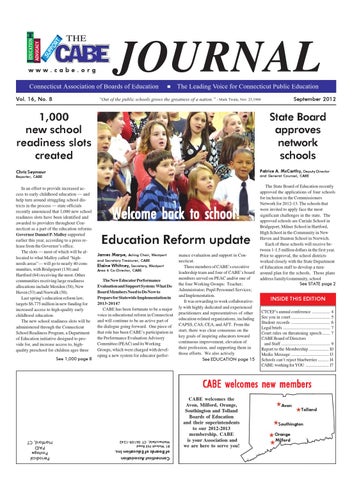
Welcome back to school! Education Reform update James Marpe, Acting Chair, Westport and Secretary Treasurer, CABE Elaine Whitney, Secretary, Westport Area 6 Co-Director, CABE
The New Educator Performance Evaluation and Support System: What Do Board Members Need to Do Now to Prepare for Statewide Implementation in 2013-2014? CABE has been fortunate to be a major voice in educational reform in Connecticut and will continue to be an active part of the dialogue going forward. One piece of that role has been CABE’s participation in the Performance Evaluation Advisory Committee (PEAC) and its Working Groups, which were charged with developing a new system for educator perfor-
mance evaluation and support in Connecticut. Three members of CABE’s executive leadership team and four of CABE’s board members served on PEAC and/or one of the four Working Groups: Teacher; Administrator; Pupil Personnel Services; and Implementation. It was rewarding to work collaboratively with highly dedicated and experienced practitioners and representatives of other education-related organizations, including CAPSS, CAS, CEA, and AFT. From the start, there was clear consensus on the key goals of inspiring educators toward continuous improvement, elevation of their profession, and supporting them in those efforts. We also actively See EDUCATION page 15
The State Board of Education recently approved the applications of four schools for inclusion in the Commissioners Network for 2012-13. The schools that were invited to apply face the most significant challenges in the state. The approved schools are Curiale School in Bridgeport, Milner School in Hartford, High School in the Community in New Haven and Stanton School in Norwich. Each of these schools will receive between 1-1.5 million dollars in the first year. Prior to approval, the school districts worked closely with the State Department of Education staff to develop a turnaround plan for the schools. Those plans address family/community, school See STATE page 2
INSIDE THIS EDITION CTCEF’s annual conference ................ 4 See you in court ................................... 5 Student records ................................... 6 Legal briefs .......................................... 7 Court rules on threatening speech ....... 7 CABE Board of Directors and Staff ............................................ 9 Report to the Membership ..................10 Media Message .................................. 13 Schools can’t reject blueberries .......... 14 CABE: working for YOU ..................... 17
CABE welcomes new members CABE welcomes the Avon, Milford, Orange, Southington and Tolland Boards of Education and their superintendents to our 2012-2013 membership. CABE is your Association and we are here to serve you!
★Avon
★Tolland
★Southington ★ Orange ★Milford
81 Wolcott Hill Road Wethersfield, CT 06109-1242
of Boards of Education Inc. Connecticut Association
Periodical Postage PAID Hartford, CT
2
The Journal
– Connecticut Association of Boards of Education • September 2012
PRESIDENT COMMENTARY
School bells ring with a new sound While walking in my neighborhood, I asked three neighbor children playing in their yard, about returning to a new school year. “I’m so excited”, bubbled the first grader, because “I love reading and meeting new friends.” Her fourth grade sister echoed, “recess is my favorite, so is math and I like when my teachers pay attention to me.” Not to be outdone, the pre-schooler stated “I just like school!” Their father watching in the backround, without hesitation said “they’re ready.” Education Lesson 101: Turnaround Schools: The State Board of Education’s approval of the Commissioner’s Network, which includes four urban schools in
“This unparalleled achievement will be about the historic ‘turnarounds’ of four schools in four neighborhoods will . . . . promote the culture of success that protects and promotes educational opportunity — and that excites every child, every September.” Bridgeport, Hartford, New Haven and Norwich, should be recognized as a groundbreaking, as it will provide a holistic approach to improving the lowest performing schools in the lowest performing districts. These schools can become where: • every child can have the same opportunity to echo sentiments not unlike the children on my street. • parents can become engaged in their children’s education. • teachers can make meaningful strides in improvement of instruction. • principals and administrators can achieve meaningful progress under their leadership. • Boards of Education can embrace the needed reform legislation to ensure struggling schools can become successful schools. The Commissioner should be applauded for setting in motion the initiative to support, guide and develop the strategies of intervention. Praise should be given to the Boards of Education, Superintendents, labor unions and
People in the News Patrice A. McCarthy has been named a member of the Connecticut Bar Association Education Law Section Executive Committee. The American Society of Association Executives (ASAE) recently announced that Lisa Steimer, Sr. Staff Associate for Professional Development, was renewed as a Certified Association Executive (CAE). The CAE is the highest professional credential in the association industry. Less than five percent of all association professionals have earned the CAE. Elizabeth A. Napolitano, Administrative Assistant to the Wallingford Superintendent of Schools and Clerk of the Board of Education, has been elected Vice President of the National Association of Educational Office Professionals (NAEOP).
parents, as their efforts and collaboration have been embraced by their communities. Every major stakeholder represented, answered the call from their lowest performing schools. The Lydia Tedone Commissioner’s Network provides a tremendous amount of promise, as an innovative and strategic approach to an urgent overhaul of failing schools. Reforms similar to the ones that will be established in Commissioner’s Network schools have been proven successful in other states since they are based on getting commitment to reform, a sense of urgency and utilization of best practices. Their success in large urban districts illustrates the possibilities of what can happen in these schools. The Commissioner’s Network is not about power, but about school improvement and community engagement. This unparalleled achievement will be about the historic “turnarounds” of four schools in four neighborhoods that will, in the end, promote the culture of success that protects and promotes educational opportunity — and that excites every child, every September.
State Board approves network schools (continued from page 1) environment, leadership, teachers/support staff, use of time, curriculum/instruction, and use of evidence/data. Several of the plans include provisions for up to three hundred hours of additional instructional time, through a combination of extended day and year. In order to make the instructional time sustainable, in some cases staff will come in 44 minutes before the regular opening time and other staff will come in 44 minutes after the regular opening time, thus adding 88 minutes to each school day without extending teacher schedules. The Milner School will partner with Jumoke Academy, a Hartford charter school, and will add 34 additional instructional days, as well as Saturday academies. They will also explore ways to increase the school year by 35 days. The New Haven plan adds 240 additional hours to the school year, with 140 of these hours used for teacher professional development. Their goal is to move from “mass production to mass personalization” for their students. Students will not be advanced a grade based on seat time, but rather will progress by demonstrating mastery on subject specific tests. The Stanton School in Norwich will also add an additional hour per day of instructional time beginning on November 1. In September and October, the additional time will be used for professional development, enabling them to “front load” the teacher training and professional development. Most of the plans also include provisions to develop a faculty that strongly supports the turnaround plan. At Curiale School, for example, in years 2 and 3 only teachers rated proficient or above will remain at the school. State Department of Education staff will work closely with the schools as they implement the improvement plans.
CABE Board of Directors EXECUTIVE COMMITTEE Lydia Tedone .................................................. President, Simsbury Richard Murray ............................. First Vice President, Killingly Ann Gruenberg ........... VP for Government Relations, Hampton Stephen Wright .... VP for Professional Development, Trumbull James Marpe ................................ Secretary/Treasurer, Westport Don Blevins ........................................... Immediate Past President John Prins ........................................................... Member at Large
AREA DIRECTORS Susan Hoffnagle ....................... Area 1 Co-Director, Winchester Mari-Ellen (Mimi) Valyo ........ Area 1 Co-Director, Winchester Daniel Santorso ........................... Area 1 Co-Director, Plymouth Becky Tyrrell ....................................... Area 2 Director, Plainville Laura Bush ............................................. Area 3 Director, Vernon Gavin Forrester .............................. Area 6 Co-Director, Stratford Elaine Whitney ............................. Area 6 Co-Director, Westport Michael D’Agostino ....................... Area 7 Co-Director, Hamden Sheila McCreven ..................... Area 7 Co-Director, Woodbridge John Prins ...................................... Area 7 Co-Director, Branford Robert Ruggiero ............................ Area 8 Co-Director, Madison Pamela Meier ................................ Area 8 Co-Director, Madison Gail MacDonald ............................. Area 9 Director, Stonington
ASSOCIATES Eileen Baker ........................................... Associate, Old Saybrook Sharon Beloin-Saavedra .......................... Associate, New Britain Gary Brochu ........................................................ Associate, Berlin Robert Guthrie .......................................... Associate, West Haven Cal Heminway ................................................... Associate, Granby COMMITTEE CHAIRS Robert Mitchell ........................ Chair, State Relations, Montville Beverly Washington ................. Chair, Federal Relations, Groton Becky Tyrrell ................................... Chair, Resolutions, Plainville
CITY REPRESENTATIVES Bob Trefry .................................. City Representative, Bridgeport Matthew Poland ........................... City Representative, Hartford Michael R. Nast ....................... City Representative, New Haven Polly Rauh .................................... City Representative, Stamford Charles Stango ........................... City Representative, Waterbury
STAFF Robert Rader ...................................................................... Executive Director Patrice McCarthy ................................ Deputy Director and General Counsel Bonnie Carney ........................................... Sr. Staff Associate for Publications Nicholas Caruso ............................................ Sr. Staff Assoc. for Field Service and Coord. of Technology Sheila McKay ............................ Sr. Staff Associate for Government Relations Kelly Moyher ......................................................................... Sr. Staff Attorney Vincent Mustaro ..................................... Sr. Staff Associate for Policy Service Lisa Steimer .............................. Sr. Staff Assoc. for Professional Development Teresa Costa ............................... Coordinator of Finance and Administration Pamela Brooks ......................... Sr. Admin. Assoc. for Policy Ser. /Search Ser. Terry DeMars .............................................. Admin. Assoc. for Policy Service Melissa Dickinson ........................... Admin. Assist. for Membership Services Gail Heath ...................................... Admin. Assoc. for Government Relations Wilmarie Newton ...................................... Admin. Assoc. for Labor Relations Corliss Ucci .............................. Receptionist/Asst. to the Executive Director
The CABE Journal (ISSN 1092-1818) is published monthly except a combined issue for July/August as a member service of the Connecticut Association of Boards of Education, 81 Wolcott Hill Road, Wethersfield, CT 06109, (860) 571-7446. CABE membership dues include $30 per person for each individual who receives The CABE Journal. The subscription rate for nonmembers is $75. Association membership dues include a subscription for each board member, superintendent, assistant superintendent and business manager. The companies and advertisements found in The CABE Journal are not necessarily endorsed by CABE. “Periodicals Postage Paid at Hartford, CT.” POSTMASTER: Send address changes to The CABE Journal, CABE, 81 Wolcott Hill Road, Wethersfield, CT 06109-1242. Email: bcarney@cabe.org. Members can find the CABE Journal online at: www.cabe.org/ userlogin.cfm?pp=84&userrequest=true&keyrequest=false& userpage=84
The Journal
3
– Connecticut Association of Boards of Education • September 2012
EXECUTIVE DIRECTOR COMMENTARY
Retirement speech for Anne L. Bryant Anne Bryant, Executive Director of the National School Boards Association, will be retiring at the end of September. Anne has been a wonderful advocate for public education and the work of school boards and superintendents. At the annual meeting of the state association executive directors in New York City, on July 31, I had the honor of giving a retirement speech for Anne on behalf of all of the executive directors. I thought you would enjoy reading the speech.
Those of us who have served as executive directors know and have known Anne Bryant for years. I don’t want to go through her whole biography or talk about the individual services, programs and activities she worked on at NSBA. Instead, I want to talk about how effective Anne has been as a representative of all of us. But, before I do, I want to mention that Anne Bryant came to NSBA the same year I came to Connecticut, 1996. She had been executive director of the American Association of University Women, a national organization advancing equity
for women and girls in education, the workplace, and the family. Anne was the first and, at least as of today, the only female executive director of NSBA. And, we all noted, her voice was nowhere as… sonorous as her predecessor, Tom Shannon. She made up for that with her ability to address critical educational issues, in writing, television and especially in her speeches at NSBA General Sessions. As Anne entered her first year, she put us through a series of strategic planning sessions, much as we have done this year, in order to determine what state associations and school districts needed from NSBA. She did much listening and she distilled what she learned, then taught it to us. The essence of the lesson: boards of education must be two things: the advocates for increasing student achievement in the education system and the conveners of the community. When we look back on our careers, all of us would like to be able to point to specific services or programs that we created or strengthened. Sometimes these new ideas become the touchstone of one’s career. In Anne’s case, however, it was her consistent fostering of this idea about the roles and the responsibilities of boards of education. She understood that the way to promote public education is by ensuring the schools give the public what it so desperately wants: high quality education, carried out at the level closest to parents, taxpayers and others in each community. Boards must convene the community to get the support of the schools that is necessary to provide high quality education. And, the public wants to see the public schools succeed. The power of the idea that public
education is the unifying factor in holding our diverse society together is not Anne’s alone, nor has she claimed that it was. But, the power to express this concept and make it count has been one of her greatest strengths. Anne’s forte was and still is, her ability to enter a room and be recognized as a key supporter of public education—with the understanding that that includes the good, the bad and the ugly (and I’m not specifically talking about anyone in this room). She talks about all the good in public education… and the bad. She extols the thousands of local districts which do really well in connecting the will of the community to the education of their children, thanks in part, to all of the people in this room. When she talks about those districts which are in trouble, which fail to increase the achievement of their students and which lack the resources to provide students with the well-rounded education every child needs, she does it in a thoughtful way, explaining why things are as they are—and talking about how we can do things better. Anne has brought her own style and graciousness to the position—whether she was wearing a beautiful scarf or not. Her presence indicated class and depth. Her thoughtfulness and caring easily comes through. And, we have all been touched by that. Her advice is warmly received by board members and superintendents, the Learning First Alliance and certainly by top government officials, going back to the Clinton Administration. An ability to develop warm relationships is something all execs need to develop and we have had a master teacher before us for years. Anne, your effectiveness all of these years is part of the glue that has held NSBA together and, has made boards of
Robert Rader
education that much stronger over the years. Holding the diverse people in front of you together, no matter how imperfect that is at times, is a continuous, difficult responsibility and we thank you for how hard you have tried—and the many times in which you succeeded. I will always think back to Anne coming on board when I think of the years I have put in as an exec. I know many of you can remember the first time you heard her voice on the phone, at an orientation or maybe at a Summer Institute. And, how we might think about our own legacies as we think back to the little and the big things she has done. And we will remember the many times when you stepped forward to help our associations, our members and often ourselves personally over those years. While writing this, I kept thinking about the Henry the Fifth speech in which he talks about his army. He talks about how closely bonded people who go through a trial or a battle become. As the executive directors wish you well in the next part of your fabulous career, Anne, I think I can say that “we few, we [usually] happy few, we band of brothers and sisters” who have striven mightily to promote public education and our local associations, thank you for the many years of committed service, dedicated mentoring and warm friendship you have given us. And wish you only the best!
CABE Affiliate Members BUSINESS AFFILIATES DIAMOND MEMBER ACT, Inc. - Northeast Region Finalsite GOLD
MEMBERS
Berchem, Moses & Devlin Connecticut Business Systems Shipman & Goodwin Siegel, O'Connor, O’Donnell & Beck, P.C Sullivan, Schoen, Campane & Connon
SILVER MEMBERS Anthem Blue Cross and Blue Shield Corporate Cost Control Lindburg & Ripple Milone & MacBroom, Inc. Ovations Benefits Group Quisenberry Arcari Architects The Segal Company Trane BRONZE PLUS MEMBERS Blue Ribbon LLC Brown and Brown Fletcher Thompson Architects Friar Associates Goldstein & Peck, P.C. Kaestle Boos Associates, Inc. O & G Industries
BRONZE PLUS MEMBERS The S/L/A/M Collaborative Suisman, Shapiro, Wool, Brennan, Gray & Greenberg Whitsons School Nutrition BRONZE MEMBERS Nathaniel G. Brown, LLC Chinni & Meuser LLC Dattco Inc. Fuller & D’Angelo Architects and Planners JCJ Architecture Kainen, Escalera & McHale, P.C. The Lexington Group Muschell & Simoncelli
EDUCATIONAL AFFILIATES American School for the Deaf Area Cooperative Educational Services Capitol Region Education Council The College Board Connecticut Association of School Business Officials Cooperative Educational Services Connecticut Center for School Change Connecticut Educators Computer Association Connecticut School Buildings and Grounds Association EASTCONN EDUCATION CONNECTION LEARN
4
The Journal
– Connecticut Association of Boards of Educatio • September 2012
David Coleman, co-author, Common Core State Standards, to speak at CTCEF’s 13th annual conference on October 2 Liz Stokes President, CTCEF
David Coleman, who played a leading role in developing the Common Core State Standards in math and literacy and has been named president of the College Board, will speak at the Connecticut Consortium of Education Foundation’s (CTCEF) 13th annual conference on Tuesday, October 2, from 8:00 a.m. to 2:00 p.m., at the Crowne Plaza Cromwell Hotel. David’s topic will be, “Driving Student Achievement Through the Common Core.” He will also present a workshop, “The Common Core State Standards: An Immersion Experience,” with Sandra Alberti, Director of Partnership Initiatives and Professional Development at Student Achievement Partners. The conference will cover a variety of topics. Barbara Diggs-Brown, communications strategy consultant for FHI 360, and Candace Debnam, FHI 360’s program and development officer, will present a workshop, Strategic Communications, for small to mid-sized education foundations
that will include using social media as a mechanism to connect to stakeholders. Unraveling the Mystery of Why People Give…and What You Can Do About It will help you understand what motivates people to give to particular causes. Presenter Melissa Morriss-Olson, professor of non-profit management and philanthropy at Bay Path College, will discuss specific strategies that you can use to better connect donors to your organization and cause. Financial Management for Your Education Foundation will cover best practices for financial management, data recording, and reporting. Bookkeeper Sara Pflueger and CPA Eric Zielinski will discuss how your data can provide helpful financial information for your education foundation. Other workshops include Major and Planned Giving Strategies for Education Foundations with Little or No Staff Support (Chris Templeman, Morgan Stanley Smith Barney) and Beyond the Grant Application: Is Your Organization Structured for Sustainable Grant
Funding? with Marti Fischer. Southington superintendent and CTCEF board member Joe Erardi will moderate a two-hour special training workshop, Education Foundation Fundamentals, for foundations that need to revitalize as well as for emerging foundations. During lunch, Joe will present a Foundation Celebration Award to an education foundation to recognize the grassroots efforts of so many hardworking volunteers. Luncheon Discussion Groups will cover cloud computing, LEF accounting questions, public relations, CiviCRM for LEFs, endowment management, time to hire staff, strategic communications, why people give, alumni, questions regarding reviving an LEF, and workplace giving. CTCEF is a statewide non-profit organization whose mission is to facilitate the creation, growth, and effectiveness of local education foundations in Connecticut. It was founded on the principle that community involvement is a key factor in improving schools. Local education foundations contribute resources to
support public education. Register now for this important conference and take advantage of our Early Bird Special (four or more people from the same organization register at the same time with check, purchase order, or PayPal payment that must be received by September 10). Visit the CTCEF Web site at www.ctcef.org and click on “Conference Page” to download the brochure. For more information, call CTCEF President Liz Stokes at 203-227-9323.
Reminder We need your help in keeping our database up-to-date. Please call us (860571-7446) or go directly to the database website (https://em.eboard solutions.com/cabe/eMembership/ Admin/Login.asp) with any changes on your school board or district administrators. With the most current information it will allow us to keep everyone informed.
The Journal
– Connecticut Association of Boards of Education • September 2012
5
See You in Court – The Nutmeg Board of Education
The Nutmeg Board deals with residency issues of a student Thomas B. Mooney, Esq. Shipman & Goodwin
The Nutmeg Board of Education makes many mistakes. The latest imbroglio created by the board will be reported here each issue, followed by an explanation of what the board should have done. Though not intended as legal advice, these situations may help board members avoid common problems. The new school year started smoothly in Nutmeg, with one exception – the burgeoning enrollment. The Nutmeg Board of Education had played it close in its staffing decisions for the coming school year, because funds were so tight. However, as the beginning of the year approached, enrollments at every level exceeded the predictions. What to do? Ms. Superintendent came to the first September Board meeting with her plan. She explained to the Board that, given class size guidelines, it would be necessary to hire another six teachers to cover the increased enrollment. “But don’t worry,” she explained. “We will be able to find the money by tightening our belts.”
“Are you kidding?” veteran Board member Bob Bombast asked. “We didn’t hide that kind of money in our budget . . . I mean if we hid any money, which of course we didn’t, it wouldn’t be that much. Besides, the class size limits are just guidelines. Don’t worry about them.” Penny Pincher, the Board’s austerity queen, put in her two cents. “I have a better idea. My neighbors are constantly telling me about the hoards of kids who are attending our schools illegally. God knows why they want to go to school in Nutmeg, but they do. If our custodians do surveillance duty, I am sure that we can exclude those lawbreakers and cut our enrollment down.” Ms. Superintendent quickly saw that she wasn’t getting anywhere with her request for more teaching positions. “OK, then,” she responded. “I think the custodians will enjoy the fresh air. I will get them right on this.” Ms. Superintendent was surprised at how easy it was. After school one day, a custodian followed one student, who got on a city bus and apparently went home
Seventh Edition Now Available
A Practical Guide to Connecticut School Law by Thomas B. Mooney, Esq. Shipman & Goodwin The Guide comes with a CD which provides hyperlinks to many cases and statutes and will permit word searches as a supplement to the Index. New to the Seventh Edition: Bullying, Background Checks, Child Abuse Reporting, Discrimination Issues, Educational Reform, FERPA, Freedom of Information, State Aid for Education and much, much more The 7th edition is now available from CABE. Call and order your copy TODAY at 860.571.7446 or 800.317.0033
to a neighboring community. He waited at the bus stop the next morning, and sure enough the student got off the bus and walked to the school bus stop. As soon as he shared this information with her, Ms. Superintendent promptly told the Board all about it. Ms. Superintendent notified the student and his family that he was not eligible for free school privileges in Nutmeg, and, as provided by statute, she notified the family of its right to appeal. She was shocked when the family actually appealed her decision to the Board, but she was confident that the Board would support her. That support was evident from the beginning of the hearing. Bill Alot, local legal scourge, represented the family. When he heard about the custodian’s observations, he scoffed and told the Board that they meant nothing. He was surprised, however, when Bob Bombast got into it with him. “Don’t give me that!” Bob thundered. “Once I heard about your client sneaking into town, I did a little ‘research’ myself. I saw your client take the bus out of town four days in a row.” The Board was surprised at Bob’s initiative, but figured that it was reliable evidence. Despite the testimony of the student and his mother that the student was simply helping his grandmother out of town, the Board voted unanimously to reject the appeal. Bill Alot vowed to appeal to the state. Does Nutmeg have a problem? As usual, Bob Bombast overstepped his limited authority as a board member. In residency matters, board members sit as judges to hear the evidence from both sides and decide the matter impartially. Ms. Superintendent’s communications with the Board and Bob’s intervention were inconsistent with that responsibility and raised due process concerns. To start, however, a more general review is warranted. School accommodation hearings address two very different situations. Since school accommodations include reasonable transportation, parents have the right to challenge transportation decisions, such as bus stop location or whether bus transportation will be provided at all. The board’s decision in such cases is very important, because if the parents appeal to the State Department of Education, the board’s decision will be affirmed unless it is arbitrary, capricious or unreasonable. School accommodation hearings more often deal with the basic question of residence and whether a student is entitled to attend school in that town. The school accommodations statute provides that the burden of proving residency for school purposes is on the
party making the claim. However, there is a strong public policy in favor of education, and, if a student claiming to be eligible is denied school accommodations, as a practical matter the administration should generally be able to show that the student is in fact living elsewhere. Sadly, the statute provides no definition of “residence.” When students spend time in another town with divorced parents or other family members, there can be serious question as to where the student actually lives. Given the complexity of modern living arrangements, school districts cannot use rigid formulas to determine school eligibility, such as requiring that the student spend a majority of nights in town. Rather, board members must consider all the facts and circumstances (e.g., living arrangements, location of possessions, history, relative frequency of nights in and out of town, what happens on school vacations) to decide whether the student has a bona fide residence for school purposes. Indeed, a student may have two such residences. Given the statutory procedures, the aforementioned due process concerns are less important than they might otherwise be. In contrast to student expulsion decisions, which are final, board-level school accommodation decisions are not. Once the board of education has ruled, the family may appeal to a hearing officer appointed by the State Department of Education. Moreover, in residency hearings, there is no deference to the decision of the local or regional board, and the state hearing officer decides the matter de novo. Thus, the state-level hearing will obviate the due process concerns. Finally, there are two labor relations issues here. First, class size is a negotiable subject. Given that enrollment can be unpredictable, flexibility in such matters is crucially important. Here, Nutmeg is fortunate simply to have guidelines. Also, in her eagerness to find ineligible students, Ms. Superintendent may have invited a labor relations complaint. For union employees, working conditions are negotiable, and school officials may not make significant changes in existing working conditions without prior negotiation. To be sure, school custodians perform a variety of important tasks. However, being a private investigator is not typically one of them, and their assignment to such duty likely triggered a duty to bargain. Attorney Thomas B. Mooney is a partner in the Hartford law firm of Shipman & Goodwin who works frequently with boards of education. Mooney is a regular contributor to the CABE Journal.
6
The Journal
– Connecticut Association of Boards of Education • September 2012
Student records (FERPA) regulations revised: Policy implications Vincent A. Mustaro Senior Staff Associate for Policy Service, CABE
The U.S. Department of Education (DOE) revised regulations governing the Family Educational Rights and Privacy Act (FERPA). FERPA is the federal privacy law pertaining to the education records of students. The new regulations continue to safeguard student privacy while giving states the flexibility to share school data that can be helpful in judging the effectiveness of government investments in education. Previously, uncertainty existed between state sunshine laws and FERPA, which created confusion for institutions about when and with whom student information could and should be shared. Schools needed flexibility to pursue routine uses of information without getting prior consent while allowing them to prevent those who may misuse or abuse student information from accessing it.
Major Changes The major changes to the existing federal regulations pertain to directory information and to statewide longitudinal
data systems. School districts may disclose a student’s directory information without consent if the district first notifies parents or eligible students of the types of information that may be disclosed and allows them the opportunity to opt out of the disclosure. Directory information includes things that are generally not considered harmful or an invasion of privacy if disclosed. Designation of certain information as directory information is beneficial to school districts, since districts are prohibited from doing things like publishing yearbooks or creating graduation publications unless the information contained in the publication is designated as directory information or consent is obtained for each individual student. Some districts do not designate some information as directory information.
New Regulations The new regulations now allow districts to adopt limited directory information policies that allow the disclosure of directory information to be limited to specific parties; for specific purposes, or
both. This new regulation lessens the burden of obtaining consent for the more mundane uses of student information, such as yearbooks, while still allowing schools to choose the purposes for which directory information may be disclosed. For example, the new regulations permit a district to adopt a limited directory information policy allowing parents and eligible students to permit the release of the student’s name, dates of attendance and honors or awards for commencement purposes while prohibiting the release of such information to non-district requestors. In addition, the new regulations clarify that parents may not, by opting out of directory information, prevent a school from requiring a student to wear or present a student ID or badge. The DOE felt the need for schools to implement measures to ensure the safety and security of students which should not be impeded by a parent or student using FERPA’s directory information optout provisions.
Amended FERPA Regulations The amended FERPA regulations also provide states with greater flexibility in sharing data in statewide longitudinal data systems. Previously, the regulations allowed school districts to disclose personally identifiable information without consent to “authorized representatives” of state and local educational authorities, the Secretary of the U.S. Department of Education, the U.S. Attorney General and the U.S. Comptroller General as may be necessary in connection with the audit, evaluation or enforcement of federal legal requirements related to federal or statesupported education programs. The interpretation of the previous regulations was that such sharing did not include other state or federal agencies because those agencies were not under the direct control of the state educational authority. This prevented the Connecticut Department of Education from making disclosures of personally identifiable information to other state agencies. The regulations now define “authorized representative” in a manner which now permits state and local education authorities to designate other individuals and entities, including other governmental agencies as their “authorized representatives,” provided those individual or agencies are involved in a federal or statesupported “education program.” The amended regulations define “education program” to include a “program that is principally engaged in the provision of education, including, but not limited to, early childhood education, elementary and secondary education, post-secondary education, job training,
career and technical education, adult education and any program that is administered by an educational agency or institution. DOE is planning to issue a series of case studies to explain in detail how education authorities may comply with these new regulations. The revised regulations permit school districts to evaluate the preparedness of its high school graduates for postsecondary education by designating the postsecondary institution as its authorized representative through a written agreement. The district could then obtain information such as remedial courses their graduates had to take in college or how long their graduates persisted in college. The regulations require the state and local education authorities to use “reasonable methods” to ensure that their authorized representatives are FERPAcompliant. DOE, to help understand this requirement, has published, “The Family Educational Rights and Privacy Act: Guidance for Reasonable Methods and Written Agreements.” This document details the specific requirements for written agreements and provides best practices for other provisions that could be included in agreements.
Policy Implications Mandated policy #5125, “Student Educational Records/Annual Notification of Parental/Student Rights,” pertains to this topic. It also contains language on the topic of “Directory Information.” Some districts also have a separate policy, #5145.15, “Directory Information.” Policy #5125 has been updated to include the new definitions and other material related to the revised regulations. The administrative regulation which accompanies the policy has also been updated. The policy and administrative regulation can be attained by contacting the CABE Policy Department. The parental notification form has also been revised. The guidance, “The Family Educational Rights and Privacy Act: Guidance for Reasonable Methods and Written Agreements” is now an optional appendix to policy #5125. Policy #5145.15, “Directory Information” and its forms have also been revised. The Family Policy Compliance Office has updated its website to include the FERPA final regulations; an overview of the new regulations; the guidance document for reasonable methods and written agreements; and new model notifications of FERPA rights. The website address is: www2.ed.gov/policy/ gen/guid/fpco/index.html.
The Journal
– Connecticut Association of Boards of Education • September 2012
Legal Briefs Kelly B. Moyher,
Constitutional Rights nd
Senior Staff Attorney, CABE
Discrimination under ADA
In a 2 Circuit (CT, NY, VT) Court of Appeals case, a high school football coach, who had previously sued the school district, asserted that the school board’s refusal thereafter to appoint him as athletic director was retaliation for that lawsuit, in violation of the First Amendment. He moved to set aside the jury’s verdict in favor of the district. The Circuit Court of Appeals upheld the district court’s determination that, even assuming he had shown the board’s decision was motivated in part by his prior speech, the board had produced sufficient evidence for the jury to have determined, as it did, that the board would have taken the same action even in the absence of the protected speech. Of the three candidates for the position, the successful one best demonstrated strong adult-to-adult interpersonal skills and the ability to interact and communicate effectively with district administrators and coaches, and with other athletic directors. In any event, as the superintendent did not recommend the plaintiff to the board for the position, the board had no occasion to vote on appointment of the plaintiff and there was no evidence it had ever voted to appoint a candidate without a recommendation from the superintendent. Evidence concerning his claims in the prior trial was properly excluded in this one, and pretext is not a relevant factor in considering a First Amendment retaliation claim. The jury properly determined that the plaintiff had not proven his case against the district, and the trial court did not abuse its discretion in upholding that verdict. Deep v. Coin 453 F.App. 49 (2d Cir., 2011) School Law Reporter, July 2012
A former teacher appealed from the dismissal of her claims of discrimination under the Americans with Disabilities Act (ADA) in a 2nd Circuit Court of Appeals case. The Circuit Court of Appeals held that she had not identified evidence to support the claim that her back injuries constituted a substantial limitation on a major life activity during the period relevant for her claims, nor did she show that her insomnia and fatigue substantially limited her ability to sleep or that her sleeping problem was worse than that of a large portion of the adult population. Even assuming she had shown a disability sufficient to establish an ADA case, she failed to show that the legitimate, nondiscriminatory reasons for termination shown by the school district, her chronic tardiness and ineffective teaching, were pretextual. The district did offer her the accommodation her doctor suggested – that she be allowed to arrive five to ten minutes late at the beginning of the school day-even though the doctor expressed doubt that it would make a difference; her suggestion, that there be someone on call for the mornings she would arrive late was patently unreasonable and would cause the district undue hardship. As she failed to show that she had a back disability, the district was not required to accommodate such a disability under the ADA. Finally, the Second Circuit has not yet decided that the ADA provides a basis for hostile environment claims but, assuming that it does, the plaintiff failed to show she was disabled and also failed to show she was harassed or ridiculed because of any alleged, disability, and she failed to show adverse action against her based on a perceived disability of mental illness. Farina v. Branford Bd. of Educ., 458 F. App. 13 (2d Cir., 2011) School Law Reporter, July 2012
:(/&20( %$&. 72 6&+22/
2QH &RQVWLWXWLRQ 3OD]D +DUWIRUG &7 $WODQWLF 6WUHHW 6WDPIRUG &7 &RQWDFW 7KRPDV % 0RRQH\ DW ZZZ VKLSPDQJRRGZLQ FRP
7
2nd Circuit Court of Appeals rules on threatening speech by students Kelly B. Moyher Senior Staff Attorney, CABE
The 2nd Circuit (CT, NY and VT) Court of Appeals has upheld a district court’s finding that school administrators are most often in the best position to distinguish between student speech that is threatening and speech that is merely offensive and is protected by the First Amendment. A 10-year old student in a fifth grade class in New York fulfilled a class assignment which required students to fill in a picture of an astronaut and write things in various sections of the astronaut. The students were instructed by their teacher to write a “wish� in the left leg of the astronaut. The student in this case wrote in the left leg portion of his crayon drawing that he wished to “Blow up the school with the teachers in it�. This was not the first drawing by the student that had raised concerns with school staff and the student shared his drawing with classmates. The school principal met with the student, who explained that he was only kidding about his wish. However, the student was suspended from school for six days. The student’s parents filed a lawsuit on their son’s behalf claiming his free speech rights were violated after an unsuccessful appeal of the suspension. The federal District Court in New York heard the case and granted the school district’s motion for summary judgment, essentially finding in favor of the district’s disciplinary actions. The parents then appealed to the 2nd Circuit Court of Appeals. It is clear through the Supreme Court of the United States’ ruling in Tinker v. Des Moines Independent Community School District (1969) that while students don’t shed their free speech rights at the schoolhouse gates, administrators may limit, and discipline students, for
certain speech that “materially and substantially interferes with the operation of the school.� The 2nd Circuit Court went on to state that school administrators may regulate student speech and expression when they have more than a mere fear or apprehension of disturbance. One judge in the case noted that while it was unlikely a 10year old would have been able to act upon his “wish�, the Court ultimately decided it was irrelevant whether the student lacked the capacity to carry out the threat or whether he meant the speech to be a joke. The Court found that a failure to discipline the students could have caused a chain of events with classmates possibly copying the student’s speech and conduct and raising Equal Protection arguments to avoid discipline. The Court also found that administrators could have reasonably foreseen parents, after hearing of the incident, would lose confidence in the district’s ability to protect its student population. Issues with parental confidence concerning children’s safety could cause negative effects such as a decline in enrollment and/or a need to hire security services for the school. The Court decided that school districts do not have to decide the ability of a student or students to carry out a threat nor their actual intention as long as school officials can reasonably forecast that the speech will substantially disrupt school activities. A student’s threat to a school or its population is not constitutionally protected speech. Districts are advised to have policies and procedures that comply with federal and state laws in place to properly and legally deal with an issue concerning stu-dent speech or expression. Should ques-tions arise, always contact legal counsel at CABE or your board’s attorney.
8
The Journal
– Connecticut Association of Boards of Education • September 2012
1,000 new school readiness slots allocated (continued from page 1) care and education across the state.” and four, according to the press release. A Dr. Ann Gruenberg, a professor of substantial majority (750 of the 1,000 new education at Eastern Connecticut State school readiness slots) will be allocated University and CABE’s Vice President within 19 existing priority school readifor Government Relations, also believes ness districts, adds the release. the new readiness slots will be beneficial Five hundred of these 750 slots will go for poorly performing districts. to Connecticut’s 10 “reform school dis“An investment in early childhood, tricts,” which are a including subset of the lowestadding opporperforming school tunities for “Pre-kindergarten districts in the state; young children experiences have the remaining 250 in districts that new slots were are challenged, the potential to have allotted among can certainly a profound positive “competitive school help turn readiness communiaround trends impact on children. ties,” which are in which defined as districts children are Their brains are still with two or more under perdeveloping, and priority schools. forming,” she According to stated. “Engagpositive experiences Fairfield Superintening families and dent Dr. David Title, supporting can help with who is also Chair of children at an this process . . . . ” the State’s Early early age are – Ann Gruenberg Childhood Education both important VP for Government Relations Cabinet, “The aspects of additional school comprehensive readiness slots are important and needed. plans for improvement.” In the short term, they will allow children All in all, adding early educational who would otherwise have not received a opportunities for 1,000 children “is a quality early childhood experience to get clear step in a very positive direction,” one.” continued Gruenberg, “It demonstrates In the long term, they are one piece of an acknowledgment of the urgency of the overall early childhood puzzle that quality early childhood experiences. It is needs to include improving the quality an important component in comprehenand access of early childhood programs sive support initiatives; it is hoped that across the state. It is clear from the fundthis focus and commitment will coning of these additional slots that the tinue.” Governor and General Assembly are There is ample evidence that early serious about improving early childhood access to quality early childhood exper-
iences is a great investment, both educationally and economically, said Gruenberg. “Pre-kindergarten experiences have the potential to have a profound positive impact on children. Their brains are still developing, and positive experiences can help with this process,” said Gruenberg. The new law also funds an additional $3 million for school readiness quality initiatives, professional development for existing early childhood providers, and development of a quality rating and improvement system, added the release. The process to award the slots to providers began this spring when school readiness councils distributed a local request for proposals to school readiness providers and other interested programs announcing the competition for additional spaces.
Allocations were prioritized according to a community’s capacity to add slots for the coming school year in facilities that hold, or will soon attain, either National Association for the Education of Young Children (NAEYC) accreditation or approval as a federally-designated Head Start facility, said the release. “High-quality preschool programs can contribute significantly to a child’s healthy development,” said State Department of Education Commissioner Stefan Pryor in the release. “In order to prevent performance gaps and increase academic success, it’s important for us to invest in high-quality early childhood education. That’s why we will work to implement this program effectively this year and to expand the availability of early childhood opportunities in the coming years.”
Board member reaches Master Level CABE is pleased to announce that one board of education member reached the Master level of the Board Member Academy Program. This board member is recognized for his achievement in participating in numerous hours of board-related professional development activities. To achieve the Master Board of Education level, a board member must first accumulate at least 20 credits, becoming a Certificated Board of Education Member (CBEM). The Master Board of Education member must earn an additional 20 credits above and beyond the CBEM level. The areas of study are: • Leadership • Effective Meetings • School/Community Relations
• Strategic Planning • Group Dynamics • Board Member Ethics • School Finance • Labor Relations • School Law The board member reaching the Master Board Member level is: David Kemp, Vernon We applaud the commitment to public education and children David has demonstrated and congratulate him on accomplishing this difficult and timeconsuming feat! Lisa Steimer Senior Staff Associate for Professional Development, CABE
NEGOTIATIONS NEWS A new negotiations season is underway in Connecticut and CABE is hoping board members and superintendents will give us their best efforts to help us collect contract and negotiations data for the Negotiations Service which CABE members receive. Surveys to collect information can be obtained online at www.cabe.org and you will also receive surveys via email throughout the season. Teacher and administrator unions are able to secure this information quickly as they are at the bargaining table. CABE relies on its membership to help us obtain this information so that we may analyze and turn it around back to you for use during negotiations. As soon as your district receives a settlement or arbitration award, please send your information to CABE so that we may add it to our database. Kelly B. Moyher Senior Staff Attorney, CABE
The Journal
9
– Connecticut Association of Boards of Education • September 2012
2011-12 CABE Board of Directors
2011-2012 CABE Staff
Executive Committee
ADMINISTRATION
Robert Rader Executive Director rrader@cabe.org
Teresa Costa Coordinator of Finance and Administration tcosta@cabe.org
Cory Ucci Receptionist/Assistant to the Executive Director cucci@cabe.org
Lydia Tedone President Simsbury 860-658-1173 (h) 860-658-4465 (b)
Richard Murray First Vice President Killingly 860-774-4165 (h)
Ann Gruenberg VP for Government Relations Hampton 860-455-1211 (h) 860-465-5268 (b)
Sheila McKay Senior Staff Associate for Government Relations smckay@cabe.org
James Marpe Secretary/Treasurer Westport 203-454-5998 (h)
Don Blevins Immediate Past President Waterford 860-444-0733 (h) 860-439-2386 (b)
John Prins Member at Large Branford 203-481-6279 (h)
Area Directors
GOVERNMENT RELATIONS
Patrice A. McCarthy Deputy Director and General Counsel pmccarthy@cabe.org
Stephen Wright VP for Professional Development Trumbull 203-459-0079 (b)
Gail Heath Administrative Associate for Government Relations gheath@cabe.org
Susan Hoffnagle Area 1 Co-Director Winchester 860-379-1249 (h)
Daniel Santorso Area 1 Co-Director Plymouth 860-940-9188 (h)
Mari-Ellen Valyo Area 1 Co-Director Winchester 860-379-4054 (h) 860-480-1515 (c)
Becky Tyrrell Area 2 Director Plainville 860-793-0615 (h)
Laura Bush Area 3 Director Vernon 860-872-2420 (h) 860-798-1693 (b)
Gavin Forrester Area 6 Co-Director Stratford 203-377-0218 (b)
Elaine Whitney Area 6 Co-Director Westport 203-221-7335 (h)
POLICY SERVICE
Michael D’Agostino Area 7 Co-Director Hamden 203-230-9292 (h) 860-240-2731 (b) Vincent A. Mustaro Senior Staff Associate for Policy Service vmustaro@cabe.org
Pamela Brooks Senior Administrative Associate for Policy Service and Search Services pbrooks@cabe.org
Terry DeMars Administrative Associate for Policy Service tdemars@cabe.org
John Prins Area 7 Co-Director Branford 203-481-6279 ( (h)
Sheila McCreven Area 7 Co-Director Woodbridge 203-389-4203 (h)
Robert Ruggiero Area 8 Co-Director Madison 203-421-5103 (h) 203-245-2778 (b)
Pamela Meier Area 8 Co-Director Madison 203-245-2868 (h) 203-530-0513 (c)
Gail MacDonald Area 9 Director Stonington 860-599-8654 (h) 860-572-0506 (b)
City Representative
Associates
LABOR RELATIONS
Kelly B. Moyher Senior Staff Attorney kmoyher@cabe.org
Wilmarie Newton Administrative Associate for Labor Relations wnewton@cabe.org
Eileen Baker Associate Old Saybrook 860-388-2761(h)
Sharon Beloin-Saavedra Associate New Britain 860-827-0136 (h)
Robert Guthrie Associate West Haven 203-934-7565 (h) 203-996-2382 (c)
MEMBERSHIP SERVICES
Gary Brochu Associate Berlin 860-828-1579 (h) 860-251-5705 (b)
Nicholas Caruso Senior Staff Associate for Field Services and Coordinator of Technology ncaruso@cabe.org
Melissa Dickinson Administrative Assistant for Membership Services mdickinson@cabe.org
Lisa Steimer Senior Staff Asociate for Professional Development lsteimer@cabe.org
You may contact staff at 800-317-0033 or 860-571-7446.
Becky Tyrrell Resolutions Plainville 860-793-0615 (h)
Beverly Washington Federal Relations Groton 860-445-7328 (h)
Matthew Poland City Representative Hartford 203-695-6303 (b)
Polly Rauh City Representative Stamford 203-325-9379 (h) 203-977-4105 (b)
J. Callender Heminway Associate Granby 860-653-3851 (h) 860-653-0550 (b)
Committee Chairs Bonnie B. Carney Senior Staff Associate for Publications bcarney@cabe.org
Bob Trefry City Representative Bridgeport 203-373-1436 (h) 203-521-8371 (c)
Robert R. Mitchell State Relations Montville 860-447-8882 (h) 860-443-7441 (b)
Charles Stango City Representative Waterbury 203-575-0411 (h)
If you have any questions about or suggestions for the Association, please feel free to contact any member of the Board of Directors. They are here to represent you, the membership.
10
The Journal
– Connecticut Association of Boards of Education • September 2012
Report to the Membership 2011-2012 CABE: Dedicated to strengthening public education through advocacy, professional development and service to boards of education. This year has been very positive for CABE, despite a Legislative Session that was one of the most challenging we have ever faced. We had very good participation from our member boards and even added a few. This translated in part into a successful year and more opportunities for CABE to help our members increase their effectiveness and address their needs. There are a number of new initiatives CABE took on over the last year. We partnered with five other organizations including CAPSS and the Connecticut Association of Schools (representing principals), business and reform groups. This was especially helpful as the Governor pushed a reform agenda. Our partnership resulted in more access to legislators and the Governor’s staff and greater visibility, both at the Capitol and in the media. We also continued our partnership with the State Department of Education, particularly with our increased emphasis on the need for student growth, through the Lighthouse Project, our work with school governance councils and workshops which also highlighted each board’s critical role in increasing student achievement. We also worked hard on the Performance Evaluation Advisory Council (PEAC) and its subgroups. Thanks go to the members of our Board of Directors which worked with our staff to ensure that we had helpful input into the process. Finance and Support Last year was difficult for school boards and, understanding the financial situation for school boards, we kept the dues frozen for the third year in a row, despite inflation and other costs. CABE has continued to ensure its resources are consistent with the needs of our members. In order to eventually free up greater resources, last fiscal year we paid off our mortgage. CABE now owns more than 2/3 of our headquarters at 81 Wolcott Hill Road, free and clear. The other third is owned by members of a legal firm. We want to remind you, if you would like to use the Rovins Conference Room, please let us know. We don’t charge for use of the room and it’s a great place for a meeting or a retreat. We want our building to be seen by board members as your building! Communications and Technology The Association continues to improve communications with our membership. CABE has a facebook page. If you have a Facebook account you can join the CABE group by going to www.facebook.com/ groups/117140651639856/. We are using Facebook to supplement our current ways of communicating with our members. A Communications Committee was established with board members and CABE staff to examine ways we can better communicate with our membership. The Committee continues to meet and will share its recommendations when finalized.
Activities we have undertaken which requires 20 credits and Master Board to serve you better this past of Education Member (MBEM), which requires 20 additional credits. year The Academy addresses the continuing Representing Connecticut school boards at the state or national level Mary Broderick served as President of the National School Boards Association (NSBA) in 2011-2012. As a member of the East Lyme Board of Education, LEARN Board of Directors, President of CABE and NSBA, she has dedicated over 22 years of service to her town of East Lyme, the state of Connecticut and the nation. Patrice A. McCarthy, Deputy Director and General Counsel, CABE served as Chair of the NSBA Council of School Attorneys (COSA) in 2011-2012. Patrice was the first Connecticut attorney ever elected chairman of this important organization. Patrice has been with the Association for 29 years.
Providing opportunities for members to learn how to better govern their district Board Member Academy Throughout the past year, CABE has continued its commitment to be the NUMBER ONE Connecticut provider of professional development, by providing high quality training for local school board members across Connecticut. By offering workshops, hot topic workshops, an annual Convention, area meetings, individual workshops, the CABE Journal and other publications, CABE presents board members and administrators with many ways to increase their knowledge and skills. Board Member Academy Certification To encourage board members’ participation in professional development, CABE’s Board Member Academy provides points for service, leading to two awards: Certificated Board of Education Member (CBEM),
Photo courtesy Windsor Public Schools
educational needs of school board members by focusing on core areas of board responsibilities. Statewide Workshops Attendance at our workshops was approximately 848. Workshop topics included: candidate briefings, new board member, negotiations, legal issues, leadership, policy, and an update on what happened at the 2012 Connecticut General Assembly. Several of these workshops were sponsored, in part, by the State Department of Education. Individual Board Workshops CABE staff continues to regularly meet with boards of education as they desire to provide professional development. Staff facilitated customized workshops from basic roles and responsibilities, the superintendent search process, goal setting and full-day board retreats. We reached more than half of our member districts with workshops (approximately 78). CABE/CAPSS Convention The Convention, Educating Our Children for a Global Society was held on November 18 and 19, 2011. • Attendance at the Convention was 622 board members, superintendents, business managers, administrators, education officials and invited guests • General session speakers included Governor Dannel Malloy, Connecticut Education Commisisoner Stefan Pryor, Richard Lemons, Jack Gallagher, James Ludes, and Sonia Manzano. • Workshops included: Creating and Implementing a Curriculum for World Language, Strategically Budgeting in Difficult Times to Educate Children for Their Place in a Global Society, CAPSS Transformation Project, Secondary School Reform Implementing the Capstone Project, and Data, Data Everywhere – But How to Know That Our Student Learning Programs Are
Having Any Meaningful Impact?. • Members of the State Board of Education participated in a lively discussion with the attendees • Approximately 55 exhibitors of education-related goods and services participated in the exhibit hall. Leadership Institute CABE’s Leadership Institute graduated its eighth class, having now served over 80 participants. The participants were very enthusiastic about their experiences and urged CABE to continue this program. It is jointly sponsored by CABE and the State Department of Education. Participants met for five four-hour sessions, including a webinar. Through facilitated discussion and outside presenters, they had the opportunity to discuss in depth a variety of education issues. Publications The CABE Journal was published eleven times over the last year. Its primary audience is school board members, superintendents and district administrators throughout the state. The Journal is also sent to state and federal legislators, other education organizations (local and national) and others who have an interest in keeping upto-date with education issues in our state. The Model Student Parent/Guardian Handbook was revised to reflect current issues and legislative changes. The eighth edition of the very successful publication A Practical Guide to Connecticut School Law was revised by author Thomas B. Mooney, Attorney, Shipman & Goodwin. Policy Highlights Twenty-six issues of the email newsletter, Policy Highlights, were distributed on an every-other-week basis to board members and superintendents, highlighting current educational topics with policy implications. Throughout, the major focus remained on issues pertaining to student achievement. Policy Requests and/or Samples Approximately 800 requests for policy information and/or sample policies from member districts were addressed, usually on the same day the request was received. The website-based Core Policy Manual also received a large number of “hits” for sample policies in addition to the district manuals that have been placed on line through the CABE Connecticut Online Policy Service (C.O.P.S.). In addition, 18 districts were under contract for Customized Policy Services during the year for the review and development of new district policy manuals or updates to selected portions of the manual. Lighthouse Project Our partnership with the Connecticut State Department of Education (SDE) is in full swing and highly successful. Funded by a grant from SDE, a team comprised of CABE and SDE personnel help districts improve student achievement through more effective board leadership. CABE/SDE trainers have been working with a cohort involving four other states and ten Connecticut (please see page 11)