C MAG A ZINE
Welcome to C Magazine’s fourth edition of the year! As we enter our last issue as editors-in-chief, we are thrilled to present our second-ever themed issue to commemorate the 250th anniversary of the United States of America. Moreover, we are so excited for this issue to be the first C Mag mailed to Paly homes since 2021 — thank you, readers, for helping make this
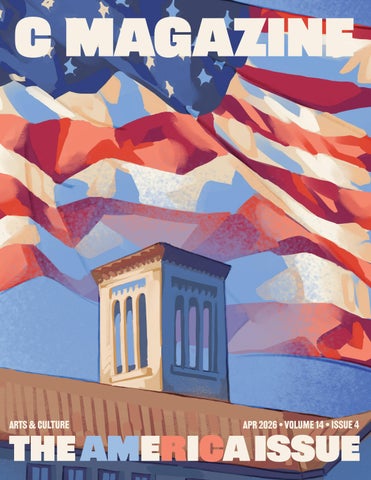
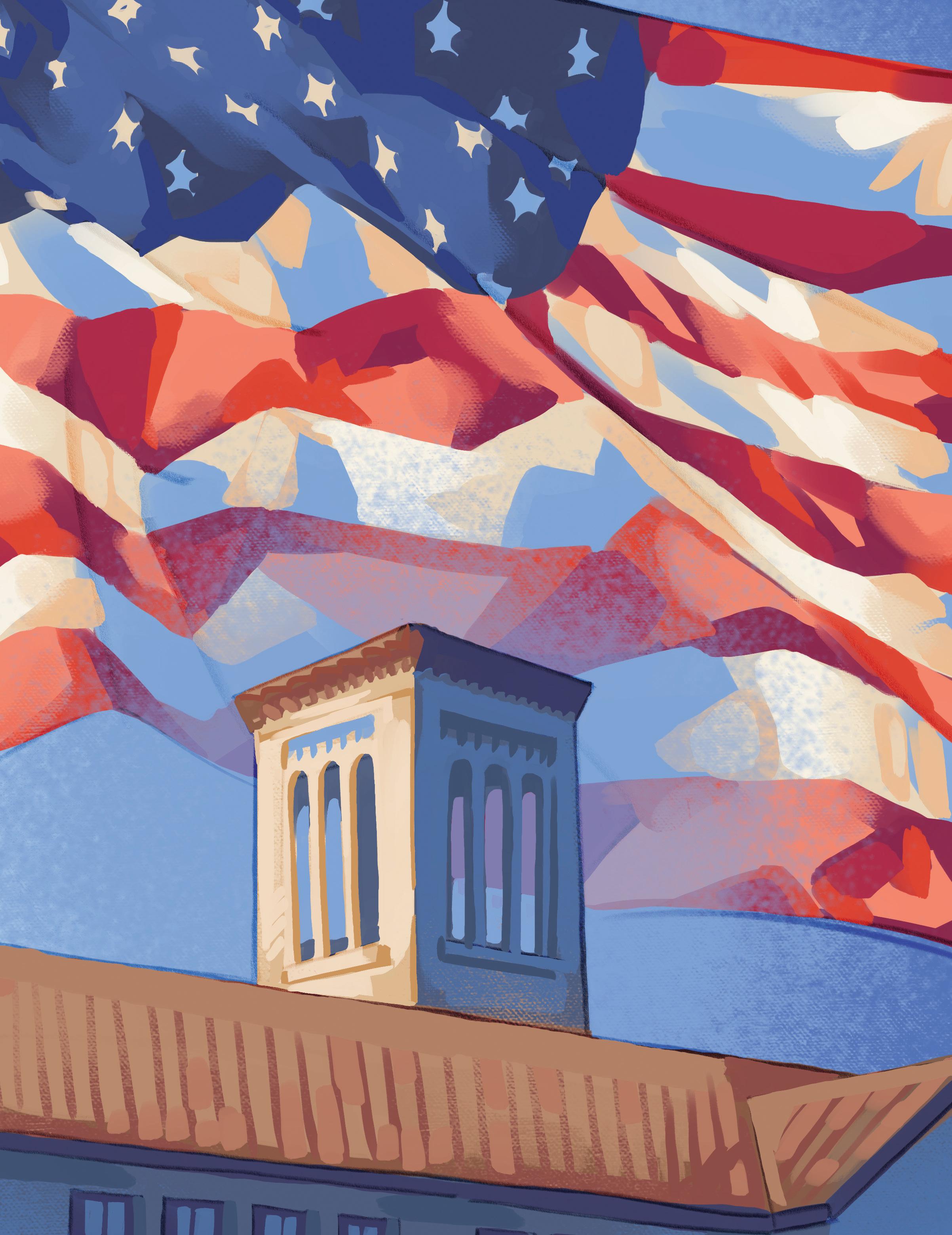
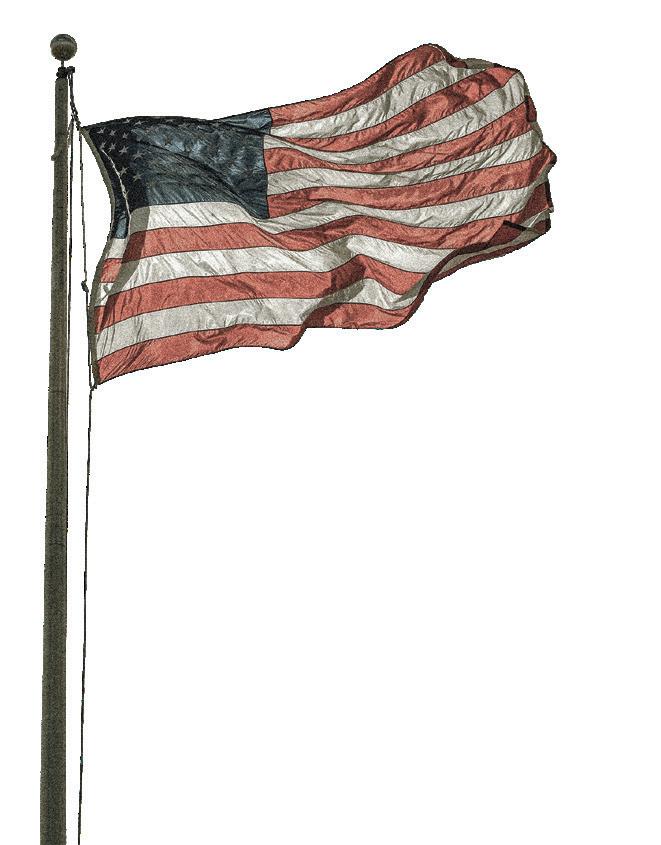
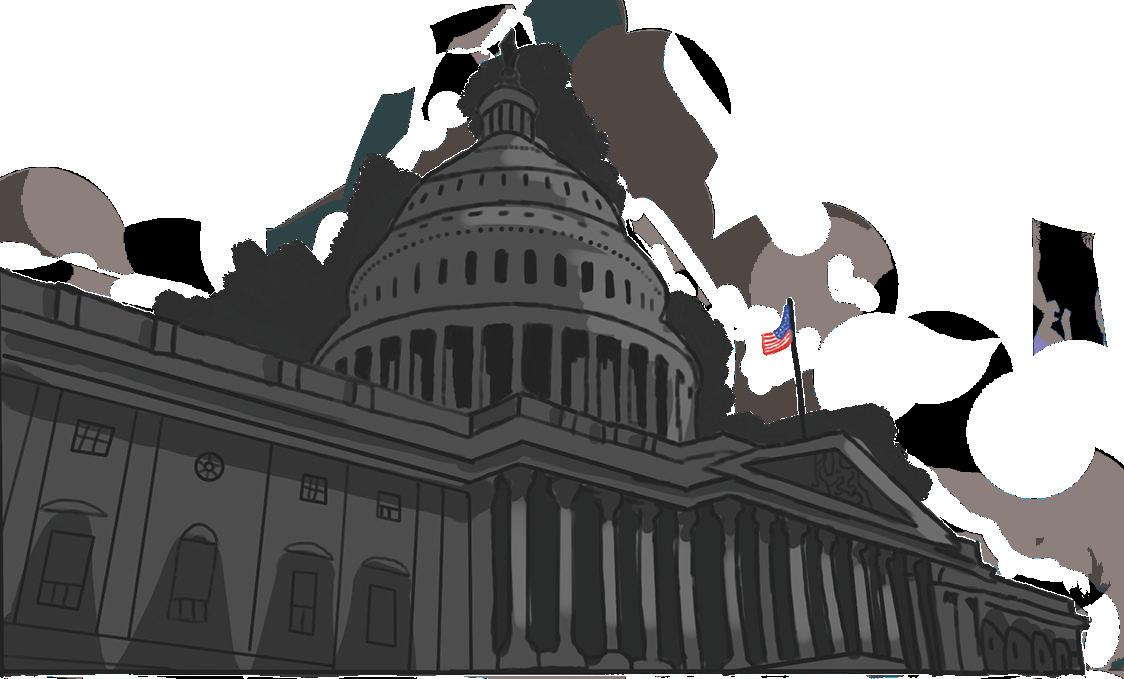
The cover of this issue was created by senior Karen Artola, and it displays an American flag above Paly’s Tower Building. This issue contains analysis on a litany of topics, ranging from cowboy culture to the origins of America to an editorial representative of C Magazine’s collective staff opinion on what it means to be American.
Junior Xuaner Duan, writer on “The America Experiment” on page 13, said she found it incredibly rewarding to dive into the history of America, one of the younger nations in the world.
“I wanted this to be a story that incorporates a lot about the strengths of being in this country and also the weaknesses that are implied by our history,” Duan said. “I wanted to leave the story on a positive and hopeful note that would eventually drive readers into trying to do better for society and provide more for our community.”
A few pages deeper into this issue will lead readers to “Ballad of the Boots” on page 40. Written by junior Poppy Morrison, sophomore Zoe Peterson and senior Silvia Rodriguez, this


C MAGAZINE Web
By Eileen Lee
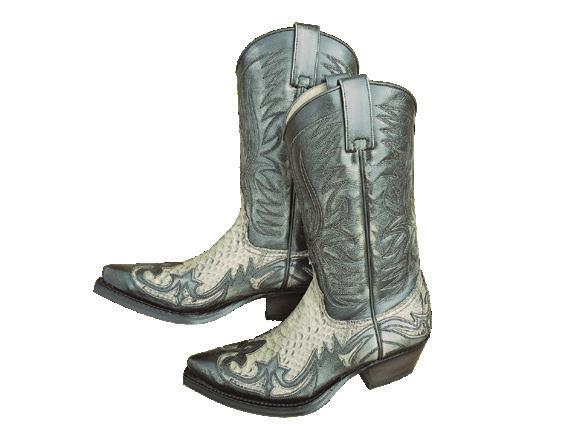
story examines how Western rodeo culture remains present throughout the nation.
“I just had so much fun working with my team,” Peterson said. “Our story turned out really well.”
While cultural motifs like cowboy boots have long been a part of American culture, other parts of America have seen more change in recent years. In “Meme Regime” on page 48, juniors Anjali Dahncke and Luna Lim and sophomore Kea Chiao tackled the surge of “memetic warfare” — the use of memes and social media as a whole to propagate content designed to target and ridicule their opponent.
“I have had a lot of fun working on this story because of how relevant it is and because of how it is something my entire group and I could source material from simply on our daily social media usage,” Dahncke said. “This feels like a unique topic that hasn’t been covered very much before. It’s particularly timely because it’s a story relevant to teenagers written by teenagers.”
With that, this issue concludes our tenure as editors-in-chief. But, it doesn’t feel right to step down without expressing our gratitude for the oppurtunity to serve as editors for the last five issues. It’s truly been a joy, and we cannot wait to see what the next leadership team does in future issues — we know it is going to be incredible.
Happy reading!

By Zoe Ferring


thanks TO OUR SPONSORS
Allison Wong
Aynur Diner
The Boneh Family
The Egan-Lech Family
Annie Lu
Jill Keefe
Jenny Guo
Kelvin Guo
Kirill Kuzmichev
The Dahncke Family
The Lee Family
Perry Meigs

Peggy Morrison
Carol Replogle
The Rodriguez Family
Sooyang Suh
The Sheffer Family
Vimal Shyamji
The Sperling Family
S.T.A.R. Physical Therapy
The Stoval Family
The Tormala Family
C Magazine, an arts and culture magazine published by the students in Palo Alto High School’s Magazine Journalism class, is a designated open forum for student expression and discussion of issues of concern to its readership. C Magazine is distributed to its readers and the student body at no cost.
Printing & Distribution
C Magazine is printed 5 times a year in October, December, February, April and May. C Magazine is distributed on campus and mailed to sponsors by Palo Alto High School. All C Magazine stories are available on cmagazine.org.
Advertising
The staff publishes advertisements with signed contracts, providing they are not deemed by the staff inappropriate for the magazine’s audience. For more information about advertising with C Magazine, please contact business manager Annie Kasanin at businesscmagazine@gmail.com.
Letters to the Editors
The C Magazine staff welcomes letters to the editors but reserves the right to edit all submissions for length, grammar, potential libel, invasion of privacy and obscenity. Send all letters to cmagazine.eics@gmail.com or to 50 Embarcadero Rd., Palo Alto, CA 94301.
Mission Statement
At C Magazine, we are committed to delivering stories that are both original and reflect the perspectives of our diverse student body. We promote creative freedom by providing a platform for impact, ultimately helping the Paly community critically engage with the world around them.
staff
Editors-in-Chief
Talia Boneh, Ria Mirchandani, Alice Sheffer, Amalia Tormala
Managing Editors
Estelle Dufour, Zoe Ferring, Silvia Rodriguez
Online Editors-in-Chief
Maia Lin, Sophia Zhang
Social Media Managers
Sonya Kuzmicheva, Luna Lim
Table of Contents
Staff Writers
Creative Directors
Dylan Berger, Ellis Shyamji
Business Manager
Anjali Dahncke
Multimedia Director
Maria Uribe Estrada
Outreach Specialists
Estelle Dufour, Silvia Rodriguez
Adviser
Brian Wilson

Derek Chen, Kyle Chen, Kea Chiao, Anjali Dahncke, Bahar Diner, Xuaner Duan, Stella Guo, Poppy Morrison, Adrienne Lec, Eileen Lee, Zoe Peterson, Ella Renazco-Sperling
Cover
Karen Artola, Ria Mirchandani, Ellis Shyamji
Illustrators and Photographers
Poster
Dylan Berger, Talia Boneh
Karen Artola, Talia Boneh, Cal Cadian, Bekki Casalco, Derek Chen, Kyle Chen, Kea Chiao, Sandra Cris, Bahar Diner, Andrew Draper, Xuaner Duan, Estelle Dufour, Maria Uribe Estrada, Zoe Ferring, Yvette garcia, Stella Guo, Jordan Johnsson, Elaine Kim, Sonya Kuzmicheva, Claire Kwac, Vaansh Lakhwara, Adrienne Lec, Eileen Lee, Luna Lim, Charlotte Liu, Poppy Morrison, Brandon Mowinkel, Sloane Nagayama, Kensie Pao, Joy Peng, Zoe Peterson, Priscilla du Preez, Oliver Reid, Ella Renazco-Sperling, Silvia Rodriguez, J. Amill Santiago, Mathew Schwartz, Harper Skey, Annie Spratt, Lily Williams, Sophia Zhang
Like what you see here? While we don’t typically mail issues out, scan the QR code to be added to our mailing list and receive five C Mag issues a year (instead of just one)!

Photo by Kensie Pao
ONutritionalconsiderations have become a less prioritizedaspectof Americans’lives

Shelf the
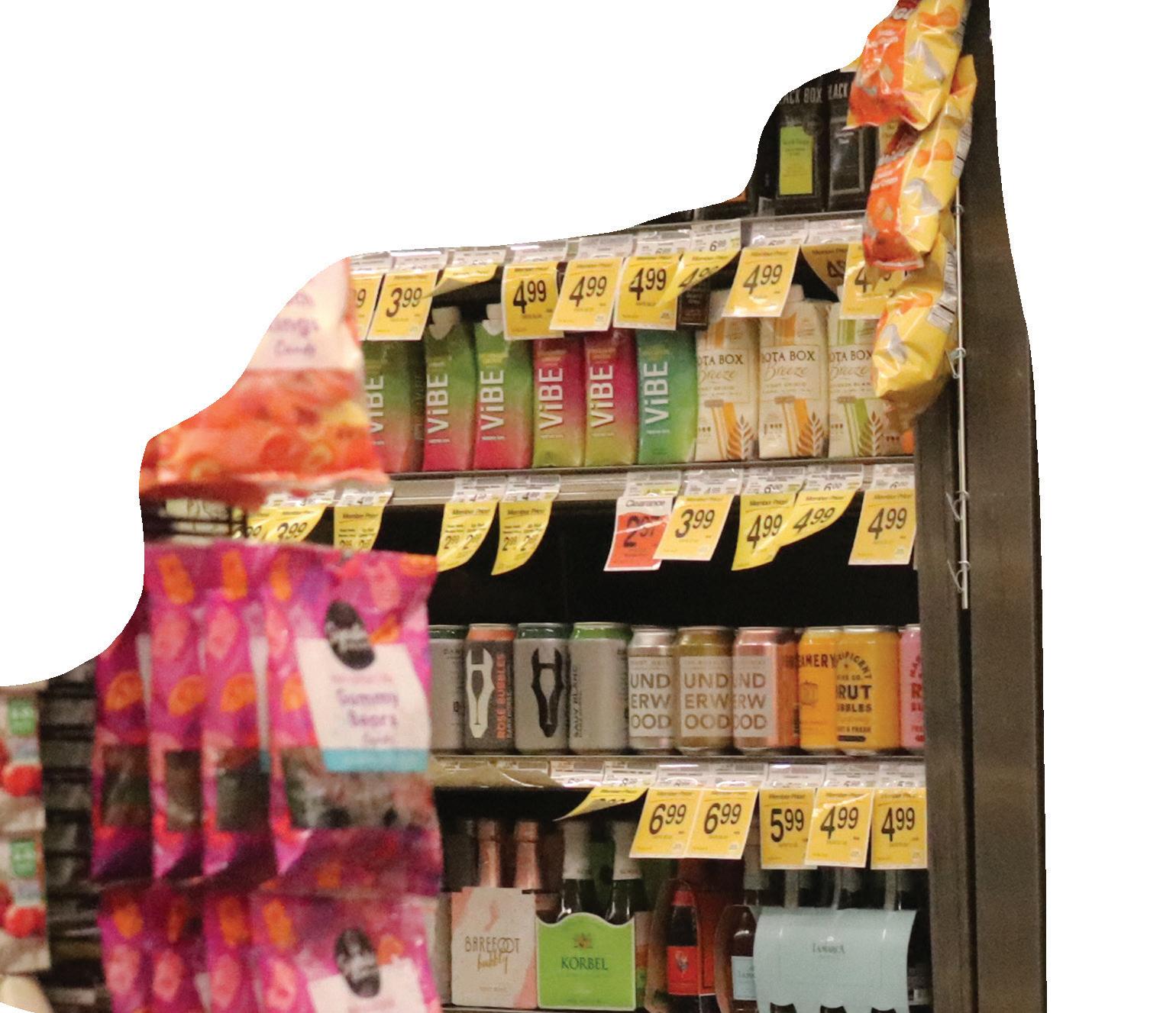

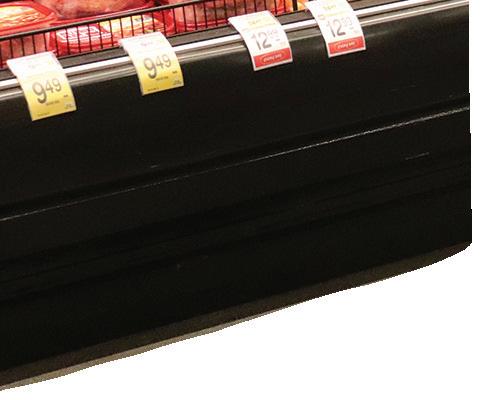
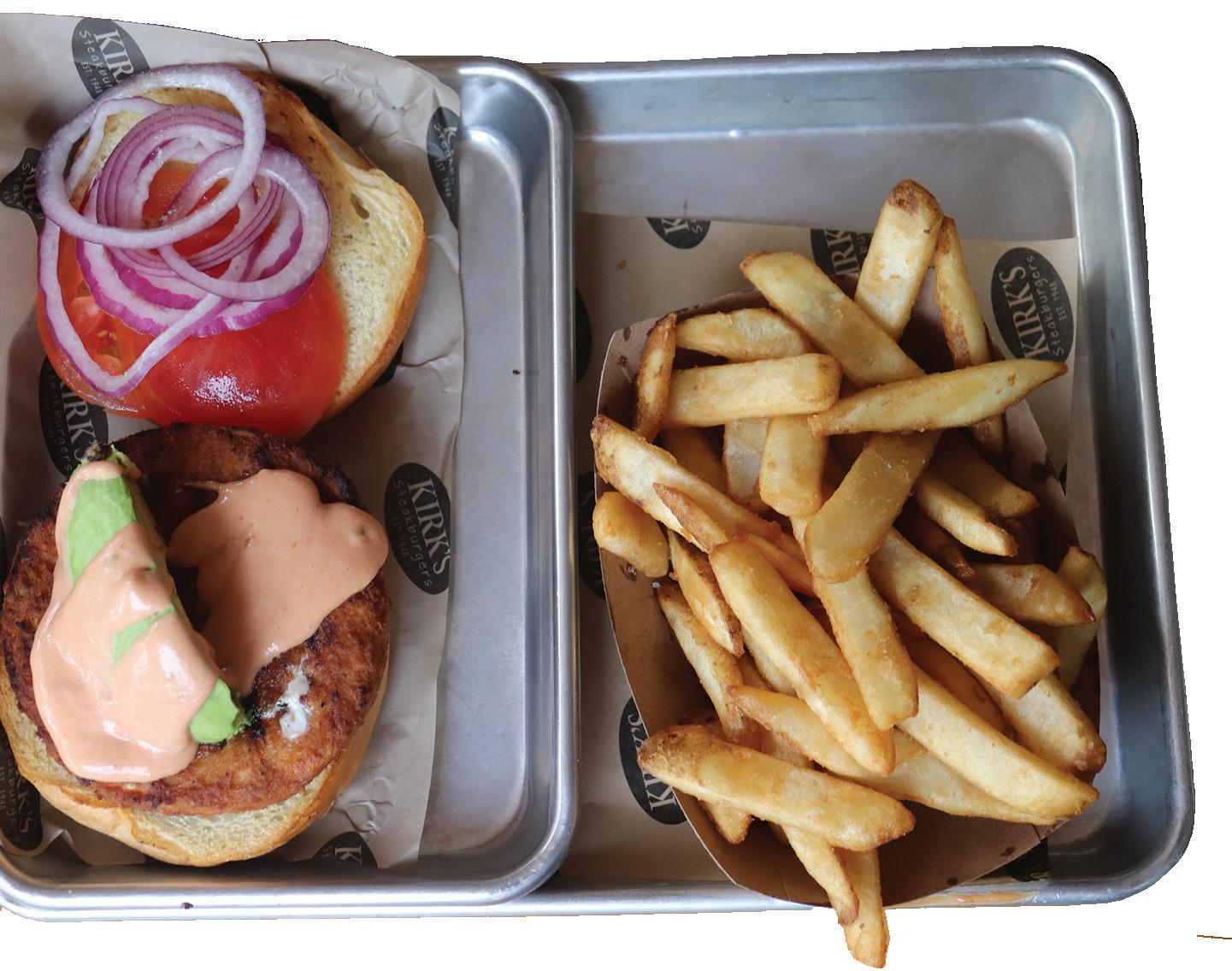
The smell of beef patties sizzling on the grill paired with caramelized onions wafts through the air. People rush to nearby counters to pick up their order. When asked about processed food, people’s minds typically go to a fast food restaurant. The reality, however, is that from popular fast food chains to seemingly healthy dairy products, 55% to 70% of the American diet consists of mass produced food items from industrialized systems, according to the Center of Disease Control. This has not always been the case, yet in the past decades, the food market has become oversaturated with processed foods.
Masha Sardari, a registered dietitian and owner of nutrition counseling business Fearlessly Nourished, said food systems have become consolidated to maximize on returns with inexpensive, processed products over traditional farming practices.
“Over the past century, the food system has experienced a significant shift from local and independent food production to large scale, industrialized systems,” Sardari said. “These shifts were largely driven by the need for shelf-stable, easy-totransport and profitable food products.”
real food,” Rubin said. “Food has become so convenient and cheap that cooking nu tritious meals at home now competes with fast food value meals. With current in flation levels, Americans are more likely to choose the cheaper, heavily processed options rather than cook at home.”
Food serves as our fundamental source of sustenance, while also operating across multiple interconnected sectors, spanning from agriculture to restaurant chains. Con sequently, food manufacturing companies shape food policies such as nutritional guidelines to protect their own interests.
“The food industry significantly influ ences food policy formation,” Rubin said. “Many of the [Dietary Guidelines Adviso ry Committee members] represent differ ent food industry players, and their inter ests influence the final dietary guidelines report.”
“Policy can be impactful, if it is created without food industry input.”
Masha Sardari, Dietitian
The American Industrial Revolution was a movement triggering notable changes in technology, according to a 2023 article on the history of American mass production by Robert J. Paradowski. These developments encouraged efficiency over quality, leading to mass production of consumer goods and an increase in workers looking for consistent, inexpensive meals. High-speed food service filled this gap, spurring the creation of modern fast food restaurants. In 2024 alone, the fast food restaurant sector in the United States generated $413.2 billion in revenue, roughly $1.1 billion a day, according to Statista.
Similarly, Annie Rubin, nutritionist and specialist in autoimmune and inflammatory disorders, said that American culture focuses on speed and convenience, prompting many Americans to eat their meals on the go.
“Because our society is so busy and stressed, we don’t take the time to cook

The Dietary Guidelines Advisory Committee is a group of 20 nationally recognized scientists formed to create a nutritional framework for the nation while considering socioeconomic, status and race related factors. 95% of committee members, however, were found to have ties to significant figures in the food and pharmaceutical industry. This raised questions about the authenticity of assigned food-based standards, according to the National Institute of Health.
Like how the regulation of food production alters the availability of different foods for Americans, Sardari said the promotion of junk foods through marketing normaliz es unhealthy eating.
“Marketing plays a significant role [in the fast food industry] as well, with food-centered advertisements on screens, billboards, sides of buildings and transpor tation systems,” Sardari said. “Over time, this has normalized the regular consump tion of convenience products. Culturally, cooking skills have declined across gener ations. Family dinners have become less frequent and quick options have become more integrated in daily life.”
Because advertisers are aware of con sumers’ eating habits, they adhere to trends and push out products that con
observe peoples’ environments to use as a tool shaping dietary behaviors.
“You can limit someone’s choice by overwhelming their environment with … alluring strategies to get you to consume, like pumping the smell of your restaurant in the air so that you can smell that restaurant when you drive by,” Ulm said.
While U.S. culture continues to exacerbate issues in the nation’s daily meals, Rubin noted that many Americans cannot afford to opt for healthier foods due to increased inflation.
“Food has become increasingly expensive,” Rubin said. “When the choice is between buying a bag of lettuce or a full meal at a fast food restaurant, most people will choose the latter.”
Alongside food affordability is the challenge of lacking grocery stores in the area. Rising prices further restrict access to nutritious
convenience stores. It’s incredibly challenging to eat a nutritious diet when living in these areas.”
Some students at Paly actively avoid processed foods. Amid America’s oversaturated food market, junior Paul Wang said he takes care of his health through a well-balanced diet and hopes for packaged food manufacturers to focus more on nutritious quality.
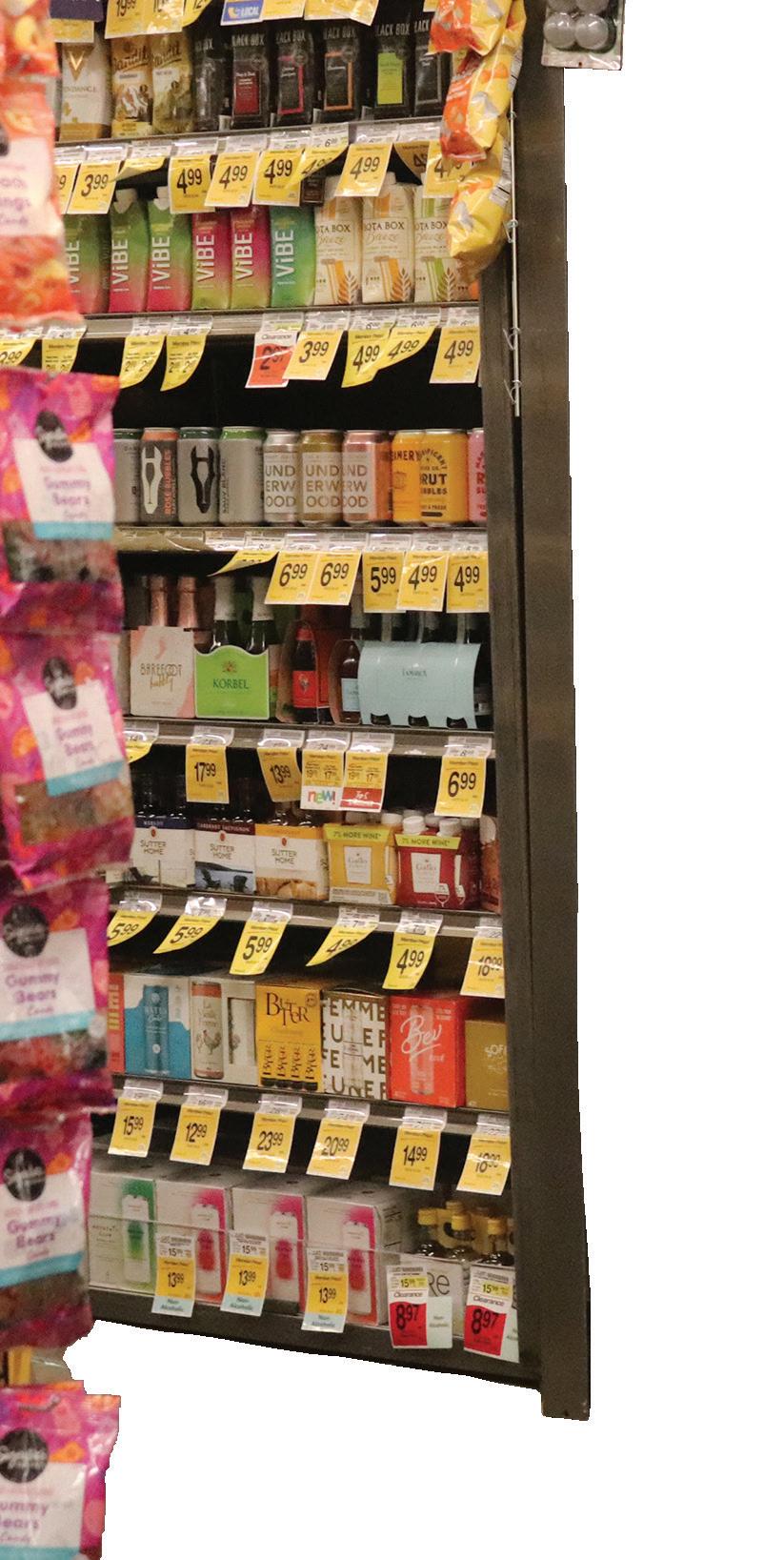
“I usually don’t do processed foods at all,” Wang said. “It’s getting really saturated in the food market right now. You go to Safeway, and half the [aisles] are basically filled up with processed foods, processed ingredients that are really unhealthy for you. America is becoming worse off as a country because we’re trying to prioritize profits in the food industry rather than care for our consumers.”
Lately, the food market prioritizes affordability, convenience and palatability, which leads to overreliance on harmful fast foods, according to a John Hopkins public health article. Prepackaged meals or artificial foods almost always consist of additives — substances added to increase shelf life or
add color to the product. Rubin said additives can cause both mental and physical health issues in the human body.
“The biggest contributor to inflammation and chronic disease is the food we eat,” Rubin said. “If you ever spend time at the grocery store reading labels, you will see numerous chemicals, additives, added sugars and stabilizers in almost all of our food. Even food you consider ‘healthy’ usually has added ingredients. All of these additives can be really inflammatory.”
Negative impacts of ultra-processed products similar to these can be seen through the nutrient imbalances it causes.
“When the majority of the dietary pattern is composed of highly processed foods, we see shifts in fullness, digestion and blood glucose response,” Sardari said. “It demonstrates that our bodies interact with them in a different way than other foods. We also tend to see nutrient gaps, specifically insufficient intakes of magnesium, potassium, iron and omega-3 fatty acids.”
for low-income communities. As the largest anti-hunger program in America, SNAP helped over 41 million people during a month in 2022, according to Feeding America. Recently, they implemented additional restrictions on ultra-processed foods in an effort to promote health and a more nutritious diet.
“If you limit what you can purchase off of SNAP, for example not including sodas and candy and so on, people will overall buy less unhealthy foods and more healthy options,” Ulm said. “To increase access to healthy options, there are SNAP incentive programs that are something like for every dollar you buy vegetables on SNAP, you get a quarter back.”
“Because our society is so busy and stressed, we don’t take the time to cook real food.”
Annie Rubin, Nutritionist
Though these new policies have not seen an immediate effect on the transformation of American diets, there has been a clear increase in attempts to change the food and health crisis, according to the National Institute of Health. In the past 20 years, community-based efforts to make food related policies focus on healthier eating have almost tripled. Ulm said that these incentives may have been contributing to making a change in obesity rates for the past few years.

New developments in food policies are slowly but surely changing America’s food market for the better, according to Ulm.

The Supplemental Nutrition Assistance Program is financial aid designed to increase food accessibility
“We have been seeing lower rates of obesity in the last year,” Ulm said. “That means that Americans are consuming less ultra-processed foods. If current trends continue, that’s fantastic.”
Mass efforts from large organizations such as SNAP have been altering how the U.S. approaches food in recent years, according to Rubin. In order to make greater strides in improving the food industry, she said people should start paying more attention to food policies and its impact on the public’s health.
“Policy can be impactful if it is created without food industry input,” Rubin said. “I would love to see the next Dietary Guidelines committee exclude members with conflicts of interest from the food industry. Americans don’t eat well because they lack the knowledge of how to eat healthily.”
Reformation of food policies are essential but cannot promise a transformation


in eating habits. Sardari said that prioritizing more diversity in crops on shelves would also make wholesome crops much more affordable.
“I would shift how agricultural subsidies are distributed,” Sardari said. “The current system emphasizes commodity crops, which leads to decreased food diversity and limits access to nutrient dense options. If these subsidies were redirected towards fruits, vegetables, legumes and diversified agriculture, it would generate significant downstream effects.”
Although subsidies in the United States are very beneficial to low income areas, most commodity crops are focused on producibility over nutritional value, according to an article by the American Action Forum. Historically, subsidies have focused on the production of the “Big Five” — corn, soybeans, wheat, cotton and rice — due to affordability. Specialty crops, on the other hand, are minimally produced due to its expense. Because of these circumstances, subsidies tend to have a higher percentage of unwholesome crops.
“Less processed options would decrease in cost, farmers would have more incentives to grow a variety of crops and the American public would have improved access to fresh foods,” Sardari said. “Such a shift would change the food landscape and make it easier for consumers to choose foods of higher nutritional quality.”
Guidance on how to maximize the use
of fresh produce is also important to what people are eating at home.
In Rubin’s eyes, America should focus not only on availability of ingredients, but how those ingredients are used in meals.
“Americans need cooking skills to use that produce effectively,” Rubin said. “It would be great for there to be a program that combined cooking classes with access to subsidized produce.”
Though focusing on the diversity of crops is essential to what goes on shelves, access alone cannot guarantee what ends up on peoples’ plates. This raises the question: Does affordability truly increase the purchase of healthy produce? In 2024, a 10% drop in the price of wholesome products increased the purchases by 12%, according to a 2024 article by Peijue Huangfu on the impact of financial incentives on consumers.
Sardari says that pairing factors like affordability with educational initiatives can help turn these purchasing practices into long term habits.
more aware of what is in their food.
“One small, realistic dietary change people can make is to start reading food and nutrition labels; understand what your food contains and how nutritious it is,” Rubin said. “For example, if you had a choice between milk or soda, milk would be the more nutrient dense choice because it contains more nutrients, vitamins and minerals than soda.”
Although realistic measures are essential to progress, having a vision of the ideal scenario can encourage people to set a goal and work towards it. Sardari said a more sustainable food system would include several significant changes to today’s eating habits.
“In a sustainable food system, … we would bring a slowness to food, taking the time to cook and sit down to eat, including the company of others at mealtime and considering where food comes from and how it is prepared,” Sardari said. “This way of approaching food would help restore a more flexible and positive relationship with it, while also bringing back the sense of community and connection that supports healthy and sustainable eating patterns.”
“It would be great for there to be a program that combined cooking classes with access to subsidized produce.”
Masha Sardari, Dietitian
“We can talk about nutrition in more neutral terms by discussing broader food systems and general health promoting behaviors rather than blaming individuals,” Sardari said. “When educating individuals, we can focus on how specific foods interact with our physiology, rather than their connection to body size or appearance.”
In order to do this, Rubin suggests developing habits that help consumers become
Eating is not simply a necessity, but an experience. Ultimately, an ideal food culture is not defined solely by nutritious produce but rather integrating factors such as education for a long term effect. Although dietary changes like this are a step in the correct direction, they are not enough to fully change attitudes toward eating habits, Sadari said. In her view, a healthy relationship with food relies not only on the content of a meal but also how people interact with it.
“A healthy food culture would balance both enjoyment and function as part of overall dietary patterns, acknowledging that the experience around food can often be just as important as the nutritional content of the foods consumed,” Sardari said.
Text and design by EILEEN LEE and SOPHIA ZHANG • Photos by SOPHIA ZHANG
“
They are Destroying the Country.”
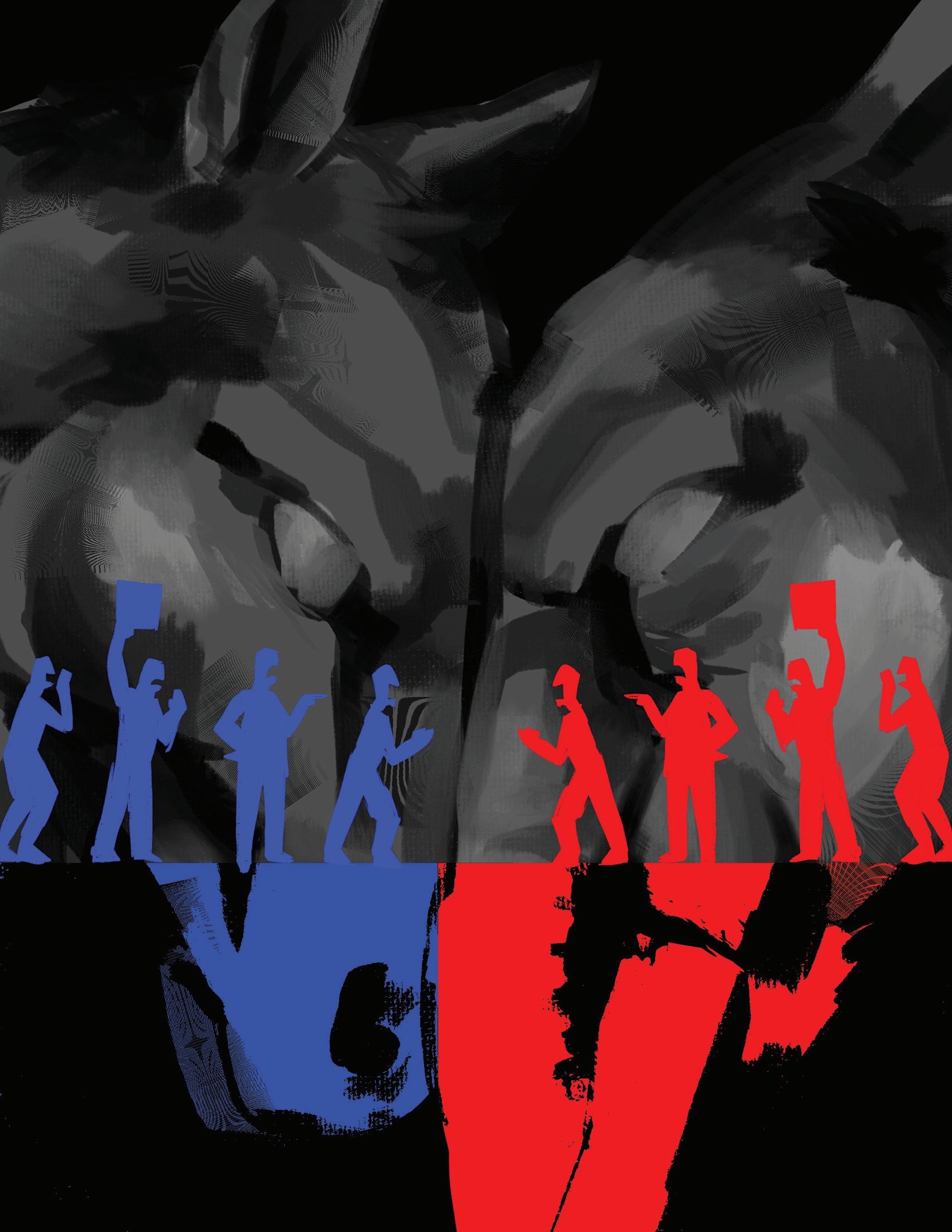
Democrats say it about Republicans. Republicans say it about Democrats. Across the United States and at Paly, the divide is only growing.
on Sept. 10, 2025, Sam — a Paly student who has requested to remain anonymous — watched as some of their peers celebrated a man’s death. That man was conservative commentator Charlie Kirk, who was shot in the neck at a Utah college campus while hosting an open debate.
“That was my breaking point,” Sam said. “I really lost respect for those people.”
Sam described standing in shock as some cheered and some openly hoped the same fate would befall President Donald Trump. In Sam’s eyes, the people around them had let their political beliefs override their humanity. This is just one reaction among many to the tragedy, whose impact was felt across the entire political spectrum.
For some, like Sam, this was an unsettling day, but across the United States, this is becoming the new normal. According to a 2024 Johns Hopkins University poll, 45% of American voters consider members of the opposing party “downright evil.”
But what does it mean when nearly half of a country’s voters think of the other side as enemies?
Media analyst Clare Ashcraft from AllSides, a company whose goal is to create a balanced newsfeed and media bias ratings, calls it affective polarization — an “us versus them” mentality.
“Affective polarization happens when we feel positively toward members in our party and negatively toward those outside of our party,” Ashcraft said.
Ashcraft said understanding the root of the problem comes with separating two terms that are often confused: polarization and extremism. It is possible to be polarized from someone whose view is not technically considered “extreme.”
views,” Ashcraft said. “More moderate views or views that are closer to the center are not always inherently better [at preventing polarization] or more correct.”
And it’s no coincidence that polarization has worsened as technology use has increased, psychology teacher Melinda Mattes said.

“We go on social media, [interact with posts and videos] and get more of what we like, so we end up in a sort of echo chamber of similar views,” Mattes said. “We lose track of that anchor and reality of the other side of the story.”
“The exhausted majority is tired of polarization and fighting.”
Clare Ashcraft, Media Analyst, AllSides
“The difficulty with defining extremism is that it’s very subjective,” Ashcraft said. “What seems extreme to me may not seem extreme to you and vice versa.”
The problem is not that Americans hold different views. Instead, it is that they have started to hate each other for it. According to the Pew Research Center, the number of Americans with a highly negative view of the opposing party has more than doubled since 1994.
“It’s a misconception that polarization results from extreme
The psychological mechanism behind this is called group polarization, which Mattes said is as old as human social behavior; social media only supercharged it. Group polarization occurs when a group of people who share the same opinions build upon one another until they’re completely polarized to that belief.
“It feels really good and validating when we believe something, and we read about other people who also believe that,” Mattes said. “So, it takes a lot of effort to go and seek out the other side.”
Not everything people encounter online is true, either. Unlike traditional news outlets, social media has no one fact checking.
“Anybody can post stuff online, and it could be news in quotes,” Mattes said. “It can be totally false, and they don’t even have to be a reputable source.”
For students who have grown up inside this media landscape, the effects are hard to escape and even harder to recognize. To Alex, an anonymous student, the content they have seen on social media has shaped the way they see groups of people, an example being those that are anti-abortion-rights.
“I feel like they [those who hold extreme views] are pretty closedminded and won’t hear out other people’s opinions or what people might be going through,” Alex said. “In ‘pro-life’ cases, people have views based on what their religion might say or what they’ve been taught. They shut their mind off to learning about specific cases. In some ways, it can stop people from having empathy.”
A lack of understanding between groups can often lead to stereotyping and generalizations. For students such as senior Evanllelyn Sanchez Vargas, co-president of the Latinos Unidos club, these media-caused negative impacts directly affect public perception of her community.
“Sometimes we’re treated as numbers [by] politicians, which is definitely dehumanizing,” Sanchez Vargas said.
That dehumanization, felt acutely by marginalized communities, is one aspect of a larger national divide, a fracture that has left millions of Americans feeling alienated from one another and from the political process itself.
“Most Americans don’t belong to loud extremes and are instead a part of what we call the ‘exhausted majority,’” Ashcraft said. “The exhausted majority is tired of polarization and fighting.”
Sanchez Vargas, whose community often sits at the center of one political debate in the country, said the answer is simple.
“I don’t think we should dehumanize anyone,” Sanchez Vargas said. “We should really consider all the circumstances, … [and we] need to care more about every single person.”
debating the idea, not the person.”
Youth and Government is an organization stemming from the YMCA that teaches teenagers how to draft bills in California and debate policies at conferences throughout the year, including visiting the state capitol in Sacramento.
“[It] isn’t about proving you’re rIght. ... it’s about trying to understanD each other’s point of view.”
Ashcraft knows this tension from experience. Raised as a liberal in a conservative Catholic family in Ohio, she describes a moment during the 2020 Black Lives Matter protests when the divide entered her home.
Mathilde hyunh, 11
“I sometimes felt [my family] was immoral for their beliefs, and that was difficult because I also knew they were great people,” Ashcraft said.
Navigating this tension led her to organizations like Braver Angels and AllSides, and she said this gradually changed her. Relationships and honest conversations opened her to perspectives she had never considered.
This is one of many groups students can join that encourage discussions between political groups. These spaces can be a useful tool to expose oneself to new opinions and debates, though a simpler way to get exposed is through the news.
“If something [seen online] seems like a little much [polarized], go ‘hm, maybe I’m missing something here,’ and ‘what might the other side argue?’” Mattes said. “Try to go find that, but it can’t be passive.”
Taking the time to engage with contrasting opinions is ultimately about understanding and connecting with one’s neighbors.
“Having these types of conversations isn’t about proving [that] you’re right,” Hyunh said. “It’s about trying to understand each other’s point of view.”
Furthermore, having differing opinions is not new nor inherently bad, something Ashcraft wishes more people would realize.
“It’s not only okay for people to have views that are very far apart, but I would argue it’s a good thing for a free and flourishing society to have diverse and divergent perspectives,” Ashcraft said. The change, she believes, starts with rejecting the idea that
“People are tired of politics getting in the way of close relationships with friends and family,” Ashcraft said. “They want community, belonging and the freedom to share their thoughts
And the movement to get there, Ashcraft said, is closer than
“Studies show that if a movement engages 3.5% of a population, it succeeds in changing the broader culture,” Ashcraft said. “In America, that’s about 11 million. That’s an achievable number.
… We can change the country, and
Text and design by ESTELLE DUFOUR and MARIA URIBE ESTRADA • Art by ESTELLE DUFOUR, CHARLOTTE LIU and MARIA URIBE ESTRADA
THE A M E R I C A experiment
How this nation’s progress towards democracy, equality and liberty shapes modern society

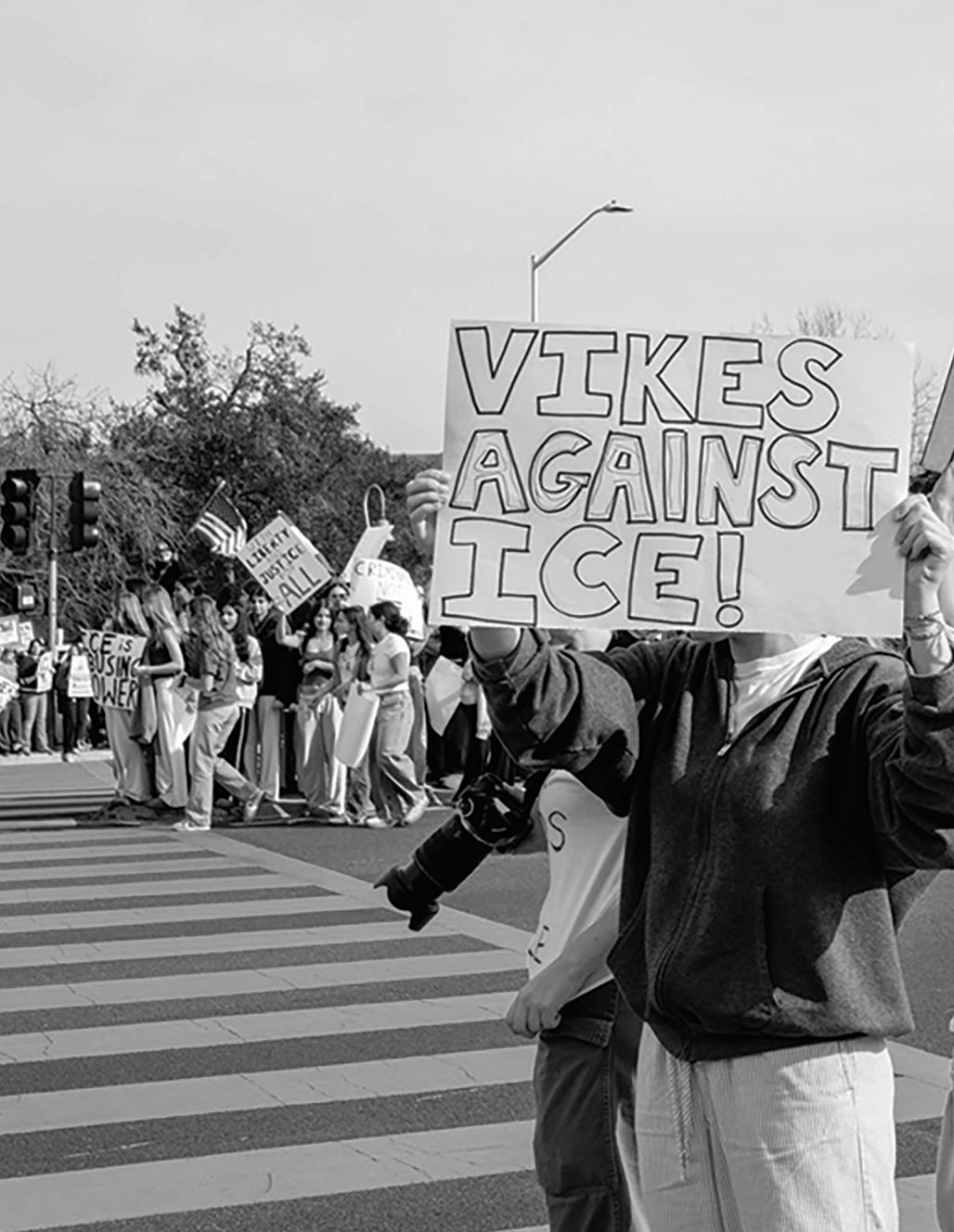
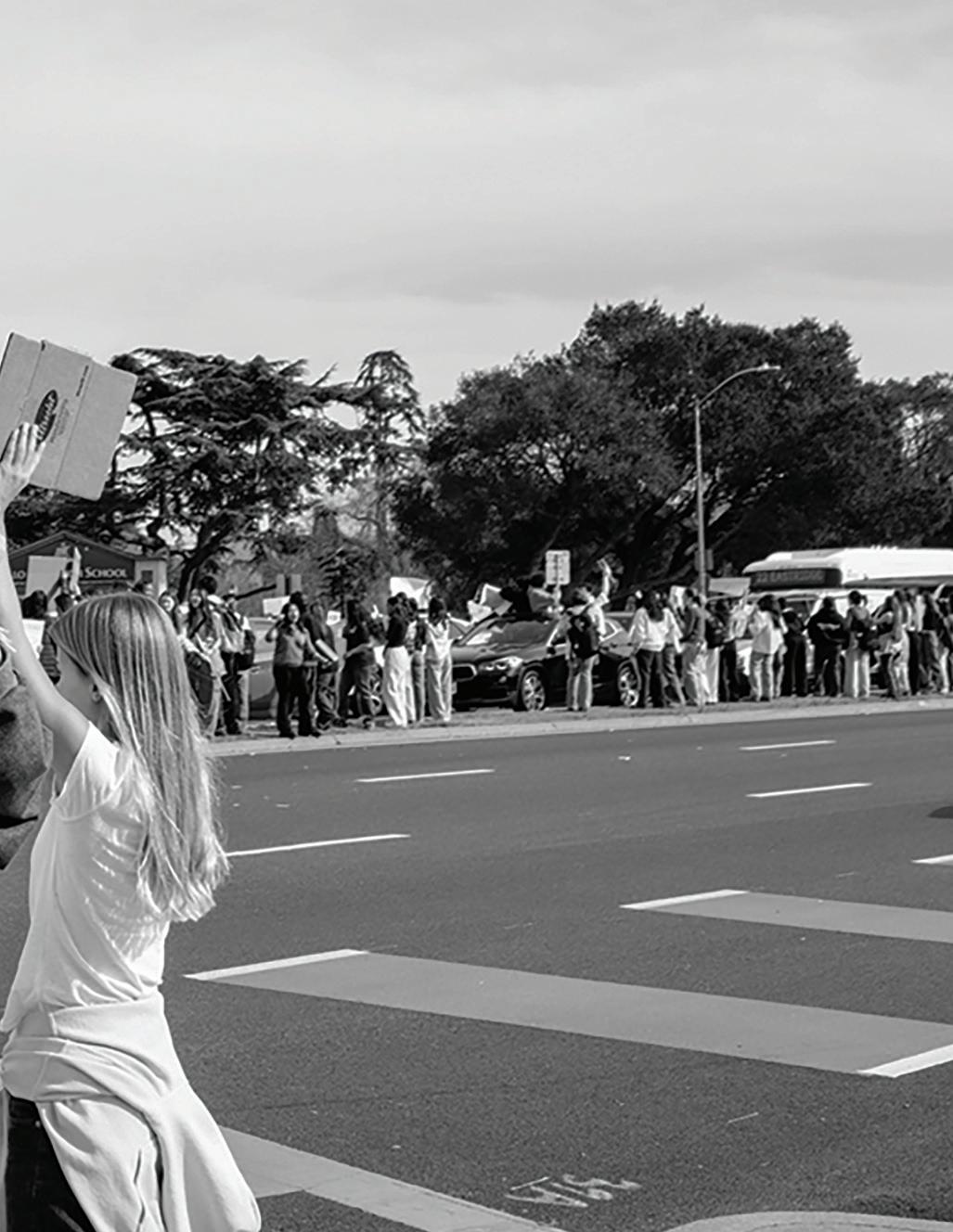
The honking of cars pans from ear to ear. Students from all over Palo Alto hoist their handmade signs in the air — chanting, shouting, hollering — in protest against the U.S. Immigration and Customs Enforcement on Jan. 30, reflecting the First Amendment right at a time when their meanings are increasingly debated nationwide.
When fundamental freedoms find themselves under threat, civic engagement can extend much further than protests at Palo Alto High School. Junior Julia Curtis advocated for 24/7 active crossing guard supervision on Feb. 4, a petition that has gained over 3,500 votes. Students also bring their concerns directly into institutional processes, as senior Dylan Chen spoke against a handful of district decisions during a Feb. 10 board meeting.
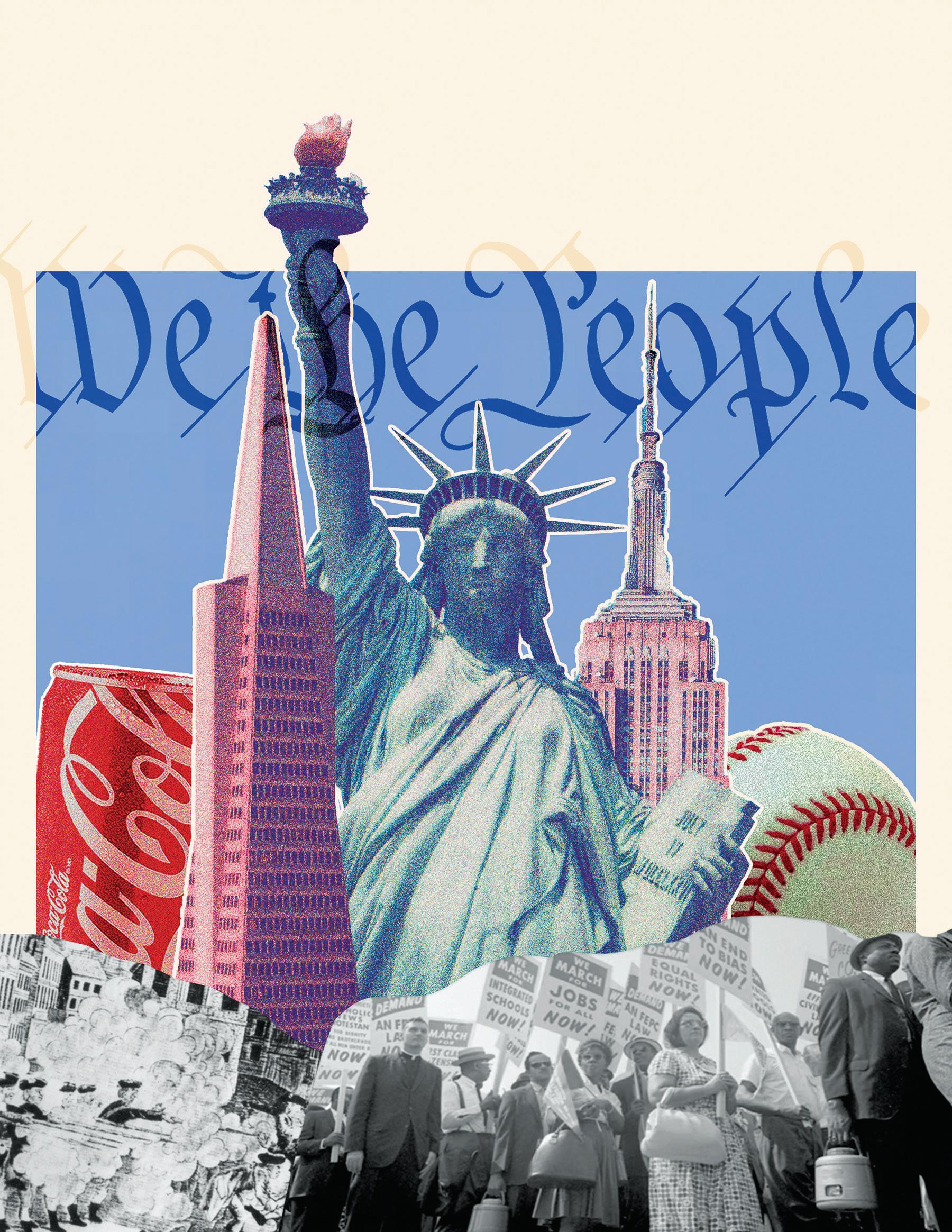
Moments like these highlight the enduring influence of the country’s founding ideals as the United States approaches the 250th anniversary of its founding this year. The rights embedded in the Constitution — from freedom of speech to the right to assemble and petition — continue to shape how Ameri cans can push for reform. The United States Semiquincenten nial marks a milestone in the na tion’s history, creating a moment for people to reconsider how the ideals of liberty and rights are understood in America today.
As a history teacher and Paly Social Justice Pathway instructor, Ken Tinsley has had several opportunities to reflect on the founding documents and their influence on the course of American history. One document in particular — the Declaration of Independence — has guided our country since its creation.
representation, piece together what is considered the majority of the values associated with the word “America”. The fundamental symbols of this na tion have developed into the embod iment of a set of principles centered on liberty, diversity and equality. These ideals still impact the foundation of what the country is built on, even to this day.
“Taking an old document ... and making it relevant now [is] really what’s important.”
Ken Tinsley, History teacher
“We looked at the Declaration of Independence and all its themes and ambitions from that lens, … seeking pursuit of happiness, equality, all those things,” Tinsley said. “Taking a really old document that might feel disconnected from our time today and making it relevant now [is] really what’s important.”
Since the last signing of the Declaration of Independence, the upbringing of democracy and freedom at the time leaves social science teacher Stephen Foug astounded by its democratic ideals.
“I had to be reminded or taught this over and over just to understand how much of a risk [writing] the Declaration of Independence was,” Foug said. “It’s [the Founding Fathers] expressing their opinions on humanity to the highest power in the world at that point. When you start talking like that, I get inspired again by the idea of America. I’m back to that city on a hill.”
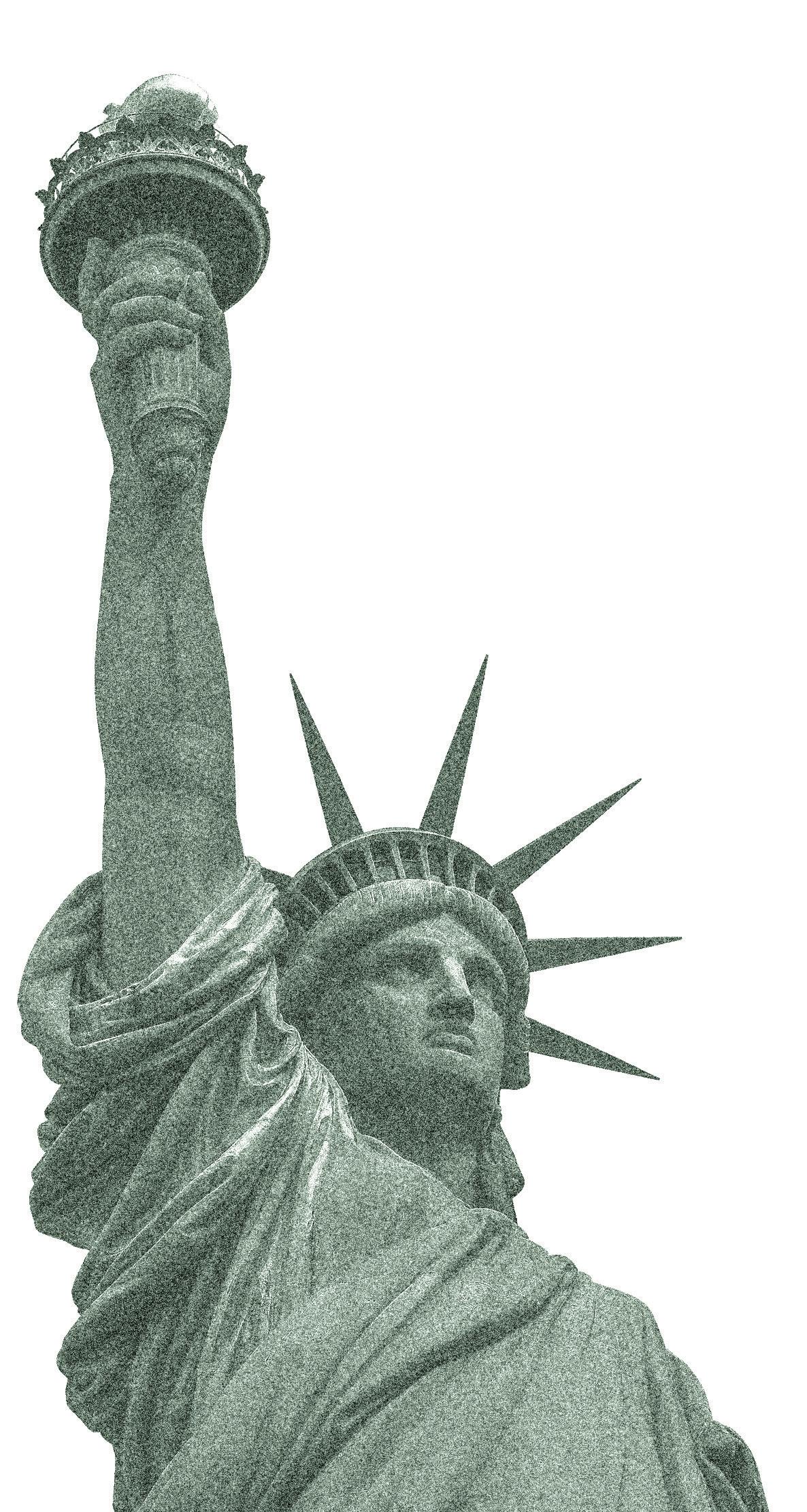
The American eagle, a symbol of freedom and strength; the Statue of Liberty, representing opportunity and refuge; and the Constitution, the document that embodies individual rights and
To understand where these prin ciples originated, it is necessary to trace back to the intellectual movements that preceded the founding of the nation. During the 17th and 18th centuries, new revolutionary principles emerged across Europe. This period of time introduced new ways of thinking about art, philosophy and politics — many of which were unprecedented, according to Britannica. The development of novel values such as individual liberty and natural rights challenged the traditional order of hereditary monarchies and divine authority present in Britain and other European empires, a sentiment later included in the Declaration of Independence. Enlightenment thinkers like John Locke argued that a government’s political authority ultimately derives from citizens themselves, a concept unique to America that was eventually adopted into the Constitution, as other countries back then ruled with antiquity and monarchy in mind.
“America is relatively unique in that these [fundamental rights] are the foundations on which we create this government,” Foug said. “I am in awe of the founders’ brainpower.”
However, the U.S. has not always been a place where free dom serves as the cornerstone of the nation. Analogous to oth er 17th-century societies, the British North American colonies were structured by rigid social hierarchies that restricted many groups of people.
“The original formula [was] not perfect, but [it was] a turn ing point,” Foug said. “[It was] a watershed moment in human history of that much mass participation in a government at that scale.”
Thus, the Founding Fathers set in motion a political experi ment that would gradually reshape ideas about rights and gov ernance. Brian DeLay, a U.S. History professor at the University of California, Berkeley, has studied how this then-new system has bolstered the idea of individual rights in America. Com pared to most countries of the 18th century, particularly those in Europe, this framework differed significantly from the way most


societies were organized at the time, DeLay said.
“There’s no inherent privilege, there’s no aristocracy and there’s no institutionalized church [in America],” DeLay said. “Neither the Catholic Church nor the Church of England has any kind of formal political power in the new United States, and that’s a really important advance in the history of democracy and liberty.”
While the founding documents introduced values of liberty and equality, librarian Sima Thomas said these principles were limited in terms of how broadly they could be applied in the context of the era.
“[The founding documents] were aspirational,” Thomas said. “They were structurally limited in their acceptance of the institution of slavery. However, I don’t think it has to be [limited] because we understand now that the way we treated indigenous people and the institution of slavery were all barbaric.”
The support of an institution such as enslavement is often seen as hypocritical and ironic. The United States, a country built on the values of independence, natural rights and liberty, found itself protecting a sys tem of enslavement that contradicted all of such ideals. While the U.S. rejected being a part of the British Empire, Delay said they were also participating in imperial tendencies.
“A political system that says there’s … a fifth of the population who, by virtue of their skin color and the location of their ancestors, are going to be treated like property is a really hideous and intense form of imperialism that the United States was committed to,” DeLay said.
The laws and regulations that made up the foundation of America had their flaws, likely influenced by the fact that they only reflected the perspective of a narrow group of people in power. America began as a republic largely governed by an oligarchy of white, wealthy men who represented only a small proportion of the population, according to DeLay.
However, DeLay said that expanding inclusion under the law has been key to the nation’s evolution and has been shaped by movements such as the Civil Rights Movement from 1954 to 1968, which spanned from the Brown v. Board of Education Supreme Court decision to the Montgomery Bus Boycott. This enabled more groups to participate in governance and shaping a society that more closely reflects its founding principles.
“Starting in the 1950s and finally culminating in the 1960s, we have a third American republic: a multicultural democracy where we actually do have a system, though it’s certainly imperfect,” DeLay said. “Still, we nonetheless inhabit a Republic where citizens are equal before the law, regardless of whether they’re men, women, white or not white.”
“underneath all of our layers, gender, sexuality, nationality and race, we are all human.”
SIMA THOMAS, LIBRARIAN
Not only did the Founding Fathers benefit from enslavement — many of whom owned plantations — but the experiences Native Americans faced were similar. Delay said it is crucial to recognize that through exploitation and abuse, the original British colonists used the Native Americans, their land and their resources.
“The entire sort of fiscal premise of how this new policy was going to actually sustain itself, fund the government and generate wealth for its citizens was dependent on the progressive displacement of the original inhabitants of North America, and that is absolutely an imperial project,” DeLay said. “The new United States’ wealth depended upon the displacement of native people and the commodification of their land.”
This transformation pinpointed a turning point in how the United States understood itself, broadening inclusiveness to those long excluded from its promises, a transformation that reached for the multicultural democracy that the nation has as of now.
“With the Constitution and the Declaration of Independence, it’s this declaration of wanting to be better,” Tinsley said. “This pursuit … is not going to be perfect, but we want to try to, as people, get together, organize, collaborate [and] make change. That’s our right as Americans.”
Over time, the meaning of the principles outlined by the Declaration of Independence have been expanded by successive generations, ultimately reinterpreting and applying more inclusive doctrines to reflect a broader and more inclusive definition of “liberty and justice” than that of the original American oligarchy.
“[It’s] life, liberty and justice for all,” Thomas said. “For all, really meaning for everyone that’s here, not just who someone decides gets it. This should be for women, for transgender people, for immigrants, for everyone of every background, every persuasion and every religion.”
While it may not necessarily be a reality, this promise of freedom for all has certainly inspired individuals all around the world to immigrate for a fresh start and new opportunities. Thomas’ father, for example, moved from Iran for a chance at education and a better life for his family, Thomas said. Not only do these individuals bring themselves to America, but they also bring their identities, cultures and perspectives — all of which create a richer country together. Stanford University’s Global and

U.S. history professor Gordon Chang researched just how important this factor is.
“The country is much better because of its diversity through immigration,” Chang said. “It is a fact of life, and our social and political practices need to keep up with the demographic change.”
The community of Palo Alto, known for its diverse backgrounds and perspectives, contributes to how individuals form their identity and understand what it means to be “American”.
“Growing up in this multicultural place like Palo Alto is one of the impacts of growing up here,” Thomas said. “But [this is] American to me, this whole idea that we can make something new [together], and we can imagine something better.”
gives me a broader perspective of the world.”
“America is unique in that these [fundamental rights] are the foundations ...”
Stephen Foug, History teacher
However, this sense of belonging is not universal. As national debates over immigration enforcement — particularly the role of ICE — have intensified, many immigrant communities report increased uncertainty and unease, according to the Pew Research Center. In a country often described as “built on immigration,” this tension underscores a contradiction between its founding principles and the lived experiences of some of its people. For sophomore Marty Bermudez, whose parents immigrated from Cuba and Nicaragua and worked as architects after coming to the U.S., recent changes in the political and cultural attitudes are difficult to ignore.
As an immigrant who moved to the U.S. in 2023, junior Jannie Long said she knows firsthand what it feels like to be an outsider who had to readjust to a new, unfamiliar country. However, this cultural separation hasn’t stopped her from discovering her community and place in America.
“I can find many people who share my cultural background, including other Chinese and Asian people,” Long said. “Even though I came to a new country, I still feel like I can find my place here. At the same time, interacting with people from different cultures
“My grandparents were architects, and … it’s very scary that we’re seeing all of their work being discredited,” Bermudez said. “It’s important to recognize that a lot of what makes [up] America are immigrants. [From] culture [to] infrastructure, [the presence of immigrants] is all around us.”
Ultimately, Thomas said, no matter the color of skin, place of origin or language spoken, every person has one facet of their identity in common: humanity.
“We really all are, underneath all of our layers, gender, sexuality, nationality and race, we are all human,” Thomas said. “And that’s a universal experience.”
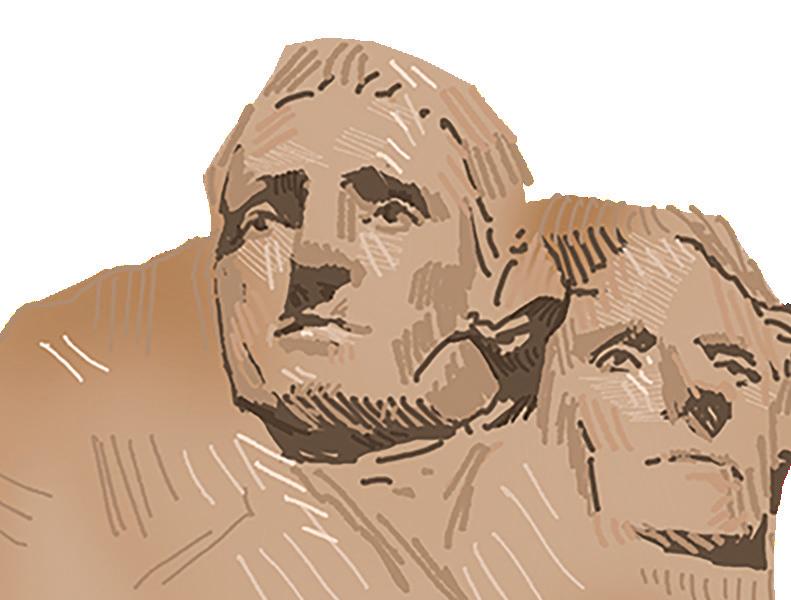

Although America has long dealt with perspectives that struggle to recognize the value that comes from humanity’s differences and similarities, that history does not preclude change. Time and time again, the nation has confronted and revised its own injustices. From the Civil War that ended enslavement to the Civil Liberties Act of 1988 which provided reparations for the incarceration of Japanese Americans during World War II, these achievements illustrate that the normalization of exclusion and injustice can be changed for the better.
“We have so many moments throughout our history where we’ve done so many bad things, but then also had moments where we’ve tried to undo them,” Chang said. “We can be bad, but we can do good and I just hope to see us doing good.”
Through efforts like Paly’s organized ICE protest, Curtis’ petition and Chen’s advocacy, it is evident that transformations are not constrained to the past but are still actively reshaping American democracy, moving ever closer to the aspirations of the Declaration of Independence.
“Even though at times it might not feel like they’re being respected or protected, these old, dusty documents still matter a lot for us today, and they’re still that North Star for how we as a society function,” Tinsley said. “As long as the government is doing its job, we as people can pursue happiness [and] pursue peace.”
Besides guiding the structure of government, the history of the founding extends far from beyond the text of the Constitution and Declaration of Independence, shaping how Americans understand and perceive equality, justice and liberty in their everyday lives. Though these documents may not be consciously present in day-to-day decisions, their influence still remains in how people interact with each other, participate in civic activities and make change. At the same time, American democracy continues to be interpreted and reshaped as society evolves.
“America is an experiment, an ongoing experiment in democratic rule,” Chang said. “I see this as meaning that the country is constantly changing. History shows that truth, great ideals [and] values are attached to early national documents. These are under constant scrutiny, and our understanding of them develops and changes over time, as the country changes socially, culturally, politically and ideologically.”
Text and design by XUANER DUAN, ZOE FERRING and SONYA KUZMICHEVA • Art by ZOE FERRING, SONYA KUZMICHEVA and JOY PENG
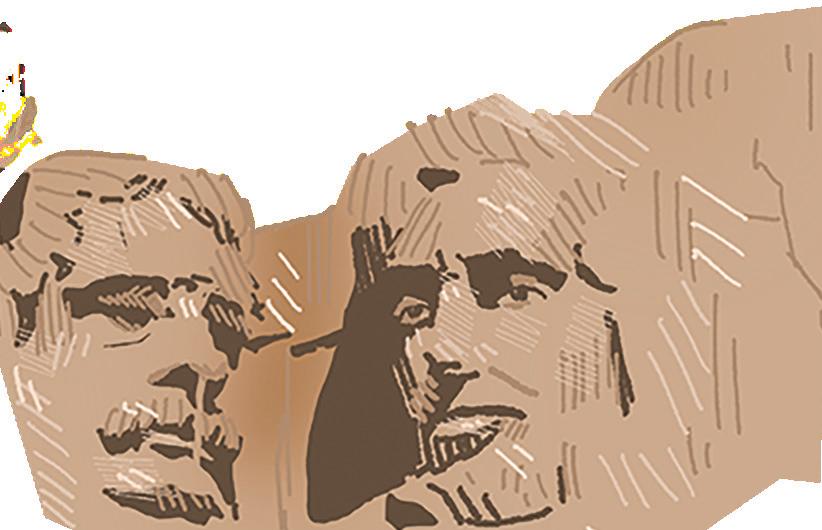

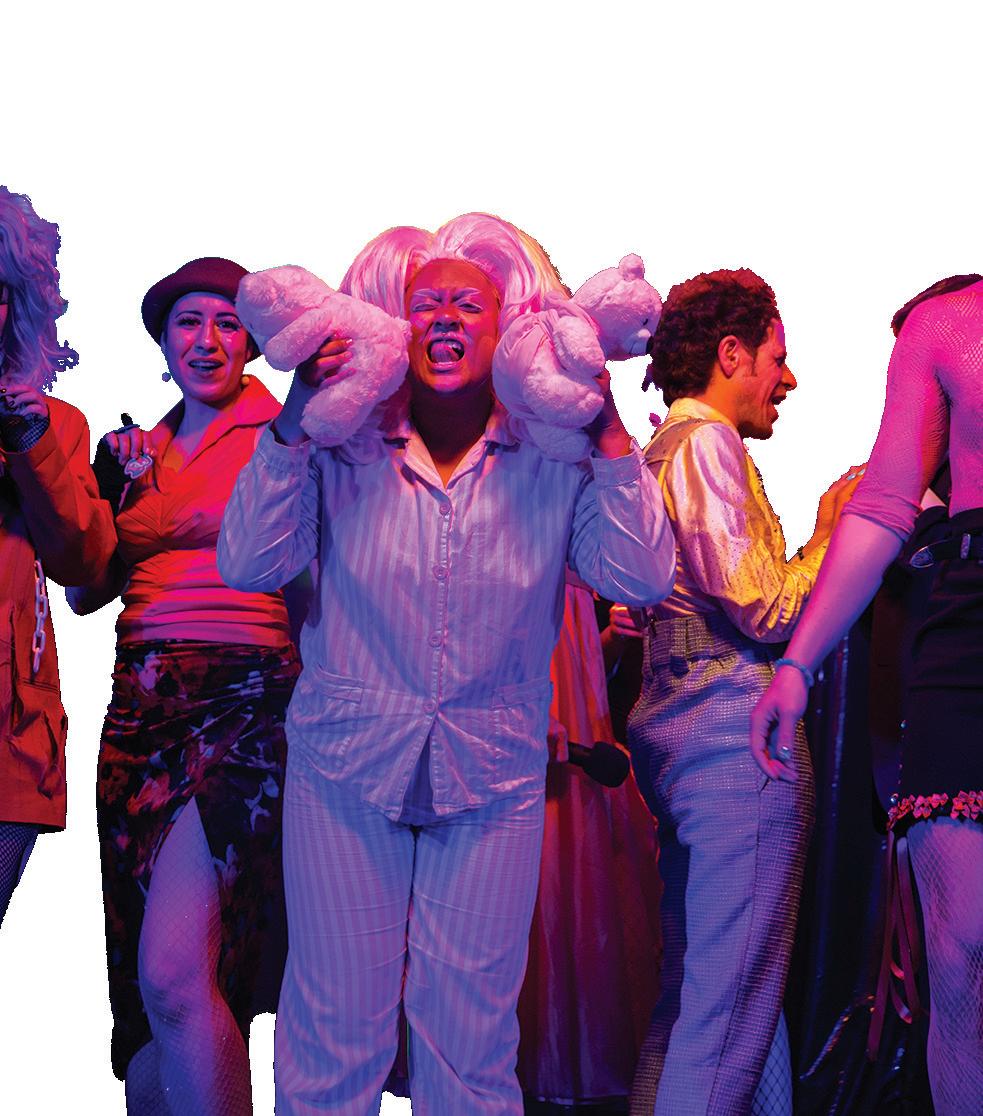
THE QUEENS AND THE KINGS THE KINGS
The cross of art and identity, drag embodies the American values of individualism and self-expression



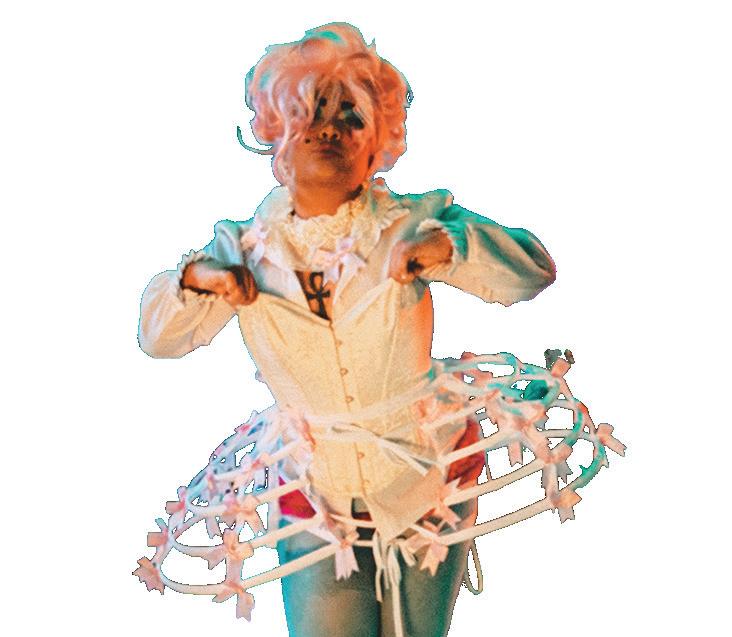
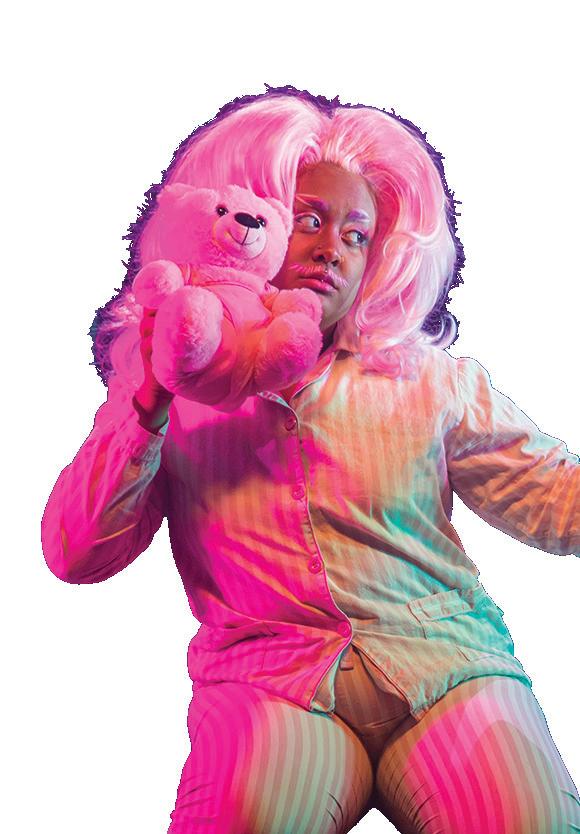
“I’m really in my own brain about outfits and will often get into hurdles of ‘I feel too fat,’ ‘I look ugly,’ ‘This color makes me look terrible,’ until I gain the confidence to finally go for it and remind myself to be kinder to myself and let myself live.”
—
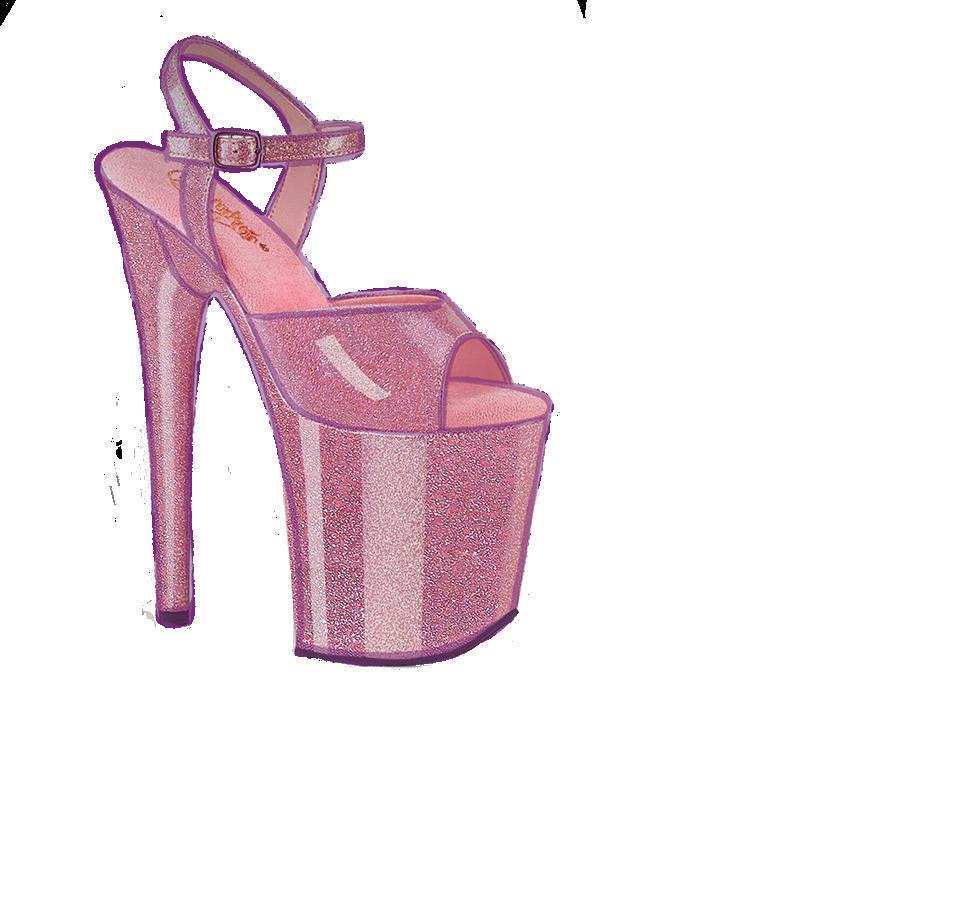
“Drag means life to me. It is authentic, crafted, inspired by humanity and life itself. Drag is art and a resistance with a direct reflection of the world that we are and the worlds within us. It takes skill, creativity, bravery and perseverance to execute well, and above all, it is fabulous.”



GET READY WITH CAL CADIAN TO GO TO A DRAG SHOW:
1. Take a shower.
2. Use his special scented lotion and perfume!
3. Put on his outfit and wig.
4. Apply make up. Then, eat miso soup and sushi rice as a snack. — Cal Cadian


Text and design by BAHAR DINER and STELLA GUO • Photos contributed by CAL CADIAN • Art by BAHAR DINER and STELLA GUO
Honeygum Gogo
BLACK STORY The Behind America
With the rise in social media trends, it’s ever-important to recognize the invaluable contributions of African American culture to American society
Her eyes followed her friends’ newly purchased gold hoop earrings as they swayed back and forth in the wind. The majority of sophomore Maya Moura’s classmates wore fashion styles Moura said she recognized as originating from Black American culture. But as she watched, Moura could not help but wonder if her classmates understood where their favorite jewelry, fashion pieces or even words originated from.
Despite the fact that African American styles and trends often go unrecognized, Stanford African and African American Studies professor Matthew Morrison said African American culture has a rich and complex history, shaping the roots of what’s been considered popular “American” culture for centuries.
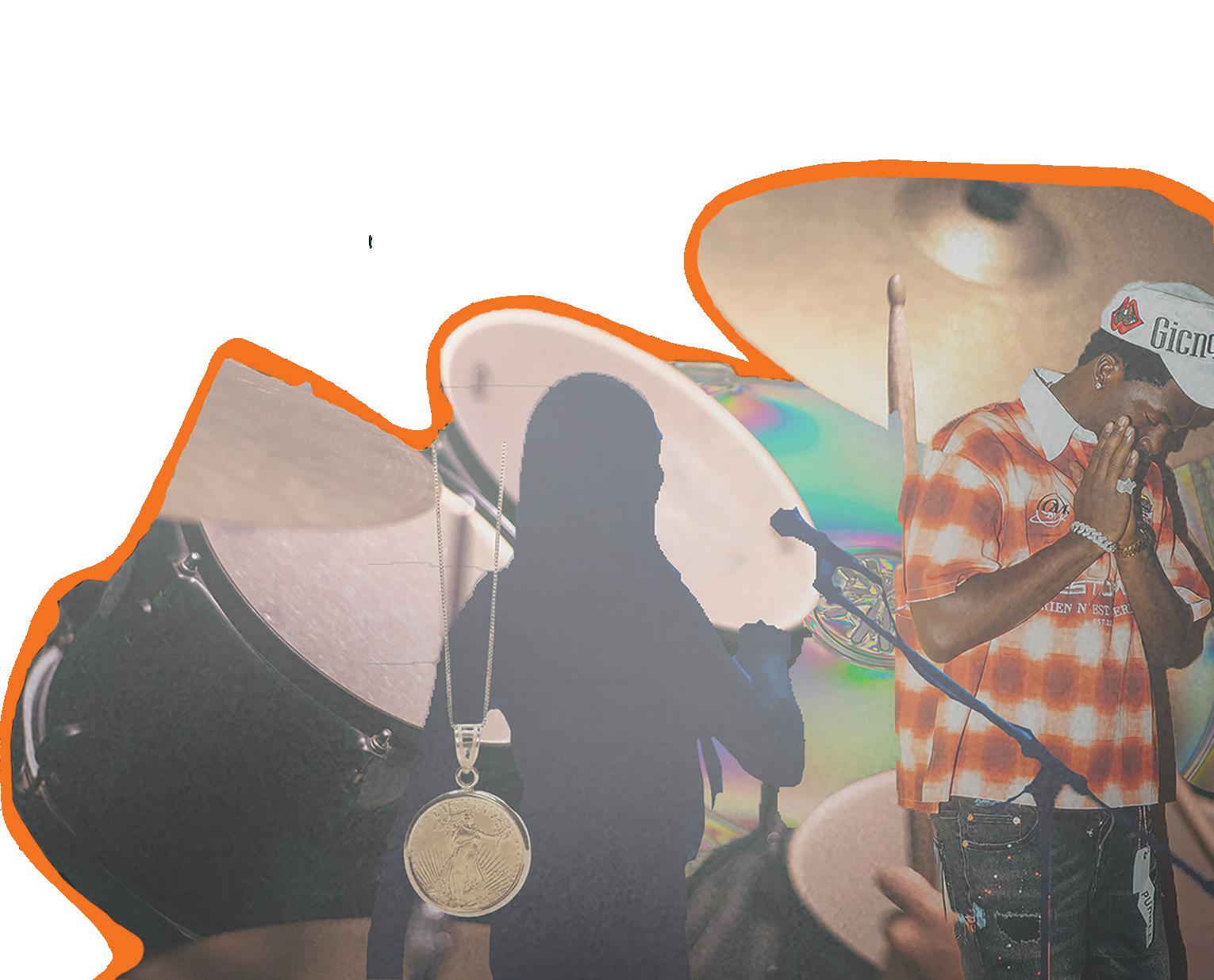
“Black American contributions to American popular music, American culture and entertainment start at the foundations,” Morrison said. “That whole enterprise and industry began in the 19th century during slavery through a musical medium called blackface minstrelsy.”
Through the expansion of blackface in musical performances — a practice in which white performers darkened their skin with makeup to stereotype Black people on stage — the Black American community was unable to gain control of their portrayal in popular culture since European, Irish and Scottish white men dictated those representations, according to Morrison.
“From there, the entire American culture and industry develops through this idea of taking up the imagined or real performances of Black people and developing new genres and styles that are based on those forms,” Morrison said. “But the people who create them don’t sort of fully get the credit that they are due for it.”
Morrison said that after emancipation, music became a key pathway for Black Americans to express themselves and their culture, though stereotypes from blackface performances re-
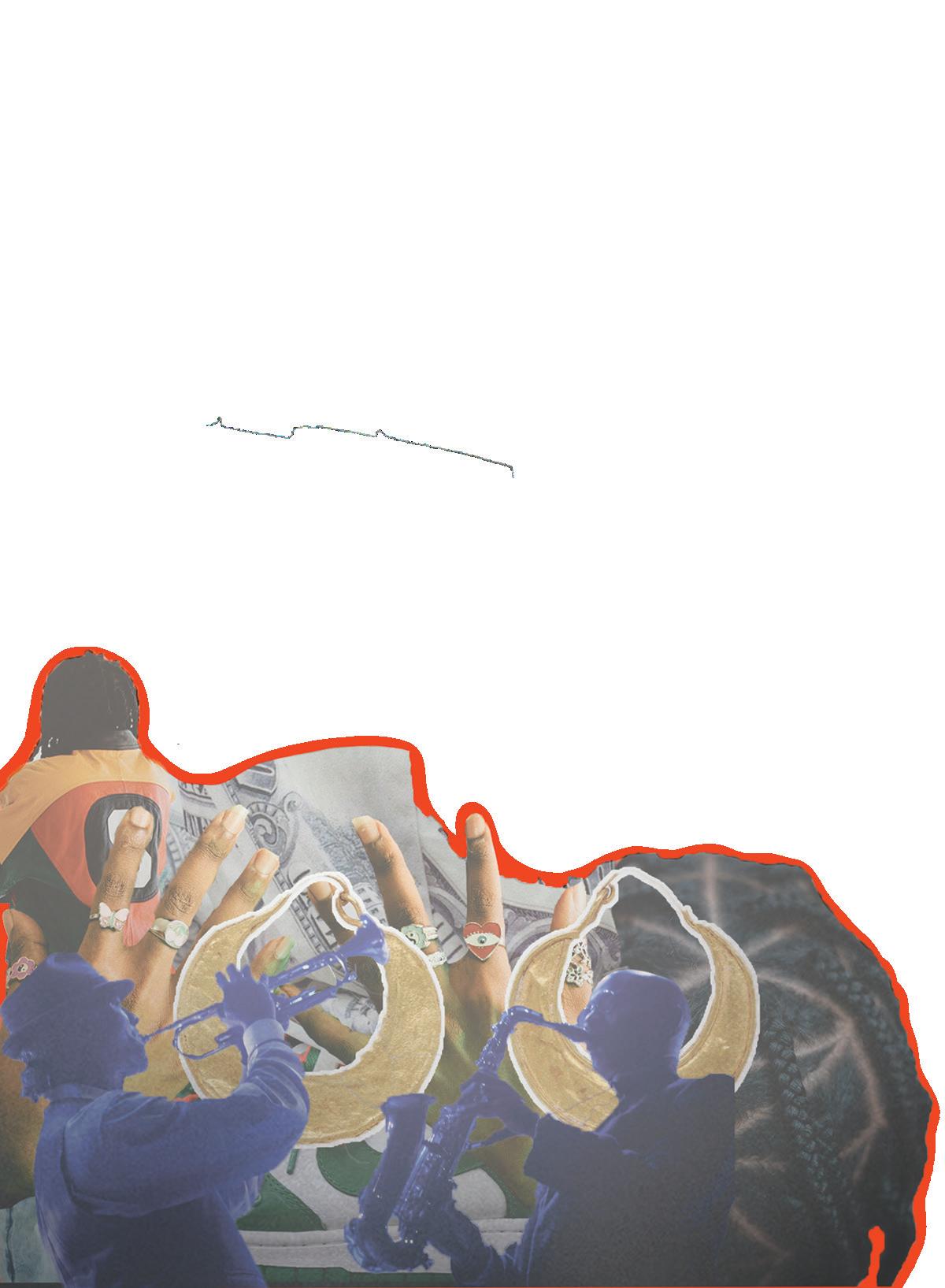
mained in the audience’s racist perception of people of color.
“They themselves had to absorb these racist representations of who they were as they tried to find ways to flip or reshape those representations of themselves through their musical performanc es,” Morrison said.
Black artists’ lack of credit has extended well beyond the 19th century. History teacher Justin Cronin said that the role of Black American cul ture in shaping Ameri can culture hasn’t always been widely understood or appreciated.
“[Black American culture has] had more of a spotlight lately, but I know [that while I was] growing up, there was no discussion of African Americans outside of Martin Luther King [Jr.] and Malcolm X,” Cronin said.
“[African Americans] had to absorb these racist representations of who they were.”
Matthew Morrison, Stanford University Professor
Since then, there has become more freedom in the teaching of history classes — perhaps made most notable by the introduction of new courses like Ethnic Studies, which Cronin said gives him more room to include diverse perspectives within the standard curriculum. Still, Cronin acknowledges that time remains a large restraint in what gets taught, and teachers ultimately have to choose how to shape their class within the time that is available.
“Who [teachers] decide to exclude and who they decide to highlight may be based on some of their assumptions and beliefs, and then individual minorities get lost in the shuffle,” Cronin said. “I would love more of everything, but you can’t realistically do that, so … every teacher has to make choices about what they dive deeper on, versus what they just kind of gloss over, versus what they don’t have.”

“I feel like there are very few Black or African American people in my grade, probably not more than 12 in every new year of school that I go into,” Moura said. “Especially here [in Palo Alto,] I feel like a lot of people lose their culture. In my personal story, I feel like I don’t celebrate my Black side of the family as Cronin attributes the lack of a Black community in Palo Alto to systemic barriers that have made it difficult for families to enter the rich climate.
“Palo Alto used to be a place where they didn’t allow Black people to own homes,” Cronin said. “It used to be written into the contracts at the bottom that they couldn’t be sold to minorities. So, when we’re talking about history, it’s not that far from where we sit in terms of years.”
Cronin added that the restriction of Black families buying houses in Palo Alto in the 1950s prevented them from building wealth in the area, which was part of a
While each teacher’s bias can exclude certain cultures, geography often shapes whether parts of American history are taught accurately in the first place, Cronin said.
“Even the simple conversation about the Civil War, in some Southern states, they still talk about it as the war of Northern aggression, and they say it was fought over states’ rights when it was fought over the institution of slavery,” Cronin said. “You have textbooks coming up in Texas that talk about enslaved people as workers or immigrants, not truly capturing what was transpiring with the Atlantic slave trade.”
For Cronin, the solution is something close to Paly’s new ethnic studies course — a class that puts the spotlight on the histories and contributions of marginalized groups that are often sidelined in traditional history classes — applied universally to how American history is taught.
“It should just be regular U.S. history,” Cronin said. “But unfortunately, we’re not quite there yet with thinking about regular U.S. history and in the way of these multiple perspectives.”
Another curriculum offered at Paly to highlight minority groups is the Social Justice Pathway. Moura said her teachers within SJP have been able to represent minority groups that she felt were previously overshadowed in her school experience.


along,” Moura said. “And in that process, we not only miss out on learning about different cultures, but we also miss out on dis covering our true selves if all we do is chase the next trend.”
The popularity of Black American trends, music and slang only adds to the value of African Amer ican artists’ creations that Morrison said have yet to be recognized.
“I’m not sure that [Black American cultural contributions] can ever be recognized fully for the value that it has contributed because ... our systematic structures of racism prevent Black Americans, in many ways, from being seen as capable of producing certain types of things that are worthy of being recognized for their value,” Morrison said. “The problem is a rac ist structural system that comes out of slavery that has not yet been addressed.”
According to Chen, these diverse cultural contributions have become even more im portant to acknowledge in the present day, especially as he sees the lack of recognition get even worse.
“We’re seeing a growing sentiment of decreasing appreciation of these minority

“There’s even more urgency, in some ways, to make sure that we are preserving certain historical truths as they’re trying to be directly challenged and erased as facts though we know that they are,” Morrison said. “Because that’s how fascism takes hold, by creating its own narratives that are not true, that they’ll become the dominant narrative acceptance for however long people accept that narrative.”
“We also miss out on discovering our true selves if all we do is chase the next trends.”
Maya Moura, 10
With the critical importance of conserving historical facts Morrison describes, Chen says it is fundamental to understand the diverse cultures of minorities as the foundation of American culture,
“Recognizing diverse culture is important because at the end of the day, diverse culture is what built American society as we know it today,” Chen said.
Text, design and
ELLA
DEREK
photos by
CHEN and
RENAZCO-SPERLING • Art by TALIA BONEH

More than a dreaM
Iwas four years old the first time I saw fireworks explode across the Fourth of July sky. The noise was so loud I covered my ears, but I couldn’t stop staring as bursts of red and blue lit up the night. Everyone around me was cheering. Even though I didn’t fully understand what we were celebrating, after a year abroad, I found out why.
I spent eighth grade living in Shang hai, China, a cyberpunk city with towering neon sky scrapers, packed sidewalks and subways so full you could barely move.
During that year, I learned three things. First, my Chinese skills could use some im provement. Second, navigating a foreign country is a lot hard er than it looks. And third, it’s surprisingly easy to forget how lucky you are to live in the U.S. Apparently, it took a full year abroad for me to remember that.
When people talk about the “American dream” today, it often sounds like some thing outdated — a phrase that belongs to another generation. For me, I didn’t always believe in the American dream either, but after spending time away from the U.S., I started to see it differently. Even though I firmly believe in the American dream, sometimes I wonder if the opportunities that I had always been educated about actually existed.


better the moment you step on American soil. But it is a place where your dreams don’t just live on paper — they’re possible.
My parents grew up in Taiwan before moving to Canada as teenagers to chase a new life far from home. In 2009, the Great Recession hit my family hard, and, for the first year of my life, my
I have the chance to becoMe whoever I want to be.
After countless job applications, it finally paid off when my father received a job offer from Nvidia in California. Despite this, my parents were uncertain, to say the least. At the time, Nvidia was one of the worst performers in the informa
I know many people in the U.S. face barriers that make the dream seem impossible. As college tuition continues to rise, healthcare costs grow more crippling and immigration policies stall the lives of many, the path to success begins to feel farther out of reach for millions of Americans. Additionally, politics divide the country, and inequality ensures that some of us are born into wealth and others have to build up to it.
Many students today think the American dream is a myth — something that people promise but is never actually witnessed in real life.
Yes, the U.S. may not be all sunshine and rainbows. Life doesn’t automatically get
hind frozen ponds, friends they had known since day one and every family member that supported them for a country they barely knew was certainly a gamble. Doing it for a company that looked financialy unsta ble made the decision even harder.
Looking back now, I realize it was much more than a change of address. For my parents, the move wasn’t really a choice at all. But it also gave them the chance to build something bigger than them selves, even when the odds were stacked Growing up in the U.S. felt like there was always something new to try, see or learn. I spent afternoons shooting hoops with my friends in a driveway or climbing the tallest trees I could find.
I loved waving the American flag as I marched down the 4th of July parade and

the PB&J sandwiches my mom would make after a long day of school. I loved racing my bike down the street with my friends before the streetlights came on and hearing the ice cream truck echo through the neighborhood on warm summer afternoons. These are the memories that make me proud to be American.
My parents always told me, “You can become whoever you want to be, as long as you work hard enough.” The first step toward fulfilling the American dream is believing it actually exists — many students don’t have that mindset. To be honest, I didn’t either, at least not until I spent a year living in another country. In China, everything felt structured. People follow a clear, predictable path, and success means fitting into the system rather than breaking past it. Being there made me realize something I had always taken for granted. In America, I have the chance to become whoever I want to be.

I missed the small things too, like sinking my teeth into a juicy In-N-Out Burger sandwich and watching the Super Bowl in a packed living room where people would cheer so loud you couldn’t even hear the TV. My year in China was an incredible experience, but I constantly wanted to return to the U.S. Although the American dream isn’t guaranteed, my family's story proves that it can be real. My parents took a risk on a country they barely knew, starting over with nothing. That risk is the reason why I am able to chase opportunities I could once only imagine.
So while racing toward senior year, college or whatever comes next, take a moment to slow down and look around. Appreciate what you have and the opportunities in front of you because in this country, for those willing to put in the work, anything is possible.
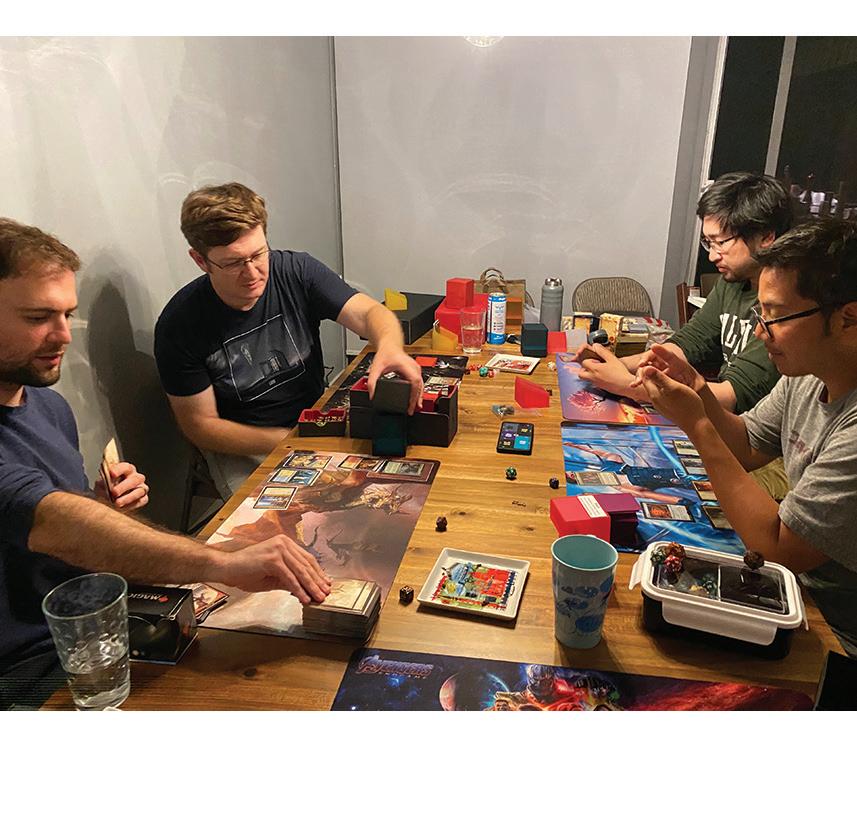
English teacher Marc Tolentino, who teaches in the Social Justice Pathway, has developed his skills in strategic thinking, assessing risks and anticipating other opponents’ moves in Magic: The Gathering. In the game, players take on the role of wizards and compete to defeat each other by playing cards that impact opponents and benefit themselves over a series of turns.
“I played in middle school back in the early to mid-90s, and then I stopped when I was in high school, all the way through college,” Tolentino said. “It’s a lot of fun, and it is one of the most complex games you can play, which keeps it very interesting.”
While the game has the end goal of taking down other players’ life total, Tolentino also appreciates the quality time with friends.
“Magic: The Gathering holds value for
MARC TOLENTINO
me because the connections with people during game nights are a lot of fun,” Tolentino said. “There is a lot of smack talking that keeps it very entertaining, and there are good conversations throughout.”
Tolentino believes that it is important to move past the social stigma of trading card games, and to instead enjoy them as a meaningful hobby.
“In middle school, there’s a little bit of shame when it comes to playing a game like Magic: The Gathering, because it is kind of nerdy,” Tolentino said. “I know a lot of people will think the game is dorky. But when you’re back at it as an older person, you’re a lot more confident and stop caring what people think a lot more. I try to champion being nerdy so it doesn’t seem uncool or socially unacceptable.”

Advertise with
Print and online ads available. Thousands of local readers each month.
FROMSEA TO SHININGSEA
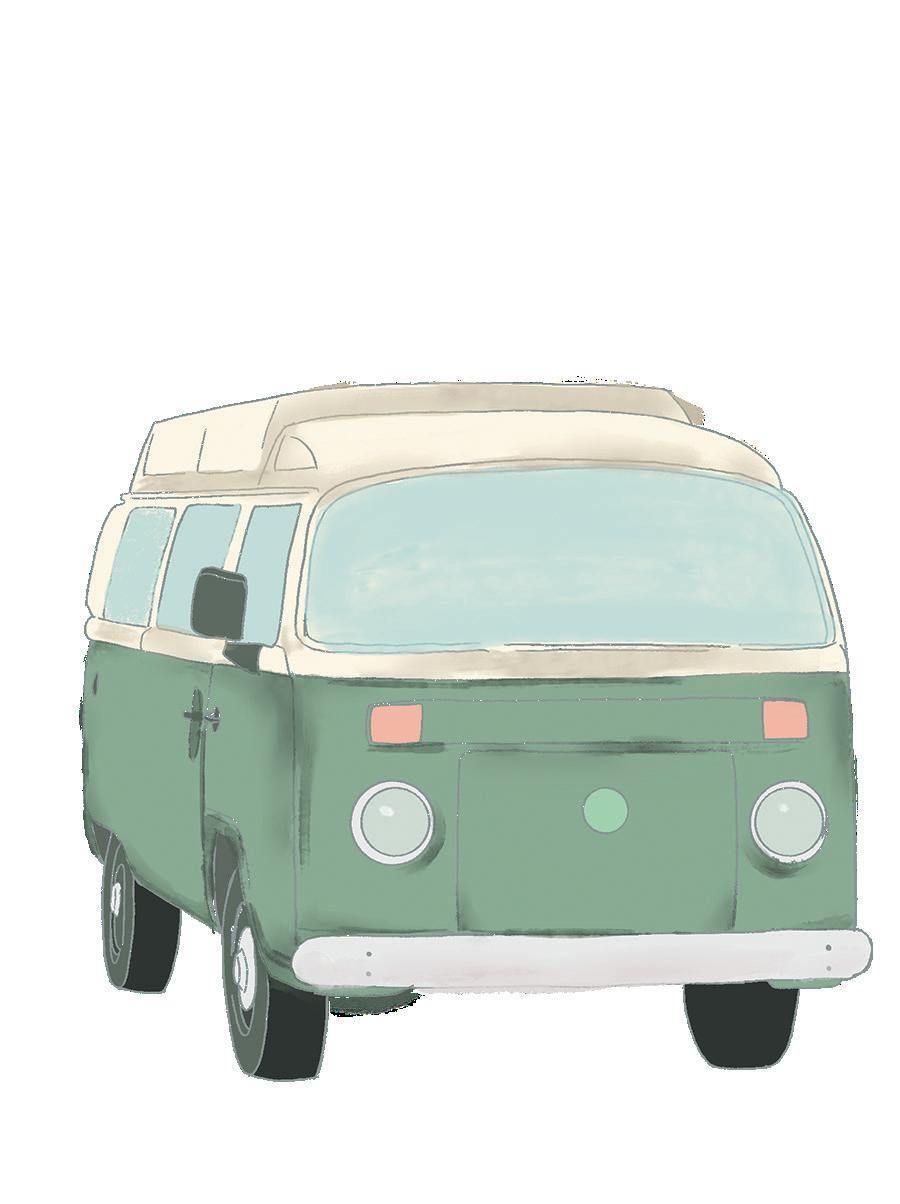
With the invention of automobiles, transportation vehicles have dominated the lives of Americans. Here is a collection of fond memories from roadtrips across America.




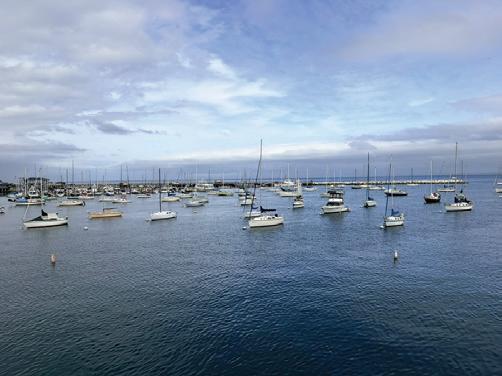
SANTA CRUZ , CALIFORNIA
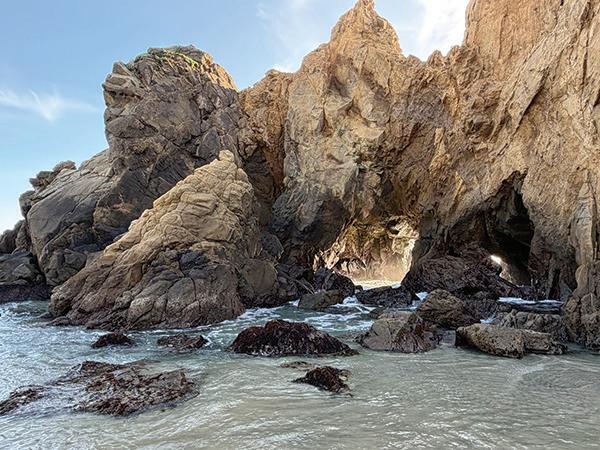


English teacher Bekki Casalco frequently goes on road trips with her husband to the coast, where she strolls around the Santa Cruz Beach Boardwalk and enjoys the arcade there.
“My favorite location to go to is the Lighthouse in Santa Cruz because you can run from there and end at Natural Bridges State Beach,” Casalco said. “Another top favorite of mine is Monterey Bay.”

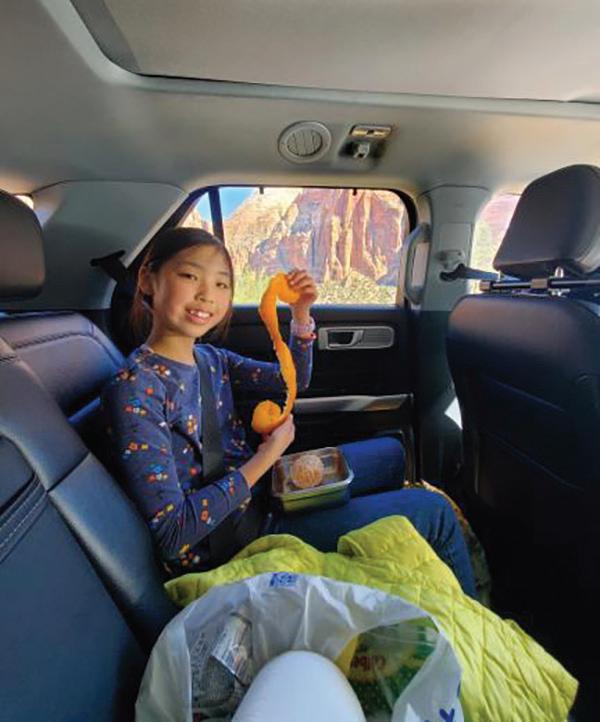
As someone who has gone on road trips to Yosemite, Los Angeles, San Diego, Lake Tahoe, Las Vegas and more, junior Elaine Kim has shared fond moments with her sister.
“My favorite part about road trips is looking out at night and seeing the stars shining so brightly,” Kim said. “Sometimes, we stop the car on the side of the road and walk out, all bundled up in jackets, just to look up at the clear night sky and point out constellations.”


Photos contributed by ELAINE KIM
Photos contributed by BEKKI CASALCO
Text and design by XUANER DUAN • Art by XUANER DUAN and EILEEN LEE
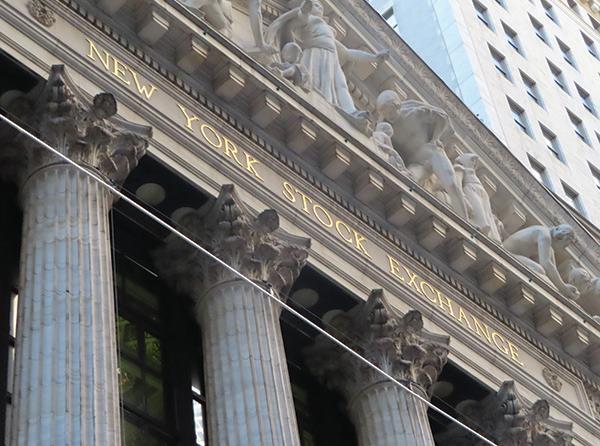

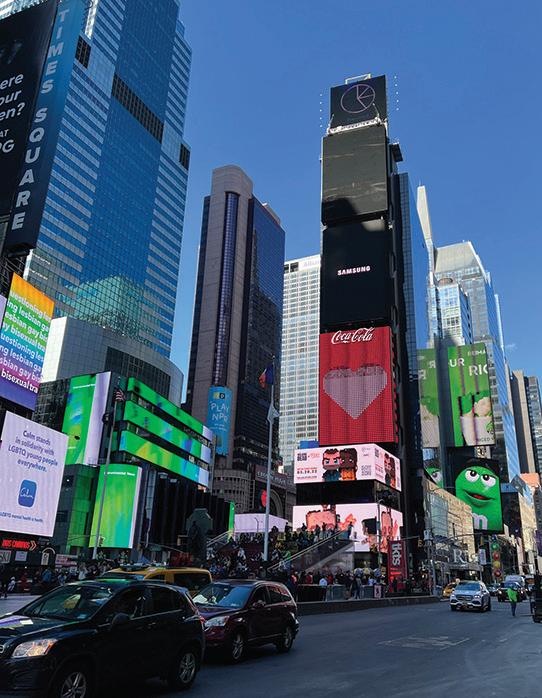
After landing at the John F. Kennedy International Airport in New York, the first thing junior Xuaner Duan and her family did was to rent a car. She traveled to many major sightseeing locations in the East Coast, including the Statue of Liberty, Times Square and also climbed to the top of the Empire State Building. One of her favorite activities is going on road trips and experiencing the beauty of nature, architecture and food.

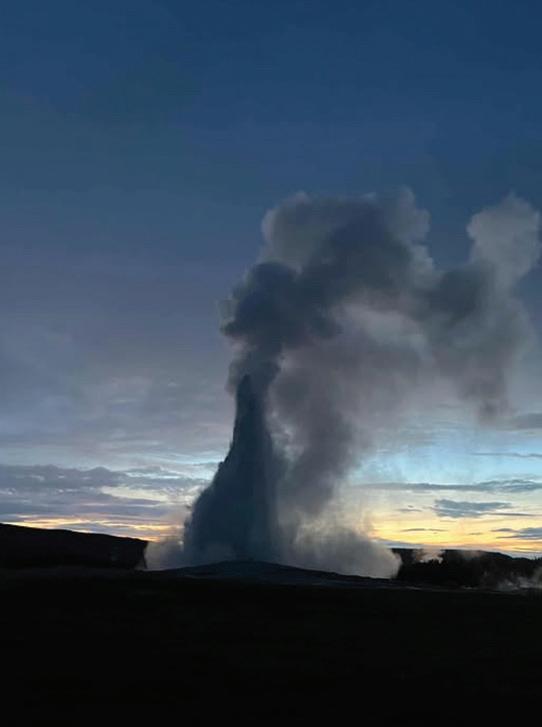
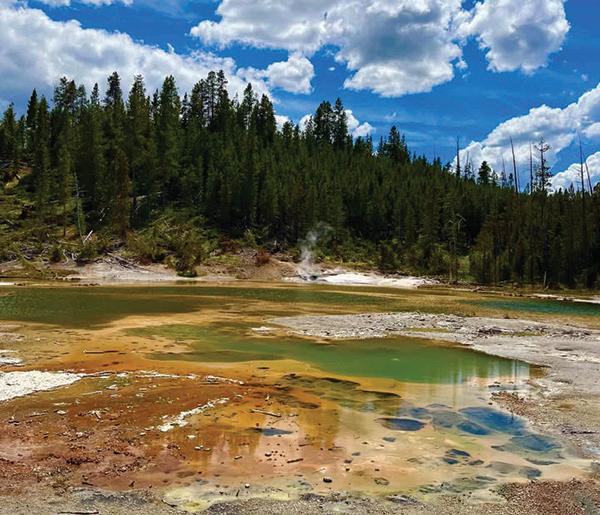



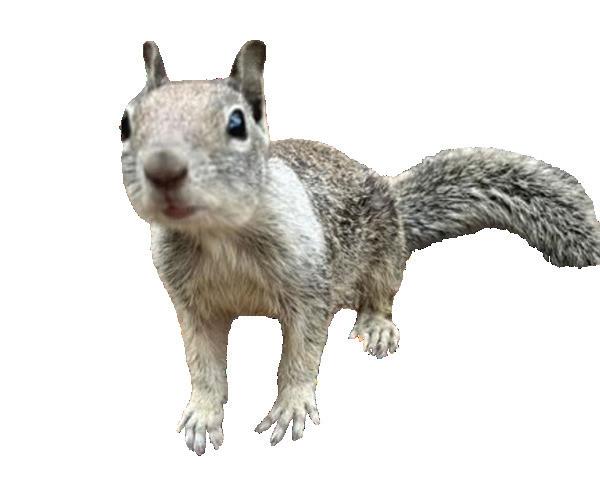
Junior Claire Kwac’s favorite memory is getting to take pictures of all the animals she sees on her road trips.
“I dont really care for rocks or trees they all start looking the same,” Kwac said.
“My favorite [memory] is Yellowstone because I saw bears, bison and coyotes.”
YELLOWSTONE
NATIONAL PARK
Photos contributed by CLAIRE KWAC
NY CITY, NEW YORK
Photos by XUANER DUAN

An editorial by the C Magazine staff:
I AM AN AMERICAN.
Rediscovering the American identity beyond politics


What does it mean to be American? For some, the image that comes to mind of the ideal American is a sunworn cowboy who speaks in a Southern drawl and keeps his shotgun at his hip — the all-American hero, who fights through any conflict with his fists.
When we think of America, we might even conjure visions of the flag — our star-spangled red, white and blue flag — backed by grandiose and dra matized versions of the national anthem, which is aptly named The Star Span gled Banner.
The values and ideals that the American flag represents span all polit ical parties, culminating in the essence of America. Yet today, when many of us think of the flag, whether it’s flying outside of a school, serving as a bumper sticker on a truck or as a pair of shorts worn on the Fourth of July, we think of a political identity aligning with more con servative, right-winged values. Things that used to be done out of pure patri otism, such as reciting the Pledge of Allegiance or having an American flag outside a house, are now tied to a specif ic political affiliation. But we at C Magazine separate these notions. We believe that patriotism and the notion of political ideology should be separated again, as they once were. We believe that America must redefine “patriotism.”

American patriotism should encompass the values we believe defines America: courtesy, respect and ambition.
American patriotism should encompass the values we believe defines America: courtesy, respect and ambition. However, more broadly, C Magazine believes that the American identity is not intertwined with the current political landscape and should be thought of as a separate entity. We believe being an American

means having a unique sense of ambition and respect, acknowledging our nation’s flaws, and being optimistic about our future; none of these ideals should be tied to a particular political party’s ideology. In fact, we believe there are many reasons to be proud of our country, today, even with its myriad flaws.
American ambition has been uniquely present since our country’s inception. For one, the United States was built on a foundation of liberty and freedom after triumphing against Great Britain — principles which have guided and shaped our decision making for the past 250 years. The founding fathers wanted to create a country free from the oppression of the British, where they could form new laws and structures that aligned with the peoples’ priorities. This initial goal led to efforts for religious equality, women’s suffrage and the civil rights of Black Americans. Historically, the U.S. has always strived to contribute to change, something Paly students can and have become a part of through activism.
Our new definition of American patriotism also includes courtesy and respect. This courtesy, we believe, should come in the form of unwavering respect toward others and other ideas; whether it be toward a U.S. citizen, someone of a different origin or someone holding a different perspective than one’s own, it is imperative that we continue honoring the collective respect our constitution demands of us. In following “we the people,” Americans must continue to treat everyone in this nation equally, as a part of one collective group moving further toward the prosperous future our founding fathers believed in.

Lastly, we believe that patriotism should include optimism about what is to come in the nation’s future. The U.S. is turning 250 years old, which is indubitably young. We have ample time to thrash out the errors in our governmental system that render the public concerned and other nations crit ical of our country. And, in these two-and-ahalf centuries of sovereignty, the U.S. has grown to be recognized as one of the most economically successful coun tries. Though there are undoubtedly ample factors contributing to this suc cess, the one that stands out the most is the American people, all of whom pos sess one unique factor: ambition.
Americans invent. Our universities are constantly putting out research, re defining the way we approach topics across many disciplines. Our inventors have consistently been at the forefront of their fields — Thomas Edison invent ed the lightbulb, Steve Jobs invented the smartphone and Stephanie Kwolek in vented Kevlar.
powers to champion for change.

Americans amend. Of course, our short lifespan has had its fair share of wrongdoings — the enslavement of millions of Black individuals for centuries, beginning before America even earned its sovereignty; the maltreatment and suppression of women; homophobic laws that were only repealed in 2015. Yet, America has grown, and the amendments etched into the United States’ constitution are emblematic of this.
What is more patriotic in this country than expressing your criticism of this country?
Americans fight. Americans triumphed against Great Britain during the Revolutionary War, winning the independence that has come to define many individuals’ perceptions of the nation. Women fought for their right to vote. And still, today, Americans protest, utilizing their constitutional
In fact, what is more patriotic in this country than expressing your criticism of this country? That discourse is precisely what the founders wanted. Today, with everything causing partisan divides, we have lost sight of that. We struggle to think in any way other than partisan.
As time passes, it is integral that individuals take into account the fluidity — and powerful history — of the American identity. There is no dictionary definition of what it means to be American; it is up to interpretation. As such, we at C Magazine have boiled down our own answer to the question “What does it mean to be American?” To be American is to be ambitious, to be respectful and to hold out hope for the future of our free nation.



fortheOymp i c s
HannahOh

"The goggles that you wear are really important. They have to feel right if I want to swim comfortably. Making sure they don't look weird is important, too."
Hannah Oh, 11 10
Jordan
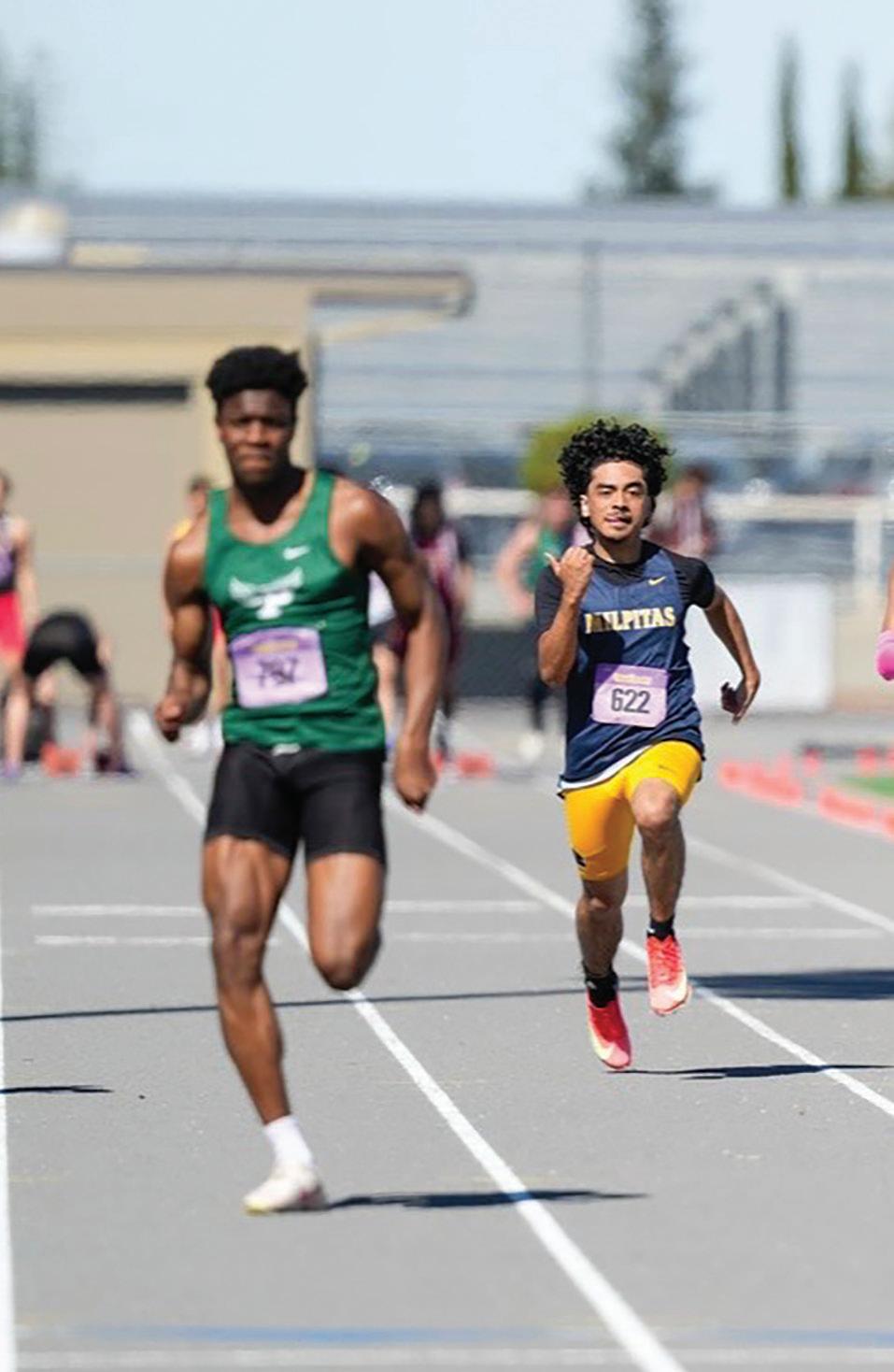
Five-star Paly athletes share how what they wear can be a real game-changer
“I wear a sweat suit, typically with a Team USA jacket with black sweatpants ... I wear it with pride.”


Johnsson
Jordan
Johnsson,
OliverReid

“I used to wear a chain with my number on it. Now, I have a matching one with my friend.”
Oliver Reid,
11
“One
"I have a swim bag that has a bunch of keychains from teamates I've met along the way."
Sloane Nagayama,

of our uni suits is for this guy who used to be on a team who passed away from cancer. We wear [it] to memorialize him.”
Harper Skey, 11


9
HarperSkey
Design by KYLE CHEN, POPPY MORRISON and MARIA URIBE ESTRADA • Photos contributed by JORDAN JOHNSSON, SLOANE NAGAYAMA, OLIVER REID and HARPER SKEY • Art by TALIA BONEH and MARIA URIBE ESTRADA SloaneNagayama
Frame A Different
of Mind
What roles do Americana art and literature play in shaping the understanding of American identity?
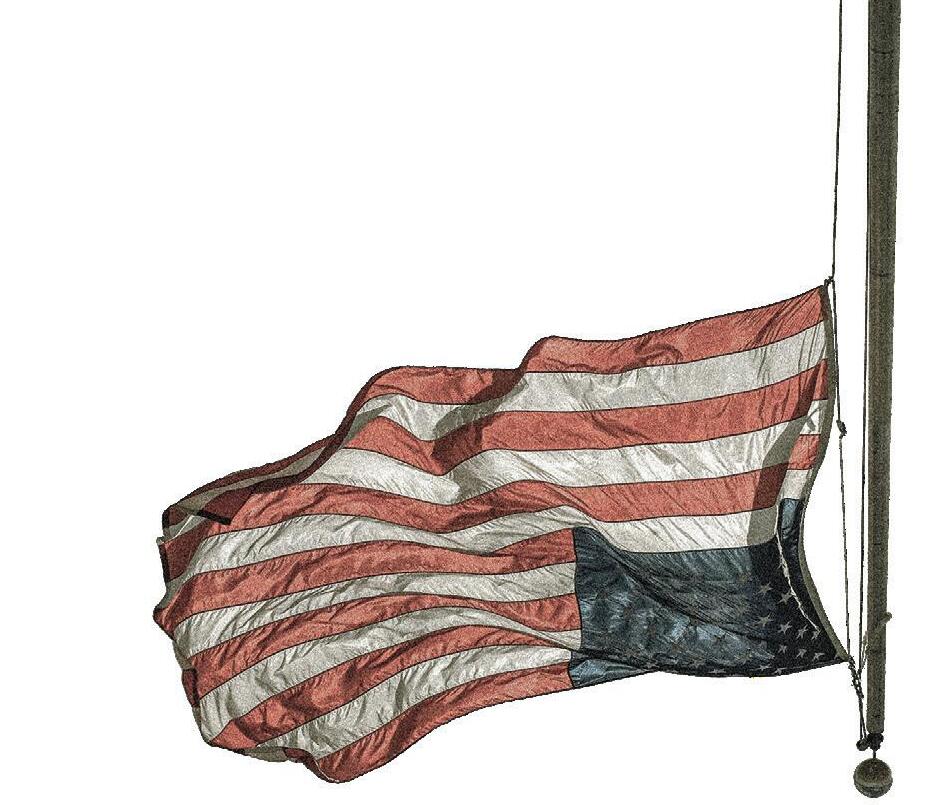
While the United States Capital Building was stormed by a mob of President Trump’s supporters on Jan. 6, 2021, people smashed windows, overturned furniture and vandalized the property. Yet, the numerous paintings surrounding the building’s rotunda which portrayed classic moments in
U.S. history were left, for the most part, intact.
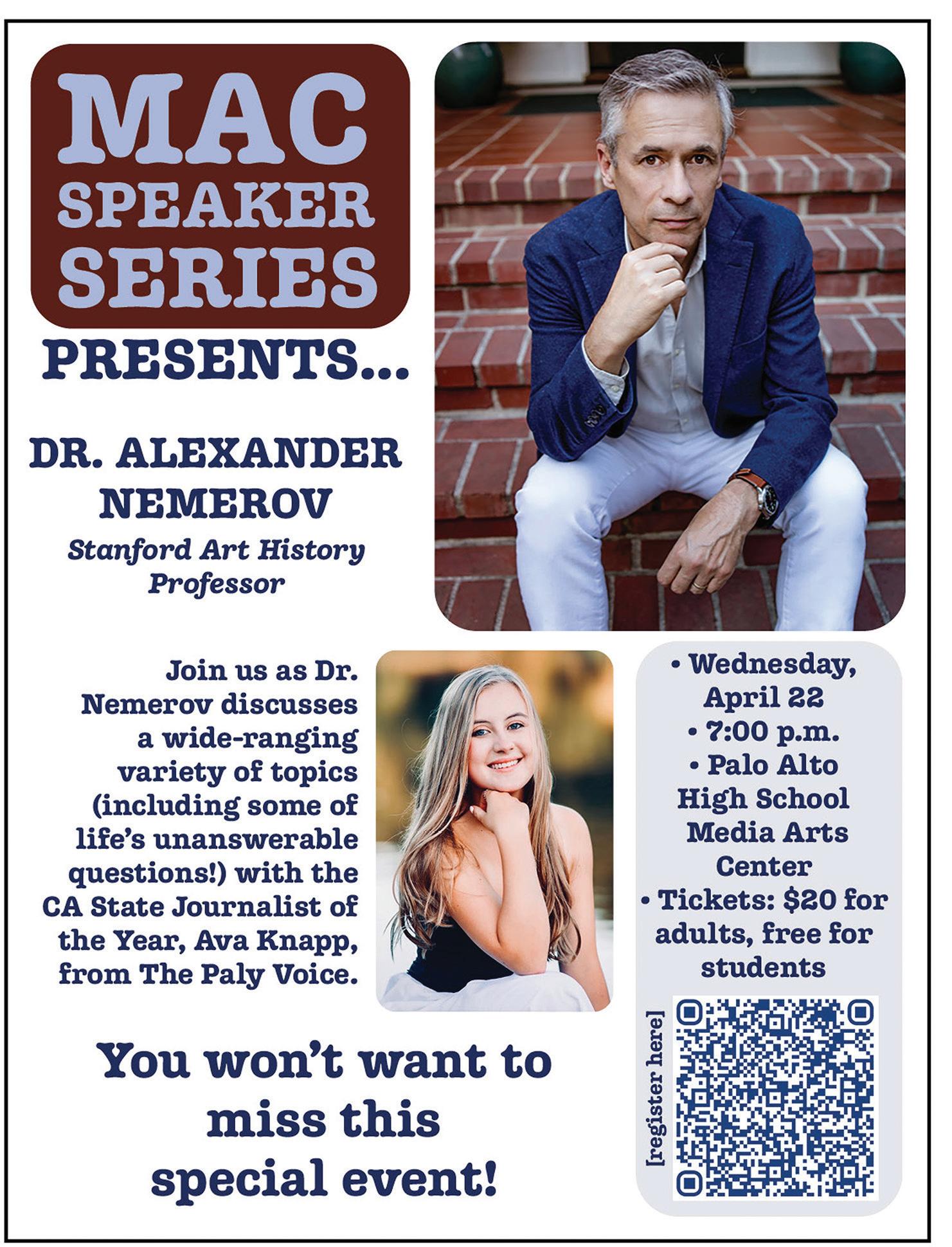
American art historian and professor at Stanford University Alexander Nemerov has been drawn particularly to this occurrence.
“I’m always interested in Jan. 6, 2021 and the insurrection,” Nemerov said. “To see the people, the rioters, milling around in front of those pictures raises the questions of what do these works [of art] stand for? … There’s a sense that those pictures represent what is stable and secure for all Americans, but naturally they [only represent] partial viewpoints.”

While contributing to an exhibition at the Smithsonian Museum in Washington, D.C., Nemerov realized the strength that art has to bring up questions regardless of people’s beliefs. Along with this, art has the ability to start conversations about topics that might otherwise be hard to broach, like those that involve contrasting political viewpoints.
The exhibition, “The West as America,” which was received with multiple conflicting opinions, served as just one example of the then hostility surrounding the emergent phrase “political correctness.”
“The exhibition was controversial because it tried to say that the paintings, which were largely heroic paintings, didn’t really tell the whole story about the racial destruction and environmental destruction that created the myth of the American West and also of the United States,” Nemerov said.
With each new artwork, there are often many different interpretations depending on the time of viewing. According to Aleesa Pitchamarn Alexander, associate curator of modern and contemporary art at the Cantor Arts Center at Stanford University, because of how meanings change over time, the art comes to accrue many different meanings when viewers from the future look upon the past.
Through the countless interpretations emerging in art, from paintings to novels, comes one overarching theme that ties in all forms of what it means to be American: Americana.
“What makes an American novel?” English teacher Keith Tocci said. “It’s people trying to figure out what makes an American.”
People are always changing what it means to be an American through art, whether that be visually or in literature. In Alexander’s eyes, maintaining that flexibility is crucial.
“The past isn’t fixed,” Alexander said. “The idea of linear time is itself a tool of Western imperialism.”
This idea of a linear past ties into Americana art themes as well. Through this perspective, the American identity can be perceived as a fixed or rigid, when the past contains a multitude of histories, some of which people may be unable to accept.
“People get very upset when a seemingly stable idea of American identity as manifested in art is challenged or questioned,” Nemerov said.
As social studies teacher Katya Villalobos has come to understand, art has long been a way of understanding identity, whether that be American or not.
“Nazis had a whole exhibition on what they considered not art,” Villalobos said. “And of course, it was all [art created by] people of color. Jews and anything modern [were] considered degenerate art, and they were trying to obviously manipulate and reinforce the racial stereotypes.”
different broad cultures. But [he saw] a lot of hope there, because by being a bunch of human[s] together, all those stigmatized prejudices could be … worked though.”
Similarly, in art, new light is being shed on historically underrepresented American artworks such as those by minority groups.
Alexander wrote her dissertation, prior to receiving her doctorate, on black artists in
“Artists tend to reject the idea that they are a part of a movement when they’re writing most of the time.”
Keith Tocci, teacher
her American modernist sculpture.
“Part of [Asawa’s] story is being incarcerated during World War II,” Alexander said. “That history of Japanese American incarceration is this uniquely American thing. It’s part of her narrative as an American artist.”

Additionally, Villalobos said that those who tend to question authority and shed light on injustices are often those who are intellectually or artistically gifted.
“It’s interesting that when authoritarian or dictators come to power, they always go after intellectuals,” Villalobos said. “Artists and people [who] push that envelope want to give that mirror to say, ‘hey, look what’s going on.’”
Ultimately, all viewers will form their own opinions on what is considered good and bad art — and the same is true for literature. For example, Tocci said that he pays particular attention to what questions literature can bring up for people.
“The question is, can all of these historical threads actually come together and face one another, and [can they] accept the injustices that happened, navigate them and move forward?” Tocci said.
Depending on where people begin, they may have diverging views on culture and what those experiences bring to the table.
“[James] Baldwin [an American author] saw America as very different from Europe in the sense that Europe existed the way it had for a very long time,” Tocci said. “In America, there was a confrontation of a bunch of

the southern U.S. — with an emphasis on the south in the post Civil Rights period — including artists Thornton Dial and Ronald Lockett.
“These are some of the most precious records and accounts of what it means to live as an American,” Alexander said. “They have profoundly shaped my worldview about ‘American-ness,’ the history of enslavement and the way that [has] impacted cultural experience, heritage and expression in ways that are both obvious and not obvious.”
One artist that Alexander was drawn to was Ruth Asawa, known for
In fact, many artists find their voice in their artistic narratives, while others tend to stray away from this concept, according to Tocci.
“A lot of artists tend to reject the idea that they are a part of a movement when they’re writing most of the time,” Tocci said.
“It’s like a rejection of easy labels, or becoming some group and
For example, writers like Octavia Butler and NK Jemison are often labeled science fiction authors, when their craft often goes beyond that medium.
“They’re engaging with the world today very directly and trying to imagine how this world could connect to a better future,” Tocci said.

“There are as many definitions of [American] identity as there are grains of sand that you might pick up on the beach.”
Alexander Nemerov, art history professor
According to Alexander, those who represent the broader demographics of Americans have changed throughout history. Moreover, the artists who have been making decisions about what topics to shed light on have transformed.
“Things are very different now,” Alexander said. “To a certain degree, many artists are less invested in an American identity as a national identity that they feel strongly aligned with, but rather thinking about oneself in relation to these … transnational histories and bringing that into the fray.”
hearing the voice of others.
“I’ve always found the importance of voices coming together, voices coming into conversation and voices trying to talk their way through the narratives we’re stuck in and getting beyond [those narratives] … to be so moving,” Tocci said.

“Americana definitely falls into the category of propaganda.” Frank Barrera, cinematographer
“What makes an American?” is a question that spreads across more than just literature, one with a malleable and everchanging answer which is inherently tied to Americana themes.
equality among everyone and everyone having an equal chance, there can be no hierarchy of a better or worse ideal.”
Particularly in modern times, Nemerov said that American identity continues to expand.
“In the sort of open-ended capitalism of our moment that is digitally enhanced and determined, American identity can mean any number of things,” Nemerov said. “There are as many definitions of that identity as there are grains of sand that you might pick up on the beach and throw in the water.”
Cinematographer Frank Barrera attributes much of the Americana following to the idea of group dynamics — particularly the idea of “in groups” and “out groups.”
“[Americana] is trying to get at [the idea] that there was a better time, and if you understand that time, you will be a better American, and you will be part of this group,” Barrera said.
However, history — like politics or emotion — can never truly be separated from art.
“Learning history was always done from a humanities perspective,” Villalobos said. “[For example], you cannot teach the Harlem Renaissance without teaching about the art.”
Because of this, it is evident that history and art are interconnected; Nemerov said that literature too has a humanitarian benefit.
“The assistance that literature can
“I think we’re still trying to say who we are as Americans,” Villalobos said. “We keep adding to the ‘we’. The ‘we’ is important because that means that we’re much more inclusive in a pluralistic society.”
Ultimately, Nemerov feels as though some questions are better left unanswered.
“There are certain argumentative hot spots or ground zeros like freedom or liberty, that by common consent, constitute the foundational matters that everyone is striving for,” Nemerov said. “However, the definition of those terms is always up for debate.”
Definitions of “American” are constantly changing, though themes of race and individualism in Americana arts and literature are steadfast.

“There are some themes that are very iconic, … like this idea of individualism,” Villalobos said. “[In] The Great Gatsby, [Gatsby] was self-made; he reinvented himself because he wanted to get Daisy back. But it’s also very iconic in the sense that it talks about a very unique period of time in America: the Jazz Age.”
Although there are recurring Americana themes, Tocci said that ultimately there are no right or wrong answers in portraying the “American experience.”
“There are things that speak to the American experience, history and values, but I don’t think you can have any one voice and achieve that,” Tocci said. “If America is about democracy and
With the U.S. beginning to develop as its own country following the American Revolution, the idea of American identity rose in prevalence.
“American identity is such a huge thing in American history, … and we’re constantly talking about who’s in and who’s out,” Villalobos said. “It’s not so much a single definition, rather about a set of ideals. We’re a multi-ethnic nation. We’ve always been a multi-ethnic nation.”
Additionally, Alexander said European artists have had an undeniable impact on Americana themes.
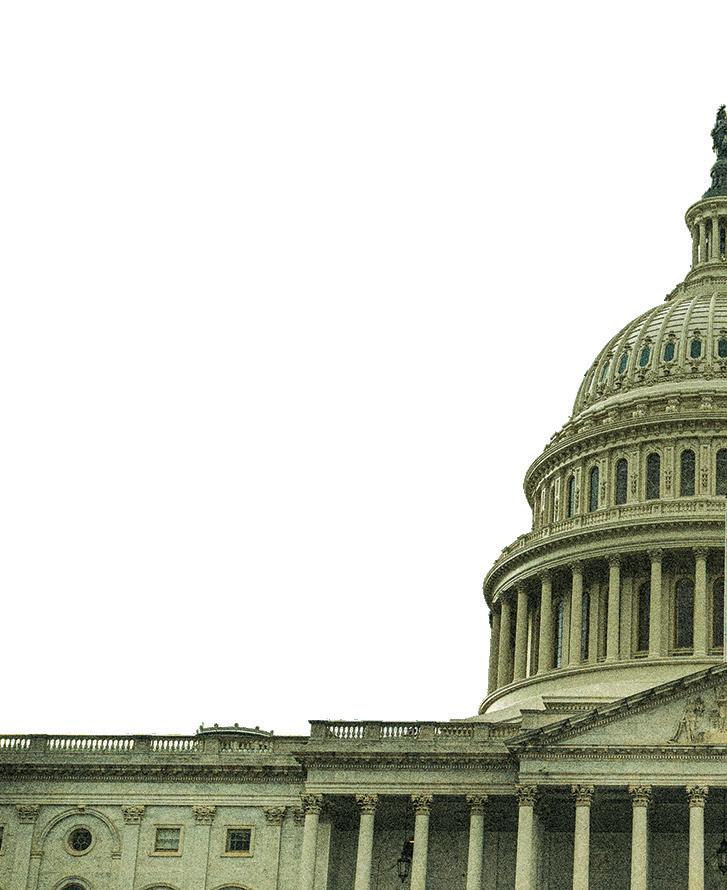
partially a nod to folk art, as well as the notion to work hard and uphold individualist ideas, according to Barrera.
“[Americana] was hearkening to a time and a period where Americans are the rugged individual, the hard-working, capitalist-producing individual,” Barrera said.
Throughout the 1960s and particularly due to the Vietnam War, American people struggled with a loss of this feeling of individualism when many felt unable to agree with both each other and the government, Barrera said, leading to an increase in Americana themes that pushed one idea of what it meant to be American.
“There was this attempt in American culture to treat [it] as monolithic,” Barrera said. “The idea of Americana … was a propaganda tool to diminish the idea of immigrants and to create this concept of a monolithic American ideology which was never real.”
Race is also encompassed in the ideology of monolithic Americana, according to Alexander.
“You were always looking at white artists as being the artists to create the central narrative and define what it means to be American, even if it was never openly talked about or acknowledged as such,” Alexander said.
Films including “The Great One” and “American Graffiti,” as well as directors like Frank Capra, proved exceptionally influential in portraying this close-minded view of Americana as filmmaking became another art form where these themes appeared, according to Barrera.
“Propaganda is a real thing,” Barrera said. “Americana definitely falls into the category of propaganda. … There is this idea that all art is propaganda.”
Moreover, the films created to endorse Americana themes also ended up tying heavily into the idea of nostalgia, which creates its own problems because nostalgia can lead people to become less flexible to changes that naturally occur in life.
“Nostalgia is a dirty word,” Barrera said. “It is by definition denying the fact that everything is changing.”
The idea that art can serve as an opening to push people past their typical views and ideas is something Nemerov internalizes.
“If [we’re] looking for works of art that only enforces how we already think, then maybe we’re instrumentalizing art in a way that’s foreign to its own openness,” Nemerov said. “If we seek out things we don’t understand, … we’re able to have more open ended conversations, [which are] less dogmatic. We’re not instrumentalizing or weaponizing art we like in order to make a point.”
“I think we’re still trying ‘we’ is important because much more inclusive in a
and defines us,” Alexander said.
or play, artists have a unique way of portraying society in spite of polarization, Villalobos said. said. “Artists speak truth to power.” characters in “The Adventures of Huckleberry Finn,” a widely controversial book and staple in many American English classes, serve to show what liberty is and what it means. Finn’] allowed us to see things about American identity and, sometimes, the hypocrisy of American identity,” Villalobos said. “He projected it in such a way that we’ve never seen before. … He was a leading critic of American imperialism.”
No matter how art originates, it is bound to have a political connotation.
“All art is political,” Barrera said. “When you’re creating a painting, a sculpture, a movie or song, everything is political, even if it’s explicitly non-political. That’s a political choice.”
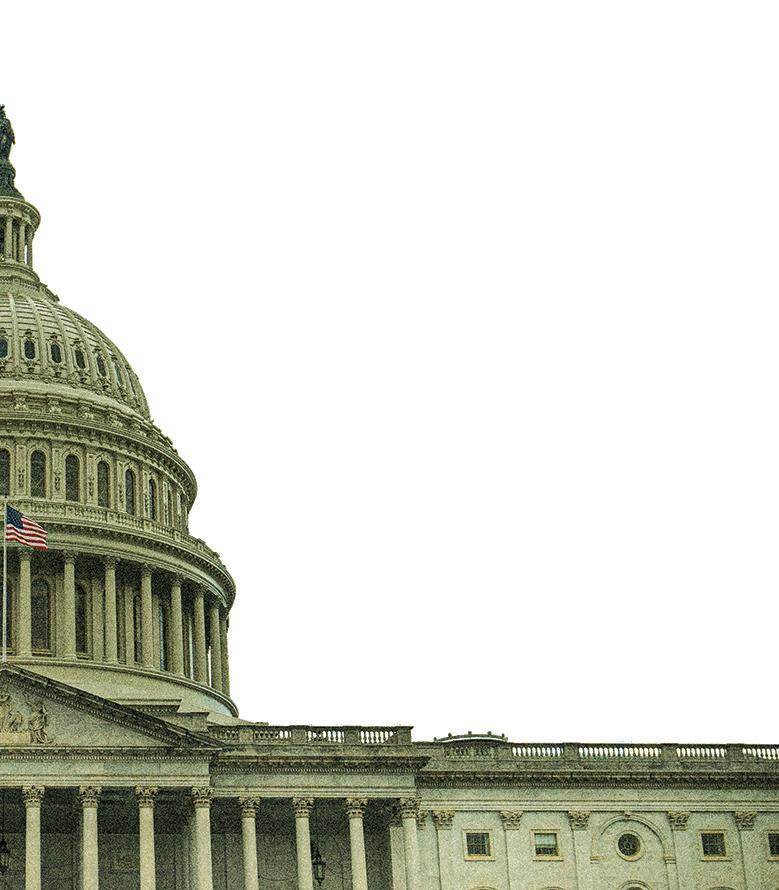

Ultimately, Alexander said that the point of seeing different cultures and perspectives reflected in American art is a crucial aspect of Americana.
“Being able to show work by artists from different cultural backgrounds, who, in some way or another, might define themselves as Americans, demonstrates to viewers that we all have a stake and a voice when it comes to the ways in which American culture and history sees us
Alexander said that continuing to share one’s voice through art in the current political climate is important because it paves the way for future generations to acknowledge history and work toward progress. Americana in art and literature can be used to inspire others, inciting a unique sense of anticipation and excitement among viewers.
“Any act of artistic creation is a gesture of hope because it is a gesture that anticipates a future in which one can be seen by others, and one can see themselves in the creation of something, and that can be seen by others,” Alexander said. “Even if they’re just at home creating, that is a sort of radical act of hope.”
LEC
MAIA LIN
MATHEW SCHWARTZ, ANNIE SPRATT and PRISCILLA DU PREEZ.
Text and design by ADRIENNE
and
• Photos by ADRIENNE LEC • Photos contributed by SANDRA CRIS, ANDREW DRAPER, YVETTE GARCIA, VAANSH LAKHWARA, BRANDON MOWINKEL, J. AMILL SANTIAGO,
Ballad Ballad of the of the Boots Boots
In the wild American west,
A cowboys are preserving their cultural and artistic traditions
As Mia Wilhelm, a cyber security engineer based in Denver, walks by the horses grazing on the pastures of her Northern Colorado home, the history of the American West is evident across its rugged landscape. Wilhelm stays in a cabin on land which was ranched by her grandfather, David Wilhelm. Cattle and cowboys have shaped the tradition of the surrounding area. All around her, Wilhelm said hardworking Americans work the land, carrying on the tradition of their forefathers.
“Our neighbor wakes up at 4 a.m. year-round to feed the ani-
Hedges — a songster, reciter, storyteller and guitarist of cow boy songs and poems. Hedges has performed at the Grand Ole Opry and at Carnegie Hall, as well as hosting a podcast, Cow boy Crossroads, where he interviews fellow musicians.
Hedges, described as the “future of the tradition” by legend ary cowboy poet Waddie Mitchel, developed a love for the music of the American West during his childhood in Tokio, a small West Texas town 60 miles southwest of Lubbock.
“My dad was a bull rider before I was born,” Hedges said. “By the time I came along, he had become a preacher, but I grew



This early introduction to the sonic traditions of the American West laid the foundation for Hedges decades-long interest in cowboy art and culture.
“When I was 13, I saw an episode of Austin City Limits with Michael Martin Murphy and friends,” Hedges said. “I was really mesmerized by the whole thing. Until that point in time, I didn’t
ing,” Hedges said. “But it also might be a work song. It might be a song that was sung to soothe the cattle at night, keep an important story alive [or] it might be a way for the news of important happenings to travel.”
Because of these varied uses, folk music evolved to become independent from its ranching origins.

Gathering in Elko, Nev., a week-long celebration of the creativity and art of the Cowboy West.
“We thought we were just having a one-time event, but people came to that event and heard these cowboy poems, and heard this cowboy music, people just wanted more,” Cannon said. “It was almost a spiritual thing for people.”
Since the first Gathering, Hedges has become a long-time performer and at tendee at the National Cowboy Poetry Gathering and describes it as a modern revival of cowboy music.
"
“There’s a whole world of people who are singing the music and telling the stories, who are rooted in the real working West,” Hedges said. “There is a vibrant com munity ranching, cowboying and interested in the life, culture and history.”
the Hollywood singing cowboys who were inspired by real cow boy music,” Hedges said. “They took on this romanticized, mythological view of the West and their songs, and the songs they wrote were very beautiful, but not very authentic. There’s not a lot of country or Western to it. It’s just become another form of pop music.”
Country music is sort of an emerging art form, and
This disconnect between country music and its Cowboy origins stems from the labelling of the Country and Western genre.
" it's still trying to find itself.
Hal Cannon
These gatherings are a way to read, sing and celebrate many aspects of cowboy culture, including poetry.
“Cowboys like all sorts of poems and they don’t always write about horses, about cows and about the life,” Cannon said. “They might write about their experience as a veteran, for in-
“For a long time, people would say it’s Country and Western music,” Can non said. “They’d say those words together, and that’s sort of been dropped; things have homogenized. Now there’s more than [just] urban country music and rural country music. It’s an amalgam of rock and roll and all sorts of different influences. It’s really not what it once was, and that’s fine. Country music is sort of an emerging art form, and it’s still trying to find itself, now it’s sort of fragmented.”
Despite country music’s drift from its cowboy roots, its sound is enjoyed by many as a connection to the American landscape. For senior Sofia Singer, country music is the soundtrack to joyful
“I love to sing, and country music is really fun to sing,” Singer said. “Most of the songs make me feel happy and a lot of them are very emotional. To me, country music reminds me of a sun
Regardless of country music’s evolution, some themes of the traditional cowboy lifestyle continue to appear in modern coun


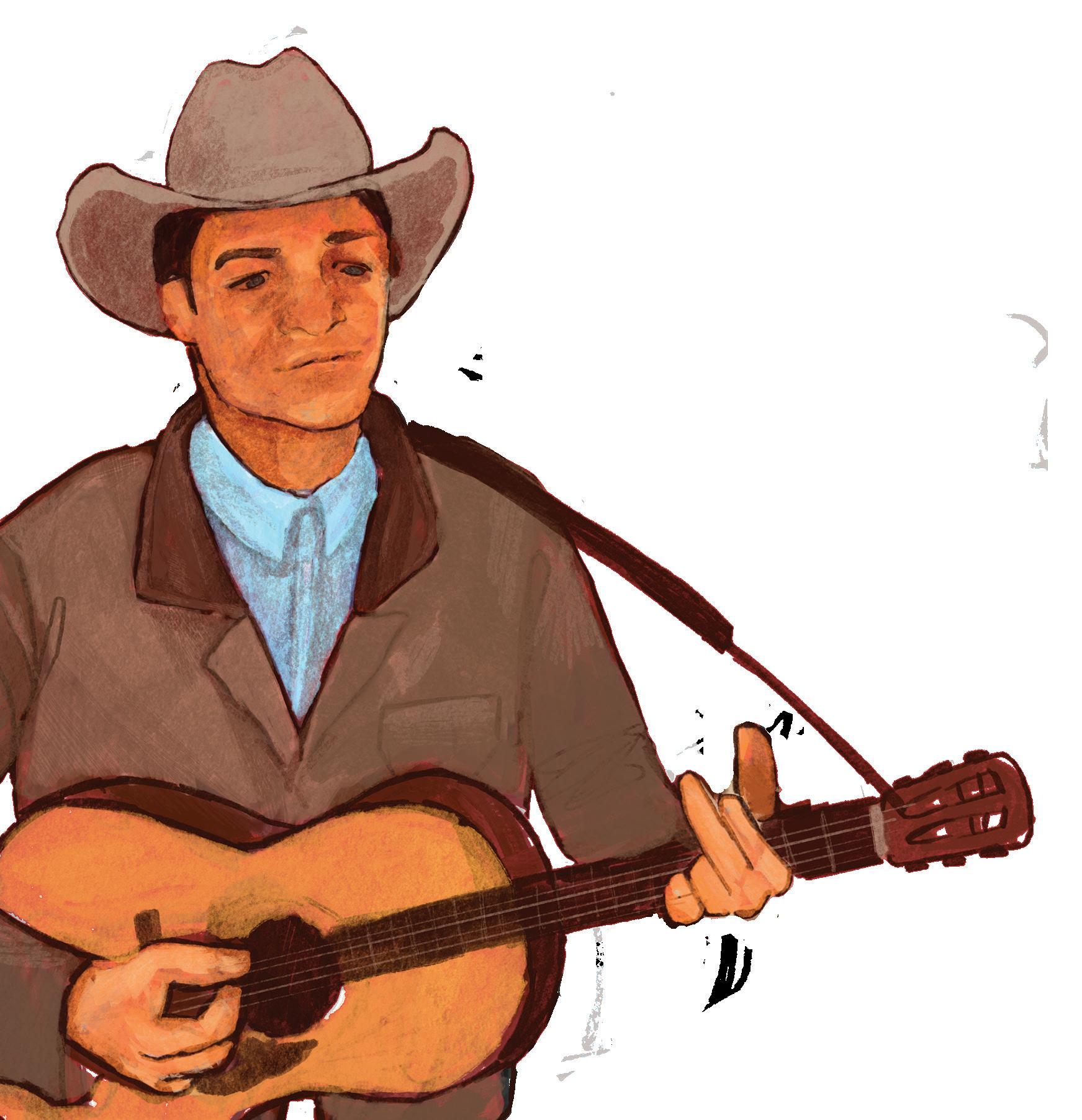


Work ethic is crucial to both cowboy culture and music, reflecting the deep connection between cow boys and their land. Because of that connection, there is strong camaraderie shared among the
“A man doing what he says he’ll do and a handshake [is] just as reliable as any con tract,” Hedges said. “The work ethic of the American ranchers and farmers is so incredible and admirable, and also a respect for the land, respect for the horses and livestock and a re
ideal. Wilhelm spends time at her family ranch in Colorado with neighbors expe
“It’s just a really hard economic model, and it’s hard to be profitable,” Wilhelm said. “The profits you can see look huge at a time, but again, you also have a million dollars in capital that’s
Despite difficult economics creating an uncertain future for the cowboy way of life, there are still many ranchers who under take it. These people are the ones keeping the traditions alive.
“There’s still many, many men and women who make their living on horseback tending cattle, and who make their living ranching,” Hedges said. “We’re still feeding the country and feeding the world, producing beef in the American West, and those traditions are very much alive and well, but it’s also very much threatened by development.”
The challenge of preserving the traditional Cowboy way of life in the American West has been prevalent since its advent.
“From the beginning of music that came from life on the American frontier, they’ve always lamented the passing of the West” Hedges said. “Even in the 1870s, they knew that what they were seeing would not last forever, that it was going to change so quickly. The trail driving period was very brief, the open range period ended very quickly, fences went up, settlements and the buffalo were slaughtered and the trail drives ended. There’s been continual change and industrialization happening since the very beginning, but it’s also stayed alive.”
we keep passing the stories and the values along,” Rollins said. “The good news is there are still a lot of ranchers, horsemen and working cowboys out there living that life every day, and there are a lot of folks who are curious about it and want to understand it. As long as we keep sharing the authenticity of the cowboy through history, skills and traditions, the cowboy culture will stay alive.”
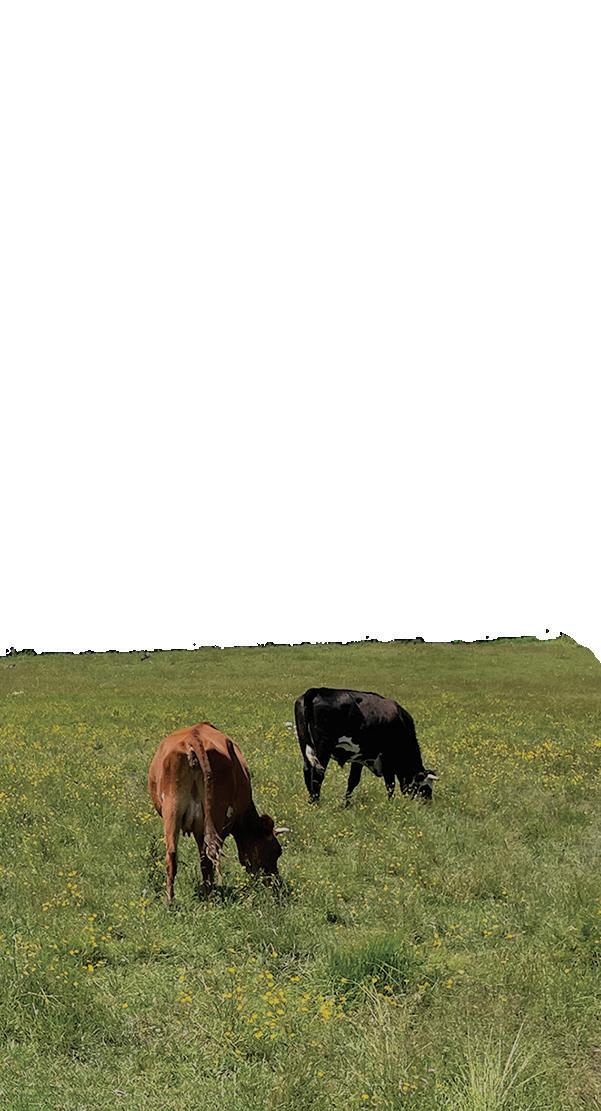
Text and design by POPPY MORRISON, ZOE PETERSON and SILVIA RODRIGUEZ • Photos by ZOE PETERSON and SILVIA RODRIGUEZ • Art by POPPY MORRISON, ZOE PETERSON and LILY WILLIAMS

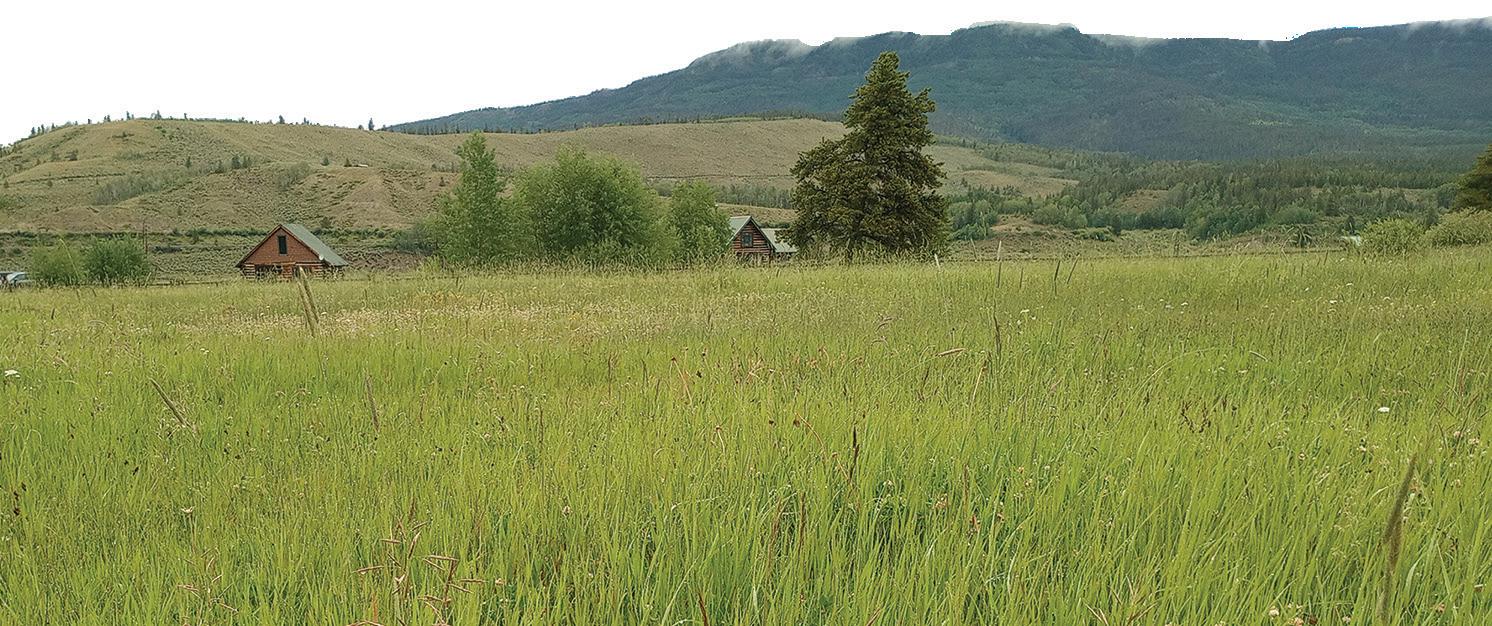

welcome to the
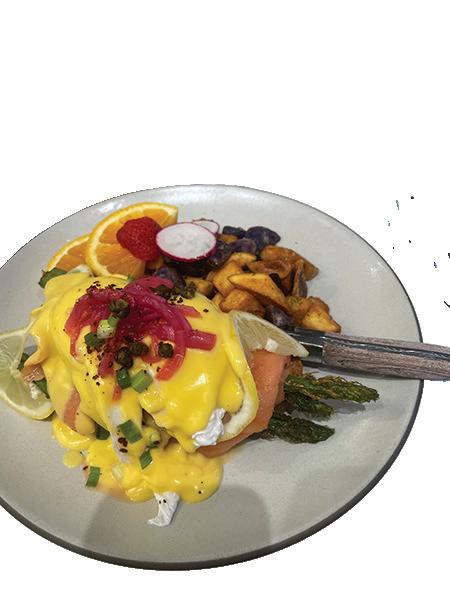
Come and enjoy a classic American breakfast, lunch and dinner
Smoked salmon eggs benedict
“I love a classic beef chili. It’s all the best warm food thrown together in a pot, and also so easy to make and delicious.”
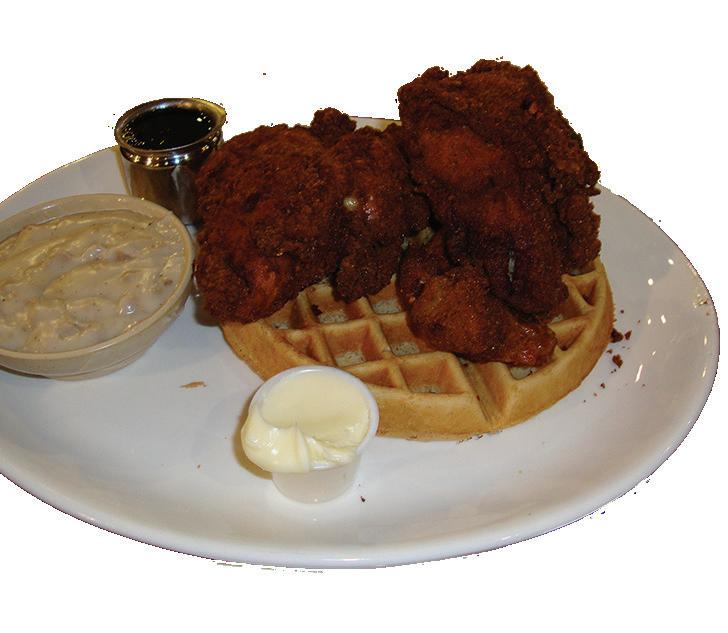
Fang, 11



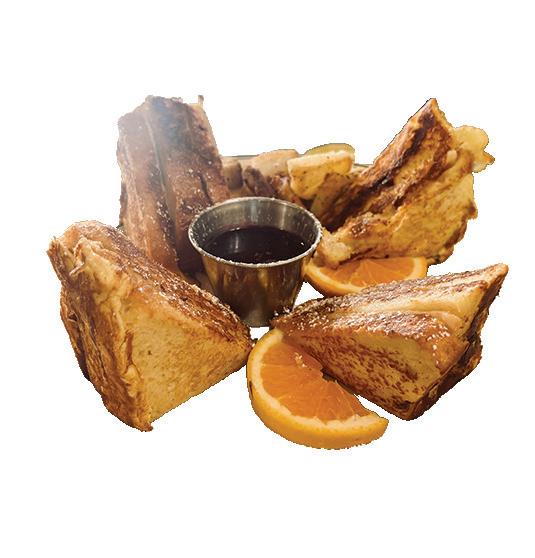

Angela
Caramel pecan pancakes
Chicken and waffles with country gravy
Citrus french toast with maple syrup
Text, design and photos by DEREK CHEN and STELLA GUO
ALL AMERICAN
Diner
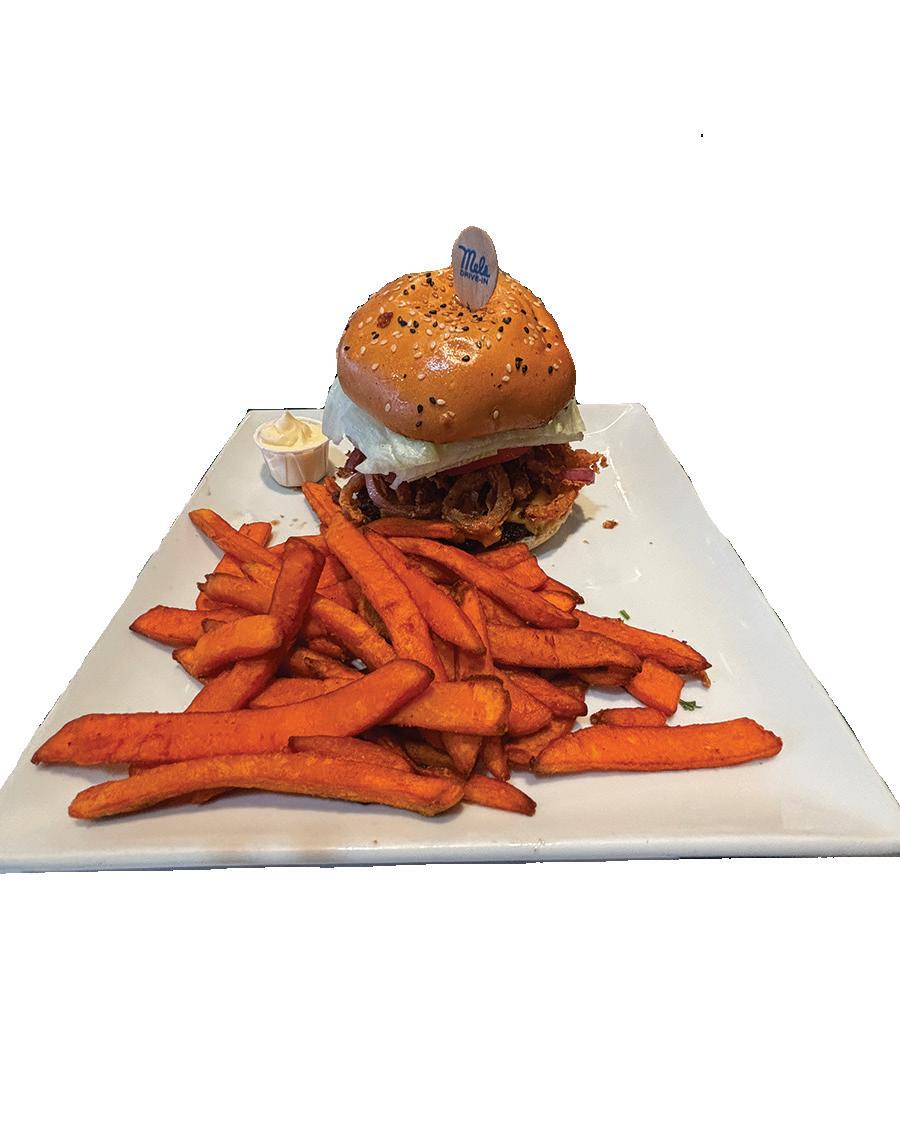
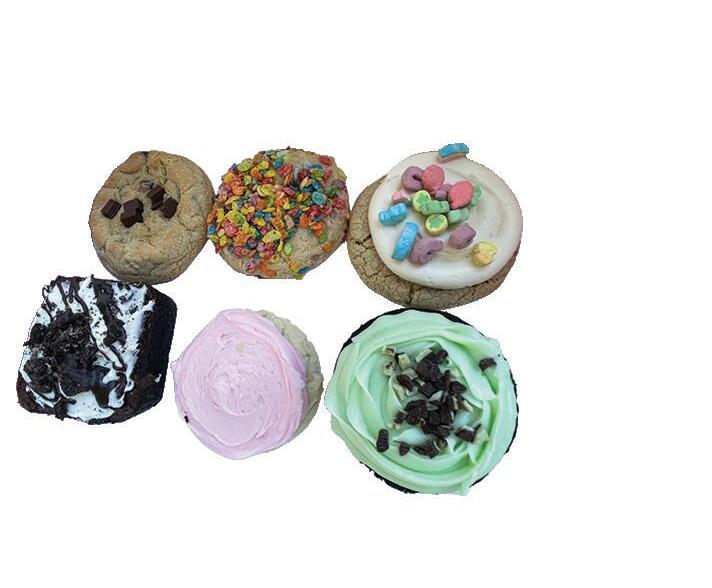
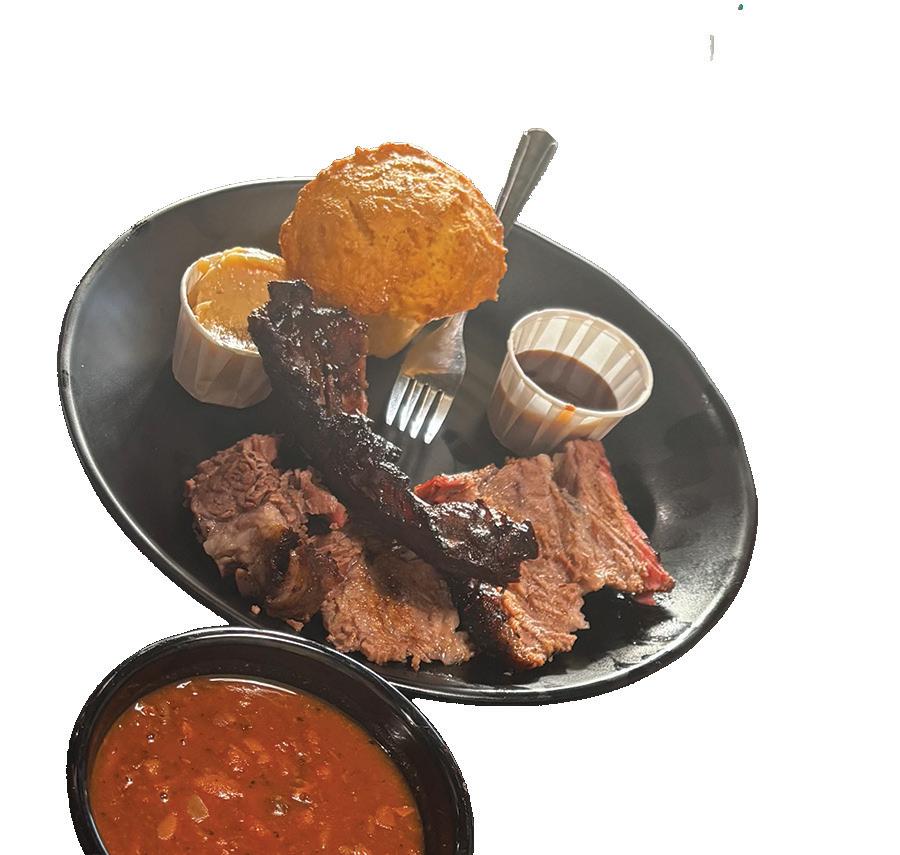

withTexasbarbecue cornbread


Cheeseburger with sweet potato fries
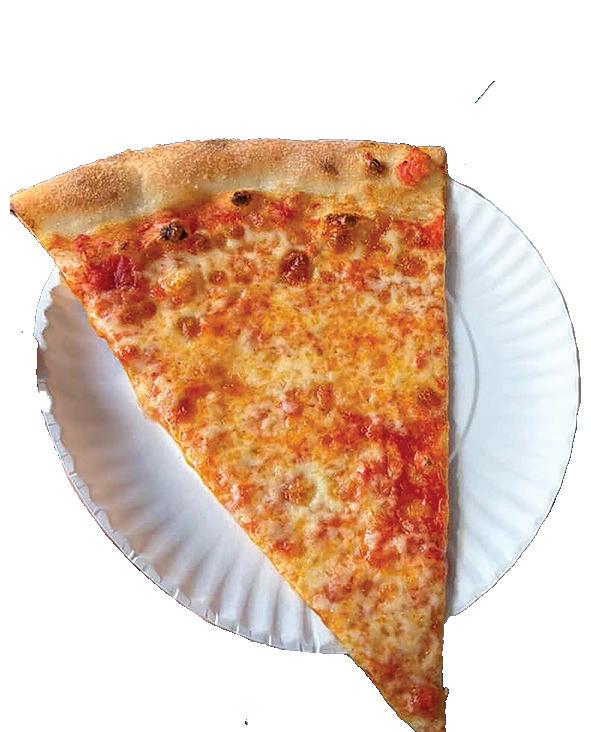
“The bite into a juicy burger is unbeatable — there’s so many things in there. It’s so saucy and flavorful.”
Keira Ling, 11
New York style cheese pizza
Crumbl cookies
THE
Featured artist: Senior Kensie
Pao
captures the world through her camera
FACTOR

“The point of the photo is to really tell the truth.”
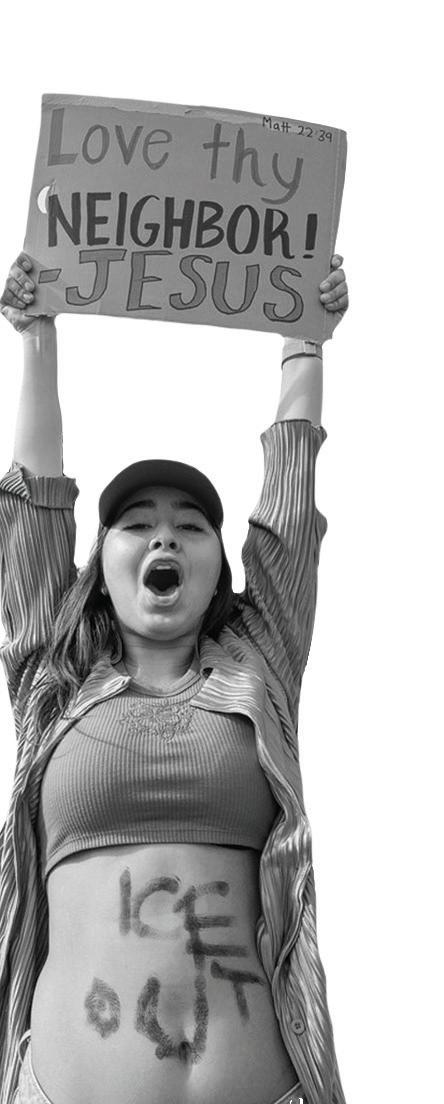
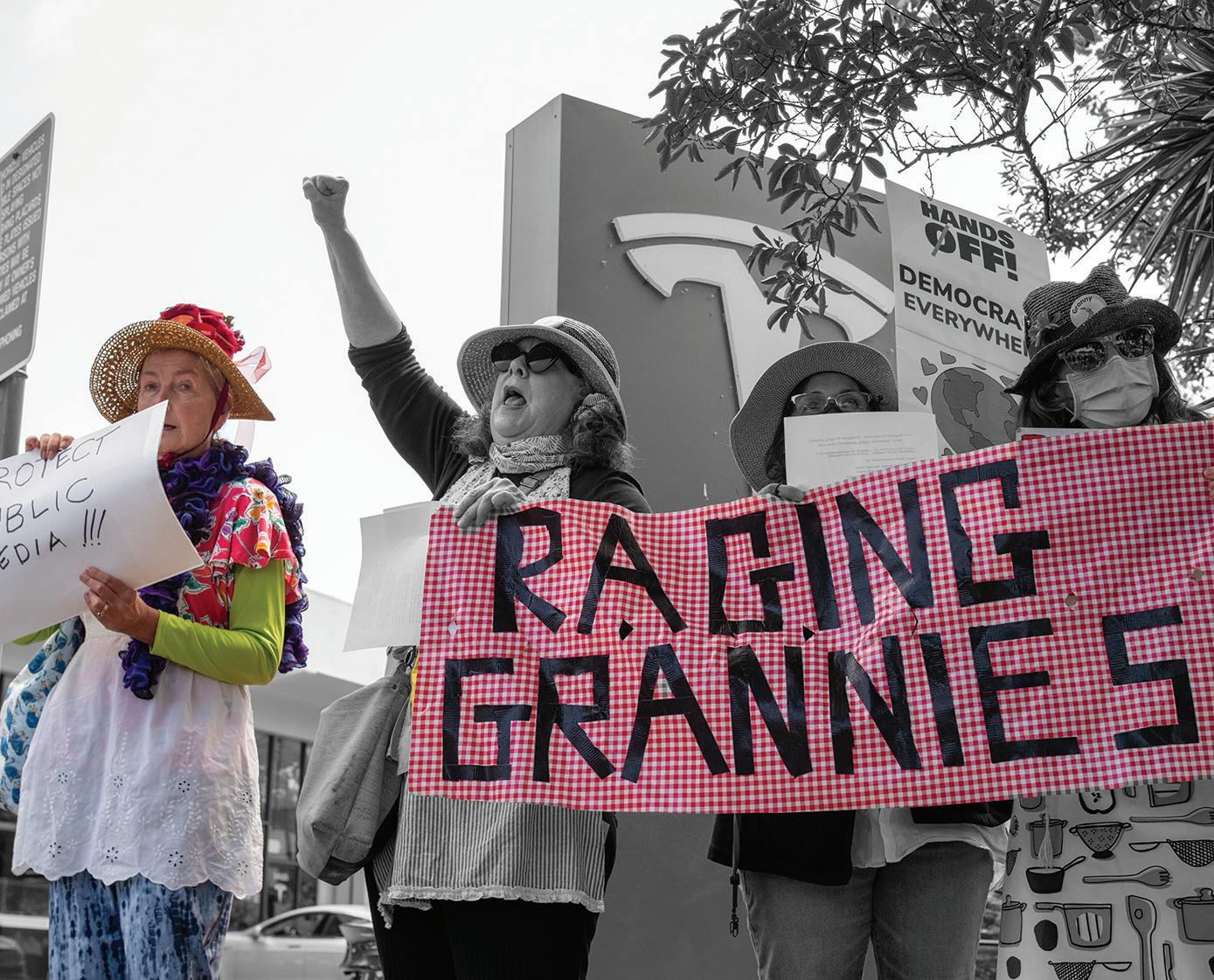
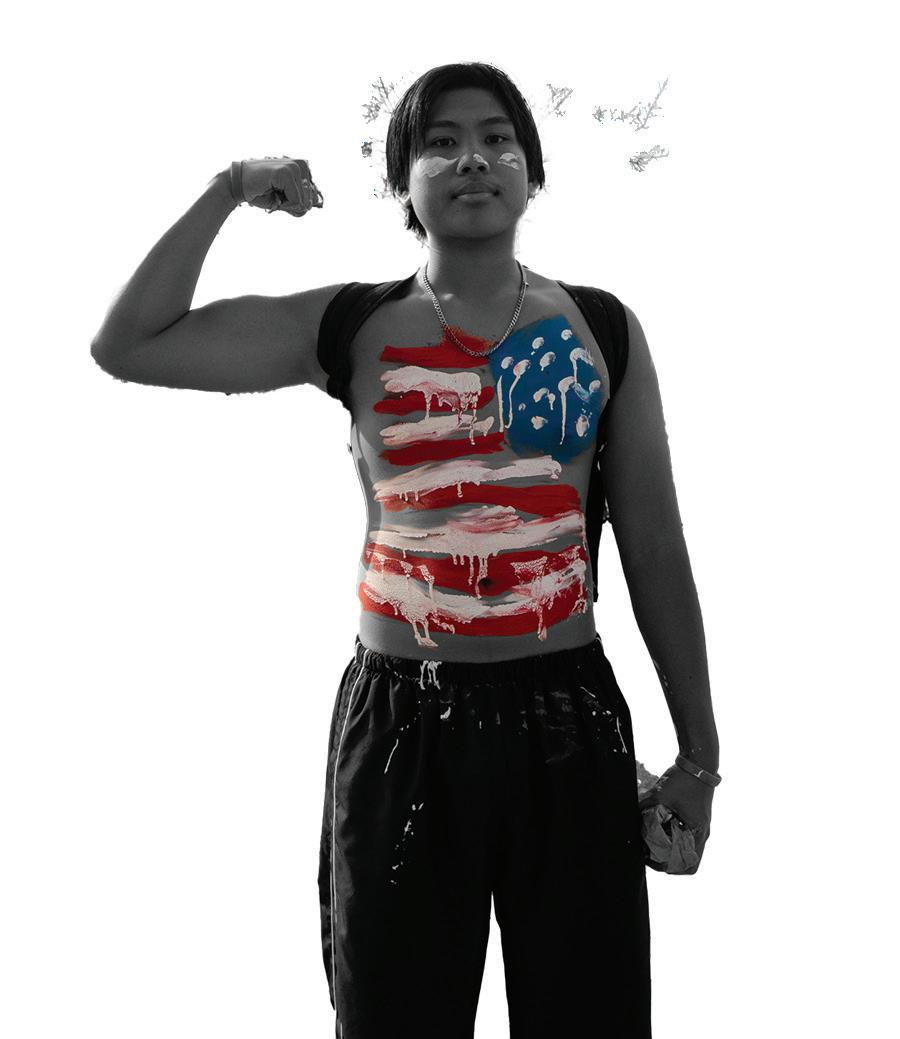
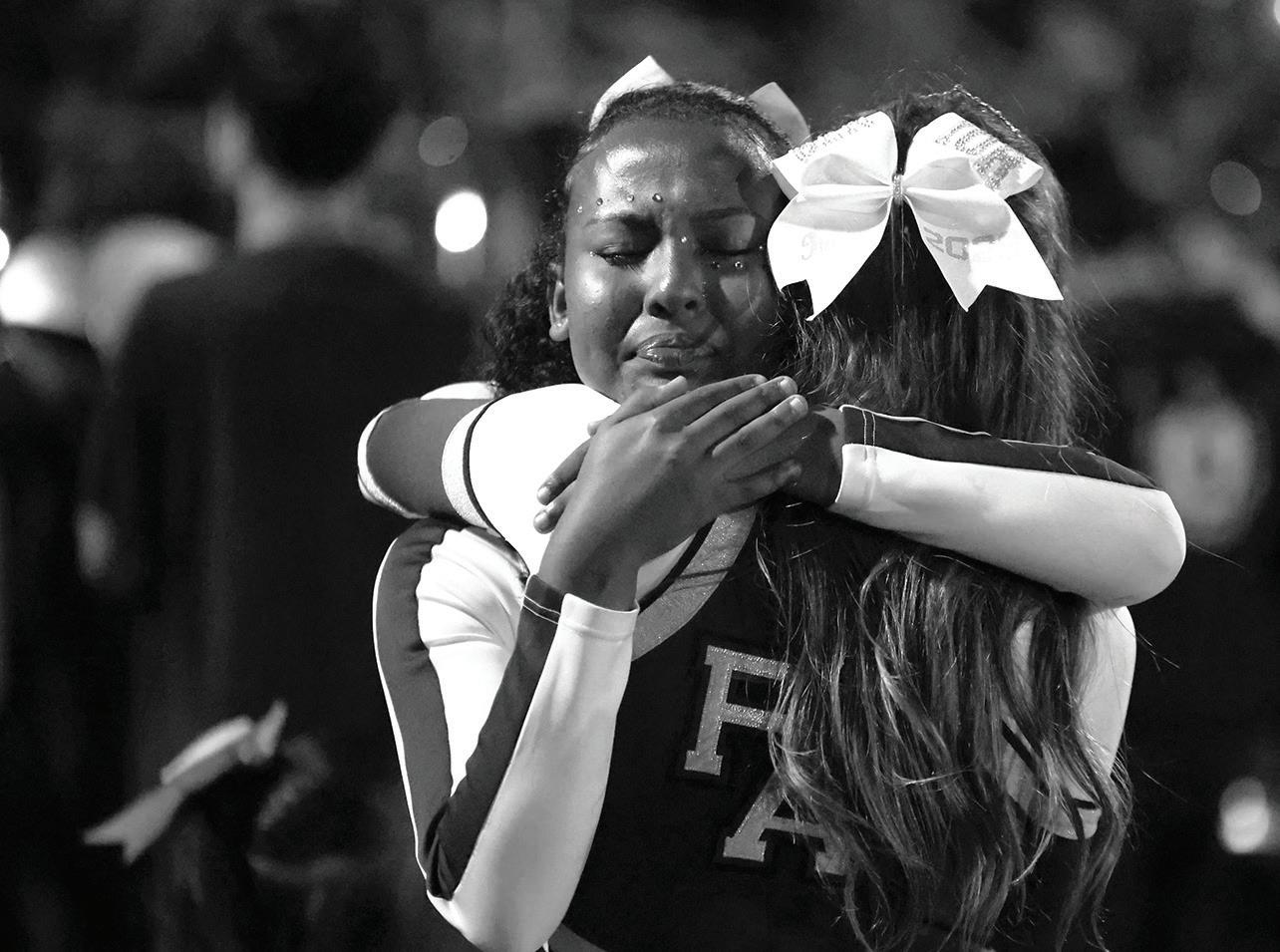
did her experience with photography classes at Paly prove to be rewarding, but Pao also found an outlet for photography through Verde Magazine, Paly’s news and features publication.
“I [took] photography at Paly my freshman year, and that was super great,” Pao said. “Then sophomore year, before I took be ginning journalism, I joined Verde Magazine solely as a photogra pher, and I would take photos for about 10 to 12 differ ent stories per cycle.”
For Pao, the best part of photography is not just what it captures, but the interactions with her subjects that allow her to connect to the community.
“[My photos] were in every single section of Verde,” Pao said. “Features, cultures, profiles, sometimes perspec tives and then also news. That exposed me to a lot of different things going around [not only] Palo Alto but also to community members.”
One story with Verde, in particular, remains a pivotal moment in Pao’s pho tography career.
isn’t real, or [it] didn’t actually happen.”
Outside of school assignments, Pao has also experimented with street photography as another way to explore storytelling inspired by the Humans of New York — a popular storytelling project that interviewed strangers telling their candid stories and personal life.

In December 2024, she spent one day in Redwood City photographing strangers and asking them questions about their lives. In just a few hours, Pao was able to talk to people with vastly different backgrounds, from a jewelry vendor to an unhoused per-
“Photography lets you be a part of the scene.”
“I went to cover the congressional debate in City Hall and a breakout protest happened,” Pao said. “It was a demonstration for pro-Palestine groups and also pro-Israeli groups, and that was a really big high-tension moment that got me to see how foreign issues were affecting real people in our community.”
Pao said it felt fulfilling to see members of her local commu nity participate in something that carried such a worldwide significance. Seeing people in a context so different from the usual opened her eyes to the emotional impact of global conflict.
“A lot of those members I’d seen at school board meetings or at a chocolate-making class,” Pao said. “It’s really nice to be able to smile and wave to them, knowing that I’ve met them and covered what matters most to them.”
Her photos give viewers the ability to engage with her subjects and connect on a similar level, allowing them to witness emotions that would otherwise go unnoticed.
“I want people to understand real human emotion,” Pao said. “There’s something really touching about being able to view an art piece and feel something from it.”
In her experience, viewing photogra phy can be just as impactful as being the one to take it. This belief also guides her approach to photojournalism: Authenticity is most important, and images should document the reality of events.
“The point of the photo is to really tell the truth,” Pao said. “You don’t want to fabricate a moment that
“What you really get to understand about these people is they all have struggles, but that’s a common thing that all makes us human,” Pao said. “It’s gotten me to become more of an empathetic person, but also somebody who is able to turn that into art for other people to
Pao believes in the impact of photography — on those who take it and those who view it. In terms of her experience photographing political events, she finds it can serve both to make people aware of what is going on and also to unite them under a clear reality.
“Bringing people under this shared sense of humanity that we all have can do a good job at invoking emotion,” Pao said. “Politically, I think photography has become a medium where people can see what’s going on. So protests, for example, you don’t actually know what it’s like until you see it.”
Ultimately, Pao’s photography enables her to confront difficult emotions and communi cate ideas that words alone cannot.
“A picture is worth 1,000 words,” Pao
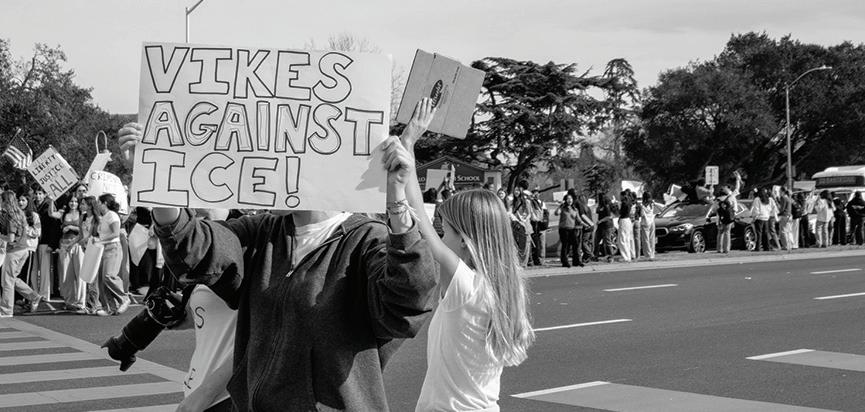
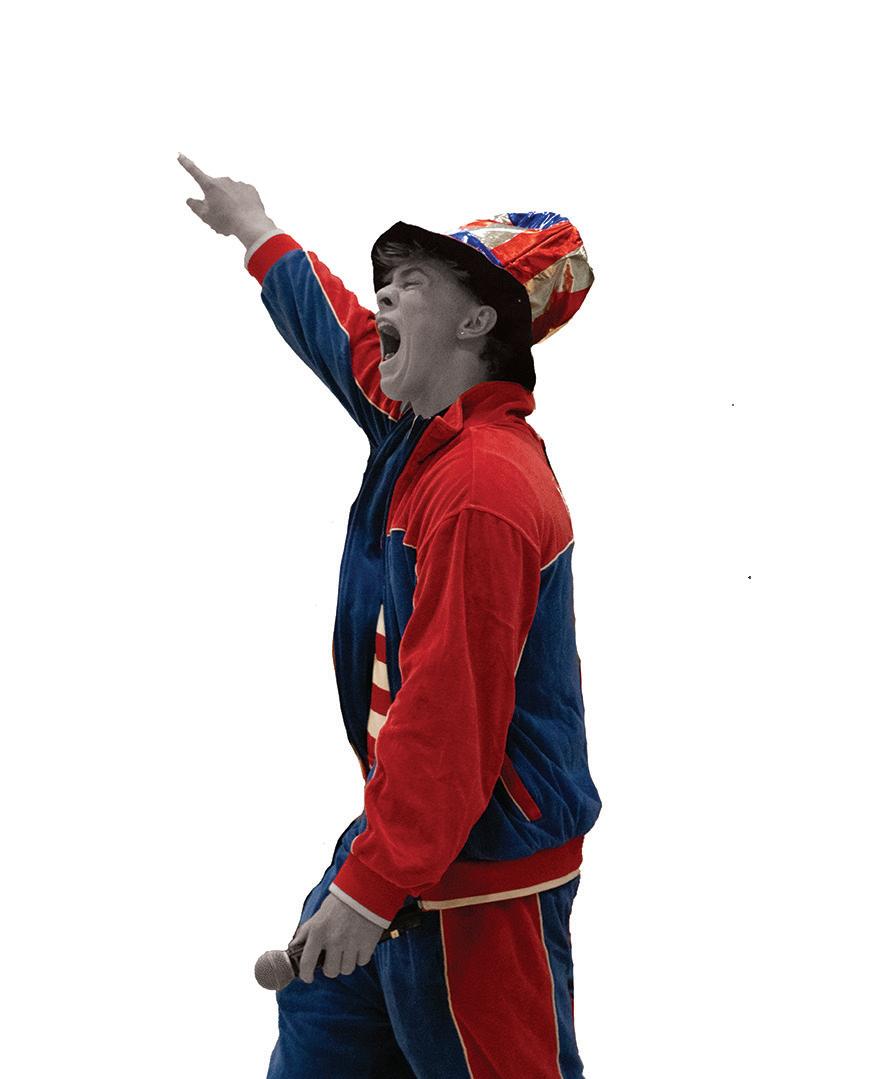

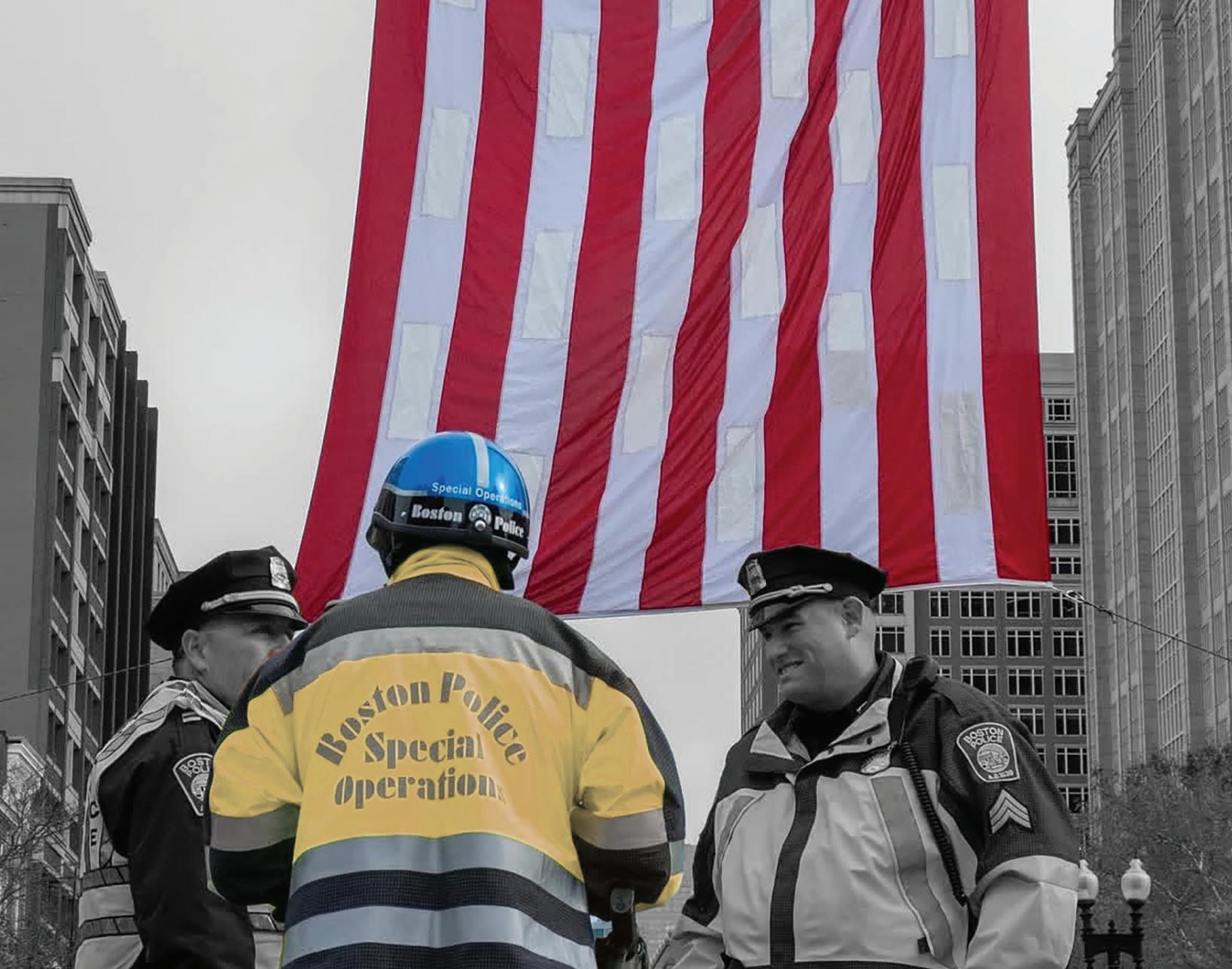
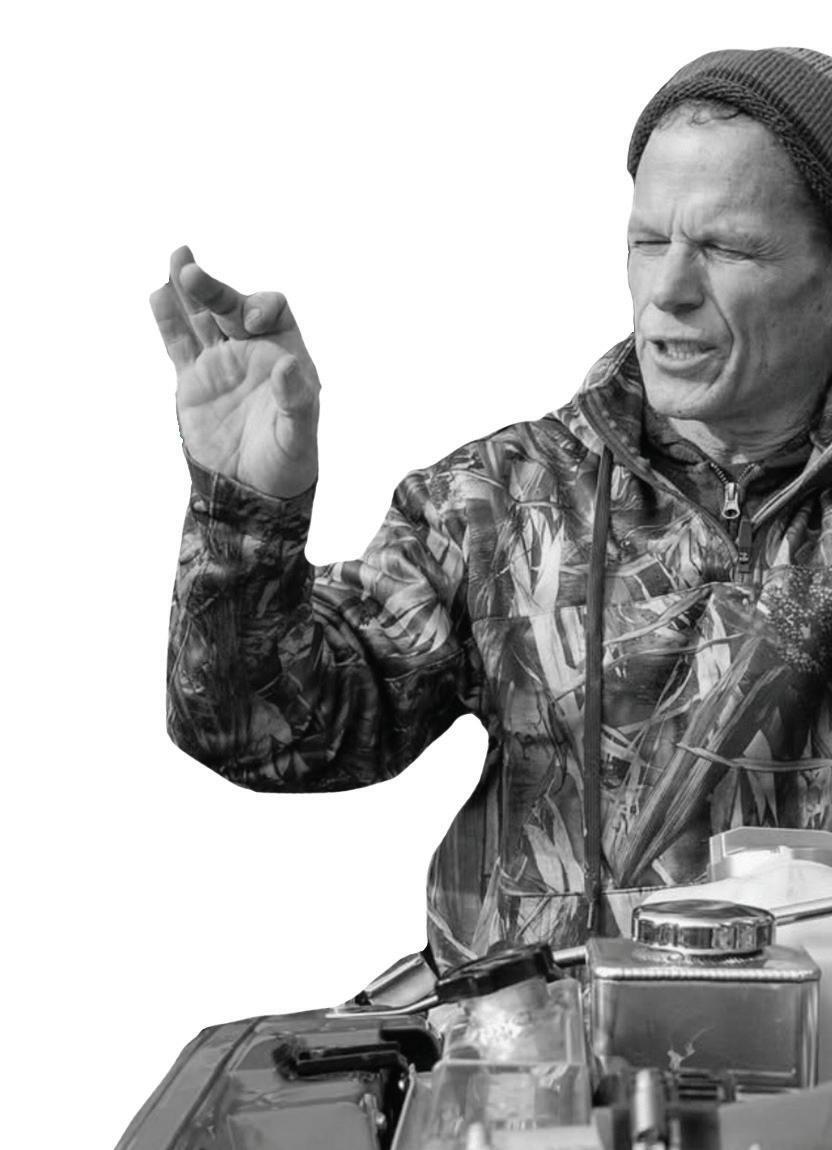

With the rise of modern media and technology, American politics and internet culture have become intertwined.
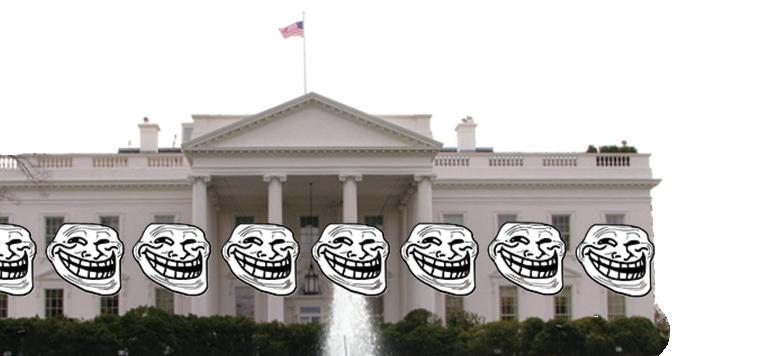


It is a video that would have confounded anyone five years ago.
A hyperrealistic, digitally generated political figure shimmies across the screen and begins breakdancing. Unicorns prance in the background as the politician bursts into song, the caption a jumble of the latest internet slang. Serious events and topics of heated debate once reserved for town halls are now punchlines for this absurdist, short-form content which has overwhelmed the online world. Swipe. Another one. And another.
In recent years, political memes have taken the internet by storm. Particularly popular with a teenage demographic, these seemingly harmless, satirical videos have begun reshaping how politics is presented, discussed and absorbed by a younger gener

Sophomore Wyatt Edson frequently encounters politically charged media on platforms such as TikTok and Instagram.
“I’ve seen a lot of very political content that’s been turned into memes or jokes,” Edson said. “I especially see a lot about Benja min Netanyahu, Charlie Kirk, [Jeffrey] Epstein and [Donald] Trump.”
This prominence of particularly polarizing figures is often an inte gral ingredient to political meme
“It’s usually political leaders from the past several years who received attention for doing negative things,” Edson said. “A few years ago, when AI [Artificial Intelligence] was really starting to take off, I’d see a lot of videos of Trump, [Joe] Biden and Kim Jong Un playing Minecraft together. Some people would say that’s disrespectful, but I thought it was funny.”
“If there’s something that is deeply upsetting for people or if it’s hard to conceptualize the severity of [an issue], humor can be a way of starting to talk about in a way that feels less difficult,” Dodd said. “But when you’re talking about humor being used as a way of targeting someone or making fun of a group, that’s different. That’s just bullying.”
Because political memes walk such a thin line between humor and insult, some students have found themselves frowning at the same videos their peers laugh at. Freshman Erika Kuei finds this type of content to be particularly disrespectful when it makes light of dark topics.
“The Charlie Kirk videos are really insensitive,” Kuei said. “It’s
“Memes are just a last resort for these politicians, Generally, it doesn’t actually do a good job implementing their campaign.”

mes featuring his face digitally plastered onto alternate bodies through artificial intelligence. The process, dubbed by the internet community as Kirkification, has received extremely mixed reactions, given the subject matter it makes fun of.
Videos like this can seem like harmless attempts to generate laughs and likes, but content creators can often cross a fragile line when exploring controversial topics or figures.
Juni Thurston
Junior
Sophomore Jonathan Salvador has dabbled in the field of politically charged meme content firsthand and is no stranger to the controversy that can accompany it. Posting under the Instagram handle @hogridda1441, he and his friends have amassed a significant online presence by posting pranks and other short-form content often featuring political references.
“I saw a lot of memes about Charlie Kirk, so we decided to go to some random houses and I started singing ‘We Are Charlie Kirk’,” Salvador said, referencing a satirical internet anthem about the late right-wing political personality. “But at the same time, he got assassinated. So it’s kind of messed up.”
Despite the serious nature of the political matters at hand, Salvador’s utmost priority remains producing lighthearted content.
“We’re serious about the political and economic state of the world right now, but at the same we want to be funny because we want likes and for people to subscribe,” Salvador said. “I do stuff that will get people [upset], because that’s kind of what’s funny.”
Salvador’s success despite the inflammatory nature of his con tent is part of a much larger digital phenomenon: polarizing subject matters becoming popular online punchlines. AP Seminar teacher Corbin Dodd has observed how humor can serve both positive and negative roles when involved with serious and controversial topics.
“Kirkification is a little funny at times, but not because it’s Charlie Kirk,” Edson said. “It’s only funny because it catches you off guard. I think that’s the main reason it’s popular. It gets mixed in with other recognizable memes and reaction images, so you do a double take at it.”
Edson firmly draws a line when the content begins to feel disturbing and exploitative.
“When the actual image of Charlie Kirk getting shot with the blood coming out of his neck was turned into a meme, it was actually really scary,” Edson said. “I was really disgusted by that. I don’t remember telling anyone that or getting into an argument, but I feel like I would have if he was brought up.”
Alex, an anonymous Paly student, believes the ethics of joking about Kirk’s death should not be a topic of debate nor influenced by political affiliations.
“Making fun of someone who might have been a bad person, but was still only speaking their mind and got killed for it, is not respectful or appropriate, especially if you say you don’t
cope with difficult topics, but the way he died was so violent and shocking.”
Regardless of whether students find political memes funny or offensive, this divisive content has undeniably become mainstream. This booming popularity has caused many politicians to adopt a meme-centric approach as a marketing strategy to appeal to a younger audience. However, not all teenagers have found this approach to be successful.
“With the official Democrats or official Republicans account, you can’t really verify who’s running it,” Alex said. “They’re just posting all these memes about the other party, and it creates political polarization. Sometimes, it spins out of control.”
Because this content, which is often designed to be satirical or embellished for comedic val ue, is being endorsed by official accounts and platforms, it can be dif ficult to discern real information from fake.

“It’s very easy to be manipulated by things you see on the internet because there’s not a clear fact checking process,” Dodd said. “Oftentimes, you are looking at things very quickly and then moving on to the next post. It can be really easy to just accept something at face value and not really dig into the reliability.”
Dodd notes that this is especially dangerous when breaking news is immediately presented humorously instead of with the severity and sensitivity it deserves.
watching, trying to catch politi cians having a bad moment,” Yonkers said. “It’s devolving the criteria for who is going to be a good president, or a good congressman, [into] what they look like, or how they’re acting in a moment where they got caught off guard.”
While this style of content may feel like an impairment of the po litical process, it has become a nor malized, and even necessary, part of cam paigning in the digital age.
“The expectation now for many politicians is that they are on Twit ter, and that they’re speaking directly to their constituency,” Yonkers said. “But be cause of that, the political landscape has increasingly become about ‘who has the best hot take?’ rather than thoughtful deliberation.”
“The political landscape has increasingly become about ‘who has the best hot take?’ rather than thoughtful deliberation.”
Adam Yonkers History teacher
“Where I start to have an issue with [political memes] is when you have political figures trivializing very serious issues,” Dodd said. “With this war in Iran, the White House account put footage of drone strikes alongside the music from Wii Sports videos. That’s highly inappropriate.”
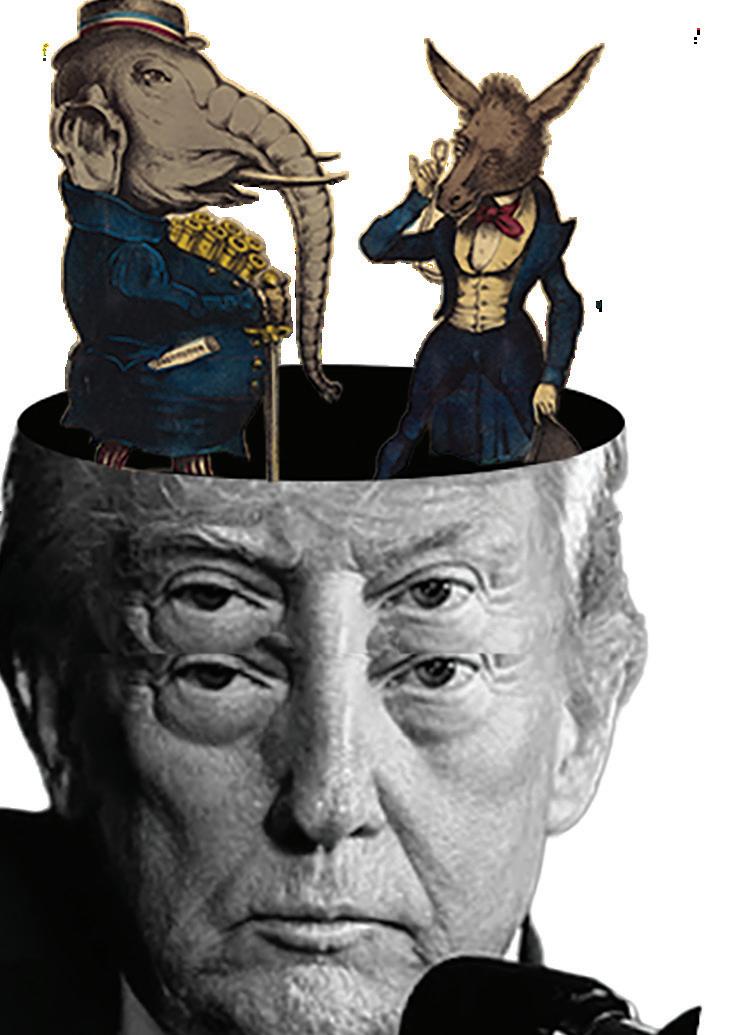
This back-and-forth
“meme warfare” between political parties has had a monumental impact on the political landscape. Distorting the traditional status quo for diplomatic relations, the official social media accounts for various politicians have begun propagating meme content designed to target their opponents. This shift is often reflected in the form of ridicule. Paly history teacher Adam Yonkers has witnessed how political discourse has evolved to criticize and mock superficial characteristics instead of substantive pol-
“The cameras are always
Despite teenagers making up a major percentage of the target demographic politicians are seeking to appeal to with their social media outreach, many students find the use of political meme content as a campaigning strategy to be out of place.
“I tend to prefer not to be too political, in the sense of not having actual people running for power, or the Democratic or Republican Party accounts, on my feed,” Edson said. “I feel like it can easily turn my relaxing scrolling into unnecessary heated worrying.”
While Edson recommends that students control their exposure to political meme content, junior Juni Thurston believes that politicians are the ones who should steer clear of it altogether.
“A lot of the memes are just a last resort for these politicians,” Thurston said. “The whole memeification of politics from political candidates themselves is something that I’m definitely not in favor of. Generally, it doesn’t actually do a good job implementing their campaign or actually inspiring voters.”
Social media has become an extremely popular political platform nonetheless, with popular memes sometimes even becoming central to the campaign itself. An example is Kamala Harris’s social media team modeling the Democratic candidate’s online branding after the English hyperpop singer Charli xcx’s neon green album “Brat”, released during the summer preceding the 2024 presidential election, after a meme compared the two. While Harris is hardly the first or last to seize an internet moment to build marketing momentum, Thurston said there is a right and wrong way to appeal to younger voters using social media.
“Kamala Harris’s whole ‘Brat Summer’ was profoundly unsuccessful among young voters, [given] young voter turnout for her was not good,” Thurston said. “But if we look at [New York City mayor] Zohran Mamdani or [Texas state representative] James Talarico, these people actually hyperfocus on the issues that matter to their constituents.”
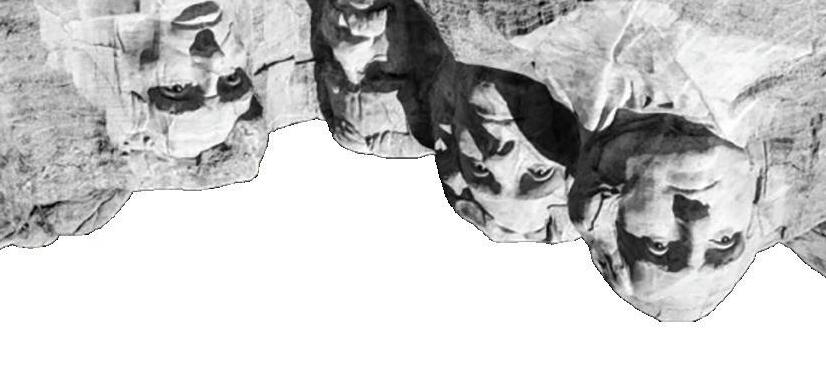
Yonkers also said that social media engagement can successfully influence voters if executed well. Often, age does play a determining factor.
“[Barack] Obama really did a much better job than [John] McCain in [the presidential election of] 2008 in terms of harnessing the power of the internet as a way to organize,” Yonkers said. “Sometimes, you just have a younger candidate who gets it a little bit more, or at least has a [savvier] social media team.”
As a part of the younger demographic older politicians are striving to appeal to, Edson has felt the disconnect firsthand.
“I find that a lot of the time when older people are making [meme content], it comes off as really offensive, no matter what side you’re on,” Edson said. “And I feel like it isn’t the smartest move to be playing off of younger people’s emotions and understandings by using these memes.”
“We’re serious about the political and economic state of the world right now, but at the same, we want to be funny.”
ating more social and political division,” Yonkers said. “[Social media] creates this echo chamber, where you are being fed things that you only agree with.”
Jonathan Salvador Sophomore
However, Edson has found himself influenced by the content in an unexpected way.
“I wouldn’t say [political memes] shape my political beliefs as much as they inform me and intrigue me to look into certain peo ple and issues more,” Edson said. “Recently, people started using AI to put the Israeli flag on people’s clothes, especially Jeffrey Ep stein or Charlie Kirk. Because of this, I looked into what was going on in Gaza and Israel, and I think it was good that I did.”
Despite any potential positive aspects of political meme culture, it has undeniably been a major agent of the acceleration of polar ization in the digital space.
Because of this constant propagation of divisive meme content, Yonkers urges politicians and voters alike to return to the political culture of the past.
“We need to keep talking to more people that we don’t agree with and go back to debating them again,” Yonkers said. “In the marketplace of ideas, there should not be a monopoly on who’s right.”
Yonkers believes that meme culture should not be normalized in politics, for the sake of maintaining a sys-
“You do need to hold politicians accountable for what they say, but a lot of what they say is being filtered instantly into something different and packaged in a way to be consumed by people from a particular audience,” Yonkers said. “It’s really eroding our democratic ideals.”


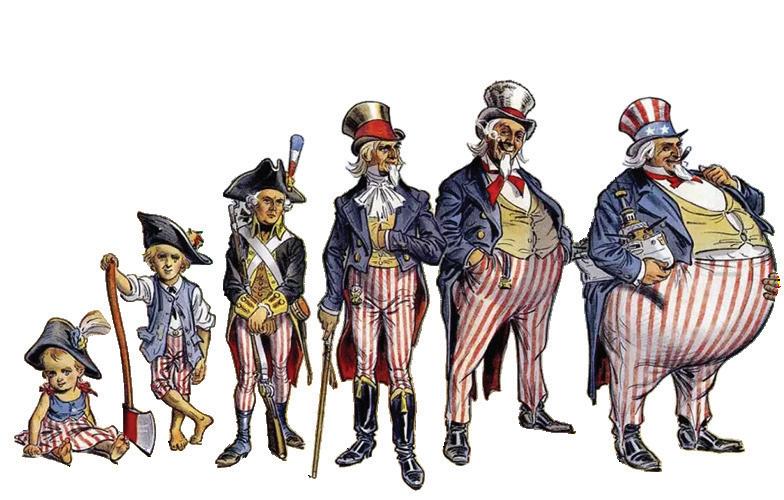


Text and design by KEA CHIAO, ANJALI DAHNCKE and LUNA LIM • Art by KEA CHIAO and LUNA LIM