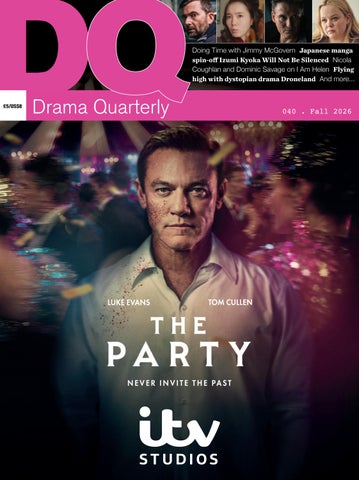
DQ £5/US$8
Doing Time with Jimmy McGovern Japanese manga spin-off Izumi Kyoka Will Not Be Silenced Nicola Coughlan and Dominic Savage on I Am Helen Flying high with dystopian drama Droneland And more...
Drama Quarterly
LUKE EVANS
040 . Fall 2026
TOM CULLEN
N E V E R I N V I T E T H E PA S T
ER - C21 print ad - MIPCOM edition.indd Alla sidor
Visit us at MIPCOM | Stand P3.B1 www.ecchorights.com
2026-09-24 14:00
Nicola Coughlan leads the latest edition of Dominic Savage’s I Am series
Fall 2026
20
Features 8
IN FOCUS: Time season three Jimmy McGovern continues his prison drama with a season set in a oung o ender institution DQ speaks to him, co-writer Samuel Bailey and director Paul Whittington about making S3 and wh oung people ehind ars are in crisis
16
IN PRODUCTION: Izumi Kyoka Will Not Be Silenced Japan’s NHK continues its manga adaptation hus po e ishi e ohan with this spin o Exec producer Keisuke Tsuchihashi explains how the series lends m ster and the supernatural
20
IN FOCUS: I Am Helen riter director ominic avage re ects on his raw, ground rea ing m films, while rish star Nicola Coughlan opens up about developing and starring in the latest instalment, m elen
24
IN PRODUCTION: Droneland Katarzyna Ozga and Pierre Majerus from Luxembourg’s Iris Productions take DQ inside the making of this six-part drama, a dystopian thriller set in a world under constant surveillance
30
DQ100: Part Three 2026/27 We pick out a range of shows to tune in for and the actors, directors and writers making them, as well as the trends and trailblazers worth catching up with
End Credits 31
24
Droneland takes flight
SIX OF THE BEST: Paul Marquess & Donna Wiffen The Long Story TV joint CEOs and executive producers’ picks include a true crime series “everyone should see” and a show about four riends across three decades
16
Izumi Kyoka Will Not Be Silenced
8
The kids aren’t alright in Time S3
8
IN FOCUS: Time S3
J
immy McGovern only ever meant to write one season of Time, his BAFTA-winning anthology drama set in a British prison. The BBC kept him waiting before renewing it for a second season, as viewers started to find the show on the broadcaster’s iPlayer streaming service, where viewing figures “shot through the roof,” the writer says. At first, he declined, believing the drama had said everything he wanted to say about life in a men’s prison. Then the BBC suggested the action move to a women’s prison. When talk later turned to a potential third season of Time, it seemed only natural to shift the drama’s gaze again, this time centring on the guards and inmates inside a young offender institution (YOI). “It had to be that. If we’re going there at all, it had to be young offenders, mainly because we’d done the male and female prisons,” McGovern tells DQ. “We started to do a bit of tentative research, and after a short while, we realised we had to go into young offenders because what’s going on there is quite urgent. It’s a scandal, really.” Season three explores the impact of locking up teenage boys and the effects on those who look after them. Siobhan Finneran returns as chaplain Marie-Louise, who comes to the YOI having lost her faith. When tragedy strikes, she clashes with custodial manager Bobby Bailey (David Tennant), who is having a crisis of his own as the pressures of his personal life weigh heavily on his career. He also knows more about the circumstances that led to the tragedy – but will he tell the truth? Meanwhile, two teenage inmates, Peter (Ollie McNulty) and James (Louis McCartney), struggle through the terrifying first weeks and months of their incarceration. Can James ever face his devastated parents after an unforgivable act of violence? Will Peter tell the truth about the death of an innocent man, or does loyalty mean more? Produced by BBC Studios Fiction for BBC One and iPlayer in coproduction with BritBox for North America, the show also stars Daniel Ryan, Jo Joyner, Vinette Robinson and Chukwubuikem Molokwu. BBC Studios is the distributor and will present the new season to buyers at Mipcom.
DQ . Fall 2026
After McGovern wrote season one solo and partnered with Helen Black (Life & Death in the Warehouse) on season two, he has written the third season with playwright and screenwriter Samuel Bailey. Bailey has a personal connection to the subject, having written Shook, a play that followed three teenage fathers in a YOI. He later adapted the script for a feature film. It was at the 2021 South Bank Sky Arts Awards that Bailey first met McGovern, who presented him with the event’s breakthrough award. Season one of Time had just aired, and Bailey was looking forward to speaking with McGovern about the show when McGovern instead started asking about his play. “So we got to hang out a bit after,” Bailey says. “I think I jokingly said to him, ‘Well, if you ever do a second series of Time...’ and then I got the call from him a little while later.” Admitting he’s “somehow become an expert” in YOIs, Bailey says his interest in the facilities stems from growing up with a group of boys who all faced custodial sentences when they were children. “I’ve never had a custodial sentence in one of them, but a lot of my friends growing up went there. So when I wrote the play, it was an environment I felt I hadn’t seen really realised on stage, or certainly on TV,” he says. “We’ve seen a lot of stuff in men’s prisons, certainly, and women’s prisons to an extent, but never really a depiction of young offenders, and they’re quite different. We’re imprisoning children. It’s a different place altogether. The young men who populate them are people I feel I know quite well, and I wanted to try to show them as rounded and, yes, impulsive and often in crisis, but also very funny and caring and warm.” At the heart of season three is the “keep apart” system in place in many real institutions, where young inmates are isolated from their peers for reasons of safety – theirs or other people’s – or because they have chosen to stay in their cells. It means many of them are left alone, or allowed to mix with only a small number of others, for the majority of the day. “I just think that’s bad news for young offender institutions. I really do. It should not be occurring,” McGovern says. “There was >
DQ . Fall 2026
IN FOCUS: Time S3 David Tennant as custodial manager Bobby in Time S3
Acclaimed British writer Jimmy McGovern continues his prisonset drama Time with a three-part season set in the restless and unrelenting world of a young offender institution. DQ speaks to him, co-writer Samuel Bailey and director Paul Whittington about making S3 and why young people behind bars are in crisis.
9
content 20-22 April 2027 Marriott Hotel • Lisbon A three-day market, conference and screenings connecting buyers and sellers around formats, factual, docs, drama and kids
www.contenteurope.net
IN FOCUS: Time S3
DQ . Fall 2026
< a place we went into and they had
them all in groups. A group of five boys could only associate with themselves, and there was a group of seven. The biggest group was 10, and then there was a group of two. There was a group of two boys, so when those two boys are out in the fresh air, the rest of the young offender institution is banged up in the cells. Absolutely crazy.” “One side of that coin is to stop the violence, but then the flip side is they don’t get to socialise properly because they’re all in single cells as well. You’re not allowed to share a cell because they’re under 18,” Bailey notes. “So they’re spending an enormous amount of time either on their own or in very small social groups. When you think about wanting to rehabilitate and educate these young men, they don’t really get to do that in the current system, which was something Jimmy felt very passionately about wanting to look at in this series.” It’s the exploration of that system that McGovern believes separates this season of Time from its predecessors, as well as the impact of having smaller numbers of inmates behind bars. “The numbers in these young offender institutions have been reduced drastically,” he says. “I think the figures say they’re 50% down over the last 10 years, and the reason for that is that angry young men are not getting sent down as much as they used to. But when they do get sent down, it is for a very serious offence. So the overall numbers are down, but for those who’ve committed serious crimes, that number is up as a proportion.” Another issue examined in the series is the transition of inmates from a YOI
“
We started to do a bit of tentative research, and after a short while, we realised we had to go into young offenders because what’s going on there is quite urgent. It’s a scandal, really. Jimmy McGovern Writer
”
to an adult prison. “I remember going around researching this, and I got talking to a few young guys, and they were looking forward to going to adult prison because they thought they’d have more time out of the cells,” the writer remembers. “I had to say to them, ‘I’m sorry, lads, that’s not necessarily the case. You’ll find yourself just as banged up in an adult prison as you are here.’”
A storyline in season three, relating to a young inmate called Christopher, emerged from a conversation McGovern’s researcher had during a visit to a YOI. A mother had come to visit her son, whom she hadn’t seen since he was a young boy and whom she assumed still spoke Swahili. When they meet, she sees a teenager who has grown up in England, has a stammer and doesn’t speak Swahili. “They just can’t communicate,” says McGovern. “From that, we got lots and lots of story. We got the boy’s story, we got her story. It all came from that little tiny paragraph that we came across inside this young offender institution. It was gold dust to us, it really was.” During development, both McGovern and Bailey were able to visit real YOIs and speak to officers and inmates. Then when they started writing, McGovern led Marie-Louise and Bobby’s storylines, as well as the story about inmate Christopher (Chukwubuikem Molokwu), based on the account his researcher had uncovered. Bailey then built out the ensemble, including Peter, who is imprisoned for his part in a joint enterprise, and James, whose guilt >
Louis McCartney as young offender James Inset: Jimmy McGovern (left) and co-writer Samuel Bailey
Siobhan Finneran has appeared in all three seasons of Time as chaplain Marie-Louise
11
12
IN FOCUS: Time S3
DQ . Fall 2026
First Time Season one of Time, which debuted in June 2021, stars Sean Bean and Stephen Graham for a story that blended moral and personal dilemmas with a visceral, emotional and highstakes portrayal of life in a British prison. Bean played prisoner Mark Cobden, who is consumed by guilt after accidentally killing a man – the crime that put him behind bars. Accepting his four-year sentence and separated from his family, he meets Eric McNally (Graham), a caring rs er h s est t l a ter th se h s har e But when one of the prison’s most dangerous inmates e t fies h s ea ess r a es a m ss le h e between his principles and his family. With Jimmy McGovern writing, S1 was directed by Lewis Arnold. At the 2022 BAFTA Television Awards, Time’s debut season won best miniseries, while Bean was named best actor.
< stems from actions that tore his
family apart. “Jimmy did the first drafts of [episodes] one and three, then I did the first draft of two, and then we would go back and forth,” Bailey says. “Then we’d meet up in Liverpool every so often and just spend a couple of days trying to find the holes in it and moving things about. But it was great. Working with Jimmy was a bit of a dream, really. This is my first TV job. I’ve worked primarily in theatre up to this point, and it’s not very often you get to work with a bit of a hero in that way, a screenwriting hero. “To get that learning experience from him across a whole story has been invaluable. And to do it on a subject that I’m also quite personally invested in and passionate about, you can’t really ask for more.” Filming took place in an empty, disused wing of Belfast’s Crumlin Road prison, most of which is now a museum. The wing was partly refurbished for the production. “It probably looks a bit more severe than the average young offender institution,” McGovern says. “But don’t be misled by appearances because inside that place, it’s savage. The level of violence is extraordinary.” It’s no surprise, then, that there is “extraordinary” violence in Time,, from a mass brawl to a fatal stabbing in episode one alone. Then there’s the constant threat of violence, and the incessant noise made by inmates behind locked cell doors, which makes the series a visceral experience throughout.
But McGovern says he is always careful with the representation of violence in the show. “I’ve been writing for television for over 40 years, and it always gets me,” he says. “If you’re working with a good director, you concoct a scene and it’s violent, yes, but in your mind’s eye, it never seems as violent as it is when it finally comes on TV and you see it with all its violence emblazoned, so it always gets me. It always looks more violent than you ever imagined. I’m not blaming the director. The director in this case is an absolute genius. He is absolutely brilliant, but every image he puts on screen is sharp as hell.” The director in question is Paul Whittington, whose four-part drama about former England international manager Gareth Southgate, Dear England, has already aired on the BBC this year. He’s also worked on numerous true crime dramas, from White House Farm and Hatton Garden to Little Boy Blue and The Moorside. With Time, the director looks at the police and justice system from the other side. Like Bailey, Whittington says McGovern is a hero and describes Time as a “bucket list” project, one that is challenging but always human and humane. “It’s impossible not to become emotionally invested in the world and the characters he creates,” he says. The challenge here was to shoot
a series that continued McGovern’s voice through the Time trilogy but allowed season three to stand up as its own distinctive piece of work. As part of his preparation, the director joined a research visit to a YOI, where he experienced the “harshness” of the prison environment. “Fascinatingly, what came out of the research, including the research I’d done myself, was that the scale of violence in YOIs is off the scale, and that seasoned, experienced prison officers who have worked right across the system actually said the worst violence right now is happening in YOIs,” he says. “There are violent incidents every day, and homemade weapons are always involved, so that was a real eye-opener for me particularly. It’s central to our story that one of the fundamental problems in the whole institution right now is violence and the scale of it.” “Violence is a problem, and that wasn’t something we wanted to sanitise because you feel like you want to represent the place as it is, so you can truthfully interrogate both the system and the people who inhabit it,” Bailey says, noting how attacks usually happen very quickly, in an extreme way, with weapons often involved, all in the name of ‘ratings’ – the offender’s reputation on the inside. “A lot of these lads are in there on quite long tariffs. There has been quite a big push to try and not give custodial >
Ollie McNulty plays Peter, another young inmate, in S3
14
IN FOCUS: Time S3
DQ . Fall 2026
Second Time
“
It’s going to punch you in the gut. It’s challenging, but it’s not a piece of work that can be watched passively, and that’s exciting. As a viewer, you become emotionally invested and an emotional participant in this story. Paul Whittington Director
”
< sentences to young people for
The story of Christopher (Chukwubuikem Molokwu) is based on the case of a real young offender uncovered during research for the series
smaller crimes – car theft and stuff like that. But what it does mean is that a lot of the people in prison are there for serious aggravated assaults, attempted murders, so they’re there on 10- or 15year tariffs. And because they’re at the start of that sentence, there’s not a lot of impetus for them to behave well, necessarily. A lot of them know they’re going to be going to an adult prison within two or three years, so they want to make sure they’re well known for being tough and someone you don’t mess around with.” Shooting those scenes, Whittington was given lots of room to shape the action as he saw it. For the fatal stabbing, he had to consider points such as how it happens, what the weapon should be, how it should be concealed and how the incident unfolds. “The violence had to be explosive and fast, sometimes opportunistic. They’re doing everything they can to keep potentially violent offenders apart, but when it happens, it happens fast,” he says. “It’s all about inflicting the maximum damage in the shortest amount of time.
Jodie Whittaker, Tamara Lawrance and Bella Ramsey headlined the cast when Time returned for season two in October 2023. Set inside a women’s prison, it follows Orla (Whittaker), Abi (Lawrance) and Kelsey (Ramsey), who arrive at Carlingford Prison on the same day and are immediately thrown together to face an unfamiliar world. Facing up to the ever-present threat of violence – and each ser t me r er ere t crimes – they discover an unexpected sense of community and shared understanding. McGovern wrote the threeparter with Helen Black, while Siobhan Finneran reprised her role as prison chaplain MarieLouise from season one. Andrea Harkin was the director.
The prison officers’ description of it was ‘feral, animalistic’ because of the speed of it. In order to achieve those aims, weapons are always used. It doesn’t mean everybody in that institution with a weapon is going to attack someone, but they all feel like they might be the victim of an attack at some point.” To make those violent outbursts all the more shocking, Time is full of stillness and long periods of inactivity, which Whittington wanted to reflect. “As with any fight scene, a lot of choreography goes into it with stunt performers,” he says. “But the way I wanted to direct them was, ‘Make it messy, don’t make it clean, don’t make it feel like it’s a Hollywood fight.’ This is not a cinematic brawl in that traditional sense.” Bailey visited the set a couple of times, where he observed cast and crew shooting in tight, cramped spaces and was able to assist if scenes needed to be cut or shifted to a different location. “Being on set was great. Paul’s just managed to keep it so calm, and I wanted to be around the
boys’ energy because it is infectious,” he says. “They are, as far as I can tell now, quite good friends because they got to go on set and just play-fight and swear at each other. On set, it was cold and you stood there waiting a bit, but they’re just laughing and joking, having a great time with the crew.” Bailey hopes this new instalment of Time encourages viewers to “turn off” and have a conversation about the existence of these prisons and how they’re run. “It’s such an unusual environment, and it is the reality of these young men’s lives and their families,” he says. “A small influence, a small change or a small choice can have such a big impact on the journey a boy’s life takes, and our TV show is both hopeful and can be quite heartbreaking.” Whittington adds: “It’s about people in moral crisis. There’s a connection between all the characters in that sense. Bobby, Marie-Louise, Peter, James – they’re all on that journey, and I would like to think this is a very immersive experience for an audience. It’s hard. I would challenge anybody not to be moved by this story. I don’t feel it’s a story that’s going to wash over you. It’s going to punch you in the gut. It’s challenging, but it’s not a piece of work that can be watched passively, and that’s exciting. As a viewer, you become emotionally invested and an emotional participant in this story, and it’s thoughtprovoking. It will leave people with food for thought.” As well as in the UK, Time has proven capable of thrilling and shocking international audiences, with the first season – which drew 11.6 million viewers over 28 days on the BBC – sold into North America, Europe, Africa, Asia and Australia. “The unfortunate reality is that the subject matter resonates all too well with audiences around the world,” says Kate Woods, joint acting director of scripted commercial at BBC Studios. “The themes and storylines explored are current and relevant wherever you are, so audiences globally will be both gripped and moved. “This season of Time once again has the perfect mix of top British writing paired with known and loved cast who international audiences love, but this time allows space for incredible new talent, with many of the younger cast members found via street casting, giving mesmerising performances.” DQ
RUPERT EVERETT
HUNTER PAGE-LOCHARD
FORTITUDE VALLEY 6 x 60’ Drama
DISTRIBUTED BY
STAND R7.J15
A Moving Floor Entertainment production for the Australian Broadcasting Corporation. Major production investment from Screen Australia, the Australian Broadcasting Corporation & Screen Queensland
BREAKING THE
SILENCE
Japanese broadcaster NHK continues its manga adaptation Thus Spoke Kishibe Rohan with spin-ofF Izumi Kyoka WilL Not Be Silenced. Exec producer Keisuke Tsuchihashi telLs DQ how the special episode shifts its focus to a new central character, how the series blends mystery and the supernatural, and why it ofFers a distinctive perspective on Japanese culture and traditions.
IN PRODUCTION: Izumi Kyoka Will Not Be Silenced
DQ . Fall 2026
A
cross nine episodes released between 2020 and 2024, Japanese drama Thus Spoke Kishibe Rohan told the story of a manga artist with a special gift. Based on manga JoJo’s Bizarre Adventure by Hirohiko Araki, the live-action episodes follow Kishibe Rohan (Issey Takahashi) and his editor Izumi Kyoka (Marie Iitoyo) as they encounter bizarre supernatural mysteries. Rohan’s gift, known as Heaven’s Door, allows him to turn people into books, so he can extract their personal history and secrets – and even add instructions, with the power to alter their future actions. As a result, peculiar incidents follow Rohan wherever he goes, leaving him to make full use of his powers and wit to overcome challenges. Earlier this year, the series continued with the launch of s s e al Izumi Kyoka Will Not Be Silenced, which puts a at the e tre a st r lle as the sh s first r al instalment not based on an existing manga, it is written by Yutaro Seki and Kentaro Hirase, and developed with Araki. It first a re a a s th s a th ter r ses shopping the special internationally. The original series comes from writer Yasuko Kobayashi. ere ter r ses e s e Ts h hash e e t e producer of Thus Spoke Kishibe Rohan and Izumi Kyoka Will Not Be Silenced, tells DQ about the making of the special, the departure from the source material and the appeal Izumi Kyoka holds for international audiences.
e a t all ma e r first attem t he e produced Poaching Seashore, with a short companion piece titled The Other Poaching Seashore – essentially a quiet conversation between Kyoka and another character. It was a charming episode, but what I really wanted to make was a story in which Kyoka herself takes the initiative and drives the narrative. With the release of Thus Spoke Kishibe Rohan: At a Confessional, we had already adapted most of the original episodes that seemed particularly well suited to live-action productions. As a result, creating another story with Rohan as the protagonist would require time. One option was to wait for a new original episode from Hirohiko Araki, but there was no way of knowing when that m ht ha e reat a r al st r r the rama r films ourselves would have been the quicker route, but we had never done that before, and I felt that capturing the qualities that make Araki's work so distinctive would not be easy. When it came to telling an original story, Kyoka seemed a more practical choice as the lead character. Before the TV series began, she had appeared only once in the original manga, so there were fewer established settings and rules surrounding the character. In fact, many aspects of Kyoka had been expanded through the live-action adaptation process, which also made her feel like a more approachable character to build an original story around.
It's been two years since the last episode of Thus Spoke Kishibe Rohan. Why did you want to revisit it with a special spin off episode? The last television episode – number nine, Poaching Seashore a re e er a se eat re film Thus Spoke Kishibe Rohan: At a Confessional, was released theatrically in 2025. Since its television debut in 2020, the Thus Spoke Kishibe Rohan series has steadily expanded its audience. It has grown into a popular title that extends beyond being s m l a tele s r ramme r a ast sa producer, I hope we can continue to deliver new instalments on a regular basis and meet the expectations of the passionate fans who have supported the series over the years. One of the reasons we wanted to make an episode with Kyoka as the lead character was her popularity among fans. In his book Manga in Theory and Practice: How to Create Villains, Hirohiko Araki describes Kyoka as a "villain" for a manga artist, someone who constantly drags Rohan into trouble and misfortune. The amusing thing is she has absolutely no awareness of this herself. As the series went on, I found myself wondering what kind of story might emerge if this distinctive and lovable character er a ere t t e tre sta e elt t l of enjoyment from a story led by Rohan.
Introduce us to Thus Spoke Kishibe Rohan. sh e ha first a eare s arre e t re art Diamond is Unbreakable, Hirohiko Araki's globally popular manga series, where he plays an important role despite not being the main character – but he was very popular with readers. As a manga artist himself, Araki also seems to have felt a strong attachment to the character. One day, when he was asked to create a standalone one-shot manga, he chose Rohan as the protagonist and adopted a format in which he tells stories about the strange incidents and supernatural phenomena he had seen and experienced. That was the beginning of Thus Spoke Kishibe Rohan in 1997. Since then, new one-shots have been published intermittently. Unlike the JoJo series, which centres on battles between people with extraordinary powers, Thus Spoke Kishibe Rohan ta es a ther a r a h th ha e ter a ere t supernatural phenomenon in each story, investigating the mystery behind it. As a manga artist, he does not necessarily solve the case in the way Sherlock Holmes would. However, there is a detective-story quality to the way he uses his power, Heaven's Door, to investigate these mysteries. Moreover, what he confronts are not ordinary criminals but supernatural phenomena. These stories don't deal with murderers but with the unknown and the supernatural. That blend of Sherlock Holmes and The Twilight Zone was what made the source material so attractive for live-action adaptation.
Issey Takahashi as Kishibe Rohan
How does Izumi Kyoka Will Not Be Silenced continue the story? Although the protagonist has changed from Rohan to Kyoka, there were certain key elements of the series we decided from the outset not to change, particularly the costumes, production design, music and sound design. Artists who have helped shape the series, including costume
>
17
AMERICAN FILM MARKET®
SCREENS EVOLVE
SO DO WE
November 10 – 15, 2026 Fairmont Century Plaza Los Angeles
americanfilmmarket.com
DQ . Fall 2026
IN PRODUCTION: Izumi Kyoka Will Not Be Silenced
< designer and character design supervisor
Isao Tsuge, production designer Sayaka Isogai, composer Naruyoshi Kikuchi/SHIN-ON-GAK and sound designer Hiroki Taniguchi, returned for Izumi Kyoka Will Not Be Silenced. Thanks to their work, the series retained a clear visual and sonic continuity with the earlier productions. At the same time, directors Yutaro Seki and Kentaro Hirase, cinematographer Shigeto Kunii, and lighting director Hirofumi Toba joined the r e t The r a r a h as te ere t from what had come before – in framing and camera work, the colour palette, use of light and shadow, and even the way music and s e e ts are se The directors, cinematographer and lighting director had worked together on a number of previous projects and already had a well-established style. But I think that style interacted remarkably well with the visual language that had been built up in the Rohan series, creating a very successful balance between continuity and innovation. How does the series blend different genres? This series is an entertainment drama that combines mystery and supernatural phenomena, with a manga artist as the central character. The people Rohan encounters often carry problems of their own, and at the root of those problems are deeply human impulses such as desire and resentment. That is where the human drama comes in. Driven by his curiosity as a manga artist, Rohan tries to look into these aspects of human nature and sometimes ends up using his special power in the process, which often leads him into trouble. But he does not actively involve himself in resolving their problems. He never tries to step beyond the boundaries of his role as a manga artist. Although Kyoka is the protagonist this time, that basic stance remains the same. Throughout the story, she views her new manga artist Mika Saion from the perspective of an editor. Saion steals people's voices and uses them to add greater realism to her own work. In confronting her, Kyoka's greatest weapons are her editor's eye for observation, her quick thinking and her fearless personality. How was Hirohiko Araki involved? Rather than adapting one of Araki’s original stories into a screenplay, this time we developed an original story based on the world and characters of the entire series. Directors Yutaro Seki and Kentaro Hirase were at the centre of that process, and we spent a reat eal t me e l r ere t eas s me t e earl er h e er e l s ere st h lt t as t reate a story that felt true to Araki’s style of storytelling. Seki and Hirase are both highly accomplished writers as well as directors. Yet even when an idea seemed interesting, once we started turning it into a plot, it would suddenly stop feeling like a Hirohiko Araki story. In other cases, an idea that might have worked perfectly well in another drama felt surprisingly
ordinary when considered as part of the Thus Spoke Kishibe Rohan series. I can’t put into words what precisely makes a story feel ‘Araki-like.’ All I can say is it was very lt a e s e t a e rm s am t of time revising and reworking ideas and plot outlines. At one point, we could not even see an end to the process, and I honestly wondered whether we would ever reach the screenplay stage. The basic plot was created by Seki and Hirase. The plot was that there is another manga artist named Saion. Kyoka visits her mansion and discovers that she steals people’s voices and uses them to create manga. After learning her secret, Kyoka herself is in danger of losing her tongue, but manages to escape through her quick thinking. It was interesting, but we felt that the story still lacked some essential Arakilike qualities. e the s m tte a r h fi e a e tl e to Araki. In response, he sent us a handwritten memo covering four key points that needed to be carefully developed when writing the screenplay: Saion’s background, the kind of manga Saion creates, the reason Kyoka becomes fascinated by Saion, and Saion’s super ability. Using Araki’s memo as a basis, Seki and Hirase then developed the story into a screenplay. That memo brought the world of Rohan and Hirohiko Araki’s unique world into much sharper focus, making the story more compelling. What challenges did you face in production? The most challenging part was actually pre-production, particularly the script development process. Although the director, cinematographer and lighting director were all r the first t me the r t process went more smoothly than we had expected. In contrast to the dark nature of the story, the atmosphere on set was very calm, friendly and full of laughter. terest ere e th s stalme t s that ha es t use Heaven's Door. As a result, the signature visual motif familiar to fans of the Rohan series, in which a person's face turns into the pages of a book that can be opened and read – a combination of s e al r sthet e e ts a tal te h es es t a ear th s e s e eleme ts s h as the t es tte Saion and the interiors of the mouths of the brother and servants she has consumed were also realised through a mix of special r sthet e e ts a Why might international audiences be drawn to the show? h le the st r s set a a tast al rl t re e ts a a s culture, traditions and landscape in a very distinctive way. The fantasy elements make the series entertaining and accessible, h le als er a e es a l m se t as e ts a a that are woven throughout the story. I hope viewers around the world will enjoy both dimensions of the show. DQ
Left: Isao Tsuge’s character design sketches for (from top) Izumi Kyoka, Kishibe Rohan and Mika Saion
19
20
IN FOCUS: I Am Helen
DQ . Fall 2026
Raising Helen
Writer-director Dominic Savage re ects on his raw, ground rea ing m films, while rish star icola oughlan opens up a out developing and starring in the latest instalment, m elen
WHEN NICOLA COUGHLAN FIRST MET DOMINIC SAVAGE, SHE HAD NO IDEA THEIR CONVERSATION MIGHT BECOME AN EARLY DEVELOPMENT MEETING FOR THE NEXT INSTALMENT OF HIS I AM SERIES.
Since 2019, writer-director Savage has partnered with a roster of leading female actors to develop topical, character-led films produced with largely improvised dialogue, each titled after its main character. The first season paired Savage with Vicky McClure, Samantha Morton and Gemma Chan. S2 then followed in 2021, featuring Suranne Jones, Letitia Wright and Lesley Manville. The most recent film, I Am Ruth, arrived in 2022, bringing Savage together with Kate Winslet for a project that saw the Oscar-winning star share the screen with her real-life daughter, Mia Threapleton. The story centres on a mother’s desperate struggle to help her teenage daughter through a social mediainduced mental health crisis. For her performance, Winslet won Best Actress at the 2023 BAFTA Television Awards, while I Am Ruth was named best single drama. But when Derry Girls, Bridgerton and Big Mood star Coughlan met Savage, she thought it was simply for “a coffee and a chat.” “My approach to a general meeting is don’t go in expecting anything,” she tells DQ. “It’s nice to just go and meet someone. And actually, it was a really lovely first meeting because we just sat and chatted about life, and it wasn’t just about work. I found him a really interesting, engaging person who was really interested in people in general, and I left that meeting being like, ‘Wow, what a great, interesting person.’” Coughlan had previously worked with Morton on period drama Harlots,, while the “raw performances” from Manville and Winslet intrigued her. “It felt like something really, really different,” she says. “Then when I found out that was what we were doing, I was terrified.” Coming soon to Channel 4, I Am Helen stars Coughlan as Helen, a young woman in a loving relationship with Steve (Joe Cole). But as Steve increasingly shows signs of falling under the influence of toxic masculinity, the visceral two-part drama follows their relationship from Helen’s perspective, examining the
pressures and expectations placed on women while confronting the realities of the ‘manosphere’ and the damage it can cause in modern relationships. Produced once again by Me+You Productions, I Am Helen is written and directed by Savage, based on a story he developed with Coughlan. NBCUniversal Global TV Distribution is the international distributor. That development process was unlike anything the actor had experienced before. “He’s somewhat of a wizard in that it is just happening before you know it’s happening, and he’s definitely steering the ship in a way that you, as the other person in the process, are maybe not as aware of,” Coughlan says. “But it felt very organic because we just talked about life and different things. “It can be very easy for people to assume the I Am stories are completely autobiographical, and that’s reductive of what they actually are because they draw from lots of different experiences – not necessarily literal, exact experiences, but certain feelings and truths.” At one point, Savage sent Coughlan outlines for six different stories and asked if she connected with any. When she selected a couple of ideas, he expanded on them and asked her again to pick the one she preferred. “It went back and forth over a couple of months, and again, I didn’t know it was for an I Am,” she says. “It was like, ‘This is just a story,’ and you’re going, ‘OK.’ Then eventually I found out Channel 4 was interested in developing it, and that’s how I knew it was going to be an I Am.” The process of developing a new I Am hasn’t changed over the course of the series, though Savage admits it is somewhat “unusual” and “unconventional.” “To collaborate with an actor as you develop the script – you know it’s for them, and they know it’s for them – that is quite a rare thing, actually, in filmmaking in general,” he says. “But it produces something that’s really different. “It feels important when you’re making it because it matters to the actor. They’re not so much acting as being. It’s not necessarily a performance. It’s more than that, and that’s what I really enjoy. I can’t really imagine doing it any other way.” Dominic Savage >
IN FOCUS: I Am Helen
Nicola Coughlan plays the title role in I Am Helen, which also stars Joe Cole (bottom left)
“
It’s a shocking piece. To be honest with you, it was hard to make. It was one of the hardest ones I’ve done just because it was very emotionally affecting. Dominic Savage Writer
”
21
The content business is undergoing unprecedented transformation. You need to change with it. New Commissioners New Creators New AI technology New Commissioner Brands New Research New Trends New Partnerships New Strategies New Models A Whole New You You won’t find the future hanging around outside Content London with people who have more questions than answers... The answers are inside!
Define your position in The New Content Economy www.contentlondon.net
IN FOCUS: I Am Helen
DQ . Fall 2026
Who am I? The stories so far < He describes I Am Helen as “almost like a horror story,”
as Helen becomes increasingly shocked and frightened by Steve’s behaviour. But Savage was also keen not to make Steve one-dimensional. “He’s not a monster, but he’s difficult. He’s up against it, and he’s trying to find out what he’s for and who he is, and he’s feeling out of sorts. You have sympathy for him, but at the same time, he becomes quite horrific too.” In fact, “it’s a shocking piece. To be honest with you, it was hard to make. It was one of the hardest ones I’ve done just because it was very emotionally affecting,” the filmmaker says. “That’s the thing with the work that we do. It’s important that it affects you as the person making it because these are difficult themes and it’s difficult territory. If I feel that when I’m making it, then surely that’s going to translate to an audience and surely an audience will feel shocked, horrified, scared, concerned – all these things – and you feel, ‘This isn’t right, this shouldn’t exist.’ It shouldn’t exist – that’s the point.” Upon meeting Coughlan, Savage was impressed by the star, who he describes as “a very real, down-to-earth woman” with great instincts for storytelling. “People love her and people believe in her, so she has power, but why she has power is she comes at things with utter conviction and truth and she brings all of herself to it,” he says. “I’m very interested in those sorts of actors, and she loves my way of working.” After that initial conversation, he began writing something for Coughlan. But Savage doesn’t produce a script so much as a story, leaving his actors to fill in the gaps, unsure of what each day on set might demand of them. “The scripts I write are chronological, and in some ways they’re quite simply written so that we can just get to the heart of it. Then the nuance and the detail come in the actual shooting of those individual scenes,” he says. “The actor being involved at the beginning means they become that character. They are that character. They’re not turning up to play it.” “What was really interesting is that it is completely different to any other job I’ve ever done because it’s not a script, really,” Coughlan says. “It’s a story of things that are happening, but Dominic doesn’t write lots of detail about the character, so it was a very different process. Even in the costume fitting with Sara Hassan, the designer, sometimes you’ll go in and you’ll try something on. You go, ‘Oh, that’s not the character,’ or ‘This completely is.’ “There’s a comfort in prep, and you feel like, ‘Oh, if I can prepare the accent, if I can prepare maybe how the character walks, or maybe this is the kind of music I like,’ but I couldn’t do that with this. It felt completely terrifying going in on day one. I didn’t really know who she was, and it’s part of the process. Part of the thing with improv is the more you try to prepare, the worse it is. So I felt incredibly vulnerable walking onto set that first day, going, ‘I don’t know who Helen is, and we have to find it in real time, and it’s all being filmed.’” I Am is filmed entirely in real locations, meaning the actors can feel the environment in which their characters live or work. Savage and his DOP Rachel Clark also try to keep the filmmaking process as “low key” as possible. With a constantly moving camera in play, the focus puller becomes a pivotal member of the team, needing to be “quick-footed” and move with the actors to capture up to 15 minutes of footage a day. Once the first scene has been shot, “you can really tell what the nature of this is going to be and what their relationship is like, and then you start just working with that,” Savage says. “It’s a lot about the preparation beforehand. It’s what
Seven instalments of I Am... came before I Am Helen. These are the films and the women who led them, in order of their release.
I Am Victoria Suranne Jones
I Am Nicola Vicky McClure
I Am Kirsty Samantha Morton
I Am Hannah Gemma Chan
I Am Danielle Letitia Wright
I Am Maria Lesley Manville
I Am Ruth Kate Winslet
we’ve gone through. It’s what we’ve talked about. It’s the territories we want to push, and it’s just really exciting because they don’t quite know what they’re going to feel. Each scene is provocative, and they’re dealing with that. Some of the scenes are very soft and thoughtful and tender. Even some of the scenes with Nicola and Joe have that. “Then you get to a point where you’ve got a lot of material. But that’s a great way to work. You’ve got all these choices, and a lot of the shaping is done in the cutting room.” Savage believes I Am Helen – the eighth film in the I Am series – stands out because despite its title, there are two main characters, though the perspective always favours Helen. In that respect, he compares it to I Am Nicola, the film starring McClure and Perry Fitzpatrick about a woman stuck in a coercive and dysfunctional relationship. “I like these explorations of men and women. But it’s really nice to be able to do something that actually does show the female perspective in such a clear way,” he says. “To keep making these pieces with the lead character as a woman is really important. It’s so rare. There are so few of them around.” Coughlan says making I Am Helen was a “really incredible experience” and something completely different from anything else she’s done. “I’m very lucky in that I’m someone who doesn’t suffer a lot from nerves, but I was terrified with nerves every single day on this because there’s no script,” she says. “You’re going in with the story of the scene. Dominic’s amazing and so supportive, but he will push you to go to places that are tough, so there were certain days when I thought, ‘What if I can’t do it today?’ It was a real lesson in just committing to the moment and not overthinking.” The star even wrote a thesis on improvisation while completing her master’s degree in acting, taking inspiration from directors such as Ken Loach and Mike Leigh. “So I’ve always had a real interest in improv and how it worked,” she says. And while I Am Helen was “incredibly challenging,” it was also “so gratifying.” She adds: “I feel like you come out of it a lot more muscular as an actor, going, ‘Oh wow, OK, these are things I didn’t know I could do.’ With a process like this, I always say to people, ‘I love it. I wouldn’t rush to do it again immediately,’ just because it’s really challenging. But I’m incredibly proud of the finished product, and I hope people connect to it and are seen by it.” DQ
23
24
IN PRODUCTION: Droneland
DQ . Fall 2026
f o e m Ga
S E N O DR
Katarzyna Ozga and Pierre Majerus from Luxembourg’s Iris Productions take DQ inside the making of six-part drama Droneland, a dystopian thriller set in a world under constant surveillance, where a war veteran and a Europol agent find themselves caught in a tech conspiracy threatening Europe.
T
he journey to Droneland, a six-part dystopian thriller, began more than 10 years ago, when Luxembourg’s Iris r t s first a ht s ht a e el by German writer Tom Hillenbrand. t that t me r s er las te l as working on another Hillenbrand adaptation t sta tl e e t t the el t ears e re t as l she “Nicolas read it and he immediately had this ea ma a r ea ser es r m t s he optioned it,” producer Katarzyna Ozga, general manager at Iris Productions, tells DQ. “There was quite a long time between the moment we optioned the book and when we really started to work on it, because Nicolas was busy with this other book, and in the meantime he also re te a ther eat re film t the he erre arr e at r s th s ha e erre a er s a e el me t e e t e at r s a the sh s lea r ter a reat e r er starte a a t the r tele s a e ee r t e er s e he sa s t l sa the reall te se e el me t t the r t
t as et ee a r t That as he m st the r t la e et a rl er sta t s r e lla e Droneland ll s a tr le ar etera a a eal st r l a e t as the rm a l el t ra el a te h s ra threate r e a the er at s real t th s ear t re r e h h the lat s m t re r es rmer s l er art ester el l er as a r l a e t a ttma he sel m st s l e the ll a lt a a er a a er s s ra re te by Max Zähle and Félix Koch, the show’s international cast also includes Sibel Kekilli, Alexander Scheer, Marc Limpach and Elise Schaap. “What Nicolas thought was most intriguing a t the as e e at the t me when it was optioned, just how prescient and res hte t as ma th s a er s sa s The ret l th s l e re t a political tensions in Europe, the migrant crisis, the r le r rl r es rse h h ha e s e e me a h e art
>
DQ . Fall 2026
IN PRODUCTION: Droneland Sophie Mousel and Oliver Masucci star as unlikely investigative partners in Droneland
“
And as we were working on it, more and more of the story became true. Some of it was already surpassed by reality while we were working on it, so that lent itself perfectly to a ‘near-fi’ series. Pierre Majerus Writer
”
25
26
IN PRODUCTION: Droneland
The show follows a war veteran and a Europol agent through a near-future Europe under constant drone surveillance
< our daily lives, as well as climate change. It just had this huge
world of foreboding. And as we were working on it, more and more became true. Some of it was already surpassed by reality while we ere r t s that le t tsel er e tl t a ear fi ser es a er s es r es the el as te emat er le t terest ar s a a t se e es r the r t team t dramatise. “But it was mostly this vision of a future that really piqued las s terest at the t me a t st e t e l r m there s we were adapting, we did have to adapt it to what was happening in the real rl e l t re t a m re The ars a terr r things like that, became part of the show as well. [We had to] go with the times and see what we could still take from the book and what we ha t a a t a l ttle t At the heart of the story is a murder mystery. For seven years, war veteran Aart has hunted rebel leader Sami Khalid, whom he blames for the death of his wife Ellen, a brilliant scientist. After a failed attempt to confront Khalid, Aart is recruited by Europol director Katarina Kush. Alongside agent Nina, he is tasked with stopping the re els r m ll a res e t al a ate h le s r ls virtual crime reconstruction tool Mirrorspace, Aart sees his dead wife Ellen in the simulation. Nina suspects delusion – until they uncover a deeper conspiracy involving illegal surveillance, secret government projects and political assassinations. ea h le te h t mer Talla a es l a seductive meta-world controlled by his corporation. As Europe teeters on the edge of authoritarian control, Aart and Nina must risk everything to stop a future where freedom is just an illusion – and where the very foundations of reality would be a thing of the past.
DQ . Fall 2026
There s a reas h a tt a a ta l e t t es r terest s t s al a s t start r m a t tr t e as a th l as a at first a that s hat e a er s notes. “But of course, invariably for any adaptation, at some point there comes a time when you want to adapt it for an audience. In this ase a T a e e r s the l t as there the est at as there the rl as there a the a th r s a r l fi r ter a has a h e r al st a r What became particularly important during the adaptation process was developing backstories for the characters, to work around the a t the el s t l r m art s ers e t e e l e e wanted to have a double lead – the male character and the female hara ter a the el s rett se the est at Majerus continues. “If you spend the whole novel with the inner th hts the hara ter t s a l ttle eas er t s the l t t we really wanted our characters to have their own arcs, their own ers al sta es th s er t a th s est at a t an audience to come back for the plot, sure, but more than anything, you want them to come back for the characters and what their relat sh s th s h le st r a the r ts e ma e s me reall terest l ttle ha es art a a s ers al st r es th e me e l rat s trust, as Aart is challenged by issues relating to his past – and the reappearance of his dead wife – while Nina wrestles with her trust in a law enforcement system that she has been part of for so long. that s hat the r ar s are a t tr st themsel es the r l es a ea h ther as e thr h the ser es the r ter sa s That s a t as m h as a sa th t t m ha a Majerus partnered with Steil as soon as he boarded the project, a als r e th ell em r r ter hr st h a er a erma r ter a r a er t e the s r ts a st world, Zoom calls played an important part in their collaboration, though they tried to get together in person as much as possible. All r r ters share re ts all s e s es ea h ta t t r to have a pass at each script, with Majerus ensuring there was one voice throughout the show. “We worked together intensely, and even when the directors came on, as we got closer to production, they got involved as consultants the r ters r m he sa s reall l e r th all them There ere ts a t h a te t hat t as a er r a r ess h le the s r ts ere e e el e as s as l the r ea r t ee e t fi a e the r e t s €16m (US$18.5m) budget, ultimately bringing together partners from r tr es t s rt the sh rs em r a erma r es th rreal ats erma T a er es the etherla s ter lm la T em r a erma r a aster erat th erma streamer a e taT a T etherla s The s alrea a reat at r a r ea r t e a se the st r t rse e ha e t fi a e m a coming from a small country, it was obvious we were going to make a r t she sa s t the stellat ee e th as t efi e r m the er e e r a there A big part of the novel takes place in Brussels, which meant a el a r t art er as t all s ht The e e e t m e the l t al st t t s t res e a sa s t as a process. But this four-country coproduction we ended up with worked er ell r reat e a fi a al reas s hat as m rta t r s as t a a r The rea e r s a term se t es r e a project that is funded through a patchwork of European producers, broadcasters, distributors and other partners, but ends up becoming creatively muddled or diluted due to the sheer number of collaborators
IN PRODUCTION: Droneland
DQ . Fall 2026
involved, often with each wanting certain actors or locations used regardless of whether they serve the story. “That’s why we worked very closely with the writers,” Ozga says. “The audience can see the European elements, because of the fi a reas s t e er ha e a e er e s et as intended to serve the story and the creative elements. It worked in a very organic way. We managed to build this coproduction with heads of departments coming from all four countries, with cast coming from all four countries, and with our international distributor New Regency coming from the UK. It’s a perfect European coproduction.” Luxembourg’s small size – its current population is approximately 700,000 – also necessitated a coproduction. “So it’s part of our DNA,” she says, “and we just know how to do it.” With less money in the television business due to rising costs a at r a aster l e e ees am ther er s t s er lt t m ss le a a s t ll fi a e a sh r ma broadcaster, producer and distributor package, even in the biggest European countries. “So coproduction becomes more natural,” Ozga says. “People in the beginning were maybe forced to do it, but I think r a asters a the re al fi a s tal t ea h ther a they are more willing to adapt and more open-minded.” Ozga jokes that her role on Droneland turned her into a pseudotour operator as she masterminded production of the series across Europe, from locations in Poland and Germany to Luxembourg and Rotterdam in the Netherlands – an expedition visiting all four coproduction countries that started in May and ended in August last year. The rapid production schedule was achievable because both directors were working simultaneously. When one was shooting footage for one of their episodes, the other would be orchestrating the second unit. When building the world of the series, the producers wanted to shoot locations for real, rather than using Leipzig as a stand-in for Brussels, for example. “That’s obviously going to increase the VFX budget and things like that, so that was one of the elements where tr t fi reat e reas s h e are these la es a er s says. “In the story, we actually go to Luxembourg as well. terms the m re ear fi eleme ts l e the r es a arts of the cities being destroyed because of war, a lot of that is postproduction, and the drones you see are all post-production drones. But we actually shot with a lot of drones. I was there for the whole shoot, as well as a writer on set, and there were many scenes where there ere a t all r es er r hea s e ha l ht r es as well, with these little spotlights, so it was a very impressive way to film e a se l reall eel t The re er s t s could really feel the oppressiveness of living in a world like that.” The filmma ers e s t sh t s m h the sh amera rather tha rel e e ts hel s t ee the sh eel real st es te ts ear fi sett ll t see ma s fi a ets th s ser es a er s sa s e reall wanted something more grounded for the audience.” e eleme t that s m re s fi tha ear fi s Mirrorspace, the programme that allows Aart and Nina to step inside surveillance footage and revist the past from every angle. “That was a big undertaking,” Majerus says, “because we have two characters in a room, walking around, but the rest of it is frozen and might be replaying or fast-forwarding. It was very impressive work by the VFX people, the directors and the whole crew to set all of that up. It’s now become one of the visual selling points, which we always knew it could be. That rr rs a e ea s a t ere t the el but very similar, and we knew when we were doing it that it had to work well, then it could become something really fascinating.”
Both Majerus and Ozga agree that the international scale of the series proved to be the most challenging aspect. “As you get closer to production as a writer, you feel that more and more because you know that at some point it’s not just a piece of paper anymore, but it has to be something that translates to the screen,” Majerus says. “So the scale of it was always the most challenging aspect. But at the same time, that became the most fun aspect. Writing something for crews and actors from four countries, with directors from two countries, and translating this to the screen was the greatest challenge, but also the greatest fun of working on this project.” r s the halle e as the fi a al s e a the logistics side, just making it work,” adds Ozga. “We were very happy t e there the first a r al h t ra h a st t e a le to say we almost did it, even if it was the beginning of new problems.” With so many countries involved, English became the principal language used throughout the series, though there are moments of German, French, Dutch and Darija, a Moroccan dialect. “That’s something that was decided early on for the global and international appeal, of course, and it became very important for the DNA of the series,” Majerus says. “But at some point, it also became a reat e art the ser es e as e t th s ea a ear fi slightly dystopian European future is that a lot of what makes Europe great in most of our minds – the diversity – has been turned into a m l th a l ttle t a th s s als re e te the la a e “There are moments in private when a character will use another language, but the world is also monolithic in its language landscape. So it became a production reason for international appeal, but it’s also a creative choice in the end. What’s fun about it for European series is we didn’t want the actors to have accents they had to train for. We just told them, ‘Go with whatever accent you naturally have,’ and you will hear that in the show. That keeps the diversity; not in the foreground, but it keeps it alive. So people will hear that all these characters come r m ere t la es The t ha e st e m l th a e t will hear it in the characters, which I think is a fun little detail.” Oliver Masucci checks the monitors between takes Below: Katarzyna Ozga and Pierre Majerus
Majerus sums up the series as a drama “about trust, truth and control, and the question of who controls truth and who you can trust, not only the institutions, the politicians and the media but also who you can trust in your personal life.” “That’s where the two characters, and their relationships with each other and with the world, come in,” he says. “Then the other part is it’s a vision of the future that we don’t necessarily want, but that part of it already feels very real.” “It’s the biggest production we have done at Iris to date,” adds Ozga, “so for me, it’s really a high-concept thriller rooted in contemporary Europe, intended for an international audience.” DQ
27
28
ONES TO WATCH: DQ100
DQ . Fall 2026
GNOMES
100
EVOKING THE “SPLATTER-GORE SPIRIT” OF CLASSIC 80S MOVIES LIKE GREMLINS and the dark humour of Hot Fuzz, this Australian series stars Asa Butterfield as Senior Sergeant Arnold Kipps, whose ex-partner and old flame Ellie McKay (Megan Smart) has just returned to Nompton to shut down his police station when an ancient, evil force is awakened by a bloodthirsty Gnome Queen. With a horde of killer ceramic gnomes unleashed upon the town, Arnold and Ellie must reunite a ragtag team of misfit cops, rebellious teens, and an overly ambitious mayor to stop the rampage before the entire town gets dug up from the roots. Commissioned by streamer Stan, it is a Total Fiction and Screen Invaders production with distribution by Happy Accidents. Gnomes debuted in October.
In the third part of the DQ100 2026/27, we pick out a range of shows to tune in for and the actors, directors and writers making them, as well as some of the trends and trailblazers worth catching up with. To see the rest of Part Three, check out the full article on dramaquarterly.com.
CLEM GARRITY
THE RACHEL INCIDENT AND LIFE IS STRANGE SCRIBE GARRITY is creator and writer of a new comedy coming to Disney+. Dad follows three grown-up siblings whose lives are irreversibly changed when their father is accused of a historic murder committed during their childhood. As their understanding of childhood is turned on its head and the pressures of adult life close in, Sammy, Ned and Jess are forced back together to uncover the secrets buried deep within their family’s past. In doing so, they must confront the harsh and often uncomfortably hilarious realities of the present. The six-part Hulu Original is produced by A24.
ZAIDA BERGROTH
THE FINNISH DIRECTOR BEHIND TOVE, Maria’s Paradise, The Good Son, Miami and SVT crime drama Detektiven från Beledweyne (Detective #24) will take charge of upcoming Finnish drama Dangerous Woman. Set across three timelines, the series centres on a middle-aged woman at the peak of her career who violently attacks a male visitor at an interior design fair, using a fork as her weapon. When she is arrested, bigger secrets begin to surface. The woman has been living as someone else for years, and now she’s attached to an unsolved murder case. The question is: who is the woman, and is she really dangerous? Created by Marika Makaroff and written by Kevin Rundle, the psychological thriller has been commissioned by Finland’s MTV. Gutsy Pictures produces with Zeitsprung in Germany and GötaFilm in Sweden. TV4 in Sweden has already prebought the series.
WELSH STAR RHYS MADE EMMY HISTORY IN SEPTEMBER. He became the first person to win two leading actor prizes at the same ceremony, triumphing in the best actor in a comedy series category for Widow’s Bay and in the best actor in a limited series group for The Beast in Me. The double win also confirmed Rhys as the first actor in Emmy history to win the lead acting prizes across all three categories, having previously won for The Americans in 2018.
MATTHEW RHYS A FAMILIAR FACE ON SCREEN THANKS TO A LONG RUNNING ROLE – counting more than 300 episodes – on soap Home & Away, the Australian star has also appeared in shows such as Paper Dolls and Territory. Most recently, Northeast gave a starmaking turn in Netflix period drama My Brilliant Career. Based on Miles Franklin’s 1901 novel, it follows Northeast’s Sybylla, a young woman from a poor family living in rural Australia who is invited to stay with her wealthy grandmother to make her debut in society – with the hope that she will find a wealthy man to marry and secure the future of her family. However, Sybylla is chasing her own dream to become a writer – and she’s willing to break every rule society has put upon her to make it.
PHILIPPA NORTHEAST
END CREDITS: Six of the Best
DQ . Fall 2026
SIX OF THE BEST Paul Marquess & Donna Wiffen The Long Story TV joint CEOs and executive producers’ picks include a true crime series “everyone should see” and a show about four friends across three decades.
Brideshead Revisited Marquess: I was 17, at school in strife-torn Belfast. Something told me I needed to watch Granada’s new drama series. In 1981, that meant persuading my parents and four siblings to give up an hour of their primetime viewing once a week for 11 weeks. A tall order. Somehow I managed it – and I was transported into a parallel reality that made me think long and hard about who I was and what I should do with my life. In 1993, I got my first television job at Granada – working for the wonderful Sue Pritchard whose name I’d first seen in the Brideshead credits. I felt I’d come home. Murdered by My Boyfriend Wiffen: This true crime drama tells the story of what happens to a teenage girl when she falls Brideshead Revisited
Paul Marquess
in love with the wrong man, and it stayed with me for months. The everyday story of young love turning dark and sinister is captivating. Beautifully written by Regina Moriarty, what at first appears a miserable story with a tragic ending – the title gives it away – is heartfelt and grounded. Essentially it questions, if you are ‘in love,’ what compromises are you willing to make? Although released in 2014, it feels contemporary – and shone a light on toxic masculinity. Something everyone should see. Band of Gold Marquess: I was working at Granada when the first season of Band of Gold was made. I remember wondering if the ITV audience would really watch a series about prostitutes in Bradford. The answer was that they would – if it was brilliantly cast and, crucially, conceived and written by a talent like Kay Mellor. The fact that such a ‘challenging’ series had me and millions of us gripped was a testament to the power of Granada at that time. The company was able to use its position to persuade ITV to take creative risks. The quality of the work then ensured those risks turned into commercial hits. The Girlfriend Wiffen: I couldn’t get enough of this drama, watching the brilliant Robin Wright’s perfect life spiral out of control when her son introduces his new girlfriend. I enjoyed
Alan Cumming and David Morrissey in Tip Toe Olivia Cooke in The Girlfriend
“
I couldn’t wait for my friends to catch up with The Girlfriend so we could discuss it – especially the episode with the exploding wedding cake. Donna Wiffen
seeing the different perspectives unfold and guessing the outcomes – the Rashomon effect. Is the mother a protector of her son, or a slightly icky, incestuous monster? Is the girlfriend a love-stricken young woman, or a gold-digging strumpet? In a world coloured by social media, the unreliability of the different characters’ accounts was fascinating. I couldn’t wait for my friends to catch up so we could discuss it – especially the episode with the exploding wedding cake. Tip Toe Marquess: Tip Toe wasn’t made by Granada TV but you can trace a line from Band of Gold to the moment when David Morrissey strings Alan Cumming up on a lamppost. Written by Granada alumnus Russell T Davies, Tip Toe was fast, furious and utterly compelling. Unashamedly provocative, it felt unusually vivid and intense – as misunderstanding
”
piled upon prejudice and no good deed went unpunished. Was it agitprop? If it was, so was The Boys from the Blackstuff. Like Band of Gold, Tip Toe was a hit – proving once again that, when the writing is as good as this, risks pay off. Our Friends in the North Wiffen: Thirty years on, I can still vividly recollect the story of four friends from Newcastle over a 30-year period starting in the 60s. Written by Peter Flannery, it took me back to growing up in turbulent political times, in West Yorkshire during the miners’ strikes. My dad was a builder, but the strikes affected the whole community – the local butchers only sold mince. It was compelling viewing with a brilliant cast. I’d just started working in TV and I found it inspirational. It was also broadcast on a weekly basis, and with no catch-up, so you literally couldn’t go out on a Monday night. DQ
29