Monday, August 3
2:00-6:00 p.m.
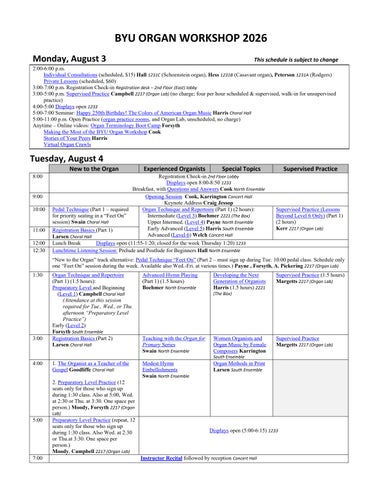
Monday, August 3
2:00-6:00 p.m.
This schedule is subject to change
Individual Consultations (scheduled, $15) Hall 1231C (Schoenstein organ), Hess 1231B (Casavant organ), Peterson 1231A (Rodgers) Private Lessons (scheduled, $60)
3:00-7:00 p.m. Registration Check-in Registration desk – 2nd Floor (East) lobby
3:00-5:00 p.m. Supervised Practice Campbell 2217 (Organ Lab) (no charge; four per hour scheduled & supervised, walk-in for unsupervised practice)
4:00-5:00 Displays open 1233
5:00-7:00 Seminar: Happy 250th Birthday! The Colors of American Organ Music Harris Choral Hall
5:00-11:00 p.m. Open Practice (organ practice rooms, and Organ Lab, unscheduled, no charge)
Anytime – Online videos: Organ Terminology Boot Camp Forsyth Making the Most of the BYU Organ Workshop Cook Stories of Your Peers Harris Virtual Organ Crawls
Tuesday, August 4
8:00 Registration Check-in 2nd Floor Lobby Displays open 8:00-8:50 1233 Breakfast, with Questions and Answers Cook North Ensemble
9:00 Opening Session Cook, Karrington Concert Hall Keynote Address Craig Jessop
10:00 Pedal Technique (Part 1 – required for priority seating in a “Feet On” session) Swain Choral Hall
11:00 Registration Basics (Part 1) Larsen Choral Hall
Organ Technique and Repertoire (Part 1) (2 hours): Intermediate (Level 3) Boehmer 2221 (The Box) Upper Intermed. (Level 4) Payne North Ensemble Early Advanced (Level 5) Harris South Ensemble Advanced (Level 6) Welch Concert Hall
12:00 Lunch Break Displays open (11:55-1:20; closed for the week Thursday 1:20) 1233
Supervised Practice (Lessons Beyond Level 6 Only) (Part 1) (2 hours) Kerr 2217 (Organ Lab)
12:30 Lunchtime Listening Session: Prelude and Postlude for Beginners Hall North Ensemble “New to the Organ” track alternative: Pedal Technique “Feet On” (Part 2 – must sign up during Tue. 10:00 pedal class. Schedule only one “Feet On” session during the week. Available also Wed.-Fri. at various times.) Payne , Forsyth, A. Pickering 2217 (Organ Lab)
1:30 Organ Technique and Repertoire (Part 1) (1.5 hours):
Preparatory Level and Beginning (Level 1) Campbell Choral Hall (Attendance at this session required for Tue., Wed., or Thu. afternoon “Preparatory Level Practice”)
Early (Level 2)
Forsyth South Ensemble
3:00 Registration Basics (Part 2)
Larsen Choral Hall
4:00 1. The Organist as a Teacher of the Gospel Goodliffe Choral Hall
2. Preparatory Level Practice (12 seats only for those who sign up during 1:30 class. Also at 5:00, Wed. at 2:30 or Thu. at 3:30. One space per person.) Moody, Forsyth 2217 (Organ Lab)
5:00 Preparatory Level Practice (repeat, 12 seats only for those who sign up during 1:30 class Also Wed. at 2:30 or Thu.at 3:30. One space per person.)
7:00
Moody, Campbell 2217 (Organ Lab)
Advanced Hymn Playing (Part 1) (1.5 hours)
Boehmer North Ensemble
Developing the Next Generation of Organists Harris (1.5 hours) 2221 (The Box)
Teaching with the Organ for Primary Series
Swain North Ensemble
Modest Hymn Embellishments
Swain North Ensemble
Women Organists and Organ Music by Female Composers Karrington South Ensemble
Organ Methods in Print
Larsen South Ensemble
Supervised Practice (1 5 hours) Margetts 2217 (Organ Lab)
Displays open (5:00-6:15) 1233
Supervised Practice Margetts 2217 (Organ Lab)
Wednesday, August 5
8:30 Music Theory for the Organist (Part 1, 1.5 hours)
1. Basic (Level 1)
A. Pickering 2221 (The Box)
2. Level 2
D. Pickering Choral Hall
10:00 Hymn Playing in the Sustained Style (Part 1)
Moody Choral Hall
11:00
Chorus Registration
Larsen Choral Hall
Music Theory for the Organist (Part 1, 1.5 hours)
Levels 3-4
Hofeling North Ensemble
1. Music Theory for the Organist (Part 1, 1.5 hours)
Levels 5-6
Kerr South Ensemble
2. Composer Clinic (Part 1, 1.5 hours, for those who are confident with Level 5-6 Theory Topics)
Harmon 2217 (Organ Lab)
Organ Technique and Repertoire (Part 2):
Intermediate (Level 3) Boehmer 2221 (The Box)
Upper Intermed. (Level 4) Payne North Ensemble
Early Advanced (Level 5) Harris South Ensemble
Advanced (Level 6) Welch Concert Hall
New Hymns: Facing New Challenges (Part 1)
Kerr South Ensemble
Learning Faster and Performing Better (Part 1)
Payne North Ensemble
12:00 Lunch Break Displays open (11:55-1:20; closed for the week Thursday 1:20) 1233
12:30 Lunchtime Listening Session: Duos for Piano and Organ Welch, with Delsa Richards North Ensemble
Supervised Practice (Lessons Beyond Level 6 Only) (Part 2 – Custom Presentation)
Kerr 2217 (Organ Lab)
Supervised Practice Margetts 2217 (Organ Lab)
“New to the Organ” track alternative: Pedal Technique “Feet On” (Part 2 – must sign up during Tue. 10:00 pedal class. Schedule only one “Feet On” session during the week. Available also Thu.-Fri. at various times.) Payne , Forsyth, D. Pickering 2217 (Organ Lab)
1:30 Organ Technique and Repertoire (Part 2):
Beginning (Level 1)
Campbell Choral Hall Early (Level 2)
Forsyth South Ensemble
2:30
1 Getting Started With the iPad – Even For “Non-Techies” (also Wed. 3:30)
Larsen North Ensemble
2. Preparatory Level Practice
(12 seats only for those who sign up during Tues. 1:30 class. Also Thu. at 3:30. One space per person.) Moody, D. Pickering 2217 (Organ Lab)
3:45 (prepare for Field Trip)
Advanced Hymn Playing (Part 2) Boehmer North Ensemble
Making the Most of Your Organ: Registration on the Allen LD-34 Payne Choral Hall
3:45 Buses depart from south of Music Building
4:45 Arrive at the SLC Food Court – dinner on your own
6:15 Tabernacle organ demonstration and recital
7:45 Buses depart from West Gate for BYU Music Building
What OrganTutor Tutors So the Tutor Needn’t Tutor Cook 2221 (The Box)
Supervised Practice D. Pickering 2217 (Organ Lab)
The Physics of Music for the Organist (Part 1) Margetts South Ensemble
Thursday, August 6
8:30
Music Theory for the Organist (Part 2, 1.5 hours)
1. Basic (Level 1)
A. Pickering 2221 (The Box)
2. Level 2
D. Pickering Choral Hall
10:00 Hymn Playing in the Sustained Style (Part 2)
Moody Choral Hall
11:00
Solo and Accompaniment Registration
Larsen Choral Hall
Music Theory for the Organist (Part 2, 1.5 hours)
Levels 3-4
Hofeling North Ensemble
1. Music Theory for the Organist (Part 2, 1.5 hours)
Levels 5-6
Kerr South Ensemble
2 Composer Clinic (Part 2, 1.5 hours, for those who are confident with Level 5-6 Theory Topics)
Harmon 2217 (Organ Lab)
Organ Technique and Repertoire (Part 3):
Intermediate (Level 3) Boehmer 2221 (The Box)
Upper Intermed. (Level 4) Payne North Ensemble
Early Advanced (Level 5) Harris South Ensemble Advanced (Level 6) Welch Concert Hall
New Hymns: Facing New Challenges (Part 2)
Kerr South Ensemble
Learning Faster and Performing Better (Part 2)
Payne North Ensemble
12:00 Lunch Break Displays open (11:55-1:20; closed for the week today 1:20) 1233
Supervised Practice (Lessons Beyond Level 6 Only) (Part 3)
Kerr 2217 (Organ Lab)
Supervised Practice Swain 2217 (Organ Lab)
12:30 Lunchtime Listening Session: Lunch at the Bell Tower Cook Carillon Hill (short walk – drive/carpool if needed)
1:30 Organ Technique and Repertoire (Part 3):
Beginning (Level 1)
Campbell Choral Hall Early (Level 2)
Forsyth South Ensemble
2:30 Building Your Music Library in a Digital Age
Harmon North Ensemble
3:30 1. Getting Started With the iPad – Even For “NonTechies” (repeat)
Larsen Choral Hall
2. Preparatory Level Practice (12 seats only for those who sign up during Tues. 1:30 class. One space per person.) Moody, Karrington 2217 (Organ Lab)
4:30 Pedal Technique “Feet On” (Part 2 – must sign up during Tue. 10:00 pedal class. Schedule only one “Feet On” session during the week. Available also Fri. 12:30) Payne , Forsyth, D. Pickering 2217 (Organ Lab)
7:00
Advanced Hymn Playing (Part 3)
Boehmer North Ensemble
Making the Most of Your Organ: Registration on the Johannus WM47/WM49
Payne Choral Hall
Sightreading Tips (also Thu 4:30)
Margetts South Ensemble
Advanced iPad/forScore Features (Part 1) Hofeling 2221 (The Box)
The Physics of Music for the Organist (Part 2)
Margetts South Ensemble
Form and Analysis – a Key to Learning and Performing your Music
Goodliffe North Ensemble
Low-Stress Performance Opportunity (Part 1 – Prep Session – limited to 8 participants)
Goodliffe 2217 (Organ Lab)
Supervised Practice D. Pickering 2217 (Organ Lab)
Sightreading Tips (repeat)
Margetts South Ensemble
Community Hymn Sing Cook, followed by reception Concert Hall
Friday, August 7
8:30 Music Theory for the Organist (Part 3, 1.5 hours)
1. Basic (Level 1)
A. Pickering 2221 (The Box)
2. Level 2
D. Pickering Choral Hall
10:00 Hymn Playing in the Sustained Style (Part 3)
Moody Choral Hall
11:00 Registration Decision Making and Score Preparation
Larsen Choral Hall
12:00 Lunch Break
Music Theory for the Organist (Part 3, 1.5 hours)
Levels 3-4
Hofeling North Ensemble
1. Music Theory for the Organist (Part 3, 1.5 hours)
Levels 5-6
Kerr South Ensemble
2. Composer Clinic (Part 3, 1.5 hours, for those who are confident with Level 5-6 Theory Topics)
Harmon 2217 (Organ Lab)
Organ Technique and Repertoire (Part 4): Intermediate (Level 3) Boehmer 2221 (The Box) Upper Intermed. (Level 4) Payne North Ensemble
Early Advanced (Level 5) Harris South Ensemble Advanced (Level 6) Welch Concert Hall
Doing Your Best With the Organ You Have
Welch North Ensemble
The Organ Music of Michael Burkhardt
Forsyth South Ensemble
12:30 Lunchtime Listening Session: Hymn Playing Masterclass D. Pickering North Ensemble
Supervised Practice (Lessons Beyond Level 6 Only) (Part 4 - play for one another!) Kerr 2217 (Organ Lab)
Supervised Practice Swain 2217 (Organ Lab)
“New to the Organ” track alternative: Pedal Technique “Feet On” (Part 2 – must sign up during Tue. 10:00 pedal class. Schedule only one “Feet On” session during the week) Payne , Swain, A. Pickering 2217 (Organ Lab)
1:30 Organ Technique and Repertoire (Part 4): Beginning (Level 1)
Campbell Choral Hall Early (Level 2)
Forsyth South Ensemble
Making Church Music “Work” –Navigating Issues and Problem Solving
Karrington North Ensemble
2:30 Update and Q&A from Church Headquarters Choral Hall
3:45
Advanced iPad/forScore Features (Part 2) Hofeling 2221 (The Box)
Closing Session Harmon, A. Pickering Concert Hall
Low-Stress Performance Opportunity (Part 2 – play for one another! Only for those in the Thu. 1:30 session) Goodliffe 2217 (Organ Lab)
Supervised Practice Karrington 2217 (Organ Lab)
Workshop classes and events are described in detail below. Each one is intended for organists at a certain level of training or range of levels. Decide which of the levels below describes your training most accurately, and then choose classes designed for that level. If you intend to work through one of the BYU Organ Study Courses (“levels”) in the months following the workshop, you will benefit directly from classes that correspond with your level. Follow these links to see the list of requirements for Levels 1-2 and Levels 3-6
Level 1: beginning (Pianists with little or no formal organ training, or who need help in applying what they have learned in their organ playing. No music theory prerequisites.)
Level 2: review basics (Those with organ training, but who would benefit from a review of basic legato organ technique, repertoire, registration, hymn playing, and registration. Should be able to sight-read single-line melodies. Music Theory prerequisites: see Theory Requirements for Level 1).
Level 3: early intermediate (Those with substantial training and fluency in legato organ technique, repertoire, registration, hymn playing, and registration. Should be able to sight-read two-part music. Music Theory prerequisites: see Theory Requirements for Levels 1-2).
Level 4: intermediate (Those with substantial training and fluency in legato organ technique, repertoire, registration, hymn playing, and registration. Have training in playing organ pieces in both legato and articulate styles. Should be able to play easy four-part vocal scores, to sight-read simple three- and four-part organ music and hymns, and to transpose hymn melodies (only) up to and including a major second up and down. Music Theory prerequisites: see Theory Requirements for Levels 1-3).
Level 5: early advanced (Those with substantial training and fluency in legato organ technique, repertoire, registration, hymn playing, registration, and in intermediate organ pieces in both legato and articulate styles. Should be able to play moderately difficult four-part vocal scores and easy choir accompaniments, to sight-read moderately difficult four-part organ music and hymns, and to transpose simple hymns into all keys up to and including a major second up and down. Music Theory prerequisites: see Theory Requirements for Levels 1-4).
Level 6: advanced (Those with substantial training and fluency in legato organ technique, repertoire, registration, hymn playing, registration, and in early advanced organ pieces in both legato and articulate styles. Should be able to play more difficult four-part vocal scores and choir accompaniments, to sight-read more difficult four-part organ music and hymns, and to transpose moderately difficult hymns into all keys up to and including a major second up and down. Music Theory prerequisites: see Theory Requirements for Levels 1-5).
ADVANCED HYMN PLAYING (3.5 hours, Levels 3-6)
This course is intended for pianists or organists who have had substantial introductory organ training and who are applying it in their hymn playing. The following topics will be covered:
Rearranging Parts (soprano solo, tenor solo, alto up an octave, soprano/tenor switch, manual only)
Advanced hymn registration
Nonharmonic Tones
An Introduction to Creative Introductions and Interludes
An Introduction to Free Accompaniments
Bring a hymnbook and receive specific direction and ideas for the coming year's practice.
Hymnbook required. Organ shoes recommended. Also recommended:
Belnap, Parley L. Hymn Studies for Organists Rev. ed Provo, UT: BYU Creative Works Office, 1992/2004. These may be available at the displays. Cook, Don. The OrganTutor Online Tutorial. Provo, UT: BYU Creative Works Office, 1998/2021 Cook, Don, with contributions by Parley L. Belnap and Richard L. Elliott. The OrganTutor Workbook. ("OTW") Spanish Fork, UT: Ard Publications, n.d. (ardpublications.com)
Dean, Carol Hymns from the L.D.S. Hymnal Marked for the Organ. Available through Printology in American Fork, UT.
You should be familiar with the concepts covered in these classes: Hymn Playing in the Sustained Style, Registration Basics, Chorus Registration, Solo and Accompaniment Registration, and Registration Decision Making Basic hymn registration is not covered in Advanced Hymn Playing. We invite you to bring a list of the stops on the organ that you play, including pitch designations. List them under each division (for example: Great: Principal 8', Octave 4', Mixture IV, etc.; Swell: Bourdon 16', Geigen Principal 8', etc.; Pedal: Principal 16', Lieblich Gedackt 16', etc.) Refer to your list throughout the workshop
This session digs deep into the iPad and forScore – the more advanced features that can make an organist’s life a little simpler and more organized. Geared for those who already use it but would like to explore more of its potential. Attend the “Getting Started With the iPad” class if you are new to this technology.
With the easy online availability of public-domain music scores such as imslp.org, the way we build our music library has changed dramatically. What are the best ways to make use of free online resources? What are some ways not to use them? What are their limitations? And what are our responsibilities? This class will help you understand online resources more completely and how to use them responsibly and to your advantage.
Once you are familiar with organ stops, how do you combine them into useful combinations for organ pieces and hymns? We use “chorus registration” when several musical lines or voices are to be played on the same sound, as when both hands play on the same manual. It is the most important type of organ registration. We will go deeper into what was introduced in the Registration Basics class. Don’t miss it!
Those attending this class should have been introduced to the organ console, families of organ tone, and pitches of organ stops.
We invite you to bring a list of the stops on the organ that you play, including pitch designations. List them under each division (for example: Great: Principal 8', Octave 4', Mixture IV, etc.; Swell: Bourdon 16', Geigen Principal 8', etc.; Pedal: Principal 16', Lieblich Gedackt 16', etc.) Refer to your list throughout the workshop
(4.5 hours, Level 6+)
This is an opportunity for composers to collaborate with Neil Harmon, whose organ compositions and arrangements are widely published and performed. Bring your compositions to get feedback or bring musical ideas to get started composing for organ.
This is a course intended for those who are confident with advanced theory topics. If you could benefit from a review of those topics, please enroll instead in a Music Theory class that would benefit you.
Maximum 12 participants. Bring staff paper or another means of music notation.
(1.5 hours, Levels 1-6)
The pipe organ is probably the most fascinating instrument in the world! It is awe-inspiring and majestic. Put a young person at the helm, letting them explore the array of sounds available at their fingertips and feet, and they can be instantly hooked. In this session, discover ways to encourage youth and children to try the organ
(1 hour, Levels 1-6)
Very few of us play on an organ with generous resources. A two-manual organ with a small number of stops on each division is very common. James Welch, whose has made a career performing on organs of a wide range of types and resources, will share with us some ways to use organs with limited resources to their full potential. You will definitely leave this class armed with new ways to make use of your organ.
(1 hour, Levels 2-6)
This class shows how understanding the structure of a composition can dramatically improve learning, memorization, interpretation, and performance. Discover how musical analysis can bring greater confidence, clarity, and artistry to your playing.
Bring your copy of the 1985 hymnbook.
“NON-TECHIES” (1 hour, Levels 1-6)
You’ve seen them – organists who have left their paper scores behind and dare to trust the likes of their performances to an iPad! What are they doing? How are they doing it? What apps are they using? Connor Larsen will walk you through the very beginnings of his paperless way – complete with the whys, the hows, and the what-do-I-do-nows. Attend the “Advanced iPad/forScore Features” class if you want to go beyond the basics.
This video is designed to answer all your questions and help you prepare for the workshop. It is designed for all participants. Be sure to watch the video before the workshop begins!
This course introduces hymn playing in the sustained legato style: evaluating the text, dealing with the repeated notes, planning fingering and pedaling, hymn registration, practicing, and hymn introductions. It is intended for pianists or organists who have had little or no formal organ training or who need help in applying that training in their hymn playing.
Bring a hymnbook and receive specific direction and ideas for the coming year's practice.
Hymnbook required. Organ shoes recommended. Also recommended:
Belnap, Parley L. Hymn Studies for Organists Rev. ed Provo, UT: BYU Creative Works Office, 1992/2004. These may be available at the displays. Cook, Don. The OrganTutor Online Tutorial. Provo, UT: BYU Creative Works Office, 1998/2018. Cook, Don, with contributions by Parley L. Belnap and Richard L. Elliott. The OrganTutor Workbook. ("OTW") Spanish Fork, UT: Ard Publications, n.d. (ardpublications.com)
Dean, Carol Hymns from the L.D.S. Hymnal Marked for the Organ. Available through Printology in American Fork, UT.
We invite you to bring a list of the stops on the organ that you play, including pitch designations. List them under each division (for example: Great: Principal 8', Octave 4', Mixture IV, etc.; Swell: Bourdon 16', Geigen Principal 8', etc.; Pedal: Principal 16', Lieblich Gedackt 16', etc.) Refer to your list throughout the workshop
Workshop instructor David Pickering will present hymns played by participants and offer comments that can be helpful for everyone. Submit your proposed hymn by email to Elena at organ@byu.edu no later than Wednesday, August 5.
If you are interested in submitting a hymn in video format, please observe these guidelines:
• Make a video recording using a good external microphone. Sound quality will be most important. Set your camera so that your hands, feet, and the stops are visible.
• For the recording, state your name, the hymn you are playing, and the make and type of organ.
• Play all verses, with registration changes, as though you were accompanying a large, enthusiastic congregation.
• Upload your video to YouTube as an unlisted video, and include the link.
• Send an email that includes the link and your name to organ@byu.edu. Video submissions are due July 27.
Meet with a workshop instructor on Monday afternoon for up to 15 minutes to get feedback on:
• Your level placement for workshop classes
• Hymn playing tips (bring a hymn to play)
• Tips on organ pieces (bring a piece to play)
• Other organ-related questions
Pay the fee at the time of registration Scheduling will open in mid-July. More information is available on our website.
FASTER AND PERFORMING BETTER (2 hours, Levels 1-6)
These two sessions are inspired by the book, Learn Faster, Perform Better: A Musician’s Guide to the Neuroscience of Practicing by Molly Gebrian. Part 1 covers the main concepts of the book. Part 2 is the “organist’s edition” – how those concepts apply in organ playing. Kymberly Payne will share some experiences in her own teaching studio, and will help participants create a plan for a piece they are working on.
LESSONS BEYOND LEVEL 6 (6 hours, Levels 6+)
This special advanced technique and repertoire course is available for up to 12 participants. Bring your pieces for supervised practice and customized feedback. You may choose to participate in a low-stress performance opportunity at the end of the week.
Part 1: Presentation on effective practice techniques, time for practice.
Part 2: Possible custom presentation and time for practice.
Part 3: Time for practice.
Part 4: Play for one another (optional - low stress!).
LOW-STRESS PERFORMANCE OPPORTUNITY (2 hours, Levels 2-6)
So – you don’t feel like playing in front of everyone during the workshop, but you wouldn’t mind playing in front of a few of your fellow workshop goers. This is your chance! For the first session, bring your prepared piece to the Organ Lab and receive a few pointers from the instructor. Her job is to help you feel comfortable and to boost your confidence. In the second session, play it for the few others who are there to do the same. It’s designed to be fun and fulfilling – even if everything doesn’t go just right!
Limited to 8 participants.
(4 hours, Levels 1-6)
Bring a lunch (on Tuesday and Friday) while you listen to experienced organists from a variety of backgrounds and perspectives play their music. Helpful lists and spoken announcements by the performers will reveal their sources – a valuable resource for all who attend. This is an excellent opportunity to hear new pieces and make choices for future study.
Tuesday session: Prelude and Postlude for Beginners.
Alena Hall will play and discuss many pieces that organ beginners might consider for prelude and postlude music.
Wednesday session: Duos for Piano and Organ.
James Welch, organ, and Delsa Richards, piano, will perform a variety of duos for piano and organ.
Thursday session: Lunch at the Bell Tower
Don Cook will perform at the BYU Centennial Carillon Tower while you enjoy lunch (provided) on the lawn surrounding the tower.
Friday session: Hymn Playing Masterclass.
MAKING CHURCH MUSIC “WORK” – NAVIGATING ISSUES AND PROBLEM SOLVING (1 hour, Levels 2-6)
Whether you are called to serve as an organist or accompanist, or as a professional church musician, the list of situations you must handle can be wide-ranging. Challenges may include interpersonal concerns, differences in musical taste, logistics, unrealistic expectations, last-minute changes, or issues with the instrument itself– to name just a few! This class will explore practical ways to manage common problems with patience, flexibility, and grace while serving effectively and confidently.
MAKING THE MOST OF YOUR ORGAN – REGISTRATION ON THE ALLEN LD34 (1 hour, Levels 1-6)
This is a rare opportunity to explore the stops and advanced features of the Allen LD34 digital organ. Kymberly Payne’s demonstration will assist both new and experienced organists in using this instrument to its full potential.
MAKING THE MOST OF YOUR ORGAN – REGISTRATION ON THE JOHANNUS
WM47/WM49 (1 hour, Levels 1-6)
This is a rare opportunity to explore the stops and advanced features of the Johannus WM47 and WM49 digital organs. Kymberly Payne’s demonstration will assist both new and experienced organists in using this instrument to its full potential.
(1 hour, Levels 3-6)
Mastering the fundamentals of hymn playing is the church organist’s main goal, and will bless a congregation through the organist’s life. The next step might be to introduce modest deviations from “the tyranny of the printed score.” Learn about some of them in this session. When you return home, practice and apply those that might be appropriate in your situation and enjoy a new dimension in your service as an organist.
THEORY FOR THE ORGANIST – Basic, Level 1 (4.5 hours, Level 1)
Music theory is central to musicianship These classes provide an opportunity to go over some key concepts with an expert and serve as a springboard for further study throughout the year. We suggest that you attend the earliest level that teaches concepts with which you are not yet familiar.
Note: The Greg Steinke/Paul Harder books referenced below are programmed learning texts in music theory, designed for self-study. The courses were designed around the 10th edition for Levels 1-4, and the 12th edition for Levels 5-6. Other editions (i.e., used books or newer editions) may be used and are even encouraged, but specific chapter numbers and the frame numbers referenced in the instructor feedback of the Quizzes may be slightly inaccurate.
Basic Music Theory – Level 1 (chapters 1-5 in Paul Harder, Basic Materials in Music Theory - ideally 10th edition):
Time and sound (sound waves, pitch, intensity, timbre, harmonics, the harmonic series), The notation of pitch (symbols for tones, basic scale, treble clef, bass clef, C-clefs, ledger lines, grand staff, ottava sign, half- and whole-steps, accidentals, enharmonic notes, chromatic scale, pitch designations), Time classifications (beat, meter, simple and compound time, borrowed divisions, subdivisions of the beat), Note and rest values (relative value of notes and rests, the dot, division of dotted and undotted notes and rests, subdivision of dotted and undotted notes and rests, the unit in simple and compound time, metronome indications, terms that express tempo) Time signatures (time signatures in simple and compound time, relation of time signatures to time classification, common time, alla breve, the tie, rhythmic patterns, syncopation)
Music theory is central to musicianship. These classes provide an opportunity to go over some key concepts with an expert and serve as a springboard for further study throughout the year. We suggest that you attend the earliest level that teaches concepts with which you are not yet familiar.
Note: The Greg Steinke/Paul Harder books referenced below are programmed learning texts in music theory, designed for self-study. The courses were designed around the 10th edition for Levels 1-4, and the 12th edition for Levels 5-6. Other editions (i.e., used books or newer editions) may be used and are even encouraged, but specific chapter numbers and the frame numbers referenced in the instructor feedback of the Quizzes may be slightly inaccurate.
Paul Harder, Basic Materials in Music Theory - ideally 10th edition):
Intervals (harmonic and melodic intervals, numerical classification of intervals, compound intervals, classification of intervals by quality, inversion of intervals, enharmonic intervals), The basic scales (structure of the basic scales, modes, the keynote), The major scale (structure of the major scale, use of accidentals to form major scales on any note), The minor scale (the natural, harmonic, and melodic minor scales; diatonic and chromatic intervals), Key signatures (key and tonality, major key signatures, relative keys, minor key signatures, use of accidentals to form the various minor scales, the circle of fifths),Triads (the tertian system, basic [diatonic] triads, major, minor, augmented, and diminished triads, Roman numeral identification, chord symbols)
– Levels 3-4 (4.5 hours, Levels 3-4)
Music theory is central to musicianship. These classes provide an opportunity to go over some key concepts with an expert and serve as a springboard for further study throughout the year. We suggest that you attend the earliest level that teaches concepts with which you are not yet familiar.
Note: The Greg Steinke/Paul Harder books referenced below are programmed learning texts in music theory, designed for self-study. The courses were designed around the 10th edition for Levels 1-4, and the 12th edition for Levels 5-6. Other editions (i.e., used books or newer editions) may be used and are even encouraged, but specific chapter numbers and the frame numbers referenced in the instructor feedback of the Quizzes may be slightly inaccurate.
Level 3 (chapters 1-5 in Steinke/Harder, Harmonic Materials in Tonal Music, Part 1- ideally 10th edition):
Definitions (tonal, keynote, key, iteration, tonality, tonal center, tonal harmony, intervals, chords, triads, harmonic interval, root, diatonic triads), The structure of tonality (harmonic tonality, functional harmony, primary triads, secondary triads, neutral chord, active triad, progressions [basic, opening, closing], basic harmonic phrases, retrogression, tonal variety), Triads in root position: doubling and spacing (figured bass symbols, three- or four-part texture, voice crossing, close/open structure, vacant tone, sonority), Triads in root position: voice leading (relative motion, consecutive intervals, common tones, redistributing tones, augmented intervals, doubling principles, spacing principles), Triads in first and second inversion (root position, inverted triads, sonority, incorrect parallel motion, irregular doubling, active tone, six-four chord types, irregular resolution, nonessential function)
Level 4 (chapters 6-10 in Steinke/Harder, Harmonic Materials in Tonal Music, Part 1- ideally 10th edition):
Introduction to seventh chords and the dominant seventh (dissonance, diatonic seventh chords [major-minor, fully diminished, etc.], first/second/third inversions, dissonant elements), Phrase structure and cadences (phrase, melodic contour, cadence types [authentic, plagal, half, deceptive, final and non-final, perfect and imperfect, picardy third, Phrygian]), Nonharmonic tones (identify and know how to write the following: passing tone unaccented and accented, neighboring tone, appoggiatura, escape tone, anticipation, suspension, retardation, ornamentation, changing tone, pedal, free tone), Harmonic progression (progression & retrogression, relative strength of various types of root movement, primary triads and their secondary triads in harmonic progression, structural and embellishing harmony, relation of a basic harmonic structure to the phrase as a whole), Melody harmonization (choice of cadence, base line, tonality, harmonic rhythm, basic harmonic structure, embellishments of basic harmonic structure)
Music theory is central to musicianship These classes provide an opportunity to go over some key concepts with an expert and serve as a springboard for further study throughout the year. We suggest that you attend the earliest level that teaches concepts with which you are not yet familiar.
Note: The Greg Steinke/Paul Harder books referenced below are programmed learning texts in music theory, designed for self-study. The courses were designed around the 10th edition for Levels 1-4, and the 12th edition for Levels 5-6. Other editions (i.e., used books or newer editions) may be used and are even encouraged, but specific chapter numbers and the frame numbers referenced in the instructor feedback of the Quizzes may be slightly inaccurate.
Level 5 (chapters 1-6 in Steinke/Harder, Harmonic Materials in Tonal Music, Part II- ideally 10th edition): Seventh chords (dissonance, diatonic seventh chords [major-minor, half-diminished, inverted, etc.], dominant seventh chord, Nondominant seventh chords (passive resolution, cadence effect, sequence patterns, regular and irregular resolutions), Altered nonharmonic tones and secondary dominants (foreign tones, tonal color, alteration of scale degrees, chromatic passing tones, false [cross] relation, double neighboring tones, chromatic mediants, tonicization, dominant function, dominant relation, leading tone relation, sequence of chords), Modulation to closely related keys (transcient modulation, tonal reference, change of mode, phrase modulation, modulating sequence, pivot chord modulation, diatonic modulation, chromatic modulation), Borrowed chords (modal mixture, modal exchange, Picardy third, deceptive cadence, ambiguity of modality), Augmented sixth chords [Italian, German, French, English] (chromatic alteration, altered chords [subdominant, subdominant seventh, supertonic seventh], motive/motif
Level 6 (chapters 7-11 in Steinke/Harder, Harmonic Materials in Tonal Music, Part II- ideally 10th edition): Neapolitan sixth chord, altered dominants, and diminished seventh chords (altered supertonic triad, tritone relationship, altered dominants, diminished seventh chords, enharmonic spellings), Chromatic third-relation harmony (tonal instability, tonal expansion, color harmony, functional/nonfunctional harmony, “chromatic stress”, ambiguous tonal effect, tonal fluidity, symmetrical relationships), Modulation to foreign [remote, distant, semirelated] keys, Ninth, eleventh, and thirteenth chords (tertian extension, incidental melodic occurrences, tone cluster, chromatic median seventh chord, dominant [eleventh, thirteenth] chord, polychord, appoggiatura chord, impressionistic music, palindrome, pandiatonicism, atonality, pantonality)
(2 hours, Levels 1-6)
The Church of Jesus Christ of Latter-day Saints is introducing many hymns that are new to Church members. Some of them come from the Children’s Songbook. Others come from the hymns of other Christian singing traditions. Many are outside of the four-part hymn style that you may be familiar with and may be challenging to play on the organ. All of them have the potential of reaching members in ways never before seen in the Church.
These two sessions will cover some of the best practices of dealing with these new hymns at the organ such as adapting pianistic hymns to the organ, registration, playing introductions, and simplifying particularly challenging pedal lines.
Most organists who studied the organ with a teacher were introduced to the organ and through an organ method book. Many excellent organ methods have fallen out of print in recent years. This session will focus on some of the most important and potentially useful organ methods that are currently in print. Learn what they teach, their strengths, their limitations, and how they might be used by organists and organ teachers in modern times.
MICHAEL BURKHARDT (1 hour, Levels 2-6)
This class introduce the inspiring and highly accessible music of one of America’s most beloved composers for church and concert organists. Elizabeth Forsyth will explore some of the pieces that have made Burkhardt’s music a favorite among performers and congregations alike.
(4.5-5 hours, Levels 1-6)
To make best use of these classes, please read this section entirely so that you will be fully prepared!
These courses offer training for pianists or organists in basic organ manual and pedal technique, and in organ repertoire. Choose the level appropriate for your needs.
Important: to make the most of these classes, choose from and bring the materials for the appropriate level and receive specific direction and ideas for the coming year's practice. Read carefully through the list of requirements for your level (Levels 1-2 and Levels 3-6). Make a list of the materials needed in that level and acquire whatever you can. Day-Murray Music and Best in Music stock many of the titles used in BYU Organ Study courses. They charge only the actual cost of shipping.
Online workshop participants are welcome to submit recorded pieces from their level for demonstration during the session. If you do so, please observe these guidelines:
• Make a video recording using a good external microphone. Sound quality will be most important. Set your camera so that your hands, feet, and the stops are visible.
• For the recording, state your name, the piece you are playing, and the make and type of organ.
• Upload your video to YouTube as an unlisted video, and include the link.
• Send an email that includes the link and your name to organ@byu.edu. Submissions are due no later than August 1 (or as arranged with the instructor)
For participants in Level 6: If you would like to play something from Level 6 during the class, please email Dr. Welch in advance at james@welch.net
If you want personalized feedback or direction from an instructor, sign up for Private Lesson (fee).
We recommend bringing the following from the appropriate Organ Technique (or BYU Organ Study Course) level: One of the organ methods Your choices of the listed repertoire pieces (See the lists for Levels 1-2 or Levels 3-6) Organ shoes
For online participants, it is highly recommended that you be seated near an organ for these sessions
ORGAN TERMINOLOGY BOOT CAMP (1 hour, Level 1)
Here’s a little self-test. Consider these terms: manual, stop, piston, reversible, expression pedal, rocker tab, Swell, Great, toe stud, rank. If the meaning behind some of these terms is not clear to you, you might want to go through this online video tutorial. It will help familiarize you with some of the basic jargon you will hear throughout the workshop.
(1 hour, Levels 1-6)
An organist may not be thought of as a “teacher.” But whenever we play a hymn, the organ prelude or postlude, or accompany a choir or a soloist, we have an opportunity to go beyond playing the notes and teach the gospel through our registrations, tempos, and our spiritual convictions. Tabernacle organist emeritus Bonnie Goodliffe will lead the class with some of her own thoughts, and she welcomes you to come with some of your own related experiences to share with the class.
PEDAL TECHNIQUE (1 hour, Levels 1-4)
This class covers the most important foundations of good legato pedal technique. Following this class, attend a “Pedal Technique ‘Feet-On’” session to get experience and individual guidance on your pedal technique.
Those who attend this class will be the first to be permitted to sign up for one (only) of the “Pedal Technique ‘Feet-On’” sessions described below.
This session provides an opportunity to practice the techniques covered in the Pedal Technique class (see the class description above) with the help of an instructor. Beginning organists are encouraged to schedule one of these sessions during the week, and experienced organists who want pedal technique pointers are also welcome. Bring pedal studies or music that you prepare before the workshop, or use materials provided by the instructor.
To receive priority registration for this “Feet-On” session, you must attend the Pedal Technique class described above and follow the instructions to sign up during or immediately after that class.
Organ shoes highly recommended.
Discover how the laws of physics shape every sound you create at the organ console. In this fascinating class, Linda Margetts will explore acoustics, pipe speech, and more science behind tone production – all explained in practical, musician-friendly terms. Knowing the physics of music can improve your registration and performance decisions, deepening both your understanding and your artistry.
LEVEL PRACTICE (1 hour, Level 1)
The Preparatory Level is introduced during the first session of the “Organ Technique and Repertoire – Level 1” class. It offers training for pianists in the most basic skills needed in classical or sacred organ playing. The Preparatory Level is designed to be learned, practiced, and completed during these Preparatory Level Practice sessions, while still allowing attendance at the Level 1 organ instruction and hymn playing classes. As an alternative, the level may be prepared during the year and played either during the next Organ Workshop or during the year with a qualified organ instructor – either in person or online
Music will be provided. Organ shoes are highly recommended. Attendance at the Tuesday 1:30 Organ Technique and Repertoire class (Level 1) is required. Sign-up for the Preparatory Level Practice will take place during that class. Class size limit: 12 students per session. Participation limit: 1 session per participant.
(45 min, All Levels)
45-minute private lessons ($60 each) with a workshop instructor of your choice are available between Monday, August 3 and Friday, August 7 The lesson can be in person or online. Pay at the time of registration, and scheduling will open in mid-July. Watch for an email with scheduling details. No refunds for missed appointments.
These lessons are an excellent opportunity to receive help with hymn playing, organ pieces, BYU Organ Study Course requirements, or in any area of organ performance. Play hymns and/or organ repertoire that you have prepared for the instructor, who will comment on your preparation and provide guidance for further study.
Organ shoes highly recommended.
(2 hours, Levels 1-2)
This two-part series explores several fundamentals in organ registration that must be understood by all organists. It is designed to lead into the Chorus Registration, Solo and Accompaniment Registration, and Registration Decision Making classes.
Part 1: THE ORGAN CONSOLE, and FAMILIES OF ORGAN TONE
Mysteries of the organ console are revealed, including the divisions of the organ and console devices such as thumb pistons and toe studs, expression and crescendo pedals, and other registrational aids. Dividing speaking stops into Principal, Flute, String, and Reed families is also introduced.
The numerals (pitch designations) found on stops are explained, leading to a discussion of the basics of building a good ensemble. Couplers are also introduced.
See the “Organ Terminology Boot Camp” video before attending this class.
We invite you to bring a list of the stops on the organ that you play, including pitch designations. List them under each division (for example: Great: Principal 8', Octave 4', Mixture IV, etc.; Swell: Bourdon 16', Geigen Principal 8', etc.; Pedal: Principal 16', Lieblich Gedackt 16', etc.). Refer to your list throughout the workshop.
Once you understand basic organ registration principles, how do you decide just when and how to apply them in specific organ pieces or hymns? This session will present a wide variety of organ pieces (primarily) and hymns, and will follow the thinking process one uses in creating a registration plan. We will also cover various ways of marking and preparing the score.
Those attending this class should have been introduced to the organ console, families of organ tone, pitches of organ stops, chorus registration, and solo and accompaniment registration.
(1 hour, Levels 1-6)
This session offers tips used by professionals when they sight-read. While nothing will take the place of practicing these skills over a long period of time, applying some of these “secrets” will definitely speed up the process.
(1 hour, Levels 1-2)
After learning about organ stops and chorus registration, how do you create combinations when one hand is playing a solo sound on a different manual from the first? Solo and Accompaniment Registration is very useful when playing preludes, postludes, and when improvising. Various types of solo stops and combinations are explored, along with ways to create balanced accompaniment combinations.
Those attending this class should have been introduced to the organ console, families of organ tone, pitches of organ stops, and chorus registration.
Inspired by the occasional stories shared between organ workshop participants, instructor Valerie Harris interviewed many of you in previous years and put together videos of some of those stories. Learning of the strength and determination in our fellow workshop participants can inspire us to press forward through our own journeys.
The BYU Organ Lab (room 2217 MB) offers a unique way to practice and learn about organ playing. During Supervised Practice time you may practice on your own on any of the twelve digital organs in the lab. If you want up to ten minutes with an instructor to answer questions and offer suggestions (no extra fee), sign up in mid-July for one session This is an excellent time for “hands-on or feet-on” training. You might also consider bringing a copy of the stoplist of your organ to Supervised Practice to get a few registration tips from the instructor.
During each Supervised Practice hour, four of the organs will be reserved for these ten-minute supervised practice sessions. The other eight organs will be open for practice or study without supervision on a firstcome first-served basis.
In addition, you can study selected basic organ topics in the Organ Lab through OrganTutor Online, an online tutorial. Seven of the twelve lab organs are equipped with an iPad that allows you to explore OrganTutor Online free and at your own pace such important topics as Families of Organ Tone, Pitches of
Organ Stops, and Three Primary Types of Organ Registration. See various pedal and manual techniques demonstrated in full-motion video clips. Together with interactive links and self-tests, this system will help clarify these important topics at your own pace. The OrganTutor Workbook is available for purchase at the displays, and an OrganTutor Online tutorial subscription is available through organtutor.byu.edu
The iPads will also allow you to view a video of a few selected classes from previous workshops.
The Organ Lab also hosts the Free Organ Music Exchange. The organ scores and books in the white crates are available for free. They have been donated by individuals who are downsizing their libraries and from estates. You are welcome to play through the scores and take those that you or your students will use. Please do not remove them with the intent to resell. If you have organ scores or books that you’d like to donate, please contact neil.harmon@byu.edu to arrange for drop-off or pick-up.
You are welcome to use the Organ Lab and the organ practice rooms (1231B, 1231C, 1231E, 4110) without supervision whenever they are not being used for classes or lessons throughout the workshop. Scheduled practice time may be available – watch your email early in the week for details.
Organ shoes highly recommended for supervised practice.
WITH THE
(1 hour, Levels 2-6)
Over several years, Laurie Swain has developed an innovative approach for teaching organ to young students or older beginning students. Organ for Primary is fast-paced and fun, and teaches steps for learning to play the organ using organ arrangements of children's songs from the Church of Jesus Christ of Latterday Saints. Centering on music that is familiar to Latter-day Saint children can provide valuable motivation! Learn more about the way her system works in this interesting session.
(1 hour, Levels 1-6)
The OrganTutor Online Tutorial and Workbook are all about harnessing technology to make life easier for the teacher and student. This session will present specific ways that OrganTutor accomplishes this –especially ways that it frees the teacher to do what a teacher does best; that is, to listen to the student play and offer personalized feedback.
WOMEN ORGANISTS AND ORGAN MUSIC BY FEMALE COMPOSERS (1 hour, Levels 2-6)
The world of organ composition and organ performance has historically been dominated by men while talented female organists have faced social, institutional, and cultural barriers. However, women continue to overcome these obstacles, making significant contributions to the field. This session will highlight women organists, sharing compositions and arrangements by female composers that represent a variety of styles and difficulty levels, including some of the finest in organ repertory.
CLOSING SESSION (1 hour, All Levels)
The closing session is an opportunity to put the workshop in perspective. Enjoy some success stories involving workshop participants, a presentation by Bonnie Goodliffe about AGO Certification and some words of encouragement by the BYU organ faculty. Those who stay for this Closing Session will be richly rewarded.
COMMUNITY HYMN SING (1 hour, All Levels)
In one of the week’s highlights, the Hymn Sing, the organist will accompany a live audience (including you!) in a wonderful program of hymns. They will apply hymn playing techniques that are often described during the workshop and taught through the BYU Organ Study Courses. This is a gold mine for ideas that
you might consider for either a special cultural event, worship services, or even a hymn sing in your own area
A few vendors will be offering music and materials for sale during selected hours throughout the workshop. Materials recommended or required for the workshop classes may be available for purchase. The only way to be sure, however, is to order them ahead of time through Day Murray Music (see contact information below) and have them either shipped directly to you or held for you at their display table.
Some BYU-specific materials (i.e., The OrganTutor Workbook) can be ordered through Ard Publications, who will also have a table at the Workshop.
Following are some of the businesses associated with the BYU Organ Workshop. Be sure to order early if you want items in hand during the workshop!
• Day-Murray Music (in-person vendor for this year’s workshop) (including the hymn prelude volumes of Dr. Neil Harmon and Dr. Douglas Bush): 1-866-DAY-1946; daymurraymusic.com
• Best In Music: 1-801-802-8022; bestinmusic.net
• Ard Publications (OrganTutor and related items): ardpublications.com; Organtutor.byu.edu
• Heritage Church Organs: heritagechurchorgan.com
• Anderson Organ Works: andersonorganworks.com
• Music of David Chamberlin: chamberlinmusic.com
• Organ for Primary: desertsunrisepublications.com
We will gather Wednesday afternoon to travel to Salt Lake City. First we’ll take time for dinner at or around the Food Court near Temple Square. Then we’ll walk to the Tabernacle, where a tabernacle organist will conduct – just for us – a demonstration/recital on the famous 206-rank five-manual Aeolian-Skinner organ.
The field trip is always a highlight of the workshop for many of our participants. Don’t miss it! Bus transportation will be available for an extra fee.
INSTRUCTOR RECITAL (1 hour, All Levels)
Several of your instructors will share some of their favorite organ pieces in this exciting recital. You’ll hear a wide variety, and maybe even some that you’ll want to learn.
OPENING SESSION (1 hour, All Levels)
The opening session features a keynote address by Craig Jessop, former director of the Tabernacle Choir. We are privileged to listen to his story and perspectives, which will set the tone for our workshop.
During the Opening Session you will also meet the instructors and hear comments from workshop organizers
QUESTIONS AND ANSWERS (1 hour, All Levels)
While you enjoy a light breakfast and wait for the opening session, workshop organizers will answer any questions about how the workshop operates, or short-answer questions about organ playing. This is a chance to ask any burning question that you might have before the workshop even begins!
SEMINAR: HAPPY 250TH BIRTHDAY! THE COLORS OF AMERICAN ORGAN MUSIC (2 hours, All Levels)
This year’s seminar is a special observance on the occasion of the 250th birthday of this country. “The Colors of American Organ Music” is an engaging history of organ music in the United States. Those
familiar with workshop instructor Valerie Harris know that her energy, preparation, and enthusiasm for anything she presents will make this seminar a great kick-off for BYU Organ Workshop 2026.
A representative from the Church Headquarters will make a presentation and field questions about serving as an organist in the Church of Jesus Christ. Frequent reference may be made to the music section of the General Handbook
If you wish to be actively involved in the Organ Technique and Repertoire classes and/or a BYU Organ Study Course, choose an organ method book from which to learn organ technique. The following are recommended. You may choose any one or a combination of more than one from which to play. If you desire, you may use another method book with the approval of the course instructor. Any method you choose should develop the concepts and skills listed below using comparable exercises.
The OrganTutor Workbook and The OrganTutor Online Tutorial are required texts for the BYU Organ Study Courses Levels 1 and 2, containing materials needed for passing the written assignments and exams. If you decide also to learn organ technique through OrganTutor, you will not need to purchase the Davis, Gleason, or Keeler books.
Cook, Don, with contributions by Parley L. Belnap and Richard L. Elliott. The OrganTutor Workbook. ("OTW") Spanish Fork, UT: Ard Publications, n.d. (ardpublications.com)
This volume contains the materials developed for the Brigham Young University Group Organ Program and the BYU Organ Study Courses. Its main strength lies in the written materials, handouts, worksheets, and exercises that cover a wide range of topics. It is revised frequently to meet current needs –most recently with version 4.0 in 2022. Ideally The OrganTutor Workbook is used together with The OrganTutor Online Tutorial.
Cook, Don. The OrganTutor Online Tutorial. Provo, UT: Brigham Young University, 1998/2021. (organtutor.byu.edu)
This is an online organ tutorial that supports The OrganTutor Workbook. A subscription for the online tutorial is available for 6 months ($30) or 3 years ($50). Free 2-week subscriptions are available by emailing organ@byu.edu. The technique exercises and hymn projects appear in the workbook for practice and are demonstrated through video clips. Registration and other concepts are demonstrated through hundreds of audio clips.
Davis, Roger. The Organist's Manual. New York: W. W. Norton, 1985.
This method book is widely accepted in organ teaching circles. It provides written instruction on important topics such as part playing, phrasing and articulation, fingering, and ornamentation, with useful appendices. Davis uses a moderately thorough approach to teaching technique. The choice of repertoire and careful editing are particular strengths of this volume. Unfortunately, the book is out of print and usually expensive to acquire used.
Gleason, Harold. Method of Organ Playing. 8th ed. Englewood Cliffs, NJ: Prentice-Hall, 1995.
This has been a standard resource in organ instruction for many years. It represents a thorough approach to teaching technique, and contains generous written instruction on elements of performance practice and other important topics, with a wide range of carefully-edited repertoire. The refinement of this book reflects Harold Gleason's many years of experience during and after his tenure at the Eastman School of Music. Gleason's late wife Catharine Crozier continued with revisions in the editions published since his death. Unfortunately, the book is out of print and usually expensive to acquire used.
Keeler, J. J., and E. Donnell Blackham. Basic Organ Techniques. 3rd ed. Bryn Mawr, PA: Universe, 1998. Many organists associated with Brigham Young University benefitted from the meticulous and thorough approach of J. J. Keeler. The technical studies in this volume represent a good approach to teaching legato technique. Some written instruction is included.
Ritchie, George H. and George B. Stauffer. Organ Technique: Modern and Early. New York: Oxford, 2000. This method book explores two basic techniques that are particularly fitting for Level 3: “modern” and “early,” for music written since and before about 1750. Its greatest strength lies in its coverage of organ historical information, and it serves as the required text for several of the Level 3-6 lessons.