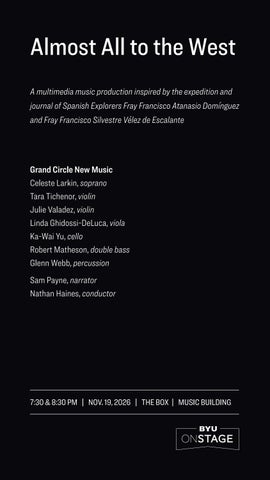
Almost All to the West A multimedia music production inspired by the expedition and journal of Spanish Explorers Fray Francisco Atanasio Domínguez and Fray Francisco Silvestre Vélez de Escalante
Grand Circle New Music Celeste Larkin, soprano Tara Tichenor, violin Julie Valadez, violin Linda Ghidossi-DeLuca, viola Ka-Wai Yu, cello Robert Matheson, double bass Glenn Webb, percussion Sam Payne, narrator Nathan Haines, conductor
7:30 & 8:30 PM | NOV. 19, 2026 | THE BOX | MUSIC BUILDING
Almost All to the West . . . . . . . . . . . . . . . . . . . . . . . . . . . . . . . . . . STEVEN L. RICKS Stephen Tuttle, librettist
0. Overture: Sunrise in the Desert String quartet
I. The Dream of Monterey Full ensemble
II. Almost All to the West Everyone except narrator
III. Travel Music Everyone except narrator and soprano
IV. Hoofsore Soprano solo with ensemble
V. Prayer for the Fallen Horses Violin I, Violin II, Cello
VI. Travel Music Everyone except narrator and soprano
VII. In America Full ensemble
VIII. Our God, Who is Everyone’s Soprano solo with ensemble; no narrator
IX. The Casting of Lots Full ensemble
X. Travel Music Everyone except narrator and soprano
XI. The Crossing of the Fathers Full ensemble
XII. Travel Music – Epilogue: The End is Not the End Everyone except narrator and soprano
Program Notes The Dream of Monterey Fray Francisco Atanasio Domínguez and Fray Silvestre Vélez de Escalante left Santa Fe in the year of our Lord 1776 bearing visions of Monterey. They wanted an overland route, a thread connecting this place to that. What they found was caliche soil that carried them from canyon to canyon, river to river. They worked through thickets and outcroppings, through narrow scrabbled valleys and mazes of rock. In the company of crickets, their horses kept time, clattering along in unfailing staccato. Beneath caprock and open sky they grew thirsty but carried on. Among them were those who sought renown and those who sought profit, those who sought minerals, those who would trade and translate and save, those who make maps of the world, naming everything in it, and those who only loved the land and the purpose it gave them. They came in peace, they said. They harmed no one. They loved everybody. Almost All to the West “Today we traveled nine leagues to the northwest. Today another nine leagues. Today a good heavy downpour caught us, and we traveled seven leagues. Today eight leagues. Today five leagues. We continued south for a league with great hardship on account of so much rock. Today nine leagues and a quarter. There is plenty of ponded water here, and pasturage. Today, six leagues. Today, nine leagues. Having crossed the river, we continued with difficulty through the same canyon for nearly a league to the south. We swung southwest a quarter league and three-quarters west through canyons, over inclines, and through troublesome tree growth. Today eight leagues. Today two leagues and a half. Today a little more than six leagues. There is no good pasturage. Today four leagues and a quarter, almost all to the west. The pasturages continued in great abundance. Today four leagues and a quarter.”
Hoofsore They made no complaint, those horses, as the men rode them through narrow valleys of soft, sinking dirt. If they stumbled, they soon steadied. Whether on the sinking dirt, over stony terrain, up hills too steep for climbing, or across dangerous defiles and slides, they carried on. Although they were fatigued and exhausted, as thirsty as the land itself, they carried the weight they were given. The men paused, when they could, for the horses to drink—draining low pools or the remains of a stream—unsure of when they would ever drink again. At times the water was clean. At times it was frozen. At times it was red and hot and tasted of sulfur. At times, it was covered in a thin white scum. The horses didn’t complain when a wall of stone forced retreat, or when the men raced them for sport. When they did and they fell, a man might be thrown a great distance and a horse’s neck might be broken. The horses didn’t complain of weariness or heat or hunger. They didn’t complain when the men, themselves in dire need, killed one horse and then another for the meat it would provide. When they could go no further, they simply went no further. They waited or wandered, looking for something to eat in the shadows of that parched land. In America When America was America but not yet America, it was a land of beaver and deer and porcupine and chicken fowl. It was a land of bison and cottontail and great droves of wild sheep. It was a land of many fish and a land of geese. In its canyon walls, swallows made symmetry of mud, nesting in tiny pueblos. On the desert floor, ants cleaned alum until it shined like crystal, heaping monuments to their industry. America was a place of squawbush and prickly pear. Of manzanita and scrub oak. Of piñon, ponderosa, spruce, poplar, sage, heather, alder, willow, tamarisk, and fetid wild rue. It was a place of chokecherry, gooseberry, and hackberry. A mesa-strewn wildness, it was a place of black volcanic slag. Of gypsum and mica. Of pyrite. Of conch shells. Of turquoise. It was a place of prevailing great heat, and a cold so cold one might freeze in his sleep. It was a place of lofty bluffs and great hogbacks of jumbled red earth. A
place of bothersome flatness and places too steep for stepping. It was a place of great rivers and middling streams. It was a land in which to lose oneself. A land on which one might never be found. Our God, Who is Everyone’s There were those who welcomed them. Those who feared. Those who watched as though unseen. Those who would war. Those who would trade. Those who wished to believe. Those of willful blindness and inveterate obstinacy. Those with beards. Those who would eat a man. Those who suffered the sun. Those who would ambush. Those who vanished into dense forest. Those who burned pastures in warning. Those of wonderful docility. Those who burst out crying copious tears. Those who wore buckskin. Those who wore blue. Those who would cure. Those who would chant. Those full of superstition. And each of them faced a cold wind from the south, blown fiercely and without ceasing. The Casting of Lots The weather was such that. Their supplies were such that. Their health was such that. There was no going forward and no going back. They would die here, looking west. Looking west, they believed they saw the Sierras and then the shimmering sea. But the weather was such that. And the leagues before them so many. The storms came upon them in their thirst. The blizzard found them in their hunger. What could they do but stand still as the rain. As the hail. As the lightning. As the horrendous thunder. In that unstillness, they weighed another way. They asked, “What if?” and “How about?” To the south, they might find a charted land, a reprieve. But in the heart of such storms, who could be convinced? Unless. Unless by the intercession of saints. Unless drawn from a hat. By divine mercy. By cosmic order. By the will of God. There they found order in the face of chaos. There they found a plan. There a purpose. There a way home. “About twelve million years ago water began trickling south
from Wyoming. Pushing sand and gravel, it hewed through plateau until it became a stream, through mountains until it became a river. Vagrant tributaries carved canyons until the river was honed into a Paul Bunyan ripsaw. In places the Colorado has cut six thousand feet deep to basement rock, a crust from some two billion years ago when our planet’s molten surface finally hardened.” –Walter Briggs, Without Noise of Arms The Crossing of the Fathers (October 26–November 7) (text drawn from The Dominguez-Escalante Journal, edited by Ted J. Warner, translated by Fray Angelico Chavez, University of Utah Press, 1995)
“[W]e came to a place where he previously thought the valley’s north exit was; and it turns out to be a corner all hemmed in by very lofty bluffs and big hogbacks of red earth which, for having various formations and the bed below being of the same color, present a pleasingly jumbled scene.” “The horse herds sank up to their knees in the dirt when the surface rubble gave.” “[W]e arrived at El Río Grande de los Cosninas. Here another small one joins it, which we named Santa Teresa. We crossed this one and halted at the edge of the large one close to a high cliff of gray rock, naming the spot San Benito de Salsipuedes.” “We were surrounded on all sides by mesas and big hogbacks impossible to climb.” “[T]wo of those who knew how to swim well entered the river naked with their clothes upon their heads. It was so deep and wide that the swimmers, in spite of their prowess, were barely able to reach the other side, leaving in midstream their clothing, which they never saw again.” “Others went to explore in different directions and found nothing but insuperable obstacles for getting to the ford without
retracing much terrain.” “On the 28th we repeated the same attempts, and all in vain.” “A wood raft was put together in short order, and Padre Fray Silvestre with the servants tried to cross the river by means of it; but since the poles used for pushing it, even though more than five yards long, did not touch bottom a short distance away from shore, it was held back by the waves raised by the contrary wind.” “[H]ere was quicksand on either bank, in the likes of which we could lose all or the better part of the horse herd.” “On the 29th, not knowing when we would be able to get out of here, and when the meat from the first horse and the piñon nuts and other things we had brought had run out, we ordered another horse killed.” “We remained waiting for those who went to look for a ford and a way out.” “[W]e were exceedingly cold.” “[We] went up the incline…It took us more than three hours to climb it because it has a very sloping sand dune for a start, and afterward extremely difficult stretches and most dangerous ledges, and is at the very last impassable.” “The descent to the river is very long, steep, rugged, and precipitous, consisting of such terrible rock embankments that two pack animals which descended the first one could not make it back.” “We passed the night here without being able to water the horse herd while being so adjacent to the river.” “The meat from the second horse had run out, we had not eaten a thing today.” “We ordered that an attempt be made to get the animal herd down to the river. . . . They got them down with great difficulty,
some of the mounts injuring themselves because, when they lost a foothold on the big rocks, they rolled down a long distance.” “We decided to continue upstream until we found a good ford and passable terrain on one and the other side.” “Tonight it rained heavily here, and it snowed in some places.” “We were stopped for a long time by a strong blizzard and tempest consisting of rain and thick hailstones amid horrendous thunder claps and lightning flashes.” “We recited the Virgin’s Litany.” “[W]e went out very early to inspect the canyon and ford” “In order to have the mounts led down to the canyon mentioned, it became necessary to cut steps with axes on a stone cliff for the space of three yards or a bit less.” “[T]he horse herds were able to get across, although without pack or rider.” “[W]e successfully passed over without the horses on which we were crossing ever having to swim.” “[T]he rest of the companions . . . finished crossing the river about five in the afternoon, praising God our Lord and firing off some muskets in demonstration of the great joy we all felt in having overcome so great a problem.” “But God doubtless disposed that we obtained no guide, either as merciful chastisement for our faults or so that we could acquire some knowledge of the peoples living hereabouts.” “May His most holy will be done in all things, and may His holy name be glorified.”
The End is Not the End Were they failures. Had they failed? Unfound was the overland route to Monterey. The Utes and Paiutes, to whom they promised a return, never saw them again. The Hopis remained unconverted, as obstinate as ever. They never saw those tribes further to the west. Never saw the far western peaks. Never the coast. Received with numb indifference, their report was dismissed as an obscurity. Exhausted by war and expansion, Spain had lost its appetite for undiscovered things. The fathers watched as the kingdom became a province, the province a territory, the territory an outpost. In toiling obscurity, Father Dominguez lamented that Jupiter rained calamites upon him. Father Vélez de Escalante fell ill and died before he reached 30. For most of a century, their account lay stashed among unsorted papers, lost in a turbulent, paper sea. But it survived. By some miracle, it survived. Just as the maps of Miera y Pacheco survived. In time, their curiosity bred curiosity, and their maps spurred others toward discovery. What they had created was an invitation, an opening, a door. Behind it and forever lay wonderment and awe.
Almost All to the West is supported by an Interdisciplinary Studies Grant from the Charles Redd Center for Western Studies.
Your donations open doors for BYU School of Music students!
D O NATE N OW