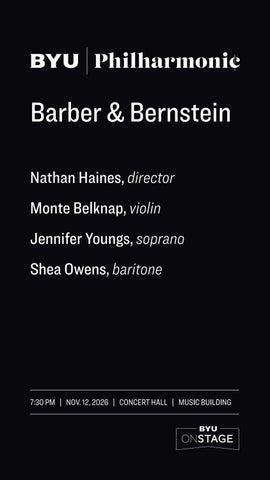
Barber & Bernstein Nathan Haines, director Monte Belknap, violin Jennifer Youngs, soprano Shea Owens, baritone
7:30 PM | NOV. 12, 2026 | CONCERT HALL | MUSIC BUILDING
Overture to The School for Scandal . . . . . . . . . . . . . . . . SAMUEL BARBER 1910–1981
Violin Concerto . . . . . . . . . . . . . . . . . . . . . . . . . . . . . . . . . . . . . . . . . . . SAMUEL BARBER Monte Belknap, violin — INTERMISSION —
Overture to Candide . . . . . . . . . . . . . . . . . . . . . . . . . . . . . . . . . LEONARD BERNSTEIN 1918–1990
Symphony No. 1, “Jeremiah” . . . . . . . . . . . . . . . . . . . . . LEONARD BERNSTEIN Jennifer Youngs, soprano
Candide, Act II: “Finale: Make Our Garden Grow” . . . . . . . . . . . . . . . . . . . . . . . . . . LEONARD BERNSTEIN Shea Owens, baritone, Candide Jennifer Youngs, soprano, Cunegonde BYU Vocal Department, Full Cast
Program Notes Samuel Barber (1910–1981) — Overture to The School for Scandal, op. 5 Written in 1931 while Barber was a student at the Curtis Institute of Music, this concert overture captures the wit and romantic intrigue of Richard Brinsley Sheridan’s comedy. Its bustling rhythms and sudden contrasts suggest a world of gossip and social maneuvering, while a tender oboe melody reveals Barber’s gift for lyrical expression. Rather than retelling the play, the music offers a lively portrait of its spirit. Samuel Barber — Violin Concerto, op. 14 Barber began his Violin Concerto in 1939, shortly after Arturo Toscanini’s performances of the Adagio for Strings and First Essay for Orchestra had brought him national attention. The commission came from Philadelphia industrialist and Curtis Institute trustee Samuel Simeon Fels, who intended the work for his protégé, violinist Iso Briselli. Barber composed the first two movements in Switzerland that summer and began the finale in Paris, returning to the United States as war approached. The commission became a source of disagreement, and Briselli ultimately relinquished the premiere. The familiar story that he rejected the finale simply because it was too difficult has been challenged by later accounts, which emphasize his reservations about its musical character and structure. Albert Spalding gave the public premiere on February 7, 1941, with Eugene Ormandy conducting the Philadelphia Orchestra. Barber continued refining the score, making revisions in 1948. The concerto has since become one of the enduring American contributions to the violin repertoire. Its appeal lies in the contrast between sustained songfulness and concentrated virtuosity. The violin enters almost immediately with the first movement’s warm, expansive melody. A long oboe solo opens the reflective second movement before
the violin takes up its theme. The brief finale changes the atmosphere completely: a breathless stream of rapid notes demands precision and stamina, bringing the concerto to an exhilarating close. Leonard Bernstein (1918–1990) — Overture to Candide Bernstein’s 1956 adaptation of Voltaire’s satire finds an ideal introduction in this sparkling overture. A bold fanfare launches music full of rhythmic surprises, quick turns, and orchestral color. Themes from the love duet “Oh, Happy We” and Cunegonde’s brilliant “Glitter and Be Gay” mingle with the bustle. Though the original Broadway production was shortlived, the overture quickly established an independent life in the concert hall. Leonard Bernstein — Symphony No. 1, Jeremiah Completed in 1942, Jeremiah helped establish Bernstein as a major American composer. He conducted its premiere with the Pittsburgh Symphony and soloist Jennie Tourel in January 1944, and the work won the New York Music Critics’ Circle award that year. Dedicated to his father, the symphony draws on the prophet Jeremiah and the biblical Book of Lamentations to explore warning, catastrophe, and grief. As Bernstein described it in his program notes for the March 1944 New York Philharmonic performances: "The intention is ... not one of literalness, but of emotional quality. Thus the first movement ('Prophecy') aims only to parallel in feeling the intensity of the prophet's pleas with his people; and the Scherzo ('Profanation') to give a general sense of the destruction and chaos brought on by the pagan corruption within the priesthood and the people. The third movement ('Lamentation'), being a setting of poetic text, is naturally a more literary conception. It is the cry of Jeremiah, as he mourns his beloved Jerusalem, ruined, pillaged and dishonored after his desperate efforts to save it."
Leonard Bernstein — “Make Our Garden Grow,” from Candide After the disasters and disillusionments of Candide, the finale turns from philosophical argument toward the practical work of building a life together. Richard Wilbur’s lyrics give Candide, Cunegonde, and their companions a shared purpose grounded in love, responsibility, and honest labor. Bernstein answers with a broad, earnest melody that grows into a full choral affirmation. The operetta’s wit gives way to a moving expression of hope through human effort.
Jeremiah — Hebrew Transliteration and English Translation III. Lamentation Hebrew (Latin transliteration)
English Translation
Eicha yashva vadad ha’ir Rabati am Hay’ta k’almana; Rabati vagoyim Sarati bam’dinot Hay’ta lamas.
Lamentations 1:1
Bacho tivkeh balaila V’dim’ata al lecheya; Ein la m’nachem Mikol ohaveiha; Kol re’eha bag’du va; Hayu la l’oyevim.
Lamentations 1:2
Galta Y’huda me’oni Umerov avoda; Hi yashva vagoyim, Lo matz’a mano’ach; Kol rod’feha hisiguha Bein hamitzarim.
Lamentations 1:3
How doth the city sit solitary, that was full of people! How is she become as a widow! She that was great among the nations, and princess among the provinces, how is she become tributary!
She weepeth sore in the night, and her tears are on her cheeks; she hath none to comfort her among all her lovers; all her friends have dealt treacherously with her, they are become her enemies.
Judah is gone into exile because of affliction, and because of great servitude; she dwelleth among the nations, she findeth no rest; all her pursuers overtook her within the narrow passes.
Hebrew (Latin transliteration)
English Translation
Chet chat’a Y’rushalayim…
Lamentations 1:8 (excerpt) Jerusalem hath grievously sinned… The opening lament from 1:1 returns here.
Na’u ivrim bachutzot N’go’alu badam; B’lo yuchlu Yig’u bilvusheihem.
Lamentations 4:14
Suru tame! kar’u lamo, Suru, suru! al tiga’u…
Lamentations 4:15 (excerpt)
Lama lanetzach tishkachenu… Lanetzach ta’azvenu…
Lamentations 5:20 (adapted in the setting)
Hashivenu Adonai elecha…
Lamentations 5:21 (excerpt)
They wander as blind men in the streets, they are polluted with blood, so that men cannot touch their garments.
“Depart ye! Unclean!” men cried unto them, “Depart, depart, touch not!”…
Wherefore dost Thou forget us forever… forsake us forever?…
Turn Thou us unto Thee, O Lord…
Candide, Act II — Finale: “Make Our Garden Grow” Music by Leonard Bernstein; lyrics by Richard Wilbur Candide
You've been a fool and so have I But come and be my wife And let us try before we die To make some sense of life We're neither pure nor wise nor good We'll do the best we know We'll build our house, and chop our wood And make our garden grow And make our garden grow
Cunegonde
I thought the world was sugarcake For so our master said But now I'll teach my hands to bake Our loaf of daily bread
Cunegonde & Candide
We're neither pure nor wise nor good We'll do the best we know We'll build house, and chop our wood And make our garden grow And make our garden grow
Cunegonde, Old Lady, Paquette, Candide, Governor, Maximilian, & Pangloss Let dreamers dream what worlds they please Those Edens can't be found The sweetest flowers, the fairest trees Are grown in solid ground
All
We're neither pure nor wise nor good We'll do the best we know We'll build our house, and chop our wood And make our garden grow And make our garden grow
PHILHARMONIC PERSONNEL STRINGS
Violin I
Viola
1 Rachel Call* Madi Bowen* 2 Clara Gunnerson Lydia Peterson 3 Madalyn Thiriot Maylee Robbins 4 Eliza Andersen Ginny Hansen 5 Makenzie Brown Isabel Pugsley 6 Mayci Cornaby Katherine Fisher 7 Olivia Washburn Millie Unsworth 8 Emma Jacobson
1 Katie Lee* Mason Bean* 2 Lauryn Schofield Eva Zemp 3 Zoe Merkley Beth Williams 4 Katherine McConkie Sam Whitlock 5 Daniel Loveridge Hannah Cleavinger 6 Kayla Gleason Noah Guymon
Violin II 1 Anna Kimber* Eva Harmon Rhodes* 2 Rylie Pence Lexi Romeril 3 Sarah Campbell James Eastmond 4 Jane Marriott Elizabeth Loveridge 5 Audrey Baldwin Faith Lindquist 6 Lauren Miller Lucy Broadbent 7 Makenzy Lopez Eliza Shaw 8 Miu Sakurai
Cello 1 Ellie Wirthlin* J.D Alexander* 2 Sequoya Lee Grant Hill 3 Claire Mortensen Nicholas Berry 4 Amanda Maxwell Isabella Cahoon 5 Jarom Gardner Jane Henriksen
Bass 1 Dallin Ivie* Jacob Payne* 2 Jaeden Jorgensen Daniel Beutler 3 Ross Pope Meredith Malo 4 Chance Smithson
* Concertmaster/Principal/ Co-Principal
WOODWIND / BRASS / PERCUSSION / AUX.
Flute
Trombone
Kalina Rencher* Olivia Tobler Madison Franklin, +pic
Daniel White* Tyler Saville Luke Lehmuller, bass
Oboe
Tuba
Caroline Seamons* Marisa Wride* Hailey Wilkerson, +eh
Elliot Richards*
Percussion
Seth Rugg* Hyehyun Pak Melissa Coulter, +bass clar
Ben Smith* Raiden Sasaki Luke Banks Julia Steed Trevor Kroff
Bassoon
Harp
Brayden Holdaway* Maggie McHenry Madeline W. Wiseman, +contra
Ashlynn Wilkins* Emily McLain
Clarinet
Horn Kyle Bishop* Spencer Landen Julianna Harvey Brooke Babcock
Trumpet Abe Smith* Emma Wycherly Casey Harris Kylee Bergstresser
Piano Christopher Papenfuss* * Principal/Co-Principals
Biographies Nathan Haines is an accomplished conductor, educator, and the director of orchestras at Brigham Young University’s School of Music in Provo, Utah. He holds a PhD in orchestral conducting and music education from Florida State University. Dr. Haines leads the BYU Philharmonic in multiple concerts throughout the year as well as the BYU Chamber Orchestra in international tours. In addition to his performance schedule, he teaches courses in conducting and orchestral literature. After earning a bachelor of arts in percussion from Brigham Young University, Nathan Haines went on to complete a master of music in orchestral conducting under Kory Katseanes. His career has taken him to prestigious venues across the globe, with performances in Asia and Europe. He has studied and performed with top professionals from around the country, including the United States Army Band “Pershing’s Own” in Washington, D.C. Most recently, he was invited to guest conduct for the world-class Ballet West in their production of Jekyll and Hyde, choreographed by Val Caniparoli. Dr. Haines is a strong advocate for the orchestral arts, particularly in new and innovative projects. As a firm believer in the importance of music education, Dr. Haines has presented and published his research at the state and national levels. His dissertation at Florida State, titled “Conducting with Multimedia in Live Performance," provides a framework of techniques and technologies that conductors can use on the modern concert stage. When not conducting orchestras, Nathan enjoys writing, alpine skiing, disc golf, and hiking. He is supported by his wife Elise Haines, who specializes in audience interaction and
performance studies and holds a masters in theater and media arts from BYU. They have three beautiful children; Estil (7) and Rowe (5), and Nico (1). Monte Belknap is a world-class violinist and master teacher known for his deep, singing tone and breathtaking virtuosity. For over five decades, he has captivated audiences across the globe, earning acclaim for his artistry and commitment to musical excellence. A winner of the International Starling Violin Competition at the Aspen Music Festival, Monte has performed as a soloist, chamber musician, and concertmaster in prestigious venues worldwide. His performance of the Barber Violin Concerto was praised by Ed Reichel of the Deseret News, who wrote: “Belknap captured the eloquence of the music with his luxurious playing that embraced the lyricism fully. . . . It was a tour de force performance.” Monte’s passion for new and meaningful works is evident in his world-premiere recordings, including Homage to a Son by Steve Lindeman. His artistry has been featured in film and television projects such as Lamb of God: The Concert Film, The Mormon Battalion: A Symphonic Saga, The Work and the Glory films, and the Book of Mormon videos, as well as popular video games like Lord of the Rings and Dungeons and Dragons. His recording of all Beethoven Violin Sonatas has been widely praised. An esteemed chamber musician, Monte has performed alongside international artists such as Menahem Pressler, Miriam Fried, Mark Kosower, John Novacek, and Jeffrey Solow, among many others. He has also served as concertmaster and soloist for Andrea Bocelli, Josh Groban, and Idina Menzel.
Dr. Jennifer Youngs has been assistant professor and coordinator of vocal studies at Texas Woman’s University since 2017. She earned a doctor of musical arts degree in performance and pedagogy as well as a master of music degree in performance and opera from the University of North Texas and a bachelor of music degree in performance from the Conservatory of Music at University of the Pacific. Soprano Jennifer Youngs began her 2019-2020 season with an appearance as Armida in Handel’s Rinaldo with The American Baroque Opera Company. Jennifer made her main stage Dallas Opera debut as Olimpia in Argento’s The Aspern Papers and was seen in the role of Laurette in the Dallas Opera Outreach production of Bizet’s Dr. Miracle. Opera roles include Lucia in Lucia di Lammermoor, Donna Anna in Don Giovanni, Birdie in Regina, Vitellia in La clemenza di Tito, Casilda in The Gondoliers, and Clorinda in La Cenerentola. She has been a featured soloist for Mahler’s 4th Symphony, Carmina Burana, Beethoven’s 9th Symphony, Handel’s Messiah, Haydn’s The Creation, Bach’s Cantata No. 110, Brahms: A German Requiem, Mozart’s Exsulate, Jubilate, and Mozart’s Requiem. She has been a featured soloist with The Dallas Symphony, Abilene Philharmonic, Winston-Salam Symphony, Richardson Symphony, and University of North Texas Symphony orchestras. Jennifer is a champion for living composers and has been featured on recitals with composers Jake Heggie, Tom Cipullo, S. Andrew Lloyd, Paul David Thomas, Lisa Despain, Dominick Argento, and Dave Brubeck. Jennifer also is a member of the Grammy-nominated ensemble, The South Dakota Chorale. Jennifer has been nominated for a Richard Tucker Foundation Career Grant in New York City. She is the winner of the Lois Alba Aria Competition, winner of the Kansas City District of the Metropolitan Opera Council Auditions, winner of the concerto competition at The University of North Texas, and a semi-finalist in the Loren Zachary Vocal Competition.
Shea Owens Hailed for his “beguilingly sounding” (Opernwelt) voice and his “irrepressible playfulness” (Luzerner Zeitung) on stage, baritone Shea Owens continues to be recognized for his artistry and vocal versatility. He was recently seen performing the role of The Pilot in Utah Opera’s production of The Little Prince, Mercutio in Central City Opera’s Roméo et Juliette, and the baritone soloist in Fauré’s Requiem with The Florida Orchestra. Mr. Owens is a former ensemble member and soloist of Theater St. Gallen in Switzerland, where he was recently invited back to be the baritone soloist in Carl Orff’s Carmina Burana. He also previously performed as the guest soloist with the worldrenowned Tabernacle Choir and Orchestra at Temple Square for their Love Thy Neighbor special event as well as the Chorale at Temple Square’s concert of Mac Wilberg’s Requiem. He has performed with other distinguished companies such as the Grand Théâtre de Genève in Switzerland, the Théâtre du Chátelet in France, and the Metropolitan Opera in New York. Along with traditional operatic and concert work, he especially enjoys the challenge and novelty of interpreting the works of contemporary composers, such as performing the role of Charlie in Jake Heggie’s Three Decembers alongside legendary mezzo-soprano Frederica von Stade. He has also recorded an album with his wife, soprano Madison Leonard, and pianist Artem Belogurov titled To the Thawing Wind: Songs of Paul Edward Gay, to be released at a future date. Mr. Owens received his bachelor of music degree from Brigham Young University and his master of music degree from Rice University. Along with maintaining an active performing career, he currently serves as an assistant professor of voice and the director of opera at Brigham Young University.
Your donations open doors for BYU School of Music students!
D O NATE N OW