Day-to-day life activities that need rental vehicles
(e.g.,
(visiting a patient or taking yourself or others for healthcare)
Demand up, but prices under pressure
2025 has proved to be a challenging year for rental companies. While demand and transaction numbers have been strong in some sectors, the abundant availability of new vehicles has increased supply and led to a reduction in rates as firms compete for business. Downward pressure on pricing has been exacerbated by the growing presence of comparison sites and aggregators in the tourism sector, where prices typically outrank other criteria such as location, age of vehicle or mileage allowances in customer decisions. In a further blow to the industry, the ferocious competition between OEMs for sales and market share has led to significant discounting, which has left some rental companies in a negative equity situation for older vehicles bought for peak prices at the height of the pandemic.
Seasonality and steady demand
Seasonality has a strong role to play in rental demand for some sectors of the industry. The summer months, for example, see a spike in in-bound tourism business at all the main airports, with Edinburgh in particular being cited by several executives as a location with an exceptionally buoyant peak season. Rentals at larger airports with more long-haul flights typically see longer hire periods than regional airports. Elsewhere, demand for panel vans naturally rises in the last quarter of the year when logistics companies need extra capacity for Christmas deliveries. For much of the year, however, demand for light commercial vehicles is both steady and long-term, with customers wanting specialist models such as flatbeds, tippers, and Lutons for extended periods.
Source: BVRLA Societal Impact Research 2024
Source: BVRLA Societal Impact Research 2024
Customer categorisation
Car rental LCV rental
Customer categorisation
Rental companies have a widely varying spectrum of insights into how their vehicles are used by customers. Retail demand from local and in-bound tourists are the easiest categories to identify, but the corporate and business sectors splinter into multiple user groups. Some, such as in-bound business executives, are straightforward to define. Others, however, can become blurred through the booking process, especially if the booking comes from a third-party broker. In these circumstances it’s difficult to know if a hire is to replace a broken-down or crash damaged vehicle, or if a lengthy rental is to fill the delivery time of a new company car for an employee or merely to provide mobility for a timelimited project. Smaller, regional operators understandably seem to have a more detailed knowledge of their customers’ specific uses, but national firms also categorise customers in great detail.
Rental as an economic indicator
Demand for rental vehicles provides an immediate insight into sectors of the economy that are performing strongly or weakly. In the former camp, several rental operators identified the film and television industry as a growing market, alongside events, from festivals to concerts to sporting championships. Home delivery for e-commerce also continues to require hire vehicles. On the other hand, the ready availability of new vehicles spells fewer hires for pre-contract company cars, while tight budget constraints in the public and university sectors have limited demand. The greater popularity of video conferencing and closer control of corporate travel budgets means B2B demand for cars has declined since Covid. The one area where rental operators are anticipating growth is construction, although the pause in HS2 has dampened demand.
Source: Rental Operator Survey, September 2024
Source: Rental Operator Survey, September 2024
Source: BVRLA Societal Impact Research 2024
LCV rental and hire periods
Van rental a strategic alternative for businesses
Uncertainty in the economy has provided a boost for light commercial vehicle rental firms, with customers viewing hire and flexi-hire arrangements as strategic alternatives to leasing or acquisition. Rental offers flexibility, lower upfront cost and avoids long-term commitment when business confidence is low. Operators report stronger demand for chassis-based LCVs, such as flatbeds, tippers and Lutons, as well as short wheelbase panel vans. But demand for pickup trucks has evaporated following the change in benefit in kind tax rules that now treat these vehicles as if they are company cars. The average age of the LCV fleet is shortening as supply becomes more readily available, following the acute shortages during and after the pandemic when several operators found themselves having to MoT their LCVs for the first time.
Rental periods shorten, but transactions increase
The average length of rentals has shortened slightly, report rental executives, although this very much depends on why a customer has hired a vehicle. Shorter lead times for new company cars, for example, means shorter precontract hires to keep employees mobile. In the retail market, the continued bite of the cost-of-living crisis is leading customers to keep hire periods as brief as possible. But in other sectors, especially for vans, hire periods extend to months and even years, with rental firms keen to support flexible rental products that endure like leasing but give customers the freedom to end the arrangement without any termination penalty. The efficiency of longer hires, even at lower daily rates, is attractive from a business perspective by avoiding the cost and staff resource involved in vehicle handovers.
Why organisations rent LCVs
Bookings by length of hire
Source: Rental Operator Survey, September 2024
Source: Nexus
Fleet management strategy
Holding periods extend compared to pre-Covid
The volatility of residual values is pushing rental companies towards longer holding periods than prior to Covid-19, eliminating one of the industry’s former profit opportunities. Pre-pandemic, large discounts and fast-cycle fleets had created the potential for a windfall at disposal, but firms say this has now evaporated. Plus, with more new cars incurring the Expensive Car Supplement, longer holding periods enable firms to amortise this cost. There is still pressure to run younger vehicles, because these present customers with the most attractive cars and vans in terms of both technology and condition, but the holding period is increasingly dictated by OEM buy-back agreements, which is creating a wider spread of contract lengths. As a rule of thumb, the holding period of cars is significantly shorter than of vans.
SMR, warranties and minimising downtime
Vehicle downtime due to warranty recalls and lengthy waits for appointments is creating a headache for rental operators. Many firms use service and maintenance workshops outside manufacturer franchises, but warranty work typically has to return to dealerships, where parts delays can ground a vehicle for days. And there is a sense that the number of recalls is rising dramatically. Even rental operators that have their own workshops are finding service and maintenance challenging, with fierce competition to recruit and retain technicians, particularly those qualified to work on heavy commercial vehicles. Generous signing-on bonuses have become commonplace, with firms requiring more maintenance capacity as their fleets age. Nor are EVs proving any cheaper to keep on the road, with increased tyre costs and longer repair times, due to the need to drain batteries before starting work, creating SMR bills that are 10-15% higher than ICE.
Source: Rental Operator Survey, September 2024
ZEV Mandate, electrification and CO2 emissions
ZEV Mandate complicates vehicle supply
Vehicle availability has returned almost to pre-Covid levels, easing fleet replacement issues, but procurement is complicated by the Zero Emission Vehicle Mandate. Manufacturers are trying to stipulate that rental companies include a percentage of electric vehicles in their orders that match the demands of the mandate, whereas hire companies are reluctant to pay more for vehicles that few customers want to rent. Most rental firms insist any EVs are supplied on buy-back agreements, with none wanting to carry residual value risk on these vehicles. Given the high price reported for EV buybacks, it appears that manufacturers don’t have much faith in EV residual values either. For rental companies that are part of larger groups with leasing arms and dealerships, EVs can be channelled for sale through these other outlets.
Average emissions of rental fleet, 2022-2024
Source: Rental Operator Survey, September 2024
Zero demand for zero emission hire cars
Rental demand for electric cars is minimal. Pressured to include a percentage of EVs in their orders to help OEMs meet their ZEV Mandate targets, rental companies are trying to stimulate the market, with guides to EV driving and maps of charging stations. Company car drivers requiring a hire car to replace their own EV, and the growing number of drivers with an automatic-only licence will accept EVs. However, domestic and in-bound tourists do not want to complicate their holidays with unfamiliar technology, and business travellers will only accept an EV if their journey is within the battery range of the car. Utilisation rates of EVs are 10 percentage points lower than ICE, said one firm, but holding costs are twice as expensive.
127G/KM AVERAGE EMISSIONS OF CARS ON RENTAL FLEET
Convincing customers to try EVs, and solving charging complexities
Renters need more confidence in charging
Charging infrastructure is the biggest barrier to renting an electric vehicle, according to a survey of more than 1,800 rental customers by Zest Car Rental. Half the respondents identified charging infrastructure as their principal obstacle, followed by vehicle range and charging times. Fewer than a quarter of the respondents own an EV, but 39% reported a positive perception of the technology (although 44% have a negative perception). Among those who rented an EV, almost two-thirds had a positive experience, and only 21.5% would try to avoid renting an EV again in future. The research also found widespread scepticism that batteries will provide the powertrain of the future, with only 29% of respondents thinking electricity will be the main car fuel of the future, compared to 44% for hybrid technology.
Charging infrastructure challenges
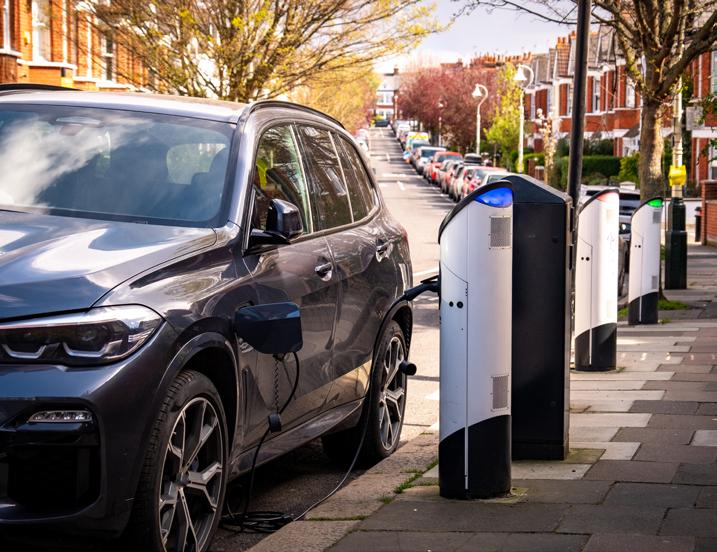
Charging infrastructure and downtime are critical barriers to EV adoption for rental operators. In peak season, the turnaround of cars at busy locations is just a handful of minutes, so having to plug a car in for an hour to recharge it undermines productivity. Worse still, sourcing power capacity to rental stations is proving to be exorbitantly expensive, and at some airport locations the power simply isn’t available. As a result, some larger operators are having to employ staff to drive to rapid charging stations, which have the highest cost tariffs, and wait with the cars while they charge. At other sites, securing capacity via a grid upgrade costs north of £500,000, to which the cost of civil engineering and chargepoint hardware must be added to the installation, making a return on investment exceptionally difficult to achieve.
Barriers to EV rental
Unfamiliar
Charging
Charging
Based on survey of 1,800 renters by Zest Car Rental
Based on survey of 1,800 renters by Zest Car Rental
The electrification challenge and new entrant OEMs
EVs – higher costs and lower utilisation
Too expensive to acquire, too volatile in their residual values, and suffering too high depreciation – electric cars and vans are proving difficult for rental companies to operate from a financial perspective. Competition for new EV sales has intensified as new OEMs fight for market share, with the result that motorists can acquire a new model for less than a hire company had originally forecast it was going to sell its ex-rental EV. Executives report that they are in ‘negative equity’, with several urging the Government to suspend or abandon the ZEV Mandate, blamed for pumping electric cars into a used market that doesn’t want them. One director cited the practical approach taken by Greater Manchester, which backed away from its ultra-low emission zone because the financial impact on businesses and households would have been unsustainable.
Wide open to new brands
Rental companies are open-minded about adding new OEM brands to their fleets, with cost driving their decisions. So much business is driven through aggregator sites, which offer the same daily rental fee regardless of whether a vehicle is from a new entrant or an established manufacturer. The most important considerations, alongside price, are vehicle quality – will customers accept it? – and aftersales support. How far is the nearest service centre and how swift is the supply of replacement parts? If both of these can match legacy brands, then the attractive terms on offer as new players use the rental sector to boost their exposure, will see a greater diversity of makes on car hire fleets. But LCV rental operators appear more conservative in their attachment to legacy brands, due to both customer preference and aftersales.
Risk and threat
Fraud and theft are a constant concern
Fraud and theft prevention are never far from boardroom discussions at rental companies, with organised crime continuing to pose a threat. The ability to rent an asset worth tens of thousands of pounds for just a few pounds will always make the sector a target of criminals, although the increasing connectivity of new vehicles should make recovery easier, at least from ‘amateur’ thieves. Even if a vehicle isn’t stolen, its use by a gang could see it impounded for days or weeks by the police, preventing rental companies from hiring it out. With uncertainty in the economy, companies are also braced for bad debts, with long-term flexi-rent customers failing or deciding to stop paying their hire fees. “It’s no longer enough to know your customers really well, you need to know your customers’ customers too,” said one executive.
453,955 Vehicles
BVRLA short term rental industry
The vehicle rental sector employs over 30,000 people, and operates a fleet of around 450,000 cars and vans.
BVRLA members operate over 1,500 rental stations in every region of the UK.
Source: BVRLA membership data, 2024
BVRLA
Outlook
Britain’s rental companies are at the heart of the national economy, helping businesses to expand more rapidly to meet demand, providing access to commitment-free transport when business confidence is low, keeping motorists mobile when their own cars are off the road, and offering the most flexible travel option for domestic and in-bound tourists.
Rental is a truly broad umbrella, covering micro-cars to highly specialist commercial vehicles, with hire periods stretching from minutes to several years.
The unifying factor is flexibility – providing customers with the vehicle they need, for as long as they require it, with the freedom to return it without a termination penalty the instant they no longer want it.
Research by the BVRLA has found that many businesses – particularly SMEs – rely on rental as a flexible, off-balance sheet and fixed cost way of managing their travel and transport requirements. Half of all business rental is with SMEs, and among customers with 11-50 employees, 82% rely fully or partially on vehicle rental. More than a third cited rental as providing the facility for accessing vehicles without a major capital investment, while a further 40% said rental reduces the financial and operational burden of vehicle maintenance and upkeep.
Ironically, the weaker the economy the stronger the demand for rental vehicles, as business customers lack the financial resources and confidence to acquire
their own vehicles. Consequently, 2025 has proved to be a successful year in terms of the number of rental transactions, with small, medium and large operators reporting strong demand across most market sectors.
Unfortunately for the industry, this healthy demand has not gone in tandem with a commensurate rise in rates, as happened in the aftermath of the pandemic. Instead, a variety of headwinds have conspired to intensify competition and amplify fleet holding costs.
Vehicle supply lines have fully recovered, enabling operators to restore their fleets to maximum capacity, and with more vehicles chasing customers, prices have been cut. The price pressure is particularly acute in the tourism sector, where rental companies say price aggregators are fuelling a race to the bottom in which the basic rate eclipses issues such as location, age and condition of vehicle, mileage limits and insurance terms. Loyalty programmes are more important than ever to overcome a fight on price.
The average duration of rentals has shortened slightly in the past year, due to: shorter lead times for new cars reducing the requirement for pre-contract cars; swifter crash repairs as parts supply chains have returned to normal; a rise in day hires for employees who had been largely home based and are now visiting customers again; and a desire among hirers across the economy to lower their spend. Rental firms report that the number of transactions has actually risen, although there’s naturally greater business efficiency in fewer, longer rentals that require less vehicle preparation in between customers.
Managing both fleet size and moving vehicles between locations to meet peak local demand, such as airports in summer, individual events like the Edinburgh Fringe, or panel vans in the run-up to Christmas, is one of the industry’s skills, especially among companies with
l Very positive
l Somewhat positive
l Neutral
l Somewhat negative
l Very negative
l Fantastic
l Generally positive
l OK, but would think twice before repeating
l Poor, would repeat if no other option
l Awful
Customer perception of EVs
Customer experience of renting EVs
Zest
BVRLA Member Outlook
multiple rental stations. They report a buoyant inbound tourism sector and burgeoning demand from television and film companies for temporary vehicles to support productions. But news from the construction sector is mixed, with demand yet to match the Government’s growth rhetoric for house building, while the cancellation of large sections of HS2 has negatively impacted the requirement for vehicles that had been on long-term rental.
Belt-tightening in the public sector has also cut demand from an important customer base.
At the same time that firms are facing pressure on pricing, they are also experiencing volatility in the used vehicle market, which has increased holding costs. Former business models that enabled operators to achieve a notional profit at disposal no longer apply, and some commercial vehicle rental companies say they are now facing negative equity in vehicles for which they paid top dollar during and after Covid. Companies differ in their approaches to sourcing, with some buying vehicles outright, others leasing them, and others negotiating buy-back agreements with manufacturers. Buying naturally brings flexibility over vehicle holding periods, but also residual value risk, which has become an even more serious issue since firms started adding electric vehicles to their fleets.
Holding periods have shortened since the supply shortages of coronavirus forced operators to keep hold of whatever vehicles were available, but are still longer than pre-pandemic fleet plans. Some timeframes are dictated by the terms of buy-back agreements, others by the depreciation sweetspot of optimum used values. In general, commercial vehicles are held for longer than cars, and the more specialist a commercial vehicle, such as tippers and dropsides, or vehicles with clientspecific racking and equipment, the longer it is kept.
Rental fleets are also increasingly diverse in terms of brand, with new entrant manufacturers keen to use the sector to build awareness and grow UK volumes. Many of these cars are petrol or plug-in hybrid, rather than pure electric, and rental operators report good customer acceptance. Their primary concerns are the ability of these OEMs to supply vehicles on time and on schedule, and to provide efficient aftersales support in terms of both workshop facilities and parts availability.
The growing complexity of vehicles from all manufacturers appears to be leading to more safety recalls, which cripple productivity with unscheduled downtime.
“Warranty recall issues are huge at the moment, and that’s where we see a real difficulty in getting cars in for warranty work and waiting for parts,” said one executive.
Furthermore, the connectivity features of new cars present a data privacy challenge for hire firms, especially those with large daily rental fleets. If a renter connects their phone via Bluetooth to the car, or downloads the manufacturer’s app, all of their data needs to be deleted before the vehicle can be hired to the next customer. With each OEM operating different processes for deleting data, rental firms need a more efficient solution to deal with this technological task.
These challenges pale into insignificance, however, in the face of electrification and the pressure from manufacturers for orders to include the percentage of electric cars and vans dictated by the Zero Emission Vehicle Mandate. With the average age of rental vehicles being just over 12 months, operators argue convincingly that their fleets are the cleanest on UK roads, but the stepchange to full electrification is proving to be highly problematic.
fuel type, 2021-25
BVRLA Member Outlook
Firms report only one customer base for electric cars, namely company car drivers whose own electric car is off the road for whatever reason, and who have charging infrastructure already installed at their homes. In-bound tourists and domestic leisure renters do not want to complicate their holiday plans with the need to find chargers, while business customers simply want the most efficient travel.
“This situation is not going to change until customers have no choice apart from an EV,” said one director.
Market research by Zest Car Rental has found that almost two-thirds (64%) of drivers who do hire an EV have a positive experience, which is a much greater percentage than the 39% whose general perception of EVs is positive. This highlights the role that rental could play in encouraging more drivers to transition to the technology by enabling motorists to try before they buy, although the numbers of hires is extremely limited.
Data from Nexus reveals, for example, that the number of EV rentals recorded by its system totalled an average of 157 per month in the peak months of May to August, whereas ICE rentals averaged 16,200 per month.
Hire companies have invested heavily in training their staff to educate customers about how to use an electric vehicle. They constantly promote the benefits of rental’s try-before-you-buy facility for business and private drivers to trial an EV without commitment before deciding if the technology works for them. Firms have created apps that locate public chargers, and a couple of major players have even launched offers that allow customers to take a car with an 80% charge and return it with a 20% charge. This would be unthinkable with a tank of fuel and for some other operators it sets an unacceptable expectation for the future of EV rental, especially where rental companies have to rely on high cost, ultra-rapid public chargers to recharge the cars.
Accessing sufficient power capacity to fast-charge EVs at a rental station costs more than half a million pounds, they report, and they’re obliged to pay for the maximum capacity required during the year, even if this is only required for two peak summer months. Moreover, the first mover pays, with neighbouring companies able to piggyback for free on local grid upgrades.
“And even if we did have 10 chargers at a branch that were doing 20-minute rapid charges, how could we do it quickly enough to put out just 50 vehicles, which would be an easy day for us?” asked one director.
But in some airport locations, the power demands of the airfield are so high that rental firms are finding it almost impossible to secure a grid upgrade and sufficient energy capacity to install chargers at their stations.
“We would normally be turning hire cars around in minutes at a busy rental station, but instead we’re having to pay staff to drive EVs to a local charging hub and sit with the car while it recharges,” said one executive. “Every single minute that a car isn’t available for rent costs us money.”
Another highlighted the ‘wild west’ of the charging infrastructure industry, with tenders for charging hardware and installation from potential suppliers differing by more than 100%.
The situation is even more acute in the light commercial vehicle market.
“The demand for electric commercial vehicles is a tiny fraction of the ZEV mandate,” said one director. “The utilisation of these vehicles is well below what’s needed to make them pay.”
“We would normally be turning hire cars around in minutes at a busy rental station, but instead we’re having to pay staff to drive EVs to a local charging hub and sit with the car while it recharges,” said one executive. “Every single minute that a car isn’t available for rent costs us money.”
BVRLA Member Outlook
The large van class is particularly problematic with the extra complications associated with running vehicles that weigh between 3.5 and 4.25 tonnes. These can be driven on a standard B licence (usually capped at 3.5 tonnes), so long as the additional weight is due to batteries, but require a tachograph, preventative maintenance inspections and annual MoTs, which involves more cost and work for rental operators.
And even if rental operators could make EVs work from an operational perspective, the finances do not stack up. The vehicles are more expensive to acquire, have suffered precipitous depreciation (most rental companies will not accept the residual value risk on EVs and will only accept them on buy-back agreements), but customers see no need to pay more to hire an EV than an equivalent ICE vehicle – they are simply buying a solution to their travel and transport needs.
“Our electric cars have a 10 percentage point lower utilisation rate, but twice the monthly holding cost,” said one executive.
Increased tyre costs and longer repair times, due to the need to drain batteries before starting work, mean EVs are costing 10-15% more to maintain, which is counter to original expectations.
“Our electric cars have a 10 percentage point lower utilisation rate, but twice the monthly holding cost,”