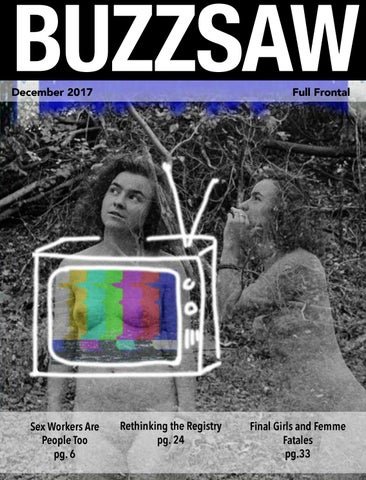
BUZZSAW
December 2017
Sex Workers Are People Too pg. 6
Rethinking the Registry pg. 24
Full Frontal
Final Girls and Femme Fatales pg.33
Buzzsaw presents...
EDITORS’ COMMENT
The Naked Issue
Naked and afraid? You should be.
BUZZSAW News & Views Upfront Ministry of Cool Prose & Cons Sawdust
Being naked elicits feelings of vulnerability and transSeesaw parency and also has sexual connotations. So grab a magazine, strip down and start reading.
Layout Art
Buzzsaw examines the cyclical and archaic debate that Website has stymied gun control legislation and increased mass Social Media shootings (Firing Back, p. 8).
Mila Phelps-Friedl Alexis Morillo Evan Popp Audra Joiner Alex Coburn Kimberly Caceci Jordan Aaron Will Cohan Julia Tricolla Tatiana Jorio Tara Eng Brianna Pulver Claire McClusky Christine McKinnie Kevin Swann
How do you reclaim your sexuality after experiencing sexual assault? A Buzzsaw editor tackles this question in a powerful personal essay (Me Too, p. 14). With all of the sexual abusers being exposed in Holly- Advisor wood, it’s easy to forget that this issue is anything but Founders new. In fact, Hollywood is practically built on the systemic silencing of sexual assault victims. (The Could Ruin Their Career, p.32).
Divider and Table of Contents Photography By Quin Crofton Quin Crofton is a Philadelphia Pennsylvanian pursuing a BFA in Film and Photography. A study of the real and the unreal, and the weirdness in between.
Jeff Cohen
Abby Bertumen Kelly Burdick Bryan Chambala Sam Costello Thom Denick Cole Louison James Sigman
Buzzsaw is published with support from the Ithaca College Student Governance Council and the Park School of Communications. Vanguard Printing is our press. (Ithaca, N.Y.)
BUZZSAW: The Naked Issue
Buzzsaw uses student-generated art and photography and royalty-free images. Views expressed in this magazine are not necessarily those of the editorial staff or of Ithaca College. Feedback and contributions should be sent to buzzsawmag@gmail.com. Front cover art by Claire McClusky Center art by Josie Sepel Back cover art by Claire McClusky
2
Write Us Our magazine exists to inspire thoughtful debate and open up the channels through which information is shared. Your comments and feedback are all a part of this process. Reach the editors by email at: buzzsawmag@gmail.com.
Seesaw ..........................................................4 Print media is dead, check out multimedia on the web.
News & Views .................................................5 Current events, local news & quasi-educated opinions.
Upfront ........................................................13 Selected dis-education of the month.
Ministry of Cool ........................................28 Arts, entertainment and other things cooler than us.
Prose & Cons .............................................39 Short fiction, personal essay and other assorted lies.
Satire threatening the magazine’s credibility since 1856.
3
BUZZSAW News & Views
Sawdust .......................................................45
Fashion Forward Thinking The ugly side to fast fashion consumption
By Rae Harris, Staff Writer
L
items. Far more clothing than ever before, is being purchased, and worn far fewer times. Sometimes purchased items aren’t worn at all. Clothing is treated as a disposable good, and is often sent to landfills. According to The True Cost, the average American generates about 82 pounds of textile waste per year. Learning this certainly changed how I looked at the brand new dress with the tags still attached that was hanging in my closet. It’s important to recognize that these cheap prices often add up. Planned obsolescence is a tool retailers use to ensure that customers will need to return to purchase more new clothing at faster rates. Instead of their garments being well-made out of lasting materials, they are made out of cheap fabrics and often with poor quality stitching. Essentially, they are designed to fall apart. Instead of purchasing one high-quality item that will last a long time, people tend to purchase several low quality fast fashion items and then dispose of it once it is unwearable. I was already questioning my shopping habits once I learned about how wasteful fast fashion is. But it turns out that the incentives for retailers to mass-produce large quantities of affordable clothing also have extremely negative effects on the environment. The rate at which fast fashion is being produced cannot be sustained in the long term. The entire process of fast fashion contributes to global pollution. According to Greenpeace, the process of pollution begins with the textiles used to produce clothing. The synthetic fibers used for clothing production are created by extracted and refining oils and the cotton used is grown with pesticides or toxic fertilizers. Then, the factories that produce these garments are coal powered and often use hazardous chemicals. Additionally, textile pollution gets into waterways from the manufacturing and the growing of cotton. There is pollution at nearly every stage of textile production for the fast fashion industry. The fast fashion industry also runs
rampant with human rights abuse. According to The True Cost, there are roughly 40 million garment workers in the world. These workers are some of the lowest paid workers, and 85% of all garment workers are women. As a feminist, this exploitation of cheap labor at the almost exclusive disadvantage of women was hard for me to swallow. I was already horrified by these abuses, but the final straw for me was learning about the Rana Plaza collapse in Bangladesh, the deadliest garment factory accident in history. In 2013, the five-story building collapsed after the building owners ignored warnings to avoid using the building due to cracks in the foundation. Despite this, garment workers were ordered to return to work. The collapse killed 1,134 people. Seeing the gruesome and horrifying images of bloody garment workers brought tears to my eyes. They are truly haunting, and I can’t separate the faces of the wounded from the cheap clothing that hangs in my closet. All these revealations left me with a dilemma: can I be both stylish and ethical? It turns out, you can. I began researching ways I could make my closet more eco-friendly. I found ethical brands such as Everlane and Reformation, that produce ethically made and on trend clothing. Even second hand clothing has gotten a makeover. With apps like Depop and Poshmark, it’s easier than ever to score lightly-used clothing for affordable prices. Even thrifting is a great option. With so many 1990’s and early 2000’s trends on the runways, sorting through the racks at a thrift store is the perfect place to find mom jeans and crop tops for just a few dollars. And even though my journey to kicking my fast-fashion habit is only just beginning, you can catch me elbow deep in a bin of vintage denim, searching for the perfect, and more importantly, ethical pair of high waisted jeans. ____________________________________ Rae Harris is a third-year journalism major who paid less for her outfit and it’s cuter than yours. They can be reached at rharris3@ithaca.edu.
5
News & Views
eopard print coat. Silk slip dress. Six-inch heels. Faux fur. The perfect vintage Levi’s. Endless pairs of trousers made out of different fabrics. An array of patterned skirts. Band t-shirts and worn in high-waisted denim shorts. These are just some of the clothing items that make up my carefully curated closet. Fashion has interested me since I first started dressing in early 2000’s trends as a child, many of which ironically have now come back in style, like the iconic Juicy Couture sweatsuit. I’ve also been engaged in environmentalism since I joined an afterschool club called Kids For Saving Earth in the first grade. It was in these meetings that I was first introduced to activism and learned about the dangers of pollution, the threat of climate change and the impact humans have on the Earth. My love for fashion and my environmental activism are two things that haven’t always been easy to reconcile, but after watching the documentary The True Cost, I was forced to confront this dichotomy. The fashion industry is one of the largest global industries. According to Fashion United, the industry is valued at around 3 trillion dollars. A huge chunk of this industry is dominated by the incredibly wasteful fast-fashion industry, which consists of mass-produced clothing sold for cheap prices. Fast fashion brands include Zara, H&M, Forever 21, and Topshop — all of which I have bought from before. Fast fashion originated in the 1980’s, when retailers began speeding up the turnaround cycle of fashion trends. In the past, there were just four seasons in the fashion industry: spring, summer, fall and winter. Now, there are 52 micro-seasons for retailers to deliver clothing to customers. While I covet luxury fashion, As a college student living off of limited means, I can’t justify high end splurges. However, while affordable clothing seems like a positive thing on the surface, cheap prices have actually led to massive over-consumption of fashion
Sex Workers Are People Too
Examining where fourth wave feminism has fallen short of protecting sex workers By Alex Coburn, Ministry of Cool Editor
6
ones perpetuating it.
Image by Jen McQueeney & Julia Tricolla
T
is completely illegal, sex workers face abuse at the hands of their clientele. “Phoenix, AZ 37% of prostitution diversion program participants report being raped by a client, and 7.1% report being raped by a pimp.” To make matters worse, many sex workers are mocked or ignored when they report rape, because according to popular belief, sex workers always want sex, right? Wrong. Sex work is work, just like any other job. If you saw a Target cashier at a Walmart, you wouldn’t ask them to start scanning your items just because that’s what they do at Target. The same logic should easily apply to sex workers, but unfortunately, it doesn’t. According to the Huffington Post, in New York City, 80 percent of street sex workers report having experienced sexual violence; the number is 46 percent for indoor, or brothel-based, sex workers. The stats are even higher when pertaining to women of color or trans women. This sounds more “We’ve all joked about dropping out of like something college and becoming strippers, but it’s you would see in the 70s film not a joke to women whose livelihoods Taxi Driver or depend on sex work.” even the film Les Miserables, set in the situation perpetuates stigma, violence, 1800’s, but these statistics are from and impunity, which further endanger this very decade. And a lot of the reason that law entheir health and safety.” And the numbers of abuse are high. A Huffington forcement is less likely to be notified Post article written by Katherine Koster about these incidences of sexual viocites that, especially in states where it lence is because sometimes they’re the hird wave feminism has ushered in several huge breakthroughs for American women: the right to choose, Title IX, and more opportunity for employment in previously male-dominated fields. But one of the biggest issues the third wave concerns itself with is sex positivity. According to Everyday Feminism, sex-positive feminism is defined as the feminist rhetoric encouraging women to feel comfortable engaging freely with their sex lives, whatever that means for each individual woman. If a woman wants to have casual sex, that’s fine. If a woman wants to be celibate, that’s fine, too. But one group of women that sex-positive feminism has historically ignored is sex workers. Sex workers have been around since the beginning of civilization, but there has been hardly any increase in their rights. Prostitution is still illegal in all states except for Nevada, where it’s allowed on a very limited scale, making it incredibly hard for sex workers to seek justice when they are violated. Generally, when sex workers report rape or abuse, they run the risk of being arrested for prostitution rather than having their perpetrator arrested for sexual assault. According to the Open Society Foundation, “Criminalization makes it difficult for sex workers to report the rights violations, especially by the police, because they are vulnerable to arrest and retribution. This
“In a Chicago study, 30% of erotic dancers and 24% of street-based sex workers who had been raped identified a police officer as the rapist,” writes Katherine Koster for Huffington Post. “Approximately 20 % of other acts of sexual violence reported by study participants were committed by the police. In Bolivia, police regularly arrest sex workers and either extort money or force them to engage in coercive sex.” How is it possible for sex-workers to feel safe when the people they would usually go to for help, may actually be more involved than anyone would like to imagine? So, while sex work has been nor-
7
News & Views
lacy. In countries where sex work is everyone involved. Rather than bemalized to some extent, it’s still legal, it’s actually harder to engage ing afraid of reporting assault to the incredibly stigmatized and unreguin human trafficking; if prostitupolice, decriminalization would allow lated. There are so many popular tion is not swept under the rug and sex workers to file reports without cam-girl Twitter accounts now that done in secret, it illuminates the fear of detainment. it’s easy to forget there are still womunderground, suspicious behavAccording to a Rolling Stone article en, many women of color or trans ior adopted by human women, walking the street with no traffickers. “Removing protection by the law. We’ve all criminal penalties for joked about dropping out of college “If fourth wave feminism is sex work does not remove and becoming strippers, but it’s not penalties for exploitation, all about sex positivity, why a joke to women whose livelihoods forced labor, violence, depend on sex work. Just because have we forgotten all about trafficking, rape or sexual some Twitter account co-opts the sex assault — including of worker aesthetic and publicly sells minors,” Huang said. nudes, that doesn’t mean sex work “All of these are grave abuses, and by Margaret Huang, executive direcis safe or lucrative for most women. anyone who commits these crimes or tor of Amnesty International, our If fourth wave feminism is all about any other form of human trafficking current model is not working to prosex positivity, why have we forgotten or exploitation for labor must be held tect sex workers or clients alike. all about the sex workers? We’re all accountable to the fullest extent of “Such laws wound up putting sex profiting off the slightly more liberthe law.” workers in even more dangerous sitated sexual environment for women Since coming to college, I’ve realuations. Sex workers are often forced while pushing sex workers aside ized that the world of feminism is to put the protection of their clients completely. It’s amazing that we can larger than my privileged, straight, above their own well-being,” Huang get free condoms in school or that we white viewpoint led me to believe said. “This pushes sex work further feel comfortable going to the gyneas that fifteen year old who got her underground, making it difficult to cologist, but sex work is a frontier of hands on a copy of a Gloria Steinem seek help when needed. Sex workers feminism that has been left largely biography. If we’re not using our are also forced to meet clients in hidun-forged. Considering a lot of these privilege as college-educated femiden places where the risks to their women were the ones advocating for nists to fight for the rights of all safety are higher, rather than places sex-positivity in the first place, it’s women — including sex workers — where they know they will be safe.” time to uplift their voices into the then it’s not sex-positive feminism, or Decriminalization would also allow feminist movement. And not just cis feminism at all. sex workers to seek housing withwhite sex workers either — trans ____________________________________ out being evicted or discriminated women and women of color, too. It’s Alex Coburn is a second year Cinema against. Many sex workers report a time to start looking for solutions inand Photography Major. They can be stead of posting the thousandth nude hard time staying in one place due reached at acoburn@ithaca.edu. to aggresto Donate to help sex workers receive sions they your legal assistance by going to face from black Sex workers have been around suspicious Sexworkersproject.org. and white Tumblr since the beginning of civiliza- landlords; if work was porn blog tion, but there has been hardly sex decriminalized, — not any increase in their rights. this would no that you longer be can’t a problem. do Sex work both. can already be hard enough. DealThe easiest solution to this probing with aggressive clients or street lem is the decriminalization of harassment is troublesome already. prostitution. Human rights organiFinding housing shouldn’t be anzation Amnesty International spent other stress added onto sex worker’s three years conducting research and plates. working closely with sex workers to The main argument against the find a solution to the many problems decriminalization of sex work — disfacing those who do sex work right cluding moralistic, archaic ones — is now; the unanimous conclusion was that it will lead to an increase in that decriminalization would make human trafficking. This is a falsex work safer and more lucrative for
Firing Back
The cyclical debate on gun control By Isabel Brooke, Staff Writer
BUZZSAW: The Naked Issue
W
not an absolute right (if it is a right at e know the story: violence. These arguments, don’t seem to ef- all), and that there are circumstances news of a mass shooting breaks; fectively counter the position of gun which would curb that right. What remains is the conclusion of politicians and rights advocates. If gun ownership is public figures ex- a basic, inalienable right, as a differ- what those circumstances are and tend condolences ent reading of the second amendment how that right is waived. The governand prayers to the victims and their than presented earlier could imply, ment, as the body that ideally estabfamilies; elected officials and the me- then it is understandable why any at- lishes and upholds justice, would be dia call for gun control; and members tempt by the government to restrict the ones to enforce and regulate these of congress introduce a bill that is al- access to guns is seen as an infringe- restrictions. From this reasoning, govmost certainly voted down. And then ment of rights and therefore intolera- ernment enforced gun control is not the noise wanes, until another mass ble, as the popular, hard-line position an infringement of rights, but rather a protection and specification of them. would argue. shooting happens. George Washington University proSo, to have a productive discussion Arguments for gun control are founded commonly in the specific lan- on this topic, to break the madden- fessor of philosophy David DeGrazia guage of the second amendment and ing cycle of noisy inaction, gun con- suggests that to make the laws reflect gun violence statistics. The second trol advocates would have to create a this reasoning, citizens should be reamendment is worded unspecifically convincing, understandable argument quired “to pass a rigorous gun safety and is somewhat open to interpreta- proving that guns are not a basic, in- course.” Because statistics on suicide, tion. To be clear, it reads, “A well reg- alienable right. This would make gun homicide and accidental death show ulated Militia, being necessary to the control legislation seem reasonable how easy it is to abuse or misuse guns, security of a free State, the right of the and even necessary, and would there- DeGrazia suggests that gun ownership is often self-defeating, and people to keep and bear Arms, “on the whole, having guns shall not be infringed.” One at home increases the risk of reading of this language implies “And then the noise wanes, until household members’ suffering a (as was argued by Former Justice another mass shooting happens.” violent death.” He makes this John Paul Stevens) that this right claim by appealing to statisonly applies in the context of tics on suicide, homicide and state militias, and does not imaccidental death. A rigorous ply any sort of inalienable right fore move the debate forward. Such gun safety course as a prerequisite for for private citizens to own guns. gun ownership doesn’t seem absurd; The statistics on gun violence prove an argument, it turns out, exists. Most of our rights, it is important to cars have a similar potential for leto be more persuasive than this argument, as numbers do not leave as note, are not absolute. They can be thality, and we require education and much room for interpretation as eigh- overridden or waived; they are limited tests before citizens can legally operteenth century syntax. To list a few in scope. Our right to speak freely, ate them. Another common proposal such statistics: Robert Preidt of CBS for example, does not cover speech for gun control is background checks News reported that “Americans are that leads to illegal activity, obscen- — from the earlier reasoning, a fair 10 times more likely to be killed by ity, defamation or libel. Our right to and even necessary measure, so that guns than people in other developed freely practice religion doesn’t excuse guns aren’t in the hands of those who countries;” Kara Fox of CNN identified violence in the name of faith. And we don’t have the right to them. The debate around gun control now that “Americans own nearly half (48%) even give up our right to life when we of civilian-owned guns worldwide;” unsolicitedly physically assault some- seems to center around whether or not and German Lopez of Vox pointed one – the victim gains the right to kill the government should regulate gun out that America’s firearm homicide out of self-defense. Rights, then, have access. There are a few major reasons rate, which was 29.7 per every million a degree of fluidity, and they do not why it is so stagnant, but one of the people in 2012, is far higher than any hold when they begin to infringe on major obstacles is that this fails to address the more basic debate of whethother advanced country. Switzerland other rights. The same holds true for the right to er or not humans do or should have came in second with a firearm homicide rate of 7.7 per million. Statistics, gun ownership. If it were a natural- the right to guns, as our constitution to be sure, can vary depending on a born, truly inalienable right, we would says. Those advocating for gun connumber of factors, but it is undeniable have to argue that convicted felons, trol seem to start from the place that that the U.S. is experiencing a very children and terrorists should have either it isn’t a right, or if it is, it isn’t high, seemingly unnecessary, and ap- access to guns. If this seems wrong, inalienable. Those who are pro-gun parently preventable amount of gun we would agree that gun ownership is seem to assume that it is an absolute,
8
or very nearly absolute, right. With- run issue-based campaign ads of its out addressing this issue, compromise own. The NRA is impressively expansive isn’t possible, and noise is just that. Another major obstacle to the pro- and its messaging is comprehensible gression of the gun control debate is and popular. But the statistics arguthe National Rifle Association, unsur- ment and the constitutional linguistics prisingly. The NRA is a powerful, well- argument, as discussed earlier, are organized and active organization. It ineffective rebuttals of the NRA messaging has a sinbecause gular mest h e y sage, it has “A rigorous gun safety course as don’t adbecome the icon for an a prerequisite for gun ownership dress the N R A ’ s entire side doesn’t seem absurd” central of the gun m e s control des a g e : bate and it has passionate members who vote. that gun ownership is an inalienable Since the 1970s, the NRA has slated right which needs to be protected. the right to own a gun as “sacrosanct,” Those hoping to break the cycle of James Surowiecki of The New Yorker inaction should, therefore, consider writes. Thus, any attempt to limit that this more foundational question and right is an assault on personal liberty. should work to prove that gun ownerThis messaging and the use of fear ship is, morally, either not a right or tactics has created about 5 million de- that it is not an absolute right. And it is true that there will continvoted members, and though the NRA Political Action Committee is powerful ue to be dissent on this topic — some in electing pro-gun candidates, their will still argue that the right to own “average donation is around $35,” ac- guns, as an extension of the right to cording to CNN. And while the PAC self-defense, is inalienable. But if the can’t receive donations from corpora- mainstream debate centers around tions, the nonprofit NRA Institute for and starts with what an orderly sociLegislative Action can, and it uses that ety’s relationship to firearms should money to lobby for new laws and to be, the road forward would be more
easily and agreeably paved. When we start on the same page, we can follow the other side’s logic and demonizing or dismissing the other side is not as easy. This, of course, requires that we listen, but listening is easier if we’re discussing the same principles. The politics of this cycle requires that a unified body opposes and acts as an alternative to the NRA. Groups like Everytown for Gun Safety, Americans for Responsible Solutions, and the Violence Policy Center are all political groups which advocate for gun control, but none have achieved NRA status. At the political level, the unification and cooperation of these and other groups would seems a necessary step for legislative success of gun control groups. Changing the argument and then unifying the voices and groups involved sounds like a tall order. But it is necessary for the advancement of the cause, and the alternative is the continuation of the unproductive cycle that we are currently caught in. _____________________________________ Isabel Brooke is a third year Philosophy-Religion and Politics major who is tired of all these mass shootings. They can be reached at ibrooke@ithaca.edu. For more info go to, petitions.moveon. org/sign/gun-control-now-1.
9
News & Views
Image by Claire McClusky
Imprisonment, Harassment and Social Ostracism Muslims must reconcile with homophobia in Islam By Mahad Olad, Contributing Writer
BUZZSAW: The Naked Issue
I
read an article in Everyday Feminism titled, “Why the Idea That Islam Promotes Intolerance of the LGBTQIA+ Community Is a Lie.” In that article, Andrew Hernández argues that Islamic doctrine doesn’t promote homophobic attitudes. Instead, prejudices against sexual minorities in the name of Islam can be ascribed to Islamophobia, western imperialism, colonialism and the misinterpretation of Islamic scriptures for political gains. Hernández isn’t necessarily wrong. But these are apologetic arguments employed by commentators attempting to divorce homophobia from the foundational texts of Islam. There are plenty of other articles intent on furthering the fantasy of Islam as a gay-friendly religion, or at least understating the role Islam plays in fermenting homophobia. And after the Orlando massacre, writers from a number of left-wing publications tried to pin the rampage on factors like “toxic masculinity,” “christian zealots,” “white supremacy” and “capitalism.” Yasir Qadhi, a well-known Islamic scholar, declared that “Islam’s stance on homosexuality is irrelevant to this massacre, period.” Homophobia is not exclusive to Islam; other religions and institutions are also intolerant of LGBTQ people. But homophobia is deeply institutionalized in the Islamic world. Approximately 40 out of 57 Muslim-majority nations have laws that criminalize homosexuality. Ten of those countries impose the death penalty for homosexuality. In countries where the death penalty hasn’t been established, the gay community often endures imprisonment, harassment and social ostracism. In Egypt, where homosexuality isn’t technically illegal, debauchery laws are exploited to conduct mass arrests of LGBTQ people. Men and women suspected of being gay are tortured in Lebanon. And this past summer in Istanbul, Turkey, authorities fired tear gas, rubber bullets and water cannons to disperse a gay pride parade. The proposition that Islam does not doctrinally condemn homosexuality
10
is simply delusional. And this delusion precludes people from criticizing the anti-gay literature in Islam, which serves as the basis for Islamic laws that prescribe death and imprisonment for homosexuality, and prompts the depressing views Muslims have on homosexuality. I should know. Growing up in an Islamic community, I struggled with being gay and Muslim during my early teenage years. I felt tremendous guilt for harboring same-sex attractions and was convinced that Allah was going to throw me in the pit of hell. I had been taught in my madrassa that homosexuality was not merely repugnant but perhaps one of the worst sins Allah’s creations can possibly commit. I vividly recall the day same-sex marriage was legalized in the U.S. and how the leader of my local Mosque devoted his sermon to assailing the LGBTQ community. He described the LGBTQ community, especially gay Muslims, as pathetic weaklings who were wholly misguided about nature and religion and were rightly doomed for hell. This is the kind of homophobic rhetoric I grew up around. It was emotionally traumatizing and theologically disorienting. And it plunged me headlong into an abyss of anxiety, confusion and uncertainty that eventually resulted in my demise as a Muslim. From a theological perspective, homosexuality is not only a sin but a crime under Islamic law. The diversity of thought among the historical legal traditions has been limited to discussions of the type of punishments prescribed for homosexuality rather than the morality of punishing sexual orientation. In light of this, it is unsurprising that homophobic attitudes are prevalent in the Muslim world. According to a 2013 Pew Research Center poll, 75 percent or more of Muslims in 33 of the 36 Muslim countries consider homosexual behavior to be morally wrong. And 51 Muslim states blocked 11 gay and transgender groups from attending a United Nations meeting on HIV/AIDs prevention. Of course, plenty of Muslims don’t
harbor anti-gay attitudes. In fact, many Muslims themselves identify somewhere on the LGBTQ spectrum. Some are even able to maintain healthy relationships with their religion and respective communities. Similarly, Muslims should not be held responsible for the actions committed by fringe groups. But this should not preclude us from acknowledging the relationship between Islam and the homophobic attitudes found in Muslim communities. When Islamic extremists commit acts of violence against the gay community they are indeed driven by aspects of their religion. This isn’t to say that Islam is inherently and particularly violent. I’m saying that religious ideology is frequently a neglected and misunderstood explanatory lens. Muslim leaders should cease making apologetic claims to defend their faith, and instead condemn homophobia and make mosques more inclusive for LGBTQ Muslims. They should follow the examples of Daayiee Abdullah and Muhsin Hendricks, both openly gay Imams putting their lives at risk to establish inclusive spaces for queer and questioning Muslims. Progress will only occur once Muslims begin critiquing Islamic prohibitions of same-sex activity. This may be an untenable suggestion because it is not usually acceptable in Muslim communities to question sacred texts. But that shouldn’t stop LGBTQ Muslims from reexamining scripture that is often used to discriminate against them. Muslims are a marginalized community. Therefore, they have a duty to stick up for other oppressed groups, including LGBTQ folks. In the words of religious scholar Reza Aslan and Muslim comedian Hasan Minhaj, “Democracy isn’t a buffet. You can’t pick and choose which civil liberties apply to which people. Either we are all equal, or the whole thing is just a sham.” _____________________________________ Mahad Olad is a second-year politics major with a minor in dropping some truth. You can email them at molad@ithaca.edu.
The Future of Advocacy
IC Club looks to give a voice to the voiceless By Christine McKinnie, Web Editor
D
uring a typical meeting of the Ithaca College Futures club, you can find students from all five IC schools gathered together in one classroom. The club poses open ended questions in order to cultivate an environment in which members of the club can openly discuss sensitive topics like race, gun control and gender fluidity. Students share their personal experience, which contributes to an enriched conversation and every week the discussion is different. One of the conversations they’ve had, which was about sexuality, brought up topics relating to sexual assault and harassment. From this conversation, IC junior and futures e-board member Tessa More came up with the idea to create an anonymous platform for those who have been impacted by sexual assault and harassment. More suggested that such a platform would be a viable outlet for those individuals who want to share their stories and experiences. Fellow e-board member Isabel Goldberger added that the platform could be used to raise awareness about the prevalence of the issue and the mental
11
News & Views
where anyone can share their story in “The hope of the submissions is that a way that empowers them. The hope other survivors will be able to relate to of the submissions the experiences people share and get is that other survivors will be able the reminder that they are not alone in to relate to the exthis experience.” periences people share and get the reminder that they a turn towards sexual assault, and are not alone in this when it did, as e-board member and experience. “I know a lot of survivors who get IC junior Mihir Siddartha pointed out, a lot of comfort from talking to other he wasn’t sure how to respond to what survivors and sharing their stories,” people were saying. “At some point I found myself thinkGoldberger said. Although anyone can submit to the ing defensively, but then I was like,’I platform, the site will be monitored can’t do that’ because that’s not and reviewed to keep trigger warnings what’s correct,” said Siddhartha. He in mind. Often with Tumblrs, there is a explained that hearing other’s point problem with people trolling and post- of view helped him develop a more ining hateful comments. In response to formed and critical perspective about these, More suggested that they would the definitions of sexual assault expenot allow comments to be anonymous riences. The group hopes to get the platform and reach out to any person posting negative comments and find out why off the ground next semester. More they think the way they do in order to said that when they pitched it to the members of the club, everyone was keep the conversation going. Futures’ goal is to work with differ- enthusiastic about the idea. “People come to Futures because ent groups around campus to make this platform come to life. They hope they’re looking for a way to be into start by targeting volved, but they stay because they it towards the local care about the issues we’re talking area and then see about,” said IC junior and Futures “...the dialogue shouldn’t fizzle out about expanding founder Michael Taormina. just because media isn’t highlighting it into a nationally Futures hopes to expand onto other college campuses as a way of conrecognized project. the issue anymore.” Cross pointed out tinuing the dialogue among students that they want to about critical issues. The club is hoptake action beyond ing this platform will help form a comhealth ramification that can be expe- the dialogue that flows in the meet- munity of support for survivors as rienced hand in hand with a trauma ings. “Our club is all about putting well as help to provide them with the like this. our words to work,” Cross said. She resources they need to help them get The platform, which would take the noted the importance of social media better. form of a Tumblr style blog, would activism and said that the dialogue _____________________________________ allow anyone to submit something. shouldn’t fizzle out just because me- Christine McKinnie is a third year More said that the platform would al- dia isn’t highlighting the issue any- Emerging Media major. They can be reached at cmckinnie@ithaca.edu. low for a diverse submission of work. more. She said that there is no limit to what The Futures club stresses that now, Futures meets in CNS 115 can be submitted and published on more than ever before, people are feel- every Wednesday at 9 pm. it, whether it’s a film, a narrative or a ing as if they can speak out about their painting, any way for these individu- experiences, but there is still some als to express their truth and feel sup- apprehension. When the club had the ported. IC junior and e-board member sexuality discussion, the group didn’t Candace Cross describes it as a place predict that the discussion would take
So Take Off All Your Clothes Delving into the subculture of nudism
BUZZSAW: The Naked Issue
By Meredith Burke, Staff Writer
Out of all the subcultures within the United States, perhaps one of the most taboo is that of nudism. It is difficult to pinpoint exactly what nudism is, given that people’s ability to participate in it, due to both legislature and nudist facilities available near them, widely varies from state to state. Not to mention that something soa starkly personal as nudity also can mean something different to each individual. According to the International Naturist Federation, nudism or naturism is the cultural and political movement practicing, advocating and defending personal and social nudity. During the organization’s XIV Congress in Agde, France in 1974, naturism was officially defined as “a way of life in harmony with nature characterized by the practice of communal nudity with the intention of encouraging self-respect, respect for others and for the environment.” Ultimately, it is a way to embrace both nature and oneself, in a manner that causes people to accept both themselves and others at their barest form. It should also be acknowledged that since my primary focus is naturism or nudism in the U.S., the language Americans use to describe nudity will be utilized. In the U.S., nudism and naturism have the same meaning. However, it should be disclosed that in other countries such as the United Kingdom, there is a distinction between the two (nudism meaning the act of being nude, while naturism the lifestyle). To fully understand the movement it is important to identify the difference between social and personal nudity. While social nudity is the act of being naked both with and in front of others, personal nudity does not have the same communal backbone. Instead, personal nudity, sometimes also described as family nudity, is when people are only naked in the privacy of their own home or garden, whether alone or with close family members. However, even this form of nudity is difficult to lump together, as it varies from occasional nudity within the home to a full naturist
12
lifestyle. Nudism attracted a lot of academic study throughout the mid-to-late 20th century, the first recorded study being Alfred Kinsey’s during 19481953. The study itself was simple, asking a group of participants how often they experienced nudity in their household. While 75 percent said never, the additional 25 percent said it was done to some degree, and 17 percent of the participants that helped comprise that quarter said it was normal and frequent in their household. Given the privacy of personal or family nudity, it is the social aspect of naturism that is easier to analyze. Although nudity is for the most part practiced on private property, especially in the U.S., even these private properties are visible to the public and are open to those who wish to or are interested in social nudism. In terms of social nudity, the state of Florida is probably the most recognizable, as it has dozens of nudist facilities and has already developed a reputation for itself as a nudistfriendly state. These communities range from family resorts and parks, as is typical of social nudism, to entire home networks that permit longer stays. Additionally, Florida has nudist facilities geared towards varying age groups, and have no laws restricting their private facilities. In Alaska, public nudity is banned altogether, and there are no private facilities to serve the naturist community. Though, honestly, I can kind of understand this. There is nothing more widely unappealing to me than being nude in Alaska. Looking at individual states’ laws, there are typically some legislative restrictions on nudist activity; however, many resorts or other facilities find ways to work around this. One example is the state of Arkansas, in which public nudity is illegal in the presence of the opposite sex, however, same-sex nudity is legal. As a result, the state’s only nudist resort, Magnetic Valley Resort, is a private men’s-only facility, a sexist factoid for another day. From these legislative restrictions,
the question arises of why Americans are seemingly so against nudity. American policies concerning nudity are particularly conservative in the context of the rest of the world, where countries such as the Netherlands or the U.K. have no problem putting anatomically accurate displays of nudity in storefronts and other public places that would be considered undoable in American society. Although the reasoning behind Americans’ views on nudity can vary between individuals, the consensus from most researchers and historians is that they originated from the Puritans, as is stated in a 2007 Alternet article by Dara Colwell. The article takes an in-depth look into American nude culture, juxtaposing the attitudes towards nudity in the Netherlands and the U.K. to those of Americans. The Puritans feared nudity to the degree that they would not even bathe, and would rarely — if ever — change their clothes. While this may seem contradictory also given American media’s obsession with sexualization, when examining people’s reactions to non-sexualized nudity it does not seem to far off. Typically, if a nude subject is not portrayed as young, athletic or healthy, they quickly become an object of disgust and people rush to censor the subject. If non-sexual nudity is still being treated with the same level of repulsion that the Puritans would view it with, there are some significant internal issues that need to be addressed. In the United States, this moves beyond the issues of personal preference, but is a societal, or even educational sanction. If our exposure laws were to change, people’s personal comfort levels and preferences would still need to be taken into account, If other countries are able to find ways to both accept themselves and each other without causing mass discrepancies, we can too. _____________________________________ Meredith Burke is a first year journalism major who is a nudist on strike. They can be reached at mburke@ithaca.edu.
Upfront
PFRONT. UPFRONT. UPFRON
13
Me Too
Reclaiming sexuality after assault By Christine Mckinnie, Web Editor
BUZZSAW: The Naked Issue
I
had my first boyfriend when I was ten years old. I didn’t know what sex was and I hadn’t seen a healthy relationship except on television. We would kiss, we would touch, but we were kids and were just having fun. Because of this first boyfriend, I knew it was possible to have fun with someone, even if it was my fourth grade pseudo-relationship that was never going anywhere to begin with. I knew something was wrong in society when one of my best friends sent me a naked picture of himself and asked me to send one back in return. I was in the eighth grade and completely oblivious to the world of sex beyond the semantics we had learned in health class. I didn’t know about horny 14-year-old boys or that sex is kind of a big deal. When this friend showed up behind me in the girl’s bathroom, I knew he wasn’t supposed to be in there, but I had no idea what he was going to do. When he pushed me against the door, I didn’t know that at that moment, I was losing all agency I had ever had. I didn’t know that I was among the 73 percent of survivors who know their assailant. Following this assault, I felt alone and alienated, and in a way I was. I tried to speak up about it, only to have it backfire. I remember being called into the principal’s office and questioned about what happened. He, my friends and even my mom looked at me as if I were to blame. At the time I thought I might be. Maybe if I wasn’t, maybe if I didn’t, maybe I somehow... All the “maybes” swam through my head, making it hard for me to see a bigger picture and making it impossible for me to even think about boys. I spent the next few years in a sea of avoidance. If I didn’t interact with people, I wouldn’t have to grow close to them. And this worked for a while. It wasn’t until I got to college that I admitted I might have been the victim in this situation. I’ve always reserved the word victim for those who have been killed in a murder (usually seen on television). Considering that I could possibly be one too made me feel unclean, like there was something wrong with me. And there was. I had this deep
14
rooted fear that something bad was going to happen, and my therapist believes it is rooted in my assault. My fear panned out in the awkwardness I felt and expressed, which only seemed to get worse when I admitted I might actually feel something other than blame. People around me can see that I’m awkward. It’s in the way I talk about things and in the way I stumble around. I’ve come to accept that it is a part of myself. Was I awkward before this happened to me? I’m sure I was. I’ve read that it can take years for a victim to recover from assault and that roadblocks happen along the way. One of these roadblocks is flashbacks. I know I got them during the first few months afterwards. After I got to college, I experienced them again. Everyone deals with assault differently, and there is no timeline for recovery. I’m sure I will experience these flashbacks again in the future as well. Change and recovery is a gradual process. One of the biggest steps I have taken was telling a guy I liked him. I have had a few crushes in the past few years, but this guy made me feel giddy. And when he started talking to me, flirting with me, I didn’t back down. I didn’t feel like I needed to. I felt comfortable flirting back. Although this flirtation didn’t go anywhere serious, it showed me that I have started to move on, at least to some extent. I’m not sure if I’m ready to go all the way with someone yet, but I know that I feel confident in myself. I have found that my confidence has come back over time. There are still some days that I look in the mirror and think, nobody is ever going to like me. But on an increasing number of days, I think something like I am beautiful, I am worth it. I know that although I was the victim of something terrible that happens to far too many people, I am also a survivor. The mentality of being a victim instead of being a survivor is something those who have experienced a traumatic event often experience. In an article for GoodTherapy.org, psychologist Susanne Dillmann points out that when someone feels as if they have been victimized, they are self-destructive and often avoid acknowledging
the truth of what happened to them. When one sees his or herself as a survivor, they have accepted what has happened to them and know that it is possible to move past it. “This understanding allows the person to begin integrating the trauma into his or her life story, to take control of life and to recognize potential for change and growth,” Dillmann writes. This change can be monumental to how someone sees his or herself. This change in mindset takes time, but it leaves one feeling empowered to take back their life. There are so many reasons to not report sexual assault or harassment. 71 percent of women don’t report it, and with good reason. Speaking up against the assailant can cause unnecessary stress. There is the chance that people will accuse you of lying. There is the fear that an assailant will retaliate. Reporting the problem isn’t the best idea in every situation, but working through your emotions is. Admitting you were assaulted, even if to yourself or a loved one, can help you start to move forward. There is no timeline for recovery. Some might find that they can move forward and live a relatively normal life within a few months, others like me can take years and years to come to terms with what happened to them. The important thing, no matter what, is to keep moving forward. Small steps are crucial. Even if you can’t admit it outloud yet, admitting to yourself in your head what happened to you can help move you forward. I know that if I can make it through this bullshit, anyone can. It took me a long time to realize I was not alone. Neither is anyone else. ___________________________________ Christine McKinnie is a third year Emerging Media student who is trying this new thing called writing about feelings. You can email them at cmckinnie@ithaca.edu. To contact the Title IX office, call 607-274-7761. To contact the Counseling and Psychological Services, call 607-274-3136.
Talk About It
Addressing misconceptions about sexually transmitted infections By Audra Joiner, Upfront Editor
I
and then neglected to inform her again when his test results came back negative. “When my partner informed me that he thought he had contracted an STD, he blamed me immediately,” she said. “And the stigma of our ‘non-exclusive’ relationship and my willingness to see other people more than he did immediately blended with the stigma of having an STD.” Although both she and her partner tested negative, her scare is not uncommon. These conversations are difficult and easily ignored in relationships. Shirley Stephenson, an advanced practice nurse who specializes in infectious disease and global health at the University of Chicago Hospital, notes the emotional component is often one of the hardest parts of destigmatization. “There’s sometimes a lot of anxiety and guilt over whether or not they should reveal it,” she explains, “because it’s not just about the STD, it’s about expectations in relationships.” It’s these expectations that, to a degree, make these conversations difficult. Part of the stigma surrounding transmission is that the carrier is often thought to be participating in behaviors deemed “high-risk,” such as unprotected sex with multiple partners. This is obviously not always the case; not every situation is preventable. Condoms don’t completely prevent the spread of herpes or human papilloma virus, and, according to the American Sexual Health Association, 25 percent of Americans are living with an incurable STI. Even with the knowledge of these common protective measures, it’s also important to consider sexual assault. A different college student, who wanted to be referred to in the article by their first name — Julie — because of privacy reasons, discussed their recent STI scare and the way it impacted how they felt about sex. “I thought I had an STI because the symptoms I had been producing were new to me and lined up with my sexual assault,” they said. It’s a common story; a survivor of sexual assault will notice symptoms and get tested, only to discover they are now STI positive. It’s a growing issue that isn’t often discussed. Julie reveals that, in regards to their
sexual assault and any impact it could have had on their STI status, there was “definitely a lot of trouble talking to [their] mom about it.” This again emphasizes the difficulty of these conversations, regardless of the level of consent or awareness one has about their STI status. It’s not something people talk about and, according to Stephenson, talking about it could be what promotes positive change. “Of course, we tell everyone to have protected sex,” Stephenson acknowledges, “but we know people go out and don’t have protected sex.” And that’s always going to happen because, as she points out, “things happen.” To a degree, this is the responsibility of sexually active people. “It’s a bit circular,” she says, “even if you trust someone, you have to acknowledge that things happen.” It’s this mutual conversation that can lead to testing and treatment, encouraging others to do so. “If we’re more open about getting treated, we’re not going to spread it. Destigmatizing improves treatment rates, which, in hand, reduces transmission.” According to her, it’s not only the role of sexually active people to be aware of their sexual health, but also the responsibility of healthcare providers. “You don’t scold people,” she says of her job, “you encourage people to be safe, but don’t shame them when things happen, so people get tested sooner.” By making health clinics and doctor’s offices a safe place to talk about sexual activity and sexually transmitted infections, people will be encouraged to ask questions of healthcare providers, to discuss options for STI prevention and treatment, and, most importantly, to get tested. “We don’t have these conversations,” she says, “but I think education and acknowledgement are what’s important.” It’s time to destigmatize STIs, from a social, educational and medical perspective. Talk about them with your friends. Ask your partner to get tested with you. Ask questions of your healthcare provider about the best method of prevention for you. Education is de-stigmatization, and de-stigmatization is prevention. ________________________________________ Audra Joiner is a first-year exploratory major who just wants you to get tested, and also just wants you to donate to Planned Parenthood by calling 1(800) 430-4907. You can email them at ajoiner@ithaca.edu.
15
Upfront
n my school district, sex education was mandatory for one year at each school level. At first, it was a simple enough class, mostly full of anatomic drawings and technical terms, without any mention of what sex was. High school was when the conversation became serious. My teacher, a man in his late thirties who was, by my assessment, not a healthcare professional, would give an in-depth lecture on something once previously only glossed over. I’ll never forget the amount of time he spent reminding us of sexually transmitted infections, that they were something inherently wrong and disgusting and that the only way to avoid them was to abstain from sex altogether. It’s not the teacher’s fault he started the conversation in this manner. Although I was lucky enough to receive a sex education expansive enough to include a conversation on the prevention of pregnancy and sexually transmitted infections, it was also a heavily “abstinence only” education. There was no mention of how one might go about getting tested and treated for an STI. And no one told us that, according to the Centers for Disease Control and Prevention, 87 percent of people with herpes haven’t been clinically diagnosed, and condoms don’t entirely prevent contraction of the virus. Our education didn’t acknowledge that accidents happen, or someone could contract an STI during sexual assault. Even this fairly comprehensive sex education wasn’t completely accurate, as it didn’t teach us about safety in a way that would diminish discomfort or stigma. This stigma, often started in the classroom, may prevent people from having a conversation about STIs and changing the attitude surrounding them. It not only keeps people from seeking testing and treatment, but it also keeps them from starting a conversation with their partners and revealing their status, even when doing so means preventing transmission. A college student, who asked to remain anonymous for reasons of privacy, spoke about her experience with a non-monogamous sexual partner who ignored her before revealing his potential STI status. Her partner neglected to inform her that he believed he had contracted an STI,
Displacing the Homeless
How laws are criminalizing unsheltered individuals By Mattie Beauford, Staff Writer
BUZZSAW: The Naked Issue
I
n 2016, The National Alliance to End Homelessness estimated that over half a million individuals in America experienced homelessness. Of this amount, nearly 40,000 individuals were veterans, nearly 78,000 suffered from disabilities and over 190,000 were part of families. Yet, despite these alarming figures, homelessness is an issue that, for generations, society has failed to solve. And in recent years, laws created to combat homelessness have brought into question whether the homeless face not only societal rejection, but criminalization as well. The National Law Center on Homelessness and Poverty, when conducting a survey of 187 cities in 2014, discovered that the number of cities with bans on camping or sleeping outside had increased by 50 percent since 2011. The survey further specified that since 2011, citywide bans on begging had increased by 25 percent and citywide bans on sleeping in vehicles had increased by 119 percent. According to the survey, as of 2014, cities that banned living in vehicles included Sacramento, San Francisco, San Diego, Houston, Austin, San Antonio, Miami, Orlando, Fort Lauderdale, Seattle, Denver, Baltimore, New Orleans, Santa Fe, Tulsa, Charlotte, Detroit and New York City. The criminalization of these activities is controversial when one considers that, according to PBS NewsHour, nearly a third of homeless individuals reside on streets, in parks, or in vehicles. In response to this issue, numerous cities throughout the United States have enacted legislation to address the many individuals living on streets, in cars and in other makeshift, temporary homes. In January of 2016, amid stated fears of harsh living conditions, New York Governor Andrew Cuomo announced an executive order designed to assist homeless individuals who were living on
16
the streets. The order authorized police officers, social service providers and state agencies to move, by force if necessary, homeless individuals to shelters when the temperature dropped below 32 degrees. Cuomo’s decree mimicked earlier policies instituted by Edward Koch and Rudy Giuliani during their tenures as mayor of New York City. While sheltering homeless individuals is arguably a laudable goal, Cuomo’s order provoked skepticism, and in some cases, outcry. Maria Foscarinis, executive director of the National Law Center on Homelessness and Poverty, questioned, when interviewed by The New York Times, whether shelters would have the space to accommodate individuals. Stephanie A. Miner, mayor of Syracuse, described Cuomo’s goal as admirable, but debated whether the forcible removal of homeless individuals from the streets equated to a criminalization of their predicament. The mayor further expressed her belief that the presence of police could potentially impact relationships built between those living on the streets and those seeking to assist. Annie Leomporra, a civil rights fellow at the National Coalition for the Homeless, also questions the intentions of laws that criminalize homelessness. However, along with criminalization of living on the street, Leomporra also points to increasing regulations against sharing food with homeless individuals as another example of a government policy that hurts unsheltered individuals. According to the National Coalition for the Homeless, 22 cities have banned the act of sharing food with homeless people. And other cities, including Phoenix, Baltimore, Denver, Dallas, Houston, Seattle, Atlanta, Philadelphia, San Diego, Sacramento, Charlotte, Miami and Orlando have made attempts to do so. Food safety is an oft-cited rea-
son for laws against sharing food with homeless individuals. However, Leomporra points out that people “do the same thing at a picnic, and it’s not an issue that is regulated.” The battle over how to address unsheltered individuals has become especially fierce in the West, where rising housing costs and lack of affordable housing in major cities such as San Francisco and Seattle has resulted in the presence of homeless camps. In Seattle, politicians have introduced legislation designed to address the issues faced in the notorious “Jungle,” a homeless camp known for its squalor and violence. In October 2016, when Mike O’Brien, a city councilman, proposed allowing unsheltered individuals to camp in some parks, residents at a city hall hearing gathered to express their disapproval. Seattle is not the only city to receive attention for its handling of the crisis. In Denver, where, according to The New York Times, the homeless population ranges from 3,500 to 3,600 — an estimated 500 of whom are unsheltered — viral videos emerged in December 2016 showing police officers taking blankets from homeless individuals. While the Denver Police Department initially explained that the individuals were illegally camping, and said that the blankets were collected as evidence of their violations, city authorities later attempted to decrease controversy by reiterating their efforts to shelter and employ unsheltered individuals. But the East also has its fair share of problems when it comes to addressing the problem of homelessness. For example, Ithaca itself has struggled to help unsheltered individuals. The city has made numerous attempts to clear the “Jungle,” a camp for homeless people. But according to an article in The Ithaca Voice, numerous camps have existed over the years behind Walmart and Agway and at the end of Cherry
Street. Carmen Guidi, founder of Second Wind Cottages, a privately-supported organization located in nearby Newfield that provides individual housing units to homeless men, says the number of homeless individuals in Ithaca continues to be a problem. “I’ve been dealing with the population in the Jungle for years now, and it keeps growing and growing,” he explains. “These people have tried to access services, and there’s no services for some of these people.” Guidi adds that the large presence of college students within the area “drives up the cost of housing,” further deepening the hardships faced by these individuals. While Second Wind Cottages provides an alternative method of addressing homelessness, traditional methods remain in use. Tierra Labrada, continuum of care coordinator for the Human Services Coalition of Tompkins County, says that “the county funds, or helps to fund, a lot of the projects out here that serve the homeless population.” In addition, she says Tompkins County — along with every other county in the country — also funds the Department of Social Services, which provides benefits, services and resources to people experiencing homelessness, those with low incomes and people in need of support.
by
Maya
University School of Law’s Homeless Rights Advocacy Project, the ACLU of Washington and the National Law Center on Homelessness & Poverty worked together to warn officials throughout Washington against impeding upon the rights of homeless individuals to sleep and camp. And on a national level, both the National Law Center on Homelessness & Poverty and the National Coalition for the Homeless work to raise awareness of criminalization policies that affect homeless individuals. Moving forward, America must address its treatment of homeless individuals. Because enacting laws that remove the homeless from the streets does not address why these individuals live in such conditions, more must be done to solve the roots of the crisis itself. ___________________________________ Mattie Beauford is a first-year writing major who doesn’t believe in criminalizing people’s existences. You can email them at mbeauford@ ithaca.edu.
Rodgers
17
Upfront
Image
However, while governments may attempt to solve the homeless crisis by transferring homeless individuals, whether by financial assistance and support or through the creation of legislation, from the streets to shelters, this ignores the fact that some homeless people prefer living on the streets. Trena Vahle, a homeless individual living in Seattle who was interviewed by The New York Times, described how, when she lived in shelters, her items were often stolen. A Huffington Post article stated that due to quotas, overcrowding was a common issue experienced in homeless shelters, creating safety issues that remain unsolved due to lack of health and safety regulations in shelters. The article further explained that certain shelters required residents to practice specific faiths, or were designated for those who had suffered from addiction and domestic violence. In addition to this, homeless individuals living in New York City, interviewed by the New York Daily News, described difficult living conditions due to rats, bedbugs and fights. One woman reported how she was almost raped at one shelter. Due to the many impediments faced by homeless individuals in their search for safe shelter, many groups have formed to address and eradicate the criminalization of homelessness. In Seattle, the Seattle
Take A Hike
Trump’s attack on public lands By Evan Popp, Upfront Editor
T
BUZZSAW: The Naked Issue
his past summer, my dad and I finished the last section of the Northern three states on the Appalachian Trail — Vermont, New Hampshire and Maine. Our route took us through babbling streams, over scenic vistas at the tops of mountains and past quiet, sky-blue lakes gleaming from the light of the sun’s rays. The week-long backpacking trip was an escape from the busyness of everyday life, and a chance to enjoy the simplicity of getting up every morning to go on a hike through the woods. And after a summer internship spent writing about the state of U.S. politics, the peacefulness and solitude of this remote stretch of trail was exactly what I needed. While hiking a section of the Appalachian Trail was my way of connecting with the natural world, many others have come to appreciate the beauty of wilderness after visiting
the designated spaces set aside for the preservation of the country’s natural wonders: our National Park system. Consisting of 417 areas and covering more than 84 million acres, the National Park system conserves spaces deemed to have particular beauty and natural value. But despite its existing protections, the National Park system is still vulnerable to the whims of politics. And never has it been more at risk than it is now with the election of a president whose administration seems to care nothing for nature or wilderness. n April of 2017, President Donald Trump ordered the Secretary of the Interior, Ryan Zinke, to review any national monument that had been created since the beginning of 1996 that extended at least 100,000 acres. The review ended up including 24 national monuments. A few months later in August, Zinke recommended changes to 10 national monuments. The changes proposed included lifting some restrictions on commercial activity inside those sites as well as shrinking the boundaries of at least four. Trump has already officially announced significant reductions to the boundaries of two of the sites targeted — Bears Ears and Grand Staircase-Escalante National Monuments in Utah. Making those sites and others smaller will allow commercial companies — such as oil and gas corporations — to buy up the land and use it for fossil fuel extraction, defeating the purpose of protecting the land for present and future generations. Shrinking national monuments isn’t the only action Trump has taken against public lands, though. The Trump administration has also pro-
Image by Courtney Yule
18
I
posed lifting a 20-year ban on uranium mining in lands surrounding the Grand Canyon and has worked toward permitting drilling in the Arctic National Wildlife Refuge. Overall, Trump’s policies on public lands have the potential to roll back decades of work to conserve land. Terry Tempest Williams, an environmental activist who has written extensively about the importance of public lands, said the Trump administration’s attack on wilderness areas and active attempt to shrink national monuments is unprecedented and will be extremely damaging. “No president has ever done this; Donald Trump is the first,” she said. “We will meet him in the courts, but in the meantime, these protections will be lifted, the land will be vulnerable and oil and gas leasing can begin immediately. So, by the time we are out of the courts, how much land will be there to protect? It’s criminal.” In addition, The Atlantic described the impact of Trump’s stance on public lands by writing that, “Never before has the country seen an administration, coupled with a Republican-controlled Congress, that is so clearly intent on rolling back existing land protections.” (Thus far, Congress has considered a bill to limit a president’s power to preserve land as well as a bill to open up the Arctic National Wildlife Refuge to drilling.) But it’s not just Trump’s actions against public lands that are concerning. Given his posture toward existing public lands, it’s unlikely he will be setting aside additional land to be preserved during his presidency. And this, according to a project by the Center for American Progress called “The Disappearing West,” is a problem. Data compiled by members of the
project shows that every 2.5 minutes, the Western United States loses “a football field’s worth of natural area to human development.” An obvious way to prevent more land from being developed is to preserve sections of territory as national parks or monuments. In this way, Trump’s predecessor, President Obama, protected more land — much of which was in the West — from development than any other president. However, given Trump’s policies thus far, it is unlikely that this protection of land will continue.
S
I
n the face of Trump’s attacks on public lands and the National Park system, conservation activists are devising ways of fighting back. One primary method has been through the court system. Following Trump’s decision to shrink Bears Ears, five Indigenous Peoples’ tribes — the Hopi, Navajo Nation, Ute Mountain Ute Tribe, Pueblo of Zuni and the Ute Indian Tribe — have pledged to file suit over the decision, arguing that the president doesn’t have the authority to modify an existing national monument. In addition, in April, outdoor clothes manufacturer Patagonia threatened to sue the president if he chose to shrink land designated for protection. Along with a legal challenge to Trump’s public land policy, Weiss said that those concerned about the future of natural areas should contact members of Congress from both parties. “Making sure they understand [public lands] are important to you is the number one thing you can do,” he said. In this vein, many members of the public took full advantage of the opportunity to make sure the Trump administration knew how they felt about its plan to review national monuments. During a two month comment period on the plan, the Department of Interior received 2.5
million responses, the overwhelming majority of which expressed support for maintaining or expanding the boundaries of national monuments. While Hazard said she was heartened by the number of comments on the plan and believes it represents an example of the level of support the National Park system has with the public, she does worry about whether all the various outrages the Trump administration’s policies have generated will cause land conservation to fly under the radar in the future. “The more stuff that’s going on, the harder it is to get people to focus, and a lot of the other things going on are really important,” she said. For her part, Williams argues that it is important for individual people to stand up against the destruction of public lands and engage in direct action and protests. She added that young people — as those who will have to grapple with the fallout from the environmental policies of today — have an important role in speaking out on the issue of public lands. Overall, Williams said in the battle to conserve public lands, those who care about wilderness must fight to protect what they love, as those they are up against have shown a blatant disregard for the natural world. “These environmental crimes are being perpetrated by privileged white rich men, who care nothing about these lands, who care nothing about anyone other than themselves, let alone other species,” she said. “And I think we have a responsibility and a right to protect one another so that we have healthy communities that extend our notion of community to include all life forms, not just human beings.” ___________________________________ Evan Popp is a fourth-year journalism major who had Leslie Knope ghostwrite this piece. You can email them at epopp@ithaca.edu.
19
Upfront
o why should protecting public lands and wilderness from the Trump administration’s attacks be a priority? Williams argues that the preservation of wilderness and public lands is crucial to the health of the country and of society. “I think our national parks, monuments, refuges, national forests, seashores, wild rivers … are breathing spaces in a society that is increasingly holding its breath,” she said. “They are our American birthright as citizens; these public lands belong to all of us.” Aaron Weiss, the media director at the Center for Western Priorities — a land conservation organization — argues that the protection of land has led to the preservation of some of the United States’ most famous and striking landmarks, such as the Grand Canyon — protected by President Theodore Roosevelt in 1908 even after there was pressure to open up the site for the mining of minerals. Furthermore, the fight to conserve public land is also part of the larger battle to stop the development of additional land by large corporations that contribute to global warming. “The bigger picture in terms of conservation comes down to climate change and the need to truly protect our planet for future generations,”
Weiss said. In addition, for Christine Hazard, senior manager of policy information at the National Parks Conservation Association, protecting public lands is a way of preserving U.S. history — both the positive parts and the negative. “[These sites] protect a lot of our stories, stories of the Civil War, stories of civil rights, how we came to be as a country,” she said of national parks and monuments. “A lot of good things and a lot of bad things.”
Living In Their Own Little World
Exploring the politics behind climate change denialism By Owen Walsh, Staff Writer
BUZZSAW: The Naked Issue
M
idway through November, the island nation of Fiji held the 23rd annual United Nations climate change conference, where delegates gathered to discuss their country’s role in warming the planet, and promised action to mitigate their carbon footprint. The United States — which pulled out of the landmark Paris Agreement earlier this year — championed three forms of energy at this carbon-mitigation conference: coal, oil and nuclear. The United States has been notoriously unwilling to firmly commit to green energies, despite being one of the worst emitters of carbon. And this continued reliance on fossil fuels has been carefully preserved by outdated skepticism or outright denial of climate change. In the U.S. the arguments against “believing in” climate change have become trite and predictable. Deniers make the baseless claims that the evidence is just not there, that the climate has nothing to do with human activity, or that perhaps the scientists are right but the effects are not significant enough to worry about. In addition, there is another element of the climate conversation that has become extremely predictable in the U.S. Whether on the Senate floor or at a local bar, the believer is probably a Democrat and the denier is probably a Republican. According to the Pew Research Center, 70 percent of liberal Democrats trust what climate scientists say compared to just 15 percent of conservative Republicans. Even though it is a matter of scientific consensus, climate change has become an issue as polarized and partisan as gay rights, gun control, health care and tax codes. Many people, including several interviewed for this article, point to high profile Democrats (most notably Al Gore) who, by making climate change a platform of the Democratic party, have discouraged Republicans from accepting what climate scientists report.
20
But there are even deeper factors to consider as well. The skepticism and politicization of climate change are not natural events or accidents. Both have been carefully manufactured by powerful interests through the exploitation of fundamental human tendencies and behaviors. David Kay, a developmental sociologist at Cornell University, explains that climate change is a unique issue in that the more people learn about it, the less likely they are to come to a consensus. “The more people are educated and competent at handling textual, mathematical, and statistical data, the more they disagree about the facts [of climate change],” Kay says. There are a number of explanations for this paradox that are still being disputed in academia. Thus far, Kay has been most convinced by the argument that when people answer questions about whether or not they believe in climate change, they are not responding from a place of knowledge, but a place of deeply ingrained identity. In other words, climate change-deniers are not really taking on the lofty task of disputing the research done by hundreds of climate scientists around the world; they are instead refusing to admit to a flaw in their fundamental worldview. The desire to reject information that challenges long-held beliefs about the world is an element of human behavior that runs much deeper than liberalism or conservatism. In fact, researchers of cultural cognition have generally found this tendency to be alive in all of us. “One thing that’s very clear is that we all pick and choose information that supports our preexisting beliefs,” says Kay. The process of picking and choosing information which supports our worldview, and rejecting information that challenges it, is defined by Kay as “motivated reasoning.” When people are motivated by something as palpable and potent as identity — in this case the identity of conservatism, which includes minimal regulation on corporations,
private over government interests and the preservation of capitalistic structures, all of which are threatened by environmental regulation — no amount of irrefutable scientific data will be enough for them to reassess their own sense of self and their own perception of the world; indeed it may only reinforce these things. Those who benefit from denialism are wise to the cultural phenomenon of people wanting to believe what fits into their perception of the world and wanting to discount what doesn’t. To this end, there is a group of “scientists” who have made it their business to produce misinformation with the intent of confirming the public’s pre-existing biases against accepting the findings of climate studies. In a book titled Merchants of Doubt, Naomi Oreskes and Erik M. Conway tell the tale of a small, insidious group of scientists who have developed a successful strategy for sowing doubt among the public about topics that the scientific community has long had consensus on. Oreskes and Conway identify men like Fred Seitz, Robert Jastrow and Bill Nierenberg — who first developed their strategy for manufactured skepticism in the 1970s when they disputed the indisputable research linking cigarettes to cancer — as significant players in the anti-science movement against climate change. “They were all senior American scientists with strong connections to the Reagan administration… so government officials were willing to listen to them,” Conway says. Sponsored by right-wing think tanks and corporate institutions interested in preventing the freemarket restrictions environmentally-friendly policies require, these scientists and their peers have applied the “Tobacco Strategy” to legitimate climate change research. These think tanks have been largely successful, most likely due to the phenomenon of motivated reasoning: one scientist disagreeing with the consensus of almost every other climate scientist can be enough to confirm the beliefs of conservatives who have everything to lose.
As Conway explains it, “We have networks of think tanks that exist to generate disinformation, a media establishment that happily publishes it — mostly for free — and a public that laps it up.” The Tobacco Strategy could not work without the complicity of the “media establishment,” identified by Conway. Mainstream news sources have played a pivotal role in shaping attitudes toward climate change, often fostering skepticism or apathy. According to Media Matters for America, between 2014 and 2015, Fox News was the only legacy broadcaster to significantly increase climate change coverage, and the majority of that coverage focused on denialism or criticism of climate policy. CBS and ABC both covered the issue less in 2015 than in the previous year. Furthermore, the fourth estate essentially provided the candidates a free pass on climate change in the most recent presidential election, bringing the topic up zero times in any of the three general election debates. And when the climate is covered, the media has often over-represented the arguments of deniers, suggesting that there are equally valid points to be had on both sides, ignoring the lack of evidence, lack of credibility, and abundant conflict of interest on the side of the deniers. “The American media practices a form of bias in its demand for ‘balanced’ coverage of major issues, insisting on ‘both sides’ being taken equally seriously regardless of merit,” Conway says. In response to the polarization of the issue and the invention of doubt about climate change, politicians and activists have been attempting to find ways to make lower carbon-emissions attractive across party-lines. One such group is the Citizens Climate Lobby (CCL), which campaigns for a fee on fossil fuels that would increase the cost of carbon emitting energies and therefore incentivize the necessary shift to renewables without directly threatening the fundamental
“The first problem with this strategy [of appealing to Republicans] is that it doesn’t work … The far more troubling problem with this approach is that rather than challenge the warped values fueling both denialism and disaster capitalism, it actively reinforces those values,” Klein writes in This Changes Everything. Unfortunately for planet Earth (and fortunately for corporations that stand to lose capital from carbon reduction policy) climate change is an exceedingly complex issue both scientifically and socially. No solution exists to the problem that does not also address some preexisting and hegemonic aspect of most people’s daily lives. Only making matters more complex, those who deny that the planet is getting hotter are not the only ones hindering the green movement. Kay observes that even people who accept the science of climate change practice their own form of denialism. While many people are not denying the information they receive from scientists, they ignore the implications of that information and continue to live life as if everything is normal. “Imagine somebody from another planet comes to me and says, ‘I have irrefutable proof that within your children’s lifetime, the world is likely to be uninhabitable’…Well I’ve heard that message and I’m just living my life like I normally do. So isn’t that a form of denial?” Kay asks. The denial of climate change, whether of the validity of the science or of the risk it poses, is widespread. The enormity of its implications are precisely what restricts people from acting. Too many everyday truisms, like taking a gas-powered car from point A to point B, and too many reified worldviews, like capitalism and consumerism, are challenged for people to accept the implications and take action. The paradox this presents is finding a solution that is both radical enough to reverse the crisis of climate change and digestible enough to be accepted by the public. So long as corporate interests continue to produce undue doubt and hold back progress in order to protect their own interests, human existence on earth remains in jeopardy. ___________________________________ Owen Walsh is a third-year journalism major who is in denial that exams are around the corner. You can email them at owalsh@ithaca.edu.
21
Upfront
Image by Maya Rodgers
ideologies of conservatism, like small government and minimal regulations. Nancy Jacobson, a professor of biology at Ithaca College and member of the CCL, believes a market-based solution can bridge the political gap currently inhibiting carbon reduction. “The idea is that this would make fossil fuels more expensive and incentivize investors, innovators, utilities and consumers to help in making the move to energy sources other than fossil fuels ... Since this is a market-based solution that would not grow government, it can be attractive to conservatives,” Jacobson says. The CCL’s carbon-fee represents an example of climate scientists, activists and politicians attempting to find common ground with deniers whose conservative or capitalist identity is preventing them from accepting the science. These solutions are purposefully non-confrontational to the conservative ideology in order to achieve more widespread support. This solution has scientific data backing it up. Dan Kahan, a leading researcher on cultural cognition, details his findings on this topic in Handbook of Risk Theory. “Don’t simply bombard people with information if you are trying to make them more receptive to risks,” he wrote. “Doing that can actually provoke a cultural-identity-protective backlash … Information can help, but it has to be framed in a way that affirms rather than threatens the cultural identities of potential risk skeptics.” However, there are others on the left who feel that the conservative worldview must be challenged, and that current economic paradigms as we know them today, especially those favored by the political right, cannot coexist with the type of drastic shifts fighting climate change requires. The best-known voice of this argument is Naomi Klein, author of This Changes Everything: Capitalism vs. Climate. While Klein does in fact support a carbon tax like the CCL, she argues against creating a solely market-based approach to emissions-curbing, saying that the drastic threat of climate change calls for deeper societal reforms than those that can be easily stomached by Republicans.
Beauty is Power The intersection of attractiveness and influence By Morgan Kornfeind, Contributing Writer
I
n Western society, beauty is a currency unlike any other. Often more powerful than money, people who are considered conventionally good looking are more likely to get a job, find a partner and earn a better living solely based on how they look. While we like to believe the age old phrase “beauty is in the eye of the beholder,” the notions of what is considered “beautiful” and what is not are typically dictated by culture and unfortunate- l y the mainstream media as well. Celebrities, moguls and some of the most successful business people often fit the cultural definition of “attractive.” Our advertisements, billboards, music videos and movies are all dominated by this idea of beauty and the secret power that comes with it. According to a 2016 Maclean’s article by Charlie Gillis, researchers found that one of the biggest reasons “beautiful” people hold power over our society is that we see them as greater people just based off of their looks. “Basically, we persuade ourselves of their greatness, projecting virtues onto the beautiful without the slightest knowledge of whether they possess them,” said Gillis. “Study after study has since shown we assume them to be smarter, kinder, more generous and more trustworthy than their less comely counterparts — even when we have nothing more to go on than pictures of their faces. This tendency, referred to as the “what’s beautiful is good” stereotype, affects men and women, adults and children, people of every race, religion and ethnicity,” he noted. “It applies whether the target of our gaze is a potential mate or a prospective head of government.” Unsur-
prisingly, many psychologists agree. This issue in our society stems from the belief that if someone is attractive on the outside, they must be on the inside too. While we know that often this is not the case, genetically we are predisposed to feeling this way. Maja Wood, a private practice psy-
According to Margaret L. Hunter, author of Colorstruck: Skin Color Stratification in the Lives of African American Women, “The detrimental effect of these European beauty standards on black women is a societal issue that is often unaddressed on a multisystem level. Black women today are subjected to incessant messages about European ideals of beauty through family, peers, partners, the media, and larger society. If young black women stand in contrast to what society dictates as attractive, they may find it difficult to grow to accept themselves. ” Michelle Hebl, Professor of Psychology at Rice University, says this is not exclusive to American society, but that almost every culture has strong norms concerning their community’s beauty. Some are cross-cultural, such as clear skin and good face structure, whereas others, like weight, hair and body shape, are not. Hebl says that, “In our society, lighter skin, mature cheekbones coupled with baby-faced features, wrinkle-free skin, and thinness are all portrayed as user-desirable features in women. Men also face inordinate pressures to look a certain way but these standards often involve appearing a certain height and having strong muscular features, also traits that are sometimes very difficult to attain.” With these societal limits in place, it is almost no surprise who is considered attractive and who isn’t, and it is no surprise there is a small number of people that can actually fit this mold. What is eerily disturbing about this country’s beauty standards is the blatant power, oftentimes social and economic power, we give to people who achieve these standards. Statistically, researchers have
BUZZSAW: The Naked Issue
If a person is seen as beautiful, then that person is also perceived to have many other positive qualities as well, such as being intelligent, motivated and successful.
22
chologist whose work addresses issues of how physical appearance influences psychological development, said these experiences often reach the workplace. While two individuals could have the same resume, one’s attractiveness often helps them get the job over their competitor. This could be attributed to the psychological phenomenon known as the “halo effect.” “This is a type of cognitive bias in which your feelings and perceptions of one characteristic in a person carries over,” said Wood. “If a person is seen as beautiful, then that person is also perceived to have many other positive qualities as well, such as being intelligent, motivated and successful. So, of course, that can help with a career.” When assessing how “beautiful” people are potentially getting further ahead in various aspects of life, it is important to note just what these characteristics are that our society finds to be so appealing in the first place. Changing from decade to decade, the most common norm in what Americans consider to be “beautiful,” is unfortunate but not surprising: being white.
Image by Courtney Yule
mesh, some places, including Washington D.C. and California actually consider it workplace discrimination to pay people or promote them solely based on their looks. However, that is not the norm across all fifty states. Unfortunately for our country, there seems to be almost no solution for the way in which we perceive and treat people society deems “beautiful.” Hamermesh put it bluntly: “There is no incentive for employers to alter their behavior. Without government intervention or affirmative action for the ugly, nothing will change anytime soon.” What we need to do as a society is look inward and ask ourselves just why we turn attractiveness into a hierarchy of unattainable standards that only a small percent benefit from. Seeing things in yourself that aren’t conventionally beautiful, perhaps cellulite, acne or scars and embracing them to your fullest potential is the best way to combat our culture’s inherent desire to give good looking individuals more power and status. Changing the dialogue about
what is and isn’t considered “attractive” is the first step to embracing everyone’s unique beauty, both inside and out. The more we press our media and even ourselves, the more we ask, “why am I lifting that person up and putting myself down?” and the more we love and accept everyone as being beautiful in their own way, the more we actually achieve true power. There is beauty in being good to ourselves. _________________________________ Morgan Kornfeind is a third-year journalism major who wants you to know who’s the fairest of them all. You can reach them at mkornfeind@ithaca. edu.
23
Upfront
found that being good looking pays. According to Daniel Hamermesh, Professor of Economics at University of Texas at Austin, there is an immense amount of evidence showing that almost all countries, including Germany, Australia, the UK and of course the United States, all discriminate based on looks. But just how significant is this economic disparity? Hamermesh says, “The typical comparisons are between folks in the top one-third of looks, the next one-half, and the bottom one-sixth. The effects appear larger in the United States, but in general the penalty for bad looks appears larger for men than for women. Among men in the United States the top one-third make about five percent more than the average group, while the bottom one-sixth make about 10 percent less.” Hamermesh also notes the direct correlation. “These differences account for a large number of other factors that cause people’s earnings to differ.” These statistics prove the ugly truth about how our society and our companies view their employees. Hamermesh notes that there are reasons companies benefit from hiring good looking individuals, which could contribute to why they do it. “Customers prefer dealing with good looking people. Other workers get pleasure out of working with them. And the boss enjoys being with them also.” The way in which employers and even employees may “enjoy” being around good looking individuals brings this argument full circle, back to the “halo effect” that often occurs when someone who is considered beautiful is around others who are seen as merely average. Bosses may see someone who is good looking on the outside and assume the inside matches as well. Because others inherently want to be near beautiful people, the cycle continues over and over again. According to Hamer-
24
BUZZSAW: The Naked Issue
Rethinking The Registry Examining the pitfalls of sex offender registries
By Celisa Calacal, Staff Writer Image by Claire McClusky
Upfront
25
BUZZSAW: The Naked Issue
I
n October 1989, 11-year-old Jacob Wetterling was abducted blocks from his family’s home. His kidnapper drove him to a remote location, then molested and killed him. Five years later, in 1994, 7-yearold Megan Kanka was lured into her neighbor’s house in Mercer County, New Jersey. Her neighbor raped her, killed her and buried her body in a nearby park. The deaths of these two children caused widespread hysteria in the United States, creating fears of child abduction and sexual predators. Distraught by the death of their children, the parents of Wetterling and Kanka lobbied for federal legislation to prevent these tragedies from occurring again. Their effort was a success. The Jacob Wetterling Act passed in 1994, and required states to implement a sex offender registry for those convicted of a sex offense. In 1996, the federal government passed Megan’s Law, which amended the Jacob Wetterling Act by requiring law enforcement to make information regarding sex offender registries publicly available. The Jacob Wetterling Act and Megan’s Law were further amended by the Adam Walsh Act in 2006, which created a threetiered system requiring sex offenders to keep law enforcement updated on their whereabouts after a certain amount of time. This trifecta of federal laws forms the backbone for the system of sex offender registries in the U.S. today. There are an estimated 747,408 registered sex offenders in the country, according to a 2012 survey by the National Center for Missing and Exploited Children. While the large number of registered sex offenders may suggest that registries have been successful at combating sex offense crimes, research about the impacts of these registries reveals that this form of punishment is excessively punitive and nearly inconsequential in actually addressing sex offenses. The development of sex offender registries in the U.S. is largely based on a foundation of myths and falsehoods about sex offense crimes. One of the strongest of these myths stems from a 1986 article in Psychology Today by Robert Longo, a counselor for sex offenders in prison, and his colleague Ronald Wall. In
26
the piece, the two men argued that “Most untreated sex offenders released from prison go on to commit more offenses … Indeed, as many as 80 percent do.” Longo said this statistic was based on his personal observations of his own program for sex offenders who didn’t finish their treatment. Later studies about sex offenders, however, have disputed Longo’s finding. According to a 2003 study from the Bureau of Justice Statistics, the recidivism rate for sex offenders committing another sex crime is 5.3 percent. The recidivism rate for sex offenders committing any kind of crime was higher at 43 percent. Still, Longo’s myth gained traction, especially after a 2003 Supreme Court ruling cited Longo’s 80 percent recidivism rate to justify upholding Alaska’s sex offender registration law. That ruling was later cited by more than 100 lower court opinions. The 80 percent myth has contributed to the characterization of sex offenders as highly dangerous, thereby justifying the need for sex offender registries. If sex offenders cannot change their ways and are likely to continue preying on children, the reasoning goes, then the only solution is to create registries to help parents protect their children. Another myth legitimizing sex offender registries is the overblown fear of stranger danger. The tragic deaths of Wetterling and Kanka helped fuel this myth, as both children were murdered by unknown men. But data on sex offense crimes shows that most sex crimes against children are committed by family members or close acquaintances. A report from the Department of Justice found that 93 percent of victims under 17 were victimized by a person they knew. It’s also common for sex offenses committed against children by close friends or family members to go unreported to law enforcement, thereby excluding these sex offenders from the registries, said Gary Potter, co-author of the book Mythology of Crime. Potter said the dominant reason sex crimes committed by one family member against another are unreported is that those situations are viewed as a private matter, and family members don’t want to put each
other on a registry. “Sex offender registries hold down reporting,” Potter said. “And we don’t really make an active effort to look at sex offenses against children. We have a myth, and the myth is the guy in the trenchcoat offering candy … standing in the playground — which almost never happens.” This phenomenon is exacerbated by the media, which has a tendency to sensationalize crimes involving children and strangers. The deaths of Wetterling and Kanka are just two examples of the media’s sensational coverage of crimes that are, according to research, outliers. Kristen Zgoba, who works at the New Jersey Department of Corrections, said these kinds of stories resonate more with the public because it’s difficult for people to see their friends and family as sex offenders. “They don’t want to think about knowing sex offenders,” Zgoba said. “The idea of a stranger relationship or a stranger case tends to carry more weight with people.” The larger, fundamental myth underlying sex offender registries is the overblown fear of crime. The Jacob Wetterling Act and Megan’s Law were passed in the early 1990s — a time characterized by public hysteria over violent street crime and the passing of tough-on-crime policies. “Somehow people imagine that we’re going to deter crime or deviance if we’re very, very punitive, and that doesn’t hold up,” said Jonathan Laskowitz, a sociology professor at Ithaca College. “Punishment can make things worse.” When sex offender registries were first implemented, many saw them as a sensible way to deter crime. However, an examination of these registries reveal serious flaws that undermine their effectiveness. Sex offender registries are applied differently state-to-state. In 13 states, registered sex offenders must stay on the registry for life. In other states, the duration for staying on the registry and following registration requirements varies from five to 30 years. Additionally, removing oneself from a state’s sex offender registry can be its own obstacle. For instance, 15 states have no process for a person to petition to have their name removed from a registry. In other states, this petition process can entail expensive fees.
Wisconsin found that more than half had lost employment because of their status. Potter noted that the myriad restrictions placed on sex offenders makes it difficult for them to re-enter society. “[It] becomes almost impossible because there’s a permanent record that pops up whenever anyone does a background search on you,” he said. “So it’s very hard to get into a position to make yourself better.” The housing and employment prohibitions on sex offenders can also make them more likely to re-enter the criminal justice system. A lack of stability in a person’s life can potentially lead a person to commit a crime, whether it be another sex offense crime or, more likely, a street crime such as robbery. “If you don’t have anywhere to live and you’re living under a bridge, like sex offenders who are in Florida because of residence restrictions and they can’t get jobs, then basically they’re living in communities of sex offenders where no one is employed with nothing to do all day,” Zgoba said. The harmful implications of sex offender registries are further compounded by civil commitment: a legal procedure that confines offenders classified as sexually violent for an indefinite amount of time. There are currently 20 states with civil commitment programs. Under civil commitment, sex offenders can be kept in prison with no hope of being released. This has come with brutal results — in Minnesota’s Sex Offender Program, more than 40 people have died in the past two decades because of civil commitment confinement. Another problem with sex offender registries is that they were designed to prevent a person from committing a similar crime in the future. This, Laskowitz said, is an issue. “How do you punish somebody because they might commit a crime? We’re not supposed to live in a culture that says that constitutionally,” he said. In 2008, Zgoba conducted a study evaluating the effectiveness of Megan’s Law on sexual offenses in New Jersey. She concluded that Megan’s Law didn’t reduce the re-offense rate for sex offenders, nor reduce the number of victims of sexual offenses in the 20 years since it was enacted. Zgoba said it’s time to reform the
laws surrounding sex offender registration and notification. “A registry and a notification process doesn’t do much,” she said. “So I think that we need to be a little bit smarter on crime and recognize that there is a relationship link between victims and offenders and focus on that more than being concerned about the two cases that are stranger cases.” The current form of sex offender registration laws makes it difficult for people to seek the treatment necessary to re-enter society. So instead of addressing sex offense laws with impunity, some advocates believe that focusing on rehabilitating sex offenders is a better solution. Laskowitz said convicted sex offenders should be released with better access to social services along with more community supervision. Of course, what must occur in order to reform sex offender laws is a cultural shift in how the public views crime. However, Zgoba believes this will be difficult to achieve. “I think what’s happening here is that people would opt to think they’re safer over knowing empirically the facts,” she said. “Because of that, I don’t see a registry or a notification system ever changing because I can’t see any politicians standing up against that thought process.” Overhauling the sex offender registration system in the U.S. will be difficult, primarily because of the flawed belief that punishment is the best deterrence to crime. Laskowitz said the hysteria, misconceptions and sensationalization of sex offenses are mythical solutions, and referred to civil commitment and registry laws as a ritual sacrifice. “We think the troubles in our village will go away if we sacrifice somebody,” he said. “And they don’t.” ___________________________________ Celisa Calacal is a fourth-year journalism major who believes in sound science over hysteria. You can email them at ccalacal@ithaca.edu.
P
27
Upfront
The crimes associated with sex offender registration laws vary by state, but generally encompass a wide-range of offenses, from molestation to public urination. In at least 12 states, public urination can lead to sex offender status, according to Slate. But having people who were convicted of a minor misdemeanor on a list that is intended to prevent violent sex offenses is a sign that registries are not operating the way they should be. The expansiveness of sex offender registries also drags teenagers and children onto these lists by criminalizing consensual sexual behavior. Instances in which a young person was caught having a consensual relationship with another teen just a few years younger have resulted in charges of statutory rape and a spot on a sex offender registry. According to a study by Slate, at least 29 states list consensual sex between teenagers as a crime that can result in sex offender status. Placing young people on sex offender registries ultimately sets them up for failure as they get older by making it more difficult for them to find adequate places to live and work. “There are all kinds of people who, as teenagers, were entered into the registry for offenses most people wouldn’t even think of as offenses, who carry that condemnation forever,” Potter said. The collateral consequences of being a registered sex offender can become a life sentence. In California, for instance, there are 239 mandatory restrictions on registered sex offenders. Overall, according to a report from the Council on State Governments, 27 states place some form of residency restrictions on registered sex offenders. This kind of restriction, however, carries unintended consequences. A federal judge in San Diego, California, for instance, ruled in 2015 that a state residency restriction law was unconstitutional. The judge found that these restrictions barred offenders from more than 97 percent of “multifamily” housing such as apartment complexes and long-residence hotels. Finding and keeping a job can also be difficult because of a person’s sex offender status, given that it’s legal for an employer to refuse to hire a sex offender. A 2014 study of sex offenders in Texas, Pennsylvania and
BUZZSAW: The Cryptic ISsue
TRYofCOOL. MINISTRYof
28
The Difference Between PG-13 and R
The MPAA’s rating system is a lot more complicated and systemic than the letters would suggest. By Arleigh Rodgers, Staff Writer
W
was given the harsher NC-17 rating for explicit sexual content and dialogue — even though a dildo is the only penis seen in the film. Hollywood’s infamous gender bias also comes into play here; male nudity will almost always receive an R rating or higher, while female full frontal nudity is allowed and even common in R films. Male nudity, being less common, will warrant a rating of NC-17. This normalization of female nudity allows the film industry to proliferate a gender-based bias that fulfils and defines much of crowdpleasing, big budget films. Sex, too, will always be rated more harshly than violence. Films with LGBT+ romances or storylines in particular, sexual or not, have been rated more harshly than heterosexual sex. The tame 2013 film GBF — a teenage audience-oriented comedy about popular high school girls in search of “gay best friends” — was rated R for sexual references. This rating gives no indication that there is actually no sex, violence, or nudity in the film. Darren Stein, the film’s director, has been openly critical of this rating; “Perhaps the ratings box should more accurately read ‘For Homosexual References’ or ‘Too Many Scenes of Gay Teens Kissing.’ I look forward to a world where queer teens can express their humor and desire in a sweet, fun teen film that doesn’t get tagged with a cautionary R.” Films with excessive violence, on the other hand, will often receive more universal ratings than those with sexual elements. The Dark Knight series, for example, which includes various situations of extreme peril involving children and a psychopathic villain who stabs a pencil through a man’s eye, was given the PG-13 rating. This is likely because of the popularity of the Batman franchise, as young boys are a target audience. Even the earlier movies in the Harry Potter franchise, with elements of violence also involving children, received PG ratings because the target audience, like the books, was children. Had the films been less popular, lower budget and released by independent studios, they may have received higher ratings. Rating films with strong language has also been inconsistent. The MPAA often will count the number of F bombs dropped rather than the context in which they are used — or if an F bomb is used in a sexual way,
the film will be more likely to be rated more restrictively. The King’s Speech, a story about facing adversity and overcoming your inhibitions, was rated R for language. Just language — not strong language, not sexual language, not even brief strong language. Just language. There are two scenes in this movie that the MPAA thought were reason to give it an R rating. The story follows King George VI (Colin Firth) in the World War II era. England needs a strong ruler, with threats from foreign enemies and a vicious war in its backyard, and Albert needs to fulfil this role. However, he struggles to overcome his speech impediment — a stutter that renders his speeches uninspiring to a people whose hope is all but lost. Albert consults with a speech therapist; in one of their meetings, he spews a series of naughty words — ones so vile and foreign to the mouths of thirteen year olds — and the MPAA’s decision was made. The MPAA, of course, is just a guide. Parents have the option of taking their children to see R rated movies because, ultimately, it is up to them what their children see. But parents often react immediately to the labels they see, judging the movie strictly on its ratings rather than on its story. The MPAA could take a note from the European film system, which takes a more balanced approach when rating films. (The King’s Speech was given 12A, and equivalent to the MPAA’s PG13.) The cultural differences between the U.S. and Europe obviously play a role here, — wherein Europe nudity is less stigmatized and violence more condemned — but these differences do not pose a hindrance on progress and change. In shying away or even vehemently opposing showing children films like The King’s Speech or Boyhood, kids may lose out on a story that perhaps will inspire them to overcome their own obstacles or know that they are not alone in the challenges inherent in growing up. Both things are, of course, not limited by the F word or by teenage romances. _____________________________________ Arleigh Rodgers, staff writer, is a firstyear English major who still hates watching sex scenes with her parents in the room. You can reach them at arodgers@ithaca.edu
29
Ministry of Cool
hen Richard L i n k l a t e r ’ s Boyhood was released in 2014, the Motion Picture Association of America (MPAA) rated it “R”. Was this because of the film’s short scene depicting the pre-teen protagonist looking at a magazine filled with women in lingerie? Or was it when, in a hazy moment of confusion and fear, the abusive step-father stumbles out of the house through the garage to, what is assumed, hurt the mother? Or was it was the entirety of the film, which follows a boy from adolescence into adulthood, that made the MPAA give it an R rating? Though this film follows the 12year span of a boy’s life, and covers the many intricacies and nuances of growing up, Linklater doesn’t very often go explicit on these elements. Puberty is thrown right into the audience’s face, but teenage romances never result in sex scenes, nor does the violence from the stepfather directly affect the protagonist. Both are afterthoughts, insinuated by small visual cues. So why is Boyhood rated R? This is only one of various times when audiences and filmmakers have found the MPAA to make incorrect decisions when it comes to rating films. The MPAA’s job is to rate films and, according to their content, decide which audiences the film is appropriate for. It chooses these ratings based on the level of nudity, violence, drug use, or language in the film. The problem that many find with this system is the certain bias shown when it comes to nudity on screen. Nudity in films is limited to PG and above, brief nudity constitutes a PG13 rating and films with sexually oriented nudity will usually receive an R rating. NC-17 ratings are given to films with explicit content directed towards adults. The MPAA, however, is ambiguous with films that contain nudity. Scary Movie, a bigger budget film by Dimension Films was rated R for strong crude sexual humor, language, drug use and violence, and had scenes showing images of ejaculation and an erect penis. Orgazmo, a porn spoof much milder by comparison, and an independent release by South Park creators Matt Stone and Trey Parker,
Let’s Face It
How the cosmetic industry capitalizes off of effortlessness By Alexis Morillo, Upfront Editor
BUZZSAW: The Naked Issue
I
f you were to ask around, I’m sure every woman could recall to you their first experience with makeup. Whether it was a soda-flavored Lip Smacker chap stick from Limited Too or a sorry excuse for an eyeshadow palette shaped like a cell phone, almost every girl remembers the first time they lathered their face with one thing or another to achieve a sense of posh and beauty they believed their natural face could not. For me, my makeup evolution was a coming of age story. I remember around third grade I was at my best friend’s house and we were giving each other makeovers — as many eight year old girls tend to do — and when she asked me what look I wanted to achieve I confidently stated “black lipstick.” I looked ridiculous. From then on, I hated everything about makeup — when my mother did it for my Halloween costumes in elementary school to when my sister did it for the various bar/ bat mitzvahs I attended in middle school. I even hated it when I was the one waking up 30 minutes before school to put on some BB cream, fill in my brows and add a touch of mascara, or when it was my unsteady hand trying to emulate a look I saw on Pinterest or Youtube for my junior year homecoming. Eventually, I graduated to winged eyeliner in my latter years of high school but still, my makeup skills were basic at best and my interest in the subculture as a whole was just not there. That is, until I bought my very first purple lipstick my first semester of college. The shade was called “Sangria” and from there on I was obsessed. That summer I saved and splurged on my first self-purchased palette, Modern Renaissance by Anastasia Beverly Hills and my weird love for all things makeup has not slowed down since. In fact, the top drawer of my dorm room’s dresser is dedicated only to my makeup and I am notorious for always being at least 30 minutes late to any function because of the time and precision I spend on
30
my face. But my love for makeup is just as great as my skepticism for it all. So many makeup brands have cult-like followings and profit off of not just the pressure to look beautiful but rather, the pressure to look beautiful while looking like you’re wearing nothing at all. Headlines like Allure’s “Top 6 Natural Makeup Looks” use photographs of celebrities on the red carpet as prototypes for “natural” when, let’s be honest, their minimalist looks were likely achieved by hired makeup artist using an array of luxury makeup products. This phenomena is not restricted to glossy magazines, either. With just one search of “natural makeup” on Youtube upwards of six million results with some videos reaching lengths of over 20 minutes — that’s 20 minutes of effort to achieve effortlessness. And of course, there are makeup lines and products that brand themselves as being perfect for the “naked” face. One of the most popular, being Urban Decay Cosmetics’ Naked line including everything from eyeshadow palettes to contour kits branded to make it seem like you’re wearing nothing at all. Don’t get me wrong, I lust over just about every new launch Urban Decay has of this line, whether it be a new palette or the release of yet another foundation with a similar-butdifferent finish from the last one. But as an active consumer I still see the contradiction of it all. The beauty industry profits — thrives — not just on those who wear dramatic looks daily or experiment with FX makeup, but on telling individuals they need this, that and the other thing to make it look like they woke up with clear skin, rosy cheeks and doey eyes. The thing is, there is no right or wrong way to wear makeup, and to think that liking natural looks versus full-face beats is mutually exclusive would be a disadvantage to women everywhere. There is no need to marginalize one makeup style apart from another. As women we should know better. It’s okay to use makeup
as a confidence booster or a security blanket to hide imperfections; just as it’s okay to use it as a form of experimentation or to not use it at all. Understanding you don’t need it to change your look while still wanting it to change how you look is nothing to be ashamed of at all. Using makeup only becomes an issue when it is pushed onto individuals rather than an autonomous choice made by themselves. The pushed narratives of “natural makeup is more attractive” or that certain makeup techniques are unprofessional in the work setting is what problematizes an art so many women feel liberated by. Like everything else in a woman’s life, makeup is a choice, not a requirement to fulfill societal expectations. As a whole, society has made some effortful strides of accepting all forms of beauty in recent years: the truly bare-faced au natural, the seemingly barefaced barely there face beat and the full-on dramatic looks, too. Alicia Keys, for example, made a personal pledge to no longer wear makeup to high profile events and has been seen barefaced ever since this decision in early 2016. Minimalist brands like Glossier have also been finding their way into the mainstream makeup world by providing all-natural ingredients to perfect an all-natural look. But still, lines of shimmery shades and epic holiday vaults continue to be sold out in minutes, likely because of the fandom that exists for the makeup world, a fandom I am shamelessly a part of and will continue to be for, well, as long as I choose to. _____________________________________ Alexis Morillo is a third-year journalism major who you should take swimming on the first date.
Arts, entertainment and other things cooler than us.
How to Take the Perfect Nude
Take nudes as perfect as that aesthetic black & white instagram model you follow By Emma Rothschild, Contributing Writer
T
Use an angle that you like or are familiar with. If a certain angle is something you are more comfortable with when taking a picture, use it. There is no rule that says that one angle is better than another. It comes down to your personal taste and what you are more confident with. Focusing too much on the stigma of being nude in a picture will set you back. Times have changed. Taking nudes is a new way of dismantling previously created notions that once implied women should usually be dressed in photos, and that if they are naked they are trashy or easy. As a culture with an increasing usage of social media, we have consistently shamed the idea of taking nude pictures, showing disapproval and utter disgust for the idea of putting ourselves in such a vulnerable position. Deciding to go against previously created ideals isn’t a sign of someone being any less of a person, it shows that it is okay to challenge your worldview. This does not degrade your integrity or morality as a person, it simply expands and proposes new perspectives. It is extremely easy to go onto Google and just look up how to take a “good” nude. Good, however, is a subjective word that usually caters to preconceived rules for what makes someone “pretty,” “hot,” or “beautiful.” Realistically it would be impossible for everyone to agree on the same characteristics that make someone pretty or hot, because beauty takes so many different forms. One owes it to themselves not to hold themselves to a certain standard. While it is hard, it’s not productive to be so critical of yourself when taking nudes is supposed to be empowering. It is important to have fun and to be safe when taking these types of pictures. When choosing to send them or not, think about who will be getting them and who you want to see them. It is hard to trust someone with these pictures because we’re naked, but it only is such a frightening
thought because as a society we place this large weight on nudity. It really is not that big of a deal. Nudes should be taken for personal satisfaction. No one has control over our bodies except for ourselves, and that is the way it should be. Taking the perfect nude means that one understands that they are in control of this liberating experience. Being confident with who you are when putting yourself in the front of the lens is what is meaningful. It is about finding your own confidence in a society that is constantly shaming people for not looking or being a certain way. Being able to defy these standards and express yourself in a vulnerable way is what makes a nude perfect. ____________________________________ Emma Rothschild is a third-year Sociology major who leaks her own nudes @mshpotatolvr. You can reach them at erothschild@ithaca.edu
31
Ministry of Cool
he main message that was constantly reiterated to me throughout middle school and high school was that once something is posted or sent, it can never be deleted. Of course not; the internet is a permanent portal for everything, and now people text faster than ever expected. It is almost impossible to hide something completely once it’s been sent to someone. That thought is often frightening, because people we once trusted and soon became of such little importance in our lives can hold something on their four-inch, shiny devices: our naked bodies. Sending nudes is no crime. We are entitled to send pictures of whatever we want (with some barriers). However, many struggle with two main parts of the whole “taking a nude” process, at least the first time they take or send one. It usually comes down to taking the picture and then finding the willpower to send it. It is easy to let the stigma shape our decision on whether to take it or not.While both are completely rational concerns, they can be easily eliminated, because taking the perfect nude depends on the power possessed by the individual taking it. When taking nudes and more risqué photos, there are a few things to always keep in mind: the first is that our society is made up of individuals with a variety of different body types. While it is easy to compare ourselves to those that we aspire to look like, it is imperative to understand that not one singular body type is the “ideal type.” Being able to value one’s body for what it is is such a vital characteristic if one is going to be taking a nude. There are some parts of our bodies that we are more fond of inherently. It is okay to focus on that area. Being confident is the most important part. Not one part of someone’s body is more “important” than the other. It is hard to be comfortable with every part of our body, since we are usually our harshest critic. It is easy to find flaws, especially when experimenting with things, naked.
“This Could Ruin Their Career” A History of Sexual Assault in Hollywood By Audra Joiner, Upfront Editor
BUZZSAW: The Naked Issue
I
n the week following the accusations against Louis C.K. as a sex offender, my mother called me to ask about it. “I think it’s gross and creepy,” she said, “but I don’t think his whole career should be destroyed. They were adult women, they could have left at any time. They weren’t risking their careers by rejecting him.” It’s a conversation we’ve had many times; it’s not just a matter of career, but one of safety, of panic, of trauma and discomfort. Her response is often the same: “But they’re adults, and these are just accusations. His whole career could be ruined. Things like this can ruin a person’s life,” she repeats. Her words come from a place of outdated misunderstanding. It’s all too common to believe that the majority of rape accusations are false, often as a result of inappropriate and biased media coverage, in addition to frequently enforced gender roles. But the concept of so-called casting couch sexual assault isn’t outdated, and, historically, the backlash isn’t toward the accused, but those who are brave enough to speak out about their experiences. Although recent accusations have brought Hollywood’s sexual assault problem to the front lines, prompting a call to action and a sea of “Me Too” statements from survivors, it’s the oldest issue in a business rife with sexual violence. In the Golden Age of Hollywood, sexual assault was so common and so overlooked that what was considered mere gossip and scandal at the time of the offense has been completely swept under the rug, as so many sexual assaults are. The accusations of early Hollywood are often impossible to track down, or are accepted as common knowledge masquerading as drama and seductions by “vixens” looking for money. Very few are discussed, and none have ended the careers of those whose stars will always grace the Walk of Fame. Charlie Chaplin, arguably the most famous actor of the silent film era, married multiple teenage girls following their respective impregnations as a result of statutory
32
rape. The actor continued to make films despite these accusations, and faced very little backlash when these allegations were made public, as is clearly reflected in his historical status. Clark Gable, the leading man of films such as Gone With the Wind and The Call of the Wild, raped actor Loretta Young and impregnated her, forcing her to go into hiding due to the social climate surrounding pregnancy out of wedlock at the time. Young didn’t publicly admit this until a conversation with her biographer on her deathbed, and, as a result, Gable’s reputation as a heartthrob has lasted the test of time, besides the occasional thinkpiece about his misogyny. Other accusations are numerous and unnamed, spanning decades of early Hollywood; Errol Flynn and Roscoe Arbuckle were accused of sexual assault separately and, despite standing trial with strong evidence against them, were acquitted. Shirley Temple was flashed at the age of 12 by an unnamed producer. And later in Hollywood’s history, famed actress Joan Collins was asked to sleep with a producer for the role of Cleopatra in a story all too common for 1960s show business. Hollywood’s sexual assault problem is by no means limited to its early years, as it grew well into the latter half of the century. Perhaps the most famous case is that of director Roman Polanski, who pled guilty to the 1977 sexual assault of a thirteen year old girl, but fled to Europe before he could be sentenced. Charges against him are still pending 40 years later. Although his career clearly suffered, his refusal to appear for sentencing is an allowance that cannot be overlooked. As with many cases, there seems to be a kind of acceptance of rape as the norm, which is still perpetuated today, allowing perpetrators to maintain their reputations as professionals, heroes, or in the case of Bill Cosby, “America’s father.” Cosby is the face of Hollywood’s sexual assault problem in the 1980s and early 1990s, following accusations from over 50 women stating that he drugged and raped them between the late 1960s and early 2000s. However, in contrast to previous cases, where the offenders of the silver screen were often defended and the accusations against them ignored, Cosby has faced backlash around the
world. Many of his honorary degrees and awards have been rescinded and, despite its popularity, The Cosby Show no longer runs in syndication. It’s clear that, in some ways, the climate surrounding sexual assault has changed, and with it, the standards that perpetrators are held to. But not all sexual abusers face repercussions. In the modern day, are we fighting back against sexual assault by firing the accused? One need look no further than the White House to see the truth. In a world where a former reality television star — who was accused of sexual assault by upwards of fifteen women and who made sexually degrading and explicit remarks surrounding non-consenting people of all ages — is the President of the United States, it’s difficult to believe that instances of sexual assault, both in Hollywood and around the world, can ruin the careers of those who have the power to sweep their accusers under the rug. The survivors are punished in a bizarre, Scarlet Letteresque instance of irony, called liars and sluts, and manipulated by the media into recanting or settling for less than justice. It’s horrible that the world is not changing enough to prevent survivors from watching their rapist go down in history. But to a degree, Hollywood’s casting couch problem is changing. Mass outrage has prevented powerful people like Harvey Weinstein, Kevin Spacey and Louis C.K. from continuing to thrive in the face of their accusers. They will no longer win Oscars or have their names indented in stars along the Walk of Fame. Their movie deals will be withdrawn, their television shows will be cancelled and they will be fired from their jobs. As my mother pointed out, their careers will be ruined by these accusations. But, undeniably, they should be. No matter their status, no matter their influence, no matter their fame, these people are still sex offenders. ______________________________________ Audra Joiner is a first-year Exploratory major who is ready to see all the abusive men of the entertainment industry taken down. You can reach them at ajoiner@ ithaca.edu
Final Girls and Femme Fatales
How the horror genre sexualizes violence against women By Julia Tricolla, Seesaw Editor
A
merican cinema has created several characterizations for women. Common tropes include: the victim, the manic pixie dream girl, the alpha bitch, the token lesbian, the final-girl, the femme fatale, etc. But A trope most often seen is the role of women playing the victim. This trope places women at the mercy of crazed killers and monsters and perpetuates the inherent misogyny in horror films which depict degrading sexual representations of women. In slasher films such as The Texas Chainsaw Massacre, Nightmare on Elm Street, and I Know What You Did Last Summer, the trope of the final-girl is used to move the narrative plot forward, while also focusing on her vulnerability and naivety. The final-girl trope is different from the victim trope because it does not heavily focus on the idea of women being the victim. In violent slasher films, both male and female characters may become victims, although a female victim’s sexuality is almost always exploited in their narrative. The sexual exploitation of women in mass media is not an uncommon theme, but violence against women in films is substantially dif-
Sexual violence against women can be seen in many other films, such as Stanley Kubrick’s A Clockwork Orange, where sadistic ringleader Alex violates a woman sexually while making her husband watch. In Alfred Hitchcock’s Psycho the first victim is a female who is stabbed to death in the shower. Or again, in Hitchcock’s Frenzy, the female victim is strangled by a man, allowing the audience to fantasize about what a woman looks like when she is strangled. This sexual exploitation of violence against women is a voyeuristic sham, a way to gain male audience members’ sexual attention — even if that attention is subtle and ambiguous. So what repercussions does violence against women in films have on those who are watching? A New York Times article released in 1984 posted a statistic that nearly a third of men are sexually stimulated when films portray extreme violence against women. Whereas female audiences who watch films with violence against women are shown to become more emotionally desensitized to this kind of violence. So how do we portray violence equally to all genders in horror films? Does it start with stripping the eroticism of sexual violence from films entirely? First, we can defy the victimhood trope. In the Iranian film A Girl Walks Home Alone at Night, a female vampire seduces and kills men who have violated women. The vampire, known as The Girl, is not portrayed as a villain; rather, she is performing a type of divine retribution for the repugnant acts made by the males in the film. By subverting the trope of the woman being a submissive victim, we get one step closer to desexualizing violence against women in films. ________________________________ Julia Tricolla is a third-year CMD major who thinks you should all see A Girl Walks Home Alone at Night.
33
Ministry of Cool
Image by Julia Tricolla
ferent than violence against men in films. In films like Fight Club, where the protagonist engages in violent and destructive behavior with other men, the viewers understand that the punches being thrown are for each man to gain spiritual enlightenment. This intrinsic motivation to perform violent acts with one another is for a self-gaining reason;, whereas violence against women in films exploits a woman’s sexuality in relation to following the victim trope. In 1991 film Sleeping with the Enemy, protagonist Laura (Julia Roberts) must fake her own death in order to escape life with her abusive husband. A quick glance at the movie cover shows a half naked Julia Roberts sitting in a bathtub, displaying an almost wistful smile across the room. The term “sleeping” suggests a sexual relationship between Julia’s character and her abusive husband. As for the term “enemy,” it hardly accurately captures what an abusive husband is. An enemy is Heather Chandler in the film Heathers or Regina George in Mean Girls. An enemy is not an overpowering male who finds sexual pleasure in accusing his wife of engaging in an affair and then repeatedly assaulting her, all while she wears only a men’s button down shirt.
Doom, Skyrim, and the future of Switch Bo Bozart unpacks what Switch games are worth buying. By Bo Bozart, Staff Writer
I
was sold on the Nintendo Switch as soon as I saw Skyrim in handheld mode. Bethesda not only promised players The Elder Scrolls V: Skyrim, but critically acclaimed games like FPS Doom (2016) and the highly anticipated FPS Wolfenstein II: The New Colossus would be making their way to the Switch as well. After a great year for Nintendo’s new hybrid console and their first party games, how do the AAA 3rd party ports run? In short, pretty well. While I’m looking forward to Wolfenstein on the PS4, I wanted to see if Doom was a worthy port. I played a bit of it when it initially released and I was blown away by the smooth yet aggressive gameplay coupled with the stunning visuals. While the Switch version is fun, it’s nowhere near as pretty as it is on PS4. While the console versions of Doom run at a glori-
ous 1080p/60fps, the Switch runs at 720p/30fps handheld AND docked, with the docked mode running a tad bit smoother. The game in handheld can feel a bit cramped control wise, and the textures can be rough, especially while trying to find enemies from a distance. Other than that, it’s Doom on the Switch. If you have a PS4, I would recommend you play it there if you want the best Doom experience. If you want an intense shooter on the go, Doom is a great buy. Skyrim on the Switch blows my mind everytime I boot it up. While the resolution is also capped at 720p/30fps in handheld, it runs at 900p/30fps while docked. Skyrim: Special Edition on PS4 runs at 1080p/30fps with 4K support on the Pro, so this is not the prettiest version for consoles. That said, it is the most polished with far fewer bugs and framerate drops. The added motion control assist when
aiming is a much welcome feature, while the lockpicking minigame has become more interesting with the addition of the Joy-Con motion control lockpicking mechanic. If you want the prettiest, most customized experience possible, you’re probably already playing on PC. If you want to play a great version of one of the best games of 2011 in the palms of your hands, then pick it up. It’s been great exploring the giant open world and getting lost in side quests, crafting gear and items and meeting NPCs while (generally) trying to save the world from the apocalypse. These ports are promising examples of the potential future of 3rd party AAA games on the Switch and I can’t wait to see what comes next. ___________________________________ Segaro “Bo” Bozart is a third-year IMC major who has been playing Skyrim since 2011. You can reach them at sbozart@ithaca.edu
The Beginner’s Guide to OWL
Bo Bozart unpacks what Switch games are worth buying. By Bo Bozart, Staff Writer
A
BUZZSAW: The Naked Issue
t Blizzcon last year, Blizzard announced the inaugural season of Overwatch League would officially begin in January of 2018, with preseason games taking place in December of 2017. Over the next few months, Blizzard has slowly revealed more and more information about OWL, including teams to build hype for the new season, new skins that will act as “jerseys” for easier viewing, as well as offering tickets to watch the teams play live. As someone who has played Overwatch since the console beta, the development of Overwatch League has been absolutely thrilling. That said, I realize there are some people who have never heard of eSports, let alone Overwatch League or Overwatch itself. So let’s start with the simple question: “What are eSports?” Wikipedia defines eSports as, “a form of competition that is facilitated by video games.” Makes sense. The game could be a 1 v 1 competition (like in
34
Street Fighter, StarCraft, or HearthStone) or a team based game (like Overwatch, League of Legends, or Destiny). There are games set in the future, games set in World War II and games set in a tavern full of fantastical creatures. There is an eSport for everyone. Which leads to the next question: “Why is Overwatch so exciting?” Overwatch was my favorite game last year for many reasons. Not only is the gameplay incredibly deep and addicting, but the presentation is bright and colorful, the characters are diverse and endearing, and above all else, the game encourages cooperation in a way that feels natural. Once you find some friends to play with, Overwatch not only tests your ability to make twitch decisions in the heat of a battle, but it also challenges you to be aware of your teammates and enemies. It’s easy to jump in and shoot things, but winning will require clear communication and tactics, as well as knowledge of your character’s entire arsenal. Not only is the gameplay pristine with constant
polish via patches and character tweaks, the games is easy and enjoyable to watch. Overwatch’s characters have a wide array of ethnicities, nationalities and even species. Players can choose a white American with an assault rifle, a teenage Korean eSports champion with her own flying Mech, or a talking gorilla scientist from the moon. The Pixar style animation appeals to fans of all ages and the distinct design of each character gives hints as to their abilities. The inclusion of spectator tools and AI “Cameramen” for games will make them easy to follow, on top of the shoutcasters giving clarification on who did what and what that means for the team. Pre-Season starts on December 6th, and the schedule, teams and rosters are available at OverwatchLeague.com. For now, I am going to paint my room purple and black and burn anything yellow and green. Go Gladiators! _______________________________________ Segaro “Bo” Bozart is a third-year IMC major who is Team Gladiators. You can reach them at sbozart@ithaca.edu
RAW SAW
The Killing of A Sacred Deer
FROM THE
Movie Review Tessa More Staff Writer
simultaneously make you care about his film using suspense while also allowing viewers to detach from its minimalism. On the one hand, the cinematography is clean and neat, yet enticing and unique drawing the audience in. He utilises blank space and wide frame shots to draw attention to the action in the scene. My personal favorite shot was a bird’s eye view of an escalator, reducing the characters to insect-size while magnifying the drama within the scene. But where the film falls short is in the music score. The film is peppered with electronic tones which add drama, but rarely any actual music. I find a good score helps truly connect to the plot, especially in a psychological horror film. Yorgos asks you to set aside your judgement and permit yourself to truly go on the journey his movies take you. Even though The Killing of a Sacred Deer leaves you with more questions than answers, the questions will weigh on you. How do you decide who should live and who should die? Do all actions require someone to take responsibility? Where does the responsibility lie? Is there moral rightness to deliberately being responsible for someone’s death if it means saving more people?
35
Ministry of Cool
The Killing of a Sacred Deer attempts to be a suspenseful psychological thriller verging on horror. I say attempt, because the most tense and nerve wracking moments are almost comical, producing a sort of tragicomedy. Yorgos Lanthimos, writer and director of The Killing of a Sacred Deer utilized a similar method in 2015’s The Lobster, where he creates a universe that has to be fully believed by the viewer, sometimes resulting in absurdity. The Killing of a Sacred Deer is based on the ancient Greek play Iphigenia at Aulis, revolving around leader Agamemnon’s having to sacrifice his daughter Iphigenia as a way of appeasing goddess Artemis prior to the Trojan War so his troops prevail. Agamemnon was responsible for the death of a sacred deer belonging to the goddess, and she suspended the winds required to sail to Troy. Agamemnon then struggles with choosing between either killing his daughter or having his family be killed back in Troy by opposing soldiers. In The Killing of a Sacred Deer, this story is used both metaphorically and literally. No deer
is killed at all. The movie opens with Dr. Steven Murphy (Colin Farrell) performing surgery, a close up of organs so intense, you might be wise to look away, a conflicting response Yorgos elicits throughout. The next scene is of Steven and a teenage boy, Martin, played by breakout star from Dunkirk Barry Keoghan. As a viewer you begin questioning Steven and Martin’s relationship — if it’s malicious, or because Steven is cheating on his wife, Anna (Nicole Kidman). Even at the end of the film, you might be walking away with a sense of confusion and uncertainty. Steven operated on Martin’s father, which ultimately resulted in his death, similar to the death of Artemis’ sacrificial deer. Martin then somehow causes an illness to infect each member of Steven’s family, beginning with paralysis and ending in death. He then forces Steven to choose which member of to kill; otherwise, they all die. Therein lies the metaphorical choice of the sacrificial deer. After Steven accepts his choice, the latter half of the movie is spent deciding who deserves to live. He travels to his children’s school to speak with their principal and see if one is more intellectuallyinclined than the others. The principal describes an enthralling paper written by his daughter about the story of Iphigenia at Aulis. As he goes through the decision making process, each family member does ethically questionable things to try to not be the one he kills. Yorgos finds a way to
You’re The Worst
TV Review Mateo Flores Staff Writer
36
“Jimmy, I’m scared of this shit, ya know? I don’t like it.” Gretchen says by the poolside, staring out over the city of Los Angeles. “I don’t believe in it anymore, so…” Jimmy replies after a second, looking out at the city from his beautiful house on a hill. “So, if we both know that it can’t work, then there’s no harm, right?” Gretchen proposes. Jimmy agrees. This is how the tumultuous love story of FX’s You’re the Worst begins,: with an agreement that Jimmy and Gretchen’s future relationship is doomed to fail. This is what makes You’re the Worst one of the best comedies on TV and one of the best rom-com television series of all time. You’re the Worst comes after hit rom-coms like How I Met Your Mother and Friends, and knows and understands what made these shows so successful for a large audience. Themes of fate, “will-they-won’t-they” couples and the constant message that if you change who you are, you can find the happily-everafter romance these shows live off of make rom-coms appealing to a wide audience of hopeless romantics. But You’re the Worst understands how impractical and unrealistic all of that is, and from the get-go we can see how show creator Stephen Falk tries to subvert genre cliches. For one, the main cast is comprised of awful, narcissistic, emotionally unavailable characters that are so easy to watch. There’s Jimmy (Chris Geere), a stuck-up and entitled 30-something novelist who, at the start of the show, has published one commercially unsuccessful novel that he never ceases to tell people about. He instantly finds a connection with Gretchen (Aya Cash), a messy and cynical PR agent with a tendency to do whatever she wants without caring about how it will affect others. Jimmy and Gretchen are awful: they take Chinese food to the movies and talk loudly over the film; yet when someone tries to shush them, they yell at them about how rude that was. A lot of the show’s humor and drama stems from their awful and self-destructive behaviors; you’d never like to hang out with these two, but they often put each other in situations that make them sympathetic and thus watchable. Much of this comes from the excellent performances of Geere and Cash, who have a great chemistry and rapport on screen. Alongside them are their friends, Edgar, Jimmy’s veteran roommate, and the unhappily married housewife Lindsay, Gretchen’s best friend. Edgar often is the straight man of the group. He’s a sweetheart who cares a
lot about his friends, even when the despondent Jimmy berates him. Edgar suffers from PTSD due to his combat experience, and a lot of his story in the first few seasons revolves around his efforts to overcome his mental health problems, as well as find his own personal independence and happiness. Lindsay is a sarcastic dimwitted disaster. She’s married to Paul, a sweet but ultimately boring man, and she feels trapped in her marriage. She married young because that was what she thought she wanted, a clear jab at that happily-ever-after love story that we often see in rom-coms. She tries to make her marriage work because she doesn’t know what she’d do if she were on her own and societal pressures have told her she should. After all, marriage is every woman’s ultimate life goal, right? Falk and his writers know and understand these characters, and they continuously push them to their breaking point to see what will happen. These characters are so compellingly messy you almost want to see them reach the tipping point just to see if they’ll improve. Sometimes they do and sometimes they don’t. They fall back onto their bad habits because change isn’t easy for them, yet it’s something they need to be ultimately happier. Falk often explores this paradox of desires with one-off episodes. They’re all excellent, but Edgar’s “Twenty-Two” and Gretchen’s “Not a Great Bet” are noteworthy. Desmin Borges and Aya Cash respectively understand and explore their characters’ mental illnesses in amazing and captivating ways. Stephen Falk crafted a show that walks a very thin line. He subverts cheesy genre cliches and handles his characters with care. Most importantly, he continuously takes important risks that keep the audience interested. He makes You’re the Worst a visually engaging show with every episode — “The Inherent Unsullied Qualitative Value of Anything” brings all the plotlines to their climax, all while framing the episode with one shot (with the exception of commercial breaks). The only thing I don’t like about You’re the Worst is that not enough people are watching it. Its most recent season, which ended this November, was a definite risk on Falk’s part and while it does stumble a bit, it ultimately sticks the landing. You’re the Worst is one of the best comedies on television right now, and if you’re not watching it, you’re missing out.
Ladybird
Gerwig flaunts all of the signatures she’s created while collaborating with Noah Baumbach. Her screenplay crackles with zippy, believable dialogue; even though awkward comedy is some of the laziest comedy out there, Gerwig delivers the jokes with earnestness and effortlessness. The laughs are byproducts of clever, strange characters — “Six inches for the Holy Spirit,” admonishes Sister Sarah Joan (Lois Smith) as she passes Lady Bird slowdancing with a classmate. The sensitive screenplay also brings depth to Lady Bird’s parents: a domineering mother (Laurie Metcalf) who can’t stand being the bad guy all the time and a closed-off father (Tracy Letts) who can’t seem to find a job. The classmate she slow-dances with, Danny (Lucas Hedges), also gets a fair bit of development, but that’s where the screenplay ends in terms of character work. The other supporting roles, from a bad-boy, rock-star lover (Timothée Chalamet) to her bubbly best friend Julie (Beanie Feldstein), are wellwritten but shallow, existing as simple cardboard cutouts and nothing more. We know everything about them and we like watching them as characters, but we can predict everything they’re going say and do because they’re conventional and unchanging. But those scenes between Ronan and Metcalf are cinematic magic. They’re always at each other’s throats, but their “favorite Sunday activity” is househunting together in rich neighborhoods as they chat about the furniture and fantasize about the sizes of rooms. Lady Bird is nothing too far from the norm, but it is, to quote a stranger, some very tasty shit.
Last Flag Flying
Richard Linklater’s latest film Last Flag Flying begins with that ancient set-up: A man walks into a bar. The man is Doc Shepherd (Steve Carell) the bar is Sal’s Grill and Bar, and the Sal in question is Sal Nealon (Bryan Cranston). Over pizza and beer, we learn that Sal is crude, cantankerous, free-wheeling Movie Review and slovenly. Doc, on the other hand, is solemn, approachable and quiet — the Tyler Obropta antithesis of nearly everything Carell Staff Writer has built his comedy career on. The two men served together as Marines in Vietnam. Doc’s son had recently died in Iraq, and they’re shipping his body home, so he’s come by to ask Sal to join him on an unlikely road trip to bury him at Arlington. They also recruit reluctant adventurer Richard Mueller (Laurence Fishburne), who was known in Vietnam as Mueller “The Mauler.” He’s a reverend now. “These men represent a dark period in my life, Ruth,” he tells his wife as the men in question eat peach cobbler in the next room. “A very dark period.” So, a man yearning for war, a man struggling for peace and a man who just wants to be left alone are in a car headed to a funeral, and how much you’ll enjoy the film is dependent on how interesting you find their conversation and how entertaining you consider Carell, Cranston and
Fishburne to be. As far as Linklater films go, Last Flag Flying is far and away his most mature. There’s still his trademark brand of existentialist, anti-capitalist, leather-jacket philosophy, but it’s more tolerable coming from the mouths of bitter war veterans than it is coming from drug-addled college students. The pretentiousness is gone, as are the gimmicks of Boyhood and Slacker, and they’re replaced with a kind of anarchic aloofness. Sal, especially, loves clashing with the rigidity of the military, and Cranston seems to be having the time of his life here. His character is unsavory, slimy and constantly spouts racist lines about the “ragheads” in Iraq, but he’s tempered by Fishburne and Carell, both of whom thankfully loosen up a bit as the narrative unwinds. As Linklater’s ex-Marine Aragorn-Legolas-Gimli team grows closer to its mission’s end, the characters start to overstay their welcome and become kind of tiresome company. So it’s more than appreciated, then, when J. Quinton Johnson arrives in uniform as a soldier assigned to watch over Doc’s son during transit. The script, penned by Linklater and the original novelist Darryl Ponicsan, bristles with life and comedy, but its greatest scenes are the quiet, more sobering ones. One of the film’s best parts takes place just after Doc sees his son’s body, bullet wound and all. He sits, silent, wracked with grief, and when the others come up to console him, Doc manages, shakily, to say, “Sal, he doesn’t have a face anymore.” I don’t think there was a dry eye in the theater.
37
Ministry of Cool
Lady Bird is a very tasty movie. I know this because after it ended, the girl behind me turned to her friend and said, “Wasn’t that the tastiest shit you’ve ever seen?” The subject of such a delicious film is Christine “Lady Bird” McPherson who is navigating the rocky shoals of her senior year at a Catholic high school in Sacramento, California. As such, Movie Review Lady Bird must juggle boys, popularity, Tyler Obropta drugs and sex — all the tropes of high school coming-of-age stories — as well as the Staff Writer anxiety of looking to the future, as college is not something Lady Bird is prepared for. Neither are relationships, and Lady Bird grapples with both of these titanic forces for most of the film’s brisk hour and a half. Saoirse Ronan delights with her best performance to date, delivering a flurry of passive-aggressive conversations (mixed with just plain aggressive ones). Yet it’s always in the back of one’s mind as they watch Ronan work that she’s 23 years old — her door to play the high school girl is closing quickly. And the role is nothing Ronan hasn’t done before, either. She’s had similar characters in 2015’s Brooklyn and a slew of young adult adaptations, including City of Ember and The Host. But the missing element in all of those was Greta Gerwig — though it also might have been Stephen Henderson playing the sweetest priest in California.
Toaster Strudel With Cum On My Ass Anonymous
I’m butt-naked looking like a toaster strudel with cum on my ass as I wait for yet another mysterious — yet somehow so predictable — brown-haired college boy to get me a paper towel. I hear his roommates shuffling around outside, one of whom was my first ever friend at this school, and the other I just so happened to hook up with all of last year and ended up blocking on various forms of social media. Yeah, that’s me. I bet you’re wondering how I got myself into this situation. Honestly, I wish I could explain it, too. Sex used to be something that scared me and seemed so intense and personal — I mean when it’s also known as “making love,” I assumed there had to be much more to it. While sex can be an act of love to some, it doesn’t always have to be. If it did, I’d be sporting cobwebs where the sun don’t shine and I’d have a lot less shag shirts in my dresser. I do consider sex to be intimate, though. You get to see someone in their (literal) barest
38
form and if you’re a weirdo like me, you can psychoanalyze them in the process, which can be fun. I’ve seen enough Kendrick Lamar posters, heard enough Spotify playlists, and listened to enough stories about “emotional unavailability” to completely understand my demographic. Sex, to this extent, is research. Some boys keep their socks on and others take them off first. Sometimes you undress yourself while other times you grip at each other’s clothes feverishly with sweaty palms to set the mood. Some people are quiet in bed and other people sound like poorly written fan fiction dialogue. Some boys prefer missionary (what year is it, again?) while others expect me to bend it like Beckham in unnatural ways. All of this research turn into stories that I’ll hopefully think back on when I’m old, gray and celibate (but did you know old folks homes are rampant with sex — honestly…me) Stories like the time we left the condom wrapper on a piano in a music building classroom
because we thought it would be cool to mark our territory. Or there was that time on the 50 yard line of the football field. Or the times I’ve woken up with bruised hips and handprints and get to look at them each day until they fade and laugh at how I got them. I have yet to get the formal “talk” from my parents, which cracks me up. God bless them. If only they knew. I’m still curious as to how the whole cliché “when a mommy and daddy REALLY love each other” trope ends. Like, what about the if two people are just a little buzzed and think they’re hot shit for a sec and wanna... do something? narrative. I’m here to tell you how that one ends… just fucking do it. Be safe, be consensual, and go get naked.
Prose & Cons
39
stripped
BUZZSAW: The Naked Issue
by Madison Barlow
and now you are an angel, too
seems too harsh a word to describe how life was taken from you. the angel came, hovered by your hospital bed. a bed i’ve since imagined to be: white with pale blue sheets — a color you would have felt comfortable slipping away in. the angel was silent except for the soft whispers floating throughout the room, telling your daughters and son and husband who she came for. when no one knew what else to say, a silence hung around you like a canopy, soft and dreamy, like the one i had in my childhood bedroom. the angel disrobed you of life, slowly treating your memories as clothes. she folded them carefully, placed them in the top drawer of your dresser, where your husband continues to search for you. we still think the angel shouldn’t have left you naked, but you were ready for life to be
40
stripped.
History forgets us. We are cold, dead things, brittle bones in homes of silt and dirt. We are relics of a time I can only remember between the hours of one and seven a.m., when dreams perform CPR and bring us back from the dead. Centuries of Earth lie above us, where the decaying flesh of the dead inside coffins press onto my chest. They hold my breath for me. Prehistoric soil gets inside my mouth, holds my tongue, when I open it to remind you that we existed. History can forget us, but I know you can’t.
by Rae Harris 41
Prose & Cons
Fossils
The summer by Julia Tricolla
I remember Driving To my nine-to-five job Glistening With sweat from the sun Beaming Down on me in my car.
BUZZSAW: The Naked Issue
I remember Peering Out the office window Wishing I was outside and not inside Staring At the computer screen Looking For anything else to do than Watching The clock.
42
I remember Running To the water Screaming “There are snakes in there!” Racing To see who could get there first Jumping Into the lake Staying Under long enough Being Without total loss of control.
I remember Driving To the park to skip rocks and Writing Stories and Thinking Without all the answers. I remember When it got colder I tried too hard To hold onto the Heat Happiness Water Sunsets Drives Music I forgot How to move on How to let go How to say “Enough is enough!” There are other seasons Other memories Other adventures
today, i lift my eyes towards the sun. i recall watching your hello transform the light into a tender orange. today, i would like to hold the fruit that lingers above our makeshift halos. i would like to hold your heart. together, we could crush the pulp and call it something divine, lapping up our labor from closed fingertips. together, we could frolic in circles and call it something whimsical, chasing our dreams through a hot autumn.
by erin e. shuster
for casey
apart, we are books, ripped from poor binding and careless tongues. we thumb through sharp corners yet detest paper cuts. apart, we are crayons, flattened from crude scribbles and angry hands. we color around dull lines yet despise careless art. together, we are rage and magic, with blood red nails and diamond teeth. you taught me how to spit my song at those who search for a sour melody. together, we are pain and sugar, with inked skin and candied lips. you taught me how to build a garden for those who have wilted thoughts.
43
Prose & Cons
today, i lift my heart in celebration. i recall watching your hello release the bouquet of balloons into the ripe dawn. today, i would like to love the sunrise that lingers above our makeshift halos. i would like to love you as you are.
i.
Falling, falling slowly. An uphill battle within my mind. Crawling, crawling quickly. Through this space to reclaim my life. I never knew what to say to you. I never knew what to do for you. But the push and pull like gravity’s force, on a comet, drags us closer together.
ii.
The world turns without a sound, revolving along with the other planets around the sun, the center. Where will you find me?
BUZZSAW: The Naked Issue
Across the universe to see what we can become. We wander slowly, forget to breathe. We never know what footprints we’ll leave.
A Space Love Affair 44
iii.
Spinning too fast, comets race all around. All on various paths, none of them looking back. Where can we go? What can we see? Will we explore this space or get sucked away?
vi.
We fly hand and hand through the galaxy. Pass planets and stars, follow our dreams. See the world, find new things. Let the future go beyond our grasp. Take in this moment as comets fly past. No end or beginning we cherish each other. Just us together, with light from the stars. Capture this moment before time runs out.
by Christine McKinnie
Sawdust
WDUST. SAWDUST. SAWDUS
45
atire threatening the magazine’s credibility since 1856.
DIY: Light Your House On Fire Instead of Putting Up Christmas Lights This Year Looks pretty and keeps the house warm By Will Cohan, Sawdust Editor
W
ith the holidays being such a stressful time of year with buying gifts and visiting family, decorating your house is just one more thing to worry about. This is especially true when every house on your block decorates with hundreds of colorful lights and inflatable snowmen. It’s very easy to feel overwhelmed by the task. But now, you can have the brightest house on your street and put in minimal effort. Just follow these easy steps! 1. First make sure to stock up on some supplies! For this simple project, you’ll need: -a tank of gasoline -a lighter or some matches -a ceremonial dagger (optional) 2. Now, you’ll want to spread the gasoline around the house and property. This is where you can really get creative with your decorating. If you want your decorations to be seen from your windows, focus on soaking your
curtains with gasoline. You can even slaughter a goat in the name of Lucifer and place its gasoline-drenched severed head in your window. What fun! Just make sure it’s connected all throughout the house. Think of the trail of gasoline like a string of Christmas lights. If there’s a disconnect in the wire or trail, only some of your house will be lit up. And we can’t have that! 3. Don’t forget about the outside of your house! Splash gasoline on the outside walls and your front lawn. If you’re feeling fancy, you can make some fun holiday designs on the grass. Here are some ideas: - A silly snowman - A jolly pentagram - A sparkling snowflake 4. While the gasoline is still wet, light a match or lighter and throw it on the trail. Almost instantly, your house will light up in bright orange flames. I guarantee your house will be the talk of the neighborhood for years to come.
If you’re lucky, you might get on the evening news. Have fun decorating and happy holidays! Bonus Decorations: 1. Why should your house have all the fun? With more gasoline, you can connect all the houses in your neighborhood so each one can shine as brightly as yours! 2. On Christmas Eve, kidnap Santa when he comes down your chimney and crucify him on your front lawn. There’s no reason to take the “Christ” out of Christmas. 3. By spilling the blood of the innocent, you can paint a nice holiday message on your sidewalk for everyone to see. Even better, the red will look stunning if applied onto snow. _____________________________________ Will Cohan is a third-year Cinema and Photography major who likes to celebrate the holidays with a bang. You can reach them at wcohan@ithaca.edu.
Student Furious in Response to Leak of Celebrity Nudes Can’t believe celebrities would take naked pictures of themselves
I BUZZSAW: The Naked Issue
By Alexa Salvato, Staff Writer
f you know Katie Rosenberg, a junior at Vonn College, you know that she will not stand for another leak of some celeb’s nude photos. As evidenced by her tweets and Facebook posts, she is livid. However, this anger is not directed at the hackers and predators leaking the pics, but the girls and women taking (and sometimes sending) them. The most recent photo hack of primarily female celebrities’ nudes happened in April of 2017. As her social media followers remember, Rosenberg was thrilled to have another opportunity to express her passionate belief that naked pictures are bad. Facebook posts included: “Why does Miley even care? She’s practically naked onstage anyway”; “Isn’t Rosario Dawson supposed to be like a feminist?”; “Kate Hudson was totally asking for it”; and the concise “Fuck Rose McGowan.” Yet Rosenberg’s classmates in Intro
46
to Women’s Studies have noticed some irony in her statements. Although she claimed, “Like, of course people who sext don’t get jobs. I’m not even sure if they deserve to get jobs. It’s so stupid,” during a class discussion on rape culture. “Katie’s constantly complaining she’s never gotten accepted to a marketing internship and that it’s so unfair,” classmate Julie Cho observed. “But I’ve checked out her Tumblr, and like…” Junior Margaret Mackintosh interrupted, “Honestly. That shit’s crazy.” On her Tumblr, Katie posts about her anger toward sexting, but also her anger toward “retards,” “the Mexicans” and even “that dyke in my Women’s Studies class.” “It’s completely out of hand,” Cho continued. “It stopped being funny in, like, 2015.” Mackintosh noted that Rosenberg is also no stranger to the gym mirror selfie,
typically taken in a sports bra and tight Spandex-esque shorts. When searching the #lifting tag on her blog, over 60 such posts came up. “I have no problem with anyone posting any pic of themselves, honestly,” Mackintosh said. “But like, you’ve gotta admit it’s pretty weird that she posts pics in her bra when she’s still refusing to watch The Hunger Games because of that Jennifer Lawrence leak.” When asked if they’d ever thought about bringing it up, Cho and Mackintosh both shrugged. “Katie would never think it’s her fault she doesn’t get any jobs for being a total bigot,” Cho sighed. “She’d call that oppression of free speech.” _______________________________________ Alexa Salvato is a Buzzsaw Alum who wishes celebrities would just wear potato sacks all the time. You can reach them at asalvato@ithaca.edu.
Image by Claire McClusky
Winter is Coming
Here are some types of boots
By Tessa More, Staff Writer
I
t’s the most wonderful time of the year, when your toes begin their annual attempt to freeze and snap right off of your feet. Especially in Ithaca, toes have a hard time retaining any heat, regardless if you blast them with your hair dryer for 45 minutes before leaving for class. Some try to combat this issue, doubling up on socks or using toe warmers. But it’s inevitable, you’ll run out of clean socks and have to resort to a more long-term solution. That’s when you bust out your boots. Yes, your boots. The ones sitting in the back of your closet until the first day it drops below 50 degrees and you go “Fuck! My feet are about to go so numb that they don’t feel any emotions like my cold dead heart.” But what types of boots are your goto? There are as many as three standard set of boots sported during the bitter winter. Maybe you own them all, or maybe you rock your Birkenstocks with a warm pair of socks.
The first most common pair of boots are Timberlands, or any boot resemble a rugged work boot. Although both men and women can own these boots, you’ll find they’re most often flaunted by a guy who has never worn them to do actual work: a sign of this is their pristine appearance. Next you’ll see the ladies and gents alike rocking their fuzzy Ugglike boots. Some have owned their pair since seventh grade, and others bought their fluffy feet warmers for $20 at Walmart. You’ve got to be careful when you’re wearing these though. If there’s any call for snow or precipitation at all, you’d best hope your boots are coated in a weather protectant spray, or else your little toesies will be soaked through and definitely not warm. For all you femme fatales out there, you might be tempted to stray away from the comfort insulated boots and opt for a more fashion forward choice. The third most
common type of boot is one that ignores the weather. Many boots fall under this category: a heeled boot, an open toe heeled boot or any that matches your outfit better than the weather you’re wearing them in. Even once there is snowfall, it’s guaranteed you’ll still see some snow cats slipping up and down the sidewalk attempting to navigate in their tread-free boots. Whether it’s snowing or sleeting, having the right boots is important, but having boots that match your outfit is even more pertinent. This winter, wear the boots that treat your toes right. __________________________________ Tessa More is a third-year Journalism major who thinks the best boots are the ones made for walkin’. You can reach them at tmore@ithaca.edu.
Trump Goes to Asia and Gets Real P.F. Chang’s And bonded with his son, too
By Kirby Wilhem, Staff Writer
P
Young Barron and his broomstick, Broomy, were told by President Trump that “now is the time to get all the real Chinese food you can eat” as “this place won’t be around much longer due to the Rocket Man up above us or America falling apart due to those libs pushing for more taxes on us and our stuff”. As it was spoken, Broomy looked up at Barron with his big, grainy eyes as if saying, “Barron, your dad is full of bullshit and we’re not even in China right now,” but Barron replied, “Of course, father. I’ll eat some General Tso’s to make you proud and go ahead and melt those snowflakes.” Woody shook in fear as the power of DJT’s wisely chosen yet inaccurate words fell into Barron’s ears. Each of Broomy’s little nubs and notches filled up the body with just a little more rage until Woody swelled up and turned into a broomstick with tiny arms and firm broomstick biceps. After a “delicious and authentic” meal at all three locations, (“This CEO really knows his shit bout both business and food, and that’s why
we eat here,” Trump confessed) Barron, Broomy and Trump were set up on a rocket, courtesy of the 30,000 US Troops stationed in Korea, directed towards a swath of the Great Wall (“The first of many great walls,” Barron noted to his father) in Badaling and were thus shot there. Meeting them halfway on their walk from Badaling to their joint meeting with President Xi in Beijing, President Trump and Young Barron, in unison, made apparent the trials and tribulations they faced on their walk to a guaranteed future greater United States. “We’ve been thinking so much about how we’re gonna save the world, how we need to poll how many buildings want our names on them. We could really use bikes. It’s really a lot. The only thing that would make it worse would be ninjas appearing right here on this wall.” ________________________________________ Kirby Wilhelm is a third-year Sociology major who orders the lettuce wrap at P.F. Chang’s. Reach them at kwilhelm@ ithaca.edu.
47
Sawdust
resident Donald J. Trump went to China recently on a diplomatic mission, accompanied only by his youngest son Barron and his pet broomstick. “This trip will be mainly used as a vacation for my son and I, so we can really get along in order to find out what his business interests are.” The noble-boy and his pa were dead-set on seeing the sights, sounds and smells of Zhongguo. “I can’t wait to finally spend some quality time with Mr. President” Barron told us. “I plan on helping the United States as much as I can. I was told by the Secret Service that I am a ‘liable kidnapping target’ and ‘shouldn’t be unattended’, yet here I am on my way to Beijing, still just being a youngly and smart nobleboy.” The first leg of the trip was to the three P.F. Chang’s in Seoul, S. Korea (but really to check on his named properties). Each were in a mall, at most an hour away from Seoul’s Trump World Tower II by mass transit. On the train towards the first,
Cooking With Nuclear Radiation Five great tips!
By Will Cohan, Sawdust Editor
W
ith the nuclear apocalypse just around the corner, certain issues may arise. While life will definitely be inconvenienced there’s no need to worry about food. With the abundance of nuclear radiation in the air, cooking has never been easier. And it’s definitely never been so fun! Just follow these tips and you’ll have a blast. 1. Don’t be afraid to get your hands dirty! After the total annihilation of everything you hold dear, don’t be surprised if there isn’t a kitchen to cook in. But don’t let that discourage you. The world is your kitchen! Now, frying an egg on the sidewalk isn’t just for summer. Throw anything edible anywhere on the ground and it’ll be sure to fry to a crisp within seconds. Wow! Waiting in front of a stove for your food to cook is now a thing of the past. Now you can get nice hot meals quick and easy. 2. Take advantage of new and unusual wildlife! With radiation seeping into the earth
and corrupting life as we know it, you might find some strange animals during your search for food. Just think of these weird creatures as an opportunity to expand your palate. What would a chicken taste like if it had scales instead of feathers? Now you don’t have to wonder. You can find out for yourself. What if squirrels had three heads instead of one? Unholy abomination? Nonsense! More like three times as many savory squirrel brains. 3. Make cooking a collaborative experience! When society crumbles, expect to find groups of scavengers collecting food and supplies. Use this opportunity to share your cooking tips and learn something new. Having trouble cooking that mutated snake just right? Always burning your face while baking those dirt cupcakes? Maybe they can help you out. 4. Get crafty! Even with something to cook and a source of heat, it can be difficult to cook without the proper supplies. This might force you to get a little cre-
ative with your cookware. For example, the skulls of your loved ones can make pots for making soup. The hood of a car can be easily used as a griddle for frying unknown meat. 5. Don’t worry about freezing leftovers! After the initial blast burns everything to the ground, dust will be blown into the atmosphere and completely block out the sun. This will launch the planet into a nuclear winter, which will be great for storing food for later. Can’t find a fridge? No problem! Just throw your food anywhere to keep it cold in case you want a snack later. It won’t go moldy because there is literally no bacteria left to grow mold. Anything you create in your apocalyptic kitchen will be around for a long time and will likely still be edible long after you wither away into the horrific remains of your home. _____________________________________ Will Cohan is a third-year Cinema & Photography student likes to try new foods. Reach them at wcohan@ ithaca.edu.
3 Failed Sawdust Pitches
No one liked them, but I’m publishing them anyway By Jordan Aaron, Sawdust Editor
BUZZSAW: The Naked Issue
T
his is my last issue here as Sawdust Editor so I figured I should do a cute little thing with some failed article pitches. Some were just not good, some were only funny to me and some are 2 edgy 4 me, but here are the pitches for you to finally see: 1) Sardonic YouTube comedians gear up for another year of sick fake iPhone ads. This one was really funny to me. I remember there being so many stupid fake iPhone ads around the time of Apple’s annual product announcements. At first, they were kind of funny, but they’re generally pretty bad nowadays. How many times can you roast a cell phone, you know? I was hoping to kind of go into that, somehow, but it just didn’t work out.
48
2) Michael Moore Pats Self on the Back for Saying Something Liberal Seriously, why even is Michael Moore? His movies are pretty annoying and he always finds stupid ways to show off how liberal he is. Remember that time he stood outside Trump Tower with a sign that said “We are all Muslim.” Shut up Michael Moore, you’re not Muslim. Or that time he spoke at the Women’s March and Ashley Judd had to shut him up about how he ran for mayor or something stupid? We get it Mike, stop trying to prove it. Now go back to your 9/11 conspiracies or something and leave us alone. 3) Park Student Excited to Intern at ISIS for new IC Syria Program It’s pretty obvious why we didn’t use this one. It didn’t even make it to be-
coming a pitch because it was pretty clearly not going to work out. I thought this would be funny as it’s the time of year where Park students pack up and move to Los Angeles, New York City, or London to get internships and study elsewhere, and everybody is talking about their great internships and interviews and how excited they are. But this one is too far so, RIP. With that, I bid you adieu and reminisce on what could have been. But these probably were never meant to go anywhere, so I’m not too upset. _____________________________________ Jordan Aaron is a fourth-year studying Writing for Film, Television & Emerging Media. They wish people thought they were funnier. Reach them at jaaron@ithaca.edu.
The Top 10 Films of 2017
Rated by a Guy Who Has Trouble Understanding the Concept of Hierarchy By Sam Archie, Contributing Writer
T
of Z, 1. My Entire High School Sinking Into the Sea, 1. The Outcasts, 1. Born in China, 1. Unforgettable, 1. Free Fire, 1. The Promise, 1. The Circle, 1. How to Be a Latin Lover (Learned a lot from this one), 1. Baahubali 2: The Conclusion, 1. Sleight, 1. Dangal, 1. Guardians of the Galaxy Vol. 2, 1. The Lovers, 1. 3 Generations, 1. King Arthur: Legend of the Sword, 1. Snatched, 1. Lowriders, 1. The Wall, 1. Paris Can Wait, 1. Alien: Covenant, 1. Diary of a Wimpy Kid: The Long Haul, 1. Everything, Everything, 1. Wakefield, 1. Baywatch, 1. Pirates of the Caribbean: Dead Men Tell No Tales, 1. Buena Vista Social Club: Adios, 1. War Machine, 1. Wonder Woman, 1. Captain Underpants: The First Epic Movie, 1. Dean, 1. The Recall, 1. The Mummy, 1. It Comes at Night, 1. My Cousin Rachel, 1. Megan Leavey, 1. Beatriz at Dinner, 1. Cars 3, 1. Rough Night, 1. All Eyez on Me, 1. 47 Meters Down, 1. The Book of Henry, 1. Transformers: The Last Knight, 1. The Beguiled, 1. The Big Sick, 1. The Bad Batch, 1. Baby Driver, 1. Okja, 1. Despicable Me 3, 1. The House, 1. The Little Hours, 1. Inconceivable, 1. 2:22, 1. A Ghost Story, 1. Spider-Man: Homecoming, 1. War for the Planet of the Apes, 1. Wish Upon, 1. Dunkirk, 1. Valerian and the City of a Thousand Planets, 1. Girls Trip, 1. First Kill, 1. Atomic Blonde, 1. The Emoji Movie, 1. An Inconvenient Sequel: Truth to Power, 1. Detroit, 1. Brigsby Bear, 1. Menashe, 1. The Dark Tower, 1. Kidnap, 1. Step, 1. Wind River, 1. Armed Response, 1. Annabelle: Creation, 1. The Glass Castle, 1. The Nut Job 2: Nutty by Nature, 1. Good Time, 1. Ingrid Goes West, 1. The Only Living Boy in New York, 1. The Hitman’s Bodyguard, 1. Logan Lucky, 1. Patti Cake$, 1. Leap!, 1. All Saints, 1. Served Like A Girl, 1. Beach Rats, 1. Tulip Fever, 1. Unlocked, 1. Los Buscadores, 1. It, 1. Home Again, 1. 9/11, 1. Napping Princess, 1. The Good Catholic, 1. Gun Shy, 1. American Assassin, 1. Mother!, 1. Brad’s Status, 1. Kingsman: The Golden Circle, 1. The Lego Ninjago Movie, 1. Stronger, 1. Battle of the Sexes, 1. Loving Vincent, 1. Woodshock, 1. Victoria & Abdul, 1. Jeepers Creepers 3, 1. American Made, 1. Flatliners, 1. Mark Felt: The Man Who Brought Down the White House, 1. Blade Runner 2049, 1. The Mountain Between Us, 1. My Little Pony: The Movie, 1. The Florida Project,
1. Brawl in Cell Block 99, 1. Outrage Coda, 1. Happy Death Day, 1. The Foreigner, 1. Marshall, 1. Breathe, 1. Goodbye Christopher Robin, 1. Professor Marston and the Wonder Women, 1. Blood Money, 1. The Snowman, 1. Geostorm, 1. Only the Brave, 1. Boo 2! A Madea Halloween, 1. Same Kind of Different as Me, 1. Leatherface, 1. Wonderstruck, 1. The Killing of a Sacred Deer, 1. Thank You for Your Service, 1. Suburbicon, 1. Jigsaw, 1. Novitiate, 1. All I See Is You, 1. The Unknown Soldier, 1. Amityville: The Awakening, 1. Thor: Ragnarok, 1. A Bad Moms Christmas, 1. Last Flag Flying, 1. Lady Bird, 1. Pokémon the Movie: I Choose You! , 1. Murder on the Orient Express, 1. Daddy’s Home 2, 1. LBJ, 1. Three Billboards Outside Ebbing, Missouri, 1. Paddington 2, 1. Mayhem, 1. Justice League, 1. The Star, 1. Wonder, 1. Cook Off! , 1. Mr. Roosevelt, 1. Roman J. Israel, Esq. , 1. Coco, 1. Darkest Hour, 1. The Man Who Invented Christmas, 1. Call Me by Your Name, 1. The Disaster Artist, 1. Padmavati, 1. The Shape of Water, 1. Wonder Wheel, 1. I, Tonya, 1. Just Getting Started, 1. Star Wars: The Last Jedi, 1. Ferdinand, 1. Jumanji: Welcome to the Jungle, 1. The Greatest Showman, 1. All the Money in the World, 1. Pitch Perfect 3, 1. Downsizing, 1. Father Figures, 1. The Post, 1. Bright, 1. Crooked House, 1. Hostiles, 1. Molly’s Game, 1. Phantom Thread. _____________________________________ Sam Archie is a fourth-year Cinema and Photography major who also doesn’t understand the concept of initials. Reach them at sarchie@ithaca. edu.
49
Sawdust
his is my definitive and conclusive list of the absolute best films that came out this year. If I forgot one of your favorite movies, sorry, but to be a critic means having to be ruthless. Mark my words, one of these select films is sure to win the bestest picture award—I wouldn’t be surprised if all of them do. 1. Underworld: Blood Wars, 1. Arsenal, 1. Between Us, 1. Railroad Tigers, 1. Monster Trucks, 1. The Bye Bye Man, 1. Sleepless, 1. 100 Streets, 1. The Book of Love, 1. Alone in Berlin, 1. Split, 1.xXx: Return of Xander Cage, 1. The Resurrection of Gavin Stone, 1. Trespass Against Us , 1. Detour, 1. The Red Turtle, 1. Sophie and the Rising Sun, 1. A Dog’s Purpose, 1. Resident Evil: The Final Chapter, 1. Lost in Florence, 1. I Am Michael, 1. iBoy, 1. Rings, 1. The Space Between Us, 1. Youth in Oregon, 1. War on Everyone, 1. I Am Not Your Negro, 1. Don’t Knock Twice, 1. Growing Up Smith, 1. The Lego Batman Movie, 1. Fifty Shades Darker, 1. John Wick: Chapter 2, 1. A United Kingdom, 1. Kedi, 1. Bornless Ones, 1. The Great Wall, 1. A Cure for Wellness, 1. Fist Fight, 1. American Fable, 1. XX, 1. Everybody Loves Somebody, 1. Land of Mine, 1. Lovesong, 1.Get Out, 1. Rock Dog, 1. Collide, 1. The Girl with All the Gifts, 1. I Don’t Feel at Home in This World Anymore, 1. Bitter Harvest, 1. Contemporary Color, 1. Logan, 1. The Shack, 1. Before I Fall, 1. Table 19, 1. The Last Word, 1. Catfight, 1. Donald Cried, 1. Sword Art Online The Movie: Ordinal Scale, 1. Kong: Skull Island, 1. The Sense of an Ending, 1. Raw, 1. Personal, 1. Shopper, 1. The Ottoman Lieutenant, 1. Burning Sands, 1. Frantz, 1. Beauty and the Beast, 1. The Belko Experiment, 1. T2 Trainspotting, 1. Song to Song, 1. Atomica, 1. All Nighter, 1. After the Storm, 1. The Devil’s Candy, 1. Power Rangers, 1. Life, 1. CHiPs, 1. Wilson, 1. Victor, 1. House on Willow Street, 1. Car Dogs, 1. Walk of Fame, 1. Ghost in the Shell, 1. The Boss Baby, 1. The Zookeeper’s Wife, 1. The Blackcoat’s Daughter, 1. The Discovery, 1. The Death of Louis XIV, 1. Carrie Pilby, 1. The Case for Christ, 1. Rocky Mental, 1. Smurfs: The Lost Village, 1. Going in Style, 1. Colossal, 1. Gifted, 1. Aftermath, 1. Your Name, 1. The Fate of the Furious, 1. Spark, 1. The Lost City
We Got Our Hands On The New Tax Plan It’s terrible
By Jordan Aaron, Sawdust Editor
BUZZSAW: The Naked Issue
W
e got our hands on the new Tax plan and you won’t believe what’s inside. As most people have heard by now, the Senate Republicans rammed through an extremely unpopular Tax Reform bill in the middle of the night between December first and second. It’s still unclear to even several senators what is in it, but Buzzsaw has gotten its hands on the legislation and is here to point out some crazy things in this horrendous bill. For starters, they’re giving a tax break to horses. This is an insane abuse of power. Lowering taxes for horses would cause an astronomical tax hike for rabbits, bears, and zebras that would devastate the middle class of the animal kingdom. What this means for you is a mass death of many animals. This is an incredibly dangerous move by an already unpopular senate and will bring much scrutiny upon them as they approach the 2018 midterms. Another terrible thing in this bill is an amendment forcing people who wear Adidas sneakers to pay more taxes. It’s a striking piece of legislation that will raise taxes for a large portion of citizens unless they decide to switch to Nike or New Balance sneakers, among other options. Some say this tax increase will help small sneaker companies compete, but it’s pretty clear that Nike used its vast sums of money to lobby Republicans to include another repugnant detail that puts more money in the pockets of a huge corporation while screwing over the little guys who wear Adidas sneakers. And if you think that’s bad, get this: under the new tax plan, the Gangnam Style music video will be taxed. So if you ever want to revisit the great sensation of 2012 that has a whopping 3 billion views on YouTube, you’ll have to fork up some extra cash. It’s pretty
50
devastating to lovers of memes and K-Pop. Some suggest it’s a misguided addition that was pitched by ignorant republicans who are unsure of the difference between North and South Korea to curb Kim Jong Un. It’s unfortunate, but that’s where we are in 2017. However, the most jarring thing about the new tax bill is that it actually raises taxes on people named Bill. This is seen as another attack on the Clinton family, but is also a threat to everyone who goes by Bill. This means that all Bills will have to pay extra in taxes, revert their name back to William or opt for the more childlike nickname, Billy. It’s certainly an odd piece of legislation and an unprecedented attack on American citizens. It’s still unclear how badly this will affect our economy but, if you ask me, it will be terrible. The 2018 midterms are going to be wild and a great opportunity to pounce on the sloppy and unjust tax plan proposed by the GOP this year. It remains to be seen how this will affect the rest of the President’s and other Republicans’ agendas as the first year of this administration comes to an end but, so far, it doesn’t seem good. ______________________________________ Jordan Aaron is a fourth-year student studying Writing for Film, TV & Emerging Media and they are facing imprisonment for tax evasion. Reach them at jaaron@ithaca.edu.
BUZZSAW ASKS WHY…
are endings so difficult? I often have trouble finding something genuine and important to say in this section. Past Sawdust editors have been more political, poignant and intelligent in this column and I, for the most part, have erred on the side of silliness. This is due to two things: the first is that you’ve already made it through fifty pages of fine writing on issues and art, read poetry and prose and great satire, so why should I indulge myself further? But also, because I feel much more comfortable being silly and irrelevant. It’s easier and better fits my own tone. But here we are. This is my final time having the last word in this magazine, and what better time than the Naked issue than to be a bit more transparent? It’s been difficult to stay positive these days. Every day is a new fight and another difficult conversation, which is good and pretty much all of them are not my discussions to lead, but I can’t help but worry that I’ve wasted my time and space here by choosing the silly route. I opted to try to make you laugh, rather than try to make you think. But with that said, I still am unsure what to say – it feels almost like dying last words. So, with that, I will tell you my favorite joke: A grasshopper walks into a bar. He sits down next to an older, grumpy and fairly inebriated fellow. The old man says to the grasshopper, “Hey, there’s a drink here named after you.” The grasshopper is astonished. He’s never felt so flattered. The grasshopper says back to the old man, “There’s a drink here named Herman?” For the last time, your editor in putting off sincerity, Jordan Aaron
WE EXIST
ONLINE
WWW.BUZZSAWMAG.ORG
@buzzsawmag
Sawdust
www.facebook.com/BuzzsawMagazine
51