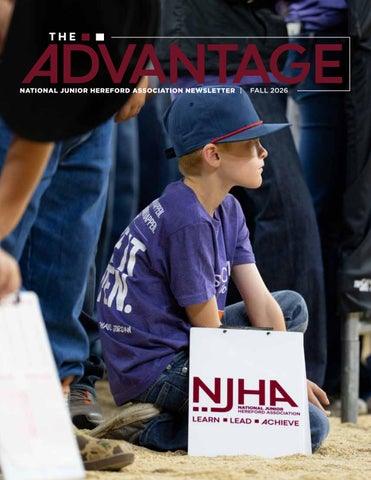
FALL 2026
KLEEN SHEEN ENHANCERS Sullivan’s
HYDRA BOOST
Sullivan’s
DEFENSE
Sullivan’s
BODY BOOST
HAIR REPAIR
Hydrate. Restore. Protect. Daily moisture that absorbs fast without a greasy feel.
Protect your hide. Fastabsorbing antimicrobial support for healthier skin.
Finish with confidence. Lift, volume and control that you can still clip through.
Repair from the inside out. Rebuilds hair for healthier, stronger, more resilient hair.
Sullivan’s
SHOP THE INFUSER LINE TODAY! Dunlap, IA • Hillsboro, TX Galt, CA • Hillsboro, OH • Stillwater, OK WWW.SULLIVANSUPPLY.COM
®
W H AT ’ S I N S I D E
4 6 8
STATE SPIRIT TAKES THE COURSE The opening ceremonies that started a week of memories.
THE PEOPLE BEHIND THE PURPLE Champions aren’t built overnight, but by small moments that lead up to greatness.
FIRST STEPS TO FINAL GOODBYES From the first time entering the showring, to the last.
HEREFORD HIGHLIGHT
18
GROWING LEADERS
20
10 12
THE HEREFORD MASTERS IN MADISON The 2026 VitaFerm® Junior National Hereford Expo in photos.
22 26 28
THE HEREFORD NETWORK
16
Bridging the Gap from the now to the future.
Taking advantage of every opportunity to connect.
LEADERS ON THE RISE
BEYOND THE SHOWRING Taking advantage of opportunities outside the showring that will set you up for success in the future.
The past six months of Hereford Highlights.
32
The 2026 Faces of Leadership conference in photos.
BOLD: LEADERSHIP BUILT TO LAST Building on leadership skills learned from Faces of Leadership to set you up for success.
FROM STEWARDSHIP TO STOCKMANSHIP Utilizing the skills learned to become a better stockman.
INDUSTRY LEADING EDUCATION Bring the data home through the National Junior Hereford Association Fed Steer Shootout.
The memories made from the “Hereford Masters in Madison” 2026 VitaFerm® Junior National Hereford Expo will last a life time. The course was set and the National Junior Hereford Association members pulled out all the stops.
JNHE HIGHLIGHTS
S TAT E S P I R I T TA K E S T H E C O U R S E The opening ceremonies that started a week of memories. by Kendall Boatman NJHA MEMBERSHIP CHAIR
A
fter months of counting down to the VitaFerm® Junior National Hereford Expo (JNHE), the week officially became real when the opening ceremonies started. State by state, juniors filled the arena, ready to represent where they came from and have a little fun. This year, the National Junior Hereford Association (NJHA) board of directors decided to tee off JNHE a little differently. Opening ceremonies brought the energy with a new State Spirit Challenge. Tying into the golf theme, as well as the 250th birthday of the USA, juniors were invited to bring their best state pride, patriotic flair and a whole lot of energy as they made their way “down the fairway.” As expected, the juniors came ready to play. From golfthemed costumes and patriotic accessories to creative ideas and plenty of enthusiasm, each state found its own way to make an entrance. A panel of judges from VitaFerm® watched from the clubhouse, looking for the state that could make the most memorable impression. Before the winners were announced, the arena took a moment to celebrate something bigger than Hereford cattle. State presidents and NJHA board members gathered in the ring and held a large American flag as the national anthem was performed. As the spotlight shone on the flag stretching across the arena, juniors from across the country stood together beneath it. With hundreds of juniors,
4
THE ADVANTAGE
families and Hereford supporters in the ring, the moment marked an especially fitting start to a week celebrating America’s birthday and Hereford cattle. Illinois junior Olivia Eubank, Oblong, Ill., had the honor of singing the anthem. For Eubank, the opportunity felt surreal. “I started out singing at my county fair, and the next thing I knew, I was singing at junior nationals,” she says. “That was crazy to me.” For Eubank, the moment was about more than performing in front of a crowd, though. “I loved doing it so much, and it meant a lot to me that I got to honor our country.”
I loved doing it so much, and it meant a lot to me that I got to honor our country. - Olivia Eubank, Oblong, Ill. Then it was time to get back on the course. When the State Spirit Challenge results were announced before the conclusion of opening ceremonies, Illinois was named the winner of the large state category, while Washington took home the small state title. Both states earned valuable points toward the GKB Super States Award, a coveted
award each year that states spend their week vying for. Illinois brought its own brand of spirit to the arena with a Happy Gilmore-inspired skit. Eubank says those memories with her state were just as memorable as singing the anthem. “Our little Happy Gilmore skit that we did was also so fun to do,” she says. “I recommend doing a skit for any opening ceremony because it made the entire thing so fun to watch and be a part of.”
It was so fun seeing all the other states’ ideas, we will have a hard time topping it next year.
Hereford juniors in the same ring all at once during a week when the country itself was being celebrated. In one night, we celebrated where we come from, the country we call home and the breed that brought us all together. Opening ceremonies have always been the official starting point of the week at JNHE, but this year, it felt like much more than that. It was loud, patriotic, competitive and full of the kind of excitement that reminds you why juniors look forward to this week all year long. And if this year was any indication, the NJHA knows how to bring the spirit to every event.
- Mesa Eatherton, Castle Rock, Wash. Washington took a different approach, bringing its spirit to the arena with a Caddyshack theme, creative costumes and plenty of personality. The idea started with a few Washington moms throwing around golf-themed ideas before turning the event into a full Caddyshack production, with the juniors even watching the movie to learn their characters. “It was a lot of fun coming up with the Caddyshack outfits,” Washington junior Brecken Eatherton said. Mesa, his sister, took on the role of the gopher. She also loved seeing what the other states brought to the arena. “I loved being a gopher, but it was so fun seeing all the other states’ ideas,” she says. “We will have a hard time topping it next year.” At the end of the night, the awards were only one part of what made the night memorable. There was something special about seeing state flags, American flags and
National Junior Hereford Association
5
JNHE HIGHLIGHTS
THE PEOPLE BEHIND THE PURPLE Champions aren’t built overnight, but by small moments adding up to greatness. by Emma Ballinger NJHA FUNDRAISING CHAIR
A
meaningful experience is rarely the product of one person’s effort. Every accomplishment has a story behind it. Every junior has a story to tell within the Hereford breed, and often, that story is shaped by far more people than the name attached to the award. Some of the most meaningful chapters are written by the people who invest their time, knowledge and encouragement along the way, by those who believe in a young person’s potential. Those contributions may not appear on a class sheet or hang on a banner, but they are woven into every accomplishment. For many juniors, their parents serve as the first and foremost members of their support system. They are the ones who make the early mornings possible and the long drives worthwhile. They spend weekends at shows, evenings at the barn and hours working alongside their children, often making sacrifices that aren’t visible to those ringside. Their investment extends beyond getting cattle ready for a show. Parents are often the first people to teach a young person what it means to work for something. They teach patience when an animal does not cooperate, perseverance when a class does not go as planned and humility when hard work does result in success. They provide perspective during disappointments and celebrate the victories that come from simply seeing their child grow. Parents deserve to be thanked for all of those things and more. It can be easy to view the work that happens behind the scenes as part of the process. But as we begin to reflect, we understand what those sacrifices really represent. The time spent preparing cattle, traveling to shows and creating opportunities is time that could have been spent elsewhere. Parents choose to make that investment because they believe the lessons their children gain through the Hereford breed are worth it. Of course, the people behind a junior’s success extend well beyond family. Every junior’s path through the breed is shaped by people willing to share what they know — someone who answers a question, a mentor who takes the time to explain why something is done a certain way or an older junior who remembers what it felt like to be new and makes sure someone else feels welcome. Often, those seemingly ordinary moments become the ones that stay with us. 6
THE ADVANTAGE
The Hereford breed has a remarkable way of connecting generations. Knowledge is passed from one person to another, not simply through formal instruction, but through conversations at the barn, time spent working cattle and experiences shared at shows. Juniors are given opportunities because someone before them decided that investing in the next generation mattered. The VitaFerm® Junior National Hereford Expo (JNHE) is one of the clearest examples of that investment. The week may center around junior exhibitors and their cattle, but the experience represents the work of an entire community. Families make the trip. Friends offer encouragement. Mentors share their experience. Behind the scenes, countless people contribute to making it possible for a junior to stand in that ring and have a moment that may shape their relationship with the Hereford breed for years to come. As fall settles in and Thanksgiving approaches, there is something fitting about taking a step back from the pace of the show calendar and considering those contributions. Success has a way of making us look forward to the next show, the next goal, the next animal. Gratitude asks us to look back for a moment, to recognize the people and experiences that brought us here. For juniors, that may mean taking the time to tell a parent, “thank you,” and understanding that the opportunity to show cattle was never something to be taken for granted. It may mean reaching out to the person who invested in you or acknowledging a mentor whose advice has influenced you more than you realized. It may mean appreciating the friendships formed through the breed and the people who have made the show barn feel like home. When it’s all said and done, what will remain are the relationships built along the way and the lessons passed from one generation to the next. Those are the things worth carrying forward. So, as you reflect on another JNHE and look ahead to another year in the Hereford breed, remember the people behind your journey. Take the opportunity to thank them, not simply for helping you get into the showring, but for everything they have taught you once you were there. Because while a young person may be the one in the showring, there is a much larger story standing behind them.
National Junior Hereford Association
7
JNHE HIGHLIGHTS
FIRST STEPS TO FINAL GOODBYES From the first time entering the showring, to the last. by Amberlynn Christenbury NJHA DIRECTOR
T
he VitaFerm® Junior National Hereford Expo (JNHE) serves as a summer highlight for many Hereford juniors. Whether they attend to cross a new state off their bucket list, show their cattle or spend a week with friends and family, it is a week many look forward to all year. For some, it is their first national show. For others, it is a final goodbye to an organization that has shaped who they are. No matter where a junior is in their journey, JNHE is about more than showing cattle. The 2026 JNHE marked the first or last junior nationals for some juniors. For Jase Braxton Thomas, a Hereford junior from Louisiana, this summer in Madison, Wis., served as his first JNHE. For Jalyn Davis, Maple Hill, Kan., “The Hereford Masters in Madison,” was her final JNHE. Davis spent one week every summer for 20 years at the JNHE — 14 of which she was an active member of the National Junior Hereford Association (NJHA). Regardless if it was their first time attending JNHE or their last, junior members left Madison with a deeper appreciation for the event and the breed. For Thomas, the JNHE was an opportunity to experience something bigger than his local show. After
8
THE ADVANTAGE
showing Herefords for three years at the Washington Parish Free Fair, he decided to step outside his comfort zone and compete at the national level.
It’s not an easy competition, because you are going up against the best. - Jase Braxton Thomas, Angie, La. His mission for his first year was simple: “Have fun with my friends and family and see how many ribbons I could get.” Showing his heifer, “Josie,” in a large arena filled with Hereford enthusiasts was both exciting and nerve-racking. Thomas also enjoyed the games and activities throughout the week. The experience taught him that competing at the national level takes preparation and hard work. “It’s not an easy competition because you are going up against the best,” Thomas says. While Thomas spent his first JNHE learning by doing, Davis spent her final JNHE reflecting on how far she had come. Contests have given Davis many opportunities to grow beyond the showring. She started her junior journey doing the Certified Hereford Beef® Grill-Off and three-on-three basketball, before challenging herself with extemporaneous speaking, which helped build her confidence and public speaking skills. Then, the photography contest allowed her to combine creativity with her love of Hereford cattle. She competed in the photo contest one final time in Madison and received first-place honors in the senior Hereford people category. “It was especially meaningful to win it at my last junior national because photography has become such a big part of my life,” Davis says. For Thomas, his first JNHE was filled with memories of showing Josie and spending time with friends and family. For Davis, two decades of JNHEs created countless memories, but one
stands above the rest — watching her sister Danica, win the junior showmanship title in Kansas City, Mo., in 2021. “That is one of the things I love most about JNHE,” Davis says. “Getting to celebrate the successes of the people around you just as much as your own.” That spirit is at the heart of JNHE. The week may be centered around cattle, but it is also about the people standing beside you when you succeed and encouraging you when things do not go as planned. Thomas finished his first JNHE already looking forward to returning. Davis spent her final JNHE surrounded by the people and experiences that had kept her coming back for two decades. Davis encourages younger members to take advantage of every opportunity NJHA provides. “Don’t spend your whole week worrying about how your cattle are doing. Go make memories,” she says. “Try the contest you’ve never done. Introduce yourself to someone new. Go sit in the barn and talk with people; you only get so many junior nationals, so make every one count.”
is today. Although she is aging out, she plans to give back through the National Hereford Women and hopes to become someone younger members can turn to for advice and encouragement. “I don’t feel like I am saying goodbye,” Davis says. “I feel like I am starting a new chapter and getting the opportunity to give back to the organization that gave me so much.” The JNHE is not just one week in the summer. It is a journey. For some, that journey begins with the excitement of walking into the showring for the first time. For others, it leads to one final week surrounded by the people who became family. For Thomas, the journey is just beginning. For Davis, it is simply entering a new chapter. Whether it is a junior member’s first JNHE or their 20th, the ribbons may eventually be packed away, but the friendships, memories and lessons made along the way will last far beyond the final show.
I don’t feel like I am saying goodbye. I feel like I am starting a new chapter and getting the opportunity to give back to the organization that gave me so much. - Jalyn Davis, Maple Hill, Kan. Davis plans to carry that message into the next chapter of her life. NJHA gave her confidence, leadership skills, friendships and opportunities that helped shape who she
National Junior Hereford Association
9
JNHE HIGHLIGHTS
B E YO N D T H E S H OW R I N G Taking advantage of opportunities outside the showring at the VitaFerm® Junior National Hereford Expo that will set you up for success in the future. by Jordan Mitchem NJHA DIRECTOR
T
he VitaFerm® Junior National Hereford Expo (JNHE) is about much more than showing cattle. Throughout the week, National Junior Hereford Association (NJHA) members can develop skills that will follow them long after they leave the showring. For instance, the Future Professionals contest — open to intermediate and senior NJHA members — gives juniors the chance to practice skills they will use in college, internships, applying for scholarships and in their future careers. Contestants create a resume and cover letter based on their education, work and other experiences. Senior contestants use these materials to prepare a mock application for a career of their choice, while intermediate contestants tailor their materials toward a mock scholarship application through the Hereford Youth Foundation of America (HYFA). Entries are judged on organization, content, grammar, relevance, categories used, layout and format. Industry professionals review the applications and select a group of finalists to participate in a live interview during the JNHE, which coincides with the Bridging the Gap College and Career Fair.
10
THE ADVANTAGE
Lauren Gatz, Fairview, Kan., knows firsthand the value of the contest. She competed in the Future Professionals contest in 2021, 2022 and 2023, winning the senior division in 2023. She later served on the NJHA board of directors, but her experience with the Future Professionals contest started well before she put on a maroon jacket. “My mom signed me up because I had done the Job Interview FFA Leadership Development Event, so I didn’t have much of a choice,” Gatz says with a laugh. “After that first year I really enjoyed interviewing and the whole process, so that is why I continued to participate.” Each time Gatz participated, she had the chance to improve and receive feedback from industry professionals.
If you are open to feedback, there is so much you can learn from professionals in the industry, and don’t be afraid to ask them questions. People want to see you succeed and are almost always willing to help if you just ask. - Lauren Gatz, Fairview, Kan. -
“What I remember most about the interview process is the feedback and the people I got to meet,” she says. “The feedback I got each year was truly invaluable and really helped me level up my game for real interviews later on.” That feedback is one of the biggest advantages of the contest. Instead of simply submitting a resume or completing an interview and moving on, contestants have the opportunity to hear directly from people who have experience hiring and interviewing others, or have served on a scholarship review committee. Whether it is learning how to word an answer differently or make a resume easier to read, each piece of feedback can become another useful tool. For Gatz, those lessons did not stop when JNHE ended. She used the feedback to improve her resume and cover letter, then carried those skills into scholarship and internship interviews throughout college. “I was able to use the feedback I got on my interviews, like how to phrase answers differently or what types of questions to have prepared to help me in a lot of scholarship and internship interviews throughout college,” Gatz says. “I now work a full-time job, and looking back,
I definitely think the skills I learned through competing in Future Professionals helped me secure my full-time position.” Perhaps the biggest lesson Gatz took away from the experience is that there is always room to improve. “If you are open to feedback, there is so much you can learn from other professionals in the industry,” Gatz explains. “And don’t be afraid to ask them questions. People want to see you succeed and are almost always willing to help if you just ask.” Interviews can be intimidating, especially if you have never had to interview for a scholarship, internship or job. Future Professionals gives NJHA members the chance to gain this experience in a supportive environment, while learning directly from industry professionals. The cattle industry will always need the next generation of leaders, employees and professionals. Future Professionals is one way the NJHA helps juniors prepare for that next step, giving them the confidence and skills to take what they have learned through the Hereford breed and carry it beyond the showring.
National Junior Hereford Association
11
“The Hereford Masters in Madison” VitaFerm® Junior National Hereford Expo brought 750 exhibitors from 44 states and two Canadian provinces, along with their families and countless Hereford enthusiasts, to Madison, Wis. Throughout the week, young exhibitors proved they could hit long and true — not only in the showring, but across a variety of contests, educational opportunities and hands-on activities designed to build confidence, develop skills and create lasting connections. From competition in the ring to learning new skills and connecting with fellow Hereford youth, the week provided countless opportunities for exhibitors to grow both as young cattlemen and women and as future leaders of the breed.
TH E H E RE FORD N ETWORK Bridging the Gap from the now to your future. by Aidyn Barber NJHA DIRECTOR
G
LEADERSHIP
rowing up in the Hereford breed opens the door to opportunities that can shape a junior member far beyond their years in the showring. From exhibiting cattle and competing in contests, to developing leadership skills and traveling across the country, each experience leaves its mark. But at the heart of those experiences are the people. They are the ones who turn a show into a memory, an opportunity into a lesson and a shared passion for Hereford cattle into something much bigger. The people behind this breed are what make it so special, and the relationships built along the way may be one of the greatest things a junior member will ever gain. It starts at the state level, where familiar faces quickly become friendships and other Hereford families become people to learn from and look up to. Then comes the VitaFerm® Junior National Hereford Expo (JNHE), where that circle stretches across state lines. Events like the Faces of Leadership conference introduce even more people, and before long, the Hereford breed has created a network that reaches much further than the show barn.
A NETWORK THAT GROWS WITH YOU One of the things that makes the Hereford network so special is that the relationships built within it grow right alongside its junior members. The breeder stalled down the aisle may eventually become a trusted mentor. A friendship formed at a Hereford event could lead to a future college roommate, coworker or lifelong friend. The industry professional met through a simple conversation may one day offer an internship, provide career advice or open the door to an opportunity. As junior members grow, so do the relationships around them, often becoming connections they carry long after their time in the National Junior Hereford Association (NJHA). Being involved in the Hereford breed continually puts youth in a position to meet people they may have never crossed paths with otherwise. State associations build the foundation close to home, while national events bring together NJHA members with diverse backgrounds from different parts of the country. While networking is often thought of as something that begins when it is time to apply for college, search for an internship or find a job, Hereford juniors have been building a network much longer than they realize. Networking happens in the barns. It happens ringside. It happens while competing in contests, traveling to leadership events and sitting down next to someone new at JNHE. Sometimes networking begins with nothing more than a “hello.” BRIDGING THE GAP The Bridging the Gap College and Career Fair gives junior members the opportunity to expand their network by connecting face-to-face with companies and professionals from across the industry. For longtime industry professional Terri Barber, one of the founding partners of the college and career fair, the opportunities Hereford juniors have to build relationships at the state and national levels are an important part of preparing them for the future. Barber believes experiences like JNHE, Faces
16
THE ADVANTAGE
of Leadership and other national conferences and events allow juniors to develop relationships while also building the skills and confidence they will use throughout their life. As she explains, these opportunities, “help develop talents and hone skills needed to accelerate their careers once they complete their educational paths.” Bridging the Gap puts that opportunity directly in front of junior members. Young people have the opportunity to learn about internships, explore potential careers and meet the people behind companies that may become a future employer. At the same time, industry professionals can meet young people who could eventually become interns, employees or colleagues. One conversation at Bridging the Gap does not have to end when the event does. “Staying in contact is a great way to stay foremost on someone’s favorite list,” Barber says. An industry professional a NJHA member met at a Bridging the Gap booth may become a mentor to reach out to with a question during college. That connection could eventually lead to an internship, an introduction to someone else in the industry or simply a familiar face at an event. Barber has seen the importance of those relationships in her own life. People she first connected with during her junior years have continued to impact her and some have remained part of her professional career. She encourages juniors to recognize the value of the people standing in front of them, even when they may not know where that relationship will lead. “You may not realize it at the time,” Barber says, “but every interaction you have at an event will be remembered long after you’ve met or they see you there.”
You may not realize it at the time, but every interaction you have at an event will be remembered long after you’ve met or they see you there. - Terri Barber, Elanco Animal Health MORE THAN A CONNECTION Bridging the Gap serves as one example of something the Hereford breed provides junior members every time they become involved — the chance to know more people. The Hereford network can open doors professionally, but its value reaches past a resume. Some of the best relationships built through the Hereford breed begin without any thought of where they might lead. They start with conversations in the barn, sitting beside someone at an event or meeting a peer from across the country. Over time, those people become the ones NJHA members look forward to seeing at the next show, call when they need advice and continue to keep in touch with long after the event is over. A connection does not have to lead to a job or an internship to be valuable. Every person is worth taking the time to know. Walk across the aisle and introduce yourself. Sit beside someone new. Ask the question. Stay in touch with the people who have invested in you, and when the opportunity comes, invest in someone else. The Hereford breed brings people together through a shared passion, but the relationships built along the way can reach far beyond it. Sometimes the greatest opportunity is simply getting the chance to know one another.
National Junior Hereford Association
17
MARCH, 2026
MADDIE JENKINS, Athens, Texas Receiving champion honors at many different national shows, including the American Royal Hereford Show, Fort Worth Stock Show, Cattlemen’s Congress and the VitaFerm® Junior National Hereford Expo (JNHE) to name a few. Her and Hawes Cattle, have gone beyond showcasing their success in the showring, but have chosen to give back to the Hereford breed that supports them. For many years, Hawes Cattle has offered a select lot in the Sale of Champions each spring with proceeds supporting the JNHE. It is that generous spirit that solidifies Maddie as a highlight of the Hereford breed this month.
APRIL, 2026
RHETT LEHMAN, Sullivan, Ill. Rhett has been an extremely involved member of both the National Junior Hereford Association (NJHA) and the Illinois Junior Hereford Association. A frequent attendee of the Faces of Leadership conference, Rhett recently was accepted and attended as a member of the BOLD Class of 2026. During the conference his outgoing nature and willingness to jump in head-first set him up for success. Rhett was recently elected to the NJHA board of directors and will be serving the NJHA membership for the next three-years, representing the interests of Hereford youth across the country.
MAY, 2026
CLAIRE COLLINS, Frederick, Okla. Claire has been an active member of the Oklahoma Junior Hereford Association throughout her junior career so far. She has served as the Southwest Area Director for 2021, 2024 and 2025, as well as serving as the 2025 Junior Hereford Association of Oklahoma Princess. Claire and her family have also been extremely involved in the National Junior Hereford Association (NJHA) Fed Steer Shootout program and attending the NJHA Fed Steer Shootout Field Day in Scott City, Kan., over the past few years.
JUNE, 2026
MORGAN FIRLUS, Wonewoc, Wis. Morgan is currently attending Kansas State University majoring in animal science and plans to give back in her future career to other youth organizations and associations that helped shape her as she grows. She’s been an extremely active junior member, attending events beyond the VitaFerm® Junior National Hereford Expo, such as the Faces of Leadership conference, being selected as a member of the 2025 BOLD class and running for the National Hereford Queen in 2025.
JULY, 2026
MASON RHOEDER, Seguin, Texas Mason has served as a director for the Texas Junior Polled Hereford Association for 6 years and is completing his year as Co- President for the newly formed Junior Hereford Organization of Texas. He has served as a Texas Youth Livestock Ambassador for the Texas Youth Livestock Association and is a fourth generation Hereford breeder who has exhibited his cattle at the VitaFerm® Junior National Hereford Expo (JNHE) for many years. He has been in the top 10 in showmanship at the JNHE as well as champion showman at the Texas State Hereford Show. He is actively involved in the family ranch and continues the tradition of raising Hereford cattle.
AUGUST, 2026
ELLA BANE, Towanda, Ill. Ella is currently in her junior year at Normal Community High School with plans to attend Lake Land College to study animal science and agriculture business after graduation. Her future career goals are to pursue a professional role in sales and consulting in the agriculture industry. She currently serves on the Illinois Junior Hereford Association board of directors and is an active member of her FFA chapter. Ella stood out for her continued involvement in the National Junior Hereford Association, both at the Junior National Hereford Expo, and recently as an active participant of the Faces of Leadership conference in Boise, Idaho.
G ROWING LEADE RS Taking advantage of every opportunity to connect. by Gavin Rhode NJHA DIRECTOR
N
LEADERSHIP
ational Junior Hereford Association (NJHA) members from 25 states participated in the annual Faces of Leadership conference July 29-Aug. 1 in Boise, Idaho, where they developed leadership skills, learned more about the beef industry, and most importantly, built relationships with other members of the Hereford family. “By the end of the conference, I had an incredible time and was so glad I decided to attend,” says Mallory Reed, Green Ridge, Mo, who attended for the first time. “It exceeded my expectations and gave me the opportunity to form relationships and create memories that I will carry with me beyond the conference.” The three-day conference began with leadership challenges and team-building activities designed to help the 100 NJHA members get acquainted and become comfortable working together. The first evening also featured Idaho Governor, Brad Little, who shared his perspective on leadership and public service. The second day brought an entirely different type of challenge as juniors took on the Payette River during a whitewater rafting adventure. While the rafting provided plenty of excitement, it also reinforced the importance of communication, trust and teamwork, as did the leadership workshops that followed.
20
THE ADVANTAGE
Logan Ipsen, Stock Point Media, capped the second day at the Boise State University football stadium, where he shared an inspiring message about maintaining a positive attitude, taking advantage of every opportunity and recognizing the importance of community. Ipsen’s message resonated with Reed. As one of two Missouri juniors attending the conference, she initially felt somewhat out of place.
I made a conscious effort to take advantage of every opportunity and connect with as many Hereford juniors as possible throughout the rest of the conference. - Mallory Reed, Green Ridge, Mo. “Logan’s presentation reminded me of the importance of leaning on the Hereford community and being willing to step outside of my comfort zone,” Reed says. “From that point on, I made a conscious effort to take advantage of every opportunity and connect with as many Hereford juniors as possible throughout the rest of the conference.”
Willingness to connect with others was a major part of the Faces of Leadership experience. Juniors come from different states, backgrounds and experiences within the Hereford breed, but the conference provides an opportunity to find common ground and learn from one another. For instance, seeing the different ways people became involved in the Hereford breed gave Reed new perspectives and helped her better understand the strength of the Hereford community across the country. She says getting to know juniors with different experiences was one of the most valuable parts of the conference. Participants also had the chance to learn about the broader beef industry with a visit to J.R. Simplot headquarters, where they learned about SimVitro technology and the CS Beef Plant. They also participated in a hands-on sensory workshop led by Jolene Pharaoh, the company’s senior manager of technical solutions and sensory.
Faces of Leadership taught me the importance of soaking in the experience rather than focusing solely on the outcome. Regardless of the outcome, I know the experiences and connections I gain along the way will shape the kind of leader and advocate I want to be for the Hereford breed.
This year’s Faces of Leadership conference ended with a visit to Colyer Herefords and Angus, where participants learned more about the operation and its management practices. Throughout the conference, Reed says she learned that leadership is not necessarily about having all the answers. Instead, it is about being willing to listen, learn from others and use different perspectives to become a better leader. Reed plans to carry this lesson with her. With the National Hereford Queen competition approaching, Reed knows she has another opportunity to put those lessons into practice. “Faces of Leadership taught me the importance of soaking in the experience rather than focusing solely on the outcome,” Reed explains. “Regardless of the outcome, I know the experiences and connections I gain along the way will help shape the kind of leader and advocate I want to be for the Hereford breed.” Faces of Leadership continues to be an integral opportunity for Hereford juniors to grow as leaders while building relationships that extend far beyond the conference. For first-time attendees, like Reed, the conference provides new leadership lessons and serves as a reminder of the importance of stepping outside of one’s comfort zone and taking advantage of every opportunity. As the next generation of Hereford leaders continues to grow, experiences like Faces of Leadership will play an invaluable role in preparing juniors to become the future leaders and advocates of our breed.
- Mallory Reed, Green Ridge, Mo. -
National Junior Hereford Association
21
Thanks to the Coley-Malir Leadership Endowment, one hundred National Junior Hereford Association (NJHA) members from 25 states gathered in Boise, Idaho, July 29–Aug. 1, for the “Leaders on the Rise” 2026 Faces of Leadership conference. Throughout the week, the young people strengthened their communication and presentation skills, collaborated on team projects, explored career opportunities with industry professionals and gained valuable insight from business and agricultural leaders. From whitewater rafting and leadership development to behind-the-scenes industry tours and networking, participants left Boise with new skills, lasting connections and a renewed passion for the future of the Hereford breed and beef industry.
B O L D : L E A D E R S H I P B U I LT T O L A S T Building on leadership skills from Faces of Leadership, to set you up for success in the future. by Maddie Weaber NJHA COMMUNICATIONS CHAIR
B
LEADERSHIP
efore attending my first Building On Leadership Development (BOLD) conference in 2024, I thought I had a pretty good idea of what I wanted to get out of it. I expected to learn more about leadership, meet other Hereford juniors and hear from people working in the agricultural industry. What I didn’t expect was to leave thinking differently about my role in the National Junior Hereford Association (NJHA). My experience at the conference ended up being one of the defining moments that helped push me toward running for the NJHA board of directors. It helped me realize how much this organization had done for me and opened my eyes to how I could use my own abilities to serve NJHA members. While the Faces of Leadership experience also gives juniors the chance to grow alongside other members, BOLD takes that knowledge a step further by challenging participants to look at their own strengths, goals and how they can use them moving forward.
26
THE ADVANTAGE
OPPORTUNITY SNAPSHOT The 2026 BOLD conference brought together 20 NJHA juniors and six board members from across the country and Canada for four days at the GKB Hi Point Ranch in Desdemona, Texas. Participants heard from people who have built careers in agriculture and beyond. For instance, country music artist, Cody Johnson, shared his experiences and encouraged participants to be comfortable with roadblocks rather than letting them stop them. Career development is an important part of BOLD. Juniors sit down with industry professionals, ask questions and hear about the different paths that led them to where they are today. That was something I appreciated about my own BOLD experience. It gave me a chance to think about what makes me different and how those strengths could be used. The same is true within the NJHA. You don’t have to be the loudest person in the room or have the longest list
of accomplishments to make an impact. Maybe you are good at bringing people together, enjoy public speaking, organizing events, working with younger members or simply are someone others can count on. BOLD encourages you to recognize those strengths and think about where you can put them to work. And that work doesn’t have to wait until you have a title. The skills developed at BOLD can come home with you and make you a better junior member within your state association, a better student, a stronger teammate and a more involved member of your community. The people you meet at BOLD become part of that growth, too. Spending several days with other juniors who are passionate about the Hereford breed creates a unique environment. Everyone comes from a different background and has different goals, but everyone has something to learn from each other.
You don’t have to be the loudest person in the room or have the longest list of accomplishments to make an impact. Now, as a NJHA board member, I get to see BOLD from a different perspective. I remember being a participant and beginning to think about how I could use my strengths to give back to the NJHA. Now, I have the opportunity to help create those experiences for other junior members. That has given me an even greater appreciation for the investment the Hereford Youth Foundation of America (HYFA), GKB Cattle and the Hereford family make in developing young leaders.
The people you meet at BOLD become part of that growth, too. Spending several days with other juniors who are passionate about the Hereford breed creates a unique environment. TAKE THE NEXT STEP If you are considering applying for BOLD in the future, don’t feel like you must have everything figured out. Come ready to learn, ask questions, introduce yourself and step outside of your comfort zone. Think about what you are good at, what you enjoy and how you can use those things to help the people and organizations around you. For me, BOLD helped me see that I had something to give back to the NJHA and played a role in my decision to run for the NJHA board of directors. The impact of BOLD doesn’t end when you leave. The real opportunity is in what you choose to do with what you learned when you get home. The 2027 BOLD conference will be held April 8-11 in Desdemona, Texas. Applications will open in October and are due Feb. 1, 2027. NJHA members ages 18-21 are eligible to apply. Approximately 20 juniors are selected each year. Learn more at Hereford.org/ youth/njha/bold.
National Junior Hereford Association 27
SHOWMANSH IP TO STOCKMANSH IP Utilizing the skills learned through the National Junior Hereford Association and the American Hereford Association to become a better stockman. by Matalyn Martinson NJHA DIRECTOR
F
E D U C AT I O N
or many National Junior Hereford Association (NJHA) members, the showring is where it starts. We learn how to set feet, read a judge, keep a calf looking its best and stay calm when things do not go according to plan. We spend early mornings rinsing, late nights in the barn and countless hours preparing for a few minutes in the ring. Showing cattle teaches responsibility, work ethic and how to compete. But eventually, every junior must look beyond the backdrop and ask a bigger question — why are we raising these cattle in the first place? Becoming a great showman is an accomplishment. Becoming a great stockman or stockwoman means taking those lessons and digging deeper into the decisions behind the cattle. Ivan Blume, Redfield, S.D., believes many skills juniors develop through the NJHA provide a foundation for this transition. Blume is a rancher and Hereford seedstock producer. He also is a former NJHA member and graduate of the American Hereford Association (AHA) Seedstock Academy. He explains, programs like the Faces of Leadership conference, allow juniors to build relationships
28
THE ADVANTAGE
with people who may someday become fellow breeders, customers and industry leaders. Blume believes networking is essential to moving from showman to stockman. “From record keeping and bookwork to moving cattle down the alley and through the chute, stockmanship covers a lot,” Blume says. “The showring is just an added bonus that helps bring those fundamentals full circle.” It can be easy to judge success by banners, buckles and backdrop photos. Production agriculture, however, gives us a much larger scorecard. Questions such as mating selections, expected progeny differences (EPDs), feeding rations, genetic value and meeting the commercial cattle sector’s needs are all important stockman considerations. Through the Seedstock Academy and his experiences within the cattle industry, Blume explains he has learned how much exists beyond the showring. “I wish more juniors were exposed earlier to commercial programs, functional cattle, finances and the data behind production earlier on,” he says. The NJHA Fed Steer Shootout program is one opportunity for juniors to gain this broader perspective.
Instead of evaluating cattle in the showring, participants can follow them through the feeding phase and see how genetics, management and health decisions influence feedlot performance and carcass value. “I think it does a great job of showing juniors the end goal of raising beef and how the decisions we make on the front end ultimately affect the product that ends up on the consumer’s plate,” Blume says. Whether we are raising a female we hope becomes a donor or a steer headed to the feedyard, we are part of a much larger beef industry. Understanding that bigger picture can make all Hereford breeders more effective cattle producers in the beef industry.
I think it does a great job of showing juniors the end goal of raising beef and how the decisions we make on the front end ultimately affect the product that ends up on the consumer’s plate. - Ivan Blume, Redfield, S.D. The transition from junior exhibitor to adult cattle producer does not happen overnight, and aging out of the NJHA does not mean involvement has to end. Programs such as the AHA Seedstock Academy can help bridge that gap. “Your involvement and leadership in the breed, the beef industry and life, as a whole, doesn’t have to end when you graduate from the junior association,” Blume emphasizes. “Programs like the Seedstock Academy can open new doors, broaden your perspective and help you continue building relationships with people who will be the future of the industry.”
For juniors wanting to grow their production knowledge now, the first step can be simple — ask the question. Ask the breeder you bought your heifer from why they made that mating. Talk with a commercial cow-calf producer about the traits that matter to their bottom line. Ask a nutritionist why a ration is formulated a certain way. Visit a feedlot. Learn to read EPDs and genomic information. Enter the NJHA Fed Steer Shootout, or after graduating from the NJHA, apply for programs such as the Seedstock Academy. “Ask questions, understand the ‘why’ behind decisions, and never stop learning,” Blume says. The showring is one of the things that makes the junior Hereford experience special. It gives us goals, teaches us how to handle cattle and creates friendships and memories that last far longer than a show season. But the greatest value of showing cattle may not be what happens while we are standing in the ring, it is what we choose to do with those lessons afterward. The goal is not to stop being a showman. It is to become a Hereford stockman, too. Blume’s grandfather gave him a piece of advice that continues to guide him: “Learn something new every day.” It is simple advice and might be exactly where becoming a better stockman or stockwoman starts. “Keep expanding your knowledge, take advantage of opportunities, and don’t be afraid to take a bite and figure out how to chew it,” Blume says. “At the end of the day, wake up, make your bed, pull your boots on and get to work.”
National Junior Hereford Association 29
I N D U S T R Y L E A D I N G E D U C AT I O N Bring the data home through the National Junior Hereford Association Fed Steer Shootout program. by Rhett Lehman NJHA DIRECTOR
A
E D U C AT I O N
s autumn continues, many National Junior Hereford Association (NJHA) members are sorting through their best steer calves in preparation for the NJHA Fed Steer Shootout. This unique program serves as a performance competition, industry education opportunity and carcass assessment tool for participants. Steers are sent to HRC Feed Yards LLC, in Scott City, Kan., a commercial cattle feeding operation. Through retained ownership, breeders are rewarded for the superior carcass traits they’ve bred for. After harvest, Shootout participants receive a report offering insight into how their cattle performed on the U.S. Premium Beef value grid. This report shows the true value of the participant’s steer and serves as a reference for future breeding decisions as they wait and assess how their cattle finished on the rail and performed in the feedlot. SKILLS FOR THE FUTURE One former NJHA member and Fed Steer Shootout participant, Haley Mouser, Tenstrike, Minn., took advantage of these resources during her NJHA career. The former NJHA Vice Chairman has applied the knowledge she learned from the program to the packing industry, spending this summer as an intern at Greater Omaha Packing Company. “I didn’t realize how applicable the skills I learned through the NJHA Fed Steer Shootout would be to my internship in the packing business,” she explains. Her experience as a board member and NJHA Fed Steer Shootout participant made her incredibly fit for her new role in the industry. The years she spent learning from the industry professionals through the program, set her apart. Mouser encourages all young breeders interested in their cattle’s carcass quality to take part in the NJHA Fed Steer Shootout.
Understanding your herds data is crucial, and physical data is the most accurate form of information that you could ever have. - Haley Mouser, Tenstrike, Minn. “Understanding your herd’s data is crucial, and physical data is the most accurate form of information that you could ever have,” Mouser says. “It allows you to interpret 32
THE ADVANTAGE
the accuracy of your expected progeny differences (EPDs) and your understanding of how to use them. It also shows the true carcass value of your herd and helps kids be mindful of terminal traits.” Mouser recognizes the value in providing industry education to NJHA juniors. The young people who attend the NJHA Fed Steer Shootout Field Day receive an incredible education on that sector of the industry, regardless of whether they entered their own cattle or partnered with a breeder to oversee a calf without any financial burden. Mouser emphasizes that the best education comes firsthand, when juniors can apply data to the base of knowledge they already have and envision future breeding decisions that will improve the value of their cattle.
BRINGING THE DATA HOME As an established NJHA Fed Steer Shootout competitor, Teegan Frederickson, Spearfish, S.D., has campaigned successfully in the contest alongside his brother, Tiernan. The brothers have finished on the podium multiple times in recent years and currently stand as the defending champions of the purebred Hereford pen-of-three division. “Annually, I get to see how well our steers end up doing,” Frederickson says. “You can see how your pens compare over time and can match the matings of the good ones back into your herd to breed for higher performance.” This forward-thinking mindset is exactly what the program encourages. When juniors draw their own conclusions from their contest results and go back into their herd with that information in mind, it fosters growth for all the qualities that will mold them into successful cattlemen.
Annually, I get to see how well our steers end up doing. You can see how your pens compare over time and can match the matings of the good ones back into your herd to breed for higher performance.
“Our family markets bulls to commercial cattlemen, and our genetics need to perform in that area of the industry,” he says. “We’ve had success in the pen-of-three competition multiple years, and we know that those genetics can perform for the commercial operations that use our bulls, too. To get that data back, it really lets us trust our own genetics and see where we can change for improvement, too.” With data backing his steers, it gives him peace of mind knowing that his herd will perform. For juniors of all ages, the NJHA Fed Steer Shootout is an incredible program. It gets juniors excited to see how their cattle perform in the real world, beyond the showring. That excitement encourages them to chase a betterperforming steer the following year and allows them to focus on breeding for productive traits and added carcass quality. It’s incredible to see how progressive participants have improved their herds using the data they received from the program. Young people stepping into the industry with an understanding of the feedlot and packer will make a difference in the Hereford breed and the beef industry as a whole. Visit Hereford.org/youth/njha/njha-fed-steer-shootout/ for the 2027 contest details. The enrollment deadline is Oct. 30, 2026.
- Teegan Frederickson, Spearfish, S.D. Frederickson also notes how important it is for his family to know that their genetics are performing well in the feedlot setting. National Junior Hereford Association 33
2026-2027 | BOARD OF DIRECTORS CHAIRMAN
Rylie Meinhardt
Matt Bruns
Onaga, Kan. rjmeinhardt@gmail.com 785-562-6643
Maddie Weaber
North Platte, Neb. mattbruns101@gmail.com 308-660-7183 FUNDRAISING CHAIR
Emma Ballinger
Wamego, Kan. maddieweaber@gmail.com 785-844-3064 MEMBERSHIP CHAIR
Kendall Boatman
McKee, Ky. ballingereg@icloud.com 606-548-3520
DIRECTOR
DIRECTOR
Amberlynn Christenbury
34
THE ADVANTAGE
DIRECTOR
Aidyn Barber
Stewartsville, Mo. 24grhode@gmail.com 816-306-6430
DIRECTOR
Starr, S.C. agchrist15@gmail.com 864-934-2434
Only, Tenn. callicottsb@gmail.com 931-981-0131
Gavin Rhode
Vale, N.C. jkmitchem@gmail.com 704-470-5922
LEADERSHIP CHAIR
Sarah Beth Callicott
Rockdale, Ill. kendallboatman@gmail.com 779-774-5141
Jordan Mitchem
COMMUNICATIONS CHAIR
VICE CHAIRMAN
Channing, Texas aidyn.barber06@gmail.com 806-681-4883
DIRECTOR
Rhett Lehman
Sullivan, Ill. LHMN-Hereford@outlook.com 309-336-7381
DIRECTOR
Matalyn Martinson
Elk River, Minn. matalyn.martinson@gmail.com 763-274-0771
BUILD WHAT THE NEXT GENERATION BUILDS ON. Move your herd forward with advanced genetics that help each generation start further ahead.
WEAN WITH CONFIDENCE,
wean strong. VitaFerm® Cattle Drench with Vita Charge® Technology supports digestive health before, during and after stressful challenges. Powered by AO-Biotics® Amaferm® and MOS to support digestion, gut health and immune function.
SCAN TO LEARN MORE!