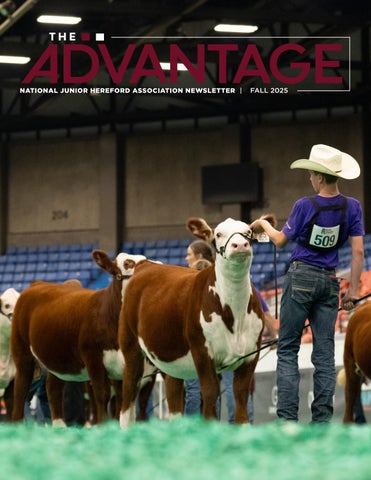
FALL 2025
W H AT ’ S I N S I D E
4 6 8
A REFLECTION ON THE NJHA A past junior Hereford leader reflects on her time in the organization.
COOL, CALM AND COLLECTED Two-time VitaFerm® Junior National Hereford Expo (JNHE) champion describes her showmanship journey.
REASONING YOUR PLACINGS The JNHE’s new oral reasons contest helps young people build life skills.
RISE. LEAD. INSPIRE.
16
HEREFORD HIGHLIGHT
18 20
LIVE FROM LOUISVILLE
10
The 2025 VitaFerm® Junior National Hereford Expo in photos.
22
NEXT LEVEL LEADERSHIP
12 15
How the BOLD conference shapes the next generation of Hereford leaders.
2025 FACES OF LEADERSHIP “Gateway to Leadership,” in photos.
Reflecting on the impact made by the annual Faces of Leadership conference.
The past six months of Hereford Highlights.
THE YOUNG BREEDERS COMPETITION Meet Team USA and learn about the global competition happening on U.S. soil.
REPRESENTING THE RED, WHITE AND BLUE Young Hereford leaders prepare for the Young Breeders Competition.
WHY THE NJHA?
24 28
The NJHA welcomes young people, regardless of their Hereford history.
THE NEXT GENERATION OF CATTLEMEN The Fed Steer Shootout provides young people insight into the cattle feeding industry.
Bred-and-owned female champion shown by Landry Allan, Nocona, Texas, steps onto the green chips for the first time during the “Live from Louisville,” 2025 VitaFerm® Junior National Hereford Expo.
by Maddie Weaber NJHA DIRECTOR
F
or decades, the National Junior Hereford Association (NJHA) has done more than bring together young people with a shared passion for cattle — it has prepared its members for life beyond the showring. From building confidence through contests to cultivating leadership skills at national events, the NJHA gives youth a solid foundation to succeed far beyond their junior years. Through leadership conferences like Building on Leadership Development (BOLD) and Faces of Leadership, contests and opportunities to serve in roles of responsibility, the NJHA equips its members with skills that translate directly into successful careers and community leadership long after they hang up their exhibitor numbers. Many NJHA alumni credit the association with giving them determination, professionalism and resilience, which have helped shaped their careers, whether they remain in the cattle industry or pursue other fields. Someone who embodies this legacy is Ashley Fitzsimmons, Perry, Okla. As a seventh-generation Hereford breeder from Wyoming, Fitzsimmons grew up with Herefords as a part of her everyday life, something she never had to question. What made her experience stand out was realizing how unique it was to be a part of a breed association that connected so many different pieces of the beef industry. “I don’t know of a breed that ties all of the facets of the industry and truly represents its thousands of members together quite as well as Hereford, with all of the opportunities that they give,” Fitzsimmons says.
At the end of the day, everything we do in this industry is about the people. Every show, every sale, every product — it’s about the connections you make along the way. - Ashley Fitzsimmons, Perry, Okla. Becoming involved in the NJHA and serving on the NJHA board of directors opened her eyes to just how far-reaching the Hereford network truly is. Fitzsimmons participated in nearly every NJHA event available during her time as a member, including judging, speech contests, salesmanship, showmanship and more. And while she loved the competition, the biggest lessons didn’t come from the banners. “You learn hard work, determination and grit,” she says. “There’s a humility you learn in winning and a grace you learn in losing. Those are skills that you carry with you into the office environment, too.” Fitzsimmons credits the NJHA for teaching her to be fully invested while also learning resilience. She discovered how to celebrate others’ wins, carry herself with respect and bounce back from setbacks. 4
THE ADVANTAGE
Those lessons of demonstrating discipline, perseverance and grace, even while under pressure, still influence her work and life today. In those early mornings, long hours and the ups and downs of competition, junior members are learning to commit to a goal even when the results don’t go their way. Fitzsimmons notes that when she hires interns, she sees this mindset across other livestock kids. “These are people who can be completely invested and give it their absolute best, and then still have the ability to bounce back when it doesn’t work out.” That perspective of celebrating others’ wins while pushing through disappointments has stuck with her. Serving on the NJHA board of directors from 2003 to 2006 gave Fitzsimmons some of her favorite experiences in the NJHA. She loved being behind the scenes planning the Junior National Hereford Expo (JNHE), organizing contests and watching other Hereford juniors light up in the showring. The junior board also gave her an education in collaboration. Working with directors from across the country, she learned how to connect with different perspectives and build around common goals. That skill has served her well in every stage of her career. Fitzsimmons attended Oklahoma State University, where she explored a variety of studies in the college of agriculture, and ultimately earned her master’s degree to complete her educational journey. Her career path took her from Ranch House Designs to BioZyme® Inc. and now to her role as senior portfolio manager for Purina Animal Nutrition, working across cattle, equine and backyard flock teams. Her NJHA background helped foster her confidence to sit at a table with colleagues who may not have experience in the industry but still relate to people, build connections and find common ground.
A REFLECTION ON THE NJHA A past junior Hereford leader reflects on her time in the organization.
Today, she and her husband, Nick Fitzsimmons, own and operate Fitz Genetics in Perry, Okla. She notes that raising and selling Hereford cattle was a conscious choice and that makes it especially meaningful. Alongside her family operation, she serves as the PTA president, mentors youth in the show cattle industry and stays active as a leader in her community and career.
Fitzsimmons hopes to build something lasting — something her kids, coworkers, friends and future generations can continue. “At the end of the day, everything we do in this industry is about the people. Every show, every sale, every project — it’s about the connections you make along the way.” Fitzsimmons encourages today’s NJHA members to make the most of their time: take advantage of all the opportunities, especially the ones outside your comfort zone. She pushes juniors to give a speech, go to the Faces of Leadership conference, enter in the NJHA Fed Steer Shootout program and attend the field day, even if these things are new to you. “Do something, take advantage of something, it’s so low risk,” Fitzsimmons says. “It’s already a part of the NJHA; you’re already a member. Do something that makes you uncomfortable, do that hard thing. The robustness of opportunities is so valuable. So many great learning and growing opportunities are right here in the NJHA for you.” Fitzsimmons’ story illustrates the lasting impact of the NJHA. Beyond winning banners or mastering skills, members gain confidence, resilience and the ability to lead both in their career and their communities. The lessons learned in the showring — hard work, humility, perseverance and collaboration — prepare youth for challenges far beyond the barn. Through her continued involvement in the cattle industry, her community and her mentorship, she demonstrates that the NJHA doesn’t just create showmen; it cultivates leaders who represent the organization’s values in every aspect of their lives.
National Junior Hereford Association
5
COOL , CALM AND COLLECTED Two-time JNHE champion describes her showmanship journey. by Salem Sifford NJHA CHAIRMAN
T
he showring isn’t just a place to prove yourself, it’s where years of hard work, early mornings and quiet moments with your show calf come to life. Showmanship has always been my favorite part of the VitaFerm® Junior National Hereford Expo (JNHE). Not only do I look forward to exhibiting in showmanship myself, but I love to see so many juniors showing their competitive side in every age division. For Ella Weldon of Piedmont, Okla., the showring has become a second home and a place where she’s made history. Her name has quickly made a mark within the National Junior Hereford Association (NJHA). This summer, Weldon claimed the champion junior showman title at “Live from Louisville.” It was a big win, not just because of the competition, but because it marked her second consecutive JNHE showmanship victory. This time, in her first year as a junior division competitor, she managed to repeat her success, a rare and remarkable feat that earned her widespread respect. “Winning junior showmanship this summer at the JNHE is probably my favorite showmanship win,” Weldon says. “This year was my first year in junior showmanship. I wanted it really bad, but knew it would be really tough.” One of my favorite things about the NJHA is simply the competitiveness of the JNHE showmanship competition. Juniors from across the nation come together to showcase their hard work, dedication and passion for exhibiting Hereford cattle. As a junior association member, I am continually impressed by the quality of showmen in every age division. The ring is filled with talent, discipline and quiet ambition. But if you’ve ever watched Weldon in the showring, you know she has a quiet focus that sets her apart. While her composure might seem effortless, she admits it doesn’t always come easy. “Honestly, on the inside, I am not calm,” Weldon explains. “I try my best to stay calm on the outside because if I don’t, my heifer will sense that and act up.” That awareness of both herself and her animal is something that’s clearly been developed through consistent time in the barn and an intentional approach to practice. For her, daily routines with her heifers are essential, but so is understanding each one’s personality. “I work with my heifers almost every day,” Weldon says. “But I don’t practice showmanship every day. Before a show, I practice setting up babies every day or every other day. I only practice with my big breds once or twice a week, so they don’t get a bad attitude.” 6
THE ADVANTAGE
It’s a strategy that blends preparation with patience, and it works. Her philosophy on training is simple but powerful: Practice like you are in the ring. Everything she does at home, she treats like a rehearsal for show day. She doesn’t just halter-break and lead, she trains with purpose. The idea is to make the ring feel familiar, not just for herself, but for her heifers, too. This mindset helps Weldon build confidence within herself and her heifer, making them a dynamic team.
Before a show, I practice setting up babies every day or every other day. I only practice with my big breds once or twice a week so they don’t get a bad attitude. - Ella Weldon, Piedmont, Okla. But even with all that preparation, Weldon shares that the nerves are still real. “Oh yeah, I get nervous, I don’t really calm my nerves, but once I get in the ring, I get in the zone and forget all about them,” becoming grounded in the moment, focused only on her heifer, the judge and executing each move with precision. “You cannot get worked up,” she says. “Your heifer will feed off of you — which can be good or bad. Always keep your cool.” In the heat of competition, emotions can run high. It all comes down to the bond between showman and animal. “Building a bond with your heifer is really important,” Weldon says. “You have to trust and respect each other.” That connection, combined with her steady nerves and relentless work ethic, has made Weldon a standout on the national stage. Back-to-back wins at JNHE don’t happen by accident. They’re the result of years of dedication and a mindset focused on growth, not just glory. Weldon’s story is inspiring for all ages, but she doesn’t claim to have all the answers. She gets nervous. She works through challenges. She adjusts and adapts. Every time she enters the showring, she does so with the quiet confidence of someone who’s put in the work and has the banners to prove it. As she continues to move through the junior division, there’s no doubt Weldon’s name will keep showing up in the top tiers. Perhaps what’s most impressive is her attitude; grounded, grateful and always learning.
National Junior Hereford Association
7
REASONING
YO U R P L AC I N G S The JNHE’s new oral reasons contest helps young people build life skills.
by Rylie Meinhardt NJHA MEMBERSHIP CHAIR
T
he livestock judging contest has become increasingly competitive over the years. Originally developed in the early 1900s, livestock judging was designed to teach young people to evaluate both breeding and market animals. By the 1920s, oral reasons had been formally introduced into major collegiate judging contests, including the International Intercollegiate Livestock Judging Contest, then held in Chicago, Ill. The purpose of adding oral reasons was to encourage competitors to defend their placings with logic and accuracy, ultimately helping them grow into confident and effective communicators. Each year at the VitaFerm® Junior National Hereford Expo (JNHE), National Junior Hereford Association (NJHA) members have the chance to showcase their evaluation skills in the livestock judging contest. Open to all age divisions, from peewee to senior, the contest gives every junior who enters cattle the opportunity to compete if interested. The contest typically features four classes: one steer class, one bull class and two heifer classes. It serves not only as an individual competition, but also as a state contest, with the top four individual scores in the age division from each state combining to determine the overall state ranking.
8
THE ADVANTAGE
At the 2025 “Live from Louisville” JNHE, the NJHA board introduced a brand new oral reasons contest, which ran alongside the livestock judging contest. Participation in the oral reasons contest was optional, giving juniors the opportunity to decide if they wanted to compete. During its inaugural offering, the NJHA opened the oral reasons contest exclusively to the senior division. Competition was tough, with Alisha Klemme of Plymouth, Wis., earning first place. Jalyn Davis of Maple Hill, Kan., placed second, and Fallon Gohr of Madras, Ore., rounded out the top three individuals. Oral reasons were scored separately from the livestock judging contest. Contestants presented two sets of reasons worth a total of 100 points following the judging portion. A data sheet component was also introduced, adding another layer of real-world evaluation. By combining phenotype and performance, the data challenged contestants to strengthen their decision-making skills and think more critically. The NJHA would like to extend a big thank you to Sheila Jensen and Jensen Livestock for sponsoring the oral reasons contest. Their support reflects Jensen’s strong belief in the value of this contest, the juniors and the JNHE. In addition, she and Chris Mullinix generously volunteered their time to listen to contestants’ reasons and provide individual critiques, giving juniors meaningful feedback from industry experts to further develop their skills. The NJHA strives to uphold its mission to “create and promote enthusiasm for the Hereford breed while providing opportunities to learn, lead and achieve, ensuring a brighter future for youth and the cattle industry.” The oral reasons contest was designed with that very mission in mind — building enthusiasm while giving junior members the chance to learn, lead and achieve through developing their communication and decision-making skills within the cattle industry.
Being on those green chips and getting to evaluate elite Hereford cattle while getting the chance to speak with industry professionals was such a unique experience. - Alisha Klemme, Plymouth, Wis. ,NJHA member, Alisha Klemme, emphasized just how valuable livestock judging and oral reasons are for young people. She explained that the contest teaches participants to justify their decisions, evaluate high-quality livestock and build confidence. When competing this past summer, Klemme had just completed her undergraduate degree in animal science and agricultural business, where she was heavily involved with her collegiate livestock judging team. “Being on those green chips and getting to evaluate elite Hereford cattle, while getting the chance to speak with industry professionals was such a unique experience,” Klemme says. When giving reasons, contestants must first place a class of four animals and then step into the reasons room to defend their decisions. Oral reasons are unique because even if a participant doesn’t agree with the official class placings they have the opportunity to explain the
reasoning behind their placings. The ability to clearly defend a decision is a lifelong skill — one that extends far beyond the contest and prepares juniors for future success in both their careers and daily lives. Through evaluating livestock, defending their choices and understanding what builds a successful operation, juniors also gain something even more valuable: confidence in themselves. The contest sharpens public speaking skills, encourages juniors to consider different perspectives and teaches them to stand firm in their own beliefs. As Klemme put it, “Confidence is built through putting it into words.” By expressing their decisions and reasoning, juniors grow in communication and critical thinking, becoming stronger advocates not only for themselves but also for the agriculture industry. The oral reasons contest is scored on accuracy, presentation and use of performance data, all of which translate into greater confidence, stronger decision making and clearer explanation skills abilities that will serve these young leaders throughout their lives. The oral reasons contest is more than just another competition, it’s an investment in the future of the Hereford breed and the agriculture industry. By challenging juniors to think critically, communicate clearly and lead with confidence, the NJHA is preparing its members to succeed both inside and outside the showring.
National Junior Hereford Association
9
The VitaFerm® Junior National Hereford Expo (JNHE) provides an opportunity for competition of junior members and their cattle projects, along with plenty of events for the entire family. The 2025 VitaFerm JNHE was held July 12-18, in Louisville, Ky., where Hereford juniors were “Live from Louisville.” Juniors embraced and celebrated their accomplishments from the past year, while they showcased the hard work that got them to that moment.
10
THE ADVANTAGE
M A R C H
3 ,
2 0 2 6
Make sure to capitalize on this unique sale that supports the VitaFerm® Junior National Hereford Expo (JNHE). With highlight lots from past JNHE Champions, to unique opportunities available to prepare for the 2026 JNHE, in Madison, Wis.
NEXT LEVEL
LEADERSHIP How the BOLD conference shapes the next generation of Hereford leaders. by Lauren Gatz NJHA LEADERSHIP CHAIR
F
or some juniors, the Building On Leadership Development (BOLD) conference inspires them to take the next step and join the junior board. For others, it sparks a drive to chase their dreams and give back to the breed. BOLD shaped Katherine Krauss’ growth and continues to influence how she contributes to the Hereford breed today as an NJHA alumna. Krauss, now a protein sales associate at Cargill Inc., first attended BOLD in 2022, as a member of the conference’s inaugural class. “BOLD gave me the chance to really connect with juniors from across the country and see how they lead, what they value in the breed and where they want to take it,” she says. “It was inspiring to hear their perspectives and to learn from people who are just as passionate about Hereford as I am.” The BOLD conference is generously made possible by Gary and Kathy Buchholz of GKB Cattle. The GKB Cattle Youth Endowment supports the event, which is hosted at their Hi Point Ranch in Desdemona, Texas. Each year, 20 young people are chosen through a competitive application
12
THE ADVANTAGE
process to attend the conference. BOLD offers participants a personalized leadership development experience. Juniors expand upon the skills they’ve learned at other NJHA events, while developing their own leadership style. Participants gain insight from experienced junior board members, mentors and industry professionals.
It’s one thing to be a part of a team, but it’s another to learn how to motivate and guide others while staying true to your values. That’s what BOLD helped me understand. - Katherine Krauss, Russell, Kan. BOLD challenges participants to grow both personally and professionally. Through interactive workshops, handson activities and mentorship opportunities, attendees refine their communication, decision-making and
problem-solving skills. Participants also engage in teambuilding exercises that simulate real-world challenges, while fostering collaboration and creativity. While focused on leadership development, BOLD also encourages juniors to act as advocates for the industry and discover new ways to make a meaningful impact on the Hereford breed. For Krauss, BOLD was more than a conference; it was a turning point. Growing up immersed in the cattle industry, she was familiar with leadership opportunities, but the conference offered a perspective she had never experienced before. “I think it really helped me figure out what kind of leader I wanted to be,” she says. “It’s one thing to be part of a team, but it’s another to learn how to motivate and guide others while staying true to your values. That’s what BOLD helped me understand.” During her time at BOLD, Krauss connected with mentors who offered guidance regarding not just leadership, but also on career paths in agriculture and the cattle industry. These connections provided her with insights she might not have gained elsewhere, helping her map out a plan for life beyond the junior program. The exposure to industry professionals and board members also showed her how dedication, preparation and a willingness to serve can translate into real-world opportunities. She reflects on the importance of these relationships, saying, “It was inspiring to see how much experience and knowledge people were willing to share. That really pushed me to think bigger about my future.” Krauss used the skills and insights she gained at BOLD to launch her career in the beef industry. After graduating from college and earning her MBA, she began working at Cargill as a protein sales associate. This year, she gave back to the Hereford breed by participating in the Bridging the Gap — College and Career Fair as a Cargill representative during the Faces of Leadership conference. “I wanted to take what I learned and pass it on,” Krauss says. “It’s exciting to see the energy and ideas younger juniors bring to the breed and to know I can help guide them along the way.” The lessons learned during the BOLD conference continue to shape Krauss’ approach to both her career and her involvement in the cattle industry. In her current role at Cargill, she draws on the communication and leadership skills honed at BOLD to build relationships, navigate challenges and contribute meaningfully to her team and clients. She emphasizes that the impact of the conference extends far beyond the three days in Texas, influencing her professional decisions, interactions and long-term goals.
Her story is a testament to the long-lasting influence BOLD can have on young person’s growth. It demonstrates that leadership is not just about taking on titles or positions — it’s about learning how to listen, motivate and inspire others while making thoughtful contributions to the industry. Her experience also underscores the value of mentorship, peer connections and hands-on learning in helping young leaders discover their strengths and ambitions. For juniors considering the program, her advice is not to hesitate: “If you’re even thinking about applying, just do it. It’s one of those experiences that changes how you see yourself and your role in the Hereford breed. You’ll gain skills, friends and opportunities you didn’t even know were possible.” Applications for the 2026 BOLD conference are now open and due Feb. 1, 2026. Juniors interested in participating can learn more and apply at Hereford. org/youth/njha/bold. With only 20 spots available, this competitive program offers a rare chance to grow as a leader, connect with peers nationwide and make a lasting impact on the Hereford breed.
National Junior Hereford Association
13
14
THE ADVANTAGE
The Faces of Leadership conference is designed to help National Junior Hereford Association (NJHA) members hone communications, team-building and other skills essential to becoming effective leaders. This year, 85 members from 21 states attended the conference hosted in Gray Summit, Mo., July 30 - August 2, where they entered the “Gateway to Leadership.”
National Junior Hereford Association
15
RISE. LEAD. INSPIRE. Reflecting on the impact made by the annual Faces of Leadership conference and its ability to set up Hereford juniors for success.
I did not know a soul who would be there. Regardless, I had the best time and established friendships that will last a lifetime. - Caden Forrest, Saluda, S.C. 16
THE ADVANTAGE
by Harlee Watson NJHA DIRECTOR
M
any events shape your summer, but Faces of Leadership shapes your future. Each summer, the National Junior Hereford Association (NJHA) hosts an impactful youth leadership conference. It is not just about name tags, breakout sessions or keynote speakers, it is about possibilities. The 2025 Faces of Leadership conference, held July 30-Aug. 2 at the Purina Animal Nutrition Center in Gray Summit, Mo., was a tremendous event full of personal growth, connection and purpose. For the 84 juniors from 21 states who attended, it was not just a trip, it was a transformation. Whether it is your last NJHA Faces of Leadership conference or you are a first-time participant, Faces of Leadership is an unforgettable experience. Juniors discover what kind of leader they want to be and why leadership is key to agriculture, our communities and life. This year’s conference was especially meaningful. It was designed to meet juniors where they are; whether they are introverted thinkers, bold speakers or quiet doers — helping them grow into the leaders they’re meant to become. Faces of Leadership is designed to empower young Hereford enthusiasts with the skills, confidence and a vision to lead. Through interactive workshops, team-building activities and exposure to industry leaders, participants are challenged to reflect on their own leadership style and values. Faces of Leadership would not be possible without the vision and support of the NJHA and the Hereford Youth Foundation of America. Through generous endowments, like the Coley-Malir Leadership Endowment, young people from across the country are given the opportunity to attend, grow and thrive. From the moment participants touched down in St. Louis, Mo., fun began and leadership became the focus.
Faces of Leadership was packed with practical workshops, inspiring keynote speakers and high-energy networking opportunities. It was really fun and definitely something I will look forward to next year. - Jarrett Worrell, Mason, Texas The three days were packed with unforgettable memories. The opening mixer at Ballpark Village in St. Louis set the stage for connection. Through an incredible game of “human bingo” juniors mingled, shared stories and began forming friendships that would carry with them throughout the week and onto their Hereford career. The opening keynote address by former Major League Baseball catcher and manager, Mike Matheny, was a home run. His message on character-driven leadership resonated deeply, reminding juniors that integrity is just as important
as ambition. Matheny’s emphasis on leading with values, not ego, challenged participants to think critically about the kind of legacy they want to leave. Throughout the week, juniors participated in panels and workshops that covered everything from communication to strategic thinking and agricultural advocacy. These were incredible experiences designed to build real-world skills. For many, this was the first time they’d thought about leadership as a lifelong journey, not just a temporary role. “Faces of Leadership was packed with practical workshops, inspiring keynote speakers and high-energy networking opportunities. It was really fun and definitely something I will look forward to next year,” Jarrett Worrell, of Mason, Texas, says. Worrell attended the conference for the first time this year, and he plans to attend again. “I encourage everyone to go.” Team challenges seemed to be fan favorites at this year’s conference. Juniors were placed into random groups and tasked with planning their own leadership conference, then faced with the challenge to present it as a group. This activity fostered collaboration, creativity and trust. It also helped juniors build confidence that will last far beyond the conference. One of the most powerful aspects of Faces of Leadership was the access it provides to agricultural professionals and industry leaders. Through panels and events, like the Bridging the Gap College and Career Fair, juniors had the chance to ask questions, explore career paths and see what leadership looks like in action. For juniors considering careers in agriculture, this exposure is invaluable. Participants toured the Purina Animal Nutrition Center, gaining firsthand insight into the science and innovation behind livestock nutrition. They also engaged with professionals who shared their own leadership journeys, offering advice and mentorship that will shape juniors’ futures. This was Caden Forrest’s first time to attend Faces of Leadership. “I immersed myself into the junior programs by signing up and participating in both my first Junior National Hereford Expo and Faces of Leadership conference,” the South Carolina native says. “I did not know a soul who would be there. Regardless, I had the best time and established friendships that will last a lifetime.” Like many other juniors, Faces of Leadership is my favorite part of the summer because, honestly, it is so much fun. From mixers and industry tours to late night card games and team challenges, the conference is packed with moments that make memories. It’s a space where juniors can be themselves, take risks and grow in ways they never imagined. Take this as your sign to not just attend Faces of Leadership — but to embrace the leader within you. You don’t have to wait until you’re older, more experienced or more confident. Leadership starts with showing up, asking questions and daring to grow. The 2025 Faces of Leadership conference proved that when juniors are given the right environment, mentorship and challenge, they rise. They lead. They inspire. National Junior Hereford Association
17
MARCH, 2025
JORDAN MITCHEM, Vale, N.C. Jordan is a senior in high school and is extremely involved in her families Hereford operation, Mitchem’s Farm 3C. She has taken over many aspects of the operation and is lovingly called the “head show cattle manager, feeder, heat detector and calf puller.” She has become increasingly involved both inside and outside the Hereford showring. She has taken a special interest in the National Junior Hereford Association (NJHA) Fed Steer Shootout program, traveling 1,500 miles to attend the 2024 NJHA Fed Steer Shootout Field Day, leading her to compete in the final portfolio contest, where she received the honor of being named the Contestant of the Year in the Senior Division.
APRIL, 2025
SAGE LAWRENCE, Avilla, Ind. Sage is involved in livestock judging and plans to pursue a degree in reproduction physiology. Sage has served as a Senior Director for the Indiana Junior Hereford Association and is currently one of the delegates for Indiana. Sage has been incredibly involved, both at the state and national level and is a leader in her state for younger members, assisting wih coaching them in all areas, including serving as a mentor while on the third place team in the VitaFerm® Junior National Hereford Expo (JNHE) Team Fitting contest, helping take a banner home for the state of Indiana.
MAY, 2025
BELLA HEWITT, Branchville, N.J. Bella is attends Kansas State University pursuing a degree in animal science with an emphasis in industry. She also hopes to obtain a certificate in beef feedlot management or rangeland management, in order to set herself up for success as she pursues a career in the beef industry in the future. An incredibly involved junior member, Bella serves as the president of the New Jersey Junior Hereford Association and represented them during the BOLD leadership conference as a selected attendee in the class of 2025. She is also passionate about being a leader to the younger junior members in both her state and beyond.
JUNE, 2025
DAGAN MURRAY, Auburn, Kan. Dagan attends Kansas State University where he is studying animal science. A member of the 2025 BOLD leadership conference, he was able to build upon his leadership skills, improve his confidence and ability to speak in front of a large group. Dagan is very involved in the Kansas Junior Hereford Association, serving as a past chairman and fundraising chair, while also being extremely involved and holding leadership positions in his FFA chapter, and earning his Kansas State FFA Degree.
JULY, 2025
SHERIDAN CHANEY, Keymar, Md. Sheridan is a retiring NJHA member, and attended her final JNHE this summer after being a member of the NJHA for 14 years. Now in her senior year at Oklahoma State University, she previously received her associates degree from Butler Community College and was a member of the livestock judging team. Now she is pursuing a degree in agricultural communications and plans to pursue a career with an agricultural company or beef association, focused on making a positive impact in the industry as a whole.
AUGUST, 2025
CADEN FORREST, Saluda, S.C. At just 16 years old, Caden is a proud member of both the South Carolina Junior Hereford Association and the NJHA. This summer marked two firsts for him — his debut at the JNHE and his first Faces of Leadership conference — and he’s jumped in with enthusiasm and dedication. A junior in high school and a fourth-generation Hereford breeder, Caden plays an active role in his family’s operation, Forrest Polled Herefords. His future plans include earning a bachelor’s degree in biology, pursuing a career as a medical doctor and continuing to grow and improve the family’s Hereford herd.
20
THE ADVANTAGE
National Junior Hereford Association
21
REPRESENTING THE
R E D , W H I T E AND B L U E Young Hereford leaders prepare for the Young Breeders Competition.
by Emma Ballinger NJHA COMMUNICATIONS CHAIR
T
his October, the Hereford spotlight shines bright as we welcome the 2025 World Hereford Conference to U.S. soil. Eleven teams representing seven countries will come together for the Young Breeders Competition (YBC). Among them, eight former National Junior Hereford Association (NJHA) members and two alternates will proudly represent the United States of America. Preparing to showcase their knowledge, skills and passion for the breed on an international stage, the competition challenges competitors to think critically, work as a team and demonstrate the knowledge and skills they’ve learned from their respective countries. YBC is a week long showcase of skills that span the entire beef industry. Competitors are tested on everything from animal evaluation and nutrition to marketing strategies, breed knowledge and showmanship. In short, it’s a chance for the next generation of Hereford breeders to expand their knowledge and experience Hereford cattle from a global point of view. For the team members representing the stripes and stars, YBC is an opportunity to highlight the leadership and other skills they developed through their time in the NJHA. The eight competitors who will make up the U.S. teams, Red and Blue, have spent years in barns, classrooms and leadership programs, which have shaped them into cattlemen and women who know the value of preparation, teamwork and communication. The international nature of the YBC also makes the competition unique. Standing shoulder to shoulder with peers from Australia, Canada, Denmark, Ireland, the United Kingdom and New Zealand, the U.S. teams will be challenged not only by the event itself, but also by the different traditions and perspectives offered by Hereford breeders from around the globe. For many, this will be their first chance to connect with Hereford breeders from other continents — a reminder that while cattle may look the same, the stories behind them stretch across cultures and generations. In the United States, the Hereford breed and its culture have been shaped by history, long standing traditions, junior programs and families who have dedicated generations to raising these cattle. YBC offers an exciting opportunity to share that history and perspective on an international stage, while learning from others from around the world. I look forward to hearing the experiences and traditions that have shaped Hereford breeders in other countries, while discovering the similarities that connect us across continents. 22
THE ADVANTAGE
Representing the U.S. as part of Team Red and Blue, competitors carry our history and perspective to demonstrate American juniors’ breed involvement, while gaining insight into the common threads that unite Hereford breeders worldwide. Perhaps one of the most valuable aspects of the YBC is the opportunity for informal learning and connection. Beyond the structured events, conversations with international peers provide a peek into different agricultural systems, emerging industry trends and new approaches to leadership. Observing how others handle similar challenges can inspire new ideas and encourage reflection on the ways young people might approach their own operations or future careers. As the competition draws near, excitement continues to build — not just for the juniors who will compete but also for the NJHA members who will watch from the sidelines. Their participation serves as a reminder of the endless possibilities available through the Hereford breed and the doors that open when young people are willing to take on new challenges. For Team USA, it is a chance to represent the unique values of American Hereford breeders, while also learning from peers who grew up thousands of miles away, yet share the same dedication and passion. The competition reminds us that while our operations and traditions may differ, the Hereford breed unites us all in one global family.
WHY THE NJHA
?
The National Junior Hereford Association welcomes young people, regardless if they hail from a multi-generational Hereford family or just purchased their first bald-faced calf.
by Jordan Mitchem NJHA DIRECTOR
T
here’s something special about walking into a barn filled with red-and-white cattle and hearing the hum of voices, laughter and excitement. It doesn’t take long to realize that the National Junior Hereford Association (NJHA) isn’t just about showing cattle — it’s about the people, the relationships and the opportunities that shape who we are. For some families, Herefords and the NJHA are a tradition passed down through generations. For others, it’s a brand new adventure. No matter where the story begins, the NJHA has a way of making everyone feel like they belong. Becky King-Spindle, a Hereford breeder from Stanley, N.M., has been immersed in the Hereford breed for a long time. Her great-grandfather started the ranch, and it has been in the family ever since. Her dad purchased their first Hereford back in the 1970s. King-Spindle grew up around cows, show barns and the Hereford community, and now, she raises her four kids the same way. Her memories from those early years in the junior association are some of her favorites. She started attending field days as a kid and recalls how the junior expo at Rocking Chair Ranch left a lasting impact. She also served on the American Junior Hereford Board (AJHA) from 1993-1996, an experience that shaped her confidence and leadership skills. “NJHA really helped me become a leader,” she says. “I’ve also served on both the National Hereford Women and American Hereford Association Boards and even ran for state representative. So much of the confidence I have today started with the AJHA.” That kind of impact is hard to put into words, but it’s easy to see in her life. The friendships she formed as a junior member are still some of her strongest today. “A lot of my best friends today were junior board members with me,” King-Spindle recalls. “One of the neatest things about the association is that I know people from almost every state, mostly from when I was a junior. If one of my kids is far from home, I have people nearby I can count on if they ever need anything.”
One of the neatest things about the association is that I know people from almost every state, mostly from when I was a junior. - Becky King-Spindle, Stanley, N.M. 24
THE ADVANTAGE
That sense of community is what sets the NJHA apart. Whether a family has been in the Hereford family for generations or is just getting started, the organization has a way of pulling people together. She took her kids along to NJHA events as soon as they were old enough, and from there, they formed their own connections. They’ve shown cattle at the Junior National Hereford Expo, National Western Stock Show, American Royal Livestock Show and Western States Hereford Show, building lifelong friendships along the way. What’s just as special is watching her kids find their own paths within the NJHA. “My kids didn’t have a choice to not grow up in the NJHA,” King-Spindle laughs. “It’s kind of cool, each one has picked out what aspects they like best,” she adds. “There are so many different things to be involved in, from showmanship and speech contests to team fitting, queen competitions and running for the board. They’ve figured out what interests them the most and have made their own paths.” King-Spindle has also watched how the NJHA has grown over the years. “It’s neat as an older person to see how the NJHA has evolved from smaller settings to this spectacular, well-run organization that so many others envy,” she says. Her advice to new NJHA members is simple: Don’t hesitate to try different opportunities. You never know which one will be the best fit. And don’t be afraid to ask for help. While some stories are rooted in tradition, the NJHA is also a home for first-generation members who don’t come from a long line of Hereford cattle. Tar Tut, originally from Faribault, Minn., grew up far from a big ranch, without a family legacy in the breed. “I wasn’t raised in a family that had been showing Herefords for generations, but I always had an interest in cattle and livestock. That’s what pulled me into agriculture,” he says. “My path wasn’t the traditional one, but that made me hungry to learn, work harder and find my place in this industry.” Like many, Tut found his start in the showring, later competing on judging teams at Butler Community College and Texas A&M University. Along the way, the NJHA gave him a place to belong. “At first, it was intimidating. You look around and see families that have been in this breed forever, and you wonder if you fit in. But what I found was that the NJHA didn’t care about your last name. It was about showing up, working hard and being part of the group. People went out
of their way to include me, and that made me feel like I belonged,” Tut reflects. That sense of belonging carried into leadership opportunities. From speaking in front of peers to taking part in contests and conferences, he credits the NJHA with helping him step out of his shell. “It gave me confidence to speak up and trust what I had to say,” he says. “That carried over into my career today, whether I’m walking into a feed store, talking with ranchers or working with coworkers.” When asked what stuck out most about the NJHA, his answer came quickly: it was the people. “What hooked me was how focused the NJHA is on building people, not just good progressive cattlemen. The banners and ribbons are great, but it’s the friendships, the lessons and the confidence you build that matter the most.” Now, Tut is excited to give back. “For me, it’s about being there for the younger kids the same way people were there for me. Whether it’s giving advice or just letting them know they belong here, I want to be that person for somebody else.”
What I found was that the NJHA didn’t care about your last name. It was about showing up, working hard and being a part of the group. People went out of their way to include me, and that made me feel like I belonged. - Tar Tut, Bells, Texas Together, these two stories — one of a family with generations in the breed and another of someone making a brand-new path — remind us of what makes the NJHA so special. It doesn’t matter whether Hereford roots run deep or whether someone is just halter-breaking their very first calf; the NJHA meets each member where they are and gives them the tools, friendships and confidence to grow. That’s what’s so beautiful about this organization. It’s about tradition and new beginnings. It’s about cattle, yes; but more than that, it’s about people. And that’s why the NJHA continues to change lives. And maybe that’s the best answer to the question, “Why NJHA?”
National Junior Hereford Association 25
SCHOLARSHIP
LEADERSHIP
E D U C AT I O N
RESEARCH
DECEMBER 17-19, 2025
A giant thank you from the Hereford Youth Foundation of America to all breeders, supporters and those dedicated to leaving things better for the next generation. $666,000 has been raised since 2022, supporting HYFA’s pillars of scholarship, leadership, education and research. Join us this season as we come together to make a difference in scholarship, leadership, research and education.
LEARN MORE
T H E N E X T G E N E R AT I O N O F C AT T L E M E N The Fed Steer Shootout provides young people insight into the cattle feeding industry.
by Sam Birdsall NJHA VICE CHAIRMAN
T
he excitement of the National Junior Hereford Association (NJHA) Fed Steer Shootout can be felt from the moment junior members across the country begin preparing their cattle for delivery. For many participants, the program is more than a contest — It’s a chance to learn, gain hands-on experience and connect with industry professionals. Among the juniors participating this year was Drew Ballard, Inman, Kan. He saw the contest as a unique opportunity to get involved in the NJHA while learning valuable lessons for his own herd management. ABOUT THE FED STEER SHOOTOUT The Fed Steer Shootout allows junior members to send their steers to be fed out at HRC Feed Yards LLC in Scott City, Kan., retaining ownership through the feedlot stage and benefiting from current cattle market prices. Contestants may enter a single steer or a pen of three in one of two divisions: purebred Hereford steers or Hereford-influenced steers sired by Hereford bulls. Steers are delivered in December and fed through spring and early summer, giving juniors a hands-on look at how cattle perform in a feedlot setting.
28
THE ADVANTAGE
Even juniors without their own cattle can now participate through a partnership program. Generous adult breeders provide calves to the feedyard, which are then registered for the contest in the junior’s name allowing that young person to gain all the educational benefits of the program without providing their own calf. While the adult member retains ownership and profit, the junior member receives first-hand experience and insight into cattle management. This partnership is a new cornerstone of the program, fostering mentorship and education within the association.
The experience has influenced our program in many ways, helping us improve both the health and growth of our cattle. - Drew Ballard, Inman, Kan. -
DREW BALLARD’S EXPERIENCE Ballard’s participation in the Fed Steer Shootout stemmed from a desire to become more involved in the NJHA and experience a different side of cattle management. “I always saw the program as a way to learn more about my herd at home and to meet different people in the industry,” he explains. He found the process of entering cattle and arranging transport to the feedyard straightforward, and the annual Fed Steer Shootout Field Day was a highlight, giving him the opportunity to see his steers’ progress firsthand. Selecting which calves to enter proved challenging for Ballard. “We calve from late March to May, so I had smaller calves, and it was tough picking ones that were big enough to send,” he says. Despite the hurdles, the experience offered invaluable lessons, including understanding cattle behavior in the yard and the real costs of feeding cattle in a feedlot. “It was eye-opening to see what goes into just feeding a few steers,” Ballard notes. Participation in the Fed Steer Shootout program has influenced Drew’s breeding and management strategies at home. He has refined vaccination protocols, adjusted treatment approaches and emphasized consistent feeding schedules and accurate rations. “The experience has influenced our program in many ways, helping us improve both the health and growth of our cattle,” he says. For junior members considering entering the contest, Ballard offers encouragement: “Even if you have smaller calves, like I did, send them anyway. It’s very beneficial to your program at home and helps develop the future of your operation.”
contest while fostering long-term relationships within the Hereford community. The Fed Steer Shootout is more than a competition — it’s an educational journey for NJHA members. From cattle selection nutrition decisions, performance monitoring and field day attendance, participants gain skills and knowledge that extend beyond the feedyard. Programs, like Partner with a Breeder, further strengthen the association by connecting experienced breeders with juniors, ensuring that the next generation of cattle producers is wellprepared for the future. The final Fed Steer Shootout portfolio projects and presentations are made each fall, and the top-performing steers and NJHA award winners are recognized during the American Hereford Association Annual Meeting and Educational Forum. The entire contest provides both recognition and learning opportunities for all participants. For juniors ready to take their herd management to the next level, the Fed Steer Shootout is an experience that educates, inspires and leaves a lasting impact.
FIELD DAY HIGHLIGHTS A key component of the program is the annual Fed Steer Shootout Field Day, held each spring in Scott City. Junior and senior members gather for two days of educational sessions, presentations and networking. Past events have included insights from HRC’s consulting veterinarian and nutritionist, as well as industry leaders such as Cargill, National Beef and BioZyme® Inc. Lee Mayo, HRC Feed Yards manager, also provides updates on the cattle feeding industry and shares performance results of the participating steers. The field day is more than just a check-in on cattle performance — it’s a hands-on learning experience where participants see the impact of feeding, management and genetics. For juniors, like Ballard, it’s also a chance to connect with peers and mentors, exchange ideas and gain insights that they can apply to their operations. PARTNER WITH A BREEDER PROGRAM The Partner with a Breeder program, is an exciting addition to the Fed Steer Shootout just introduced this past year. The program allows junior members without their own cattle to still participate and learn from experienced breeders. This mentorship model ensures that even newcomers can experience the educational benefits of the National Junior Hereford Association 29
2024-2025 | BOARD OF DIRECTORS CHAIRMAN
Salem Sifford Goldvein, Va. ssifford366@gmail.com 336-266-0194
VICE CHAIRMAN
Sam Birdsall Torrington, Wyo. birdsall.sam04@gmail.com 607-423-8915
FUNDRAISING CHAIR
Matt Bruns North Platte, Neb. mattbruns101@gmail.com 308-660-7183
Rylie Meinhardt Onaga, Kan. rjmeinhardt@gmail.com 785-562-6643
Sarah Beth Callicott Only, Tenn. callicottsb@gmail.com 931-981-0131
30
THE ADVANTAGE
DIRECTOR
Kendall Boatman Rockdale, Ill. kendallboatman@gmail.com 779-774-5141 DIRECTOR
Gavin Rhode Stewartsville, Mo. 24grhode@gmail.com 816-306-6430
LEADERSHIP CHAIR
Lauren Gatz Fairview, Kan. lauren03g@gmail.com 785-285-0617 DIRECTOR
DIRECTOR
Jordan Mitchem Vale, N.C. jkmitchem@gmail.com 704-470-5922
Emma Ballinger McKee, Ky. ballingereg@icloud.com 606-548-3520
MEMBERSHIP CHAIR
DIRECTOR
Harlee Watson Flemingsburg, Ky. harleewatson1@gmail.com 606-748-3669
COMMUNICATIONS CHAIR
DIRECTOR
Maddie Weaber McKee, Ky. maddieweaber@gmail.com 785-844-3064
TODAY IS YOUR OPPORTUNITY BUILD THE TOMORROW YOU WANT. At Trans Ova Genetics, we’re empowering breeders to build a tomorrow that exceeds expectations. We provide the complete toolbox of services you need to create a legacy of excellence. Today’s choices shape tomorrow’s success. Choose Trans Ova Genetics and leave a lasting legacy for the next generation. For a full list of locations, visit www.transova.com
embryo transfer • in vitro fertilization • sexed semen Donor Housing • recipient options • Genetic Preservation • Cloning
IT’S ALL I FEED.
Scott Ranches, Wyoming
MORE POUNDS AT WEANING
HEALTHIER HERDS
CONSISTENT RETURNS
To see how VitaFerm® provides maximum energy and forage utilization at every stage, scan the QR code or contact your local BioZyme® dealer today.
VitaFerm.com
HIGHER CONCEPTION RATES