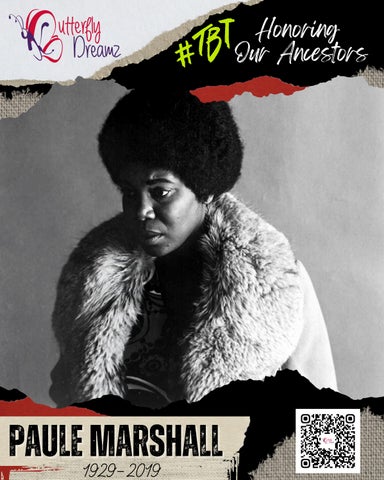
Honoring Our Ancestors
paule1929–2019 marshall
After work, they had the kitchen table.
Paule Marshall and her sister did homework in a corner of their Brooklyn kitchen. Around the big table, a group of Black women shared tea or cocoa after work. They were Paule’s mother and her friends. Their talk ranged from World War II to the island they missed to the people whose homes they cleaned. Some bosses served them an egg and a little cottage cheese for lunch. Who could scrub floors all day on a meal like that? Paule was born Valenza Pauline Burke in Brooklyn, New York, in 1929. Her parents came from Barbados, an island in the Caribbean. The “e” in Paule is silent, so her name sounds like Paul. What caught Paule’s ear was the way the women told their stories. They talked “endlessly, passionately, poetically.” A boss they didn’t like might have “a face like an accident before it happened.” Their working day could start with having to bargain over pay. Around the kitchen table, they could say what they thought of their bosses and make each other laugh. “Soullygal, talk yuh talk!” they told each other. Think about your own voice. Where can you talk like yourself without having to weigh each word? What changes when someone new walks in? Why?
Who gets to tell the story? “I wanted them to be center stage.”
Paule Marshall on why she wrote about women: “I determined to make women—especially Black women— important characters in my stories when I started writing. To make up for the neglect, the disregard, the distortions, and untruths. I wanted them to be center stage.”
—Interview with Daryl Cumber Dance
Same story, two sources.
Find one news story from this week told by two different sources. How is the same story told in different
ways? Whose voices does each source include? Why do you think so?
“This, too , is valid. This , too, is heroic. ” Paule Mar sh
she heard all on the speech a take that t home: “…I could ve Black Eng rnacular, that sort li s of they spok h West Indian style e, paper. I co and I could put it o n u is valid. Th ld say that this, too is, to , —Democr o, is heroic.” acy Now!, March 29 , 2000.
The power of women... In 1991, Paule published Daughters. Ursa Mackenzie is a Black woman in New York. Her dad, Primus, is a big-name leader on Triunion. It’s a made-up island in the Caribbean. The women in his life, like Ursa, Astral, and Estelle, circle him the way stars circle the North Star. Primus once had plans for small farms, new homes, and hospitals. Then he trades them for a secret deal. Rich people would get a resort, a casino, and a golf course. The deal would cut people off from the beach where they fish. Ursa and her mother, Estelle, find out about the deal. Now they have to decide what to do, and whether to stand up to Primus together. Ursa’s closest friend is Viney. Some women on the island guess that they might be a couple. Paule leaves it open: are they friends, sisters, or more?
“It’s woman’s power on which a society ultimately depends.” Paule Marshall on her mother and her mother’s friends, in an interview about Daughters: “There’s an African proverb that says, ‘It’s woman’s power on which a society ultimately depends.’ I sensed this particular power in that group of women long ago.” —Interview with Daryl Cumber Dance
The work behind the gift
At the kitchen table, Paule was the one who listened. Years later, people stood in line to meet her. After one reading, Erica VitalLazare hung back. Paule waved her over and asked if she wrote. Then she said, “Send me something.” Erica sent stories and a novel. With Paule’s help, she got into graduate school with a teaching fellowship that covered her tuition.
“Her notes were tough, but she gave you room to find your way.” —Erica Vital-Lazare on Paule’s feedback. Mary Helen Washington, Paule Marshall: A Writer’s Life, p. 197.
Paule’s students remember a teacher who expected hard work. She made them read many kinds of writers. In her class, writers had to stay quiet and listen while the group talked about their story. Her student Shamar Hill said, “It might be hard to hear it, but it forced you to grow.” Paule knew talent was not enough. As writer Shay Youngblood recalled, Paule wanted students tough enough to “stay the course.” She said, “Even if they have the gift, that’s not enough: they need discipline, doggedness, cussedness, luck.” Doggedness means you keep going. Cussedness means you’re too stubborn to quit.
Pick a goal that matters to you, like making a team, starting a business, or helping your family. What could you practice a little every day? Who could give you honest notes that help you grow? Which of Paule’s words do you need most right now: discipline, doggedness, cussedness, or luck?
Who gets a say on the shelf? In New Jersey, a school board can’t pull a book from a school library just because of the writer’s background or views. If someone asks to have a book removed, the law says it must stay in the school library. Students can still borrow it until the board makes its final decision. Imagine Brown Girl, Brownstones is up for review, and you have 30 seconds to speak at the meeting. Which part of Selina’s story would you want the board to hear? Whose voices might they miss if no Black girls had a chance to speak? Make your case: Use Paule’s novel or pick another book by a Black woman. Name one moment in it and tell the board why that moment matters to you. Try it with someone older. Ask them to listen as if they were on the board. Which part would they remember after the meeting? You decide what to keep. Take it one step further. Ask a local librarian how students can speak up when someone wants a book removed. What will you do with what you learned?
References Want to check a quote or learn more? Here are the sources we used.
Dance, Daryl Cumber. "An Interview with Paule Marshall." The Southern Review 28, no. 1 (Winter 1992). https://scholarship.richmond.edu/cgi/viewcontent.cgi? article=1152&context=english-faculty-publications Encyclopaedia Britannica. "Paule Marshall." https://www.britannica.com/biography/Paule-Marshall Marshall, Paule. "From the Poets in the Kitchen." The New York Times Book Review, January 9, 1983. https://openlab.citytech.cuny.edu/engl1101zieper-f24/files/2024/09/Paule-Marshall-From-the-Poets-in-theKitchen.pdf Marshall, Paule. "Women Writers." Democracy Now!, March 29, 2000. https://www.democracynow.org/2000/3/29/women_writers New Jersey Department of Education. Freedom to Read Act model removal policy. https://www.nj.gov/education/standards/ftra.shtml New Jersey Freedom to Read Act. P.L. 2024, c. 96. https://pub.njleg.state.nj.us/Bills/2024/PL24/96_.HTM Washington, Mary Helen. "Paule Marshall." 2021 National Black Writers Conference Biennial Symposium journal. https://centerforblackliterature.org/wp-content/uploads/2021/03/2021Biennial_NBWC_Journal2_digired.pdf Washington, Mary Helen. Paule Marshall: A Writer's Life. Yale University Press, 2026. Ch. 4, "The Girl Can Write." https://doi.org/10.12987/9780300289701-005 Washington, Mary Helen. Paule Marshall: A Writer's Life. Yale University Press, 2026. Ch. 9, "I'm Taking More Risks." https://doi.org/10.12987/9780300289701-010 Washington, Mary Helen. Paule Marshall: A Writer's Life. Yale University Press, 2026. Ch. 10, "The New Generation." https://doi.org/10.12987/9780300289701-011
“I grew up among poets.” —Paule Marshall, remembering her mother and her mother’s friends. “From the Poets in the Kitchen” (1983)