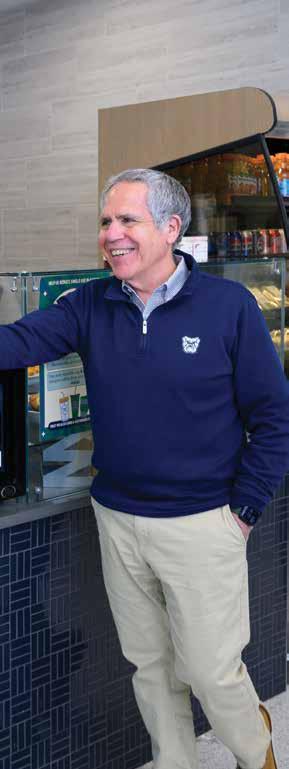
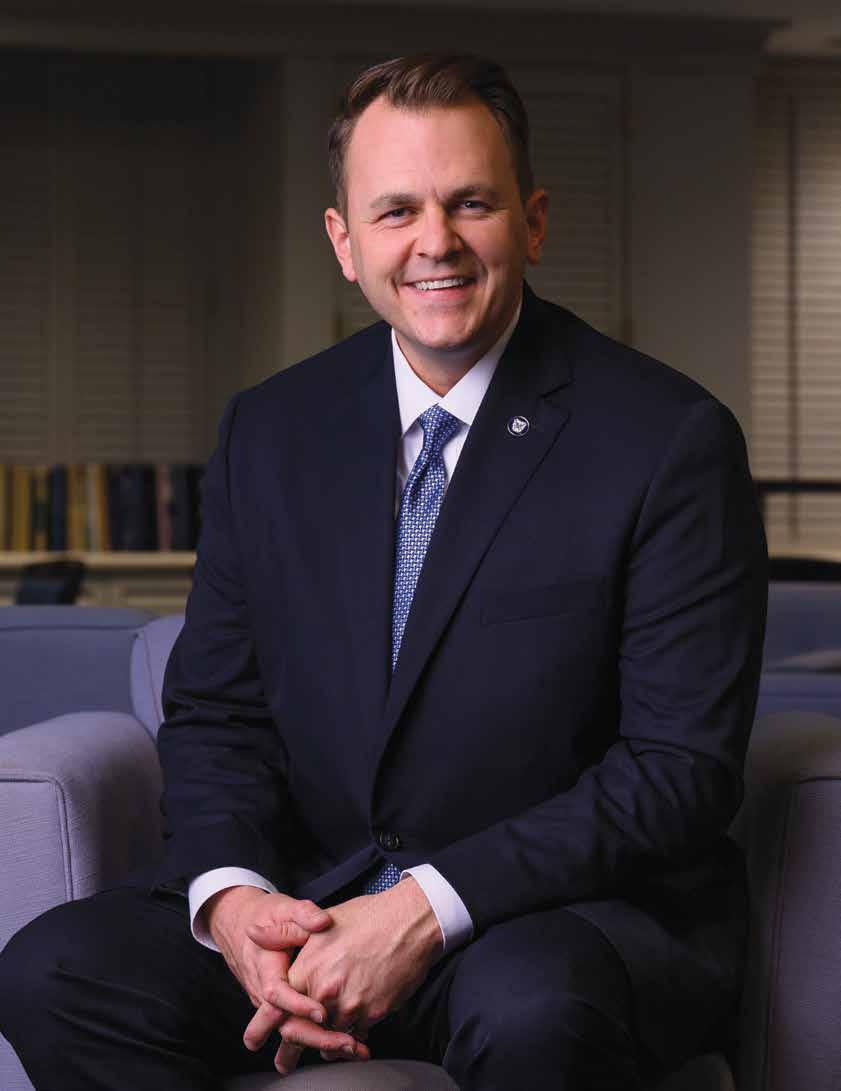
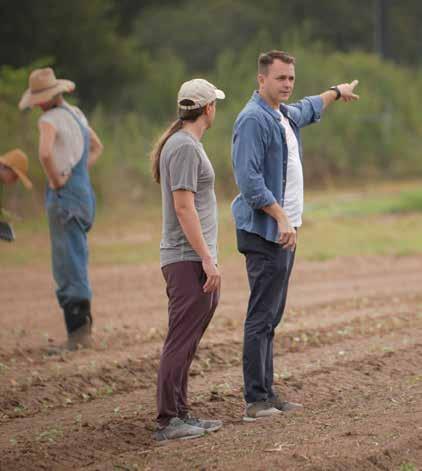
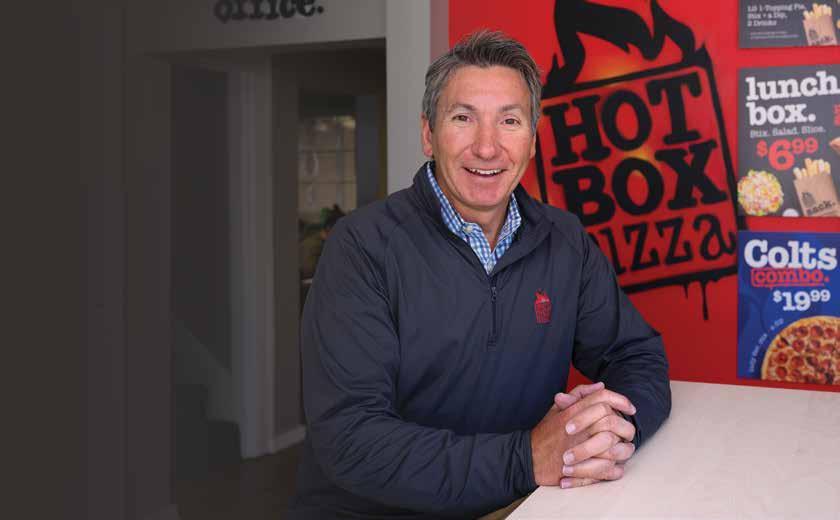
HotBox Pizza founder, Gabe Connell MBA ’01, finds fulfillment in serving the community and his team.
Sponsored by Elements Financial
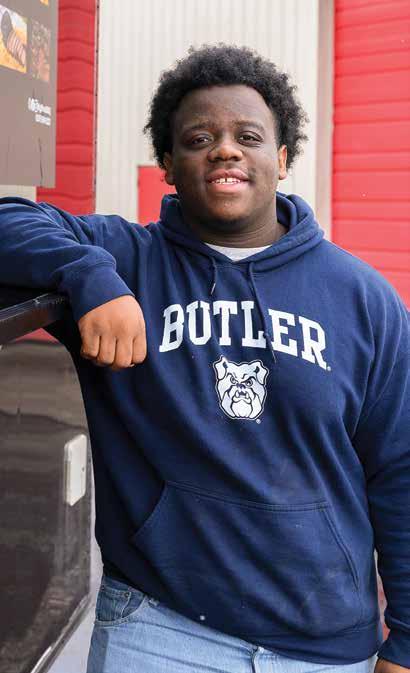
Demico Southern ’28 uses his food truck to dish up barbecue and tuition dollars.
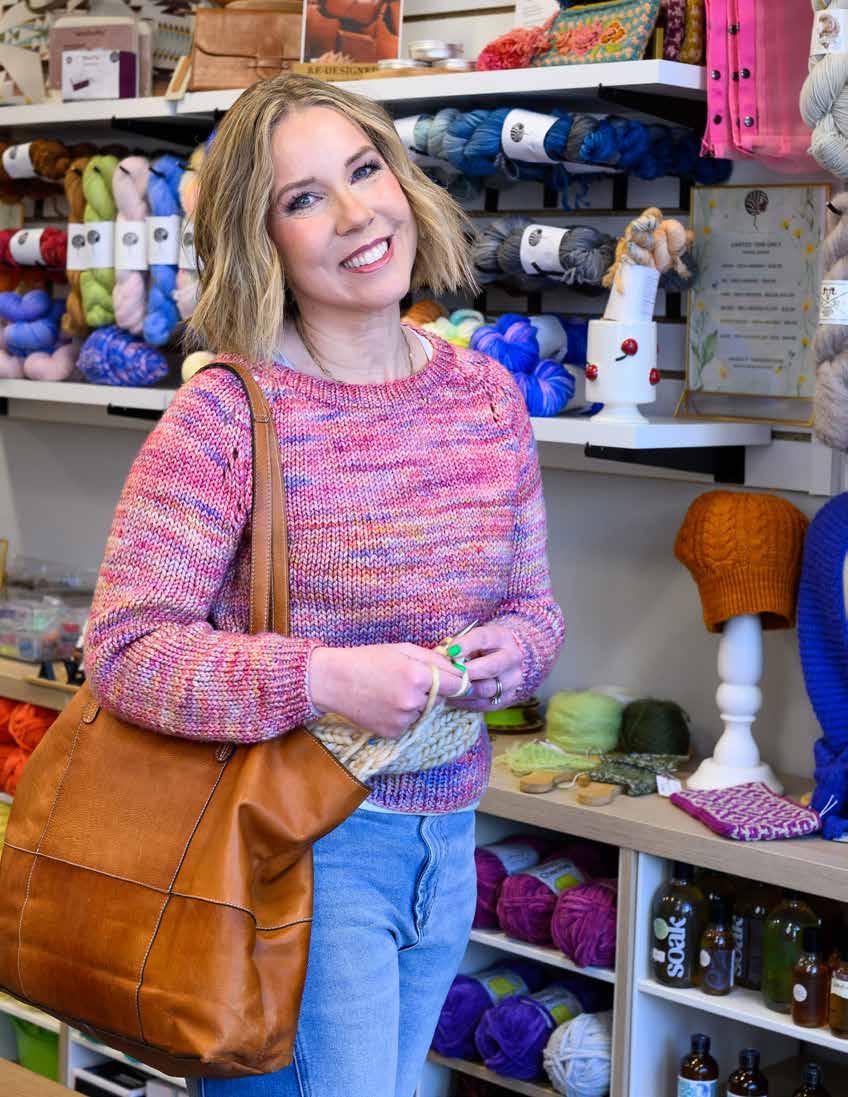
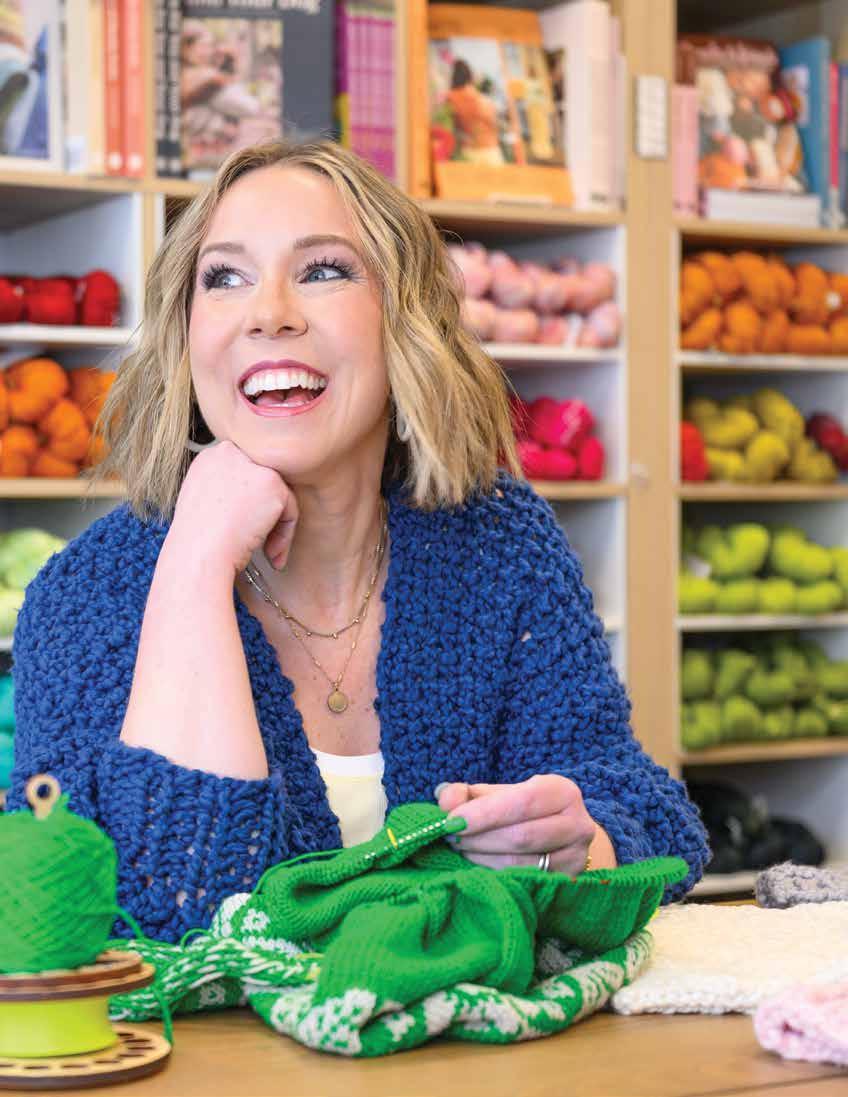
Ali Dillingham ’03, A Yarn Market owner, weaves creativity into her
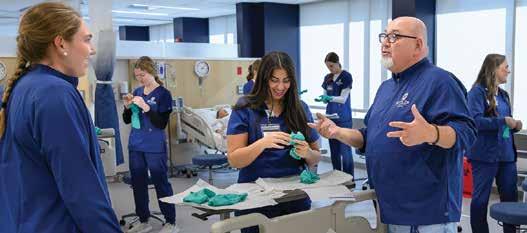
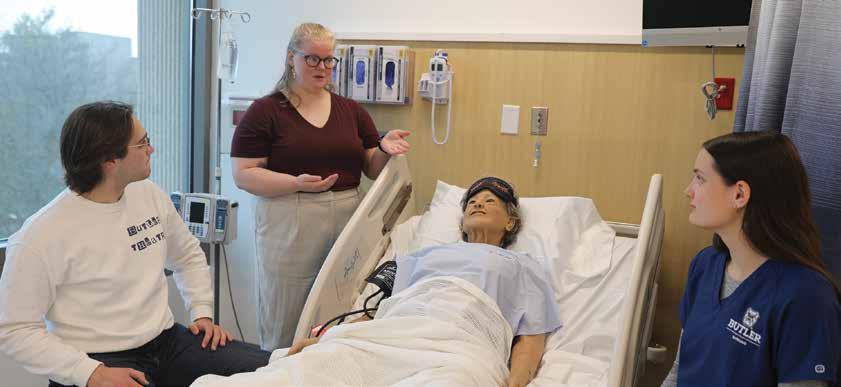
Theatre students contribute to healthcare training for Nursing and College of Pharmacy and Health Sciences students.
New Ambassador Program engages the power of the global Butler community.
Jim Conklin ’96 turns brain cancer diagnosis into career redirection and community impact.
Sponsored by Elements Financial
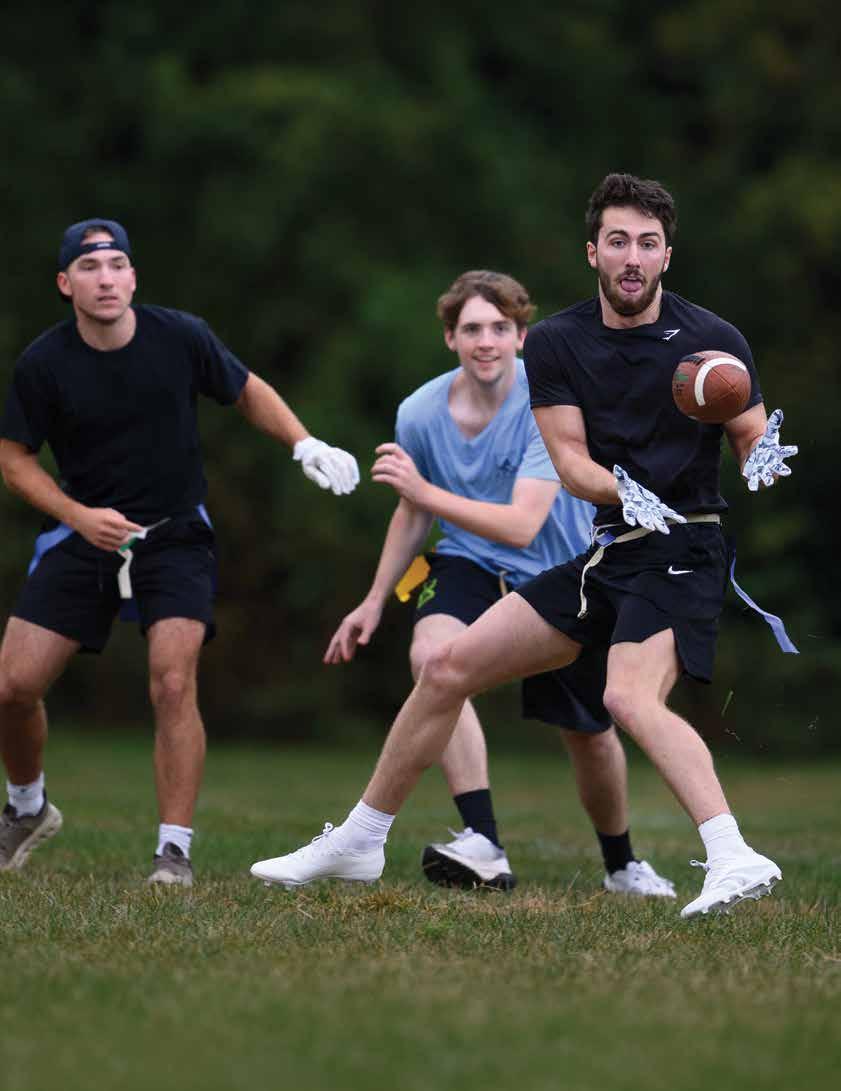
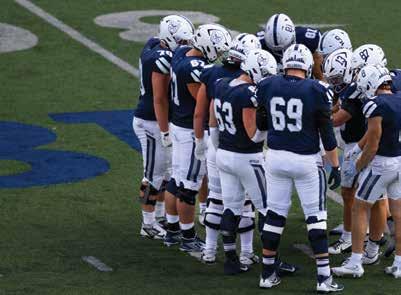
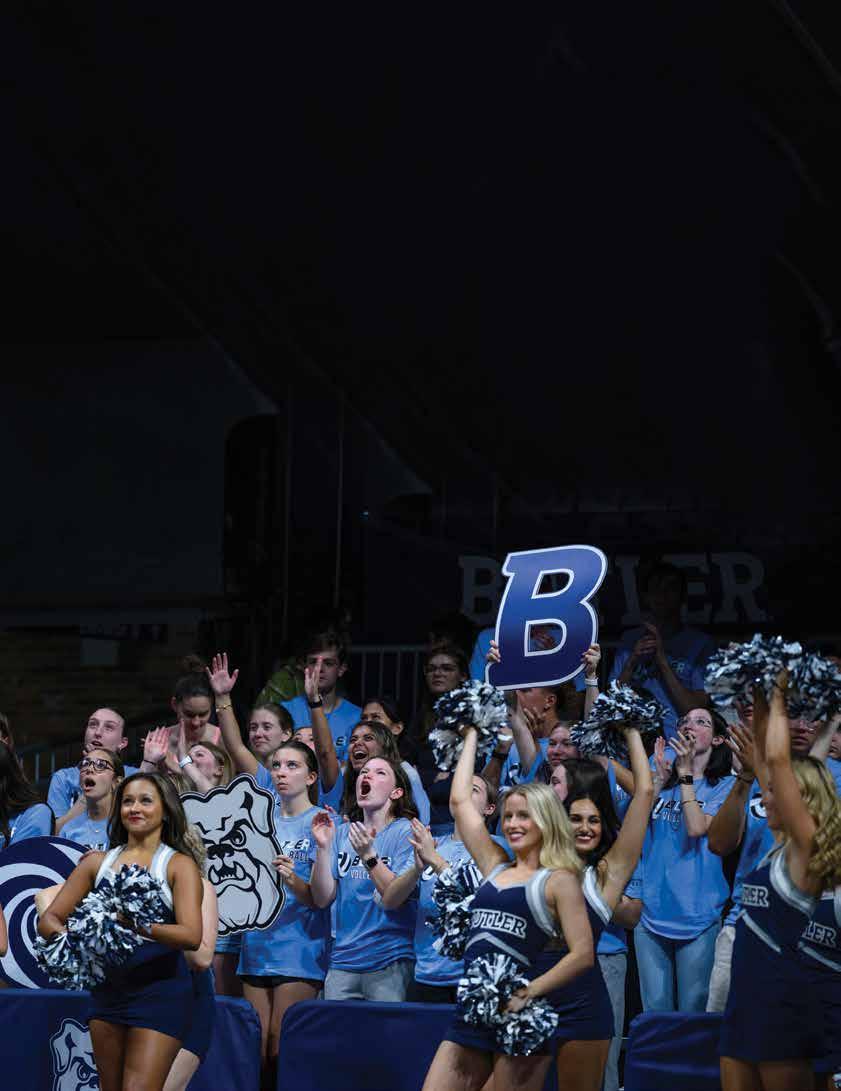
Athletics programs sustain The Butler Way through high standards and commitment to a team mentality.
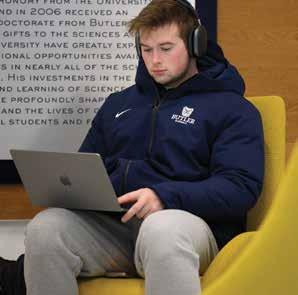
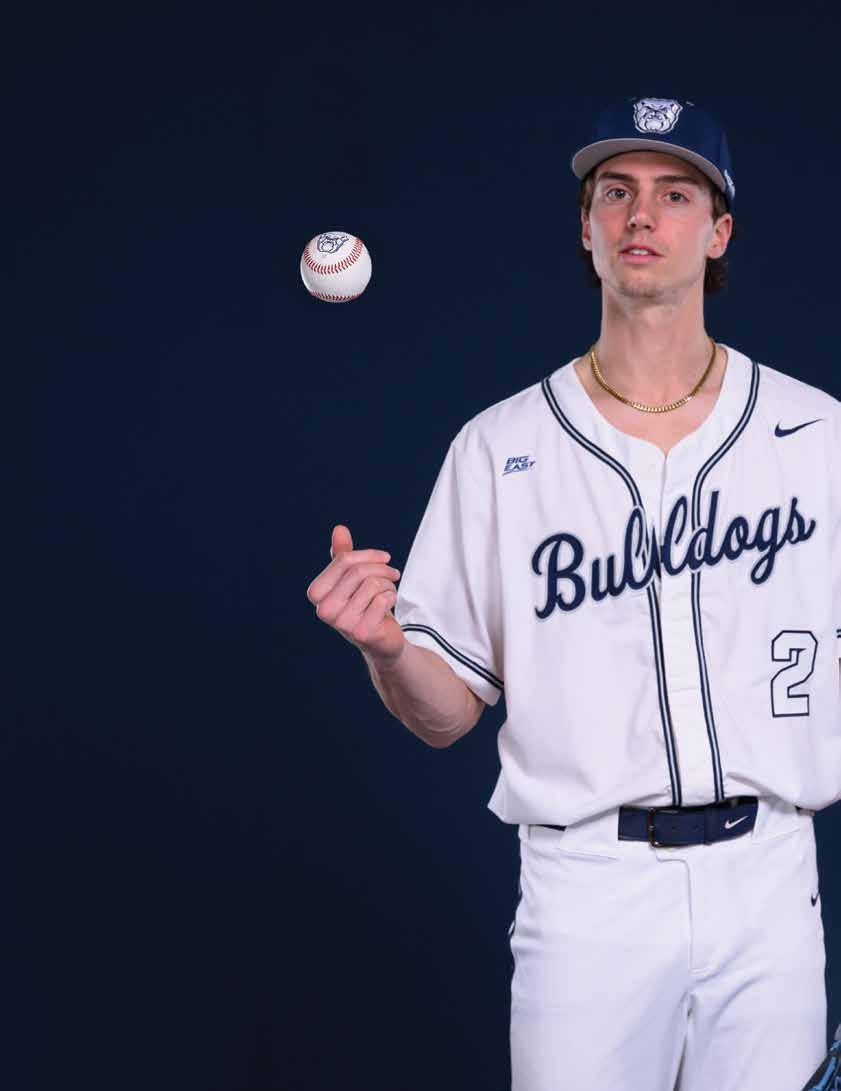
Junior David Ayers pursues a career in medicine while balancing life in the classroom and on the field.
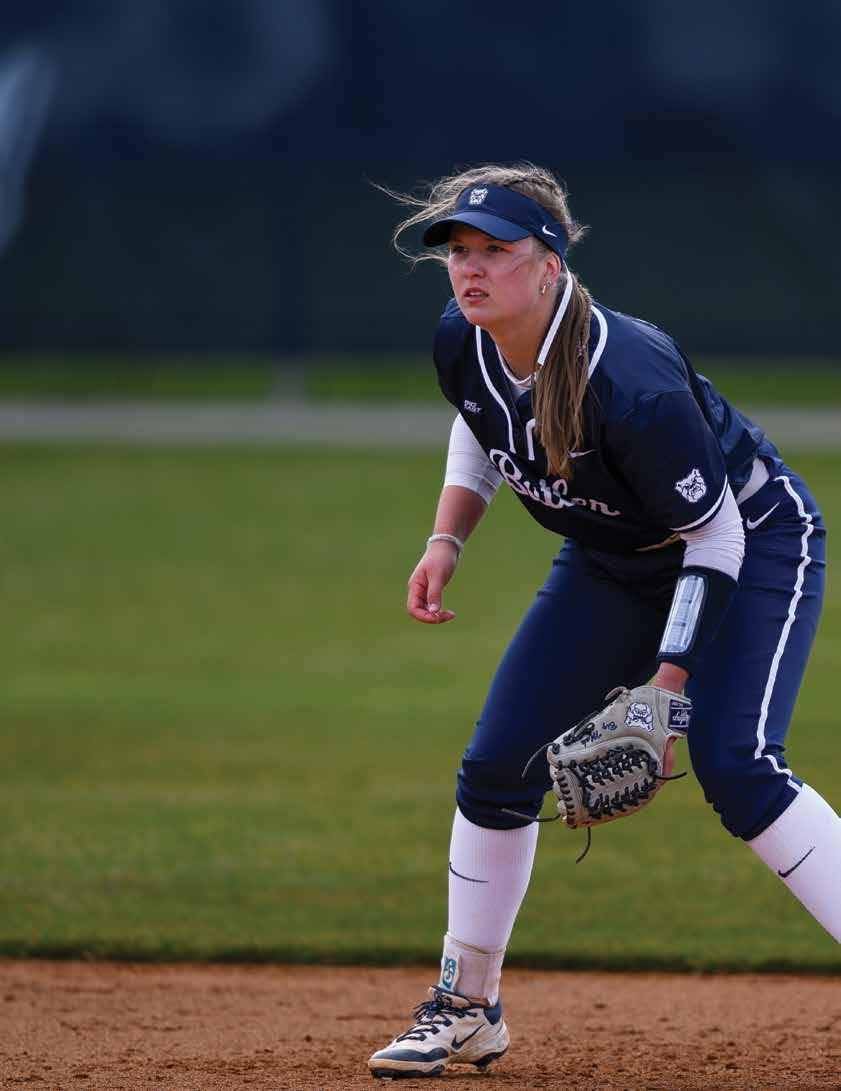
Health Sciences major Makena Alexander ’27 utilizes hard work, resilience, and teamwork to guide her life inside and outside the classroom.
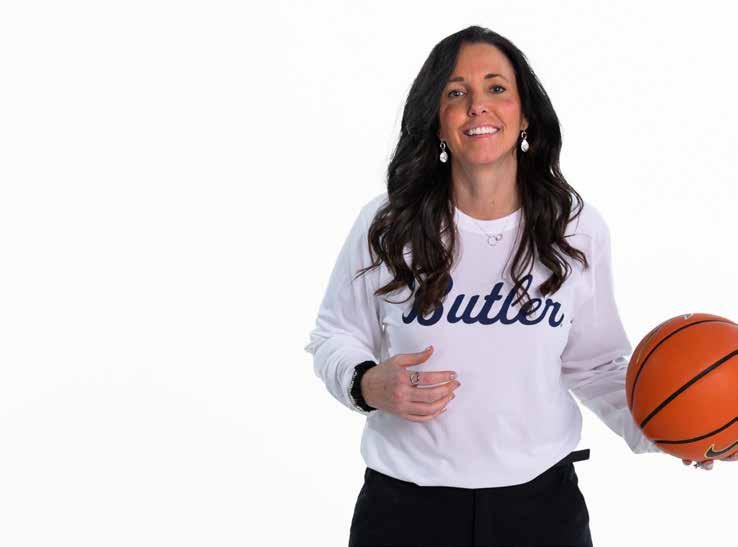
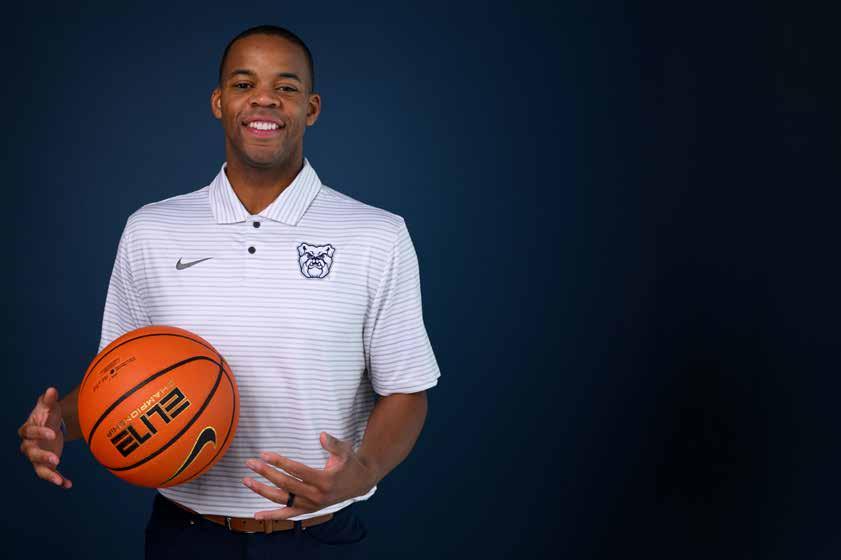
Maria Marchesano ’05 and Ron Nored ’12 return to Butler in head coaching roles.
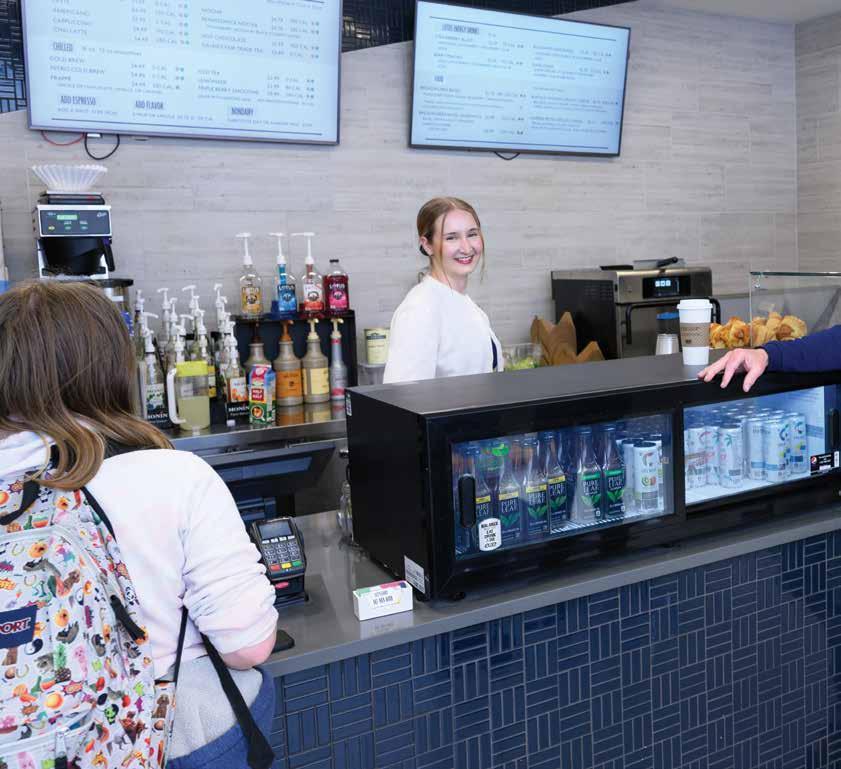
Butler Brew, located in Dugan Hall, is Butler University’s student-run coffee shop operated in partnership with Bon Appétit Management Company.
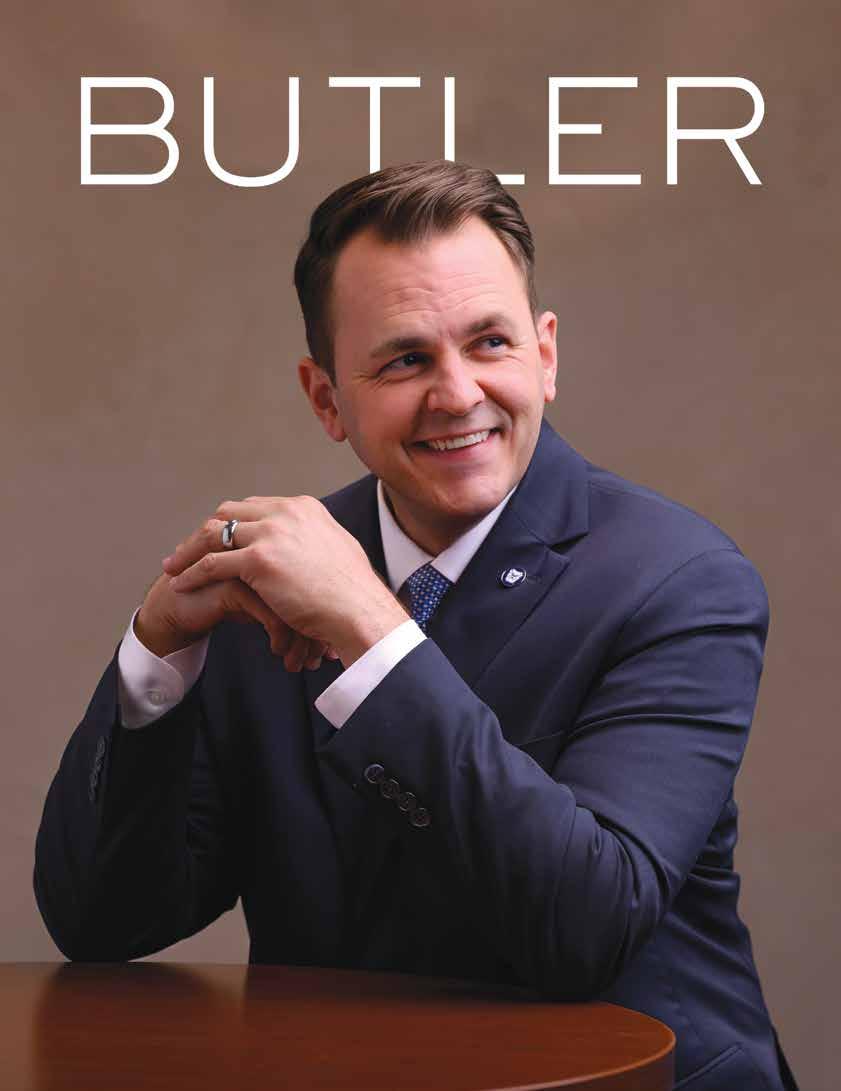
Universities are often measured by rankings, programs, or facilities. Those things matter, but over time, I have come to believe our true impact is found in something more enduring: the people we shape and the communities they influence.
I am reminded of that in my conversations with Butler students. Not long ago, a student shared how an idea that began as a class project had grown into something real, a venture now serving customers well beyond campus. What stayed with me was not only the ambition but the confidence that developed along the way. Somewhere between that first classroom conversation and the first customer, learning became ownership, and ownership became leadership.
That is the Butler experience at its best.
We have long believed that education should lead somewhere meaningful. It should stretch students and prepare them to contribute in ways that matter. Yes, we want them to succeed in their careers. Just as importantly, we want them to become thoughtful individuals who know how to lead, how to listen, and how to engage with a world that is changing quickly.
That feels especially important now. Artificial intelligence is reshaping how work gets done and how ideas are formed. It is a powerful tool, and our students must learn to use it well. At Butler, we are leaning into that opportunity.
At the same time, what defines a Butler education has never been information alone. It is relationships, mentoring, hands-on experiences, and the development of judgment and character. Those are the elements that will not be replaced. In many ways, they become even more important in a world where technology can do more of the technical work.
You will see that balance throughout this issue of Butler Magazine. It is present in the entrepreneurial journeys of students and alumni who are turning ideas into businesses that serve others. It is evident in the Near West Free Clinic, where students experience how knowledge and compassion come together in real ways. It also comes to life in the collaboration between the Jordan College of the Arts and the College of Pharmacy and Health Sciences, where theater students help future healthcare professionals develop the empathy and communication that define excellent care.
You will also meet alumni whose paths remind us that the Butler experience continues well beyond graduation. They are addressing food insecurity, building organizations, and contributing to their communities in ways that reflect the values they developed here.
Butler itself continues to evolve. In this issue, we introduce Dr. Michael Hole ’08, recently announced as our next Executive Vice President and Provost. I am excited about what his leadership will bring as we strengthen our academic programs and expand opportunities for students and faculty.
As I reflect on the stories in these pages, I come back to a simple idea. Butler’s strength has always been in how we bring people together to learn, to grow, and to lead. That is not something that can be automated. It must be experienced.
It is a privilege to see that happen every day.
Getting to know
incoming Executive Vice President and Provost
Michael Hole ’08
What Matters
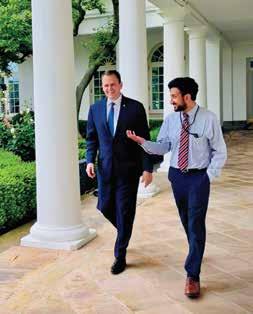
As Michael Hole prepares to return to Butler, he brings with him a career that defies easy categorization. A physician, professor, entrepreneur, and officer in the U.S. Air Force, Hole’s path spans rural Indiana roots to national service at the highest levels of government, including his role as Senior Advisor for Rural America at the White House.
From caring for incarcerated youth and underserved families to helping lead federal efforts that drove a historic decline in overdose deaths, Hole’s work has consistently focused on expanding opportunity and improving lives. A prolific scholar and educator, he has also built and supported organizations aimed at economic mobility, public health, and community resilience.
In this Q&A, Hole reflects on the experiences that shaped his approach to leadership, service, and innovation—and what he hopes to bring to the next chapter at his alma mater.
Q: What’s a story you tell people when they ask what Butler is really like?
It’s about something that happened when I was a junior.
I went to Professor Bob Pribush and said I wanted to help build a school in Uganda for children without access to education. Walking into his office, I halfexpected him to say, “Focus on your coursework.” But he didn’t. He said my idea sounded important and asked how he could help.
Over the next couple of years, with support from classmates, faculty, staff, and community partners, we all got to work and built that school together. It was my first real lesson in leadership—in setting a vision, rallying people around a cause, raising money, and delivering lasting results that we could measure. Every year since 2009, 300 students have attended that school in Uganda.
That’s what Butler’s really like. We know that the world’s problems are too big, too urgent. We don’t ask students to delay addressing them until they have diplomas or titles. We ask them to act now to serve the greater good, to have a meaningful impact on people’s lives.
Q: What kind of leader do you hope to be at Butler?
A leader who makes this very special place even better than I found it.
I’m from a small, beloved town in rural Indiana. I was a first-generation college student raised by wonderful parents, and I didn’t fully understand what was possible for me. Butler opened doors and changed everything. So, when I think about leadership, I start there: with the weight of what this University means to so many people. Coming back to serve this place that changed my life is a mission and deeply personal.
I aim to be a collaborative leader, one who asks questions more often than I give answers. Throughout my career, I learned repeatedly that the people closest to a challenge are often closest to its solution. My role is to listen carefully, bring people together, and help align our strengths to accomplish things that matter.
Q: When you were announced as Butler’s next Provost, you said, “Tough minds. Tender hearts. Let’s get to work.” Elaborate on what that means to you and how it applies to the Butler community.
When I say, “tough minds,” I’m talking about competence. Rigorous academics. A real commitment to excellence. The willingness to ask hard questions, work through complex problems, and pursue the truth, even when it’s uncomfortable.
But that’s never been Butler’s whole story.
“Tender hearts” means we care—for one another and for the communities we serve. It means using what we learn to help people who need us.
I learned that from my parents. As a boy, I’d go with them into the homes of elderly neighbors who were dying. I mostly watched. They’d cook meals, help with baths, fetch medications, and sometimes just sit and listen. They protected their neighbors’ dignity. I learned from them that compassion is about showing up, especially when it’s hard.
Tough minds without tender hearts can do harm. Tender hearts without tough minds can fall short. To take on the world’s hardest problems, we need leaders who have both.
Q: How would you say your unique and broad professional experience has prepared you for this new role?
My career has never followed a straight line. And I’ve come to believe that’s exactly the point.
I’m a professor. Teaching, mentoring, and scholarship aren’t abstractions for me—they’re my everyday life. I care deeply about academic excellence and about supporting the people who make it possible.
At the same time, much of my work has been across sectors: health care, business, government, nonprofits, and the military. The toughest problems don’t fit neatly inside one discipline or industry. They require collaboration. They require people who can translate between worlds—who can bring a researcher, a CEO, and a policymaker into the same room and help them understand one another and move forward.
Leading diverse teams to solve hard problems in fast-changing environments and finding ways to move forward—that’s been my career. And that’s what I hope to bring here. Not a rigid agenda, but the instincts to help Butler write its next great chapter, boldly and together.
Q: You’ve talked a lot about your life-changing trip to Ecuador when you were a student. What other experiences at Butler helped shape your professional journey?
The through-line of my career—how I learned to navigate medicine, business, and government—leads back to Butler.
Early in my medical career, I cared for children in homeless shelters whose symptoms rarely fit together neatly. Some causes were medical, others
environmental, still others tangled up in everything the kids’ families had endured. My Butler science courses had trained me to follow the data rather than the easiest explanation. That discipline made all the difference.
But I kept hitting a wall. Getting the diagnosis right wasn’t solving the problem. Many of my patients faced challenges no prescription could fix. So, I went back to something else Butler had taught me: how to bring people together around a shared mission. As a student, I’d started a couple of organizations on campus, figuring out how to lead people toward a goal nobody
had mapped out yet. I drew on that experience at Butler as I later built programs delivering food, health care, and economic support to families across the country. With service at the federal level, I sought to reach even more people. At the White House, I relied every day on lessons from Butler’s humanities courses: how to write and speak clearly, distill complexity into something actionable, weigh ethical tradeoffs, and hold competing truths without oversimplifying.
Butler had prepared me for every step. And when I felt unprepared, it gave me mentors to close the gap, sometimes decades after I’d graduated.
Q: What do you see as Butler’s unique strengths?
I’ve thought about this question a lot—as a student, alum, and trustee, and as someone now coming home to serve. Many things set Butler apart, and I’ve had the privilege of experiencing several of them firsthand.
First, our liberal arts foundation has never been more relevant. Today’s technology can generate massive amounts of information instantly. Butler has a duty to cultivate in students the habits of mind that can analyze, harness, and then use that information wisely. Critical thinking. Ethical reasoning. Clear communication. A global and historical perspective.
Second, Butler is embedded in a rare natural and civic space. Students can learn on a fun, park-like campus in the morning and apply what they’ve learned that same afternoon across Indianapolis. Internships, research partnerships, service opportunities, arts, sports, healthcare, business, government. Butler’s community is directly connected to all of it.
Third, Butler occupies a sweet spot of scale: large enough to carry a nationally recognized name and broad academic ambition, yet small enough to remain nimble. Innovation is part of our culture. When Butler decides to move, we actually can move—and that matters more than ever as higher education evolves.
Finally, there’s the Butler Way: relationship-rich and service-oriented. Students and faculty really know one another. Bulldogs everywhere care about their communities. In an increasingly fragmented nation and world, Butler draws people to feel connected and to do something larger than themselves. In this moment, that may be our greatest competitive advantage.
Q: What are the top priorities you have for Butler that can be accomplished through this role?
I’m not coming in with all the answers. My first priority is to listen—really listen—to anyone who loves Butler.
The best plans we will build together. But a few things are already taking shape in my mind.
First, as AI reshapes workforce needs, we must cultivate the distinctly human capacities that technology cannot replace. This means Butler’s liberal arts strengths become more, not less, valuable. I’m eager to partner with faculty to ask hard questions about how best to serve students in an AI age, imagining new possibilities for teaching and scholarship, and making learning more personalized, flexible, and crossdisciplinary.
Second, hands-on learning has never mattered more. Butler’s strategy to make experiential learning a core element of the curriculum for all students is vital to how we prepare them for the future. As part of this work, I’d like to see us extend the classroom even further into our communities. More internships. More co-ops. More local and global partnerships. I envision Butler classrooms inside workplaces, turning up the volume on industry integration and collaboration. When learning connects to real problems and real people, students carry lessons for life. Third, none of this works unless people know they belong. Students, faculty, and staff must feel supported, included, and valued to do their best work. We should continue strengthening our relationshiprich culture and support for mental and physical health so everyone at Butler can thrive.
Fourth, I want more Bulldogs to fall in love with Indiana. There is enormous opportunity here. Let’s make it easier for students and employees to experience and contribute to our state’s future.
for years. When I showed up, trust deepened and people got better. That lesson has stayed with me.
I plan to be a provost-on-the-move, visible in the daily life of our University. So, you’ll find me in classrooms and dining halls, at performances and games, in student meetings and late-night study sessions. Not to supervise, but to listen and better understand what it’s like to teach and learn at Butler now.
And I hope we ask more often what Butler can do for our country and world. Public service and civic learning will be priorities. Because when students are close to pressing challenges while in school, they’re more likely to spend their lives helping to address them.
Q: How will you stay connected to the daily academic life of students and faculty?
By showing up consistently.
As a physician, I learned that trust grows when you leave the office and go where people actually are. I’ve treated patients in shelters, food pantries, and prisons
But showing up is only half of it. I also want people to feel comfortable coming to me—and having lots of ways to do that. I want students, faculty, and staff to raise ideas or concerns knowing they’ll be taken seriously, and that there will be follow-through. Starting this fall, I plan to regularly host an open forum in Atherton Union. No agenda, just conversation.
I’m fired up to partner with the community that makes Butler so special—and to discover just how far we can go.
TWO COLLEGES. NEW NAMES. MORE IMPACT.
As the fields of healthcare and education continue to evolve, Butler is reimagining and expanding its academic offerings to meet the needs of the community and to ensure students graduate with the skills and knowledge needed to thrive in these dynamic industries. Reflecting this commitment, effective June 1, the College of Education will be renamed the College of Education and Human Development, and the College of Pharmacy
and Health Sciences will become the College of Health Professions.
“The renaming isn’t a change in direction,” says Brooke Kandel, Dean of College of Education and Human Development (CEHD). “It’s an alignment with the work we are already doing and the future of the disciplines represented in our college. Our students are entering a professional world in which education, human development, wellness, and community-based services intersect and require broad and interdisciplinary expertise and enduring skills. Whether a student is studying the physiological basis of movement in Kinesiology or support systems in Youth and Community Development, they are all working toward the same goal: thriving communities.”
The CEHD now spans Kinesiology, Sport Coaching, Youth and Community Development, Higher Education, Student Affairs, and Mental Health Counseling, alongside historical strengths in excellent K-12 educator preparation. The new name also reflects growing student interest in professions tied to community well-being and personal development. As always, with new programs come new ways for alumni to mentor.
“We are leaning further into the vision of our founder, Eliza Blaker,” says Kandel. “She didn’t just train educators; she sought to improve the conditions that allow every individual to reach their full potential.”
The newly named College of Health Professions (CHP) reflects a growth in health professions programs but also a new vision, direction, and structure for how Butler educates and prepares future healthcare professionals. It includes a Bachelor of Science in Nursing program that launched last fall and Respiratory Therapy that will launch Fall 2027. Other programs under consideration include Social Work, Nutrition, and Patient Care Manager and Healing Arts.
“We are building on that foundation to offer programs that reflect the evolving needs of our communities, our students, and the industries they will serve.”
-President Jim Danko
The strategy and outcomes behind the renaming include:
• Extending reach into new health professions programs by building upon the strengths and reputation of the College’s legacy programs
• Educating and providing experiences for graduates to become skilled practitioners and health advocates for patients and the community, leading to more meaningful careers
• Transforming the approach to healthcare through partnerships willing to think differently and approach the real problems in health.
“Ultimately,” says Dr. Robert Soltis, Dean of CHP, “we are building more healthcare offerings to meet workforce demands and improve health across our communities. These additional programs will strengthen our legacy programs in Pharmacy and Physician Assistant Studies through shared resources and interprofessional activities.”
President James Danko adds, “We look to the future, with gratitude for the strong legacy of excellence that has defined Butler’s education and healthcare programs. We are building on that foundation to offer programs that reflect the evolving needs of our communities, our students, and the industries they will serve.”
COMMUNITY CALLING
By Victoria Ochs
At one of Outreach Indiana’s program centers serving homeless youth and young adults in Indianapolis, Volunteer Experience Manager Jennifer Ebner watched a Butler student help a young person prepare for a job interview—brushing and styling their hair.
It was a small act of care that helped send them out with confidence, embodying the dignity the organization strives to offer at every turn.
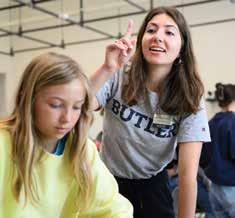
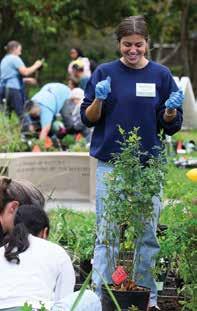
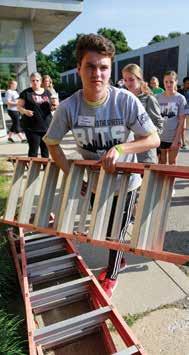
Students connect with Outreach through the Sociology course Homelessness in America, the Ambassadors of Change preorientation program’s “Just Get a Job” simulation, and volunteer opportunities throughout the school year.
“While my focus is on the benefits of understanding homelessness and the systems that impact it, it’s also important that students connect personally with the people in our program,” says Ebner. “Butler students learn the power of listening more than fixing, especially for those healing from trauma, and practice those skills when they spend time with us.”
These experiences are central to Butler’s identity, evidenced by its Community Engagement Classification: a prestigious national designation that recognizes institutions committed to meaningful, reciprocal partnerships that enrich learning, strengthen communities, and advance the public good. Awarded by the Carnegie Foundation for the Advancement of Teaching, the classification was first granted to Butler in 2015 and recently reaffirmed following a comprehensive review of its partnerships and impact.
“This recognition affirms something fundamental about Butler,” Butler University President James Danko says. “Our mission calls us to educate students in ways that are connected to the world around them. Community engagement is not separate from our academic work—it is essential to how we prepare students to lead meaningful lives and contribute to the common good.”
Talk to students across campus and you’ll hear stories about the relationships they’ve built through community engagement. Some serve through Butler Ambassadors for Special Olympics or Fraternity and Sorority Life, which contributes more than 17,000 service hours and $425,000 to charities annually. Others work with organizations like the Martin Luther King Jr. Community Center, Indy’s Global Village, and Shalom Health Care Center.
“We strive to build relationships with a wide variety of community partners to reflect the diversity of our external and
internal communities’ interests, identities, and passions,” says Associate Director of Student Experience and Engagement Hanako Gavia.
Gavia connects faculty, staff, students, and longstanding partners through Butler’s academic community engagement efforts. She also oversees the Indianapolis Community Requirement (ICR), which ensures every student completes a meaningful, academically grounded community engagement experience before graduation.
“We work to really listen to what our partners are saying and find where we fit,” Gavia says. “Sometimes it’s servicebased activities like a book drive or tutoring, sometimes it’s engagement-based like attending partner events or inviting them in to teach us about their experiences, and sometimes it’s a formal agreement to accomplish a shared goal.”
Senior Ireland Crabtree, a Criminology and Psychology major, completed her ICR at Big Brothers Big Sisters. Now, she works as their Advocate for Community Engagement (ACE), helping Gavia connect community sites with Butler students and faculty.
“The feedback I receive most from other students at the end of their ICR is that they’ll miss seeing their mentee every week, and mentees say the same thing about their Butler mentors,” Crabtree says.
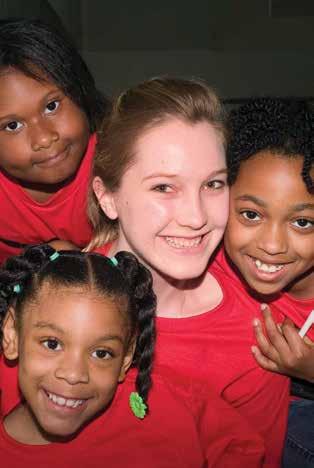
One student she mentored started the program withdrawn and disengaged. But by the end of the semester, he stepped in as a vibrant leader during activities.
“Seeing him smile and get more involved showed me our contributions to the Indianapolis community are extremely important and can mean more to others than we may think,” she says. “Academically, it was great to be able to connect what I was learning in class to hands-on experiences.”
Gavia says that, over time, students are often the ones most transformed. She sees them begin to “decenter themselves and think of themselves as part of a whole network,” bringing a deeper sense of community into their learning and professional development.
Director of Campus and Community Development Karissa Hulse sees this mindset echoed in Butler’s broader initiatives across Midtown Indianapolis, where partnerships seek to invest in strengthened connection, accessibility, and shared prosperity.
“A strong sense of place shapes how we engage, contribute, and have fun,” says Hulse. “At Butler, this means understanding our role in Midtown Indianapolis—as neighbors and as partners— and uplifting the experience of community-engaged learning and the cultural vitality of our city.”
MORE than
By Victoria Ochs
Student-Run Clinic Serves Indianapolis’ Westside
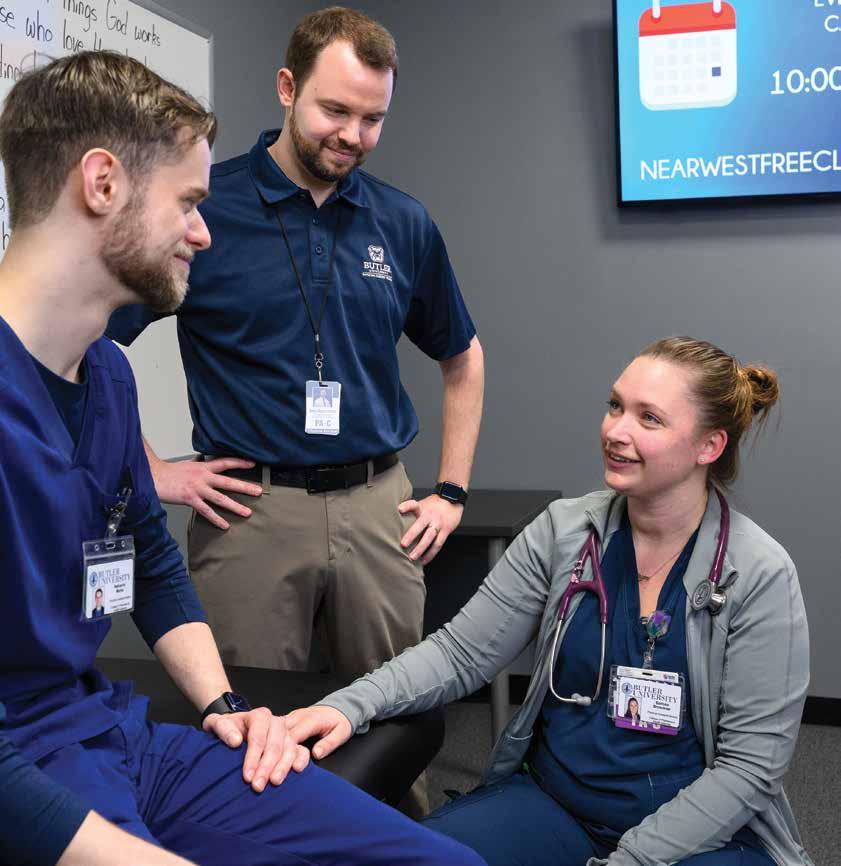
While volunteering at the Near West Free Clinic (NWFC)—a no-cost, student-run clinic serving Indianapolis’ underserved westside—a first-year Butler PA student noticed slight discoloration on a patient’s neck. Though the routine visit was for knee pain, her observation led to a diagnosis of seriously uncontrolled diabetes.
“If it wasn’t for the student actually thinking through a good physical exam and taking the extra time to connect with the patient, they never would have found it, since the patient didn’t want to seek care anywhere else,” says Kevin Bogenschutz ’17, the Clinical Director and Assistant Professor in Butler’s PA Program.
With medication, the patient’s symptoms improved quickly. She returned the next week with her family, and soon after, her neighbors. Stories like this unfold almost every week, Bogenschutz says. Now, the clinic is poised to expand its impact after being awarded the nccPA Health Foundation EMPOWER Grant, which supports PA-led, grassroots interventions for underserved populations.
Bogenschutz co-wrote the proposal alongside Butler PA students and NWFC board representatives Sarinna Brueckner ’26 and Nate Marks ’26. Competing against more than 30 proposals—many submitted by professionals—the students secured funding for upgraded equipment, additional medications, and more.
“Writing the grant was a great experience,” says Brueckner. “It really gave us a more in-depth look into the Marion County population and its needs, which in turn helped to determine the best route to seek support through the EMPOWER Grant.”
NWFC serves neighborhoods disproportionately impacted by poverty, chronic disease, and lack of insurance. The clinic brings together Butler PA students, Butler undergraduates in healthcare disciplines and the Medical Spanish program, Marian University medical students, and community partners. Bogenschutz leads the clinic alongside Medical Director and supervising physician Dr. James Pike.
Established in 2018, it served more than 800 patients last year.
“I never get more hugs than I do from patients when I’m there on a Saturday,” Bogenschutz says. “They’re just truly grateful for the care. They’re uplifted. To be able to care for them while working with our team and teaching PA students at the same time … is such a fun experience while still making a big impact.”
Academically, he feels Butler’s expanding healthcare partnerships signal the University’s growing leadership in both clinical training and community health in Indianapolis.
For Brueckner, the interdisciplinary teamwork and patient relationships are why she loves to volunteer. As a second-year PA student, she values the chance to practice forming differential diagnoses, navigating language barriers, and collaborating with other healthcare professionals.
A report on student NWFC volunteers through the years found significantly improved performance, increased confidence, and even lower burnout despite working shifts of 6–8 hours on Saturdays. Students reported feeling more motivated after connecting with the why behind their chosen career path.
And Brueckner is no exception. Volunteering isn’t required, but even with her studies, rotations, and responsibilities on the NWFC board, she can’t stop showing up.
“It’s so rewarding when you get to see patients a few weeks or months down the road and they’re thankful for how much they’ve improved,” she says. “It makes them feel seen, heard, and cared for. There isn’t really a feeling like it.”
By Victoria Ochs
COLLEGE... before College
When Emerson Baran ’29 first envisioned her life in college, she realized most of her expectations came from movies and shows like Gilmore Girls. As a first-generation student, her future felt unclear; she wasn’t sure what campus life was truly like or which major might be right for her.
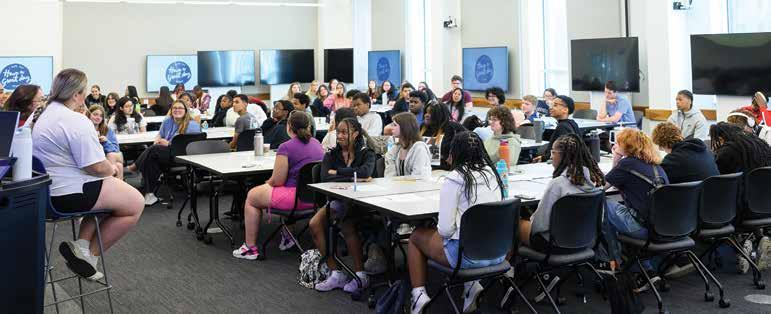
She admitted she felt anxious when she signed up for Butler’s Pre-College Programs: a weeklong summer experience for high schoolers designed to bring clarity about academic interests, build practical leadership skills, and develop independence in a supportive setting. But looking back now as a Butler Sociology and Psychology double major, she’s an earnest advocate for its impact.
“Pre-College Programs prepared me to pursue a college degree by introducing me to different resources and people on campus who all work to help support you throughout college,” Baran says. “Before even getting accepted into Butler and before coming for my first year in August of 2024, I felt confident that I knew who I could reach out to or where I could go if I needed help. … There are so many things to be nervous about as you transition to college, and the simple act of knowing where you’re going and where things were helped me to feel more comfortable during my first year.”
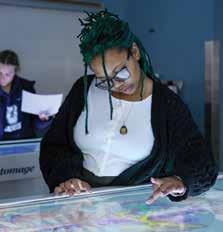
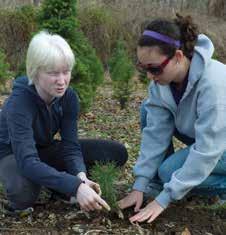
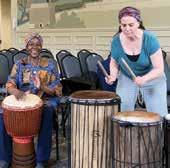
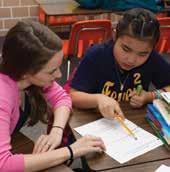
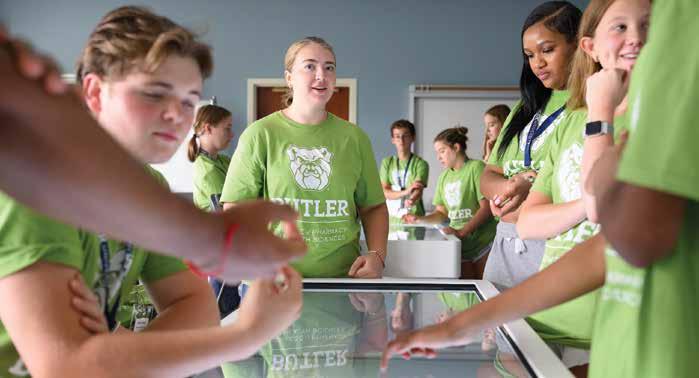
As a participant in the program’s Exploratory track, Baran got to try majors across Butler’s colleges through hands-on, interactive sessions. She made her own hand sanitizer with the College of Pharmacy and Health Sciences, learned about milestones in child development with the College of Liberal Arts and Sciences, and even tried dance and drumming through the Jordan College of the Arts.
This year, the University expanded its Pre-College Programs as a major initiative of the Boldly Butler strategic direction, adding new tracks for students interested in the Business and Healthcare fields. All three tracks include leadership development sessions and community-building activities outside of the classroom, and some tracks even offer college credit.
Supported in part by a $453,750 grant from Lilly Endowment Inc. through its Indiana Youth Programs on Campus initiative, the investment reflects Butler’s commitment to building inclusive, innovative, workforce-aligned educational models that start before students even enter college.
“This expansion is about more than summer programming— it’s about opening doors earlier,” Butler University
President James Danko says. “Through Boldly Butler, we are intentionally creating pathways that prepare future students to succeed in college and contribute meaningfully in their communities.”
High school sophomores through seniors are eligible to attend, including students graduating high school the May prior to the start of camp. Need-based tuition is available for 21st Century Scholars, students who qualify for free
Pre-College Programs
Exploratory
June 7–12
Discover a variety of disciplines as you reflect on your strengths, interests, and values.
or reduced lunch, and prospective first-generation college students. The program is offered both as a residential and commuter experience.
Tracks in Engineering and Sports Management are in development for 2027.
Learn more and register by May 15 at butler.edu/precollege.
Business
June 21–26
Explore marketing, entrepreneurship, risk management, and more through hands-on activities.
Healthcare
July 12–17
Build clinical skills through labs and simulations as you learn about healthcare careers.
Find the
By Emily Schlorf
’21
Krissi Edgington ’05 has always been a challenger. So it wasn’t a surprise to many when she left her career as a sports marketing executive to become an entrepreneur.
“I’m a curious kind of troublemaker, and I always say I’m an advocate of ‘why,’” Edgington says. “I think ‘why’ gets a bad rap. A lot of times it’s considered to be this challenging, confrontational, resistance word, but to me, it is such a superpower.”
During her time at Butler, Edgington’s challenger mindset pushed her to combine different experiences and skill sets to align with her dream career in sports media, from Communications and Psychology courses to an internship with the Indiana Pacers.
And just years after graduation, Edgington was living her dream, occupying seats at influential tables as Vice President of a sports and entertainment marketing agency—until becoming a mom forced her to confront some new whys.
“I struggled terribly for the first time in my life with a ‘What am I doing here?’ situation,” Edgington says.
“Here I was dropping off my infant and preemie babies to be raised by strangers every day, while I was going to do work that sometimes felt great and sometimes felt very misaligned.”
Returning to work armed with a handmade sign reading “Make It Worth It,” Edgington did all she could to make her time away from her babies matter. That is, until she realized how much more meaningful her work could be if she were in the driver’s seat, ensuring every project she touched aligned with her values, expertise, and purpose.
A year later, Edgington took the leap and left her job to begin working with her first consulting client, Butler University, before eventually founding MIWI Marketing.
MIWI—which is pronounced “my why” and stands for “Make It Worth It”—challenges the way brands market, encouraging clients to find their why.
“One of the things I say very directly to clients is, ‘What will have changed because you were there?’’’ Edgington says. “It’s not just about what you do, but it’s about what you create because of that.”
In just 10 years since its founding, MIWI has grown to four dedicated team members and earned media mentions for clients on ESPN, in The New York Times, and more, all the while transforming clients’ multifaceted brand identities and challenging limiting beliefs every step of the way.
Around the same time Edgington was establishing MIWI Marketing, another opportunity arose out of tragedy.
Andrew Smith ’13, a member of Butler’s back-to-back NCAA Finals Men’s Basketball teams, had just lost his two-year battle with cancer. His widow, Samantha, began championing bone marrow registry drives—a bone marrow transplant had added three months to her late husband’s life—but there was much more that could be done.
“When I came in, I was really looking to maximize my experience in athlete branding and cause marketing to say, ‘All right, there’s something here that needs to be done,’” Edgington says. “Andrew had a platform. We have a platform. What good can we create from this tragedy?”
Edgington partnered with the University to campaign Butler Blue III as the national ambassador for the Be The Match bone marrow registry before pitching an impactful story to ESPN.
The story in question was how Chase Stigall ’13, a teammate of Andrew’s, saved the life of a 2-yearold battling leukemia after adding his name to the bone marrow registry at Smith’s celebration of life. Amplifying Stigall’s and Smith’s stories was just the beginning.
In 2016, Edgington and Samantha Smith-Michael cofounded Project 44, a nonprofit housed at Butler aimed at saving lives by growing the national bone marrow registry. And while it’s difficult to put a number to how many lives Project 44 has saved, the nonprofit has added thousands of willing donors to the registry in its 10 years.
From transforming brands at MIWI Marketing to saving lives with Project 44, it’s no question that Edgington has always been good at finding the why.
Her real superpower? Finding—and working tirelessly to achieve—the how.
DO WHAT you LOVE
(and LOVE what you do)
ALUMNI PROFILES
Thank you to our credit union partner, Elements Financial, for their support.
By Katie Grieze
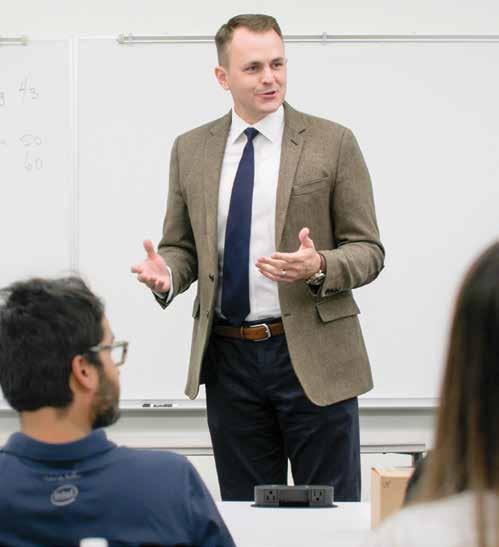
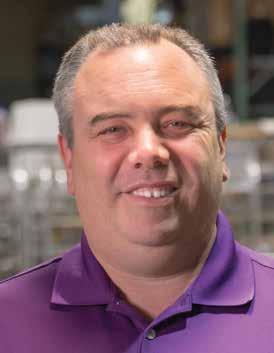
Gabe Connell MBA ’01 first had the idea to start a pizza business as an undergrad marketing student in Bloomington, Indiana, where he and his girlfriend (now wife) often shared a pie at their favorite local shop.
“We loved the pizza,” he says, “and it was always in the back of our minds—why not do that one day?”
That moment finally came in early 2004 when Connell opened HotBox Pizza in downtown Indianapolis, not long after completing his MBA at Butler University.
“It was actually at Butler that I started really hatching that plan,” he recalls. “At the time, I owned a couple of roller-skating rinks here in Indy, but I didn’t love that business and wanted to get into something that I could really be proud of and enjoy.”
Connell first enrolled at Butler with the desire to expand his knowledge in areas such as accounting and finance, skills he needed for an ongoing career in business ownership. He was drawn to Butler’s MBA for its flexibility, allowing him to attend night classes while working full time. He also loved the opportunity to learn alongside classmates from a wide variety of professional backgrounds.
“Whether it was people who were working in healthcare, with big manufacturing companies, or people like me who owned small independent businesses—that range of perspectives really enhanced the experience when we were looking at how to tackle problems or work through group projects,” says Connell.
In addition to connecting with fellow students, Connell valued the relationships he built with Butler professors. Several of those faculty members, including former finance professor and Real Business Experience (RBE) founder Dr. Mark Uchida, even influenced Connell’s choice to pivot out of roller rinks and into the world of pizza.
“At the time I was 28 years old, and Dr. Uchida told me, ‘If you don’t love what you’re doing at 28, you’re not going to love it when you’re 38 or 48, so get out now and find what your passion is,’” Connell remembers. “I was laser-focused on pizza once I got that in my head.”
HotBox has expanded rapidly since then, opening 22 locations across Central Indiana plus a spot at the Indianapolis International Airport—and if you’ve ever had a slice from the concessions at a Colts or Pacers game, there’s a good chance that was HotBox, too.
Throughout those years of growth, Connell has consistently leaned on the skills he learned at Butler, especially when it comes to being a strong leader for his team.
“Servant leadership is something I apply to everything we do,” he says. “Because we serve the public, developing a team with the mindset of ‘we’re here to serve’ really matters. Concepts like that aren’t necessarily what I went into Butler thinking I was there for, but they are a big part of what I took away and still think about on a regular basis.”
FUELING a DREAM
By Katie Grieze
For Demico Southern ’28, owning a business means a shot at stability—a chance to set his own schedule, do things his way, and earn an income through work that he truly enjoys.
That’s why, in August 2025, Southern launched his own family food truck while still attending Software Engineering classes as a sophomore at Butler University.
Big Benz BBQ grew out of a small catering business Southern had been running alongside his family for about a year. He loved those gigs but wanted to build something more established. With inspiration from his parents, lots of research, and some basic entrepreneurship skills gained at meetings hosted by Butler Trustee and Lecturer Dr. Anthony Murdock ’17, the food truck idea was born.
“I pretty much sell out every week,” Southern says.
The business has exploded in popularity since last fall. The oxtails, rib tips, and lamb chops are usually the first to go.
The truck is open Fridays and Saturdays, and it recently moved to a new location with more parking to accommodate the crowds. Southern says it’s been a challenge to adjust to growing demand, but with a goal of using the business to help pay for school, it’s a challenge he’s grateful to have.
“When we first started, there was a steady flow of people, but now we have a line before we open up,” he says. “There’s a lot more work, and a lot more food that needs to be cooked.”
Luckily, Southern isn’t in it alone. He has help from his brothers, cousin, mom, and dad. His dad often grills out on the weekends and taught Southern how to cook when he was young.
“My dad is a big inspiration for me,” he says.
Southern also feels encouraged by support from the community at Butler, where faculty and others around campus often recognize him from online posts about the food truck.
“It’s very uplifting to have all those people supporting you even though they don’t always really know you,” he says. “I think that’s a really cool thing about the Butler campus.”
While at Butler, Southern has learned to balance his priorities in a way that made business ownership possible.
“I’ve learned I can’t be doing too much at once,” says Southern, who played saxophone for Butler’s Jazz Ensemble in previous semesters but chose to take a break when his business took off. “In high school I was in so many clubs, but college has taught me you need to pick a priority and go with it.”
Still, he’s hopeful that recruiting more people to help with Big Benz will allow him time to join the band again.
With the success of his current business, Southern already has his sights set on the future. His entrepreneurial goals don’t stop at barbecue, and the Software Engineering major dreams of eventually running his own start-up in that field—in addition to the food truck, of course.
To find the Big Benz BBQ food truck location, visit bigbenzbbq. com/online-ordering and note the pick-up address.
knit
By Emily Schlorf ’21
You may think the shift from speech-language pathology to owning a small business is a big jump, but to Ali Dillingham ’03, owner of A Yarn Market in Carmel, Indiana, the similarities far outnumber the differences.
“With my background in speech therapy, I saw the benefits of knitting for anxiety, ADHD, and for preventing dementia. We refer to it as ‘yarn therapy,’” Dillingham says. “As an adjunct professor at Butler … I was able to take Butler students out into preschools for community-based learning. I enjoyed teaching the importance of positive reinforcement and would usually have some sort of hands-on activity. I think there’s been that creativity woven into work and into therapy all along.”
Like many fiber artists, Dillingham learned how to knit as a child but didn’t pick up her knitting needles again until graduate school as a way to relieve stress.
knitIt wasn’t until another stressful chapter two decades later—the COVID-19 pandemic—that Dillingham would consider turning her knitting passion into a career. While missing the connection and sense of community of in-person speech sessions with patients and witnessing the solace and joy knitting provided her friends and family, Dillingham’s idea began to take shape.
“I thought it would be a good time to see what I could offer the community as far as an intergenerational and community activity,” Dillingham says. “We did not have a yarn shop in Carmel, and so it was one of those ‘taking a leap’ moments, drawing on what I knew, which was teaching.”
Applying what she knew from her career as a speech-language pathologist— teaching, collaboration, community—was easy. Filling in the gaps of what she didn’t know? Not so much.
While Dillingham didn’t know the ins and outs of starting a business, her Butler education instilled in her a confidence to face the unknown.
“Butler taught me to ask questions and to not be afraid when you don’t know something,” says Dillingham. “If you don’t know something, then how do you find the answers? Or find somebody who does? Sometimes when people ask a question, I respond with, ‘I don’t know, but I’ll find out.’ And a lot of that was built in classes and learning how to learn.”
Dillingham also utilized several Butler University resources to make A Yarn Market a reality, including the Central Indiana Small Business Development Center—which is housed on campus— as well as the student-run communications agency, Five Fountains. She hired three Bulldogs as retail associates too.
Since its opening in 2024, A Yarn Market has strived to cater equally to knitters and crocheters, at all skill levels and ages, preaching progress over perfection.
“It takes a level of bravery to try something. I’ve seen some people who have given up for years. … A lot of times it’s because of an experience, whether that was taking a class or having something that didn’t fit right,” Dillingham says. “We know the time and effort to make something, so we host Flaunt It Fridays, which is basically show-and-tell day, and we celebrate what people are making.”
Dillingham knows better than anyone that starting a new chapter takes courage and support. And that’s why A Yarn Market is what it is today: a hub of encouragement, guidance, and collaboration.
“You can come in and ask questions, and we encourage that, because we want people to have that sense of joy. That’s what it’s about,” Dillingham says. “Yes, there’s yarn, but you need to know what to do with it, and we love being that resource for people.”
A Yarn Market is located at 1905 S. New Market Street, Suite 167, in Carmel, Indiana. To browse A Yarn Market’s online shop and view upcoming classes and events, visit ayarnmarket.com.
THE ART of CARE
By Rachel Stotts
In cities with major medical schools and teaching hospitals— like Indianapolis—professional actors are increasingly stepping into exam rooms instead of rehearsal halls. When they’re not on stage or on set, many are working as simulated patients, portraying individuals with specific symptoms, histories, and emotions so future medical professionals can practice real-world care.
“Patient simulation sounds funny to people not in the business,” says Diane Timmerman, Theatre Department Chair. “But it’s literally one of the hottest day jobs for actors in the country right now and can pay very well.”
Patient simulation falls under the umbrella of applied theatre, a broad term for theatrical techniques used outside traditional performance spaces. It can include work in prisons, museum theatre, and social service agencies.
The idea of incorporating patient simulation at Butler was sparked by a conversation Pharmacy Professor Julie Koehler had with one of her daughters’ theatre teachers, who said, “Theatre teaches empathy.” As a healthcare professional, that statement immediately captured her attention. “It became clear to me that the empathy cultivated through theatre could be incredibly powerful in healthcare education,” says Koehler.
In spring 2023, Timmerman and Koehler began pairing Theatre students with Pharmacy students in simulated patient scenarios in Koehler’s Self-Care and Health Promotion course.
Both sides loved the experience. “It’s a real opportunity for a science student to connect with a theatre student, each in their own expertise,” Timmerman says. “We’re always collaborating in theatre, but we’re not always collaborating with the sciences.”
Koehler agrees: “Meaningful innovation often happens at the intersection of disciplines, and it’s wonderful to see our disciplines joining together to support and teach one another.”
Now, Timmerman is determined to expand the effort and formalize it through a Patient Simulation Certificate program.
In January, Sarah Heider ’17, an actress and Patient Simulation Specialist at IU Health, led a two-hour workshop for Butler Theatre students. Heider began her career as an actor in patient simulation and now oversees others in the field.
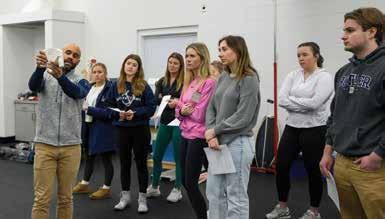
Nursing student Reese McKee ’29 explains how interacting with a trained actor helped her understand how patients process news.
“It challenged me to adjust my communication in real time. This is something you can’t fully capture in a classroom setting, making it one of the most practical experiences I have had.”
The proposed certificate would require students to attend workshops led by Heider and gain hands-on experience across Nursing, Pharmacy, Physician Assistant, and Respiratory Therapy programs, with an aim at integrating Social Work as well.
“If a student could walk out of here with a credential in patient simulation—hours of experience, documented training— that’s powerful,” she says.
Heider confirms, “If someone came into my office with that certification and experience on their résumé, I would hire them in a second.”
Just as important, the partnership reflects a broader philosophy about theatre education. “Some people think it’s Broadway and feature films, or nothing,” Timmerman says. “But there’s a whole world of theatre where people make a really good living and have a creatively rich life.”
CALLING ALL BULLDOGS
New Ambassador Program Takes Flight
The Butler Ambassador program, a new initiative led by the University’s Community Engagement office, invites alumni, parents, and friends to stay connected and advance Butler’s mission—no matter where they live.
“The Butler Ambassador program is designed to harness the passions of the full community of Butler alumni, parents, and supporters that now spans the globe,” says Jonathan Purvis, Vice President for Advancement and Marketing.
“Butler University’s bold plans for the future can only be realized by engaging the power of our global Butler community.”
The new structure builds upon the University’s former regional alumni model, expanding opportunities beyond geographic boundaries. Instead of focusing solely on citybased chapters, the Ambassador program offers flexible, structured ways for Bulldogs everywhere to get involved. Central to the program is its customizable level of commitment. Ambassadors can choose how they participate based on their interests and availability. One of the simplest ways to serve is by proudly representing Butler in everyday life—displaying University license plates, hanging Butler flags in offices, or wearing Butler gear. These visible expressions of pride help spark conversations, build recognition, and strengthen Butler’s brand in emerging markets.
The program is open to anyone connected to Butler. Prospective Ambassadors can visit the Butler Ambassador website to complete a brief quiz that matches them with engagement opportunities aligned with their interests—no matter their location.
For Kate Kennedy ’04, Chair of the Butler University Alumni Association Regional Engagement Committee, the new approach signals a more inclusive era of alumni engagement.
“Living in Cincinnati, I sometimes felt outside the traditional alumni circle,” she says. “This new approach includes Bulldogs everywhere, with opportunities that can be tailored to personal interests and varying levels of engagement.”
With the launch of the Butler Ambassador program, the University is calling on Bulldogs around the world to play a role in shaping its future—proving that wherever they go, Butler goes with them.
Sign up today!
Waste not, Want not.
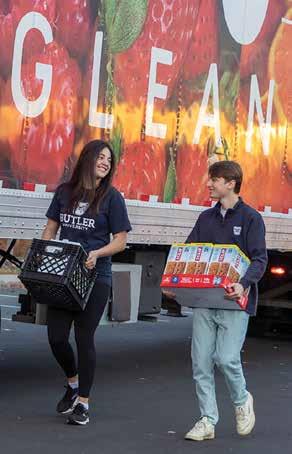
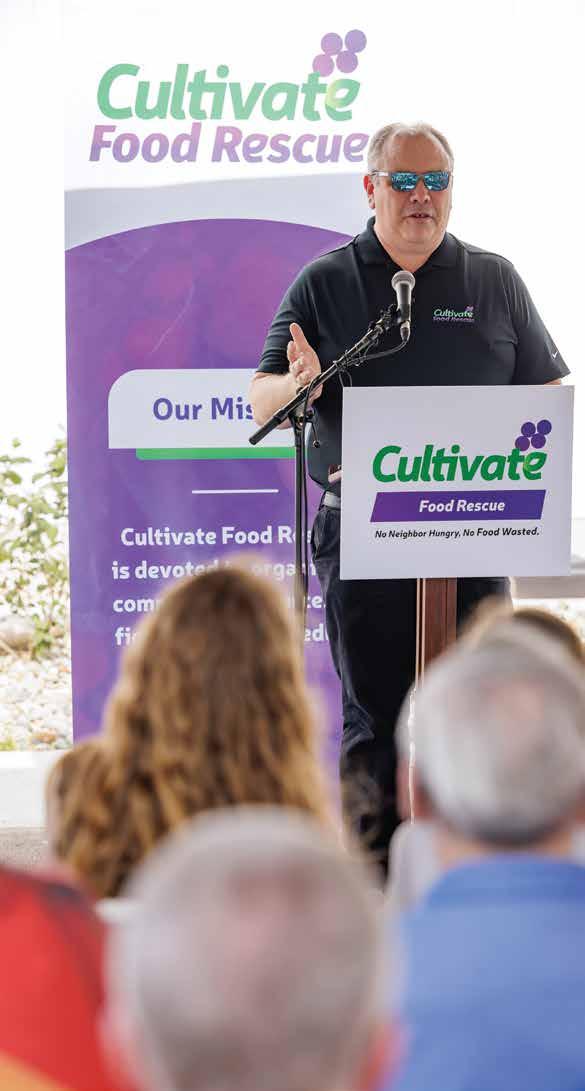
Jim Conklin ’96 founded Cultivate Food Rescue in 2016 to feed hungry people in the South Bend/Plymouth/Elkhart, Indiana, area and reduce food waste. In the 10 years since, he has built an organization of 30 full-time employees and seven part-timers who have distributed more than 15 million pounds of food that might have otherwise gone to waste, raised more than $5 million, and motivated 6,500 people to volunteer to feed their neighbors.
The seed for this nonprofit was planted roughly 20 years earlier, when Conklin was a Butler Accounting student doing an internship with Indianapolis Public Schools. At the time, he was mentoring a student—“I still remember his face today”—who opened up about his food insecurity.
“I didn’t come from a ton of wealth, but we always had food and we were safe,” says Conklin. “So, hearing what that child experienced was very substantial. I didn’t know how important that was at the time, but when I look back, it was foundational”
But first, Conklin had school to finish and a career to pursue.
Motivated by professors such as Harry Hicks and internships at Allison Transmission and car auction company ADESA, Conklin started in commercial banking, then began studying to become a Chief Financial Officer.
Then, in 2010, he was diagnosed with a “sizable” brain tumor. He has subsequently undergone five surgeries and five radiation treatments—the most recent in late January. Today, his recovery is going very well, he says.
Faith guided him through. It also caused him to ask: Do I really want to be a CFO, or can I do something to help the community?
The answer took a few years to materialize. In 2013, Conklin was hired by Headsight Inc. (now called Precision Planting), an agricultural technology company in Bremen, Indiana, and a dream opportunity for him. Headsight’s owners, Rich and Samantha Gramm, “had a very positive impact on my faith and generosity,” Conklin says.
The Gramms also owned some side ventures, including a restaurant that was struggling. Conklin suggested closing it; the Gramms countered that Conklin and the restaurant’s chef,
By Marc D. Allan MFA ’18
Randy Ziolkowski, should come up with another venture to help the community.
Their first thought was a culinary school, but then they visited Second Helpings, an Indianapolis nonprofit that rescues food that would otherwise be thrown away, prepares it, and delivers it to local nonprofits at no cost.
“The joy on people’s faces was just infectious,” he says. “We walked in there—both the chef and I had been in business for a long time—and we had this overwhelming feeling that they’re doing this very well. On the way back, we agreed, ‘We’ve got to do this.’”
The first place they approached was the University of Notre Dame.
“We thought, we’re going to swing big on this and see if we can get some traction,” Conklin says. “Sustainability is huge for them. Having a positive impact on the community is huge for them. And so, we came along at the perfect time.”
The partnership continues to this day. In 2024, Notre Dame named Cultivate its Sustainability Partner of the Year.
“Seeing members of the local community working side by side with the university to tackle this very difficult challenge was inspiring and attracted me to my current role,” says Geory Kurtzhals, Notre Dame’s Executive Director of Sustainability. “What Jim and his colleagues have achieved in this last decade should be celebrated and elevated. They have developed a model which can—and hopefully will—be duplicated in other places.”
Once Notre Dame was on board, in 2017, Cultivate officially opened its doors. The organization started with its Kids Weekend Backpack Program, which takes rescued food and turns it into nutritious frozen meals that are delivered directly to kids in need to fill the gap on weekends. Cultivate now distributes six meals to over 2,100 students each Friday.
In addition, Cultivate now distributes another 10,000 meals a week through area food pantries and soup kitchens.
Conklin says this growth, these partnerships, and being part of an organization providing sustenance to the community fulfills him.
“It is hard and tiring, but we have made a huge impact,” he says. “We have been able to change the focus to food insecurity in our community, and the community has embraced what we are trying to accomplish and, most importantly, who we are trying to help.”
Thank you to our credit union partner, Elements Financial, for their support.
the
By Jennifer Gunnels
When Cybil Stillson ’26 was deciding where to go to college, she had three important criteria in mind: staying in her home state of Indiana; pursuing a degree that would prepare her for a career in sports media; and competing in the sport she loves against the top players in the country. Though Butler wasn’t originally on her radar, a serendipitous drive through campus in the spring of 2021, as Butler was hosting March Madness tournament games at Hinkle Fieldhouse, changed her life.
“We saw teams getting off their buses and walking into Hinkle Fieldhouse to compete, and you could just feel the energy and the tradition and the magic,” Stillson says.
She quickly got in touch with the Butler Women’s Golf coaching staff and learned the College of Communication has a Sports Media major. With the help of an athletic scholarship, Stillson has pursued her academic goals at Butler while competing against the nation’s top Division I golfers as a member of the Women’s Golf team.
“Having that support from Butler keeps me motivated and makes me want to be the best student and teammate I can be,” she says.
Despite media headlines focused on revenue sharing and high-stakes recruiting in college athletics, those stories are largely the exception. Like Stillson, the majority of Butler’s more than 500 student-athletes aren’t chasing NIL deals or transfer portal millions; they are here to earn a degree while playing the sport they love.
Collective Ambition
While the student-athlete experience is unique, it is also part of a much larger tapestry that pulls in a massive
cross-section of the student body. From the roar of the Dawg Pound to the precision of the Athletic Bands to the student managers on the sidelines, the ripple effect of a thriving Athletics program fosters a vibrant campus for everyone. This culture of collective ambition creates an environment where the energy of the arena extends into the classroom, raising the bar for every student.
“The students that go to Butler have very high standards for themselves, and that’s something that I’ve really appreciated about my time here,” Stillson says. “My teammates and classmates are always pushing me to keep setting higher goals for myself and doing my best.”
The numbers prove Stillson’s point. Last fall, Butler student-athletes combined for a 3.527 GPA, marking the 14th consecutive semester student-athletes have combined for a GPA of 3.3 or higher.
“I think people wonder if the idea of the ‘studentathlete’ is real anymore. But Butler is a unique school that maintains that standard—we are still students. We are going to class and being pushed to do our best academically and athletically because that’s the expectation our coaches have set. That’s something our school should be really proud of,” Stillson says.
Sustaining The Butler Way
Reagan Andrew ’26, quarterback on the Butler Football team, says the Athletics Department sets clear expectations for student-athletes from the start of their time at Butler, but also provides the support to meet those expectations.
“Football teaches you so many life lessons in general, but when you’re playing at the collegiate level, time management, in particular, is a big one. At Butler, Sonya Hopkins [Associate Athletic Director of Academics] makes it clear what is expected of us as student-athletes, but she’s also there to provide that support and help us figure out how to manage school while still giving our best to our team and developing as a player.”
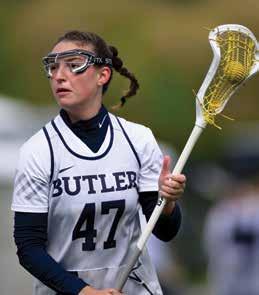
Mila Navarro ’27, a member of the Women’s Lacrosse team, says that while use of the transfer portal has increased during her years at Butler, the values of The Butler Way are clearly communicated to new recruits right from the start.
“We’ve had changes in the makeup of the team over the years, but our team culture has been very steady,” she says.
Stillson says the magic she felt the first time she visited campus and saw student-athletes walking into Hinkle Fieldhouse has only grown stronger after four years of representing Butler on the golf course.
“There is such a strong community here at Butler, and I think Athletics adds so much to a campus. It brings that sense of pride and school spirit. Golf is a sport that could get lost in the shuffle because we practice off campus, but what’s neat about Butler is when I walk through Hinkle, no matter who I pass, they know where our next tournament is or they are asking how practice is going. Everyone is so supportive of each other. We all want to do our best to compete and win, but we want to win in the right way, and we want to do it together.”
BUTLER ATHLETICS by the Numbers
20 12% 900+ ~150 ~200 3.527
| NCAA Division I Teams
| Undergraduate students directly participating in Athletics, Cheer, or Dance
| Dawg Pound members cheering on their classmates
| Students in the Butler Athletic Bands and Color Guard
| Students supporting the department as team managers, ticketing and hospitality staff, statisticians, and more
| Combined GPA for student-athletes last fall—the 14th consecutive semester above a 3.3
ATTITUDE A HEALTHY
For David Ayers, a junior baseball player for Butler, in-season life is a constant test of balance—but it’s also preparation for the future.
By Elle Rotter ’27
Ayers has been playing baseball since first grade. The sport has been a motivator that has propelled his growth over the years—not just shaping his skills on the field, but his discipline, time management, and resilience while off of it.
The life of a Division I student-athlete is rigorous. For Ayers, a typical week means Sundays end with a game and a late-night flight back to campus, leaving little time to reset before a new week begins. Mondays serve as the team’s off day from competition.
Another game is typically scheduled for Tuesday or Wednesday, sometimes requiring more travel. Thursdays bring travel and practice, followed by game days again on Friday and Saturday. On weeks like this, Ayers makes the most of his time in the classroom and any open time to study.
“It’s definitely not easy,” Ayers says. “You need to be prepared for the week. You have to be very intentional with your time. If you’re not disciplined, it’s easy to fall behind fast.”
For Ayers, the early mornings, long days, and demanding travel schedule are not just the life of a student-athlete; they are laying the foundation for a career in the medical field.
Ayers was originally unsure of the career path he wanted to take, but after shadowing a professional in the emergency room, he started to picture a future in medicine.
Watching doctors and nurses work in high-pressure situations while helping patients during their most vulnerable moments sparked something inside him. The experience reshaped his priorities and introduced him to a new purpose beyond the baseball diamond.
“Ever since that moment, I’ve just immersed myself in the grind,” Ayers says. “Anytime I shadow, it’s super motivating to talk to different doctors and see their daily job and interactions with people.”
Now a Health Sciences major on a Pre-Med track, Ayers is working toward medical school while navigating the relentless pace of Division I athletics. The structure, discipline, and resilience he has developed through baseball mirror the demands of a career in healthcare.
“Obviously, I wouldn’t be here without the support of my family,” Ayers says.
“But Coach Blake Beemer has been my biggest supporter. He keeps believing in and putting his confidence in me. That helps me have confidence in myself.”
MORE THAN the GAME
Long before she was balancing college softball, science labs, and a color-coded planner full of todo lists, Makena Alexander ’27 was a kid running around local ballfields in Frankton, Indiana.
What first started as Pee Wee Baseball soon transitioned to a softball league at the age of six—and then a travel league at the age of 10. The pace, the teamwork, and the competition quickly turned a childhood activity into a passion that would fuel her all the way to college.
Now a junior Health Sciences major/Chemistry minor at Butler University, Alexander has turned that early love for the sport into a collegiate softball career while also preparing for a future in healthcare.
Alexander’s academic interests were influenced long before she stepped onto campus. Her mother, a nurse, introduced her to the world of healthcare at a young age.
“I was around the hospital a lot when I was younger,” Alexander says. “Because of that, I knew I wanted to go into the medical field, but I didn’t really know what field. And then I saw Butler’s Health Sciences program would give me the opportunity to go wherever I want.”
The flexibility of Butler’s Physician Assistant program appealed to her. For Alexander, exploring different areas of healthcare while building a strong scientific foundation was key. However, her favorite learning experiences at Butler have taken place outside the classroom. Through experiential learning opportunities for her Indianapolis Cultural Requirement class, Alexander has spent time working with elderly residents at Fairview Presbyterian Church.
“I was just there hanging out with elderly men and women who were absolutely phenomenal,” Alexander says. “Listening to all of their stories is probably my favorite bit of the semester.”
Whether she’s studying for exams on a team bus, learning through hands-on-experience, or stepping up to bat, Alexander approaches each challenge with careful planning and genuine passion. The lessons of hard work, resilience, and teamwork that she learned through softball are the same ones guiding her toward a future career in healthcare.
By Elle Rotter ’27
All Good Dawgs Come Home
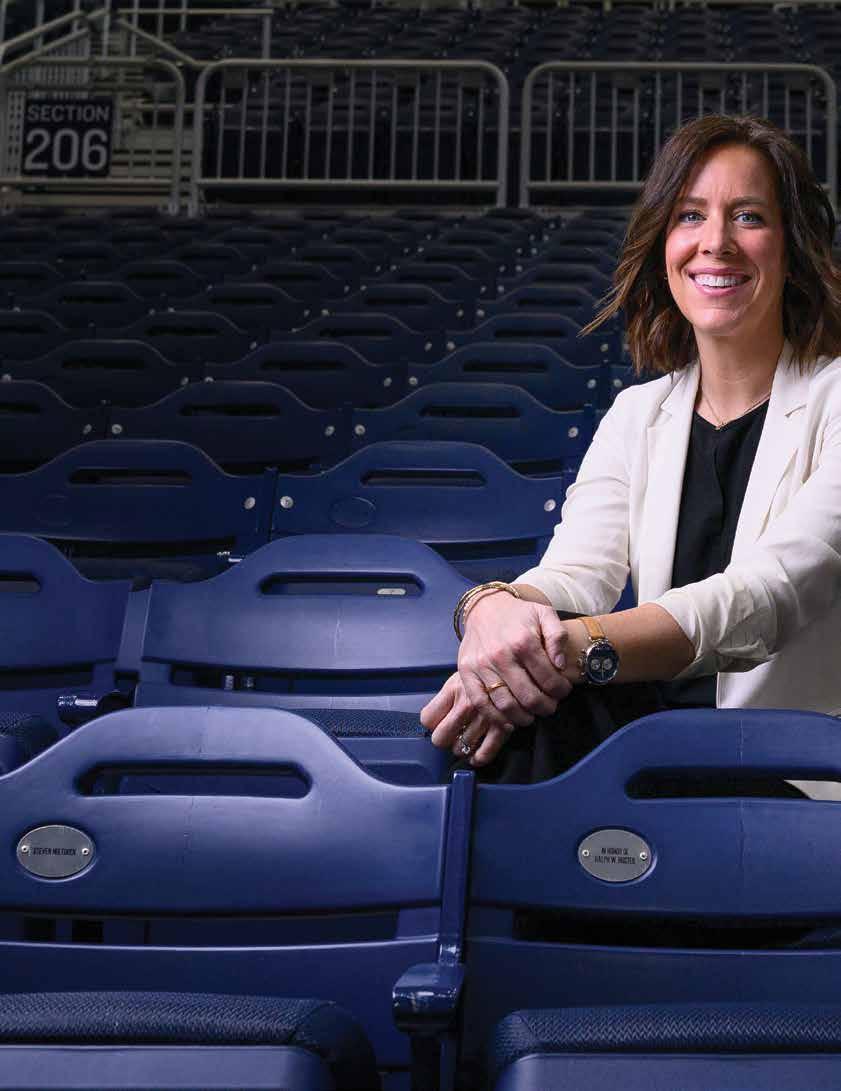
Maria Marchesano ’05, who has led Purdue Fort Wayne to three consecutive 20-win seasons and postseason appearances, has been hired as the Head Coach of the Bulldogs’ Women’s Basketball program. Vice President and Director of Athletics Grant Leiendecker made the announcement Wednesday, April 8.
Marchesano’s 14-year head coaching career includes 234 wins across stops at Purdue Fort Wayne (five seasons), Mount St. Mary’s (four seasons), Walsh (three seasons), and Urbana (two seasons).
“We are excited to bring Maria home to Butler,” says Leiendecker.
“She is a proven program-builder, a coach who has achieved success at every university she has been. Maria will bring her immense talent, energy, and commitment to Butler, a place that is incredibly special to her as someone who wore our jersey. Maria has a great vision for what our program can achieve and a solid plan on how to get there. The future is incredibly bright for Butler Women’s Basketball.”
Maria Marchesano
After more than a decade climbing the NBA coaching ranks, Ron Nored ’12 is returning to the program where he helped author one of college basketball’s most memorable runs. Nored was the steady floor general behind back-to-back national championship game appearances under Brad Stevens, and now comes back to Hinkle Fieldhouse with a résumé shaped at the game’s highest level.
For Nored, the opportunity is so much more than a homecoming.
“The term ‘dream job’ doesn’t do justice to how I feel about the opportunity to lead the Butler program,” he says. “As a player, I poured blood, sweat, and tears into this program. No one appreciates the responsibility and potential that comes with this position more than me.”
That blend of reverence and urgency is exactly what Butler leadership was looking for. Vice President and Director of Athletics Grant Leiendecker made it clear this hire is about more than nostalgia.
“In a rapidly evolving college basketball landscape, our priority was identifying the absolute best leader to spearhead the future of Butler Basketball. Ronald Nored is that leader,” Leiendecker says. “Ron is a relentless worker with an elite basketball IQ and a proven track record of developing talent at the highest level. We didn’t hire him for his history here—we hired him for his vision of what we can become and how we will get there.”
Briefs
Athletics Hall of Fame welcomes Class of 2025
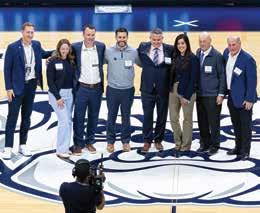
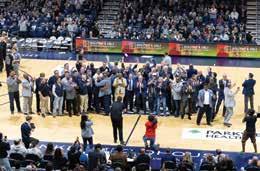
This year’s Hall of Fame class was celebrated on campus in February in conjunction with the men’s basketball game that evening against Seton Hall. The Class of 2025 includes the 1991 football team, Jenny (Esparza) Levengood ’13 (softball), Ron Griswold ’97 (football), Michael Mariscalco ’02 (men’s soccer), Dale Mueller ’05 (baseball), Michele Nash ’12 (women’s golf), Bill ’51 and Joanne Dugan (Special Service award), and Jon Hind (Special Service award).
“We are extremely proud to recognize this group of exceptional Bulldogs,” says Grant Leiendecker, Vice President and Director of Athletics. “The Butler Athletics Hall of Fame is one of the greatest honors that can be bestowed upon a Bulldog student-athlete and those who have significantly supported Butler Athletics. This class—during their time on campus and in the years since graduation—includes tremendous representatives of The Butler Way.”
Clowes Memorial Hall ranks among world’s top theatres
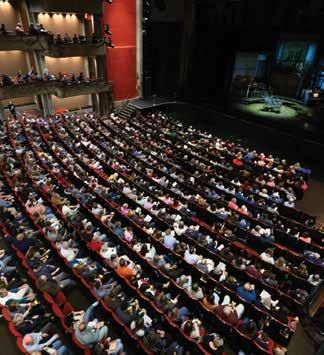
In Pollstar’s newly released 2025 Year-End Worldwide Top Theatre Grosses, Clowes Memorial Hall ranked 61st globally, generating more than $10.7 million in gross ticket revenue. The ranking places Clowes Hall among the Top 100 theatres in the world and reaffirms its position as Indiana’s top-selling theatre.
“Clowes Memorial Hall had another outstanding year, and the Pollstar rankings affirm the work our team puts in every day,” says Aaron Hurt, Vice President for Arts, Events, and Enterprise Management. “To remain a Top 100 theatre worldwide—and to reclaim the top spot in Indiana—speaks to the quality of the experience we deliver on every level.”
The 2025 ranking marks the seventh consecutive year Clowes Memorial Hall has earned a place on the Pollstar list of top-performing theaters worldwide.
Butler selected as 2026 Beckman Scholars Program awardee
Butler University has been selected as a 2026 awardee of the prestigious Beckman Scholars Program, an honor that recognizes institutions with a strong commitment to undergraduate research in the chemical and life sciences. The announcement was made by the Arnold and Mabel Beckman Foundation, which selected 14 colleges and universities nationwide through a highly competitive, expert-reviewed process.
As a Beckman Scholars Program awardee, Butler will receive funding to support six undergraduate Scholar–Mentor pairs over a three-year period. Each year, two exceptional undergraduate students will be named Beckman Scholars and will engage in intensive, 15-month mentored research experiences alongside Butler faculty. The program is designed to immerse students in sustained, high-impact research early in their academic careers—often shaping future paths toward graduate study, professional school, or researchfocused careers.
Butler’s selection reflects the University’s long-standing emphasis on faculty-mentored undergraduate research as a core component of a Butler education—and a key priority within the Boldly Butler strategy.
The 2026 Beckman Scholars Program includes more than $2.1 million in total funding nationwide and will support 84 undergraduate researchers across the selected institutions. Butler joins a distinguished cohort that includes leading public and private universities and nationally recognized liberal arts colleges.
Briefs
SKYLAKE Adventures partners with Butler
SKYLAKE Adventures, Indiana’s first and only largescale adventure park of its kind, has announced a partnership with Butler University Institute for Sports and Entertainment (BISE), reflecting a shared commitment to strengthening local communities and driving economic development in central Indiana.
Opening this summer in Hamilton County, SKYLAKE will be a year-round destination offering a personalized, outdoor-adventure experience where guests can choose their own thrill level across water obstacle courses, ropes courses, and other land attractions, or relax along a sixacre, white-sand lake.
“Butler helped set the foundation for everything we’ve built, so teaming up with the BISE program feels full circle,” says Sean “Mouse” Howard ’93, co-owner of SKYLAKE and a proud Butler graduate. “This partnership puts Butler students where they belong— inside real sports and entertainment experiences, doing real work that builds real careers. We can’t wait to collaborate with the next generation of Bulldogs and give them a front-row seat to the industry.”
BISE is an interdisciplinary initiative to connect Butler University students to sports and entertainment opportunities in Indiana. The SKYLAKE team will pour into BISE students with mentorship and real-life experiences in the entertainment industry. In turn, the Butler students will learn practical skills in marketing, social media, and communications while contributing to SKYLAKE’s growing brand presence.
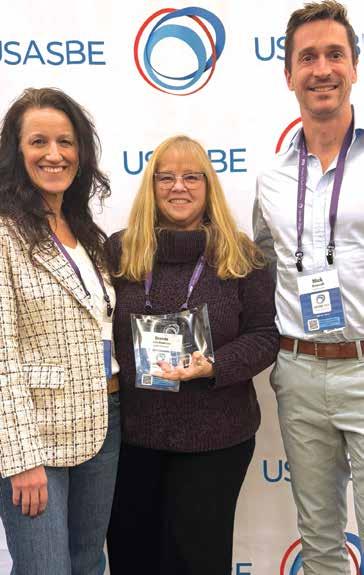
Butler Entrepreneurship receives National USASBE award
Butler University’s Lacy School of Business (LSB) has been honored with the Model Re-Emerging Program award by the United States Association for Small Business and Entrepreneurship (USASBE), recognizing Butler Entrepreneurship as the nation’s leading re-emerging entrepreneurship program. USASBE’s Excellence in Entrepreneurship Education awards recognize outstanding, innovative, and impactful programs, educators, and accelerators that advance entrepreneurship education. This distinction highlights LSB’s national leadership in experiential and innovation-driven entrepreneurship education.
The award acknowledges programs that demonstrate exceptional impact, innovation, and measurable outcomes— qualities that define Butler’s re-emerging entrepreneurship ecosystem. While anchored in more than a decade of strong experiential coursework, the program has undergone a significant revitalization over the past three years, marked by curricular enhancements, strengthened infrastructure, expanded staffing, substantial growth in student-led and student-run ventures, and community engagement.
“This national recognition is a powerful validation of the bold work happening across our entrepreneurship ecosystem,” Lacy School of Business Dean Craig Caldwell says. “Our students don’t just learn about innovation—they practice it every day by building real companies, solving real problems, and engaging with leaders.”
Program Highlights
• A four-year experiential learning pipeline
• Bulldog Enterprises and Startup Lab
• A strong network of mentors and partners
• Private Venture Association (PVA)
• Community engagement and crossinstitutional leadership
• A culture that champions innovation
Dr. Matthew Lanham named top professor
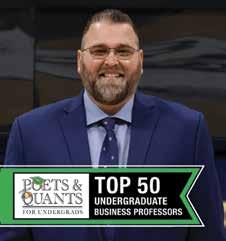
Dr. Matthew Lanham, Assistant Professor of Business Technology and Analytics in the Lacy School of Business, has been named one of Poets&Quants’ 50 Best Undergraduate Professors for 2025.
This recognition honors faculty who demonstrate outstanding teaching excellence and a profound impact on their students’ lives.
“Nobody deserves this award more than Professor Lanham,” says Max Sanders, senior Accounting major. “He is kind and caring, fun, and enthusiastic. You can tell when he teaches that he just wants to make us all better individuals, inside and outside of the classroom. Butler University is insanely blessed to have a professor as good as Professor Lanham.”
When asked what makes him stand out as a professor, Dr. Lanham reflects: “A zeal for outcomes. I care deeply that every student leaves my course with tangible evidence of growth—certifications earned, projects delivered, and confidence gained. Grades matter less to me than transformation. My approach is to coach, not just to teach, and to measure success by the lives my students change afterward.”
CLASS ACTS
the ’70s
David R. Head ’70, MS ’75 volunteers to teach English to Asian and Central European high school students from as far away as Mongolia at the Summer Language Institute in Klaipeda, Lithuania.
Alice Friman ’71 won the 2025 Poetry Award from the Society of Midland Authors for her poetry collection On the Overnight Train: New and Selected Poems, published by Louisiana State University Press. Friman has also been selected for the 2026 induction into the Georgia Writers Hall of Fame.
the ’80s
Marsh Davis ’80, President Emeritus of Indiana Landmarks, received the 2025 Eli Lilly Lifetime Achievement Award from the Indiana Historical Society and the 2025 John H. Chaffee Trustees’ Award for Outstanding Achievement in Public Policy from the National Trust for Historic Preservation.
Mark Longerbone ’80 retired from Nexstar Media Group in February 2025 after 49 years in broadcasting. He worked
at Nexstar’s Indianapolis media hub, ensuring that all 60+ stations received their daily programming. Prior to that, he worked at WISH-TV and before that at WTTV, right after graduating from the Radio and Television Department at Butler.
Ken Maynard ’80, Doctor of Osteopathic Medicine, recently retired after a 40-year career in Family Medicine in Brownsburg, Indiana, and surrounding Hendricks County communities.
Kris Dighe ’82 retired from the U.S. Department of Justice in October 2025, after 31 years as a federal criminal prosecutor. Dighe prosecuted cases throughout the nation, including New Jersey, Hawaii, Michigan, Alabama, California, Georgia, Virginia, the District of Columbia, and Indiana. He and his wife, Kristin, reside in Maryland, and he plans to travel and use his skills to help others.
Nathan Harter ’82 retired as a professor emeritus from Christopher Newport University in May 2025 after teaching Leadership Studies and, before that, at Purdue University, for a total of 35 years in higher education. He has published eight books on the topic. Harter and his beloved wife, Karin (King) Harter ’82, have now moved back to Indiana to be closer to their grandchildren.
Tim Livesay ’84 has accepted the position of Chief Executive Officer of Suburban Health at Home, following 14 years as Director of Pharmacy at Hancock Health. Suburban Health at Home is owned by seven rural hospitals and is dedicated to providing comprehensive
ambulatory care services: home care, hospice, and home medical equipment.
Tim Burton ’87 is retiring after 39 years in public education in Fort Wayne, Indiana, where he served 17 years as an English teacher, coaching numerous sports, and 22 years as a high school administrator.
Steven Goeglein ’88, MS ’95 retired from the MSD Lawrence Township after 37 years of service.
the ’90s
Carolyn (Clark) Miner ’91 published her first children’s book, What’s That Sound?
Chip Keller ’93 was appointed to serve a four-year term as a member of the Indiana Local Government Investment Pool Board by Senator Pro Tempore Rod Bray.
Ron Nicholson ’94 had his debut novel, Justice House Shadows, published by Main Street Rag in June 2025. He is also the 2025 recipient of the Chickasaw Playwriting Prize. His winning play, The King and Queen of Foggy Flats, will premiere in Mobile, Alabama, in June 2026.
Renée K. Nicholson ’95 will publish her sixth book, FEVERDREAM, a full-length collection of poems, through Redhawk Publications in March 2026.
Holly A. Evans ’96 was named the Program Head of Pace University’s prestigious BFA Commercial Dance Department in New York City, New York. Evans’ graduates are dancing on stages around the world, with many on Broadway
and at Radio City Music Hall. She is a proud graduate of Butler Ballet.
Jennifer Axom ’98 joined Old Town Design Group as a Marketing Specialist.
Amber Meranda ’98 was appointed Managing Director, Clinical Pharmacy, at Howden as the company continues to strategically expand its global reach into the U.S. market.
Aaron Simms ’98 has been promoted to Executive Director of Shakespeare on the Sound in Norwalk, Connecticut.
Bonny (Sullivan) McCabe ’99 accepted a position at Lilly Pharmaceutical as Executive Director, Clinical Research Investigator.
the ’00s
Andy Dillingham ’00 recently accepted a position as Regional Medical Director for IU Health Medical Group Primary Care North Region.
Suzanne Haag ’02 is the Associate Artistic Director and Resident Choreographer at the Eugene Ballet (Oregon). She presented her first fulllength premiere of Dracula.
Dancing for her in the company are Sarah Kosterman Downard ’16 as a Principal Dancer, Nina Nicotera ’20 as a Company Dancer, and Brita Malena Gilbert ’24 as an Aspirant Dancer. Haag has also been identified as one of 33 up-and-coming “Future Leaders and Artistic Directors” in the ballet world on the national stage and participated in a conference for these artists at the Dutch National Ballet.
Katie Reel ’02 has been teaching since leaving the Butler classroom, and now she is teaching all those who follow her on her Instagram @thereadingreel, where she inspires parents of children with dyslexia. She is a mother of four and continues to teach in person in the homeschool pod she started.
Maggie Bradburn Marton ’03 has a forthcoming nonfiction book, FOR THE LOVE OF DOG, which raises money and awareness for Indianapolis-area shelter dogs. The book’s publisher, Regalo Press, unites philanthropy with the business of book publishing by making a donation to a charity of the author’s choice on every deal. Maggie selected IndyHumane.
Duane Lightfoot Jr. ’04 recently published his first book, Beyond the Game: How Sports Teach You to Compete, Lead, and Win at Life
Maria A. Marchesano ’05 was inducted into the Indiana Basketball Hall of Fame 2026 Women’s Silver Anniversary Team. After college, she played four seasons of professional basketball and four seasons of professional softball in Italy. Marchesano is in her 16th season as a college women’s basketball coach, currently in her fifth season as Head Coach at Purdue Fort Wayne.
Katie Boone MA ’08 was inducted into the Indiana Basketball Hall of Fame 2026 Women’s Silver Anniversary Team. Since 2005, she has worked as a Physician’s Assistant in general surgery and trauma for Franciscan Health of Indianapolis.
Kate Hewitt ’08 was inducted into the Outstanding Atlanta Class of 2025, which honors 10 young leaders of Atlanta each year for their community involvement and contributions to the city’s betterment. She serves as the Executive Director of 21st Century Leaders, a youth leadership and career readiness program for high school students across Georgia.
Ryne Kerchner ’08 accepted the role of Director of Recruitment for the Purdue Polytechnic Institute.
Ayako Hasebe Lloyd ’09 was appointed as Cincinnati Ballet’s Summer Intensive Leader for 2025. She is currently a faculty member of the Cincinnati Ballet Academy and its Professional Training Division. Ayako also serves as a Teaching
Artist and Administrative Assistant at The Lexington Theatre Company.
Andrew J. Rayburn ’09, a Video Production Specialist for Community Health Network for many years, passed away in February 2025. As a tribute to him, his colleagues dedicated the Andrew Rayburn Memorial Studio in his honor.
the ’10s
Kate Klimek ’10 recently co-founded Grandir, a company based on her original tote bag design.
Nick Yoder ’11 was elected to the School Board for Edwardsburg Public Schools in November 2024.
Grace Speckman ’13 joined Meridian Investment Advisors as a Senior Financial Advisor, where she helps uniquely successful individuals and families make thoughtful decisions around investing, financial planning, and long-term wealth. She looks forward to building new relationships in her role.
Spencer Kemmeling ’14 was appointed Chief Executive Director of Premier Networx, an award-winning managed IT services provider.
Kyle Cherry ’16 started a new position as a Quality Control Biologist at Eli Lilly and Company in Indianapolis. His time in the Butler Biology department’s Kowalski lab prepared him immensely to take on the challenges of working in a highly regulated pharmaceutical manufacturing environment.
INCLUDE YOUR NEWS IN THE NEXT CLASS ACTS
Your fellow alumni are interested in your professional accomplishments, including a job change, a promotion, or retirement; community and volunteer activities; a recent marriage or addition to your family; or any other news you would like to share. Submit your updates at butler.edu/alumni/stay-connected
Due to space limitations, submitted photographs and/or Class Acts may not always be published.
Harriet Steinke ’16 has been selected as the 12th recipient of the 2025 Hermitage Prize in Composition, which
includes a residency at the Hermitage in Sarasota County, Florida. Steinke is a concert-music composer from Michigan. She has worked with chamber ensembles, orchestras, and soloists across the United States, premiering multiple works in her hometown of Detroit. Her music has been recognized with a Charles Ives Scholarship Award from the American Academy of Arts and Letters, as well as composition fellowships from summer festivals at Aspen, Tanglewood, and Norfolk.
Benjamin Lange ’19 is currently employed as an Advanced Nuclear Engineer by Fluor Marine Propulsion, LLC, at Knolls Atomic Power Laboratory in Niskayuna, New York.
the ’20s
Elizabeth Verkamp ’20 was appointed as Chief of Staff for McGill and Partners, a global specialty insurance and reinsurance broking firm. Verkamp has moved from Chicago, Illinois, to London, England, to pursue her responsibilities in this new role.
Abbey Wenzel ’20 achieved certifications as a Direct Support Professional (DSP) and Qualified Intellectual Disabilities Professional (QIDP), reflecting a high level of
professional expertise and commitment to excellence in supporting individuals with intellectual and developmental disabilities.
Anthony Gary MBA ’21 announced his campaign for Hendricks County Council. Fred Matos ’22 was recently promoted to Vice President of the Condo & Multifamily practice group for Marsh McLennan Agency, the largest insurance brokerage in the world.
Tarryn Harris ’23 joined the University of Arkansas Clinton School Impact Center as a Research Associate.
She is currently leading a wide range of research projects focused on public health prevention and management strategies, workforce development needs assessments, and community-level interventions for families impacted by the opioid crisis.
Ben Varner ’24, who received a dual degree in Economics and Mechanical Engineering, has joined Hoosier Racing Tires in Lakeville, Indiana, as Dirt Oval Racing Product Manager.
WEDDINGS
Lauren Verner ’14 and Brian Seyforth on October 11, 2025 (1)
Kevin Bozymski ’15 and Kate Niemer on August 16, 2025 (2)
Kyle Annis ’15 and Courtney West ’16 on October 3, 2025 (3)
Sam Thomas ’17 and Amanda Hashimoto ’17 on April 5, 2025 (4)
Lindsey (Babovac) Smith ’18 and Christopher Smith ’18 on October 19, 2024 (5)
Rachel (Burke) Purdum ’19, ’20 and David Purdum ’20 on August 16, 2025 (6)
Miranda Stratton, PharmD ’19 and Greyson Johnson on August 23, 2025 (7)
Sam Yeaton ’19 and Leanna Kerbs ’19 on August 23, 2025 (8)
Sam Phifer ’20 and Ava Phifer on September 6, 2025 (9)
Janine Paquette ’20 and Samantha Worden ’21 on October 4, 2025 (10)
Caitlin Dunlap ’22 and Andrew Taylor ’24 on October 24, 2025 (11)
Malayna (Pottschmidt) Garcia ’22, MPAcc ’23 and Zach Garcia on May 23, 2025 (12)
Megan (Rahn) Schorm ’22 and Tyler Schorm on May 31, 2025 (13)
Kyle Schwartz ’22 and Julia (North) Schwartz ’22 on September 26, 2025 (14)
Natalie (Mondus) Rieg ’23 and Graham Rieg ’23 on October 11, 2025 (15)
Lydia (Sarver) Bichey ’24 and Dawson Bichey on July 11, 2024 (16)
NEW ARRIVALS
Steven Johnson ’13 and Sarah Rooksberry ’15 welcomed Nora Johnson in May 2025 (1)
Andrew Raebig ’13 and Erin Raebig welcomed Charlotte Marie Raebig in August 2025 (2)
Michael Strauss ’14 and Lauren (Need) Strauss ’16 welcomed Chloe Rose Strauss in May 2025 (3)
Mary Kate (Daniels) Moskal ’16 and Blake Moskal ’16 welcomed James Thomas Moskal in November 2024 (4)
Ashley (Crossland) Van Dyke ’16 and Alex Van Dyke welcomed Jack Taylor Van Dyke in August 2025 (5)
Jessica (Giaquinto) Vashi ’16 and Parth Vashi welcomed Nikhil Owen Vashi in November 2025 (6)
Shannon (Reid) Harris ’17 and Clark Harris welcomed Bridget Harris in October 2025 (7)
Keenan Conklin ’18 and Kendall (Roessler) Conklin ’21 welcomed Parker James Conklin in September 2025
Hannah (Shelton) Davis ’19 and Blake Davis ’19 welcomed Daphne Kay in October 2024 (8)
Madison (Stefanski) Stewart ’19 and Christian Stewart ’19 welcomed Greta Stewart in August 2025 (9)
Anna Swenson ’20 and Justin Littell welcomed Eva and Elnora Littell in April 2025 (10)
Fred Matos ’22 and Taryn Turpin welcomed Lacie Lily Matos in June 2025 (11)
Aubrey (Cast) Sherwin ’22 and Daniel Sherwin welcomed Avery Janet Sherwin in October 2025 (12)
IN MEMORIAM
Bruce Bigelow
Wilma (Grabhorn) Brown ’44
Betty Jo (Fark) Pavey ’46
Rosalind (Martin) Meek ’47
Carol (Bryant) Finley ’49
Lester Ringham ’50
Anne (Bailey) Rudy ’50
Robert Russell ’50
Marian (Collins) Marlowe ’51
Carolyn (Steffy) McGuire ’51
Jacquelyn (Bernhart) Wagoner ’51
Harold Conley ’52
Joan (Coxen) Nichols ’52
John Steinberger
Sue (Cummins) Lockwood
Patricia (Martin) Murphy ’53
Mary (Gianakos) Albean ’54
Roland Stellhorn ’54
Charles Bate ’55
Michael Caruso
John Crawford
Charles Moore ’55, MS ’58
Anna (Muktepavels) Motivans ’55
Jose Ramos ’55
Marilyn Wolfe ’55
Gundars Grislitis ’56
Donald Swenson ’56
Royce Boyer ’57
Gilbert Herod ’57
Arnold Spilly MS ’57
Byron DeCapua ’58
Ralph Eacret ’58
Samuel Hiatt ’58
Harold Nickels ’58
Diana Deitsch ’59, MA ’61
Donald Embry ’59, MS ’64
John Kraft ’59, MS ’66
David Croner
Joan (Dillon) Mays ’60
Jeannine (Boley) Miller MS ’60
Alfred Waner ’60, MA ’61
Jean (Kehling)
Willenberg ’60, MS ’67
Alice Appel ’61, MS ’64
Ronald Galosich ’61
Sharon (Holland) Logan ’61, MS ’75
Wilma Myer ’61
Myrneth Anderson ’62
David Brown ’62
Dorothy (Medich) Milivojac ’62, MS ’69
Judith (Gray) Ochs ’62
Patricia Persinger ’62
Brenda (Kilgore) Baldauf ’63
Norman Curry ’63
Dan Kaufman ’63
S. Kim Leech ’63
Frances (Sodeman) Lester ’63
Larry Miller ’63
Lester Walker ’63, MS ’64
Dana (Day) Witmer ’63, MS ’83
Marvin Wright ’63
Bruce Bade ’64
Joyce (Bills) Black ’64
Beverly (Liechty) Broglin ’64
Ann (De Motte) Hadden ’64
Joseph Kirsch ’64
Kitty (Miller) McGee MS ’64
Benjamin Newberry ’64
Douglas Webb ’64
Charles Fromer ’65
Paul O’Sullivan ’65
Stephen Plopper ’65
David Spencer ’65
Russell Bauman MBA ’66
James McGinty ’66
Larry Hall ’67
Deborah (Dunbar) Narcus ’67
Noel Nauber ’67
John Sutcliffe ’67
Gerald Swisher MS ’67
Nancy (Shumaker) Ahrbecker MS ’68
Silvija (Dzelme) Kaulins ’68
Barbara Likens MS ’68
Alice (Price) Wood ’68
Donald Bauder ’69
Glenna DeBrota MS ’69
Gracia (Johnson) Floyd ’69
Beverly (Gray) Morgan MS ’69
John Bedan MS ’70
Cheryl (Johnson) Brady ’70
Kenton Deich ’70
Mary (Goodson) Geise MS ’70
Wayne Johnson ’70
Mark Macke ’70
Robert Bishop ’71
Larry Fitzgerald MA ’71
James Johnson MS ’71
Richard Lewis ’71
Roy Weber ’71
Constance (Sisson) Womer ’71
Joan (Hudson) Beaman MS ’72
Robert Campbell ’72
Charles Chiesa ’72
Michael Crawford ’72
Jacquelyn Douglas MS ’72
Mark Hindsley ’72
Wendy (Schaubel) Noder ’72
Robert Stewart ’72
Patricia Denton MS ’73
Joan (Comstock) Field MS ’73
Larry Krauser ’73
Sara (Maddox) McDaniel MM ’73
William Newbold ’73
Stanley Ricks MM ’73
Judith Tilton ’73
Robert Crouch MBA ’74
Weimer Hicks, Jr. MA ’74
Daryl Mason ’74
William Jefferson ’75
Dennis Leonard ’75
Jean (Griffing) Madden ’75
Lawrence Semrau MS ’75
Maribeth Bailey ’76
Carter Blakeman MBA ’76
Steven Hobbs ’76
Dorothy (Bettis) Lukenbill MS ’76
Alan Syfert ’76
Marianne (McFrye) Werry ’76
Robert Curry MBA ’77
James Rea ’77
Chris Royal
Raymond Howard MS ’79
John Litel
Joyce (Lamb) Nobbe MS ’79
Susanne Wegert ’80
Catherine White ’80
Patti (Adams) Bohner
Maryann (Beckerich) Pluckebaum MA ’81
Robert Boyd MBA ’83
Beverly Griffin MS ’83
David Meier ’83
Nancy Lewis MS ’84
Roger Malcom ’84
Noble Parks, Jr.
Wayne Anderson MA ’87
Joan (Akre) Christen MS ’87
Nancy Costin MA ’87
Christine (Essington) Irbe ’87
Joseph Flanagan MBA ’88
Josette Jones MS ’88
Diana Price MA ’88
George Werres MBA ’89
Leanna (Mitchell) Woody ’92, MM ’95
David Misner MBA ’94
Exie Goodson
Nikita Haley ’97
Matthew Clapp
Nancy Vaughan MM ’05
Samantha (DeKruiff) Wilkins ’07
Jennifer Vincent MM ’08
Melissa White MS ’12
FORMER FACULTY
Joseph L. Kirsch Jr. ’64
FACULTY EMERITUS
Glenna “Jinx” DeBrota
Editor’s note: In the Fall 2025 issue of Butler Magazine, Linda Stowring ’69 was incorrectly listed in the In Memoriam section.
Rollin “Rollie” M. Dick
Rollin “Rollie” M. Dick, one of Indiana’s most influential business leaders and philanthropists, passed away peacefully at home on January 3, 2026, with his wife, Cheri, by his side. He was 94.
Rollie was a principled businessman and a tireless servant of the community. He lived a life defined by integrity, humility, and devotion. Not only was he a remarkable leader, but a quiet force whose wisdom, generosity, and commitment touched many.
At Butler University, Rollie’s legacy is indelible. As a trustee for several decades, he chaired committees, mentored students, provided scholarships, hosted annual dinners for “10 Bulldog students,” and was a constant presence at Butler basketball games. He believed fiercely in the “Butler Way” and in higher education as a pathway to leadership and service. His mentorship of Butler investment classes—many of whom outperformed the S&P 500 under his guidance—reflected his collaborative style: inclusive, thoughtful, and with respect for diverse perspectives.
From The Indianapolis Star
Support from my student interns has been an invaluable part of the success of the Butler Blue Live Mascot Program. For over 15 years, they have kept me and my predecessors in a state of controlled chaos—getting us where we need to go, seeing who we need to see, and giving us snacks along the way.
While I may be the creative genius behind my social media posts, my interns also help me come up with some great content ideas. I mean, I don’t have thumbs, so they post for me too. And let’s face it—my dad isn’t getting any younger and his connection to what college students think is relevant is also fading, so my interns’ input has become invaluable in our marketing process.
I do my best to set them up for success after college. While interning with me, not only do they get a daily dose of cuteness, but they are also on the front lines as brand ambassadors for the University, manage a social media audience of 200,000-plus, and learn what it’s like to work in a professional marketing environment. (There is just a bit more drool and dog hair than they might experience at another office.)
Not surprisingly, my former interns have gone on to do some incredible things. Allow me to brag on a couple:
Emma Bronsteader ’23 interned with me in 2022 when I ran for the Mascot Hall of Fame. After graduation, she headed west to begin her role with Cal Athletics Creative Services (University of California, Berkeley) as a video producer. In addition, she works for Major League Baseball as a live content creator based with the San Francisco Giants.
Grace Worcester ’25 spent two years interning with me in 2023 and 2024 and created my “Day in the Life”style content. She took a job down the road at Lucas Oil Stadium to help out the other Indy mascot named Blue. She now works with the Colts full-time and has traveled across the globe with Blue while growing their mascot social media audience to over 10 million!
All my interns have helped shape our mascot program into what it is today, and I could not be more proud of everything they have accomplished.
SPRING 2026
PRESIDENT, BUTLER UNIVERSITY
James M. Danko
VICE PRESIDENT, UNIVERSITY ADVANCEMENT AND MARKETING
Jonathan Purvis
EDITOR
Rachel Stotts
EDITORIAL TEAM
Mike Beam
Kristi Lafree
Victoria Ochs
Meredith Sauter ’12
Courtney Tuell ’99
ART AND DESIGN TEAM
David Downham
Phil Eichacker (Art Director)
Alisha Luckenbill
UNIVERSITY PHOTOGRAPHER
Zach Bolinger
CONTRIBUTING WRITERS
Marc D. Allan MFA ’18
Katie Grieze
Jennifer Gunnels
Victoria Ochs
Elle Rotter ’27
Emily Schlorf ’21
Rachel Stotts and Butler Blue IV
CLASS ACTS
Office of Butler Community Engagement
ClassActs@butler.edu
Butler Magazine is published for alumni, parents, supporters, and friends of Butler University. Share Butler Magazine story ideas and comments via email at butlermagazine@butler.edu or by phone at 317-940-9946.