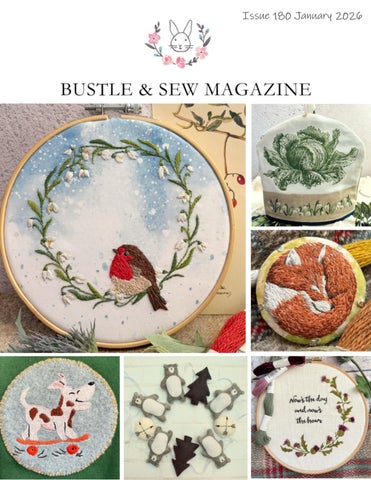
1
A Bustle & Sew Publication Copyright © Bustle & Sew Limited 2025 The right of Helen Grimes to be identified as the author of this work has been asserted in accordance with the Copyright, Designs and Patents Act 1988. All rights reserved. No part of this publication may be reproduced, stored in a retrieval system or transmitted in any form, or by any means, without the prior written permission of the author, nor be otherwise circulated in any form of binding or cover other than that in which it is published and without a similar condition being imposed on the subsequent purchaser. Every effort has been made to ensure that all the information in this book is accurate. However, due to differing conditions, tools and individual skills, the publisher cannot be responsible for any injuries, losses and other damages that may result from the use of the information in this book.
First published 2025 by: Bustle & Sew Station House West Cranmore Shepton Mallet BA4 4QP www.bustleandsew.com
2
Welcome to the January Magazine I can hardly believe that, after all the anticipation and excitement, that Christmas is behind us now and the New Year is nearly here. January has a quiet kind of beauty. After all the Christmas activity the pace of life slows, the air turns crisp, and our homes are at the heart of everything we do. In this issue we’re celebrating the comfort and creativity that make winter such a rewarding time for makers. January is the perfect moment to rediscover the simple joy of making something beautiful at your own pace and between the covers you’ll find a variety of projects that I hope will inspire you. As well as the patterns, you’ll discover articles on Evelyn Dunbar - the only paid female war artist in the UK, becoming a confident stitcher, unlocking the mysteries of hand needles and much more besides. I do hope you’ll enjoy this issue and the February edition will be published on Thursday 29 January, in a little under five weeks time. Until then… Very best wishes for a very happy new year 2026
Helen xx
3
21
Frosty days and starry nights …
30
53
5
44 20 4
January Almanac
5
Not Just for Christmas Hoop
9
Becoming a Confident Stitcher
12
Lovely Idea: Crochet Bucket Bag
14
A January Afternoon
15
Snowdrops Tea Cosy
17
A Garden for all Months
20
Evelyn Dunbar: A Life in Colour
21
The Winter Road
26
Alfie Learns to Skateboard
27
In the Kitchen: Under the Snow
30
Fox Brooch
41
Indoor Plants
44
Hand Sewing Needles
45
In Silhouette
48
Wilderness Bunting
49
Lovely Idea: Booper the Cat
52
Robert Burns - Scotland’s Bard
53
Now’s the Day Hoop
56
Tabby Weave: Not for Cats
59
In the Deep Midwinter
60
Poetry Corner: The Firewood Poem
65
RSN Stitch Bank
66
Kitchen Conversion Table
67
Templates
68
How to Embroider Fur
76
Two Sleepy Foxes
81
January
The old English word “winter” derives from the old High German and Gothic for “wet” and, as well as plentiful rain, we can expect to experience bitter cold, frost, snow, and darkness. Winter is a season from which the sun is absent, or at least remote - pale and weak, casting a thin watery light over the landscape. January is an Anglicization of the from the Roman month Latin word meaning “door” and associated with the two-faced god Janus, January being a transitional time between the old year and the new, the past and future. The new year emerges from the depths of winter. Although the shortest day is past and gone, January is a dark month in northern Europe. This can mean that once the Christmas and
New Year festivities have come to an end, we’ve all returned to work, and the cheerful seasonal envelopes dropping on our doormat bringing flocks of robins, snowmen and reindeer have been replaced by those plain versions with windows containing bills, offers of life insurance and other such delights, then the beginning of January can seem a little flat - even depressing. The nights are still long and in dull weather it can feel as though there is hardly any daylight at all. By the end of this month however, we will have about an extra hour of daylight, depending upon where you are of course, but it mightn’t seem that way as the mornings feel darker than ever. This is because until the ninth, the days are lengthening, but at sunset rather than sunrise. 5
Traditionally celebrated on the first Monday of the new year, Handsel, or Hansel Monday, is a Scottish custom marked by the giving of gifts. Also known as Diluain Traoighte in Gaelic, the word “handsel” originates from the Saxon word that means to deliver by hand. In the early nineteenth century this day was described as “an occasion when it is customary to make children and servants a present.” Small gifts or tokens, also known as handsels, were given to those that served in large manor houses. A gift of silver was considered lucky, while sharp objects should never be gifted, as this is believed to cut the relationship between the giver and the receiver. `
I wonder
I wonder if the snow loves the trees and the fields, that it kisses them so gently? And then it covers them up snug, you know, with a white quilt; and perhaps it says “Go to sleep, darlings, till the summer comes again”
Lewis Carroll, 1871: “Through the Looking-Glass and What Alice Found There”
6
7
Do you enjoy looking at hand embroidery projects online? But feel that maybe your own work doesn’t stand comparison with those super-talented embroiderers? Do you find yourself feeling anxious that you’ll never achieve a “good enough” standard of stitching?
Becoming a Confident Stitcher If you’ve been stitching for a while, you’ve almost certainly succumbed to the temptations of Instagram and Pinterest, scrolling through the work of some very talented needlework artists who produce simply wonderful pieces that leave you (and me too!) in awe and wondering how on earth they ever produce such beautifully stitched complex designs. Then it’s hard not to listen to that small internal voice saying or The danger of this kind of thinking is that you’ll become so insecure or intimidated by others’ skills that you’ll stop enjoying embroidery believing that you lack the talent to produce work that’s even half-way as good. It’s worth stopping for a moment though to consider, what exactly is
talent? I guess that we would normally describe someone possessing a particular talent as having a natural ability, an aptitude for, or leaning towards, some particular skill which means that person can easily master that particular activity. And yes, it’s definitely an advantage to possess natural talent for something, but it’s not a guarantee of success - but simply a starting point. I think we’re often in danger of confusing talent with expertise. Talent is definitely a bonus, but real skill and expertise comes with three P’s - Practice, Perseverance and Patience.
artists had to practice, practice and practice - hours of stitching sessions and innumerable failures and unpicking of stitches would have gone on before they were able to complete those beautiful pieces. Without dedication and practice a natural talent is worth very little as it isn’t being developed properly. Conversely, even if you don’t have any natural abilities, if you are keen and enthusiastic and keep practising you will certainly develop and improve your needlework skills. Be patient with yourself, take time and understand that you need to grow, and in time you will be able to achieve the results you dream of.
Those wonderful pieces that leave you in awe weren’t produced by beginner stitchers on their first attempt. No, those needlework
Also, it’s worth remembering that there is really no such thing as perfection. Any errors and imperfections in your work will
8
always be blindingly obvious to you, though in many cases others will never notice them. Yet when you look at others’ work, you may often think that they are indeed perfect - but true perfection doesn’t exist - you simply don’t see the errors.
time you look at your work. Like any craft, hand embroidery is a constant learning process, and you’ll improve your skills over time whether you begin with a natural talent or not. If you are satisfied with your work then that’s the really important thing.
I don’t mean that you shouldn’t look at your work with a critical eye however, as if something is really wrong, and you are completely dissatisfied with the result, then it’s always best to unpick and rework that spot. Trust yourself. It’s much better to redo a particular area than to feel out of sorts every
And finally, this may sound counter-intuitive, but learn to welcome your mistakes. Nothing is a better learning experience than making a mistake for yourself. Take the time to think about what went wrong, where you made your mistakes and try to learn from them.
Do try to remember all of this next time you come across an amazing piece of needlework and don’t let that inner voice stop you from enjoying your creative journey. Instead of thinking “I could never achieve results like that” instead take a good look at the piece and try to think what appeals to you most about it, whether it’s the subject, colour choices or stitches used. Then try to incorporate some of those design elements into your next project - and next step on your stitching journey.
A Lovely Idea: Crochet Bucket Bag
This intermediate level crochet bucket bag features a secure tie closure to keep your essentials safe when on the go and is the perfect make ready for the warmer weather to come
Free from DMC: Sylvestre Bucket Bag
11
Gardens for all Months I do hold it, in the royal ordering of gardens, there ought to be gardens for all the months in the year; in which severally things of beauty may be then in season. For December, and January, and the latter part of November, you must take such things as are green all winter: holly; ivy; bays; juniper; cypress trees; yew; pine-apple trees; fir trees; rosemary; lavender; periwinkle, the white, the purple, and the blue; germander; flags; orange trees; lemon trees; and myrtles, if they be stoved; and sweet marjoram, warm set. There followeth, for the latter part of January and February, the mezereon tree, which then blossoms; crocus vernus, both the yellow and the grey; primroses; anemones; the early tulippa; hyacinthus orientalis; chamairis; fritillaria.
These particulars are for the climate of London; but my meaning is perceived, that you may have ver perpetuum, as the place affords.
Francis Bacon: from The Essays or Counsels, Civil and Moral: On Gardening, 1625
12
Evelyn Dunbar: A Life in Colour
I was inspired to find out more about Evelyn Dunbar after the image above appeared on one of my social media feeds (I can’t resist a good chicken painting!). It isn’t by Evelyn Dunbar but by fellow artist Charles Mahoney and is taken from the cover of“An Earthly Paradise” written by Lisa Llewellyn about his life and work. Mahoney was a tutor at the Royal College of art, whilst Dunbar was his student. They collaborated on a number of projects including the book Gardeners’ Choice (1937), containing botanical illustrations with text by Mahoney and artwork by Dunbar (and others). They also had a brief affair.
The Lane in Winter The ground was hard, the air was still, my road was lonely; I walked fast till I got warm, and then I walked slowly to enjoy and analyse the species of pleasure brooding for me in the hour and situation. It was three o’clock; the church belle tolled as I passed under the belfry: the charm of the hour lay in its approaching dimness, in the low-gliding and pale-beaming sun. I was a mile from Thornfield, in a lane noted for wild roses in summer, for nuts and blackberries in autumn, and even now possessing a few coral treasures in hips and haws, but whose best winter delight lay in its utter solitude and leafless repose. If a breath of air stirred, it made no sound here; for there was not a holly, not an evergreen to rustle, and the stripped hawthorn and hazel bushes were as still as the white, worn stones which causewayed the middle of the path. Far and wide, on each side, there were only fields, where no cattle now browsed; and the little brown birds, which stirred occasionally in the hedge, looked like single russet leaves that had forgotten to drop.
Charlotte Bronte (1816-1855) from Jane Eyre, 1847
16
Under the Snow…
17
January brings the first true deep cold of winter to the mild, maritime county of Somerset. There may even be snow to level the fields and hide the broken clumps of mud: a smooth white surface covers the landscape. But in the afternoons when the sun shines in a cloudless sky, the whole frosty world sparkles brightly in its light - before the early sunset when the golden disc turns to a rich golden red as it seeks into the mist on the horizon. Night falls and the frost sharpens and the snow hardens on the boughs… this is the season of casseroles and soups, warming and hearty - yet healthy too as we put the days of Christmas feasting behind us. In the first week of January, Twelfth Night marks the end of the Christmas season which historically was celebrated with the final party of Christmastide. Twelfth Night is immortalized in the famous Shakespeare play which would have been performed on all around the night itself. One Twelfth Night custom was to bake a cake that contained a bean or dried pea. The person finding the bean in their slice would be crowned Lord of Misrule for the Day. Other traditions included creating surprise pies with live fillings to amuse the diners (the origin of the “four and twenty blackbirds” in the eponymous Nursery rhyme and wassailing - a ceremonial blessing of the apple orchards. Though January is often viewed as the cold, dark, overspent, almost joyless month, with spring still a long
way off, I think we should try to view these days more positively. After the seasonal excesses of the festive season, January is a bracing, fresh start to the new year, a chance to turn the page and begin anew, whatever your resolutions may be. On the next pages I’ve tried to include recipes that we have enjoyed that are warming and nourishing to both soul and body, and that taste good too!
Jam Roly Poly Ingredients ● 50g salted butter, cold and cut into chunks, plus extra for greasing ● 250g self-raising flour, plus extra for rolling ● 1 vanilla pod, seeds scraped out ● 50g shredded suet ● 150ml milk, plus a drop more if needed ● 100g/4oz raspberry or plum jam, or a mixture ● custard, to serve ●
Method ● Put a deep roasting tin onto the bottom shelf of the oven, and make sure that there’s another shelf directly above it. Pull the roasting tin out on its shelf, fill twothirds with boiling water from the kettle, then carefully slide it back in. Heat oven to 180C/160C fan/gas 4. Tear off a large sheet of foil and greaseproof paper (about 30 x 40cm). Sit the greaseproof on top of the foil and butter it. ● Tip butter, flour and vanilla seeds into a food processor; pulse until the butter has disappeared. Tip into a mixing bowl. Stir through the suet, pour in the milk and work together with a cutlery knife until you get a sticky dough. You may need a drop more milk, depending on your flour. ● Tip the dough out onto a floured surface, quickly pat together to smooth, then roll out to a square roughly 25 x 25cm. Spread the jam all over, leaving a gap along one edge, then roll up from the opposite edge. Pinch the jamfree edge into the dough where it meets, and pinch the ends roughly, too. Carefully lift onto the greased paper, join-side down (you might find a flat baking sheet helpful for this), loosely bring up the paper and foil around it, then scrunch together along the edges and ends to seal. The roly-poly will puff quite a bit during cooking so don’t wrap it tightly. Lift the parcel directly onto the rack above the tin and cook for 1 hr. ● Let the pudding sit for 5 mins before unwrapping, then carefully open the foil and paper, and thickly slice to serve.
20
21
Robert Burns: Scotland’s Bard On a cold January night in Scotland, voices still rise in unison to sing “Auld Lang Syne.” Glasses are raised, poems are recited, and a haggis is ceremoniously addressed as if it were a long-lost hero. At the centre of it all is the memory of Robert Burns—farmer, poet, rebel, romantic—whose life burned as brightly and briefly as the verses he left behind. More than two centuries after his death in 1796, Burns remains not just Scotland’s national poet, but one of the most human literary figures in history: flawed, passionate, politically charged, and defiantly alive.
23
Tabby Weave - not for cats! Tabby weave actually has nothing to do with cats, but who can resist the photo Tabby weave is the most basic and simple of all weaves, sometimes called plain weave. It consists of warp threads interlaced with weft threads in a regular over and under sequence, with the return row being under and over. It's fundamental in textiles, used for everything from clothing to home furnishings, and variations can add texture by changing yarn thickness or using bundled yarns. The name “tabby weave” also has nothing to do with cats… According to the twelfth century geographer al Idrisi, the city of Almería in Andalusia manufactured imitations of Iraqi and Persian silks called “attabi, a taffeta fabric made of silk and cotton originally produced in Attabiya, a district of Baghdad." The word was adopted into Medieval Latin as attabi, then French as tabis and English as tabby, as in "tabby weave" Its uses range from heavy and coarse canvas and blankets made of thick yarns to the lightest and finest cambries and muslins made in extremely fine yarns. Chiffon, organza, percale and taffeta are also plain weave fabrics.
24
The Royal School of Needlework was founded in 1872 with a mission to preserve the art of hand embroidery. To mark its 150th anniversary the RSN launched the RSN Stitch Bank to continue this mission. The RSN Stitch Bank aims to digitally conserve and showcase the wide variety of the world’s embroidery stitches and the ways in which they have been used in different cultures and times. The RSN Stitch Bank is an ongoing project and new stitches are added regularly. The RSN will be working with partners around the world to include stitches from different traditions.
Every year we lose historic textiles through wear, age, and the more aggressive routes of war, neglect and destruction. We know that stitches from history have been lost because they fall out of use. Then, when an older embroidered piece is discovered, curators and museum staff cannot recognise the stitches. Textiles and the knowledge of stitches throughout the world continue to be threatened by wars and other disturbances, as well as changes in manufacturing processes. Stitchers can use the RSN Stitch Bank to find a new stitch to use in a project and learn how to make it using videos, written instructions, illustrations and photographs for each stitch. Researchers, curators, historians and students can use the site to learn about the use, structure and history of each stitch in a range of embroidery techniques and to identify a stitch on a textile. You can browse the stitch wall here You can also create your own folder and save the stitches you are most interested in. It is all completely free and an amazing resource for stitchers!
25
26
Templates
How to Embroider Fur: Bear in a Hat Hand Embroidery Project