1
A Bustle & Sew Publication Copyright © Bustle & Sew Limited 2026 The right of Helen Grimes to be identified as the author of this work has been asserted in accordance with the Copyright, Designs and Patents Act 1988. All rights reserved. No part of this publication may be reproduced, stored in a retrieval system or transmitted in any form, or by any means, without the prior written permission of the author, nor be otherwise circulated in any form of binding or cover other than that in which it is published and without a similar condition being imposed on the subsequent purchaser. Every effort has been made to ensure that all the information in this book is accurate. However, due to differing conditions, tools and individual skills, the publisher cannot be responsible for any injuries, losses and other damages that may result from the use of the information in this book.
First published 2026 by: Bustle & Sew Station House West Cranmore Shepton Mallet BA4 4QP www.bustleandsew.com
2
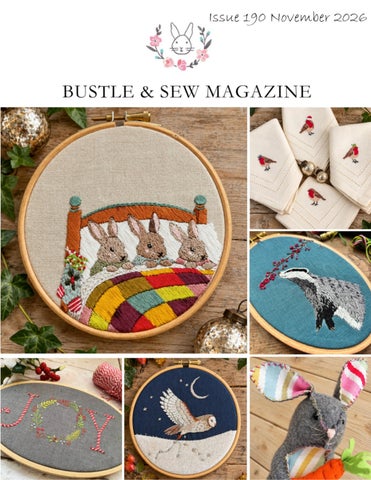
Welcome to the November Magazine November has arrived, bringing with it shorter days, chilly mornings and the last of autumn's colour. Here in the countryside, the trees are shedding their remaining leaves, the hedgerows are looking rather bare and the fields have settled into their winter appearance. There are still splashes of colour to be found though, particularly in the bright berries of holly and hawthorn. As the evenings draw in and the weather becomes less inviting, there's something particularly appealing about settling down indoors with a warm drink and a little stitching. It's still early enough to enjoy making gifts and decorations without feeling too rushed, and this month's patterns have been chosen with the coming season in mind. The Christmas Robin Napkins are just the thing to add a handmade touch to your Christmas table, whilst the Hedgerow Hunter celebrates one of our best-loved woodland creatures. And then there are two winter owl patterns, that I hope you'll enjoy stitching as the days grow colder. So why not put the kettle on and find yourself a comfortable spot to enjoy this month's issue? Christmas will be here before we know it, but for now there's still time to enjoy the last few weeks of autumn and all the pleasures of November. The December edition will be published on Thursday 26 November in four weeks time. Until then… Very best wishes
Helen xx
3
79
Misty mornings and frost at night….
26 41
53
33
46
9
4
November Almanac
5
Scattering Stars Hoop
10
Owl in Winter Hoop
15
Poetry Corner: The Owl
21
The Other Side of the Hoop
22
Chrysanthemums: Autumn Splendour
23
The Trouble with Bulbs
26
Fuzzypeg and his Carrot
28
Time to Sleep
32
Christmas is Coming
33
Lovely Idea: Advent Wreath
37
Christmas Robin Napkins
38
A Cut Above… your Scissors
41
Lovely Idea: Crochet Wreath
45
Fleeces, Fields and Stories
46
Christmas Joy Hoop
50
In the Kitchen: Warm and Cosy
53
Hedgerow Hunter Hoop
62
Brock the Badger
66
Flowers from the Loom
70
Thrifty Stitching
71
Naughty or Nice Bunnies
75
At Autumn’s End
78
Preparing for the Holidays
72
RSN Stitch Bank
82
Kitchen Conversion Table
83
Templates
84
November By November, autumn is well advanced, though winter has not quite taken hold. There may still be surprisingly mild afternoons when a coat feels unnecessary, but equally there can be hard frosts, bitter winds and the occasional early fall of snow. The weather becomes increasingly unpredictable, and a grey morning may suddenly clear into an afternoon of extraordinary brightness, with sunlight shining through the last copper leaves and casting long shadows across the fields. Perhaps the most noticeable change in the landscape during November is the disappearance of leaves. At the beginning of this month some woodlands may still hold magnificent colour. Oaks are often among the last trees to lose their leaves, while beech woods can remain richly copper coloured well into November. A few sheltered trees may hold on even longer. Then
comes a night of strong wind, completely altering the landscape. Leaves lie ankle deep along woodland paths and gather against walls and gates. Once their foliage has fallen, it’s much easier to identify the individual shapes of trees. The oak spreads broad and irregular, its branches twisting into distinctive forms. Beech trees often rise tall and smooth, their grey trunks particularly beautiful in winter light. Silver birches appear delicate and airy, while pollarded willows beside rivers develop their characteristic knobbled silhouettes. Hedgerows change too. What seemed in the summer to be a solid green wall is revealed as a complicated structure built from hawthorn, blackthorn, hazel, dog rose, field maple and countless other plants. Old stems twist together, creating shelter for birds and small
5
mammals throughout the colder months. Beneath the fallen leaves, fungi continue their remarkable work. Although October is the great fungi month, many species remain visible during November if conditions are suitable. Bracket fungi decorate dead wood, tiny mushrooms appear among moss and fallen leaves, and decaying logs support entire communities of organisms. Dead wood is enormously valuable within a woodland. What looks like a fallen branch slowly rotting away may support beetles, fungi, mosses and countless microscopic organisms. Birds search it for insects and small mammals shelter around it. The fallen leaves themselves are gradually broken down by fungi, bacteria and invertebrates. Nutrients are returned to the soil, where they become available once more to growing plants.
November sun is sunlight poured through honey: Old things, in such a light, grow subtle and fine. Bare oaks are like still fire… ~ Conrad Aiken,
6
1915
7
As well as the Scattering Stars owl pattern I thought you might enjoy my Winter Owl design that was published in issue 168 nearly 2 years ago as I think they go rather well together ….. 8
9
The Owl When cats run home and light is come, And dew is cold upon the ground, And the far-off stream is dumb, And the whirring sail goes round, And the whirring sail goes round; Alone and warming his five wits, The white owl in the belfry sits. When merry milkmaids click the latch, And rarely smells the new-mown hay, And the cock hath sung beneath the thatch Twice or thrice his roundelay, Twice or thrice his roundelay; Alone and warming his five wits, The white owl in the belfry sits.
Alfred Lord Tennyson (1809-1892)
10
The Other Side of the Hoop Secure threads and tidy endings….
11
Perhaps, like me, you were taught that embroidery should be as neat on the back as it is on the front? Or maybe you have seen photographs of wonderfully neat reverse sides and wondered why yours doesn’t look like this? It is very easy for this hidden side of our stitching to become a source of unnecessary anxiety.
So, before you begin to stitch, consider how your embroidery will be used. For a decorative piece that will be used for display only, the chief concerns are security, show-through and excess bulk. A few short, well-managed threads behind densely stitched areas are unlikely to cause trouble.
Yet a useful question comes before any judgement about neatness: what does the back of this particular piece need to do? A framed picture, a linen napkin and an embroidered cardigan will all have different requirements.
An unlined napkin or tablecloth will need more attention because both sides will be seen and handled. An embroidered garment may have threads rubbing against clothing or skin, while a bag can expose its reverse to keys, fingers and other contents. If you’re working on a lightweight or pale coloured fabric a dark thread carried across an unstitched area may appear as a faint line on the front, even though the reverse will eventually be covered.
A reasonably tidy reverse does however have several practical serves several practical purposes. It helps your embroidery lie smoothly, reduces the chance of snagging and makes it easier to find your way when changing colours or correcting a mistake. On lightweight fabric, it also prevents unwanted threads from showing through. None of this however requires the reverse to reproduce the picture on the front (contrary to my Grandma’s instructions!) Different stitches leave different structures behind them. A line of stem stitch, an area of satin stitch and a scattering of French knots will each produce their own arrangement of threads underneath. If you’re using a variety of stitches your embroidery design may therefore have a rather busy reverse, even when you’ve been working really carefully. The real test is whether the threads are secure, the fabric sits comfortably and nothing untoward affects the front of your work. It’s perfectly possible to take a real pleasure in making the of your work neat and tidy. If you enjoy this aspect of stitching, there is every reason to take pride in it. The difficulty begins only when neatness becomes a rule applied without regard to the project.
The instruction never to use knots is often regarded as an absolutely unbreakable rule. In practice, a small, secure knot can be perfectly serviceable in some projects, particularly where it will be enclosed and will not create a bump. Problems arise when knots become large, clustered or uncomfortable. Several piled into one small area can prevent the work from lying evenly. On fine fabric, a knot may also be visible through the weave. Knotless starts are useful skills to learn because they give you more choices. One method is to make a few tiny anchoring stitches within an area that will later be covered by embroidery. These need to be secure, but small enough to disappear beneath the finished stitching. You can also use a temporary waste knot on the front to hold the thread while making anchoring stitches nearby. Once the thread is secured, the knot is cut away. The precise placement depends on the stitches and design being worked.
The Trouble with Bulbs Plant the indoor bulbs. Just as I am in the middle of them, Lady Boxe calls. I say, untruthfully, how nice to see her, and beg her to sit down while I just finish the bulbs. Lady B. Makes determined attempt to sit down in armchair where I have already placed two bulb-bowls and the bag of charcoal, is headed off just in time and takes the sofa. Do I know, she asks, how very late it is for indoor bulbs? September really, or even October is the time. Do I know that the only really reliable firm for hyacinths is Somebody of Haarlem? Cannot catch the name of the firm, which is Dutch, but reply Yes I do know, but think it my duty to buy
Empire products. Feel at the time, and still think, that this is an excellent reply. Unfortunately Vicky comes into the drawing room later and says: “O Mummie, are those the bulbs we got at Woolworths?” …......... Finish the bulbs and put them in the cellar. Feel that after all the cellar is probably draughty, change my mind, and take them all up to the attic.
From The Diary of a Provincial Lady, 1930, E M Delafield
13
Take a look at bulb-bowls on returning suitcase to attic, and am inclined to think that it looks as though the cat has been up here. If so, this will be the last straw. Shall tell Lady Boxe that I sent all my bulbs to a sick friend in a nursing home. Consult Cissie about the bulbs, which look very much as though the mice had been at them. She says: Unlimited Watering, and tells me about her own bulbs at Norwich. Am discouraged. Administer Unlimited Water to the bulbs (some of which goes through the attic floor onto the landing below), and move half of them down to the cellar, as Cissie Crabbe says attic is airless.
: On Rose’s advice, bring bulbbowls up from cellar and put them in drawing room. Several of them perfectly visible, but somehow do not look entirely healthy. Rose thinks too much watering. If so Cissie Crabbe entirely to blame. (Mem: Either move bulbbowls upstairs, or tell Ethel to show Lady Boxe into morning room if she calls. Cannot possibly enter into further discussions with her concerning bulbs. Angela looks at bulbs, and says What made me think they would be in flower for Christmas? Do not reply to this. Remove bulb-bowls, with what is left of bulbs to greenhouse. Tell Robert that I hope to do better another year. He replies, Another year, better not waste my money.
15
Time to Sleep In the country even more than in the town it is best to be a hug-the-hearth during November. Except for a few rough-coated young stock the cattle and cart-horses have long ago been brought Into stall and stable. All wild living things have sought shelter ,many are already in a hibernating state. The badger, with eyelids fast shut, is snugly asleep in his sett under the green hill dreaming of succulent pig -nut roots; the hedgehog, rolled up in his leafy den, is in his fancy eagerly afot after slugs and beetles… the dormouse with his tail curled to touch his cold nose, sees in his quaint imagination hazel nuts more in number than he, with nimble forepaws, could have piled up in a lifetime of day-time reality. Llewelyn Powys (1884-1939) from The Twelve Months, 1936
16
Christmas is Coming….
17
This year November brings two special Sundays as we look forward to Christmas time and the festivities ahead. Before the decorations come down from the attic, and before we make the (very short!) Journey to our local Christmas Tree Farm, there is Stir-up Sunday. This is the day when the mixing bowl appears on the kitchen table, dried fruit, spices, sugar and suet are assembled, a sturdy spoon is found, and everyone is invited to lend a hand in making the Christmas pudding. Stir-up Sunday falls on the last Sunday before Advent, which in 2026 is 22 November. Its name comes from the opening words of a prayer in the Book of Common Prayer: “Stir up, we beseech thee, O Lord, the wills of thy faithful people”. The prayer concerns good works rather than good puddings, but its wording became a convenient seasonal reminder to get mixing. Making the pudding ahead of Christmas also allows time for the flavours of a suitable recipe to mature. The best-loved part of the custom is taking turns to stir and making a secret wish. Other traditions suggest stirring from east to west in honour of the journey of the Wise Men, or using thirteen ingredients to represent Christ and the twelve apostles. These are appealing pieces of kitchen folklore, although they should not be mistaken for evidence that a medieval church authority laid down the rules for Christmas pudding. Recipes vary enormously, and a successful pudding definitely doesn’t depend upon counting ingredients or consulting a compass. It is easy to imagine generations of cooks doing precisely the same thing. Yet the pudding itself has changed considerably. The rich dark and often rather solid dessert we recognise today, packed with dried fruit and perhaps brought to the table surrounded by blue flames, is the result of centuries of development. Its story takes us from medieval grains and spiced broths to Victorian cookery books, wartime substitutions and supermarket shelves. Along the way, it has acquired almost as many stories as it contains currants. Accounts of its beginnings frequently start with frumenty, a dish based on cooked wheat. This could be prepared with milk or other liquids and enriched according to the occasion and the household’s resources. Another important part of the background is plum pottage or plum porridge, in which dried fruits and spices appeared alongside meat broth and thickening ingredients. These dishes belonged to a culinary world where the division between sweet and savoury was much less defined than it is in most British kitchens today. Medieval and early modern cooks would have been familiar with combining fruit, spice and meat, while boiled puddings developed their own methods and ingredients. The modern Christmas pudding emerged from this broader cooking tradition. The name “plum pudding” can also cause confusion, particularly for anyone expecting to find fresh garden plums inside it. In older culinary usage, “plum” could refer to raisins or other dried fruits, so a plum pudding did not necessarily contain the fruit we now associate with the word. This explains why the old name continued to be used for a pudding crowded with raisins and currants. The language preserved a connection with earlier cooking even as recipes and expectations changed.
19
A Cut Above… A (very) Little Guide to your Scissors
20
Fleeces, Fields and Stories A (very) little look at British Sheep,
21
Winter is on the way, and like me, I expect many of you have been taking out your winter woollies, ready for the colder days ahead. Today many jumpers are made from acrylic or other man-made fibres, but I must admit I still favour woollen jumpers as I feel they’re superior in both warmth and resilient in wear - as long as those pesky moths haven’t eaten holes them over the summer months that is! Britain’s sheep produce an extraordinary range of fleeces. British Wool, the organisation that collects, grades and markets wool on behalf of its farmer members, identifies more than sixty breeds in Britain, each contributing to the diversity of the wool available. A fleece suitable for a soft scarf may be quite different from one destined for an upholstery fabric or a durable carpet. The breed names themselves such as. Wensleydale, Lincoln Longwool, Bluefaced Leicester and Herdwick seem as much at home on a map as on a yarn label. Some sheep produce long, lustrous fibres; others give wool with a more robust character. Bluefaced Leicester is valued for comparatively fine, soft wool, while Herdwick wool is associated with toughness and durability. Many breeds now outside their places of origin, but nonetheless, looking at their original homes is a good way to understand why British wool offers such different materials. The Herdwick is perhaps the clearest example. Closely associated with the Lake District, this hardy sheep belongs to a landscape of steep fells, exposed grazing and frequent rain. Its distinctive grey fleece has a coarse, robust character, often containing kemp, the brittle white fibres that remain conspicuous among the wool. It would be an unlikely first choice for a delicate scarf, but makes useful material for carpets and other demanding applications. Herdwick wool is also used in building insulation, giving a practical modern
purpose to a traditional local resource. Herdwicks are famous for being hefted, or heafed, to particular areas of fell. This is a learned attachment to a home grazing territory, encouraged and maintained within the flock, rather than simply a matter of sheep wandering wherever they please. It helps explain why protecting a fell flock involves preserving knowledge as well as animals. Further north, the small sheep of Shetland belong to an island landscape where wool has long supported remarkable knitting skills. With careful selection and preparation, their finer fibres can be spun into very fine yarn. Shetland fine lace knitting, developed from in Victorian times, demonstrates how a a relatively coarse animal fibre can become something extraordinarily delicate. Shawls and scarves combine warmth with openwork patterns that seem almost too light to have begun as a fleece. Shetland wool is also associated with patterned knitting. Its natural colours and the skill of local knitters offer a different kind of beauty from the long, glossy locks of a lustre breed. The Wensleydale belongs to a different wool family altogether. Developed in North Yorkshire during the nineteenth century, it produces long, curly locks with a pronounced lustre. Its breeding history can be traced to a notable ram called Bluecap, born in 1839. Wensleydale wool is used for handknitting yarn and some upholstery yarns. Its sheen and length offer effects quite different from a short, springy fleece. Lustre, however, should not be confused with fineness: a fibre can look beautifully silky while still feeling more substantial than the softest knitting wool.
Warm and Cosy…
23
November brings a noticeable change to the way we cook and eat. The clocks went back at the end of October and now the days are shorter, the weather is colder and we crave warming, substantial meals rather than the lighter dishes we enjoyed through the summer. The last of the autumn harvest has been gathered, and the vegetables and fruits available now are those that will see us through the winter months. It is a good time for soups, casseroles, pies and traditional puddings, as well as making a start on some of the preparations for Christmas. Root vegetables are particularly important in November cooking. Carrots, parsnips, swedes, turnips and beetroot are all readily available and lend themselves to a wide range of dishes. Roasting brings out their natural sweetness, while slow cooking makes them ideal for soups, stews and casseroles. Parsnips are especially good at this time of year, becoming sweeter after the first frosts, and they are just as useful in a creamy soup as they are roasted alongside a Sunday joint. Cabbages, Brussels sprouts, kale and other members of the brassica family also come into their own during November. Leeks are another particularly useful November vegetable. Their mild onion flavour makes them suitable for everything from simple soups to savoury pies, gratins and casseroles. Combined with potatoes, they make one of the most familiar and comforting soups of the season, while leeks cooked slowly with butter and
a little cream are a delicious accompaniment to fish or chicken. There is still plenty of British fruit to enjoy during November, especially apples and pears from varieties that store well. Apples remain one of the most versatile ingredients in the autumn kitchen, equally at home in savoury dishes and sweet puddings. Apple crumble, baked apples and traditional apple cakes are all particularly welcome as the weather grows colder. Pears can be poached, baked or added to cakes, while dried fruits begin to play a more important role as preparations for Christmas get underway. November is, of course, the month when many of us begin thinking seriously about Christmas cooking. Traditionally, Stir-up Sunday falls on the last Sunday before Advent and is associated with making the Christmas pudding, allowing several weeks for its flavours to develop. Christmas cakes, mincemeat and homemade chutneys are also often prepared during November, ready to be enjoyed or given as gifts in December. There is something satisfying about getting these jobs done early, particularly when the kitchen is warm and the weather outside is anything but inviting The recipes in this issue reflect the changing season, with an emphasis on warming dishes, traditional favourites and ingredients that are readily available in November.
Parsnip and Apple Soup Ingredients ● 4 eating apples ● 1 tbsp olive oil ● knob of butter ● 1 onion, diced ● 500g parsnips, peeled and chopped ● 2 garlic cloves, peeled and diced ● 1 tbsp mild curry powder ● 700ml vegetable stock ● 4 tsp soured cream ● fresh chives, snipped
Method ● Preheat the oven to gas 1/2, 130°C, fan 110°C. ● Slice 2 apples as thinly as you can horizontally. Remove any seeds, then arrange on a baking tray lined with nonstick baking paper. Bake for 1 1/2 hours, or until dried out; leave to cool. ● Meanwhile, heat the oil and butter in a heavy-bottomed pan, add the onion and parsnips; cover and cook gently for 10 minutes. ● Chop the remaining apples and add to the pan with the garlic. Cook, covered, for 5–10 minutes. Stir in the curry powder and cook for 30 seconds. ● Add the stock and 100ml (3 1/2fl oz) water. Simmer, uncovered, for 10 minutes. ● Using a blender, whizz the soup until smooth. ● Divide between 4 bowls, top each with 1 tsp soured cream, some chives, a few apple crisps and a twist of black pepper.
26
Beneath the Hedgerow The Badger: Fact, Folklore and Traditon
27
In the past badgers were sometimes credited with properties that went far beyond their actual natural history. Parts of animals were historically carried as charms throughout Europe, and the badger was included in this tradition. Badger hair, teeth, skin and other parts were sometimes believed to possess protective or medicinal properties. Badger hair also had practical uses. It became particularly well known for use in shaving brushes, while badger-hair brushes have also been used by artists and crafts people. Not every aspect of the badger's relationship with people is pleasant however. For centuries badgers were hunted and persecuted. One of the cruellest activities associated with them was badger baiting. A captured badger was placed in an enclosed space and dogs were encouraged to attack it. The badger's strength and ability to defend itself were precisely what made the practice attractive to those who participated. This activity also gave the English language the verb "to badger", meaning to pester or repeatedly harass someone. Badger baiting was prohibited in Britain in the nineteenth century, but illegal persecution did not disappear completely.
Changing attitudes towards wildlife during the twentieth century eventually resulted in much stronger legal protection. Today badgers and their setts are protected by law in Britain, although the animal remains at the centre of continuing debates about agriculture and bovine tuberculosis. One of the most famous fictional badgers is Mr Badger in Kenneth Grahame's The Wind in the Willows, first published in 1908. Grahame makes clever use of genuine badger characteristics when creating his character. Mr Badger lives underground in the Wild Wood. He values privacy, dislikes unnecessary socialising and is physically imposing. At the same time, he is dependable, practical and hospitable towards his friends. When Rat and Mole become lost in the Wild Wood during winter, they eventually arrive at Badger's underground home. What they find is comfortable, well established and secure.The description reflects something of the real animal's attachment to its sett. Grahame's badger has helped to shape the popular image of the animal as solid, independent and rather serious.
Thrifty Stitching A little goes a long way….
29
30
Autumn drew shiveringly to its end. One day something seemed to be gone from the gardens; the tenderer leaves of vegetables had shrunk under the first smart frost, and hung like faded linen rags; then the forest leaves, which had been descending at leisure, descended in haste and in multitudes, and all the golden colours that had hung overhead were now crowded together in a degraded mass underfoot, where the fallen myriads got redder and hornier, and curled themselves up to rot. Thomas Hardy, from The Woodlanders, 1887
31
Preparing for the holidays….. “Christmas is coming, The geese are getting fat. Please to put a penny In the old man’s hat!”
And there are lots of other things you can put in hand now to make December just that little bit easier and less stressed.
32
The Royal School of Needlework was founded in 1872 with a mission to preserve the art of hand embroidery. To mark its 150th anniversary the RSN launched the RSN Stitch Bank to continue this mission. The RSN Stitch Bank aims to digitally conserve and showcase the wide variety of the world’s embroidery stitches and the ways in which they have been used in different cultures and times. The RSN Stitch Bank is an ongoing project and new stitches are added regularly. The RSN will be working with partners around the world to include stitches from different traditions.
Every year we lose historic textiles through wear, age, and the more aggressive routes of war, neglect and destruction. We know that stitches from history have been lost because they fall out of use. Then, when an older embroidered piece is discovered, curators and museum staff cannot recognise the stitches. Textiles and the knowledge of stitches throughout the world continue to be threatened by wars and other disturbances, as well as changes in manufacturing processes. Stitchers can use the RSN Stitch Bank to find a new stitch to use in a project and learn how to make it using videos, written instructions, illustrations and photographs for each stitch. Researchers, curators, historians and students can use the site to learn about the use, structure and history of each stitch in a range of embroidery techniques and to identify a stitch on a textile. You can browse the stitch wall here You can also create your own folder and save the stitches you are most interested in. It is all completely free and an amazing resource for stitchers!
33
34
Templates