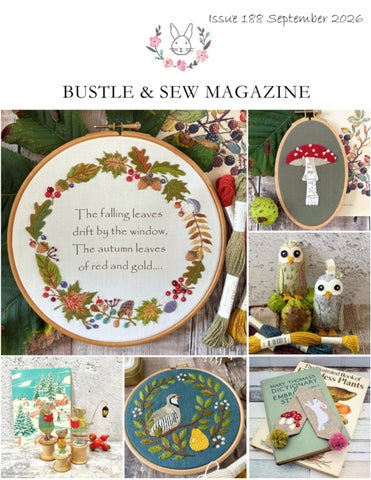
1
A Bustle & Sew Publication Copyright © Bustle & Sew Limited 2026 The right of Helen Grimes to be identified as the author of this work has been asserted in accordance with the Copyright, Designs and Patents Act 1988. All rights reserved. No part of this publication may be reproduced, stored in a retrieval system or transmitted in any form, or by any means, without the prior written permission of the author, nor be otherwise circulated in any form of binding or cover other than that in which it is published and without a similar condition being imposed on the subsequent purchaser. Every effort has been made to ensure that all the information in this book is accurate. However, due to differing conditions, tools and individual skills, the publisher cannot be responsible for any injuries, losses and other damages that may result from the use of the information in this book.
First published 2026 by: Bustle & Sew Station House West Cranmore Shepton Mallet BA4 4QP www.bustleandsew.com
2
Welcome to the September Magazine September is, to me, a month poised between two seasons. There are still warm, golden afternoons to enjoy, but the mornings are cooler, the evenings are drawing in fast and there’s an unmistakable sense of autumn arriving in the countryside. Leaves are starting to turn, hedgerows are heavy with berries and it feels just the right time to think about our autumn and Christmas projects This month’s magazine has plenty to enjoy as we move into the new season. We take a look at botanical dyes and the wonderful colours that can be created from plants, and take a look at the different types of sewing machine needles. There’s also a fascinating glimpse into stitching on the Home Front during the Second World War, when knitting, sewing, crochet and embroidery were shaped by necessity, ingenuity and the restrictions and shortages of wartime life. September’s patterns have a distinctly autumnal feel , including a cheerful scarlet toadstool and a design inspired by autumn leaves, perfect for welcoming the changing season. And, as always, there’s a visit to the kitchen, where this month’s recipe section celebrates some of the wonderful seasonal ingredients and comforting flavours of early autumn. I hope you’ll enjoy this September edition and find plenty to inspire you as summer gives way to autumn. The October edition will be published on Thursday 24 September. So until then… Very best wishes
Helen xx 3
5
Those autumn leaves….
26 60 14
5
64
26 48 4
September Almanac
5
Those Autumn Leaves Hoop
10
Woven into Words
14
Let’s look at Sewing Machine needles
19
Carol Singing Bobbin Mice
21
From Hedgerow to Dye Pot
26
The Tawny Owl
34
Felt Owl Ornaments
35
Lovely Idea: Fabric Flower Seed Heads
38
Stitching on the Home Front
39
Spotted Toadstool Hoop
45
In the Kitchen: Harvest Home
48
Partridge and a Pear Hoop
57
The Feast of Michaelmas
60
Lovely Idea: Map Luminaries
63
Preserving Natures’ Bounty
64
Pompom Book Marks
69
Poetry Corner: A Church Mouse
72
September in the Countryside
73
RSN Stitch Bank
74
Kitchen Conversion Table
75
Templates
76
September
By early September the frantic energy of midsummer has faded. The busiest holiday weeks are over, village life settles into a familiar rhythm once more, as clubs and societies return after the summer break and the familiar chatter and laughter of children on their way to school can be heard the other side of the hedgerow. All around our house, the landscape has transformed into a tapestry of mellow colours. Harvested fields stretch across the countryside in shades of honey and gold, their neat rows of stubble glowing in the low afternoon sunshine. Here and there enormous round bales of straw rest quietly in the fields like giant sculptures, becoming temporary landmarks that seem almost as
much a part of September as blackberries and falling leaves. The light itself has begun to change. Although the days are still longer that the nights, at least at the beginning of the month that is, the sun sits a little lower in the sky, casting longer shadows across meadows and village greens. Early mornings often begin beneath a veil of mist that hangs above rivers and low lying fields before slowly dissolving in the warmth of the rising sun. The hedgerows, which only weeks before were bright with flowers, now overflow with fruit and berries. Glossy blackberries cluster among thorny brambles, while scarlet rose hips brighten the greenery with vivid splashes of colour. 5
Elderberries hang in heavy purple black bunches, attracting flocks of birds that feast upon their rich harvest, and hazel trees begin to offer their first ripening nuts to squirrels, jays and patient walkers alike. Blackberry pickers can often be spotted along the wayside during September, their fingers stained deep purple, arms and sometimes legs bearing scratches from determined brambles, and conversations drifting lazily as each particularly generous bush is discovered. Once home, the berries become crumbles, pies, jams and jars of richly coloured blackberry jelly that capture the flavour of the countryside long after the season has passed.
“There’s a whisper down the field where the year has shot her yield And the ricks stand grey to the sun Singing: “Over then, come over, for the bee has quit the clover, And your English summer’s done.” Rudyard Kipling The Long Trail, 1892
6
7
Woven into Words… A (very) little look at Textiles and Threads in Language, Myths, Fairy Tales and Novels
8
The Three Fates, 1910 canvas print by Alexander Rothaug
Until I was thinking about writing this article I can honestly say that I’d never really noticed how in how many similes we still use cloth thread. We spin a yarn, weave a tale, follow a thread of thought, unravel a mystery and tie together loose ends. We become tangled in complicated situations, mend broken relationships and stitch our lives back together after difficult times. Even today, in an age of computers and instant communication, the language of cloth and thread remains woven into the way we describe our world. This shouldn’t really surprise us though as for millennia making cloth has been one of humanity's most important skills. Long before writing became widespread, every community depended upon spinning, weaving, sewing and mending. Textiles were as essential as food and shelter, and the people who created them possessed incredibly valuable knowledge. Thread could literally mean survival. A broken loom, an empty spindle or worn-out clothing represented hardship, while a well-stocked linen chest promised comfort, prosperity and security. Over centuries these activities have found their way into myths, fairy tales, poetry and novels, becoming symbols of destiny, patience, love, memory and endurance.
Long before books became commonplace, stories were passed from one generation to another around fires and within family homes. The women who spun wool or flax often became the guardians of these tales. While hands worked steadily at the spindle, voices carried memories of ancestors, legends, warnings and songs. Many historians believe this close association between spinning and storytelling developed simply because spinning required concentration but not constant attention. Unlike weaving, which demanded careful counting and observation, spinning allowed conversation to flow naturally. Winter evenings were often spent with neighbours gathered together for communal spinning, creating opportunities for stories to grow richer with each telling. It is no coincidence that some of the oldest words associated with storytelling also relate to thread. The Old English word spin referred not only to twisting fibres but also gradually came to mean inventing or extending a story. We may still be accused of "spinning a yarn" if we tell a slightly suspect or rather over-exaggerated tale! Among the oldest textile symbols is the idea that human life itself resembles a length of thread.
10
From Hedgerow to Dye Pot
September is the month when the countryside around us changes from late summer’s dusty greens to a glowing kaleidoscope of autumn hues - reds, golds, ochres and rusts. And so, as colour is all around us this month, I thought this would be a good time to take a look at botanical dyes…. Long before colour could be ordered in a packet or selected from a shade card, the dyer’s palette began in the landscape. Roots were dug from the ground, leaves gathered from fields and gardens, bark stripped from fallen branches and flowers harvested at just the right moment. These materials were soaked, crushed, fermented or simmered until their colour passed into water and, from there, into wool, linen or silk. The colours produced by botanical dyes were not necessarily the pale, muddy shades we sometimes associate with natural dyeing today. Experienced dyers created brilliant yellows, deep reds, strong blues, warm browns, greens, purples and near-blacks. Some colours were grown in Britain, while others arrived through increasingly extensive trade networks. The colour of a length of cloth could reveal not only the plants used to
dye it, but the wealth of its owner, the knowledge of the dyer and their connections with the wider world. Plant dyeing has been practised for thousands of years. The basic method remains unchanged. Colour is extracted from plant material, usually with water and heat, and transferred to a fibre. Many dyes also require a mordant, traditionally a metallic salt such as alum or iron, which helps the colour attach to the fibre and can alter the resulting shade. The word “mordant” comes from the Latin , meaning “to bite”, an appealingly vivid description of the mordant helping the colour take hold. Yet botanical dyeing isn’t formulaic or process driven. The same plant may produce different results according to where it grew, when it was gathered, the part of the plant used and the mineral content of the water. The fibre, mordant, temperature and length of time in the dye bath all have an effect. A plant that gives golden yellow on wool might produce a quieter beige on linen. The addition of iron could turn a bright colour grey, green or brown. One dye bath might yield several shades as successive pieces of cloth exhaust the remaining colour.
Nature Notes: The Tawny Owl The tawny owl is our most widespread owl, yet it is far more often heard than seen. Its familiar night-time call is actually a duet: the male usually gives the long, wavering “hoo-hoo”, while the female answers with a sharper “ke-wick” which together produce the classic “twit-twoo” associated with owls in folklore. Tawny owls are remarkably faithful to their territories, often remaining in the same patch of woodland for many years, and pairs may stay together for life. Unlike the barn owl the tawny owl Unlike the barn owl the tawny owl does build a nest, and prefers to do so in holes in trees. They roost during the day time, and take to the wing to hunt mainly at dawn and dusk. Their extraordinarily sensitive hearing allows them to locate small mammals moving through leaf litter in almost complete darkness, while the soft, fringed edges of their flight feathers break up the turbulence of the air, enabling them to swoop upon their prey with remarkably little sound. Ted loves to “talk” with the tawny owls that live in the thicket near us. On mild autumn evenings he will sit on the patio, answering the “ke-wick” of the females with his own deep and booming “woo-woo-woo!”
13
14
Stitching on the Home Front
16
Harvest Home…
17
September is an interesting month in the kitchen. Summer has not quite disappeared, but the first signs of autumn are beginning to make themselves felt. There are still tomatoes, courgettes and beans to enjoy, while apples, pears, plums, squash and other early autumn produce are starting to arrive. It is a month when the choice of seasonal ingredients is particularly good, with the last of the summer harvest appearing alongside the first of the foods we associate with cooler days. The countryside is changing too. Cereal fields have largely been harvested, orchards are heavy with fruit and hedgerows are filling with blackberries, rosehips, elderberries and sloes. In gardens and allotments there is plenty of work still to be done, with beans to pick, potatoes to lift and tomatoes to gather before the weather becomes cooler. September has always been an important month in the farming calendar, and even today there is a strong sense of harvest about these few weeks. For the cook, this means there is an unusually wide range of fresh ingredients available. Runner beans and French beans can continue cropping well into the month, while courgettes and tomatoes often remain plentiful. Sweetcorn is particularly good at this time of year, as are beetroot, carrots, onions and potatoes. At the same time, pumpkins and squashes begin to appear, bringing with them the richer flavours that will become more familiar as autumn progresses.
September is also one of the best months for British fruit. Apples are perhaps the most obvious example, with many traditional varieties ripening throughout the month. Some are best eaten straight from the tree, while others are perfect for pies, crumbles, cakes and sauces. Pears and plums are plentiful too, and damsons, with their distinctive sharp flavour, are excellent for jams, preserves and puddings. As the evenings become cooler, our cooking naturally begins to change. The salads and lighter dishes of midsummer gradually give way to soups, pies, casseroles and dishes straight from the oven. There is no need to rush towards winter food just yet, though. September is a month for combining the two seasons, perhaps serving roasted vegetables with a fresh salad, making a tomato soup with the last of the summer crop, or turning newly harvested apples into a simple cake to enjoy with an afternoon cup of tea. It is also a useful month for preserving. A glut of tomatoes can be turned into sauces and chutneys, while excess beans can be frozen and fruit made into jams, jellies and compotes. Pickles and chutneys are particularly satisfying to make at this time of year, using up vegetables that might otherwise go to waste and filling the cupboard with jars to enjoy during the winter. There is something very practical about this traditional approach to seasonal cooking: enjoy what you can while it is fresh and save some of the surplus for later.
Medlars Although little known today, and rarely available commercially, medlars have been cultivated for more than three millennia. They probably originated along the west coast of the Caspian Sea, but leaf impressions have been found in the rocks of Eastern Germany so they may be one of the ancient trees of Europe. Medlars were popular with the Greeks and later the Romans, who probably introduced them to this country. In the Middle Ages they were regarded as a treat because they ripened late in the season when not much else was available, and were included in most walled monastery gardens. , comes from the Their Latin name, Greek meaning half and meaning ball. This refers to theshape of the fruits which rather resemble large squashed-looking rosehips. Their shape also earned them the ruder common names of “open arse” or “openars” in England and in France. Unless you’re going to make jelly with them, medlars need to be “bletted” or stored to overripen before you eat them. This comes from the french term which refers to the resulting bruised appearance.
Now will he sit under a medlar tree And wish his mistress were that kind of fruit As maids call medlars when they laugh alone O Romeo, that she were, O that she were An open-arse and though a poperin pear!
William Shakespeare Romeo and Juliet Act 2, Scene 1 Lines 34-39
Pears Poached in Red Wine Ingredients ● 1 vanilla pod ● 1 bottle red wine ● 225g caster sugar ● 1 cinnamon stick halved ● fresh thyme sprig, plus sprigs to serve ● 6 pears peeled, but kept whole with stalk intact ●
Method ● Halve the vanilla pod lengthways, scrape out the black seeds and put in a large saucepan with the wine, sugar, cinnamon and thyme. Cut each piece of pod into three long thin strips, add to pan, then lower in the pears. ● Poach the pears, covered, for 20-30 mins, making sure they are covered in the wine. The cooking time will very much depend on the ripeness of your pears – they should be tender all the way through when pierced with a cocktail stick. You can make these up to 2 days ahead and chill. ● Take the pears from the pan, then boil the liquid to reduce it by half so that it’s syrupy. Serve each pear with the cooled syrup, a strip of vanilla, a piece of cinnamon and a small thyme sprig.
Blackberry and Apple Loaf Cake Ingredients ● butter, for the tin ● 250g self-raising flour ● 175g butter ● 175g light muscovado sugar ● ½ tsp cinnamon ● 2 rounded tbsp demerara sugar ● 1 small eating apple such as Cox’s, quartered (not cored or peeled) ● 2 large eggs. beaten ● 1 orange finely grated zest ● 1 tsp baking powder ● 225g blackberries
Method ● Preheat the oven to 180C/gas 4/fan 160C. Butter and line the bottom of a 1.7 litre (2lb) loaf tin. ● In a large bowl, rub the flour, butter and muscovado sugar together with your fingers to make fine crumbs. Measure out 5 level tbsp of this mixture into a small bowl for the topping, and mix in to it the cinnamon and demerara sugar. Set aside. ● Coarsely grate the apple down to the core and mix in with the eggs and the zest. Stir the baking powder into the rubbed-in mixture in the large bowl, then quickly and lightly stir in the egg mixture until it drops lightly from the spoon. Don’t over mix. ● Gently fold in three quarters of the berries with a metal spoon, trying not to break them up. Spoon into the tin and level. Scatter the rest of the berries on top. Sprinkle over the topping and bake for 1¼ -1 hour 20 minutes. Check after 50 minutes and cover loosely with foil if it is browning too much. When done the cake will feel firm, but test with a skewer. ● Leave in the tin for 30 minutes before turning out, then cool on a wire rack. Peel off the paper before cutting. Will keep wrapped in foil or in a tin for up to 2 days.
22
The Feast of Michaelmas
23
Lovely Idea: Map Luminary Bags
With the convenience of flameless tea lights, simply grab the remote, and "voila"—your room is instantly bathed in the golden glow of a candle-like ambience, thanks to these easy DIY paper bag luminaries.
Free from Claire at PillarBox Blue: Paper Lantern Luminary Bags 24
Preserving Nature’s Bounty…
25
Diary of a Church Mouse For me the only feast at all Is Autumn’s Harvest Festival, When I can satisfy my want With ears of corn around the font. I climb the eagle’s brazen head To burrow through a loaf of bread. I scramble up the pulpit stair And gnaw the marrows hanging there. It is enjoyable to taste These items, ere they go to waste.
Extract from the poem by John Betjeman (1906-1984)
26
The Countryside in September September of the Summer Equinox, her gardens cartwheeled with gossamer where the fat spiders, striped like tigers, wait for their nectar-seeking prey. September of the bush-rose turning on the slow, cool lamplight of the second bloom; September of the thin blue skies, slow of assertion after the morning mist; September of late holidays, blackberries, bracken turning and heather upon the moors. Last village cricket matches are played and the stumps drawn for the last time of a long-shadowed windless evening, the pavilion doors are closed, and that is that for six long months to come. How the evenings draw in! And in the village you notice it now, since on fine evenings how short a time there is of daylight for the children to appear about the green and upon the bridges between their return from school and the drawing of the home curtains. Harvest is home and the land lies shorn and tailored under the pale blue skies. The swallows and the martins crowd the wires, filling the air with their busy twitterings of departure. The striped wasps gorge among the windfalls. The blackberries at their most flavoursome are ripe in the hedgerows and all about the sweet and sticky ivy-bloom the insects gather for their annual feasting. Slowly the leaves deaden and darken on the trees, and the long orchard grass where the windfall apples lie will not dry again until the winds of March. The Autumn Show - what a firework display of fruit and flowers this is, what a plump display of bottled fruit, and jam, and country wine; what a testimony to the busy months gone by. It is the best show of all the year. Now, though there will be warm corners yet in the garden for many a day to come, we realise summer is over and gone. True the yellow sunflower still shakes her coronet and the late rose blooms and the brave lines of the dahlias stand forth against the coming frost in all the gaudy assortment of their regimental plumes. Yet the plough has passed where the corn was ripe, and now only the solitary swallow flits silently around the grain-stacked barn. Very quietly the last warm days of the month die down towards the awakening of October’s evening owls.
C Gordon-Glover Extract from 1953
40
27
The Royal School of Needlework was founded in 1872 with a mission to preserve the art of hand embroidery. To mark its 150th anniversary the RSN launched the RSN Stitch Bank to continue this mission. The RSN Stitch Bank aims to digitally conserve and showcase the wide variety of the world’s embroidery stitches and the ways in which they have been used in different cultures and times. The RSN Stitch Bank is an ongoing project and new stitches are added regularly. The RSN will be working with partners around the world to include stitches from different traditions.
Every year we lose historic textiles through wear, age, and the more aggressive routes of war, neglect and destruction. We know that stitches from history have been lost because they fall out of use. Then, when an older embroidered piece is discovered, curators and museum staff cannot recognise the stitches. Textiles and the knowledge of stitches throughout the world continue to be threatened by wars and other disturbances, as well as changes in manufacturing processes. Stitchers can use the RSN Stitch Bank to find a new stitch to use in a project and learn how to make it using videos, written instructions, illustrations and photographs for each stitch. Researchers, curators, historians and students can use the site to learn about the use, structure and history of each stitch in a range of embroidery techniques and to identify a stitch on a textile. You can browse the stitch wall here You can also create your own folder and save the stitches you are most interested in. It is all completely free and an amazing resource for stitchers!
28
29
Templates